
I did an article on the Messianic prophecies in Isaiah. But there is a lot more than that in Isaiah. I will focus on some of the great lessons and verses in Isaiah in this article.
- THE HYPOCRITICAL WORSHIP OF JUDAH
Isaiah 1:11 “What are your multiplied sacrifices to Me?”
Says the Lord.
“I have had enough of burnt offerings of rams
And the fat of fed cattle;
And I take no pleasure in the blood of bulls, lambs or goats.
12 “When you come to appear before Me,
Who requires of you this trampling of My courts?
13 “Bring your worthless offerings no longer,
Incense is an abomination to Me.
New moon and sabbath, the calling of assemblies—
I cannot endure iniquity and the solemn assembly.
14 “I hate your new moon festivals and your appointed feasts,
They have become a burden to Me;
I am weary of bearing them.
15 “So when you spread out your hands in prayer,
I will hide My eyes from you;
Yes, even though you multiply prayers,
I will not listen.
Your hands are covered with blood.
16 “Wash yourselves, make yourselves clean;
Remove the evil of your deeds from My sight.
Cease to do evil,
17 Learn to do good;
Seek justice,
Reprove the ruthless,
[g]Defend the orphan,
Plead for the widow. 18 “Come now, and let us reason together,”
Says the Lord,
“Though your sins are as scarlet,
They will be as white as snow;
Though they are red like crimson,
They will be like wool.
19 “If you consent and obey,
You will eat the best of the land;
20 “But if you refuse and rebel,
You will be devoured by the sword.”
Truly, the mouth of the Lord has spoken.
21 How the faithful city has become a harlot,
She who was full of justice!
Righteousness once lodged in her,
But now murderers.
22 Your silver has become dross,
Your drink diluted with water.
23 Your rulers are rebels
And companions of thieves;
Everyone loves a bribe
And chases after rewards.
They do not defend the orphan,
Nor does the widow’s plea come before them.
This passage speaks for itself against hypocritical religion. They were offering sacrifices, praying, and keeping the sabbath, but they were oppressing or neglecting the poor, the widows, and the orphans. They were not treating people fairly and the land was full of violence. The acid test of true Christianity is not how many times we go to church or how much money we put in the collection plate. It is how we treat our fellow man, how we take care of the poor, the widows, and the orphans. It is how we try to stop the ruthless who are oppressing others. As James 1:27 says, “pure and undefiled religion is to visit the widows and orphans in their distress”.
2. THE WOMEN OF JUDAH JUDGED
Isaiah 3:16 Moreover, the Lord said, “Because the daughters of Zion are proud
And walk with heads held high and seductive eyes,
And go along with mincing steps
And tinkle the bangles on their feet,
17 Therefore the Lord will afflict the scalp of the daughters of Zion with scabs,
And the Lord will make their foreheads bare.”
18 In that day the Lord will take away the beauty of their anklets, headbands, crescent ornaments, 19 dangling earrings, bracelets, veils, 20 headdresses, ankle chains, sashes, perfume boxes, amulets, 21 finger rings, nose rings, 22 festal robes, outer tunics, cloaks, money purses, 23 hand mirrors, undergarments, turbans and veils.
24 Now it will come about that instead of sweet perfume there will be putrefaction;
Instead of a belt, a rope;
Instead of well-set hair, a plucked-out scalp;
Instead of fine clothes, a donning of sackcloth;
And branding instead of beauty.
25 Your men will fall by the sword
And your mighty ones in battle.
26 And her gates will lament and mourn,
And deserted she will sit on the ground.
Why does Isaiah attack the women of Judah? That is pretty obvious from reading this section. The women were extremely worldly and excessive in their clothing, accessories, hair, and appearance. No doubt they treated poor women with contempt and took advantage of them. In the mission work I have been involved in, it has always been that the women of the church are the heart and soul of the church. Yes, they can also be the source of slander, gossip, and contention. Paul mentioned 2 women in Philippians 4 who apparently were having conflict. Some of the Corinthian church women were apparently misusing their gifts to try to take over leadership from the men. He tells Timothy to not let the women usurp authority over the men. But in my experience, godly, humble women have always been the heart and soul of the church. The men are often focused on their jobs, as they should be as the main providers in the home. They deal with the stress of the workplace, although more and more women have to deal with that same stress (which btw probably hurts the spirituality of the home and church). It is the older women who are teaching the younger women to love their husbands and children (Titus 2). Paul has some specific instructions about widows and younger women in 1 Timothy 5: 9 A widow is to be put on the list only if she is not less than sixty years old, having been the wife of one man, 10 having a reputation for good works; and if she has brought up children, if she has shown hospitality to strangers, if she has washed the saints’ feet, if she has assisted those in distress, and if she has devoted herself to every good work. 11 But refuse to put younger widows on the list, for when they feel sensual desires in disregard of Christ, they want to get married, 12 thus incurring condemnation, because they have set aside their previous pledge. 13 At the same time they also learn to be idle, as they go around from house to house; and not merely idle, but also gossips and busybodies, talking about things not proper to mention. 14 Therefore, I want younger widows to get married, bear children, keep house, and give the enemy no occasion for reproach; 15 for some have already turned aside to follow Satan. 16 If any woman who is a believer has dependent widows, she must assist them and the church must not be burdened, so that it may assist those who are widows indeed.” Paul also warns godly women about being too concerned about their clothes and outward appearance in 1 Timothy 2: 9 Likewise, I want women to adorn themselves with proper clothing, modestly and discreetly, not with braided hair and gold or pearls or costly garments, 10 but rather by means of good works, as is proper for women making a claim to godliness. Peter has similar comments in 1 Peter 3: 3 Your adornment must not be merely external—braiding the hair, and wearing gold jewelry, or putting on dresses; 4 but let it be the hidden person of the heart, with the imperishable quality of a gentle and quiet spirit, which is precious in the sight of God.” Television ads and women being in the workplace has made many women focus on their appearance and clothing. In the U.S., one study showed that the average women spends $125,000 on clothing, handbags, accessories in her lifetime, and the figure is $200,000 for women under the age of 25. Older women were not raised on the emphasis on appearance that younger women are today. 2 out of every 5 women said they reapply their makeup up to 5 times a day. And yet 3 out of every 5 said they couldn’t find anything suitable to wear in their wardrobe. Another study showed that the average women spends over $300 per month on beauty products, hair treatments, or “beauty experiences” like facials, manicures, tanning, and pedicures. I imagine that amount is the same for church women as well as non-church women. Yes, I want my wife and women in the church to take care of their personal appearance, but aren’t we going to the same extremes as in Isaiah? Yes, I know that men have their bad spending habits and are often overly concerned about their clothing and appearance, but Isaiah focuses on the women in Israel as I am focusing on the women in the church. BTW those surveys I mentioned sound unrealistic but still accurately reflect trends among most women. The godly woman in Proverbs 31 is still the example for all women to follow. Stop and read that chapter again before you read on.
3. THE “WOES” TO THE WICKED
From Marlene Ellis
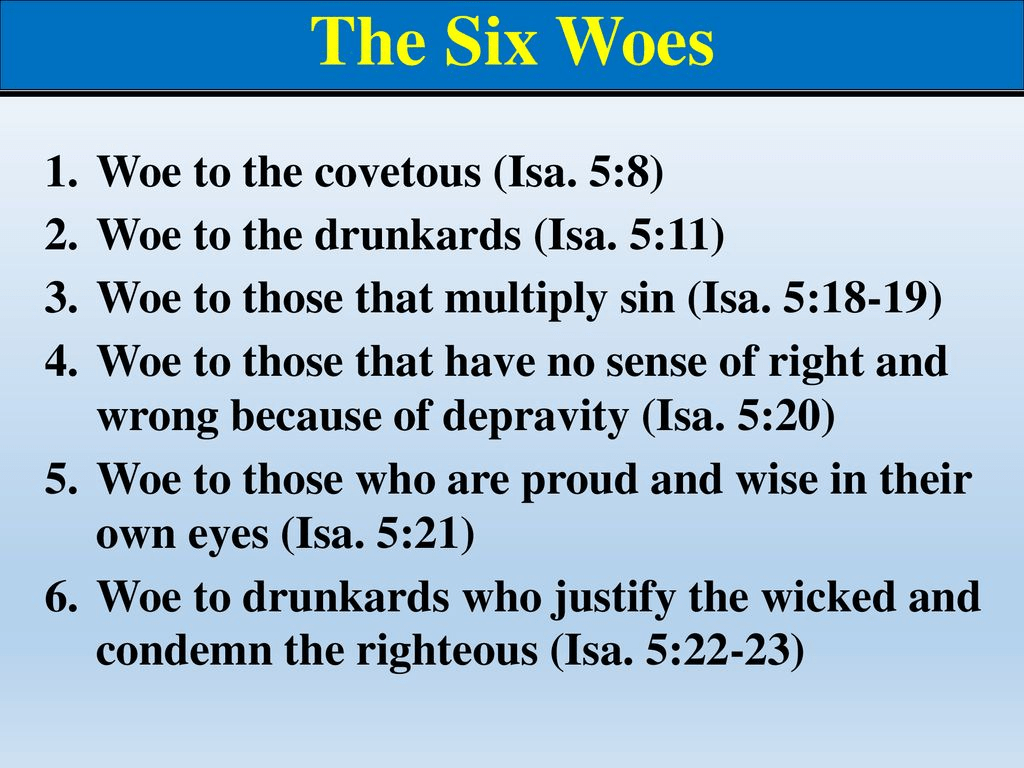
Isaiah 5:8 Woe to those who add house to house and join field to field,
Until there is no more room,
So that you have to live alone in the midst of the land!
9 In my ears the Lord of hosts has sworn, “Surely, many houses shall become desolate,
Even great and fine ones, without occupants.
10 “For ten acres of vineyard will yield only one bath of wine,
And a homer of seed will yield but an ephah of grain.”
11 Woe to those who rise early in the morning that they may pursue strong drink,
Who stay up late in the evening that wine may inflame them!
12 Their banquets are accompanied by lyre and harp, by tambourine and flute, and by wine;
But they do not pay attention to the deeds of the Lord,
Nor do they consider the work of His hands.
13 Therefore My people go into exile for their lack of knowledge;
And their honorable men are famished,
And their multitude is parched with thirst.
14 Therefore Sheol has enlarged its throat and opened its mouth without measure;
And Jerusalem’s splendor, her multitude, her din of revelry and the jubilant within her, descend into it.
15 So the common man will be humbled and the man of importance abased,
The eyes of the proud also will be abased.
16 But the Lord of hosts will be exalted in judgment,
And the holy God will show Himself holy in righteousness.
17 Then the lambs will graze as in their pasture,
And strangers will eat in the waste places of the wealthy.
18 Woe to those who drag iniquity with the cords of falsehood,
And sin as if with cart ropes;
19 Who say, “Let Him make speed, let Him hasten His work, that we may see it;
And let the purpose of the Holy One of Israel draw near
And come to pass, that we may know it!”
20 Woe to those who call evil good, and good evil;
Who substitute darkness for light and light for darkness;
Who substitute bitter for sweet and sweet for bitter!
21 Woe to those who are wise in their own eyes
And clever in their own sight!
22 Woe to those who are heroes in drinking wine
And valiant men in mixing strong drink,
23 Who justify the wicked for a bribe,
And take away the rights of the ones who are in the right!
But Isaiah condemns the men also! Not so much for their spending habits on their looks and concern for personal appearance, but for their greed, banqueting (partying), drinking, pride, and how they treat the poor by bribes. These are all listed in the “woes” in Isaiah 5. My dad was raised in the great depression era and was raised poor. He worked hard his whole life for minimum wages. We lived in very modest houses. He never bought anything that he didn’t really need. He generously helped others with his time and money. He never led a prayer in church but attended and set a godly example for me in his daily life and service to others. He loved his family and cared for them by hard work. He was the type of men Paul described in 1 Thessalonians 4: But we urge you, brethren, to excel still more, 11 and to make it your ambition to lead a quiet life and attend to your own business and work with your hands, just as we commanded you, 12 so that you will behave properly toward outsiders and [p]not be in any need. Or in Ephesians 4:28 He who steals must steal no longer; but rather he must labor, performing with his own hands what is good, so that he will have something to share with [t]one who has need.” We have this crisis in the welfare system of absentee dads. But we also have a similar crisis among middle and upper class dads. The emphasis is so great on making money, buying expensive houses, buying “man toys” like guns and boats, spending money on sports. Men in the church are just as guilty as non-church men. The average church going man spend 2-3% of their income on charity or church contributions. This emphasis on career and making money also limits the time he actually spends one on one with his children and wife. His children spend hours every day on social networking and just a few minutes at best every day one on one with dad. And then there is the partying and drinking. Need we say more about the drinking habits of American men. In Isaiah’s time, the “heroes” of society were the bullies and wine drinkers. In our times, the heroes are the sports heroes who make millions, or musicians or actors, or super rich business men who started all these businesses that consume our money. Who would consider the simple, godly, conservative living Christian family man to be a hero today? Don’t forget to mention gambling that is ruining the lives of so many men today. Again, these trends probably are the same for church and non-church men to a large degree. What about the addiction to porn among even church going men? Studies show that over 30% of men in church on a given Sunday have viewed porn on the internet within the last month. This country became great because of hard working, godly men, most of whom were also faithful Christians in churches all over America. One French visitor commented that the strength of America was its churches. But has that changed? Do Christian men still go to church, give that 2-3% of their income to the church, etc. and yet they are just as worldly as non Christian, non church going men? You be the judge.
4. ISAIAH’S VISION OF THE THRONE OF THE LORD
From alittleperspective.com

Isaiah 6: From Bible.art
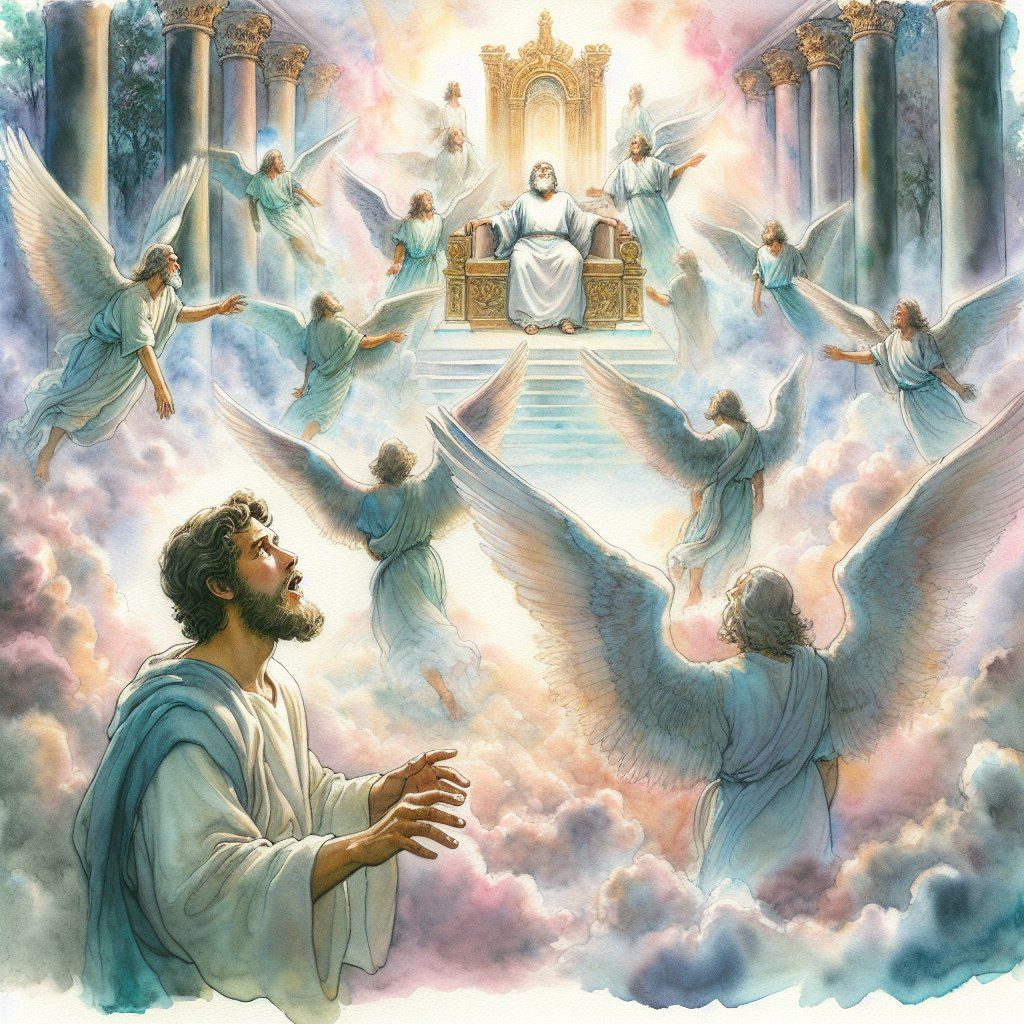
I think this image tells us what Isaiah saw, except each of the seraphim had 6 wings. They were calling out to one another, “Holy, holy, holy is the Lord of hosts; the whole earth is full of his glory!” 4 And the foundations of the thresholds shook at the voice of him who called, and the house was filled with smoke. Of course we don’t know what the Lord Himself actually looked like on the throne. Was it an elderly man like figure? God is a spirit, not flesh, so what exactly did Isaiah see on that throne?
5 And I said: “Woe is me! For I am lost; for I am a man of unclean lips, and I dwell in the midst of a people of unclean lips; for my eyes have seen the King, the Lord of hosts!” (YHWH tsaba) 6 Then one of the seraphim flew to me, having in his hand a burning coal that he had taken with tongs from the altar. 7 And he touched my mouth and said: “Behold, this has touched your lips; your guilt is taken away, and your sin atoned for.”
What would your reaction be if you saw this throne scene? The temple is shaking like in an earthquake (you know the panic people feel in an earthquake). You are standing in the presence of God. You have seen the Lord (some grandiose image of Him). Isaiah’s sinfulness is awakened by the vision. I think the worst of sinners, like Hitler, and the most infamous atheists would all have this same reaction in the presence of the Lord. But God takes away and atones for his sins. The Hebrew word for “atone” is kaphar: To cover, to atone, to make reconciliation, to purge. The same root word for the mercy seat in the Holy of Holies. From AI: “According to the Hebrew Bible, the kaporet (Hebrew: כַּפֹּרֶת kapōreṯ) or mercy seat was the gold lid placed on the Ark of the Covenant, with two cherubim at the ends to cover and create the space in which Yahweh appeared and dwelled. Isaiah would have thought of the high priest sprinkling blood on the mercy seat (Leviticus 16:13) to make atonement (Leviticus 16:16 kaphar: to cover over, pacify, make propitiation) for the sins of Israel for the whole past year. The mercy seat was figuratively where God dwelt, where the high priest could be in the presence of God. Now Isaiah has that privilege! This vision is critical to God’s calling of Isaiah to preach. 6:8 Then I heard the voice of the Lord, saying, “Whom shall I send, and who will go for Us?” Then I said, “Here am I. Send me!” What should be the main motivation for preaching the gospel? It should be gratitude for the atonment of our sins through the cross of Jesus. How many of us really feel that motivation? We don’t need a special vision like Isaiah or Ezekiel had (Ezekiel 1) to be aware of our sinfulness. When I think about my sinful thoughts and deeds for each day I live, I should feel very unworthy of grace. But then I feel relieved, happy, and grateful that I am forgiven by the grace of God. If I feel that every day, then I should want to tell sinners about the forgiveness they can have in Jesus. If I don’t feel that, it is probably b/c my mind is set on earthly things and not the things above. Colossians 3:1″If then you have been raised with Christ, seek the things that are above, where Christ is, seated at the right hand of God. 2 Set your minds on things that are above, not on things that are on earth.” If so, I need to start and close each day thinking about my sins I have committed and the forgiveness I have received.
The sad thing is that he is told that the people won’t listen and repent at his preaching. So he asks, “how long do I need to do this since they are not even going to listen”? The answer: until the Lord brings devastating judgment on them with only a tenth surviving. That tenth would be the remnant, the “holy seed is the stump”. As God told Elijah, 1 King 19:18 Yet I will leave seven thousand in Israel, all the knees that have not bowed to Baal, and every mouth that has not kissed him.” In all of God’s judgments against the sins of Israel, He has always had a remnant that were saved. A remnant is “Remnant” is used to describe a small part or piece that is left over after the majority of something has been used or destroyed, like the scaps of a piece of cloth used to patch a garment, or the remnants of a building that was destroyed. Romans 9 talks about the remnant of Jews who accpeted Jesus as the Messiah and who would be spared the judgment of the Jews in 70 AD when the temple was destroyed. Romans 9:27 And Isaiah cries out concerning Israel: “Though the number of the sons of Israel be as the sand of the sea, only a remnant of them will be saved”. Paul is quoting Isaiah 10:20 In that day the remnant of Israel and the survivors of the house of Jacob will no more lean on him who struck them, but will lean on the Lord, the Holy One of Israel, in truth. 21 A remnant will return, the remnant of Jacob, to the mighty God. 22 For though your people Israel be as the sand of the sea, only a remnant of them will return. Destruction is decreed, overflowing with righteousness.” The context there is a return of a remnant from captivity, but the principle is the same.
6:9 And He said, “Go, and tell this people:‘Keep on listening, but do not understand;
And keep on looking, but do not gain knowledge.’ 10 Make the hearts of this people insensitive,
Their ears dull, And their eyes blind, So that they will not see with their eyes, Hear with their ears,
Understand with their hearts, And return and be healed.”
11 Then I said, “Lord, how long?” And He answered, “Until cities are devastated and without inhabitant,
Houses are without peopleAnd the land is utterly desolate,12 The Lord has completely removed people,
And there are many forsaken places in the midst of the land.13 Yet there will still be a tenth portion in it, And it will again be subject to burning, Like a terebinth or an oak Whose stump remains when it is cut down. The holy seed is its stump.”
 Nicky's Notes