
After Joshua died and his generation (the ones who conquered Canaan) died, there “arose another generation after them who did not know the Lord, nor yet the work which He had done for Israel” (2:10). They did not utterly destroy all the Canaanites and their altars (2:1-3) in their respective 12 land divisions even though they could have b/c the Canaanite fighting forces had been destroyed in the 7 years under Joshua. B/c of their disobedience, God left the Canaanite nations as a thorn in the side of Israel, and their gods as a snare to tempt them to idolatry (2:3; 3:1-6). They also intermarried with them, which was forbidden by the Lord (3:6; Deut 7:3,4).
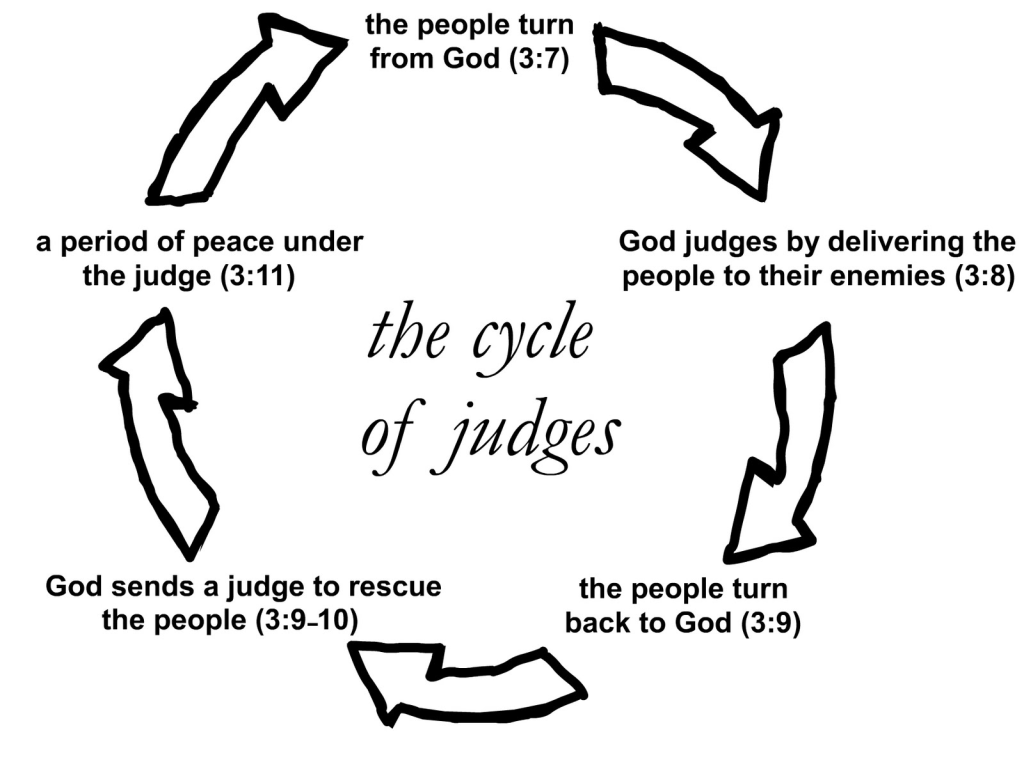
This led to a cycle repeated several times in Judges as described in 2:11-23:
1. Sin: Israel fell into sin and idolatry;
2. Servitude: God let their enemies oppress them;
3. Sorrow: Israel cried out to God for help;
4. Salvation: God would raise up a judge to defeat their enemies, usually followed by a period of peace.
Here is a summary of the different Canaanite oppressions, the judges whom God raised up, and years of rest each judge provided Israel before the cycle repeated itself. The total period of the Judges probably around 300 years with some of the judges overlapping.
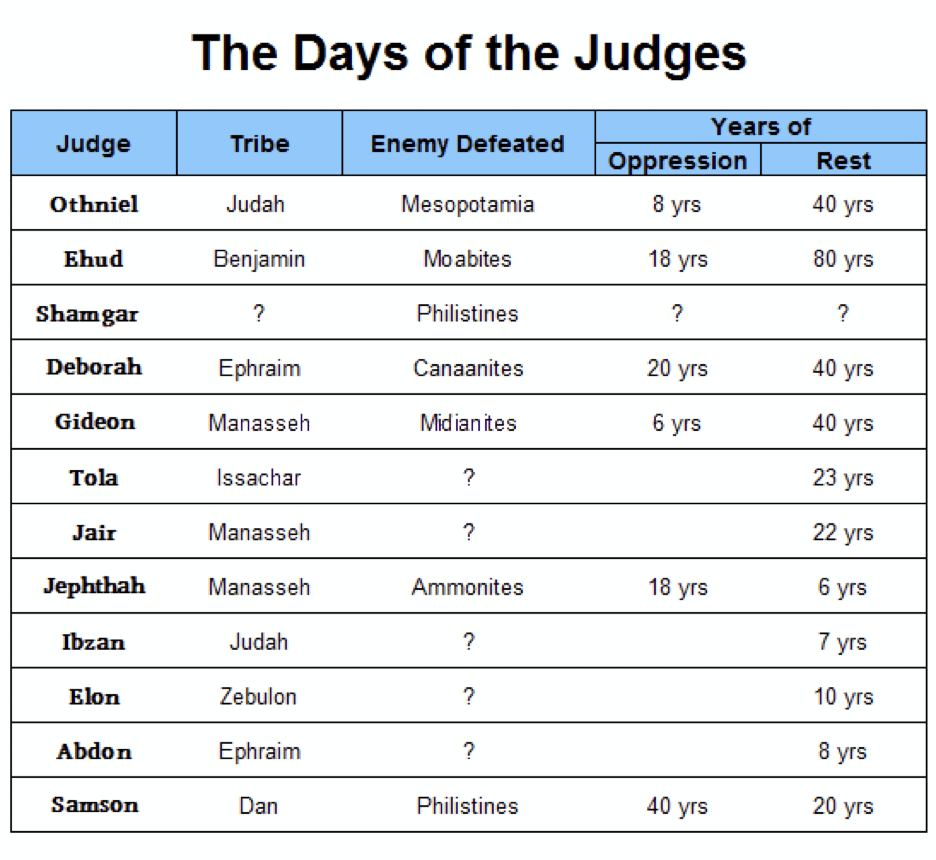
Not much on the first 3 judges. The 1st judge Othniel (Caleb’s younger brother) “killed the Mesopotamian king Cushan-rishathaim. The 2nd judge Ehud killed the Moabite king Eglon after 18 years of Moabite oppression. He went to Eglon, pretending to have a secret message from God. Eglon cleared the room. Ehud was left handed, so picture him putting his right hand up to his mouth as if giving a secret message in the ear of Eglon, while he pulled out an 18″ double edged sword that he had hidden on his right thigh under his clothes. Eglon’s servants had not done a good job searching Ehud for weapons. Eglon was very fat. Ehud stuck the 18” sword so deep into Eglon’s belly that the sword was no longer visible in the fat. Ehud sneaked out. Ehud’s servants delayed entering the room, thinking the king was “relieving himself in the closet of his cool chamber”. The delay allowed Ehud time to escape. He mounted an army and defeated the Moabites. The 3rd judge Shamgar is known for killing 600 Philistines with an oxgoad (a long stick with a pointed end used to prod oxen along). Kinda like Samson killed 1,000 Philistines with the jawbone of a donkey.
I want to focus on the story of the 4th judge, Deborah in Judges 4-5.
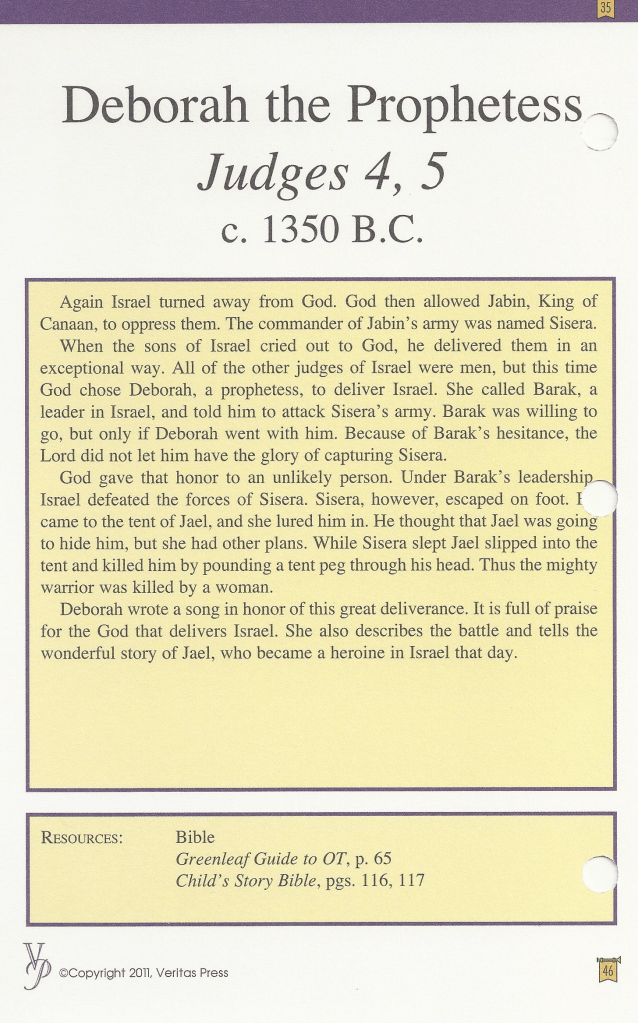
The Canaanite king Jabin and his commander Sisera had oppressed Israel for 20 long years. Israel was no match for the military strength of Jabin who had 900 chariots of iron (the Israelites probably had no chariots and very few crude weapons as the Philistines would have destroyed all those). Deborah was both a prophetess and a judge (judging Israel under a palm tree). Apparently there were no men willing to stand up to Jabin. Deborah had to challenge Balak to gather an army of 10,000 men and she would draw out Sisera to the river Kishon. 8 Barak said to her, “If you will go with me, I will go, but if you will not go with me, I will not go.” 9 And she said, “I will surely go with you. Nevertheless, the road on which you are going will not lead to your glory, for the Lord will sell Sisera into the hand of a woman.” Deborah went with Barak to the river to meet Sisera’s army and chariots. We learn from Deborah’s victory song in ch 5 that apparently the Lord heavy rains and all the 900 chariots got bogged down and could not move. Sisera’s army and chariots were defeated, “not a man was left”, and Sisera fled on foot. He fled to what he thought was the safety of the tent of Jael, the wife of Heber (there was peace between Jabin and Heber). Sisera must have been exhausted. Jael gave him some milk and told him to sleep. She was to guard the entrance in case Israelite soldiers came. While he was in deep sleep, she took a tent peg and drove it through his temple down into the ground. He must have died immediately without a struggle. We don’t know why Jael did this or what her husband Heber would say when he found out about what Jael had done b/c that would surely break the peace between their nations. When Barak arrived, Jael showed him the body of Sisera in the tent. Just as Deborah had predicted, the glory of victory went to a woman, Jael, and not Barak. Israel went on to destroy Jabin, king of Canaan.
Thus Deborah goes down in history as the only woman judge. Why did God choose a woman judge? B/c there were apparently no men with the courage to stand up to Jabin. Apparently there were not even any men like Gideon who. was very reluctant to fight the Midianites but after several signs given him by God he found the courage to defeat them with 300 men against 135,000 Midianites. Barak did answer the challenge, but only if Deborah would go with him to fight. Not very courageous (but at least he did go fight). The glory of victory would go to Jael, not Barak.
That might bring up a lot of questions. I think the Bible is pretty clear about what God expects. He created Eve to be a “helper” to Adam. Part of the curse put on Eve b/c of her sin was that “her husband would rule over her” (Gen 3:16). That makes sense since the electrician’s apprentice helper is in submission to the electrician. 1 Peter 3:1 Likewise, wives, be subject to your own husbands, so that even if some do not obey the word, they may be won without a word by the conduct of their wives, 2 when they see your respectful and pure conduct. 3 Do not let your adorning be external—the braiding of hair and the putting on of gold jewelry, or the clothing you wear— 4 but let your adorning be the hidden person of the heart with the imperishable beauty of a gentle and quiet spirit, which in God’s sight is very precious. 5 For this is how the holy women who hoped in God used to adorn themselves, by submitting to their own husbands, 6 as Sarah obeyed Abraham, calling him lord. And you are her children, if you do good and do not fear anything that is frightening.
That doesn’t meant that women are inferior to men in any way, mentally or spiritually. Peter does go on to say 7 Likewise, husbands, live with your wives in an understanding way, showing honor to the woman as the weaker vessel, since they are heirs with you[a] of the grace of life, so that your prayers may not be hindered. In what way is the woman the “weaker vessel”? This is from gotquestions.org. “What does it mean that the wife is a “weaker vessel”? The passage does not specifically say. There are many speculations. The most common proposal is that 1 Peter 3:7 is referring to physical weakness since the vast majority of husbands are significantly physically stronger than their wives. Some interpreters see other ways that women are, generally speaking, weaker than men, such as being less in control of their emotions. Others point to the idea that women are more easily deceived (based on 1 Timothy 2:14). The primary problem with these theories is that this passage, and the Bible as a whole, nowhere specifically identifies ways that women are weaker than men. First Timothy 2:14 simply says that Eve was deceived. It does not say that women are more easily deceived than men.”
So it probably does refer to the fact that most men (not all) are stronger then women. Maybe also that, since God made women to be able to nurse and raise children, they might be less in control of their emotions than men. Men think with their head, women think with their hearts. That’s no necessarily a bad thing b/c they need more emotion than men to unselfishly raise children from birth and to put up with their husbands! If true, that might make women more susceptible (not gullible) to false teachers as 2 Timothy 3 says, 6 For among them are those who creep into households and capture weak women, burdened with sins and led astray by various passions, 7 always learning and never able to arrive at a knowledge of the truth. Remember, as Paul points out in 1 Tim 2:14, Eve was deceived by Satan’s lies but the man was not deceived. It is controversial that the new pick for defense secretary says that women should not serve in combat roles. They were not allowed to do that until 2016 when restrictions were lifted, allowing women to serve in all combat roles. We’ll see how that one turns out! You can just hear the claim that Republicans are misogynists if the new secretary of defense gets his way!
We are embroiled in so many accusations in politics that it is hard to know the truth. From MSNBC: “Trump ran a campaign that included denying women their free will (i.e. the right to control their own bodies and have abortions legally). He vowed to be women’s protector “whether the women like it or not,” and he repeatedly praised the chaos that has ensued after the Supreme Court’s decision to overturn women’s federal right to abortion as “beautiful.” His victory has some in the MAGA movement eager to subjugate women, and their remarks all but affirm some people’s fears that a Trump win would unleash misogyny akin to that in “The Handmaid’s Tale.” Look up “The Handmaid’s Tale” if that statement make you curious about what that is. It is about a futuristic men led New England state where men totally suppress women’s rights and the women try to gain independence.
I am not defending Trump’s statements, but it is interesting that today a man is accused of misogyny (misogyny is the hatred of, contempt for, or prejudice against women or girls. It can also refer to social systems or environments where women face hostility and hatred because they’re women in a world created by and for men — a historical patriarchy) if he believes that abortion is killing life in the womb and that women’s rights to control their own bodies does not include killing babies in their wombs. That is not misogyny. That is standing up for what God says. A key passage is in Exod 21:22 “When men strive together and hit a pregnant woman, so that her children come out, but there is no harm, the one who hit her shall surely be fined, as the woman’s husband shall impose on him, and he shall pay as the judges determine. 23 But if there is harm, then you shall pay life for life, 24 eye for eye, tooth for tooth, hand for hand, foot for foot, 25 burn for burn, wound for wound, stripe for stripe. Apparently God considers life in the womb to be a living being during the entire pregnancy.
The other issue that brings the accusation of misogyny is what Paul said about wives being in submission to their husbands (Ephesians 5:25-33). Also in 1 Corinthians 11 Paul said 2 Now I commend you because you remember me in everything and maintain the traditions even as I delivered them to you. 3 But I want you to understand that the head of every man is Christ, the head of a wife is her husband, and the head of Christ is God. That is a mandate of God from the very beginning in Genesis. To teach that is not misogyny. Of course, the husband is to love and cherish his wife and take care of her needs, so he should not be a cruel dictator. But the fact remains that the Bible teaches that the husband is the head of the wife. Many today think Paul was not inspired and that we don’t have to follow his teaching. They say he is just homophobic and misogynistic and giving his opinions. But Paul was an apostle inspired by the Holy Spirit. His teachings are from the Holy Spirit.
That brings up the role of women in the church. One of my students asked if a woman could be the President, or a Princpal, or a CEO of a business, etc. I told him that I personally thought that was ok. Paul said in 1 Timothy 2: 11 Let a woman learn quietly with all submissiveness. 12 I do not permit a woman to teach or to exercise authority over a man; rather, she is to remain quiet. 13 For Adam was formed first, then Eve; 14 and Adam was not deceived, but the woman was deceived and became a transgressor. I think that restriction on women only applies to the church positions. For example, the qualifications for elders in 1 Timothy 3 is “husband of one wife”, so women could not be elders. Why not? Elders might have to refute false teaching and rebuke heretics., which would involve taking authority over the men. Some churches have women elders in spite of Paul’s teaching.
What about women praying out loud among a group of men? I have never thought that was wrong. Why not? 1 Corinthians 11 goes on to say that a woman could use her miraculous gift of prophecy or probably praying in tongues if she would wear a veil to show that she was not “usurping authority” over the men and trying to take over. So women could pray out loud in the presence of men (praying silently would not be in context here b/c that could not possibly be taken as usurping authority). Then in 1 Cointhians 14 Paul says 26 What then, brothers? When you come together, each one has a hymn, a lesson, a revelation, a tongue, or an interpretation. Let all things be done for building up. That could be gifted men or women using their gift in assemblies or meetings of Christians. So women could us that gift of prophecy to give a revelation in such a meeting as long as they word a veil to show subjection. I assume that women can give a teaching or lead in prayer in a mixed group of men and women today. Why not? I don’t think they would even need to wear a veil since that was a cultural way of showing subjection back then. Today, I think it would just be obvious if the woman was just humbly using her gift or knowledge or if she was trying to take over. The church I was raised in was so inconsistent on this issue. They would allow women to share a teaching in a classroom before going into the auditorium for the main service, but then they would not allow a woman to share a teaching in the main service. Why would going into the auditorium make it any different than in the classroom? It should either be wrong in both or right in both. I think the Bible teaches that it is ok in both! My church squelched the gifts of our women by keeping them from using their gifts in the assembly. But doesn’t Paul say in 1 Corinthians 14:33 “As in all the churches of the saints, 34 the women should keep silent (sigaó: To be silent, to keep silence, to hold one’s peace) in the churches. For they are not permitted to speak (laleó: To speak, to talk, to utter) but should be in submission, as the Law also says. 35 If there is anything they desire to learn, let them ask their husbands at home. For it is shameful for a woman to speak in church.” My church used that verse to say that women could not share a teaching or speak in the assembly, total silence. Of course, they allowed women to sing out loud but that was it (inconsistent again if they demand total silence). But requiring total silence of women in the assembly would be a contradiction of 1 Cor 11 where Paul said the women could speak in prayer or prophecy in any meeting of men and women. So how do we explain this verse in 1 Cor 14:34-35? Paul must have specifically been rebuking women who are usurping authority over the men in the assembly, butting in when the men are speaking, just blatantly taking over (maybe they think the men are not doing a good job leading the church). Paul tells those specific women to not speak at all but ask their husbands any questions when they get home. Paul is not making some general rule for all women to be totally silent in assemblies which would contradict 1 Cor 11. So I don’t think it is wrong for a woman in the assembly to share a teaching, to lead a song, to lead the group in prayer, etc. I do believe in the men taking the lead but often that does not happen. I guess women do have to step up at times.
But often the question is raised, “Is it wrong to have women preachers?” I say yes and here is why. Usually the preacher is considered the senior pastor of the church and will have the authority to rebuke false teachers or the immoral and rebellious in the church. A woman preacher might thus have to rebuke male members of the church and that would violate Paul saying women could not usurp authority over the men. Of course, a more relevant question might be, “why do we have paid preacher positions in the church today at all?” There was no such position in the early church. Churches were led by elders and deacons. The elders did the shepherding and they had gifted teachers. But no paid preachers. I think the addition of the paid preacher position is similar to the request to have king so they could be like the other nations (1 Samuel 8). The church leaves the house church model and starts to build buildings and hire preachers, youth ministers, and secretaries. It becomes a business instead of a simple house church where you would never hire a preacher for a house church. The “evangelists” mentioned in Ephesians 4:11 traveled to different churches to ground churches or rebuke heresy. They had miraculous gifts enabling them to do that. The church they went to might give them food and a place to stay, but they were not permanent paid preachers like today. Two other gifts in Eph 4:11 were pastors and teachers, both miraculously gifted positions. You might think that he is talking about preachers of churches who are called pastors today, but he is not. The word for pastor is poimén: Shepherd. It refers to elders, not preachers. In Acts 20 Paul is talking to the elders of Ephesus. 20:17 Now from Miletus he sent to Ephesus and called the elders (presbuteros: elder, older, presbyter) of the church to come to him. He said 20:28 Pay careful attention to yourselves and to all the flock, in which the Holy Spirit has made you overseers (episkopos: Overseer, Bishop), to care for (poimainó: To shepherd, to tend, to feed, to guide) the church of God, which he obtained with his own blood. All 3 words, shepherd (poimen, the same word in Eph 4:11 for pastors), overseers (episkopos, the word some churches use to have bishops), and elders (presbuteros, the same word some churches use to have presbyters) refer to one position in the church, that of elders. Local church assemblies had these elders and deacons, and that was it. It was the Catholic church that started making different positions of bishops and presbyters, but they were one and the same in the NT.
Many churches have different views on the role of women in their churches and in their assemblies. Each church must study and define these roles for their church. They just need to remember that we might end up agreeing to disagree. Each Christian must decide if he is comfortable with the role of women as defined by his church.
I know this article has gone off into several issues with a lot of my opinion. I don’t make my opinions on these issues to be heaven/hell issues that might diivide churches. I hope you enjoyed the study of Deborah, the only woman judge.
 Nicky's Notes