
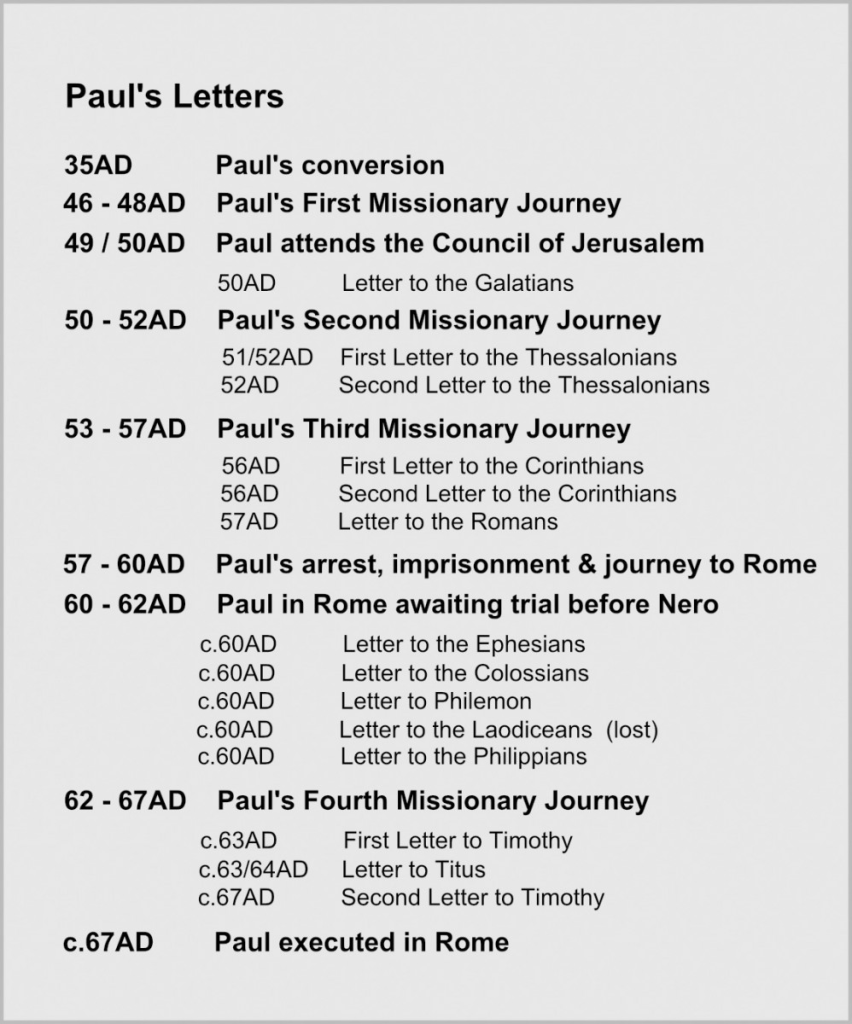
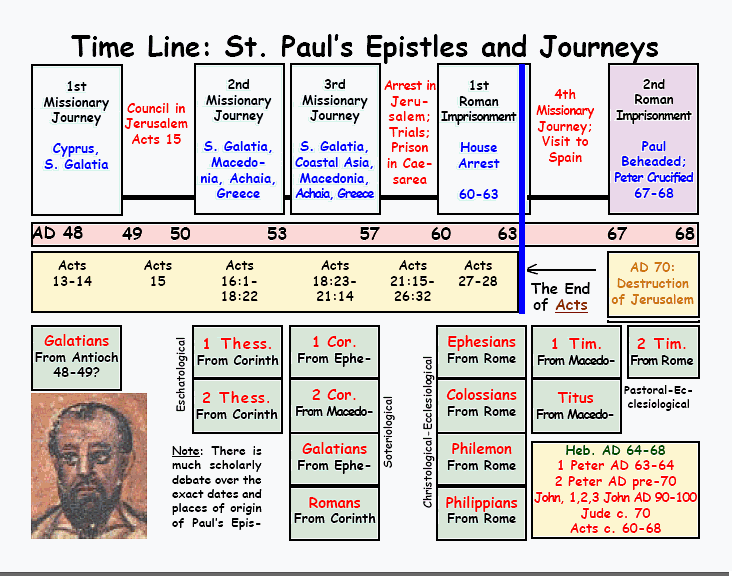
I will use this outline, pulling up the verses, to teach the book. This is Paul’s last letter before he is beheaded by Nero, probably in about 66-67 AD. Nero died in 68 AD. The letter is full of personal concerns, as ch 4 shows. But main purpose of the letter is clear: to encourage Timothy to remain steadfast in his ministry as an evangelist, to endure whatever hardship comes, to teach the truth of the inspired word of God (3:16,17), to “preach the word”, and to refute false teachers, as well as to help Paul quickly with some of his needs and some last instructions, knowing he will die soon. Truly, the key verse: 2 Tim 4:5 “But you be watchful in all things, endure afflictions, do the work of an evangelist, fulfill your ministry.”
If you knew you were writing your last letter to a loyal, loving friend and co-worker or family member, or to a child or grandchild, what would you say? Not a suicide note, but suppose you are older and know that you are going to die of natural causes very soon. 2 Timothy is Paul’s last letter as he expects to die soon in Rome.
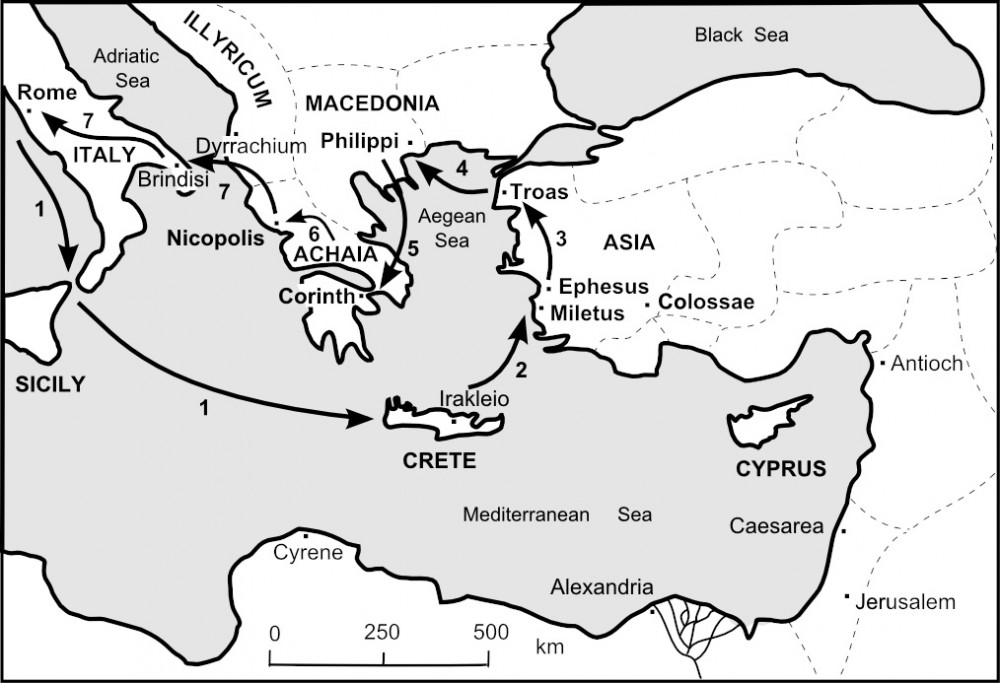
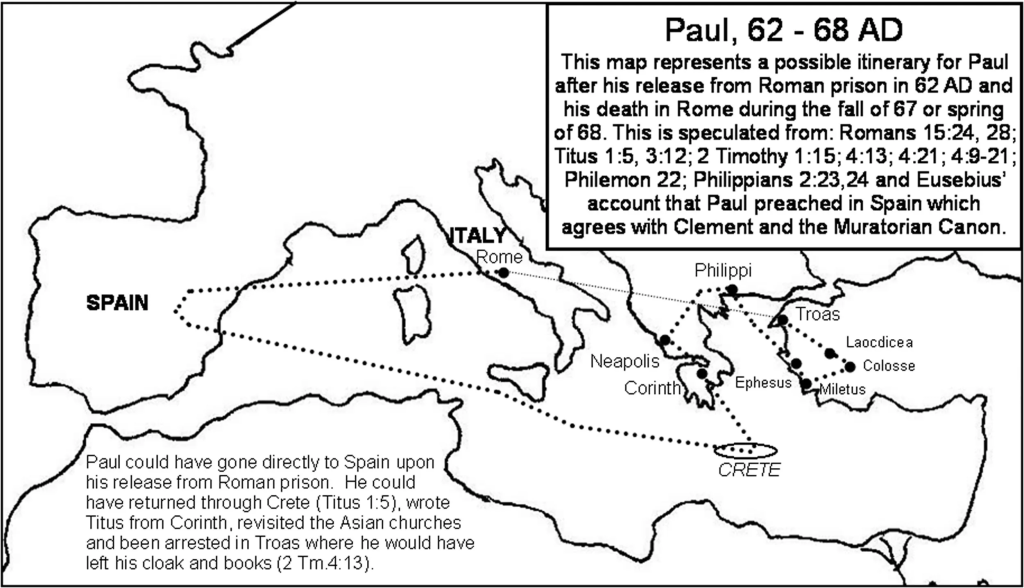
He wrote 2 Timothy from Rome after his 2nd arrest and imprisonment (2 Tim 1:8,16;2:9) in 67 AD, with no hope of release (4:6-8)(as opposed to hope of release from his 1st imprisonment in Phil 1:25) to Timothy who was in Ephesus. He was beheaded by Nero in 67 AD. He had been deserted by friends and companions (1:15;4:10-11). He want Timothy to come see him before he dies, and to bring Mark (the same John Mark Paul did not want to go on the 2nd journey but now Paul finds him “useful to him for service” 4:11). He wants him to come before winter (he planned to spend the winter in Nicopolis (Tit 3:12) but apparently was arrested in Nicopolis and would spend his last winter in Rome instead. He wants him to bring his cloak (that he had left in Troas) for his physical warmth, and his “books, especially the parchments” (4:13) for his spiritual warmth! He sent Tychicus to Ephesus, apparently bringing this letter to Timothy. Tychicus probably delivered Paul’s letter to Titus. He warns against Alexander the coppersmith, which would fit with Ephesus and Demetrius the silversmith who started the riot (Acts 19) b/c Paul was hurting his trade. He speaks of being delivered from this 1st imprisonment so he could preach to the Gentiles, but now expects to be brought safely to the “heavenly kingdom”. He tells Timothy to greet Prisca and Aquila, and Onesiphorus (whose home was Ephesus but who had visited and helped Paul in Rome, 1:16-18). 2 Timothy gives more details about his “4th missionary journey”. Paul’s travels then during the Pastorals, were 1) possibly to Spain as some claim, 2) to Crete with Titus, whom he left there, (Tit 1:5), 3) to Ephesus (1 Tim 1:3) where he left Timothy, 4) on to Miletus (2 Tim 4:20) where he left Trophimus sick, 5) on to Troas (2 Tim 4:13) where he left his cloak and books, , 6) on to Macedonia (1 Tim 1:3) where he probably wrote 1 Timothy and Titus, 7) on to Nicopolis where he planned to winter (Tit 3:12) but 8) was arrested there and spend his last winter in Rome in prison (2 Tim 1:16,17), and died soon after a martyr’s death, according to tradition, on the Ostian Way, west of Rome, during the reign of Nero. See the map above. Here is a map that includes the possible visit to Spain right after his release from house arrest in Rome, his first imprisonment (Acts 28). This map says that he was arrested in Troas.
2 Timothy is intensely personal. He looks forward to the crown of righteousness and heavenly kingdom when he dies, but is sad over so many deserting him. He commends Timothy’s faith from his mother and grandmother, and warns him to guard the gospel entrusted to him against false teachers, like Hymenaeus and Philetus who said the resurrection had already taken place (2:17), warns of widespread sin in the last days, warns against those who enter into households and captivate weak women led on by various impulses, encourages him to preach the word and rebuke false teaches for the “time will come when they will not endure sound doctrine, but wanting to have their ears tickled, they will accumulate for themselves teachers in accordance to their own desires, and will turn away their ears from the truth, and will turn aside to myths” (4:2-4). He urges Timothy to flee youthful lusts and pursue righteousness, to not be quarrelsome, but be able to teach, kind to all, patient when wronged, with gentleness correcting those in opposition (2:22-25).
Instead of the usual verse by verse study, I think the summary above will be sufficient. Instead, I want to focus on the lessons we can learn from the letter.
(AI) “Key lessons from 2 Timothy include: remaining faithful to the Gospel even in the face of persecution, diligently guarding and teaching the truth of the Word, not fearing hardship, actively mentoring and equipping other believers, and prioritizing the calling God has given you to fulfill your ministry despite challenges and potential opposition.”
From Chuck Swindoll: “Paul understood that the ministry would only become more difficult for Timothy with the apostle’s impending death. (Indeed, at some point after this letter from Paul, Timothy was imprisoned for his faith [Hebrews 13:23]). Paul knew that Timothy’s task of keeping the church within the bounds of sound doctrine while encouraging believers to live their lives well for the sake of Christ would be an often thankless and difficult task. Though hardship would come, Paul wanted Timothy to continue in those things he had learned, drawing on the rich heritage of faith that had been passed down to the young pastor, not just from Paul but also from his mother and grandmother (2 Timothy 1:5–6; 3:14–15).
The most striking feature of Paul’s encouragement comes when the aging apostle used a phrase that showed up prominently in his letter to Timothy four years prior. In that earlier letter, Paul exhorted Timothy to “fight the good fight” (1 Timothy 1:18; 6:12). But in this letter, Paul turned that phrase on himself, writing that he had “fought the good fight . . . finished the course . . . [and] kept the faith” (2 Timothy 4:7). What a great encouragement it must have been to the young pastor of the church at Ephesus to know that his mentor boldly modeled his perseverance in the faith, even to the point of death. Second Timothy brings us to the brink of death, forcing us to consider its reality and how we might react when faced with it. Paul’s response instructs us still today. His mind was not on himself, dwelling on the injustice that had befallen him. Instead, trusting that God had him right where He wanted him, the aging apostle turned his attention to others, specifically to the church and to his young protégé, Timothy. Where do you hope your thoughts linger as you come to the end of your days?”
Some key sections that I really like. 2 Timothy 1:3 I thank God, whom I serve with a clear conscience the way my forefathers did, as I constantly remember you in my prayers night and day, 4 longing to see you, even as I recall your tears, so that I may be filled with joy. 5 For I am mindful of the sincere faith within you, which first dwelled in your grandmother Lois and your mother Eunice, and I am sure that it is in you as well. 6 For this reason I remind you to kindle afresh the gift of God which is in you through the laying on of my hands. 7 For God has not given us a spirit of timidity, but of power and love and discipline.” I just got an email from Trinidad where we did 3 years of mission work back in the 70’s. It was from a daughter of the first person we baptized in a town called Siparia. Her mother and her children (5 of them I think) became the nucleus of that small church that met in a community center while we were there. We hope to talk via whatsapp soon. The mom would be in her 70’s just as we are now. I’ve seen her once on a visit to Trinidad since the 70’s and the church is still going strong. She has apparently passed her faith on to her children, one of which emailed me. Like Paul, it brings me joy to think of the mom. It also makes me a little guilty that I am not “kindling afresh the gift that is in me” like I should. God used my teaching gift to start churches, evangelize, convert people to Jesus, train church leaders in the book, etc. back in the 70’s. Mission work was a burning passion for me after I attended a school of preaching in West Monroe, La for 2 years (after I got my engineering degree at UAB). Now I spend way too much time watching Amazon Prime movies and TV series like Murdoch Mysteries (I’m in season 14). I do still teach Bible part time in a Christian school, but I sometimes feel lukewarm in my passion. I pray that God will help me rekindle the fire during my last years on earth.
2 Timothy 1:8 Therefore do not be ashamed of the testimony of our Lord or of me His prisoner, but join with me in suffering for the gospel according to the power of God, 9 who saved us and called us with a holy calling, not according to our works, but according to His own purpose and grace, which was granted to us in Christ Jesus from all eternity, 10 but has now been revealed by the appearing of our Savior Christ Jesus, who abolished death and brought life and immortality to light through the gospel.” Salvation by grace through faith again, but notice Jesus “abolished death and brought life and immortality to light through the gospel”. Jesus came to abolish spiritual death, not physical death. Isaiah 25:8. ESV He will swallow up death forever; and the Lord God will wipe away tears from all faces, and the reproach of his people he will take away from all the earth, for the Lord has spoken.” What “death” does Isaiah predict will be swallowed up in the Messianic Age when the Messiah (Jesus) would come? 1 Corinthians 15:23 But each in his own order: Christ the first fruits, after that those who are Christ’s at His coming, 24 then comes the end, when He hands over the kingdom to our God and Father, when He has abolished all rule and all authority and power. 25 For He must reign until He has put all His enemies under His feet. 26 The last enemy that will be abolished is death.” When would death be abolished? At “the end”, which is the end of the Jewish Age at Jesus’ 2nd coming in 70 AD. 1 Corinthians 15:50 Now I say this, brothers and sisters, that flesh and blood cannot inherit the kingdom of God; nor does the perishable inherit the imperishable. 51 Behold, I am telling you a mystery; we will not all sleep, but we will all be changed, 52 in a moment, in the twinkling of an eye, at the last trumpet; for the trumpet will sound, and the dead will be raised imperishable, and we will be changed. 53 For this perishable must put on the imperishable, and this mortal must put on immortality. 54 But when this perishable puts on the imperishable, and this mortal puts on immortality, then will come about the saying that is written: “Death has been swallowed up in victory. 55 Where, O Death, is your victory? Where, O Death, is your sting?” 56 The sting of death is sin, and the power of sin is the Law; 57 but thanks be to God, who gives us the victory through our Lord Jesus Christ.” Notice “we will not all sleep”. That does not mean, “some people will be alive when he comes back in a couple of thousand years (at least). That means what it says: some of the ones he is writing to will still be alive when death is swallowed up and immortality is given to believers, dead or alive, at the 2nd coming in 70 AD. Either that, or Paul is making a false prediction and is a false apostle, certainly not speaking by the inspiration of the Holy Spirit. And he can’t be just “mistaken” as some claim. If he is mistaken then he is not inspired. If he is mistaken in this prediction, then how can we know whether he is mistaken in his other writings? Maybe he is mistaken in his denouncing of homosexuality (which is what many claim today). So in 70 AD, Jesus fully abolished spiritual death and gave immortality to believers, just as Isaiah predicted and Paul quotes Isaiah 28:5. The Law was the source of sin and spiritual death when you sin. The Law officially ended in 70 AD when Jesus came in judgment on the evil Jews, destroying the temple and the city of Jerusalem, in 70 AD. Hebrews 8:13 When He said, “A new covenant (in Jeremiah 31:31-34),” He has made the first obsolete. But whatever is becoming obsolete and growing old is about to disappear.” That was written about 60 AD. The Law basically did “disappear” in 70 AD. No more animal sacrifices after that. No more priests to offer them after that. No more genealogies to even confirm who the priests and the Messiah might be. When the Law ended, spiritual death ended. Immortality was only promised to believers, not the wicked unbelievers. John 11:25 Jesus said to her, “I am the resurrection and the life; the one who believes in Me will live, even if he dies, 26 and everyone who lives and believes in Me will never die.” Every believer after 70 AD will live forever after physical death. He will still die physically b/c Jesus did not come to destroy physical death. But what about those believers during the transition period between the old and new covenants (i.e. 30 – 70 AD)? Were they not saved from spiritual death? Did they not have eternal life (immortality)? Yes they did. But it was “already but not yet”. It’s like our presidential election. Trump is the president elect but not president officially until his inauguration 2 months later. That transition period was a special, one time only, period. The believers in that period were made alive from spiritual death. Ephesians 2:4 But God, being rich in mercy, because of His great love with which He loved us, 5 even when we were dead in our wrongdoings, made us alive together with Christ (by grace you have been saved), 6 and raised us up with Him, and seated us with Him in the heavenly places in Christ Jesus. They already had it, but officially they would not have immortality until 70 AD. Every believer after 70 AD would not be in that transition “already, not yet” state. We have eternal life, spiritual death has been conquered, and we have immortality to live on forever even after we die physically. We still interpret Bible verse as if we are living in that transition period. Or some teach that the 2nd coming hasn’t happened yet, so that means we are still in that transition period and death isn’t conquered for us and we don’t have immortality, which is a big problem to me. That would mean that Jesus did not finish his work, but he did. It leaves us still waiting for something that we already have.
 Nicky's Notes