
Here is a great chronological cummary of Paul’s missionary journeys and death.
Paul’s 1st visit to Jerusalem is found in Galatians 1 and Acts 9 where he went to Jerusalem 3 years after his conversion for a brief 15 day stay, meeting only Peter and James the Lord’s brother. We pick up after his 2nd visit to Jerusalem as found in Acts (Acts 11:27-30) for famine relief to the Jewish saints in Jerusalem. That would be the same visit to Jerusalem in Galatians 2 which was 14 years after his conversion. That visit to Jerusalem in Galatians 2 was also the 2nd visit to Jerusalem in Galatians.
C. The period from the 2nd until the 3rd visit to Jerusalem.
- After the relief visit (2nd visit) to Jerusalem (Acts 11:27-30; Galatians 2), Paul returned to Antioch.
- Very soon afterwards, the 1st missionary journey began.
- Paul, Mark, and Barnabas traveled from Antioch to Seleucia, the nearest port, then to Cyprus.
- Then they went to Pamphylia which lies to the north of Cyprus in modern day Turkey.
- From there, they went to Galatia, as far as the city of Derbe, but without Mark, who went home.
- Then they went back through the same cities in the opposite direction.
- Finally, they sailed from Perga back to Antioch of Syria.
- This entire journey lasted from six to nine months, concluding before the storms of winter would have stopped ship travel in the Mediterranean.
D. The period from the first missionary trip through the second journey (including the Jerusalem council).
- Paul traveled from Antioch to Jerusalem for the Jerusalem council (Acts 15), then back to Antioch.
- At that time, Paul began the 2nd Missionary Journey (Acts 15-17).
- Paul and Barnabas parted ways. Paul went with Silas and Barnabas went with John Mark.
- Paul and Silas journeyed from Antioch to Syria and Cilicia, this time using the overland route through Turkey.
- They visited Derbe and Lystra (where he picked up Timothy to go with him), then passed through Phrygia and Galatia. They arrived at Troas, where Paul had a vision calling them to Macedonia. Luke joined Paul and Silas at Troas.
- Upon arrival, they went to Philippi (where he converted Lydia the seller of purple and the Philippian jailor), then to Samothrace, Neopolis, Amphipolis, Thessalonica (where the unbelieving Jews drove him out), and Berea (where the Jews were more noble miinded, searching the Scriptures daily to verify Paul’s preaching).
- Then Paul went to Athens where he preached to the idol worshippers on Mars Hill, and finally to Corinth where he stayed for 1 1/2 years making tents with Aquilla and Priscilla. He wrote 1 and 2 Thessalonians from Corinth after Timothy brought him reports from Thessalonica.
- After the Macedonian and Greek ministry, he traveled briefly to Ephesus, Caesarea, and back to Antioch in Syria.
Paul’s 3rd Missionary Journey (Acts 18-21)
- Paul again traveled overland from Antioch to Phrygia and Galatia.
- He then traveled to Ephesus where he preached and taught for over three years. He wrote 1 Corinthians while in Ephesus. There was a riot tarted by Demetrius the idol maker.
- After the Ephesian ministry, Paul sailed to Macedonia (where he wrote 2 Corinthians after Titus meeting him there after a visit to Corinth), and went by foot to Greece including a second stop at Corinth (2 Cor. 13:1). During this three month stay, he wrote the book of Romans.
- Paul then went back to Macedonia stopping at Philippi, before setting sail for Troas.
- From Troas, he sailed for Jerusalem stopping on the way at Assos, Mytelene, Chios, Samos, Miletus (where he called for the elders from Ephesus to come meet him), Ephesus, Cos, Rhodes, Patara, Tyre, Ptolemais, and Caesarea.
- He had several representatives from the churches traveling with him at the end of this journey, each bringing money collected at their churches for the famine relief in Jerusalem.
- I believe Paul wrote the Galatian letter during this 3rd journey. He was very critical of them in the letter and it seems that he wasn’t able to ever visit them again in person, which would be the case since he never made it back to Antioch at the end of the 3rd journey.
E. Paul’s arrest in Jerusalem, and imprisonment at Caesarea (Acts 21:17-26:32)
- Paul was arrested in Jerusalem shortly after arriving from his 3rd Missionary Journey.
- Only days later, he was then taken to Caesarea where he was imprisoned for 2 years.
- This is where he and Luke wrote the book of Luke, and later, the book of Acts.
- He appeared in various trials before the Roman governors Felix, and then Festus. Fearing a Jewish plot to kill him, he appealed to Caesar to have his trial before Caesar. His last trial was before Festus and King Agrippa before being sent to Rome.
F. Paul’s trip to Rome (Acts 27-28)
- Paul’s prison ship left from Caesarea and sailed to Sidon, Myra, and Fair Havens on Crete, where he stayed until after the Day of Atonement.
- He then sailed west until a fierce storm left him shipwrecked on Malta. He wintered there for 3 months.
- When Spring came, he sailed to Syracuse, Rhegium, and Puteoli, finally arriving in Rome, where he remained in prisoned in a private house for 2 more years.
- During that 2 years he wrote the “prison epistles”: Ephesians, Philippians, Colossians, and Philemon.
G. Paul’s movements after the Roman imprisonment.
Paul was apparently freed after the 2 year house arresst Roman imprisonment. There is Biblical and
early church historical evidence and that Paul was released and traveled more,
including a trip to Spain, according to Clement of Rome in 1 Clement (see also
Romans 15:24).
Some call this his 4th missionary journey. He left Titus at Crete, Timothy at Ephesus, and wrote 1 Timothy and Titus probably from Macedonia. At some point after that he was arrested and taken to Rome where in his last months he wrote 2 Timothy. He was martyred (beheaded by Nero) in the summer of 64 AD.
The article above does a great job of trying to get the exact dates in Paul’s life and travels if you care to dig into that. Some key conclusions: Paul was converted (Acts 9) in 33-34 AD (Jesus was crucified in 30 AD). His 2nd visit to Jerusalem as recorded in Acts 11:27-30 was about 46 AD (a date given for the famine by Tacitus), which would be about 14 years (Galatians 2:1) from his conversion if the Galatians 2 visit to Jerusalem (the 2nd visit to Jerusalem in Galatians) is indeed the same visit as the Acts 11 famine visit (which I think it is). According to Josephus Herod died (Acts 12) about 44 AD which fits the 2nd visit to Jerusalem in Acts 11 to be. about 44 AD also. The 1st missionary journey (Acts 13,14) began about 48 AD. The Jerusalem conference of Acts 15 was about 48-49 AD.The 2nd missionary journey began about 49 AD. There is historical evidence that Gallo was proconsul in Corinth about 51 AD when Paul appeared before him on his 2nd journey, which fits the beginning of the 2nd journey in 49 AD since Paul spent 18 months in Corinth. He began his 3rd journey in 52 AD. He spent 3 years in Ephesus and the 3rd journey ended when he was arrested in Jerusalem in 55 AD. He spent 2 years in prison in Caesarea under Felix so he started his voyage to Rome as a prisoner in 57 AD. He arrived as a prisoner in Rome in 58 AD and spent 58-60 AD in his own hired quarters in Rome and the end of the book of Acts. He made a 4th journey and was arrested again and put in Roman prison. He was beheaded in 64 AD.
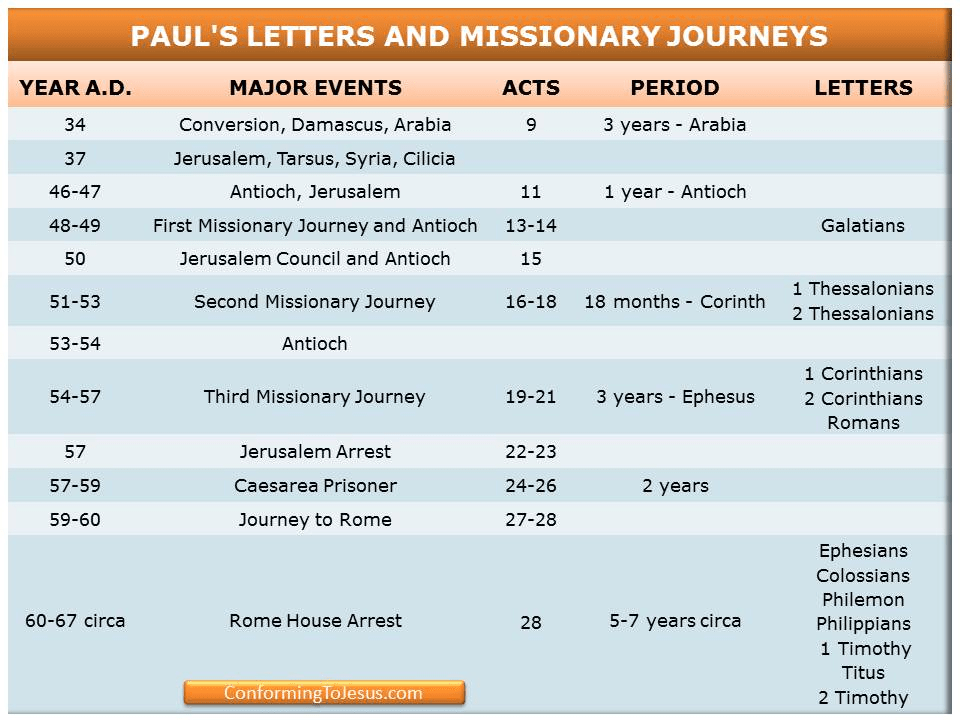
Here is a pretty good timeline for the chronology of Paul’s conversion, journeys, and death except for the last entry “60-67 AD Rome House Arrest”. We know he was in house arrest for 2 years, released, made a 4th journey and was beheaded about 64 AD. Also he wrote 1 Timothy and Titus on that 4th journey and 2 Timothy just before he was beheaded in 64 AD. Otherwise it is a good chart with similar dates to what the article came up with. As stated earlier, I believe Galatians was written during the 3rd journey and not the 1st.
There are many other facts and stories not covered in this summary.
 Nicky's Notes