Amaziah was the ninth king of Judah, reigning for 29 years. He was the son of Joash and succeeded him after his assassination. One of Amaziah’s first acts was to bring justice upon the murderers of his father (2 Kings 14:5). The Bible summarizes Amaziah’s reign thus: “He did what was right in the eyes of the LORD, but not as his father David had done” (2 Kings 14:3). He failed to removed the high places where people offered sacrifices instead of in the temple.
From https://www.gotquestions.org/King-Amaziah.html “Amaziah later conquered the Edomites and foolishly brought back their gods and sacrificed to them. This idolatry resulted in an unnamed prophet coming to Amaziah and rebuking him. Amaziah insolently resisted the prophet’s words, saying to him, “Since when have I made you the king’s counselor?” (2 Chronicles 25:16, NLT). The prophet was not to be intimidated, however. He told King Amaziah, “I know that God has determined to destroy you, because you have done this and have not listened to my counsel” (verse 16). Amaziah’s defeat of the Edomites had made him overconfident, so he sent a challenge to King Jehoash of Israel to meet him in battle (2 Kings 14:8; 2 Chronicles 25:17). Jehoash recognized Amaziah’s arrogance and refused the challenge, knowing that he could easily defeat the smaller territory of Judah (2 Kings 14:9–10; 2 Chronicles 25:18–19). But Amaziah would not back down, and so Jehoash attacked, defeating the army of Judah and capturing Amaziah. Amaziah was taken to Jerusalem where Jehoash plundered the temple before returning to Samaria (2 Kings 14:14; 2 Chronicles 25:24).
After Jehoash died, Amaziah lived another 15 years. It is unknown whether he returned to rule in Jerusalem, but, in any case, the men of Judah were conspiring against him, causing him to flee to Lachish in southwestern Judah. But the assassins sent after Amaziah found him and killed him. “He was brought back by horse and was buried with his ancestors in the City of Judah” (2 Chronicles 25:28). Amaziah could have had a long, successful reign had he continued following the Lord, but his story became another cautionary tale of the fate of the kings who turned aside to idolatry.”
The amazing thing about Amaziah is that he defeated the Edomites when he trusted in God, but he brought back the gods (idols)of the Edomites and sacrificed and worshipped them. The Edomites worshiped Qos, their national god, and other gods such as El, Baal, and ‘Uzza. Qos was a fertility god, similar to the gods of Ammon and Moab. That makes no sense. It was by the power of the one true God Yahweh that he defeated the Edomites and their gods. Why would he bring their failed gods back to Jerusalem and worship them? Apparently, he attributed his victory to their power instead of giving credit to God, essentially committing idolatry by believing the Edomite deities were responsible for his success on the battlefield; this act of pride and disregard for Yahweh is seen as a major reason for his subsequent downfall in battle against Israel. (AI)
So is there a lesson for us in Amaziah? Maybe. Perhaps it is that God often gives us victories and success and we fail to give Him the glory. We give glory to someone or something else. You get a promotion at work, but you fail to give God the glory. Instead, you give credit to your own ability or to someone at work who made your promotion possible. People praise you for something you did and you fail to give God the glory. Herod is a great example of this. Acts 12:20 Now Herod was angry with the people of Tyre and Sidon, and they came to him with one accord, and having persuaded Blastus, the king’s chamberlain,[b] they asked for peace, because their country depended on the king’s country for food. 21 On an appointed day Herod put on his royal robes, took his seat upon the throne, and delivered an oration to them. 22 And the people were shouting, “The voice of a god, and not of a man!” 23 Immediately an angel of the Lord struck him down, because he did not give God the glory, and he was eaten by worms and breathed his last.” He did not give god the glory.
You will hear some athletes brag about their own. ability when they win. It is refreshing to hear an athlete give God the glory, win or lose. Patrick Mahomes, the Kansas City Chief’s quarterback gave God the glory in their semi-final victory. C.J.Stroud, the quarterback for the Houston Texans, lost his playoff game but gave God the glory, saying that Jesus Christ is his rock that he falls back on, win or lose. He has spoken publicly about his Christian faith, and is known to say: “First and foremost I’ve got to thank my Lord Savior Jesus Christ” during interviews. Athletic ability, high intelligence, musical talent, good looks: these are all gifts from God. Paul said in 1 Corinthians 4:What do you have that you did not receive? If then you received it, why do you boast as if you did not receive it?” So it is not just giving God the glory when we win. It is giving God the glory win or lose, when good things happen to you or when bad things happen. If you truly believe that God can make something good come even from something bad that happens, then you try to find that good and let God use you to make it happen. When you find that good from a bad thing, you can give God the glory even for bad things.
So I am going to try to give God the glory all day today for everything.
Jehoshaphat was the 4th king of Judah. Second Chronicles 17:3–6 gives this commendation: “The Lord was with Jehoshaphat because he followed the ways of his father David before him. He did not consult the Baals but sought the God of his father and followed his commands rather than the practices of Israel. The Lord established the kingdom under his control; and all Judah brought gifts to Jehoshaphat, so that he had great wealth and honor. His heart was devoted to the ways of the Lord; furthermore, he removed the high places and the Asherah poles from Judah.” In addition, Jehoshaphat sent men throughout the kingdom to teach the people the Law of God (2 Chronicles 17:7–9). He removed the male cult prostitutes (1 Kings 22:46). Judah and Israel had been fighting constantly since the kingdom split, but he made peace with wicked king Ahab of Israel.
Nothing but good is said about him until 1 Kings 22 and 2 Chronicles 18. Jehoshaphat goes to visit King Ahab in Samaria. He joined with wicked King Ahab of the northern kingdom of Israel to retake Ramoth-gilead from the Syrians. Ahab has replaced the 450 prophets of Baal that Elijah had killed in 1 Kings 18 with 400 more prophets of Baal. They tell Ahab what he wants to hear, that he will be victorious in the battle. Jehoshaphat demands that a true prophet give his prediction, and Micaiah predicts that Ahab will die in the battle. You would think that Jehoshaphat would break off this partnership with Ahab and head home to Jerusalem, but instead he still joins Ahab in the battle. Ahab is killed by a God-guided random arrow even though he disguised himself as a regular soldier instead of wearing the kingly garments.
2 Chronicles 19:1 Jehoshaphat the king of Judah returned in safety to his house in Jerusalem. 2 But Jehu the son of Hanani the seer went out to meet him and said to King Jehoshaphat, “Should you help the wicked and love those who hate the Lord? Because of this, wrath has gone out against you from the Lord. 3 Nevertheless, some good is found in you, for you destroyed the Asheroth out of the land, and have set your heart to seek God.” To his credit, he apparently received that rebuke and continued to be a righteous king. The same prophet Hanani had rebuked Asa (Jehoshaphat’s father) but Asa imprisoned Hanani. Jehoshaphat then appointed Levites and priests as judges, warning them to give impartial judgements and not take bribes.
After the rebuke by Hanani, Judah was attacked by Moabites and Ammonites. Jehoshaphat led a long, humble prayer asking God for help, acknowledging that he was powerless without God’s help (2 Chronicles 20). The prophet Jahaziel told Jehoshaphat and the people of Judah, “Don’t be afraid for the battle is not yours but God’s” (2 Chronicles 20:15). Did you ever wonder where that song “The Battle Belongs to the Lord” came from? The Lord set an ambush for the attacking enemy. Apparently they ended up fighting among themselves and with the Edomites and were all killed. The army of Judah didn’t even have to fight. When they arrived, all they saw was dead bodies. They took great spoil for 3 days and then on the 4th day they celebrated and praised God with musical instruments and singers.
But we have to ask ourselves, “Why would a righteous king like Jehoshaphat even go visit Ahab? Why would he join with him in a battle that a true prophet of Yahweh warned against, one that he insisted on hearing his prediction?” This all goes back to 2 Chronicles 18:1 Now Jehoshaphat had great riches and honor, and he made a marriage alliance with Ahab.” This is referring to a marriage between Jehoram, Jehoshaphat’s son, to Athaliah, the daughter of Ahab and Jezebel. Jehoram succeeded Jehoshaphat as king and was an evil king, restoring pagan worship in Judah. Athaliah was the daugher of the wicked Queen Jezebel of Israel who fed 450 prophets of Baal and 400 prophets of Asherah at her own dinner table, and desperately tried to kill Elijah. Jezebel was the main ungodly influence of her husband King Ahab. After marrying Jehoram and become Queen of Judah, Athaliah turned out to be “like mother, like daughter”. She restored and promoted Baal worship in Judah, and even built a pagan idol in the temple of God. Ahaziah (Athaliah and Jehoram’s son), succeeded Jehoram as king of Judah. Jehu was appointed by Elijah to kill Ahab, Joram (Ahab’s wicked son who succeeded him), all of Ahab’s descendants, Ahaziah, 42 of Ahaziah’s descendants, Baal’s worshippers and prophets (those 400 prophets of Baal who told Ahab he would be victorious in battle?), and Jezebel. After Athaliah’s son King Ahaziah was killed by Jehu, Athaliah killed all of the royal household of Ahaziah (yes, that would be her grandchildren) and made herself queen for 6 years. Only the baby Joash was spared through the efforts of his nurse Jehoshaba. He was hidden for 6 years in the temple until the priest Jehoiada had Athaliah killed and Joash made king at the age of 7.
Jehoshaphat’s father, King Asa, was a righteous man (for most of his reign until his pride caused him to imprison Hanani) and Jehoshaphat followed in his righteous footsteps. But Jehoram (Jehoshaphat’s son) did not follow in his father’s righteous footsteps. He chose to marry wicked Athaliah. Could Jehoshaphat not have stopped that marriage? That’s a tough question b/c many of us have not been able to stop our children from entering what we feel is a bad marriage. Samson’s parents were not able to stop Samson from marrying the Philistine woman which led to all kind of problems. But that marriage alliance was the beginning of Jehoshaphat’s problems. That no doubt led to a visit to Ahab in Samaria, which led to joining Ahab in a forbidden battle.
We don’t know what Jehoshaphat was thinking or what his motives were for joining Ahab. He had made peace with Ahab and there were no wars betwen Israel and Judah as had been in the past. Was he afriad that Ahab would turn on him and go to war with Judah if he refused to go to battle with him? Jehoshaphat was wealthy and that could hurt his cash flow, as war always does.
What we do know is that Jehoshaphat violated the principle in the rebuke by Hanani, “Should you help the wicked and love those who hate the Lord?” The same principle in 2 Corinthians 6:14 Do not be mismatched with unbelievers; for what do righteousness and lawlessness share together, or what does light have in common with darkness? 15 Or what harmony does Christ have with Belial, or what does a believer share with an unbeliever? 16 Or what agreement does the temple of God have with idols? For we are the temple of the living God; just as God said,“I will dwell among them and walk among them; And I will be their God, and they shall be My people. 17 Therefore, come out from their midst and be separate,” says the Lord.”
God commands us to be the salt of the earth, preserving and adding godly flavor to a sinful world. To do that, we must be “in the world but not of the world”. Associating with the ungodly in this world is inevitable unless you live in a monastery. Paul wrote, 1 Corinthians 5:9 I wrote to you in my letter not to associate with sexually immoral people; 10 I did not at all mean with the sexually immoral people of this world, or with the greedy and swindlers, or with idolaters, for then you would have to leave the world.” At the same time, He warns us about making unnecessary friendships, partnerships, and associations with the ungodly. We must be careful about “why” we associate with the ungodly. We must ask, “Is this association or partnership, or. friendship something that God might use to His glory, or am I doing it for selfish reasons.
Apparently Jehoshaphat had a character flaw (don’t we all). For whatever reason or motive, he was afraid to say “no” to Ahab when asked to join him in battle. Or he selfishly saw some possible monetary reason for joining him. Do you (or I) have that same character flaw? Do you join the ungodly in drinking parties b/c you don’t want to be different? They say that the first semester in college is when many kids from Christian backgrounds and families first start drinking b/c they feel the pier pressure that “hey, that is the college experience, everyone does it”. It is hard for high school and college kids to say “no” when pressured by their peers to drink or do drugs. No one wants to be mocked b/c they are different, “better than thou” Bible thumpers.
But what about your business and friendship decisions? Do you get into business deals that make you money even though you know they might lead you to compromise your Christian values? Does hanging around with the ladies or guys in your friend group lead you to doing things that violate your conscience? Maybe doing that enhances your image or popularity?
BTW, you would think that Jehoshaphat would learn his lesson from the incident with Ahab, right? Wrong! 2 Chronicles 20:35 After this Jehoshaphat king of Judah joined with Ahaziah king of Israel (the son of Ahab and Jezebel), who acted wickedly. 36 He joined him in building ships to go to Tarshish, and they built the ships in Ezion-geber. 37 Then Eliezer the son of Dodavahu of Mareshah prophesied against Jehoshaphat, saying, “Because you have joined with Ahaziah, the Lord will destroy what you have made.” And the ships were wrecked and were not able to go to Tarshish.” He got into trouble by joining Ahab and was rebuked by God. But then he makes another partnership, joining Ahab’s wicked son Ahaziah in a shipping venture.
Perhaps this shows that Jehoshaphat’s character flaw was the love of money. In the words of Paul, 1 Timothy 6:9 But those who desire to be rich fall into temptation, into a snare, into many senseless and harmful desires that plunge people into ruin and destruction. 10 For the love of money is a root of all kinds of evils. It is through this craving that some have wandered away from the faith and pierced themselves with many pangs.” As someone said, “it’s all about the money”. We are so driven by the desire to have nice things, to keep up with the Joneses (whoever that is), to wine and dine with our friends. Many of us fell into that “snare” and are plunged into ruin and destruction. Can you think of some Christian men and women who started drinking and partying, hanging out with the wrong crowd, and now they have left the faith? I can.
Let us pray for ourselves first of all. Then pray right now for those whom you think have left the faith b/c of their love of money. Pray for our college students and high school students who face enormous evil peer pressure. Don’t give up on those who fall. James 5:19 My brothers, if anyone among you wanders from the truth and someone brings him back, 20 let him know that whoever brings back a sinner from his wandering will save his soul from death and will cover a multitude of sins.”
I wanted to do an article on this and found a great article from https://www.gotquestions.org/Baal-and-Asherah.html that was better than anything I could have come up with. But here is a summary of Baal and Asherah worship using quotes from the article. Why reinvent the wheel? Maybe I can add a little.
“God had commanded Israel not to worship idols (Exodus 20:3; Deuteronomy 5:7)—indeed, they were to avoid even mentioning a false god’s name (Exodus 23:13). To prevent compromise, they were warned not to intermarry with the pagan nations and to shun practices that might be construed as pagan worship rites (Leviticus 20:23; 2 Kings 17:15; Ezekiel 11:12). Israel was the nation chosen by God to one day give rise to the Savior of the world, Jesus Christ. Yet, even with their heritage and so much riding on their future, Israel was continually drawn into dalliances with Baal and Asherah.
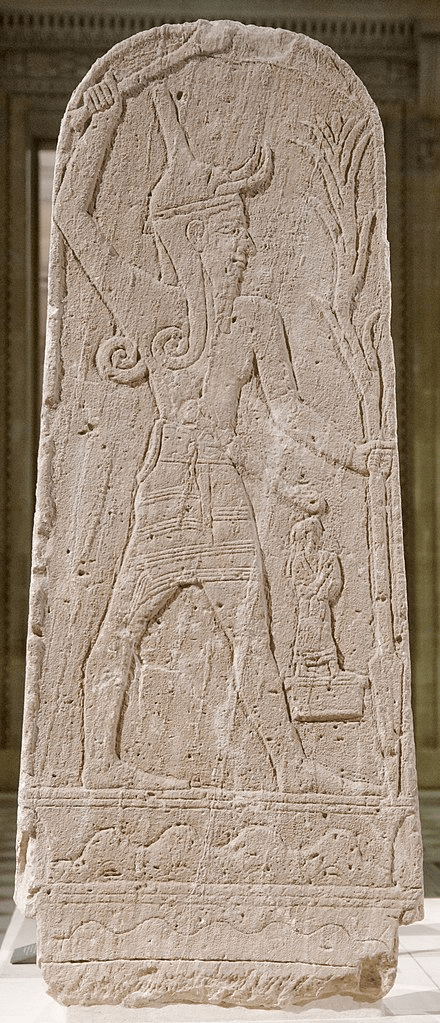
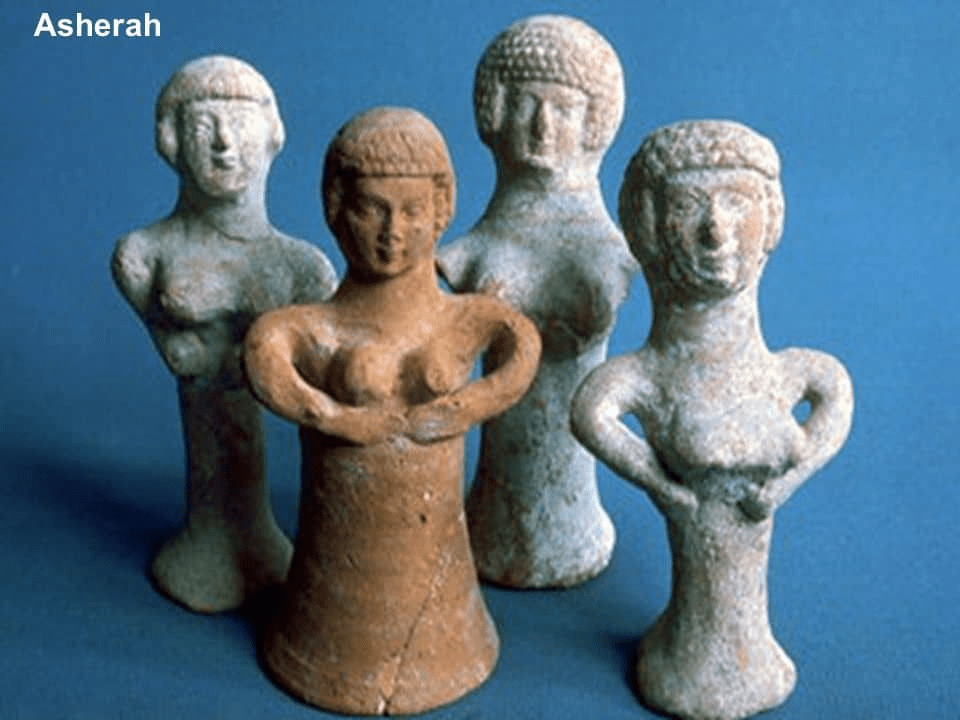
Baal was the supreme god in ancient Canaan and Phoenicia. As the storm god, he was usually depicted holding a raised lightning bolt. His consort, Asherah, was the chief female deity and was represented by a carved pole or limbless tree trunk planted in the ground. Baal and Asherah are often mentioned together in Scripture. Sometimes Baal is mentioned with the goddess Ashtoreth who, in Canaanite mythology, was closely related to Asherah and may have been for a time considered the same goddess. All of them were fertility gods, and their worship rites involved sexual perversion.”
History of the worship of Baal and Asherah (or Ashtoreth) in Israel: it goes back to Balaam. Balak, the king of Moab, had hired Balaam the prophet to curse Israel as they passed by his land on the way to the promised land. Numbers 22:41 And in the morning Balak took Balaam and brought him up to Bamoth-baal, and from there he saw a fraction of the people.” The pagans gave Baal various compound names (similar to Yahweh Rophe, Yahweh Shalom, etc.) and named places after Baal: Baal-gad (“lord of good fortune”, Joshua 11:17), etc. The Spirit did not allow Balaam to curse Israel, but instead through Balaam blessed Israel 4 times. But Balaam got his money by a cunning move. He knew God would curse Israel if they worshipped the gods of the pagans, like Baal. So he persuaded Balak to get Moabite women to intermingle with and worship the gods of the Moabites, which included having sex with them. That happened at Baal-peor. Numbers 25:1 While Israel lived in Shittim, the people began to whore with the daughters of Moab. 2 These invited the people to the sacrifices of their gods, and the people ate and bowed down to their gods. 3 So Israel yoked himself to Baal of Peor. And the anger of the Lord was kindled against Israel.” Numbers 31:16 Behold, these (i.e. the women who had sex with the Israelite men at Baal Peor), on Balaam’s advice, caused the people of Israel to act treacherously against the Lord in the incident of Peor, and so the plague came among the congregation of the Lord.” 24,000 died before Phinehas drove a spead through an Israelite man and Moab woman as they were having sex brazenly right in the camp of Israel. The history of Baal worship continues in Judges. “After the death of Joshua, the worship of Baal and Asherah became a plaguing and perennial problem for Israel. It didn’t take long: in the very next generation after Joshua, “The Israelites did evil in the eyes of the Lord; they forgot the Lord their God and served the Baals and the Asherahs” (Judges 3:7). Later, God told the judge Gideon to clean house: “Tear down your father’s altar to Baal and cut down the Asherah pole beside it” (Judges 6:25). (Judges 8:33 No sooner had Gideon died than the Israelites again prostituted themselves to the Baals.) They set up Baal-Berith as their god.Again, in the days of Jephthah, “the Israelites did evil in the eyes of the Lord. They served the Baals and the Ashtoreths” (Judges 10:6).”
The last judge Samuel persuaded the Israelites to stop worshippin Baal and Asherah at least for a little while. 1 Samuel 7:3 And Samuel said to all the house of Israel, “If you are returning to the Lord with all your heart, then put away the foreign gods and the Ashtaroth from among you and direct your heart to the Lord and serve him only, and he will deliver you out of the hand of the Philistines.” 4 So the people of Israel put away the Baals and the Ashtaroth, and they served the Lord only.” After Samuel anointed Saul as the first king, the people confessed: 1 Samuel 12:10 ‘We have sinned, because we have forsaken the Lord and have served the Baals and the Ashtaroth (i.e. during the period of the judges).”
The “peak”, or maybe better called the “low”, of Baal and Asherah worship came under King Ahab and his wife Queen Jezebel. 1 Kings 16:30 And Ahab the son of Omri did evil in the sight of the Lord, more than all who were before him. 31 And as if it had been a light thing for him to walk in the sins of Jeroboam the son of Nebat, he took for his wife Jezebel the daughter of Ethbaal king of the Sidonians, and went and served Baal and worshiped him. 32 He erected an altar for Baal in the house of Baal, which he built in Samaria. 33 And Ahab made an Asherah. Ahab did more to provoke the Lord, the God of Israel, to anger than all the kings of Israel who were before him.” The prophet Elijah confronted “four hundred and fifty prophets of Baal and . . . four hundred prophets of Asherah, who eat at Jezebel’s table” (1 Kings 18:19) at Mt Carmel. 1 Kings 18: 21 And Elijah came near to all the people and said, “How long will you go limping between two different opinions? If the Lord is God, follow him; but if Baal, then follow him.” And the people did not answer him a word.”The prophets of Baal and Asherah could not get Baal to bring down fire on the altar, but Elijah drenched the altar with water 3 times and then Yahweh consumed the altar with fire. The Israelites killed all 850 prophets of Baal and Asherah. Jezebel then swore to kill Elijah within the next 24 hours and that caused Elijah to flee, ending up at Mt Sinai. He was depressed that Jezebel had not been killed, that his life was in jeopardy. He told God, 1 Kings 19:10 He said, “I have been very jealous for the Lord, the God of hosts. For the people of Israel have forsaken your covenant, thrown down your altars, and killed your prophets with the sword, and I, even I only, am left, and they seek my life, to take it away.”” God rebuked him in a gentle breeze, telling him to get back to his work as a prophet and leave the judging to God. He was to anoint Hazael as king of Syria (who God would use to kill many Israelites), Elisha (to take Elijah’s place later), and Jehu as a later king of Israel (whom God would use to kill all of Ahab’s descendants, cutting off the heads of 70 of his sons (2 Kings 10), to kill Baal worshippers in a trap (2 Kings 10), and to kill Jezebel (he told men to thrown her down from a 2nd story and she died with the dogs eating all of her but her hands, feet, and skull). He told Elijah, 1 Kings 19:18 Yet I will leave seven thousand in Israel, all the knees that have not bowed to Baal, and every mouth that has not kissed him.” Unfortunately, 2 Kings 10:28 Thus Jehu wiped out Baal from Israel. 29 But Jehu did not turn aside from the sins of Jeroboam the son of Nebat, which he made Israel to sin—that is, the golden calves that were in Bethel and in Dan.”
Ahab’s evil son Ahaziah was the next king. He fell through the lattice and was severely injured. Elijah told him: 2 Kings 1:16 He told the king, “This is what the LORD says: Is it because there is no God in Israel for you to consult that you have sent messengers to consult Baal-Zebub, the god of Ekron? Because you have done this, you will never leave the bed you are lying on. You will certainly die!”
It was b/c of this persistent worship of false gods, the worhsip of the golden calves set up by Jereboam, and especially the worship of Baal and Asherah that in 722 BC God sent the Assyrians to take the 10 northern tribes into exile, to be lost forever in history. 2 Kings 17:14 But they would not listen, but were stubborn, as their fathers had been, who did not believe in the Lord their God. 15 They despised his statutes and his covenant that he made with their fathers and the warnings that he gave them. They went after false idols and became false, and they followed the nations that were around them, concerning whom the Lord had commanded them that they should not do like them. 16 And they abandoned all the commandments of the Lord their God, and made for themselves metal images of two calves; and they made an Asherah and worshiped all the host of heaven and served Baal. 17 And they burned their sons and their daughters as offerings and used divination and omens and sold themselves to do evil in the sight of the Lord, provoking him to anger. 18 Therefore the Lord was very angry with Israel and removed them out of his sight. None was left but the tribe of Judah only.” You would think that the southern kingdom of Judah would see what happened to the northern kingdom and would not worship foreign gods or Baal and Asherah. But apparently the worship of Asherah began early during the reign of the first 3 kings of Judah. It says of the 3rd king, Asa, 2 Chronicles 14:2 And Asa did what was good and right in the eyes of the Lord his God. 3 He took away the foreign altars and the high places and broke down the pillars and cut down the Asherim.” “The “Asherim” refers to the cultic symbols or sacred poles associated with the Canaanite goddess Asherah, essentially representing her presence in worship and considered idolatrous by the Bible; they are often translated as “Asherah poles” in English translations.” (AI) Of the 4th king Jehoshaphat it says, 2 Chronicles 17:3 The Lord was with Jehoshaphat, because he walked in the earlier ways of his father David. He did not seek the Baals”.
The next king of Judah was Jehoram. He married Athaliah, the daughter of Ahab and Jezebel, and no doubt she reinforced the worship of Baal and Asherah in Judah. 2 Chronicles 21: 6 And he walked in the way of the kings of Israel, as the house of Ahab had done, for the daughter of Ahab was his wife. And he did what was evil in the sight of the Lord. 7 Yet the Lord was not willing to destroy the house of David, because of the covenant that he had made with David, and since he had promised to give a lamp to him and to his sons forever.” That promise was the only things that kept God from sending Judah into captivity earlier than he did. After the death of Athaliah’s evil son, Ahaziah, Athaliah killed all of the royal house of Judah except for one son, Joash, who was hidden from her for 6 years, making herself queen. The priest Jehoida had her executed and Joash made king. 2 Chronicles 23:16 And Jehoiada made a covenant between himself and all the people and the king that they should be the Lord’s people. 17 Then all the people went to the house of Baal and tore it down; his altars and his images they broke in pieces, and they killed Mattan the priest of Baal before the altars.” Joash began restoring the temple and made this comment in 2 Chronicles 24:7 For the sons of Athaliah, that wicked woman, had broken into the house of God, and had also used all the dedicated things of the house of the Lord for the Baals.”
The 12th king of Judah was Ahaz. 2 Chronicles 28:And he did not do what was right in the eyes of the Lord, as his father David had done, 2 but he walked in the ways of the kings of Israel. He even made metal images for the Baals, 3 and he made offerings in the Valley of the Son of Hinnom and burned his sons as an offering, according to the abominations of the nations whom the Lord drove out before the people of Israel. 4 And he sacrificed and made offerings on the high places and on the hills and under every green tree.” King Ahaz of Judah was the first king of Judah to sacrifice his son in a pagan ritual. According to the Bible, Ahaz sacrificed his son by fire to the god Moloch.
“According to the Book of Hosea, the prophet Hosea prophesied during the reigns of four kings of Judah: Uzziah, Jotham, Ahaz, and Hezekiah. Hosea’s prophetic ministry primarily focused on the northern kingdom of Israel under King Jeroboam II, but his writings also reference the aforementioned Judah kings.” (AI) Several times he condemned northern kingdom’s worship of Baal. The book of Hosea aptly uses adultery as a metaphor to describe Israel’s idol worship. Forsaking the God of their covenant and chasing after false gods such as Baal and Asherah was akin to spiritual adultery.
The 14th king of Judah was the wicked grandson of Ahaz. Ahaz’s son Hezekiah had made many great reforms in Judah, but that didn’t last long. 2 Chronicles 33:2 And he did what was evil in the sight of the Lord, according to the abominations of the nations whom the Lord drove out before the people of Israel. 3 For he rebuilt the high places that his father Hezekiah had broken down, and he erected altars to the Baals, and made Asheroth, and worshiped all the host of heaven and served them. 4 And he built altars in the house of the Lord, of which the Lord had said, “In Jerusalem shall my name be forever.” 5 And he built altars for all the host of heaven in the two courts of the house of the Lord. 6 And he burned his sons as an offering in the Valley of the Son of Hinnom, and used fortune-telling and omens and sorcery, and dealt with mediums and with necromancers. He did much evil in the sight of the Lord, provoking him to anger. 7 And the carved image of the idol that he had made he set in the house of God, of which God said to David and to Solomon his son, “In this house, and in Jerusalem, which I have chosen out of all the tribes of Israel, I will put my name forever, 8 and I will no more remove the foot of Israel from the land that I appointed for your fathers, if only they will be careful to do all that I have commanded them, all the law, the statutes, and the rules given through Moses.” 9 Manasseh led Judah and the inhabitants of Jerusalem astray, to do more evil than the nations whom the Lord destroyed before the people of Israel.” Manasseh’s son was Amon: 2 Chronicles 24:22 And he did what was evil in the sight of the Lord, as Manasseh his father had done. Amon sacrificed to all the images that Manasseh his father had made, and served them.” But Manasseh’s grandson was Josiah, who began reigning at the age of 8. When he was 16: 2 Chronicles 34:3 For in the eighth year of his reign, while he was yet a boy, he began to seek the God of David his father, and in the twelfth year he began to purge Judah and Jerusalem of the high places, the Asherim, and the carved and the metal images. 4 And they chopped down the altars of the Baals in his presence, and he cut down the incense altars that stood above them. And he broke in pieces the Asherim and the carved and the metal images, and he made dust of them and scattered it over the graves of those who had sacrificed to them. 5 He also burned the bones of the priests on their altars and cleansed Judah and Jerusalem. 6 And in the cities of Manasseh, Ephraim, and Simeon, and as far as Naphtali, in their ruins all around, 7 he broke down the altars and beat the Asherim and the images into powder and cut down all the incense altars throughout all the land of Israel. Then he returned to Jerusalem.”
Josiah’s reforms were “too little, too late”. Jeremiah began prophesying in the 13th year of Josaih and prophesied for 40 years during the reigns of five kings of Judah: Josiah, Jehoahaz, Jehoiakim, Jehoiachin (also known as Jeconiah), and Zedekiah. He condemned the worship of Baal many times during his 40 years. Zephaniah prophesied during the reign of Josiah and predicted the fall of Judah. Zephaniah 1:“I will stretch out my hand against Judah and against all the inhabitants of Jerusalem; and I will cut off from this place the remnant of Baal and the name of the idolatrous priests along with the priests, 5 those who bow down on the roofs to the host of the heavens, those who bow down and swear to the Lord and yet swear by Milcom (the god of the Ammonites), 6 those who have turned back from following the Lord, who do not seek the Lord or inquire of him.”
You must be a history buff if you are still reading this long article! We have to ask ourselves, why was the worship of Baal and Asherah such a tempting, persistent problem in the entire history of Israel, going all the way back to Balaam and when the new generation was headed into the Promised Land?
From https://www.gotquestions.org/Baal-and-Asherah.html “There are several reasons why the worship of Baal and Asherah was such a problem for Israel. First, the worship of Baal and Asherah held the allure of illicit sex, since the religion involved ritual prostitution. This is exactly what we see in the incident of Baal of Peor, as “the men began to indulge in sexual immorality with Moabite women, who invited them to the sacrifices to their gods” (Numbers 25:1–2). During this episode an Israelite named Zimri brazenly brought a Midianite woman into the camp and went straight to his tent, where the two began having sex (verses 6–8, 14–15).
Another reason that the worship of Baal and Asherah was a perennial problem for Israel is what we could call international peer pressure. Israel wanted to be like the other nations (see 1 Samuel 8:5, 20). The other nations worshiped Baal and Asherah, and so many Israelites felt a pull to do the same.” In order to placate their gods, the Canaanites would offer their children to the gods and bury them in the foundations of a house under construction.
Many statues of Baal have been uncovered.
Many images of Asherah have been uncovered:
The article from gotquestions.org ends this way:
“The problem of Baal and Asherah worship was finally solved after God removed Israel from the Promised Land. Due to the Israelites’ idolatry and disregard of the law, God brought the nations of Assyria and Babylon against them in an act of judgment. After the exile, Israel was restored to the land, and the people did not dally again with idols.
Christians today may be quick to judge the Israelites for their idolatry, but we should remember that idols take many forms. Idolatrous sins still tempt the modern-day believer (Romans 3:23; 1 John 1:8–10). Instead of bowing down to the ancient forms of Baal and Asherah, we today sometimes honor possessions, success, and physical pleasure to the dishonoring of God. Just as God disciplined the Israelites for their idolatry and forgave them when they repented, He graciously disciplines us and extends the offer of forgiveness in Christ (Hebrews 12:7–11; 1 John 1:9; 2 Peter 3:9).”
We need to heed the words of John: 1 John 5:21 Little children, keep yourselves from idols.” I need to examine my heart. Have I put my money, possessions, prestige, and hobbies above God in my heart, my time spent, my devotion, my priority in life?
King Asa, the 3rd king of the southern kingdom of Judah, reigned for 41 years and was one of the more righteous kings of all 19 kings of Judah. But “pride goeth before a fall”, which means “People who are overconfident or too arrogant are likely to fail.” Humility might be the most important thing for sinners who are seeking a right relationship with God. James 4:6 Therefore it says, “God opposes the proud but gives grace to the humble.” 10 Humble yourselves before the Lord, and he will exalt you.” 1 Peter 5:5 All of you, clothe yourselves with humility toward one another, because, “God opposes the proud but shows favor to the humble.” Luke 14:11 For all those who exalt themselves will be humbled, and those who humble themselves will be exalted.” Micah 6:8 He has shown you, O mortal, what is good. And what does the LORD require of you? To act justly and to love mercy and to walk humbly with your God.”
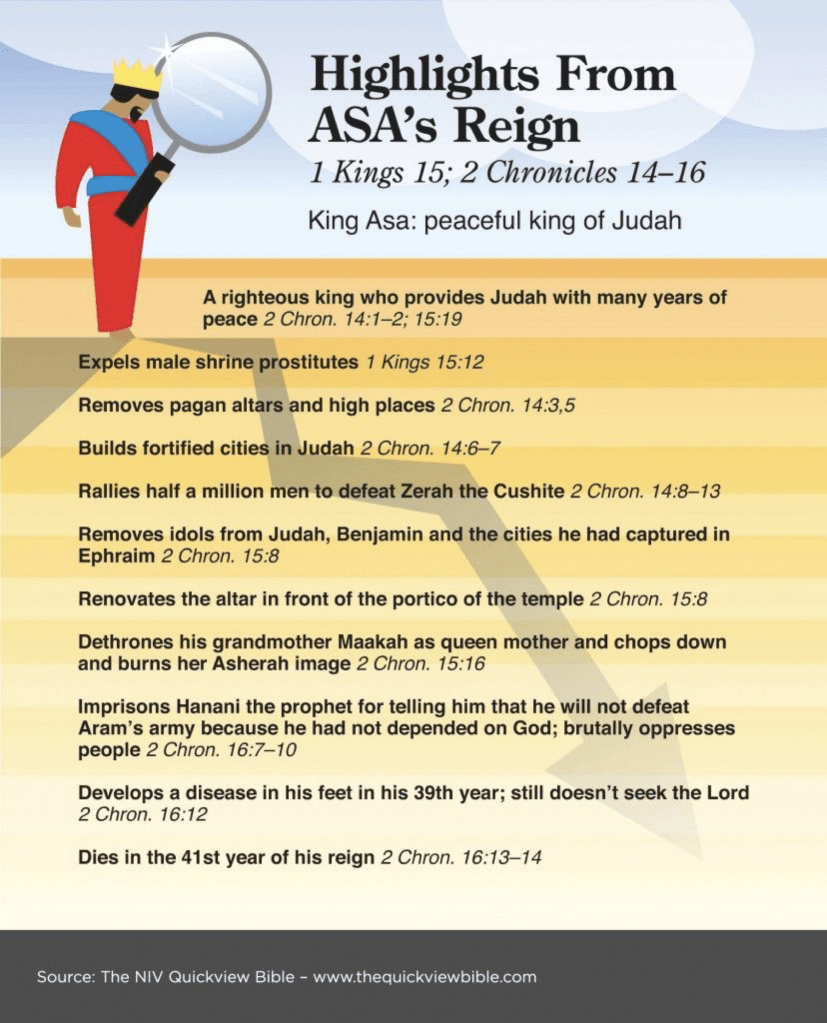
Here is a great image of King Asa’s reforms in Judah.
2 Chronicles 14:2 And Asa did what was good and right in the eyes of the Lord his God. Judah had decayed morally to the point that there were male shrine prostitutes, which Asa remove. He removed pagan altars. Judah had peace with no wars for most of his reign. He bullt walled cities. He had an army of 580,000 men of valor from the two tribes of Judah and Benjamin (which made up the southern kingdom after the kingdom split).
Even when Zerah the Ethiopian attacked Judah with one million men, Asa humbly prayed “O Lord, there is none like you to help, between the mighty and the weak. Help us, O Lord our God, for we rely on you, and in your name we have come against this multitude. O Lord, you are our God; let not man prevail against you.” (2 Chronicles 14:11). Psalm 149:4 For the LORD takes delight in his people; he crowns the humble with victory.” God gave Asa the victory b/c he was humble and trusted God in battle.
The prophet Azariah told Asa, ““Hear me, Asa, and all Judah and Benjamin: The Lord is with you while you are with him. If you seek him, he will be found by you, but if you forsake him, he will forsake you” (2 Chroniclles 14:2). After hearing those words, Asa immediately responded by tearing down pagan altars throughout Judah. He persuaded all the people of Judah and Benjamin, and even those from some of the northern kingdom tribes who had moved to Judah to get away from the idolatry in the northern kingdom, to enter a covenant to seek the Lord with all their heart and soul. Whoever broke the covenant would be put to death. He even removed Micaah, his own queen mother, from being queen b/c she built a detestable image for Asherah. “The heart of Asa was wholly true all his days” (2 Chronicles 15:17).
But things changed in the 35th year of his 41 year reign. The evil king Baasha of the northern kingdom built Ramah on the border between the two kingdoms in order to stop defectors from leaving the northern kingdom to go to Judah to live. There was war between Baasha and Asa. God would have given Asa victory over Baasha if he had just humbly trusted God like he did in the victory over Zerah. Instead, Asa bribed King Beh-hadad of Syria with gold and silver from the temple to attack Baasha and force Baasha to withdraw from fighting Judah. It worked! Apparently Asa was feeling pretty confident in his ability after that.
Hanani the prophet met Asa and told him ““Because you relied on the king of Syria, and did not rely on the Lord your God, the army of the king of Syria has escaped you. 8 Were not the Ethiopians and the Libyans a huge army with very many chariots and horsemen? Yet because you relied on the Lord, he gave them into your hand.” (2 Chronicles 15:7-8) How did Asa handle this rebuke from the prophet? Did he humbly repent and ask forgiveness? 2 Chronicles 15:10 Then Asa was angry with the seer and put him in the stocks in prison, for he was in a rage with him because of this. And Asa inflicted cruelties upon some of the people at the same time.”
What happened that changed Asa from the humble man who sought God with all his heart to one who would in a rage put God’s prophet in stocks in prison and inflict cruelties upon some of the people? PRIDE. Proverbs 16: 18Pride goeth before destruction, and an haughty spirit before a fall.” In the 39th year of his reign, he was afflicted with diseased feet, but instead of seeking the Lord for help, he only sought his physicians. He died without any record of his repenting of his pride.
It is hard to be humble in America when we have so many resources to rely on. Not all, but most o us Christians have money, medical insurance, retirement funds, prestige at work, and respect at work. But when we have a crisis, like health, money, job, marital, or family problems, who do we turn to first? God has given us doctors and there is nothing wrong in seeking help from doctors. But who do we turn to first in a medical crisis: physicians or The Great Physician. When there is a crisis at work or possibly losing my job, who do I turn to first? In a money crisis, who do I turn to first: a financial counselor or the word of God? In a marital crisis, who do I turn to first: a marital counselor or God? Who do I rely on to help me either solve a problem or cope with the problem? The one you turn to first in a crisis is the one you trust to be fully able to help you in the crisis.
God told Solomon after he built and dedicated the new temple: 2 Chronicles 7:14 if my people who are called by my name humble themselves, and pray and seek my face and turn from their wicked ways, then I will hear from heaven and will forgive their sin and heal their land.” Proverbs 14:34 Righteousness exalts a nation, but sin is a reproach to any people.” I think that our country is at a critical point right now. We have been blessed with so many material wealth. “In 2023, the mean personal income in the United States was $63,510. The median household income was $80,610.” “According to the World Bank’s classification, the mean income in “third world” countries, categorized as low-income economies, is typically below $1,145 per capita per year, with lower middle-income countries ranging between $1,146 and $4,515 per capita”. “According to data from the World Bank, around 84% of the world’s population lives in “developing countries,” which is often considered synonymous with “third world countries,” meaning the majority of the global population resides in these regions.” Many complain about lack of money, but usually that is b/c of mismanaging money and debt from a high standard of living. The U.S. has more military might and capability than ever before. “The United States military is considered the most powerful in the world, with a large budget, advanced technologies, and a global presence. The US military’s strength is measured by its capability, capacity, and readiness to handle missions.” 70 % in our country say they believe in God, but according to a 2023 Pew Research Center survey, only 54% of US adults believe in “God as described in the Bible”. So only half of our people believe in Yahweh of the Bible. That other 16% would believe in the god of some of the world religions like Buddhism. Only 30 % attend church. I am not a big proponent of organized churches, but church attendance is still a good indicator of an active faith in God. Only 25% believe that homosexual relations is a morally wrong and a sin. 64% believe that homosexual relations are morally acceptable.
All those statistics sound to me like America is in need of moral reform. If the prophet Azariah was here today, I think he would tell us the same thing he told Asa, “The Lord is with you while you are with him. If you seek him, he will be found by you, but if you forsake him, he will forsake you” . That means believing in the Bible as the verbally inspired error free word of God (the orginals were error free and the translations we have are trustworthy). If the Bible says that homosexuality or adultery or drunkenness in a sin, then it is a sin. That means relying on Yahweh as the only true God and Jesus Christ as the only Savior from our sins. That means relying on God for how we live, think, and do. That means humbling ourselves to love God with all our heart, soul, mind, and strength. That means fellowshipping with other Christians in house churches or even orgainzied churches.
MAGA: “make America great again”. I’m all for that. But I prefer MAHA: “make America humble again.”
1 Corinthians 9:9 Am I not free? Am I not an apostle? Have I not seen Jesus our Lord? Are you not my work in the Lord? 2 If I am not an apostle to others, at least I am to you; for you are the seal of my apostleship in the Lord.
3 My defense to those who examine me is this: 4 Do we not have a right to eat and drink? 5 Do we not have a right to take along a believing wife, even as the rest of the apostles and the brothers of the Lord, and Cephas? 6 Or do only Barnabas and I have no right to refrain from working? 7 Who at any time serves as a soldier at his own expense? Who plants a vineyard and does not eat its fruit? Or who tends a flock and does not consume some of the milk of the flock?
8 I am not just asserting these things according to human judgment, am I? Or does the Law not say these things as well? 9 For it is written in the Law of Moses: “You shall not muzzle the ox while it is threshing.” God is not concerned about oxen, is He? 10 Or is He speaking entirely for our sake? Yes, it was written for our sake, because the plowman ought to plow in hope, and the thresher to thresh in hope of sharing in the crops. 11 If we sowed spiritual things in you, is it too much if we reap material things from you? 12 If others share the right over you, do we not more? Nevertheless, we did not use this right, but we endure all things so that we will cause no hindrance to the gospel of Christ. 13 Do you not know that those who perform sacred services eat the food of the temple, and those who attend regularly to the altar have their share from the altar? 14 So also the Lord directed those who proclaim the gospel to get their living from the gospel.
Before we look at 1 Corinthians 9, we need to tie it in to 1 Corinthians 8. In chapter 8 (please read my article on 1 Corinthians 8-10) Paul discussed what it meant to cause a weak brother to stumble and sin. Without going through the chapter here, we want to just focus on his last statement in chapter 8: 13 Therefore, if food causes my brother to sin, I will never eat meat again, so that I will not cause my brother to sin. So in chapter 9, his basic point is: I am not an apostle like the other apostles (I saw the resurrected Jesus on the road to Damascus which qualifies me to be an apostle). He gave the Corinthians miraculous gifts by the laying on of his hands which made them the seal of his apostleship, proving that he was an apostle. I have the right to eat the meat offered to idols, but I choose to not eat. So he ends up discussing how he had. right to marry (like the other apostles) but chose not to; he had a right to not have to work for a living but chose not to. 15 But I have used none of these things. And I have not written these things so that it will be done so in my case. I chose not to use my freed to do these things, and I am not writing this to get you to start allowing me to do these things.15:for it would be better for me to die than that. No one shall make my boast an empty one! 16 For if I preach the gospel, I have nothing to boast about, for I am under compulsion; for woe to me if I do not preach the gospel. 17 For if I do this voluntarily, I have a reward; but if against my will, I have been entrusted with a commission nonetheless. 18 What, then, is my reward? That, when I preach the gospel, I may offer the gospel without charge, so as not to make full use of my right in the gospel. He sees his reward as being able to preach the gospel for free, not using his right to charge for preaching.
Paul says that he could have charged money for preaching the gospel to the Corinthians. He gave examples of soldiers getting pid, farmers getting to eat some of their vineyard fruit, and shepherds drinking some milk from the flock. He cited the Law: 9:9 You shall not muzzle the ox while it is threshing”, saying that applied to people and not just oxen. He cited the priests who ate some of the offerings of the people. 14 So also the Lord directed those who proclaim the gospel to get their living from the gospel.”
Is Paul defending the paid local preacher system that most churches use today (not house churches)? I guess you could say that he was based on vs 14, but I don’t think he was! Remember, the church met in house churches. The leadership in the house churches was elders and deacons. They had teachers and maybe prophets, but there were no full time paid local preachers in house churches. Then you had apostles and evngelists. The evangelists would travel church to church, town to town, working with congregations on a short term basis or preaching the gospel to establish churches (“evangelists” comes from the word which meant “to announce the good tidings of the gospel”). These traveling evangelists were given food and a place to stay, but they did not become full time local paid preachers. That was started when churches left the house churches and built buidings in the 4th century with paid priests. It evolved into what. we have now with full time paid preachers in what could be called the “church business”. So I don’t think Paul was suggesting full time paid preachers. I think he was talking about those apostles and evangelists who traveled church to church, town to town, and therefore could not do self supporting jobs. They were worthy of support. 9: 11 If we sowed spiritual things in you, is it too much if we reap material things from you? 12 If others share the right over you, do we not more? Nevertheless, we did not use this right, but we endure all things so that we will cause no hindrance to the gospel of Christ.
But Paul felt strongly about not taking any money or support from the congregation that he was working with. He made tents and supported himself in Corinth. He did receive some money/supplies from the church at Philippi while working in Corinth to allow him more time to preach the gospel. Philippians 4:15 You yourselves also know, Philippians, that at the first preaching of the gospel, after I left Macedonia, no church shared with me in the matter of giving and receiving except you alone; 16 for even in Thessalonica you sent a gift more than once for my needs.He told the Ephesian elders: Acts 20: 33 I have coveted no one’s silver or gold or clothes. 34 You yourselves know that these hands served my own needs and the men who were with me. 35 In everything I showed you that by working hard in this way you must help the weak and remember the words of the Lord Jesus, that He Himself said, ‘It is more blessed to give than to receive.’” So to Paul this was a matter of deep conviction.
Is it a sin to have full time paid preachers? First of all, I suppose you could argue that that is a “right” someone or some church could use based on this chapter. It is not a Biblical system, but maybe some can justify it. But is it a wise use of the Lord’s money? Most churches haves several talented, knowledgable men who could preach and teach the word without paying a preacher. But most churches feel that they need a full time preacher who is a talented speaker to compete with other churches. We, like Israel (1 Samuel 8) want to have a “king to be like the other nations”! Then we hire full time youth ministers, educational directors, secretaries, etc.
Paul then tells why he chooses not to use his rights to eat meat, to be paid, etc. He did so for the sake of his influence among the lost, so they would not accuse him of preaching for money. 9:19 For though I am free from all people, I have made myself a slave to all, so that I may gain more. 20 To the Jews I became as a Jew, so that I might gain Jews; to those who are under the Law, I became as one under the Law, though not being under the Law myself, so that I might gain those who are under the Law; 21 to those who are without the Law, I became as one without the Law, though not being without the law of God but under the law of Christ, so that I might gain those who are without the Law. 22 To the weak I became weak, that I might gain the weak; I have become all things to all people, so that I may by all means save some. 23 I do all things for the sake of the gospel, so that I may become a fellow partaker of it.
One verse is interesting. 9:20 To the Jews I became as a Jew, so that I might gain Jews; to those who are under the Law, I became as one under the Law, though not being under the Law myself, so that I might gain those who are under the Law.” But we know that Paul kept the Law strictly even after he became a Christian. In Acts 24 Paul challenged them to bring forth evidence that he was breaking the Law of Moses. Acts 21:20 And when they heard about them, they began glorifying God; and they said to him, “You see, brother, how many thousands there are among the Jews of those who have believed, and they are all zealous for the Law; 21 and they have been told about you, that you are teaching all the Jews who are among the Gentiles to abandon Moses, telling them not to circumcise their children nor to [e]walk according to the customs. 22 So what is to be done? They will certainly hear that you have come. 23 Therefore, do as we tell you: we have four men who have a vow upon themselves; 24 take them along and purify yourself together with them, and pay their expenses so that they may shave their heads; and then everyone will know that there is nothing to what they have been told about you, but that you yourself also conform, keeping the Law. 25 But regarding the Gentiles who have believed, we sent a letter, having decided that they should abstain from meat sacrificed to idols and from blood and what is [k]strangled, and from sexual immorality.” 26 Then Paul took along the men, and the next day, after purifying himself together with them, he went into the temple giving notice of the completion of the days of purification, until the sacrifice was offered for each one of them.” Notice vs 24: but that you yourself also conform, keeping the Law.” He kept the Jewish vow to show that he had not been telling Jewish converts to quit keeping the Law after they became Christians. But this also was to show that he also was “keeping the Law”, which he was. But in 9:20 he says that “he was not under the Law”. Is that a contradiction? I actually did my thesis on this. Paul is not saying the he was no longer under any obligation to keep the Law after he became a Christian. All the Jewis Christians were under obligation to keep the Lw after becoming Christians all the way up to the end of the age in 70 AD. The Law was “perpetual”, i.e. age lasting. But Paul was no longer under the Law as a means of justification. Now he was under the new covennt law of grace and faith for justification.
But the main thought has to be 9:22 To the weak I became weak, that I might gain the weak; I have become all things to all people, so that I may by all means save some.” Back to the weak brother who believes it is a sin to eat meat offered to idols. If that brother sees Paul eating that meat and then eats also while having doubts and violating his conscience, then Paul has caused him to sin. If that be the case, then Paul says he would become like the weak brother and not eat meats ever in order to save that weak brother’s soul.
This requires self discipline, i.e. to not eat that meat even though you really want to eat it! So Paul closes with some comments on self discipline. 9:24 Do you not know that those who run in a race all run, but only one receives the prize? Run in such a way that you may win. 25 Everyone who competes in the games exercises self-control in all things. So they do it to obtain a perishable wreath, but we an imperishable. 26 Therefore I run in such a way as not to run aimlessly; I box in such a way, as to avoid hitting air; 27 but I strictly discipline my body and make it my slave, so that, after I have preached to others, I myself will not be disqualified.”
A CHALLENGE TO THE GODS OF IDOLATRYTO PREDICT THE FUTURE
Isaiah 41:21-29 Isaiah is challenging the pagan gods directly. “Set forth your case”, i.e. defend your existence and reality as if on trial in a courtroom. “Bring your proofs”: what proof do you have that you really are gods? Hinduism, for example, is filled with idols and gods. (AI) “The Hindu trinityThe three gods of the Hindu trinity are Brahma, Vishnu, and Shiva: 1) Brahma: The god of creation. 2) Vishnu: The god of preservation, and the supreme deity in Vaishnavism. Vishnu is often depicted sleeping on the serpent Adishesha, a personification of time, while floating on the ocean of milk, Kshira Sagara. 3) Shiva: The god of destruction, who destroys the universe in order to recreate it. Many other gods that they worship to get special blessings: Durga: The goddess of war. Kali: The goddess of time and destruction, and the divine mother. Lakshmi: The goddess of wealth, fortune, and prosperity, and the consort of Vishnu. Indra: The king of the devas and Svarga, and the god of the thunderbolt. Saraswati: The goddess of wisdom. Parvati: The goddess of power. Thousands of other gods.They have the Vedas: (AI) “The oldest and most authoritative Hindu texts, which Hindus believe were revealed by God and not created by humans. The Vedas were passed down orally for generations before being written down.” The Vedas are full of myths: (AI) “Myths found in the Vedas include the creation story of the “Cosmic Man” (Purusha) where the universe is created from the different parts of his body, the story of the earth goddess Prithivi being impregnated by the sky god Dyaus to produce rain, and the myth of the primordial sacrifice where the different social classes (Brahmanas, Kshatriyas, Vaishyas, and Shudras) are born from different parts of Purusha’s body; most of these myths are found in the Rig Veda, the oldest Vedic text.” Hinduism has legendar creatures: Navagunjara: A creature made up of nine different animals. Panchamukhi Hanuman: Hanuman took on a five-faced form to kill Ahiravana. Reachisey: A mythical animal with the head of a lion, the trunk of an elephant, and the body of a dragon. Hinduism has mytholoical stories: The Ramayana: Rama is exiled with his wife Sita and brother Lakshmana, but is forced to rescue Sita from the clutches of the king of Lanka, Ravana. Other myths and legends in Hinduism: Mahabalipuram and the God who Sunk Temples. Amritam and the Nectar of Immortality. Lord Rama and his Army of Monkeys. Shesha Naga: The Earthquake-Producing Snake. Vish Kanyas: The Squad of Venomous Female Assassins. Then there is Krishna: Often called Lord Krishna, he is one of the most widely worshiped and popular Hindu deities. Krishna is the eighth avatar (or incarnation) of Vishnu. He was deified in the 5th century and since then has also been worshiped as the supreme god himself. Krishna is the Hindu god of compassion, protection, and love.
Isaiah would challenge all the gods of Hinduism (as well as all the other gods of the pagan world religions): Bring your proof that you really exist, that these myths and legends actually happened in history. So what is the main proof that he challenges them to bring? 41:22 Let them bring them, and tell us what is to happen. Tell us the former things, what they are, that we may consider them, that we may know their outcome; or declare to us the things to come. 23 Tell us what is to come hereafter, that we may know that you are gods; do good, or do harm, that we may be dismayed and terrified. 24 Behold, you are nothing, and your work is less than nothing; an abomination is he who chooses you.” Hinduism has no proof of predictons of the future being fulfilled with 100% accuracy. That was God’s way of proving that He is the one true God of the world, that His prophets were speaking His words, and that their writings were inspired by God. 2 Peter 1:19 “And we have the prophetic word more fully confirmed, to which you will do well to pay attention as to a lamp shining in a dark place, until the day dawns and the morning star rises in your hearts, 20 knowing this first of all, that no prophecy of Scripture comes from someone’s own interpretation. 21 For no prophecy was ever produced by the will of man, but men spoke from God as they were carried along by the Holy Spirit.”
Then Isaiah gives an example of accurately predicting the future. He predicts that: 40:25 “I stirred up one from the north, and he has come, from the rising of the sun, and he shall call upon my name; he shall trample on rulers as on mortar, as the potter treads clay. 26 Who declared it from the beginning, that we might know, and beforehand, that we might say, “He is right”? There was none who declared it, none who proclaimed, none who heard your words.” The “one from the north” is Cyrus, King of Persia. Cyrus the Great ruled Persia from 559–530 BC. He is also the “one from the east” in 41:2 Who stirred up one from the east whom victory meets at every step? He gives up nations before him, so that he tramples kings underfoot; he makes them like dust with his sword, like driven stubble with his bow.” Persia was to the northeast of Palestine. Daniel 5 tells of the handwriting on the wall that foretold the fall of Belshazzar’s Babylonian kingdom. Daniel 5:30 That very night Belshazzar the Chaldean king was killed. 31 And Darius the Mede received the kingdom, being about sixty-two years old.” Darius I ruled the Medo-Persian Empire from 522-486 BC, so he could not be the man mentioned here in 539 BC.(AI) “Darius the Mede is mentioned in the Book of Daniel as King of Babylon between Belshazzar and Cyrus the Great, but he is not known to secular history and there is no space in the historical timeline between those two verified rulers.” We leave that debate to scholars. Here is an article that gives 2 options to explain this: https://www.evidenceunseen.com/bible-difficulties-2/ot-difficulties/daniel-amos/dan-531-who-is-darius-the-mede/ It was Cyrus the Persian who took the city of Babylon. (AI) “The Babylonians had prepared themselves for a siege but the Persians diverted the river Euphrates to get into the city. Babylon was surrendered to Cyrus without a fight. Cyrus gave battle against the army of Akkad (Babylon).He defeated them and slaughtered the people.” Cyrus is the king who, after defeating the Babylonians in 539 BC, allowed the Israelites in Babylonian captivity to return to rebuild the temple that Nebuchadnezzar had destroyed in 586 BC. Ezra 1:1 In the first year of Cyrus king of Persia, that the word of the Lord by the mouth of Jeremiah might be fulfilled, the Lord stirred up the spirit of Cyrus king of Persia, so that he made a proclamation throughout all his kingdom and also put it in writing:” It then goes on to say that he allowed the Jews to return and for the Babylonians to give them silver, gold, and all the supplies they needed for the long trip and to rebuild the temple.
The amazing thing about this prediction about Cyrus is that is was made about 150 years before it would be fulfilled, about 100 years before Cyrus was even born! You can see why Isaiah 41:25 says that the prediction concerning Cyrus was a great proof that YHWH was the one true God, as oposed to the false pagan gods who could not predict the future (the challenge Isaiah gave to them). You can see why the “liberals” say that Isaiah could not possibly have predicted this since they believe no one can predict the future with 100% accuracy. Here is a good discussion of the topic. https://hermeneutics.stackexchange.com/questions/75073/what-evidence-is-used-to-support-the-claim-that-isaiah-was-written-before-the-re Basically, the Jews accepted the full book of Isaiah as the product of the prophet Isaiah in the 8th century BC. They were the ones entrusted by God with collecting the inspired scrolls in the old testament. Romans 3:1 Then what advantage has the Jew? Or what is the value of circumcision? 2 Much in every way. To begin with, the Jews were entrusted with the oracles of God.” (AI) The entire Book of Isaiah, including chapters 40-66, is considered part of the Jewish scriptures. While the entire book is included, scholars often divide Isaiah into sections like “Proto-Isaiah” (chapters 1-39) and “Deutero-Isaiah” (chapters 40-66) based on stylistic differences and potential authorship variations.” You can see why they might question the authorship of chapters 40-66 since they would not believe that Isaiah 53 is predicting Jesus the Messiah. So, did the Jews believe that Isaiah’s prediction about Cyrus was written before Cyrus was born? (AI) Yes, Jews traditionally believe that the prophet Isaiah predicted the rise of Cyrus, the Persian king who allowed the Jews to return from exile in Babylon, even mentioning him by name in his prophecies, which are considered to have been written significantly before Cyrus’s time; this is seen as a remarkable example of biblical prophecy coming true.” Our best proof that Isaiah did predict about a future Cyrus is that the Jews accepted that to be true. “This prophecy is seen as a powerful testament to God’s sovereignty and ability to guide history through his chosen instruments.” (AI) “There are multiple theories about the authorship of the Book of Isaiah, with some scholars believing that it was written by 3 authors: 1) Proto-Isaiah: Chapters 1–39, written by the original Isaiah. 2) Deutero-Isaiah: Chapters 40–55, written by an anonymous author during the exile. 3) Trito-Isaiah: Chapters 56–66, written by an anonymous author after the exile. Why would the liberals claim 3 authors? (AI) “Many scholars believe the Book of Isaiah was written by multiple authors due to noticeable differences in writing style, historical context, and the time period covered within the text, suggesting that various prophets or editors added to the original work of Isaiah over a significant span of time, particularly with the “Deutero-Isaiah” theory highlighting a distinct section likely written during the Babylonian exile, significantly later than Isaiah’s life.” But the bottom line is that they won’t accept that Isaiah could predict the future with such accuracy! They deny the miraculous prediction of the future by God’s prophets. They start with the assumption that such is just not possible in the natural and scientific realsm (naturalism), and then try to find proof of their assumption, such as “differences in writing style” in the different sections of Isaiah. This called circular reasoning: Circular reasoning is a logical fallacy that occurs when an argument assumes its conclusion is true and uses it as evidence to support itself. “Certain chapters focus more heavily on themes like redemption and restoration, which could reflect a later perspective on the Babylonian exile”. Of course that is true, but so what. The last part of the book (ch 40-66) focuses on the hope of Israel, both the return from Babylonian captivity and the Messianic hope. BTW the Great Isaiah Scroll, a complete Hebrew copy of Isaiah, was found in the Dead Sea Scrolls (discovered in 1947 AD). “The Great Isaiah Scroll, also known as 1QIsa, is dated to around 100 BCE. The scroll’s date has been determined using radiocarbon dating and palaeographic/scribal dating. The scroll was discovered in 1947 in Cave 1 at Qumran.” This was collected by Jews and is one complete book of Isaiah, all 66 chapters, with no indication of any divisions due to different authors. Again, I’ll go with the Jews on this instead of the naturalists who are looking for reasons to deny the miracles of the Bible!
Before we close the predictions of Cyrus, let’s go to the other verses in Isaiah that predict Cyrus. Isaiah 44:24 “Thus says the Lord, your Redeemer, who formed you from the womb: “I am the Lord, who made all things, who alone stretched out the heavens, who spread out the earth by myself, 25 who frustrates the signs of liars and makes fools of diviners, who turns wise men back and makes their knowledge foolish, 26 who confirms the word of his servant and fulfills the counsel of his messengers, who says of Jerusalem, ‘She shall be inhabited,’ and of the cities of Judah, ‘They shall be built, and I will raise up their ruins’; 27 who says to the deep, ‘Be dry; I will dry up your rivers’;28 who says of Cyrus, ‘He is my shepherd, and he shall fulfill all my purpose’; saying of Jerusalem, ‘She shall be built, and of the temple, ‘Your foundation shall be laid.’”
Again, the prediction of Cyrus, the return from Babylon in 536 BC, and the rebuilding of the temple “confirms the word of His (God’s) servant and fulfills the counsel of His messengers”. But that’s not all! 45:1 “Thus says the Lord to his anointed, to Cyrus, whose right hand I have grasped, to subdue nations before him and to loose the belts of kings, to open doors before him that gates may not be closed: 2 “I will go before you and level the exalted places, I will break in pieces the doors of bronze and cut through the bars of iron, 3 I will give you the treasures of darkness and the hoards in secret places, that you may know that it is I, the Lord, the God of Israel, who call you by your name.” Did you notice, “who call you by your name”? First of all, this prophecy predicts a future destruction and “ruins” of the temple. The temple was destroyed in 586 BC, so this prediction is made over 100 years before the temple is destroyed. Any prediction made by Isaiah in 700 BC of a destruction of the temple to be fulfilled in 586 BC would be blasphemy to the Jews, but Isaiah made it. Then it predicts a “raising up” of the ruins of the destroyed temple, made possible by King Cyrus which necessitates the return of the Jews from Babylon as part of the prediction. . That prediction was fulfilled in 536 BC, over 160 years before it happened, 100 years before Cyrus was born. That’s impressive. But get this! He then “calls you by your name” (45:3). Just to predict the destruction of the temple and the return to rebuild it to be fulfilled 100-160 years in the future is amazing. But to name the king who will allow them to return? To actually call him by name 100 years before he is born!!!!!!!!!! No wonder the liberals reject these predictions of Isaiah.
One last prediction made by Isaiah about Cyrus is Isaiah 46:8 “Remember this and stand firm, recall it to mind, you transgressors, 9 remember the former things of old; for I am God, and there is no other; I am God, and there is none like me, 10 declaring the end from the beginning and from ancient times things not yet done, saying, ‘My counsel shall stand, and I will accomplish all my purpose,’ 11 calling a bird of prey from the east, the man of my counsel from a far country. I have spoken, and I will bring it to pass; I have purposed, and I will do it.” This “bird from the east” must again refer to Cyrus. God predicted about Cryus and God would “accomplish His purposes for raising up Cyrus”, thus proving He is God by fulfilling prophecy (again).
We could give many examples of fulfilled prophecies of the Bible to prove that the God who inspired his messengers the prophets to make those predictions is the one true God, YHWH (also confirming the messengers to be inspired, 44:26). Isaiah himself in the first part of the book (ch 1-39) predicted the fall of Assyria to the Babylonians (612 BC, 90 years in the future) and the fall of Babylon to the Medes (Isaiah 13:17 Behold, I will stir up the Medes against them) and Persians (539 BC, 160 years in the future). We can go to Jeremiah who predicts the rise of the Medes and the fall of Babylon to the Medes (Jeremiah 50 and 51). We can go to Daniel who predicts the kingdoms in order of Babylon, Medo-Persians, Grecians, and Rome in Daniel 2. The prediction about the Grecian kingdom was made over 200 years before it happened, and the Roman prediction was 500 years in the future. . He even names the Medo-Persian and the Grecian kingdoms in Daniel 7,8. He even says that the Grecian kingdom will have a conspicuous horn (Alexander the Great) and that horn will be broken into 4 lesser kingdoms (the Grecian kingdom was divided among his 4 generals after his death). That prediction was made over 200 years before Alexander the Great conquered Persia in 336 BC and before his death in 323 BC. The prediction about the horn and its breaking up into 4 kingdoms is just an amazing prediction that the liberals say could not be predicted (same logic used as on Isaiah’s predictions).
Ezekiel 26 predicts the siege of Tyre by Nebuchadnezzar with its towers and walls broken down and cast into the sea (Tyre lies on the east coast of the Mediterranian Sea. Some have questioned the accuracy of this prophecy b/c Nebuchadnezzar did not destroy the city and throw it in the sea. We think it was accurate but divided into two predictions. Tyre is divided into two sections: part of it is on the mainland, and part of it is an island.At one point, Nebuchadnezzar had plundered the mainland part of Tyre. Quite a while later, Alexander conquered island Tyre. But how did that happen? Basically, there is a natural “land bridge” between island Tyre and the mainland that is about three feet below the water. So Alexander had his men take the ruins from “Old Tyre” (on the mainland) and throw it into the sea so they could walk across! So it was fulfilled just as Ezekiel predicted. Here is an article that discusses all that. https://biblearchaeology.org/research/divided-kingdom/3304-ezekiel-26114-a-proof-text-for-inerrancy-or-fallibility-of-the-old-testament Amos 1:9-10 (800 BC) also predicts that Tyre’s fortresses would fall. Ezekiel 29:15 predicted that Egypt would never again be an empire ruling over other nations. At the Battle of Carchemish in 605 BC, Nebuchadnezzar inflicted a crushing defeat on an Egyptian army led by Pharaoh Necho II, and ensured that the Neo-Babylonian Empire would succeed the Neo-Assyrian Empire as the dominant power in the ancient Near East. Cyrus’ son Cambyses II conquered Egypt in 525 BCE. Cambyses’s conquest was the major achievement of his reign. Ezekiel 25:1-17: Contains prophecies against Ammon, Moab, Edom, Philistia, Tyre, and Sidon, all of which were fulfilled by Babylon invading those nations.
Isaiah 44:6-7 gives the same challenge. 44:6 Thus says the Lord, the King of Israel and his Redeemer, the Lord of hosts: “I am the first and I am the last; besides me there is no god. 7 Who is like me? Let him proclaim it. Let him declare and set it before me, since I appointed an ancient people. Let them declare what is to come, and what will happen.”
Isaiah 45:21 gives this same challenge to predict the future. “Declare and present your case; let them take counsel together! Who told this long ago? Who declared it of old? Was it not I, the Lord? And there is no other god besides me, a righteous God and a Savior; there is none besides me.”
Isaiah 48 has the same stuff. 48:3 “The former things I declared of old; they went out from my mouth, and I announced them; then suddenly I did them, and they came to pass. 4 Because I know that you are obstinate, and your neck is an iron sinew and your forehead brass, 5 I declared them to you from of old, before they came to pass I announced them to you, lest you should say, ‘My idol did them, my carved image and my metal image commanded them.” An intesting added thought here. God predicted the future so that you could see that it was YHWH who made it come to pass, and not the idols.
Many other examples could be given, but I hope that these examples are sufficient. God “set forth his case (41:21) that He is the only one true God, proved by predicting the future with 100% accuracy. Of course we could add all the Messianic predictions. See my blog article “Isaiah Messianic Prophet” for the Messianic predictions given just by Isaiah along. Isaiah 42:1-3 and 45:1-5 are Messianic and covered in the blog article “Isaiah Messianic Prophet” so they are not included in this blog.


 Nicky's Notes