THE HOPE OF ETERNAL LIFE

Key Bible Verses on the Hope of Eternal Life

  • Titus 1:2 (ESV): “In hope of eternal life, which God, who never lies, promised before the ages began”.
  • John 3:16 (ESV): “For God so loved the world, that he gave his only Son, that whoever believes in him should not perish but have eternal life”.
  • Romans 6:23 (ESV): “For the wages of sin is death, but the free gift of God is eternal life in Christ Jesus our Lord”.
  • John 17:3 (ESV): “And this is eternal life, that they know you, the only true God, and Jesus Christ whom you have sent”.
  • 1 John 5:11 (ESV): “And this is the testimony, that God gave us eternal life, and this life is in his Son”.
  • Romans 8:24-25 (ESV): “For in this hope we were saved. Now hope that is seen is not hope… But if we hope for what we do not see, we wait for it with patience”.
  • 1 Peter 1:3 (NLT): “…Now we live with great expectation, and this is because God raised Jesus Christ from the dead”.
  • John 10:28 (ESV): “I give them eternal life, and they will never perish, and no one will snatch them out of my hand”.
  • 1 John 2:25 (ESV): “And this is the promise that he made to us—eternal life”.
  • Titus 3:7 (ESV): “…so that being justified by his grace we might become heirs according to the hope of eternal life

What will it be like if there is no life after death? I recently talked to a very nice man in his 30’s with a wife and 3 teenage children. He said that he was not into talking about life after death. I told him that I wanted to live eternally with my family and that was important to me. I told him that I did not want to simply die and cease to exist for eternity. He said, “we didn’t exist for millions of years so it’s no big deal if we cease to exist for eternity after we die.” The idea of ceasing to exist didn’t bother him. He had no hope of anything good after death. He added, “If there is life after death, I have been a pretty good person and that will be enough.”

I feel bad using that conversation b/c it might seem that I am trying to capitalize on it to do a blog article. But the conversation impacted me a lot. I gave a mini testimony to the man, which he said did not offend him, about the hope of eternal life for those who trust in Jesus’ death for our sins and belief that He was raised from the dead to give us eternal life. I pray that God will open the man’s heart so we can talk more.

The conversation got me thinking about my hope of eternal life. My children believe in Jesus and have the hope of eternal life. We all hope that one day we will all be together in heaven (wherever that is) enjoying eternal life with God, Jesus the Lamb, and other believers in Jesus. I look forward to seeing my mom and dad there, and my wife’s dad. Her mom is stil living at 96.

Read all those verses above. Add 1 John 5:13 These things I have written to you who believe in the name of the Son of God, so that you may know that you have eternal life.” Those living before Jesus defeated spiritual death in 70 AD were still living for the “hope of eternal life” b/c the fulfillment of that hope was still in their future. After Jesus defeated spiritual death in 70 AD, believers after that have eternal life. Now look at John 8:21 Martha then said to Jesus, “Lord, if You had been here, my brother (Lazarus) would not have died. 22 Even now I know that whatever You ask of God, God will give You.” 23 Jesus *said to her, “Your brother will rise from the dead.” 24 Martha *said to Him, “I know that he will rise in the resurrection on the last day.” 25 Jesus said to her, “I am the resurrection and the life; the one who believes in Me will live, even if he dies, 26 and everyone who lives and believes in Me will never die. Do you believe this?” 27 She *said to Him, “Yes, Lord; I have come to believe that You are the [i]Christ, the Son of God, and He who comes into the world.” There was a resurrection in the future when Jesus said this, but notice closer what Jesus said. Jesus said that the resurrection and living eternally was not just about some judgment day and resurrection day. He himself is the resurrection. Believe in Him and you will live even if you die physically. You will never die again spiritually. Some part of you will receive an eternal spiritual body when you become a Christian and you will continue to live eternally with God and Jesus after you die.

1 Corinthians 15 tells us a lot about immortality and eternal life. First of all Paul tells us that our resurrected body will be spiritual not physical. I am amazed at all the Bible scholars who say that someday we will be raised with an eternal physical body. Paul taught just the opposite of that. Secondly Paul tells us that some of those that Paul was writing to would still be alive when the resurrection woud happen. Thirdly Paul tells us that whether dead or alive when that resurrection would happen that all believers would receive immortality, which is the same as eternal life. Paul said that Jesus would destroy spiritual death which would allow for believers to have immortality. Now I believe that resurrection happened in 70 AD just as Daniel predicted in Daniel 12:1-2. All the Old Testament dead, whether wicked or rightesous would be raised to receive their eternal fate of immortality or of destruction. Paul had said in Acts 24:15 that there was “about to be” a resurrection at the time he was speaking. But even if you think the resurrection is still in our future at some point, the lesson in 1 Corinthians 15 is still the same. Believers receive immortality today when they accept Jesus and become Christians. Ephesians 2:1-3 says that they are raised from the dead and made alive spiritually.

The thought of dying still scares me, I must admit, although it shouldn’t. When doubt arises, I try to think about Jesus’ resurrection. The same power of God that raised Jesus from the dead will give me an eternal, immortal part that will live on after death. I hope that those reading this article have that hope. The only way to get that hope is to believe in Jesus (John 3:16). He died to give you that hope. Don’t reject him.
COULD JESUS HAVE BEEN CRUCIFIED ON A DAY OTHER THAN GOOD FRIDAY? COULD HE HAVE BEEN RAISED ON SATURDAY NIGHT OUR TIME?

Here is the argument for the traditional Good Friday crucifixion of Jesus.

Arguments for the Traditional Friday Crucifixion:

Jewish Time Reckoning: In the first century, any part of a day was often counted as a full day. Therefore, Friday (day 1), Saturday (day 2), and Sunday (day 3) fulfill the “three days” requirement

“Preparation Day” Definition: The Gospels identify the day of crucifixion as “Preparation Day” (John 19:31), which is commonly understood to mean the day before the Sabbath (Friday).”

Is it possible that Jesus was raised on Saturday evening (our time which would be Jewish first day of the week) instead of early Sunday morning? AI: “Yes, there is a prominent theological and chronological argument that Jesus was resurrected on Saturday evening (our time), rather than Sunday morning. This theory hinges on a strict, 72-hour interpretation of Jesus’ prophecy that he would be in the “heart of the earth” for “three days and three nights” (Matthew 12:40), combined with Jewish sunset-to-sunset timekeeping. 

Here is the breakdown of that view based on the search results: The “Saturday Night” Argument

  • Jewish Timekeeping: In the first century, days started at sunset, not midnight. Therefore, “the first day of the week” (Sunday) began at sunset on Saturday.
  • The 72-Hour Count: To have 72 hours, three full nights (Wed, Thu, Fri) and three full days (Thu, Fri, Sat), Jesus would have needed to rise around sunset on Saturday—the very beginning of the first day of the week.
  • Tomb Evidence: When the women arrived at the tomb early Sunday morning, it was already empty (John 20:1). This indicates the resurrection happened sometime before their arrival, potentially Saturday night.
  • Wednesday Crucifixion: To align with a Saturday night resurrection, proponents believe Jesus was crucified on a Wednesday, not a Friday. In this scenario, Thursday was a “high day” Sabbath (Passover), Friday was a day of preparation, and Saturday was the regular weekly Sabbath.” In other words, there was a “high day” Sabbath in the last week that did not fall on the weekly Saturday Sabbath, and then there was the weekly Sabbath also mentioned which was on a Saturday That helps clear up what looks like a conradiction in the gospels.

BTW, if you use a strict 72 hour count then the 72 hours ends on Saturday evening at 6pm (Jewish time) and he had to be raised shortly after that. Otherwise, if he were raised, let us say, early Sunday morning our time, then he would be in the tomb more than 72 hours. That would be inconsistent with insisting that the 72 hours was exactly 72 hours. So this view would necessitate that Jesus was raised Saturday evening our time which would be the Jewish first day of the week.

Does it matter? Of course not, except for one thing. If Jesus meant 72 hours when he said “3 days and 3 nights” then he would have been mistaken if he was only in the tomb less than a full 72 hours. Some say that the 3 days and 3 nights could just mean part of 3 days and just two nights. I mean, when we say we are going to the beach for 3 days, that would only include 2 nights. If, as many believe, Jesus was crucified on Friday, he would only be in the tomb a couple of hours on Friday before 6pm Saturday began, and all day Saturday, and then several hours on Sunday: thus parts of 3 days and 2 full nights. The Jewish use of day and night is more specific than that. When the terms day and night are used together, it always refers to a 12 hour day and a 12 hour night (as in Genesis on day 1). So the full 72 hours in the tomb makes more sense.

All this is based on Jesus being raised on the first day of the week (Jewish time). Yes the women came to the tomb early on Sunday, the first day of the week, but it doesn’t say that he was raised on Sunday morning our time. Luke 24:1 the women came on the first day of the week to the tomb. Jesus is walking and talking with the 2 men on the road to Emmaus that same day. Then in 24:21 one of the men said that “it is now (Sunday) the third day since these things (i.e. the trial and crucifixion of Jesus) happened.” Does he mean that Sunday was the 3rd day since Jesus was crucified or does he meant that on that Sunday 3 full days that had passed since Jesus was crucified or does he mean that it was the 3rd day since the sealing of the tomb which happened probably on the day after the crucifixion. A lot hinges on how to interpret what the man said .

Many believe that Sunday was indeed the 3rd day since he was crucified, which is actually what 24:21 says. If so, that gives credibility to the view that Jesus was crucified on Good Friday. Here is that view:

AI: “In Luke 24:21, the first day of the week (Sunday) is considered the “third day” because of inclusive reckoning, a common first-century Jewish idiom where any part of a day is counted as a full day. Crucifixion on Friday our time (Day 1), burial on Saturday our time (Day 2), and resurrection Sunday morning our time (Day 3) constitutes three days. That would be the parts of 3 days and 2 full nights view.

How the 3rd Day Calculation Works: This view used Roman time and our time with a day beginning at. 12 am.

  • Day 1 (Friday): Jesus was crucified and buried before sunset. This portion of Friday counts as the first day.
  • Day 2 (Saturday/Sabbath): Jesus remained in the tomb for the entirety of Saturday.
  • Day 3 (Sunday): Jesus rose early in the morning, making Sunday the third day of the sequence. 

This inclusive method meant that the partial time on Friday, the whole day of Saturday, and the early hours of Sunday were recognized together as three days, rather than a strict 72-hour period. The disciples in Luke 24:21 were counting Sunday as the third day since the events of Friday.” That view makes sense also if it doesn’t have to be a full 72 hours.

Using this same inclusive method, some have even argued that Jesus was crucified on Thursday our time before 6 pm, and, using our time, thus was in the tomb Thur, Fri, and Sat nights and that would mean he was only in the tomb 2 full days (Friday and Saturday our time) but that Sunday was the third day since his death, which is what the man on the road said (Luke 24:21). That view makes more sense that the crucified on Good Friday view to me, but it still would mean that he was not in the tomb a full 72 hours, (instead, 3 full nights and parts of 3 days). Here is that view:

AI: “Yes, it is historically and biblically possible that Jesus was crucified on a Thursday rather than a Friday. This view argues that a Thursday crucifixion provides a full 72 hours (“three days and three nights”) to fit the “sign of Jonah” prophecy (Matthew 12:40), allowing for a Thursday burial and a Sunday resurrection. 

Key Arguments for a Thursday Crucifixion:

  • Three Full Days and Nights: A Thursday death allows for three full nights (Thursday/Fri, Fri/Sat, Sat/Sun) in the tomb before rising on Sunday, addressing the limitation of a Friday crucifixion, which only covers two nights.
  • Two Sabbaths Theory: Proponents argue that a “special Sabbath” (First Day of Passover) occurred on Friday, followed by the regular Saturday Sabbath. The women could have purchased spices on Friday in between the two Sabbaths.
  • Timing of Passover: A Thursday crucifixion aligns with the view that Jesus was killed at the same time the Passover lambs were being prepared on Nisan 14. 

Back to the crucified on Wed Jewish time before Thursday Jewish time began at 6pm

If Jesus was raided shortly after Jewish first day of the week began at 6pm Saturday Jewish time, then start there and back up 72 full hours. That would take you back to crucifixion on Wednesday Jewish time, in the tomb that night Thursday night Jewish time, Thursday day, Friday night, Friday day, Saturday night, Saturday day (all Jewish times) which be right at 72 full hours in the tomb. But how would we reconcile that the man in Luke 24 said that Sunday was only the 3rd day since the crucifixion. Some interpretations suggest that the “third day” refers not to the crucifixion itself, but to the finalization of the sealing of the tomb (which happened probably on the morning after he was crucified). So if that is so, then backing 3 days from Sunday would be from Friday Jewish time, Saturday Jewish time, and then Sunday the 3rd day since the sealing of the tomb on Thursday Jewish time.

I’m still not sure which view to take? What about you? The main thing is that he was crucified for our sins, buried, and raised on the 3rd day. But the timing of all that is debated a lot, and you can see why. After writing this article, I remembered why I have not spent much time in the past studying this topic. Every time I do, I can’t come up with a definitive view. The fact that Jesus specified 3 days and 3 nights does make me want to study it more closely!

Just something to think about as we celebrate the resurrection of Jesus.

WHAT IS LEGALISM AND WHAT IS IT NOT!

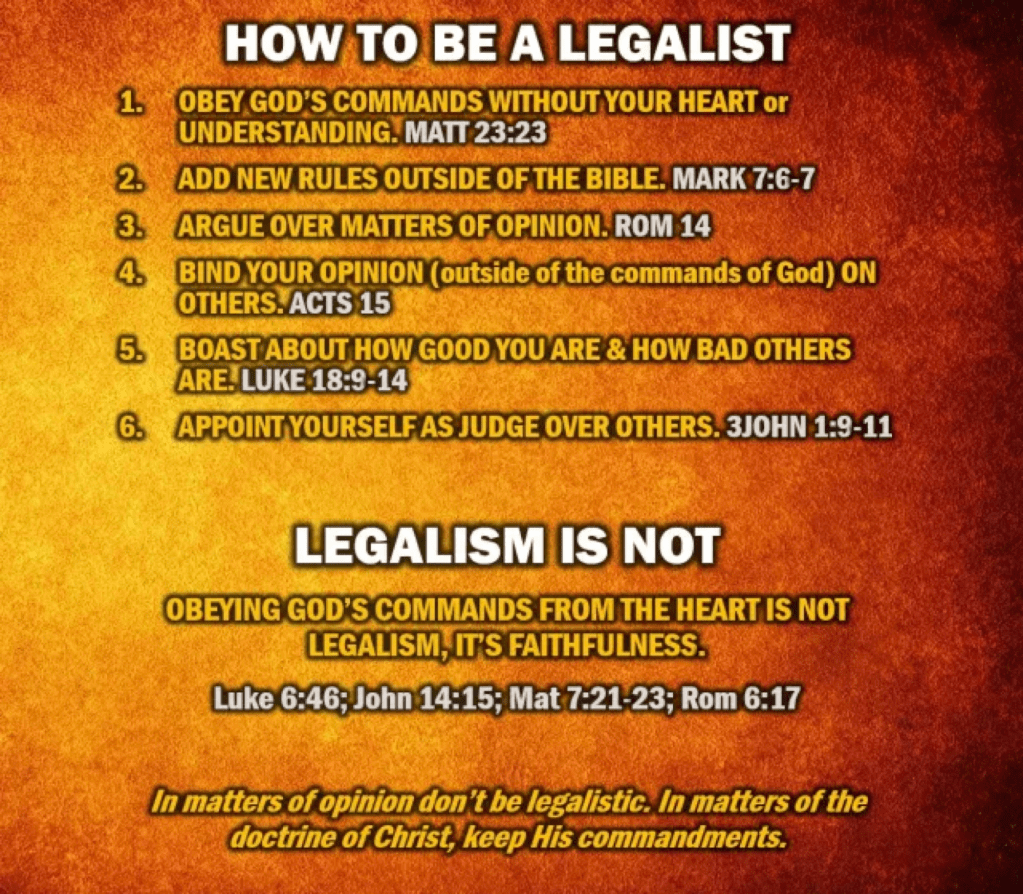
We hear the words “legalism” and “liberalism” tossed out a lot in religious discussions nowadays. Usually it is implied that it is bad or unscriptural to be a “legalist” or a “liberal”. What do these two terms even mean? The definition of these two terms can differ even among sincere interpreters of the Bible, but here is a slide from the Borger Church of Christ that I think really nails it on what legalism is and what it is not.

WHAT LEGALISM IS. Let’s discuss these points. 1) Mattew 23:23 The Pharisees stressed tithing even if they were hypocrites in their hearts. They would tithe even of garden spices that they grew, and yet they neglected mercy and compassion. So legalism includes hypocritically keeping laws of God. You are a legalist if you think that keeping God’s laws can save you even if you are an insincere hypocrite.

2) Mark 7:6-7 The Pharisees condemned Jesus’ disciples for not washing their hands before eating based on their traditions that they had added to the Law of Moses. Jesus said that their worship was vain b/c they taught as doctrine the commandments of men (i.e. their tradition and commandments that they bound on others). Actually, tradition itself is not necessarily bad. In 2 Thessalonians 3:6 Paul called the teachings he had given them “tradition received from us”. Taking the Lord’s Supper every week becomes a tradition based on the commands of Jesus. Even traditions not based on the commands of the Bible are not necessarily bad. Many churches had a weekly tradition of 2 songs, a prayer, another song, and then the sermon every Sunday week after week. Nothing wrong with that. Tradition becomes wrong when, like the Pharisees, someone or some church binds its way of doing things on others, judging and condemning those who don’t follow their example. The Jehovah’s Witnesses have a long standing doctrinal tradition of “no blood transfusions”. They legalistically condemn those who use blood transfusions medically. They don’t allow their members to use them. I would call that legalism. If someone chooses not to have a blood transfusion, that is their choice based on their interpretation of the Bible, but they should not bind that on others.

3) Romans 14:1-3 Paul is discussing differences among believers on eating meats or not, and observing special days. Some say that was just different opinions and not doctrine, but Paul gave a clear doctrine about eating meats (or eating anything). In 1 Timothy 4:1-4 he said that a Christian can eat anything that he wants as long as he gives thanks for it. Paul even said that eating meats offered to idols is not wrong unless it causes someone to stumble by their eating and violating their conscience. But even if there is a clear doctrine about eating meats, Paul said that two believers who disagreed on that should not judge each other and should not withdraw fellowship from one another over that issue. That issue is not a “heaven/hell” issue. God’s grace covers many doctrinal misunderstandings or else none of us would make it to heaven b/c no one understands every single Bible doctrine or teaching perfectly. There are a few “heaven/hell” doctrines like the Deity of Jesus, salvation by grace through faith in the sacrifice of Jesus, loving one another, and obeying God’s moral laws (with right and wrong being defined by God). These are discussed in 1 John as tests of walking in the light and of fellowship with God and other believers. But almost all issues that believers divide over are not heaven/hell issues. Eating meats or not, observing special days (Lent, Sabbath observance), having and eating in kitchens in your church building, using one cup or many cups in the Lord’s Supper, etc. are not heaven/hell issues. Someone might claim they have Bible verses on each of those issues, but that it not the point. The point is that even if someone disagrees with you on the issue, you should not judge them or withdraw fellowship from them b/c those are not heaven/hell issue. Even if you think that you are the one with the correct understanding of the doctrine in question, you still should not condemn those who disagree. I realize that we might even disagree of what the heaven/hell issues are but we should be very reluctant to not make a non heaven/hell issue or doctrine to be a heaven/hell one that we bind on others, causing division.

4) Acts 15 was the conference to decide if circumcision should be demanded of Gentile Christians which is what some Jewish Christians were doing (the Judaizers). The conference, using the inspired testimony of Paul and others, decided that circumcision should not be bound on Gentile Christians. Paul said that circumcision was not a heaven/hell issue in itself, but that binding the practice on others causing division becomes a heaven/hell issue (Galatians 5:1-4). It’s okey to have your opinion about any and all doctrines and issues. Follow your conscience. But if its not a heaven/hell issue then don’t bind your opinion on others, judging and condemning others and causing division.

5) Luke 18:9-14 The Pharisee bragged in his prayer about how he tithed and fasted. He bragged how he was not a sinner like the publican who prayed “God be merciful to me the sinner”. The Pharisee was self-righteous. You are a legalist if your keeping the Laws of God makes you feel superior to others who don’t keep God’s laws as you interpret them. If you do that, you are acting like you own keeping of laws of God saves you, like you are earning your salvation which is legalism in its worst form. You are no longer giving full credit to the grace of God in your salvation and you will probably not be compassionate toward others.

6) 3 John 1:9-11 John condemned Diotrephes harshly. In 3 John, John told the Christians to receive evangelists who came to them teaching the truth about Jesus. Diotrephes claimed to be first among his church. He disagreed with John and those sent out by John on doctrines (mainly the Deity of Jesus), so he unjustly accused John with malicious words and refused to help those sent by John. Not only that, he forbade any other church members from helping them: he even put those who helped them out of the church. This Diotrephes is the kind of church leader whom Paul warned about, those who cause dissension and division, who try to be dictators of others in the church (Romans 16:17). Many such men have split churches time and time again.

WHAT LEGALISM IS NOT. Luke 6:46; John 14:15; Matthew 7:21-23; Rom 6:17. Someone keeping the laws of God as they interpret them is not legalism. They might even have some really strict law keeping that you think is unnecessary in you opinion. A lady thinks she should wear a little covering in the assembly. She should follow her conscience on that, just don’t condemn those who don’t wear it. You can abstain from alcohol completely, just don’t condemn those who drink in moderation. You can choose to not eat pork, just don’t condemn those who do. Over and over the Bible stresses obedience to God’s commands. Someone who tries to keep all of God’s commands in the strictest, most literal sense is not a legalist. He can be a strict keeper of God’s law and yet still trust in the grace of God for salvation and not in his own law keeping. So we should not call him a a legalist and mock him b/c he is such a strict law keeper One final note. Today, if I insist on following a literal interpretation of Paul’s passages where he condemns homsexuality, then some will say that I am a “legalist”, that I am more interested in laws than love. That is not Biblical. If the Bible clearly condemns a practice, then I am nto a legalist if I boldly denounce that practice. If the issue is a heaven/hell issue, like LGBTQ or the Deity of Jesus or universlaissm, then I am not a legalist for condemning such things

HEBREWS 13 THE END OF A “BRIEF” LETTER?

THE CLEAR MESSAGE OF THE BOOK OF HEBREWS The message of the book of Hebrews is clear. The author is telling the Jewish Christians not to leave their faith in Jesus. Don’t be decieved by their non-Christian Jewish brethren who will reveolt agaisnt the Romans in a few years. Don’t go back to trusting in the Law of Moses. In Christ, you have a better messenger than angels, a better deliverer than Moses, a better high priest than Aaron, a better covenant than the old one, a better sacrifce than animals, and a better way of faith. Don’t let the mockers (2 Peter 3) discourage you to think that Jesus’ prediction of his imminent 2nd coming is not going to happen: Hebrews 10:37 He is coming soon and will not delay”. In 30 ADJesus had predicted that He would come within that generation (Matthew 24:30-34) and that was going to be fulfilled in 70 AD which would still be within that generation. The old covenant is about to disappear (Hebrews 8:13), and it did in 70. AD. God is about to (mello) judge the Jews in 70 AD and, if you leave the faith, you will be judged also b/c you have “trampled underfoot the Son of God, and has regarded as unclean the blood of the covenant by which he was sanctified, and has insulted the Spirit of grace? ” (Hebrews 10:26-31). God is going to shake the heavens and earth (a great judgment) one more time in 70 AD, removing the old heavens and earth (the Jewish system) and replacing it with the new heavens and earth, i.e. the Messianic new covenant system (Hebrews 12:18-24).

THE 10 PRACTICAL INSTRUCTIONS TO THE RECIPIENTS OF THE LETTER Having made that message clear, how would you close this letter if you were the author of Hebrews? The message has been about not losing their faith, about not quitting. But not a lot of specific Chrsistian duties. So the book closes with some generic Christian duties for them to practice. 1) Love your fellow Christians. 2) Practice hospitality.for Christians whom you don’t know who need assistance. 3). Remember those in prison b/c of their faith. 4) Be faithful to your marriage vows. 5) Don’t love money. 6) Imitate the faith of those who led you to Christ. 7) Don’t be led astray by those trying to get you to go back to trusing in the old covenant. 8) Continue to offer up spiritual sacrifices of praise, doing good and sharing. 9) Obey your leaders. 10) Pray for us (i.e. those teeaching the Word). These are so practical. The general message in the book is directed to the Jewish Christian who are discouraged and tempted to leave the faith, but chapter 13 had practical admonitions that apply to all Christians of all times. So look at those 10 things and see how you are doing.

THE BENEDICTION AND MYSTERIOUS CLOSING REMARKS The Hebrews author closes the book with a neat benediction: Hebrews 13:20 Now may the God of peace, who brought up from the dead the great Shepherd of the sheep through the blood of the eternal covenant, that is, Jesus our Lord, 21 equip you in every good thing to do His will, working in us that which is pleasing in His sight, through Jesus Christ, to whom be the glory forever and ever. Amen.” Notice the specific mention of the “blood of the eternal covenant” which of course is the blood of Jesus, but the author wants to emphasize again the new covenant. He/she also says, 13:22 But I urge you, brothers and sisters, listen patiently to this word of exhortation, for I have written to you briefly.” 13 fairly long chapters is brief? He/she adds, 13:23 Know that our brother Timothy has been released, with whom, if he comes soon, I will see you.” No one knows where and when Timothy was in prison so as to be released. How was Timothy’s release going to help the author to be able to visit the recipients of the letter? Again, no one knows. Finally, 13:24 Greet all of your leaders and all the saints. Those from Italy greet you.” Does this mean that the author wrote the letter from Italy, or simply that some ex-patriots from Italy were with him/her when he/she wrote the letter? Again, no one knows. Interesting mysterious ending to the letter.

BY FAITH ENOCH WAS TAKEN UP AND DID NOT DIE

Hebrews 11:By faith Enoch was taken up so that he would not see death; and he was not found because God took him up; for before he was taken up, he was attested to have been pleasing to God. And without faith it is impossible to please Him, for the one who comes to God must believe that He exists, and that He proves to be One who rewards those who seek Him.”

ENOCH WAS PLEASING TO GOD. What does that mean? Paul said: “So whether we are at home or away, we make it our aim to please him. (2 Corinthians 5:9)”. “Finally, then, brothers, we ask and urge you in the Lord Jesus, that as you received from us how you ought to walk and to please God, just as you are doing, that you do so more and more. (1 Thessalonians 4:1).” Who do you most want to please? When we admire someone, we want to please them. Jesus said, “The Father has not left Me alone, for I always do those things that please Him” (John 8:29). When we admire and revere God, we want to do whatever pleases Him, whatever brings Him joy and pleasure. We know what pleases Him and we try to do that. For example, the Lord is also pleased when we are generous and share with those in need: “But do not forget to do good and to share, for with such sacrifices God is well pleased” (Hebrews 11:16). We don’t just live to please ourselves.

AN ILLUSTRATION FROM MARRIAGE: From GotQuestions.org “The concept of pleasing God can be compared to a marriage. A woman accepts a man’s proposal and becomes his wife because she loves him and he loves her. They are as married and in love as two people can be, yet they seek ways to continue pleasing each other. He brings her flowers, not so that they will remain married, but because he delights in pleasing her. She gives him a backrub and wears the perfume he likes, not so that he will love her but because she loves him. Likewise, once we’ve entered into a spiritual relationship with God, we want to do things that honor and delight Him.”


ENOCH HAD FAITH IN GOD. Pleasing God begins with faith in God. Without faith it is impossible to please God. We don’t know how much special revelation Enoch had from God. Had God spoken to him often? “Faith comes by hearing and hearing by the word of God’ (Romans 10:17) so surely God had spoken to him. He was a descendent in the line of Seth, the godly line, so surely he would have been taught about the one true God through oral tradition. The most basic thing that someone coming to God needs is to believe that God exists, of course. One might possibly believe that God exists and yet not want to come to God, but if you do want to come to God you must believe that God exists in order to be pleasing to God.

HAVE YOU EVER DOUBTED THE EXISTENCE OF GOD? Have you ever been an atheist who denies that God exists? Or maybe a skeptic who doubts that God exists? Or maybe an agnostic who says that we can’t really know if God exists? Do you ever have moments of doubt where you kinda wonder how this omniscient, omnipresent, omnipotent, spirit that fills the universe can really exist? I think most of us have those moments. A friend of mine said that when he has such a moment of doubt, he goes to the mirror and looks at his eye! He is thinking about all the complex steps required to see: steps and parts that could not have randomly formed by atheistic evolution. The eye is designed by God. The whole human body with its many systems is designed by God. All the systems have to be present and working for the body to be alive and function (irreducibal complexity). The over 30 physics constants in the universe are finely tuned (such as the “G” gravitational constant in the equation F=Gm(1)m(2)/r^2, or the “C” speed of light in the equation E=mc^2). The periodic table is arranged by atomic numbers with each succeeding element in the table having one extra proton and electron. Atheists say the universe started with an explosion of a few elements (although they can’t say where the elements or the explosion came from). How could a few elements evolve randomly into the precision of the periodic table? Atheists say that the universe began from nothing, but the first law of thermodynamics says that, if there was ever nothing, then there would still be nothing. You can’t get something from nothing. As Hebrews 3:2 says, “every house has a builder”. You would never think that a house just popped into existence from nothing. Atheists say that life had to come from non-living chemicals at some point in evolution, but the law of biogenesis says that you can only get living things from living things. Scientists like Redi and Pasteur showed that spontaneous generation doesn’t happen. Before that, it was thought maggots could come from dead meat (they come from flies laid on the meat which is what Redi showed). I could go on, but the bottom line is that there is no other believable view as to how the universe and well designed life came to be if there is no God. It might take faith to believe that there is a God who created everything, but that is more plausible that not believing in God. There must be a supernatural force outside of nature that created it all, and we call that “God”. Romans 1:20 says that we can see God’s invisible power by what he created and that there is no excuse for not bellieving that there is a god. That is called “natural revelation”. That doesn’t tell us what that God is like. It takes “special revelation” where God speaks through prophets to tell us what God is like and what His will is for us. God has done that also in His Word, the Bible. You can see why David said, “The fool has said in his heart that there is no God.”

If you have faith and are pleasing to God like Enoch, you probably won’t get carried up into heaven before you die. But one day when you do die, you will be carried up into heaven to be with Jesus forever. You can meet Enoch and talk about his life and his faith. Won’t that be fun?

IS EZEKIEL 38,39 BEING FULFILLED IN IRAN????

MANY VIDEOS THINK IT IS! I google youtube and get a wide variety of videos. Sports, songs, shorts, religion, history, travel, AGT, cults, ads, politics, etc. I have to click on Ray Stevens “The Mississippi Squirrel Revival”! But also there are usually videos claiming that what is going on in Iran is the fulfilling of Bible predictions from Ezekiel 38,39.

EZEKIEL 38,39 IS NOT AN ELEPHANT! I will tell you what I think Ezekiel is predicting, but first let me tell you what he is definitely not predicting. An illustration that I use is that if you are looking at a really strange small insect you might not know what it is but you definitely know that it is not an elephant! Ezekiel 38, 39 is not predicting anything past the destruction of Jerusalem and the temple by the Romans in 70 AD. I know that b/c of what Jesus said in Luke 21:20 “But when you see Jerusalem surrounded by armies, then recognize that her desolation is near. 21 Then those who are in Judea must flee to the mountains, and those who are inside the city must leave, and those who are in the country must not enter the city; 22 because these are days of punishment, so that all things which have been written will be fulfilled.” This surrounding of Jerusalem had to occur within the generation of those whom Jesus was speaking to b/c he said in Luke 21:32 Truly I say to you, this generation will not pass away until all things take place.” The word for “generation” in the Greek is genea and in the New Testament it always means a 40 year period or the people living in a 40 year period. One usage of the word is in Matthew 1 where there are 42 “generations” from Abraham to Jesus, which covers about 2,000 years. Or Matthew 23:36 Truly I say to you, all these things will come upon this generation” where Jesus is specifically talking about that generation of wicked Jews living at the time he was speaking, predicting the judgement to come on them in 70 AD when a million evil Jews were killed by the Romans.

WHAT DID JESUS SAY ABOUT THE FULFILLMENT OF ALL OLD TESTAMENT PREDICTIONS? But notice what Jesus said: Luke 21:22 because these are days of punishment, so that all things which have been written will be fulfilled.” He is saying that all things which had been written in the Old Testament would be fulfilled by the destruction of Jerusalem in 70 AD. That would include Ezekiel 38,39. So we might not be sure what Ezekiel 38,39 is predicting, but we can be sure that it was not predicting any event past 70 AD! That means it was not predicting what is going on in Iran right now as many claim that it is! It is not an elephant!

HERE IS WHAT I BELIEVE EZEKIEL 38,39 WAS PREDICTING TO HAPPEN IN 70 AD: So what was Ezekiel 38, 39 predicting. Here is my brief belief on that. First of all the time of the fulfillment of Ezekiel 38,39 is “in the latter years” (38:8), “in the last days” (38:16) That phrase “in the last days” used in the New Testament means the last days of the Jewish Age, the time period from 30 AD to 70 AD. The end of the Jewish Age was in 70 AD when the temple was destroyed and when the old covenant “disappeared” (Hebrews 8:13). Ezekiel is predicting a leader God of the land of Magog from the north coming to destroy God’s people Israel. He even said that former prophets had predicted all this. Ezekiel 38:17 ‘This is what the Lord God says: “Are you the one of whom I spoke in former days through My servants the prophets of Israel, who prophesied in those days for many years that I would bring you against them?” Several Od Testament prophets predicted the destruction of Jerusalem in 70 AD at the “end of the age” (Daniel 9,12; Zechariah 14; Isaiah 65,66). But Ezekiel also predicts that God and Magog will be destroyed, after which God will “restore the fortunes of Israel” (39:25) when “I will have poured out My Spirit on the house of Israel,” declares the Lord God (39:29). The pouring out of the Spirit on Israel is predicted by Joel (2:28-32) and Isaiah (44:3 where pouring out life giving water on the offspring of Israel is the pouring out of the Spirit). Ezekiel 37 had predicted the famous valley of dry bones where the bones come to life when God pours out His Spirit on them (37:14). This pouring out of the Spirit is fulfilled beginning in Acts 2 when Peter said that Joel’s prophecy was being fulfilled in the “last days” with the pouring out of miraculous powers on the Jews dead in Judaism who believed in Jesus as the Messiah and came to life spiritually. That would also be the “restoring of the fortunes of Israel: not restoring the physical kingdom fortunes of the whole nation, most of whom rejected Jesus, but restoring the spiritual fortunes of the remnant of Jews who did accept Jesus. It is referring to spiritual blessings in the church kingdom. So Ezekiel 38:17 is predicting that the events predicted in Ezekiel 38,39 would be fulfilled when God poured out His Spirit miraculously on the Jewish church from 30 AD to 70 AD. That would be in total harmony with Jesus’ prediction in Luke 21:22 that “all things written in the Old Testament” would be fufilled by 70 AD.

WHAT DOES THE BOOK OF REVELATION SAY ABOUT GOG AND MAGOG? One final note since Gog and Magog are mentioned in Revelation 20:When the thousand years are completed, Satan will be released from his prison, and will come out to deceive the nations which are at the four corners of the earth, Gog and Magog, to gather them together for the war; the number of them is like the sand of the seashore. And they came up on the broad plain of the earth and surrounded the camp of the saints and the beloved city, and fire came down from heaven and devoured them.” Revelation 1:1-3 and 22:6,10 says that the events predicted in the book of Revelation would happen “shortly” for the time is “near”. The book was written about 63 AD, so the events concerning God and Magog in Revelation 20:7-9 had to be fulfilled soon after that. Gog and Magog “surround the camp of the saints (i.e. Jewish people)’ and the beloved city (i.e. Jerusalem). That must be referring to the Romans surrounding Jerusalem (Luke 21:21) and destroying Jerusalem. That would happen when Satan was released at the end of the “1000 years” to get the Romans to attack Jerusalem. The 1000 years is not a literal 1000 years as most teach b/c it had to end in 70 AD when the Romans destroyed Jerusalem. That means that the 1000 years must be figurative of the period from 30 AD to 70 AD, a 40 year period, the period of the last days of the Jewish Age. But did God destroy God and Magog as Ezekiel 38,39 and Revelation 20:9 predicted. Physically, no. Jesus said that his kingdom was not “of this world” (John 18:36) so the church kingdom has never been about physically destroying the Roman empire or any nation. But the evil princes who controlled Rome, and all the evil princes of all the world kingdoms, were judged in 70 AD and their powers conquered by Jesus. In that senese, God and Magog were destroyed in 70 AD (i.e. their spiritual powers). The kingdoms of the world would then become the kingdoms of the Lord and Christ would reign over his spiritual kingdom, the church, forever (Revelation 11:15). He has been reigning over that spiritual kingdom for 2,000 years now.

So I wish people would quit trying to convince others that Ezekiel 38,39 are being fulfilled in the war in Iran right now. If that was true, then Jesus was a false prophet! I feel the need to to defend Jesus’ words!

DEALING WITH CONFLICT OVER HOW TO BEST DO THE LORD’S WORK OR SPEND THE LORD’S MONEY!

HOW DO YOU HANDLE A DISAGREEMENT OVER HOW TO BEST DO THE LORD’S WORK? Let’s suppose that you disagree with someone about how to best do the Lord’s work or spend the Lord’s money. Maybe an eldership that is, in your opinion, unwisely spending the Lord’s money on buildings and staff instead of on helping the poor and printing Bibles. You have spoken up boldly and shared your views on how you think things should be done. But those you disagree with do not see the value of your ideas and are not implementing your ideas. Maybe they are even making comments that offend you or hurt your pride. You are tempted to respond rashly and get caught up in a “war of words” with them. That’s probably when you just need to walk away quietly, prayerfully leaving it to the Lord to get things done the way you think they should be done. You can’t make it personal. It’s not about you. It’s. only about how to best do the Lord’s work and spend the Lord’s money. Off course, you could even be wrong in your ideas and the Lord might have a better way that your way.

HOW DID DAVID HANDLE CONFLICT How did David haandle such situations? AI: “David frequently avoided getting “caught up” in petty wars of words, choosing instead to focus on actions, divine trust, or, in moments of crisis, simply walking away. When David visited his brothers on the battlefield, his oldest brother Eliab did not see David’s value and put him down. When Eliab questioned his competence, David did not stand up for his ego. He let it slide. Turn away and don’t spend time trying to prove your value, promote yourself, argue your competence or perhaps respond with an equal amount of negativity. David could have been offended and gotten into a war of words with Eliab but he didn’t. There was a bigger battle of the Lord to fight with Goliath. While Goliath, a giant, spent 40 days issuing threats and insults to “fight with words,” David did not engage in a verbal shouting match. Instead, he made one declarative statement of faith (“The battle is the Lord’s”) and moved immediately to action. Despite being relentlessly pursued by Saul, David refused to respond to the slander and injustice with verbal attacks or retaliation. He maintained his “prudent speech” and refused to take vengeance, often leaving his defense to God. He rashly was about to kill Nabal b/c Nabal had refused to give David’s men food after David had asked very politely and peacefully. Abigail brought David food and asked him not to seek vengeance on her foolish husband. David thanked her and did not attack Nabal. When Shimei cursed David, threw stones, and threw dust at him, David explicitly refused to engage or retaliate. He told his men, “Leave him alone, and let him curse,” choosing not to be dragged into a war of words.  David is often described as looking at problems from God’s viewpoint rather than reacting emotionally to insults. Ask God to give you the wisdom you need to know which battles to ignore at home, school, work, church and everywhere you may find yourself (Joseph Anwana, “The Battle David did not fight”).”

PRAYERFULLY WALK AWAY FROM CONFLICT AND TRUST IN THE LORD You may or may not right now be dealing with a situation like what I described, but I assure you that you will be at some time if you are really concerned about how to best do the Lord’s work and spend the Lord’s money. You must speak up. You must make your arguments. You must try to convince others to see it your way. But then leave it with the Lord. Don’t get caught up in a war of words trying to show your worth or the worth of your ideas. Prayerfully walk away and wait to see how the Lord handles it. Trust that the Lord will bring about the best results.

PAUL’S “SHARP DISAGREEMENT WITH BARNABAS”: The apostle Paul did not always handle such situations well. He had a “such a sharp disagreement with Barnabas” over whether to take John Mark (with them on the 2nd missionary journey that they separated and went different ways. John Mark had deserted Paul and Barnabas while on the first journey. Paul took Silas on the journey and Barnabas took John Mark with him on a different journey. Here are two godly men arguing about how best to do the Lord’s work. That’s understandable and inevitable but when did they resort to a “sharp disagreement” instead of just prayefully discussing it and trying to come to a good resolutiion? BTW it turns out that Barnabas might have been the wiser one in this disagreement. As always, he was the “son of encouragement” ( Acts 4:36 his name translated meant that) and was willing to give John Mark a “second chance” but Paul refused to do that. But 10 years later when Paul was in prison in Rome awaiting his beheading, he told Timothy, “Take along Mark and bring him with you, for he is useful to me for service.” (2 Timothy 4:11) So apparently Paul changed his mind about John Mark’s ability to do the Lord’s work after all. But the Lord used the disagreement to perhaps do a better plan that just Paul and Barnabas taking John Mark on the 2nd journey after all. The Lord multiplied one missionary journey into two journeys, perhaps accomplishing more spreading of the gospel.

HOPEFULLY THIS BLOG HELPS YOU IF YOU ARE DEALING WITH A SIMILAR SITUATION I obviously am caught up right now in a situation like I described, so I am writing this to help me deal with it. My emotions are stirred to got caught up in such a war of words, to try to prove my value or the value of my ideas. Even some anger. I hope I can take my own advice, which is hard to do at times! There’s is someone out there reading this blog who is in a similar situation. I recently personally talked to 3 friends who are dealing with a similar situation. We are all frustrated and don’t know what else we can do to advance our ideas. I will share this advice with them just as I am sharing it with you readers.

IS GOD WORKING IN THE WORLD?

HISTORY IS FILLED WITH EVIL: History is filled with wars, genocides, poverty, murder, slavery, greed, political power struggles, revolts, racism, etc. It is pretty obvious that God has allowed people to do about what they want to do, whether it could be doing good or doing evil. We know that God was heavily involved in the history of nations in the Old Testament. He foretold the next 3 kingdoms after Babylon, which would be the Medo-Persians, Greece and Rome (Daniel 2) and raised up and deposed rulers to make that happen. The purpose was to bring about the establishment of his eternal kingdom, the church, in the days of the Roman Empire. God’s sovereignty over the nations was obvious and no one could stop it. But notice that in the New Testament, there is no such prediction of who the world powers would be after Rome. Some thought that the book of Revelation predicted the Catholic Church, but that is not true. Revelation was about things to happen soon, but the formation of the Roman Catholic Church was a few centuries in the future after the book was written. Many have tried to say that the OT prophets predicted nations to come in modern history but all have been shown to be false predictions. There are no NT verses that predict historical events after the Roman Empire and after the fall off Jerusalem in 70 AD.

HAS GOD NOT BEEN WORKING FOR THE LAST 2,000 YEARS? So we might ask, “Has God been working among the nations over the past 2,000 years since the Roman Empire? Since there are no verses that answer that directly, we can only speculate based on what we think is the nature of God’s working among men. Could God have worked with nations to control them over the past 2,000 years? Certainly. If so, we are still left with a lot of questions about when and where God worked? Did he providentially help the allies defeat the Germans to stop Hitler? That might make sense since Hitler would have wiped out Christianity if he wasn’t stopped. But then why didn’t God stop Hitler before he killed 6 million in the Holocaust? Why didn’t he stop Stalin from killing millions in the Ukraine? Why didn’t he stop all the other genocides led by evil dictators?

GOD IS CERTAINLY WORKING WITH INDIVIDUALS IN GOOD AND BAD CIRCUMSTANCES: Maybe God did intervene among the nations but we have no prophets to tell us what He was doing. In the OT the prophets would tell the people exactly what God had done, was doing, and was going to do. So we can only speculate about God’s work among the nations over the last 2,000 years since we have had no prophets during that time (in spite of all the false claims of latter day prophets who falsely tried to predict the future). Maybe God has simply quit working at all among nations or even among people on earth. That is what the deists believe about God’s working from the very beginning. They believe that God created everything, but never intervened in any way after that. No miracles, no prophets, no incarnation of His Son, no predicting the future and controlling the destiny of nations. Maybe after God completed His plan, sent Jesus, destroyed death, maybe He just left everything to free will. If you are fortunate enough to hear the gospel then accept Jesus and be saved. If not, too bad. I don’t want to accept that. I believe that has been working providentially among individuals for the last 2,000 years just as He worked with Joseph and Esther. I believe that He is more concerned with how individuals handle circumstances than He is making circumstances happen one way or the other, for good or for bad. Romans 8:28 He will make all things work together for good but that doesn’t mean that He will make all things work out for good as we define good. I believe He is especially working with those who face dire circumstances, giving them hope through the gospel of Jesus and the hope of eternal life. He will no doubt allow wars to continue and yet give hope to those caught up in those wars. That is happening in the Ukraine as as many are finding Jesus through Bibles given them by EEM. The same with Christians in Iran. It is estimated that there are 120,000-500,000 Christians in Iran. I don’t know if God will get directly involved in Iran to give the people a government that is more accepting of Christianity. But I do know that God will work with the Iranian people on the ground to use the war to lead others to Jesus. Pray for persecuted Christians all over the world. Slavery will no doubt continue in spite of efforts to abolish it, but God will give eternal hope to those who can’t escape slavery. Pray for those caught up in the slave trade and human trafficking.

GOD WORKS IN US AND THROUGH US TO ACCOMPLISH HIS PURPOSES: A verse comes to mind. Philippians 2:12 So then, my beloved, just as you have always obeyed, not as in my presence only, but now much more in my absence, work out your own salvation with fear and trembling; 13 for it is God who is at work in you, both to desire and to work for His good pleasure.” Men will continue to be evil, to hurt innocent people. God is not going to stop that completely. His desire is for people believing in Jesus and receiving eternal life. People have always been more inclined to come to Jesus during bad circumstances. The first century church grew amidst extreme persecution. It got soft when Constantine legalized Christianity and it became popular to be a Christian. The church is still growing best in countries where Christians are persecuted worldwide. The church in the US has become soft bc/ of our materialism, greed, and sinful ways. It doesn’t cost us anything to be a Christian. What we do have in the US is a lot of money. We can help persecuted Christians through various organizations. We can use our money to print and distribute Bibles all over the world through organizations like Eastern European Missions (EEM). Get Bibles to people so that the Holy Spirit can do His work to convince men of their sins and then show them eternal life through Jesus.

ANOTHER LOOK AT CALVINISM

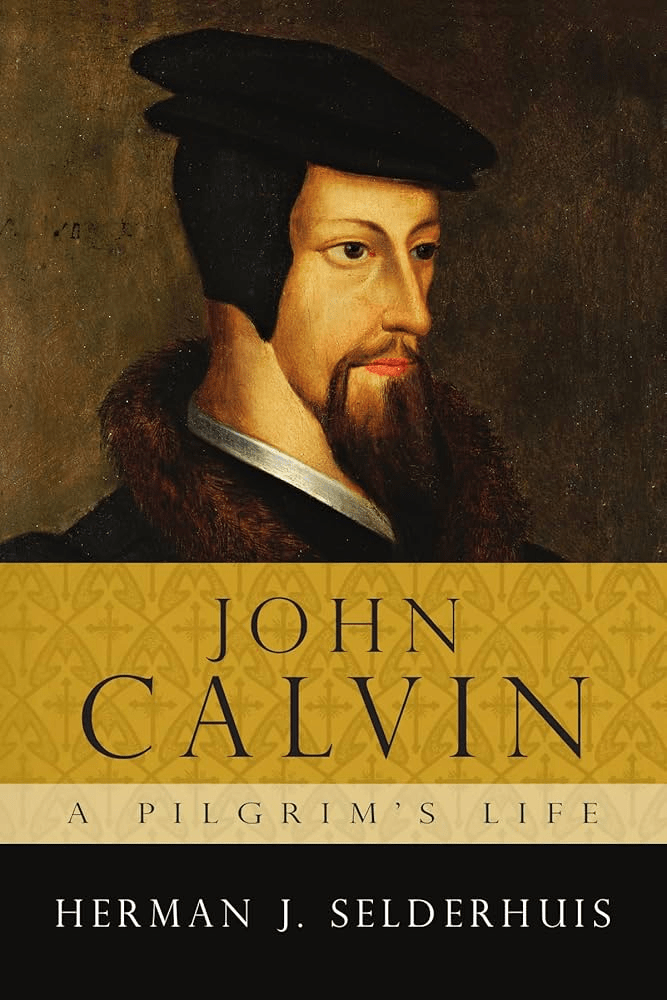
JOHN CALVIN’S TULIP: John Calvin’s doctrine of predestination posits that God, before creation, eternally and sovereignly decreed who would be saved (the elect) and who would be condemned (the reprobate). Calvin believed God’s will is supreme, and human salvation is not based on foreseen faith or merit.” In other words, God arbitrarily chooses who will be saved or lost and people do not have the ability to change that fate even if they want to b/c they are born “Totally depraved” (the T in TULIP). There are no “conditions” or requirements to be met by a person if he is the saved “elect”: thus “Unconditional election” (the U in TULIP). Since only a select number, the elect, were were predestined to be saved, then Jesus only died for those elect and not for all men: “Limited atonement”(the L in TULIP); If you are the predetermined elect, then you can’t choose to resist God’s salvation. You are depraved and can’t just choose to believe. God must send His Spirit on you to change your heart and enable you to believe.Thus, “Irresistible” grace (the I in TULIP). Finally, if you are the saved elect, you will never lose your salvation no matter what you do or don’t do. God’s grace is so powerful that your salvation doesn’t depend on what you do or don’t do. Even if you continue in willful sin, grace will still save you. Thus: “Perseverance of the saints”: you can’t fall from grace (the P in TULIP). THAT’S CALVINISM AND TULIP!!!!!!! Calvinists have Bible passages to support each of the 5 points in TULIP: Ephesian 1:4; Romans 8:28; John 6:44; 10:27-29.

ARMINIANISM: Have you ever heard of the Arminians? AI: “Arminians are followers (called the Remonstrants) of the 16th-century Dutch theologian Jacobus Arminius, holding a Protestant theological view that emphasizes human free will in accepting or rejecting God’s grace, universal atonement (Jesus died for all), and conditional election. They generally disagree with Calvinist doctrines of predestination and irresistible grace, believing instead that God desires all to be saved. God extends grace to all people, enabling, but not forcing, them to believe. Humanity, empowered by grace, has the ability to choose or reject salvation. God chooses (“elects”) individuals for salvation based on His foreknowledge of who will freely believe in Christ, not by arbitrary decree. Christ’s death was for every person, though only those who believe receive the benefit.  While views vary, many Arminians believe it is possible to fall from grace or lose salvation through apostasy. Arminianism is widely found in many Pentecostal, Wesleyan, Free Will Baptist, and other evangelical denominations.” Arminians have Bible passages to support each of their counter arguments against Calvinism: Galatians 5:4; 2 Peter 2:1,20,21; John 3:16; Revelation 3:20; 1 John 2:2; Hebrews 2:9; 6:4-6; Acts 2:38. AS YOU MIGHT GUESS, I AM AN ARMINIAN!!!!!!

CALVIN (16TH CENTURY) AND AUGUSTINE (5TH CENTURY): Calvinistic verses emphasize God’s grace and power in salvation. We can’t earn salvation by good works. Calvinism really began with Augustine, not Calvin. AI: “In the early 5th century, Augustine of Hippo opposed Pelagius in a major theological controversy over salvation, grace, and human nature. Pelagius argued that humans have the free will to achieve righteousness without divine aid, denying original sin. Augustine countered that humanity is corrupted by sin and requires irresistible grace to be saved. Augustine argued that Adam’s sin corrupted all humanity, while Pelagius believed sin is merely a voluntary act. Pelagius emphasized humanity’s capacity to choose good independently. Augustine insisted that, due to the Fall (and original sin), human will is enslaved to sin and entirely dependent on God’s grace for salvation.” Augustine was defending God’s grace against the doctrine that man can saved himself by his own goodness. AI: “Augustine’s theology of predestination profoundly influenced John Calvin, forming the foundation of Calvinist soteriology. Calvin considered Augustine a faithful interpreter of Scripture, often quoting him to support unconditional election, irresistible grace, and the inability of fallen humanity to initiate salvation.”

RECONCILING CALVINISTIC AND ARMINIAN VERSES: To me, it does seem that that many verses appear to support Calvinism, but then there are those verses that refute Calvinism that can’t be ignored. For example, John 10:27-29 appear to teach that no one can fall from grace, but then Galatians 5:4 clearly says that some had “fallen from grace”. They can’t both be true. The scriptures can’t contradict themselves. The only possible explanation that teaches the truth of both verses is this: John 10 says that the sheep who hear his voice and follow Jesus will always have God’s grace, but that is conditional on the sheep hearing and following Jesus. If they do not do that, then they can fall from grace as in Galatians 5:4. So John 10 is a great verse that gives assurance to those following Jesus even though they can fall from grace if they quit following Jesus. That is the only possible reconciliation of the 2 verses that makes sense and avoids a contradiction. The same logic can be applied to all TULIP points and verses that refute TULIP. In each case, each point of TULIP is shown to be false based on the verses that refute TULIP.

A LOVING GOD WOULD NOT DO THE THINGS OF CALVINISM: Then there’s the emotional, logical argument for free will and the nature of God. God is a loving God who desires all men to be saved, “not willing for any to perish” (1 Timothy 2:4; 2 Peter 3:9). Why would God send Jesus just to die for a few men instead of all men? Why would God not allow all men to make a free will choice to believe in Jesus and be saved? Why would He arbitrarily pick some to be saved and others lost with no ability to choose to be saved. Why would He put conditions, like repentance and baptism (Acts 2:38) if it is totally unconditional? Why would Stephen condemn the Jews for “resisting the Holy Spirit” (Acts 7:51) if the Spirit is “irresistible”? Why would God blame the for resisting when they weren’t the elect and didn’t even have the ability to choose to accept or resist? There are so many illogical flaws in Calvinism that go against the loving nature of God.

Churches that teach Calvinism (Reformed theology) are primarily found in the Presbyterian churches, Primitive Baptist churches, and Reformed churches. Presbyterian churches owe their origins to John Knox, who studied under Calvin in the 1550s and desired to establish churches governed by the elder system (elder, in Greek, is presbuteros, hence “Presbyterian”). They follow the “Westminster Confession of Faith” that was drawn up in 1646 AD in England. The confession is a systematic exposition of Calvinist theology but also contains many other church doctrines and beliefs.There have been many famous Calvinistic preachers such as Jonathon Edwards, George Whitefield, Charles Spurgeon, R.C.Sproul, and John MacArthur. Most evangelical churches and preachers are Arminian, not Calvinists. Barton Stone and Aexander Campbell were key leaders in the Church of Christ Restoration Movement. Though a Presbyterian minister, Stone rejected the Westminster Confession of Faith and Calvinistic teachings on predestination, viewing them as unscriptural and divisive. He was more Arminian in his views and focused on the idea that salvation was available to all. Alexander Campbell: Campbell left his Presbyterian ordination (mainly due to infant baptism) and was known for strongly opposing Calvinism and, in particular, the Calvinist-influenced Baptist confessions. He favored a view that emphasized personal faith, repentance, and immersion as necessary for the remission of sins,”

IS CALVINISM HERESY? Can a person believe in Calvinism and still be saved? A saved person might believe that he can’t fall from grace and yet never commit sins that would cause him to fall from grace. But what if a saved person believes that he can’t fall from grace b/c of Calvinist teaching and then commits sins that do cause him to fall from grace? He might still feel like he is saved even though he has fallen from grace. His belief in the P of Calvinism can cost him his eternity with Jesus. Some Baptists avoid this possible situation by saying that a “backsliding church member” who falls back into sin and rejects Jesus “never was really saved”, which doesn’t make sense. They will assure that person that he is saved by God’s grace through his faith for a year and then tell him that he never was really saved if he backslides after that year. The Bible teaches that you can be fully assured of your salvation by grace through faith and yet fall from grace. Why is that so hard to understand? I must also include an experience I had teaching someone who had been influenced by Calvinism. He was a very good moral man who wanted to be saved. But he had been taught by Calvinists that you go to the mourners’ bench to see if you are one of the saved elect and wait for the Spirit to enter and enable you to be saved and give you a sign (an emotional or miraculous sign) to confirm that you are the elect. He tried that 2 or 3 times and got nothing (he was not an emotional person). He gave up on being saved although he continued to be a good moral, family man. I studied Acts 2 with him and showed him the those whose hearts were pricked simply repented and were baptized for the remission of their sins. They knew they were saved b/c the gospel Peter preached to them told they would be saved if they repented and were baptized. My friend said, “You mean if I do that tonight then I will be saved?” I said “yes” and he was baptized that very night and was a faithful, assured Christian until his death several years ago. I wonder how many people never found salvation b/c of Calvinism?

ANOTHER LOOK AT CALVINISM.

TAKING EVERY THOUGHT CAPTIVE

2 CORINTHIANS 10:1-11 2 Corinthians 10:1 Now I, Paul, myself urge you by the meekness and gentleness of Christ—I who am meek when face to face with you, but bold toward you when absent! I ask that when I am present I need not be bold with the confidence with which I intend to be courageous against some, who regard us as if we walked according to the flesh. For though we walk in the flesh, we do not wage battle according to the flesh, for the weapons of our warfare are not of the flesh, but divinely powerful for the destruction of fortresses. We are destroying arguments and all arrogance raised against the knowledge of God, and we are taking every thought captive to the obedience of Christ, and we are ready to punish all disobedience, whenever your obedience is complete.

You are looking at things as they are outwardly. If anyone is confident in himself that he is Christ’s, have him consider this again within himself, that just as he is Christ’s, so too are we. For if I boast somewhat more about our authority, which the Lord gave for building you up and not for destroying you, I will not be put to shame, for I do not want to seem as if I would terrify you by my letters. 10 For they say, “His letters are weighty and strong, but his personal presence is unimpressive and his speech contemptible.” 11 Have such a person consider this, that what we are in word by letters when absent, such persons we are also in deed when present.”

THE HISTORICAL SETTING “Paul wrote 2 Corinthians (c. A.D. 55-56) from Macedonia, following a “painful visit” (2 Cor 2:1), Paul faced continued opposition from “false apostles” who attacked his character, motives, and ministry. Paul addressed false accusations regarding his integrity, his changing travel plans, and his refusal to accept financial support from them, which some deemed evidence of not being a true apostle.” (AI) Some had criticized that he was not bolder when he was with them in confronting the false teachers, thus implying that his authority as an apostle was weak. He basically says, “if you want to see me bold, then just wait: I will be as bold as need be when I come”. He hoped the Corinthians would all repent so that he did not have to be bold when he came.

PAUL’S BATTLE WITH THE FALSE TEACHERS IN CORINTH But I want to focus on vs 5-6. Paul is in a battle for the spiritual minds of the Corinthians. Arrogant false teachers were apparently undermining Paul’s authority with the Corinthian church. No doubt they had convincing arguments. They had heretical doctrines that Paul opposed. But they were not just attacking Paul on a personal level. They were attacking his authority as an apostle. The apostles were given the Holy Spirit to guide them into “all truth” (John 16:13). Their preaching and writings would be the standard for truth from the first century on. By Paul’s authority granted him as an apostle he was “destroying all arguments” against him. He was “taking every thought captive”. What does that mean? “Taking every thought captive (based on 2 Corinthians 10:5) is the proactive, spiritual practice of monitoring your mind to intercept negative, doubtful, or ungodly thoughts. It involves actively rejecting thoughts that contradict biblical truth and replacing them with God’s word, ensuring mental, emotional, and spiritual alignment with Christ. Treating thoughts as potential intruders that must be arrested rather than passively accepted. Comparing thoughts to the Gospel and Scripture to determine their validity. ” (AI) The language Paul uses is of a battle in war: “battle, weapons of warfare, destruction of fortresses, taking thoughts captive”.

PAUL’S BATTLE WITH THE FALSE TEACHERS AT CORINTH But I want to focus on vs 5-6. Paul is in a battle for the spiritual minds of the Corinthians. Arrogant false teachers were apparently undermining Paul’s authority with the Corinthian church. No doubt they had convincing arguments. They had heretical doctrines that Paul opposed. But they were not just attacking Paul on a personal level. They were attacking his authority as an apostle. The apostles were given the Holy Spirit to guide them into “all truth” (John 16:13). Their preaching and writings would be the standard for truth from the first century on. By Paul’s authority granted him as an apostle he was “destroying all arguments” against him. He was “taking every thought captive”. What does that mean? “Taking every thought captive (based on 2 Corinthians 10:5) is the proactive, spiritual practice of monitoring your mind to intercept negative, doubtful, or ungodly thoughts. It involves actively rejecting thoughts that contradict biblical truth and replacing them with God’s word, ensuring mental, emotional, and spiritual alignment with Christ. Treating thoughts as potential intruders that must be arrested rather than passively accepted. Comparing thoughts to the Gospel and Scripture to determine their validity. ” (AI) The language Paul uses is of a battle in war: “battle, weapons of warfare, destruction of fortresses, taking thoughts captive”.

PAUL’S AUTHORITY AS AN APOSTLE Oh how this applies to our spiritual warfare today. The Bible is the inspired, God-breathed word of God. The original manuscripts were infallible and error free. We have over 5,000 ancient manuscripts that allow us to say that we have 99% accurate copies of the originals. Paul’s was of equal authority to the original 12 apostles. 2 Corinthians 12:11 I have become foolish; you yourselves compelled me. Actually I should have been commended by you, since I was in no respect inferior to the most eminent apostles, even though I am a nobody. 12 The distinguishing marks of a true apostle were performed among you with all perseverance, by signs, wonders, and miracles. “Jesus appeared to him on the road to Damascus, qualifying and choosing him to be the apostle to the Gentiles. The Corinthians had seen his apostolic miracles that he did in their presence, They should not have listened for a second to the arguments of the false teachers against Paul’s apostleship. Paul’s letters were inspired by the Holy Spirit and fully authoritative on all matters of Christian living and doctrine. But apparently some of the members had been swayed by the false teachers We are dealing with that same situation today. Many today say that Paul’s writings are not authoritative. The big issue is the LGBTQ issue. Paul plainly and clearly condemns homosexuality as a sin (Romans 1:26-27; 1 Corinthians 6:9; 1 Timothy 1:10). The LGBTQ supporters say that Paul was just homophobic and that we don’t have to follow his teaching. They say that he does not have the authority of an apostle. They might argue that we only have to listen to the words of Jesus and not Paul. So we present arguments to counter their claims, but it seems as if we are losing the battle over Paul’s authority. What’s even more distressing is that many preachers and churches don’t respect Paul’s authority and writings as an apostle either. The recent Methodist church departure from the truth illustrates that.

TAKING EVERY THOUGHT CAPTIVE But there is a more personal application of 2 Corinthians 10:5-6 “taking every thought captive”. Am I aware of the battle for control of my thoughts and mind? Do I recognize thoughts that cause fear, anxiety, or disobedience to God, and then treat them as dangerous enemy intruder that must be taken captive instead of allowing them to roam freely in my mind? Do I replace negative, false, or unhelpful thoughts with biblical truths? Do I actively reject the thought and replace it with a positive, constructive, or truthful one? I don’t know about you, but I have a lot of bad thoughts that come to my mind every day. But I don’t always fight to capture and destroy those thoughts. I know they are wrong but I just allow them to occupy my thoughts for a while. I’m always thinking, “what can I do to capture such bad thoughts when they attack”? Of course, quoting Scripture is good. That is what Jesus did when he was tempted. Surely the thought entered his mind about how good some homemade fresh bread would taste if he turned those stones to bread, especially since he had been fasting for 40 days. But he quoted Scripture, “Man shall not live by bread alone” to counter Satan. David said in Psalm 119:11 “Your word I have hidden/stored in my heart, that I might not sin against You”. Maybe it would be good to visualize something else when a bad thought enters. Maybe picture Jesus on the cross dying for me so that I would not let sin master over me.  

I hope this helps me most of all, but I hope it helps you also.