JOHN G. PATTON: MISSIONARY TO CANNIBALS

Do you have any idea where the New Hebrides islands are? They are in the South Pacific.

The New Hebrides, now known as Vanuatu, consists of roughly 80 islands in the South Pacific. These islands are situated northeast of New Caledonia and southeast of the Solomons. While there are 80-odd islands in total, not all of them are inhabited. Notice the islands of Tanna and Aniwa. They are at the heart of the post today concerning John G. Paton. Born in Scotland in 1824, John married Mary in April, 1858 and 14 days later sailed to the South Pacific and landed on the island of Tanna in November, 1858. They joined a missionary who had been working there for several years. Three months after their arrival, a son, Peter Robert Robson, was born on 12 February 1859. But just 19 days later, Mary died from tropical fever soon to be followed to the grave by the newly born Peter at 36 days of age. The natives on Tanna were cannibals. In 1839 two missionaries had been martyred and eaten by the cannibals in the South Pacific. “After Mary died, John spent nights sleeping on their grave to protect them from the local cannibals. The gravesite is still accessible to this day with a plaque marking the spot, erected in 1996.” (Wikipedia)

John continued alone for 4 years trying to convert the cannibals in spite of the danger he faced from the cannibals. 14 times he was attacked with a fever. He barely escaped the cannibals on many occasions. Later he returned to Scotland to raise money for the work in the New Hebrides and to encourage missionaries to go there. In 1865 he married again to Maggie and they went to another island in the New Hebrides, Aniwa, in 1866. The natives of Aniwa were cannibals also but they were more receptive than those in Tanna. “John learned the language and reduced it to writing. Maggie taught a class of about fifty women and girls who became experts at sewing, singing and plaiting hats, and reading. They trained the teachers, translated and printed and expounded the Scriptures, ministered to the sick and dying, dispensed medicines every day, taught them the use of tools, held worship services every Lord’s Day, built orphanages and took care of many orphans, and sent native teachers to all the villages to preach the gospel. Enduring many years of deprivation, danger from natives and disease, they continued with their work and after 15 years of patient ministry, the entire island of Aniwa professed Christianity. In 1899 Paton saw his Aniwa New Testament printed and the establishment of missionaries on twenty-five of the thirty islands of the New Hebrides.” (Wikipedia) Maggie died in 1905 and John died at the age of 82 in 1907. John spent almost 50 years mission work in Tanna and Aniwa. He was courageous and willing to put his life on the line to propagate the gospel of Jesus.

“In Christianity, an unreached people group refers to an ethnic group without an indigenous, self-propagating Christian church movement. It is estimated that of the 8.08 billion people alive in the world today, 3.42 billion of them live in unreached people groups with little or no access to the Gospel of Jesus Christ.  For every $100,000 a Christian earns, only $107 on average will go to world missions. And roughly 1% of that money will support the 3.1 billion people who live in unreached people groups.” (AI)

I encourage you to pray over this map of unreached people groups worldwide. Churches spend about 75-80 % of the money they collect in contributions on buildings and staff. Churches collect about 75 billion per in contributions but only a small % of that money goes into mission work and a very, very small % of that money goes toward reaching the unreached people groups with the gospel. Fellow Christians, what are we doing? Where do you think Jesus would want all that money spent? Children dying all over the world b/c of unclean water. Families and children in refugee camps trying to escape local warring groups. Famine and flood relief needed. The Bible needs to be translated into all the languages of the world. “As of November 2024 the whole Bible has been translated into 756 languages, the New Testament has been translated into an additional 1,726 languages, and smaller portions of the Bible have been translated into 1,274 other languages. Thus, at least some portions of the Bible have been translated into 3,756 languages.” (AI) So the translations are there, we just need to print and distribute them to the world.

I hope you at least tithe (give a tenth). I hope you give that tithe to the many organizations that print Bibles, support missionaries, drill wells, provide food for the oppressed and needy worldwide.

LOTTIE MOON

In my posts I try to gather info and pass it on to you. You can go to different sites and read the original sources that I gather from, but i hope my summaries make it simpler for you. Today, it’s Lottie Moon, missionary to China. Born in 1840, she went to China in 1873 at the age of 32 and spent 39 years there teaching women and girls and sharing the gospel in China. She was one of the first women to earn a master’s degree in the south. She never married (though engaged at one time) but instead dedicated her whole life to serving God. She spoke Latin, Greek, French, Italian, Spanish, and was fluent in reading Hebrew. Instead of pursuing a career in the U.S. she chose to devote her life to sharing the gospel in China. She adopted Chinese dress and customs and identified with the Chinese people. “She took a special interest in Chinese women, establishing schools for girls and working to free them from customs such as foot binding.” (AI) Lottie had several nicknames in China—foreign devil, foreign lady teacher, heavenly book visitor, and the cookie maker. (Lottie baked cookies to win the hearts of the children and families who were frightened of her.)” (AI) She was often persecuted by Chinese who hated foreigners. “Throughout her missionary career, Moon faced plague, famine, revolution, and war. The First Sino-Japanese War (1894), the Boxer Rebellion (1900) and the Chinese Nationalist uprising (which overthrew the Qing Dynasty in 1911) all profoundly affected mission work. Famine and disease took their toll as well.” (from Wikipedia)

She is famous for her letters to southern Baptist Christians begging them to come do mission work in China among the 472 million Chinese living at that time, or send missionaries, or support sending missionaries. She was a realist. She once wrote home to the Foreign Mission Board, “Please say to the [new] missionaries: they are coming to a life of hardship, responsibility and constant self-denial.” “Disease, turmoil and lack of co-workers threatened to undo Lottie’s work. But she gave herself completely to God, helping lay the foundation of what would become the modern Chinese church, one of the fastest-growing Christian movements in the world. Lottie Moon died at 72 — ill and in declining health after decades ministering to her beloved Chinese. But her legacy lives on. And today, when gifts aren’t growing as quickly as the number of workers God is calling to the field, her call for sacrificial giving rings with more urgency than ever.” (from the International Missions Board of the southern Baptist Church) There are now 1.4 billion Chinese. In 1918 the Women’s Missionary Union started the annual Lottie Moon Christmas Offering for international Missions. Lottie died in 1912. “In her final hours, she sang “Jesus Loves Me” with the missionary nurse who accompanied her. Lottie made one final gesture, pushing her fists together in the form of the Chinese greeting.” (AI) Due to declining health and sharing her food with starving Chinese, she weighed 50 pounds when she died. She was a feminist, promoting gender equality. She would have fit in quite well with the modern feminist movement!

I enjoyed learning more about Lottie Moon. I continue to be amazed at foreign missionaries like Lottie who suffered much to do life long mission work in foreign countries. My usual rant: the church in the U.S. should be sending and supporting missionaries to the unreached peoples groups around the world instead of spending 80% of the contributions on staff and buildings. Pray for all the missionaries abroad. In the messages to the 7 churches (Revelation 2,3), a warning is given several times to the churches to get back to their first love, to strengthen the things that remain, to repent of sin and worldliness, to oppose false teaching (like the lGBQT movement that has captured many churches), and to awake from lukewarm complacency. Those warnings would apply to many churches in the U.S.

GLADYS AYLWARD (INN OF THE 6TH HAPPINESS)

Gladys Aylward (1902-1970)

“She always knew that she would be a missionary, but when Gladys applied to the China Inland Mission she was denied. They didn’t think someone so young could learn the language, and she had little education to back her up. Gladys wasn’t one to give up, and after working as a housemaid, she spent her life savings on a train ticket to China. Her trip was full of setbacks, but in 1932, Gladys arrived in Yangcheng and began to work with an older missionary, Jennie in setting up the Inn of the Eighth Happiness. Gladys worked for the Chinese government as a “foot inspector”, enforcing the new laws against female foot binding. She became a beloved Chinese citizen, affectionately called “Ai-Weh-Deh”. She took in many orphans and unwanted girls. When the region was invaded by the Japanese during WWII, Gladys took around 100 orphans over the mountains to safety. Unable to return to China after the communist regime was in place after the war, Alyward settled in Taiwan where she spent her remaining days running her orphanage.” Chantel from kimdredgrace.com

From Gladys Aylward: The Little Woman book, an autobiography where Gladys tells her own story: “A solitary woman. A foreign country. An unknown language. An impossible dream? No! With no mission board to support or guide her, and less than ten dollars in her pocket, Gladys Aylward left her home in England to answer God’s call to take the message of the gospel to China. With the Sino-Japanese War waging around her, she struggled to bring the basics of life and the fullness of God to orphaned children.”

One of my favorite movies was Inn Of The 6th Happiness (1958) with Ingrid Bergman (a name only we old timers will be familiar with, a great actress). AI: “The movie “The Inn of the Sixth Happiness” is a dramatized, fictionalized account of Gladys Aylward’s life, not a strict biography, and deviates significantly from reality in several key aspects, including character portrayals, plot details, and the actual name of the inn.” It was actually “The Inn of the 8th Happiness”. AI: “The inn was originally called “The Inn of the Eight Happinesses” (Chinese: 八福客栈; pinyin: bāfú kèzhàn), referencing the eight virtues of Love, Virtue, Gentleness, Tolerance, Loyalty, Truth, Beauty and Devotion, but was renamed in the film “The Inn of the Sixth Happiness”. Some romantic scenes didn’t really happen, but the core of the movie is factual. Can you imagine a 30 year old poor woman setting out on a train by herself to go do mission work in Chine? Aylward took a train across Siberia on the Trans-Siberian Railway to China. This dangerous 7,000 mile, 5 week long, trip took place in 1930, at a time when the Soviet Union and China were in an undeclared war.  Can you imagine a young woman in China finding a way to support herself so she could learn Chinese and spread the gospel? Can you imagine her rescuing 100 orphans who were roaming the streets, abandoned, and starting an orphanage? Can you imagine a woman leading 100 orphans over the mountains, avoiding the Japanese, to get them to safety. It is amazing how God provided help for her on the journey. AI: “Gladys Aylward did not lead the children over the mountain entirely by herself; she received assistance along the way, including from a Buddhist priest, Chinese soldiers, and a Chinese officer who helped them cross the Yellow River.” At the end of the journey, “the brown-eyed, modest missionary was virtually unconscious and delirious with typhus and fever.”

I read the story of this woman’s zeal for mission work and her faith and I feel so inadequate. You don’t have to be a missionary in a foreign country to do the Lord’s work. I told my wife to be when we were dating that I wanted to be a missionary. I don’t know why I wanted that? I remember thinking as a teen that it would be more noble to preach the gospel where it had not been preached, which was the apostle Paul’s philosophy. Romans 15:20 It has always been my ambition to preach the gospel where Christ was not known, so that I would not be building on someone else’s foundation.” I remember thinking that we had plenty of paid preachers in the U.S. My philosophy led me and my wife to do 5 years of mission work in Trinidad, West Indies, and Cali, Colombia. But our mission work was nothing like what Gladys did. We didn’t have much money, but we had a supporting congregation, churches, and individuals who provided us to have what we needed to live on overseas. We got on a 6 hour flight to Trinidad, not a 5 week train ride filled with many dangers and hazards. I think the Lord was pleased with our mission work even if it didn’t even start to compare with what Gladys did, but I admire her so much.

I appreciate the good that paid preachers and youth ministers do here in the U.S. I was a full time paid preacher for 6 years. I appreciate the good that organized churches do with their buildings and staff. But I wonder if we are doing church the wrong way? The church in the book of Acts did not have a paid preacher system or buildings. When they took up a collection offering, it was for someone in need (according to Justyn Martyr). They had house churches led by elders. There were evangelists who were like our missionaries, going from place to place where needed, establishing or maturing churches, receiving food and a place to stay from members,but they never became full time paid preachers. Paul himself would never take money from the church he was working with. He supported himself by tent making. He did take some help from another church, other than the one he was working with, so that he could devote more time to preaching where he was working. That’s kinda what we do when we support missionaries for a few years in the field. Churches spend 3/4 of their contributions on buildings and staff. What if we spent 3/4 of the contributions on printing and distributing Bibles, drilling clean water wells, helping orphans (over 150 million orphans worldwide, orphaned by wars, disasters, poverty, diseases like AIDS), etc. Can you imagine the good that churches could do? I appreciate finding a preacher who at least is very involved in mission work, both going on short mission trips and organizing members of his church to go on such trips. I appreciate a church that raised over $200k a year to support an orphanage in Ecuador even if they spend most of their budget on building and staff. At least perhaps they are making the best of the church system that we have set up.

Reading about Gladys Aylward and other great missionaries inspires me to want to be like her. I want to get back to the days when my wife and I only lived to do one thing, to spread the gospel. Or, if we can’t do that now, then am I living to share the gospel with my students I teach at school and others? Is that my passion? God has blessed us so much financially even though making money was never our goal. Am I using my money to support organizations that are printing Bibles (like EEM), that are drilling wells (like Healing Hands), that are establishing self supported mission works (like Mission Upreach in Honduras), that are supporting poor children overseas (like Christian Relief Fund), that are doing mission work in Mexico (like Baja Missions with my long time friend Rex Watson). Those are some of my favorite mission works, but there are many, many more that you might be involved in. Am I involved in helping the poor right here where I live?

So, does the Gladys Aylward story inspire you? Watch the movie if you can. Read the book.

WHAT IS YOUR “AMBITION”?

I encourage you to subscribe for free to have the My Utmost For His Highest by Oswald Chambers to come to your email every day. I am enjoyed a renewed interest in his daily devotionals.

For example the devotional for March 17 was tken from 2 Corinthians 5:Therefore we also have as our ambition, whether at home or absent, to be pleasing to Him.” The Greek for “ambition is philotimeomai: To strive earnestly, to aspire, to be ambitious. “The verb “philotimeomai” conveys the idea of making it one’s aim or ambition to achieve something honorable or praiseworthy. It reflects a strong desire to accomplish a goal that is considered noble or virtuous. In the New Testament, it is used to describe a commendable pursuit or aspiration, often in the context of living a life that is pleasing to God.” (AI). The word is also translated as “goal” or “aim”, but I think “ambition” is the best translation. “While ambition can be a positive motivator, unchecked or excessive ambition can lead to negative consequences, including unethical behavior, burnout, and neglecting important aspects of life.” There is nothing wrong with having the ambition to climb the corporate ladder, achieve success in your career or field, make a lot of money, or own a lot of possessions as long as that ambition doesn’t become the main goal in life to the neglect of the spiritual or as long as we give God the glory and use our success for Him.

But notice that 2 Corinthians 5:9 says that our ambition should be “to be pleasing to Him”. There is nothing wrong with having spiritual goals, such a converting others, helping build a good church, going on mission trips, being involved in community efforts, etc. But Chambers says that those things should no be out ambition or aim. Our ambition should simply be to be pleasing to God. Yes, that would lead to striving to achieve some spiritual goals, but our ambition is just to be pleasing to God. If we make that our ambition, then the Spirit will guide us into specific spiritual things that God wants us to be to make him happy, to make him be pleased with us. Sometimes we set our own spiritual goals mainly to please ourselves, using our own wisdom and gifts without seeking God to see if he would really be pleased with what we are trying to achieve. I might be wanting to preach somewhere but that might not be what he wants me to do to be pleasing to him. He might have other things that He wants me to do.

That Greek word for “ambition” is only used 3 times in the New Testament: Romans 15:20 where Paul “aspired” to preach the gospel; 2 Corinthings 5:9; and in 1 Thessalonians 4:11. I love the one in 1 Thessalonians 4:11 and to make it your ambition to lead a quiet life and attend to your own business and work with your hands, just as we instructed you, 12 so that you will behave properly toward outsiders and not be in any need.” I especially like this passage b/c it describes my dad. He was from the “great generation.” AI: “The “Greatest Generation” refers to Americans born roughly between 1901 and 1927, who came of age during the Great Depression and World War II, and are often characterized by their strong work ethic, frugality, and patriotism.” My dad was born in 1918 so he lived through the Great Depression and World War II (although he did not serve b/c of some medical reason I have been told). He was raised country farm dirt poor. I’m not sure he graduated high school before he went to work with a concrete making plant and worked for them for about 50 years. He never made more than minimum wage so he worked a lot of overtime to provide for us. There was no union at his work, so his reward for all those years was a retirment check of about $100 per month! He built a modest house for us to live in comfortably but we never had much money. He took time to carry me fishing a lot and we built a cabin from scratch on Smith Lake and spent many weekends there fishing and swimming. He attended church regularly with our family but never led a prayer in church. He never prayed aloud with me or our family except when my mom would say at the dinner table, “Ambres, lead the prayer”, and he would pray “God is great, God is good, let us thank him for our food”. We never had a spiritual talk. He never said “I love you”, probably b/c his parents never expressed love for each other. The first time he said “I love you” to me was when he was 72 and was told that he had only 2 more years to live due to a lung disease. He spend those last 2 years expressing love, listening to gospel music, and reading the Bible, and died at age 74 in 1992. As you can see, he didn’t do a lot of the things you might expect a spiritual father to do. But what he did do was to make it his ambition or goal in life to fulfill that passage in 1 Thessalonians 4:11 and to make it your ambition to lead a quiet life and attend to your own business and work with your hands, just as we instructed you, 12 so that you will behave properly toward outsiders and not be in any need.” He did those things all his life! He lived a simple, quiet life. He mided his own business. He worked with his hands. He helped anyone who needed someone to fix something. He did things for a lot of people. When he died, about 500 people signed the register book at his visitation or funeral. Those people were from work, church, family, community, etc. Just a lot of people that he had helped, using his hands and knowledge of how to fix things, all through his life. We tend to think that a “spiritual”man is a Bible quoting, daily Bible reader, prayer leader, elder or deacon in the church, regular church attender, etc. But to me, my dad defines what it means to be spiritual for just a lot of ordinary, hard working, common people.

Read what Paul said in 1 Corinthians 12:14 For the body is not one part, but many. 15 If the foot says, “Because I am not a hand, I am not a part of the body,” it is not for this reason any less a part of the body. 16 And if the ear says, “Because I am not an eye, I am not a part of the body,” it is not for this reason any less a part of the body. 17 If the whole body were an eye, where would the hearing be? If the whole body were hearing, where would the sense of smell be? 18 But now God has arranged the parts, each one of them in the body, just as He desired. 19 If they were all one part, where would the body be? 20 But now there are many parts, but one body. 21 And the eye cannot say to the hand, “I have no need of you”; or again, the head to the feet, “I have no need of you.” 22 On the contrary, it is much truer that the parts of the body which seem to be weaker are necessary; 23 and those parts of the body which we consider less honorable, on these we bestow greater honor, and our less presentable parts become much more presentable, 24 whereas our more presentable parts have no need of it. But God has so composed the body, giving more abundant honor to that part which lacked, 25 so that there may be no division in the body, but that the parts may have the same care for one another. 26 And if one part of the body suffers, all the parts suffer with it; if a part is honored, all the parts rejoice with it.

Think about what Paul said. We tend to give the most honor to the more gifted in the church, the leaders, the preacher, the elders, the youth ministers, the ones who seem to be more important. But Paul says that those people know that they are more gifted and more visible, and they do not need to constantly be told how important they are. they don’t need special attention to buld them up, to show how badly they are needed in the body. Often times they are inflated with their own gifts and importance, as was teh case in the Corinthian church where some of the more gifted members had become arrogant. Instead it is the less noticeable who we need to give special attention and honor to. We need to constantly be telling them how important they are in the body. There is someone like my dad who got very little notice in the church activities, but the church is the people, not the organized church business model. He was important to the body in what he was doing to use his hands to help a lot of people outside of the church assembly, men’s business meetings, Bible classes, or visitation programs. We tend to think of the church in the church business model and what the members visibly do for the church business. Instead we should think of the church as the people using their gifts 24/7 at home, at work, in their friendships, in taking care of their kids and/or elderly parents. We sometimes say “10% of the members do 90% of the church work”, but that usually means church work taking care of the building, being involved in the visitation program, attending Sunday night as well as Sunday morning, attending Wednesday evening Bible classes, doing projects around the building, taking care of assembly preparations, etc. Maybe not all, but many of those 90% that we criticize are people like my dad who are fulfilling 1 Thessalonians 4:11 every day. They are doing “church work”. Or maybe some unassuming, humble, barely noticeable lady member who takes food to the poor every Saturday, or takes care of elderly parents, or takes care of some widows in the church or takes care of foster children. That is “church work”. We tend to give honor to those more visible in the church busines work instead of the real church work. We need to keep giving special honor to the less noticeable members doing the less noticeable church work.

I guess I got sidetracked! Just make it your ambition to be pleasing to God and He will guide you on what He wants you to do. It might not be what you want to do, but that doesn’t matter! Ask yourself every moment today: “Does what I am doing, thinking, or saying please the Father?

Adios y Dios los bendiga! Goodbye and God bless you.

2 TIMOTHY 2:1-2 Training leaders; How churches spend their money

Refer to 2 Timothy 1 blog article to get background of this last letter of Paul before he is beheaded in Rome by Nero about 65-66 AD. Remember he pretty well knows that this is his last winter. He is writing a very personal letter to his beloved son in the faith, Timothy. Instead of verse by verse, I am just giving some key texts and how they might apply to us.

2 Timothy 2:1 You therefore, my son, be strong in the grace that is in Christ Jesus. The things which you have heard from me in the presence of many witnesses, entrust these to faithful people who will be able to teach others also.” This verse means a lot to me. When I finished 2 years at the school of preaching in West Monroe, La, the Lord guided my wife and I to do 3 years of mission work in Trinidad, West Indies. The work in Trinidad had been started all over on the island, mainly due to the work of Bob Brown. “Campaigns” all over the island led to thousands of baptisms. I went on one that baptized 150 in less than 2 weeks. That led to the starting of congregations all over the island. My coworker chose the southern part of the island b/c there were no missionaries or preachers, and the churches were young. But this verse was a key in our mission. We baptized more people and we established a few more congregations, but our mission was to train leaders in those churches that could carry on the work after we left without relying of U.S. money to pay preachers. After all, that is the way it was done in the New Testament early house churches.

We had seen the paid preacher system in mission work (foreign preachers paid by U.S. congregations) and wanted no part of that. It wasn’t Biblical and it wasn’t effective in the long run. We did start a full time 2 year school of preaching in Trinidad and we missionaries taught the classes, very similar to my school of preaching in La. That might have been needed since we brought in men from other islands as well as Trinidad to train. Looking back, I’m not sure how effective that really was, however. The best thing we did was a “Saturday” mini school of preaching for a year for local leaders, men and women, members who had regular jobs, those who could preach and teach the word. We did many of the same Bible courses, just cut back. We trained a customs agent, an oil company employee, a postman, etc. These men and women led the churches over the past 50 years since we were there! They have never had a paid by the U.S. preacher in that time. In turn, after we left after 3 years, they trained other men, just as 2 Timothy 2:1 says: entrust these to faithful people who will be able to teach others also.” The congregations are still doing well. Some of the men we trained have established new congregations and have done mission work in Guyana, which is just across the bay in South America.

It was kinda ironic when they would come back from a short mission trip to Guyana and tell me that there were several paid by the U.S. preachers in Guyana that were “momaguying” (deceiving, fooling, tricking) the U.S. supporting congregations by putting on a show when their representatives were in Guyana on short trips. Our Trinidadian guys saw that the Guyana paid preachers were just putting on a show while they were there, but after that weren’t working hard at all.

Such is the paid by the U.S. preacher system everywhere. Granted, short term pay of missionaries might be necessary. After all, we were supported by U.S. congregations while in Trinidad. But it was never to set up a paid preacher system in Trinidad, which we did not do. I know that system works well is some places, but only as long as the U.S. money keeps coming. Is it still viable? Maybe so if the preachers are honest, sincere men who are not preaching for money, for a job. But often that is not the case. Often those preachers will stop preaching and evangelizing if the pay stops. Also, the paid by the U.S. preacher tends to become “the pastor” who runs the show in the congregations, instead of installing elders to shepherd the flocks. I was glad to see one of our Trinidadian congregations appoint elders recently. I do know of some mission works that train leaders in some way but then expect the leaders to get jobs to support themselves; the U.S. churches give them “working funds” to their travel, etc. as they minister to the local congregations and that seems to work pretty well.

I know Paul said 1 Corinthians 9:Or is it only Barnabas and I who have no right to refrain from working for a living? 11 If we have sown spiritual things among you, is it too much if we reap material things from you? Galatians 6:Let the one who is taught the word share all good things with the one who teaches.” But is Paul talking about paying full time local. preachers? There was no such thing in the local church. He must have been talking about traveling evangelists like Timothy and Titus, who might not be able to support themselves with a job like Paul supported himself with tent making. That full time traveling evangelist might even end up being supported full time without supporting himself. Paul personally would never take money from the church he was establishing and working with. Paul spent 3 years working with the church in Ephesus but he told the Ephesian elders Acts 20: 33 I coveted no one’s silver or gold or apparel. 34 You yourselves know that these hands ministered to my necessities and to those who were with me.” Apparently he never took money from them. He made tents to support himself while working in Corinth. He did receive some help from the church at Philippi to give him more free time to preach (Philippians 4) while he was in Corinth, but he would not take money from the church in Corinth. Some elders actually received supplemental income if their shepherding took so much time from their jobs that they could not support their families. 1 Timothy 5:17 Let the elders who rule well be considered worthy of double honor, especially those who labor in preaching and teaching. 18 For the Scripture says, “You shall not muzzle an ox when it treads out the grain,” and, “The laborer deserves his wages.” But no full time local paid preachers.

But what amazes me is that we run the same paid preacher system here in the U.S. Usually there are several competent men leaders and elders who are “able to teach” (1 Timothy 3:2) , who “hold firm to the trustworthy word as taught, so that he may be able to give instruction in sound doctrine and also to rebuke those who contradict it” (Titus 1:9). Men who have jobs and are self supporting. And yet we hired preachers, often at large salaries and benefits, to preach sermons (which is the main thing they do). We build large congregations and draw new members (usually from other congregations which swap members all the time with other congregations) around the paid preacher’s ability to deliver sermons that appeal to us. The pay might include visiting the sick, which is really the work of the elders and members, or the paid preacher might insist that is not part of his work. This paid preacher system is not Biblical. I’m not saying that it is a sin. It’s just not Biblical. In house churches, elders did the shepherding. There were teachers. Evangelists were not full time local paid preachers. They traveled to different churches, stayed for different periods of time, were given food and a place to stay while they were at a church, but then moved on. They never became full time paid preachers for local congregations. The Didache (100 AD) said that if they stayed for more than 2 or 3 days that they were preaching for money and should be sent away. Again, many congregations do this system well. They hire really good preachers who can do very good sermons and draw members. Other congregations deal with the complications of this faulty system when they hire a preacher who doesn’t turn out to be a good person, or they just get tired of him and his sermons. Or he just moves on to a higher paying or better church situation. How much money is spent on this paid preacher system? Millions. (

AI) “According to available data, the average church allocates around 50% of their contributions towards staff salaries and benefits, while typically dedicating another 25-30% towards building costs, including maintenance and utilities, meaning a combined percentage of roughly 75% of contributions go towards staff and buildings combined.” About 10% of money collected goes to ministry programs for youth and adults among the members themelves. About 10% goes to mission work, printing Bibles for mission work drilling wells for clean water in Africa, supporting widows and orphans. That leaves about 5% miscellaneous. Here is a good article on how churches spend their money. https://www.churchlawandtax.com/manage-finances/budgets/how-churches-spend-their-money/ Church buildings now cost in the millions and churches have many on staff. One local church built a $1 million dollar bell tower which is impressive, but how many wells could be drilled for clean water and how many poor children overseas could be supported with that money? But could large churches with buildings and paid preachers and staff function without full time employee? Probably not. So, we just continue to do the same non Biblical system whether it is a wise use of the Lord’s money or not. I know this is just my opinion. Others would say that the system works well and, even though 75% of collections is spent on buldings and staff, there is a lot of good edification of members going on and at least 10-15% is going to missions, benevolence, etc. But in effective churches, usually that edification really happens in small groups that meet. The assembly does edify many, but the most personal one on one edifications comes from small groups that meet in houses. Sounds like the early church house churches, doesn’t it?

How would the church do if we did away with church buildings and paid staff and went to only house churches? (AI) “Due to the nature of house churches often operating underground or without official registration, it’s impossible to give a precise number of churches meeting solely in homes across foreign countries; however, estimates suggest millions of people globally participate in house churches, particularly in countries like China, where religious restrictions drive many Christians to meet in private homes; conservative estimates for China alone could reach tens of millions of house church attendees.” From https://jcgresources.com/en/resources/church_planting/en_contemporary/ “The most rapid growth in the house church movement is in restricted access areas like China, Asia, and North Africa. I attended one mission gathering and heard a missionary representative for China talk about house churches springing up like wildfire. The representative spoke of one Chinese leader who had planted 30,000 churches—all house churches. This Chinese leader trains people and within three weeks they are expected to plant a church. Well-known pollster George Barna has estimated that by the year 2025, membership in the conventional church in the U.S. will be cut by fifty percent, while alternative movements (like house churches) will potentially involve thirty to thirty-five percent of all Christians in the United States. (I wonder if that 2015 prediction has come true now that we are about to begin 2025? ). Similar movements of house churches are also rising up in other western nations like Australia, Austria, Canada, Finland, Germany, the Netherlands, Spain, Switzerland, and the U.K. House churches do not require ordained, seminary-trained professionals to function effectively. House churches point to the fact that New Testament teaching does not recognize clergy and laity distinctions. Those who are seminary or Bible school-trained can be assets to house churches, sometimes serving as catalysts who plant the first few house churches in a given area or people group. But they don’t always have to be physically present for house churches to have legitimacy or theological understanding. House churches do need godly, mature leadership (1 Timothy 3:1-12, Titus 1:5-9, 1 Peter 5:1-4). The training, however, happens primarily through an informal approach, with basic Bible knowledge and practical ministry as the main components. House church leaders are volunteers. Financial resources are normally used to support itinerant workers, missions, or meeting the practical needs of members, such as the poor, widows, and orphans. In most cases, the house church does collect an offering. And in rare cases, a house church may decide to support one of the leaders.

Larry Kreider writes:The Chinese house church movement has made a commitment to the Lord concerning how the church will exist even when they are freed from communism in the future. They have already made a decision that they will build no buildings. They want to keep their method of training and sending intact, and not focus on constructing buildings but on building people. House churches are fully functioning churches in themselves. They partake of the Lord’s supper, baptize, marry, bury, and exercise church discipline. Many house churches, however, do network with other house churches for mutual accountability, encouragement, and cooperation. Those in the house church movement long to return to New Testament Christianity. Many in the movement are fed up with the modern day version of Christianity that emphasizes crowds, church buildings, and unnatural hierarchies. They desire to go back to the values of simplicity and the priesthood of all believers, just like the early church. And houses churches are well-positioned to meet this need. They thrive without money or traditional hierarchy to make things happen.” So if the house church system works in China and other poor or persecuted areas, why couldn’t it work in the U.S. also? It could and in some places in the U.S. does.

Another informative article: https://www.hitland.net/resources/articles/article-house-church-movement.html “Focusing only on those who attend some kind of church (which I recall is about 43 percent of us), 74 percent of themattend only a traditional church, 19 percent attend both a
traditional and a house church (i.e. small groups as part of a traditional church), and 5 percent are hard-core house church folks (house church only). Please don’t think of the house church as a new fad. For the first 300 years of Christianity, house churches were the norm. In fact, church buildings were quite rare until the fourth century, when the power-hungry Roman Emperor Constantine suddenly outlawed house church meetings, began erecting church buildings with Roman tax money, and issued a decree that all should join his Catholic Church. If you want to stick to a biblical model, the house church is your only choice. In China, the world’s largest church (120 million) is 90 percent based in homes.”

Of course, the reason that the house church only model might now work as well in the U.S might be that the average church member doesn’t really want it. He/she would rather go to a bigger, impersonal church assembly in a building, listen to a sermon, hear a band playing Christian music, and go home. That doesn’t mean he/she isn’t a sincere Christian who maybe has a Christian ministry somewhere, but many church attending members are only just “Sunday only” Christians. Also, house churches are a lot of work. My wife and I have had a Wednesday night small group (up to 25 people) every week for 30 years now. It is not a burden, but it does take commitment and work. My wife cooks for 25 people once per month (others do the same). We have to get ready for the meeting, etc. Also I’m not sure that most church members are evangelistic. Going to house churches is not just to save money. It is to try to bring in unchurched people who don’t like what they see in the modern church business system, who really would like to do simple early church Christianity. Or to bring in the unsaved and establish a close relationship with them so as to teach them the gospel. Once a house church gets to a certain size doing that (maybe 15-25), split off and start another house church. Again, a lot of church members might enjoy a house church group in someone else’s house, but they would never start another group in their own houses. Another issue might be providing for the members’ children in a house church model. But that should not be a hurdle. Parents take turns working with the children in each house church. Also, much of the meeting in a house church can be done with whole families being together for the singing, the Lord’s Supper, for encouraging words and family news, etc. Maybe the children can break off into children’s classes of some sort while the adults have a deeper Bible study.

Well, that is a lot! Sorry if you disagree and just like the current system. Enjoy it and get the most you can from it. It still has a lot of good things even if it is not Biblical.

PAUL’S LETTER TO TITUS: SOUND DOCTRINE AND CHURCH DIVISION

Titus was a prominent figure in the early church. He traveled with Paul from Antioch to Jerusalem for the Jerusalem Council (see Acts 15 and Galatians 2). Paul did not have Titus circumcised as he did Timothy since Titus was Greek. In Galatians 2 Paul said that he took Titus to Jerusalem for the debate over whether Gentile Christians had to be circumcised or not. He used Titus as a “test case” for his argument against Gentile Christians having to be circumcised. Titus worked with Paul in Ephesus during his third missionary journey and may have delivered a letter to the Corinthian church from Paul (2 Corinthians 2:12–13).

Titus 1:For this reason I left you in Crete, that you would set in order what remains (leipó: To leave, to forsake, to lack) and appoint elders in every city as I directed you.” Some say that Paul established the church in Crete on his 4th journey when he left Titus there, but it says that Titus was to set in order what remains. So the church must have been in Crete for a while before Paul left Titus in Crete. Also there were Judaizer false teachers there. 10 For there are many rebellious people, empty talkers and deceivers, especially those of the circumcision, 11 who must be silenced because they are upsetting whole families, teaching things they should not teach for the sake of dishonest gain.” That sounds like already existing church families were being upset. I don’t think Paul established the church in Crete or else he would have appointed elders already, and yet he told Titus to appoint elders so apparently they didn’t have elders. It just appears that the church had been in Crete for some time, long enough to be down to “what remains” of the original church. Cretans were present on the Day of Pentecost in 30 AD (Acts 2:both Jews and proselytes, Cretans and Arabians—we hear them telling in our own tongues the mighty works of God.”). No doubt some Cretans were baptized among the 3,000 baptized and they would have gone back to Crete and established the church there.

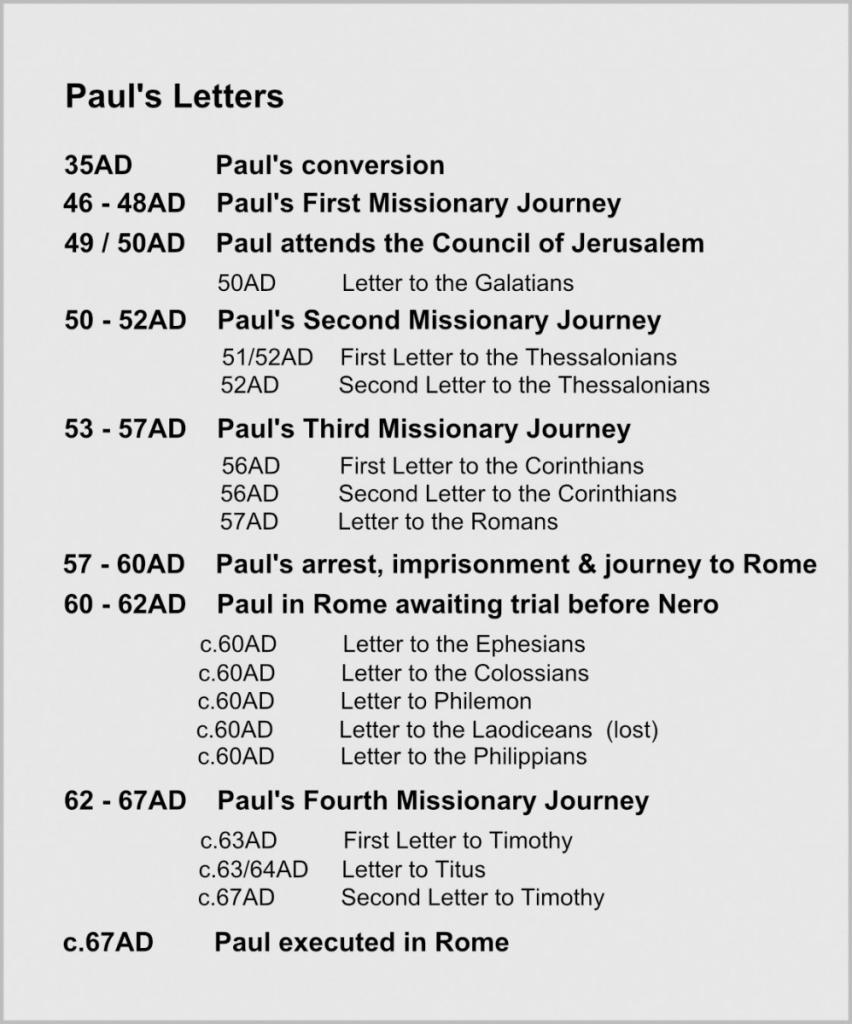
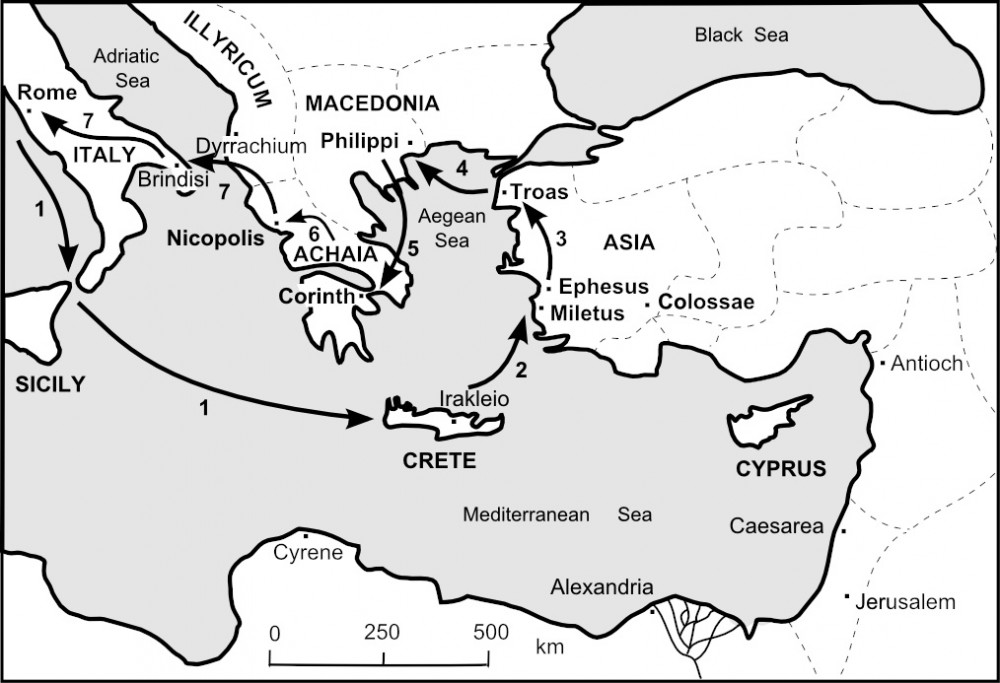
Paul wrote Titus from Macedonia or Ephesus to Titus in Crete (2 Tim 1:5), probably 66 AD. Paul had visited Crete with Titus on his “4th missionary journey (see charts above) and left him there, having seen firsthand the problems. When he wrote the letter to Titus, Paul was on his way to Nicopolis, in Achaia, to spend the winter (3:12), but apparently was arrested in Nicopolis and sent to Rome for his final imprisonment and martydom. He hoped to sent Tychicus to Crete (3:12). He tells them to help Zenas the lawyer and Apollos on their way, so they would be coming to Crete. Just as 1 Timothy, Paul deals with issues of sound doctrine and church order. He tells Titus to “set in order” (1:5) what remains of a church now several years old as his death and the end of the miraculous period approaches, to appoint elders in every “city” with emphasis on men who are able to “exhort in sound doctrine and refute those who contradict”, warns against the Judaizers who preach for money and are “upsetting whole families”, and warns against foolish controversies and disputes about the Law (3:9-10), even rejecting a factious man after 2 warnings. His “sound doctrine” deals not only with heretical teachings, but with healthy (“sound”) Christian living of older men, older women, young women, young men, and slaves, urging all to engage in good deeds b/c of the great saving kindness, love, and grace given them through Jesus Christ. Titus was to teach these things and to reprove with all authority, letting no one disregard him (2:15).

The theme of the letter to Titus is “sound doctrine”. There are two parts to the sound doctrine.

Firstly, the core central truths of the gospel is part of the sound doctrine. One of the main qualifications for the elders that Titus was to appoint in every city: Titus 1:holding firmly the faithful word which is in accordance with the teaching, so that he will be able both to exhort in sound (hugiainó: To be sound, to be healthy, to be well) doctrine and to refute those who contradict it.” Sound doctrine is teaching that will make believers healthy in their faith. What were the false teachers teaching? 10 For there are many rebellious people, empty talkers and deceivers, especially those of the circumcision, 11 who must be silenced because they are upsetting whole families, teaching things they should not teach for the sake of dishonest gain. 12 One of them, a prophet of their own, said, “Cretans are always liars, evil beasts, lazy gluttons.” 13 This testimony is true. For this reason reprimand them severely so that they may be sound in the faith, 14 not paying attention to Jewish myths and commandments of men who turn away from the truth. 15 To the pure, all things are pure; but to those who are defiled and unbelieving, nothing is pure, but both their mind and their conscience are defiled. 16 They profess to know God, but by their deeds they deny Him, being detestable and disobedient and worthless for any good deed.” The “especially those of the circumcision” and “Jewish myths” tells us it is the Judaizers who were trying to make Gentile Christians be circumcised and keep the Law. Also they were teaching for money. Titus was to “reprimand them severely”. The elders appointed were “to refute those who contradict it (i.e. sound doctrine). These false teachers were worthless, detestable, disobedient liars. They were bad! The rest of the qualifications for the elders to be appointed by Titus were similar to those in 1 Timothy 3. Titus 1:namely, if any man is beyond reproach, the husband of one wife, having children who believe, not accused of indecent behavior or rebellion. For the overseer must be beyond reproach as God’s steward, not self-willed, not quick-tempered, not overindulging in wine, not a bully, not greedy for money, but hospitable, loving what is good, self-controlled, righteous, holy, disciplined”.

Secondly, there is a practical part of sound doctrine. Paul discusses that in Titus 2. Sound doctrine is not just a list of intellectual doctrines to be believed. It includes how Christians should live and act. Paul gives sound doctrine instructions (Titus 2:1 But as for you, proclaim the things which are fitting for sound doctrine) for older men, older women, young men, young women, and slaves.

Titus 2: Older men are to be temperate, dignified, self-controlled, sound in faith, in love, in perseverance.”

Older women likewise are to be reverent in their behavior, not malicious gossips nor enslaved to much wine, teaching what is good, so that they may encourage the young women to love their husbands, to love their children, to be sensible, pure, workers at home, kind, being subject to their own husbands, so that the word of God will not be dishonored.” Of note here is “workers at home”. When I was young, preachers preached against Christian women working outside the home. Paul always tell women to be subject to their husbands.

Likewise urge the young men to be sensible; in all things show yourself to be an example of good deeds, with purity in doctrine, dignified, sound in speech which is beyond reproach, so that the opponent will be put to shame, having nothing bad to say about us.”

Urge slaves to be subject to their own masters in everything, to be pleasing, not argumentative, 10 not stealing, but showing all good faith so that they will adorn the doctrine of God our Savior in every respect.” Many Christians were slaves in the early church, so this was needed instructions. Paul always gave similar instructions to slaves.

Paul then gives the reason that such godly living is needed by all of these groups of Christians. Titus 2:11 For the grace of God has appeared, bringing salvation to all people, 12 instructing us to deny ungodliness and worldly desires and to live sensibly, righteously, and in a godly manner in the present age, 13 looking for the blessed hope and the appearing of the glory of our great God and Savior, Christ Jesus, 14 who gave Himself for us to redeem us from every lawless deed, and to purify for Himself a people for His own possession, eager for good deeds. 15 These things speak and exhort, and rebuke with all authority. No one is to disregard you.

The saving grace of God instructed Christians to “deny ungodliness and worldly desires and to live sensibly, righteously, and in a godly manner in the present age”. Jesus gave Himself for us to “redeem us from every lawless deed and to purify for Himself a people eager for good deeds”. These verses sum up how Christians should live. You have the “don’t do’s”: deny ungodliness and worldly desires” and “redeem us from every lawless deed”, and the “do’s”: live righteously, sensibly, and in a godly manner” and “eager for good deeds”. Doesn’t that about sum it all up! We are saved 100% by the grace of god through faith in Jesus, we can’t earn it. But these verses tell what is expected of those saved by grace. No believer will do these things perfectly and the grace of God will continue to save us even when we sin (as long as we don’t fall from grace), but we must try to do these things.

3:1 is linked to 2:15 These things speak and exhort, and rebuke with all authority. No one is to disregard you.” Then he adds: 3:1  Remind them to be subject to rulers, to authorities, to be obedient, to be ready for every good deed, to slander no one, not to be contentious, to be gentle, showing every consideration for all people. For we too were once foolish, disobedient, deceived, enslaved to various lusts and pleasures, spending our life in malice and envy, hateful, hating one another. But when the kindness of God our Savior and His love for mankind appeared, He saved us, not on the basis of deeds which we did in righteousness, but in accordance with His mercy, by the washing of regeneration and renewing by the Holy Spirit, whom He richly poured out upon us through Jesus Christ our Savior, so that being justified by His grace we would be made heirs according to the hope of eternal life. This statement is trustworthy.”

3:1-2 is a basic list of things that every Christian should do out of gratitude for the grace of God that saves us. “Showing every consideration (prautés: Gentleness, meekness; usually translated “gentleness”, even “humility”)for all people”. Christians might tend to look down on non-Christians, but Paul says “remember that you too were just like they are, and it was only b/c of the kindness of God and His love and grace that you are saved, not on the basis of your deeds or works.” So show “consideration” or kindness or mercy to “all people”, including all the sinners around you. Be “humble” and not self righteous. Be “gentle” if they oppose you. 2 Timothy 2:25 with gentleness correcting those who are in opposition, if perhaps God may grant them repentance leading to the knowledge of the truth.”

“This statement is a trustworthy saying”. I assume that statement is all of vs 4-7. Here they are:

  • Christ Came to Save Sinners – 1 Timothy 1:12-17 “Here is a trustworthy saying that deserves full acceptance: Christ Jesus came into the world to save sinners—of whom I am the worst.” 
  • A Noble Task – 1 Timothy 3:1-7 “Here is a trustworthy saying: Whoever aspires to be an overseer desires a noble task.”
  • The Value of Godliness – 1 Timothy 4:8-10 “For physical training is of some value, but godliness has value for all things, holding promise for both the present life and the life to come. 9 This is a trustworthy saying that deserves full acceptance.”
  • He Remains Faithful – 2 Timothy 2:11-13 “Here is a trustworthy saying: If we died with him, we will also live with him; if we endure, we will also reign with him. If we disown him, he will also disown us; if we are faithless, he remains faithful, for he cannot disown himself.” 
  • Saved by Grace. Now What? – Titus 3:1-8 “But when the kindness and love of God our Savior appeared, he saved us, not because of righteous things we had done, but because of his mercy. He saved us through the washing of rebirth and renewal by the Holy Spirit, whom he poured out on us generously through Jesus Christ our Savior, so that, having been justified by his grace, we might become heirs having the hope of eternal life. This is a trustworthy saying.”

Paul then adds: 3:8 and concerning these things I want you to speak confidently, so that those who have believed God will be careful to engage in good deeds. These things are good and beneficial for people. But avoid foolish controversies and genealogies and strife and disputes about the Law, for they are useless and worthless. 10 Reject a divisive person after a first and second warning, 11 knowing that such a person has deviated from what is right and is sinning, being self-condemned. Avoid those Judaizer myths, disputes about the Law. If a false teacher continues to divide the flock with their teachings, then reject them after 2 warnings. Romans 16:17 – Now I urge you, brothers and sisters, keep your eye on those who cause dissensions and hindrances contrary to the teaching which you learned… ” Some characteristics of a divisive person: Starting arguments. Spreading gossip. Creating cliques. Creating fear. Carrying grudges. Backstabbing. Deliberately undermining those in authority. Pitting one person off against another. Lying. Setting up rules in order to create social barriers. Being a racist or sexist or elitist. Giving orders and demanding obedience. Using principles (or even ‘righteous’ anger) as an excuse to cut off contact. The church has always been filled with “divisive persons”. The church at Corinth divided over favoritism toward different ministers who had worked with the church. 1 Corinthians 1:10 I appeal to you, brothers and sisters, in the name of our Lord Jesus Christ, that all of you agree with one another in what you say and that there be no divisions among you, but that you be perfectly united in mind and thought. 11 My brothers and sisters, some from Chloe’s household have informed me that there are quarrels among you. 12 What I mean is this: One of you says, “I follow Paul”; another, “I follow Apollos”; another, “I follow Cephas”; still another, “I follow Christ.” 13 Is Christ divided? Was Paul crucified for you? Were you baptized in the name of Paul? 14 I thank God that I did not baptize any of you except Crispus and Gaius, 15 so no one can say that you were baptized in my name. 16 (Yes, I also baptized the household of Stephanas; beyond that, I don’t remember if I baptized anyone else.) 17 For Christ did not send me to baptize, but to preach the gospel—not with wisdom and eloquence, lest the cross of Christ be emptied of its power.”

I was raised in a denomination that was filled with divisive persons and division. I think that, for the most part, the divisive persons sincerely thought they were simply refuting false teachers just like Paul told Titus to do, although probably many were carried away by the desire for power, to control, and pride. They operated under the belief that we had to get every doctrine right, and we had to rebuke and withdraw from everyone who disagreed. The problem was that they operated without the trustworthy statement in Titus 3. We are saved by grace. No one understands every single doctrine correctly. Grace must save us even if we don’t understand every doctrine correctly. Most doctrines that we disagree on are not heaven or hell issues. We must extend grace to others on such doctrines, just as God extends grace to us when we don’t understand every doctrine correctly. Divisive persons in the church constantly debate issues, making all kinds of points for their beliefs. For example, having kitchens in the church building. The divisive person says that we can only do things in the church specifically authorized in the New Testament by command, approved example, or necessary inference (CENI). Now, I can counter with my arguments that CENI is not a correct way to interpret scripture. But before I get into a debate with that person, I challenge them: “is this a heaven/hell issue? Will the grace of God save both of us even if we disagree? Should the church split over this issue? Is everyone who disagrees with you going to hell?” If I can’t get someone to see the grace of God that would allow us to agree to disagree on this issue, then it is futile to debate the issue with that person.

By the same token, my denomination probably created division among churches at large. We taught that a church is not the “one true church” if it did not have the right name, the right form of governance, the right baptism, the right worship (without instruments; the “5 acts of worship”), etc. We condemned the division among the many denominations and appealed to them to come be the one true church with us. Yet these denominations, for the most part, agreed with us on the basics: salvation by grace through faith in Jesus’ sacrificial death, the Deity of Jesus, the necessity of baptism (though interpreted differently), the godly obedience of those saved in all areas of their lives, the mission of the church to preach the gospel to the world, etc. We disagreed over instrumental music, how often to take the Lord’s Supper, the name of the church, etc. But even if we were right on those doctrines, those are not heaven/hell doctrines to be divided over. But we were the ones actually causing division in the church at large b/c we made those doctrines to be heaven/hell. If we had not done that, we would have said that all denominations were part of the one body even if they differed in a lot of ways.

I remember when I was young the preacher quoting Galatians 1 to condemned denominations. 1:I am amazed that you are so quickly deserting Him who called you by the grace of Christ, for a different gospel,which is not just another account; but there are some who are disturbing you and want to distort the gospel of Christ.But even if we, or an angel from heaven, should preach to you a gospel contrary to what we have preached to you, he is to be accursed! As we have said before, even now I say again: if anyone is preaching to you a gospel contrary to what you received, he is to be accursed!” The preacher was saying that the denominations were preaching a distorted gospel when they, for example, said instrumental music was not a sin and not a heaven/hell issue to be divided over. But look at the context of Galatians. Those who were preaching a different, distorted gospel were the Judaizers who were trying to force Gentile believers to be circumcised. Paul said, “that is not a heaven or hell issue (6:15 For neither is circumcision anything, nor uncircumcision, but a new creation), but if you make it so and divided the church over that issue, then you are the divisive persons preaching a distorted gospel. In other words, anyone who divides the church over issues that are not heaven/hell is condemned by Paul in Galatians. Yet that is what we were doing in my church, making instrumental music a heaven/hell issue when it is not (in my opinion). We accused the denominations of preaching a distorted gospel when it was really we who were preaching a distorted gospel. I’m thankful that many of our churches have grown past these mistakes and now preach grace and fellowship believers in all denominations.

Yes, there are some heaven/hell doctrines that we must refute, even divide over, such as the Deity of Jesus, salvation by grace through faith in Jesus’ death, the necessity of love, the necessity of obedience in the moral commands (not practicing sin). But there are very few. The LGBQT is a heaven/hell issue. It has caused division in many churches such as recently with the Methodist Church. Also we can’t fellowship with groups like the Jehovah’s Witnesses and Christian Science who deny the Deity of Jesus. But we must be very careful when we make any issue a heaven/hell issue and divide the church over it. My philosophy is this: If the New Testament does not specifically say that an issue is a heaven/hell issue, then don’t make it one. “Specifically” means book, chapter, verse that says the issue is absolutely essential for salvation. Not a verse that teaches the correctness of the issue but a verse that says that the issue is a heaven/hell issue.

Paul closes the letter to Titus with personal concerns. Titus 3:12 When I send Artemas or Tychicus to you, make every effort to come to me at Nicopolis, for I have decided to spend the winter there. 13 Diligently help Zenas the lawyer and Apollos on their way so that nothing is lacking for them. 14 Our people must also learn to engage in good deeds to meet pressing needs, so that they will not be unproductive. 15 All who are with me greet you. Greet those who love us in the faith. Grace be with you all.” Tychicus probably delivered the letter to Titus. He probably wrote the letter while in Macedonia. He planned to spend the winter at Nicopolis (find it on the map above; not sure why he was headed there), but probably was arrested before he was able to do that. He probably spent his last winter in prison in Rome awaiting his beheading from Nero. He wrote 2 Timothy during that last winter in prison. He was cold and told Timothy to come bring him a coat! I. 2 Timothy 4:13 When you come, bring the overcoat which I left at Troas with Carpus, and the books, especially the parchments.” It was common practice to help ministers and messengers with food and a place to stay as they traveled among the churches (thus help Zenas and Apollos). “Engage in good deeds” again (2:7,13; 3:1), so that must be important for Paul to keep repeating that. We are not saved by our good deeds (3:5) but we must do good deeds or works if we are saved and if we want to continue to be saved. We are justified by grace not works (3:7), but that doesn’t mean we don’t have to do works as a condition of continued justification. James 2:24 You see that a person is justified by works and not by faith alone.” “Engage in good deeds to meet pressing (anagkaios: Necessary, needful, indispensable).needs”. Helping Zenas and Apollos with their needs was a pressing need. The early church only took up collections for pressing needs such as helping widows and orphans. Justin Martyr 150 AD in First Apology described the collection of money in the Sunday assemblies: “Those who have means and are willing, each according to his own choice, gives what he wills, and what is collected is deposited with the president. He provides for the orphans and widows, those who are in need on account of sickness or some other cause, those who are in bonds, strangers who are sojourning, and in a word he becomes the protector of all who are in need.” Google his full description of a 2nd century assembly. Of course, they did not have church buildings, utility bills, paid preacher payrolls, insurance on the building and church vehicles as part of their “pressing needs”. 70-80% of money collected by churches today goes to those things and not the needs mentioned by Justin Martyr. How did we get to where we are today in the “church business” system????????

“Engage in good deeds to meet pressing needs that they won’t be unproductive (unfruitful).” Luke 8:14 And the seed which fell among the thorns, these are the ones who have heard, and as they go on their way they are choked by worries, riches, and pleasures of this life, and they bring no fruit to maturity.” John 15:If anyone does not remain in Me, he is thrown away like a branch and dries up; and they gather them and throw them into the fire, and they are burned.”

As Paul said, “Grace be with you all”.

1 TIMOTHY 3:8-16 WORK OF DEACONS; WOMEN DEACONS?

Does your church have deacons? I found this in AI: Deacons are found in many Christian denominations:

  • Catholic: Deacons are ordained ministers in the Catholic Church, and are one of the three orders of ordained ministers, along with bishops and presbyters. Deacons perform many ministries, including preaching, baptism, and leading funerals. 
  • Anglican: Deacons are appointed or elected in the Anglican Church, and often report directly to the bishops of their diocese. 
  • Lutheran: Deacons are found in Scandinavian Lutheran and Lutheran churches. 
  • Baptist: Deacons are managing trustees in Baptist churches, along with the minister. 
  • Presbyterian: Deacons are found in the Presbyterian Mission Agency. 
  • The role of deacons varies by denomination. In some denominations, deacons focus on administrative duties, while in others they focus on pastoral or liturgical duties. 

1 Timothy 3 gives the qualifications for deacons in the church. They come right after the qualifications for elders. The early church met in house churches. There were no paid preachers. The house churches were led by “elders and deacons”. Philippians 1:Paul and Timothy, bond-servants of Christ Jesus, To all the saints in Christ Jesus who are in Philippi, including the overseers and deacons.”
The Greek word for deacon is diákonos (διάκονος). It is an ancient Greek word that means “servant”, “waiter”, “minister”, or “messenger”. (AI) “In the Greco-Roman world, a “diakonos” was typically a servant or attendant who performed various duties. In the early Christian church, the term took on a more specific connotation, referring to those who served the community in both practical and spiritual matters. The role of a deacon, as outlined in the New Testament, was one of service and support, assisting the elders and apostles in the ministry of the church.”

But can we find the first deacons ever appointed in the church? Acts 6:1 Now at this time, as the disciples were increasing in number, a complaint developed on the part of the Hellenistic Jews against the native Hebrews, because their widows were being overlooked in the daily serving of foodSo the twelve summoned the congregation of the disciples and said, “It is not desirable for us to neglect the word of God in order to serve tables. Instead, brothers and sisters, select from among you seven men of good reputation, full of the Spirit and of wisdom, whom we may put in charge of this task. But we will devote ourselves to prayer and to the ministry of the word.” The announcement found approval with the whole congregation; and they chose Stephen, a man full of faith and of the Holy Spirit, and Philip, Prochorus, Nicanor, Timon, Parmenas, and Nicolas, a proselyte from Antioch. And they brought these men before the apostles; and after praying, they laid their hands on them.” While these men are not called “deacons”, it appears that they are the first deacons ever appointed by the church. They are to “serve” (diakoneó: To serve, to minister, to attend to) tables (providing food) for the neglected Hellenistic Jewish widows. 1 Timothy 5:-16 discusses the care of widows by the church. 1 Timothy 5:A widow is to be put on the list …” Qualifying widows were put on a list of widows to be taken care of by the church, especially daily food provided. More on all that in a later blog. These 7 men in Acts 6 were the first deacons. Notice that they were chosen by the wholee congreation, which would be they way to choose deacons today. In Acts 6 those deacons had to be “men of good reputation, full of the Spirit and of wisdom”. Why were any women not chosen? More on that later. The apostles officially appointed them by laying hands on them after the congregation chose them. I believe “full of the Spirit” means that these men had miraculous gifts of some kind, as did all those baptized believers whom the apostles laid their hands on to impart gifts to them.

Paul gives much more detailed qualifications for deacons in 1 Timothy 3: Deacons likewise must be men of dignity, not insincere, not prone to drink much wine, not greedy for money, but holding to the mystery of the faith with a clear conscience. 10 These men must also first be tested; then have them serve as deacons if they are beyond reproach. 11 Women must likewise be dignified, not malicious gossips, but temperate, faithful in all things. 12 Deacons must be husbands of one wife, and good managers of their children and their own households. 13 For those who have served well as deacons obtain for themselves a high standing and great confidence in the faith that is in Christ Jesus.

Qualifications for men in verses 8-10 and then 12-13 who are the “husbands of one wife”. Notice that the quallifications are less than for those of elders. The deacons do have to be married and manage their own households well. But they do not have to have believing children, and they do not have to be able to refute false teachers. It does not say that they can’t be a new convert (as with elders), but it does say they must be first tested in some way before they are officially appointed. Apparently some service tasks, such as helping or feeding widows, was given to men who met the qualifications in verses 8-9. They must prove themselves to be trustworthy, not slacking in duty or embezzling money or food, before they are officially appointed as deacons. Men given money or food to give to the widows could easily be tempted to keep those for themselves. Notice that they could drink wine, just not much wine. Deacons would no doubt be the ones to care for widows “on the list” (1 Timothy 5:9). They must “hold the mystery of the faith with a clear conscience”, i.e. they must have an honest conscience that would bother them if they misappropriated funds or food. The position of deacon might seem inferior to that of elders, but faithful deacons “obtain a high standing” in the faith. Their gifts are serving, not shepherding (elders’ work). “The writings of Ignatius of Antioch (5-108 AD) which mention the role of bishops, priests, and deacons as indispensable within the church structure. ” (AI) In the early Christian church, deacons assisted the bishop in a variety of ways, including: Funds: Deacons were responsible for funds for the needy. Liturgy: Deacons assisted the bishop during sacred liturgy. Alms: Deacons distributed alms to the poor. Eucharist: Deacons carried the bread and wine to the homes of those who were unable to attend the Lord’s Supper. Care of the sick: Deacons cared for the sick, as they were often the ones who were unable to attend the Lord’s Supper. Baptism: Deacons arranged for the baptism of catechumens. Holy Communion: Deacons brought Holy Communion to the baptized. Care of the needy: Deacons cared for the needs of widows, orphans, and the imprisoned. Sacred items: Deacons were responsible for sacred items such as liturgical books and vessels.”

Notice that all of the duties of deacons involved serving people in some way, whether it be widows, the sick, the needy, those being baptized, those taking the communion (the Lord’s Supper), those imprisoned for their faith and their families, orphans, etc.  That is the way it should be today and many deacons are appointed in churches today to take care of widows, etc. Unfortunately the church has evolved into a business with buildings, property, budgets, payroll, etc. to be maintained and managed. Often you will find deacons appointed today to take care of the church property, keep the grass cut, etc. Or a deacon to take care of the building. Or a deacon to do the finances. I guess that is needed and, in a way, serves the flock, but I don’t think that was the original intention for the work of deacons. Deacons actually are shepherding in a way, looking out after the needs of others. I would assume than many faithful deacons would later become elders when they reached elder qualifications.

But what about women deacons? The word is used 29 times, masculine in gender, but only used of the official position of deacons 3 times: 1 Timothy 3, Philippians 1:1, and Romans 16:1 where a woman is called a deacon. Romans 16:1 recommend to you our sister Phoebe, who is a servant of the church which is at Cenchrea, that you receive her in the Lord in a manner worthy of the saints, and that you help her in whatever matter she may have need of you; for she herself has also been a helper of many, and of myself as well.” Was she an officially appointed deacon (or is it deaconess?) or just a woman serving others and Paul?. Maybe. I don’t see why not appoint women as deacons as long as they don’t usurp authority over the men. Notice 1 Timothy 3:11 Women must likewise be dignified, not malicious gossips, but temperate, faithful in all things.” This verse is put right in the middle of the qualifications for men deacons. Who are the “women” in this verse that have to meet certain qualifications. Some say they are the wives of the elders or wives of the deacons, or both. But it seems as if Paul would say that if so. It seems for logical that Paul is giving qualifications for women deacons, like Phoebe (Romans 16:1). Men would the most logical choice for deacons b/c of the male leadership factor. Women Christians would be more likely to be at home taking care of their own children rather than out doing all the service projects that men deacons do. But there might be women like Phoebe who don’t have families to take care of and can devote time to doing the same service projects as men deacons would. Women could not be elders b/c elders might have to rebuke male false teachers and to take charge over the men at times, which is forbidden by Paul (1 Timothy 2). But deacons are not takin authority over anyone; they are just serving. There is no reason that women could not be deacons. The church I was raised in would never appoint women deacons. They did appoint women to serve in certain ministries such as teaching the children in Bible classes, even a women heading up the children’s program (not involving any men). Our church has 3 women who are in charge of the ladies’ ministry. They are not official deacons but could be, and for all practical purposes, they are deacons just like Phoebe.

That’s about it for deacons. If you are a deacon, woman or man, I commend your service. You are doing the real work of the Lord in helping others.

1 TIMOTHY 3: ELDERS; Rebuking elders

Let’s look at the office of elders in the church. First, a little word study. 1 Timothy 3:1 It is a trustworthy statement: if any man aspires to the office of overseer, it is a fine work he desires to do. The Greek for overseer is episkopé: Oversight, visitation, office of a bishop. It is the word that the Episcopalian church used to describe their “bishops”. The Episcopal Church is structured around bishops, who oversee geographic areas called dioceses. Bishops are considered the primary shepherds of the church, and their authority is equal to that of the Apostles. An overseer here is obviously the same as an elder in Titus 1 and 1 Peter 5:1 but a different Greek word is used there. Titus 1:This is why I left you in Crete, so that you might put what remained into order, and appoint elders in every town as I directed you. 1 Peter 5:1 So I exhort the elders among you, as a fellow elder …” Both times the Greek word is presbuteros: elder, older, presbyter (emphasis on an older man). The Presbyterian Church has presbyters. The word “Presbyterian” comes from the Greek word πρεσβύτερος (presbyteros), meaning “elder.” Accordingly, Presbyterian church government is elder-ruled church government, as we see clearly taught in the New Testament. BTW 1 Timothy 5:17 17 Let the elders who rule well be considered worthy of double honor, especially those who labor in preaching and teaching. The word for elders here is presbuteros, so that shows that the overseers in 1 Timothy 3:1 are the same as elders. Then in Titus 1:7 For an overseer, as God’s steward, must be above reproach. He must not be arrogant or quick-tempered or a drunkard or violent or greedy for gain.” The word for overseer is episkopos which is the same office as presbuteros translated elder in Titus 1:5. So they are the same office.

There is a 3rd word for elders. (AI) “The Greek word for pastor is poimēn (poy-MAYN). It appears in the New Testament 18 times, but is translated as “shepherd” in every instance except Ephesians 4:11, where it is translated as “pastor”. Poimēn is a noun that means “one who shepherds” or “one who serves as guardian or leader”. The verb form of the word is poimaino, which means “to tend a flock as a shepherd”. In the Bible, the terms “pastor,” “bishop,” and “elder” are used interchangeably to refer to the same office. Ephesians 4:11 And he gave the apostles, the prophets, the evangelists, the shepherds (or some translations “pastors”) and teachers. The work of elders is to shepherd the flock. 1 Peter 5:shepherd (poimanate) the flock of God that is among you, exercising oversight (episkopountes), not under compulsion, but willingly, as God would have you; not for shameful gain, but eagerly; not domineering over those in your charge, but being examples to the flock. Again, that equates the elders (presbuteros) of 1 Peter 5:1 with the overseers (episkopos) of 1 Peter 5:3 as being the same office. Acts 20 combines all 3 words. Paul has called the elders from the church at Ephesus to come meet him at Miletus. Acts 20:17 Now from Miletus he sent to Ephesus and called the elders (presbuteros) of the church to come to him. 18 And when they came to him, he said to them… 28 Be on guard for yourselves and for all the flock, among which the Holy Spirit has made you overseers (episkopos), to shepherd (poimainein)the church of God which He purchased with His own blood. So elders (presbuteros), overseers (episkopos), and pastors or shepherds (poimen) all refer to the same office although some churches have separated them. Some churches call the preachers “pastors” but unless they are qualified elders, that is not the Biblical use of the word.

The early church met in house churches. The structure was simple. Each church hopefully had some qualified men as elders and some lesser qualified men as deacons. Philippians 1:Paul and Timothy, bond-servants of Christ Jesus, To all the saints in Christ Jesus who are in Philippi, including the overseers and deacons. That was it. There might have been some elders who shepherded all the house churches in a given city. Paul told Titus in Titus 1:For this reason I left you in Crete, that you would set in order what remains and appoint elders in every city as I directed you” but that could mean elders in every house church in every city and not elders over all the house churches in every city. I do think that it is God’s plan for every house church to have elders and deacons. I don’t think it was God’s plan to have paid preachers, church groups owning property and buildings, etc. After all, nowadays churches have “trustees” and are incorporated. Where is that in the New Testament? Do the trustees make major decisions? Technically they probably due based on the church’s “charter”.

“During the 2nd century, the Christian church leadership transitioned from a system of multiple elders to a more centralized structure with a single bishop at the head of each congregation, assisted by a group of presbyters (elders) and deacons, marking a significant shift towards a more formal “episcopal” style of leadership; this development is particularly evident in writings from figures like Ignatius of Antioch.” This is not the scriptural organization of church leadership. “Kruger then points to evidence from the Didache, 1 Clement, and the Shepherd of Hermas  to show that during the first century a plurality of elders leading a local church was the most common pattern.” (The Simple Pastor) It evolved after the 2nd century to eventually be the Catholic church organization: (AI) The Catholic Church has a hierarchical structure with several levels of leadershipPope: The head of the Catholic Church and God’s representative on Earth. Cardinals: A group of close advisors to the Pope who usually choose the next Pope when the current one dies or resigns. Archbishops and bishops: Oversee multiple churches in a region. Priests: In charge of individual churches. Deacons: Assist with practical works of charity and have a more limited liturgical role. This is not the scriptural pattern of church organization either.  

That’s a lot, but important info on elders. Now let’s look at the qualifications of elders. The first elders had miraculous gifts. Ephesians 4:11 11 And He gave some as apostles, some as prophets, some as evangelists, some as pastors and teachers.” These are 5 miraculously gifted leadership positions in the early church. Paul established churches in Iconium, Lystra, and Derbe on his first missionary journey, and immediately backtracked through those cities appointing elders. Acts 14:23 When they had appointed elders for them in every church, having prayed with fasting, they entrusted them to the Lord in whom they had believed.” They did not have the New Testament. 1 Timothy 3:6 says the elders could not be a “new convert” but these new elders were new converts. The only way they could shepherd the church and protect it against false teachers was to have those miraculous gifs. James 5 is probably talking about some of those miraculously gifted elders who could heal people. James 5:14 Is anyone among you sick? Then he must call for the elders of the church and they are to pray over him, anointing him with oil in the name of the Lord; 15 and the prayer of faith will restore the one who is sick, and the Lord will raise him up, and if he has committed sins, they will be forgiven him.By the time Paul wrote 1 Timothy, the church would have access to almost all of the New Testament books so the need for miraculously gifted elders would have diminished.

The qualifications: 1 Timothy 3:1 It is a trustworthy statement: if any man aspires to the office of overseer, it is a fine work he desires to doAn overseer, then, must be above reproach, the husband of one wife, temperate, self-controlled, respectable, hospitable, skillful in teaching, not overindulging in wine, not a bully, but gentle, not contentious, free from the love of money. He must be one who manages his own household well, keeping his children under control with all dignity (but if a man does not know how to manage his own household, how will he take care of the church of God?), and not a new convert, so that he will not become conceited and fall into condemnation incurred by the devil. And he must have a good reputation with those outside the church, so that he will not fall into [f]disgrace and the snare of the devil.”

Titus 1 has these qualifications: For this reason I left you in Crete, that you would set in order what remains and appoint elders in every city as I directed you, namely, if any man is beyond reproach, the husband of one wife, having children who believe, not accused of indecent behavior or rebellion. For the overseer must be beyond reproach as God’s steward, not self-willed, not quick-tempered, not overindulging in wine, not a bully, not greedy for money, but hospitable, loving what is good, self-controlled, righteous, holy, disciplined, holding firmly the faithful word which is in accordance with the teaching, so that he will be able both to exhort in sound doctrine and to refute those who contradict it.

I think most of these are self explanatory. All Christian men should have most of these. The ones that are unique to elders: 1) Husband of one wife. 2) Skillful in teaching. 3) Believing children. 4) Not a new convert. 5) Manages his own household well keeping his children under control (to prove that he can manage the household of God). 6) Able to exhort in sound doctrine and to refute those who contradict it. This last one is very important if the elders are to fulfill what Paul asked elders to do in Titus 1:9 and Acts 20:28 Be on guard for yourselves and for all the flock, among which the Holy Spirit has made you [u]overseers, to shepherd the church of God which He purchased with His own blood. 29 I know that after my departure savage wolves will come in among you, not sparing the flock; 30 and from among your own selves men will arise, speaking perverse things to draw away the disciples after them.”

It might be surprising to some that elders could drink wine, just not be addicted to or overindulge in wine. Several questions might arise. What if a man is divorced and remarries? He is the husband of one wife, but is he stll quallified? What if his wife dies? Do all of his children have to be “believing”? Does that mean baptized believing children? If a man becomes an elder but one or more of his believing children leave the faith after he becomes an elder, should he resign? What if there are two elders in a church and one dies or resigns: should the remaining elder resign?

The main work of elders is to “shepherd” (poimen) the flock. Ezekiel has a scathing rebuke against the elders of Israel: Ezekiel 34:34 Then the word of the Lord came to me, saying, “Son of man, prophesy against the shepherds of Israel. Prophesy and say to those shepherds, ‘This is what the Lord [b]God says: “Woe, shepherds of Israel who have been feeding themselves! Should the shepherds not feed the flock? You eat the fat and clothe yourselves with the wool, you slaughter the fat sheep [e]without feeding the flock. Those who are sickly you have not strengthened, the diseased you have not healed, the broken you have not bound up, the scattered you have not brought back, nor have you searched for the lost; but with force and with violence you have dominated them. They scattered for lack of a shepherd, and they became food for every animal of the field and scattered. My flock strayed through all the mountains and on every high hill; My flock was scattered over all the surface of the earth, and there was no one to search or seek for them.”’” The work of the elders of Israel was to shepherd. To make sure the flock is fed well. To strengthen the sickly. To heal the diseased. To bind up the broken. To search for and bring back the lost sheep. They had not done these things. They “dominated” the sheep: the Hebrew is “with force (chozqah: Strength, power, might) you have ruled (radah: To rule, to have dominion, to subdue)”. Peter talks about that in 1 Peter 5:shepherd the flock of God among you, exercising oversight, not under compulsion but voluntarily, according to the will of God; and not with greed but with eagerness; nor yet as domineering (katakurieuó: to exercise dominion over: also translated “not lording it over”) over those assigned to your care, but by proving to be examples to the flock.” Elders are not to act like dictators over the flock. They must not be carried away with power over the flock. Instead they should be “examples”: the Greek word is tupos: the mark (of a blow), an impression, stamp (made by a die). They should be such good examples of what a Christian should be that the sheep want to be an exact imprint just like them.

Too often men are appointed as elders in a church just b/c they are important in their worldly occupations. The eldership becomes a “board of directors” whose main job is to “control” the flock. They push their opinions on the flock and shut out those who disagree. They don’t personally shepherd the sheep. They become the business managers of the church instead of shepherds. They spend more time in elders’ meetings than they do in shepherding. Lynn Anderson wrote the best book I have ever read of elders: They Smell Like Sheep. He told of a man who resigned from a “board of directors” eldership so he could actually shepherd the flock. He told of changing such an eldership from a “board of directors” model to a shepherding model. He told of a church having just a few elders even though there were many more men qualified to be shepherds, men who in some way were. shepherding at least a few of the sheep. That church went from 5 elders to 25 elders. They turned the business of the church over to deacons and trustees so that they could spend their time shepherding. They met rarely, and when they did, it wasn’t a business meeting: instead it was a prayer meeting and discussion of how to shepherd the flock better. I know of a church of 1,000 memers with 7 elders. That church no doubt had 30 or 40 men who were not elders but were just as qualified to be elders as those 7 elders. When that church added any elders, it was always adding 2 or 3 that totally agreed with the way the elders were doing business. I asked one of those 7 elders, “why don’t you appoint all those 30 or 40 qualified men as elders”? He said, “we might lose control if we did that”. 7 elders can control a flock as a board of directors but they can’t effectively shepherd the flock. 30 or 40 elders could divided the flock of 1,000 into small groups and actually effectively shepherd each group they are assigned to with small house church type groups. Each shepherd could have a small group that he could actually know the physical and spiritual needs of that group and shepherd that group. I know of a church that had several men who were not elders but were continually shepherding sheep in the flock, taking care of members. But those men, though fully qualified, would not allow the flock to make appoint them as elders. They saw the elders as a board of directors whose job was to make decisions for the flock and control the flock and they didn’t want that responsibility to be that type of an elder. So that church has 3 elders when they could have 15 elders.

Another important point is “how long should elders be appointed for”? Is it like a supreme court justice: appointed for life? The church I was raised in had no procedure to assess whether elders were doing a good job or not. The church voted them in as elders, but had no way of voting them out if need be. Some churches therefore have a “reup” each year or some time interval where they vote to reaffirm the current elders, which sounds like a good idea. Elders must have the confidence of the flock if they are to shepherd well.

That brings us to 1 Timothy 5: 17 The elders who lead well are to be considered worthy of double honor, especially those who work hard at preaching and teaching. 18 For the Scripture says, “You shall not muzzle the ox while it is threshing,” and “The laborer is worthy of his wages.” 19 Do not accept an accusation against an elder except on the basis of two or three witnesses. 20 Those who continue in sin, rebuke in the presence of all, so that the rest also will be fearful of sinning21 I solemnly exhort you in the presence of God and of Christ Jesus and of His chosen angels, to maintain these principles without bias, doing nothing in a spirit of partiality. 22 Do not lay hands upon anyone too quickly and thereby share responsibility for the sins of others; keep yourself free from sin.” “Double honor” would be the honor of serving as an elder but also getting some monetary help if need be. An elder might need supplemental income from the flock if he is devoting so much time to both shepherding and preaching. But where would they “preach” in addition to shepherding? In the New Testament, the word “preach” comes from the Greek word kerusso, which means to proclaim, to declare, to announce, or to herald a message. It was the message proclaimed by the kerux, who was the official spokesman or herald of a king.Used to describe the act of proclaiming the Gospel message of Jesus Christ.” It would not be the word used of an elder shepherding his house flock, although he might preach the gospel basics if a non Christian is visiting the group gathering. Apparently some elders would go to surrounding locations and actually preach the core gospel message to those who were not Christians. That might take time from their trade and incoome to support their family. The paid preacher system is not Biblical, but paying shepherds in some cases (rare) actually is. Most elders have full time jobs and don’t need any financial help from the flock.

Paul cautions about receiving an accusation against an elder unless there are 2 or.3 witnesses to some specific sin of an elder. It is easy for some sheep to sit back and overly criticize the elders. On the other hand, elders could and should be rebuked publicly if necessary. Remember, however, that Timothy was inspired by the Holy Spirit and would have miraculous guidance from the Spirit in rebuking an elder. An uninspired person might try to rebuke an elder in some kind of a power struggle. If, after a correctly done rebuking of an elder, he continues to sin, then he should be forced to resign. There should be no partiality in dealing with elders. If an elder sins, he should be rebuked whether we like the man or not. He should not be given any preferential treatment.

We do not have miraculously gifted elders as they did in the very early church (AD 30-70). Elders must realize that when making decisions. They must refute heresy, but they must be careful in what they deem to be “heresy”. I know of a church that forced an elder out b/c they said he was teaching heresy, but what he was teaching was not “heaven or hell” doctrine. Very few doctrines are “heaven or hell” essential doctrines. Elders must be careful not to force their opinions on non-essential on the flock. Elders must be very wise. I know a church where the elders made a very unwise decision that caused the church to split unecessaily. There was a way that the elders could have kept the flock together in love but they chose not to do that. They were more interested in controlling the flock.

I hope this is a beneficial study of elders.


1 TIMOTHY 2:11-15: Women’s silent in the church?Women elders and preachers?

Continuing the study of 1 Timothy 2:8-15, let’s get to the controversial part. 11 A woman must quietly receive instruction with entire submissiveness. 12 But I do not allow a woman to teach or to exercise authority over a man, but to remain quiet. 13 For it was Adam who was first created, and then Eve. 14 And it was not Adam who was deceived, but the woman was deceived and became a wrongdoer. 15 But women will be preserved through childbirth—if they continue in faith, love, and sanctity, with moderation.” The word “quietly” in 2:11 and “quiet” in 2:12 is hésuchia: Quietness, silence, tranquility. In the New Testament, “hésuchia” refers to a state of quietness or tranquility, often in the context of demeanor or lifestyle. It implies a peaceful and calm disposition, free from disturbance or agitation. This term is used to describe both an external quietness and an internal peace of mind.” I don’t think it means absolute silence at all times, although silence could be included at times. A submissive women in marriage or in the church will have a peaceful, calm demeanor and not be aggressively speaking out or challenging their husbands or the men in the church leadership. She cannot “teach or exercise authority over the man”. All this does not mean that the women could not speak in church gatherings. In 1 Corinthians 11, the women were told that they could pray and prophesy in a mixed men/women group if they would wear a veil to show that they were in submission and not trying to take over from the men. That has to be vocal prayer (prayer in silence would make no sense) and prophesying was vocal. This was based on the order given in 1 Cor 11:But I want you to understand that the head of every man is Christ, the head of a wife is her husband, and the head of Christ is God.” That order would apply to the home and church. But in 1 Cor 14:26 What then, brothers? When you come together, each one has a hymn, a lesson, a revelation, a tongue, or an interpretation. Let all things be done for building up.” Paul gives some guidelines for “when you come together” in any group of Christians, house church, small group, church building. This would have to include women who had a miraculous gift like prophecy b/c he had just told the women they could use their gift of prophecy as long as they wore a veil. So the women could use their gifts in a mixed assembly to teach or prophecy or pray aloud (maybe in tongues) or sing a solo song, etc. But in 1 Cor 14:33 As in all the churches of the saints, 34 the women should keep silent in the churches. For they are not permitted to speak, but should be in submission, as the Law also says. 35 If there is anything they desire to learn, let them ask their husbands at home. For it is shameful for a woman to speak in church.” The forbidden “speaking” here is sigaó: To be silent, to keep silence, to hold one’s peace. Guzik: “Some have said the reason for this is because in these ancient cultures (as well as some present-day cultures), men and women sat in separate sections. The thought is that women interrupted the church service by shouting questions and comments to their husbands during the service. Clarke expresses this idea: “It was lawful for men in public assemblies to ask questions, or even interrupt the speaker when there was any matter in his speech which they did not understand; but this liberty was not granted to women.” So the context of 1 Cor 14:34 women not speaking is indeed silence but silence under certain circumstances and not some general rule that in the assembly the women can’t use their gifts aloud at all, which would be a contradiction of 1 Cor 11.

I was raised in a church that used 1 Cor 14:34 to say that the women could not pray aloud in the assembly *even if veiled) or share a teaching in the assembly. I think that is a unbiblical restriction of the use of gifts that women in the church have to edify the church. Plus my church was so inconsistent on applying the rule. Women could sing in the assembly, but that goes against their literalist interprestion of not speaking at all. They could share a truth in a mixed Bible class before the assembly began but could not do the exact same thing once everyone went into the “sanctuary”. The early church only met in house churches, and there would be no such distinction between a Bible classroom and the sanctuary. The male leaders of the church are allowing the women to use their gifts in a mixed group gathering. The women are not “usurping” the authority of the men, trying to take charge, when they modestly use their gifts, yielding to the male leadership when need be.

BTW I need to add this. If women did lead prayer in a mixed group, I don’t think they would need to wear a veil to show submission. That was a cultural way in the first century of showing submission but that is not our culture here in the U.S. I think a woman could lead a prayer in a mixed group without a veil. I think it is obvious if a woman praying is being submissive or not without a veil. It is interesting that some of our churches of Christ stil encourage the ladies to wear little doillies during the assemblies. That is weird really since they are not even allowed to pray out loud, which is the reason for wearing a veil in 1 Cor 11, i..e. only if a woman is praying aloud in a mixed group. If a woman’s conscience tells her to wear a doillie like that, then she should follow her conscience. Hopefully she would not judge others who choose not to do so, and those who choose not to do so would not judge her (Romans 14:1-3).

Does this mean that women can’t be elders and preachers? The elder part of that question is obvious to me. 1 Timothy 3: one of the. qualifications of an elder is “husband of one wife”. Unless you are a LGBQT proponent of a wife having only one wife, that rules out women being elders. Sometimes I see unwise elders making terrible decisions for the flock and I wish some of the wise women in the. pews could be the elders instead, but we must trust God’s wisdom on this matter. What about women preachers? That is a little more difficult to answer. I concede that a woman can come into the gathering (even the main church assembly in the sanctuary) and share a teaching aloud to the flock as long as she does not try to usurp authority and take over from the men leaders. Then could the men agree to allow her to. preach a 30 minute sermon in the same assembly. Technically, I guess so. But this brings us back to a bigger issue. Why do we have a 30 minute sermon, even by some man preacher?

In the early church, there were many miraculous gifts for mutual edification. 1 Cor 12:Now there are varieties of gifts, but the same Spirit; and there are varieties of service, but the same Lord; and there are varieties of activities, but it is the same God who empowers them all in everyone. To each is given the manifestation of the Spirit for the common good. For to one is given through the Spirit the utterance of wisdom, and to another the utterance of knowledge according to the same Spirit, to another faith by the same Spirit, to another gifts of healing by the one Spirit, 10 to another the working of miracles, to another prophecy, to another the ability to distinguish between spirits, to another various kinds of tongues, to another the interpretation of tongues. 11 All these are empowered by one and the same Spirit, who apportions to each one individually as he wills.” Then in 1 Cor 14 Paul gives instructions on how to use those gifts in any assembly or gathering of sainst. 1 Cor 14:26 What then, brothers? When you come together, each one has a hymn, a lesson, a revelation, a tongue, or an interpretation. Let all things be done for building up. 27 If any speak in a tongue, let there be only two or at most three, and each in turn, and let someone interpret. 28 But if there is no one to interpret, let each of them keep silent in church and speak to himself and to God. 29 Let two or three prophets speak, and let the others weigh what is said. 30 If a revelation is made to another sitting there, let the first be silent. 31 For you can all prophesy one by one, so that all may learn and all be encouraged, 32 and the spirits of prophets are subject to prophets. 33 For God is not a God of confusion but of peace.”

No one gift dominated the time in the assemblies. We don’t have those miraculous gifts, but “prophecy” might be close to our concept of preaching today since the preacher is doing what the prophets did, which is revealing the word of God to people (although not miraculously like the prophets). So, 2 or 3 prophets, and apparently, if one of them goes too long and takes over the time, then a prophet sitting in the flock, then the long winded prophet was to “be silent” and let the one sitting speak. Apply that to church preachers today. Can you imagine 10 minutes into the preacher’s 30 minute sermon some man in the pews telling him that he has a teaching from the word of God that needs to be preached. He tells the main preacher to sit down and then he speaks for 10 minutes. Bottom line, the way we do it is not not scriptural. The assembly should be using our gifts (even if not miraculous gifts) to edify the flock. Use diverstiy of gifts: we don’t need more than 2 or 3 of any gift. Do not let any one gifted person dominate the time, even a paid preacher.

Which brings to a bigger question. Why do we have paid preachers in congregations? In the early church, you had house churches with elders (hopefully) in each group. You had miraculously gifted elders and teachers in each group. You would never think to hire a paid full time preacher for the group. If anything, 1 Timothy 5 will say that an elder might need supplemental income from the flock if he is devoting so much time to shepherding and preaching. 1 Timothy 5:17 Let the elders who rule well be considered worthy of double honor, especially those who labor in preaching and teaching.” But where would they “preach” in addition to shepherding? In the New Testament, the word “preach” comes from the Greek word kerusso, which means to proclaim, to declare, to announce, or to herald a message. It was the message proclaimed by the kerux, who was the official spokesman or herald of a king.Used to describe the act of proclaiming the Gospel message of Jesus Christ.” It would not be the word used of an elder shepherding his house flock, although he might preach the gospel basics if a non Christian is visiting the group gathering. Apparently some elders would go to surrounding locations and actually preach the core gospel message to those who were not Christians. That might take time from their trade and incoome to support their family.

The “evangelists” in the early church would go to different places for limited periods of time. Paul left the evangelists Timothy in Ephesus and Titus in Crete to work with those churches. The church might give them food and clothing, but they did not become full time paid preachers. They would stay for a while and then move on to preach the gospel somewhere else, establish a church, or work to correct a church that needed help (like Ephesus or Crete). The Didache (late 1st century church manual) says that if they stayed more than 2 or 3 days, they were false teachers preaching only for money! Didache Chapter 11 “Travelling teachers — Apostles — Prophets: 3 And concerning the Apostles and Prophets, act thus according to the ordinance of the Gospel.  4 Let every Apostle who comes to you be received as the Lord, 5 but let him not stay more than one day, or if need be a second as well; but if he stay three days, he is a false prophet. 6 And when an Apostle goes forth let him accept nothing but bread till he reach his night’s lodging; but if he ask for money, he is a false prophet.” So already in the first century they had problems with men preaching for money!

I know we are discussing whether women should be full time paid preachers. The bigger question: should anyone, man or woman, be a full time paid preacher. My answer is no. There are some full time paid preachers who have done a lot of good, but overall the full time paid preacher system has been a negative. It has killed mutual edificatioin in church assemblies. It has put too much power in the preacher, his talents, his opinions, his influence. It has become a job for many. It has become a real problem when the preacher commits some money or sex scandal. Very few paid preachers are out preaching the core gospel message to unconverted sinners. Most of what they preach is just edifying messages from the word but there are most likely several men who could do that, for free, with short messages without a 30 minute sermon.

But how could a big church with a building, a budget, etc. function without a full time paid preacher that draws the crowds? It probably can’t, although I would love to see an established big church try to do without a paid preacher. Do you see the problem? The house church is growing, using mutual edification and no paid preachers, so we decide to rent a bigger place to meet. Then we get even bigger and decide to build a church building. Then we decide to hire a full time paid preacher who can give us 30 minute sermons instead of mutual edification. We have now done what Israel did: ” Give us a king so that we can be like the other nations”. We have enetered the big church business competition. Some get a talented paid preacher that can draw new members (usually not new converts but Christians coming from other churches). Do you see the problem? So to correct all that, do we disband big churches, sell the property and use the money to drill wells overseas and print Bibles for mission work, and encourage members to start meeting in house churches? Or, do we just try to make the best of it, live with the system, hire good men to preach good edifying messages, and allow the flock to love and serve one another within the current system? (BTW I still fill in to preach an occasional sermon at our church). Or do I pull away from the big church and start a house church in my home, hoping to draw even non Christians to our group? And if our group gets too large, then split and start another evangelistic house church.

Enough said on that! The questions was “should women be preachers”? If we mean, full time paid preachers (as I think the question would imply), then “no”. But maybe neither men or women should be full time paid preachers. I guess if you decide to use unscriptural full time paid preachers, then you are making up your own rules for doing church work. If you do that, then I guess the argument could be made to allow men or women full time paid preachers. The problem even there might be if she is considered to be the “senior pastor” as many denominations do. The word for “pastor” in the New Testament refers to elders, so a woman can’t be a senior pastor elder. The male elders might have to rebuke false teacher men in the flock. A woman elder might have to do that, which would be usurping authority over men, which is forbidden. If a woman preachers is considered to be the senior pastor, even if not appointed as an elder, then she would perhaps need to rebuke false teacher men in the flock. Do you see the problem?

In conclusion, Paul gives the reasons that women are not to usurp authority over the men. 1 Timothy 2:12 But I do not allow a woman to teach or to exercise authority over a man, but to remain quiet. 13 For it was Adam who was first created, and then Eve. 14 And it was not Adam who was deceived, but the woman was deceived and became a wrongdoer. 15 But women will be preserved through childbirth—if they continue in faith, love, and sanctity, with moderation.” The chain of authority is 1 Cor 11:But I want you to understand that the head of every man is Christ, the head of a wife is her husband, and the head of Christ is God.” But is this just a first century cultural thing? In 1 Timothy 2, Paul says that this order goes back to the creation story in Genesis 1-3. 1) The order in which Adam and Eve were created. Adam was created and then Eve was created to be a “helper” to Adam. An electrician has an apprentice helper, but you can’t have 2 heads, 2 people in charge. The main electrician is the one in charge. 2) Eve was deceived by Satan, but Adam was not deceived. So what? The implication, to me, is that women might the more likely of the two to be deceived in spiritual matters. Why might that be? B/c God has given women some unique qualities for birthing, nursing, and caring for little children while men out working in the weeds to provide for the family. Men think with their head, and women think with their heart. So, yes, women might be more easily deceived. So the men are given the responsibility of leading the home and making the tough spiritual decisions and women are to be in submission. Paul says this same logic would mean that women were not to usurp authority over the men in the church also. BTW Paul added this about the subject: 2 Timothy 3:For among them are those who creep into households and capture weak women, burdened with sins and led astray by various passions, always learning and never able to arrive at a knowledge of the truth.”

I know I have given a lot of opinion in this article. You can decide on how valid my opinions are. There is a lot of talk about men being “misogynists” today. I hope I am not one of those, just trying to keep women in outdated submissive roles. I hope I am just teaching the roles for women as God laid out in scripture.

Thanks for reading.


EPHESIANS 4:1-16

4:CH 4-6 THE PRACTICAL SECTION

Having given 3 fairly deep doctrinal chapters, Paul goes on in the last 3 chapters to give day to day practical commands for living the life of one who has been saved and added to this church body of believers of all different backgrounds.

A key word is “walk”, used figuratively of how you move about as a Christian day to day, how you conduct yourself. There are 6 walks found in Eph 4-6. Let’s examine the first.

  1. 4:1-16 Walk in a manner worthy of your calling in the “unity of the faith” (which includes both dotrinal unity and love unity)

    Q: Does God call us to become Christians? How? Do you consider your conversion to be a calling of God? Does God call people by some voice or thought that He puts in your head? We probably have different opinions on that, but one thing for certain is that he calls us “through the gospel”. The good news of salvatiion by grace through Christ’s death for us is the drawing power.

    2 Thessalonians 2:13 But we ought always to give thanks to God for you, brothers beloved by the Lord, because God chose you as the firstfruits to be saved, through sanctification by the Spirit and belief in the truth. 14 To this he called you through our gospel, so that you may obtain the glory of our Lord Jesus Christ.


     In ch 2 and 3 Paul gave the doctrine of the mystery of uniting Jew and Gentile believers into the one church body. But that brings together believers from two totally different backgrounds. Just as in the church today, we have many different backgrounds and personalities. It is one thing to say that we are united in one body, but it is another thing to say that we love and tolerate one another in love when we have conflicts and differences. 

    Q: 4:1-3 gives the qualities necessary for us to really have “unity” in the church. Which of these is the most important in your opinion? Which one do you struggle with practicing?

    Paul then goes on to give the 7 doctrinal truths that are necessary to have “unity”. Hindus could have all the qualities in 4:1-3 and be united as Hindus, but that would not be unity in Christ. There are 7 basic doctrines and beliefs that we must have to really have Christian unity.

    This list excludes those who believe in other gods than Yahweh and other Lords than Yeshua (Jesus). The one baptism is water baptism for the remission of sins (as opposed to the baptism of the Holy Spirit or of fire as some teach). There is one body, which is the church, which is believers all over the world.

    Q: How exclusive is this list among those who have the one faith but are in many different denominations? It is exclusive, but some of the 7 doctrines could be interpreted differently.

    Q: Does the one baptism have to be for exactly the right reason (i.e. the remission of sins) in the right manner (immersion)? Can it be sprinkling or pouring? Does that really matter? Can it be baby baptism? Why can’t we unite of what the “on baptism” of unity is?

    Q: Does the “one body” include all the denominations who have many different names and beliefs but basically hold to these 7 doctrines? The church I was raised in taught that the different man made denominations could not be part of the “one body”, but I disagree with that. The one body is simply those saved by grace throug faith even though they are in different denominations. Unity of those denominations would be great, but not essential for salvation. The founders of the Churches of Christ, Stone and Campbell, sought to get believers from all denominations to put away their denominational names and creeds and just be united as Christians, but they did not say that those believers in those denominations were not Christians.

    But what about the denominations that are going LGBQT? Are they still part of the one body?

    The “one hope” is that of eternal life. But there are many views on eschatology (amillinealism, ? Do we all have to believe the same on eschatology? Add preterism to the chart below.

    4:8 Jesus gave miraculous “gifts” to certain men in the early church to give the doctrinal truths necessary for unity. He “ascended” to heaven to pour out those gifts on men.

    Act 2:33 Being therefore exalted at the right hand of God, and having received from the Father the promise of the Holy Spirit, he has poured out this that you yourselves are seeing and hearing.

    This would include the 5 miraculously gifted leadership positions (apostles, prophets, evangelists, pastors, and teachers) as well as the miraculous gifts given to members of the church (1 Cor 12). Thus in 4:16 “every joint” helped maintain unity in the body. 

    These 5 gifted positions were to equip the saints for ministry, to build up the body, to a mature unity of faith and knowledge, to not be tossed about by deceitful doctrines, to speak the truth in love. 

    Jesus prayed for this “unity of the faith” in John 17:20 “I do not ask for these only, but also for those who will believe in me through their word, 21 that they may all be one, just as you, Father, are in me, and I in you, that they also may be in us, so that the world may believe that you have sent me. 22 The glory that you have given me I have given to them, that they may be one even as we are one, 23 I in them and you in me, that they may become perfectly one, so that the world may know that you sent me and loved them even as you loved me. 

    This is Jesus’ prayer on the night before he is crucified the next day. It would be like me knowing that I will die tomorrow and the night before I pray that my 3 children will always be united and love and help each other after I die.

    Q: As a result of these gifted 1st century positions, do we have all that we need for Christian unity and “maturity” in the church? If we have all that we need doctrinally for unity, then why. do we have so many different denominations teaching so many different doctrines? I might teach my 3 children all that they need to become mature adults, but that doesn’t mean they will become mature adults.

    What would be examples of “deceitful doctrines” that stray from that unity? This sounds more devious than just differences of interpretation on issues and doctrines that are not heaven or hell issues, such as those given by Paul in Romans 14 (eating of meats, observing of days, etc.). Deceitful doctrines sounds like doctrines taught by devious people trying to lure and pull believers away from the one body, maybe their motivation is power or sex or money.

    Peter spoke of such false prophets in 2 Peter 2:But false prophets also arose among the people, just as there will be false teachers among you, who will secretly bring in destructive heresies, even denying the Master who bought them, bringing upon themselves swift destruction. And many will follow their sensuality, and because of them the way of truth will be blasphemed. And in their greed they will exploit you with false words. Their condemnation from long ago is not idle, and their destruction is not asleep.

    Q: What are some doctrines that are not heaven or hell doctrines? Maybe instrumental music in worship, frequency of taking the Lord’s Supper, names and organization of churches, etc. We should not make any doctrine a heaven or hell doctrine unless the scriptures specifically do so. If we make almost every doctrine a heaven or hell one, then we will end up in untold division, as some groups have found out.

    Q: So what are the doctrines are heaven or hell essential doctrines to the “unity of the faith”?

    The list of 7 doctrines in this chapter is where we start, but even then the “one baptism” can be interpreted differently. Certainly the one faith would include the belief that Jesus is the Son of God whose death is the only way to be saved. That would rule out all the cults who deny the deity of Jesus.

    There are certain sins that Paul says in Galatians 5:19 Now the works of the flesh are evident: sexual immorality, impurity, sensuality, 20 idolatry, sorcery, enmity, strife, jealousy, fits of anger, rivalries, dissensions, divisions, 21 envy, drunkenness, orgies, and things like these. I warn you, as I warned you before, that those who do such things will not inherit the kingdom of God. The Bible teaches that homosexuality is a sin, but the LGBQT issue has divided churches and believers, but there can be no compromise on that. Sometimes unity is not possible if some refuse to acknowledge the inspiration of Scripture and won’t allow the Bible to define what is right and wrong.

    Q: Do we still need and have those gifted leaders today? 

    Apostles (the Mormon church has 12 apostles)? Paul spoke of false apostles: Paul spoke of “false apostes”: For such are false apostles, deceitful workers, transforming themselves into apostles of Christ. And no wonder! For Satan himself transforms himself into an angel of light. Therefore it is no great thing if his ministers also transform themselves into ministers of righteousness, whose end will be according to their works (2 Corinthians 11:13-15).

    Prophets (many churches claim to have prophets)? What about all the prophets of all the cults? The Mormons have Joseph Smith as their prophet, the Seventh Day Adventists have Ellen G. White, the Jehhovah’s Witnesses have Rutherford and Russell, Christian Science have Mary Baker Eddy, and countless more examples. These false prophets have no miraculous confirmation that they are a prophet and no predicting of the future to confirm that they are prophets. They also add to the “all truth” that was given to the original apostles without any proof that Jesus is allowing them to do that.

    Evangelists (are our preachers really evangelists?) In the early church, evangelists were gifted men who moved around preaching the gospel, establishing churches, grounding churches in the truth as Paul left Timothy in Ephesus to do (1 Timothy 1:As I urged you when I was going to Macedonia, remain at Ephesus so that you may charge certain persons not to teach any different doctrine) or as Paul left Titus in Crete to do (Titus 1:This is why I left you in Crete, so that you might put what remained into order, and appoint elders in every town as I directed you—). It was not a permanent paid position such as the paid clergy position that we have invented in churches today. The church did provide food and a place to stay for the evangelists who came to them. The Didache (a first century document) warns “You should treat apostles and prophets as the Gospel commands. Receive every apostle that comes to you as you would the Lord. But he must not stay more than one day, or two if necessary: but if he stays three days, he is a false prophet.” In other words, he must be preaching for the money! There were gifted elders and teachers to lead the church, so a permanent paid evangelists were not needed or authorized. We don’t have miraculously gifted elders or teachers today, but we still have many good elders and teachers in our churches. Why do we spend so much money of permanent paid pastors and preachers?

    I can see how evangelists who do mission work to establish churches might need to be supported (as my family was doing mission work in Trinidad and Colombia), but even then that was not a permanent position. It is interesting that the Moravians sent out many missionaries all over the world (I encourage you to read about their history). They taught them a trade so they could support themselve in the foreign country they worked in, gave them money to get there, but did not support them as they lived there!

    Pastors (i.e. elders; are our elders today gifted?): The word for shepherd is poimainó: to act as a shepherd. [4165 /poimaínō (“to shepherd, tend”) occurs 11 times in the NT, usually with a figurative sense of “shepherding (tending) God’s flock.” This provides Spirit-directed guidance (care) conjunction with feeding His people (teaching them Scripture).] This is the word Paul used in Acts 20 when telling the elders (4245 presbýteros – properly, a mature man having seasoned judgment (experience); an elder.) whom God had made to be overseers (episkopos: a superintendent, an overseer: this is the word used of elders in 1 Timothy 3 and Titus 14166 poimḗn – properly, a shepherd (“pastor” in Latin); (figuratively) someone who the Lord raises up to care for the total well-being of His flock (the people of the Lord).) to “shepherd (Pastors (i.e. elders; are our elders today gifted?): The word for shepherd is poimainó: to act as a shepherd. [4165 /poimaínō (“to shepherd, tend”) occurs 11 times in the NT, usually with a figurative sense of “shepherding (tending) God’s flock.” This provides Spirit-directed guidance (care) conjunction with feeding His people (teaching them Scripture).] This is the word Paul used in Acts 20 when telling the elders (4245 presbýteros – properly, a mature man having seasoned judgment (experience); an elder.) whom God had made to be overseers (episkopos: a superintendent, an overseer: this is the word used of elders in 1 Timothy 3 and Titus 1) to shepherd (4166 poimḗn – properly, a shepherd (“pastor” in Latin); (figuratively) someone who the Lord raises up to care for the total well-being of His flock (the people of the Lord) the flock. In other words, the 3 Greek words in Acts 20 refer to the same position: elders( presbyteros from which we get presbyters), overseers (episkopos from which we get bishops), shepherds (poimen from which we get pastors and shepherds). The early church organization at the local level was “elders and deacons”. Philippians 1:1: Paul wrote to the “overseers and deacons” in Philippi.1 Timothy 3: Paul lists qualifications for elders and deacons, including that elders should be experienced Christians with good reputations and well-ordered families. Titus 1: Paul refers to elders and overseers as the same. Acts 20:28: Paul spoke to the elders in Ephesus and told them to be overseers of the church. 1 Peter 5: Paul uses language of elders both shepherding and overseeing. In Christianity, the roles of presbyters and bishops have varied across time and denomination, often as 2 different positions, but the words refer to one position, that of elders.

    Bottom line, the gifted “pastors” in Eph 4:11 were shepherds or elders, not preachers like the term is used for preachers in denominations today. They were appointed in churches even soon after they were established. Paul on his 1st missionary journey: Acts 14:21 When they had preached the gospel to that city and had made many disciples, they returned to Lystra and to Iconium and to Antioch, 22 strengthening the souls of the disciples, encouraging them to continue in the faith, and saying that through many tribulations we must enter the kingdom of God. 23 And when they had appointed elders for them in every church, with prayer and fasting they committed them to the Lord in whom they had believed. So Paul appointed elders in those local congregations very soon after he established those churches. Those elders would have met the qualifications for elders in 1 Tim 3, but they would have needed the miraculous gifts to enable them to guide and protect the flock from false teachers. I believe all the first century elders had miraculous gifts, just as Eph 4:11 claims.

    We do not have miraculously gifted elders today, so do we still need elders? I think so. They just need to realize their limitations since they are not miraculously gifted. Of course, they can still protect the flock from heresy without being gifted by using the “all truth” in the Word, and they can still lovingly shepherd and care for the flock. They need to be careful about forcing their “opinions” on the flock.  

    Teachers : According to Ephesians 4:11, “pastors and teachers” are listed together, but whether they represent one single position or two distinct gifts is a matter of debate among scholars; some interpret it as meaning that all pastors should be teachers, but not all teachers are necessarily pastors, suggesting a distinction between the roles even if they are closely related. One of the qualifications for an overseer or elder was “apt to teach” (1 Timothy 3:1The saying is trustworthy: If anyone aspires to the office of overseer, he desires a noble task. Therefore an overseermust be above reproach, the husband of one wife, sober-minded, self-controlled, respectable, hospitable, able to teach… Of the elders that Paul told Titus to appoint in Crete: Titus 1:He must hold firm to the trustworthy word as taught, so that he may be able to give instruction in sound doctrine and also to rebuke those who contradict it. So, elders did teach in the churches, but in Eph 4:11 the “teachers” probably referred to a different position from elders. There were miraculously gifted teachers in the early church. 1 Cor 12:27 Now you are the body of Christ and individually members of it. 28 And God has appointed in the church first apostles, second prophets, third teachers, then miracles, then gifts of healing, helping, administrating, and various kinds of tongues. 29 Are all apostles? Are all prophets? Are all teachers? Do all work miracles? 30 Do all possess gifts of healing? Do all speak with tongues? Do all interpret? 31 But earnestly desire the higher gifts.It is interesting that Paul list the top 3 gifted positions in the church at Corinth as apostles, prophets, and teachers. It is also interesting that he does not include the miraculously gifted positions of elders or evangelists. Evangelists traveled church to church, so I can see why they were not included, but were there not miraculously gifted elders in the church at Corinth. I found this on the internet:”No, elders do not appear in any Biblical accounts of the church at Corinth. The church at Corinth lacked the spiritual maturity that would have been necessary for elders to be present. The church was made up of people with a history of immoral lifestyles, including sexual immorality, idolatry, and adultery. There was also evidence that many Corinthian disciples were former members of pagan mystery cults.” But then I found this. “For example, there is nothing said in the New Testament of the Eldership in Corinth, yet the epistle of the church in Rome to the church in Corinth commonly called the epistle of Clement, written about the close of the first century, proves that there was a plurality of Elders in Corinth.” Maybe the church added elders after Paul’s death as the miraculous gifts ceased to exist?

    Do we need teachers today in churches, even if they are not miraculously inspired? I think so. They just need to be grounded in the Word.