1 PETER 5:1-14

1 Peter 5:1 Elders who [are] among you, I exhort, who [am] a fellow-elder, and a witness of the sufferings of the Christ, and of the glory about to be (mello which always means “about to”) revealed a partaker, (YLT) shepherd the flock of God among you, exercising oversight, not under compulsion but voluntarily, according to the will of God; and not with greed but with eagerness; nor yet as domineering over those assigned to your care, but by proving to be examples to the flock. And when the Chief Shepherd appears, you will receive the unfading crown of glory. You younger men, likewise, be subject to your elders; and all of you, clothe yourselves with humility toward one another, because God is opposed to the proud, but He gives grace to the humble.

Again, the letter of 1 Peter is filled with full preterist comments, and here is one: An exhortation to fellow elders among the diaspora. The glory was about to be (mello) revealed, which would have to be 70 AD. Peter was an apostle but also an “elder”. He along with James and John were the “pillars” of the church in Jerusalem, which could mean they were elders there. Perer personally wintessed the suffering of Jesus, more so than any other apostle. After all, he followed Jesus to Pilate’s hall and watched the trials and mockery of Jesus. He might have witnessed the actual scourging of Jesus. We don’t know exactly where he went right after his 3rd denial of Jesus. Maybe he went straight to the house where the other apostles were hiding. He doesn’t give a list of qulifications of elders as in 1 Timothy 3 and Titus 1. Instead, he focusses on the main work of elders, which is “shepherd the flock”. and “be an example to the flock”. Maybe he remembers Jesus’ words to him by the Sea of Galiee after he was raised: 3 times Jesus told Peter, “feed my sheep”. He asserts the authority of elders: exercising oversight but not under compulsion, not for greed (getting money although some elders could get money 1 Timothy 5), not domineering (katakurieuo: To lord over, to exercise dominion over, to subdue: The verb κατακυριεύω is used in the New Testament to describe the act of exercising dominion or authority over others, often with a connotation of oppressive or authoritarian control) over the sheep but proving to be examples. When the Chief Shepherd appears (the 2nd coming again), the elders would receive a crown of glory (again, a glory “about to be revealed 1 Peter 5:1). You younger men, humbly submit to the elders among you. Of course this was during the time of miraculous gifts. The miraculously gifted offices of the early church were Ephesians 4:11 apostles, prophets, evngelists, pastors (i.e. elders) and teachers. So these elders would have had miraculous gifts no doubt. They would be in more of a position to shepherd the flock and exercise oversight (which implies authority over the flock). Elders today do not have miraculous gifts and must be very careful not to lord it over the flock, controlling the flock with their opinions. I have been with elders who are more interested in controlling the flock than shepherding the flock. I knew one elder who did very little, if any, actual shepherding but told me that the only reason he was an elder was to control the flock. He ended up helping to split the church. Sometimes the elders are not very good examples. One brother quit smoking and started dipping so he could become an elder. He also was very legalistic with his opinions: he believed we should not use any version but the KJV. Sometimes they are very leglaistic and oppose free thinking among he flock. I know of one eldership that withdrew from a fellow elder b/c he was teaching full preterism, which is what I believe. But also I have known many good shepherd elders who do a great job. The challenge for younger men who are not elders is to know how to deal with “bad” elders. Plus, in most churches, elders are like supreme court justices: appointed for life. There is no “elder recll” vote every year, which there should be.

1 Peter 5:Therefore humble yourselves under the mighty hand of God, so that He may exalt you at the proper time, having cast all your anxiety on Him, because He cares about you. Be of sober spirit, be on the alert. Your adversary, the devil, prowls around like a roaring lion, seeking someone to devour. So resist him, firm in your faith, knowing that the same experiences of suffering are being accomplished by your brothers and sisters who are in the world. 10 After you have suffered for a little while, the God of all grace, who called you to His eternal glory in Christ, will Himself perfect, confirm, strengthen, and establish you11 To Him be dominion forever and ever. Amen.

Humble yourselves. Cast all your anxiety on Him (merimna: Care, anxiety, worry). (AI) “The term “merimna” refers to the concept of care or anxiety, often implying a sense of distraction or concern that divides one’s attention. In the New Testament, it is used to describe the worries and concerns of life that can distract believers from their faith and trust in God.” The classic text on worry: Matthew 6:25 “For this reason I say to you, do not be worried about your life, as to what you will eat or what you will drink; nor for your body, as to what you will put on. Is life not more than food, and the body more than clothing? 26 Look at the birds of the sky, that they do not sow, nor reap, nor gather crops into barns, and yet your heavenly Father feeds them. Are you not much more important than they? 27 And which of you by worrying can add a single day to his life’s span? 28 And why are you worried about clothing? Notice how the lilies of the field grow; they do not labor nor do they spin thread for cloth29 yet I say to you that not even Solomon in all his glory clothed himself like one of these. 30 But if God so clothes the grass of the field, which is alive today and tomorrow is thrown into the furnace, will He not much more clothe you? You of little faith! 31 Do not worry then, saying, ‘What are we to eat?’ or ‘What are we to drink?’ or ‘What are we to wear for clothing?’ 32 For the Gentiles eagerly seek all these things; for your heavenly Father knows that you need all these things. 33 But seek first His kingdom and His righteousness, and all these things will be provided to you. 34 “So do not worry about tomorrow; for tomorrow will worry about itself. Each day has enough trouble of its own.” Philippians 4:Do not be anxious about anything, but in everything by prayer and pleading with thanksgiving let your requests be made known to God. And the peace of God, which surpasses all comprehension, will guard your hearts and minds in Christ Jesus.” “Anxiety in a man’s heart weighs him down, but a good word makes him glad” (Proverbs 12:25) It suggests that constant worry can feel like a heavy burden, causing stress, sadness, and even physical symptoms like fatigue or difficulty sleeping. We should be on the alert (grégoreó: To watch, to be vigilant, to stay awake). (AI) “The verb “grégoreó” primarily means to be watchful or vigilant. It conveys the idea of staying awake and being alert, both physically and spiritually. In the New Testament, it is often used in the context of spiritual readiness and moral alertness, urging believers to be attentive to their faith and the coming of the Lord.” He tells them to watch out the devil who is prowling about like a roaring lion. I personally don’t believe the devil is doing that after 70 AD. In Revelation 20 the devil, Satan, is cast into the lake of fire and brimstone and is destroyed along with his angels (2 Peter 2). If that is 70 AD, and I believe it is, then how can he still be prowling around. So we should still be on the alert, but there is no Satan running around. Evil exists without Satan. Sin exists b/c sin is due to our lusts (James 1).

Back to the theme of 1 Peter: suffering. 5:9 knowing that the same experiences of suffering are being accomplished by your brothers and sisters who are in the world. 10 After you have suffered for a little while, the God of all grace, who called you to His eternal glory in Christ, will Himself perfect, confirm, strengthen, and establish you.” Again, “after you suffer a little while”. 1 Peter 1:In this you greatly rejoice, even though now for a little while, if necessary, you have been distressed by various trials.” It would be about 6 years from the writing of the letter to 70 AD and the relief the diaspora would get from their suffering at the hands of their unbelieving Jewish countrymen. Relatively speaking, all suffering is but for a little while compared to eternity. 2 Corinthians 4:16 Therefore we do not lose heart, but though our outer person is decaying, yet our inner person is being renewed day by day. 17 For our momentary, light affliction is producing for us an eternal weight of glory far beyond all comparison, 18 while we look not at the things which are seen, but at the things which are not seen; for the things which are seen are temporal, but the things which are not seen are eternal.” Romans 8:18 For I consider that the sufferings of this present time are not worthy to be compared with the glory that is about to (mello) be revealed to us.”

Closing remarks.

1 Peter 5:12 Through Silvanus, our faithful brother (for so I regard him), I have written to you briefly, exhorting and testifying that this is the true grace of God. Stand firm in it! 13 She who is in Babylon, chosen together with you, sends you greetings, and so does my son, Mark. 14 Greet one another with a kiss of love. Peace be to you all who are in Christ.

David Guzik: “By Silvanus… I have written to you: This portion was probably written by Peter’s own hand, after he (according to the custom of the day) had dictated the bulk of the letter to Silvanus. This man Silvanus was probably the same one known as Silas in many of Paul’s letters.” Peter apparently wrote the letter from “Babylon”. In Revelation, “Babylon” was the name written on the forehead of the harlot (Rev 17:5), which was the great city (Rev 17:18) “where the Lord was crucified, i.e. Jerusalem Rev 11:8). So “Babylon” is Jerusalem, not Rome as many claim. There is no clear Bible evidence that Peter ever went to Rome, let alone resided in Rome. Also no evidence that he was the bishop in Rome or the first pope in Rome, as the Catholics claim. Paul wrote the letter to the church in Rome and never mentions Peter although he lists numerous people by name in Romans 16. Paul wrote Romans in about 57 AD. You would think that he would have mentioned Peter if Peter had been in Rome. Early church fathers, like Irenaeus of Lyons, wrote that Peter and Paul preached in Rome and established the Church there. But Irenaeus lived in the late 2nd century and had no first hand information. Probably the church in Rome started when Jews from Rome were baptized in Jerusalem on the Day of Pentecost in 30 AD (Acts 2) and then went back to Rome. “There is in fact no New Testament evidence, nor any historical proof of any kind, that Peter ever was in Rome. All rests on legend.” Guzik: “So does Mark my son: This verse connects Mark with Peter, apparently the same Mark of Acts 12:1212:25, and 15:37-39. When the style and perspective of the Gospel of Mark are taken into account, many believe that Peter was Mark’s primary source of information for his gospel.”

Greet one another with a holy kiss. That’s another one of those commands that we decide was cultural and we don’t have to obey it! Or obey it if you want to!

Peace be to you all who are in Christ.

That concludes my articles on 1 Peter. I hope you have benefited from them

1 TIMOTHY 3: ELDERS; Rebuking elders

Let’s look at the office of elders in the church. First, a little word study. 1 Timothy 3:1 It is a trustworthy statement: if any man aspires to the office of overseer, it is a fine work he desires to do. The Greek for overseer is episkopé: Oversight, visitation, office of a bishop. It is the word that the Episcopalian church used to describe their “bishops”. The Episcopal Church is structured around bishops, who oversee geographic areas called dioceses. Bishops are considered the primary shepherds of the church, and their authority is equal to that of the Apostles. An overseer here is obviously the same as an elder in Titus 1 and 1 Peter 5:1 but a different Greek word is used there. Titus 1:This is why I left you in Crete, so that you might put what remained into order, and appoint elders in every town as I directed you. 1 Peter 5:1 So I exhort the elders among you, as a fellow elder …” Both times the Greek word is presbuteros: elder, older, presbyter (emphasis on an older man). The Presbyterian Church has presbyters. The word “Presbyterian” comes from the Greek word πρεσβύτερος (presbyteros), meaning “elder.” Accordingly, Presbyterian church government is elder-ruled church government, as we see clearly taught in the New Testament. BTW 1 Timothy 5:17 17 Let the elders who rule well be considered worthy of double honor, especially those who labor in preaching and teaching. The word for elders here is presbuteros, so that shows that the overseers in 1 Timothy 3:1 are the same as elders. Then in Titus 1:7 For an overseer, as God’s steward, must be above reproach. He must not be arrogant or quick-tempered or a drunkard or violent or greedy for gain.” The word for overseer is episkopos which is the same office as presbuteros translated elder in Titus 1:5. So they are the same office.

There is a 3rd word for elders. (AI) “The Greek word for pastor is poimēn (poy-MAYN). It appears in the New Testament 18 times, but is translated as “shepherd” in every instance except Ephesians 4:11, where it is translated as “pastor”. Poimēn is a noun that means “one who shepherds” or “one who serves as guardian or leader”. The verb form of the word is poimaino, which means “to tend a flock as a shepherd”. In the Bible, the terms “pastor,” “bishop,” and “elder” are used interchangeably to refer to the same office. Ephesians 4:11 And he gave the apostles, the prophets, the evangelists, the shepherds (or some translations “pastors”) and teachers. The work of elders is to shepherd the flock. 1 Peter 5:shepherd (poimanate) the flock of God that is among you, exercising oversight (episkopountes), not under compulsion, but willingly, as God would have you; not for shameful gain, but eagerly; not domineering over those in your charge, but being examples to the flock. Again, that equates the elders (presbuteros) of 1 Peter 5:1 with the overseers (episkopos) of 1 Peter 5:3 as being the same office. Acts 20 combines all 3 words. Paul has called the elders from the church at Ephesus to come meet him at Miletus. Acts 20:17 Now from Miletus he sent to Ephesus and called the elders (presbuteros) of the church to come to him. 18 And when they came to him, he said to them… 28 Be on guard for yourselves and for all the flock, among which the Holy Spirit has made you overseers (episkopos), to shepherd (poimainein)the church of God which He purchased with His own blood. So elders (presbuteros), overseers (episkopos), and pastors or shepherds (poimen) all refer to the same office although some churches have separated them. Some churches call the preachers “pastors” but unless they are qualified elders, that is not the Biblical use of the word.

The early church met in house churches. The structure was simple. Each church hopefully had some qualified men as elders and some lesser qualified men as deacons. Philippians 1:Paul and Timothy, bond-servants of Christ Jesus, To all the saints in Christ Jesus who are in Philippi, including the overseers and deacons. That was it. There might have been some elders who shepherded all the house churches in a given city. Paul told Titus in Titus 1:For this reason I left you in Crete, that you would set in order what remains and appoint elders in every city as I directed you” but that could mean elders in every house church in every city and not elders over all the house churches in every city. I do think that it is God’s plan for every house church to have elders and deacons. I don’t think it was God’s plan to have paid preachers, church groups owning property and buildings, etc. After all, nowadays churches have “trustees” and are incorporated. Where is that in the New Testament? Do the trustees make major decisions? Technically they probably due based on the church’s “charter”.

“During the 2nd century, the Christian church leadership transitioned from a system of multiple elders to a more centralized structure with a single bishop at the head of each congregation, assisted by a group of presbyters (elders) and deacons, marking a significant shift towards a more formal “episcopal” style of leadership; this development is particularly evident in writings from figures like Ignatius of Antioch.” This is not the scriptural organization of church leadership. “Kruger then points to evidence from the Didache, 1 Clement, and the Shepherd of Hermas  to show that during the first century a plurality of elders leading a local church was the most common pattern.” (The Simple Pastor) It evolved after the 2nd century to eventually be the Catholic church organization: (AI) The Catholic Church has a hierarchical structure with several levels of leadershipPope: The head of the Catholic Church and God’s representative on Earth. Cardinals: A group of close advisors to the Pope who usually choose the next Pope when the current one dies or resigns. Archbishops and bishops: Oversee multiple churches in a region. Priests: In charge of individual churches. Deacons: Assist with practical works of charity and have a more limited liturgical role. This is not the scriptural pattern of church organization either.  

That’s a lot, but important info on elders. Now let’s look at the qualifications of elders. The first elders had miraculous gifts. Ephesians 4:11 11 And He gave some as apostles, some as prophets, some as evangelists, some as pastors and teachers.” These are 5 miraculously gifted leadership positions in the early church. Paul established churches in Iconium, Lystra, and Derbe on his first missionary journey, and immediately backtracked through those cities appointing elders. Acts 14:23 When they had appointed elders for them in every church, having prayed with fasting, they entrusted them to the Lord in whom they had believed.” They did not have the New Testament. 1 Timothy 3:6 says the elders could not be a “new convert” but these new elders were new converts. The only way they could shepherd the church and protect it against false teachers was to have those miraculous gifs. James 5 is probably talking about some of those miraculously gifted elders who could heal people. James 5:14 Is anyone among you sick? Then he must call for the elders of the church and they are to pray over him, anointing him with oil in the name of the Lord; 15 and the prayer of faith will restore the one who is sick, and the Lord will raise him up, and if he has committed sins, they will be forgiven him.By the time Paul wrote 1 Timothy, the church would have access to almost all of the New Testament books so the need for miraculously gifted elders would have diminished.

The qualifications: 1 Timothy 3:1 It is a trustworthy statement: if any man aspires to the office of overseer, it is a fine work he desires to doAn overseer, then, must be above reproach, the husband of one wife, temperate, self-controlled, respectable, hospitable, skillful in teaching, not overindulging in wine, not a bully, but gentle, not contentious, free from the love of money. He must be one who manages his own household well, keeping his children under control with all dignity (but if a man does not know how to manage his own household, how will he take care of the church of God?), and not a new convert, so that he will not become conceited and fall into condemnation incurred by the devil. And he must have a good reputation with those outside the church, so that he will not fall into [f]disgrace and the snare of the devil.”

Titus 1 has these qualifications: For this reason I left you in Crete, that you would set in order what remains and appoint elders in every city as I directed you, namely, if any man is beyond reproach, the husband of one wife, having children who believe, not accused of indecent behavior or rebellion. For the overseer must be beyond reproach as God’s steward, not self-willed, not quick-tempered, not overindulging in wine, not a bully, not greedy for money, but hospitable, loving what is good, self-controlled, righteous, holy, disciplined, holding firmly the faithful word which is in accordance with the teaching, so that he will be able both to exhort in sound doctrine and to refute those who contradict it.

I think most of these are self explanatory. All Christian men should have most of these. The ones that are unique to elders: 1) Husband of one wife. 2) Skillful in teaching. 3) Believing children. 4) Not a new convert. 5) Manages his own household well keeping his children under control (to prove that he can manage the household of God). 6) Able to exhort in sound doctrine and to refute those who contradict it. This last one is very important if the elders are to fulfill what Paul asked elders to do in Titus 1:9 and Acts 20:28 Be on guard for yourselves and for all the flock, among which the Holy Spirit has made you [u]overseers, to shepherd the church of God which He purchased with His own blood. 29 I know that after my departure savage wolves will come in among you, not sparing the flock; 30 and from among your own selves men will arise, speaking perverse things to draw away the disciples after them.”

It might be surprising to some that elders could drink wine, just not be addicted to or overindulge in wine. Several questions might arise. What if a man is divorced and remarries? He is the husband of one wife, but is he stll quallified? What if his wife dies? Do all of his children have to be “believing”? Does that mean baptized believing children? If a man becomes an elder but one or more of his believing children leave the faith after he becomes an elder, should he resign? What if there are two elders in a church and one dies or resigns: should the remaining elder resign?

The main work of elders is to “shepherd” (poimen) the flock. Ezekiel has a scathing rebuke against the elders of Israel: Ezekiel 34:34 Then the word of the Lord came to me, saying, “Son of man, prophesy against the shepherds of Israel. Prophesy and say to those shepherds, ‘This is what the Lord [b]God says: “Woe, shepherds of Israel who have been feeding themselves! Should the shepherds not feed the flock? You eat the fat and clothe yourselves with the wool, you slaughter the fat sheep [e]without feeding the flock. Those who are sickly you have not strengthened, the diseased you have not healed, the broken you have not bound up, the scattered you have not brought back, nor have you searched for the lost; but with force and with violence you have dominated them. They scattered for lack of a shepherd, and they became food for every animal of the field and scattered. My flock strayed through all the mountains and on every high hill; My flock was scattered over all the surface of the earth, and there was no one to search or seek for them.”’” The work of the elders of Israel was to shepherd. To make sure the flock is fed well. To strengthen the sickly. To heal the diseased. To bind up the broken. To search for and bring back the lost sheep. They had not done these things. They “dominated” the sheep: the Hebrew is “with force (chozqah: Strength, power, might) you have ruled (radah: To rule, to have dominion, to subdue)”. Peter talks about that in 1 Peter 5:shepherd the flock of God among you, exercising oversight, not under compulsion but voluntarily, according to the will of God; and not with greed but with eagerness; nor yet as domineering (katakurieuó: to exercise dominion over: also translated “not lording it over”) over those assigned to your care, but by proving to be examples to the flock.” Elders are not to act like dictators over the flock. They must not be carried away with power over the flock. Instead they should be “examples”: the Greek word is tupos: the mark (of a blow), an impression, stamp (made by a die). They should be such good examples of what a Christian should be that the sheep want to be an exact imprint just like them.

Too often men are appointed as elders in a church just b/c they are important in their worldly occupations. The eldership becomes a “board of directors” whose main job is to “control” the flock. They push their opinions on the flock and shut out those who disagree. They don’t personally shepherd the sheep. They become the business managers of the church instead of shepherds. They spend more time in elders’ meetings than they do in shepherding. Lynn Anderson wrote the best book I have ever read of elders: They Smell Like Sheep. He told of a man who resigned from a “board of directors” eldership so he could actually shepherd the flock. He told of changing such an eldership from a “board of directors” model to a shepherding model. He told of a church having just a few elders even though there were many more men qualified to be shepherds, men who in some way were. shepherding at least a few of the sheep. That church went from 5 elders to 25 elders. They turned the business of the church over to deacons and trustees so that they could spend their time shepherding. They met rarely, and when they did, it wasn’t a business meeting: instead it was a prayer meeting and discussion of how to shepherd the flock better. I know of a church of 1,000 memers with 7 elders. That church no doubt had 30 or 40 men who were not elders but were just as qualified to be elders as those 7 elders. When that church added any elders, it was always adding 2 or 3 that totally agreed with the way the elders were doing business. I asked one of those 7 elders, “why don’t you appoint all those 30 or 40 qualified men as elders”? He said, “we might lose control if we did that”. 7 elders can control a flock as a board of directors but they can’t effectively shepherd the flock. 30 or 40 elders could divided the flock of 1,000 into small groups and actually effectively shepherd each group they are assigned to with small house church type groups. Each shepherd could have a small group that he could actually know the physical and spiritual needs of that group and shepherd that group. I know of a church that had several men who were not elders but were continually shepherding sheep in the flock, taking care of members. But those men, though fully qualified, would not allow the flock to make appoint them as elders. They saw the elders as a board of directors whose job was to make decisions for the flock and control the flock and they didn’t want that responsibility to be that type of an elder. So that church has 3 elders when they could have 15 elders.

Another important point is “how long should elders be appointed for”? Is it like a supreme court justice: appointed for life? The church I was raised in had no procedure to assess whether elders were doing a good job or not. The church voted them in as elders, but had no way of voting them out if need be. Some churches therefore have a “reup” each year or some time interval where they vote to reaffirm the current elders, which sounds like a good idea. Elders must have the confidence of the flock if they are to shepherd well.

That brings us to 1 Timothy 5: 17 The elders who lead well are to be considered worthy of double honor, especially those who work hard at preaching and teaching. 18 For the Scripture says, “You shall not muzzle the ox while it is threshing,” and “The laborer is worthy of his wages.” 19 Do not accept an accusation against an elder except on the basis of two or three witnesses. 20 Those who continue in sin, rebuke in the presence of all, so that the rest also will be fearful of sinning21 I solemnly exhort you in the presence of God and of Christ Jesus and of His chosen angels, to maintain these principles without bias, doing nothing in a spirit of partiality. 22 Do not lay hands upon anyone too quickly and thereby share responsibility for the sins of others; keep yourself free from sin.” “Double honor” would be the honor of serving as an elder but also getting some monetary help if need be. An elder might need supplemental income from the flock if he is devoting so much time to both shepherding and preaching. But where would they “preach” in addition to shepherding? In the New Testament, the word “preach” comes from the Greek word kerusso, which means to proclaim, to declare, to announce, or to herald a message. It was the message proclaimed by the kerux, who was the official spokesman or herald of a king.Used to describe the act of proclaiming the Gospel message of Jesus Christ.” It would not be the word used of an elder shepherding his house flock, although he might preach the gospel basics if a non Christian is visiting the group gathering. Apparently some elders would go to surrounding locations and actually preach the core gospel message to those who were not Christians. That might take time from their trade and incoome to support their family. The paid preacher system is not Biblical, but paying shepherds in some cases (rare) actually is. Most elders have full time jobs and don’t need any financial help from the flock.

Paul cautions about receiving an accusation against an elder unless there are 2 or.3 witnesses to some specific sin of an elder. It is easy for some sheep to sit back and overly criticize the elders. On the other hand, elders could and should be rebuked publicly if necessary. Remember, however, that Timothy was inspired by the Holy Spirit and would have miraculous guidance from the Spirit in rebuking an elder. An uninspired person might try to rebuke an elder in some kind of a power struggle. If, after a correctly done rebuking of an elder, he continues to sin, then he should be forced to resign. There should be no partiality in dealing with elders. If an elder sins, he should be rebuked whether we like the man or not. He should not be given any preferential treatment.

We do not have miraculously gifted elders as they did in the very early church (AD 30-70). Elders must realize that when making decisions. They must refute heresy, but they must be careful in what they deem to be “heresy”. I know of a church that forced an elder out b/c they said he was teaching heresy, but what he was teaching was not “heaven or hell” doctrine. Very few doctrines are “heaven or hell” essential doctrines. Elders must be careful not to force their opinions on non-essential on the flock. Elders must be very wise. I know a church where the elders made a very unwise decision that caused the church to split unecessaily. There was a way that the elders could have kept the flock together in love but they chose not to do that. They were more interested in controlling the flock.

I hope this is a beneficial study of elders.


EPHESIANS 4:1-16

4:CH 4-6 THE PRACTICAL SECTION

Having given 3 fairly deep doctrinal chapters, Paul goes on in the last 3 chapters to give day to day practical commands for living the life of one who has been saved and added to this church body of believers of all different backgrounds.

A key word is “walk”, used figuratively of how you move about as a Christian day to day, how you conduct yourself. There are 6 walks found in Eph 4-6. Let’s examine the first.

  1. 4:1-16 Walk in a manner worthy of your calling in the “unity of the faith” (which includes both dotrinal unity and love unity)

    Q: Does God call us to become Christians? How? Do you consider your conversion to be a calling of God? Does God call people by some voice or thought that He puts in your head? We probably have different opinions on that, but one thing for certain is that he calls us “through the gospel”. The good news of salvatiion by grace through Christ’s death for us is the drawing power.

    2 Thessalonians 2:13 But we ought always to give thanks to God for you, brothers beloved by the Lord, because God chose you as the firstfruits to be saved, through sanctification by the Spirit and belief in the truth. 14 To this he called you through our gospel, so that you may obtain the glory of our Lord Jesus Christ.


     In ch 2 and 3 Paul gave the doctrine of the mystery of uniting Jew and Gentile believers into the one church body. But that brings together believers from two totally different backgrounds. Just as in the church today, we have many different backgrounds and personalities. It is one thing to say that we are united in one body, but it is another thing to say that we love and tolerate one another in love when we have conflicts and differences. 

    Q: 4:1-3 gives the qualities necessary for us to really have “unity” in the church. Which of these is the most important in your opinion? Which one do you struggle with practicing?

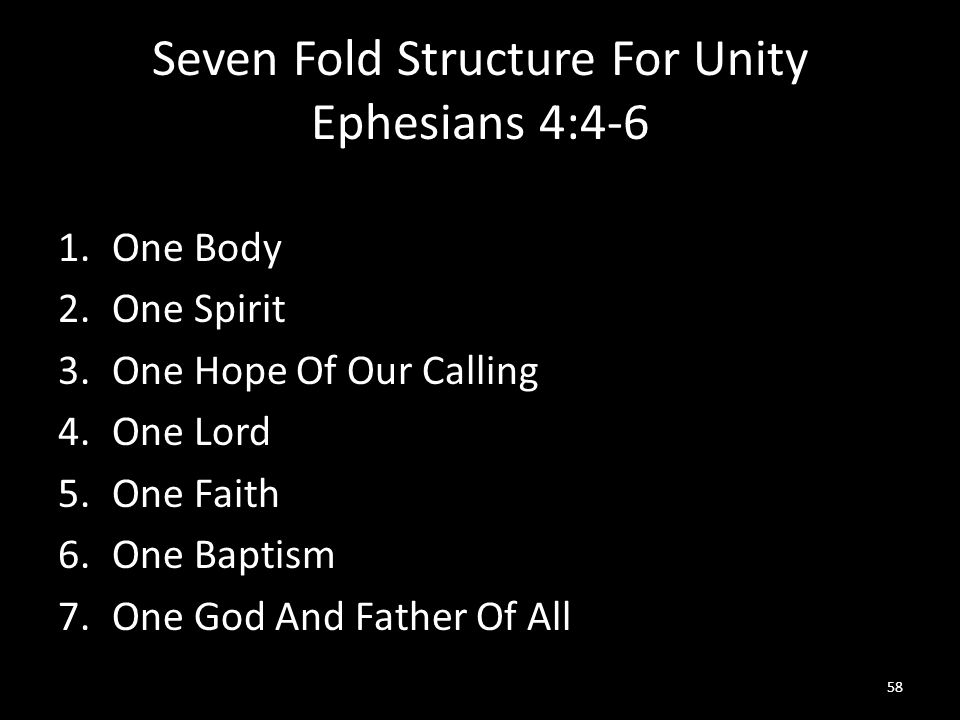
    Paul then goes on to give the 7 doctrinal truths that are necessary to have “unity”. Hindus could have all the qualities in 4:1-3 and be united as Hindus, but that would not be unity in Christ. There are 7 basic doctrines and beliefs that we must have to really have Christian unity.

    This list excludes those who believe in other gods than Yahweh and other Lords than Yeshua (Jesus). The one baptism is water baptism for the remission of sins (as opposed to the baptism of the Holy Spirit or of fire as some teach). There is one body, which is the church, which is believers all over the world.

    Q: How exclusive is this list among those who have the one faith but are in many different denominations? It is exclusive, but some of the 7 doctrines could be interpreted differently.

    Q: Does the one baptism have to be for exactly the right reason (i.e. the remission of sins) in the right manner (immersion)? Can it be sprinkling or pouring? Does that really matter? Can it be baby baptism? Why can’t we unite of what the “on baptism” of unity is?

    Q: Does the “one body” include all the denominations who have many different names and beliefs but basically hold to these 7 doctrines? The church I was raised in taught that the different man made denominations could not be part of the “one body”, but I disagree with that. The one body is simply those saved by grace throug faith even though they are in different denominations. Unity of those denominations would be great, but not essential for salvation. The founders of the Churches of Christ, Stone and Campbell, sought to get believers from all denominations to put away their denominational names and creeds and just be united as Christians, but they did not say that those believers in those denominations were not Christians.

    But what about the denominations that are going LGBQT? Are they still part of the one body?

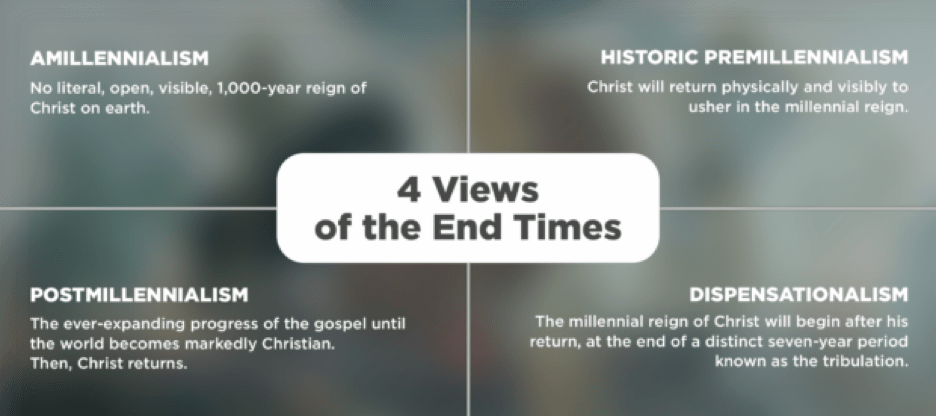
    The “one hope” is that of eternal life. But there are many views on eschatology (amillinealism, ? Do we all have to believe the same on eschatology? Add preterism to the chart below.

    4:8 Jesus gave miraculous “gifts” to certain men in the early church to give the doctrinal truths necessary for unity. He “ascended” to heaven to pour out those gifts on men.

    Act 2:33 Being therefore exalted at the right hand of God, and having received from the Father the promise of the Holy Spirit, he has poured out this that you yourselves are seeing and hearing.

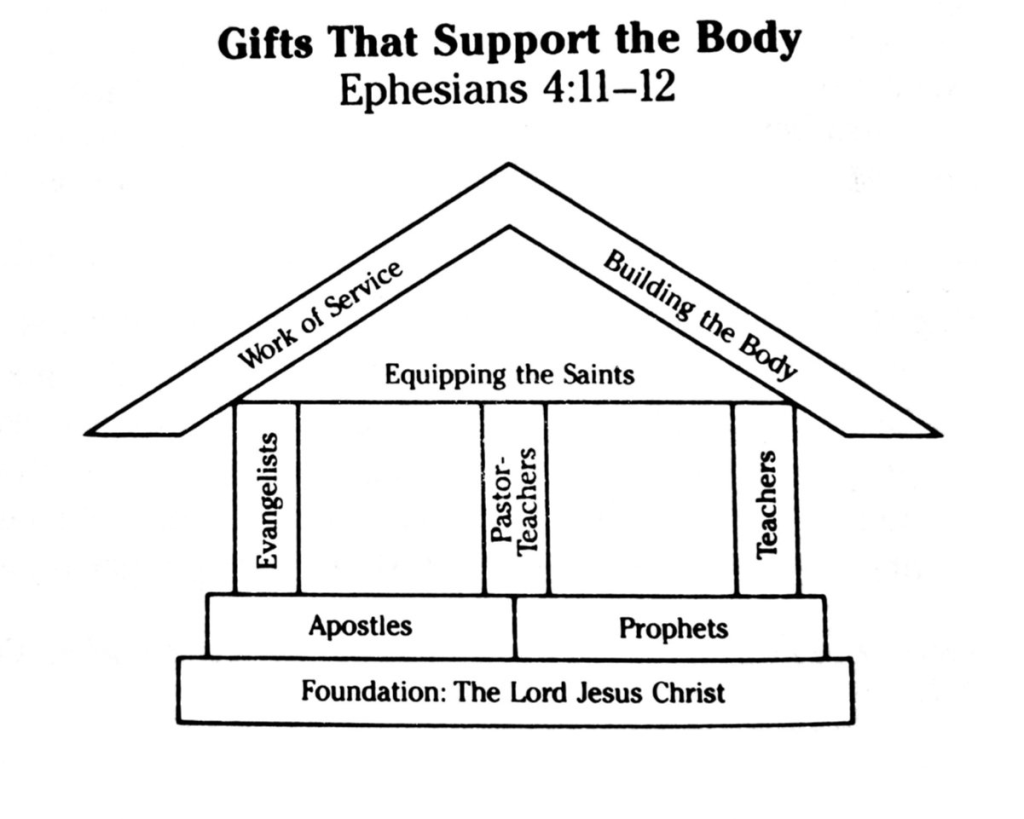
    This would include the 5 miraculously gifted leadership positions (apostles, prophets, evangelists, pastors, and teachers) as well as the miraculous gifts given to members of the church (1 Cor 12). Thus in 4:16 “every joint” helped maintain unity in the body. 

    These 5 gifted positions were to equip the saints for ministry, to build up the body, to a mature unity of faith and knowledge, to not be tossed about by deceitful doctrines, to speak the truth in love. 

    Jesus prayed for this “unity of the faith” in John 17:20 “I do not ask for these only, but also for those who will believe in me through their word, 21 that they may all be one, just as you, Father, are in me, and I in you, that they also may be in us, so that the world may believe that you have sent me. 22 The glory that you have given me I have given to them, that they may be one even as we are one, 23 I in them and you in me, that they may become perfectly one, so that the world may know that you sent me and loved them even as you loved me. 

    This is Jesus’ prayer on the night before he is crucified the next day. It would be like me knowing that I will die tomorrow and the night before I pray that my 3 children will always be united and love and help each other after I die.

    Q: As a result of these gifted 1st century positions, do we have all that we need for Christian unity and “maturity” in the church? If we have all that we need doctrinally for unity, then why. do we have so many different denominations teaching so many different doctrines? I might teach my 3 children all that they need to become mature adults, but that doesn’t mean they will become mature adults.

    What would be examples of “deceitful doctrines” that stray from that unity? This sounds more devious than just differences of interpretation on issues and doctrines that are not heaven or hell issues, such as those given by Paul in Romans 14 (eating of meats, observing of days, etc.). Deceitful doctrines sounds like doctrines taught by devious people trying to lure and pull believers away from the one body, maybe their motivation is power or sex or money.

    Peter spoke of such false prophets in 2 Peter 2:But false prophets also arose among the people, just as there will be false teachers among you, who will secretly bring in destructive heresies, even denying the Master who bought them, bringing upon themselves swift destruction. And many will follow their sensuality, and because of them the way of truth will be blasphemed. And in their greed they will exploit you with false words. Their condemnation from long ago is not idle, and their destruction is not asleep.

    Q: What are some doctrines that are not heaven or hell doctrines? Maybe instrumental music in worship, frequency of taking the Lord’s Supper, names and organization of churches, etc. We should not make any doctrine a heaven or hell doctrine unless the scriptures specifically do so. If we make almost every doctrine a heaven or hell one, then we will end up in untold division, as some groups have found out.

    Q: So what are the doctrines are heaven or hell essential doctrines to the “unity of the faith”?

    The list of 7 doctrines in this chapter is where we start, but even then the “one baptism” can be interpreted differently. Certainly the one faith would include the belief that Jesus is the Son of God whose death is the only way to be saved. That would rule out all the cults who deny the deity of Jesus.

    There are certain sins that Paul says in Galatians 5:19 Now the works of the flesh are evident: sexual immorality, impurity, sensuality, 20 idolatry, sorcery, enmity, strife, jealousy, fits of anger, rivalries, dissensions, divisions, 21 envy, drunkenness, orgies, and things like these. I warn you, as I warned you before, that those who do such things will not inherit the kingdom of God. The Bible teaches that homosexuality is a sin, but the LGBQT issue has divided churches and believers, but there can be no compromise on that. Sometimes unity is not possible if some refuse to acknowledge the inspiration of Scripture and won’t allow the Bible to define what is right and wrong.

    Q: Do we still need and have those gifted leaders today? 

    Apostles (the Mormon church has 12 apostles)? Paul spoke of false apostles: Paul spoke of “false apostes”: For such are false apostles, deceitful workers, transforming themselves into apostles of Christ. And no wonder! For Satan himself transforms himself into an angel of light. Therefore it is no great thing if his ministers also transform themselves into ministers of righteousness, whose end will be according to their works (2 Corinthians 11:13-15).

    Prophets (many churches claim to have prophets)? What about all the prophets of all the cults? The Mormons have Joseph Smith as their prophet, the Seventh Day Adventists have Ellen G. White, the Jehhovah’s Witnesses have Rutherford and Russell, Christian Science have Mary Baker Eddy, and countless more examples. These false prophets have no miraculous confirmation that they are a prophet and no predicting of the future to confirm that they are prophets. They also add to the “all truth” that was given to the original apostles without any proof that Jesus is allowing them to do that.

    Evangelists (are our preachers really evangelists?) In the early church, evangelists were gifted men who moved around preaching the gospel, establishing churches, grounding churches in the truth as Paul left Timothy in Ephesus to do (1 Timothy 1:As I urged you when I was going to Macedonia, remain at Ephesus so that you may charge certain persons not to teach any different doctrine) or as Paul left Titus in Crete to do (Titus 1:This is why I left you in Crete, so that you might put what remained into order, and appoint elders in every town as I directed you—). It was not a permanent paid position such as the paid clergy position that we have invented in churches today. The church did provide food and a place to stay for the evangelists who came to them. The Didache (a first century document) warns “You should treat apostles and prophets as the Gospel commands. Receive every apostle that comes to you as you would the Lord. But he must not stay more than one day, or two if necessary: but if he stays three days, he is a false prophet.” In other words, he must be preaching for the money! There were gifted elders and teachers to lead the church, so a permanent paid evangelists were not needed or authorized. We don’t have miraculously gifted elders or teachers today, but we still have many good elders and teachers in our churches. Why do we spend so much money of permanent paid pastors and preachers?

    I can see how evangelists who do mission work to establish churches might need to be supported (as my family was doing mission work in Trinidad and Colombia), but even then that was not a permanent position. It is interesting that the Moravians sent out many missionaries all over the world (I encourage you to read about their history). They taught them a trade so they could support themselve in the foreign country they worked in, gave them money to get there, but did not support them as they lived there!

    Pastors (i.e. elders; are our elders today gifted?): The word for shepherd is poimainó: to act as a shepherd. [4165 /poimaínō (“to shepherd, tend”) occurs 11 times in the NT, usually with a figurative sense of “shepherding (tending) God’s flock.” This provides Spirit-directed guidance (care) conjunction with feeding His people (teaching them Scripture).] This is the word Paul used in Acts 20 when telling the elders (4245 presbýteros – properly, a mature man having seasoned judgment (experience); an elder.) whom God had made to be overseers (episkopos: a superintendent, an overseer: this is the word used of elders in 1 Timothy 3 and Titus 14166 poimḗn – properly, a shepherd (“pastor” in Latin); (figuratively) someone who the Lord raises up to care for the total well-being of His flock (the people of the Lord).) to “shepherd (Pastors (i.e. elders; are our elders today gifted?): The word for shepherd is poimainó: to act as a shepherd. [4165 /poimaínō (“to shepherd, tend”) occurs 11 times in the NT, usually with a figurative sense of “shepherding (tending) God’s flock.” This provides Spirit-directed guidance (care) conjunction with feeding His people (teaching them Scripture).] This is the word Paul used in Acts 20 when telling the elders (4245 presbýteros – properly, a mature man having seasoned judgment (experience); an elder.) whom God had made to be overseers (episkopos: a superintendent, an overseer: this is the word used of elders in 1 Timothy 3 and Titus 1) to shepherd (4166 poimḗn – properly, a shepherd (“pastor” in Latin); (figuratively) someone who the Lord raises up to care for the total well-being of His flock (the people of the Lord) the flock. In other words, the 3 Greek words in Acts 20 refer to the same position: elders( presbyteros from which we get presbyters), overseers (episkopos from which we get bishops), shepherds (poimen from which we get pastors and shepherds). The early church organization at the local level was “elders and deacons”. Philippians 1:1: Paul wrote to the “overseers and deacons” in Philippi.1 Timothy 3: Paul lists qualifications for elders and deacons, including that elders should be experienced Christians with good reputations and well-ordered families. Titus 1: Paul refers to elders and overseers as the same. Acts 20:28: Paul spoke to the elders in Ephesus and told them to be overseers of the church. 1 Peter 5: Paul uses language of elders both shepherding and overseeing. In Christianity, the roles of presbyters and bishops have varied across time and denomination, often as 2 different positions, but the words refer to one position, that of elders.

    Bottom line, the gifted “pastors” in Eph 4:11 were shepherds or elders, not preachers like the term is used for preachers in denominations today. They were appointed in churches even soon after they were established. Paul on his 1st missionary journey: Acts 14:21 When they had preached the gospel to that city and had made many disciples, they returned to Lystra and to Iconium and to Antioch, 22 strengthening the souls of the disciples, encouraging them to continue in the faith, and saying that through many tribulations we must enter the kingdom of God. 23 And when they had appointed elders for them in every church, with prayer and fasting they committed them to the Lord in whom they had believed. So Paul appointed elders in those local congregations very soon after he established those churches. Those elders would have met the qualifications for elders in 1 Tim 3, but they would have needed the miraculous gifts to enable them to guide and protect the flock from false teachers. I believe all the first century elders had miraculous gifts, just as Eph 4:11 claims.

    We do not have miraculously gifted elders today, so do we still need elders? I think so. They just need to realize their limitations since they are not miraculously gifted. Of course, they can still protect the flock from heresy without being gifted by using the “all truth” in the Word, and they can still lovingly shepherd and care for the flock. They need to be careful about forcing their “opinions” on the flock.  

    Teachers : According to Ephesians 4:11, “pastors and teachers” are listed together, but whether they represent one single position or two distinct gifts is a matter of debate among scholars; some interpret it as meaning that all pastors should be teachers, but not all teachers are necessarily pastors, suggesting a distinction between the roles even if they are closely related. One of the qualifications for an overseer or elder was “apt to teach” (1 Timothy 3:1The saying is trustworthy: If anyone aspires to the office of overseer, he desires a noble task. Therefore an overseermust be above reproach, the husband of one wife, sober-minded, self-controlled, respectable, hospitable, able to teach… Of the elders that Paul told Titus to appoint in Crete: Titus 1:He must hold firm to the trustworthy word as taught, so that he may be able to give instruction in sound doctrine and also to rebuke those who contradict it. So, elders did teach in the churches, but in Eph 4:11 the “teachers” probably referred to a different position from elders. There were miraculously gifted teachers in the early church. 1 Cor 12:27 Now you are the body of Christ and individually members of it. 28 And God has appointed in the church first apostles, second prophets, third teachers, then miracles, then gifts of healing, helping, administrating, and various kinds of tongues. 29 Are all apostles? Are all prophets? Are all teachers? Do all work miracles? 30 Do all possess gifts of healing? Do all speak with tongues? Do all interpret? 31 But earnestly desire the higher gifts.It is interesting that Paul list the top 3 gifted positions in the church at Corinth as apostles, prophets, and teachers. It is also interesting that he does not include the miraculously gifted positions of elders or evangelists. Evangelists traveled church to church, so I can see why they were not included, but were there not miraculously gifted elders in the church at Corinth. I found this on the internet:”No, elders do not appear in any Biblical accounts of the church at Corinth. The church at Corinth lacked the spiritual maturity that would have been necessary for elders to be present. The church was made up of people with a history of immoral lifestyles, including sexual immorality, idolatry, and adultery. There was also evidence that many Corinthian disciples were former members of pagan mystery cults.” But then I found this. “For example, there is nothing said in the New Testament of the Eldership in Corinth, yet the epistle of the church in Rome to the church in Corinth commonly called the epistle of Clement, written about the close of the first century, proves that there was a plurality of Elders in Corinth.” Maybe the church added elders after Paul’s death as the miraculous gifts ceased to exist?

    Do we need teachers today in churches, even if they are not miraculously inspired? I think so. They just need to be grounded in the Word.