The prophet Elijah had just achieved a maor victory over the wicked King Ahab and his wicked wife, Queen Jezebel. On Mt. Carmel, he had just defeated the 400 prophets of Baal and the 450 prophets of Asherah. He should feel quite victorious, yes? No. Instead he goes into depression, even what would be considered suicidal depression. The mental health questionaires always ask, “did you ever consider killing yourself when you were depressed?” Eliah did. After his victory, he heard that Jezebel had sworn to kill him the next day. There would probably be many of her soldiers tracking him down 24/7. 1 Kings 19:3 Then he was afraid, and he arose and ran for his life and came to Beersheba, which belongs to Judah, and left his servant there. 4 But he himself went a day’s journey into the wilderness and came and sat down under a broom tree. And he asked that he might die, saying, “It is enough; now, O Lord, take away my life, for I am no better than my fathers.” That is suicidal thinking. An angel gave him food and sent him on a 40 day journey to Mt. Sinai. 1 Kings 19:9 There he came to a cave and lodged in it. And behold, the word of the Lord came to him, and he said to him, “What are you doing here, Elijah?” 10 He said, “I have been very jealous for the Lord, the God of hosts. For the people of Israel have forsaken your covenant, thrown down your altars, and killed your prophets with the sword, and I, even I only, am left, and they seek my life, to take it away.” “I have accomplished nothing, my life is a failure.”
What happens next is interesting. 1 Kings 19:11 And he said, “Go out and stand on the mount before the Lord.” And behold, the Lord passed by, and a great and strong wind tore the mountains and broke in pieces the rocks before the Lord, but the Lord was not in the wind. And after the wind an earthquake, but the Lord was not in the earthquake. 12 And after the earthquake a fire, but the Lord was not in the fire. And after the fire the sound of a low whisper. ” In other words: The Lord doesn’t always punish our enemies when and how we want him to. He doesn’t always remove our enemies when we want him to. It would be several years before God punishes Jezebel and the dogs eat almost all of her body and lick up her blood. Sometimes God has a more gentle way of dealing with our depressing circumstances, so we just need to trust him and be patient.
1 Kings 19:13 And when Elijah heard it, he wrapped his face in his cloak and went out and stood at the entrance of the cave. And behold, there came a voice to him and said, “What are you doing here, Elijah?” 14 He said, “I have been very jealous for the Lord, the God of hosts. For the people of Israel have forsaken your covenant, thrown down your altars, and killed your prophets with the sword, and I, even I only, am left, and they seek my life, to take it away.” Apparently Elijah didn’t get the lesson with the gentle breeze whisper! God asked him the same question that he did before the breeze. God was not asking that for His sake. He was asking that to challenge Elijah’s depression thinking. In other words: “Elijah, why are you even here? You should not even be here, several days away from the action. You should not be here feeling sorry for yourself.” Self pity is a big part of depression. You get the “victim mentality. You complain a lot. You dwell on things that have happened to you or past mistakes. You look at others who are doing better than you. You just feel sorry for yourself. Why me? Have you ever felt that? Self pity is a symptom of depression or can lead to depression. Of course, if you look at how many others are suffering then you won’t feel so sorry for yourself.
So what did God tell him to do to deal with his self pity and suicidal depression? 1 Kings 19:15 And the Lord said to him, “Go, return on your way to the wilderness of Damascus. And when you arrive, you shall anoint Hazael to be king over Syria. 16 And Jehu the son of Nimshi you shall anoint to be king over Israel, and Elisha the son of Shaphat of Abel-meholah you shall anoint to be prophet in your place. 17 And the one who escapes from the sword of Hazael shall Jehu put to death, and the one who escapes from the sword of Jehu shall Elisha put to death. 18 Yet I will leave seven thousand in Israel, all the knees that have not bowed to Baal, and every mouth that has not kissed him.” In other words: “Quit feeling sorry for yourself. Get back to work using your gift to do what I have commissioned you to do, i.e. to do the work of a prophet. I have work for you to do and this self pity and depression is hindering that work. Go anoint Hazael to be king over Syria: I will use him to punish the idolatry of Israel (and God did that later). Go anoint Jehu to wipe out the household and descendants to Ahab and Jezebel, which he did later. Go anoint Elisha to take your place later, and he will pronounce even more punishments on Israel for their idolatry. But be patient. The strong wind, earthquake, and fire will come, but only when I am ready and how I dictate it to happen. You just get back to work using your prophetic gift.” Elijah apparently immediately did what God said. Maybe it helped him deal with his depression and self pity.
So in part 1, we got lessons from the depression of Job. What is the main takeaway from the depression of Elijah. To me it is this: Quit feeling sorry for yourself. Get up and go use your gift to help others. 1 Peter 4:8 Above all, keep loving one another earnestly, since love covers a multitude of sins. 9 Show hospitality to one another without grumbling. 10 As each has received a gift, use it to serve one another, as good stewards of God’s varied grace: 11 whoever speaks, as one who speaks oracles of God; whoever serves, as one who serves by the strength that God supplies—in order that in everything God may be glorified through Jesus Christ. To him belong glory and dominion forever and ever. Amen.” 2 main types of gifts: teaching and serving. Using our gifts will help get our minds off our depression and make us feel useful. The world is full of opportunities for us to use our gifts. Find something that gives you purpose and perspective, that gives you a reason to live and gives meaning to your existence.
So, from Job: trust in God that he knows what’s best and humbly accept depressing circumstances.
From Elijah: quit feeling sorry for yourself and go use your gift to serve others.
From Paul: Keep your eyes on eternal life and whatever you face here on earth will be light and momentary in comparison with our eternal weight of glory.
When you have done all that, go get some good home made banana pudding, a good cup of coffee, and make the best of every day that you have left. At least, that’s what I do!
I wanted to do an article on this and found a great article from https://www.gotquestions.org/Baal-and-Asherah.html that was better than anything I could have come up with. But here is a summary of Baal and Asherah worship using quotes from the article. Why reinvent the wheel? Maybe I can add a little.
“God had commanded Israel not to worship idols (Exodus 20:3; Deuteronomy 5:7)—indeed, they were to avoid even mentioning a false god’s name (Exodus 23:13). To prevent compromise, they were warned not to intermarry with the pagan nations and to shun practices that might be construed as pagan worship rites (Leviticus 20:23; 2 Kings 17:15; Ezekiel 11:12). Israel was the nation chosen by God to one day give rise to the Savior of the world, Jesus Christ. Yet, even with their heritage and so much riding on their future, Israel was continually drawn into dalliances with Baal and Asherah.
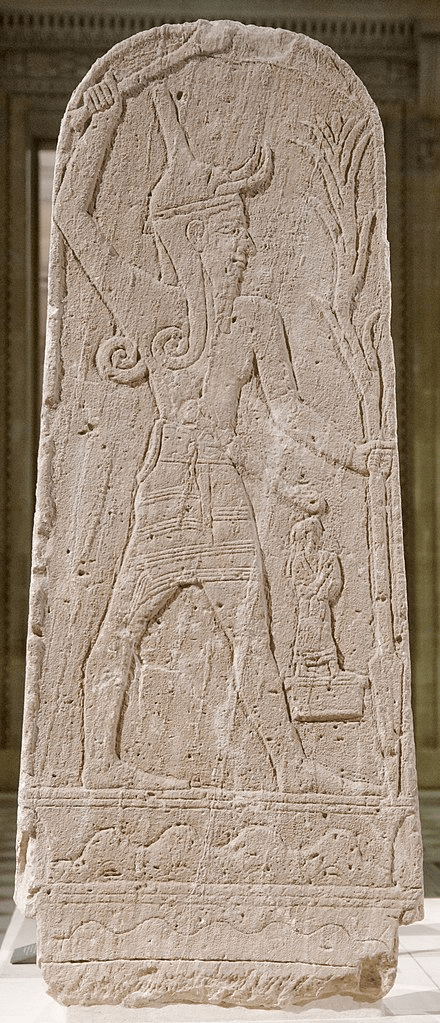
Baal was the supreme god in ancient Canaan and Phoenicia. As the storm god, he was usually depicted holding a raised lightning bolt. His consort, Asherah, was the chief female deity and was represented by a carved pole or limbless tree trunk planted in the ground. Baal and Asherah are often mentioned together in Scripture. Sometimes Baal is mentioned with the goddess Ashtoreth who, in Canaanite mythology, was closely related to Asherah and may have been for a time considered the same goddess. All of them were fertility gods, and their worship rites involved sexual perversion.”
History of the worship of Baal and Asherah (or Ashtoreth) in Israel: it goes back to Balaam. Balak, the king of Moab, had hired Balaam the prophet to curse Israel as they passed by his land on the way to the promised land. Numbers 22:41 And in the morning Balak took Balaam and brought him up to Bamoth-baal, and from there he saw a fraction of the people.” The pagans gave Baal various compound names (similar to Yahweh Rophe, Yahweh Shalom, etc.) and named places after Baal: Baal-gad (“lord of good fortune”, Joshua 11:17), etc. The Spirit did not allow Balaam to curse Israel, but instead through Balaam blessed Israel 4 times. But Balaam got his money by a cunning move. He knew God would curse Israel if they worshipped the gods of the pagans, like Baal. So he persuaded Balak to get Moabite women to intermingle with and worship the gods of the Moabites, which included having sex with them. That happened at Baal-peor. Numbers 25:1 While Israel lived in Shittim, the people began to whore with the daughters of Moab. 2 These invited the people to the sacrifices of their gods, and the people ate and bowed down to their gods. 3 So Israel yoked himself to Baal of Peor. And the anger of the Lord was kindled against Israel.” Numbers 31:16 Behold, these (i.e. the women who had sex with the Israelite men at Baal Peor), on Balaam’s advice, caused the people of Israel to act treacherously against the Lord in the incident of Peor, and so the plague came among the congregation of the Lord.” 24,000 died before Phinehas drove a spead through an Israelite man and Moab woman as they were having sex brazenly right in the camp of Israel. The history of Baal worship continues in Judges. “After the death of Joshua, the worship of Baal and Asherah became a plaguing and perennial problem for Israel. It didn’t take long: in the very next generation after Joshua, “The Israelites did evil in the eyes of the Lord; they forgot the Lord their God and served the Baals and the Asherahs” (Judges 3:7). Later, God told the judge Gideon to clean house: “Tear down your father’s altar to Baal and cut down the Asherah pole beside it” (Judges 6:25). (Judges 8:33 No sooner had Gideon died than the Israelites again prostituted themselves to the Baals.) They set up Baal-Berith as their god.Again, in the days of Jephthah, “the Israelites did evil in the eyes of the Lord. They served the Baals and the Ashtoreths” (Judges 10:6).”
The last judge Samuel persuaded the Israelites to stop worshippin Baal and Asherah at least for a little while. 1 Samuel 7:3 And Samuel said to all the house of Israel, “If you are returning to the Lord with all your heart, then put away the foreign gods and the Ashtaroth from among you and direct your heart to the Lord and serve him only, and he will deliver you out of the hand of the Philistines.” 4 So the people of Israel put away the Baals and the Ashtaroth, and they served the Lord only.” After Samuel anointed Saul as the first king, the people confessed: 1 Samuel 12:10 ‘We have sinned, because we have forsaken the Lord and have served the Baals and the Ashtaroth (i.e. during the period of the judges).”
The “peak”, or maybe better called the “low”, of Baal and Asherah worship came under King Ahab and his wife Queen Jezebel. 1 Kings 16:30 And Ahab the son of Omri did evil in the sight of the Lord, more than all who were before him. 31 And as if it had been a light thing for him to walk in the sins of Jeroboam the son of Nebat, he took for his wife Jezebel the daughter of Ethbaal king of the Sidonians, and went and served Baal and worshiped him. 32 He erected an altar for Baal in the house of Baal, which he built in Samaria. 33 And Ahab made an Asherah. Ahab did more to provoke the Lord, the God of Israel, to anger than all the kings of Israel who were before him.” The prophet Elijah confronted “four hundred and fifty prophets of Baal and . . . four hundred prophets of Asherah, who eat at Jezebel’s table” (1 Kings 18:19) at Mt Carmel. 1 Kings 18: 21 And Elijah came near to all the people and said, “How long will you go limping between two different opinions? If the Lord is God, follow him; but if Baal, then follow him.” And the people did not answer him a word.”The prophets of Baal and Asherah could not get Baal to bring down fire on the altar, but Elijah drenched the altar with water 3 times and then Yahweh consumed the altar with fire. The Israelites killed all 850 prophets of Baal and Asherah. Jezebel then swore to kill Elijah within the next 24 hours and that caused Elijah to flee, ending up at Mt Sinai. He was depressed that Jezebel had not been killed, that his life was in jeopardy. He told God, 1 Kings 19:10 He said, “I have been very jealous for the Lord, the God of hosts. For the people of Israel have forsaken your covenant, thrown down your altars, and killed your prophets with the sword, and I, even I only, am left, and they seek my life, to take it away.”” God rebuked him in a gentle breeze, telling him to get back to his work as a prophet and leave the judging to God. He was to anoint Hazael as king of Syria (who God would use to kill many Israelites), Elisha (to take Elijah’s place later), and Jehu as a later king of Israel (whom God would use to kill all of Ahab’s descendants, cutting off the heads of 70 of his sons (2 Kings 10), to kill Baal worshippers in a trap (2 Kings 10), and to kill Jezebel (he told men to thrown her down from a 2nd story and she died with the dogs eating all of her but her hands, feet, and skull). He told Elijah, 1 Kings 19:18 Yet I will leave seven thousand in Israel, all the knees that have not bowed to Baal, and every mouth that has not kissed him.” Unfortunately, 2 Kings 10:28 Thus Jehu wiped out Baal from Israel. 29 But Jehu did not turn aside from the sins of Jeroboam the son of Nebat, which he made Israel to sin—that is, the golden calves that were in Bethel and in Dan.”
Ahab’s evil son Ahaziah was the next king. He fell through the lattice and was severely injured. Elijah told him: 2 Kings 1:16 He told the king, “This is what the LORD says: Is it because there is no God in Israel for you to consult that you have sent messengers to consult Baal-Zebub, the god of Ekron? Because you have done this, you will never leave the bed you are lying on. You will certainly die!”
It was b/c of this persistent worship of false gods, the worhsip of the golden calves set up by Jereboam, and especially the worship of Baal and Asherah that in 722 BC God sent the Assyrians to take the 10 northern tribes into exile, to be lost forever in history. 2 Kings 17:14 But they would not listen, but were stubborn, as their fathers had been, who did not believe in the Lord their God. 15 They despised his statutes and his covenant that he made with their fathers and the warnings that he gave them. They went after false idols and became false, and they followed the nations that were around them, concerning whom the Lord had commanded them that they should not do like them. 16 And they abandoned all the commandments of the Lord their God, and made for themselves metal images of two calves; and they made an Asherah and worshiped all the host of heaven and served Baal. 17 And they burned their sons and their daughters as offerings and used divination and omens and sold themselves to do evil in the sight of the Lord, provoking him to anger. 18 Therefore the Lord was very angry with Israel and removed them out of his sight. None was left but the tribe of Judah only.” You would think that the southern kingdom of Judah would see what happened to the northern kingdom and would not worship foreign gods or Baal and Asherah. But apparently the worship of Asherah began early during the reign of the first 3 kings of Judah. It says of the 3rd king, Asa, 2 Chronicles 14:2 And Asa did what was good and right in the eyes of the Lord his God. 3 He took away the foreign altars and the high places and broke down the pillars and cut down the Asherim.” “The “Asherim” refers to the cultic symbols or sacred poles associated with the Canaanite goddess Asherah, essentially representing her presence in worship and considered idolatrous by the Bible; they are often translated as “Asherah poles” in English translations.” (AI) Of the 4th king Jehoshaphat it says, 2 Chronicles 17:3 The Lord was with Jehoshaphat, because he walked in the earlier ways of his father David. He did not seek the Baals”.
The next king of Judah was Jehoram. He married Athaliah, the daughter of Ahab and Jezebel, and no doubt she reinforced the worship of Baal and Asherah in Judah. 2 Chronicles 21: 6 And he walked in the way of the kings of Israel, as the house of Ahab had done, for the daughter of Ahab was his wife. And he did what was evil in the sight of the Lord. 7 Yet the Lord was not willing to destroy the house of David, because of the covenant that he had made with David, and since he had promised to give a lamp to him and to his sons forever.” That promise was the only things that kept God from sending Judah into captivity earlier than he did. After the death of Athaliah’s evil son, Ahaziah, Athaliah killed all of the royal house of Judah except for one son, Joash, who was hidden from her for 6 years, making herself queen. The priest Jehoida had her executed and Joash made king. 2 Chronicles 23:16 And Jehoiada made a covenant between himself and all the people and the king that they should be the Lord’s people. 17 Then all the people went to the house of Baal and tore it down; his altars and his images they broke in pieces, and they killed Mattan the priest of Baal before the altars.” Joash began restoring the temple and made this comment in 2 Chronicles 24:7 For the sons of Athaliah, that wicked woman, had broken into the house of God, and had also used all the dedicated things of the house of the Lord for the Baals.”
The 12th king of Judah was Ahaz. 2 Chronicles 28:And he did not do what was right in the eyes of the Lord, as his father David had done, 2 but he walked in the ways of the kings of Israel. He even made metal images for the Baals, 3 and he made offerings in the Valley of the Son of Hinnom and burned his sons as an offering, according to the abominations of the nations whom the Lord drove out before the people of Israel. 4 And he sacrificed and made offerings on the high places and on the hills and under every green tree.” King Ahaz of Judah was the first king of Judah to sacrifice his son in a pagan ritual. According to the Bible, Ahaz sacrificed his son by fire to the god Moloch.
“According to the Book of Hosea, the prophet Hosea prophesied during the reigns of four kings of Judah: Uzziah, Jotham, Ahaz, and Hezekiah. Hosea’s prophetic ministry primarily focused on the northern kingdom of Israel under King Jeroboam II, but his writings also reference the aforementioned Judah kings.” (AI) Several times he condemned northern kingdom’s worship of Baal. The book of Hosea aptly uses adultery as a metaphor to describe Israel’s idol worship. Forsaking the God of their covenant and chasing after false gods such as Baal and Asherah was akin to spiritual adultery.
The 14th king of Judah was the wicked grandson of Ahaz. Ahaz’s son Hezekiah had made many great reforms in Judah, but that didn’t last long. 2 Chronicles 33:2 And he did what was evil in the sight of the Lord, according to the abominations of the nations whom the Lord drove out before the people of Israel. 3 For he rebuilt the high places that his father Hezekiah had broken down, and he erected altars to the Baals, and made Asheroth, and worshiped all the host of heaven and served them. 4 And he built altars in the house of the Lord, of which the Lord had said, “In Jerusalem shall my name be forever.” 5 And he built altars for all the host of heaven in the two courts of the house of the Lord. 6 And he burned his sons as an offering in the Valley of the Son of Hinnom, and used fortune-telling and omens and sorcery, and dealt with mediums and with necromancers. He did much evil in the sight of the Lord, provoking him to anger. 7 And the carved image of the idol that he had made he set in the house of God, of which God said to David and to Solomon his son, “In this house, and in Jerusalem, which I have chosen out of all the tribes of Israel, I will put my name forever, 8 and I will no more remove the foot of Israel from the land that I appointed for your fathers, if only they will be careful to do all that I have commanded them, all the law, the statutes, and the rules given through Moses.” 9 Manasseh led Judah and the inhabitants of Jerusalem astray, to do more evil than the nations whom the Lord destroyed before the people of Israel.” Manasseh’s son was Amon: 2 Chronicles 24:22 And he did what was evil in the sight of the Lord, as Manasseh his father had done. Amon sacrificed to all the images that Manasseh his father had made, and served them.” But Manasseh’s grandson was Josiah, who began reigning at the age of 8. When he was 16: 2 Chronicles 34:3 For in the eighth year of his reign, while he was yet a boy, he began to seek the God of David his father, and in the twelfth year he began to purge Judah and Jerusalem of the high places, the Asherim, and the carved and the metal images. 4 And they chopped down the altars of the Baals in his presence, and he cut down the incense altars that stood above them. And he broke in pieces the Asherim and the carved and the metal images, and he made dust of them and scattered it over the graves of those who had sacrificed to them. 5 He also burned the bones of the priests on their altars and cleansed Judah and Jerusalem. 6 And in the cities of Manasseh, Ephraim, and Simeon, and as far as Naphtali, in their ruins all around, 7 he broke down the altars and beat the Asherim and the images into powder and cut down all the incense altars throughout all the land of Israel. Then he returned to Jerusalem.”
Josiah’s reforms were “too little, too late”. Jeremiah began prophesying in the 13th year of Josaih and prophesied for 40 years during the reigns of five kings of Judah: Josiah, Jehoahaz, Jehoiakim, Jehoiachin (also known as Jeconiah), and Zedekiah. He condemned the worship of Baal many times during his 40 years. Zephaniah prophesied during the reign of Josiah and predicted the fall of Judah. Zephaniah 1:“I will stretch out my hand against Judah and against all the inhabitants of Jerusalem; and I will cut off from this place the remnant of Baal and the name of the idolatrous priests along with the priests, 5 those who bow down on the roofs to the host of the heavens, those who bow down and swear to the Lord and yet swear by Milcom (the god of the Ammonites), 6 those who have turned back from following the Lord, who do not seek the Lord or inquire of him.”
You must be a history buff if you are still reading this long article! We have to ask ourselves, why was the worship of Baal and Asherah such a tempting, persistent problem in the entire history of Israel, going all the way back to Balaam and when the new generation was headed into the Promised Land?
From https://www.gotquestions.org/Baal-and-Asherah.html “There are several reasons why the worship of Baal and Asherah was such a problem for Israel. First, the worship of Baal and Asherah held the allure of illicit sex, since the religion involved ritual prostitution. This is exactly what we see in the incident of Baal of Peor, as “the men began to indulge in sexual immorality with Moabite women, who invited them to the sacrifices to their gods” (Numbers 25:1–2). During this episode an Israelite named Zimri brazenly brought a Midianite woman into the camp and went straight to his tent, where the two began having sex (verses 6–8, 14–15).
Another reason that the worship of Baal and Asherah was a perennial problem for Israel is what we could call international peer pressure. Israel wanted to be like the other nations (see 1 Samuel 8:5, 20). The other nations worshiped Baal and Asherah, and so many Israelites felt a pull to do the same.” In order to placate their gods, the Canaanites would offer their children to the gods and bury them in the foundations of a house under construction.
Many statues of Baal have been uncovered.
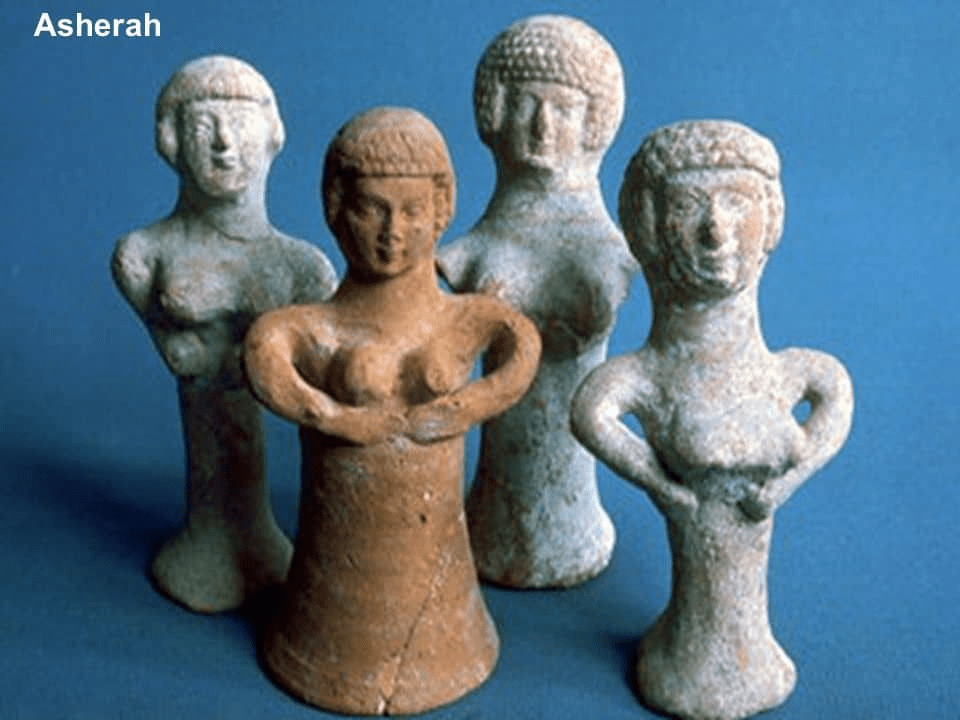
Many images of Asherah have been uncovered:
The article from gotquestions.org ends this way:
“The problem of Baal and Asherah worship was finally solved after God removed Israel from the Promised Land. Due to the Israelites’ idolatry and disregard of the law, God brought the nations of Assyria and Babylon against them in an act of judgment. After the exile, Israel was restored to the land, and the people did not dally again with idols.
Christians today may be quick to judge the Israelites for their idolatry, but we should remember that idols take many forms. Idolatrous sins still tempt the modern-day believer (Romans 3:23; 1 John 1:8–10). Instead of bowing down to the ancient forms of Baal and Asherah, we today sometimes honor possessions, success, and physical pleasure to the dishonoring of God. Just as God disciplined the Israelites for their idolatry and forgave them when they repented, He graciously disciplines us and extends the offer of forgiveness in Christ (Hebrews 12:7–11; 1 John 1:9; 2 Peter 3:9).”
We need to heed the words of John: 1 John 5:21 Little children, keep yourselves from idols.” I need to examine my heart. Have I put my money, possessions, prestige, and hobbies above God in my heart, my time spent, my devotion, my priority in life?


 Nicky's Notes