SEPT 4. READ GENESIS 46-50

God had promised Abraham, “I will make you a great nation” (Genesis 12:2). He promised Abraham to give him the land of Canaan, the “promised land” (Genesis 15::18). But he also told Abraham, “Know for certain that your descendants will be strangers in a land that is not theirs, where they will be enslaved and oppressed four hundred years” (Genesis 15:13). What was this whole story of Joseph and Egypt about? Genesis 46:3 God told Jacob as he was about to bring his whole family to Egypt to see Joseph, “I am God, the God of your father; do not be afraid to go down to Egypt, for I will make you a great nation there. I will go down with you to Egypt, and I will also surely bring you up again; and Joseph will close your eyes.” This was about God making a great nation from Jacob, whose name had been changed to “Israel” (i.e. the nation of Israel). Jacob was excited to see Joseph alive after thinking he was dead for 20 years, but he was also afraid. He is 130 years old and knows he doesn’t have many years to live. He would be moving to a land filled where Pharoah probably had over 1,000 chariots and Jacob has a history of being afraid. So God tells him not to be afraid. Have you ever made a major move to a new place that scared you? Maybe moving that first time into a dorm or an apartment at college, far away from home? Maybe moving to a new city on a new job? Were you afraid? My wife and I moved around a lot during our mission travels. I counted 11 moves that we made in a 10 year period when we were in our 20’s and early 30’s. We loaded my ’69 mustang and moved 300 miles from our house we had just bought to a school of preaching in Louisiana to live in a house trailer for 2 years. We got on a plane to fly 2,000 miles to the island of Trinidad in the West Indies to do mission work. I remember the fear I felt when we boarded that plane and I sat down in my seat. All the excitement of going was gone. All the supporters sending us off were left back at the departure gate, including all our parents. Now it was just fear of the unknown. Jacob was afraid of the move to Egypt, but God eased his fears. God had a plan. His family would not be slaves to begin with. They would live in Goshen, isolated as shepherds b/c the Egyptians did not like sheep and considered shepherds as “loathsome” (Genesis 46:34). Have you read of the range wars between cattle herders and sheep herders out west from 1870-1900? Cattle herders don’t like sheep b/c the sheep will eat all the grass right down to the root (cattle don’t). Another aspect of the providence of God to isolate Jacob’s family in Goshen for the next 400 years where they would not mix with the pagan Egyptians. They were not slaves at first. Joseph was about 40 when Jacob moved his family to Egypt, and Joseph died at 110. Exodus 1:6-11 says that they only became slaves at some point after Joseph died, so that means that Jacob’s descendants had at least 70 years of peace and prosperity in Egypt before they became slaves. What is this whole story about? God is making a great nation of Jacob, fulfilling the promise to Abraham. Jacob’s descendants will grow from 70 (Genesis 46:27) to maybe 2 million at the end of their stay in Egypt. They would never have grown that large in Canaan. This whole story of the providential working of God in the life of Joseph is about God making a great nation of Jacob (Israel).

Most of Genesis 46-50 is about the last 17 years of Jacob’s life spent in Egypt with Joseph. A couple of incidents stand out to me. 1) Joseph met Pharoah for the first time. Genesis 47:Then Joseph brought his father Jacob and presented him to Pharaoh; and Jacob blessed Pharaoh. Pharaoh said to Jacob, “How many years have you lived?” So Jacob said to Pharaoh, “The years of my sojourning are one hundred and thirty; few and unpleasant have been the years of my life, nor have they attained the years that my fathers lived during the days of their sojourning.” The Hebrew word for “unpleasant” is ra’: Evil, bad, wicked, harmful, unpleasant. So Joseph is using a really strong word to sum up his 130 years so far. I am 76 and can’t have many more years to live. If someone asked me to sum up my life, I hope I would not say my life has been “unpleasant” or miserable so far. And I wouldn’t say that. God as blessed me with many great years and memories. A few difficulties, but overall great and blessed. Why would Jacob say that his 130 years had been unpleasant? Let’s review his life: He lied to his father and steals Esau’s blessing, and fled his home in Canaan b/c. Esau was going to kill him. He was deceived and cheated by Laban for 20 years in Haran. He had a terrifying meeting with Esau at Penuel. He had a horrible incident at Shechem with the raping of Dinah, the vengeful acts of Simeon and Levi, and his fear that the Canaanites will all unite against him. He had many conflicts with the Philistines over wells that his men dug. His favorite wife Rachel, the only one he loved, died in childbirth (“to his sorrow, Genesis 48:7) as they arrived in Canaan after 20 years in Haran. He spent 20 years thinking his favorite son was dead, killed by an animal. He was terribly afraid of letting Benjamin go with the other brothers to Egypt and no doubt worried greatly while they were gone. I guess I can see why he said his years were “unpleasant”? But the main issue is that he spent most of those years “wrestling’ with God for control (which is what God was tellling him at Penuel). He spent his whole life trying to control his circumstances and get physical blessings by using his own cunning instead of trusting God, and it always led to disaster even though, as in Haran, God blessed him physically anyway.

Life Lesson: Look back at your life so far. Have you been letting God control your life, your decisions, your morals, your actions or have you tried to control evrything? Has your lack of trust in God’s control caused you to spend your years in fear and worry just like Jacob? I must admit that I have spent my life much like Jacob, in fear and worry and “what if’s”. Here’s a great image:

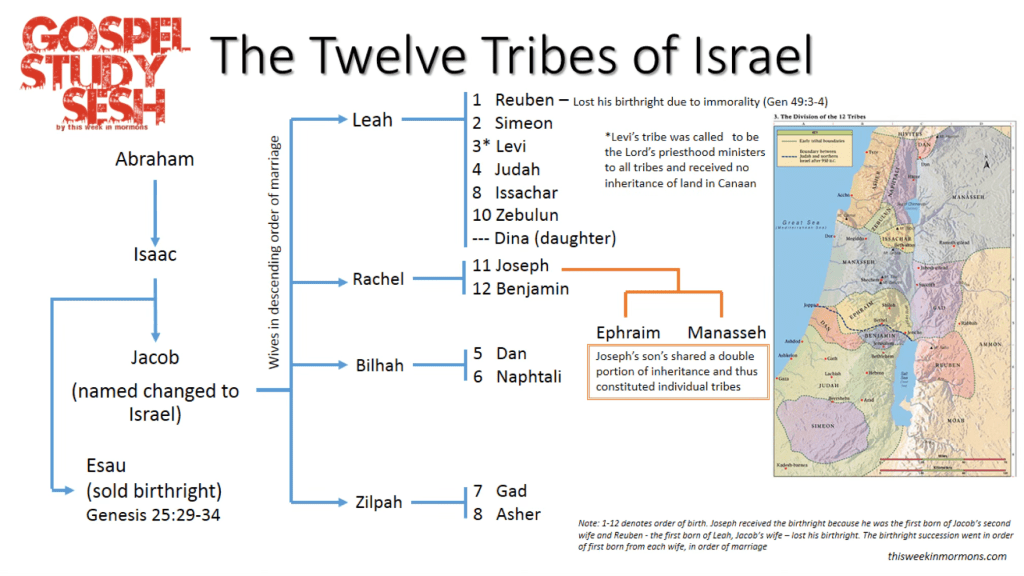
2) In Genesis 48, Jacob is sick, can’t see any longer, and is literally on his “dying bed”. He somehow finds the strength to “sit up in his bed” and call for Joseph’s two sons, Ephraim and Manasseh, to be brought to him so he could bless them before he died. He elevated Joseph’s two sons to equal status as Jacob’s biological sons. That also explains why Ephraim and Manasseh are given land when the promised land is divided among the 12 tribes. The Levites get 48 cities but no large portion of land. Joseph is not one of the 12 land divisions but his two sons are. So technically the 12 tribes of Israel which included Ephraim and Manasseh are not the same as the 12 biological sons of Jacob (Israel). But what interests me is what he said as he blessed the two boys, “The God before whom my fathers Abraham and Isaac walked, the God who has been my shepherd all my life to this day, the angel who has redeemed me from all evil, bless the lads” (Genesis 48:15-16). It seems as if on his dying bed he finally realizes that, in spite of wrestling with God most of his life for control, that God was his shepherd all along the way: protecting him, guiding him, rescuing him, providing for his physical needs, doing all the things a shepherd does for the sheep! He just seldom realized that. He was filled with worry and fear b/c he didn’t trust God as his shepherd. Contrast that with David in Psalm 23. David found great peace and courage b/c God was his shepherd even though he had his moment of fear and doubt. Jacob had very little peace in his life.

Life Lesson: I can look back at my life and see how God was my shepherd all along the way even when I didn’t realize it or when I didn’t turn to him for protection and guidance. Can you look back at your life and see that? But more importantly, what about your life now and in the future? Are you allowing God to be your shepherd? Are you trusting Him to guide, protect, and provide for your needs? Are you trusting the “good shepherd” Jesus to do the same? Does this verse resonate with you: 1 Peter 2:25 For you were continually straying like sheep, but now you have returned to the Shepherd and Guardian of your souls.” Jesus wants to be your shepherd. Will you let him?

Jacob’s story and life ends as he blesses his 12 sons before he dies. Most notably is the blessing to Judah: Genesis 49:10 “The scepter shall not depart from Judah, nor the ruler’s staff from between his feet, until Shiloh comes”. Most interpret this as saying that the rightful kingly line of Israel down to Jesus (Shiloh) will come from the tribe of Judah. He charged his sons to bury him in the cave of Machpelah where Abraham, Sara, Isaac, Rebekah, and Leah (Rachel was buried near Bethlehem). Genesis 49:33 When Jacob finished charging his sons, he drew his feet into the bed and breathed his last, and was gathered to his people.” Hebrews 11:21 By faith Jacob, as he was dying, blessed each of the sons of Joseph, and worshiped, leaning on the top of his staff.” I find it interesting that the only moment of faith in Hebrews “hall of faith” is that moment as he was dying and worshipping God. He could finally let go of all his fears, worries, plotting, and planning. He could just praise God who had been his shepherd and be joined to his ancestors. I kinda look forward to that day myself when it is inevitable that I am going to die (if I am allowed that moment). I might still have a little fear of the unknown and of dying, but finally I will be able to quit worrying about all the “what if’s” that I dream up, quit being afraid of so many things, quit struggling with the flesh and evil thoughts. I can just relax and worship God and look forward to seeing my mom and dad again along with many others.

Read chapter 50. It was a marvelous, unparalleled funeral procession from Egypt to Canaan. Joseph and his brothers buried Jacob in the cave of Machpelah. When they returned to Egypt, Joseph’s brothers were afraid that Joseph would retract his forgiveness of them now that their father was dead. Genesis 50:19 But Joseph said to them, “Do not be afraid, for am I in God’s place? 20 As for you, you meant evil against me, but God meant it for good in order to bring about this present result, to preserve many people alive.” Joseph is still confident that his whole story is about the providence of God in saving Jacob’s family and making a great nation from Jacob. The next book of the Bible, Exodus, will fast forward for a couple of hundred years.

SEPT 3. READ GENESIS 41-45

This should be a lot shorter than past blogs. You can read the chapters and get most of the details. We all know Pharoah’s two dreams: the fat cows that came up first, then the skinny cows came up and ate the fat cows. The same with the 7 full ears of grain followed by 7 withered ears that ate the full ears. We need to notice that Joseph gives full credit to God, not himself, for interpeting Pharoah’s dreams. He constantly says that God is the one who will cause the 7 years of plenty followed by 7 years of famine. Giving credit to God is typical of the character and integrity of Joseph. So Genesis 41:39 Pharaoh said to Joseph, “Since God has informed you of all this, there is no one so discerning and wise as you are. 40 You shall be over my house, and according to your command all my people shall do homage; only in the throne I will be greater than you.” 41 Pharaoh said to Joseph, “See, I have set you over all the land of Egypt.” Joseph then set about with a plan to store excess grain during the 7 years of plenty and then sell it to people all over suffering from the 7 years of famine. BTW Joseph is 30 when he stood before Pharoah 41:46. He was 17 when his brothers sold him to a caravan. He spent 2 years in prison false accused by Potiphar’s wife. The restored butler forgot Joseph for 2 years so that means he spend 4 years total in prison. That means he spent about 9 years as a slave in Potiphar’s house. That’s longer than I thought!

I’m not going to give all the details of Joseph’s brothers two trips to Egypt to buy food. That’s fairly easy, plain reading. I am going. to focus on chapter 45. Joseph is moved to tears as he hears Judah make a very passionate appeal to Joseph not to keep Benjamin in Egypt. Judah said that would kill Jacob, their father. He offered to take Benjamin’s place and stay in Egypt as a slave if Joseph would let Benjamin go back to his father in Canaan. Joseph heard that plea and realized that that his brothers had changed. Joseph wept so loudly that Pharoah’s household heard him weeping. He then revealed to his brothers that he was Joseph. He then said, “Genesis 45:Now do not be grieved or angry with yourselves, because you sold me here, for God sent me before you to preserve life. For the famine has been in the land these two years, and there are still five years in which there will be neither plowing nor harvesting. God sent me before you to preserve for you a remnant in the earth, and to keep you alive by a great deliverance. Now, therefore, it was not you who sent me here, but God; and He has made me a father to Pharaoh and lord of all his household and ruler over all the land of Egypt.” We could call this an epiphany (a sudden moment of clear understanding or a great realization). It finally dawned on him that everything that had happened was part of God’s providential working to get Jacob’s family to move to Egypt where they would end up enslaved but multiplying to over a million people so that God’s promises in Genesis 15 could come true, i.e. that Abraham’s descendants would be slaves for 400 years and then come out to go possess the promised land of Canaan.  They would never have grown so much if they had stayed in Canaan. Joseph told his brothers that it wasn’t them that sent him to Egypt: it was God. It actually was his brothers who sold him into slavery in Egypt but was in control of making that happen. We don’t know how God works behind the scenes to make His plans happen. He uses the free will choices of people but He also directs circumstances to make things happen. Joseph forgave his brothers and they had a tearful but joyous reunion. Joseph, with Pharoah’s help and wagons, had Jacob moved from Canaan to Egypt, about 75 people.

Life Lesson: When bad things happen, you never know what good things God might make happen out of the bad. You have to trust God. Romans 8:28 God causes all things to work together for good to those who love him. That’s called the “behind the scenes providential working of God. It’s a mixture of God allowing people to make good and bad choices but sill making things work out like He wants them to. Usually there are no Bible miracles involved. The story of Joseph and the story of Esther are ttwo great examples of the providence of God working. The book of Esther doesn’t even have the name of God in it, but the hand of God is seen throughout the book and the events in the book. I will close with my example. I have only been fired once in my 76 years. It wasn’t for anything bad I had done. The elders where I was preaching just decided to tell me to move on since I had been telling them that I was probably going to take another job in Huntsville at Madison Academy when it came open. But they did fire me. It was very rough making the move to Huntsville. I took a 50% cut in pay to come to Madison Academy and my wife lost her new, very good paying teacher job in Vernon Alabama. But God blessed us, my wife found a good job, and I became principal of the school a year later which doubled my pay. I also started preaching part time with a church in Huntsville. But the greatest blessing of getting fired was my 3 children finding their mates in Huntsville over the next few years after we moved. I truly believe that God was working to get us to Huntsville. I believe that He was behind our firing. He did not make the elders fire me. They did so on their own, but God somehow influenced them to make that decision. Before they fired me, I had just decided to not move to Huntsville, but after they fired me I had no choice since I no longer had the preaching job in Vernon. That was rough on us at the time, but I look back and it was one of the best things that has ever happened to my family. Do you have a story of God working in your life? Of God making bad things work for good? Have you ever had an epiphany like Joseph did and it just hit you that God had been working all along even though you didn’t realize it?

SEPT 2. READ GENESIS 36-40

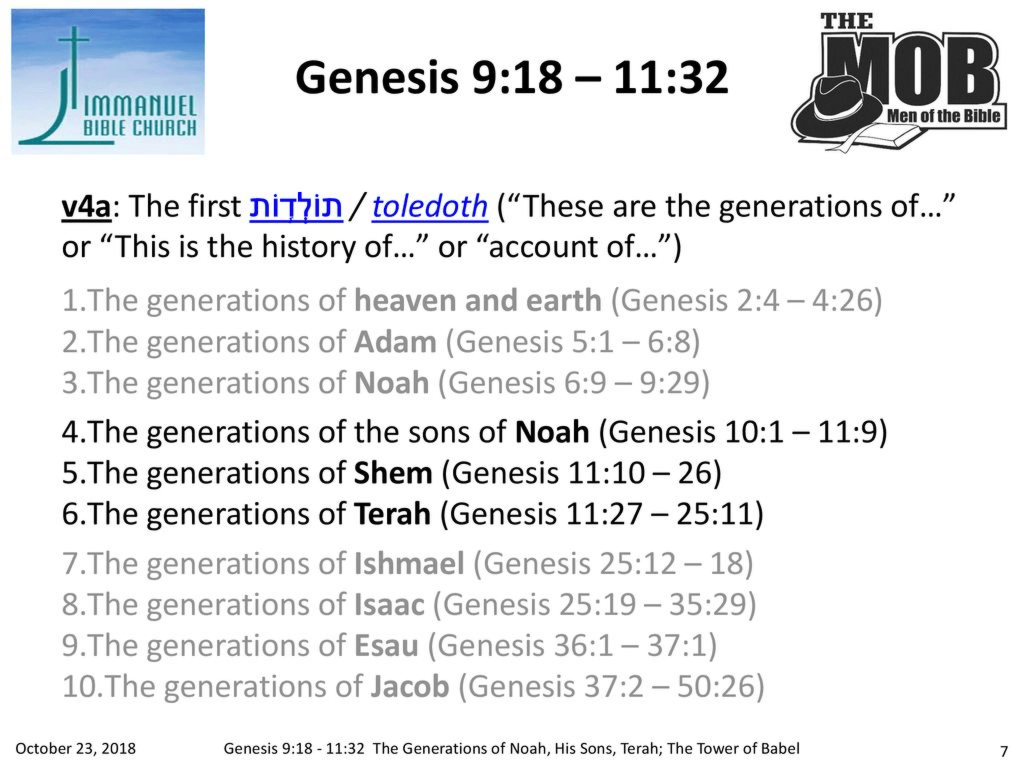
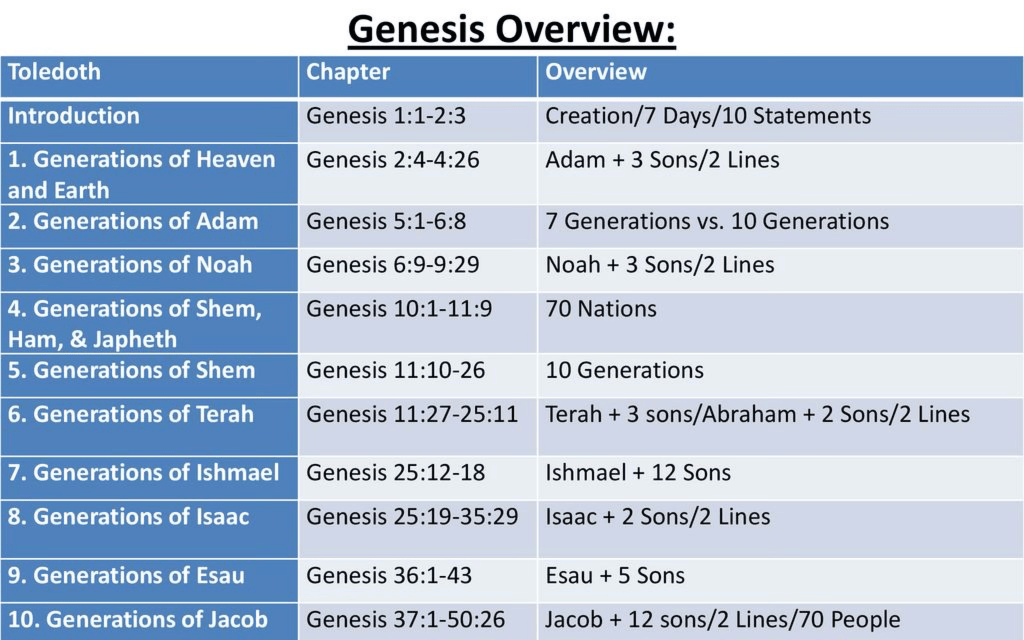
I like outlines of books. Seldom does a book of the Bible actually give an outline for that specific book, but Genesis does.

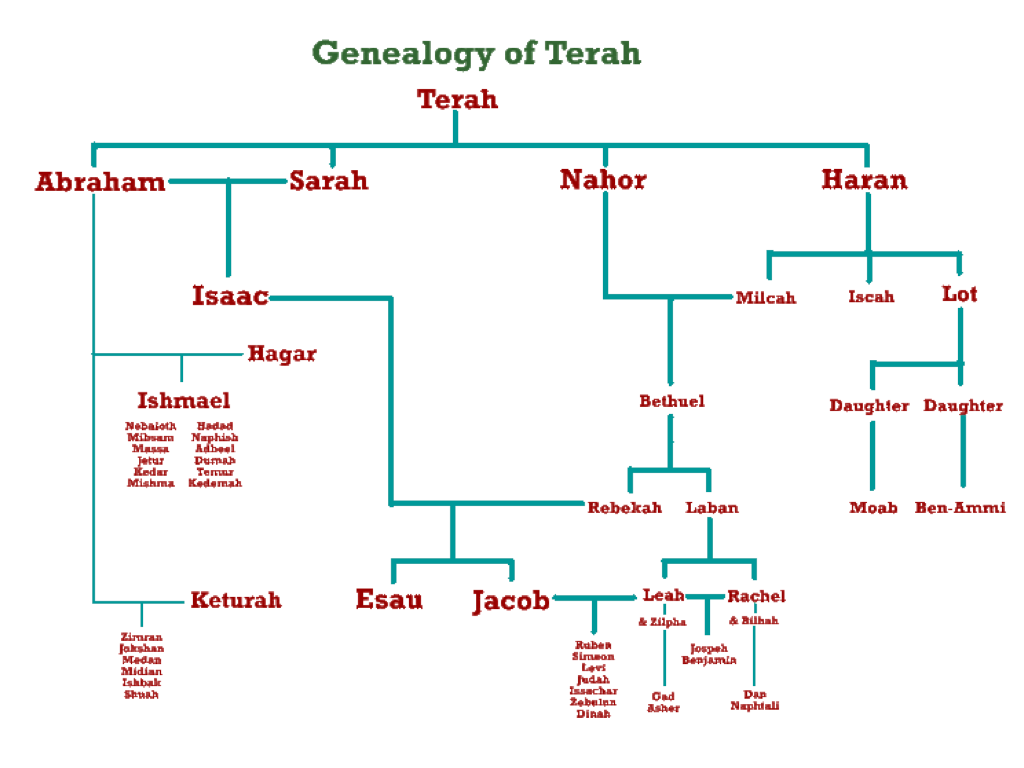
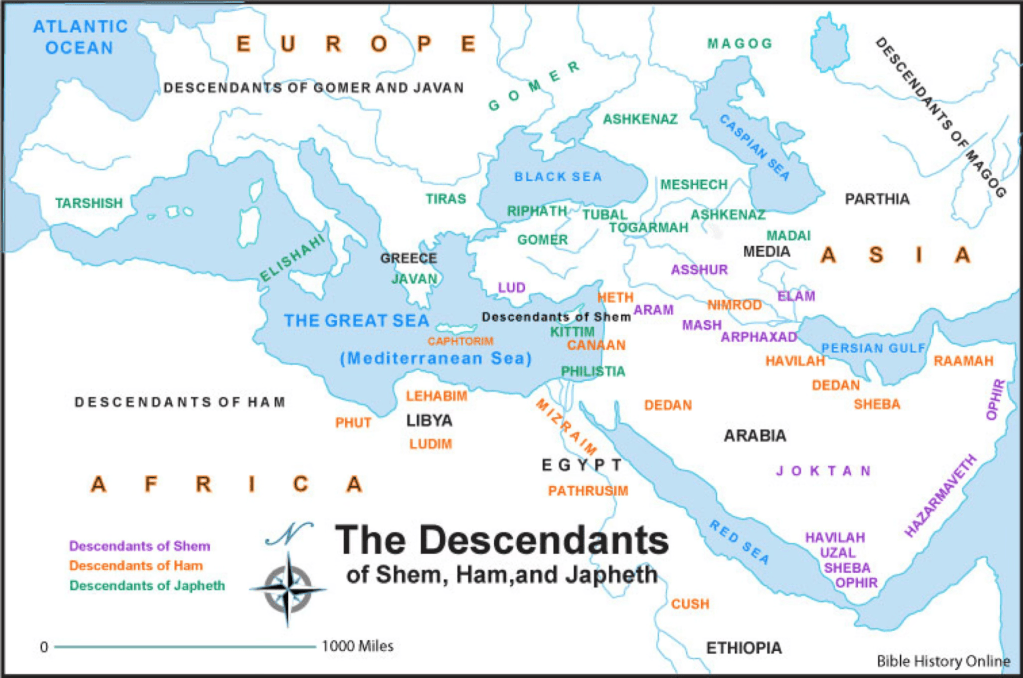
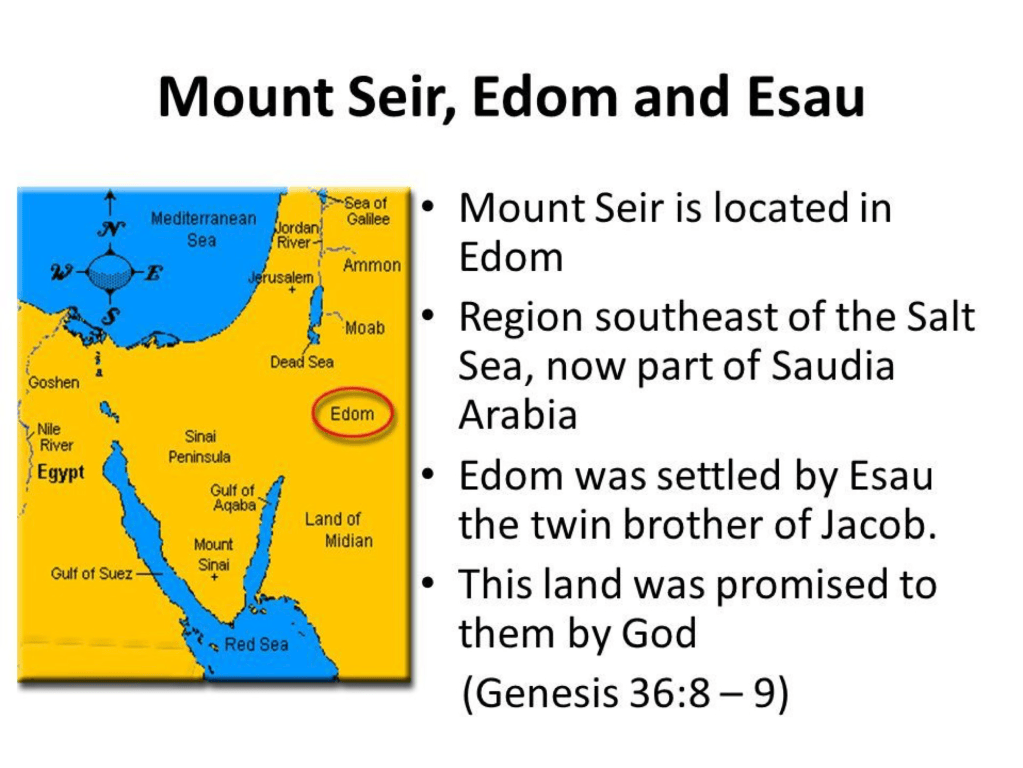
Each part of the outline begins “These are the records of the generations of …” as in Genesis 36:9 “These are the records of the generations of Esau” and then 37:1 “These are the records of the generations of Jacob”. It is interesting that Abraham, a main character in Genesis, does not have his own “generations of Abraham”. Instead, he is included in the “generations of Terah” (his father). Likewise, Joseph has 13 chapters (Genesis 3-50) devoted to his life, but does not have have his own “generations of Joseph”. Instead he is included in “the generations of Jacob” (his father). But Ishmael, Abraham’s son by Hagar, has his own “These are the records of the generations of Ishmael” in Genesis 25:12 which would not seem important to the Jews since Isaac, born to Sarah, was the son of the promises to Abraham and not Ishmael. But both Ishmael and Esau had many powerful and important descendants. Esau has his own chapter of generations (chapter 36).The Arabs come from Ishmael. The Edomites descended from Esau. The Edomites played a complex role in the history of Israel. They refused to allow Israel to pass through their territory as Israel was making their way to Canaan. The Edomites cheered and plundered Jerusalem when Babylon destroyed Jerusalem in 586 BC. The short one chapter book of the prophet Obadiah is a prediction about the destruction of Edom b/c of “violence done to your brother Jacob”, b/c they took part in plundering and “looting” Jerusalem when it fell, b/c they “gloated and rejoiced” over the fall of Jerusalem, b/c they killed or imprisoned fugitives trying to escape from the city when it fell. Obadiah mentions their arrogance: they live in mountain ranges like Petra where they felt no enemy could defeat them. AI: “the ancient city of Petra in Jordan appears in Indiana Jones and the Last Crusade (1989). Harrison Ford and Sean Connery’s characters travel through the narrow gorge (the Siq) and arrive at the Treasury where the holy grail is during the final sequence of the film.” The Edomites grew rich and proud from controlling trade routes that passed through Edom. But Obadiah predicted the destruction of Edom and the house of Esau. That prophecy was fulfilled by the time of the Romans when Edom no longer existed as a separate people. The only survivors were living in Idumea, not Edom, and were called Idumeans. Herod the Great who ruled Judea was an Idumean appointed by the Romans as king. More than you wanted to know about Edom, maybe, but Genesis 36 and the book of Obadiah show the importance of Edom and the descendants of Esau in the Bible.

Moving on to Genesis 37:2 “these are the records of the generations of Jacob”. The life of Jacob was already told in Genesis 25-36, so this last section of generations in the Genesis outline is really mainly about Joseph and the other sons of Jacob, along with Jacob, moving to Egypt during the famine. Jacob committed favoritism, just as his parents Isaac and Rebekah had done with him and his brother Esau, by loving Joseph more than his other sons. Joseph was the son of his favorite wife Rachel. It caused his brothers to hate him and sell him to a caravan going to Egypt. Joseph even contributed to their hatred by telling them of his dreams of the brothers, even including Jacob and Rachel, bowing down to Joseph. Why tell that dream to your brothers who already hate you and are jealous of you? Did Joseph have a little bit of an “attitude”, “better than his brothers”? Joesph was given special privileges. The brothers were out shepherding the flocks, but not Joseph. He was back with Jacob who sent him to check up on his brothers who have moved the sheep to Dothan, about 65 miles north of where they all lived in Hebron. So shepherding and finding pasture for large flocks all over Canaan would have been hard work that Joseph (and probably Benjamin, Jacob’s other favorite son by his wife Rachel) were exempt from that hard work. Jacob made Joseph a “coat of many colors” which made his brothers hate him even more. Stop and youtube Dolly Parton’s song, “Coat of many colors”. Her mother sowed her a coat from rags, inspired by the Bible story of Joseph’s coat of many colors. So when he found his brothers, they put him in a pit and eventually sold him to the caravan going to Egypt. They dipped his coat in animal blood and showed it to Jacob, saying an animal had killed Joseph. Jacob was very grieved. He would believe that Joseph was dead for the next 22 years before he was reunited with Joseph in Egypt. Life Lesson: Be thankful if you have never been involved in some type of family conflict among siblings or parents! Many of us have and it is a miserable thing to deal with. Joseph and his brothers will end up in a happy reunion 22 years later, but many sibling and family conflicts don’t end up in happy reunions. They end up with hatred and bitterness, accusing each other of wrong doing, squabbling over family inheritance, one sibling having to care for aging parents while the other siblings just give lip service. If you do have such family conflicts, try to be the peacemaker. You may end up being the responsible sibling who does more work and sacrifices more than the others, but God will reward you for your integrity and your sense of responsibility.

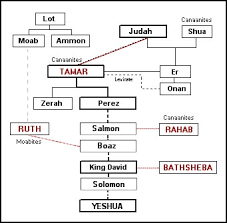
Then we come to one of the strangest chapters in the Bible, Genesis 38. Right in the middle of telling about Joseph’s childhood and being sold into slavery in Genesis 37 and his being a slave to Potiphar in Egypt in Genesis 39 is a totally unrelated chapter about a sordid affair in Genesis 38. Read it for the details. Judah, Jacob’s son who is in the seed line of the rightful kings of Judah down to Jesus, unknowingly goes to a prostitute who is his daughter in law Tamar. Tamar married one of Judah’s sons but that son died without a child, so the other two brothers were supposed to take her as wife and bear a child for their deceased brother. This was called the Levirate marriage law and is found in Deuteronomy 25:5-10. The 2nd son refused to put his seed in Tamar and was killed. The 3rd son was still too young, so Judah promised that later he would give that 3rd son to Tamar to bear a child for the deceased brother, but as the 3rd son grew older, Judah failed to keep his promise and failed to obey the Levirate marriage law. He probably knew that his 3rd son was evil like the first two sons and was afraid the 3rd son would disobey and be killed also. Did Tamar know that Judah was prone to visit prostitutes? She dressed up as a temple prostitute and Judah had sex with her, promising to pay her with a goat. He gave her his ring as collateral. But Judah’s friend was sent to give her the goat and recover Judah’s ring but the prostitute (Tamar) was nowhere to be found. Judah discontinues the search for Tamar and his ring, and hopes no one will find out about the sordid affair, making him a “laughingstock”. 3 months later they bring Tamar to Judah b/c she is pregnant, saying she had committed prostitution. Judah said, “Let her be burned”. Burning someone was a capital punishment used for certain crimes in the Old Testament, like a man marrying both a woman and her mother (Leviticus 20:14) or like the burning of Achan for taking forbidden items from Jericho (Joshua 7). Perhaps the victim was killed first and then his/her body burned. As they were carrying her out to be burned, she basically says, “BTW Here is the ring of the man who got me pregnant if you want to track him down and punish him also”. Can you imagine the startled look on Judah’s face as he looks at his own ring that he had given Tamar after having sex with her? The guilt, the shame, the embarrassment, the exposure of his self righteous conviction of Tamar. Can you imagine the startled look on the faces of those who were carrying Tamar out when they realized Judah had gotten his own daughter in law pregnant while she was posing as a temple prostitute? Can you imagine the shock of Judah’s friend, the Adullamite, whom Jacob sent to take Tamar the goat and retrieve his ring? I guess that friend knew Judah had been to a prostitute, which was a sin, but did not know that the woman posing as a prostitute was Tamar. Tamar was not burned, but instead had twins, Perez and Zerah. But the most unusual thing about this sordid affair is that Perez is in the seed line of Jesus. Perez will be the great grandfather of King David! Life Lesson: Don’t judge people based on their family history. I wonder if anyone mocked Perez as he was growing up, knowing that he was the illegitimate “bastard” son of the noble Judah and his daughter in law Tamar. Leviticus 18:15 states directly: “Do not have sexual relations with your daughter-in-law; she is your son’s wife, so you must not have sexual relations with her”. Leviticus 20:12 reinforces this rule, stating that if a man has sexual relations with his daughter-in-law, both of them must be put to death because it is a perversion.” The Law of Moses had not yet been given at the time of Judah, but this would still have been a terrible sin. But this wasn’t the fault of Perez. Often you see children of bad, immoral people. The children might have a rough upbringing with sinful, irresponsible parents. They might end up considered to be “bad” kids and looked down on by outsiders. But you never know what all those “bad” children have gone through. Don’t judge the kids by their family history. We would like to think that Perez handled people knowing about his shameful birth well. Maybe that is why he was chosen to be in the seed line of Jesus instead of Zerah. It had looked like Zerah was coming out of Tamar’s womb first (the midwife put a scarlet thread on Zerah’s hand as his hand first emerged but then his hand drew back and Perez came out first, making him the firstborn). Maybe God knew Perez could handle his family’s sordid history better than Zerah? Surely you have seen that where two siblings from bad parenting and shameful births react totally different to their bad family history. One learns from it and uses it to be a better person than his/her parents. The other lets the family history make him a victim of self pity all his life.

Genesis 39 and 40 tell about Joseph being a slave to Potiphar in Egypt and being imprisoned falsely b/c Potiphar’s wife falsely accused him of trying to rape her when it was really she who was trying to seduce Joseph. The thing we admire about Joseph is his integrity and character. He could have just become another miserable slave, wallowing in self pity. Instead he was such a loyal and responsible slave to Potiphar that he was put in charge of everything Potiphar had. He had moral integrity. They say, “integrity is doing what is right when no one is looking”. Surely it was tempting for Joseph to have sex with Potiphar’ wife. He perhaps had never had sex with a woman. He wouldn’t want to risk causing her to become angry with him by rejecting her advances, would he? Surely they could keep it a secret affair and Potiphar never find out? But Joseph “just said no”. He apparently had his convictions on not having sex out side of marriage. He told her, “No, I won’t sin against my master and against my God”. “Hell hath no fury like a woman scorned” did not come from Shakespeare. The phrase comes from the English playwright William Congreve in his 1697 play The Mourning Bride. But wherever it originated, it fits Joseph’s predicament. She lies to Potiphar and has Joseph thrown in prison unjustly. Life Lesson: Stats say that 25% of marriages have some adulterous affair. AI: “When emotional affairs, online connections, and sexting are included, rates jump to roughly 45% for men and 35% for women. Many couples report that emotional cheating can hurt a relationship just as much as a physical affair.” Paul said that fornicators and adulterers will not inherit the kingdom of God (1 Corinthians 6:9,10). He then added, “6:18 Flee immorality. Every other sin that a man commits is outside the body, but the immoral man sins against his own body. 19 Or do you not know that your body is a temple of the Holy Spirit who is in you, whom you have from God, and that you are not your own? 20 For you have been bought with a price: therefore glorify God in your body.” Joseph literally “fled” from Potiphar’s wife, leaving his garment in her hand. To resist fornication (sex outside of marriage) or adultery (sex with a marriage involved) requires that a person has conviction about his sexual boundaries, about how far he/she will go sexually in a relationship. He/she already has his/her mind made up and is ready to say “no” when temptation arises or when he/she is being pressured into having sex. He/she is ready to “flee”. Some good advice: Avoid places or times with close contact where you will be tempted. Promptly just leave a place when you see where it is headed sexually. Don’t give in to lines like “if you loved me then you would have sex with me”. Avoid flirtatious friendships at work that can lead to emotional infidelity. Certainly avoid pornographic literature or videos that can pollute your mind. If you are still young and dating, do group dating so that you won’t find yourself in isolated, tempting or pressured situations. Think about the horrible conseqences to your family if you cheated on your mate. Would an affair be worth the damage it would cause? Get in the word and study passaages about sexual purity.

But again instead of wallowing in self pity in prison, it says that Joseph was such a responsible prisoner that the chief jailor put him in charge of all the other prisoners. Many times people in prison just want to talk about how unfairly they were treated or that they were innocent of charges. They talk about the inequity of their harsh, lengthy prison sentences as opposed to prison sentence given to the rich. They talk about racism being part of prison sentences. Not Joseph. His character is seen as he just sets about to be the best prisoner he can be. Several times it says “The Lord was with Joseph and prospered Joseph”, both in Potiphar’s house and in prison, showing how God rewards integrity and character. Life Lesson: I have a friend who spent 25 years in prison for committing murder. He never once said he was innocent or that he got an unfair prison sentence (he got “life” but not “life without parole”). He had no money so that didn’t help in his legal representation, but he never complained. I would talk to him once a month for 25 years. I baptized him while he was in local jail waiting on his trial. We studied the Bible once a week. We studied a lot of Old Testament history just like the past few weeks of our study. In prison, he spent his time studying the Bible and trying to convert other prisoners. He had his depressed times, but usually we talked about people he was trying to help. Finally after 25 years and 2 or 3 “parole denied” hearings, he was released on parole and is still on parole. But the Lord rewarded him for his integrity and character. He has held a steady job and gone to church regularly since his release. His faith is still strong and he helps others. Not all prisoners released do as well as my friend. The stats say 70% of prisoners released end up back in prison within 5 to 9 years after release. Prison ministry is a difficult one with many failures. But that doesn’t mean that there is not someone who is like my friend, who is part of the 30 % who do not end up back in prison. If released prisoners have the integrity and character of Joseph, they can live successful lives in spite of their past history and crimes. Don’t judge someone when you find out they have been in prison before. It might just be like my friend.

Finally, chapter 40 tells about Joseph interpreting the dreams of two fellow prisoners that leads to the release and restoration to his job of Pharoah’s butler and the beheading of Pharoah’s baker. The sad part about this is that Joseph asked the butler to remember him after he will be released. The butler was restored to his position and could have helped Joseph get out of prison a lot earlier than the did but the butler forgot Joesph and what Joseph had done for him. Life Lesson: Have you ever helped someone and just asked them to remember you in the future if you need their help- but they forgot you? Someone said, “I’m tired of people just remembering me when they need help”. They never call me or socialize with me, but then out of the blue they call me wanting help in some way. They never call you or contact you unless they need something. Do you ever feel like people are “using you” to get what they want? They don’t really appreciate your friendship or what you have done for them. They seldom thank you or show appreciation. That’s ok. Find new friends who are loyal to you. Two great verses to close with: Proverbs 18:24: This verse warns against fake companions and highlights that a real friend sticks closer than a brother. Proverbs 17:17: This verse explains that a true friend loves at all times and is born to help during times of distress.

This has been long but there is so much to discuss in Genesis, especially doing 5 chapters at a time. I hope you are keeping up with the daily reading. Sept 3 will be Genesis 41-45 and Joseph’s time in Egypt.

SEPT 1. READ GENESIS 31-35

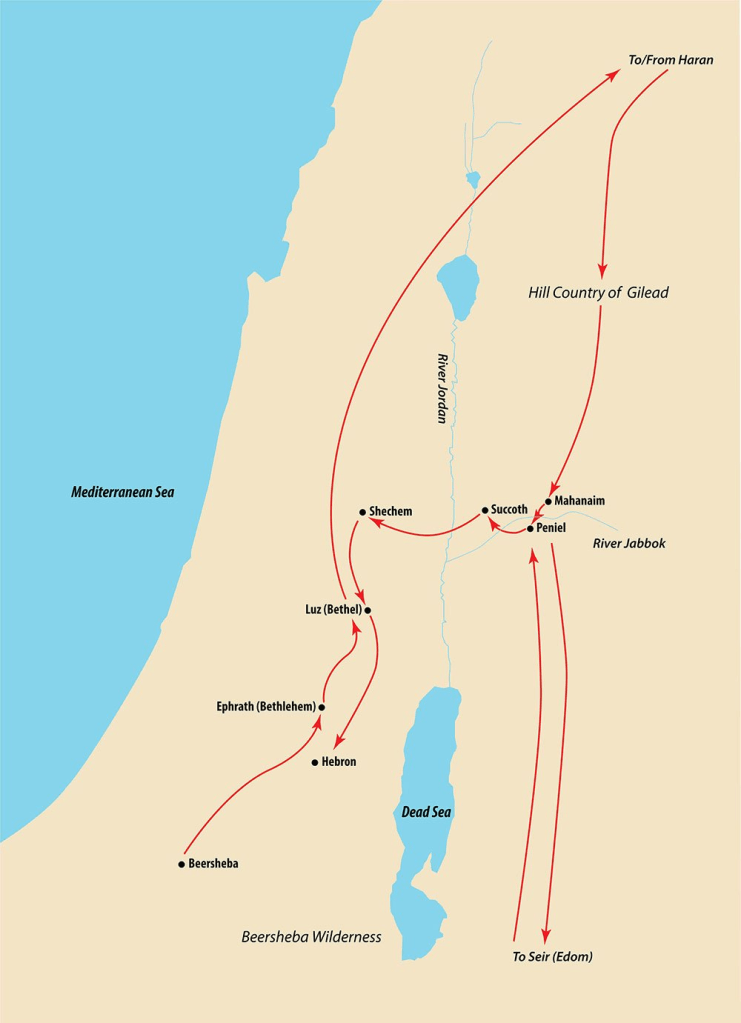
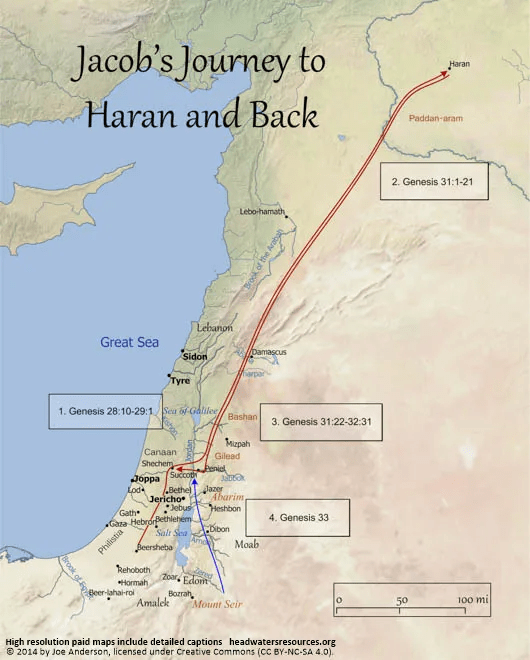
Again, each day 5 chapters and comments. For Sept 1, read Genesis 31-35. Here is the map of Jacob’s journey from Beersheba to Haran and back to Canaan. You can trace his journey by key places on the map, even number them if you wish.

BEERSHEBA. He begins in Beersheba when he steal the blessing that Isaac intended to give to Esau. He flees from Esau’ plan to kill him, going to Haran supposedly to get a godly wife but really to escape Esau.

BETHEL He leaves Beersheba at the age of 77. His first night away from being protected by his mama Rebekah, he dreams of the ladder to heaven and names the place, Bethel, “house of God”, sensing God’s presence there.

HARAN. He spends the next 20 years working for Laban who is a bigger con man than Jacob ever was. But God blesses him and after the 20 years he ends up with 11 sons, 1 daughter, and much wealth. But he only has one wife that he loves, i.e. Rachel, and his favorite son is the son born to Rachel, i.e. Joseph.

GILEAD. (Genesis 31) After 20 years working for Laban, Jacob observes that Laban’s attitude has become hostile to Jacob. Why has Laban become so hostile toward Jacob? The reason is that during those last 6 years of the 20 years, Jacob worked for Laban, paid with sheep. Laban would say that Jacob’s pay was all the speckled sheep born that year, which would only be a few, but God would make there be many, many speckled born. Laban would then get mad and change Jacob’s wages to the spotted ones born, but God would multiply the spotted ones born. Laban would change his wages again, etc. for 10 times in 6 years. By the end of the 6 years Laban is very angry with Jacob. God then told Jacob to return with his family and flocks to Canaan where he began his journey 20 years earlier. Jacob tells his wives and they agree, sensing that Laban has nothing to give them as an inheritance. It is interesting to note that Jacob, while trying to outsmart Laban (read how Jacob used tree “rods” to try to induce a certain type of sheep born and stronger sheep in Genesis 30:37-43), it seems that Jacob has finally realized that it was God who made him wealthy and not his own cunning. He told Rachel and Leah, “God has been with me”, “God did not allow Laban to hurt me”, and “God took away Laban’s flocks and gave them to me”. I consider this to be an important step in Jacob’s spiritual growth. Laban deceived, lied to, and cheated Jacob for 20 years but God kept Jacob safe and made him wealthy. Jacob and his family, servants, and animals flee Haran without telling Laban. When Laban discovers their departure, he is furious. He chases Jacob down for 7 days, catching him at the hill country of Gilead. God warned Laban not to hurt Jacob. An interesting side note is that Rachel had stolen Laban’s household god idols and hidden them on her camel. That means that Rachel apparently has some reverence for the foreign gods of Laban. Laban doesn’t find the idols. He and Jacob made a treaty to not hurt each other and Laban goes back to Haran. Again, Jacob gives God the credit for his wealth and protection from Laban (31:42). They name the place of their peace covenant Gilead or Mizpah. Life lesson: Have you ever been through a real tough time in your life? You tried to use your own cunning and ingenuity to handle things but felt frustrated the whole time? But then, somehow, later there was a break through and things changed and got better without your help? You then realized that it was God blessing you even during the tough times? That’s how God works some times!

MAHANAIIM. (Genesis 32:1-2) Find it on the map. The angels meet him and he names the place “Mahanaim” which means “two camps” (i.e. his camp and the camp of angels). Another step in Jacob’s spiritual growth? He realizes when he meets those angels that God will protect him with his angels wherever he goes? Unfortunately, that doesn’t keep him from being terrified at the next stop in Penuel. Life lesson: God’s angels are protecting us at all times but we don’t always see them.

PENUEL (Genesis 32:3-33:17) Find it. Panic! Jacob learns that Esau is headed toward him with 400 men. The last time he saw Esau, Esau (say that fast) was planning to kill Jacob (20 years earlier). He was “greatly afraid and distressed” (32:7). He resorted to his own cunning instead of trusting God. He devised a plan for Rachel and Joseph to escape if Esau kills his less favorite sons and Leah. I assume he would escape with them. He tries to bribe his way out by offering Esau animals. Pretty cowardly, but typical of Jacob. That night a man wrestles with Jacob all night but neither prevail. In the morning, the man touches Jacob’s thigh and dislocates it. An interesting trait of Jacob follows. You would think that Jacob would gladly let the man go after the man dislocates his thigh by just touching him. I mean, if the man could do that, then he could have done that the first 5 minutes of the wrestling match. If the man was that powerful, then why would he still keep him in your grasp after he dislocates your thigh? But Jacob would not let the man go unless the man blessed him. He must have realized that this was not an ordinary man, but was God himself who had taken the form of a man just to wrestle with Jacob. For all his faults, Jacob seems to realize that all blessings come from God and therefore he wants more blessings from God. The man changes Jacob’s name to “Israel”, which means “he who strives or wrestles with God”. Jacob names the place “Penuel”, which means “face of God”. He felt he had seen and wrestled with God himself, but that God had not killed him so God must have bigger plans for Jacob. This idea that Jacob wrestled with God seems to fit Jacob’s whole life. He had always tried to control things and get blessings by his own cunning and ingenuity. He had wrestled with God for control of his life instead of giving God complete control. Life Lesson: Does anyone reading this relate to that? I know I do. I have always tried to control things instead of giving complete control to God. Usually I am pretty successful, but often I realize that I have not let God have complete control. Often I make a mess of things by not submitting to God.

The next day when Esau came, Esau hugged him and kissed him and they both wept! Esau was the redneck who could threaten to kill you one day and have a friendly beer with you the next day! God had blessed Esau with wealth to compensate for what Jacob took from him. Jacob made an amazing statement: “I see your face as one sees the face of God” (33:10) and you have received me favorably (i.e. forgiven me). Perhaps Jacob had felt guilty over the years for the way he stole from and took advantage of Esau. Perhaps he wondered if God would ever forgive him of that wrong he had done. But when Esau forgave him, that was like looking at the face of God and God saying, “Jacob, I forgive you for what you did to Esau”. Life lesson: Have you ever struggled to forgive yourself for wrongs you have done to others? God will forgive you. Have you ever struggled with fear and panic attacks facings some danger or bad situation? Sometimes, God uses someone like Esau to ease your fears. I had that happen to me one time. I was about to have a nervous breakdown over an issue I was dealing with. A friend took me to a legal expert and that man told me, “you have nothing to worry about, we “got your back”, get back to using your gifts for God and quit worrying and being afraid”. That man telling me that allowed me to sleep that night (I had been getting about an hour of sleep every night and waking up worrying and my mind racing). I saw the face of God in that man who helped me. I should have seen the face of God a month earlier and trusted God and found peace of mind, but I just couldn’t do it. I needed that man’s help and I think God used him like God used Esau to help Jacob see God’s forgiveness for Jacob. Does any of that resonate with you?

SUCCOTH. (Genesis 33:17) Find it on the map. Jacob then goes to Succoth, just east of the Jordan River and close to Canaan. Apparently he planned to stay there for an extended period b/c he built a house. Many think he stayed about a year there. Why didn’t he just cross the Jordan River and just go on over into Canaan? We don’t know, but perhaps what happened at Shechem when he did cross the Jordan gives an indication of his reluctance to cross the Jordan. We must remember that there were many powerful armies in Canaan. Jacob might have been afraid to cross over?

SHECHEM. (Genesis 33:18-34:31) Find it. After leaving Succoth, Jacob camped near Shechem. Shechem was a well developed fortified urban center with massive walls, inhabited by Canaanite people with polytheistic practices. Leah’s daughter Dinah visited the city (we don’t know why?) and was raped by a man named Shechem who said he loved her and wanted to marry her. Jacob’s usual cowardice shows up and he does nothing to correct the wrong done to his daughter Dinah. But two of her biological brothers (all born to Leah) were angry. They devised a plan. They got the men of Shechem to agree to all be circumcised so they could marry the “daughters” in Jacob’s family. Again, we hear nothing from Jacob. But the 3rd day after they Shechemites are all circumcised and completely incapacitated by the “surgery”, Simeon and Levi go in the city and kill all the men. They rescued Dinah from the house of Shechem and killed him, and Jacob’s other sons looted the city completely. Jacob’s reaction? He was only concerned that what Simeon and Levi had done would unite the other Canaanites to attack him. Again, Jacob’s cowardice and lack of trust in God pops up. How could any father be so passive if his daughter gets raped and do nothing? I know I would be tempted to take the law into my own hands if that happened to one of my two daughters (which would be wrong to do of course). God could have righted this wrong done to Dinah without this deceptive and cruel plan of Simeon and Levi. Life Lesson: Rape is one of the most degrading, horrible crimes ever. We have to wonder how Dinah handled this whole incident later. Do you know of someone who has had to deal with a rape incident? Was justice served?

BETHEL (Genesis 35) Find it. God told Jacob to move on to Bethel and make an altar. Do you remember Bethel, “house of God” where he spent his first night after leaving Beersheba to flee to Haran at the age of 77? He is about 97 years old when he returned to Bethel. His journey has made “full circle”. To his credit, another step in spiritual growth. He makes an altar at Bethel, makes his family give up their foreign gods idols, and said, “God answered me in the day of my distress and has been with me wherever I have gone.” Jacob has come a long way, distance wise and spiritually also. God takes care of his fears as the people of Canaan have apparently heard of the ruthlessness of Jacob’s sons and are afraid of Jacob, which is just the opposite reaction to what Jacob had feared. At Bethel, God reaffirmed Jacob’s name change to Israel and his promises of a nation and land. Life Lesson: Do you have a “Bethel” in your life, a place and time when you finally decided to put way your idols and totally trust in God like you never had before? Where you realized that you had been on a long journey with God and finally arrived at a more trusting relationship with God? Share that with others.

BETHLEHEM. (Genesis 35:16-21) Leaving Bethel, on the way to Bethlehem, Rachel died giving birth to Benjamin. Rachel’s two sons, Joseph and Benjamin, would become Jacob’s favorite sons which cause a lot of problems later. Jacob would stay in Canaan 33 years after returning to Canaan.

HEBRON (Genesis 35:21-29) Find it. This is where he found his father Isaac whom he had not seen for 20 years. Isaac was 137 years old when Jacob left for Haran. He was about 157 when Jacob came to Hebron. He died at the age of 180. So Jacob would have been able to spend about 20 years with Isaac at Hebron before Isaac died. You have to wonder what that was like. Did Isaac see a changed person in Jacob after he returned from Haran? Did he see a more mature spiritual man than the deceptive, cunning, lying son that Jacob was before he left for Haran? Did Jacob ever apologize to his father for lying and deceiving him when he stole the blessing from Esau? Was Jacob’s mother Rebekah still alive when Jacob returned to Hebron to live with Isaac? She is never mentioned in Genesis after she sent Jacob off to Haran so some assume that she died while he was in Haran. Genesis 49:31 tells us that she was buried in the cave of Machpelah but we don’t know when she died. It is interesting that Jacob and Esau join together to bury their father Isaac. Esau had settled in Edom, which is southeast of the Dead Sea. I wonder what that reunion was like when they buried their father. Did Jacob and Esau ever see each other again after that? Life Lesson: God can reconcile broken family relationships like that of Jacob and Esau.

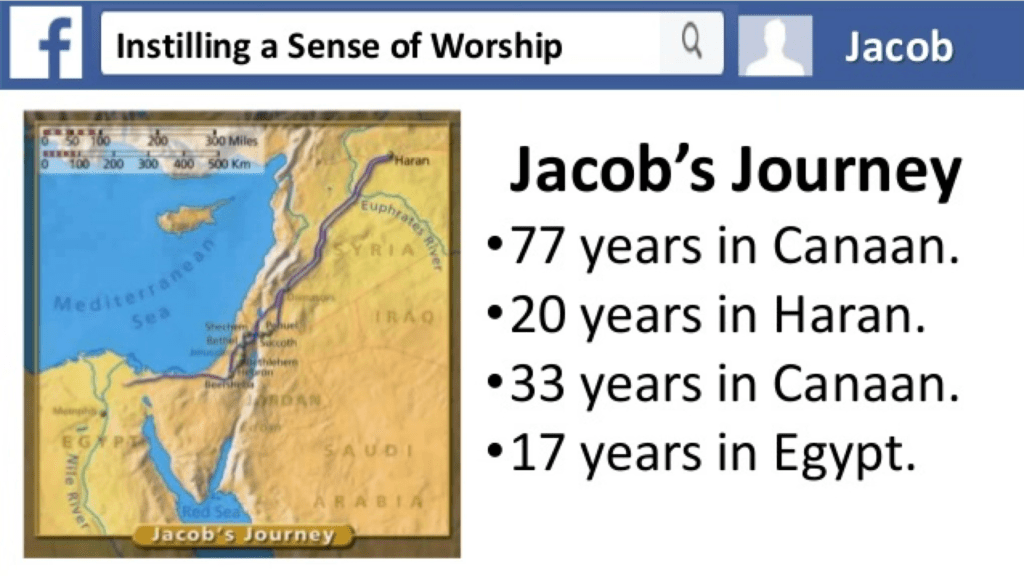
Jacob would be 130 when he moved to Egypt so he spent 33 years in Canaan. His journey will not be totally complete until he spends his last 17 years in Egypt and meets Pharoah, but we will save that for later. I hope you keep up with the daily reading and maybe even read these blog article that go along with each reading. This could be a great plan for personal or small group Bible study on a daily basis.

AUG 31 READ GENESIS 26-30

I am going to begin a daily commentary on about 5 chapters of the Bible every day. My grandaughter and her friends are doing those readings daily. Aug 31 is Genesis 26-30 so read those chapters and then this blog article. I will include some great images that I hope come through ok.

I love the story of Jacob which begins with 25:19-34 which was covered on the Aug 30 reading. The birth of Jacob and Esau. Esau the firstborn with special birthright privileges (twice as much inheritance as the firstborn) but he gives his birthright to Jacob for a bowl of stew! Typical redneck hunter who didn’t appreciate his birthright. How could anyone give up 1/3 of his inheritance for a bowl of stew! A lof of kids raised in the church get off to college after being grounded in the faith all their lives only to give it up to some atheistic or skeptic view of God and the Bible. The stats say we lose 2/3 of church kids by the time they finish college.

Chapter 26: God renews to Isaac his nation/land/seed promise he made to Abraham in Genesis 12:1-3 (the nation would be then nation of Israel, the land would be the promised land of Canaan, and the seed promise would be salvation through Jesus Galatians 3:16). Then “like father like son”, Isaac goes to Gerar in Philistine territory and tells the same lie that Abraham did, i.e. he told Abimelech that Rebekah was his sister so that Abimelech would not kill him to take his wife! Did Isaac not know that Abraham told that same lie about his wife Sarah twice and how much trouble it caused? Did Isaac not trust God to protect him from Abimelech? Then quarreling with the Philistines over wells of water that Isaac drilled until finally Isaac and Abimelech make a treaty to not harm each other. Isaac is allowed to drill another well at Beersheba and he builds an altar there. Beersheba will be an important location in the journeys of Jacob.

Esau’s lack of spiritual concern pops up again as he marries two Hittite women which grieves Isaac and Rebekah greatly. They no doubt remember how Abraham sent Eliezar back to Haran to get a godly wife for Isaac (chapter 24). How Eliezar prayed for God’s guidance and success in his mission. Rebekah would have been a believer in the one true God, El Shaddai. Now Esau is marrying two Hittite pagan women. The Hittites were known as the “people of a thousand gods”, worshipping gods like Tarhum the storm god and king of the gods, the sun goddess of Arinna, and many others. Esau’s lack of spiritual concern is why God chose Jacob, the younger, to be in the seed line of Jesus and not Esau.

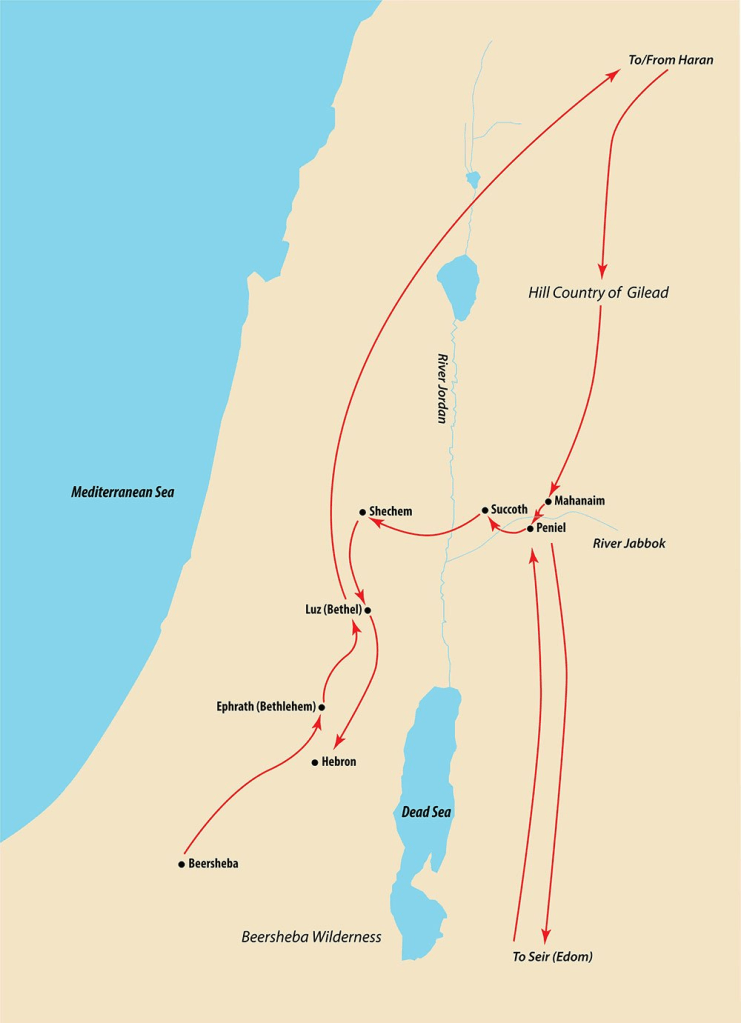
This is a great image that tracks the journey of Jacob beginning in Beersheba, to Haran, and ending up back in Canaan in Hebron where Isaac dies. Follow his journey on the map as you study the rest of Jacob’s life.

BEERSHEBA. This journey begins in Beersheba when Jacob, with Rachel’s guidance, deceives an aging, almost blind, Isaac into giving his final blessing to Jacob instead of Esau. The birthright was already gone to Jacob and Isaac couldn’t change that, but he hoped he could give Esau a final special blessing. Jacob stole it (Genesis 27 for details). After that, Esau planned to kill Jacob as soon as Isaac would die, so Rebekah sent Jacob off to Haran under the pretense of sending him to get a godly wife from their relatives just as happened with getting Rebekah for Esau. BTW Genesis 27 shows the damage due to favoritism in families. Was there favoritism in your family if you have siblings? Most people will say there was but then say they were not the favorite child! But very seldom does favoritism do to the extremes of Jacob lying several times to his father and stealing a blessing from a sibling! Isaac seems resolved (chapter 28) that the promises to Abraham will be fulfilled thourgh Jacob, not Esau, even though Esau was his favorite. He sends Jacob off to Haran to get a godly wife.

BETHEL. (Genesis 28:10-22) Jacob is 77 years old when he begins his journey from Canaan to Haran. On the first night, he sleeps on a rock and has a dream of angels ascending and descending on a ladder to heaven. He interprets this as a sign of God’s presence and protection and names the place, Bethel, “house of God” (where God dwells). Typical of Jacob, he makes a conditional promise that if God will bless him on his journey then he will give God a tenth and will make El Shaddai his God! Jacob is always trying to get blessings by his own cunning and ingenuity. Did you ever do the craft “Jacob’s ladder” with string when you were little? Get some yarn and pull up a youtube video on making a “Jacob’s ladder” if you can. My wife finally did it after 30 minutes. Some of my kids in my Bible classes did it quickly while watching the video.

HARAN. (Genesis 29, 30 you can read the details). Bottom line, he spends 20 years in Haran: 14 years working for Laban (Rebekah’s brother) and 6 years after that working for Laban for wages paid in sheep, etc. Jacob conned his brother out of his birthright and blessing, and now he meets a bigger con man in Laban who deceives him into 7 extra years of work to get Rachel and then continues to deceive Jacob by changing his wages 10 times over the last 6 years in Haran. Karma for what Jacob did to Esau. But God continues to bless Jacob and make him wealthy. He gives Jacob 11 sons and one daughter during those 20 years in Haran. I feel sorry for Leah, the “unloved wife who had weak eyes, whatever that means!”), but God gave her 6 of the 11 sons. Jacob’s only wife he loved was Rachel who finally had Joseph and Joseph automatically became Jacob’s favorite son. Years later Rachel would have a 2nd son, Benjamin, while dying in childbirth near Bethlehem in Canaan, and Joseph and Benjamin became Jacob’s two favorite sons. That favoritism cause much trouble for Joseph as we will see later on. These 12 sons would become the 12 tribes of Israel. Talk about a dysfunctional family! Seems like all the patriarchal families were dysfunctional! That gives you hope if you came from a dysfunctional family!

This blog was a rush job so I hope you can read Genesis 26-30, the Aug 31 reading, and read the article today. The next reading is Sept 1, Genesis 31-35. I will do a blog article for that early tomorrow. I hope this helps and is not too long.

JACOB’S FAITH: YOU DON’T HAVE TO HAVE PERFECT FAITH TO PLEASE GOD

EVERY PROFESSIONAL SPORT HAS A HALL OF FAME Almost every professional sport has a “hall of fame”. Prominent North American Sports Halls of Fames:  
Baseball (National Baseball Hall of Fame and Museum): Located in Cooperstown, NY, this museum honors MLB history, famously considered one of the strictest to enter.
Pro Football Hall of Fame: Situated in Canton, OH, this hall houses bronzes busts of inductees.
Naismith Memorial Basketball Hall of Fame: Located in Springfield, MA, the birthplace of basketball.
Hockey Hall of Fame: Based in Toronto, Ontario, Canada, dedicated to the history of ice hockey.
NASCAR Hall of Fame: Located in Charlotte, NC, featuring interactive exhibits and racing simulators.
International Tennis Hall of Fame: Situated in Newport, RI.
International Boxing Hall of Fame: Located in Canastota, NY.
National Soccer Hall of Fame: Located in Frisco, TX.
National Wrestling Hall of Fame and Museum: Located in Stillwater, OK.

GOD HAS HIS OWN HALL OF FAME BUT IT IS REALLY A HALL OF FAITH Every Old Testament character listed in Hebrews 11 is indeed famous, but only famous b/c of his/her faith. Hebrews 11:For by it (i.e. faith)the people of old gained approval.” Some like Noah, Abraham, Joseph, Moses, and David really stand out for their faith, but even those were not perfect. Noah got drunk which led to the curse on Ham, Abraham lied twice (same lie) that Sarah was his sister to avoid being possibly killed, Joseph mistreated his brothers when they came to Egypt accusing them of being spies even puting one of them in prison before he eventually forgave them, Moses fled Egypt and then made excuses at the burning bush for not wanting to obey God’s command to go tell Pharoah to let Israel go, David committed adultery with Bathsheeba and had her husband Uriah killed, and Samson chased Philistine women which led to his death. So even the best examples of faith had major flaws. What does that tell us? It tells us that we don’t have to have perfect, flawless faith Thank goodness for that!

JACOB ONLY HAS ONE MENTION OF HIS FAITH IN HEBREWS 11 AND THAT IS WHEN HE IS DYING! But one of the heroes in the hall of faith in Hebrews 11 has always gotten my attention. Hebrews 11:21 By faith Jacob, as he was dying, blessed each of the sons of Joseph, and worshiped, leaning on the top of his staff.” One act of faith out of 147 years of life, and that act of faith was while he was dying. Did Jacob have no other great moments or deeds of faith during his 147 years? Let’s review the main events of his life.

1) AT BEERSHEBA. He took advantage of his hungry brother Esau, getting Esau to give Jacob his birthright, a very valuable thing, for a bowl of stew. So Jacob starts off selfish and unloving. Did you ever take advantage of your siblings?

2) AT HEBRON. He joins his mother Rebekkah in lying to Jacob’s blind aged father Isaac to steal a blessing that Isaac had intended for Esau. Selfish, greedy, lying even to his father. Did you ever lie to your parents? That might be the worst lie possible! Was favoritism ever a problem in your family? It certainly contributed to Jacob’s bad actions early in life.

3) AT BETHEL. As he flees Canaan to escape the wrath of Esau, he spends the first night and has the dream of the ladder to heaven. He awakes and names the place Bethel, “House of God”. God tells him that He will be with him on his journey to Haran and back to Canaan. Jacob expresses no faith, but proposed a deal. Genesis 28:20 Jacob also made a vow, saying, “If God will be with me and will keep me on this journey that I take, and give me food to eat and garments to wear, 21 and I return to my father’s house in safety, then the Lord will be my God. 22 And this stone, which I have set up as a memorial stone, will be God’s house, and of everything that You give me I will assuredly give a tenth to You.” In other words, “If you protect me God on this journey, then I will accept You as my God and give a tenth to you.” It’s a wonder God didn’t ditch him right there! God is patient.

4) IN HARAN. After 20 years of serving Laban and battling wits with a deceptive Laban over wives for Jacob and flocks, God told Jacob to return to Canaan. Jacob tells Rachel and Leah, Genesis 31:5 “the God of my father has been with me. You know that I have served your father with all my strength. Yet your father has cheated me and changed my wages ten times; however, God did not allow him to do me harm.” Jacob had tried to outwit Laban and had been successful, but here it seems that he finally realized that it was God protecting and blessing him and not his own cunning. This statement from Jacob is more an epiphany of realizing what God had been doing for him during the 20 years than an act of faith. He never acted out of faith during those tough 20 years with Laban, always relying on his own cunning.

5) AT PENIEL. On returning from Haran to Canaan, he is told that Esau is coming with 400 men to meet him. Jacob was “greatly afraid and distessed”. The last time he had seen Esau 20 years earlier was when Esau was wanting to kill Jacob. To his credit, Jacob speaks to God, reminding Him of the promise God had made to protect Jacob, asking Him to save him from Esau. But as usual, He relies on his cunning to divide his people into 3 groups to consecutively meet Esau with Rachel and Joseph in the last group. His plan is that if Esau starts killing Jacob’s family, than Rachel and Joseph can escape. He sends everyone and all his animals across the river and spends the night alone (out of fear?). He wrestles with a man who appears, and after wrestling all night realizes that the man is an appearance of God himself. He names the place Peniel, “face of God” b/c he had seen God and lived. Typical Jacob, he demands a blessing from the man before he will let the man go, as if the man couldn’t get away if he wanted to since he had already dislocated his thigh. The man (God) changes Jacob’s name to Israel, “he who wrestles with God”. The next day Jacob goes out to meet Esau and Esau runs to hug Jacob, kisses him, and they both weep. Esau had forgiven him and Jacob had nothing to fear from Esau. It’s amazing how we worry about things that never happen! Later Jacob and Esau would bury Isaac when he died at age 180. I don’t know if you would call this an incident of Jacob’s faith, but at least he did ask God to save him from Esau.

6) AT SCHECHEM. Jacob came to the city of Shechem which is in Canaan. To his credit he built an altar to God there. But then his daughter Dinah was raped by a prince named Shechem who then asked to marry Dinah. Jacob does nothing and says nothing. Simeon and Levi deceive the men of Shechem, getting them to be circumcised on the pretense that Shechem could marry Dinah if they did so. Then Simeon and Levi killed all the males while they were recovering from being circumcised and took all their flocks, wealth, and families. Where was Jacob during all this? Silent. He finally spoke, Genesis 34:30 Then Jacob said to Simeon and Levi, “You have brought trouble on me by making me repulsive among the inhabitants of the land, among the Canaanites and the Perizzites; and since my men are few in number, they will band together against me and attack me, and I will be destroyed, I and my household!” 31 But they said, “Should he treat our sister like a prostitute?” Jacob is more concerned about his own safety than he was about the rape of his daughter. No faith there. Maybe if Jacob had led in faith the resolution of the rape then Simeon and Levi would not have done what they did. But Jacob’s cowardice in this incident is obvious.

7) AT HEBRON. Jacob continued the practice of favoritism with his childen as he gave Jospeh the coat of many colors and preferential treatment which led to Joseph’s brothers selling him to slavery in Egypt. Later, during the 7 years of famine, he only cared about the safety of his other favorite son by Rachel, i.e. Benjamin, when he refused to send Benjamin with the other brothers to Egypt to get food. On their 2nd trip he finally allowed them to take Benjamin as Joseph had demanded, but again his only concern was what might happen to Benjamin and not the safety of the other 10 brothers or the brother in prison in Egypt.

8) IN EGYPT. After Joseph revealed himself to his brothers, he had Jacob’s whole family of 70 brought to Egypt to survive he famine. Joseph brought his father Jacob to meet Pharoah. Pharoah asked Jacob how many years he had lived. Jacob replied, Genesis 47:9 “The years of my living abroad are 130; few and unpleasant have been the years of my life, nor have they attained the years that my fathers lived during the days of their living abroad.” What a terrible summary of his life spoken to a stranger he had never met. The truth is that his life had been unpleasant for the most part b/c he had always wrestled with God, trying to control circumstances and get wealth and safety by his own cunning instead of fully trusting in God. That could probably be said of me and many of you reading this article.

9) IN GOSHEN. After 17 years in Egypt, Jacob was dying and Joseph brought his 2 sons, Ephraim and Manasseh for a final blessing from Jacob. Jacob blessed the younger Ephraim to be greater than the older Manasseh, which displeased Jospeh. Jacob then blessed Joseph, saying Genesis 48:15 ““The God before whom my fathers Abraham and Isaac walked, the God who has been my shepherd all my life to this day, 16 the angel who has redeemed me from all evil.” An epiphany that God had always been his shepherd his whole life, protecting and blessing him, in spite of Jacob’s wrestling with God to control circumstances. I know personally that I can relate to what Jacob said. I have tended to worry and try to control things instead of fully trusting in God. I did obey God and went where I felt like God wanted me to go be a part of his plan just like Jacob did. But I often wrestled with God for control of my life and did not always enjoy the peace that comes wiht fully trusting God. A lot of worrying and a lot of fear. Jacob, as he was dying, finally could look back at his 147 years and see how God had used him to be a part of the plan to make a great nation, Israel. I hope that I can relax and have a similar epiphany when it is time for me to die.

10) IN GOSHEN. Then comes that one mention of the faith of Jacob out of all his 147 years of living. Hebrews 11:21 By faith Jacob, as he was dying, blessed each of the sons of Joseph, and worshiped, leaning on the top of his staff.” By blessing Joseph’s sons, Jacob was showing his faith in the promises of God to bless his family in the future. He told his sons to bury him back in Canaan in the cave of Machpelah where Abraham, Sarah, Isaac, and Rebekah were buried. That’s faith that the promise God made to Abraham in Genesis 15 that after slavery the chosen family would come out of Egypt and go to the promised land. Picture his last moments. He “worshipped” God as he leaned on his staff for support by the side of his bed, unable to stand on his own strength. That’s the only mention of Jacob ever worshipping God in 147 years. He then “drew his feet into the bed and breathed his last, and was gathered to his people.”

I have not tried to discredit Jacob and his faith, just to point out the facts. I can’t judge his heart or his faith. But I know that, in spite of Jacob’s weaknesses and lack of faith for almost all of his life that he is in God’s hall of faith. In other words, we dont’ have to have perfect faith to be in God’s hall of faith. We do have to obey God, and Jacob always obeyed God. Abraham left Ur to go to Canaan out of great faith. Jacob returns to Canaan mainly out of fear of Laban, not out of faith. I can relate to that since I went to a school of preaching after getting my engineering degree mainly out of fear, but God blessed me anyway. Abraham dies satisfied with his life (Genesis 25:8) but Jacob summarized his life as “unpleasant”, at least at the age of 130. But God used both of them to carry out his plan to make a great nation of Israel and lead them to the promised land. I want this article to give you hope. Your faith does not have to be perfect to be pleasing to God. Many of the patriarchs in the hall of faith had dysfunctional families, but God blessed them anyway. Did you come from a dysfunctional family? God can bless you anyway if you have faith. Does your faith waver at times? God can still use you. The grace of God and the blood of Jesus will cleanse you from your sins and mistakes. I feel like the man who told Jesus, “I believe. Help my unbelief.”

Here is a great map of Jacob’s journeys.

THE FAITH OF ABRAHAM (HEBREWS 11:8-19)

ABRAHAM’S FAITH (1): BY FAITH ABRAHAM LEFT UR WHEN HE WAS CALLED Hebrews 8:By faith Abraham, when he was called, obeyed by going out to a place which he was to receive for an inheritance; and he left, not knowing where he was going.” Ur was an ancient Sumerian city in southern Mesopotamia near the head of the Persian Gulf in what is Iraq today. . “A thriving, wealthy port city during the Early Bronze Age, it was dominated by the Sumerian moon god Nanna. The city was at its height around 2000 B.C., which aligns with traditional dating for Abraham. Critics claimed Ur never existed but it was excavated extensively by Sir Leonard Woolley from 1922-1934, revealing it was a highly advanced civilization with intricate jewelry, musical instruments, and urban housing, unearthing a grand ziggurat, royal tombs, and thousands of cuneiform tablets that confirmed its status as a major Sumerian city-state..” (AI) Joshua 24:2 says that Abraham’s father Terah served other gods (maybe Nanna) but we don’t know if Abraham did. Jewish tradition (Midrash) characterizes Terah as a maker and seller of idols,We don’t know how many times God spoke to Abraham or if God gave him some kind of miraculous confirmation that He was the one true God. We just know that God called Abraham to leave Ur at the age of 65 and he left in faith, not knowing where he was going. He would head 600 miles northwest with his wife Sarai, nephew Lot, his brother Haran, and servants to Haran (where Nanna was also worshipped) where he would spend about 10 years until Terah died. We don’t know if Terah ever quit serving other gods. At the age of 75 God told him (Genesis 12) to make the 400 mile journey on down to the Promised Land, and he did so. Abraham left Ur by faith to go the Promised Land. He didn’t have a map or GPS to guide him He just trusted in God as his GPS. 50 years ago my wife and I left Alabama to go to Trinidad, West Indies, which is over 2,000 miles from Alabama. I remember a big “send-off” at the Birmingham airport with our parents and many Christian supporters gathered right at the gate (you could do that back then) as we boarded the plane.I remember taking our seats on the plane and thinking, “What have we done? This is crazy. We are going off to a far away land for at least 3 years, not knowing so many details about our stay in Trinidad.” I had a really sick feeling in my stomach on that plane. But we knew that we would come back to Alabama once each year to visit and see our parents. We knew we had missionary friends in Trinidad to greet us and take care of us until we found our own place to live. Our parents came to Trinidad to visit us so we didn’t leave all relatives forever as Abraham did. Abraham was leaving Ur not knowing any details about provisions in the Promised Land for his stay there. He just trusted God and obeyed Him, leaving Ur by faith. BTW, our going to Trinidad, while not equal to Abraham’s journey, began a journey of faith for my wife and me. We felt the need to go train leaders in the newly established churches in Trinidad and establish new churches. We didn’t get some miraculous call, but we believed that was what God wanted us to do, so we did it. We were scared and nervous, but we went. It turned out to be the beginning of a life journey of faith for us, going wherever we felt God wanted us to go work over the past 50 years. It turned out to be the best thing that ever happened to us. I had an engineering degree from UAB and a job with Alabama Power, and probably could have continued to work there until retirement as a friend of mine did. We could have stayed in Birmingham, living close to our parents, which would have been great. But God had something better for us. I just got calls from Trinidad from two close brothers and sisters there. It made my heart glad. We would have missed baptizing and working with all those people in Trinidad if we had stayed in Birmingham! Abraham could have stayed in Ur and started serving the one true God, but God had a better plan for Abraham. Does God have a possible plan for you that scares you? Just trust God and “go”. Most people want their futures to be laid out in detail with secure plans for success. Life is so much more interesting if we see ourselves on a faith journey with God, just going where He calls us to go, doing what He calls us to do.

ABRAHAM’S FAITH (2): BY FAITH ABRAHAM LIVED IN THE PROMISED LAND LIKE A STRANGER Hebrews 8:By faith he lived as a stranger in the land of promise, as in a foreign land, living in tents with Isaac and Jacob, fellow heirs of the same promise; 10 for he was looking for the city which has foundations, whose architect and builder is God.” Abraham lived 100 years in the Promised Land. He lived in tents the whole time, moving from place to place, often driven from water wells by the Canaanites. He never built a house for Sarai, or lived in a city in Canaan. He never received “citizenship” in Canaan. He would have been considered an “illegal immigrant”. He was just a stranger, a foreigner, living the entire 100 years in Canaan. After 3 years in Trinidad, we moved to Colombia, South America to do mission work. I remember that on our visas to stay there we were considered “estranjeros” for our 2 year stay there. That means “strangers”, just like in Hebrrews 11:9 Abraham was a “stranger” in Canaan. We sing that song, “This world is not my home, I’m just a passing through”. Here is that song. https://www.youtube.com/watch?v=t8e57YGVj7Q One of the verses touched me: “I have a loving mother waiting for me.” My mom moved to Huntsville to be near us where we could take care of her as she aged. I would sometimes just go by her apartment and sit when I was struggling with things. We didn’t talk much. We mainly watched “Samford and Son” on TV! She did in 2010 at the age of 92. I often wish I could go sit and visit with her. My dad died in 1992. I look forward to seeing both of them some day in heaven. Most of us spend too much time planting roots in this world as if we are going to be here forever. Abraham was looking for a heavenly city and was totally content to just be a stranger in Canaan. Our citizenship is in heaven (Philippians 3:20).

ABRAHAM’S FAITH (3): BY FAITH ABRAHAM DIED WITHOUT RECEIVING THE PROMISED LAND Hebrews 11:13 All these died in faith, without receiving the promises, but having seen and welcomed them from a distance, and having confessed that they were strangers and exiles on the earth. 14 For those who say such things make it clear that they are seeking a country of their own. 15 And indeed if they had been thinking of that country which they left, they would have had opportunity to return. 16 But as it is, they desire a better country, that is, a heavenly one. Therefore God is not ashamed to be called their God; for He has prepared a city for them.” Can you imagine how Abraham might have felt when he arrived in Canaan and God told him that he would never personally actually receive official ownership of the Promised Land. In Genesis 15, after being in the land for several years,God informed him he would not personally get to own the land but that it would be his descendants who would get it, but even then only 4 generations later and after spending a few hundred years in slavery in a foreign country. I wonder how he felt after hearing that? Did he think, “God, why didn’t you tell me that before I left Ur.” Did that discourage him? Did he feel like God had deceived him? Apparently not. Apparently he just trusted God on those promises that were “far off, from a distance” (Hebrews 11:13) and confessed that he would spend the next 90 years as a “stranger and pilgrim” in Canaan. He would go through many difficult times during that 100 years: famine that caused him to go to Egypt where he feared for his life and told Pharoah that Sarah was his sister, conflict with Lot that separated them, conflict with the Canaanites who would drive him from wells of water that his servants dug. The only piece of property in Canaan that he ever owned was the cave of Macpelah which he had to buy to bury Sarah in. He had to buy property that technically he already owned! I wonder if during that 100 years in Canaan he ever thought about going back to Ur? Since he would never actually get the land, why not go back to Ur where he would probably have relatives and a more secure living standard? He would probably be a respected citizen back in Ur. I know that I often thought about going back to Alabama while we were in Trinidad for 3 years, even though we had a nice house and a great life and ministry there. I missed a lot of things about our life back in Alabama. The only shows on TV were British shows that were weird (we did get MASH shows and looked forward to that). I was not able to see any American football games on TV, only soccer and cricket matches. No Alabama football games for 3 years!!!! No internet to get shows or games. To talk to our parents we had to go through a ham operator in San Fernando who had to go through a ham operator in the US who would make a collect call to our parents! Now we can talk to Trinidadians and see their faces as we talk! So yes, even though we were very happy and fulfilled, I thought often about when we would go back to Alabama. Did Abraham ever think about going back to Ur? Apparently not! Hebrews 13:16 says that he had the opportunity to go back to Ur any time that he wanted to. But Abraham was not discouraged or frustrated and never wanted to go back to live in Ur, or even to visit in Ur. He was looking for a heavenly country, a heavenly city. I don’t know what that heavenly country and city would have looked like in his mind. I guess that’s kinda like our vision of going to heaven even though we don’t know exactly where that is or what it will look like. We know that there will be no hunger or thirst or scorching heat or tears and that the Lamb Jesus our shepherd will guide us to springs of the water of life giving us eternal life where God dwells (Revelation 7:16,17). But we don’t even know where that is or any other details. I wonder what Abraham’s vision of the heavenly country or city looked like? All we know is that Abraham by faith lived in Canaan for 100 years as a stranger and was totally satisfied with his status. Genesis 25:7-8 says that he lived a long life and was “satisfied” with his life. He died satisfied with his journey of faith with God. If your goals in life are materialistic, you will never be satisfied. Ecclesiastes 5:10 “Those who love money will never be satisfied with the money they have. Those who love wealth will not be satisfied when they get more and more. This is also senseless.” (ERV) They will die, not satisfied with their life on earth. Those who seek a heavenly eternal existence will live to please God and will die satisfied with their life on earth. But it takes faith to live like Abraham did: faith that there is such a heavenly place prepared for us. I hope you have that faith. An atheist has nothing to look forward to after death. Go listen to the song “Looking for a city” for an encouraging reminder of our heavenly city that we are looking for. https://www.youtube.com/watch?v=oVjXDhOfne0 Great lyrics!

ABRAHAM’S FAITH (4): BY FAITH ABRAHAM OFFERED ISAAC AS A SACRIFICE Hebrews 11:17 By faith Abraham, when he was tested, offered up Isaac, and the one who had received the promises was offering up his only son18 it was he to whom it was said, “Through Isaac your descendants shall be named.” 19 [o]He considered that God is able to raise people even from the dead, from which he also received him back as a type.” Of course, he did not have to actually kill Isaac as a human sacrifice. An angel told him there was a ram to offer in the place of Isaac. But Hebrews 11:17 says that in God’s eyes he “offered Isaac as a sacrifice” since Abraham was willing to do that. I can’t possibly imagine what Abraham thought when God told him to go to Mt Moriah and offer Isaac as a sacrifice. He had spent 25 years planting his seed in the womb of his barren wife Sarai but finally at the age of 100 Isaac was born. He loved his son Ishmael that he bore through Hagar, but he knew that the promise that his descendants would be “like the stars and the sands on the shores” would be fulfilled through Isaac, not Ishmael. Killing Isaac would mean that that promise would never be fulfilled. We don’t know how old Isaac was when going with Abraham to Mt Moriah: we do know he was old enough and strong enough to carry the wood for the sacrifice. Josephus estimated that Isaac was 25, but he could have been just a teenager. The idea of making a human sacrifice would have seemed totally inconsistent with the God that Abraham worshipped. The Canaanites did human sacrifices to their gods, like to Molech the Moabite god, and God would later condemn such a practice as an abomination. He would strongly condemn King Ahaz and King Manasseh of Judah for offering a son as a human sacrifice to Molech. But here God is commanding Abraham to offer his son to God as a human sacrifice. But did Abraham argue with God? No. He got up early the next morning to take Isaac and offer him. He told Sari, “we will return after making the offering” (Genesis 22:5). That implies that he expected to return with Isaac after the sacrifice. How could he think that? Hebrews 11:17-19 tells us what Abraham was thinking. It says that Abraham thought that God would surely raise Isaac from the dead after offering him as a sacrifice. Abraham had never seen God raised anyone from the dead, and yet he reasoned this out in his mind. He offered Isaac by faith. He trusted God so much that he believed that God would do the impossible and raise Isaac from the dead after the sacrifice. Talk about faith that God will provide! Talk about “with God all things are possible”. Have you ever been in a tough situation where it just looks like there is going to be a terrible ending? Have you ever been terribly frustrated with some tragedy and wondered how God could allow such a thing to happen? Were you able by faith to think of a great positive thing that God might do to help you overcome that situation even if it ended terribly, some good that God had in mind? It’s called the “power of positive thinking” (Norman Vincent Peale: you can read his book online free). It’s called “possibility thinking”. “Impossibility thinking” fixates on why something cannot be done rather than how it can be done. With God, all things are possible. Always think of what great thing God might do in a terrible crisis. He might not save someone you love from cancer, but there is something great that God can do even in that situation. BTW God provided a ram to take Isaac’s place. Abraham named the place, “The Lord will provide” (Jehovah Jireh). That ram was aa type of Jesus’s death sacrifice to take our place as sinners. Jesus was offered to saved us from spiritual death. It’s amazing to see all the Old Testament types that should have prepared the Jews to accept Jesus as the offering for their sins.

CONCLUSION Paul says that those who believe in Jesus will be credited with righteousness and just like Abraham was credited with righteousness throug his faith (Genesis 15:6; Galatians 3:6-9). His faith is our example to follow. We become the “sons of Abraham” (spiritually) when we imitate his faith by believing in Jesus. Paul said that Abraham was “the father of all who believe’ (Romans 4:11). Christians are the true sons of Abraham today. The unbelieving Jews told Jesus,“Abraham is our father.” Jesus *said to them, “If you are Abraham’s children, do the deeds of Abraham (i.e. believe like Abraham did)”. (John 8:39). He went on to tell them that the devil was their father! God promised Abraham that he would have many descendants. There are the Arabs who descended from his son Ishmael. There are still Jews who don’t believe in Jesus and yet have been given statehood in Palestine. They claim to be God’s chosen people and most evangelicals still consider them to be God’s chosen people even though they don’t believe in Jesus (although many Messianic Jews do believe in Jesus). God’s chosen people, the true sons of Abraham, are believers in Jesus. They make up the church which consists of believers in Jesus from all the nations. Thus all the nations are blessed through the seed of Abraham, which is Jesus (Galatians 3:16). I know this article was long, but I think the faith of Abraham can be of great encouragement for our faith today. I hope this article blesses you.