2 PETER 1:1-15 Who wrote 2 Peter? Peter’s ladder of virtues!

2 Peter 1:1 Simon Peter, a bond-servant and apostle of Jesus Christ,

Many question whether Peter really wrote 2 Peter. He says in 2 Peter 1:A lot of uncertainly about exactly when Peter wrote 2 Peter and when he died. Tradition says that he was crucified upside down in Rome by Nero. Since Nero died in 68 AD, we can assume Peter both wrote 2 Peter and died between 64-67 AD. Are we sure Peter wrote 2 Peter? Many scholars say Peter did not write 2 Peter (even if they think he did write 1 Peter). Here is an article that discusses that debate over who wrote 2 Peter. https://answersingenesis.org/is-the-bible-true/did-peter-write-2-peter/?srsltid=AfmBOoqlolwPdUTr6Zvy1Nb5zI2-Cqhe_32JKTx8HuQ_zLsswW7kjs1j

I won’t summarize the article, but one point is interesting. Some say the grammar and style of 2 Peter is different that 1 Peter, which is true. I thought the article made a valid answer to that: “The differences between 1 Peter and 2 Peter reflect the specific pastoral situations in each. For example, 1 Peter is written to encourage believers who are facing suffering for their faith (1 Peter 1:63:14). On the other hand, 2 Peter is written to warn believers about false teachers (2 Peter 2). In 2 Peter, Peter is at a different stage in his life, although only a few years apart from 1 Peter, as he knows that he is near death and so is leaving a farewell address (2 Peter 1:12–15).” Another issue is: “It is well noted amongst scholars that of all the books in the New Testament, 2 Peter had the most difficult time of being accepted into the canon. One of the reasons for this is that there were other letters that were forgeries (e.g., The Gospel of PeterThe Acts of PeterThe Apocalypse of Peter) around the second century claiming to be written by Peter.” “The early church father and historian of Christianity, Eusebius (AD 263–339), in his compilation on early church history, tells his readers that although 2 Peter was disputed, it was not unknown but recognized by many (Histeccl. 3.25). Irenaeus (AD 130–202), bishop of Lyon, seems to have had access to 2 Peter as the wording of 3:8, “with the Lord one day is as a thousand years, and a thousand years as one day,” is very close to what he wrote (Haer. 5.23.2). Other early church fathers, such as Clement of Alexandria (AD 150–215), also appear to accept 2 Peter as Scripture (see Eusebius Histeccl. 6.14.1, 3.25.3).” Bottom line, in the 4th century AD our 27 books of the NT were “officially” acknowledged to be the ” NT canon” of inspired scripture. Those who made that decision were not inspired and could have made a mistake, accepting a book that was not inspired or rejecting one that was inspired. But they did reject a few spurious “Peter epistles” like “The Acts of Peter”, and they did accept 2 Peter even though they acknowledged that many doubted Peter as the author. They saw enough evidence that the early church fathers accepted Peter as the author based on comments they made. I would add another argument that Peter wrote 2 Peter. My argument comes from 2 Peter 3 and his prediction of a new heavens and earth. As I will show later in a blog on 2 Peter 3, I think that chapter is predicting 70 AD. If so, the letter was written before that event, i.e. before 70 AD. If it was written before 70 AD, then those living at about the same time as Peter’s death would have known if Peter really wrote it. They would have exposed the letter as spurious if he did not write it. Another good article: https://bible.org/article/2-peter-peter%E2%80%99s “2 Peter was recognized as canonical by the Councils of Hippo and Carthage in the fourth century, and this is the more significant because these Councils rejected the Epistle of Barnabas and 1 Clement, because they were not of apostolic origin. . . . At the Reformation it was regarded as second-class Scripture by Luther, rejected by Erasmus, and regarded with hesitancy by Calvin.” I would claim that 2 Peter is “first class Scripture” b/c of the accurate prediction about 70 AD found in 2 Peter 3. I found this to be a good point in the article: “The struggle over 2 Peter began early in church history. “II Peter was disputed up to the time of Eusebius. It was quoted less and discussed more by the Church Fathers than any other single book of the New Testament.”11 The earliest certain reference to ii Peter is in Origen, whom Eusebius (H.E. vi. 25) refers to as having said that Peter left one acknowledge epistle, and ‘perhaps also a second, for it is disputed… .’ Farther back than Origen it is not easy to trace.12 Robert Picirilli has shown that 2 Peter is clearly a possible source for several allusions by the early church fathers. If and when the similarities between 2 Peter and the Fathers are a possible twenty-two times, “the level of likelihood ranging from merely possible to highly probable”13 is high that 2 Peter is Peter’s. He summarizes the external evidence well, by saying that:

One cannot dogmatically affirm that there are certainly no allusions to 2 Peter in the Apostolic Fathers; the common material is too obviously there… . [The] authenticity of 2 Peter will have to be debated on grounds other than whether the Apostolic Fathers knew it and alluded to it.” The arguments for and against Petrine authorship are many and complicated. But I do think Peter wrote 2 Peter.

2 Peter 1:1 To those who have received a faith of the same kind as ours, by the righteousness of our God and Savior, Jesus Christ: Grace and peace be multiplied to you in the knowledge of God and of Jesus our Lord, for His divine power has granted to us everything pertaining to life and godliness, through the true knowledge of Him who called us by His own glory and excellence. Through these He has granted to us His precious and magnificent promises, so that by them you may become partakers of the divine nature, having escaped the corruption that is in the world on account of lust.”

Notice twice “granted to us“:

1) His divine power has granted to us everything pertaining to life and godliness. His divine “power” (dunamis: Power, strength, ability, might, miracle: the word we get dynamite from). Dunamis is often used of the miraculous power of God and of the Holy Spirit. It is often translated “miracle”. God’s miraculous power has granted (dóreomai: To give freely, to bestow) to us everything pertaining to eternal life and godliness (eusebeia: Godliness, piety, devotion). (AI) “In the New Testament, “eusebeia” refers to a reverent and devout attitude towards God, characterized by a life that reflects His holiness and commands. It encompasses both an inner piety and outward conduct that aligns with God’s will. This term is often associated with living a life that is pleasing to God, marked by moral integrity and spiritual devotion.”

2) Through these things (i.e. His own glory and excellence) He has granted to us His precious (timios: Precious, valuable, honorable)and magnificent (megas: Great, large, mighty: from which we get mega) promises so that by them (His promises) you can become partakers (koinónos: Partner, sharer, companion, participant) of the divine nature, having escaped the corruption (phthora: Corruption, decay, destruction) in the world on account of lust. God promised eternal life to us: Titus 1:in hope of eternal life, which God, who never lies, promised before the ages began and at the proper time manifested in his word through the preaching with which I have been entrusted by the command of God our Savior” It is by that promise of eternal life that we partake of God’s nature, which I take to mean “immortality”. 1 Timothy 6:15 he who is the blessed and only Sovereign, the King of kings and Lord of lords, 16 who alone has immortality, who dwells in unapproachable light, whom no one has ever seen or can see. To him be honor and eternal dominion. Amen.” 1 Corinthians 15:53 For this perishable body must put on the imperishable, and this mortal body must put on immortality. 54 When the perishable puts on the imperishable, and the mortal puts on immortality, then shall come to pass the saying that is written: “Death is swallowed up in victory.”55 “O death, where is your victory? O death, where is your sting?” Think about that for a moment. We have escaped the sinful corruption of the world (and of us) through lust. We were trapped by our own lusts that separated us from God and made us dead spiritual. Ephesians 2:1 And you were dead in the trespasses and sins in which you once walked, following the course of this world, following the prince of the power of the air, the spirit that is now at work in the sons of disobedience— among whom we all once lived in the passions of our flesh, carrying out the desires of the body and the mind, and were by nature children of wrath, like the rest of mankind.” Usually you “escape” from something really bad, like being held a prisoner in a terrible place. By the grace of God, we escaped that corruption, that decay, that spiritual rottenness and have been given immortality, constantly cleansed by the grace of God through faith in the blood of Jesus. We share (partakers) of God’s immortality. All the bad in this life means nothing in light of this immortality and eternal life. 2 Corinthians 4:16 So we do not lose heart. Though our outer self is wasting away, our inner self is being renewed day by day. 17 For this light momentary affliction is preparing for us an eternal weight of glory beyond all comparison, 18 as we look not to the things that are seen but to the things that are unseen. For the things that are seen are transient, but the things that are unseen are eternal.” I watch my wife’s 94 year old mother, her body failing in so many ways, “wasting away”. It helps to think that inside of her is this immortal body that will pass into eternal life with God, Jesus, her deceased husband of 70 years. I know she is ready and doesn’t even want to hang on to this life.

2 Peter 1:Now for this very reason also, applying all diligence, in your faith supply moral excellence, and in your moral excellence, knowledge, and in your knowledge, self-control, and in your self-control, perseverance, and in your perseverance, godliness, and in your godliness, brotherly kindness, and in your brotherly kindness, love. For if these qualities are yours and are increasing, they do not make you useless nor unproductive in the true knowledge of our Lord Jesus Christ. For the one who lacks these qualities is blind or short-sighted, having forgotten his purification from his former sins. 10 Therefore, brothers and sisters, be all the more diligent to make certain about His calling and choice of you; for as long as you practice these things, you will never stumble; 11 for in this way the entrance into the eternal kingdom of our Lord and Savior Jesus Christ will be abundantly supplied to you.

But you can fall from grace and lose your eternal life (Calvinism says that you can’t fall from grace). Galatians 5:You are severed from Christ, you who would be justified by the law; you have fallen away from grace.” 2 Peter 2:20 For if, after they have escaped the defilements of the world by the knowledge of the Lord and Savior Jesus Christ, they are again entangled in them and are overcome, the last state has become worse for them than the first. 21 For it would be better for them not to have known the way of righteousness, than having known it, to turn away from the holy commandment handed on to them. 22 It has happened to them according to the true proverb, “A dog returns to its own vomit,” and, “A sow, after washing, returns to wallowing in the mire.” A saved sinner can also become complacent and revert to his lusts. He can “forget” his purification from sin nd just take that for granted. He can become very worldly minded. He can become “useless and unproductive”, bearing little or no fruit. So to “make certain your eternal life, here are the qualities that you need to practice so that you don’t “stumble” and fall from grace. So you can receive “entrance into the eternal kingdom of Jesus”. They were “already” in the kingdom, the church, of Jesus. Colossians 1:13 He has delivered us from the domain of darkness and transferred us to the kingdom of his beloved Son, 14 in whom we have redemption, the forgiveness of sins.” But there was another “phase” of the kingdom to be delivered in 70 AD (as 1 Peter talked about so much) when the kingdom was officially realized as the kingdom above all worldly kingdoms. Revelation 11:“The kingdom of the world has become the kingdom of our Lord and of his Christ, and he shall reign forever and ever.” Entrance into that phase of the kingdom was still future to the diaspora that Peter was writing to. Notice what Paul told the new converts on his first journey: Acts 14: 21 When they had preached the gospel to that city and had made many disciples, they returned to Lystra and to Iconium and to Antioch, 22 strengthening the souls of the disciples, encouraging them to continue in the faith, and saying that through many tribulations we must enter the kingdom of God.” We are not waiting to enter that kingdom today. We are in that kingdom, the church, the saved.

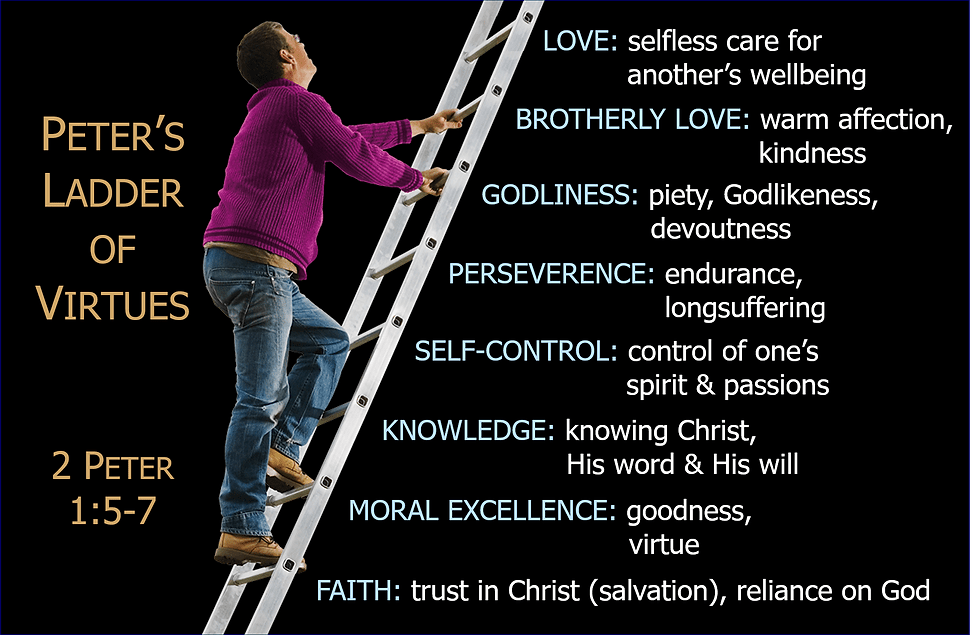
This is the famous Christian ladder: This image from Paul Reich: https://www.plumblineministries.org/post/the-progression-of-godliness

Obviously it all starts with “faith” since we are saved by grace through faith. Are these 7 virtures to be added to faith sequential, logical order, each virture building on the previous one. In other words, is “moral excellence” the first things we strive for once we are saved? And then add knowledge” to your “moral excellence”? Is there any priority of virtues here? I don’t think so. “Love” is the last one, and surely love is perhaps the first virtue we should strive for after becoming a Christian. I think the image above gives a brief definition of each virtue that will suffice. I am going to just sit here (and I encourage you the reader to do the same) and think about whether I have these virtues and are they “increasing” (2 Peter 1:For if these qualities are yours and are increasing) constantly in my Christian walk. Rate yourself from 1 to 10 (10 being the highest) on these virtues in your life. Which ones are you the strongest in? Which ones are you the weakest in? I don’t get drunk or cheat on income tax, but what about my sinful thoughts and desires? I think I have the knowledge of God’s word pretty good, but do I really know God Jesus in a personal, intimate way? Can I control my lustful thoughts, passions, and desires? How “pious” am I, worshipping God constantly, giving him honor and praise? How affectionate am I with other believers, just good old brotherly love “(philadelphia: Brotherly love, love of brothers: Philadephia, the city of brotherly love) with hugs and concern? (AI) “Philadelphia refers to the love and affection shared among believers, akin to the love between siblings. It emphasizes a deep, familial bond that transcends mere friendship, highlighting the unity and mutual care expected within the Christian community. This term is used to describe the ideal relational dynamic among Christians, characterized by kindness, compassion, and support.” Finally, how loving am I? The Greek word for “love” is agape. (AI) “Agapé is a term used in the New Testament to describe a selfless, sacrificial, unconditional love. It is the highest form of love, often associated with the love of God for humanity and the love that believers are called to have for one another. Unlike other Greek words for love, such as “eros” (romantic love) or “philia” (brotherly love), agapé is not based on emotions or feelings but is an act of the will, characterized by a commitment to the well-being of others.” Finally, are these virtues “increasing” as the years go by? In some of them, I think I am doing worse than I did when I first became a Christian. I don’t know about you, but I have a lot to work on! I’m thankful we have the grace of God and don’t have to practice these virtues perfectly.

What a challenge from Peter to the diaspora of Jewish Christians! What a challenge to us today! I need to look at the image above every day and think about practicing these virtues. I need to think about my purification from sin and how wonderful it is to be saved and given immortality and eternal life. How many days do I probably get up and go through the day with all its lusts and stresses and never even think about my forgiveness from sin?

2 Peter 1:12 Therefore, I will always be ready to remind you of these things, even though you already know them and have been established in the truth which is present with you13 I consider it right, as long as I am in this earthly dwelling, to stir you up by way of reminder, 14 knowing that the laying aside of my earthly dwelling is imminent, as also our Lord Jesus Christ has made clear to me. 15 And I will also be diligent that at any time after my departure you will be able to call these things to mind.

I have taught lessons through the entire Bible many, many times since I started preaching and teaching the word. I have studied and taught the same books, like Acts, over and over through the years. I also realize that anyone in my classes have studied the same books multiple times with different teachers. I sometimes think, why keep studying the same Bible books over and over? Isn’t once enough? A lot of people feel that way and maybe that’s why the shift from direct Bible study to a study of some book some person wrote about the Bible. That’s ok, but I’m thinking, “why not just let the Holy Spirit Himself speak to us directly through the written word. There will always be a new, fresh perspective on the same passages even though we’ve studied them many times. Also our circumstances, age, season of life, experiences change. The Holy Spirit can take the. same book, like James, and apply it in a current, different way than He would have 5 years earlier.

Then there is the “reminder” factor. Peter is saying, “you already know all this; I’m just reminding you b/c it is very important.” That’s what a “reminder” is. Reminding us of something we already know. I get a phone call from my doctor: this is a reminder that you have an appointment Tuesday. I already knew I had the appointment, but I appreciated the reminder so I would not “forget” to go. Peter had spoken in 2 Peter 1:For the one who lacks these qualities is blind or short-sighted, having forgotten his purification from his former sins.” Peter is trying to remind them of what it felt like when they first became Christians, when Jesus forgave all their sins, when they arose from the water of baptism to a new life, when they were so excited and happy about their new birth. Some had forgotten that, just as we tend to take that for granted today. Peter wanted to “stir” (diegeiró: To awaken, to stir up, to arouse) them up with this reminder, to call them to action (to go to that doctor appointment). (AI) “The verb διεγείρω is used in the New Testament to describe the action of awakening or stirring someone from sleep or inactivity. It conveys a sense of urgency and thoroughness, often implying a transition from a state of rest or dormancy to one of alertness or action. This term can be used both literally, as in waking someone from physical sleep, and metaphorically, as in stirring someone to spiritual awareness or action.” Peter wants to stir them to be “diligent” about the 7 virtues on the spiritual ladder.

Peter said that he wanted to remind them as long as was alive, but that, when he wrote the letter, his death was imminent. As stated in the 1st article on 2 Peter 1, his death was at the hands of Nero who died in 68 AD. Thus Peter died before that, sometime between 64-67 AD. He said that he would be
diligent” even after death that this 2nd letter would remind them of his warnings in the letter. We must be able to read 2 Peter as if Peter is personally speaking directly to us through the Holy Spirit. My mom wrote some long letters about things before she died. Occasionally I read through those letters again. When I do, I can just see her face, her voice, her expressions as if she was talking directly to me even though she was dead.

1 PETER 4:1-11

1 Peter 4:1 Therefore, since Christ has suffered in the flesh, arm yourselves also with the same purpose, because the one who has suffered in the flesh has ceased from sin, so as to live the rest of the time in the flesh no longer for human lusts, but for the will of God. For the time already past is sufficient for you to have carried out the desire of the Gentiles, having pursued a course of indecent behavior, lusts, drunkenness, carousing, drinking parties, and wanton idolatries. In all this, they are surprised that you do not run with them in the same excesses of debauchery, and they slander youbut they will give an account to Him who is ready to judge the living and the dead. For the gospel has for this purpose been preached even to those who are dead, that though they are judged in the flesh as people, they may live in the spirit according to the will of God.

Peter had just mentioned the suffering of Christ in 3:18 For Christ also suffered for sins once for all time, the just for the unjust, so that He might bring us to God, having been put to death in the flesh, but made alive in the spirit.” “Therefore” “arm (hoplizó: To arm, to equip: the word is only used once in the NT) yourselves to suffer just as Christ did.  (AI) “In ancient Greek culture, the concept of arming oneself was closely associated with the life of a soldier. Greek hoplites were heavily armed infantry soldiers, and the term ὅπλον referred to their armor and weapons. The act of ὁπλίζω would have been understood as a crucial step in preparing for warfare, emphasizing readiness and protection.” “The one who has suffered in the flesh has ceased (pauó: To cease, to stop, to restrain) from sin”. That does not mean the Christian will reach a state of never sinning. 1 John 1:If we say we have no sin, we deceive ourselves, and the truth is not in us.” It does mean that is you turn from sin that you will suffer. 2 Timothy 3:12 Indeed, all who desire to live a godly life in Christ Jesus will be persecuted.” Outsiders will not persecute you if you are still participating in the same sins that they commit. They will persecute you if you condemn and turn from the sins they are living in. So if you do suffer for Jesus, it is a sign that indeed you have turned or ceased from sin. It is a sign that you have chosen “to live the rest of the time in the flesh no longer for human lusts, but for the will of God.”

Those lusts can be summed up in 1 John 2:15 Do not love the world or the things in the world. If anyone loves the world, the love of the Father is not in him. 16 For all that is in the world—the desires of the flesh and the desires of the eyes and pride of life—is not from the Father but is from the world. 17 And the world is passing away along with its desires, but whoever does the will of God abides forever.” I wonder how many church going Christians have not really made this choice. They are still living in their lusts just like the non Christians are. They are no different than outsiders. They don’t suffer persecution or mockery either. Peter says to his readers that they should have already turned from these lusts, and then he names the lusts.

“Indecent behavior” is aselgeia: Licentiousness, debauchery, sensuality, lewdness. (AI) “In the Greco-Roman world, “aselgeia” was often associated with the hedonistic lifestyles prevalent in certain segments of society. The term captures the essence of living without regard for moral or social norms, often in pursuit of personal pleasure. Such behavior was not only common in pagan religious practices but also in the broader cultural context, where indulgence in sensual pleasures was sometimes celebrated.” “Carousing” is kómos: Revelry, carousing, orgy. (AI) “In ancient Greek culture, a “kómos” was a common feature of religious festivals and social gatherings, where participants engaged in revelry and merrymaking. These events were often associated with the worship of Dionysus, the god of wine, and were marked by a lack of restraint and moral boundaries. The New Testament writers, aware of these cultural practices, used the term to caution against the dangers of such excesses and to promote a life of holiness and discipline.” “Drinking parties” is potos: Drinking, banquet, feast. (AI) “ In the Greco-Roman world, banquets and drinking parties were common social events. These gatherings were not only for celebration but also for discussing philosophical ideas, forming political alliances, and enjoying entertainment. However, they could also lead to moral excesses and were sometimes criticized by philosophers and moralists of the time. In Jewish culture, while wine was a common part of meals and celebrations, excessive drinking was generally discouraged.” “Wanton” is athemitos: unlawful, forbidden, improper. (AI) “The term “athemitos” is used to describe actions or behaviors that are considered unlawful or forbidden according to divine or moral law.” “Idolatries” is eidólolatria: Idolatry (a transliteration: the process of converting a word or phrase from one writing system to another while preserving its pronunciation.. ” (AI) “ In the Greco-Roman world, idolatry was a prevalent practice, with numerous gods and goddesses being worshipped through statues and images. Temples dedicated to these deities were common, and religious rituals often involved offerings and sacrifices to idols. For early Christians, rejecting idolatry was a significant aspect of their faith, as it distinguished them from the surrounding pagan culture.”

The pagan Gentiles were “surprised” (xenizó: To entertain, to lodge, to surprise, to astonish) that the Christians were no longer running with them in the same excesses of debauchery. (AI) “The verb “xenizó” primarily means to entertain or to host a stranger or guest. It can also imply being surprised or astonished by something unusual or unexpected. In the New Testament, it often carries the connotation of hospitality, especially in the context of welcoming and caring for fellow believers or strangers.” The connection between entertaining a stranger and being surprised (the two translations of xenizo) is that one is surprised when a stranger comes to your door looking for hospitality. You didn’t expect that person to show up at your door and you are surprised. “running with them” is suntrechó: To run together, to rush together, to come together. (AI) “The verb “suntrechó” is used in the New Testament to describe the action of people coming together quickly, often in a crowd or group, usually with a sense of urgency or excitement. It conveys the idea of converging or assembling rapidly, often in response to an event or situation.” “Debauchery” is asótia: Dissipation, debauchery, profligacy, reckless living. (AI) “ In the Greco-Roman world, “asótia” was often associated with the behavior of those who lived extravagantly and without regard for societal norms or personal responsibility. Such lifestyles were typically marked by excessive drinking, sexual immorality, and wastefulness. The term would have been understood by early Christians as a warning against adopting the hedonistic practices prevalent in the surrounding pagan culture.” The pagan Gentiles will slander (blasphémeó: To blaspheme, to speak evil of, to slander, to revile) you if you do not run with them in their debauchery.

These are some interesting word studies. The sins of the first century Gentiles are very similar to where our culture is today. Sexual immorality, drinking parties, hedonism (the ethical theory that pleasure (in the sense of the satisfaction of desires) is the highest good and proper aim of human life), drunkenness. Sinners today are “running together” to have a drinking party at a bar, to “hook up” with someone there for random sex, to find some thrill adventure that makes them laugh and be happy. They work at jobs but live for pleasure, sex, and drinking. I think it will become more and more apparent who the true children of God are in the future. The true Christian will not participate in those things. The sinners will mock them for not participating with them. “Oh, you think you are too good, better than us. You are going to miss out on all the fun.” It will also be harder and harder for the true Christian to abstain from all these sins. Their friends do all these sins and are surprised that you don’t. Psalm 1:Blessed is the man who walks not in the counsel of the wicked, nor stands in the way of sinners, nor sits in the seat of scoffers;
but his delight is in the law of the Lord, and on his law he meditates day and night.” 1 Corinthians 15:33 Do not be deceived: “Bad company ruins good morals.”

“But they (the pagan Gentiles) will give account to Jesus who is ready to judge the living and the dead”. We automatically think this refers to some future (in our future) final judgment, but notice 2 Timothy 4:I do fully testify, then, before God, and the Lord Jesus Christ, who is about to (mello which always means about to happen in the NT)judge living and dead at his manifestation and his reign.” 1 Peter 4:17 For it is time for judgment to begin with the household of God; and if it begins with us first, what will be the outcome for those who do not obey the gospel of God?This sounds like a judgment of the pagan Gentiles as well as the Jews in 70 AD. But how would AD 70 be a judgment on the Gentiles (as described in Romans 2)? In 70 AD, the Jewish Christians were shown to be the true children of God and not the unbelieving Jews who were killed in the destruction of the temple and city. That event in 70 AD would have also shown the pagan Gentiles that the Jewish diaspora Christians living among them in the empire were the true children of God. It would also show that the Jewish diaspora Christians whom they slandered were really the people of God. It would have exposed their pagan sinful life. The godly lives of the Christians would judge and condemn the sins of the pagan Gentiles and unbelieving Jews. The idea is found in 1 Peter 2:12 Keep your behavior excellent among the Gentiles, so that in the thing in which they slander you as evildoers, they may because of your good deeds, as they observe them, glorify God on the day of visitation.” So 70 AD was not a judgment of the Gentiles and the whole world as most depict it with an end of the world and everyone, dead or alive, standing before Jesus in judgment to be given eternal sentences and punishment. It was simply a time when the true Christian way of life in believers would be shown to be the one true way of God and thus the pagan Gentiles would be judged.

That judgment in 70 AD that was about to happen (2 Timothy 4:1) would be a judgment of “the living and the dead”. Jesus was “ready” to do that judgment. Vs 6 says that the gospel was preached to the dead, so the “dead” in vs 6 must be those spiritually dead, not physically dead. So the “dead” in vs 5 would also have to be the spiritually dead. The pagan Gentiles who would have to give an account for their sins (vs 5) would be the spiritually dead in vs 5 that Jesus was about to judge through the lives of the true believers. Some of those Gentiles who slandered the Christians would see the error of their ways and “glorify God in the day of visitation” (1 Peter 2:12), become Christians, and “live spiritually (4:6).

1 Peter 4:The end of all things is near; therefore, be of sound judgment and sober spirit for the purpose of prayer. Above all, keep fervent in your love for one another, because love covers a multitude of sins. Be hospitable to one another without complaint. 10 As each one has received a special gift, employ it in serving one another as good stewards of the multifaceted grace of God. 11 Whoever speaks is to do so as one who is speaking actual words of God; whoever serves is to do so as one who is serving by the strength which God supplies; so that in all things God may be glorified through Jesus Christ, to whom belongs the glory and dominion forever and ever. Amen.

This is such a critical statement: “the end of all things is near (eggizó: To draw near, to approach, to come near)”. The word eggizo is often translated in the NASB as “at hand” (Mark 1:15 the kingdom is at hand) or “approaching” (Luke 19:29 as Jesus approched Bethpage), or “near” (Luke 21:8 the time is near discussing AD 70 and things that were to happen within that generation Luke 21:32 verily I say to you — This generation may not pass away till all may have come to pass). So Peter’s meaning is clear. He is predicting the end of all things to happen soon. The world did not end soon, so he is not predicting that.If he was predicting that, then he is a false prophet b/c the end of the world did not happen soon. What did end soon (about 6 years after writing 1 Peter) was the destruction of Jerusalem and the judgment on the Jews in 70 AD, so this must be what Peter is referring to. He is referring to the end of the Jewish age, the Jewish nation as God’s nation, the end of keeping the Law and animal sacrifices, etc. that happened in 70 AD.

Since that end was near, Peter gives a list of Christian duties: use good judgment, pray, be
fervent (ektenés: Earnest, fervent, constant in love). The Greek adjective ἐκτενής (ektenés) conveys the idea of being earnest, fervent, or constant in action or attitude. It is often used to describe a quality of intense and sustained effort or emotion, particularly in the context of prayer, love, or other spiritual disciplines. The term suggests a stretching or reaching out with purpose and dedication. The word is derived from the Greek verb ἐκτείνω (ekteinō), meaning “to stretch out” or “to extend.” Be hospitable (philoxenos: Hospitable: Derived from two Greek words: φίλος (philos), meaning “loving” or “friend,” and ξένος (xenos), meaning “stranger” or “foreigner.” (AI) “In the ancient Near Eastern and Greco-Roman cultures, hospitality was a highly valued virtue. It was often seen as a sacred duty to welcome and care for travelers and strangers, who were vulnerable and dependent on the kindness of others. In the early Christian community, hospitality was especially important as believers traveled to spread the Gospel and needed safe places to stay. The practice of hospitality was also a means of demonstrating the love of Christ to others, both within and outside the faith community.” Use your unique spiritual gift (miraculous or not) to serve others as a good steward of that gift. Gifts can be divided into 2 general ctegories: 1) Speaking (like prophesying, tongues, teaching), and 2) Serving (like healing, mercy, exhortation). All things to the glory of God forever. Which category is your gift: speaking or serving? Or some of both (me).


1 PETER 2:4-17 LIVING STONES: GOD’S NEW NATION; HONOR AUTHORITY

As Living Stones

1 Peter 2:And coming to Him as to a living stone which has been rejected by people, but is choice and precious in the sight of God, you also, as living stones, are being built up as a spiritual house for a holy priesthood, to offer spiritual sacrifices that are acceptable to God through Jesus Christ. For this is contained in Scriptures (Psalm 118:22-23): “Behold, I am laying in Zion a choice stone, a precious cornerstone,

And the one who believes in Him will not be put to shame.” This precious value, then, is for you who believe; but for unbelievers, “A stone which the builders rejected, This became the chief cornerstone,” and, “A stone of stumbling and a rock of offense”; for they stumble because they are disobedient to the word, and to this they were also appointed.

A couple of other passages like this come to mind: 1 Corinthians 3:11 For no one can lay a foundation other than that which is laid, which is Jesus Christ.” Ephesians 2:19 So then you are no longer strangers and aliens, but you are fellow citizens with the saints and members of the household of God, 20 built on the foundation of the apostles and prophets, Christ Jesus himself being the cornerstone, 21 in whom the whole structure, being joined together, grows into a holy temple in the Lord. 22 In him you also are being built together into a dwelling place for God by the Spirit.” These passages got me thinking about Matthew 16:13 Now when Jesus came into the district of Caesarea Philippi, he asked his disciples, “Who do people say that the Son of Man is?” 14 And they said, “Some say John the Baptist, others say Elijah, and others Jeremiah or one of the prophets.” 15 He said to them, “But who do you say that I am?” 16 Simon Peter replied, “You are the Christ, the Son of the living God.” 17 And Jesus answered him, “Blessed are you, Simon Bar-Jonah! For flesh and blood has not revealed this to you, but my Father who is in heaven. 18 And I tell you, you are Peter, and on this rock I will build my church, and the gates of hell shall not prevail against it. 19 I will give you the keys of the kingdom of heaven, and whatever you bind on earth shall be bound in heaven, and whatever you loose on earth shall be loosed in heaven.” 20 Then he strictly charged the disciples to tell no one that he was the Christ.” There is much debate over who or what the “rock” (petra) is that Jesus said he would build his church on. Is it Peter (petros) or is it the confession that Peter made that Jesus is the Christ, the Son of God. There is a big difference in the 2 Greek words petros and petra: 4074 Pétros (a masculine noun) – properly, a stone (pebble), such as a small rock found along a pathway. 4074 /Pétros (“small stone”) then stands in contrast to 4073 /pétra (“cliff, boulder,” Abbott-Smith). It looks like Jesus would have used the same Greek word for Peter (petros) and rock (petra) if he meant they both referred to Peter. It could mean that Peter would be a significant apostle in establishing the church. He was the apostle to the Jews (Galatians 2). He would indeed use the “keys to the kingdom” when he preached the first gospel sermon in Acts 2, with 3,000 being baptized and becoming the first church, which is the kingdom of God on earth, which is the spiritual body of Christ, the saved. Thus he used the keys to open the door into the church kingdom. Even if that is what Jesus. meant, it would not mean that Peter was the head of the church, the first pope. Ephesians 4:11 lists the leadership positions of the early church: apostles, prophets, evangelists, pastors (elders), and teachers. If a pope was the head of the church as Catholics claim, surely that would be included in Ephesians 4:11. Also in Galatians 2, Paul said that the “pillars” of the church in Jerusalem were Peter, James, and John. That puts those 3 men on the same level, which would not be true if Peter was the head of the church and the pope. Having said all that, the passages about Jesus being the cornerstone of the church makes me lean more to the rock being the confession that Peter made that Jesus is the Christ, the Son of God. That would certainly be a “cliff or boulder” (petra) to build the church on as opposed to a “small stone” (petros). Several scriptures point to Jesus being the chief cornerstone, which would be a large “rock”. If there is no other foundation (1 Corinthians 3:11), then how could the church be built on a man, Peter, instead of Jesus the cornerstone? So I think the rock is the confession of Peter that Jesus is the rock, the Son of God, that the church is built on.

Of course, we have to add the apostles and prophets in the foundation of the church: Ephesians 2:20 built on the foundation of the apostles and prophets, Christ Jesus himself being the cornerstone.” Here is a great image for that:

1 Pete 2:But you are a chosen people, a royal priesthood, a holy nation, a people for God’s own possession, so that you may proclaim the excellencies of Him who has called you out of darkness into His marvelous light; 10 for you once were not a people, but now you are the people of God; you had not received mercy, but now you have received mercy.

Vs 10 is the verse that makes many say that the letter of 1 Peter was written to Gentiles Christians who were scattered all over. That would be the only time “disapora” (1 Peter 1:1; James 1:1; John 7:35) ever referred to Gentiles. John 7:35 NAS: to go to the Dispersion among the Greeks”, which shows a clear distinction between the Jewish diaspora and the Gentiles. Vs 10 quotes Hosea 1:10; 2:25 where “you were once not a people but now you are the people of God”. Most commentaries would say that Hosea is referring to Gentiles, but that is not the context. The 2nd child of Hosea and Gomer was to be called “no mercy” (Hosea 1:6). The 3rd child was to be called “not my people” (Hosea 1:8). So those two names refer to apostate Israel and not Gentiles. Then Hosea 1:And in the place where it was said to them, “You are not my people,” it shall be said to them, “Children of the living God.” 11 And the children of Judah and the children of Israel shall be gathered together, and they shall appoint for themselves one head.” The context would be the remnant of Judah and Israel that would believe in Jesus as the Messiah and thus no longer be called “no mercy” or “not my people”. The believing remnant would be called the children of God, the NT people of God. Hosea 2:1 Say to your brothers, “You are my people,” and to your sisters, “You have received mercy.” Hosea 2 tells how God will take back apostate Israel in the Messianic Age, just as Hosea was to take back his runaway wife Gomer. Hosea 2:23 And I will have mercy on No Mercy, and I will say to Not My People, ‘You are my people’; and he shall say, ‘You are my God.’” Again the context is saving the remnant of Israel, not saving the Gentiles. Chapter 3 is a Messianic prediction. Hosea 3:And the Lord said to me, “Go again, love a woman who is loved by another man and is an adulteress, even as the Lord loves the children of Israel, though they turn to other gods and love cakes of raisins.” So I bought her for fifteen shekels of silver and a homer and a lethech of barley. And I said to her, “You must dwell as mine for many days. You shall not play the whore, or belong to another man; so will I also be to you.” For the children of Israel shall dwell many days without king or prince, without sacrifice or pillar, without ephod or household gods. Afterward the children of Israel shall return and seek the Lord their God, and David their king, and they shall come in fear to the Lord and to his goodness in the latter days.” Notice that the context is remnant Israel, not Gentiles. But what about Romans 9:22 What if God, desiring to show his wrath and to make known his power, has endured with much patience vessels of wrath prepared for destruction, 23 in order to make known the riches of his glory for vessels of mercy, which he has prepared beforehand for glory— 24 even us whom he has called, not from the Jews only but also from the Gentiles? 25 As indeed he says in Hosea, “Those who were not my people I will call ‘my people,’ and her who was not beloved I will call ‘beloved.’” 26 “And in the very place where it was said to them, ‘You are not my people, there they will be called ‘sons of the living God.’” Is Paul here saying that Hosea 1-3 is referring to Gentiles who were not His people but now were called His people? I don’t think so. Notice that “not my people but now my people” includes Jew and Gentile believers (Romans 9:24). He is talking about the remnant of Israel, Romans 9:27 And Isaiah cries out concerning Israel: “Though the number of the sons of Israel be as the sand of the sea, only a remnant of them will be saved”, which is what Hosea is predicting. Paul is simply saying that the Gentile believers will be included with the remnant of Israel to be saved in the church. He is not changing the original context of Hosea, which is not about Gentiles. So 1 Peter 2:10 is not an indication that 1 Peter was written to the Gentiles. 1 Peter 2:10 is referring to the remnant diaspora of Jewish Christians, just as Hosea did. It may sound like Hosea 1-3 and 1 Peter 2:10 are referring to Gentiles, but they don’t.

1 Peter 2:9 But you are a chosen people, a royal priesthood, a holy nation, a people for God’s own possession.” Who is this referring to? Again, it refers to the Jewish remnant who accepted Jesus as the Messiah and who became the first church. In the OT, it was the nation of Israel that were God’s chosen people, HIs holy nation. On Mt Sinai, God said to the Israelites, Exodus 19:Now therefore, if you will indeed obey my voice and keep my covenant, you shall be my treasured possession among all peoples, for all the earth is mine; and you shall be to me a kingdom of priests and a holy nation.Deuteronomy 7:6: “For you [Israel] are a people holy to the Lord your God. The Lord your God has chosen you out of all the peoples on the face of the earth to be his people, his treasured possession” But in the new covenant Israel as a nation is no longer God’s chosen people or holy nation. Matthew 21:43 Therefore I tell you, the kingdom of God will be taken away from you and given to a people producing its fruits.” This verse makes it clear that as of 70 AD when he judged the rebellious, evil Jewish unbelievers that. Israel was no longer God’s holy nation or chosen people after 70 AD. In the new covenant, God’s chosen people and holy nation are the church, made up of Jewish and Gentile believers in Jesus, and not the whole nation of Israel. I guess I do believe in “replacement theology”: (AI) In Christianity, “replacement theology” or “supersessionism” is the belief that the Christian Church has superseded or replaced the Jewish people as God’s chosen people. This doctrine suggests that the New Covenant established through Jesus Christ has replaced the Old Covenant made with the Israelites”. This new covenant was actually made with the remnant of Israel (Hebrews 8:8 “Behold, the days are coming, declares the Lord, when I will establish a new covenant with the house of Israel and with the house of Judah”) but would include Gentile believers also. The new covenant was made abailable to all Jews as the gospel was preached to the Roman Empire in the first century, to the Jew first and then to the Gentiles. But only believing Jews would be included in that new covenant. Only the remnant Jews would be forgiven of sins under the new covenant (Hebrews 8:10-12). God no longer has any special promises to the nation of Israel such as he did in the Old Testament. Of course, God wants all Jews today to accept Jesus and enjoy the blessings of the new covenant. I guess that is “replacement theology” that a lot of people today don’t like to hear. They want the entire nation to have a special place in God’s promises today even if they don’t believe in Jesus as the Messiah. If God rejected the nation (Matthew 21:43) in 70 AD, taking the nation away from Israel and giving it to the church nation, then why would God feel any different about all the Jews over in Israel today who, for the most part, reject Jesus as the Messiah?????????????

1 Peter 2:11 Beloved, I urge you as foreigners and strangers to abstain from fleshly lusts, which wage war against the soul. 12 Keep your behavior excellent among the Gentiles, so that in the thing in which they slander you as evildoers, they may because of your good deeds, as they observe them, glorify God on the day of visitation.”

Since we are God’s holy nation, then our citizenship is a spiritual one, not an earthly one. Philippians 3:20 But our citizenship is in heaven, and from it we await a Savior, the Lord Jesus Christ, 21 who will transform our lowly body to be like his glorious body, by the power that enables him even to subject all things to himself.” That makes us foreigners (paroikos: Sojourner, foreigner, stranger, alien) and strangers (parepidémos: Sojourner, stranger, exile, temporary resident) here on earth even though we are still citizens of whatever country we are in. My wife and I lived in Trinidad, West Indies and in Colombia, South America. We were “extranjeros” (foreigners) while living there b/c our citizenship was back in the U.S. That is how it is with our citizenship in heaven. While foreigners living in overseas, we did not buy property or plant roots deeply b/c we knew we would only be there for a few years. Christians should think the same way. Don’t plant your roots too deeply in this world. The song: This world is not my home, I’m just a passing through” says it all! So abstain from the lusts of this world which wage war against your soul and can keep you from receiving eternal life in heaven. 1 John 2:15 Do not love the world or the things in the world. If anyone loves the world, the love of the Father is not in him. 16 For all that is in the world—the desires of the flesh and the desires of the eyes and pride of life—is not from the Father but is from the world. 17 And the world is passing away along with its desires, but whoever does the will of God abides forever.” Keep your behavior excellent among the Gentiles. That again sounds like Jewish Christians among the Gentiles and that the letter is written to Jewish Christians. The Gentile pagans might slander you as evildoers (refer to the article 1 Peter 3:8-22 for more discussion of how the Gentiles accused the Christians (Jew or Gentile Christians) of being evil. Mainly they accused them of cannibalism (eating the flesh and blood of Jesus, atheism (b/c they didn’t believe in the Romans gods), and incest (b/c they called each other brothers and sisters). But in 70 AD, the “day of visitation”, God would show that the Jewish Christians were his chosen people and not the unbelieving Jews. They would take not of all the good deeds of the Jewish Christians and glorify God as they could then after 70 AD see God’s plan of salvation realized, no doubt drawing many Gentile Christians to join the Jewish Christians in the church.
Honor Authority

1 Peter 2:13 Submit yourselves for the Lord’s sake to every human institution, whether to a king as the one in authority, 14 or to governors as sent by him for the punishment of evildoers and the praise of those who do right. 15 For such is the will of God, that by doing right you silence the ignorance of foolish people. 16 Act as free people, and do not use your freedom as a covering for evil, but use it as bond-servants of God. Let every person be subject to the governing authorities. For there is no authority except from God, and those that exist have been instituted by God. Therefore whoever resists the authorities resists what God has appointed, and those who resist will incur judgment. For rulers are not a terror to good conduct, but to bad. Would you have no fear of the one who is in authority? Then do what is good, and you will receive his approval, for he is God’s servant for your good. But if you do wrong, be afraid, for he does not bear the sword in vain. For he is the servant of God, an avenger who carries out God’s wrath on the wrongdoer. Therefore one must be in subjection, not only to avoid God’s wrath but also for the sake of conscience. For because of this you also pay taxes, for the authorities are ministers of God, attending to this very thing. Pay to all what is owed to them: taxes to whom taxes are owed, revenue to whom revenue is owed, respect to whom respect is owed, honor to whom honor is owed.

This section brings up an important point. If Christians feel that they can, b/c they are citizens of a spiritual nation, the church, rebel against the government or authorities on earth, then they will be slandered as evildoers. If they say they don’t have to pay taxes, then they will be slandered (and arrested). Matthew 17:24 When they came to Capernaum, the collectors of the two-drachma tax went up to Peter and said, “Does your teacher not pay the tax?” 25 He said, “Yes.” And when he came into the house, Jesus spoke to him first, saying, “What do you think, Simon? From whom do kings of the earth take toll or tax? From their sons or from others?” 26 And when he said, “From others,” Jesus said to him, “Then the sons are free. 27 However, not to give offense to them, go to the sea and cast a hook and take the first fish that comes up, and when you open its mouth you will find a shekel. Take that and give it to them for me and for yourself.” Technically, Jesus says, only citizens of the U.S. will pay federal income tax. You could argue that Christians are “free” from their government rules and taxes b/c our citizenship is in heaven and we are “foreigners”. But “to not give offense”, pay the taxes. That is, to not be slandered as rebellious citizens of the U.S., which is the exact context of 1 Peter 2. But what if the government is evil, such as the Roman government where the emperor claimed to be god. The general rule is that governments are from God to punish evildoers and to prevent anarchy. Paul elaborates on this in Romans 13:Let every person be subject to the governing authorities. For there is no authority except from God, and those that exist have been instituted by God. Therefore whoever resists the authorities resists what God has appointed, and those who resist will incur judgment. For rulers are not a terror to good conduct, but to bad. Would you have no fear of the one who is in authority? Then do what is good, and you will receive his approval, for he is God’s servant for your good. But if you do wrong, be afraid, for he does not bear the sword in vain. For he is the servant of God, an avenger who carries out God’s wrath on the wrongdoer. Therefore one must be in subjection, not only to avoid God’s wrath but also for the sake of conscience. For because of this you also pay taxes, for the authorities are ministers of God, attending to this very thing. Pay to all what is owed to them: taxes to whom taxes are owed, revenue to whom revenue is owed, respect to whom respect is owed, honor to whom honor is owed.” Paul’s command to not resist authorities was written during an evil Roman government, but the command to not resist sill applies. Of course, an evil government could be so evil that it presents a difficult choice for Christians. Bonhoeffer was a Lutheran pastor in Germany as Hitler rose to poser. He advocated not resisting the government until he realized that Hitler was exterminating millions of Jews, gypsies, etc. He had a tough choice. He decided to resist and took part in a plot to assassinate Hitler which failed. I will not judge him for making that choice. Sometimes we have to break a law of God if the circumstances require it. But don’t use your Christian “freedom” as a covering for evil, i.e. as an excuse for rebelling against the government simply b/c you want to be free from the government. The American Revolution against England is interesting. Religious scholars say it was the providence of God leading George Washington and the rebels to rebel. But Romans 13 says that the colonies, most of whom claimed to be Christians, should not resist the government. Why did they resist King George? Not even b/c he will killing people in America like Hitler did, but b/c they didn’t like his tax without representation. Sounds to me like a forbidden resistance, at least for Christians, instead of a providential uprising and rebellion. I might have a few who disagree with that!
Peter concludes this section: 1 Peter 2:17 Honor all people, love the brotherhood, fear God, honor the king.”Romans 13:Pay to all what is owed to them: taxes to whom taxes are owed, revenue to whom revenue is owed, respect to whom respect is owed, honor to whom honor is owed.” Those are the guiding principles of how Christians should react with the governments in the countries they live in, which might be difficult in some evil, atheistic or Islamic countries.

Peter even includes servants who have harsh masters, and tells them to obey them anyway. 1 Peter 2:18 Servants, be subject to your masters with all respect, not only to those who are good and gentle, but also to those who are harsh.” That would be applying the earlier principles to slaves. Many of the early Christians in the Roman Empire were slaves. Could they just rebel against their masters once they become Christians? Maybe it their masters were harsh and evil, that could be the excuse for them to rebel. Not so, says Peter.

Wow, this was long but different thoughts just kept coming. Some of this section required some deeper digging into the word.

1 PETER 1:17-2:3 REDEEMED BY THE BLOOD OF THE LAMB; LOVE; SPIRITUAL NEWBORNS

1 Peter 1:17 If you address as Father the One who impartially judges according to each one’s work, conduct yourselves in fear during the time of your stay on earth18 knowing that you were not redeemed with perishable things like silver or gold from your futile way of life inherited from your forefathers, 19 but with precious blood, as of a lamb unblemished and spotless, the blood of Christ. 20 For He was foreknown before the foundation of the world, but has appeared in these last times for the sake of you 21 who through Him are believers in God, who raised Him from the dead and gave Him glory, so that your faith and hope are in God.

1) “1:17 is interesting. We are not saved by our works, but we will be judged by our works. Bottom line, you must try to live holy and not sin even though you don’t have to be sinless. God’s grace will save you by the blood of Jesus. But at the same time, if you go back into sin, your sins will cause you to fall from grace and lose your eternal life when you die. 2 Peter 2:20 For if, after they have escaped the defilements of the world by the knowledge of the Lord and Savior Jesus Christ, they are again entangled in them and are overcome, the last state has become worse for them than the first. 21 For it would be better for them not to have known the way of righteousness, than having known it, to turn away from the holy commandment handed on to them. 22 It has happened to them according to the true proverb, “A dog returns to its own vomit,” and, “A sow, after washing, returns to wallowing in the mire.” Therefore, we need to conduct ourselves in “fear” while on earth. Aren’t we supposed to have full assurance of our salvation and not be fearful of standing before God in judgment? Doesn’t “perfect love cast our fear” (1 John 4:17 By this, love is perfected with us, so that we may have confidence in the day of judgment; because as He is, we also are in this world. 18 There is no fear in love, but perfect love drives out fear, because fear involves punishment, and the one who fears is not perfected in love.)” Yet Peter tells them to live in fear while on earth. Bottom line is that we still need to be fearful of losing our salvation while on earth. Paul, the proponent of “salvation by grace through faith, not works”, echoes this fear command: Philippians 2:12 So then, my beloved, just as you have always obeyed, not as in my presence only, but now much more in my absence, work out your own salvation with fear and trembling13 for it is God who is at work in you, both to desire and to work for His good pleasure.”

2) The motivation for this appeal to be holy is that they were “redeemed (lutroó: To redeem, to ransom, to liberate by paying a ransom price) by the blood of the Lamb”. In the ancient Greco-Roman world, the concept of redemption was well understood in the context of slavery and captivity. A person could be freed from slavery or imprisonment if a ransom was paid. The ransom price to free us from the slavery of sin was the blood of Jesus, i.e. his death on the cross. Some of the early church fathers thought that God paid this ransom price to Satan, but that is not true. God paid the ransom price to Himself to satisfy his wrath against our sin so that he could justify us. That appeasing of God’s wrath is called propitiation. This plan to redeem us by the blood of Jesus was “foreknown” by God before he even started the creation week in Genesis 1. How is that? He knew he was going to create humns with free will and that they, given the choice of the tree of life and the tree of knowledge of good and evil, would chose to sin, and then everyone born after the fall would make the same choice to sin. Romans 5:12 Therefore, just as through one man sin entered into the world, and death through sin, and so death spread to all mankind, because all sinned.” So God is thinking, “I love all people and want them to have a way to be saved from my just wrath; how can I do that”? Maybe he could let us try to save ourselves by good works, or even by buying our salvation with “gold or silver”? No that would not satisfy God’s wrath. The only thing that would satisfy HIs wrath against our sins was to let His Son become flesh and die for us. I don’t understand why that was the only thing that could do that, but it was. So Jesus appeared the first time in his incarnation (God becoming flesh, John 1:14 and the word became flesh and dwelt among us) and God proved that he would redeem us by the blood of Jesus by raising Jesus from the dead.

3) 1 Peter 1:22 Since you have purified your souls in obedience to the truth for a sincere love of the brothers and sisters, fervently love one another from the heart, 23 for you have been born again not of seed which is perishable, but imperishable, that is, through the living and enduring word of God. 24 For, “All flesh is like grass, And all its glory is like the flower of grass. The grass withers, And the flower falls off, 25 But the word of the Lord endures forever.” And this is the word which was preached to you.” Peter now switches from “obedience” verses to “love” verses for the first time. We purify (hagnizó: To purify, to cleanse, to sanctify) ourselves by obedience, by no conforming to our former lusts, by living a set apart life. But is that all there is to the Christian life, just stay away from sin? No. God wants us to purify ourselves so that we can love one another: a sincere, fervent love from the heart. Replace the “lusts” with “love”. The whole spirit of Christianity is “love”. The motivation is that we have been “born again” of the imperishable seed of the word of God that endures forever. We have a new self that is filled with love for one another b/c God loved us and gave His Son to save us. I know that has been the biggest challenge in my Christian walk. I was raised where the emphasis seemed to be getting all the right doctrines even though I’m sure that love was preached and shown by a lot of church members. My parents never said “I love you” until they were in their 70’s and I was in my 40’s, although I know they loved me. They were raised on the farm in the depression and WWII, working hard all their lives. Expressing emotion was not something they were raised in and they didn’t show it in my life. Maybe in my last days I can work on that!

4) 1 Peter 2:1 Therefore, rid yourselves of all malice and all deceit and hypocrisy and envy and all slander, and like newborn babies, long for the pure milk of the word, so that by it you may grow in respect to salvation, if you have tasted the kindness of the Lord.” “Therefore (based on what went on before), i.e. you were born again (1:23) so you are “newborns” spiritually. Newborns feed on milk and spiritual newborns feed on the milk of the word of God, i.e. the basics of obedience and love. The Hebrew writer talks about the “meat” of the word as he discusses the priesthood of Melchizadek and the change of the Law in Hebrews 5:11 About this we have much to say, and it is hard to explain, since you have become dull of hearing. 12 For though by this time you ought to be teachers, you need someone to teach you again the basic principles of the oracles of God. You need milk, not solid food, 13 for everyone who lives on milk is unskilled in the word of righteousness, since he is a child. 14 But solid food is for the mature, for those who have their powers of discernment trained by constant practice to distinguish good from evil.” So God doesn’t want us to keeping eating milk but that is where we all start as spiritual newborns. But first you must put away the bad stuff in your heart and mind. The motivation for all this: “if you have tasted the kindness of the Lord”.

1 PETER 1:10-16 What did the prophets understand about their Messianic predictions; be ye holy as God is holy

The theme of 1 Peter is the suffering of the diaspora Jewish Christians. Read the background for this letter in the first article: 1 Peter Suffering (1). There are 4 fairly lengthy section on this suffering and how to endure it: thus 4 articles Suffering 1,2,3,4. But what about the other comments by Paul mixed in with these sections on suffering?

  1. 1 Peter 1:10 As to this salvation, the prophets who prophesied of the grace that would come to you made careful searches and inquiries, 11 seeking to know what person or time the Spirit of Christ within them was indicating as He predicted the sufferings of Christ and the glories to follow. 12 It was revealed to them that they were not serving themselves, but you, in these things which now have been announced to you through those who preached the gospel to you by the Holy Spirit sent from heaven—things into which angels long to look.” What salvation? He had just told them that after a little while of suffering that they would receive glory and salvation at the revelation of Jesus (His 2nd coming). Therefore they should rejoice even in their suffering. 1:10 comments on that salvation. The prophets in the OT did prophesy of the gracious salvation that the Messiah would bring, of his sufferings and his glorious resurrection. For example, Isaiah 53: But He was pierced for our offenses, He was crushed for our wrongdoings; The punishment for our well-being was laid upon Him, And by His wounds we are healed. He was oppressed and afflicted,
    Yet He did not open His mouth; Like a lamb that is led to slaughter, And like a sheep that is silent before its shearers, But the Lord desiredTo crush Him, causing Him grief if He renders himself as a guilt offering, He will prolong His days, And the good pleasure of the Lord will prosper in His hand. 11 As a result of the anguish of His soul, He will see it and be satisfied;By His knowledge the Righteous One, My Servant, will justify the many, For He will bear their wrongdoings. 12 Therefore, I will allot Him a portion with the great, And He will divide the plunder with the strong, Because He poured out His life unto death, And was counted with wrongdoers; Yet He Himself bore the sin of many, And interceded for the wrongdoers.” This Messianic prediction has the suffering, death, resurrection, and glory of the Messiah to come 700 years after Isaiah wrote this. The Dead Sea Scrolls confirms that this was written at least 150 years before Jesus was born. A complete copy of Isaiah, the Great Isaiah Scroll, has Isaiah 53 almost verbatim with our earliest Hebrew copy of Isaiah which was 1000 AD. That showed that the prediction in Isaiah 53 were not put in there “after the fact” and that the book was copied accurately through the centuries since the original. But did Isaiah understand his predictions? No. Did Micah understand his prediction that Jesus would be born in Bethlehem (Micah 5:2)? No. Did David understand his prediction of Jesus’ resurrection in Psalm 16:For You will not abandon my soul to Sheol; You will not allow Your Holy One to undergo decay”? No. No doubt these prophets did “careful searches and inquiries” into what the Holy Spirit had inspired them to write. Maybe they meditated on previous scripture. Maybe they asked the Spirit to explain their predictions to them. But they were never told what the “person or time” in which their predictions would be fulfilled. All that was “revealed to them” was that the fulfillment was not for their time or benefit but for the distant future generations. Peter tells the diaspora that they were able to. understand and benefit from the fulfillment of all the Messianic prophecies via the preaching of the gospel (the good news of the death, burial, and resurrection of Jesus which by grace through faith they were saved). What a great privilege! Even the angels never understood God’s plan. Would you rather live in Isaiah’s time period? I don’t think so. We live 2,000 years after God’s plan was completely revealed in the NT in the first century AD. We are even more privileged than the first century diaspora. We have all the letters of the NT explaining this gospel salvation. They were looking for glory and immortality to be given them after a “little while” at the 2nd coming in 70 AD. We have that immortality and assurance that we will live eternally after we die.
  2. 1 Peter 1:13 Therefore, prepare your minds for action, keep sober in spirit, set your hope completely on the grace to be brought to you at the revelation of Jesus Christ. 14 As obedient children, do not be conformed to the former lusts which were yours in your ignorance, 15 but like the Holy One who called you, be holy yourselves also in all your behavior; 16 because it is written: “You shall be holy, for I am holy.” “Therefore” (based on what went before) Peter tells them how they should live so as not to lose that future salvation. So they were expecting to receive this salvation and immortality at the “revelation of Jesus” (His 2nd coming). Paul said that the believers, some of whom would still be alive at the resurrection, would receive immortality at the resurrection at the end of the Jewish Age in 70 AD (1 Corinthians 15). That glory was “about to be” revealed to them: 5:1 Elders who [are] among you, I exhort, who [am] a fellow-elder, and a witness of the sufferings of the Christ, and of the glory about to be (mello which always means about to happen) revealed.” In 70 AD God would show to the world who the true sons of God were, i.e. the Jewish Christians and not the unbelieving Jews who were rebelling against Rome and would be killed (a million died) in the siege and destruction of the city and the temple. Paul also spoke of this glory “about to be revealed” in Romans 8:18 For I reckon that the sufferings of the present time [are] not worthy [to be compared] with the glory about to be (mello)revealed in us”. As Gentiles Christians living 2,000 years later, it is hard to understand what 70 AD meant to the Jewish Christians who had been persecuted by their Jewish non believers during the transition period from 30-70 AD. It gave them relief from their persecution from the Jews (1 Thessalonians 1) and showed the world that they were the true children of God. But, they would need to be faithful in order to receive that glory and immortality. They would need to not be conformed (suschématizó: To conform, to fashion oneself according to: from which we get a “schematic”: a drawing or plan that shows the details of how something operates or is put together) to their former lusts which could cause them to fall from grace and lose their future salvation.” The goal: Be ye holy (hagios: Holy, sacred, set apart) as He (God) is holy. God makes us “set apart”, cleansed, “sanctified” (“Hagiazō”: is a verb that signifies the act of making something holy or sacred. It’s derived from the Greek word “hagios” (ἁγιος), which means “holy”. It signifies the process of setting something or someone apart for God’s special use or purpose.” But we are not special if we conform ourselves to the lusts of sinners all around us. Instead, Romans 12:1 I call upon you, therefore, brethren, through the compassions of God, to present your bodies a sacrifice — living, sanctified, acceptable to God — your intelligent service; and be not conformed (suschématizó: To conform, to fashion oneself according to) to this age, but be transformed (metamorphoó: To transform, to change form: the word we get “metamorphosis”: Metamorphosis is a biological process that involves a significant change in an organism’s form, structure, or substance during development. It can occur in many animals, including insects, amphibians, fish, mollusks, and crustaceans) by the renewing of your mind, for your proving what [is] the will of God — the good, and acceptable, and perfect.” In other words we go from ugly cocoons to beautiful butterflies. Not by our own good works, but by the sanctifying work of the Holy Spirit. He cleanses us from sin and will keep us clean by the blood of Jesus. So try to keep that new cleansed self as clean from sin as you can. You don’t have to be perfect and sinless, but you should try. The grace of God will take care of the rest. 1 John 1:and if in the light we may walk, as He is in the light — we have fellowship one with another, and the blood of Jesus Christ His Son doth cleanse us from every sin.” From AI: “Helping us to live for God is what the Spirit’s “sanctifying work” is all about. As Peter indicates, our participation in this can be described mainly as obedience. Sanctification is the moment-by-moment process by which we more and more submit our hearts, minds, and bodies to following Jesus.” 1 Thessalonians 5:23
    Now may the God of peace himself sanctify you completely, and may your whole spirit and soul and body be kept blameless at the coming of our Lord Jesus Christ.” 1 Corinthians 6:11
    And such were some of you. But you were washed, you were sanctified, you were justified in the name of the Lord Jesus Christ and by the Spirit of our God.” Paul quotes from Leviticus “be ye holy for I am holy”. “Be ye holy for I am holy” is a central theme in the Book of Leviticus, specifically found in Leviticus 11:44-45 and 19:2, where God commands the Israelites to be holy, reflecting His own holiness. This signifies a call to live a life dedicated to God, reflecting His purity, righteousness, and separation from the world. The Israelites had just come out of pagan Egypt and God was calling them to be different from the Egyptians and their idolatry and sins. Am I any different from the non Christians around me? Am I still consumed by the lust of the eye, the lust of the flesh, and the pride of life? Would a non Christian look at me and see that I am a special cleansed sinner?

1 PETER 2: SUFFERING (2)

1 Peter 2:18 Servants, be subject to your masters with all respect, not only to those who are good and gentle, but also to those who are harsh. 19 For this finds favor, if for the sake of conscience toward God a person endures grief when suffering unjustly. 20 For what credit is there if, when you sin and are harshly treated, you endure it with patience? But if when you do what is right and suffer for it you patiently endure it, this finds favor with God.

Christ Is Our Example

21 For you have been called for this purpose, because Christ also suffered for you, leaving you an example, so that you would follow in His steps, 22 He who committed no sin, nor was any deceit found in His mouth; 23 and while being abusively insulted, He did not insult in return; while suffering, He did not threaten, but kept entrusting Himself to Him who judges righteously; 24 and He Himself brought our sins in His body up on the cross, so that we might die to sin and live for righteousness; by His wounds you were healed. 25 For you were continually straying like sheep, but now you have returned to the Shepherd and Guardian of your souls.

This is the 2nd article on the suffering of the diaspora Christians in 1 Peter. Please read the first article for background. This article looks at the 2nd main section in the letter on suffering. Several key points;

1) It starts with servants (slaves) who suffer from harsh masters. (AI) “Estimates suggest that slavery was widespread in the Roman world, with anywhere from 25% to 40% of the population being enslaved. This means a substantial number of early Christians would have been slaves or former slaves, as the early church drew members from all walks of life within the Roman Empire.” Peter tells them be subject to (obey) and respect those harsh masters. God is pleased if such a suffering slave can endure it faithfully. He makes the point that there is no credit (kleos: Glory, Renown, Fame) if you suffer for doing something wrong. I have beloved brother and friend who suffered 25 years in prison for something he did wrong. He used that time to grow into a strong believer, so it all worked out well. But in the early church, believers were tortured, imprisoned, and killed for their faith, not for something wrong they did. If they can suffer with patience, that “finds favor with God’.

2) Christ is our example of “unjust, undeserved suffering”. Why did Jesus have to suffer so much in the scourging and crucifixion? He did have to die for our sins, but couldn’t God have allowed him to die without so much suffering and still accomplish God’s mission of saving sinners from sin? Of course he could have. He could have. just allowed Jesus to be poisoned or smothered by some enemy and die a quick, relatively painless death. He could have allowed a soldier to pierce Jesus through with a sword causing quick death. But God allowed him to undergo terrible suffering before he died. Jesus had seen many crucifixion victims hanging on crosses on the Roman roads, a warning to all about rebellion to the empire. That’s why he was in such agony in the Garden of Gethsemene, sweat as blood (that sounds like a “panic attack” to me). Such suffering from the nails on the cross that he cried out “My God, my God, why hast Thou forsaken me”? He hang for 6 long hours suffering on the cross. Was this really a necessary of God’s plan? It was. Not essential to save us, but to give suffering Christians an example to follow when they suffer unjustly. God knew that Christians would suffer for their faith through much of the 2,000 years of church history and He wanted to give them an example of how to suffer faithfully, not returning insult for insult, etc. Don’t retaliate or seek vengance: just trust God who will repay those who persecute His children. The Roman arenas where Christians were killed, Foxes Book of Martyrs, even torturing and killing Christians by the Catholic church, suffering in Muslim controlled countries or atheistic countries like China. We don’t experience persecution in the U.S. but Jesus’ example of suffering even helps us as we go through various trials that test our faith. How should you respond when insulted or mocked b/c of your faith? When you suffer from a harsh boss? When you suffer from an abusive husband (Peter deals with that later)? Is Jesus giving an example for passive resistence: “a way of opposing the government without using violence especially by refusing to obey laws.” This was what Ghandi did in India as he opposed the oppressive British colonialism rule over India. He was committed to non-violence, but he did led protest Marches like his 240 mile Salt March to protest British policies that took advantage of the Indians. Martin Luther King might be the perfect example of one following Jesus’ example. King was inspired by Ghandi, but more so by Jesus. He was totally committed to non-violence although he did lead non-violent peace marches and boycotts. He never encouraged breaking any civil laws. Jesus stood up to the corrupt leaders of the Jews. He didn’t just ignore the corruption. He never encouraged any opposition to the cruel Roman authorities. He told Peter to pay the temple tax. He did resort to some turning over of the tables in the temple but he never retaliated when he suffered personally. So, Jesus’ suffering was necessary in God’s plan, not to save us but to give suffering Christians an example of how to suffer. As Paul said in 2 Timothy 3:12 Indeed, all who desire to live a godly life in Christ Jesus will be persecuted.”

3) After his suffering on the cross, He completed God’s plan of salvation by dying on the cross for our sins. “By his wounds” (the scourging, the crown of thorns) we are healed. This has to mean “spiritual healing”. Jesus can still heal physical sickness but this is not a promise of physical healing to those who become Christian. I know a saved lady who is still in a wheelchair due to spinal bifida even after becoming a Christian. Isaiah predicted Jesus’s non-retaliatory suffering: Peter probably alludes to Isaiah 53:

Isaiah 53:However, it was our sicknesses that He Himself bore,
And our pains that He carried;
Yet we ourselves assumed that He had been afflicted,
Struck down by God, and humiliated.
But He was pierced for our offenses,
He was crushed for our wrongdoings;
The punishment for our well-being was laid upon Him,
And by His wounds we are healed.
All of us, like sheep, have gone astray,
Each of us has turned to his own way;
But the Lord has caused the wrongdoing of us all
To fall on Him.

He was oppressed and afflicted,
Yet He did not open His mouth;
Like a lamb that is led to slaughter,
And like a sheep that is silent before its shearers,
So He did not open His mouth.

Thus Hebrews 2:10 10 In bringing many sons and daughters to glory, it was fitting that God, for whom and through whom everything exists, should make the pioneer of their salvation perfect (teleioó: To complete, to perfect, to accomplish, to bring to an end.)through what he suffered.” His sufferings made God’s plan of salvation “complete” b/c it was an important part of the plan.

1 PETER 1: SUFFERING (1)

I Peter 1:1 Peter, an apostle of Jesus Christ,

To those who reside as strangers, scattered throughout Pontus, Galatia, Cappadocia, Asia, and Bithynia, who are chosen according to the foreknowledge of God the Father, by the sanctifying work of the Spirit, to obey Jesus Christ and be sprinkled with His blood: May grace and peace be multiplied to you.”

Peter wrote this letter to the Jewish Christians scattered (diaspora: Dispersion, Scattering) over several countries. That would be the Jewish diaspora: “The term diasporas is only ever applied to ethnic Jews in biblical texts (John 7:35; James 1:1; in the Apocrypha, 2 Maccabees 1:27; Judith 5:19), so if it were taken to mean Gentiles in 1 Peter 1:1, it would have to be a remarkable exception. It certainly wouldn’t be a natural reading of the verse.” (Derek Demars) Some say 1 Peter 2:10 shows that the letter was written to Gentile Christians, but I refer you to my article on 1 Peter 2:10-17 to discuss that verse which I do not think means Peter is writing to Gentile Christians. Also remember that Peter is the “apostles to the Jews” (Galatians 2), so it is more likely that Peter would be writing to the Jewish Christians among the Jewish diaspora than to Gentile Christians scattered. Gentile Christians were never scattered. The Jewish diaspora were the “chosen” remnant of the Jewish believers who accepted Jesus as the Messiah. They were sanctified in the Spirit and sprinkled with the blood of Jesus. John 7:35 NAS: to go to the Dispersion among the Greeks.

Usually we speak of the diaspora as the scattering of the Jews after the destruction of the temple in 70 AD, but Wikipedia says this: “A Jewish diaspora existed for several centuries before the fall of the Second Temple in 70 CE. The Jewish diaspora in the second Temple period (516 BCE – 70 CE) was created from various factors, including through the creation of political and war refugees, enslavement, deportation, overpopulation, indebtedness, military employment, and opportunities in business, commerce, and agriculture.[7] Before the middle of the first century CE, in addition to Judea, Syria and Babylonia, large Jewish communities existed in the Roman provinces of Egypt, Crete and Cyrenaica, and in Rome itself.[8] In 6 CE the region was organized as the Roman province of Judaea.” All Jews in the diaspora suffered wherever they were scattered, but Peter was writing to Jewish Christians who were scattered before 70 AD for whatever reasons to Cappadocia, Asia, Bithynia (Pontus) and Galatia. Peter died in 65 AD, so he wrote I Peter before that.

Much of 1 Peter deals with the suffering and trials that the diaspora faced. So let’s look at the sections that deal with their suffering.

1 Peter 1:Blessed be the God and Father of our Lord Jesus Christ, who according to His great mercy has caused us to be born again to a living hope through the resurrection of Jesus Christ from the dead, to obtain an inheritance which is imperishable, undefiled, and will not fade away, reserved in heaven for you, who are protected by the power of God through faith for a salvation ready to be revealed in the last time. In this you greatly rejoice, even though now for a little while, if necessary, you have been distressed by various trials, so that the proof of your faith, being more precious than gold which perishes though tested by fire, may be found to result in praise, glory, and honor at the revelation of Jesus Christ; and though you have not seen Him, you love Him, and though you do not see Him now, but believe in Him, you greatly rejoice with joy inexpressible and full of glory, obtaining as the outcome of your faith, the salvation of your souls.

Several points from this section.

1) Christians have a “living” hope b/c of the resurrection of Jesus from the dead. Why “living”? B/c our Savior is not still dead like other religioius leaders of world religions, like Mohamed, Buddha, Zoroaster, the Bab, etc. Our Savior still lives to be our HIgh Priest forever. Also the resurrection of Jesus is the ultimate proof that He is the Son of God and Savior. No other world religion can offer such irrefutable proof of its validity.

2) The diaspora Christians had an imperishable inheritance, a salvation “ready to be revealed in the last time”. This indicates a future salvation of some kind. Vs 9 also:  “obtaining as the outcome of your faith, the salvation of your souls.” That would be a future salvation of some kind. But weren’t they already saved? Of course they were. So what is this salvation that is still in their future? Is it heaven? Could be. But it could be the same “immortality” that Paul said believers would receive at the resurrection of the dead which he said some of those he was writing to would still be alive to receive (1 Corinthians 15:50-54). That would have to be the resurrection of the dead at 70 AD, predicted by Daniel 12:1-2 to happen at the end of the Jewish Age in 70 AD. Paul said in Acts 24:15 that there “is about to be (mello, which always in the NT means “about to happen”) a resurrecton of the righteous and the unrighteous just as the Law and Prophets predicted. This is the “already, not yet” phase of salvation for the transiton Christians (those living between 30AD and 70AD): already saved but not yet received immortality until the resurrection in 70 AD.

3) They could rejoice even in he midst of “distressing” (lupeó: To grieve, to cause sorrow, to distress) suffering and trials, looking forward to that future salvation.

4) A tested, proven (dokimion: Testing, trial, proving) by enduring trials faithfully would result in “praise, glory, and honor at the revelation of Jesus Christ (i.e. his 2nd coming). Again, that is a reward in their future. While most say this 2nd coming revelation (apokalupsis: Revelation, unveiling, disclosure) of Jesus, full preterism would say that this 2nd coming was at 70 AD. 1 Peter 4:13 calls this 2nd coming a “revelation of his glory”. So what is the “glory” that these diaspora believers would receive at 70 AD if they remained faithful? Romans 8:18 For I reckon that the sufferings of the present time [are] not worthy [to be compared] with the glory about to be (mello) revealed in us. 21 that also the creation itself shall be set free from the servitude of the corruption to the liberty of the glory of the children of God; 23 And not only [so], but also we ourselves, having the first-fruit of the Spirit, we also ourselves in ourselves do groan, adoption expecting — the redemption of our body; (Young’s Literal Translation). Notice that this glory to be received by believers was “about to be revealed”. Many try to make this some, still in our future, restoration of the created earth to its Garden of Eden state, but this event is “about to” happen in the lifetime of those Paul is writing to, so it can’t be something in our future. So this must refer to the 2nd coming in 70 AD when God would destroy the temple and send the Romans to kill 1 million evil Jews in Jerusalem who rejected Jesus as the Messiah. When He did that, it would be obvious that the Jewish remnant believers in Jesus were the true children of God, not the unbelieving Jews who still claimed to be the children of Abraham and of God (John 8). The believing Jews would be “glorified” at the 2nd coming in 70 AD. 1 Peter 5:1 Elders who [are] among you, I exhort, who [am] a fellow-elder, and a witness of the sufferings of the Christ, and of the glory about to be revealed (again, mello)a … This glory of 1 Peter 1:7 was “about to be revealed” to them at 70 AD. It would indeed be “glorious” as they would be given immortality and imperishable, spiritual bodies that would live forever even after physical death (1 Corinthians 15).

5) They could rejoice even while “distressed” in their suffering and trials with “joy inexpressible and full of glory” over the prospects of receiving glory and immortality at the 2nd coming of Jesus in 70 AD. Again, we can’t ignore the fact that this is all “about to happen”.

In a way, we can’t relate to these suffering diaspora Christians. The Voice of the Martyrs constantly tells us about believers in foreign countries who are suffering just as the diaspora Christians were. This letter is more applicable to them than us, and they probably love this letter more than we do in the U.S. where we really don’t suffer persecution. While our lack of suffering is a good thing, it probably makes us weaker, materialistic Christians. Even if these verses mean heaven when one dies instead of 70 AD, a suffering Christian can rejoice at the prospect of the glory to be received in heaven in eternal life. Suffering believers long for that release from their suffering. They rejoice in their suffering for Jesus, and they even rejoice when a believer is martyred for his/her faith.That just sounds foreign to believers in the U.S. who don’t really suffer persecution.

But that doesn’t mean that we can’t rejoice over the prospects of eternal life after we die. After 70 AD, all believers receive their immortal, spiritual bodies when they become Christians. That allows them to “live even if they die physically” (John 11:24-26). We might not suffer persecution as the diaspora did, but we still go through a lot of trials or testing of our faith. We have a lot of “1st world” problems to endure. Our faith is constantly tested by the agnostic and atheistic attacks on the Bible, God, and Jesus. We are being mocked for our conservative stands on LGBQT and abortion. Bellevers are “distressed” by things like divorce, death of loved ones especially children, child abuse, infidelity of one’s mate, one’s children addicted to drugs, serious or even fatal illnesses of ourselves or loved ones, mental or physical abuse by one’s mate, poverty for some, the terminal illness especially in old age that brings a lot of physical suffering, etc.. These things might not be some Muslim terrorists killing us, burning our church buildings, and putting us in. prison for our faith, but they are real trials nonetheless. We can rejoice in those. trials, knowing that we will live on after death in eternity in our immortal spiritual bodies.

THE APOSTLE PETER

Here is a neat site with a timeline of Peter’s life: https://totallyhistory.com/biblical-history/simon-peter-the-apostle/ It has the main events and timeline along with the verses which I am not including below. Here is my summary of all the events in Peter’s life.

Peter starts his first letter to the Jewish Christians who were scattered over several countries with the words “Peter an apostle of Jesus Christ”. He was a Galilean fisherman and married. His brother Andrew, a disciple of John the Baptist, found Peter and told him that he had found the Messiah. Jesus changed his name from Simon to Cephas, which translated means Peter (Gk petros, a stone). Jesus calls Peter and Andrew to. follow him and they do. Jesus heals Peter’s sick mother-in-law. After fishing all night and catching nothing, Jesus tells Peter to cast his net into the water and he caught many fish. Peter is part of the inner circle of Peter, James, and John who see Jesus raise a dea d girl. Jesus walks on water to the boat the apostles were in during a storm, and Peter asks to walk on water to Jesus. He does so until he looks at the waves and sinks, but Jesus pulled him up. Peter makes the great confession, “You are the Christ the Son of the Living God”. Jesus tells Peter, “Upon this rock (either the apostle Peter or the confession that Peter made) I will build my church. Jesus would give Peter the keys to the kingdom. Peer rebukes Jesus when he tells him that he must suffer, be killed and rasied on the third day. Along with James and John, Peter sees Jesus transformed on the Mt of Transformation (he also sees Moses and Elijah). Jesus tells Peter that he will deny him 3 times but Peter says that he will never deny Jesus. Jesus leaves Peter, James and John to pray for him as he agonizes in the Garden of Gethsemane over his coming death. When Jesus is arrested in the Garden, Perter cuts off the ear of a servant. Peter goes to Pilate’s palace where he denies knowing Jesus 3 times. Mary Magdelene tells the apostles that the tomb of Jesus is empty and Peter and John run to the tomb. Jesus makes a separate appearance to Peter at some point after his resurrection. Jesus appeared to the 11 apostles, including Peter, the Sunday night of his resurrection that morning, and then again to the 12 apsotles, including Thomas, one week later. Jesus appears to Peter and 6 other apostles while fishing on the Sea of Galilee, and gives them a miraculous catch of fish. While eating with them that morning after the catch, Peter tells Jesus that he loves him three times as Jesus tells him to “feed my sheep”. Peter and the 10 apostles (judas is gone) see Jesus ascend into heaven from Galilee. Peter leads in the choosing of a replacement for Judas who had hanged himself (Matthias was chosen). After speaking in tongues (foreign languages) along with the other apostles, Peter preaches the first gospel sermon on the day of Pentecost, and 3,000 are baptized for the remission of sins. Peter and John heal a man at the temple who had been lame since birth. Peter and John are taken into custody by the Sadducees and warned not to preach Jesus any more. Peter confronts Ananias and Sapphira about their lying about their giving money and they are struck dead. Peter and John go to Samaria to lay their hands on those baptized there by Philip who had not received the Holy Spirit and Simon the Magician is rebuked for trying to buy the power to impart miraculous gifts. Peter heals a paralyzed Aenaes in Lydda and raises Dorcas from the dead in Joppa. Peter is sent by God to Cornelius, a Gentile centurion, in Caesarea. Peter preaches the gospel to him and Cornelius speaks in tongues to show that God will accept Gentiles for salvation and inclusion in the church. Cornelius is baptized. Back in Jerusalem, Peter is confronted by Jewish Christians for associating with Gentiles, but they are appeased when they hear about Cornelius speaking in tongues. Peter is put in prison by Herod who had just executed James the brother of John, but is released by an angel and goes to the house of Mary, the mother of John Mark. In Antioch of Syria, Paul rebukes Peter because he, influenced by some brethren from James the Lord’s brother in Jerusalem, has quit eating with the Gentile believers. Tradition says that Peter is crucified upside down in Rome by Nero because he felt unworthy to be crucified in the same manner as Jesus was.

We have so much more information about Peter’s life than any other apostle. Was he more important than the other apostles? Yes. He became the “apostle to the Jews” according to Paul. Galatians 2:On the contrary, when they saw that I had been entrusted with the gospel to the uncircumcised, just as Peter had been entrusted with the gospel to the circumcised (for he who worked through Peter for his apostolic ministry to the circumcised worked also through me for mine to the Gentiles).” But was he the first pope, the head of the church? No. The whole claim that Peter was the first pope comes from Jesus telling Peter: Matthew 16:18 And I tell you, you are Peter, and on this rock I will build my church, and the gates of hell shall not prevail against it. 19 I will give you the keys of the kingdom of heaven, and whatever you bind on earth shall be bound in heaven, and whatever you loose on earth shall be loosed in heaven.” I have read the debates: Is the “rock” Peter himself or the confession that Peter made that “Jesus is the Christ the Son of God”? But even if the rock is Peter, does that mean that he will be the first Pope, the head of the church? No. Ephesians 4:11 gives the leadership offices of the early church: “apostles, prophets, evangelists, pastors, and teachers”. Don’t you think that the position of “pope” would be included in that list if such a position was authorized by Jesus. Paul called Peter one of the “pillars of the church” along with James the Lord’s brother and John the apostle. Peter is not singled out as being above James and John. Many other arguments could be made against Peter being the first pope, but that will suffice for now.

So what are the highlights of Peter’s life? Would it be walking on water? Would it be the miraculous catches of fish? Would it be his confession that Jesus is the Christ, the Son of God? Would it be seeing the resurrected Jesus on several occarions? Would it be preaching the first gospel sermon in Acts 2? Would it be healing the sick and raising the dead? Would it be converting the first Gentile Cornelius?

What would be the “lowlights” of Peter’s life? Would it be sinking as he walked on the water? Would it be rebuking Jesus for saying that he would die and be raised, only to be rebuked by Jesus? Would it be denying Jesus 3 times, the last time with Jesus glancing out at Peter from Pilate’s hall? Would it be his time in jail, especially right after James was killed by Herod. Would it be his confusion about eating the meat in the sheet vision and what that meant relative to the conversion of Cornelius? Would it be the conflict with Paul in the church at Antioch (Galatians 2) over eating with Gentile believers? Would it be his last imprisonment in Rome before he was crucified?

Overall, this man’s life is amazing. He is usually the first one to speak out his opinions, questions, or doubts. He ends up being rebuked by Jesus more than any other apostle. He has the faith to walk on water (none of the other apostles did) but then he sinks. He is the only apostle to make the great confession that Jesus is the Christ, the Son of God, but then he denies Jesus 3 times. But instead of committing suicide like Judas, Peter becomes the chief spokesman apostle in the establishment of the first church. God confirms that the Gentiles like Cornelius are accepted in full fellowship with the Jews, and yet he acts hypocritically when men from James in Jerusalem influence him to quit eating with the Gentile Christians in Antioch. He is an “enigma”: “If you call a person an enigma, you mean that they’re hard to figure out—the reasons behind what they say and do are not easily understood.” Peter can be so weak and then he can be so strong. Maybe Jesus summed up Peter in Luke 22:31 “Simon, Simon, behold, Satan demanded to have you, that he might sift you like wheat, 32 but I have prayed for you that your faith may not fail. And when you have turned again, strengthen your brothers.” As soon as Jesus said that, 33 Peter said to him, “Lord, I am ready to go with you both to prison and to death.” 34 Jesus said, “I tell you, Peter, the rooster will not crow this day, until you deny three times that you know me.” Peter bragged that he would die for Jesus instead of denying him, and yet within 24 hours later he denied Jesus 3 times just like Jesus predicted. After his 3rd denial: Luke 22:60 And immediately, while he was still speaking, the rooster crowed. 61 And the Lord turned and looked at Peter. And Peter remembered the saying of the Lord, how he had said to him, “Before the rooster crows today, you will deny me three times.” 62 And he went out and wept bitterly.” It is amazing that Peter did not commit suicide like Judas did. It is amazing that Peter made a comeback like Jesus prayed for him: “but I have prayed for you that your faith may not fail. And when you have turned again, strengthen your brothers.”” Jesus knew he would brag about not denying Jesus but would fail. The key was how he responded to his failure.

Isn’t that the main lesson we get from Peter. How many times have you failed in your faith journey or let Jesus down? How did you feel? Guilty? Ashamed? But Jesus is always there to love us, forgive us, and use us “if” we will “turn” back to our faith. Yes, Peter failed when he walked on water, but he was the only one with the faith to try. Maybe he learned a valuable lesson from that (it had to be very scary). Would you have even tried to walk on the water? Do you ever venture out in your faith to attempt amazing things for Jesus?

WHY FULL PRETERISM? GOING FROM PARTIAL TO FULL PRETERISM!

(AI) “Preterism is a Christian belief that some or all of the Bible’s prophecies have already happened in history. The word comes from the Latin word praeter, which means “past” or “beyond”.” Most Bible scholars are “partial preterists” b/c they beleve many Bible prophecies have already happened. Some even believe that many of the new testament prophecies were fulfilled at the 70 AD destruction of the temple and of Jerusalem (prophecies that are often said to have not happened yet as of today). Few are “full preterists” who say that all the Bible prophecies have already happened, including the 2nd coming, the resurrection of the dead, the 70th week of Daniel, the new heavens and earth, the new Jerusalem, etc. This article: what factors would make someone move from partial preterism to full preterism?

  1. Jesus predicts that his 2nd coming would be within the lifetime of those he was speaking to. There are only 4 times in the synoptics where he predicts a 2nd coming or coming again: Matthew 10:23; 16:27,28; 24:30-34; 26:64. (My blog article “the 2nd coming of Jesus”). That either happened as Jesus predicted in the next 40 years after he predicted it (the word genea in Matthew 24:34 always means a 40 year period or tehe people living in a 40 year period in the NT), or else Jesus: 1) is a false prophet, or 2) he was mistaken (as C.S.Lewis claimed) which would make him a false prophet, or 3) he did predict an imminent 2nd coming but “delayed it” (Hebrews 10:37 refutes any delay theories: “37 for yet a very very little, He who is coming will come, and will not tarry”). Matthew 16:27-28 and Mark 8:38-9:1 is a key point. Some of those he was speaking to would still be alive at his 2nd coming. Matthew 16:28 28 Verily I say to you, there are certain of those standing here who shall not taste of death till they may see the Son of Man coming in his reign.'” Matthew 16:27 even uses the word mello (which always means “about to”) “For the Son of Man is “about to come” (usually translated incorrectly as “will come” except in Young’s Literal Translation). Some say the was predicting the Mount of Transfiguration that would happen soon after in Mt 17, but notice that these 2 parallel passages are both “coming in judgement” passages (“and then he will repay each person according to what he has done”). There was no judgment on the Mount of Transfiguration. Jesus’ coming in judgment ( 2nd coming) in 70 AD to judge the evil Jews who rejected him as the Messiah fulfills Jesus’ predictions of an imminent 2nd coming. Those predictions involve some figurative language such as the “stars falling” (Matthew 24:29) which can easily be seen to have a figurative not literal fulfillment based on OT predictions that use the same language to describe the destruction of Babylon, for example (Isaiah 13).
  2. I challenge you to find a verse in the gospels where Jesus predicts a “coming back” that is not to be fulfilled in the lifetime of those he is speaking to. Don’t you think that there would be a verse that did that? So why am I a “heretic” for defending Jesus’ credibility as a prophet just b/c I believe that what he predicted came true exactly as he predicted? I would never make full preterism a heaven or hell issue, just as I would not make any eschatological beliefs a heaven or hell issue (such as premillennialism or postmillennialism). But I just don’t understand why some would say I am a heretic for believing that Jesus’ predictions came true exactly as he predicted. The 3 options above if his predictions did not come true as predicted are just not acceptable. Some full preterists claim that it is heresy not to believe that the 2nd coming was in 70 AD but I don’t take that position although I think there is a lot at stake here. Unbelieving Jews, atheists, and Muslims all claim that Jesus is a false prophet b/c they say his predictions did not come true as predicted, and you can see why they would say that if indeed his predictions did not come true as predicted.
  3. Believing that the resurrection of the dead occurred at 70 AD is one of the hardest hurdles to overcome in moving from partial to full preterism. But here are some points to consider. Acts 24:14 `And I confess this to thee, that, according to the way that they call a sect, so serve I the God of the fathers, believing all things that in the law and the prophets have been written,15 having hope toward God, which they themselves also wait for, [that] there is about to be a rising again of the dead, both of righteous and unrighteous” (YLT). Paul is saying 2 things: 1) the resurrection of the dead was “about to” (mello) happen, and 2) the Law and Prophets predicted this resurrection that was about to happen. So where did the prophets predict a resurrection of the righteous and unrighteous? Daniel 12:And many of those who sleep in the dust of the ground will awake, these to everlasting life, but the others to disgrace and everlasting contempt. That is the only place in the OT that predicts this resurrection. And yet Paul says it is “about to happen”. So is Paul mistaken (which is untenable since it would make him not inspired and how would we know which of his writings are inspired and which are not?. Is Paul just another false prophet who thinks the 2nd coming and resurrection are imminent but is wrong? The whole chapter 12 in Daniel is about the “end time” , “the end”, the “tribulation of the Jewish nation” (which Jesus spoke of in Mt 24, a tribulation that had to occur within that generation Matthew 24:34), and the “abomination of desolation” (the destruction and desecration of the temple). Jesus said in Matthew 24:15 that the abomination of desolation as predicted by Daniel would be fulfilled within the lifetime of the generation living when he was saying this (Matthew 24:34 the word genea in the NT always refers to a 40 year period or the people living in a 40 year period). So Daniel 12:2 is also referring to a resurrection of the dead at the end of the age in 70 AD. Paul said that resurrection was about to happen. All the dead in the OT went to Hades to await their resurrection and final judgment of eternal life or eternal destruction in 70 AD. In 70 AD they were raised, not bodily to be seen, but spiritually just as Paul predicted. I believe that happened just as Paul predicted, or else Paul is a false prophet. Paul gives further detail on this resurrection in 1 Corinthians 15. He says that some of those he is writing to would still be alive at the resurrection. 15:51 Behold, I am telling you a mystery; we will not all sleep, but we will all be changed.” He says that the believers, whether dead or alive at the resurrection (the Daniel 12:2 resurrection) will be given “immortality”. 15:53 For this perishable must put on the imperishable, and this mortal must put on immortality. 54 But when this perishable puts on the imperishable, and this mortal puts on immortality, then will come about the saying that is written: “Death has been swallowed up in victory.” Is Paul mistaken about this prediction also? This resurrection to immortality occurred within their lifetime in 70 AD. All believers since that date receive immortality when they believe (they can lose it if they fall from grace) and as Jesus said in John 11, “they will live even if they die (physically)”. So the belief that the resurrection of the dead occurred at 70 AD is not only Biblical, but is not a big hurdle in going from partial to full preterism.
  4.  The other NT writers and apostles also predicted an imminent 2nd coming. James 5:You too be patient; strengthen your hearts, for the coming of the Lord is near.” Is James a false prophet? 1 Peter 4:who shall give an account to Him who is ready (hetoimós: Ready, prepared) to judge living and dead… The end of all things is near (eggizó: To draw near, to approach, to come near: same word as used in Mark 14:42 he who betrays me is “at hand”).” Is Peter the apostle a false prophet? What about the apostle John? He said that the events predicted in the book of Revelation were to take place “soon” (1:1), “the time is near (eggus: Near, close, at hand)” (1:3), “soon take place” (22:6), “the time is near” (22:10). The book is about the destruction of Jerusalem in 70 AD, a follow up of all that Jesus predicted in Mt 24, Mk 13, and Lk 21. But it is also about the 2nd coming: Rev 1:Behold, He is coming with the clouds, and every eye will see Him, even those who pierced Him; and all the tribes of the earth will mourn over Him. So it is to be. Amen.” John says repeated that Jesus said “I am coming quickly” (2:16; 3:11; 22:12,20)”. Some say that just means “swiftly” but it obviously means “soon” since the events were “about to happen” (mello which always means “about to happen” in the NT) (1:19; 2:10; 3:10,16; 6:11; 8:13; 12:5). So is John the apostle a false prophet also? Let’s throw in another prediction by Paul here. 2 Timothy 4:1I do fully testify, then, before God, and the Lord Jesus Christ, who is about to (mello) judge living and dead at his manifestation and his reign (YLT).” This fits an AD 70 judgment also.
  5. The book of Hebrews also predicts the destruction of Jerusalem in 70 AD and the 2nd coming. Hebrews 9:28 so Christ also, having been offered once to bear the sins of many, will appear a second time for salvation without reference to sin, to those who eagerly await Him.” But when would this 2nd appearing or coming happen? Hebrews 10:37 For yet in a very little while,
    He who is coming will come, and will not delay.” That 2nd appearing or coming would be in a very little while. That can only refer to his 2nd coming in 70 AD or else the writer of the Hebrew letter is a false prophet. The letter also predicts that the old covenant is “about to disappear” (8:13), which would fit 70 AD when the temple was destroyed, no more animal sacrifices since then, no more priests, and replaced with the new covenant. The book was definitely written before 70 AD: Hebrews 9:The Holy Spirit is signifying this, that the way into the holy place has not yet been disclosed while the outer tabernacle is still standing.” The verb “is” indicates that the temple “is” still standing at the time the letter was written. It would be destroyed in 70 AD. Unfortunately a lot of the translations have “was still standing” which is not the accurate verb tense in Greek. Hebrews 6:5 predicts the new age (i.e. the Messianic Age) that is “about to come” (mello). Hebrews 13:14 predicts a city (i.e. the new Jerusalem) that is “about to come” (mello). We don’t know who wrote the Hebrew letter, but whoever wrote it (and Paul did not write it) did so before 70 AD and his/her predictions would come true in 70 AD. He/she was truly inspired by the Holy Spirit.
  6. We must discuss 2 Thessalonians as a separate point since it is mainly about the 2nd coming. Chapter 1 says that Jesus will be revealed from heaven (i.e. the 2nd coming) to give relief to the Thessalonian Christians who are being afflicted or persecuted. Paul had said in 1 Thess 2:14 that they were being persecuted by their Jewish non believing countrymen but “wrath has come upon them (i.e. the Jewish unbelievers who were killed in 70 AD) fully.” (2:17). The main persecutors and killers of the Jewish Christians during the transition period from AD 30-70 were the Jewish unbelievers like Saul. Jesus’ 2nd coming in 70 AD would have the Romans killing a million evil Jews who rejected Jesus as the Messiah, so 2 Thess 1 certainly fits that context of giving the believers relief. It is always important that we. understand “audience relevance”, i.e. how does a passage relate to the audience it was written to. But some were saying that the 2nd coming “had already come” (2 Thess 2:2). Paul then goes on to say that before the 2nd coming there would be an “apostasy” (which could be a falling away of believers or it could be the Jewish revolt in years preceding 70 AD), and a “man of sin” would come with lying signs and wonders. This man of sin would claim to be god and would sit in God’s temple. This can only refer to Titus. Once the temple is destroyed in 70 AD, there is no temple for the man of sin to sit in, which eliminates all the many predictions of who the man of sin is (such as the papacy, some future Antichrist). Some person was holding that man of sin back at the time of writing, but 2 Thess 2:For the mystery of lawlessness is already at work; only He who now restrains will do so until He is removed. Then that lawless one will be revealed, whom the Lord will eliminate with the breath of His mouth and bring to an end by the appearance of His coming.” These verses tell us that this process was already at work at the time of writing. The man of sin was living at the time of writing. The man of sin (living at that time) would be judged at Jesus’ coming or appearing, which means the 2nd coming would have to be within the lifetime of those Paul is writing to.” Again, is Paul inspired? Did these things happen within the lifetime of those he was writing to or is he a false prophet? Paul had already spoken of the 2nd coming in the first letter to the Thessalonians: 1 Thess 1:10; 2:19; 3:13; 5:2. Would that no be the same 2nd coming that he gave further discussion on in 2 Thessalonians? I think so! So those verses in 1 Thess are talking about the 2nd coming within their lifetime, in 70 AD. That brings us to another somewhat of a hurdle to full preterism in 1 Thess 4:13-18. The early Christians in the transition period from 30-70 AD all expected Jesus’ 2nd coming to be imminent, in their lifetime. Why would they think that? As James Stuart Russell said, “because Jesus and the apostles told them it would be imminent in their lifetime!” So they were concerned when a few of their loved ones also believers, died before the 2nd coming (70 AD), that they would not be alive to receive and immortality at the 2nd coming. Paul says, “don’t worry about them. Jesus will bring them with him when he comes (1 Thess 4:14). Apparently during this transition period the dead believers (and martyrs) would go directly to be with Jesus when they died. They would not go to hades like all the dead in the OT. Revelation 20:4 speaks of this “first resurrection” of those martyred during the transition period as occurring at the beginning of the 100 year reign of Christ. The “rest of the dead”, i.e. the dead of the OT who were waiting in hades for their resurrection in 70 AD at the end of the age (Daniel 12:2; Acts 24:15), would not be raised till the end of the 1000 years which would be in 70 AD. At the end of the 1000 years, Gog and Magog (Rome) would “surround the beloved city (i.e. Jeruslem), so if that is something that has to happen “soon” or “shortly” then the end of the 1000 years would be the Romans sieging and detroying the city of Jerusalem. That means that the 1000 years is a figurative number (as often done in Revelation) and is the 40 years from AD 30 to AD 70. That destroys the theories about Christ coming in our future to set up a 1000 year reign on earth (the millennium) that many preach about today. BTW Jesus said that his kingdom was “not of this earth” (John 18:36); his kingdom that was “at hand” when he spoke (Mark 1:15) was the spiritul kingdom, the church, that began in 30 AD. Back to 1 Thess 4. Paul goes on to say that those already dead in Christ (those Jesus is bringing with him) will join those still alive to meet Jesus when he comes. Those alive would be caught up together with those dead to meet Jesus when he comes and “will always be with the Lord” (4:17). Some say this is the “rapture” of saints before or at the 2nd coming. Is this not the same 2nd coming as in 2 Thessalonians, which would be in 70 AD? If so, then this is not a prediction of some rapture of saints that will occur in our future at some future 2nd coming of Jesus. It is simply a reference to a common practice of that day. If a dignitary or king came to visit a city, the residents of the city would go out to meet the king and then the king would go with them into the city to be with them in person. Paul is saying that those living would figuratively meet Jesus as He came to earth in His 2nd coming, after which Jesus would go with them and abide with them in their presence. He is not taking anyone back to heaven. He is coming to make His presence with the believers on earth in the church. From the 2nd coming in 70 AD on Jesus has dwelt by faith in believers in the new Jerusalem, i.e. the church (Rev 21:1-4). But the main point here is that 1 Thess 4:13-18 must be talking about the same 2nd coming as in 2 Thess, which would be in their lifetime, in 70 AD. So forget all the rapture ideas that you here. We believers have already been caught up with Jesus’ presence in the church.
  7. In closing, I hope this will be helpful for someone who is a partial preterist but is contemplating becoming a full preterist. If you do become a full preterist, you are not going to be a heretic, at least in my estimation even if some would consider that to be heresy. You must be willing to go where the Scriptures lead you even if it goes against 2,000 years of church orthodoxy and doctrine. I am more interested in what the Bible says than what people say that it says.
  8. If you just don’t want to consider all this as worth studying, that’s fine. It is not a heaven or hell issue (no eschatological theory is a heaven or hell issue). Just keep trusting in Jesus for eternal life and doing good works to glorify God. That is what really matters, not eschatology. But some of us, like I, must study and teach about this issue in light of all the false teaching that is currently being taught. Thanks for reading and I hope this article has been helpful to some.

1 CORINTHIANS 8-10 WHO IS THE WEAK BROTHER?

1 Corinthians 8:1 Now concerning food sacrificed to idols, we know that we all have knowledge. Knowledge [a]makes one conceited, but love edifies peopleIf anyone thinks that he knows anything, he has not yet known as he ought to know; but if anyone loves God, he is known by Him.

Therefore, concerning the eating of food sacrificed to idols, we know that an idol is [b]nothing at all in the world, and that there is no God but one. For even if there are so-called gods whether in heaven or on earth, as indeed there are many gods and many lords, yet for us there is only one God, the Father, from whom are all things, and we exist for Him; and one Lord, Jesus Christ, by whom are all things, and we exist through Him.

However, not all people have this knowledge; but some, being accustomed to the idol until now, eat food as if it were sacrificed to an idol; and their conscience, being weak, is defiled. Now food will not bring us [c]close to God; we are neither [d]the worse if we do not eat, nor [e]the better if we do eat. But take care that this [f]freedom of yours does not somehow become a stumbling block to the weak. 10 For if someone sees you, the one who has knowledge, dining in an idol’s temple, will his conscience, if he is weak, not be strengthened to eat things sacrificed to idols? 11 For through your knowledge the one who is weak is ruined, the brother or sister for whose sake Christ died. 12 And so, by sinning against the brothers and sisters and wounding their conscience when it is weak, you sin against Christ. 13 Therefore, if food causes my brother to sin, I will never eat meat again, so that I will not cause my brother to sin.”

First let’s set the background for this issue of eating meat offered to idols. From Guzik: “The meat offered on pagan altars was usually divided into three portions. One portion was burnt in honor of the god, one portion was given to the worshipper to take home and eat, and the third portion was given to the priest. If the priest didn’t want to eat his portion, he sold it at the temple restaurant or meat market. The meat served and sold at the temple was generally cheaper. Then, as well as now, people loved a bargain (including Christians). Things offered to idols: The issue raised many questions for the Corinthian Christians: Can we eat meat purchased at the temple meat market? What if we are served meat purchased at the temple meat market when we are guests in someone’s home? Can a Christian eat at the restaurant at the pagan temple?” I don’t know if this was a Jew/Gentile issue or not. I don’t guess it has to be. But probably most of the Corinthian converts were of Gentile background. Some would have no problem eating meat that had been offered to idols since, as Paul said, there are no real gods behind those idols. Others might think it is wrong to eat that meat since it had been offered to a god and this might seem like participating in the idol worship that they had given up to become a Christian.

Paul’s points are these: 1) The correct “knowledge” on this issue is that it is ok to eat the meat offered to idols since there are no real gods behind those idols. 2) If you have this correct knowledge on the issue, don’t be arrogant with that knowledge when dealing with those who don’t have that knowledge. “Knowledge makes one conceited but love edifies people”. 3) Not all Christians have the correct knowledge on this issue. When they eat meat offered to idols, it makes them feel like they are still worshipping the gods of those idols like they used to do. Their conscience will tell them it is wrong to et that meat even if someone tells them it is ok. 4) If a Christian has a strong conviction, then it doesn’t matter if he eats or doesn’t eat the meat. It’s not a heaven/hell issue. 5) But if a Christian thinks it is wrong to eat the meat, then will violate his conscience in doing so and that is a sin even if it is not actually wrong to eat the met. The sin is that he violates his conscience. The “weak” brother in this matter is the one who violates his conscience whether he has the correct knowledge or not on the issue. 6) A brother with strong conviction and a strong conscience against eating the meat will watch you eat the meat and have no problem with it. He will not be tempted to eat the meat and violate his conscience. 7) But a brother with a weak conscience will see you eat the meat and he might be tempted to follow your example and eat the meat also even though the whole time he is violating his conscience. He is sinning if he does that. 8) You perhaps have unintentionally caused him to eat the meat and sin by violating his conscience. He might be thinking, “Jack is a mature Christian so if he eats the meat, I guess I can eat it (and yet the whole time he eats he is violating his conscience and sinning). You have caused him to sin. You might even be arrogant and flippant about it, telling him “there’s nothing wrong with eating the meat, so eat up” without asking him if eating the meat would violate his conscience or not. 10) Paul said that he would never eat meat if it caused a weak brother to sin (as just described).

We skip over to 1 Corinthians 10: 23 All things are permitted, but not all things are of benefit. All things are permitted, but not all things build people up. 24 No one is to seek his own advantage, but rather that of his neighbor. 25 Eat anything that is sold in the meat market without asking questions, for the sake of conscience; 26 for the earth is the Lord’s, and all it contains. 27 If one of the unbelievers invites you and you want to go, eat anything that is set before you without asking questions, for the sake of conscience. 28 But if anyone says to you, “This is meat sacrificed to idols,” do not eat it, for the sake of that one who informed you and for the sake of conscience; 29 Now by “conscience” I do not mean your own, but the other person’s; for why is my freedom judged by another’s conscience? 30 If I partake with thankfulness, why am I slandered about that for which I give thanks?

These instructions in chapter 10 are for the brother who knows it is ok to eat the meat and his conscience doesn’t bother him when he eats. 11) If you have the correct knowledge that there is nothing wrong with eating the meat, then don’t even bother to ask if the meat you buy in the market was offered to idols. Just buy it and eat it. 12) If an unbeliever asks you over to eat, then eat the meat he prepares for you without asking where it came from. It will probably be meat from the market that has been offered to idols, but that won’t bother you and there are no Christians around to be concerned about. 13) But if you are at the unbeliever’s house eating and another guest is obviously bothered by meat offered to idols being served then don’t eat b/c you by eating might encourage him to eat and violate his conscience.

Now to one last section. 1 Corinthians 10:14 Therefore, my beloved, flee from idolatry. 15 I speak as to wise people; you then, judge what I say. 16 Is the cup of blessing which we bless not a sharing in the blood of Christ? Is the bread which we break not a sharing in the body of Christ? 17 Since there is one loaf, we who are many are one body; for we all partake of the one loaf. 18 Look at the people of Israel; are those who eat the sacrifices not partners in the altar? 19 What do I mean then? That food sacrificed to idols is anything, or that an idol is anything? 20 No, but I say that things which the Gentiles sacrifice, they sacrifice to demons and not to God; and I do not want you to become partners with demons. 21 You cannot drink the cup of the Lord and the cup of demons; you cannot partake of the table of the Lord and the table of demons. 22 Or do we provoke the Lord to jealousy? We are not stronger than He, are we?23 All things are permitted, but not all things are of benefit. All things are permitted, but not all things build people up. 24 No one is to seek his own advantage, but rather that of his neighbor.”

This section adds another consideration in the discussion of eating meats or not. You might be one who can eat meats with clear conscience. You might could eat at a pagan feast where the meat is offered to idols. You might be strong enough to eat that meat without being tempted to worship the idol, and certainly the idol is nothing. But you are sharing in their worship just as you share with other believers when you take the cup and the bread in the Lord’s Supper. All things are permitted but not all things are of benefit. It is not wise to eat at the pagan feasts. It will hurt your influence and it cause a weak brother to sin if he sees you eating there. You have the Christian “liberty” or freedom to eat the meat but it might not be best for you to use that freedom.

So where would all this weak brother stuff apply today. The church I grew up in has a lot of such issues. Let’s just look at one: eating in the church building (and having a kitchen in the building). It might sound strange that someone would think that it is wrong to eat in the church building or have a kitchen in the building. After all, the church began in house churches where you would certainly eat meals and have a kitchen. The objection is that there are no “approved examples” of eating in the building. Also 1 Corinthians 11:34 if anyone is hungry, let him eat at home—so that when you come together it will not be for judgment.” That passage is not forbidding eating in the building. The early church had a love feast when they met which was a meal, during which they also took the Lord’s Supper. So the verse can’t mean “don’t eat in the building”. The problem was that they were not waiting on each other to take the Lord’s Supper or eat the love feast meal. They were having cliques and divisions. Paul’s point is that, if you are just at the assembly to eat a meal b/c you are hungry, then eat at home. The love feast and Lord’s Supper should be a time when you all eat together in love. As far as needing an “approved example” to eat in the building, why do you need an approved example. Who says that you can only do something if you have an approved example? Who says that, if you do have an approved example of the early church doing something in a particular way, that that is the only authorized way you can do that?

Having said all that, what if you still have a brother who believes it is wrong to eat in the building. He would violate his conscience if he ate in the building. So your elders decide to have a kitchen and have church meals in the building. First of all, this is not a heaven/hell issue, so you can “agree to disagree”. Romans 14:1 As for the one who is weak in faith, welcome him, but not to quarrel over opinions. One person believes he may eat anything, while the weak person eats only vegetables. Let not the one who eats despise the one who abstains, and let not the one who abstains pass judgment on the one who eats, for God has welcomed him. Who are you to pass judgment on the servant of another? It is before his own master that he stands or falls. And he will be upheld, for the Lord is able to make him stand.” The one who eats and the one who doesn’t eat should not judge one another. Certainly don’t withdraw fellowship from one another. If the church is having a meal in the building, then the one who feels it is wrong should simply not eat the meal. He should not expect the others to not eat just b/c he is not going to eat. He should not say to them, “if you eat then you will offend me and therefore you should not eat”. We had a lot of people using that logic in my church, but you shouldn’t restrict someone else’s liberty to do something just b/c you don’t do it. But what if a brother feels that it is wrong to eat in the building and yet he has a weak conscience. He sees others eating and thinks, “well I guess its ok to eat since they are eating”. And then he eats but the whole time he eats his conscience is bothering him. He has sinned then. Not b/c the eating is a sin but b/c he is violating his conscience. Romans 14:23 But whoever has doubts is condemned if he eats, because the eating is not from faith. For whatever does not proceed from faith is sin.” Your eating might have caused him to sin. So the key is communication and love. You need to make sure that anyone eating doesn’t have a problem with eating in the building. Let everyone know that they should follow their conscience on the matter.

That might sound like a frivolous example but it is a real example. Another might women be wearing the little doily in the assembly based on 1 Corinthians 11 wearing a veil when women pray in. mixed assembly. I won’t get into the right or wrong of the issue itself. But for sure it is not a heaven/hell issue. If a women feels she should wear the doily, then she should do so and not violate her conscience. Those who feel they don’t need to wear it should not judge those who disagree, and vice versa. The ones who don’t wear it should be careful to see if there is anyone who thinks they should wear it but don’t wear it b/c they see others not wearing it, and thus violate her conscience by not wearing it. I know that sounds frivolous, but it is a real issue in some churches.

Another more important issue might be drinking alcohol. If you believe it is ok to drink alcohol, then you need to be careful that you don’t influence someone to drink if they believe it is wrong. That would cause them to violate their conscience and sin. They might see you drinking and think “I guess it is ok” and then drink but the whole time violating his conscience. You may have, even unintentionally, caused him to sin by your drinking. So the key is to know how the other person feels about drinking, whether it is wrong. or not. Tell them to not drink if it bothers their conscience. It is not a heaven/hell issue so you can agree to disagree. I might add this. Even if you have the liberty to drink in moderation, you might decide not to drink alcohol at all since it might hurt your influence. Drinking is such a major issue nowadays. If you go to a social event where there is a lot of drinking, there will probably be a lot of drinking and some getting tipsy or even drunk. You are kinda like Paul’s example of attending the pagan feasts. It might be better if you didn’t drink at all if you attend (you might not have a choice on attending or not) or not attend at all.

I know this is long and drawn out, but a proper understanding of the weak brother issue is important.