Adoniram (1788-1850) and Ann (1789-1826) Judson: MISSIONARIES TO BURMA (MYANMAR)

Adoniram (1788-1850) and Ann (1789-1826) Judson

“At the age of 25, Adoniram Judson was the first American (raised in Massachusetts) missionary to Burma (he arrived in Burma in 1813). He and Ann married two weeks before they boarded a ship bound for India, from which they eventually were able to make their way to Burma. Judson would spend the next nearly forty years of his life living among and witnessing to the Burmese people. Until her death, Ann was the friend of many and even more fluent in the Burmese language than her academically inclined husband. Judson’s efforts were slow-going. (AI: Adoniram Judson was charged by the Burmese during the first Anglo-Burmese War with being an English spy and was imprisoned in June 1824. In a 21-month period of incarceration during the Anglo-Burmese War, he suffered from fever and malnutrition and underwent a forced march.”) He was imprisoned and tortured, but he never gave up on his God-given calling to reach Burma for Christ. Before his death, Adoniram Judson had not only established several churches in Burma, but he had also given Burma one of the greatest gifts: the Bible in their own language. .” From Kindred Grace Magazine

AI: “Judson had two master goals (passions): (1) translate the Bible into the Burmese language, and (2) live to see 100 converts. As mentioned earlier, it was six long years of witness before the first Burmese soul came to know Christ. By the time of Judson’s death, there were 63 churches and 7,000 converts. But that is out of a population of 4 milliion in Burma in 1800’s. Now there are 54 million people in Burma. Christianity was brought to Myanmar by missionaries from England and France in the 17th century. It was not until the 19th century however, that large numbers of converts were made in the country.”

AI: “Judson developed a serious lung disease and doctors prescribed a sea voyage as a cure. On April 12, 1850, he died at age 61 on board ship in the Bay of Bengal and was buried at sea, having spent 37 years abroad with only one trip back home to America. Ann died at Amherst, Lower Burma, of smallpox in 1826.”

Here’s a great article about the Judsons, the suffering Ann went through, the first convert and how more converts were made in Burma. https://www.asiaharvest.org/adoniram-judson-a-life-poured-out-to-god

Where is Burma, now called Myanmar?
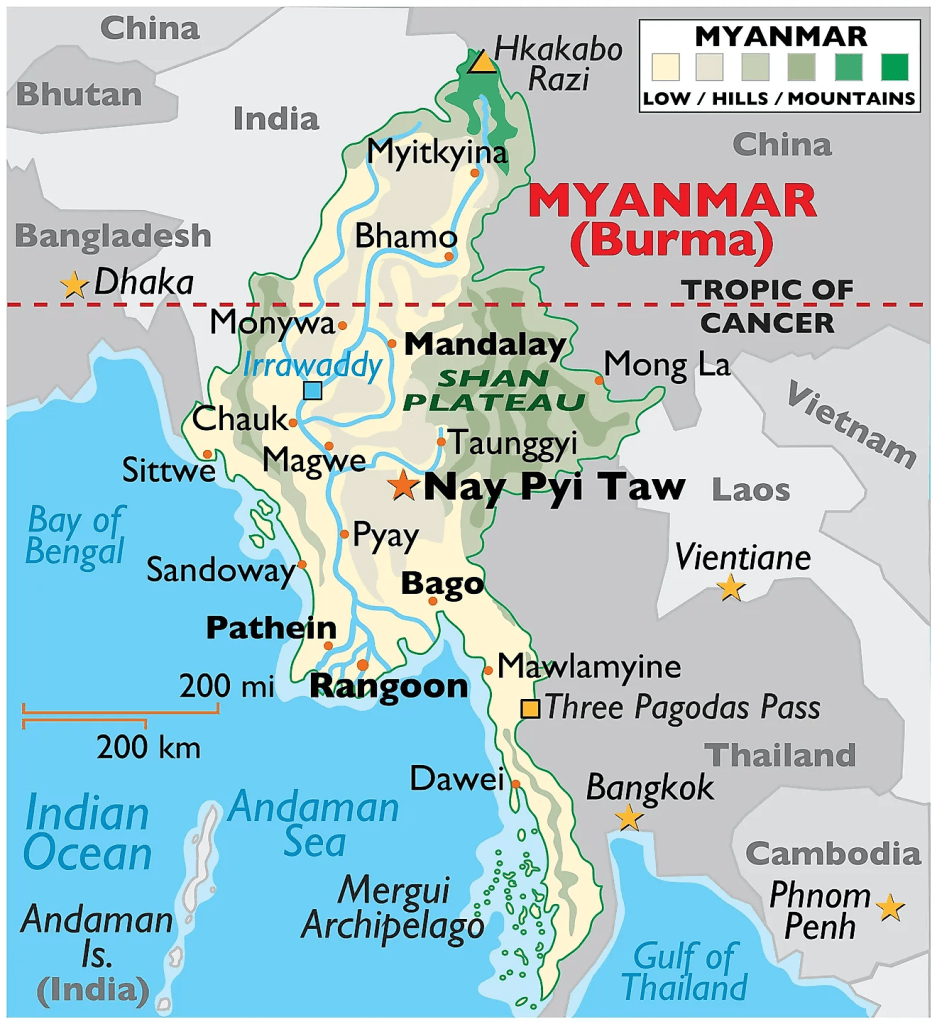
AI: “The history of Burma (now Myanmar) is marked by ancient city-states, the rise of the Pagan Kingdom (850-1300), periods of Mongol invasion, and British colonial rule, culminating in independence in 1948, followed by decades of military rule and ongoing conflict. British rule in Burma lasted from 1824 to 1948. This started from the successive three Anglo-Burmese wars through the creation of Burma as a province of British India to the establishment of an independently administered colony. The rule finally ended with independence. Some 40,000 British and Indian troops fought in the First Anglo-Burmese War, of whom over 15,000 died. Since staging a coup on February 1, 2021, the Myanmar military has carried out a brutal nationwide crackdown on millions of people opposed to its rule, killing 6,000 people and displacing 1 1/2 million people. Christians have been persecuted, caught in the middle of the military and rebel groups fighting. The dominant religion in Myanmar is Theravada Buddhism, practiced by about 88% of the population, with significant minorities of Christians (6%) and Muslims (4.3%).” Pray for the Christians in Myanmar.

Have you ever studied Buddhism? Buddhism originated in India around the 6th to 5th century BCE, with the teachings of Siddhartha Gautama, also known as the Buddha, forming its foundation. It spread to many countries and a number of different schools of Buddhism evolved, such as the Therevada Buddhism of Burma. Here is an AI summary of Buddhist teachings: The Four Noble Truths:These truths address the nature of suffering (dukkha), its origin, its cessation, and the path to its cessation. First Noble Truth: Life is characterized by suffering, which arises from attachment and craving.  Second Noble Truth: Suffering arises from attachment to impermanent things, leading to dissatisfaction and craving.  Third Noble Truth: Suffering can be overcome and ended. Fourth Noble Truth: The path to the cessation of suffering is the Eightfold Path.  The Eightfold Path:This is the practical guide for achieving enlightenment and ending suffering, comprised of eight interconnected practices: right understanding, right thought, right speech, right action, right livelihood, right effort, right mindfulness, and right concentration.”  I sum it up like this: Life is suffering and unfulfilled desires. Suffering is due to the desire to not suffer, to want things. The end of suffering is to cease to want to not suffer, to want things. Quit wanting to not suffer and you won’t be upset when you do suffer. Buddhist are actually very good people living by the 8 fold path. They just don’t have a Savior for their sins. Buddha never claimed to be such a savior. You can be a Buddhist and not believe in any god, as Buddhism is often described as a non-theistic or nontheistic religion, meaning it doesn’t require belief in a creator god. Buddhism has some good teachings, but no Savior.

That was the predominant religious culture in Burma when Judson worked for 37 years. 6 long years and much suffering before the first Burmese convert to Christ. I am a numbers person and would probably have given up after a couple of years and returned to America. But that one convert, Byu, led 1,270 members of his tribe to Christ in 12 years, and then Christianity spread to other tribes.Judson spent 37 years in Burma and only returned to America one time (in 1845) during those years. My wife and I spent 5 years in mission work in Trinidad, West Indies and Colombia, South America. We went home once a year during those 5 years. I must admit that I longed for life back in Alabama even though we loved our mission work abroad. I can’t imagine 37 years abroad and ony returning one time. Can you imagine that one visit Judson made back home to Massachusetts in 1845? He saw where Texas had just become the 28th state. He probably saw the conflict brewing in the states which led to the Civil War in 1861. He probably saw a lot of indifference and materialism. He stayed for 9 months and headed back to his passion, Burma.

All these great missionaries inspire me. Maybe I can’t or won’t do mission work abroad again as we did back in the 1970’s. But I teach students in my Bible classes that might become a Byu. Indeed a few grads are doing mission work in Ecuador, Tunisia, etc. My rant again: churches need to quit spending so much money on ourselves (buildings, staff, and assembly comforts) and start spending the vast majority of their contributions on printing Bibles to get the gospel to all these Hindu, Buddhist, Muslim, and atheistic countries. Judson had a goal to print the Bible in the Burmese language, and he did. I wonder how many were converted by that Burmese Bible? We need to make the printing and distributing of the Bible in all the main languages a priority in our spending. If you can go do mission work, go, even if on a short term trip. If you can’t go, then live modestly and give your tithing to organizations that print Bibles like Eastern European Ministries (EEM).
EPHESIANS 2

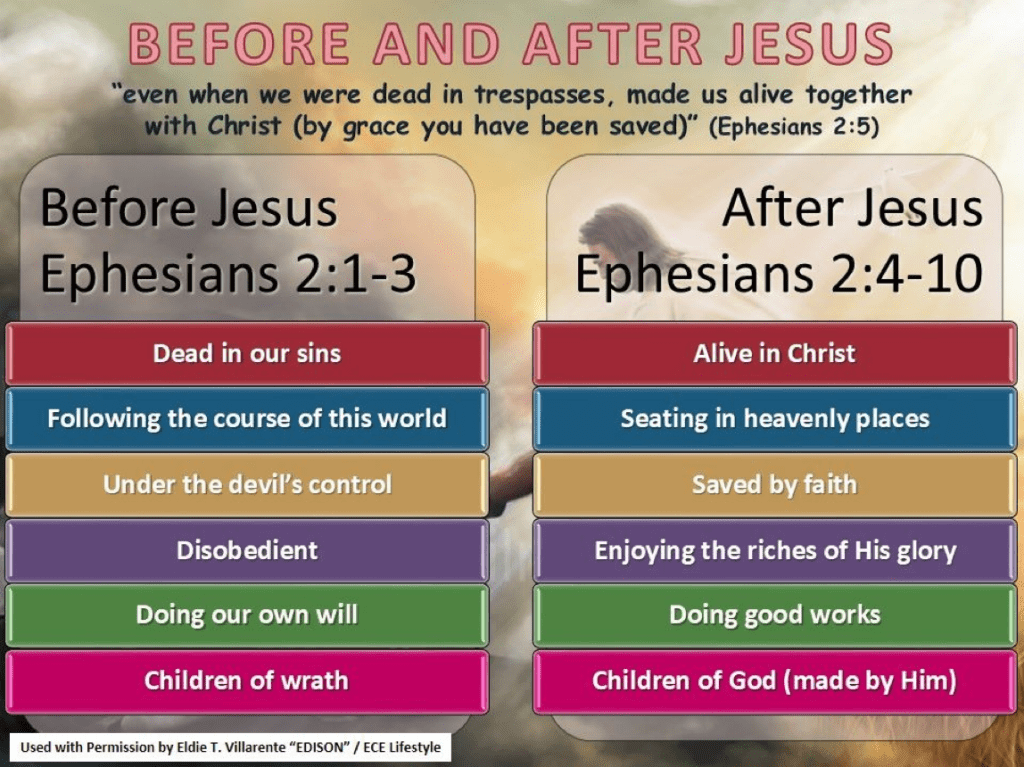
2:1-10 SAVED BY GRACE THROUGH FAITH

Taken from the internet:

Eph 2:1-10  is directly tied to 1:15-23. Again, from p. 19: This power of God’s working (that Paul wanted the eyes of their hearts opened to see) is in accordance with God’s power when he raised Jesus from the dead, seated him at His right hand “in the heavenly places” far above all spiritual powers of darkness and made him head over the church, which is his body. This last few verses will set the tone for God’s power raising us from the spiritual dead, making us alive spiritually,  and seating us with Jesus at the right hand of God in the heavenly places. 

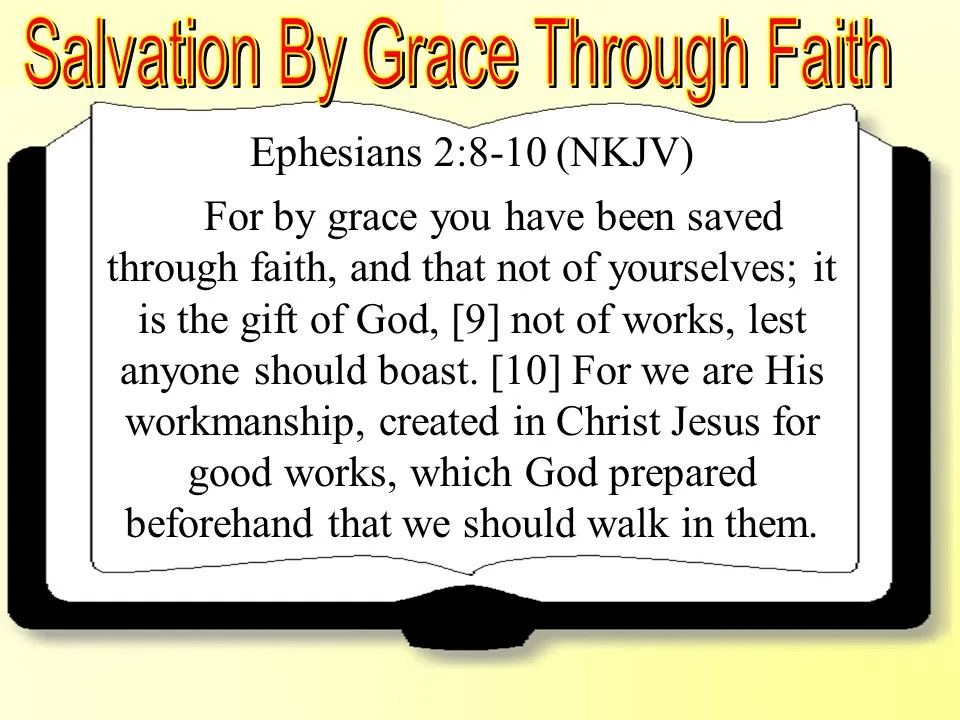
Yes, “saved by grace through faith” is considered the central doctrine of the New Testament, primarily based on verses like Ephesians 2:8-9 which state that salvation is a gift from God received through faith, not by any merit of our own actions; essentially meaning that God’s grace is the sole basis for our salvation when we put our trust in Jesus Christ. 

Key points about this doctrine:

  • Grace is undeserved favor:
    This means that God’s love and forgiveness are freely given, not earned by good works. 
  • Faith is essential:
    To receive this grace, one must believe in Jesus Christ and accept his sacrifice as sufficient for their salvation. 
  • Not by works:
    This doctrine emphasizes that salvation cannot be achieved through personal efforts or adherence to religious laws, but solely through faith in Jesus. 
  • Romans 3:21 But now the righteousness of God has been manifested apart from the law, although the Law and the Prophets bear witness to it— 22 the righteousness of God through faith in Jesus Christ for all who believe. For there is no distinction: 23 for all have sinned and fall short of the glory of God, 24 and are justified by his grace as a gift, through the redemption that is in Christ Jesus, 25 whom God put forward as a propitiation by his blood, to be received by faith. This was to show God’s righteousness, because in his divine forbearance he had passed over former sins. 26 It was to show his righteousness at the present time, so that he might be just and the justifier of the one who has faith in Jesus.

27 Then what becomes of our boasting? It is excluded. By what kind of law? By a law of works? No, but by the law of faith. 28 For we hold that one is justified by faith apart from works of the law. 29 Or is God the God of Jews only? Is he not the God of Gentiles also? Yes, of Gentiles also, 30 since God is one—who will justify the circumcised by faith and the uncircumcised through faith. 31 Do we then overthrow the law by this faith? By no means! On the contrary, we uphold the law.

  • Romans 3 is perhaps the greatest detailed statement of salvation by grace through faith, not works. Eph 2:8-10 is a shortened form. Paul continually has to fight the Judaizers who are undermining his teaching of the gospel. They teach that the Gentile Christians should keep the Law of Moses as well as the teachings of Jesus. They made that a test of fellowship in the early church. 
  • In Romans 3, he uses the term “justification” for salvation. It is a legal term. dikaioó: to show to be righteous, declare righteous. The believer is “made righteous/justified” (1344 /dikaióō) by the Lord, cleared of all charges (punishment) related to their sins. Moreover, they are justified (1344 /dikaióō, “made right, righteous”) by God’s grace through faith. This also called “imputed or reckoned righteousness” in Romans 4:What then shall we say was gained by Abraham, our forefather according to the flesh? For if Abraham was justified by works, he has something to boast about, but not before God. For what does the Scripture say? “Abraham believed God, and it was counted to him as righteousness.” Now to the one who works, his wages are not counted as a gift but as his due. And to the one who does not work but believes in him who justifies the ungodly, his faith is counted as righteousness. The Greek word for “counted or credited or imputed” is logizomai: to reckon, to consider. 3049 logízomai (the root of the English terms “logic, logical“) – properly, compute, “take into account”; reckon (come to a “bottom-line”), i.e. reason to a logical conclusion (decision). This word is used 11 times in Romans 4 alone. 

The “bottom line of” or “logical reason for” salvation is that works can’t save someone (neither works of the Law of Moses or any works system), and that God counts a person to be righteous by his faith, not works. It is “on the basis of faith”. 

Philippians 3:Indeed, I count everything as loss because of the surpassing worth of knowing Christ Jesus my Lord. For his sake I have suffered the loss of all things and count them as rubbish, in order that I may gain Christ and be found in him, not having a righteousness of my own that comes from the law, but that which comes through faith in Christ, the righteousness from God that depends on faith— 

Romans 11:But if it is by grace, it is no longer on the basis of works; otherwise grace would no longer be grace.

Q: Does James contradict Paul in James 2?

James 2:21 Was not Abraham our father justified by works when he offered up his son Isaac on the altar? 22 You see that faith was active along with his works, and faith was completed by his works; 23 and the Scripture was fulfilled that says, “Abraham believed God, and it was counted to him as righteousness”—and he was called a friend of God. 24 You see that a person is justified by works and not by faith alone.

Martin Luther, the main leader of the Protestant Reformation, promoted 3 key concepts of reform of the Catholic Church. 

The three solas are a set of maxims that summarize Martin Luther’s theology and were a rallying cry for Luther and other reformers:

  • Sola scriptura: Scripture alone
  • Sola gratia: By grace alone
  • Sola fide: By faith alone
  • By “faith alone” he meant salvation is not by works, just as Paul taught. But he called the letter of James a “strawy epistle” b/c of James’ saying that “a person is justified by works and not by faith alone”. He said that the letter should not be in the NT canon. 

Paul and James do not contradict each other. Paul is discussing the basis of God saving someone, which is 100% by grace. But Paul does say that faith is necessary. James is discussing what kind of faith is necessary for salvation by grace, which is an active, working faith. Faith without works is dead and will not save someone. James is not saying that salvation is on the basis of works, which would indeed contradict Paul. Works prove or show that one has sincere, saving faith necessary to be saved.

Q: How many works are necessary to prove that one has the faith that is necessary to be saved? 

A key verse: Matthew 13:8 Still other seed fell on good soil, where it produced a crop—a hundred, sixty or thirty times what was sown.

Also Luke 12:48 From everyone who has been given much, much will be demanded; and from the one who has been entrusted with much, much more will be asked.

In my religious upbringing, we were taught salvation by grace through faith. But b/c of our fear of teaching of denominations who taught that salvation was by grace through faith that did not include baptism, and who taught “once saved, always saved” (without having to have an active working faith), we ended up emphasizing the necessity of works so much that it left members thinking that there was no way they could do enough works to be saved. They doubted their salvation b/c of that. 

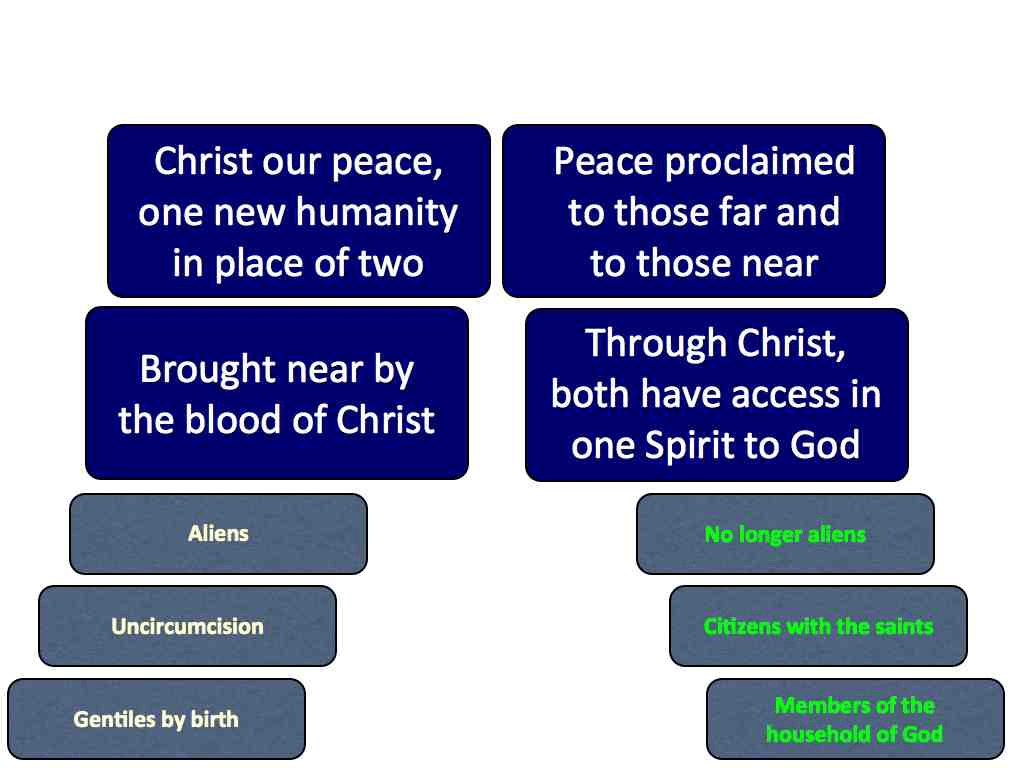
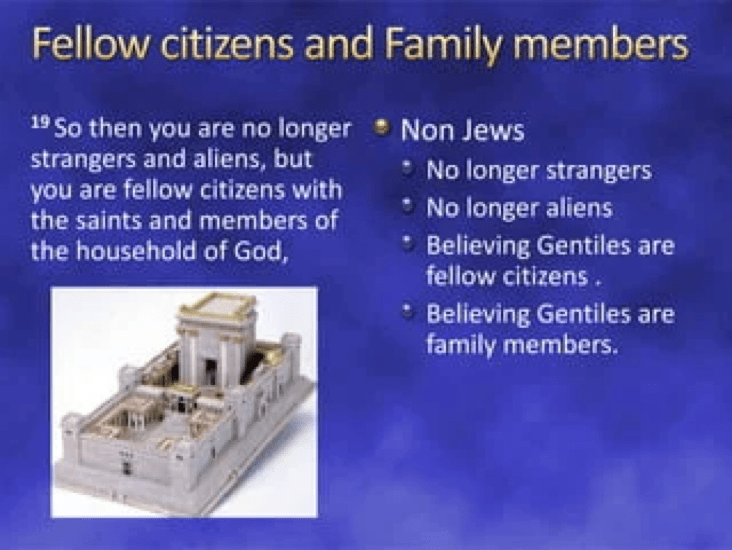
He reconciled Jew and Gentile believers back to God through the blood of the cross. That made them brothers in Christ and took away the enmity between the two.  to reconcile completely (ἀπό) (others, to reconcile back again, bring back to a former state of harmony. The Law of Moses was a source of conflict dividing the two, making the Jews feel superior, looking down and judging the Gentiles. Jesus took away that wall by destroying the condemning power of the law, even for the Jews who continued to keep the Law up till 70 AD. Of course, the Gentiles were never under the Law. There was now peace between Jew and Gentile believers. 

The only way conflicts between different groups will be removed is when all of them become Christians, brothers and sisters in Christ. 

John 14:27 Peace I leave with you; my peace I give you. I do not give to you as the world gives. Do not let your hearts be troubled and do not be afraid.


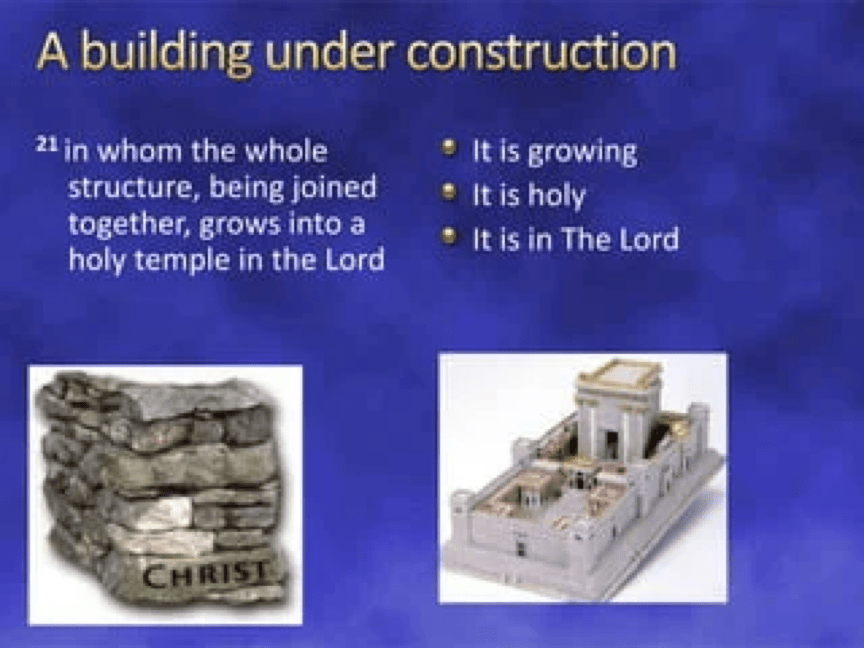
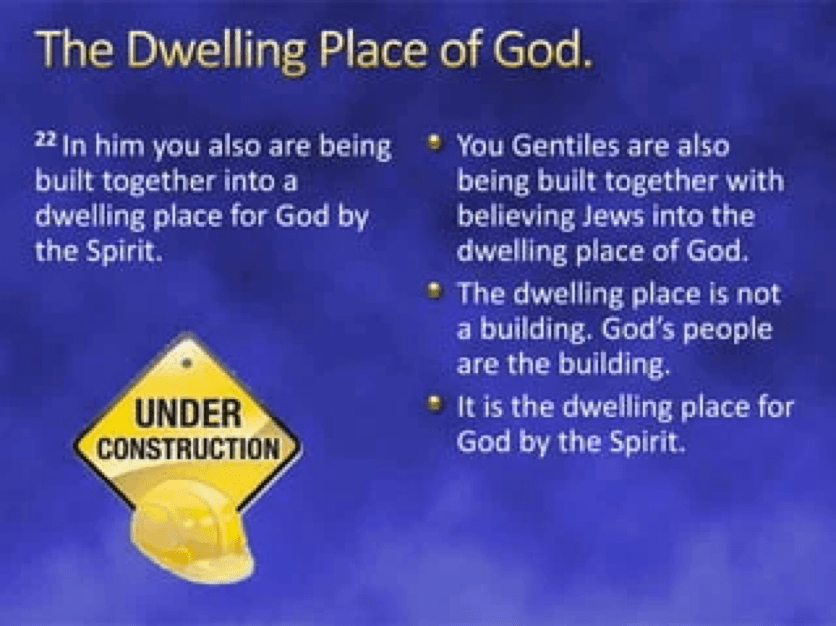
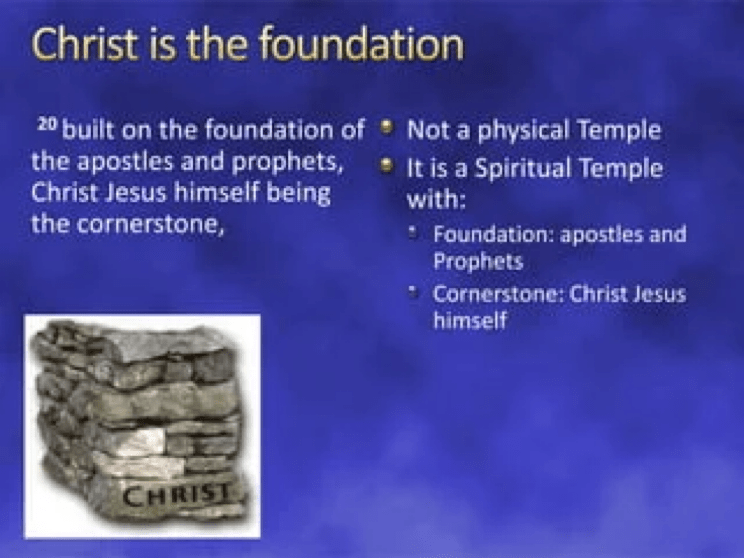
The church, made up of Jew and Gentile believers, is a spiritual temple built on the foundation of the apostles and prophets, with Jesus being the chief cornerstone.   

Some great images taken from the internet:


Q: How was the Law a source of enmity between Jews and Gentiles?

The problem was not the law itself. The Law was spiritual (Romans 7), perfect. But it did separate the Jew from the Gentiles, giving the Jews a sense of superiority (Romans 2). But even then the Law, if used properly (Romans 10), would lead all Jews to Christ where they would be united with the Gentiles in the church. Under grace, the Law no longer had condemning power even if the Jewish Christians continued to keep the Law up till 70 AD. Jesus destroyed the condemning power of the Law when he died to save from sin. After his death, the Law should no longer be a source of enmity b/c both Jew and Gentile Christians were saved by the same grace, and none were saved by the Law.

Q: What are some of the sources of conflicts between groups of people today?

The world is full of hate and conflict. Most current is the Arab/ Israel conflict that goes all the way back to Isaac and Ishmael. We have the Ukraine/Russia conflict. There is North and South Korea. We still have a big racial divide in the U.S. in spite of decades of legislation trying to remove that. We have “hate crimes” against minority groups in the U.S.

Q: Many actual walls have been built to separate groups that are enemies, such as the Berlin Wall. Many peace treaties have been made in attempts to make peace between groups that are enemies, such as the Treaty of Versailles: Ended World War I between Germany and the Allies. The treaty required Germany to disarm, pay reparations, and recognize the independence of states that were previously part of the German Empire. 

But what is the only way to make peace between groups that are enemies for whatever reason?

Q: In what way is the church built upon the foundation of the apostles and prophets? Does that mean there would be no additional apostles and prophets after the original ones?

(The Mormons and others claim to have apostles today.) 

The original 12 apostles (minus Judas replaced by Mathias, Acts 1) plus Paul (an apostle out of due season, 1 Cor 15) were given special authority (Ephesians 4 will define that authority). Jesus told them that the Holy Spirit would guide them into all the truth.

John 14:26 26 But the Helper, the Holy Spirit, whom the Father will send in my name, he will teach you all things and bring to your remembrance all that I have said to you.

John 16:13 13 When the Spirit of truth comes, he will guide you into all the truth, for he will not speak on his own authority, but whatever he hears he will speak, and he will declare to you the things that are to come. 

This led to a “once for all time” delivery of the faith of Jesus.

Jude 3:Beloved, although I was very eager to write to you about our common salvation, I found it necessary to write appealing to you to contend for the faith that was once for all delivered to the saints.

Only these original apostles had that special authority. There is no “apostolic succession” of apostles (as the Mormons claim they have with their apostles, and other groups like the Latter Rain claim to have apostles) after them to replace them and continue special revelation after they died.