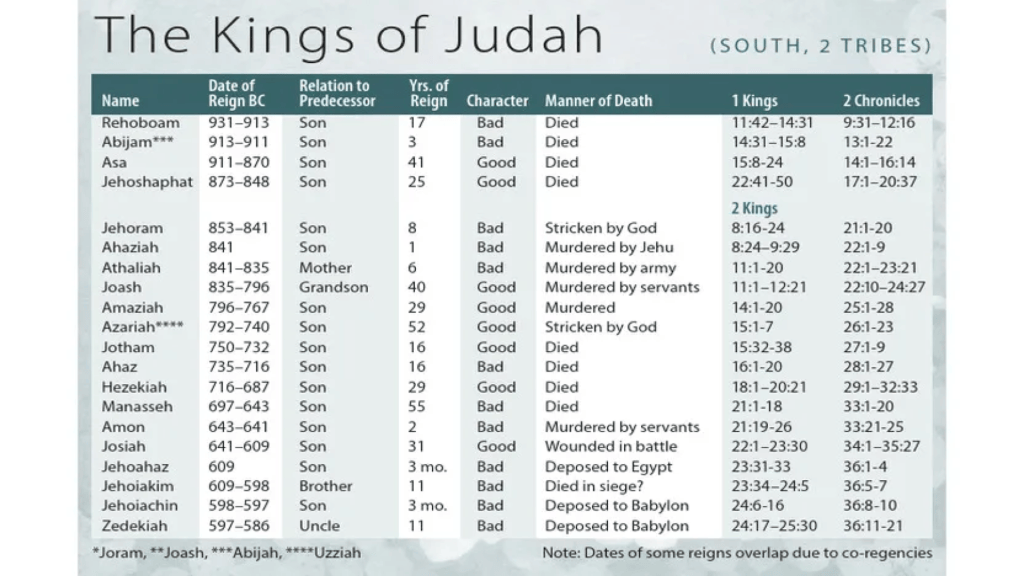
NOV 11 READ 2 CHRONICLES 19-23

Judah #4 Jehoshaphat. 2 Chronicles 17-20 Reigned 25 years. Good

After returning from the foolish alliance with King Ahab of Israel (2 Chronicles 18), rejecting Micaiah’s prediction that the battle would be lost, Ahab is killed in the battle. 2 Crhonicles 19:1 Then Jehoshaphat the king of Judah returned in safety to his house in Jerusalem. 2 Jehu the son of Hanani the seer went out to meet him and said to King Jehoshaphat, “Should you help the wicked and love those who hate the Lord and so bring wrath on yourself from the Lord? 3 But there is some good in you, for you have removed the Asheroth from the land and you have set your heart to seek God.” Hanani the prophet (seer) summed up Jehoshaphat really well. “Your weakness is making alliance with wicked people who hate the Lord, but there is a lot of good in you and God will bless your reign.” Don’t we all have some weakenss that keeps popping up in our lives? You might be doing well spiritually but then you are out with friends and they suggest doing something that you know is sinful and you compromise your values and join them in sin. Down deep in your heart you know that your fiance is not the type of spiritual person that you want to spend your whole life with but you marry anyway for various reasons. Paul gave a warning to the Corinthians in 2 Corinthians 6:14 Do not be bound together with unbelievers; for what partnership have righteousness and lawlessness, or what fellowship has light with darkness? 15 Or what harmony has Christ with Belial, or what has a believer in common with an unbeliever? 16 Or what agreement has the temple of God with idols?” 1 Corinthians 15:33 “Do not be deceived: ‘Bad company ruins good morals“. AI: “Human beings naturally absorb the attitudes, speech, and behaviors of the people they spend the most time with. Even strong principles can wear down over time through constant exposure to negative influences.” (Borrowdale Community Church) Christians are the salt of the earth and salt must come in contact with meat to give it flavor or preserve it, but be careful that your constact with sinners is helping influence them for good instead of them influencing you for bad. Jehoshaphat then began more reforms, espeically judicial reforms demand that judges judge fairly without prejudice or taking bribes.

2 Chronicles 20 The Moabites and Ammonites attack Judah with a very large army and Jehoshaphat is afraid. He then leads a very humble prayer trusting to Yahweh to give Judah the victory. 19:12 For we are powerless before this great multitude who are coming against us; nor do we know what to do, but our eyes are on You.” 3 parts to that closing of the prayer: 1) Acknowledge that we are powerless. 2) Appeal to God wisdom, to know what to do. 3) Eyes on God, trusting Him, waiting on Him to do give the victory. That’s a pretty good prayer thought isn’t it? Jahaziel the prophet then told Jehoshaphat and Judah “Do not fear or be dismayed because of this great multitude, for the battle is not yours but God’s.” The battle belongs to the Lord (a song). Do not fear or be dismayed; tomorrow go out to face them, for the Lord is with you.” I wish I could have such courage and trust to face my battles in life. Everyone fell to the ground and worshipped God even before the battle began. A strange battle ensued. The Lord intrervened to set ambuses in some way among the enemy. The Moabites and Ammonites attacked the Edomites and slaughtered them. And then the Moabites and Ammonites started fighting each other and destroyed each other. By the time Jehoshaphat got to the battle field, there was nothing but corpses and no battle to fight. Judah never had to even fight and spent 3 days collecting the spoil. Our battles are no always won so easily, but many of our battles could be won like that if we fully trust God and seek him in prayer. He might decide that we need a break from constant battle fatigue and gives us a victory with little or no effort on our part.

Unfortunately, we tend to fall back into bad habits. Toward the end of his reign in the 17th year, he made another alliance will an evil king of Israel, Azariah the son of King Ahab. They planned a shipping venture to get gold from Tarshish. Eliezar the prophet condemned the venture and the ships were destroyed by a storm before they ever set sail. When Ahaziah later asked for a second attempt with a combined crew, to his credit Jehoshaphat refused. But again, Jehoshaphat’s weakness popped up, making alliances with evil people. You would think that he would finally get it, but he didn’t. Don’t we repeat the same mistakes over and over?

Judah #5 Jehoram. 2 Chronicles 21 Reigned 8 years. Bad

The first thing Jehoram did was kill all his brothers! He married Athaliah, daughter of King Ahab and Jezebel of Israel. AI: “The marriage was arranged as a political alliance between King Jehoshaphat of Judah and King Ahab of Israel to end decades of war between the two rival kingdoms. Jehoram of Judah began his co-regency and rule in the mid-9th century BCE (approximately 853–841 BCE), meaning the marriage took place prior to or near the beginning of his rise to power as part of the diplomatic pact forged by his father Jehoshaphat and Ahab. Athaliah brought the religious influences of the northern house of Ahab and Jezebel into Judah, notably promoting the worship of Baal. Here is a great chart showing the influence of Jezebel and her daughter Athaliah even on the sourthern kingdom of Judah.
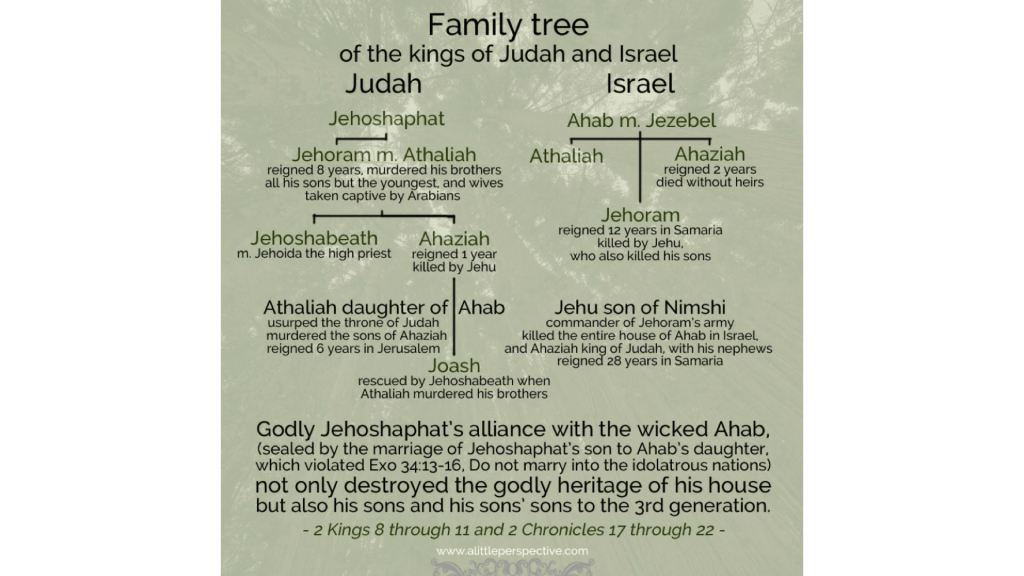


Elijah the prophet cursed him b/c of killing his brothers and all the evil he had done and told him “21:15 You yourself will be very ill with a lingering disease of the bowels, until the disease causes your bowels to come out.’”18 After all this, the Lord afflicted Jehoram with an incurable disease of the bowels. 19 In the course of time, at the end of the second year, his bowels came out because of the disease, and he died in great pain. His people made no funeral fire in his honor, as they had for his predecessors. He passed away, to no one’s regret.” That’s a sad commentary: “he died and no one regretted it! everyone was glad he died”. I hope I don’t end like that!

Judah #6 Ahaziah. 2 Chronicles 22:1-9 Reigned 1 year. Bad

His mother’s name was Athaliah, the daughter of Ahab and Jezebel, who encouraged him to act wickedly. Like his father Jehoram, he allied with King Joram of Israel, son of Ahab, to go into battle with Hazael King of Aram (Syria). Joram was wounded in the battle and Ahaziah went to Jezreel to check on him. The God appointed assassin Jehu tracked him down and killed him.

Judah #7 Athaliah. 2 Chronicles 2 Chronicles 22:10 – 23:21. Reigned 6 years. Bad

As soon as Ahaziah died, Athaliah killed all the royal descendants except Joash, Ahaziah’s son, who was rescued and kept hidden from Athaliah for 6 years in the temple by Jehosheba, Ahaziah’s sister, the daughter of King Jehoram and wife of the priest Jehoiada. After 6 years, Jehoiada anointed Joash king as Athaliah cried “Treason”. They tracked Athaliah down and killed her. They then destroyed all the Baals. Jehoiada led the people in many reforms, tearing down Baal idols.

Good stopping place with the death of Athaliah and anointing of Joash.

NOV 10 READ 2 CHRONICLES 14-18

Judah #3 Asa. 2 Chronicles 14:1-16:14 Reigned 41 years. Good

Asa removed a the foreign altars and cut down the Asherim. He had an army of 580,000 men but was facing Zerah the Ethiopian who had one million men. Asa prayed a very humble prayer, trusting in God, and God gave him the victory over Zerah. The prophet Azariah gave Asa a warning: 15:And if you seek Him, He will let you find Him; but if you forsake Him, He will forsake you.” Jesus said, “Seek and you will find”. God is ready to help us in our battles, but we must seek Him. He will not force Himself on us and make us make moral choices (which is what Calvinism teaches). In the 15th year of his reign, Asa began more reforms, removing idols from the land and getting the people to make a covenant that whoever would not seek God would die. Asa even removed his own mother, Maacah, from being queen b/c she had a horrid image. In the 35th year of Asa’s reign he changed: Baasha the evil king of Israel (the northern kingdom of 10 tribes) attacked Asa. Instead of praying to and trusting God for victory, he bribed the king of Syria with gold and silver to attack Baasha to get Baasha to leave attacking Asa, and it worked. Baasha withdrew. Hanani the prophet rebuked Asa for not trusting in God like he did when facing Zerah, but Asa became angry with Hanani and imprisoned him. Obviously Asa had become pride-filled, trusting in his own ingenuity instead of God. Do you ever do that when facing a challenging problem? Is prayer to God the first thing you do or do you start thinking of your own strategies for dealing with the problem? Do you trust your resources or do you trust God for victory? 15:12 In the thirty-ninth year of his reign Asa became diseased in his feet. His disease was severe, yet even in his disease he did not seek the Lord, but the physicians. It is sad to see a king who did so much good for God end up like that after an otherwise faithful reign of 41 years. I am 76 and I hope that I don’t end up my life in pride, trusting in my money, possessions, retirement plan, and medical plans. I’m sure that I will face some major problem like Asa did with Baasha, but I hope I turn to God for wisdom before I panic and trust in my own plans.

Judah #4 Jehoshaphat. 2 Chronicles 17:1-20:37 Reigned 25 years. Good

Jehoshaphat also removed the high places and Asherim. He also sent the Levites throughout Judah teaching them the Law of Moses. He had a large army and even the Philistines and Arabians paid tribute gifts to him. Jehosphaphat’s thorn in the flesh was his alliances with some of the evil kings of the northern kingdom. He allied with the evil king of Israel Ahab at Samaria to go fight the Arabians and retake Remoth-gilead. 400 prophets of Baal said they would be victorious but Jehoshaphat asked if there was a prophet of Yahweh to consult with and Micaiah the prophet, who after sarcastically saying they would be victorious, said they would be defeated. The unbelievable thing is that Jehoshaphat went with Ahab to battle even after hearing the prediction of Micaiah. Micaiah said that deceiving spirits were in the Baal prophets. Ahab disguised himself as a regular soldier instead of the king and was fatally wounded by a random, God-guided, arrow through a tiny joint in his armor. We will continue in 1 Chronicles 19 in the next blog.

AI: “King Jehoshaphat’s political and military alliance with King Ahab was cemented—and in many ways enabled or sealed—by the marriage alliance in which Jehoshaphat’s son, Jehoram, married Ahab and Jezebel’s daughter, Athaliah. King Jehoshaphat arranged for his son Jehoram to marry Athaliah, which brought the southern kingdom of Judah and the northern kingdom of Israel into a dynastic and political relationship.” We will read much more about how this marriage affected both kingdoms.

KING JEHOSHAPHAT: THE RIGHTEOUS KING WHO DIDN’T SAY “NO” TO AHAB

Jehoshaphat was the 4th king of Judah.  Second Chronicles 17:3–6 gives this commendation: “The Lord was with Jehoshaphat because he followed the ways of his father David before him. He did not consult the Baals but sought the God of his father and followed his commands rather than the practices of Israel. The Lord established the kingdom under his control; and all Judah brought gifts to Jehoshaphat, so that he had great wealth and honor. His heart was devoted to the ways of the Lord; furthermore, he removed the high places and the Asherah poles from Judah.” In addition, Jehoshaphat sent men throughout the kingdom to teach the people the Law of God (2 Chronicles 17:7–9). He removed the male cult prostitutes (1 Kings 22:46). Judah and Israel had been fighting constantly since the kingdom split, but he made peace with wicked king Ahab of Israel.

Nothing but good is said about him until 1 Kings 22 and 2 Chronicles 18. Jehoshaphat goes to visit King Ahab in Samaria. He joined with wicked King Ahab of the northern kingdom of Israel to retake Ramoth-gilead from the Syrians. Ahab has replaced the 450 prophets of Baal that Elijah had killed in 1 Kings 18 with 400 more prophets of Baal. They tell Ahab what he wants to hear, that he will be victorious in the battle. Jehoshaphat demands that a true prophet give his prediction, and Micaiah predicts that Ahab will die in the battle. You would think that Jehoshaphat would break off this partnership with Ahab and head home to Jerusalem, but instead he still joins Ahab in the battle. Ahab is killed by a God-guided random arrow even though he disguised himself as a regular soldier instead of wearing the kingly garments.

2 Chronicles 19:1 Jehoshaphat the king of Judah returned in safety to his house in Jerusalem. 2 But Jehu the son of Hanani the seer went out to meet him and said to King Jehoshaphat, “Should you help the wicked and love those who hate the Lord? Because of this, wrath has gone out against you from the Lord. 3 Nevertheless, some good is found in you, for you destroyed the Asheroth out of the land, and have set your heart to seek God.” To his credit, he apparently received that rebuke and continued to be a righteous king. The same prophet Hanani had rebuked Asa (Jehoshaphat’s father) but Asa imprisoned Hanani. Jehoshaphat then appointed Levites and priests as judges, warning them to give impartial judgements and not take bribes.

After the rebuke by Hanani, Judah was attacked by Moabites and Ammonites. Jehoshaphat led a long, humble prayer asking God for help, acknowledging that he was powerless without God’s help (2 Chronicles 20). The prophet Jahaziel told Jehoshaphat and the people of Judah, “Don’t be afraid for the battle is not yours but God’s” (2 Chronicles 20:15). Did you ever wonder where that song “The Battle Belongs to the Lord” came from? The Lord set an ambush for the attacking enemy. Apparently they ended up fighting among themselves and with the Edomites and were all killed. The army of Judah didn’t even have to fight. When they arrived, all they saw was dead bodies. They took great spoil for 3 days and then on the 4th day they celebrated and praised God with musical instruments and singers.

But we have to ask ourselves, “Why would a righteous king like Jehoshaphat even go visit Ahab? Why would he join with him in a battle that a true prophet of Yahweh warned against, one that he insisted on hearing his prediction?” This all goes back to 2 Chronicles 18:1 Now Jehoshaphat had great riches and honor, and he made a marriage alliance with Ahab.” This is referring to a marriage between Jehoram, Jehoshaphat’s son, to Athaliah, the daughter of Ahab and Jezebel. Jehoram succeeded Jehoshaphat as king and was an evil king, restoring pagan worship in Judah. Athaliah was the daugher of the wicked Queen Jezebel of Israel who fed 450 prophets of Baal and 400 prophets of Asherah at her own dinner table, and desperately tried to kill Elijah. Jezebel was the main ungodly influence of her husband King Ahab. After marrying Jehoram and become Queen of Judah, Athaliah turned out to be “like mother, like daughter”. She restored and promoted Baal worship in Judah, and even built a pagan idol in the temple of God. Ahaziah (Athaliah and Jehoram’s son), succeeded Jehoram as king of Judah. Jehu was appointed by Elijah to kill Ahab, Joram (Ahab’s wicked son who succeeded him), all of Ahab’s descendants, Ahaziah, 42 of Ahaziah’s descendants, Baal’s worshippers and prophets (those 400 prophets of Baal who told Ahab he would be victorious in battle?), and Jezebel. After Athaliah’s son King Ahaziah was killed by Jehu, Athaliah killed all of the royal household of Ahaziah (yes, that would be her grandchildren) and made herself queen for 6 years. Only the baby Joash was spared through the efforts of his nurse Jehoshaba. He was hidden for 6 years in the temple until the priest Jehoiada had Athaliah killed and Joash made king at the age of 7.

Jehoshaphat’s father, King Asa, was a righteous man (for most of his reign until his pride caused him to imprison Hanani) and Jehoshaphat followed in his righteous footsteps. But Jehoram (Jehoshaphat’s son) did not follow in his father’s righteous footsteps. He chose to marry wicked Athaliah. Could Jehoshaphat not have stopped that marriage? That’s a tough question b/c many of us have not been able to stop our children from entering what we feel is a bad marriage. Samson’s parents were not able to stop Samson from marrying the Philistine woman which led to all kind of problems. But that marriage alliance was the beginning of Jehoshaphat’s problems. That no doubt led to a visit to Ahab in Samaria, which led to joining Ahab in a forbidden battle.

We don’t know what Jehoshaphat was thinking or what his motives were for joining Ahab. He had made peace with Ahab and there were no wars betwen Israel and Judah as had been in the past. Was he afriad that Ahab would turn on him and go to war with Judah if he refused to go to battle with him? Jehoshaphat was wealthy and that could hurt his cash flow, as war always does.

What we do know is that Jehoshaphat violated the principle in the rebuke by Hanani, “Should you help the wicked and love those who hate the Lord?” The same principle in 2 Corinthians 6:14 Do not be mismatched with unbelievers; for what do righteousness and lawlessness share together, or what does light have in common with darkness? 15 Or what harmony does Christ have with Belial, or what does a believer share with an unbeliever? 16 Or what agreement does the temple of God have with idols? For we are the temple of the living God; just as God said,“I will dwell among them and walk among them; And I will be their God, and they shall be My people. 17 Therefore, come out from their midst and be separate,” says the Lord.”

God commands us to be the salt of the earth, preserving and adding godly flavor to a sinful world. To do that, we must be “in the world but not of the world”. Associating with the ungodly in this world is inevitable unless you live in a monastery. Paul wrote, 1 Corinthians 5:9 I wrote to you in my letter not to associate with sexually immoral people; 10 I did not at all mean with the sexually immoral people of this world, or with the greedy and swindlers, or with idolaters, for then you would have to leave the world.” At the same time, He warns us about making unnecessary friendships, partnerships, and associations with the ungodly. We must be careful about “why” we associate with the ungodly. We must ask, “Is this association or partnership, or. friendship something that God might use to His glory, or am I doing it for selfish reasons.

Apparently Jehoshaphat had a character flaw (don’t we all). For whatever reason or motive, he was afraid to say “no” to Ahab when asked to join him in battle. Or he selfishly saw some possible monetary reason for joining him. Do you (or I) have that same character flaw? Do you join the ungodly in drinking parties b/c you don’t want to be different? They say that the first semester in college is when many kids from Christian backgrounds and families first start drinking b/c they feel the pier pressure that “hey, that is the college experience, everyone does it”. It is hard for high school and college kids to say “no” when pressured by their peers to drink or do drugs. No one wants to be mocked b/c they are different, “better than thou” Bible thumpers.

But what about your business and friendship decisions? Do you get into business deals that make you money even though you know they might lead you to compromise your Christian values? Does hanging around with the ladies or guys in your friend group lead you to doing things that violate your conscience? Maybe doing that enhances your image or popularity?

BTW, you would think that Jehoshaphat would learn his lesson from the incident with Ahab, right? Wrong! 2 Chronicles 20:35 After this Jehoshaphat king of Judah joined with Ahaziah king of Israel (the son of Ahab and Jezebel), who acted wickedly. 36 He joined him in building ships to go to Tarshish, and they built the ships in Ezion-geber. 37 Then Eliezer the son of Dodavahu of Mareshah prophesied against Jehoshaphat, saying, “Because you have joined with Ahaziah, the Lord will destroy what you have made.” And the ships were wrecked and were not able to go to Tarshish.” He got into trouble by joining Ahab and was rebuked by God. But then he makes another partnership, joining Ahab’s wicked son Ahaziah in a shipping venture.

Perhaps this shows that Jehoshaphat’s character flaw was the love of money. In the words of Paul, 1 Timothy 6:9 But those who desire to be rich fall into temptation, into a snare, into many senseless and harmful desires that plunge people into ruin and destruction. 10 For the love of money is a root of all kinds of evils. It is through this craving that some have wandered away from the faith and pierced themselves with many pangs.” As someone said, “it’s all about the money”. We are so driven by the desire to have nice things, to keep up with the Joneses (whoever that is), to wine and dine with our friends. Many of us fell into that “snare” and are plunged into ruin and destruction. Can you think of some Christian men and women who started drinking and partying, hanging out with the wrong crowd, and now they have left the faith? I can.

Let us pray for ourselves first of all. Then pray right now for those whom you think have left the faith b/c of their love of money. Pray for our college students and high school students who face enormous evil peer pressure. Don’t give up on those who fall. James 5:19 My brothers, if anyone among you wanders from the truth and someone brings him back, 20 let him know that whoever brings back a sinner from his wandering will save his soul from death and will cover a multitude of sins.”