MY JOY AND CROWN

Usually I get my creative (what little creativity I get) early in the morning, I mean real early, like 3 AM. This morning I got nothing. So I fell back asleep and than at 7 AM I got a phone call I missed. It was from a man from Trinidad. He had tried to reach me a week ago and I didn’t recognize his name so I didn’t follow up to contact him. This morning something told me to call him, so I did. It was one of the teenagers that we baptized 50 years ago. Of course he is now 64, not the 14 when we baptized him in a crusade (what we called a “gospel meeting” but in a rented hall and not a church b/c there was no church in the town he lived in and where we held the crusade. We baptized several teens in that crusade and started the church in that town. I don’t think that I have seen him in 50 years. He has one grown son living in Queens, New York.I had a long talk with my long, lost brother in Christ. We talked about several of the brothers and sisters in Trinidad, some of whom I have talked to via WhatsApp recently. Many of those we worked with are now older than me and I am 75. Those guys were in their 30’s when we spent 3 years in Trinidad when I was in my mid 20’s. They are men whom we did intense Bible studies with to train them in the book so they could carry on the work in Trinidad after we left in 1976 and they have been carrying on the work in several congregations without any U.S. paid preachers and I am very proud of that. My long lost brother is still very active in the church there. I sadly learned that one of my most trusted friends and leaders in Trinidad now has advanced dementia; he doesn’t know anyone, he just sits and smiles. That church we started with that crusade is having their 50th year anniversary on April 15 of this year.

Ok, breaking news.My wife just came in and I mentioned our brother with dementia, that we should call them. The only phone we had for him and his wife was a landline, so we called it. She answered and we were able to talk to both of them. My dementia brother even perked up and I think remembered us! We chatted for a while and it was a joy. She said we made her day and it certainly made our day. From what she said, I’m not sure my bother has much longer to live.

All this is kinda personal, I know, and thank you for reading if you are reading it. I know everyone has their stories from the past but these are mine today! My mind is filled with a lot of thoughts right now. But I am so thankful that God providentially guided us to do 3 years of mission work in Trinidad back in the 70’s. It was a special, special time. But I think that I can relate more to what the apostle Paul said in Philippians 4:1 “Therefore, my brothers, whom I love and long for, my joy and crown, stand firm thus in the Lord, my beloved.” 1 Thessalonians 2:19 For what is our hope or joy or crown of boasting before our Lord Jesus at his coming? Is it not you? 20 For you are our glory and joy.” That’s exactly how I feel right now.

Paul also said in 2 Timothy 4:For I am already being poured out as a drink offering, and the time of my departure has come. I have fought the good fight, I have finished the race, I have kept the faith. Henceforth there is laid up for me the crown of righteousness, which the Lord, the righteous judge, will award to me on that day, and not only to me but also to all who have loved his appearing.” So there is a crown of life waiting for us. In the Roman Empire, crowns were often given to victorious military leaders, so the imagery of a crown carried connotations of triumph and overcoming challenges. It  signifies the reward for enduring hardship and remaining faithful to the end. In other words, eternal life somewhere with the Father, Son, Holy Spirit, angels and other believers. But Paul’s other crown he was looking for was to be rerunited in eternity with all those he had converted to Chist and mentored and taught in his 30 years of preaching the gospel of Christ to the Gentiles. My Trinidadian brothers and sisters will be our crown some day, our joy. Even our boasting. We won’t boast about our good works. We will simply tell Jesus, “Look who I helped to become your brother”. We are all brothers to Jesus and sons of the same Father. Hebrews 2:11 For he who sanctifies and those who are sanctified all have one source. That is why he is not ashamed to call them brothers, 12 saying, “I will tell of your name to my brothers; in the midst of the congregation I will sing your praise.” That means that Jesus, having finished the word of dying for our sins and setting us apart (sanctification) from sin, would tell of the name (and character behind that name) of the Father to His brothers (those who believed in Jesus). When Jesus was raised, he told the women: Matthew 28:10 Then Jesus said to them, “Do not be afraid. Go and tell my brothers to go to Galilee; there they will see me.” He said the same thing in John 17:17 Jesus said to her, “Do not cling to me, for I have not yet ascended to the Father; but go to my brothers and say to them, ‘I am ascending to my Father and your Father, to my God and your God.’” I don’t think he ever called his apostles “brothers” until after the resurrection. I had never thought of that until writing this article, so the word always has something new for us.

I hope you have someone to be your crown and joy, to greet you when you get to heaven (or whom you can greet if get there before they do!). This has been an amazing day! I could hear my dementia brother’s wife after we had said good bye, and I could still hear her saing “Praise the Lord!”. Yes, praise the Lord.”


NEW WINE IN OLD WINESKINS

Luke 5:33 And they said to him, “The disciples of John fast often and offer prayers, and so do the disciples of the Pharisees, but yours eat and drink.” 34 And Jesus said to them, “Can you make wedding guests fast while the bridegroom is with them? 35 The days will come when the bridegroom is taken away from them, and then they will fast in those days.” 36 He also told them a parable: “No one tears a piece from a new garment and puts it on an old garment. If he does, he will tear the new, and the piece from the new will not match the old. 37 And no one puts new wine into old wineskins. If he does, the new wine will burst the skins and it will be spilled, and the skins will be destroyed. 38 But new wine must be put into fresh wineskins. 39 And no one after drinking old wine desires new, for he says, ‘The old is good.’”

The new wine would ferment more and release gasses that would cause the old wineskin to burst since the old wineskin had already shrunk all that it could schrink. The new cloth would shrinnk when washed, thus pulling away from the old cloth it was sewn to b/c the old cloth. That’s pretty easy to understand. So new wine needs to be put in new wineskins so that the new wineskin can expand as the new wine ferments.

So what is the lesson in this parable? Jesus is introducing new thinking to the legalism of the Pharisees. They were content with the old, “keep the Law” strictly, way of thinking. Jesus would introduce things like “you have heard don’t commit adultery, but I say unto you don’t lust”. They were more concerned about keeping the rituals of the Law rather than the purity of the heart. Jesus’ teaching would be the new wine and the new cloth. The Pharisees’ hypocrisy and legalism would be the old wineskins and the old cloth.

So how does that apply to me? Many of us have been brought up in churches where keeping the commands was the emphasis. Nothing wrong with that unless your strict law keeping ends up making you legalistic, judgmental, and self righteous. You might be exposed to some new spiritual thoughts that should expand your belief in the Bible or in Jesus and you are just closed minded and don’t give the new thoughts a fair chance. Don’t get me wrong. There is a lot of new thinking in churches that LGBQT is an acceptable way of loving. I am closed minded on that b/c the Bible clearly says that is a sin. But then I attend one of those mega churches that has a contemporary worship service with the band and the 7/11 music (repeating the same 7 words 11 times). My old church upbringing makes me a little skeptical. Is this entertainment or worship? Our legalistic preachers in the past told us it was entertainment. But while I was there, the lights were down low and I sat by a co-worker and her family and felt a peace that i was needing. I watched my co-worker’s little 9 year old girl singing every word with emotion, swaying to the music, and I thought, “I never did that as a kid. Maybe I need what she has.” I am anti-paid preachers and big churches, but I watched probably a thousand people worship in 3 different services that morning.

I heard a sermon from probably a $100,000+ preacher that challenged me. He was preaching on 1 Corinthians 2:1-5 where Paul said that he focused on just preaching the gosel without using persuasive words of wisdom. How Paul preached out of weakness (his thorn in the flesh?) and was not an elegant speaker like Apollos. He said Paul would be turned down for preaching at most big churches today. He mentioned men like David Brainerd, the apostle to the North American Indians, who was kicked out of Yale b/c of his “spiritual enthusiasm” that had been stirred up by George Whitefield (the 2nd Great Awakening movement). He lived with tuberculosis most of his life and suffered greatly from it, dying at the age of 29 from his disease. In later life, he suffered from depression, loneliness, and lack of food. He died staying in the house of Jonathon Edwards. He probably only converted a few Indians, but he influence men like William Carey, the father of Protestant missions., and Adoniram Judson, the missionary to inland China. John Wesley said ‘Let every preacher read carefully over the Life of David Brainerd‘.

Back to the worship service I attended and the sermon. The preacher challenged the audience, “have you been called to preach, which I thought was strange since he was preaching to an audience with probably no one there who was called to preach. Then I wondered if he was talking to me! He said it was the Spirit speaking through the word in sermons so maybe it was the Spirit.

My point is that the Spirit is trying to put new, fresh, spiritual thoughts in our hearts and minds all the time if we will just tune in. You have to tune in to your favorite radio program, to tune in to the frequency of that program, in order to listen to your favorite music. You have to change your old way of listening to other radio program frequencies to get the new one that will edify you. So I leave it with you to do that in your own experiences. I shared mine and I imagine you have things like that to share also. I need to look at the wordress site and see if there is something I can click that would allow readers to share comments with one another. Hey, that might be new wine.

Jesus concluded the parable with  “and no one after drinking old wine desires new, for he says, ‘The old is good.’” I think that means that people tend to prefer what they are familiar with and are reluctant to try something new, even if it might be better. We are kinda stuck in our old ways and way of thinking.

CHANGE MY HEART OH GOD

Mark 7:14 And he called the people to him again and said to them, “Hear me, all of you, and understand: 15 There is nothing outside a person that by going into him can defile him, but the things that come out of a person are what defile him.” 17 And when he had entered the house and left the people, his disciples asked him about the parable. 18 And he said to them, “Then are you also without understanding? Do you not see that whatever goes into a person from outside cannot defile him, 19 since it enters not his heart but his stomach, and is expelled?” (Thus he declared all foods clean.) 20 And he said, “What comes out of a person is what defiles him. 21 For from within, out of the heart of man, come evil thoughts, sexual immorality, theft, murder, adultery, 22 coveting, wickedness, deceit, sensuality, envy, slander, pride, foolishness. 23 All these evil things come from within, and they defile a person.”

The Pharisees had just criticized Jesus’ disciples for not washing their hands before eating. In parenthesis, Mark explains that this was their tradition of washing hands when they came from the market place, which means washing away touching anything that a Gentile had touched, thus making them unclean. This was not a command under the Law for all Jewsalthough the priests were commanded to wash their hands before serving in the tabernacle or temple, so this was just a tradition of the Pharisees. Jesus then went on to show how hypocritical the Pharisees were. They held to their hand washing tradition legalistically, condemning those who disobeyed, and yet they would avoid supporting their parents in need, using a hypocritical oath saying they had given their money to God and didn’t have any for their parents. Mark 7:And he said to them, “Well did Isaiah prophesy of you hypocrites, as it is written, “‘This people honors me with their lips, but their heart is far from me; in vain do they worship me, teaching as doctrines the commandments of men.’”

That led to a teaching by Jesus of what defiles a man. He was not saying that he Jews should no longer follow the laws of not eating unclean meats. That would contradict what Jesus said in Matthew 5:17 “Do not think that I have come to abolish the Law or the Prophets; I have not come to abolish them but to fulfill them. 18 For truly, I say to you, until heaven and earth pass away, not an iota, not a dot, will pass from the Law until all is accomplished. 19 Therefore whoever relaxes one of the least of these commandments and teaches others to do the same will be called least in the kingdom of heaven, but whoever does them and teaches them will be called great in the kingdom of heaven.” The Law would not be abolished until 70 AD according to Hebrews 8:13 In speaking of a new covenant, he makes the first one obsolete. And what is becoming obsolete and growing old is ready to vanish away.” That verse was written around 60 AD predicting the vanishing of the Law in 70 AD. Even the Jewish Christians continued to keep the Law during the transition period from 30 AD to 70 AD.

What Jesus is saying is that it’s not really what you eat that defiles you. What you eat is digested and the wastes come out. It’s what is in your heart that defiles you and what’s in your heart will always end up coming out of your mouth, your mind, your actions. Here’s a great image.

As the capital one commercial says, “What’s in your wallet?” What’s in your heart?

These verses comfort me and scare me. The other day in inservice at school, teachers in groups were asked to give a positive comment to all the teachers in their group. All the compliments given me were “Nicky has a lot of knowledge that he shares.” That’s good but other treachers got comments like “John really cares about the kids and loves them.” Why am I known more for my knowledge than my love.

Bottom line, it’s comforting to know that God looks at the heart. David was a man “after God’s own heart”. He committed adultery and murder, but God forgave him b/c David had a pure heart even though he really messed up. He later begged God, “Create in me a clean heart” again. I have so many bad things in my heart but it is comforting that the grace of God will forgive me just as He forgave David.

But then it’s scary to know that God looks past all my knowledge, good deeds, Bible teaching and preaching, and mission work to see what’s really in my heart. He knows when I am being hypocritical, unloving, judgmental, bitter, proud. He saves me by His grace but He expects me to change my heart, to try to get rid of all the bad things in my heart.

He gives me the Spirit to help me do that b/c my flesh is so evil that I can’t do it by myself. Ezekiel 36: 26 And I will give you ia new heart, and ia new spirit I will put within you. iAnd I will remove the heart of stone from your flesh and give you a heart of flesh.” For the mind set on the flesh is death, but the mind set on the Spirit is life and peace, because the mind set on the flesh is hostile toward God.” (Romans 8:6-8) When you have those evil thoughts in your heart, if you ask the Spirit to help you get rid of them and replace them with pure thoughts, then He will help you. It’s called the “renewing of your mind” b/c the heart is just an organ and it’s really all about the mind. Philippians 4:Finally, brothers, whatever is true, whatever is honorable, whatever is just, whatever is pure, whatever is lovely, whatever is commendable, if there is any excellence, if there is anything worthy of praise, think about these things.”

So we will never have a perfectly pure heart. That’s the scary part. We can fall from grace and lose our salvation. I need to try harder to allow the Spirit to change my heart. In Acts 8, Simon had been baptized but then he wanted to buy the apostles’ gift of laying hands on believers to give them miraculous gifts. Acts 8:20 But Peter said to him, “May your silver perish with you, because you thought you could obtain the gift of God with money! 21 You have neither part nor lot in this matter, for your heart is not right before God. 22 Repent, therefore, of this wickedness of yours, and pray to the Lord that, if possible, the intent of your heart may be forgiven you. 23 For I see that you are in the gall of bitterness and in the bond of iniquity.” That means that a baptized believer could be in serious trouble with God if his/her heart is not right before God.

So this article is to enoucrage me to try harder to let the Spirit help me change my heart.

Here’s a great song to close with. Please listen to it for your devotional thought for the day and then pray, “change my heart oh God, make it ever new…”

https://www.youtube.com/watch?v=IlSmG-_eJTU


DOES ESCHATOLOGY EVEN MATTER?

First, what is eschatology? Eschatology is the study of the end times and the “last things” (the 2nd coming, the resurrection, the judgement). There are 5 basic views of eschatology. The word “millennial” is based on the 1,000 years (a millennium) of Revelatioin 20 that Christ and the saints will reign for a thousand years, the end of which will be the battle of Armageddon.

1)A millennial –Realized Millennial. (Greek: a – “no” + millennialism) is the view in Christian eschatology which states that Christ is presently reigning through the Church and that the “1000 years” of Revelation 20:1-6 is a metaphorical reference to the present church age which will culminate in Christ’s return (the 2nd coming). .

2_ Post-Millennial – The 2nd coming will be at the end of the millennium. This was a popular view in the 19th and 20th centuries among abolitionists and social gospel reformers who hoped to create a 1,000 years of social reform that would enable the 2nd coming to happen.

3) Pre-Millennial – Historical. After the tribulation, the 2nd coming will be the beginning of the millennium. From gotquestions.org “Historic premillennialism was held by a large majority of Christians during the first three centuries of the Christian era. Many of the church fathers such as IreneausPapiasJustin MartyrTertullianHippolytus, and others taught that there would be a visible kingdom of God upon the earth after the return of Christ. Historic premillennialism taught that the Antichrist would appear on earth and the seven-year tribulation would begin. Next would be the rapture, and then Jesus and His church would return to earth to rule for a thousand years When Christianity became the official religion of Rome in the fourth century, many things began to change, including acceptance of historic premillennialism. Amillennialism soon became the prevailing doctrine of the Roman Catholic Church.”

4) Pre-Millennial – Dispensational. A 2nd coming to rapture the church, followed by a 2nd coming with the church after the tribulation that will begin the millennium. 7 periods or dispensations are emphasized:

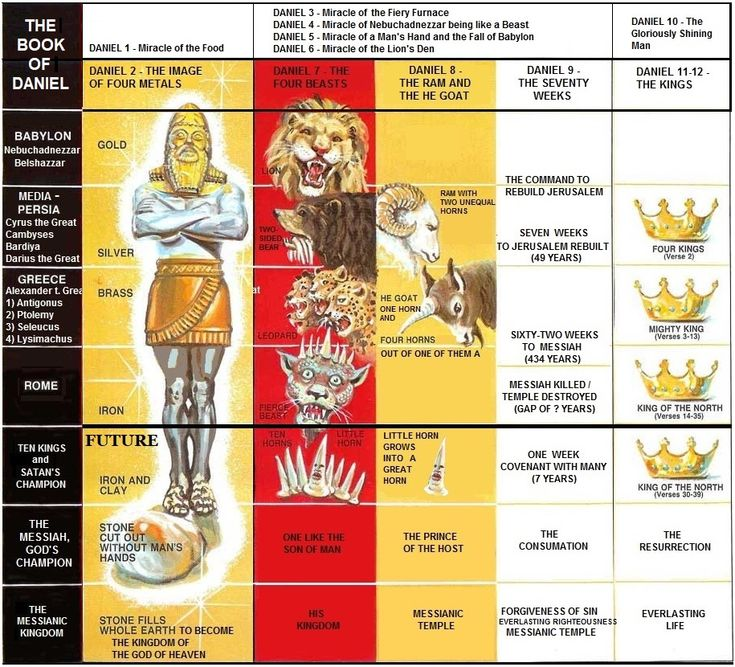
Here is a chart that compares the first 4 views of eschatology. There are several variations of some of these views, but this chart summarizes the basics.

5) Preterism. Preterism is a Christian belief that most or all Bible prophecies have already happened. The term comes from the Latin word preter, which means “past”. Full preterism believes that all have already happened by 70 AD when the Romans destroyed Jerusalem and the temple. The resurrection, the 2nd coming, and the judgment all happened at 70 AD. The millennium is the 40 year period from the beginning of the church on the day of Pentecost (Acts 2) in 30 AD to 70 AD (thus the 1,000 years of Revelation 20 is a figurative number, not a literal 1,000 years). The new heavens and new earth is the new Messianic system and age that replaced the old heavens and earth (i.e. the Jewish system and age). The new Jerusalem is the church that replaced the old Jerusalem that was destroyed in 70 AD. The new temple (Ezekiel 40-48) is the church in which God dwells.

Does eschatology even matter? Is it even important or worth the time to study eschatology? Isn’t faith in Jesus and living the Christian life all that really matters?

One’s view of eschatology is not necessarily a “heaven/hell” issue that a believer must understand correctly in order to be saved. No one will get to the pearly gates and be refused entrance b/c he/she misunderstood the correct view of eschatology above. One’s view of eschatology could, however, cause a believer to lose faith in the Bible prophecies and lose faith in the Bible being the inerrant word of God if that particular view of eschatology was proven to be false. That could in turn cause him/her to lose faith in the central message of the Bible, which is salvation by grace through faith in the death, burial, and resurrection of Jesus as the sacrifice for our sins. If you think the Bible prophecies did not come true as predicted, then the Bible is full of false prophesy. Why would you believe that the Bible is right about the salvation part if you think it is wrong about the eschatology part?

I would encourage you to stop now and read this article https://en.wikipedia.org/wiki/Great_Disappointment about the “great disappointment of 1843 AD. William Miller had predicted the 2nd coming would be in 1843 based on Daniel 8. People sold their possessions and waited on house tops on October 22, 1844 but nothing happened. “Henry Emmons, a Millerite, later wrote, ‘I waited all Tuesday [October 22] and dear Jesus did not come;—I waited all the forenoon of Wednesday, and was well in body as I ever was, but after 12 o’clock I began to feel faint, and before dark I needed someone to help me up to my chamber, as my natural strength was leaving me very fast, and I lay prostrate for 2 days without any pain—sick with disappointment’.” The followers of Miller were mocked after the prediction failed. Most of the Millerites did not lose their faith in the Bible. They came up with possible explanations for the failure and started new groups. One of those groups started when Hiram Edson theorized that Christ did return on Oct 22, 1844 but his return was an invisible event in heaven where he entered the Most Holy Place in the heavenly sanctuary and began investiagative judgment that would end in his visible 2nd coming. Ellen G. White became the prophetess of this group which became the Seventh Day Adventists. She taught that a major fault of Milerism was the church worship on Sunday instead of the sabbath day. The 7DA’s meet on Saturday.

Another interesting group that eventually resulted from the great disappointment was the Baha’i faith. “Members of the Baháʼí Faith believe that Miller’s interpretation of signs and dates of the coming of Jesus were, for the most part, correct. They believe that the fulfillment of biblical prophecies of the coming of Christ came through a forerunner of their own religion, the Báb, who declared that he was the “Promised One” on May 23, 1844, and began openly teaching in Persia in October 1844.”

Most of the Millerites still kept their faith in the Bible, which is good. I think that was b/c people just generally believed that the Bible was the inerrant word of God back in the 19th century. They might admit that Miller was wrong on his date for the 2nd coming, but they would never say that he was right on the date but that the Bible had made a false prophecy about that date. So they just came up with possible explanations for the failure, hoping that someone else would figure out the correct interpretation of the Bible on the 2nd coming prediction. There have been many since then who predicted date for the 2nd coming. The Jehovah’s Witnesses predicted 1975. Herbert Armstrong of the Worldwide Church of God predicted 1936, and then 1942, and then 1972. Jeane Dixon predicted 1962 and later changed it to 2020. Charles Manson predicted that Helter skelter, an apocalyptic race war, would occur in 1969. Chuck Smith, the founder of Calvary Chapel predicted that the generation of 1948 would be the last generation and the world would end by 1981. In late 1976, Pat Robertson predicted on his The 700 Club TV programme that the end of the world would come in that year, but later changed it to 2007. Edgar Whisenant predicted in his book 88 Reasons Why the Rapture Could Be in 1988 that the Rapture of the Christian Church would occur between 11 and 13 September 1988. Harold Camping predicted the Rapture would occur on 6 September 1994. When it failed to occur he revised the date to 29 September and then 2 October of 1994, but eventually changed it to 2011. Isaac Newton predicted that Christ’s Millennium would begin in 2000 in his book Observations upon the Prophecies of Daniel, and the Apocalypse of St. John. Yisrayl Hawkins, pastor and overseer of The House of Yahweh, predicted in his February 2006 newsletter that a nuclear war would begin on 12 September 2006 (that one interests me b/c one of the young men I trained in Trinidad to be a preacher later converted to the House of Yahweh). Hal Lindsey ublished a book, The Late Great Planet Earth, suggesting Christ would return in the 1980s, probably no later than 1988. During and before 1999, there were widespread predictions of a Y2K computer bug that would crash many computers at midnight of 31 December 1999, causing malfunctions that would lead to major catastrophes worldwide, and that society would cease to function.

Things have changed since the 19th century when most in the U.S. believe the Bible to be the inerrant word of God. Now, only about half believe that the bible is the “inerrant” word of God, i.e. without errors, fully inspired by God. About 1/4 of the world population are Muslims and 7% are atheist or agnostic. Then there are the non Christian Jews (only 0.2% of the world population). There are about 16% that are “religiously unaffiliated” (not connected to any particular rellgion) made up of atheists, agnostics, and even believers in God who aren’t connected to a church (the “nones” in religious surveys). These groups do not believe that the Bible is the inerrant word of God. So, when they read of a failed prediction of the 2nd coming, they tend to say that means that the Bible is full of failed prophecies, that it is written by fallible men who make false predictions. They say that the Bible is not reliable and cannot be trusted.

That leads us to the core of the full preterism eschatology. Jesus predicted his own return or 2nd coming only 4 times in the synoptics (Matthew 10:23; 16:27,28; 24:30-34; 26:64 and in the parallel passages in Mark and Luke). In all 4 predictions, Jesus predicted that he would return within the lifetime of the people he was speaking to. In Matthew 24 He predicted 29 “Immediately after the tribulation of those days the sun will be darkened, and the moon will not give its light, and the stars will fall from heaven, and the powers of the heavens will be shaken. 30 Then will appear in heaven the sign of the Son of Man, and then all the tribes of the earth will mourn, and they will see the Son of Man coming on the clouds of heaven with power and great glory. 34 Truly, I say to you, this generation will not pass away until all these things take place. The Greek word for “generation” is genea and always in the New Testament refers to a 40 year period or the people living in a 40 year period.

He even predicted: Matthew 16:27 `For, the Son of Man is about to (the Greek word is mello which always in the New Testament means something about to happen although most translators incorrectly translate it “certain to happen”) come in the glory of his Father, with his messengers, and then he will reward each, according to his work. 28 Verily I say to you, there are certain of those standing here who shall not taste of death till they may see the Son of Man coming in his reign.’ Jesus is not predicting, as some claim, his transfiguration which occurred after he made this prediction b/c the context is a coming in judgment and the transfiguration was not such a coming. It is a clear prediction of the 2nd coming within the lifetime of those he was speaking to and that some of the ones he was speaking to would still be alive to see his 2nd coming. There is no plausible way to avoid this interpretation of what Jesus was predicting. The Muslims, atheists, and non Christian Jews see this and conclude that Jesus was a false prophet. I mean, what do we conclude about all those failed predictions by men that I mentioned earlier? We conclude they were false prophets and we should not want to follow those false prophets in their varioius groups they started. Why would anyone follow Jesus and be a Christian if he was a false prophet? I wouldn’t.

BTW, there are no other predictions in the synoptics by Jesus of a return or coming back other than those 4 mentioned. I challenge someone to find a verse where he predicts a coming back that it not within the generation of those he was speaking to. Surely it would be there if this is a core teaching of Christianity for the past 2,000 years. BTW the apostles taught the same thing about the 2nd coming. James said the “coming of the Lord is at hand” (James 5:8). Peter said “the end of all things is at hand” (1 Peter 4:7). Paul taught that the 2nd coming was “already at work” as he was writing 2 Thessalonians 2. Paul said that “we (including the Christians he was writing to) shall not all sleep (be dead) but we shall all be changed” (1 Corinthians 15:51) when the resurrection would happen and believers, dead or alive, would be given immortality. John said they were living in “the last hour” (1 John 2:18). God told John that the predictions in Revelation would “soon take place, the time is near” (Rev 1:1-3) and tied that to Rev 1:Behold, he is coming with the clouds, and every eye will see him, even those who pierced him, and all tribes of the earth will wail on account of him.” He repeated that in Rev 22:6 that the predictions “must soon take place” and added “behold, I am coming soon” (22:7). He added “the time is near” (22:10) and “surely I am coming soon” (22:20). Quotations from the ESV.

The predictions by Jesus and the apostles of an imminent 2nd coming within the lifetime of those they were speaking or writing to is obvious. If these predictions didn’t come true, then Jesus and the apostles were false prophets. One could say they were just “mistaken”, but if that was so then they are not inerrant and how could we trust any of the rest of the things they wrote?

But just as with the great disappointment, many Christians see this problem with those predictions but it doesn’t cause them to lose their faith in the Bible where those predictions are found. Even C.S.Lewis said that Jesus was wrong in his prediction of an imminent 2nd coming but he still chose to follow Jesus an Christianity. They come up with other possible interpretations of those predictions. Some say “yes, Jesus and the apostles predicted an imminent 2nd coming that would occur in their lifetime, but due to the Jewish rejection of Jesus He postponed or delayed that imminent 2nd coming”. The Hebrew letter refutes that idea. Hebrews 10:37 For, “Yet a little while, and the coming one will come and will not delay.” They try to make the word “soon” in Revelation 1 and 22 to mean “soon in God’s time frame, which could be thousands of years”. But John says “Rev 1:Blessed is the one who reads, and those who hear the words of the prophecy and keep the things which are written in it; for the time is near.” It should be obvious that the reason the readers should keep the things written was that the time was soon or near in their lifeime. What if I told my students at school, “you better study hard on this new material b/c we are have a test on it soon”. I obiously mean “soon” in their time frame.

Such possible explanations of how Jesus and the apostles’ predictions did not come true might suffice most Christians and not cause them to lose their faith in Jesus or the apostles, but it would hinder my faith greatly. It also gives the atheists, skeptics, Muslims, and non Christian Jews plenty of arguments against Jesus and Christianity (which is the case in many of their writings). Instead, we are called to “always being prepared to make a defense to anyone who asks you for a reason for the hope that is in you” (1 Peter 3:15). I, for one, am going to try to make a defense (apologia: Defense, Answer, Apology) on behalf of Jesus and God’s word. We get our word “apology” from that Greek word, but did not mean an apology for us being Christians. “ In the New Testament, “apologia” refers to a formal defense or justification of one’s beliefs, actions, or position. It is often used in the context of defending the Christian faith against accusations or misunderstandings. The term implies a reasoned argument or explanation, rather than a mere excuse.” Sometime it seems that Christians apologize for being Christians who claim that Jesus is the only way of salvation. For many, they seem to be apologizing for Jesus’ predictions of an imminent 2nd coming that didn’t come true, like “I know he said that but it didn’t really mean that or he didn’t really mean it like it sounds, but He is still the Savior”. I might say something radical that offends someone, and a friend of mine might try to apologize for what I said, “oh, he didn’t really mean that”.

Back to the 5 views of eschatology. The only view that fits the facts is the “full preterism” view. Again, this whole discussion might seem like a waste of time to some. “Interesting, but who cares. Eschatology doesn’t really matter”. But to some, a correct interpretation of Jesus and the apostles’ predictions of the 2nd coming might increase their faith in the Bible as the inerrant word of God. That in turn might increase their faith that the core message of salvation in Jesus is true. I had a friend recently tell me that this was indeed the case for her husband.

A correct understanding of all this should help us appreciate the church, which is the spiritual kingdom that Jesus said was “at hand” (Mark 1:15). He said ““My kingdom is not of this world. If my kingdom were of this world, my servants would have been fighting, that I might not be delivered over to the Jews. But my kingdom is not from the world.” (John 18:36). He never came to establish an earthly kingdom, nor will he come back to establish one in our future. Believing that Jesus will return to set up an earthly, physical kingdom (like the OT kingdom of David) keeps many from: Eph 3:21 to him be glory in the church and in Christ Jesus throughout all generations, forever and ever.” It puts an emphasis on possible future physical blessings instead of the spiritual blessings that we have right now in Jesus and in the church.

I hope this article is helpful to someone, or at least food for thought! Thanks for reading (i.e. if you made it reading it to the end!).

LORD I NEED SOME ANSWERS

Have you been there? You have some things really troubling you? You might even be a little depressed? You have some key decisions that you need to make? You are thinking about quitting in some way? You feel like others don’ appreciate you? You are starting to imagine some conspiracy plots against you?

But you also know that maybe you deserve some of the things that are troubling you? You know your secret sins even if others don’t. You know that you have had some ulterior motives that you don’t want others to know about.

You know that pride could be part of your problem. It might be that the Lord has already been trying to answer your questions and lead you in a good path but your pride has kept you going on your own path. God said, “My ways are not your ways, and my thoughts are not your thoughts”. Maybe you have been relying on your own thoughts and ways instead of God’s. Maybe God is testing you. Maybe God is trying to humble you. Asa, Uzziah, and Hezekiah were great men of God until they were lifted up with pride. You don’t want to let your pride cause you to make some really, stupid, rash decisions. You want to just selfishly pull away from people, from the things you have been involved in. The future looks bleak. You have so much to be thankful for, but you are in a real funk. You might even have considered trying to drink your problems away, although that is not characteristic of you. You dont know who to talk to and who to turn to for help.

Lord, I need some answers. How do I get them? Well it starts with humbly asking God for wisdom. James 1:If any of you lacks wisdom, let him ask God, who gives generously to all without reproach, and it will be given him. But let him ask in faith, with no doubting, for the one who doubts is like a wave of the sea that is driven and tossed by the wind.” Then in faith trust God that He will give you some answers and lead you in the best path for you to take. Then, the hard part, wait for Him to clearly show you the answers. You look for signs or indicators of God’s leading. You try not to just look for the signs that might want to find, but be totally open to any and all signs. You think you have a sign and then you look for confirmation of that sign. Gideon asked God for a sign: a wet fleece on dry ground. He got it, but then he asked for confirmation: a dry fleece on a wet ground. I can’t believe the Lord gave him the 2nd sign without scolding him for his lack of faith.

I know some people who are just so decisive. They survey the situation. They make decisions and take action. They never second guess themselves or look back if they make a bad decision. But some of us don’t have as much confidence in our decision making skill. We have trouble making decisions. We second guess our decisions. We are always asking “What if I hadn’t don that, or what if I had done that”. We worry about making a decision and we worry if we made the right decision. That doesn’t sound like a lot of confidence that the decisions you make are in harmony with what the Lord wants you to do. If you feel like the Lord is helping you make a decision, then you make it and then the results and consequences of your decision over to the Lord.

Hebrews 4:16 Let us then with confidence draw near to the throne of grace, that we may receive mercy and find grace to help in time of need.” I am in need, Lord, please hear my prayer and help me.

Lord, I am feeling lost and uncertain right now. I come before you with a heavy heart, seeking your guidance and wisdom. Please, reveal your answers to the questions that trouble me, and help me to see clearly the path you want me to follow. I trust in your love and your perfect plan for my life. Amen.” 


So I prayed and now I wait. I am afraid He will give me some answers that I don’t want to hear even though I say that I want answers. I was going to quit, maybe make a big show of quitting with an bad attitude. What if he tells me to get my act together, quit my pity party, and don’t quit. What if he tells me that he had me in just the right spot that he wanted me to be in.

Things will usually look better in the morning. Weeping may endure for a night, but joy cometh in the morning. Psalm 30:5 These troubling, uncertain times are when you find out how much you really depend on and trust God to lead you. Use them to grow closer to God.

If this article seems to be just what you need to hear today, then that’s great. Praise God and pray. Pray that prayer several times. William Carey was the father of Protestant mission work. He had a dream of preaching the gospel to the heathen Hindus in India. He met resistance from his Calvinistic preachers who said that, if God wanted that done in India, then God would send the Spirit directly to get it done without anyone even going there. But Carey had a saying: “Expect great things from God. Attempt great things for God.” He went. He had many difficult times and lost his family, but he ended up printing, not preaching. He printed to Bible in the native Indian dialects that led to the conversion of thousands. His picture is on a commemorative stamp.

Once you think you know what the lord wants you to do, then be bold. Expect great things from God. Attempt great thing for God. If He closes a door, then he will open another door for you.

God bless you (and me) as we try to seek answers from the Lord. If this article doesn’t fit where you are right now, then be assured it fits someone else. Go encourage them. Let God use you to help someone who is down right now.

START YOUR DAY WITH THESE 7 THINGS

Philippians 4:Always be filled with joy in the Lord. I will say it again. Be filled with joy.

Let everyone see that you are gentle and kind. The Lord is coming soon. Don’t worry about anything, but pray and ask God for everything you need, always giving thanks for what you have. And because you belong to Christ Jesus, God’s peace will stand guard over all your thoughts and feelings. His peace can do this far better than our human minds.” ESV

The secret to having good days is to start the day right. A great place to do that is Philippians 4.

1 Rejoice, be filled with joy. If you have eternal life, why does anything on earth really matter. The worst case scenario might be the health or death of loved ones, but when we all get to heaven, sickness and death here on earth will seem like a minor illness that you had 30 years ago.

2 Be kind and gentle. Try a little kindness. Instead of focusing on my problems, my work to be done, my stuff, let your mind think of ways you can show little acts of kindness to others today. It will bring joy to you and it will get your mind off your stressors.

That Glen Campbell song Try A Little Kindness is great:

https://www.youtube.com/watch?v=MvswocNN-g8

 If you see your brother standing by the road
With a heavy load from the seeds he sowed
And if you see your sister falling by the way
Just stop and say, “You’re going the wrong way”

… You’ve got to try a little kindness
Yes, show a little kindness
Just shine your light for everyone to see
And if you try a little kindness
Then you’ll overlook the blindness
Of narrow-minded people on the narrow-minded streets

… Don’t walk around the down and out
Lend a helping hand instead of doubt
And the kindness that you show every day
Will help someone along their way

 3. Don’t worry. 1 Peter 5:Give all your worries to him, because he cares for you.” ERV It’s nice to be able to write down on a piece of paper the things that you are concerned or worried about (there is a fine lline between the two) and then just hand that paper over to someone whom you trust, who has the capabiltiy and resources to take care of everything you put on that paper, and to just tell that person “Take care of these things for me, please”, and then relax and trust the person to take care of it all. It frees you to do other good stuff.
Luke 10: “Martha, Martha, you are getting worried and upset about too many things. 42 Only one thing is important. Mary has made the right choice, and it will never be taken away from her.” ERV

4. Pray. Have A Little Talk With Jesus. That song goes back to 1937, first sung by The Stamps Quartet.

I may have doubts and fears
My eyes be filled with tears
But Jesus is a friend who watches day and night
I go to him in prayer
He knows my every care
And just a little talk with Jesus makes it right

Now let us have a little talk with Jesus
Let us tell Him all about our troubles
He will hear our faintest cry
And He will answer by and by

And when you feel a little prayer wheel turnin’
And you will know a little fire is burnin’
You will find a little talk with Jesus makes it right

5. Be thankful. 1 Thessalonians 5:16 Always be full of joy. 17 Never stop praying. 18 Whatever happens, always be thankful. This is how God wants you to live in Christ Jesus.” ERV I pray with the ACTS model: Adoration (praise), Confession, Thanksgiving, Supplecation (for others or requests). Sometimes I start with the T instead of the A. Often if we just start with thanking our Father for all the good things he has given us, it minimizes the bad things that we might be concerned about.

The song Count Your Many Blessings is always a great one.

https://www.youtube.com/watch?v=5v18f_y2wA8

When upon life’s billows you are tempest tossed,
When you are discouraged, thinking all is lost,
Count your many blessings name them one by one,
And it will surprise you what the Lord hath done.

Count your blessings, name them one by one;
Count your blessings, see what God hath done;
Count your blessings, name them one by one,
    And it will surprise you what the Lord hath done.

Are you ever burdened with a load of care?
Does the cross seem heavy you are called to bear?
Count your many blessings, every doubt will fly,
And you will be singing as the days go by.

When you look at others with their lands and gold,
Think that Christ has promised you His wealth untold.
Count your many blessings, money cannot buy
Your reward in heaven, nor your Lord on high.

So amid the conflict, whether great or small,
Do not be discouraged, God is over all;
Count your many blessings, angels will attend,
Help and comfort give you to your journey’s end.

6. Tell God your requests, what you need, what you want. That’s the S (supplecation) in the ACTS model. Philippians 4:6, which says “Do not be anxious about anything, but in everything by prayer and supplication with thanksgiving let your requests be made known to God.” NASV The word “supplication” comes from the Latin “supplicare” which means “to plead humbly.” The Greek word for supplicaation is deésis: Derived from δέομαι (deomai), meaning “to beg” or “to ask. “From biblebasedliving.com “Supplication is an essential aspect of prayer as it involves making specific requests to God. It goes beyond general prayers of praise or thanksgiving and allows believers to bring their specific needs before the Lord. When we engage in supplication, we humbly acknowledge our dependence on God and His ability to meet our needs. It is an act of surrendering our desires to His will and seeking His guidance in all matters.” Ephesians 6:18 praying at all times in the Spirit, with all prayer and supplication.”
Make your requests known to him (He already knows what you are thinking or wanting or needing, but He wants to hear you ask, showing your dependence and trust in Him. Then, leave the answered prayers up to God. “Thy will be done”. Whatever you think is best, Father, I’m ok with that.

7. Find the peace of God. Let the peace of God “guard” against all negative emotions and feelings. The Greek for guard is phroureó: To guard, protect, keep watch over. “The term “phroureó” would have been familiar to early Christians as it was used in both military and civilian contexts to describe the act of keeping watch or protecting something valuable.” 2 Corinthians 11:32 At Damascus, the governor under King Aretas was guarding the city of Damascus in order to seize me, 33 but I was let down in a basket through a window in the wall and escaped his hands.” A military or civilian guard keeps anyone or anything out that would endanger the thing or person that he/she is guarding. The peace of God will keep out fear, doubt, worry, bitterness, anger, wrath, hate, envy, jealousy, lust, pride, frustration, guilt, disgust, helplessness, loneliness, confusion, sadness, shame, self-criticism, judging others, contempt, stress, inadequacy, resentment. The peace of God will not allow those emotions to keep you from rejoicing in the Lord. John 14:27 Peace I leave with youmy peace I give you. I do not give to you as the world gives. Do not let your hearts be troubled and do not be afraid.” Isaiah 26:3 “Thou wilt keep him in perfect peace, whose mind is stayed on thee: because he trusteth in thee.Colossians 3:15 “And let the peace of God rule in your hearts, to the which also ye are called in one body; and be ye thankful.” The Greek for rule is brabeuó: To rule, to arbitrate, to decide, to govern. From the root word βραβεύς (brabeus), meaning “an umpire” or “a judge.” From AI: “In ancient Greek culture, athletic games were a significant part of society, and the role of the umpire was crucial in ensuring fair competition. The umpire, or “brabeus,” was responsible for enforcing the rules and awarding the prize to the victor. This cultural backdrop provides a vivid metaphor for the spiritual life, where believers are encouraged to let the peace of Christ rule in their hearts, much like an umpire ensuring harmony and order.”

The song Peace, Perfect Peace. https://www.youtube.com/watch?v=ibqgZxWa6bM

I need to read this article every morning and listen to these songs!


KING UZZIAH OF JUDAH: Great king but leper in the end!

I guess you can tell that I’m into the kings of Judah and Israel. Today is King Uzziah, the 10th king of Judah. Uzziah was 16 when he became king of Judah and reigned for 52 years. The first 24 years of his reign were as a co-regent with his father, Amaziah (the king in my last article). Such a long reign meant that he lived during several prophets and kings of Israel. Ministering during Uzziah’s reign were the prophets Hosea, Isaiah, Amos, and Jonah. The kings in the northern kingdom of Israel during his time were Jeroboam II, ZechariahShallum, Menahem, Pekahiah, Pekah, and Hoshea. Uzziah is also called Azariah in 2 Kings 14:21. From gotquestions.org “King Uzziah was sixteen years old when he began to reign, and he reigned for 52 years in Judah from approximately 790 to 739 BC. He almost lived up to the 722 BC Assyrian captivity of Israel. He “did what was right in the eyes of the Lord” as his father Amaziah had done (2 Chronicles 26:4). King Uzziah sought the Lord “during the days of Zechariah, who instructed him in the fear of God.” This Zechariah is most likely a godly prophet to whom Uzziah listened. As long as Uzziah made a point to seek God, God made him prosperous (2 Chronicles 26:5). Unfortunately, after Zechariah died, Uzziah made some mistakes later in his life.”

Uzziah could be compared to General Patton or Eisenhower. “King Uzziah in the Bible is shown as a wonderfully intelligent and innovative king, under whom the state of Judah prospered (2 Chronicles 26:6–15). He was used by God to defeat the Philistines and Arabs (verse 7), he built fortified towers and strengthened the armies of Judah (verses 9 and 14), and he commissioned skilled men to create devices that could shoot arrows and large stones at enemies from the city walls (verse 15). He also built up the land, and the Bible says he “loved the soil” (verse 10). The Ammonites paid tribute to King Uzziah, and his fame spread all over the ancient world, as far as the border of Egypt (verses 8 and 15).” MJG He “made Judah great” (not a political comment).

The evil kings of Judah died in various ways. Unfortunately, even the good kings of Judah usually had a bad ending. Amaziah (mostly a righteous king although after defeating the Edomites he brought back the Edomite god idols and worshipped them) was assassinated. Jehoshaphat (the righteous son of Asa but his son married wicked Athaliah, the daughter of Ahab and Jezebel) ended his reign with a failed business venture with a wicked king of Israel after a failed partnership with Ahab. Asa ended up with diseased feet and consulted with his doctors instead of God. Josiah (who found the book of the Law in the temple) died in battle with Pharoah Neco even though Neco told him that he was coming to fight Assyria, not Judah. Joash (Jehoash) (the only surviving grandchild after Athaliah killed all her grandchildren) was righteous as long as the priest Jehoida (the one who had Athaliah killed and Joash anointed as king) lived but after that restored Baal worship, killed the prophet Zechariah (the son of Jehoiada), and was assassinated. Hezekiah (the king when the 185,000 Assyrians who were sieging Jerusalem were killed and who was given 15 extra years) was lifted up with pride and showed the Babylonians the temple treasures when they came to inquire about the time shadow going back 10 steps (that led to God predicting that Judah would go into Babylonian captivity). Jotham (son of Uzziah) was righteous but did not remove the high places the people were sacrificing on and “the Lord began to send Rezin king of Aram and Pekah son of Remaliah against Judah” (apparently as punishment on Judah).

It will be no different ending for the good king Uzziah. 2 Chronicles 27:16 But when he was strong, he grew proud, to his destruction. For he was unfaithful to the Lord his God and entered the temple of the Lord to burn incense on the altar of incense. 17 But Azariah the priest went in after him, with eighty priests of the Lord who were men of valor, 18 and they withstood King Uzziah and said to him, “It is not for you, Uzziah, to burn incense to the Lord, but for the priests, the sons of Aaron, who are consecrated to burn incense. Go out of the sanctuary, for you have done wrong, and it will bring you no honor from the Lord God.” 19 Then Uzziah was angry. Now he had a censer in his hand to burn incense, and when he became angry with the priests, leprosy broke out on his forehead in the presence of the priests in the house of the Lord, by the altar of incense. 20 And Azariah the chief priest and all the priests looked at him, and behold, he was leprous in his forehead! And they rushed him out quickly, and he himself hurried to go out, because the Lord had struck him. 21 And King Uzziah was a leper to the day of his death, and being a leper lived in a separate house, for he was excluded from the house of the Lord. And Jotham his son was over the king’s household, governing the people of the land.”

Seems pretty obvious that the lesson for us is on “pride”. How could such a righteous king think that he could go into the temple and offer incense? He knew that only the priests could do that. Pride. God made him great and powerful as a military leader. Judah was prospering. Things were going great for Uzziah and Judah. But then he “got the big head”. He “grew proud”. “As a result of all his blessings, Uzziah, rather than humbling himself in thanksgiving to God, began to think more highly of himself than he should have and developed an exaggerated sense of his own importance and abilities.” (Thomas Tarrants)

Nebuchadnezzar might be the classic example of bad pride. Daniel 4:28 All this came upon King Nebuchadnezzar. 29 At the end of twelve months he was walking on the roof of the royal palace of Babylon, 30 and the king answered and said, “Is not this great Babylon, which I have built by my mighty power as a royal residence and for the glory of my majesty?” 31 While the words were still in the king’s mouth, there fell a voice from heaven, “O King Nebuchadnezzar, to you it is spoken: The kingdom has departed from you, 32 and you shall be driven from among men, and your dwelling shall be with the beasts of the field. And you shall be made to eat grass like an ox, and seven periods of time shall pass over you, until you know that the Most High rules the kingdom of men and gives it to whom he will.” 33 Immediately the word was fulfilled against Nebuchadnezzar. He was driven from among men and ate grass like an ox, and his body was wet with the dew of heaven till his hair grew as long as eagles’ feathers, and his nails were like birds’ claws.”

 A lesson on religious pride from the New Testament is found in the Parable of the Pharisee and the Tax Collector (Luke18:9–14). It is aimed at those “who trusted in themselves that they were righteous, and treated others with contempt.” It addresses spiritual or religious pride. In the story of the Pharisee and the Tax Collector, the Pharisee proceeds to commend himself to God because of his careful observance of the law and to look down with scornful contempt on the sinful tax collector. “God, I thank you that I am not like other men, extortioners, unjust, adulterers, or even like this tax collector. I fast twice a week; I give tithes of all that I get.” Notice in his prayer that his focus is not really on God at all but on how good he is and how bad others are. Here is pride wrapped in the cloak of religion (Tarrants).

In Mere Christianity C. S. Lewis said,
According to Christian teachers, the essential vice, the utmost evil, is Pride. Unchastity, anger, greed, drunkenness, and all that, are mere flea bites in comparison: it was through Pride that the devil became the devil:

Pride leads to every other vice: it is the complete anti-God state of mind…… it is Pride which has been the chief cause of misery in every nation and every family since the world began.1
So we need to be very careful not to be lifted up with pride. Most of us have a lot of financial security, good jobs, nice houses, nice cars, money to spend, etc. We might be considered important at work. Be careful that we don’t think more highly of ourselves than we should (Romans 12:3) and feel that we accomplished all those things by our own ability, not giving God the credit.

Most of us are faithful, church going Christians who do a lot of good works for Jesus. We have important roles in our churches. We don’t party and drink like most do today. We give a lot of money for God’s work. We are so much better religiously and spiritually than most of the world today. Be careful that we don’t have the religious pride that Pharisee had. We should have the attitude, “except for the grace of God, there go I”. That phrase has been attributed to St Francis of Assisi, or maybe John Bradford. John Bradford (1510–1555) was an English Reformer. He was imprisoned in the Tower of London for alleged crimes against Queen Mary I. He was burned at the stake on 1 July 1555. St. Francis of Assisi was an Italian friar who lived in Italy in the 13th century. He lived a life of ascetic poverty and was dedicated to Christian charity. Either one of those godly saints would be worthy of having said that phrase.


Open publish panel

  • Post

KING AMAZIAH OF JUDAH:

Amaziah was the ninth king of Judah, reigning for 29 years. He was the son of Joash and succeeded him after his assassination. One of Amaziah’s first acts was to bring justice upon the murderers of his father (2 Kings 14:5). The Bible summarizes Amaziah’s reign thus: “He did what was right in the eyes of the LORD, but not as his father David had done” (2 Kings 14:3). He failed to removed the high places where people offered sacrifices instead of in the temple.

From https://www.gotquestions.org/King-Amaziah.html “Amaziah later conquered the Edomites and foolishly brought back their gods and sacrificed to them. This idolatry resulted in an unnamed prophet coming to Amaziah and rebuking him. Amaziah insolently resisted the prophet’s words, saying to him, “Since when have I made you the king’s counselor?” (2 Chronicles 25:16, NLT). The prophet was not to be intimidated, however. He told King Amaziah, “I know that God has determined to destroy you, because you have done this and have not listened to my counsel” (verse 16). Amaziah’s defeat of the Edomites had made him overconfident, so he sent a challenge to King Jehoash of Israel to meet him in battle (2 Kings 14:82 Chronicles 25:17). Jehoash recognized Amaziah’s arrogance and refused the challenge, knowing that he could easily defeat the smaller territory of Judah (2 Kings 14:9–102 Chronicles 25:18–19). But Amaziah would not back down, and so Jehoash attacked, defeating the army of Judah and capturing Amaziah. Amaziah was taken to Jerusalem where Jehoash plundered the temple before returning to Samaria (2 Kings 14:142 Chronicles 25:24).

After Jehoash died, Amaziah lived another 15 years. It is unknown whether he returned to rule in Jerusalem, but, in any case, the men of Judah were conspiring against him, causing him to flee to Lachish in southwestern Judah. But the assassins sent after Amaziah found him and killed him. “He was brought back by horse and was buried with his ancestors in the City of Judah” (2 Chronicles 25:28). Amaziah could have had a long, successful reign had he continued following the Lord, but his story became another cautionary tale of the fate of the kings who turned aside to idolatry.”

The amazing thing about Amaziah is that he defeated the Edomites when he trusted in God, but he brought back the gods (idols)of the Edomites and sacrificed and worshipped them. The Edomites worshiped Qos, their national god, and other gods such as El, Baal, and ‘Uzza. Qos was a fertility god, similar to the gods of Ammon and Moab. That makes no sense. It was by the power of the one true God Yahweh that he defeated the Edomites and their gods. Why would he bring their failed gods back to Jerusalem and worship them? Apparently, he attributed his victory to their power instead of giving credit to God, essentially committing idolatry by believing the Edomite deities were responsible for his success on the battlefield; this act of pride and disregard for Yahweh is seen as a major reason for his subsequent downfall in battle against Israel. (AI)

So is there a lesson for us in Amaziah? Maybe. Perhaps it is that God often gives us victories and success and we fail to give Him the glory. We give glory to someone or something else. You get a promotion at work, but you fail to give God the glory. Instead, you give credit to your own ability or to someone at work who made your promotion possible. People praise you for something you did and you fail to give God the glory. Herod is a great example of this. Acts 12:20 Now Herod was angry with the people of Tyre and Sidon, and they came to him with one accord, and having persuaded Blastus, the king’s chamberlain,[b] they asked for peace, because their country depended on the king’s country for food. 21 On an appointed day Herod put on his royal robes, took his seat upon the throne, and delivered an oration to them. 22 And the people were shouting, “The voice of a god, and not of a man!” 23 Immediately an angel of the Lord struck him down, because he did not give God the glory, and he was eaten by worms and breathed his last.” He did not give god the glory.

You will hear some athletes brag about their own. ability when they win. It is refreshing to hear an athlete give God the glory, win or lose. Patrick Mahomes, the Kansas City Chief’s quarterback gave God the glory in their semi-final victory. C.J.Stroud, the quarterback for the Houston Texans, lost his playoff game but gave God the glory, saying that Jesus Christ is his rock that he falls back on, win or lose. He has spoken publicly about his Christian faith, and is known to say: “First and foremost I’ve got to thank my Lord Savior Jesus Christ” during interviews. Athletic ability, high intelligence, musical talent, good looks: these are all gifts from God. Paul said in 1 Corinthians 4:What do you have that you did not receive? If then you received it, why do you boast as if you did not receive it?”
So it is not just giving God the glory when we win. It is giving God the glory win or lose, when good things happen to you or when bad things happen. If you truly believe that God can make something good come even from something bad that happens, then you try to find that good and let God use you to make it happen. When you find that good from a bad thing, you can give God the glory even for bad things.

So I am going to try to give God the glory all day today for everything.

HOSEA: A STRANGE MARRIAGE

The prophet Hosea prophesied in the 8th century B.C.E., during the reign of Kings Jeroboam II and Hoseah.  King Jeroboam II (787-747 BCE) was the 13th king of Israel and King Hoseah (731-722 BCE) was the 19th and last king of Israel. Hosea had a very long prophetic ministry, probably from about 750 to 722 BCE.  He prophesied to the northern kingdom of Israel in the 30 years before they were carried into Assyrian captivity in 722 BC as punishment for idolatry. We don’t know how or where he died. Jereboam I (931-910 BC), the 1st king of Israel,

had began the idol worship by making the two golden calves at Dan and Bethel, but the worship of Baal and Asherah persisted throughout the history of the northern kingdom (from 931-722 BC). Especially King Ahab (874-853 BC), the 7th king of Israel, who built a temple for Baal in Samaria. His wicked wife Jezebel had 450 prophets of Baal and 400 prophets of Asherah who “ate at her table”. Elijah had the test at Mt Carmel and then they killed all those prophets of Baal and Aserah. Jehu (841-814 BC), the 10th king of Israel, was anointed king by Elijah for the purpose of killing all of Ahab’s descendants and killing Jezebel. He did just that, beheading 70 of Ahab’s sons and killing Ahab’s son, Ahaziah (853-852 BC), the 8th king of Israel, and all his relatives. He pretended to host a banquet for the followers of Baal, only to trap and kill them. He tracked Jezebel down and some men cast her down from an upper story as she put on her makeup. The dogs ate all of her except her hands, feet, and skull. The dogs licked her blood in the same place that Jezebel had Naboth killed to get his vineyard for Ahab. Unfortunately, Jehu eliminated Baal worship from Israel but he continue to worship the golden calves of Jereboam I.

Hosea 1:1The word of the Lord that came to Hosea, the son of Beeri, in the days of Uzziah, Jotham, Ahaz, and Hezekiah, kings of Judah, and in the days of Jeroboam the son of Joash, king of Israel.” That would be Jereboam II (793-753 BC), the 13th king of Israel (no kin to Ahab). From https://www.julianspriggs.co.uk/pages/KingsOfIsrael “Jeroboam restored the land to the same boundaries as in the days of David and Solomon (14:25). He also had control over Damascus, as ordained by God and spoken through the prophet Jonah (14:27). During Jeroboam’s reign, Assyria had a succession of weak leaders. The peace brought economic prosperity and trade with Phoenicia.Hosea and Amos condemned the north for abandoning God and oppressing the poor. Ivory was used to build mansions. Some administrative documents have been found. Great quantities of oil was bought at low price from the farmers (Amos 6:6). These economic as well as the moral iniquities caused the decline of Israel.” During the reign of Mehahem (752-742 BC), the 16th king of Israel, Tiglath-pileser III (called Pul – 15:17) became one of the strongest rulers of Assyria. 

During the reign of Pekah (740-732 BC), the 18th king of Israel, “Tiglath-pileser’s campaign of 734-732 took him to Philistia, which he subdued, then on to Israel by 733, destroying cities in Galilee and Naphtali. People were deported to Assyria, as was his custom. After Israel, the Assyrians continued up to Damascus, which they took in 732. Rezin was killed, thus ending the nation which was often used by God to judge Israel. Damascus became an Assyrian province (2 Kg 16:9-10). Pekah was spared by Tiglath-pileser.” Again, from https://www.julianspriggs.co.uk/pages/KingsOfIsrael During the reign of Hoshea (732-722 BC), the 19th and last king of Israel: “By this time, Israel had become a small vassal state paying regular tribute to Assyria, who had occupied the whole of Galilee and the Transjordan.Hoshea rebelled and made an alliance with So, the weak king of Egypt. When Assyria came to suppress the revolt, Hoshea tried to give them tribute again. It did not work and he was put in prison, the land was invaded and Samaria was besieged for three years (17:1-5). Unable to withstand, Samaria fell and its inhabitants were deported to Assyria and further east in the land of Media (17:6).”

All that history of the northern kingdom to tell you what things were like in Israel when Hosea prophesied. Israel’s doom of Assyrian captivity was sealed and we think Hosea lived to see it happen. But his book is not just more condemning of Israel. It is a stange love story. From AI: “In the Bible, Hosea’s marriage to Gomer, a woman described as a prostitute, served as a symbolic representation of God’s covenant with Israel, where God, like Hosea, remained faithful despite Israel’s repeated unfaithfulness and idolatry, illustrating God’s enduring love for his people even when they stray away from him; essentially, Hosea was commanded by God to marry Gomer, who then committed adultery, mirroring Israel’s betrayal of God through worshipping false idols.” Their 3 sons had names symbolizing the punishment about to come on Israel. Chapter 3 is a key chapter. Apparently Gomer left Hosea and her sons and went back into prostitution, ending up on the auction block. Hosea 3:1 And the Lord said to me, “Go again, love a woman who is loved by another man and is an adulteress, even as the Lord loves the children of Israel, though they turn to other gods and love cakes of raisins.” So I bought her for fifteen shekels of silver and a homer and a lethech of barley. And I said to her, “You must dwell as mine for many days. You shall not play the whore, or belong to another man; so will I also be to you.” For the children of Israel shall dwell many days without king or prince, without sacrifice or pillar, without ephod or household gods. Afterward the children of Israel shall return and seek the Lord their God, and David their king, and they shall come in fear to the Lord and to his goodness in the latter days.”

So, even though Hosea condemns Israel, he gives Messianic hope for at least some of them. We know this is a Messianic chapter b/c “David will be their king in the latter days”. Ezekiel 37 had made this same prophecy: 37:24 “My servant David shall be king over them, and they shall all have one shepherd.” So that is figurative language fulfilled in Jesus as the future Messianic king. Isaiah and Jeremiah both said that a “root (or descendant) of Jesse” would arise in the Messianic age (again that was fulfilled in Jesus). David being king and Israel being restored would happen in the “latter days”, or the last days of the Jewish Age (from 30 AD to 70 AD). The northern kingdom would be without a king for many years until the Messiah would come. Benson Commentary: “And this prediction was remarkably fulfilled upon the ten tribes, when made captives by Shalmaneser, (compare Hosea 9:4,) and upon the two remaining tribes, after the destruction of their temple and commonwealth by Nebuchadnezzar, and during their captivity in Babylon.” I think Benson is correct in saying that this prediction would include Judah after her exile in Babylon. The exiles cured Israel and Judah of her idolatrous practices. There is no more mention of idolatry in Judah from the time of her return from Babylon in 536 BC until Jesus came.

I find this prediction amazing. God still loved the northern kingdom of Israel in spite of her idolatry. They were carried into Assyrian captivity to become known as the “lost 10 tribes of Israel’. “Once exiled, the tribes gradually integrated with other populations, losing their distinct identity and cultural practices.  Due to the lack of historical records after their exile, the exact location of the “Lost Tribes” remains unknown, leading to various theories and speculation about their descendants.” From gotquestions.org “Many of the Jews who remained in the land intermarried with people from Cutha, Ava, Hamath, and Sepharvaim who had been sent by the Assyrian king to inhabit Samaria (2 Kings 17:24Ezra 4:2–11).” They became the “Samaritans” of the New Testament. There are many mysteries, legends, and traditions as to what happened to the ten “lost” tribes of Israel. One legend says that the ten tribes migrated to Europe (the Danube River, they say, got its name from the tribe of Dan). Another legend says the tribes migrated all the way to England and that all Anglo-Saxons today are actually Jews—this is a teaching of the heretical British Israelism (Herbert W. Armstrong who claimed that the United States is descended from the tribe of Manasseh, while England and the British Commonwealth are descended from the tribe of Ephraim). A surprising number of groups around the world claim to have descended from the “lost” tribes: there are people in India, Nigeria, Ethiopia, Pakistan, Afghanistan, and North America who all claim such ancestry. Other theories equate the Japanese or the American Indians with the ten “lost” tribes of Israel (taught by the Mormons). The truth is that the “lost tribes of Israel” were never really lost. Many of the Jews who remained in the land after the Assyrian conquest re-united with Judah in the south (2 Chronicles 34:6–9). Assyria was later conquered by Babylon, who went on to invade the Southern Kingdom of Israel, deporting the two remaining tribes: Judah and Benjamin (2 Kings 25:21). Remnants of the northern tribes would have thus been part of the Babylonian deportations. Seventy years later, when King Cyrus allowed the Israelites to return to Israel (Ezra 1), many (from all twelve tribes) returned to Israel to rebuild their homeland. In the Gospels, the prophetess Anna (Luke 2:36) was from the tribe of Asher (one of the ten supposedly lost tribes). Anna wasn’t lost at all. Both Zechariah and Elisabeth—and therefore John the Baptist—are from the tribe of Levi (Luke 1:5). Jesus promises the disciples that they will “sit on thrones, judging the twelve tribes of Israel” (Luke 22:30). Paul, who knows he is from the tribe of Benjamin (Romans 11:1), speaks of “the promise our twelve tribes are hoping to see fulfilled as they earnestly serve God day and night” (Acts 26:7)—note the present tense. James addresses his epistle “to the twelve tribes scattered among the nations” (James 1:1). In short, there is ample evidence in Scripture that all twelve tribes of Israel are still in existence and will be in the Messianic kingdom.”

Thus the 10 tribes dispersed and no longer existed as distinct tribes after the Assyrian captivity, but they still claim to know which tribe they descended from. The amazing thing is that God still had a remnant from among the 10 tribes who would become part of the Jewish remnant church of the book of Acts, which would have included Jewish Christians from all 12 tribes.

Worshipping other gods is spiritual adultery, or “whoredom (spiritual prostitution)”.

Hosea 4:12 “They ask a piece of wood for advice! They think a stick can tell them the future! Longing after idols has made them foolish. They have played the prostitute, serving other gods and deserting their God.”

Hosea 9:1 “O Israel, do not rejoice as other nations do. For you have been unfaithful to your God, hiring yourselves out like prostitutes, worshiping other gods on every threshing floor.”

Ezekiel 6:9 “Then when they are exiled among the nations, they will remember me. They will recognize how hurt I am by their unfaithful hearts and lustful eyes that long for their idols.” NOTICE THAT GOD IS HURT BY SPIRITUAL ADULTERY JUST AS A HUSBAND OR WIFE WOULD BE BY THE ADULTERY OF A MATE.

Ezekiel 16:32 “Yes, you are an adulterous wife who takes in strangers instead of her own husband.”

Jeremiah 3:1 “If a man divorces a woman and she goes and marries someone else, he will not take her back again, for that would surely corrupt the land. But you have prostituted yourself with many lovers, says the Lord. Yet I’m still calling you back to me.”

Isaiah 1:21 “See how Jerusalem, once so faithful, has become a prostitute. Once the home of justice and righteousness, she is now filled with murderers.”

Judges 2:17 “Yet Israel did not listen to the judges but prostituted themselves by worshiping other gods. How quickly they turned away from the path of their ancestors, who had obeyed the Lord’s commands.”

Leviticus 20:5“I myself will turn against them and cut them off from the community, because they have committed spiritual prostitution by worshiping Molech.”

God is a “jealous God”, just like a husband or wife would be jealous of an adulterous mate who gives their love to a stranger. Exodus 34:14 “You must worship no other gods, for the Lord, whose very name is Jealous, is a God who is jealous about his relationship with you.”

Jesus has a passionate love for us, his bride, but do we still have a passionate love for him? Zechariah 8:2 “This is what the Lord of Heaven’s Armies says: ‘My love for Mount Zion is passionate and strong; I am consumed with passion for Jerusalem!’” You became the bride of Christ when you became a Christian. Your loyalty and devotion to God must be pure like that of a loyal husband or wife. Paul said in 2 Corinthians 11:For I feel a divine jealousy for you, since I betrothed you to one husband, to present you as a pure virgin to Christ. But I am afraid that as the serpent deceived Eve by his cunning, your thoughts will be led astray from a sincere and pure devotion to Christ.”

Maybe you are thinking, “I’m glad I don’t worship idols like Israel did”. But read what James said: James 4:4 “You adulterers! Don’t you realize that friendship with the world makes you an enemy of God? I say it again: If you want to be a friend of the world, you make yourself an enemy of God.” James says that friendship with the world is spiritual adultery. The solution: James 4:Draw near to God, and he will draw near to you. Cleanse your hands, you sinners, and purify your hearts, you double-minded. Be wretched and mourn and weep. Let your laughter be turned to mourning and your joy to gloom. 10 Humble yourselves before the Lord, and he will exalt you.” Greed is idolatry. Ephesians 5:For you may be sure of this, that everyone who is sexually immoral or impure, or who is covetous (that is, an idolater), has no inheritance in the kingdom of Christ and God.”

We have a Hindu temple right here in Huntsville, Al, which is hard to believe in the Bible belt. I have taken my Bible classes there on several occasions to walk around the temple and see all the Hindu god and goddess idols around the walls. They still practice idolatry in that temple. But how many of us Christains practice idolatry when we give our devotion to our idols of materialism, sports, hobbies, and greed? The Ephesian church in Revelation 2 had “lost their first love”.

God, please help me to restore that passion I had when I first became a Christian, when I was in my honeymoon stage of my spiritual marriage to Jesus. Help me to destroy or give up all my idols, things that I put ahead of God and Jesus in my life.

But the comforting thing comes from the book of Hosea. In spite of all the many times that I have committed spiritual adultery, God and Jesus still have a passionate love for me and will forgive me. I may find myself at the bottom of the barrel spiritually, like Gomer when she ended up on the auction block, but God still loves me and will buy me back (which is the meaning of the word “redemption). I don’t deserve that love any more than an unfaithful husband deserves a loving wife who forgives him after he has had an affair.


FIGURATIVE FULFILLMENT OF MESSIANIC PROPHECIES

Malachi 4:5“Behold, I will send you Elijah the prophet before the great and awesome day of the Lord comes. And he will turn the hearts of fathers to their children and the hearts of children to their fathers, lest I come and strike the land with a decree of utter destruction.” The Jews expected Elijah to come in person, but Jesus said that John the Baptist was the fulfillment of Malachi’s prediction. Matthew 11:13 For all the Prophets and the Law prophesied until John, 14 and if you are willing to accept it, he is Elijah who is to come. 17:10 And the disciples asked him, “Then why do the scribes say that first Elijah must come?” 11 He answered, “Elijah does come, and he will restore all things. 12 But I tell you that Elijah has already come, and they did not recognize him, but did to him whatever they pleased. So also the Son of Man will certainly suffer at their hands.” 13 Then the disciples understood that he was speaking to them of John the Baptist.”

This is a great example of Old Testament prophecies being fulfilled in a figurative or spiritual way instead of a literal way. John the Baptist would have the same type of ministry as Elijah did, i.e. of trying to get the Jews to repent before judgment fell on them. For Elijah, that judgement on the northern kingdom would be the Assyrian captivity. For John, that judgement would be the Romans killing one million Jews when they destroyed the temple and Jerusalem in 70 AD. Many OT Messianic prophecies were fulfilled figuratively in the new Messianic kingdom of Jesus in the NT. The prophets Jeremiah and Ezekiel predicted that David would be the prince, shepherd, and king of the Messianic kingdom (Ezekiel 34:23,24; Jeremiah 30:9), but most agree that figuratively refers to Jesus as our king, Prince of Peace, and Good Shepherd. Jesus predicted that the kingdom to be established in the days of the 4th empire of Nebuchadnezzar’s statue (Daniel 4) was “at hand”. He even said that some of those he was talking to would be alive to see Him coming (2nd coming) in his kingdom. Matthew 16: 27 `For, the Son of Man is about to come (mello which always means “about to) in the NT) in the glory of his Father, with his messengers, and then he will reward each, according to his work. 28 Verily I say to you, there are certain of those standing here who shall not taste of death till they may see the Son of Man coming in his reign.’ Was Jesus a false prophet or mistaken in this prediction of an imminent establishment of the kingdom of Daniel 2? Of course not. That prediction was fulfilled figuratively in a spiritual kingdom, the church. Paul said that the Colossians were in that kingdom. Colossians 1:13 For He rescued us from the domain of darkness, and transferred us to the kingdom of His beloved Son, 14 in whom we have redemption, the forgiveness of sins. Revelation 1:To Him who loves us and released us from our sins by His blood— and He made us into a kingdom, priests to His God and Father—to Him be the glory and the dominion forever and ever. Amen.”

Another example: Jeremiah 33:14 ‘Behold, days are coming,’ declares the Lord, ‘when I will fulfill the good word which I have spoken concerning the house of Israel and the house of Judah. 15 In those days and at that time I will make a righteous Branch of David sprout; and He shall execute justice and righteousness on the earth. 16 In those days Judah will be saved and Jerusalem will live in safety; and this is the name by which it will be called: the Lord is our righteousness.’ 17 For this is what the Lord says: ‘David shall not lack a man to sit on the throne of the house of Israel; 18 and the Levitical priests shall not lack a man before Me to offer burnt offerings, to burn grain offerings, and to prepare sacrifices continually.’” The Branch of David always is a prediction of Jesus in the OT, so this is a prediction for the Messianic Age to come. “David not lacking a man to sit on his throne” is a prediction based on God’s promise to David in 2 Samuel 7:12-13. That is fulfilled by Jesus siting on the throne of David figuratively, forever.

But what about vs 18? If this was to be fulfilled literally, then in the Messianic Age, which is the church age now, will the Levitical priesthood with Aaron’s descendants being the high priests be restored, and will animal burnt offerings be resumed? I like these comments: Ellicott’s Commentary for English Readers(18) Neither shall the priests the Levites want a man . . .—Here again we have a promise which received a fulfilment other than that which the words appeared to imply, and which doubtless was in the prophet’s thoughts. The Levitical priesthood passed away (Hebrews 7:11), but Christ was made a Priest after the order of Melchizedek; and by virtue of their union with Him, His people became a holy priesthood (Hebrews 10:19-22), offering, not the burnt-offerings and meat-offerings which were figures of the true, but the spiritual sacrifices of praise and thanksgiving (1Peter 2:5; Hebrews 13:15,16), the sacrifice of body, soul, and spirit, which alone was acceptable to God (Romans 12:1).” The burnt offerings would be the offering of Jesus’ body for our sins on the cross once for all time. This prophecy could include the spiritual sacrifices that we offer as a spiritual priesthood.

But what about the predictions that Israel would be restored and live in the holy land again? Jeremiah 30:“This is what the Lord, the God of Israel says: ‘Write all the words which I have spoken to you in a book. For behold, days are coming,’ declares the Lord, ‘when I will restore the fortunes of My people Israel and Judah.’ The Lord says, ‘I will also bring them back to the land that I gave to their forefathers, and they shall take possession of it.’” 33: And I will restore the fortunes of Judah and the fortunes of Israel, and will rebuild them as they were at first.” Ezekiel 36:26 Moreover, I will give you a new heart and put a new spirit within you; and I will remove the heart of stone from your flesh and give you a heart of flesh. 27 And I will put My Spirit within you and bring it about that you walk in My statutes, and are careful and follow My ordinances. 28 And you will live in the land that I gave to your forefathers; so you will be My people, and I will be your God.” Was the restoration of Israel to the promised land to be fulfilled literally, or is that another prophecy to be (and has been) fulfilled figuratively in the church? A key to interpret this correctly is vs 27: “I will put My Spirit within you”. That was fulfilled during the last days of the Jewish Age (AD 30-AD 70) as Jesus poured out the Spirit on believers in the church (Joel 2:28-32; Acts 2:17-22), so we expect the land prediction to be fulfilled at the same time. Also, who is to be filled with the Spirit? Is it the nation of Israel even though most of them rejected Jesus as the Messiah? Of course not. It refers to spiritual Israel, i.e. the remnant of the Jewish nation who would accept Jesus as the Messiah and become the first church. The first Jewish remnant church in the book of Acts did not receive the physical holy land as a fulfillment of Ezekiel’s prediction. This prophecy was, like all the others, fulfilled literally. Jesus said the “meek would inherit the earth”. Any kingdom must have land. The spiritual kingdom, the church, has spiritual land. That spiritual land is the “new heavens and new earth that Isaiah predicted in Isaiah 65:“For behold, I create new heavens and a new earth; And the former things will not be remembered or come to mind. 18 But be glad and rejoice forever in what I create; For behold, I create Jerusalem for rejoicing.” The new heavens and earth is the spiritual realm of the kingdom of Jesus over which he rules in the church. It does not refer to the nation of Israel receiving the holy land in 1948 as many claim. It is fulfilled spiritually. It refers to a restoration of the fortunes of only the remnant of Jews who accepted Jesus. It refers to spiritual, not physical land. The “new Jerusalem” of Isaiah 65:18 is a prediction of the church which is the new heavenly spiritual Jerusalem. Hebrews 12:22 But you have come to Mount Zion and to the city of the living God, the heavenly Jerusalem, and to myriads of angels, 23 to the general assembly and church of the firstborn who are enrolled in heaven.”

Likewise, 2 Peter 3 is not referring to something in the future where the heavens and earth are destroyed to prepare the way for the earth to be restored to the Garden of Eden state. It is predicted the imminent destruction of the old heavens and earth, i.e. the Jewish system and replacing it with the spiritual new heavens and earth which is the Messianic system.

Revelation predicted things that would happen shortly. Revelation 1:1The Revelation of Jesus Christ, which God gave Him to show to His bond-servants, the things which must soon take place; and He sent and communicated it by His angel to His bond-servant John, who testified to the word of God and to the testimony of Jesus Christ, everything that he saw. Blessed is the one who reads, and those who hear the words of the prophecy and keep the things which are written in it; for the time is near.” 22:And he said to me, “These words are faithful and true”; and the Lord, the God of the spirits of the prophets, sent His angel to show His bond-servants the things which must soon take place. 10 And he *said to me, “Do not seal up the words of the prophecy of this book, for the time is near.” The time restraints of “soon” and “near” must mean soon in he lifetime of those John is writing to. The warning is that they must repent and keep the commands written in the book b/c the time was near and soon in their time frame, not God’s. Sure, a day is as a 1000 years and 1000 years as a day to God, but that is not the context when God is warning people to repent b/c of imminent judgement on them in their lifetime.

Revelation 21:1-4 must be interpreted in light of those time restraints. 21: 1 Then I saw a new heaven and a new earth; for the first heaven and the first earth passed away, and there is no longer any sea. And I saw the holy city, new Jerusalem, coming down out of heaven from God, prepared as a bride adorned for her husband. And I heard a loud voice from the throne, saying, “Behold, the tabernacle of God is among the people, and He will dwell among them, and they shall be His people, and God Himself will be among them, and He will wipe away every tear from their eyes; and there will no longer be any death; there will no longer be any mourning, or crying, or pain; the first things have passed away.”

The book of Revelation was written during the reign of the 6th emperor of Rome, i.e. Nero. Revelation 17:10 and they are seven kings; five have fallen, one is, the other has not yet come; and when he comes, he must remain a little while.” Beginning with Julius as the first king of Rome (Josephus affirms that and he lived in the first century so he should know who was considered to have been the first king of Rome), Nero would be the 6th, the “one is”. He died in 68 AD so the book had to be written before 68 AD. The book’s main prediction is the destruction of Jerusalem and the temple by the Romans in 70 AD. In chapter 17, the harlot Jerusalem is destroyed by the sea beast Rome. 17:16 And the ten horns which you saw, and the beast, these will hate the prostitute and will make her desolate and naked, and will eat her flesh and will burn her up with fire. 17 For God has put it in their hearts to execute His purpose by having a common purpose, and by giving their kingdom to the beast, until the words of God will be fulfilled. 18 The woman whom you saw is the great city, which reigns over the kings of the earth.” Chapter 11 identifies who the “great city” (which is the same as the harlot) as Jerusalem, the place where the Lord was crucified. 11:And their dead bodies will lie on the street of the great city which spiritually is called Sodom and Egypt, where also their Lord was crucified.”

So 21:1-4 had to be fulfilled soon after the time of writing (and it was written before 68 AD). It was fulfilled spiritually in a spiritual new heavens and earth (the new spiritual realm of the Messianic kingdom) and a spiritual new Jerusalem, the church. These came down to earth soon after the time of writing and could only refer to spiritual things. It also calls this new Jerusalem the bride of Christ which we know refers to the church. 21:Then one of the seven angels who had the seven bowls, full of the seven last plagues, came and spoke with me, saying, “Come here, I will show you the bride, the wife of the Lamb. 10 And he carried me away in the Spirit to a great and high mountain, and showed me the holy city, Jerusalem, coming down out of heaven from God.”

This figurative spiritual fulfillment of Messianic predictions is the reason Paul could say in Romans 9 that God had kept his promises to Israel. 9:But it is not as though the word of God has failed.” The Israel that would receive the Messianic promises would only be the remnant Jews who accepted Jesus as the Messiah. 9:27 Isaiah cries out concerning Israel, “Though the number of the sons of Israel may be like the sand of the sea, only the remnant will be saved.” 11:In the same way then, there has also come to be at the present time a remnant according to God’s gracious choice.” Those Messianic promises were received figuratively spiritually by the remnant. The rest of the Jews who rejected Jesus as the Messiah would be judged in 70 AD.

It is so misleading to hear many saying that the OT Messianic prophecies are being fulled literally over in Israel, especially beginning in 1948 when Israel was officially given statehood by the UN. Please study the nature of fulfillment of those prophecies to see that they were never meant to be fulfilled literally in the Messianic Age. Paul said that God kept his promises to Israel (the remnant) but many are basically saying that he has not kept those promises yet (they are expecting a literal fulfillment).

I know this is a controversial topic, but I hope this article helps.