HOSEA: A STRANGE MARRIAGE

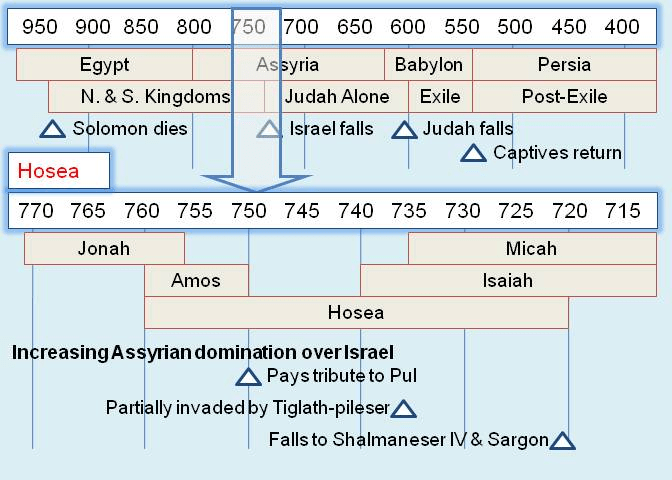
The prophet Hosea prophesied in the 8th century B.C.E., during the reign of Kings Jeroboam II and Hoseah.  King Jeroboam II (787-747 BCE) was the 13th king of Israel and King Hoseah (731-722 BCE) was the 19th and last king of Israel. Hosea had a very long prophetic ministry, probably from about 750 to 722 BCE.  He prophesied to the northern kingdom of Israel in the 30 years before they were carried into Assyrian captivity in 722 BC as punishment for idolatry. We don’t know how or where he died. Jereboam I (931-910 BC), the 1st king of Israel,

had began the idol worship by making the two golden calves at Dan and Bethel, but the worship of Baal and Asherah persisted throughout the history of the northern kingdom (from 931-722 BC). Especially King Ahab (874-853 BC), the 7th king of Israel, who built a temple for Baal in Samaria. His wicked wife Jezebel had 450 prophets of Baal and 400 prophets of Asherah who “ate at her table”. Elijah had the test at Mt Carmel and then they killed all those prophets of Baal and Aserah. Jehu (841-814 BC), the 10th king of Israel, was anointed king by Elijah for the purpose of killing all of Ahab’s descendants and killing Jezebel. He did just that, beheading 70 of Ahab’s sons and killing Ahab’s son, Ahaziah (853-852 BC), the 8th king of Israel, and all his relatives. He pretended to host a banquet for the followers of Baal, only to trap and kill them. He tracked Jezebel down and some men cast her down from an upper story as she put on her makeup. The dogs ate all of her except her hands, feet, and skull. The dogs licked her blood in the same place that Jezebel had Naboth killed to get his vineyard for Ahab. Unfortunately, Jehu eliminated Baal worship from Israel but he continue to worship the golden calves of Jereboam I.

Hosea 1:1The word of the Lord that came to Hosea, the son of Beeri, in the days of Uzziah, Jotham, Ahaz, and Hezekiah, kings of Judah, and in the days of Jeroboam the son of Joash, king of Israel.” That would be Jereboam II (793-753 BC), the 13th king of Israel (no kin to Ahab). From https://www.julianspriggs.co.uk/pages/KingsOfIsrael “Jeroboam restored the land to the same boundaries as in the days of David and Solomon (14:25). He also had control over Damascus, as ordained by God and spoken through the prophet Jonah (14:27). During Jeroboam’s reign, Assyria had a succession of weak leaders. The peace brought economic prosperity and trade with Phoenicia.Hosea and Amos condemned the north for abandoning God and oppressing the poor. Ivory was used to build mansions. Some administrative documents have been found. Great quantities of oil was bought at low price from the farmers (Amos 6:6). These economic as well as the moral iniquities caused the decline of Israel.” During the reign of Mehahem (752-742 BC), the 16th king of Israel, Tiglath-pileser III (called Pul – 15:17) became one of the strongest rulers of Assyria. 

During the reign of Pekah (740-732 BC), the 18th king of Israel, “Tiglath-pileser’s campaign of 734-732 took him to Philistia, which he subdued, then on to Israel by 733, destroying cities in Galilee and Naphtali. People were deported to Assyria, as was his custom. After Israel, the Assyrians continued up to Damascus, which they took in 732. Rezin was killed, thus ending the nation which was often used by God to judge Israel. Damascus became an Assyrian province (2 Kg 16:9-10). Pekah was spared by Tiglath-pileser.” Again, from https://www.julianspriggs.co.uk/pages/KingsOfIsrael During the reign of Hoshea (732-722 BC), the 19th and last king of Israel: “By this time, Israel had become a small vassal state paying regular tribute to Assyria, who had occupied the whole of Galilee and the Transjordan.Hoshea rebelled and made an alliance with So, the weak king of Egypt. When Assyria came to suppress the revolt, Hoshea tried to give them tribute again. It did not work and he was put in prison, the land was invaded and Samaria was besieged for three years (17:1-5). Unable to withstand, Samaria fell and its inhabitants were deported to Assyria and further east in the land of Media (17:6).”

All that history of the northern kingdom to tell you what things were like in Israel when Hosea prophesied. Israel’s doom of Assyrian captivity was sealed and we think Hosea lived to see it happen. But his book is not just more condemning of Israel. It is a stange love story. From AI: “In the Bible, Hosea’s marriage to Gomer, a woman described as a prostitute, served as a symbolic representation of God’s covenant with Israel, where God, like Hosea, remained faithful despite Israel’s repeated unfaithfulness and idolatry, illustrating God’s enduring love for his people even when they stray away from him; essentially, Hosea was commanded by God to marry Gomer, who then committed adultery, mirroring Israel’s betrayal of God through worshipping false idols.” Their 3 sons had names symbolizing the punishment about to come on Israel. Chapter 3 is a key chapter. Apparently Gomer left Hosea and her sons and went back into prostitution, ending up on the auction block. Hosea 3:1 And the Lord said to me, “Go again, love a woman who is loved by another man and is an adulteress, even as the Lord loves the children of Israel, though they turn to other gods and love cakes of raisins.” So I bought her for fifteen shekels of silver and a homer and a lethech of barley. And I said to her, “You must dwell as mine for many days. You shall not play the whore, or belong to another man; so will I also be to you.” For the children of Israel shall dwell many days without king or prince, without sacrifice or pillar, without ephod or household gods. Afterward the children of Israel shall return and seek the Lord their God, and David their king, and they shall come in fear to the Lord and to his goodness in the latter days.”

So, even though Hosea condemns Israel, he gives Messianic hope for at least some of them. We know this is a Messianic chapter b/c “David will be their king in the latter days”. Ezekiel 37 had made this same prophecy: 37:24 “My servant David shall be king over them, and they shall all have one shepherd.” So that is figurative language fulfilled in Jesus as the future Messianic king. Isaiah and Jeremiah both said that a “root (or descendant) of Jesse” would arise in the Messianic age (again that was fulfilled in Jesus). David being king and Israel being restored would happen in the “latter days”, or the last days of the Jewish Age (from 30 AD to 70 AD). The northern kingdom would be without a king for many years until the Messiah would come. Benson Commentary: “And this prediction was remarkably fulfilled upon the ten tribes, when made captives by Shalmaneser, (compare Hosea 9:4,) and upon the two remaining tribes, after the destruction of their temple and commonwealth by Nebuchadnezzar, and during their captivity in Babylon.” I think Benson is correct in saying that this prediction would include Judah after her exile in Babylon. The exiles cured Israel and Judah of her idolatrous practices. There is no more mention of idolatry in Judah from the time of her return from Babylon in 536 BC until Jesus came.
I find this prediction amazing. God still loved the northern kingdom of Israel in spite of her idolatry. They were carried into Assyrian captivity to become known as the “lost 10 tribes of Israel’. “Once exiled, the tribes gradually integrated with other populations, losing their distinct identity and cultural practices.  Due to the lack of historical records after their exile, the exact location of the “Lost Tribes” remains unknown, leading to various theories and speculation about their descendants.” From gotquestions.org “Many of the Jews who remained in the land intermarried with people from Cutha, Ava, Hamath, and Sepharvaim who had been sent by the Assyrian king to inhabit Samaria (2 Kings 17:24Ezra 4:2–11).” They became the “Samaritans” of the New Testament. There are many mysteries, legends, and traditions as to what happened to the ten “lost” tribes of Israel. One legend says that the ten tribes migrated to Europe (the Danube River, they say, got its name from the tribe of Dan). Another legend says the tribes migrated all the way to England and that all Anglo-Saxons today are actually Jews—this is a teaching of the heretical British Israelism (Herbert W. Armstrong who claimed that the United States is descended from the tribe of Manasseh, while England and the British Commonwealth are descended from the tribe of Ephraim). A surprising number of groups around the world claim to have descended from the “lost” tribes: there are people in India, Nigeria, Ethiopia, Pakistan, Afghanistan, and North America who all claim such ancestry. Other theories equate the Japanese or the American Indians with the ten “lost” tribes of Israel (taught by the Mormons). The truth is that the “lost tribes of Israel” were never really lost. Many of the Jews who remained in the land after the Assyrian conquest re-united with Judah in the south (2 Chronicles 34:6–9). Assyria was later conquered by Babylon, who went on to invade the Southern Kingdom of Israel, deporting the two remaining tribes: Judah and Benjamin (2 Kings 25:21). Remnants of the northern tribes would have thus been part of the Babylonian deportations. Seventy years later, when King Cyrus allowed the Israelites to return to Israel (Ezra 1), many (from all twelve tribes) returned to Israel to rebuild their homeland. In the Gospels, the prophetess Anna (Luke 2:36) was from the tribe of Asher (one of the ten supposedly lost tribes). Anna wasn’t lost at all. Both Zechariah and Elisabeth—and therefore John the Baptist—are from the tribe of Levi (Luke 1:5). Jesus promises the disciples that they will “sit on thrones, judging the twelve tribes of Israel” (Luke 22:30). Paul, who knows he is from the tribe of Benjamin (Romans 11:1), speaks of “the promise our twelve tribes are hoping to see fulfilled as they earnestly serve God day and night” (Acts 26:7)—note the present tense. James addresses his epistle “to the twelve tribes scattered among the nations” (James 1:1). In short, there is ample evidence in Scripture that all twelve tribes of Israel are still in existence and will be in the Messianic kingdom.”

Thus the 10 tribes dispersed and no longer existed as distinct tribes after the Assyrian captivity, but they still claim to know which tribe they descended from. The amazing thing is that God still had a remnant from among the 10 tribes who would become part of the Jewish remnant church of the book of Acts, which would have included Jewish Christians from all 12 tribes.

Worshipping other gods is spiritual adultery, or “whoredom (spiritual prostitution)”.

Hosea 4:12 “They ask a piece of wood for advice! They think a stick can tell them the future! Longing after idols has made them foolish. They have played the prostitute, serving other gods and deserting their God.”

Hosea 9:1 “O Israel, do not rejoice as other nations do. For you have been unfaithful to your God, hiring yourselves out like prostitutes, worshiping other gods on every threshing floor.”

Ezekiel 6:9 “Then when they are exiled among the nations, they will remember me. They will recognize how hurt I am by their unfaithful hearts and lustful eyes that long for their idols.” NOTICE THAT GOD IS HURT BY SPIRITUAL ADULTERY JUST AS A HUSBAND OR WIFE WOULD BE BY THE ADULTERY OF A MATE.

Ezekiel 16:32 “Yes, you are an adulterous wife who takes in strangers instead of her own husband.”

Jeremiah 3:1 “If a man divorces a woman and she goes and marries someone else, he will not take her back again, for that would surely corrupt the land. But you have prostituted yourself with many lovers, says the Lord. Yet I’m still calling you back to me.”

Isaiah 1:21 “See how Jerusalem, once so faithful, has become a prostitute. Once the home of justice and righteousness, she is now filled with murderers.”

Judges 2:17 “Yet Israel did not listen to the judges but prostituted themselves by worshiping other gods. How quickly they turned away from the path of their ancestors, who had obeyed the Lord’s commands.”

Leviticus 20:5“I myself will turn against them and cut them off from the community, because they have committed spiritual prostitution by worshiping Molech.”

God is a “jealous God”, just like a husband or wife would be jealous of an adulterous mate who gives their love to a stranger. Exodus 34:14 “You must worship no other gods, for the Lord, whose very name is Jealous, is a God who is jealous about his relationship with you.”

Jesus has a passionate love for us, his bride, but do we still have a passionate love for him? Zechariah 8:2 “This is what the Lord of Heaven’s Armies says: ‘My love for Mount Zion is passionate and strong; I am consumed with passion for Jerusalem!’” You became the bride of Christ when you became a Christian. Your loyalty and devotion to God must be pure like that of a loyal husband or wife. Paul said in 2 Corinthians 11:For I feel a divine jealousy for you, since I betrothed you to one husband, to present you as a pure virgin to Christ. But I am afraid that as the serpent deceived Eve by his cunning, your thoughts will be led astray from a sincere and pure devotion to Christ.”

Maybe you are thinking, “I’m glad I don’t worship idols like Israel did”. But read what James said: James 4:4 “You adulterers! Don’t you realize that friendship with the world makes you an enemy of God? I say it again: If you want to be a friend of the world, you make yourself an enemy of God.” James says that friendship with the world is spiritual adultery. The solution: James 4:Draw near to God, and he will draw near to you. Cleanse your hands, you sinners, and purify your hearts, you double-minded. Be wretched and mourn and weep. Let your laughter be turned to mourning and your joy to gloom. 10 Humble yourselves before the Lord, and he will exalt you.” Greed is idolatry. Ephesians 5:For you may be sure of this, that everyone who is sexually immoral or impure, or who is covetous (that is, an idolater), has no inheritance in the kingdom of Christ and God.”

We have a Hindu temple right here in Huntsville, Al, which is hard to believe in the Bible belt. I have taken my Bible classes there on several occasions to walk around the temple and see all the Hindu god and goddess idols around the walls. They still practice idolatry in that temple. But how many of us Christains practice idolatry when we give our devotion to our idols of materialism, sports, hobbies, and greed? The Ephesian church in Revelation 2 had “lost their first love”.

God, please help me to restore that passion I had when I first became a Christian, when I was in my honeymoon stage of my spiritual marriage to Jesus. Help me to destroy or give up all my idols, things that I put ahead of God and Jesus in my life.

But the comforting thing comes from the book of Hosea. In spite of all the many times that I have committed spiritual adultery, God and Jesus still have a passionate love for me and will forgive me. I may find myself at the bottom of the barrel spiritually, like Gomer when she ended up on the auction block, but God still loves me and will buy me back (which is the meaning of the word “redemption). I don’t deserve that love any more than an unfaithful husband deserves a loving wife who forgives him after he has had an affair.
FIGURATIVE FULFILLMENT OF MESSIANIC PROPHECIES

Malachi 4:5“Behold, I will send you Elijah the prophet before the great and awesome day of the Lord comes. And he will turn the hearts of fathers to their children and the hearts of children to their fathers, lest I come and strike the land with a decree of utter destruction.” The Jews expected Elijah to come in person, but Jesus said that John the Baptist was the fulfillment of Malachi’s prediction. Matthew 11:13 For all the Prophets and the Law prophesied until John, 14 and if you are willing to accept it, he is Elijah who is to come. 17:10 And the disciples asked him, “Then why do the scribes say that first Elijah must come?” 11 He answered, “Elijah does come, and he will restore all things. 12 But I tell you that Elijah has already come, and they did not recognize him, but did to him whatever they pleased. So also the Son of Man will certainly suffer at their hands.” 13 Then the disciples understood that he was speaking to them of John the Baptist.”

This is a great example of Old Testament prophecies being fulfilled in a figurative or spiritual way instead of a literal way. John the Baptist would have the same type of ministry as Elijah did, i.e. of trying to get the Jews to repent before judgment fell on them. For Elijah, that judgement on the northern kingdom would be the Assyrian captivity. For John, that judgement would be the Romans killing one million Jews when they destroyed the temple and Jerusalem in 70 AD. Many OT Messianic prophecies were fulfilled figuratively in the new Messianic kingdom of Jesus in the NT. The prophets Jeremiah and Ezekiel predicted that David would be the prince, shepherd, and king of the Messianic kingdom (Ezekiel 34:23,24; Jeremiah 30:9), but most agree that figuratively refers to Jesus as our king, Prince of Peace, and Good Shepherd. Jesus predicted that the kingdom to be established in the days of the 4th empire of Nebuchadnezzar’s statue (Daniel 4) was “at hand”. He even said that some of those he was talking to would be alive to see Him coming (2nd coming) in his kingdom. Matthew 16: 27 `For, the Son of Man is about to come (mello which always means “about to) in the NT) in the glory of his Father, with his messengers, and then he will reward each, according to his work. 28 Verily I say to you, there are certain of those standing here who shall not taste of death till they may see the Son of Man coming in his reign.’ Was Jesus a false prophet or mistaken in this prediction of an imminent establishment of the kingdom of Daniel 2? Of course not. That prediction was fulfilled figuratively in a spiritual kingdom, the church. Paul said that the Colossians were in that kingdom. Colossians 1:13 For He rescued us from the domain of darkness, and transferred us to the kingdom of His beloved Son, 14 in whom we have redemption, the forgiveness of sins. Revelation 1:To Him who loves us and released us from our sins by His blood— and He made us into a kingdom, priests to His God and Father—to Him be the glory and the dominion forever and ever. Amen.”

Another example: Jeremiah 33:14 ‘Behold, days are coming,’ declares the Lord, ‘when I will fulfill the good word which I have spoken concerning the house of Israel and the house of Judah. 15 In those days and at that time I will make a righteous Branch of David sprout; and He shall execute justice and righteousness on the earth. 16 In those days Judah will be saved and Jerusalem will live in safety; and this is the name by which it will be called: the Lord is our righteousness.’ 17 For this is what the Lord says: ‘David shall not lack a man to sit on the throne of the house of Israel; 18 and the Levitical priests shall not lack a man before Me to offer burnt offerings, to burn grain offerings, and to prepare sacrifices continually.’” The Branch of David always is a prediction of Jesus in the OT, so this is a prediction for the Messianic Age to come. “David not lacking a man to sit on his throne” is a prediction based on God’s promise to David in 2 Samuel 7:12-13. That is fulfilled by Jesus siting on the throne of David figuratively, forever.

But what about vs 18? If this was to be fulfilled literally, then in the Messianic Age, which is the church age now, will the Levitical priesthood with Aaron’s descendants being the high priests be restored, and will animal burnt offerings be resumed? I like these comments: Ellicott’s Commentary for English Readers(18) Neither shall the priests the Levites want a man . . .—Here again we have a promise which received a fulfilment other than that which the words appeared to imply, and which doubtless was in the prophet’s thoughts. The Levitical priesthood passed away (Hebrews 7:11), but Christ was made a Priest after the order of Melchizedek; and by virtue of their union with Him, His people became a holy priesthood (Hebrews 10:19-22), offering, not the burnt-offerings and meat-offerings which were figures of the true, but the spiritual sacrifices of praise and thanksgiving (1Peter 2:5; Hebrews 13:15,16), the sacrifice of body, soul, and spirit, which alone was acceptable to God (Romans 12:1).” The burnt offerings would be the offering of Jesus’ body for our sins on the cross once for all time. This prophecy could include the spiritual sacrifices that we offer as a spiritual priesthood.

But what about the predictions that Israel would be restored and live in the holy land again? Jeremiah 30:“This is what the Lord, the God of Israel says: ‘Write all the words which I have spoken to you in a book. For behold, days are coming,’ declares the Lord, ‘when I will restore the fortunes of My people Israel and Judah.’ The Lord says, ‘I will also bring them back to the land that I gave to their forefathers, and they shall take possession of it.’” 33: And I will restore the fortunes of Judah and the fortunes of Israel, and will rebuild them as they were at first.” Ezekiel 36:26 Moreover, I will give you a new heart and put a new spirit within you; and I will remove the heart of stone from your flesh and give you a heart of flesh. 27 And I will put My Spirit within you and bring it about that you walk in My statutes, and are careful and follow My ordinances. 28 And you will live in the land that I gave to your forefathers; so you will be My people, and I will be your God.” Was the restoration of Israel to the promised land to be fulfilled literally, or is that another prophecy to be (and has been) fulfilled figuratively in the church? A key to interpret this correctly is vs 27: “I will put My Spirit within you”. That was fulfilled during the last days of the Jewish Age (AD 30-AD 70) as Jesus poured out the Spirit on believers in the church (Joel 2:28-32; Acts 2:17-22), so we expect the land prediction to be fulfilled at the same time. Also, who is to be filled with the Spirit? Is it the nation of Israel even though most of them rejected Jesus as the Messiah? Of course not. It refers to spiritual Israel, i.e. the remnant of the Jewish nation who would accept Jesus as the Messiah and become the first church. The first Jewish remnant church in the book of Acts did not receive the physical holy land as a fulfillment of Ezekiel’s prediction. This prophecy was, like all the others, fulfilled literally. Jesus said the “meek would inherit the earth”. Any kingdom must have land. The spiritual kingdom, the church, has spiritual land. That spiritual land is the “new heavens and new earth that Isaiah predicted in Isaiah 65:“For behold, I create new heavens and a new earth; And the former things will not be remembered or come to mind. 18 But be glad and rejoice forever in what I create; For behold, I create Jerusalem for rejoicing.” The new heavens and earth is the spiritual realm of the kingdom of Jesus over which he rules in the church. It does not refer to the nation of Israel receiving the holy land in 1948 as many claim. It is fulfilled spiritually. It refers to a restoration of the fortunes of only the remnant of Jews who accepted Jesus. It refers to spiritual, not physical land. The “new Jerusalem” of Isaiah 65:18 is a prediction of the church which is the new heavenly spiritual Jerusalem. Hebrews 12:22 But you have come to Mount Zion and to the city of the living God, the heavenly Jerusalem, and to myriads of angels, 23 to the general assembly and church of the firstborn who are enrolled in heaven.”

Likewise, 2 Peter 3 is not referring to something in the future where the heavens and earth are destroyed to prepare the way for the earth to be restored to the Garden of Eden state. It is predicted the imminent destruction of the old heavens and earth, i.e. the Jewish system and replacing it with the spiritual new heavens and earth which is the Messianic system.

Revelation predicted things that would happen shortly. Revelation 1:1The Revelation of Jesus Christ, which God gave Him to show to His bond-servants, the things which must soon take place; and He sent and communicated it by His angel to His bond-servant John, who testified to the word of God and to the testimony of Jesus Christ, everything that he saw. Blessed is the one who reads, and those who hear the words of the prophecy and keep the things which are written in it; for the time is near.” 22:And he said to me, “These words are faithful and true”; and the Lord, the God of the spirits of the prophets, sent His angel to show His bond-servants the things which must soon take place. 10 And he *said to me, “Do not seal up the words of the prophecy of this book, for the time is near.” The time restraints of “soon” and “near” must mean soon in he lifetime of those John is writing to. The warning is that they must repent and keep the commands written in the book b/c the time was near and soon in their time frame, not God’s. Sure, a day is as a 1000 years and 1000 years as a day to God, but that is not the context when God is warning people to repent b/c of imminent judgement on them in their lifetime.

Revelation 21:1-4 must be interpreted in light of those time restraints. 21: 1 Then I saw a new heaven and a new earth; for the first heaven and the first earth passed away, and there is no longer any sea. And I saw the holy city, new Jerusalem, coming down out of heaven from God, prepared as a bride adorned for her husband. And I heard a loud voice from the throne, saying, “Behold, the tabernacle of God is among the people, and He will dwell among them, and they shall be His people, and God Himself will be among them, and He will wipe away every tear from their eyes; and there will no longer be any death; there will no longer be any mourning, or crying, or pain; the first things have passed away.”

The book of Revelation was written during the reign of the 6th emperor of Rome, i.e. Nero. Revelation 17:10 and they are seven kings; five have fallen, one is, the other has not yet come; and when he comes, he must remain a little while.” Beginning with Julius as the first king of Rome (Josephus affirms that and he lived in the first century so he should know who was considered to have been the first king of Rome), Nero would be the 6th, the “one is”. He died in 68 AD so the book had to be written before 68 AD. The book’s main prediction is the destruction of Jerusalem and the temple by the Romans in 70 AD. In chapter 17, the harlot Jerusalem is destroyed by the sea beast Rome. 17:16 And the ten horns which you saw, and the beast, these will hate the prostitute and will make her desolate and naked, and will eat her flesh and will burn her up with fire. 17 For God has put it in their hearts to execute His purpose by having a common purpose, and by giving their kingdom to the beast, until the words of God will be fulfilled. 18 The woman whom you saw is the great city, which reigns over the kings of the earth.” Chapter 11 identifies who the “great city” (which is the same as the harlot) as Jerusalem, the place where the Lord was crucified. 11:And their dead bodies will lie on the street of the great city which spiritually is called Sodom and Egypt, where also their Lord was crucified.”

So 21:1-4 had to be fulfilled soon after the time of writing (and it was written before 68 AD). It was fulfilled spiritually in a spiritual new heavens and earth (the new spiritual realm of the Messianic kingdom) and a spiritual new Jerusalem, the church. These came down to earth soon after the time of writing and could only refer to spiritual things. It also calls this new Jerusalem the bride of Christ which we know refers to the church. 21:Then one of the seven angels who had the seven bowls, full of the seven last plagues, came and spoke with me, saying, “Come here, I will show you the bride, the wife of the Lamb. 10 And he carried me away in the Spirit to a great and high mountain, and showed me the holy city, Jerusalem, coming down out of heaven from God.”

This figurative spiritual fulfillment of Messianic predictions is the reason Paul could say in Romans 9 that God had kept his promises to Israel. 9:But it is not as though the word of God has failed.” The Israel that would receive the Messianic promises would only be the remnant Jews who accepted Jesus as the Messiah. 9:27 Isaiah cries out concerning Israel, “Though the number of the sons of Israel may be like the sand of the sea, only the remnant will be saved.” 11:In the same way then, there has also come to be at the present time a remnant according to God’s gracious choice.” Those Messianic promises were received figuratively spiritually by the remnant. The rest of the Jews who rejected Jesus as the Messiah would be judged in 70 AD.

It is so misleading to hear many saying that the OT Messianic prophecies are being fulled literally over in Israel, especially beginning in 1948 when Israel was officially given statehood by the UN. Please study the nature of fulfillment of those prophecies to see that they were never meant to be fulfilled literally in the Messianic Age. Paul said that God kept his promises to Israel (the remnant) but many are basically saying that he has not kept those promises yet (they are expecting a literal fulfillment).

I know this is a controversial topic, but I hope this article helps.  

AT LEAST KING JOSIAH TRIED!

King Josiah was the 16th king of the southern kingdom of Judah from 640-609 BC.

Josiah’s grandfather was perhaps the most evil of the 19 kings of Judah. His 55 year reign was mostly marked by terrible evil.

The Assyrians carried Manasseh to Babylon in hooks, bound with bronze fetters. In his suffering there, he humbled himself and repented of his evil way. We don’t know how, but God brought him back to Jerusalem. He then removed the idols, foreign gods, altars for sacrificing to those gods, etc. 2 Chronicles 33:18-19 mentions his prayer. There is a book in the Apocrypha called “The Prayer of Manasseh”, a short prayer that he supposedly prayed. We are not sure of the authenticity of that book, but 2 Chronicles 33:19 says that his prayer was recorded in the records of Hozai, so it is possible that “The Prayer of Manasseh” is really his prayer passed down throught Jewish history. As evil was Manasseh was, God forgave him and he died in a right relationship with God. God is such a merciful, forgiving God.

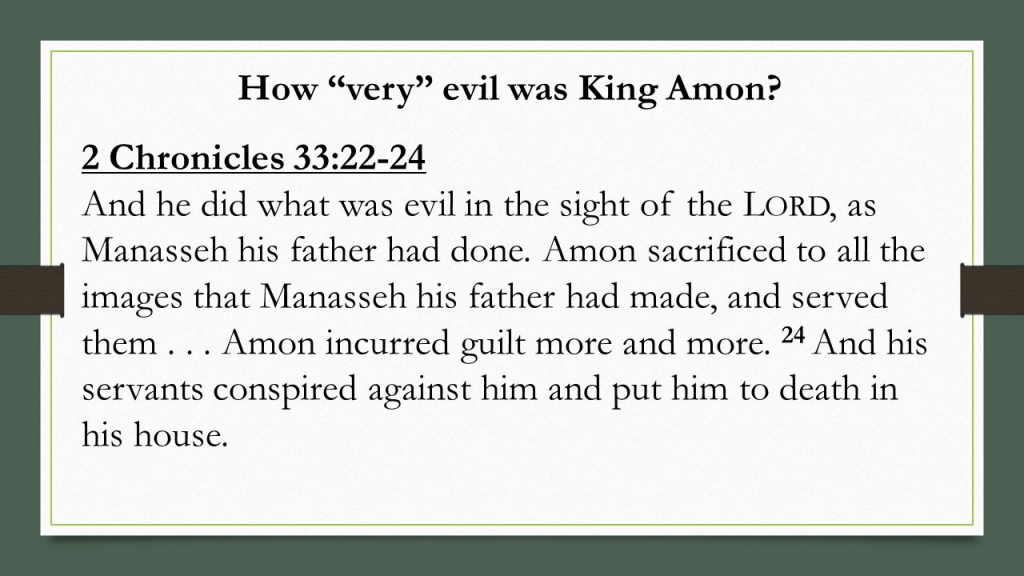
His father was the evil king Amon, the son of Manasseh. Amon began to reign when he was 22 and reigned for only 2 years. Most of his teen and young adult life would have been watching his father Manasseh do evil things. He would have also sseen Manasseh’s repentance and reforms, but that did not make an impact on Amon. How evil was Amon?

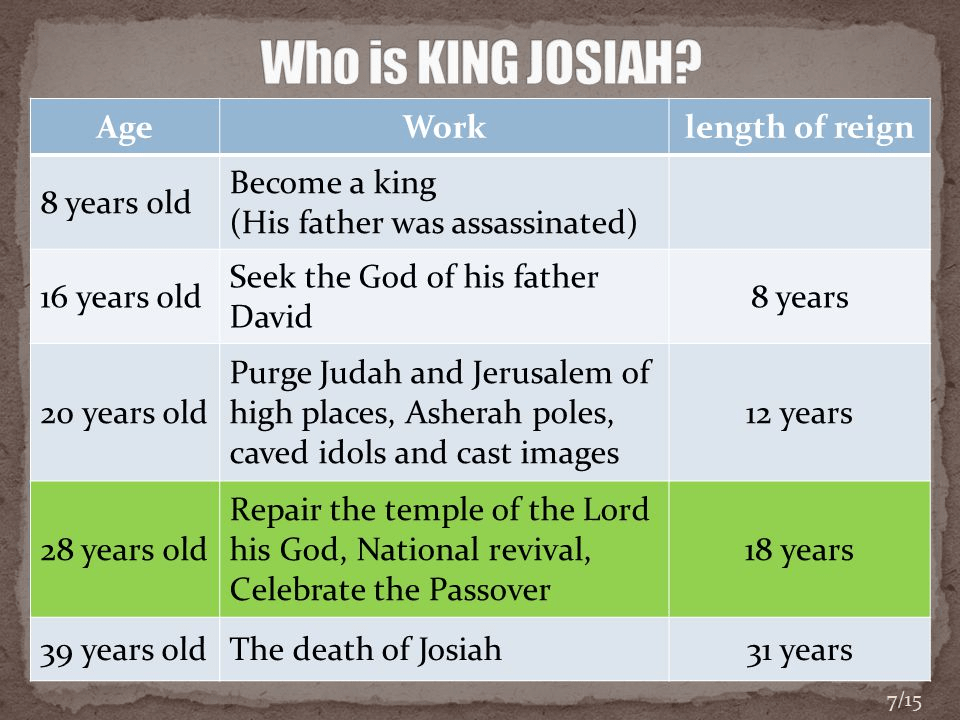
Josiah began to reign when he was 8 years old. Amon his father reigned for 2 years. That means that Josiah was 6 years old when his grandfather Manasseh died and 8 years old when his father Amon died. . His memories of his evil father Amon would not have been good as a 6 and 7 year old child. Fortunately his memories of his grandfather might have been mostly good as a 4 and 5 year old child since Manasseh would have been doing his reforms during those years of Josiah’s childhood.

Here is a great image detailing the age of Josiah when he began to reign at age 8 and did reforms. (Actually it should be 26 years old, the 18th year of his reign, when he repaired the temple.

During the repair of the temple when he was 26 that Hilkiah the priest found the “book of the Law” (i.e. the Pentateuch) and brought it to Josiah (2 Chronicles 34:14-21). The king tore his clothes and he himself read the book of the Law to all the elders, priests, Levites and people of Judah. He told Hlkiah to ask the prophetess Huldah what his (i.e. Josiah’s) fate would be in light of the curses that he read from the book of Deuteronomy, no doubt, as consequences for all the evil that Manasseh and Amon had done in Judah ( 2 Chronicles 34:22-30). Huldah told him that he would be spared seeing the punishment that God was going to inflict on Judah, but that the evil was so wide spread that Josiah’s reforms were “too little, too late” to save Judah from being carried off into Babylonian captivity. There were 3 deportations to Babylon that began almost immediately after Josiah died during the reign of the last 4 evil kings of Judah, and in 586 BC King Nebuchadnezzar of Babylon destroyed Jerusalem and the temple and took the last group of captives to Babylon, beginning the 70 years of exile in Babylon.

So why this lesson on King Josiah at this particular time? It is b/c of my concern for America. I know there is a lot of talk about “make Ameria great again”. You can buy a MAGA hat for $50. I do hope that we can balance the budget, trim the deficit, cut government spending, secure the border, reduce inflation, etc. But will America truly repent of the greed and sexual immorality that permeates our country? Will the churches who promote LGBQT go back and read the Bible condemnation of homosexuality and repent? Will our leaders truly turn to God for guidance on how to lead this country? America has typically bounced back from ungodly stretches of its history with “grass roots revivals” like the 1st and 2nd Great Awakenings, and the Jeremy Lanphier prayer revival (that spread across many cities with thousands praying every day at noon)? But those revivals were based on people believing that the Bible was the word of God. If the Bible said drunkenness was a sin, then to repent means to quit getting drunk. But today about 70% of Americans believe that same sex relationships are morally acceptable. If someone does that believe that homosexuality is a sin, then they won’t repent of that. Therefore a grass roots revival will be nearly impossible unless we do what Josiah did. We need to rediscover the Bible, open and study it, and let the Bible tell us what sin is, and then repent if we are guilty of sin. What will be the fate of America if we do not repent and restore the Judeo-Christian values that this country was built on? Only God knows the answer to that, but I am praying for a revival. American Christians have so many resources that can and are being used to drill wells overseas and print Bibles to spread the gospel. I don’t want to see that end.

In the mean time, we need to pray daily and earnestly for our country and our leaders. 1 Timothy 1:1 First of all, then, I urge that requests, prayers, intercession, and thanksgiving be made in behalf of all people, for kings and all who are in authority, so that we may lead a tranquil and quiet life in all godliness and dignity. This is good and acceptable in the sight of God our Savior, who wants all people to be saved and to come to the knowledge of the truth.”

THE INAUGURATION OF JESUS AS KING OF KINGS

Most of us are watching the inauguration ceremony of Donad Trump as I write this article. I am amazed at the bureaucracy of the federal govenment, but also anxious to see what reforms Trump will initiate very soon once he is inaugurated. I am anxious to see if anyone will actually curb government spending and try to balance the budget (fat chance!). Boos and cheers at the ceremony as different ones walk in: sounds more like a sporting event. Oh well, enough of that. First time in 47years that it is indoors (due to the cold). I hope that it not a bad omen! All smiles as the most recent presidents are announced. A stirring rendition of “Glory, glory hallelujah, His truth is marching on”. I pray that God’s truth in morals will truly march on. Will we truly have one of those “grass roots revivals” that America experienced like the 1st and 2nd Great Awakenings and the Lampier Prayer revival? That remains to be scene. The smiles have rescended among some as Trump takes shots at the past administration. Very interesting that he claimed that he was saved by God from the assassination attempt on his life so that he can make America great again. Several standing ovations and applause. He just declared that the government would recognize two genders, male and female. Closing with a moving prayer by Pastor Sewell, quite appropriate on MLK day, reminiscent of a MLK speech.

I want to focus on a far more important inauguration, i.e. the inauguration of the king of kings, Jesus Christ. I read several articles that suggested different moments in the life of Jesus in which he was inaugurated. Was it at His baptism, Last Supper, or maybe His ascension?

We need to look at a couple of key passages in discussing this.

Daniel 7:13 “I saw in the night visions,and behold, with the clouds of heaven there came one like a son of man, and he came to the Ancient of Days and was presented before him. 14 And to him was given dominion and glory and a kingdom, that all peoples, nations, and languages should serve him;
his dominion is an everlasting dominion, which shall not pass away, and his kingdom one that shall not be destroyed.”

Most say this refers to the ascension of Jesus into heaven, but there’s a passage in Luke that needs to be considered.

Luke 19:11 As they heard these things, he proceeded to tell a parable, because he was near to Jerusalem, and because they supposed that the kingdom of God was to appear immediately. 12 He said therefore, “A nobleman went into a far country to receive for himself a kingdom and then return. 13 Calling ten of his servants, he gave them ten minas, and said to them, ‘Engage in business until I come.’ 14 But his citizens hated him and sent a delegation after him, saying, ‘We do not want this man to reign over us.’ 15 When he returned, having received the kingdom, he ordered these servants to whom he had given the money to be called to him, that he might know what they had gained by doing business. 16 The first came before him, saying, ‘Lord, your mina has made ten minas more.’ 17 And he said to him, ‘Well done, good servant! Because you have been faithful in a very little, you shall have authority over ten cities.’ 18 And the second came, saying, ‘Lord, your mina has made five minas.’ 19 And he said to him, ‘And you are to be over five cities.’ 20 Then another came, saying, ‘Lord, here is your mina, which I kept laid away in a handkerchief; 21 for I was afraid of you, because you are a severe man. You take what you did not deposit, and reap what you did not sow.’ 22 He said to him, ‘I will condemn you with your own words, you wicked servant! You knew that I was a severe man, taking what I did not deposit and reaping what I did not sow? 23 Why then did you not put my money in the bank, and at my coming I might have collected it with interest?’ 24 And he said to those who stood by, ‘Take the mina from him, and give it to the one who has the ten minas.’ 25 And they said to him, ‘Lord, he has ten minas!’ 26 ‘I tell you that to everyone who has, more will be given, but from the one who has not, even what he has will be taken away. 27 But as for these enemies of mine, who did not want me to reign over them, bring them here and slaughter them before me.’”

Several things to notice in this parable. Some supposed that “the kingdom was going to appear immediately”. The kingdom referred to in the kingdom promised in Daniel 2:44-45 that would be established in the days of the 4th kingdom of Nebuchadnezzar’s statue, i.e. the Roman Empire. Both Jesus and John the Baptist had said “the kingdom is at hand”. The phrase “at hand” means “at hand” in the time frame of those Jesus is speaking to. Jesus made that even clearer in Mt 16:27  “For, the Son of Man is about to come ( mello, which. always means “about to be or about to happen” in the NT) in the glory of his Father, with his messengers, and then he will reward each, according to his work. 28 Verily I say to you, there are certain of those standing here who shall not taste of death till they may see the Son of Man coming in his reign.” (YLT) Not only does Jesus say that the judgement and 2nd coming was “about to” happen, but He also says that some of those he was speaking to would still be alive to see Him coming (His 2nd coming) in his kingdom. That kingdom that was “at hand” would indeed be established in the first century, but it was not a physical kingdom like that of the Jewish kingdom in the OT. It was a spiritual kingdom, the church. Jesus had said, John 18:36 Jesus answered, “My kingdom is not of this world; if my kingdom were of this world, my officers had struggled that I might not be delivered up to Jews; but now my kingdom is not from hence.” (YLT) Jesus had said to Peter in Matthew 16:18 And I also say to you that you are Peter, and upon this rock I will build My church; and the gates of Hades will not overpower it. 19 I will give you the keys of the kingdom of heaven.” Peter used the keys to open the door to enter that kingdom when he preached the first “gospel sermon” in Acts 2 and 3,000 were baptized for the remission of sins, becoming the first church, which is the spiritual body of Jesus of which he is the head. The kingdom of Jesus on earth in the NT was the church. Paul said, Colossians 1:13 For He rescued us from the domain of darkness, and transferred us to the kingdom of His beloved Son, 14 in whom we have redemption, the forgiveness of sins.” The Colossian Christians were in that kingdom.

So that kingdom of Daniel 2:44,45 was to be established within the lifetime of those Jesus spoke to, but in Luke 19 some supposed it was to appear immediately (i.e. immediately after Jesus’ lifetime which ended in about 30 AD). The establishment of that kingdom, the church, would indeed begin soon in Acts 2, but would involve a transition period of 40 years, from 30 AD to 70 AD. The parable says that “the nobleman would go into a far country to receive a kingdom and then return”. It says that “having received the kingdom” (in the far country) that he would “return” (the 2nd coming) to “reign”. That tells us Jesus did not officially receive his reign over his kingdom until his 2nd coming (his “return” from the farcountry).

Doesn’t that sound just like our inauguration process? We elected a president back in November. There was a transition period until Jan 20 till the official inauguration. The president elect did not take over the powers of the president until Jan 20. Jesus ascended into heaven to receive his kingdom, so technically he became king at this ascension. But he would not officially begin to reign fully until 70 AD, just as in the parable of Luke 19. Jesus’ official inauguration as King of Kings began in 70 AD and continues today since his kingdom is an everlasting kingdom.

I close with Revelation 11: 15 Then the seventh angel sounded; and there were loud voices in heaven, saying, “The kingdom of the world has become the kingdom of our Lord and of His Christ; and He will reign forever and ever.” 16 And the twenty-four elders, who sit on their thrones before God, fell on their faces and worshiped God, 17 saying, “We give You thanks, Lord God, the Almighty, the One who is and who was, because You have taken Your great power and have begun to reign.” This would be fulfilled after the events of the imminent destruction of Jerusalem in 70 AD. God and His Christ would begin to reign in the everlasting church kingdom from then on and He is reigning today over His spiritual kingdom, the church, which is above all the kingdoms of the world.

Gabriel told Mary, Luke 1:32 He (her baby Jesus)will be great and will be called the Son of the Most High; and the Lord God will give Him the throne of His father David; 33 and He will reign over the house of Jacob forever, and His kingdom will have no end.” Isaiah had predicted, Isaiah 9:For a Child will be born to us, a Son will be given to us; And the government will rest on His shoulders; And His name will be called Wonderful Counselor, Mighty God, Eternal Father, Prince of Peace. There will be no end to the increase of His government or of peace On the throne of David and over his kingdom, To establish it and to uphold it with justice and righteousness From then on and forevermore. The zeal of the Lord of armies will accomplish this.”

Peter preached Acts 2:29 “Brothers, I may confidently say to you regarding the patriarch David that he both died and was buried, and his tomb is with us to this day. 30 So because he was a prophet and knew that God had sworn to him with an oath to seat one of his descendants on his throne, 31 he looked ahead and spoke of the resurrection of the Christ, that He was neither abandoned to Hades, nor did His flesh suffer decay. 32 It is this Jesus whom God raised up, a fact to which we are all witnesses. 33 Therefore, since He has been exalted at the right hand of God, and has received the promise of the Holy Spirit from the Father, He has poured out this which you both see and hear. 34 For it was not David who ascended into heaven, but he himself says: ‘The Lord said to my Lord, “Sit at My right hand, 35 Until I make Your enemies a footstool for Your feet.”’ Peter is saying that Jesus was raised and exalted at the right hand of God and had begun sitting on the throne of David. Not the physical throne of David as in the OT, but sitting on a spiritual throne of David (figurative fulfillement of 2 Samuel 7). He has been sitting on that throne since Acts 2 in 30 AD.

Zechariah adds another promise, Zechariah 6:13 Yes, it is He who will build the temple of the Lord, and He who will bear the majesty and sit and rule on His throne. So He will be a priest on His throne, and the counsel of peace will be between the two offices.”’ Jesus will be king and priest at the same time. That would nto be possible under the Law since Jesus was of the tribe of Judah but the high priest could only come from the tribe of Levi. I think all Christians agree that Jesus is our high priest today. That must be in heaven since the Hebrew writer said, Hebrews 8:Now if He were on earth, He would not be a priest at all, since there are those who offer the gifts according to the Law”. A little deductive reasoning here: 1) Jesus is our high priest in heaven now, and He could not be high priest on earth. 2) He is our king at the same time that he is our high priest. 3) Therefore, he must be king in heaven and not of earth.

His kingdom must be a kingdom that was established in the first century. That could only be the spiritual kingdom, the church. This debunks all the theories that Jesus will return some day to establish a physical kingdom on earth and reign a thousand years in that kingdom. Most say that Jesus did plan to establish a physical kingdom in the first century, but that he delayed that b/c of his rejection by the Jews. Hebrews debunks the notion of a delayed kingdom (and 2nd coming): Hebrews 10:For yet in a very little while,
He who is coming will come, and will not delay. That was written in about 62 AD and predicts that Jesus would come in a “very little while” (the 2nd coming) and would not delay. That fits his 2nd coming in 70 AD.

Even if you don’t agree with some of this article, we can all agree that Jesus is the King of Kings, Lord of Lords. We can agree that the church is an important part of his kingdom, even if not all agree on the establishment of some future kingdom. Let us offer praise to the King of Kings.

One of my favorite songs is King of Kings by Hillsong. https://www.youtube.com/watch?v=dQl4izxPeNU

Listen to that song as you read the lyrics:

In the darkness we were waiting
Without hope, without light
‘Til from Heaven You came running
There was mercy in Your eyes
To fulfill the law and prophets
To a virgin came the word
From a throne of endless glory
To a cradle in the dirt

Praise the Father, praise the Son
Praise the Spirit, three in one
God of glory, Majesty
Praise forever to the King of Kings

To reveal the kingdom coming
And to reconcile the lost
To redeem the whole creation
You did not despise the cross
For even in your suffering
You saw to the other side
Knowing this was our salvation
Jesus for our sake you died

Praise the Father, praise the Son
Praise the Spirit, three in one
God of glory, Majesty
Praise forever to the King of Kings

And the morning that You rose
All of Heaven held its breath
‘Til that stone was moved for good
For the Lamb had conquered death
And the dead rose from their tombs
And the angels stood in awe
For the souls of all who’d come
To the Father are restored

And the church of Christ was born
Then the Spirit lit the flame
Now this gospel truth of old
Shall not kneel, shall not faint
By His blood and in His name
In His freedom I am free
For the love of Jesus Christ
Who has resurrected me

Praise the Father, praise the Son
Praise the Spirit, three in one
God of glory, Majesty
Praise forever to the King of Kings

Praise forever to the King of Kings

Amen and Amen!

WE SAW THEE NOT

I google youtube.com and get multiple videos on sports, politics, even the Bible and Christian songs. This morning the song “We saw thee not” popped up and I listened to it. You might want to listen to a youtube acapella version of the song. https://www.youtube.com/watch?v=d25PYT8v71I

1 We saw Thee not when Thou didst come
To this poor world of sin and death;
Nor yet beheld Thy cottage home,
In that despised Nazareth;

Refrain:
But we believe Thy footsteps trod
Its streets and plains, Thou Son of God:
But we believe Thy footsteps trod
Its streets and plains, Thou Son of God.

2 We saw Thee not when lifted high
Amid that wild and savage crew;
Nor heard we that imploring cry,
“Forgive, they know not what they do!”

Refrain:
But we believe the deed was done,
That shook the earth and veiled the sun;
But we believe the deed was done,
That shook the earth and veiled the sun;

3 We gazed not in the open tomb,
Where once Thy mangled body lay;
Nor saw Thee in that “upper room,”
Nor met Thee on the open way;

Refrain:
But we believe that angels said,
“Why seek the living with the dead?”
But we believe that angels said,
“Why seek the living with the dead?”

4 We walked not with the chosen few,
Who saw Thee from the earth ascend;
Who raised to heav’n their wond’ring view,
Then low to earth all prostrate bend;

Refrain:
But we believe that human eyes
Beheld that journey to the skies;
But we believe that human eyes
Beheld that journey to the skies.

Anne Richter wrote the hymn “We Saw Thee Not”. John Hampden Gurney modified the hymn and published it in Psalms and Hymns for Public Worship in 1851. The tune (Shaw) was composed by Knowles Shaw (1834-1878; see #75).  It first appeared around 1877 in one of his Sunday school song collections and became popular after being included in James H. Fillmore’s The New Christian Hymn and Tune Book, Part III, in 1887. There was a 5th stanza added: Stanza 5 (not used by Shaw) says that we do not see Him now, yet we believe His word “And now that Thou dost reign on high, And thence Thy waiting people bless, No ray of glory from the sky Doth shine upon our wilderness. But we believe Thy faithful word, And trust in our redeeming Lord” (repeat).

What a great song! The life, crucifixion, resurrection, and ascension of Jesus. Do you remember what Jesus said to doubting Thomas? John 20:27 Then he said to Thomas, “Put your finger here, and see my hands; and put out your hand, and place it in my side. Do not disbelieve, but believe.” 28 Thomas answered him, “My Lord and my God!” 29 Jesus said to him, “Have you believed because you have seen me? Blessed are those who have not seen and yet have believed.” Thomas was able to put his fingers in the holes in Jesus’ hands and side. It took that for Thomas to believe. That is a great proof for the resurrection of Jesus. The resurrection was not just believed by a group of people who were expecting a resurrection. It was believed by the apostles who did not expect Jesus to die, certainly not die and be raised. But it was also believed by Thomas who did not even show up when Jesus first appeared to the 10 apostles on the night of the day he was raised (John 20:19-25). John 20:24 Now Thomas, one of the twelve, called the Twin, was not with them when Jesus came. 25 So the other disciples told him, “We have seen the Lord.” But he said to them, “Unless I see in his hands the mark of the nails, and place my finger into the mark of the nails, and place my hand into his side, I will never believe.” So he still didn’t believe even though the 10 told him they had seen the resurrected Jesus. He needed more proof. So this adds to the proof that the resurrection of Jesus really happened.

The same argument could be made of James, the Lord’s brother, who did not believe in Jesus when he was alive but became a believer after seeing Jesus raised. We don’t know when the resurrected Jesus appeared to James, but 1 Corinthians 15:Then he appeared to James, then to all the apostles.” The same argument could be made of Saul who was killing Christians until the resurrected Jesus appeared to him on the road to Damascus (Acts 9). Nothing could have converted Saul (Paul) other than actually seeing the resurrected Jesus. He had everything in Judaism but gave it all up after seeing Jesus and spent the rest of his life witnessing the resurrection and suffering for Jesus, eventually being beheaded by Nero in 67 AD. So the resurrected Jesus was seen and believed by his skeptics.

But Jesus said to Thomas, “Have you believed because you have seen me? Blessed are those who have not seen and yet have believed.” That would be anyone who believed or believes in Jesus even though they did not actually see the resurrected Jesus. That would be us. That’s not saying that we are more blessed than those who actually saw the resurrected Jesus. It is just saying that we can be blessed with faith even though we did not see the resurrected Jesus.

An interesting question: Would you rather have lived back then and have been able to actually see the resurrected Jesus, or live today when you have to rely on the written testimony of those who did see the resurrected Jesus? It would be nice if Jesus would appear to any skeptic today and allow them to put their fingers in the holes, but he doesn’t. Why doesn’t he? A little speculation here. Satan told Jesus, “If you are the Son of God, throw yourself down (from the pinnacle of the temple) and the angels will catch you”. Jesus replied, “You shall not put the Lord your God to the test”.

We use the law of gravity and the acceleration due to gravity (9.8 m/s^2) in many equations and applications in physics. What if, every time we use that, someone says “would you prove to me that the acceleration of gravity is 9.8 m/s^2 ? That would be proving something that is a solid, irrefutable,proven law of physics. The same with the resurrection of Jesus. God gave us sufficient proof that Jesus was raised from the dead. We have the credible witness of the apostles. We have many post resurrection appearances of Jesus (1 Corinthians 15), even to 500 (many of whom Paul said were still alive when he wrote that so that skeptics could actually talk to some of them if they so wished). Luke told Theophilus that Jesus was raised from the dead and that he had confirmed that by talking to “eyewitnesses” (Luke 1:1-4). We have skeptics like Thomas, James, and Paul who were very reluctant to believe in Jesus until they actually saw the resurrected Jesus. We have the resurrection of Jesus being preached in the same city in which it allegedly occurred (Jerusalem) just 50 days after the resurrection, and yet no one said “you can’t prove that”. Imagine if I claimed that someone was riased from the dead in Maple Hll Cemetary 50 days ago right here in Huntsville, Al. That would be so easy to disprove if it did not actually happen. But thousands in Jerusalem became believers. Not all did, but there was sufficient evidence to convince thousands right there in Jerusalem where the resurrection happened. I doubt there would be one single believer of my claim that someone was raised 50 days ago in Maple Hill.

Could Jesus have appeared to even more after his resurrection? Sure. Would that have made the proof of his resurrection greater? I suppose. Could he make multiple appearances today to prove to skeptics that he was raised? Sure. Would that help people believe in Jesus? Mabye some. But do you remember what Jesus said to the rich man: Luke 16:27 And he (the rich man in torment) said, ‘Then I beg you, father, to send him to my father’s house— 28 for I have five brothers—so that he may warn them, lest they also come into this place of torment.’ 29 But Abraham said, ‘They have Moses and the Prophets; let them hear them.’ 30 And he said, ‘No, father Abraham, but if someone goes to them from the dead, they will repent.’ 31 He said to him, ‘If they do not hear Moses and the Prophets, neither will they be convinced if someone should rise from the dead.’” Not everyone would believe if even if Jesus made appearances today. But the bottom line is that God gave us sufficient proof that Jesus was raised and He will not allow us to continually test him over and over to prove that again. A teacher will not stop his physics lesson every time someone asks him/her to prove that the acceleration of gravity is 9.8 m/s^2.

Peter felt that the proof for the resurrection of Jesu was sufficient. Acts 10:39 And we are witnesses of all that he did both in the country of the Jews and in Jerusalem. They put him to death by hanging him on a tree, 40 but God raised him on the third day and made him to appear, 41 not to all the people but to us who had been chosen by God as witnesses, who ate and drank with him after he rose from the dead.” He did not feel that Jesus needed to appear to “all the people” to prove that He was raised.

Back to the song: We did not see him walk the earth, be crucified, be raised, and ascend to heaven. But we believe! We are the “blessed” who did not see the resurrected Jesus and put our fingers in the holes, and yet we believed. Paul said in 2 Timothy 1:12 “I know whom I have believed, and I am convinced that he is able to guard until that day what has been entrusted to me.”

Now would be a good time to listen to the song, “I know whom I have believed” acapella. https://www.youtube.com/watch?v=_bRV3J4n8cc The song says “I know not” why God and Christ so graciously loved and saved us, how faith saved us, how the Spirit moves to convict men of sin and create faith, or what good or bad times we will face in the future. But one thing is sure: “I know whom I have believed, and am persuaded, that He is able, to keep that which I’ve committed unto him against that day”. This is another of those great songs from the 1800’s (1883 AD to be exact). It is interesting that different endings to the refrain appear in different song books based on 2 Timothy 1:12. Some versions, similar to the KJV (for I know whom I have believed, and am persuaded that he is able to keep that which I have committed unto him against that day.”), read “He is able to guard what I have entrusted to Him” and others read “He is able to guard what has been entrusted to me”. Was it what Paul entrusted or committed to God or was it what had been entrusted to Paul (i.e. the gospel). Let’s just say “both” and get the main point. “I know (without a doubt) whom (Jesus) I have believed”. To know Jesus is to know and believe the intellectual facts of his life, death, and resurrection and that he is our Savior. But it is also to have an intimate knowledge of Jesus like what you have with your mate b/c you made a commitment to him/her to spend your whole life with him/her. You committed your whole life and love to your mate, and your mate committed his/her whole life and love to you. Both is true.

So, begin your day today listening to “We saw Thee not” (and maybe “I know whom I have believed”).


PAUL’S LAST LETTER: 2 TIMOTHY (PT 2)

7) 3:1-9 Avoid false teachers in the “last days” who slip into households and lead believers astray. They are like Pharoah’s magicians (Paul even names them even though they are not named in Exodus) who tried to lead Pharoah into not believing that Moses was giving him the word of God. Those “last days” would be the last days of the Jewish Age (from 30 AD to 70 AD when the temple was destroyed by the Romans), but Paul’s warning would apply to us today living in the Messianic Age (the “age to come”). Look at the list of sins given in these verses and you will see the same today. There are still plenty of false teaches who “slip into” the church and lead believers astray, starting up cults or splitting churches, preaching for money and interested in power and control.

8) 3:10-12 Follow my (Paul’s) teaching, conduct, purpose, faith, patience, love, perseverance, 11 persecutions, and sufferings.” Paul said, “Be ye followers of me, even as I also am of Christ” in 1 Corinthians 11:1. Would you recommend that someone you are mentoring follow your example in these matters? We are to follow Jesus’ example, but it sure helps to have some mentor in our lives to set the example for us. I’ve had mentors like that. When my wife and I first left Birmingham to attend a school of preaching for 2 years in West Monroe, La, we met Hugh and Dorothy Minor. They became mentors and examples to my wife and I all through the years during the school and after that as our paths crossed over the years. We had the privilege of working with them for many years here in Huntsville before they passed away. Hugh especially was my mentor with the way he handled church matters and problems. His wisdom, love, and patience was so obvious. I only wish we had spent more time with them. Unfortunately, that’s what we often say when a friend dies, so go spend more time with that person now.

9) 3:13-17 Continue in the scriptures that you were taught from childhood that are able to make you wise unto salvation in Jesus through faith. That would be OT scriptures that he would have been taught in childhood of course. But Paul then gives a great statement on all Scriptures: 3:16 All Scripture (graphé: Scripture, writing) is inspired (theopneustos: God-breathed, inspired by God) by God and beneficial for teaching, for rebuke, for correction, for training in righteousness; 17 so that the man or woman of God may be fully capable, equipped for every good work.” From AI: “ In the New Testament, “graphé” primarily refers to the sacred writings of the Old Testament, regarded as divinely inspired and authoritative. It is used to denote the collection of books that constitute the Hebrew Bible, which were considered the Word of God by early Christians. The term underscores the belief in the divine origin and enduring authority of these texts.” A good definition of “inspiration” is found in 2 Peter 1:20 knowing this first of all, that no prophecy of Scripture comes from someone’s own interpretation. 21 For no prophecy was ever produced by the will of man, but men spoke from God as they were carried along by the Holy Spirit.” Their original writings and teachings were infallible words of the Holy Spirit even though they were allowed to use their own vocabulary and thoughts. We don’t have the original OT or NT writings, but we have plenty of manuscripts and translations that are trustworthy. The battle today is about the inspiration of the Bible. From the gallup poll, 2022: “A record-low 20% of Americans now say the Bible is the literal word of God, down from 24% the last time the question was asked in 2017, and half of what it was at its high points in 1980 and 1984. Meanwhile, a new high of 29% say the Bible is a collection of “fables, legends, history and moral precepts recorded by man.” Bottom line, if you believe fallible men wrote the Bible, then it is not the authoritative word of God binding on us today. The inspiration of the apostle Paul is questioned when he condemns homosexuality. Those who question that might still say they believe the Bible is the word of God, but they would “twist” his writings (2 Peter 3:16), saying that Paul’s writings are just his homophobic opinions not binding on us. So it is important that we correctly understand the claim of the inspiration of the Bible.

When Paul says “All Scripture” I think he is here including any of the NT inspired writings along with the OT scriptures. Peter calls Paul’s writings “Scripture” in 2 Peter 3:15 And count the patience of our Lord as salvation, just as our beloved brother Paul also wrote to you according to the wisdom given him, 16 as he does in all his letters when he speaks in them of these matters. There are some things in them that are hard to understand, which the ignorant and unstable twist to their own destruction, as they do the other Scriptures.” By 67 AD when Paul wrote 2 Timothy, there would have been several NT inspired writings like the gospels, Paul’s other letters, and the rest of the NT letters that were being circulated and copied by the churches.

10) 4:1-5 Do the work of an evangelist: preach the word at all times, patiently correcting, rebuking, and exhorting. Paul said that times would come when men would “not tolerate sound doctrine; but wanting to have their ears tickled, they will accumulate for themselves teachers in accordance with their own desires, and they will turn their ears away from the truth and will turn aside to myths.” BTW, Paul also said: 4:1 I do fully testify, then, before God, and the Lord Jesus Christ, who is about to (mello, always means “about to” in the NT) judge living and dead at his manifestation and his reign”. That imminent judgment was the motivation for being diligent in preaching the word, to get people ready for that judgement. The Bereans were the example of those who searched the OT scriptures to see if Paul’s teaching about the Messiah was true. Acts 17: 11 Now these people were more noble-minded than those in Thessalonica, for they received the word with great eagerness, examining the Scriptures daily to see whether these things were so.” Paul told the Thessalonian believers: 1 Thessalonians 2:13 For this reason we also constantly thank God that when you received the word of God which you heard from us, you accepted it not as the word of mere men, but as what it really is, the word of God, which also is at work in you who believe.” Contrast that with those that Paul predicts would accumulate teachers who would simply tell them what they want to hear and not what the word of God says. We are faced with that today big time. The Bible is clear in condemning the LGBQT movement and teachings. But that movement still has hundreds of paid preachers who tell them what they want to hear, i.e. that homosexuality is not a sin, even though the word of God clearly condemns it.

11) 4:9-15 Come to me in Rome as soon as possible, before winter (4:21), bringing Mark, my overcoat, and books. We don’t know if Timothy made it to see Paul before he was beheaded in 67 AD. Only Luke is with Paul in this 2nd Roman imprisonment, others having deserted him or gone on to do evangelistic work (like Titus to Dalmatia).

12) 4:19-21 Greet Aquila and Priscilla and Onesiphorus. Aquila and Priscilla had made tents with Paul in Corinth before moving to Ephesus, and had a housechurch in Ephesus when Paul wrote 2 Timothy. Onesiphorus is only mentioned twice in the NT (here and 2 Timothy 1:16). He had served Paul during the 3 years Paul spent in Ephesus on his 3rd missionary journey. He had come to Paul in his 2nd Roman imprisonment and helped Paul. So Paul ends 2 Timothy with “tell everyone hello; give them my love.”

In closing, let’s notice Paul’s “mood and state of mind” during this 2nd imprisonment. He was fully expecting to die soon. 4:For I am already being poured out as a drink offering, and the time of my departure has come.” He is disappointed at those who forsook him and left him, no doubt fearing they would be imprisoned. 1:15 You are aware of the fact that all who are in Asia turned away from me, among whom are Phygelus and Hermogenes.” 4: 10 for Demas, having loved this present world, has deserted me and gone to Thessalonica.” 4:16 At my first defense no one supported me, but all deserted me; may it not be counted against them.” But he is not “doom and gloom”. 1:12 For this reason I also suffer these things; but I am not ashamed, for I know whom I have believed, and I am convinced that He is able to protect what I have entrusted to Him until that day.” 4:I have fought the good fight, I have finished the course, I have kept the faith; in the future there is reserved for me the crown of righteousness, which the Lord, the righteous Judge, will award to me on that day; and not only to me, but also to all who have loved His appearing.” 4:17 But the Lord stood with me and strengthened me, so that through me the proclamation might be fully accomplished, and that all the Gentiles might hear; and I was rescued out of the lion’s mouth. 18 The Lord will rescue me from every evil deed, and will bring me safely to His heavenly kingdom; to Him be the glory forever and ever. Amen.”

Will you be able to say, “I have fought the good fight, I have finished the course, I have kept the faith” when your death is imminent? Will you be fully confident that the Lord will reward you with eternal life in the heavenly kingdom? Paul is such a great example for us to follow. He said in Philippians 1 that he preferred to die even during his first imprisonment in Rome (Acts 27, 28) but that he thought that the Lord wanted him to live and preach longer, and he was indeed released. “For me to die is gain, but to live is Christ”, he said. But now in 2 Timothy, he is ready to go. After reading what all Paul suffered since becoming a believer in Jesus, you can see why he was ready to go. 2 Corinthians 12: in far more labors, in far more imprisonments, beaten times without number, often in danger of death. 24 Five times I received from the Jews thirty-nine lashes25 Three times I was beaten with rods, once I was stoned, three times I was shipwrecked, a night and a day I have spent adrift at sea. 26 I have been on frequent journeys, in dangers from rivers, dangers from robbers, dangers from my countrymen, dangers from the Gentiles, dangers in the city, dangers in the wilderness, dangers at sea, dangers among false brothers; 27 I have been in labor and hardship, through many sleepless nights, in hunger and thirst, often without food, in cold and exposure. 28 Apart from such external things, there is the daily pressure on me of concern for all the churches. 29 Who is weak without my being weak? Who is [k]led into sin without my intense concern?” Paul was probably about 30 years old when he was converted (Acts 9) and about 60 years old when he died. Paul had 30 long, tough years as the apostle to the Gentiles! He sufferred much and often. He gave his life for Jesus, martyred in Rome by Nero.

I’m glad Paul wrote this last letter to Timothy before he died. There is so much in it for us today!


PAUL’S LAST LETTER: 2 TIMOTHY (PT 1)

Acts 27,28: Paul is in a Roman prison when he wrote the “prison epistles” (Ephesians, Philippians, Colossians, and Philemon). Actually, more like “house arrest” in his own quarters with a guard for 2 years. He had appealed to have his trial before Caesar and apparently was wating for that trial. We don’t have any follow up on that trial, but we think that he was released after the 2 years and made another missionary journey.

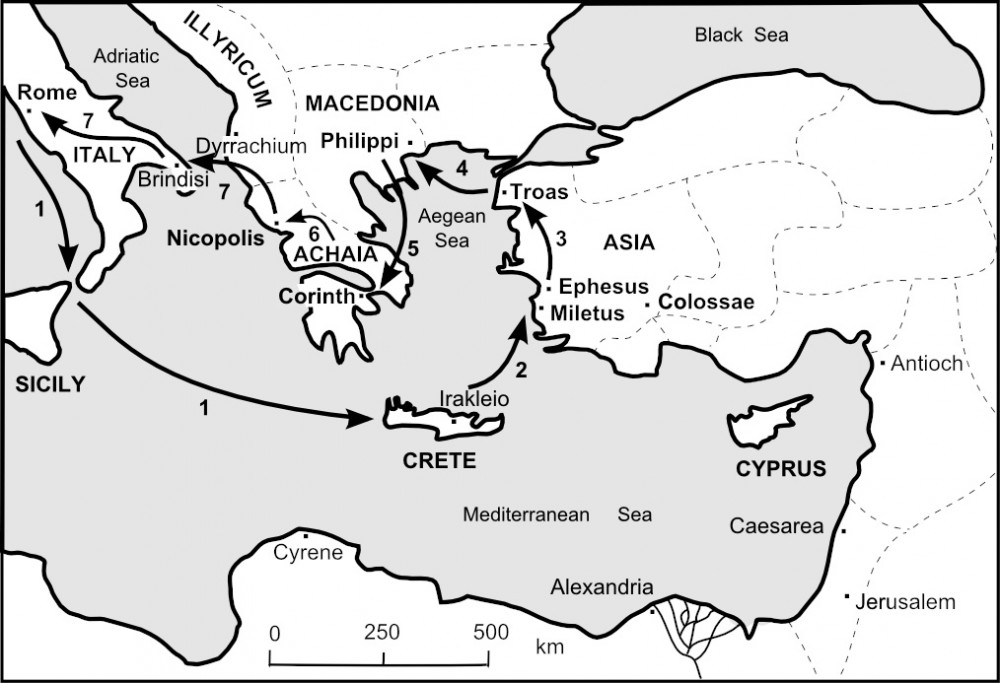
Here is a great map from thebiblejourney.org tracing of his last missonary journey after he was released.

This image has an empty alt attribute; its file name is image-16.png

“Paul commissioned Titus to be the leader of the local church while in Crete (which Paul had visited only briefly before, en route to Rome – see Titus 1:5 & Acts 27:8-9). He visited Miletus (and left Trophimus there because he was ill – see 2 Timothy 4:20) and then left Timothy in charge of the church at Ephesus (see 1 Timothy 1:3) (see on Map 28). He may have visited Colossae (see Philemon 1:22) before he continued to Troas (where he left his coat with Carpus – see 2 Timothy 4:13) (see on Map 28).

Paul then went on to Philippi in Macedonia (see 1 Timothy 1:3) where he wrote his First Letter to Timothy and his Letter to Titus between 63 and 66AD (see on Map 28). He may have visited Ephesus again (see 1 Timothy 3:14 & 4:13) before travelling back via Corinth (see 2 Timothy 4:20) (see on Map 28) and Nicopolis (see Titus 3:12) (see on Map 28) to Rome (see on Map 28) where he was imprisoned in the Mamertine Prison (see 2 Timothy 1:8,16-17 & 2:9). From Rome he wrote his Second Letter to Timothy shortly before he was beheaded (as he was a Roman citizen) in c.67AD during the intense persecution of Jews and Christians by Nero (see 2 Timothy 4:6).

Paul may also have visited Spain at some time between 63 and 67AD (see Romans 15:24 & 28) but we have no Biblical evidence of such a visit.”

I encourage you to take time right now to read 2 Timothy (12 minutes reading time). As you read it, think about the mood that Paul was in during his last months in prison in Rome before he was beheaded. It says a lot that he would write his last letter to Timothy, “my beloved child” (2 Timothy 1:2; 2:1), his “child in the faith” (1 Timothy 1:2). If you knew your death was imminent and that you could write one last letter, who would you write it to? I would probably write it to my surviving family, but Paul had no surviving family that we know of. His family was his church family. His brothers and sisters were those who worked with him preaching the gospel to the Roman Empire. You can just feel the emotion as he thinks about his time with Timothy: 2 Timothy 1:I thank God whom I serve, as did my ancestors, with a clear conscience, as I remember you constantly in my prayers night and day. As I remember your tears, I long to see you, that I may be filled with joy. I am reminded of your sincere faith, a faith that dwelt first in your grandmother Lois and your mother Eunice and now, I am sure, dwells in you as well.” He hoped that Timothy could come to him soon: 2 Timothy 4:Do your best to come to me soon.” We don’t know if Timothy made it to see Paul before he died.

Paul had a lot of instructions for Timothy.

1) 1: 6 “Kindle afresh (anazópureó: To rekindle, to stir up, to fan into flame) his gift (i.e. his evangelistic miraculous gift, Ephesian 4:11). The ESV translates it “fan the flame”. That’s not to say that Timothy’s zeal had begun to waver. It is just a reminder to constantly keep that zeal blazing, just like you stoke a fire constantly to keep the fire bright and burning.

2) 1:8 Don’t be ashamed of Paul’s imprisonment. Some of Paul’s enemies might try to make Timothy be ashamed of Paul being in prison as a condemned criminal worthy of death. Especially Jewish unbelievers might say that Pauls’ death proved that he was just another misled false teacher of this false sect called Christianity. After all, his imprisonment was at the time that the Jewish rebels were rebelling against Rome, trying to convince all Jews that victory over Rome was imminent.

3) 2:1-7 Be strong, suffering hardship as a good soldier, a competitive athlete, and a hard working farmer. Those are 3 down to earth examples to show Timothy how to handle his suffering.

4) 2:2 Entrust the gospel to faithful men who would then be able to teach others. An evangelist must train others to carry on the work. This verse was our “mission statement” when we went to Trinidad to do 3 years of mission work. There were already hundreds of baptized believers in Trinidad due to evangelistic campaigns and several churches already established (we worked mainly with two of them in the south). We baptized several more and established 3 new congregations while there. But our main focus was identifying and training their leaders to carry on the work after we left. We had a “Saturday school” where we taught many of the church leaders the same Bible courses that we had studied in our 2 years in a school of preaching in West Monroe, La. Apparently that worked b/c those leaders carried on the work in the churches for the next 50 years without depending on U.S. money to pay preachers there! I recently talked to several of those leaders via WhatsApp. That was very encouraging to me. Those leaders also continued to train other men. A son of one of those leaders worked with some of the new congregations and did mission work over in Guyana, South America. Paul wanted Timothy to do the same training of leaders, and I’m sure that he did.

5) 2:14-19 Remind those faithful men (and all believers) to “accurately handle the word of truth”. Avoid disputes over words, worldly and empty chatter. Especially avoid heretical teachings like that of 2 men who were saying that the resurrection had already taken place. Paul had said that “there is about to be (mello, which always means “about to” in the NT) a resurrection of the righteous and unrighteous (Acts 24:15). That would be the resurrection of Daniel 12:2 which would occur at the end of the Jewish Age in 70 AD. The OT dead in hades would be raised to receive their final sentencing in 70 AD. Paul wrote 2 Timothy in 67 AD, so that resurrection had not taken place yet. We don’t know exactly what arguments were used by those 2 men to say the resurrection had already happened. It is interesting that Paul did not just say, “it is obvious that the resurrection has not happened yet b/c no one has seen bodies coming out of the tombs”. Apparently, the resurrection as Paul taught it was not a bodily resurrection as many teach or else Paul could have said that and used that argument against them. In 1 Corinthians 15, Paul taught that the resurrection would be changing to immortal spiritual bodies, not physical bodies raised. He even told them in 15:50 I tell you this, brothers: flesh and blood cannot inherit the kingdom of God, nor does the perishable inherit the imperishable. 51 Behold! I tell you a mystery. We shall not all sleep, but we shall all be changed.” He told them that some of those he was writing to would still be alive at the resurrection that was “about to happen” (Acts 24:15). But dead or alive, the believers would be given immortal, spiritual bodies at that resurrection. Either Paul is a false prophet predicting this to happen in their lifetime or else it did happen, and it did. Yes, that means that I am saying that, based on Paul’s writing, the resurrection “has already happened” at 70 AD. You might say I am a heretic for teaching that just like those 2 men. But the difference is when those 2 men made that statement and when I am making that claim (which is today, long after 70 AD). Food for thought!

6) 2:22-26 Flee youthful lusts and purse righteousness, faith, love, and peace. Don’t be quarrelsome in trying to correct those teaching error. Many who try to “defend the faith” end up being very argumentative, thinking their opinion on doctrine is the only correct one. That leads to sectarianism. The church I was raised in taught a lot of truths but also became very argumentative about minor doctrines, condemning those who disagreed.

COLOSSIANS 3-4 THE SPIRITUAL MINDSET

Ephesians 1-3 is doctrine (spiritual blessings in Christ, predestination, salvation by grace through faith, Jews and Gentiles united in one body, the mystery revealed). Ephesians 4-6 is practical (the 5 “walks” or conduct Christians should have, and stand up to the devil using the armor of God).

Colossians is very similar. Both letters were written while Paul was in “house arrest” in Rome for 2 years (Acts 27,28). But in the Colossian letter Paul is fighting specific heretical teachings about Jesus. The first two chapters are doctrinal, stating the preeminence of Jesus Christ. They deal with the person and work of Jesus Christ. Christ is sufficient for all our spiritual and doctrinal needs. He condemns the false teaching of asceticism, mysticism, Jewish laws being bound on Gentiles, and gnosticism (at least early gnostic thinking if not full blown gnosticism of the 2nd century). Please refer to my last blog to read that discussion and see a couple of very good short videos.

The last section of Colossians is practical. Since Christ is all-sufficient for our spiritual and doctrinal needs, we don’t need to be distracted by human philosophy, religious rules, visions, asceticism, etc. The last verse of chapter 2 gets us ready for chapters 3-4: “22 according to human precepts and teachings? 23 These have indeed an appearance of wisdom in promoting self-made religion and asceticism and severity to the body, but they are of no value in stopping the indulgence of the flesh.”

So, now Paul is ready to talk about the real issue facing Christians, and that is how to “stop the indulging of the flesh”. Someone can be a great debater of doctrine, or a very strict religious rule keeper, but if he/she then lives in lust, adultery, hate, jealousy, greed, etc. then all his religion is worthless.

3:1  If then you have been raised with Christ, seek the things that are above, where Christ is, seated at the right hand of God. Set your minds on things that are above, not on things that are on earth. For you have died, and your life is hidden with Christ in God. When Christ who is your life appears, then you also will appear with him in glory.

These 4 verses set the tone for chapters 3 and 4. 2:12 having been buried with him in baptism, in which you were also raised with him through faith in the powerful working of God, who raised him from the dead. 13 And you, who were dead in your trespasses and the uncircumcision of your flesh, God made alive together with him, having forgiven us all our trespasses.” You were raised from spiritual death and made alive in Christ. So, what should I be seeking? What should be the main priority and purpose of my living? It should be seeking the kingdom of God. It should be things that are above, i.e. spiritual things. Set (phroneó: To think, to set one’s mind on, to have a mindset) on things above, where Christ sits at the right hand of God, on spiritual things. Can you picture Jesus sitting at God’s right hand somewhere in heaven. He is watching everything I do and say. HIs Spirit is working on me to help me fight the flesh and be a good example of a cleansed sinner. What is he thinking about how I am acting? Is he pleased or displeased? Am I in total submission to him? What does he want me to work on in my life? What plans does he have for me?

Romans 8:For those who live according to the flesh set (phroneó: To think, to set one’s mind on, to have a mindset) their minds on the things of the flesh, but those who live according to the Spirit set their minds on the things of the Spirit. For to set the mind on the flesh is death, but to set the mind on the Spirit is life and peace. For the mind that is set on the flesh is hostile to God, for it does not submit to God’s law; indeed, it cannot. Those who are in the flesh cannot please God.” I like that word for “set”, i.e. “one’s mindset”. (AI) “A person’s mindset is a set of beliefs that influences how they think, feel, and act in different situations. It also affects how they perceive the world and themselves.” Is my mind set on the things of the flesh or the things of God? Do I spend most of my time thinking about materialism, pleasure, fulfilling my lusts of the flesh, eye, and pride of life? What is my mindset? Is my mindset on spiritual beliefs and things? Is that spiritual mindset strong enough to guide me and stop my from “indulging in the flesh” (2:23)?

So, if you have the proper spiritual “mindset”, here is what you will do. You will “put to death” earthly, sensual thought, deeds, words, and lusts. 3:Put to death therefore what is earthly in you: sexual immorality, impurity, passion, evil desire, and covetousness, which is idolatry.” You will “put away” these things: 3:But now you must put them all away: anger, wrath, malice, slander, and obscene talk from your mouth. Do not lie to one another, seeing that you have put off the old self with its practices 10 and have put on the new self, which is being renewed in knowledge after the image of its creator.” You have been re-created by the grace of God into a new spiritual person, constantly cleansed by the blood of Jesus. Now act like such a cleansed sinner should act. You don’t have to be perfectly sinless in putting off these old self practices, but you must make a sincere effort to do so.

Picture being given a new white beautiful dress or a sharp all white men’s suit. Your old clothes are covered in dirt, mud, grease, paint, and holes. You are so thankful for the new clothes that were given to you out of love and compassion. You put off the old clothes and put on the new. How hard would you try to keep that new white dress or suit clean? If you wore it all the time, you would probably spill food or drink on it, or get it dirty, but you would try your best to keep it clean. And if you get it dirty, you have this magic “stain remover” that you quickly apply so that your dress or suit remain white. To me, that is the example of putting off the old self and putting on the new.

Having sincerely tried to put off the old self and old sinful practices, you will try to put on the new self and new practices. 3:12 Put on then, as God’s chosen ones, holy and beloved, compassionate hearts, kindness, humility, meekness, and patience, 13 bearing with one another and, if one has a complaint against another, forgiving each other; as the Lord has forgiven you, so you also must forgive. 14 And above all these put on love, which binds everything together in perfect harmony (teleiotés: Perfection, maturity, completeness).” In the New Testament, this word is used to describe the process of becoming spiritually mature and fully developed in faith and character. A Christian who is not a loving person is not a mature Christian. He will have little influence on others for Jesus no matter how religious he is or how doctrinally sound he is.

One could do a sermon on each of these new attitudes and practices that we need to “put on”, but their meaning is quite easy to understand. How hard am I trying to work on putting on these? For example, do I have compassion for those less fortunate and the lost? That’s not just to “feel sorry” for them, but to help them. On a scale of 1 to 10, how am I doing in each of these areas? And “above all these put on love”. Would people call me a “loving person”? Love makes one compassionate, kind, forgiving, and patient.

3:15 And let the peace of Christ rule in your hearts, to which indeed you were called in one body. And be thankful. 16 Let the word of Christ dwell in you richly, teaching and admonishing one another in all wisdom, singing psalms and hymns and spiritual songs, with thankfulness in your hearts to God. 17 And whatever you do, in word or deed, do everything in the name of the Lord Jesus, giving thanks to God the Father through him.” The peace of Christ will rule (brabeuó: To rule, to arbitrate, to decide, to govern: From the root word βραβεύς (brabeus), meaning “an umpire” or “a judge.”) in our hearts. It will be an umpire or judge to tell you, “No, your feelings for that person or the way you are treating that person is not right: change your attitude and action.” It will be an umpire that will call fouls on you when you violate the rules of Christian conduct. You were once alienated from Christ, an enemy of God due to your sin, but the grace of God has brought you into a state of being reconciled to God and peace with God. That peace is a spiritual peace with God and it brings an inner peace in your hear with your inner self and your dealings with all people. A person who has a troubled, sinful inner self will not be concerned about being kind to others. A person at peace with God and self will say, “God has been so good to me, saving me, and I want to share that peace with others and help them to find that peace.” 3:15 “and be thankful” for what God has done for you.

Let the word dwell (enoikeó: To dwell in, to inhabit) in you richly. Not just “dwell in you” but “dwell in you richly”. The way the word gets in you is by reading, studying, and meditating on the word of God. But, as the SEC radio slogan says, “it’s not that you schedule your child’s birth around college football games, it just means more than that”. It means that the word of God lives in you and influences and guides you in everything that you do. Of course, you have to know what the word says, thus the reading and studying. Once the word gets in your mind and heart, picture the Spirit of God constantly urging you to apply what the word says to your life. The Spirit through the word nudges you to not do something bad that you were about to do and urges you to do something good that you need to do. My mom wrote long letters telling how she felt about things. I read those letters at times and it is a constant reminder of what she would want me to do. Her spirit speaks to me through those written letters. It’s the same with the Spirit and the word of God. Hebrews 4:For the word of God is living and active, sharper than any two-edged sword, piercing to the division of soul and of spirit, of joints and of marrow, and discerning the thoughts and intentions of the heart. 13 And no creature is hidden from his sight, but all are naked and exposed to the eyes of him to whom we must give account.” But the word is only “living and active” if you are intent on letting the Spirit energize that word to influence and guide you. I am a full preterist in doctrine and feel that I can really help people understand the Bible in context in such a way that it will increase their faith in Jesus and the word. That means a lot of the word in my mind. But I struggle to let the Spirit use the word to help me put away certain bad thoughts and deeds, and put on love, compassion, and kindness. That’s what I need to work on! How about you?

The word dwelling in you will also motivate you to teach (didaskó: To teach, instruct) and admonish (noutheteó: To admonish, to warn, to instruct) one another. A good way to do this is with singing psalms, hymns, and spiritual songs with thankfulness in our hearts. Psalms were singing the 150 psalms of the Old Testament. Hymns were praise songs sung by a congregation. Spiritual songs would be any song that the Spirit led them to sing about our new life in Christ. This is not just a command for the assembly on Sunday morning. It is not a command that would forbid singing songs with instrumental music. The Greek word for psalms is psalmos and is derived from the verb ψάλλω (psallō), meaning “to pluck” or “to play a stringed instrument.” 5568 psalmós – a psalm (“Scripture set to music”). Originally, a psalm (5568 /psalmós) was sung and accompanied by a plucked musical instrument (typically a harp), especially the OT Psalms.” That doesn’t mean that we can only sing psalms with an instrument, but it certainly does not rule out using an instrument to sing psalms with. My church has made such a big issue of non-instrumental worship, even calling the use of instruments a sin, perhaps a sin that would condemn one’s soul. That is sad. It has caused division instead of eliminating it.

Finally, 3:17 And whatever you do, in word or deed, do everything in the name of the Lord Jesus, giving thanks to God the Father through him.” That covers it all, doesn’t it. Whatever you do in word or deed, do it by that authority and command of the head, Jesus, always giving thanks. Let a thankful heart be always in you. If someone saved my life, I would be always thinking about what they did for me and how I could show gratitude to them.

That leads Paul to state the commands for wives to submit to husbands, husbands to love their wives, children obey their parents, fathers don’t provoke your children, slaves server your masters as if you were serving Jesus himself, and slave masters to be fair and kind to their slaves.

A few personal instructions close the letter to the Colossian church. “3:Continue steadfastly in prayer, being watchful in it with thanksgiving. At the same time, pray also for us, that God may open to us a door for the word, to declare the mystery of Christ, on account of which I am in prison— that I may make it clear, which is how I ought to speak.Walk in wisdom toward outsiders, making the best use of the time. Let your speech always be gracious, seasoned with salt, so that you may know how you ought to answer each person.” This speak of God’s providence opening doors for the preaching of the gospel. Organizations like Eastern European Missions are constantly looking for and finding open doors for printing and distributing Bibles and children’s Bible story books all over the world in many languages. Paul was in prison in Rome and yet God opened a door for him to preach to the imperial guard (they guarded the emperor) (Eph 1:13). The Colossians are told to pray for God to open a door for Paul to preach the gospel. I don’t know how intercessory prayer works, but it works.

Salt preserves and adds flavor. Our speech should be seasoned with salt. We should be encouragers when others are frustrated and pessimistic. We should be praising and thanking God when others are cursing. We should be peacemakers when people are arguing and fighting. We should be giving a special word to someone who needs it. We should be able to make a defense to anyone who asks us about the hope we have in Jesus (1 Peter 3:15). Especially to non-Christians, outsiders, who are watching us closely to see if we really are sincere Christians.

Then some very personal comments. Several names. Tychicus would carry the letter to the Colossians. Onesimus was the runaway slave of Philemon who was converted in Rome by Paul. Philemon was a member of the Colossian church. Aristarchus was a fellow prisoner, actually with Paul on his 3rd journey and as a prisoner with Paul on the ship to Rome. Markm the cousin of Barnabas, was back in favor with Paul after Paul rejected him going on the 2nd journey b/c he left them on the 1st journey. Jesus called Justus comforted Paul in prison. Those 4 men were the only Jewish Christians that helped him in prison. Most of the Jews in Rome who came to hear Paul preach in prison rejected His gospel message. The physician Luke who traveled with Paul on his 3rd journey and was with Paul in Rome. Demas was still in grace at this time (and in Philemon 24) but later left Paul, loving the present world (2 Tim 4:10). Nympha was a member of the church in Laodicea and had a house church in her church. Archippus was told to fulfill his ministry, maybe as a pastor in the church at Laodicea. The Colossians were to pass their letter to the Laodicean church and then read the letter Paul wrote to the Laodiceans, which we don’t have. Paul wrote this letter with his own hand.


COLOSSIANS 1-2 PREEMINENCE OF CHRIST

I have a blog article on Colossians that is more complete, but this is a shorter version. I encourage you to stop right now and watch this 5 minute video on the historical background of Colossians. You might hear the term “dualism” and wonder what that means. This video will help understand some of the heretical philosophy being taught and discussed in Colossae.

https://www.youtube.com/watch?v=i2UW66oBEsA&list=PLWdLxfKtLrX6IqjbPbuybN0NouIq5nzjp&index=8

The theme of Colossians is “Christology“: the study (ology) of Jesus Christ, his person (who he is) and his work (what he came to do). The first two chapters discuss the person and work of Jesus Christ. Stop and watch this 4 minute video on the first two chapters.

This slide from Marvin Willis sums up the false teaching that Paul was confronting in the letter:

Gnosticism is complicated, but basically: all flesh is evil and God cannot come into an evil fleshly body, so Jesus cannot be “God in the flesh”.

HIs answer to all this heresy is that all the fullness of God dwells in Jesus Christ. He is fully God while being fully man. That is hard to understand fully and we don’t have to understand it perfectly. In the first few centuries of Christianity there were several councils to debate the different philosophies about the nature of Jesus, such as docetism. (AI) “Docetism, (from Greek dokein, “to seem”), Christian heresy and one of the earliest Christian sectarian doctrines, affirming that Christ did not have a real or natural body during his life on earth but only an apparent or phantom one.” There were many more. The councils usually ended up deciding which view was correct, and then they declared as heretics anyone who disagreed with that view. It was a lot of unnecessary “splitting of hairs” that led to much division in the early church. We simply must believe that the fullness of God dwells in Jesus (i.e. He is fully God), that He did come in the flesh (i.e. the incarnation), that He is the only begotten Son of God (John 1:14), that He is the Christ (i.e. the Messiah: Christ is the Greek translation of the Hebrew Messiah). 1 John 2:22 Who is the liar but he who denies that Jesus is the Christ? This is the antichrist, he who denies the Father and the Son. 23 No one who denies the Son has the Father. Whoever confesses the Son has the Father also.”

Here is another good summary by Marvin Willis of what Paul says in chapter 1 and 2:

Or this slide (a little blurred) by Ernie Varra that gives the verses:

1:15 He is the image (eikón: Image, likeness, representation) of the invisible God, the firstborn of all creation.” The word is used by Jesus of the image of Caesar that was on a denarius coin. Matthew 22:20 And He *said to them, “Whose image (eikon) and inscription is this?” So when you see the coin, you see the likeness of Caesar himself. Jesus said, “He that hath seen Me hath seen the Father; and how sayest thou then, ‘Show us the Father’?” (John 14:9). God is a spirit (John 4:24) and you can’t see a spirit (sorry, Casper is not real). But when you see all the qualities that Jesus had, you see what the Father is like.

1:18 And he is the head of the body, the church. He is the beginning, the firstborn from the dead, that in everything he might be preeminent.” Preiminent in the Greek is próteuó: To have the first place, to be preeminent. (AI) “The verb “próteuó” signifies holding the highest rank or position, being first in importance or influence. It is used in the New Testament to describe the supremacy and preeminence of Christ, particularly in relation to creation and the church.” The word is only used once in the New Testament and it fits so well in Colossians. The supremacy and preeminence of Jesus Christ. Why is He preeminent? 1:19 For in him all the fullness of God was pleased to dwell” (i.e. b/c he was not just a man, a prophet, a spiritual guru: he was God in the flesh.

He was not a created being as the Jehovah’s Witness claim. John 1:1 In the beginning was the Word, and the Word was with God, and the Word was God. 2 He was in the beginning with God. All things came into being through Him, and apart from Him not even one thing came into being that has come into being.” Everything is either created (from nothing, Genesis 1) or not created (eternal). The “Word” here is Jesus. 1:14 And the Word became flesh, and dwelt among us; and we saw His glory, glory as of the only Son from the Father, full of grace and truth.” Thus Jesus created all things. Anything that was created was created by Jesus. If he was a created being, he would have to have created himself. He is the firstborn (prototokos: Firstborn) of all creation. (AI) “The term “prototokos” is used in the New Testament to denote the firstborn child in a family, emphasizing preeminence and priority in both birth order and status. In a theological context, it is often used to describe Jesus Christ, highlighting His supremacy and unique position in creation and redemption.” “Firstborn” here does not mean Jesus was the first thing created, which would contradict John 1:1-3. It means that he has the preeminence over all creation just as the firstborn son has preeminence.

All the elements that make up the earth are made up of cells with a nucleus in each cell. The nucleus has positively charged protons in the nucleus itself and negatively charged electrons that spin around the nucleus in defined shells and orbitals. Positive attracts negative. What keeps the negatively charged electrons from being drawn into the nucleus by the positively charged protons, thus collapsing the cell and destroying matter? 1:17 says that is is Jesus who holds thing together. Where does the force of gravity come from? 1:17 says it is Jesus’ power that creates gravity. There is an equation for the force of attraction between two objects: F = G * (m1 * m2) / r^2. M1 and m2 are the masses of the two objects. F is the force of attraction. G: is the gravitational constant (approximately 6.674 × 10^-11 N⋅m²/kg²). G is one of the many “constants” in physics and math that cannot be explained by random by chance atheistic explanations of how the earth came to be. But why does that equation exist and work? 1:17 says it is by the power of Jesus. Jesus created all objects. His power is the attraction between the two objects (which creates gravity and another constant, the force of gravity which is 9.8 m/sec^2). Jesus is the one who came up with the force of attraction equation and put it into effect at creation. Jesus is the one who wrote all the equations and constants that govern how the universe operates. It is by his power that they all work so consistently and perfectly.

1:18 And he is the head of the body, the church. He is the beginning, the firstborn from the dead, that in everything he might be preeminent.” If he is preeminent over all creation, then certainly He is the head over his spiritual body, which is the church, i.e. those saved by his death, burial, and resurrection. The husband is the head of the wife, which means she is in submission. The church is in submission to follow and obey all the teachings of Jesus. Just as our physical systems of the body are controlled by our heads, so it is with Jesus and his body, the church. The pope is not the head of the church. Ephesians 4:11 lists 5 gifted leadership offices or positions: apostles, prophets, evangelists, pastors (elders), and teachers. Don’t you think that the position of “pope” would be in that list if Jesus wanted a pope to be the leader of the church? We must submit to Christ and Him only.

1:20 and through him to reconcile (apokatallassó: To reconcile completely, to restore to favor) to himself all things, whether on earth or in heaven, making peace by the blood of his cross. 21 And you, who once were alienated and hostile in mind, doing evil deeds, 22 he has now reconciled in his body of flesh by his death, in order to present you holy and blameless and above reproach before him.” Reconciliation emphasizes the total restoration of a relationship that was once broken due to sin. It is the restoration of a state of peace between two parties that were enemies in a conflict. Romans 5:10 For if while we were enemies we were reconciled to God through the death of His Son, much more, having been reconciled, we shall be saved by His life. 11 And not only this, but we also celebrate in God through our Lord Jesus Christ, through whom we have now received the reconciliation.” We were enemies of God due to our sin. It is not that we hated God. It is simply that our sins put us in a state of enmity with God. Reconciliation with God makes us at peace with God in our spiritual relationship. Romans 5:1: “Therefore, since we have been justified through faith, we have peace with God through our Lord Jesus Christ.” Jesus’ is our means of achieving that peace. Ephesians 2:14 For He Himself is our peace.” 2 Corinthians 5:17 Therefore if anyone is in Christ, this person is a new creation; the old things passed away; behold, new things have come. 18 Now all these things are from God, who reconciled us to Himself through Christ and gave us the ministry of reconciliation, 19 namely, that God was in Christ reconciling the world to Himself, not counting their wrongdoings against them, and He has committed to us the word of reconciliation. 20 Therefore, we are ambassadors for Christ, as though God were making an appeal through us; we beg you on behalf of Christ, be reconciled to God. 21 He made Him who knew no sin to be sin in our behalf, so that we might become the righteousness of God in Him.

Paul continues with what Jesus did, what he accomplished. 2: 11 In him also you were circumcised with a circumcision made without hands, by putting off the body of the flesh, by the circumcision of Christ, 12 having been buried with him in baptism, in which you were also raised with him through faith in the powerful working of God, who raised him from the dead. 13 And you, who were dead in your trespasses and the uncircumcision of your flesh, God made alive together with him, having forgiven us all our trespasses, 14 by canceling the record of debt that stood against us with its legal demands. This he set aside, nailing it to the cross. 15 He disarmed the rulers and authorities[and put them to open shame, by triumphing over them in him.” He made us alive spiritually as we rose from immersion in baptism (the word baptism means immersion). Baptism is an act of faith, not a work to earn salvation. He was circumcised (peritomé: Derived from the Greek verb περιτέμνω (peritemnō), meaning “to cut around, the cutting around of the foreskin) cut off from the land of the living (hence the word circumcision). Isaiah 53:By oppression and judgment he was taken away; and as for his generation, who considered that he was cut off out of the land of the living, stricken for the transgression of my people?”

Since Christ is all we need and he is the head of the church, we should not let anyone bind rules or laws on us that Jesus did not command. Apparently there were many false teachers who were doing that. They were teaching asceticism: the denial of the body’s normal desires in order to be more righteous: don’t taste, don’t touch. They were teaching the Gentile Christians that they had to keep the rituals of the old covenant, such as the unclean food laws, the observance of Jewish feasts and the new moon. Some were saying they had visions about angels and promoted the worship of angels. They were telling the Christians that they were not fully saved unless they did these things. None of these things were commanded by Jesus. We are sufficient in Christ. Don’t let anyone judge you or mislead you or bind human traditions or philosophy on you.

There is much to apply to today concerning the Christology that Paul presented. There are a lot of Christian denominations and cults that deny that Jesus was God, such as Christian Science, Jehovah’s Witness, and many others. There are many denominations that make their members observe the unclean food laws, such as the Seventh Day Adventists. Some groups have leaders that deceive the members with visions they claim to have seen. Some groups emphasize the teachings of their latter day prophets to the exclusion of making Jesus Christ the core of their teaching.

In other words, we have a lot of the same false teaching as the Colossians did.

EPHESIANS: SIT, WALK, STAND (run, hide,fight)

I teach Bible at Madison Academy in Huntsville, Al. Been there 30 years. Every year we have a lengthy presentation on what to do if a shooter comes in. But it always ends with “run, hide (if you can’t run), fight (if you can’t run or hide)”. In the moment of an actual shooter in the building, I won’t remember the whole lecture, but I will remember those 3 words and it might save lives. Hopefully, this blog will be brief in order to emphasize 3 key words in Ephesians: “sit, walk, stand”.

SIT

From prayersandpetitions.org

From mission venture ministries:

Jesus finished his redemptive work on the cross and then was raised and seated at the right hand of the Father. Eph 1:18 having the eyes of your hearts enlightened, that you may know what is the hope to which he has called you, what are the riches of his glorious inheritance in the saints, 19 and what is the immeasurable greatness of his power toward us who believe, according to the working of his great might 20 that he worked in Christ when he raised him from the dead and seated him at his right hand in the heavenly places, 21 far above all rule and authority and power and dominion, and above every name that is named, not only in this age but also in the one to come. Paul prayed that his readers’ spiritual eyes would be opened to see that the same power that raised and seated Jesus had raised and seated them with Jesus in the heavenly places (Eph 2:6).So, it is important to start with where we are now seated: with Christ in the heavenly places. I’m not sure where that is exactly, but it must be a spiritual realm all around us that we can’t see. But we can see with an eye of faith our exalted position as Christians: raised from spiritually dead in sin, made alive spiritually, and seated with Jesus in the heavenlies. So, in one sense, you are exalted above spiritual death. The evil one can’t touch you. That should make you feel special in God’s eyes. So it is important that, before we talk about walking and standing, that you know where you sit in God’s eyes! In one sense, it’s not about what you do, about how you walk and stand. It’s about how God’s grace and love has lifted you to a different spiritual realm above all evil powers in this world. You are safe in the Father’s hands and no one can take you out of them.

WALK

So now that we realize where we are safely seated with Jesus in the heavenly places, how should we live as special children of God. How you walk is simply how you conduct yourself: what you do, think, and say every day 24/7. There are 7 “walks” in Ephesians. 1) 2:1-2 how you walked in sin and lusts before being saved. 2) 2:10 the good works we should walk in as newly created saved by grace children of God.

Chapters 4-6 then begin 5 very practical “walks”: 3) 4:1-3 walk worthy of you calling by God to be His child, with an emphasis on unity among believers and unity of doctrine (the 7 “ones”). 4) walk no longer as the Gentile pagans in futility and unbridled lust: put off the old sinful self and put on the new self that is created in the image of Christ. 5) 5:1-2 walk in love as Christ loved us and gave Himself for us, with an emphasis on putting away sexual immorality and greed. 6) 5:8 walk as children of light: the light of the world, Jesus, has shined on us and lifted us out of spiritual darkness and made us reflected lights; so put away all the deeds of darkness.

7) 5:15-16 walk as wise men, using your time wisely to be filled with the Spirit so you can encourage others and give thanks to God continually. To walk wisely includes “submitting to one another”. Paul then gives several areas where we should submit to one another: 1) Wives submit to husbands. 2) Husbands love their wives as Christ loved the church, nourishing and cherishing them (which is a submitting of your selfish will to God’s will for husbands). 3) Children obey (submit) your parents. 4) Fathers bring up your children in the discipline (training) and instruction of the Lord (submitting you will as the head of the family to God’s will for parenting). 5) Slaves obey (submit) to your masters. 6) Masters treat your slaves kindly (which is submitting being a slave owner to God’s will on how to treat them).

STAND

The Christian “walk” will not be a “cakewalk” (achieve or win something easily). There will be trials, tests of your faith, problems to overcome, difficulties, etc. I walk around our pond and the other day the wind was so strong that it made it hard to walk. You have seen reporters giving updates while in 100 mph winds of a hurricane, and it is all they can do to “stand”. So Paul ends the letter with the warning that we need to stand against the schemes of the devil and the spiritual forces in the heavenly places.

To stand against these schemes, we need to put on the “whole armor of God”. Imagine a soldier going into battle without a single defensive piece of equipment or an offensive weapon. He would be destroyed quickly. We will be destoryed by Satan if we don’t put on God’s armor. Notice the defensive equipment such as the shield, the feet protected (Roman soldiers wore heavy-soled military sandals called caligae), breastplate, and helmut. Notice the offensive weapon, the sword of the Spirit (the word of God). Like any soldier, we need to be alert to enemy danger and pray.

Isn’t that a neat way to look at Ephesians? Sit, walk, and stand. It simplifies it all. Much like they teach us in school on responding to a shooter: “run, hide, fight”. You won’t remember the 2 hour lectures someone gave you at inservice on shooters coming in school. In the moment of danger, you might remember 3 simple words: “run, hide (if you can’t run), fight (if you can’t run or hide)”.