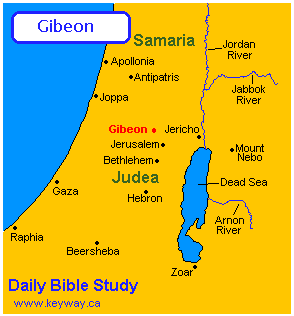
Joshua 9. Do you remember in Deuteronomy that God told Israel to totally annihilate all the inhabitants of all the cities in Canaan but they could make a peace treaty with cities outside of Canaan, letting them live if they would become servants to Israel. So the Gibeonites came to Joshua with worn out sandals and clothes, telling him they were from far off and wanted to make a peace treay. Joshua agreed and only 3 days later found out they had deceived him. Gibeon was very close to Gilgal where Israel camped. But Joshua said that he would keep his word and not destroy the Gibeonites, only make them servants.
Joshua 10. Five of the Canaanite kings attacked Gibeon for making this peace treaty with Israel b/c they thought it would weaken the coalition of Canaanite kings willing to fight Israel. They didn’t know that the Gibeonites had deceived Israel. So Joshua marched all night with his army to rescue the Gibeonites. The armies of the 5 kings were slaughtered with the Lord killing many with hailstones (more than the Israelites killed). Joshua needed more time to finish chasing down and killing the Canaanites, so he asked God to make the sun and moon stand still until they finished teh slaughter, and God did so. 9:13 Is it not written in the book of Jashar? And the sun stopped in the middle of the sky and did not hasten to go down for about a whole day. 14 There was no day like that before it or after it, when the Lord listened to the voice of a man; for the Lord fought for Israel. I do believe that this happened. I can’t explain how it happened. I know that scientifically the sun doesn’t even really move across the sky although it looks that way to us and the Bible speaks of it that way in accommodation language. But the Lord who made the sun from nothing and set in motion the laws of planetary orbits could make it stay daylight for an extra day. They finish the slaughter and Joshua killed the 5 Canaanite kings.
Life Lesson: If you were Joshua and you needed more hours of daylight to finish a complete slaughter of the Canaanites, would you have ever thought to ask God to make the sun stand still and give you an extra day of daylight? Have you ever asked God for something really crazy, something really out of the ordinary, something almost miraculous if not miraculous? Don’t be afraid to ask. James says “you have not b/c you ask not”. Think of something that you would really like God to do. Maybe it’s helping you find a mate. Maybe it’s working out a big issue in your marriage. Maybe it’s a major illness or injury that your loved one is facing. Mabye it’s a career change. I’m thinking of something that I want to see happen but there will need to be some big changes first. I’m going to ask God to make it happen and then trust Him, His will be done.
Chapter 10 then describes the conquest of southern Palestine. Chapter 11 describes the conquest of northern Palestine. Chapter 12 names the 31 kings that Joshua and the Israelites defeated and killed.
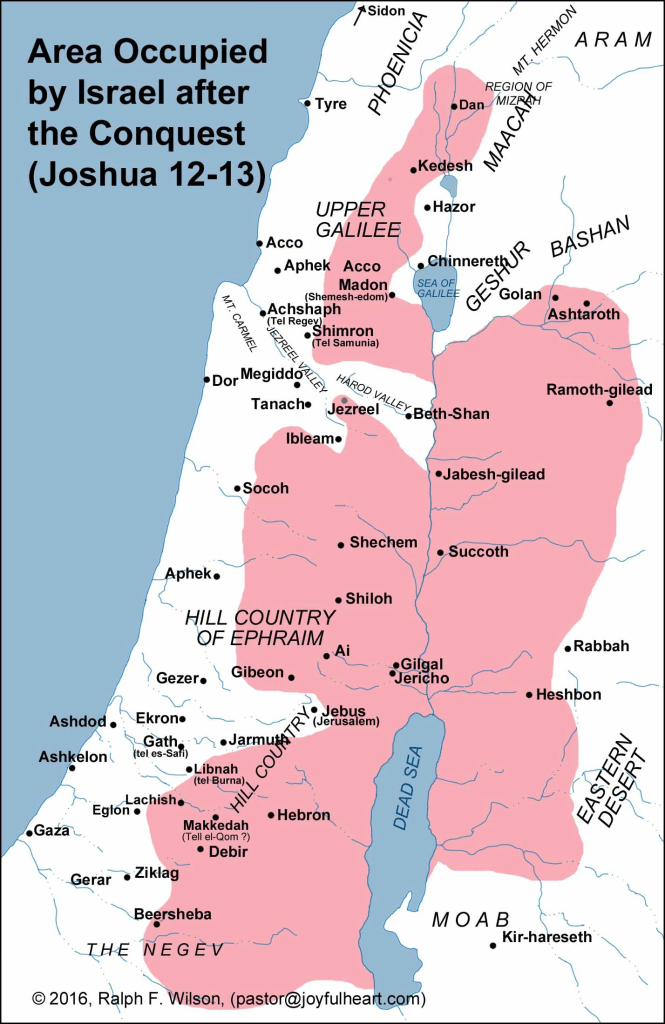
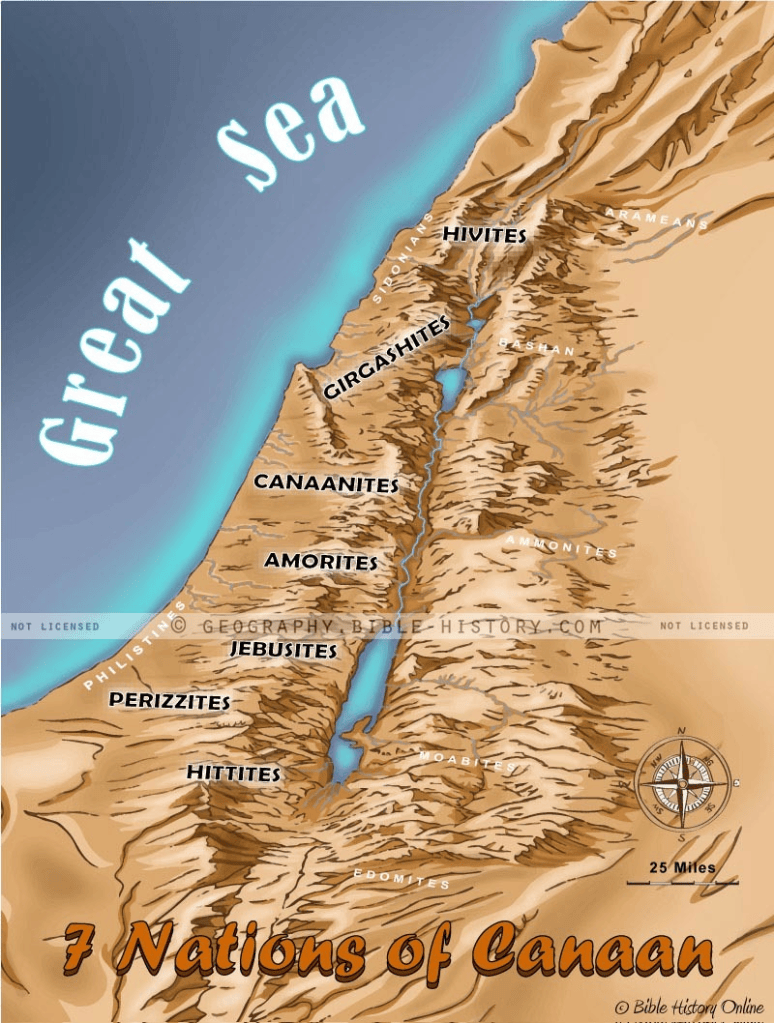
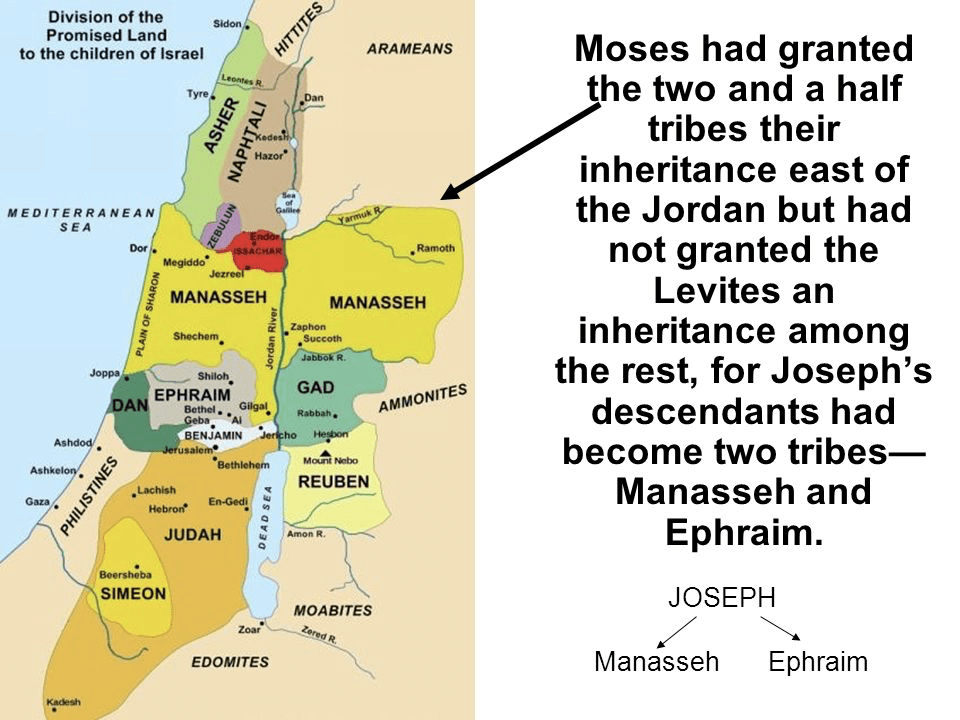
Chapter 13 begins: 13:1 “Now Joshua was old and advanced in years when the Lord said to him, “You are old and advanced in years (probably in his late 80’s), and very much of the land remains to be possessed.” He is told to give the land of Canaan west of the Jordan River to the 9 1/2 tribes (the half of the tribe of Manasseh) and to give the land east of the Jordan to the 2 1//2 tribes of Reuben, Gad, and half of the tribe of Manasseh. Here is a great map of the land that Israel had not yet conquered as Joshua neared the end of his life. As you can see, there was still a lot of land to be conquered. Unfortunately, they did not finish conquering those lands. Notice they did not conqueer the Philistines and the Philistines will be a major thorn in their side in the future just as God predicted.
The next thing will be the actual division of the parts of Canaan that they did conquer.
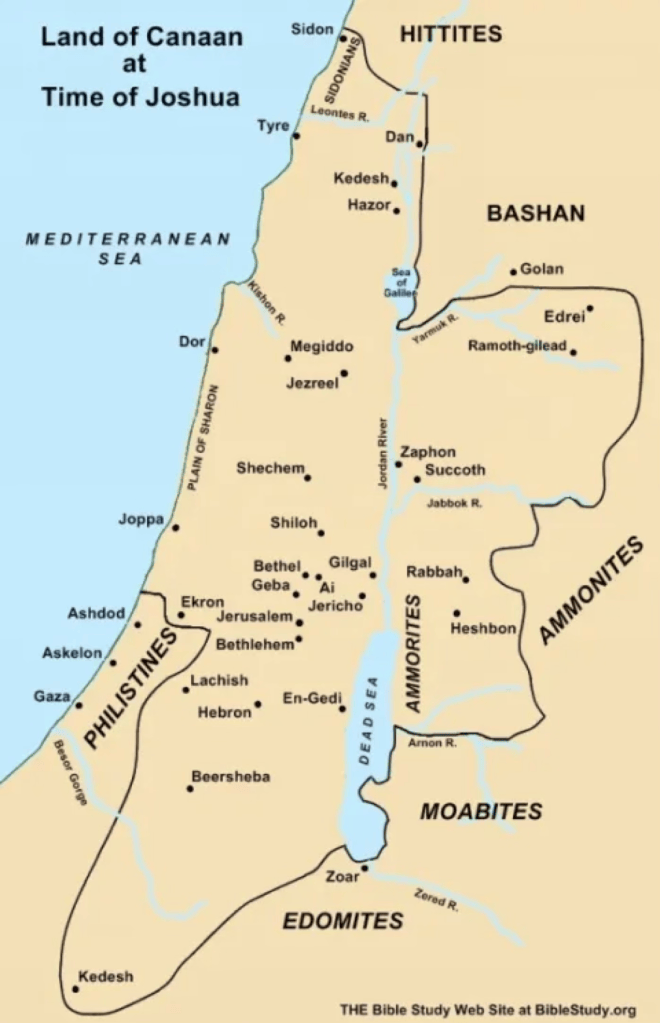
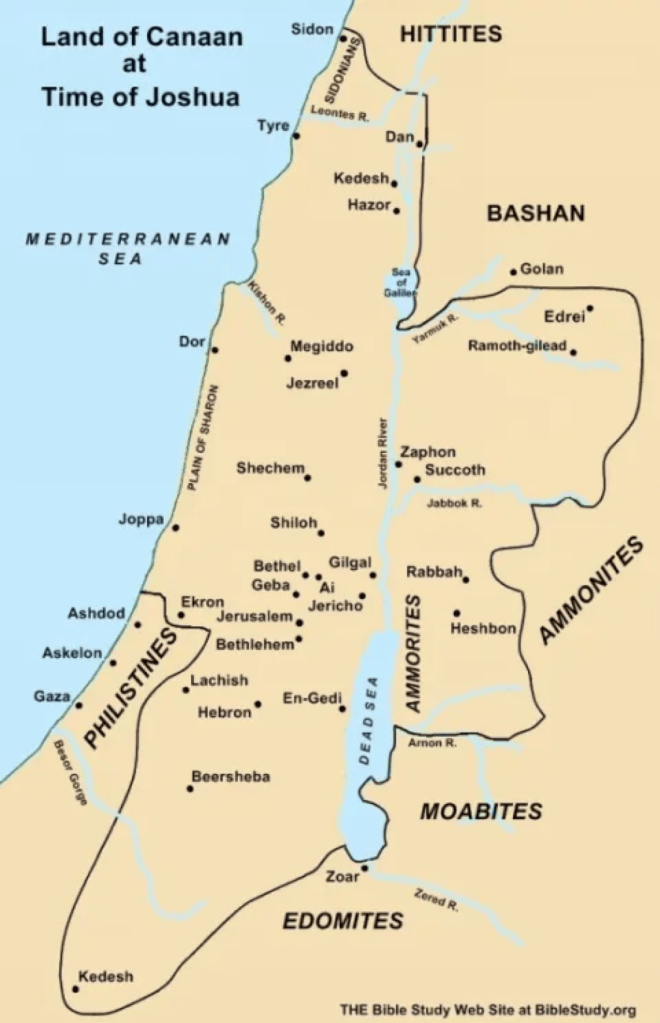
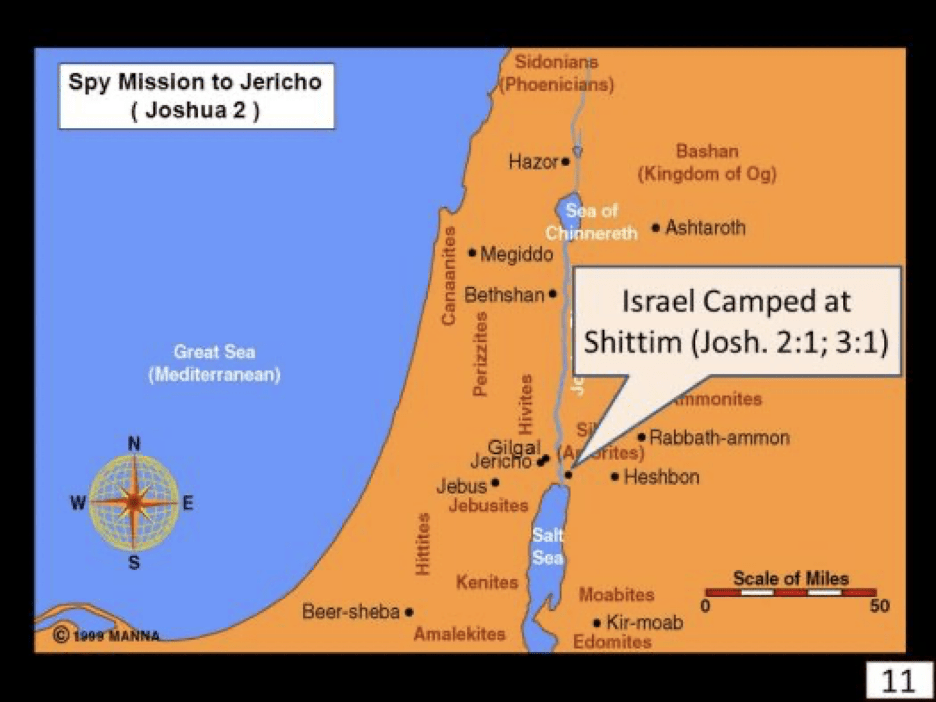
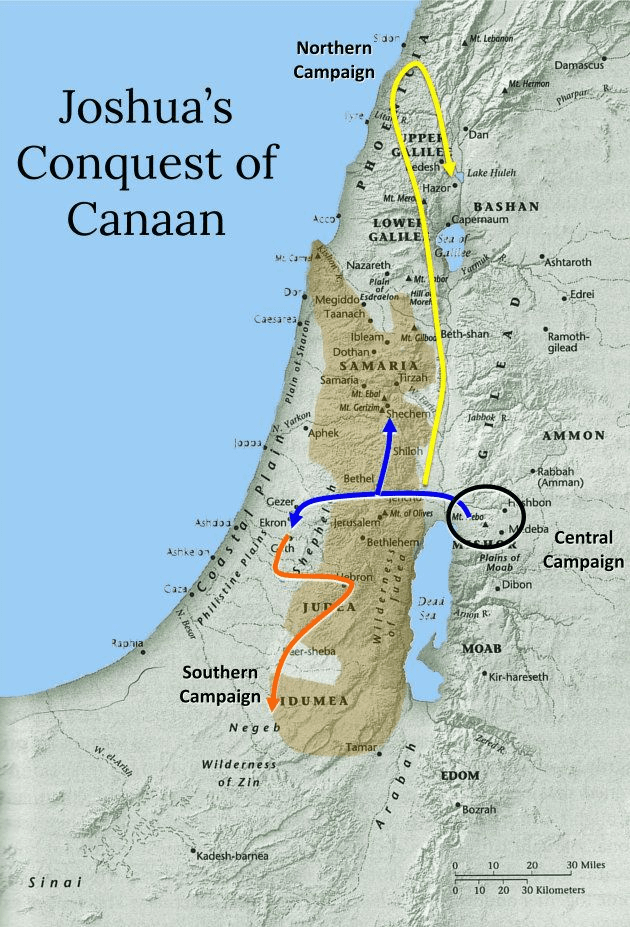
Here is a map of the land of Canaan at the time of Joshua to help see where the different cities are.
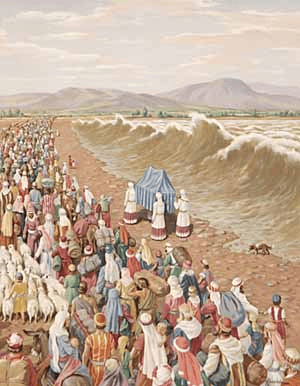
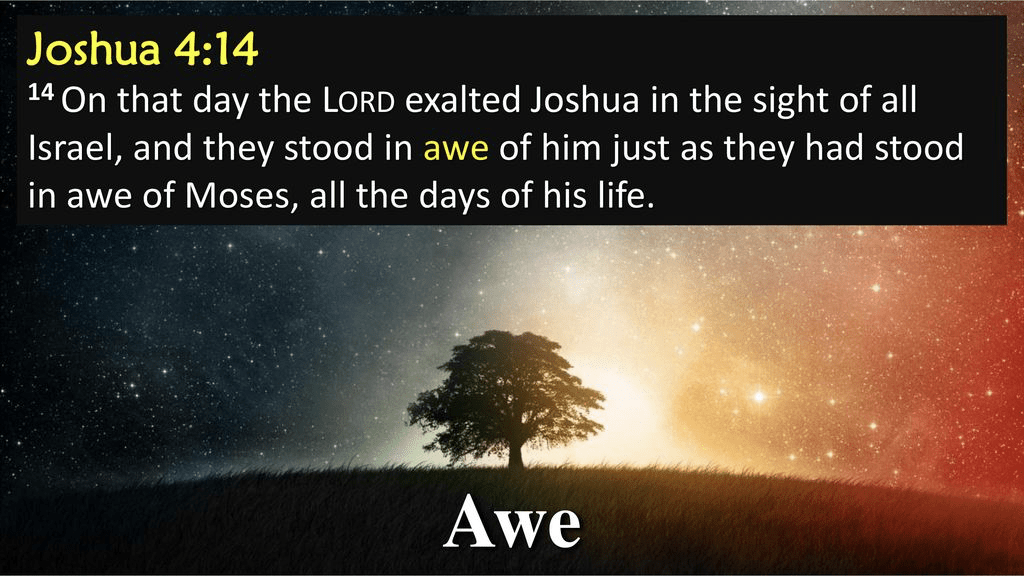
Joshua 4 The memorial stones from the crossing of the Jordan River. That crossing with the ark held by the. priests in the middle while the waters were held back and all Israel crossed over cand best be summed up by Joshua 4:14 On that day the Lord exalted Joshua in the sight of all Israel; so that they revered him, just as they had revered Moses all the days of his life.” Moses had brought the Israelites out of Egypt with miraculous signs and wonders, had parted the Red Sea and drowned the Egyptian chariots, and had led Israel 40 years in the wilderness. It was important for God to confirm that Joshua had been appointed by God to take Moses’ place and lead the people to conquer Canaan. So they took 12 stones from Jordan River bed, one for each tribe, and made a memorial so they could tell their children that God had dried up the water of the Jordan just like God parted the Red Sea. Life Lesson: If you have children, are you teaching your children the Bible stories about the amazing acts of God in history? It is our responsibility as parents to teach our children what God has done. Don’t leave it to the Sunday school teachers at church, although that is a great supplement. You should teach them at home. Read Bible stories and pray with them. I am so thrilled to hear about Eastern European Mission printing hundreds of thousands of children’s Bible story books and giving them out all across eastern Europe and to the Ukraine. I hear so man wonderful stories of children so excited about getting one of the books. Praise God for the work of EEM. $5 can print and distribute one children’s Bible story books. That’s a cup of coffee at Star Bucks!
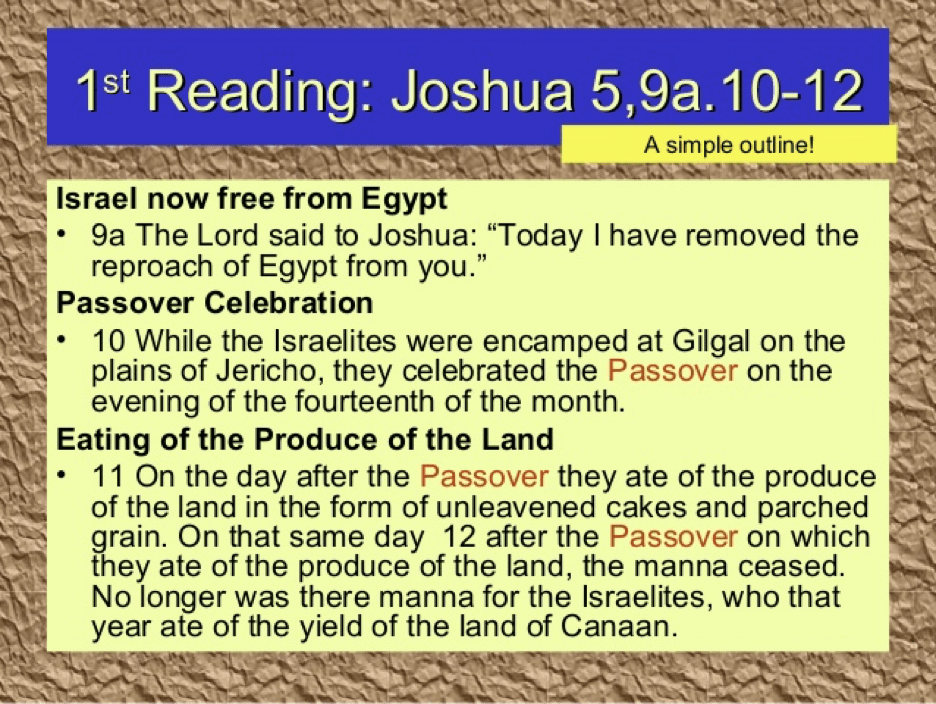
Joshua 5 Circumcision and Passover. When the Canaanite kings heard how God dried up the Jordan and thatBut Israel had crossed over the Jordan, their hearts melted with fear. But there was something that Israel needed to do before beginning the conquest of Canaan. Apparently they had not circumcised any of the male babies born during the 40 years in the wilderness, so they had a mass circumcision. This was risky. Do you remember when Simeon and Levi convinced all the men of Shechem to be circumcised so they could presuamably marry into Jacob’s family? It was a cunning, deceptive plot. When the circumcised men of Shechem were “laid up” after the circumcisions, they were unable to fight and Simeon and Levi came in and killed them all as revenge for the ruler Shechem raping their sister Dinah. So Israel was taking a big risk by getting circumcised. The Canaanite kings could have heard about that and attacked the newly circumcised Israelite men while they were weak from the circumcision. 5:9 Then the Lord said to Joshua, “Today I have rolled away the reproach of Egypt from you.” So the name of that place is called Gilgal (which means “rolling”) to this day.” The place was also called Gibeath-haaraloth (which means “hill of foreskins”). You can imagine the mound of foreskins from 600,000 men! Gross.
While camped at Gilgal, they observed the Passover on the 14th day of the 1st month of the Hebrew calendar. This was a big deal. Apparently they had not celebrated the Passover since they were at Sinai in the 2nd year after coming out of Egypt. That’s 39 years of no Passover. Those born during that 39 years were never circumcised and you couldn’t eat the Passover if you weren’t circumcised. Those over 20 were destined to die in the wilderness and probably didn’t even care if they did the Passover. Not only that, but Acts 7 tells us, 7:42 But God turned away and delivered them up to serve the host of heaven; as it is written in the book of the prophets, ‘It was not to Me that you offered victims and sacrifices forty years in the wilderness, was it, O house of Israel? 43 You also took along the tabernacle of Moloch and the star of the god Rompha, the images which you made to worship.’ The Israelites over 20 who were destined to die in the 40 years were worshipping false gods so they would not have been interested in keeping the Passover.
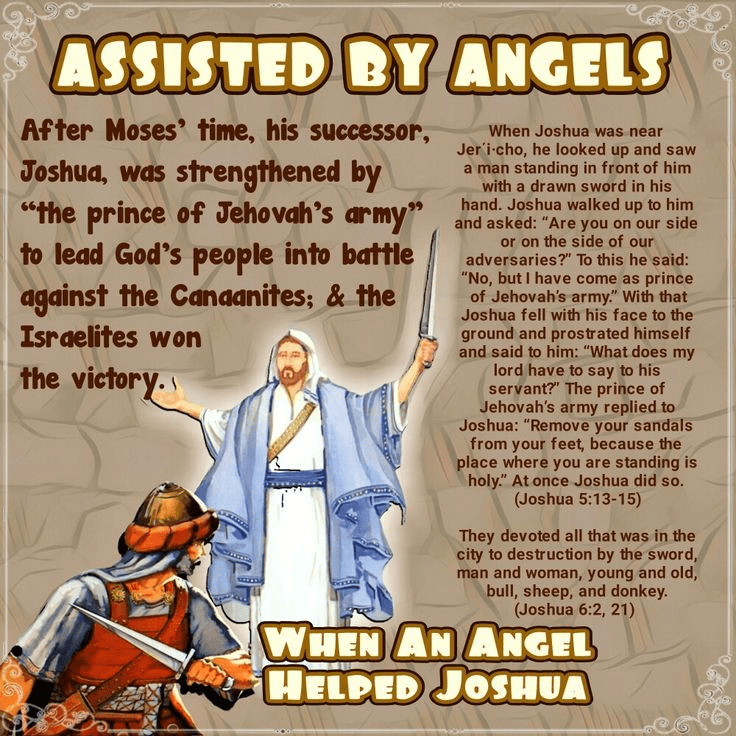
The “captain of the Lord’s hosts” came as a man to meet Joshua. He told Joshua to take off his sandals b/c he was standing on holy ground, i.e. in the presence of the Lord Himself in the form of a man, possibly the pre-incarnate Jesus. Do you remember that Moses was told the same thing at the burning bush in Exodus 3:5? This man is the one doing the speaking in chapter 6.
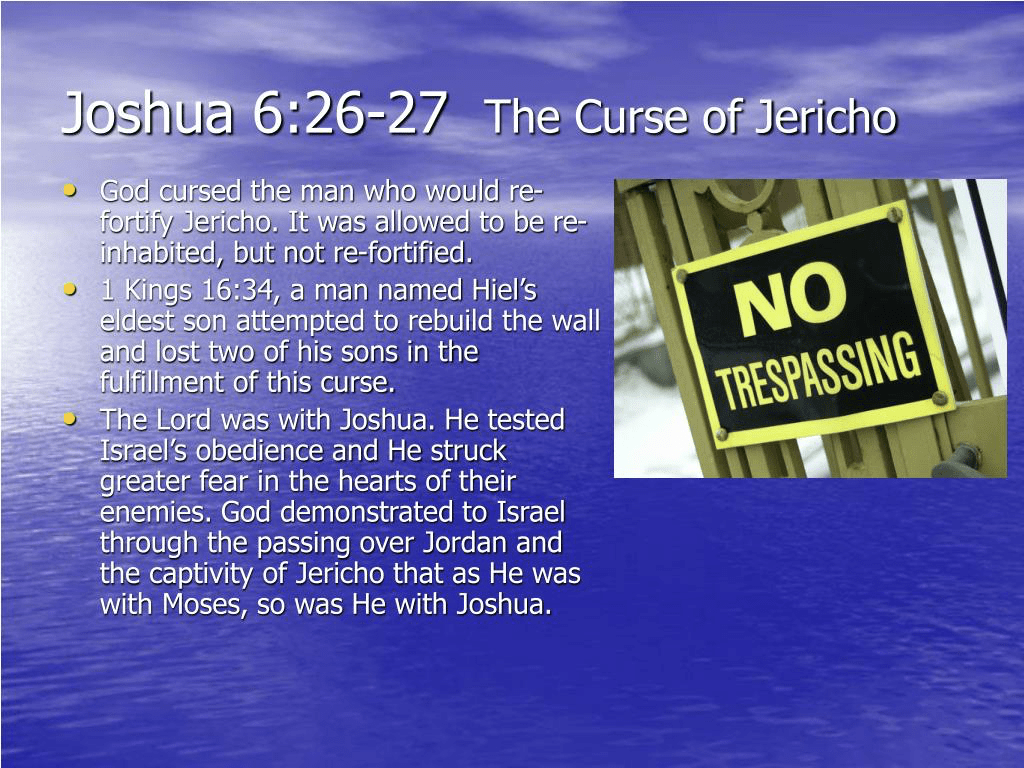
Joshua 6. It is the captain of the Lord’s host who is still speaking to Joshua, and yet it says “The Lord said to Joshua…” So the man was the Lord himself, God taking the form of a man to give Joshua the battle plan for taking Jericho. Think about how crazy this battle plan sounded to Joshua and the fighting men of Israel. March around the city once a day without saying word for 6 days and then march around the city on the 7th day, blow the trumpet, and shout and the walls will come tumbling down! It would take about an hour for the 40,000 men to walk around Jericho. Everyone in the city would have heard the continuous blowing of the trumpets as they marched, which was probably eerie. But then on the 7th day, up to 7 hours of non stop trumpet had to be rattling for the people in the city, as if they knew something big was about to happen. Imagine their horror as they heard this loud shout of 40,000 men and the walls start tumbling down all around the perimeter of the city. That is, all but the part of the wall with Rahab’s house. The 2 spies were told to go rescue Rahab and her family, and they did. A ban was put on taking anything from the city as spoils or booty (remember that). Everyone and everything in the city was to be destroyed and the city burned. A curse was put on anyone rebuilding the city with the loss of his oldest and youngest sons. Hiel of Bethel attempted and completed the rebuilding of Jericho during the reign of King Ahab, according to the biblical account in 1 Kings 16:34. According to the text, Hiel laid the foundation at the cost of his oldest son, Abiram, and set up the gates at the cost of his youngest son, Segub, fulfilling Joshua’s warning. This may interest your from AI:
Archaeologists have found collapsed ancient fortification walls at the site of Tell es-Sultan (ancient Jericho), but how those findings connect to the biblical account remains a subject of ongoing scholarly debate. What Archaeologists Discovered:
Excavations led by figures like John Garstang, Kathleen Kenyon, and more recently Lorenzo Nigro have uncovered extensive ruins at Jericho, revealing a history of massive defensive walls and violent destruction: Scholars debate if these ruins are the actual ruins of the fall of the walls under Joshua.
Collapsed Bricks: Excavations found fallen piles of mud-brick retaining walls at the base of the mound, which researchers noted had collapsed outward.
Burn Layers: Archaeologists identified a thick layer of ash and burn debris, indicating the city met its end in a massive fire.
Stored Provisions: Large jars filled with charred grain were discovered intact, suggesting the city was conquered rapidly rather than starved out during a long siege.
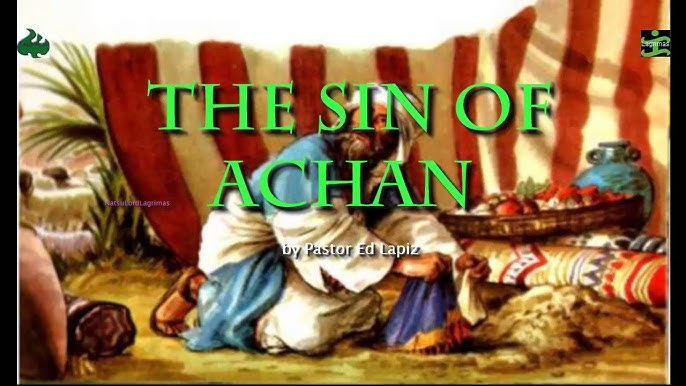
Joshua 7. Chapter 7 is difficult to discuss. Achan violated the ban on Jericho and took gold, silver, and valuable mantle from Jericho and buried them in his tent. B/c of that, Israel was defeated when they sent 3,000 men to take the small city of Ai. At least 36 Israelites were killed and the Israelite force was routed by the man of Ai. Joshua started questioning God about why He had let them lose the battle, how the other Canaanites would hear about the defeat and take courage to fight Israel. God told him there was sin in the camp. Joshua went tribe by tribe, family by family, down to individuals until he found the guilty party, Achan, who confessed. So they took Achan, his sons, his daughters, his livestock, and all his possessions and stoned them to death and burned them. They raised over them a heap of stones and called it the valley of Achor (which means trouble).
BTW there might be a little Life Lesson here. Don’t take success for granted. Joshua was relying on his own knowledge and military reasoning. He thought 3,000 men would be plenty to take Ai, but he never consulted with the Lord, “Lord should we take Ai now?” If he had, the Lord would have told him to deal with the sin in the camp first and then go take Ai. James warned us about that: James 4:13 Come now, you who say, “Today or tomorrow we will go to such and such a city, and spend a year there and engage in business and make a profit.” 14 Yet you do not know what your life will be like tomorrow. You are just a vapor that appears for a little while and then vanishes away. 15 Instead, you ought to say, “If the Lord wills, we will live and also do this or that.” 16 But as it is, you boast in your arrogance; all such boasting is evil.” Always consult God before decisions.
But what bothers me are 2 nagging questions. 1) Why was all Israel punished by the defeat at Ai when it was just one man who violated the ban? There doesn’t seem to be any indication that anyone else knew about what Achan did. I really can’t answer my own question! I read where scholars try to explain it as “corporate personality”, i.e. a group stands or falls together as one. All I can say is that God wanted to make an example to Israel of what happens when someone disobeys Him. It is sad that at least 36 innocent men died to make that example. Maybe God is saying that Israel should have been more careful to make sure no one took anything from the city. They could have placed more guards to watch for anyone coming from the city with valuables. What I do know is that God’s people must purge the corporate body of anyone who sins repeatedly and will not repent. In 1 Corinthians 5 Paul tells the church to withdraw fellowship from unrepentant church members, to quit eating and fellowshipping them. 2) Why were Achan’s sons and daughters stoned to death along with Achan for his sin? There is no indication they had anything to do with his sin. Of course if they did know, they should have reported it to Joshua. Deuteronomy 24:16 Fathers shall not be put to death for their sons, nor shall sons be put to death for their fathers; everyone shall be put to death for his own sin.” So it looks like a complete violation of that verse to kill his children, which is why some scholars say that the children must have known about his sin but didn’t report it. Maybe so. For sure, it shows how much responsibility God puts on fathers to lead their families in the right way. I guess I need to quit asking questions that I can’t satisfactorily answer. I wish I could hear your comments as you study this dilemma.
The preacher where I was raised preached a sermon “Sin in the Camp” when I was about 14. He got up and just said “there is sin in the camp here at this church”, and then he sat down. They sang another song and he got back up and finished the sermon, telling about the story of the sin of Achan. That kinda shook us all up a little and I got baptized that morning! Some others came forward also to confess sins. Looking back I totally disagree with what the preacher did but it got me in the water! Of course, I think I was baptize with one thing in mind, “to not go to hell”. I was baptized again at age 21!
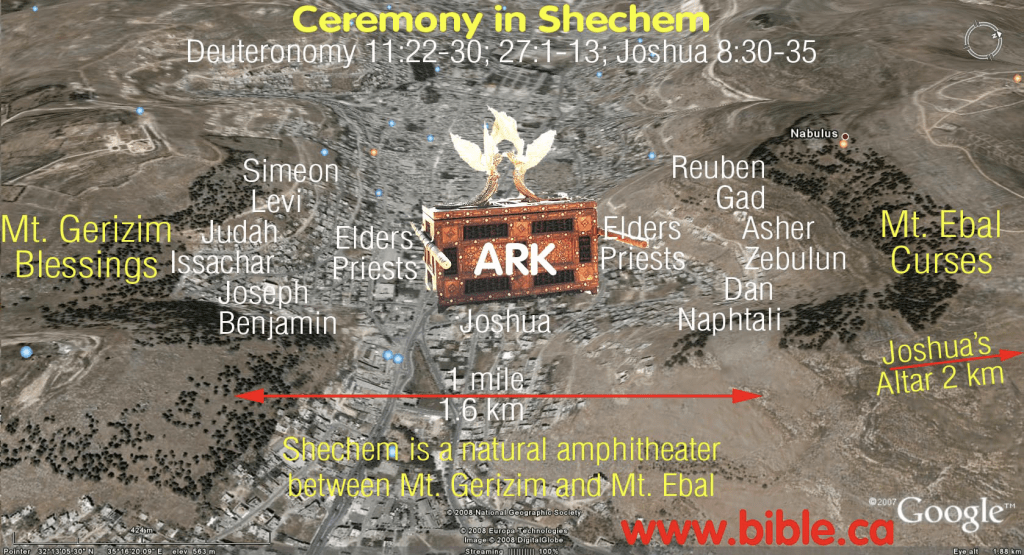
Joshua 8. The conquest of Ai. Having dealt with Achan, Joshua set up a plan to ambush the men of Ai and destroyed 12,000 “men and women” in Ai and burned the city. He hanged the king of Ai. So things are back on track to conquer Canaan. Then Joshua had half the 12 tribes stand on Mt Ebal and half on Mt Gerizim. He read the blessings and curses of Deuteronomy 27-28 just as Moses had told the people to do when they entered Canaan. Locate Jericho, Ai, and Gilgal on the map.
Deuteronomy 33: Moses gives a blessing to each of the 12 tribes.
Deuteronomy 34: The death of Moses. In Deuteronomy 32 Moses was told to go up on Mt Nebo to die, but here he goes to the top of Pisgah. Mount Pisgah and Mount Nebo are closely connected in the Bible, but scholars debate whether they are the exact same peak or two different peaks on the same ridge. Either way, it would have been high enough to see much of the Promised Land since Mt Nebo has an elevation of 3300 feet. 34:1 Now Moses went up from the plains of Moab to Mount Nebo, to the top of Pisgah, which is opposite Jericho. And the Lord showed him all the land,5 So Moses the servant of the Lord died there in the land of Moab, according to the word of the Lord. 6 And He buried him in the valley in the land of Moab, opposite Beth-peor; but no man knows his burial place to this day.” AI: “Known locally by its Arabic name, Siyagha, Mt. Nebo began attracting Christian worshipers in the early fourth century, when Christianity was acknowledged in the Roman Empire as a lawful religion. Its connection to Moses and the Exodus narrative brought in Christian monks, who wanted to live and pray near where Moses was buried, as well as pilgrims, who wished to commemorate the prophet and contemplate God’s promises to his people.” (Biblical Archaeology Society article).
An interessting verse in Jude 1:9 But Michael the archangel, when he disputed with the devil and argued about the body of Moses, did not dare pronounce against him a railing judgment, but said, “The Lord rebuke you!” We don’t know why the devil wanted the body of Moses. AI: “Many scholars suggest that Satan wanted to reveal the location of Moses’ grave so the Israelites would turn his remains into an object of worship or an idolatrous shrine. Another view, supported by scholars like Richard Bauckham, is that Satan laid a legal claim to Moses because Moses was a sinner and a murderer (having killed an Egyptian in Exodus 2:12). Under this theory, Satan argued that Moses stood condemned under the law, giving the devil a rightful claim over his body and soul.” We don’t know why the devil wanted the body of Moses. But Michael rebuked him. Moses was the only man God spoke face to face with. He had his weaknesses, but he ended up serving God for 120 years. The grace of God that saved Abraham and David (Romans 4) would save Moses in spite of his sin at Meribah. He would appear with Elijah on the Mt of Transfiguration making it even clearer that he was in a good place after he died and was not with the devil.
What a great complement is paid to Moses. 34:10 Since that time no prophet has risen in Israel like Moses, whom the Lord knew face to face, 11 for all the signs and wonders which the Lord sent him to perform in the land of Egypt against Pharaoh, all his servants, and all his land, 12 and for all the mighty power and for all the great terror which Moses performed in the sight of all Israel.” He was also the great lawgiver. John 1:17 For the Law was given through Moses; grace and truth were realized through Jesus Christ.” He was the great deliverer of God’s people from slavery, a type of Jesu, the even greater deliverer of God’s people from spiritual slavery (Hebrews 3:1-4).
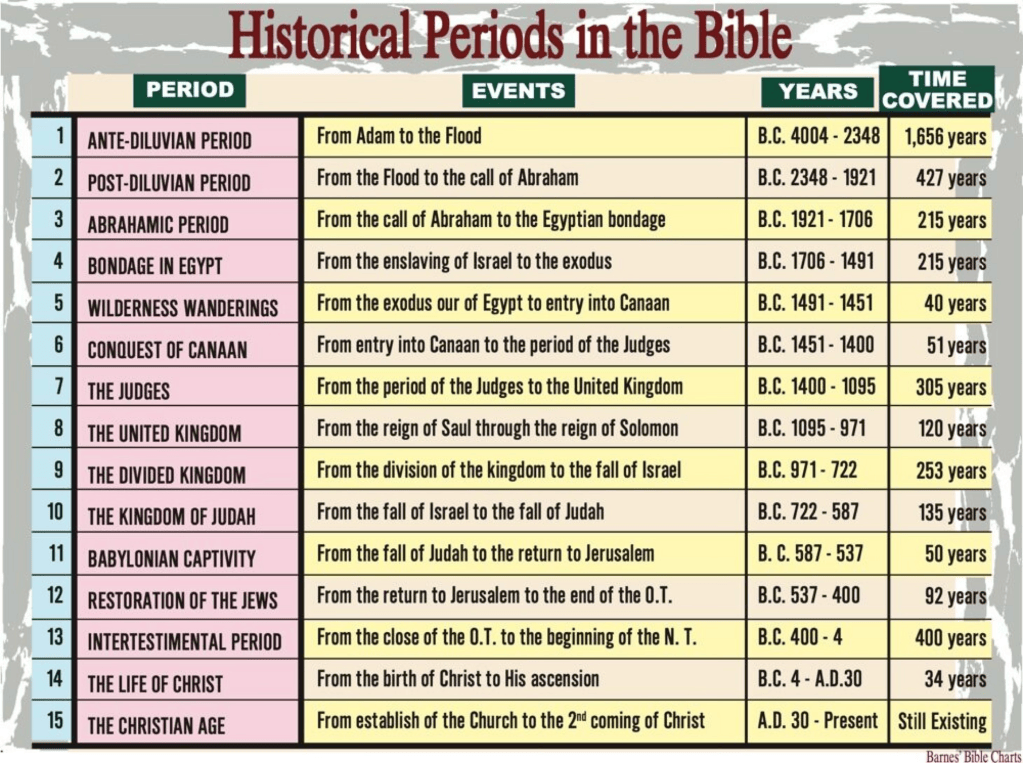
THE CONQUEST OF CANAAN PERIOD. The 6th period of Old Testament history.
THE BOOK OF JOSHUA
Joshua 1: Still camped on the plains of Moab 3 days before entering Canaan, God tells Joshua 3 times “Be strong and courageous”. He has faith that God will give Israel victory over the fortified cities and stron armies of the Canaanite nations, but he will need courage. He and his Israelires army will be fighting for 7 1/2 years, conquering 31 Canaanite kings.
Joshua 2: Jericho sent 2 spies out “secretly” to spy out Canaan, especially Jericho. That was pretty smart. I’m sure he wanted to avoid what happened when the 12 spies went out 40 years ago and caused a rebellion against Moses and God. Most of us know the story of Rahab hiding the 2 spies and then helping them escape the city through a window in her house which was on the outer wall. I want to focus on what made her decide to start following Yahweh, the God of the Israelites. Joshua 1: 9 and said to the men, “I know that the Lord has given you the land, and that the terror of you has fallen on us, and that all the inhabitants of the land have melted away before you. 10 For we have heard how the Lord dried up the water of the Red Sea before you when you came out of Egypt, and what you did to the two kings of the Amorites who were beyond the Jordan, to Sihon and Og, whom you utterly destroyed. 11 When we heard it, our hearts melted and no courage remained in any man any longer because of you; for the Lord your God, He is God in heaven above and on earth beneath. ” The spies came back to Joshua with a different report than the 10 spies did 40 years ago when they spied out the same land. “They said to Joshua, “Surely the Lord has given all the land into our hands; moreover, all the inhabitants of the land have melted away before us.”
Observation: Not just Rahab but all the inhabitants of the land of Canaan heard about the 10 plagues, the parting of the Red Sea, and the defeat of Og and Sihon. They all could have converted to follow Yahweh just like Rahab did. So don’t feel like God is being too harsh in commanding the Israelites to totally destroy all the Canaanite pagan nations. They worshipped other gods for a long time. They had heard of the God of Israel back in the days of Abraham, Isaac, and Jacob. God even sent Melchizadek as a priest and king of Salem (later Jerusalem) to try to convert some of them but we don’t know if he had any success. An interesting verse, God told Abraham in Genesis 15:16 Then in the fourth generation (of being slaves in Egypt) they (Israel) will return here (to Canaan), for the iniquity of the Amorite is not yet complete.” God was patient with pagan nations up to a certain point. When He decided that a nation was “past the point of no return” He would destroy that nation. “The cup of God’s wrath” would become full and He would exercise justice, which He the just judge of the world has the right and obligation to do.
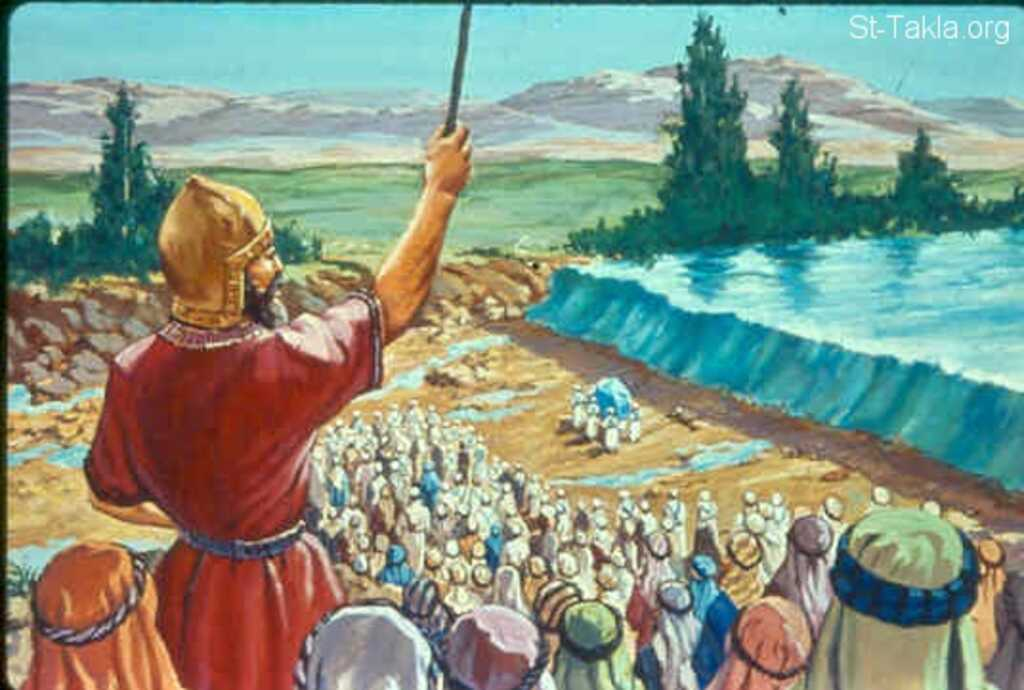
Joshua 3: The crossing of the Jordan was an important step in showing that God had chosen Joshua to lead the people in the conquest of Canaan. It was what the parting of the Red Sea was to confirm Moses as God’s leader. This of course was not a “parting of the Jordan” but the backing up of a river since it was a river and not a sea. The ark, carried by the priests, would remain in the bed of the Jordan until everyone had crossed over, which would take a long time since there were probably over 1 1/2 million Israelites. As each person crossed over and saw the ark standing by the waters held back, it would have reminded them that their God Yahweh was all powerful. 3:10 Joshua said, “By this you shall know that the living God is among you, and that He will assuredly dispossess from before you the Canaanite, the Hittite, the Hivite, the Perizzite, the Girgashite, the Amorite, and the Jebusite.”
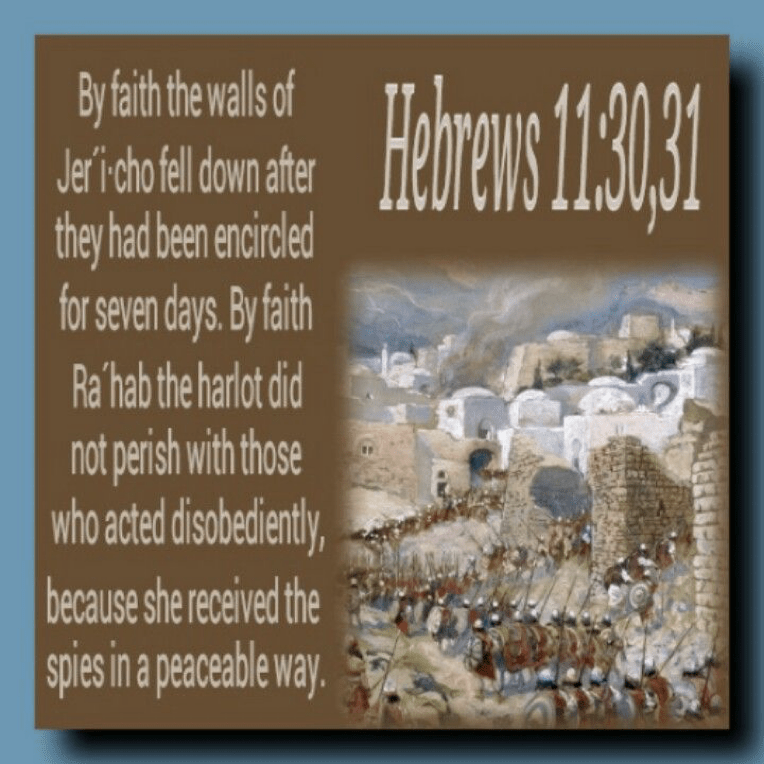
BY FAITH THE WALLS OF JERICHO FELL DOWN Hebrews 11:30 By faith the walls of Jericho fell down after the Israelites had marched around them for seven days.” It is interesting that the Hebrew writer picks this one event from the period of the conquest of the promised land under Joshua, who took Moses’ place leading Israel after Moses died. He could have cited Joshua’s faith when Joshua was one of the 12 spies sent to spy out the land and only Joshua and Caleb had faith that God could defeat the Canaanites. He could have cited Joshua’s great faith in asking God to make the sun stand still so that Israel could get a more complete victory over the Amorites. Would you have ever thought to ask God for such an amazing miracle? But for some reason the Hebrew writer chose the fall of Jericho as this hall of faith moment of faith during the period of the conquest. This incident would have included the faith of Joshua and the Israelite army. The “captain of the army of the Lord” had appeared to Joshua at Gilgal as a man with a sword. This man was God Himself and told Joshua to take off his sandals b/c he was standing on holy ground (i.e. in the presence of God Himself, just as Moses was at the burning bush) (Joshua 5:13-15) In Joshua 6 this man (and it calls him “the Lord”) gives Joshua the battle plan for taking Jericho. It would not be a long siege of the city to starve them to surrender, or build siege towers on ramps to attack. The plan was to march around the city one time each day for 6 days (without saying a word) with the ark of the covenant and the priests in front. Can you imagine the derisive, mocking calls directed toward them from the men from Jericho from the top of the walls. Then to march around the city 7 times on the 7th day, and at the blowing of the trumpets by the priest the army was to shout and the walls would fall. Joshua never questioned the Lord about this crazy plan. It would take about 1 hour to march around the city that had a 1/2 mile circumference. Joshua 4 perhaps indicates that 40,000 Israelites marched around the walls. 4:12 The sons of Reuben, the sons of Gad, and the half-tribe of Manasseh crossed over in battle formation before the sons of Israel, just as Moses had spoken to them; 13 about forty thousand equipped for war, crossed for battle before the Lord to the desert plains of Jericho.” That verse referred to the crossing of the Jordan but perhaps tells us the number of men who marched around the city. 40,000 men marching around the city had to be an impressive sight and their silence as they marched had to be nerve wracking to the men of Jericho as they watched! By faith he told his army about the plan. They never questioned the plan saying, “Joshua, are you serious? That is your plan for taking the city?” The Israelites had faith also as they marched around the city. After that last time around the city on the 7th day, they had faith that when they shouted that the walls would fall, and they did. So they would march 7 hours around the city on that 7th day. Give credit to this generation of Israelites. The generation (age 20 and above) that came out of Egypt in the exodus all died in the 40 years in the wilderness b/c of lack of faith (Hebrews 3). Those 20 and under when they came out of Egypt and those born during the 40 years made up the new generation that entered the promised land by faith. Jericho was the first city in the promised land to be conquered. Judges 2 pays a great compliment to that new generation: 7 The people served the Lord all the days of Joshua, and all the days of the elders who survived Joshua, who had seen all the great work of the Lord which He had done for Israel.” That new generation conquered the major cities and armies of the Canaanites in 7 1/2 years (although they did not completely destroy all the Canaanites as God had commanded them). The generation after them would revert to a generation lacking faith. Judges 2:10 All that generation (i.e. the generation that conquered Canaan) also were gathered to their fathers; and another generation rose up after them who did not know the Lord, nor even the work which He had done for Israel.” That would be the generation that began the period of the judges during which the Israelites forsook God and worshipped other gods for over 300 years. So the new generation that conquered the land would be the only faithful generation for over 300 years.
THE COMPARISON TO OUR HISTORY IN THE USA That new generation was like the “Greatest Generation” here in the USA. AI: “The generation immediately preceding the Greatest Generation (born 1901–1927) is generally known as the Lost Generation. Born roughly between 1883 and 1900, this cohort came of age during World War I and was shaped by the societal shifts following the industrial revolution, with many experiencing disillusionment after the war.” That might be comparable to the “lost” generation of Israelites who spent 40 years in the wilderness. I’m sure they felt “disallusioned” also, knowing their fate to gradually all die in the wilderness. “The Greatest Generation that followed the Lost Generation was born 1901–1927, and is the American cohort that lived through the Great Depression and fought in World War II. Coined by Tom Brokaw, this term honors their resilience, patriotism, and sacrifice. They are known for their commitment to duty, frugality, and for building modern post-war America.” They built the churches that made America great. Alexis de Tocqueville (1805–1859), a French political thinker and historian who visited the United States in 1831-1832 said that religion played a crucial role in American democracy by fostering morality and supporting freedom. He observed that American religious life was robust and that churches helped sustain the “virtue” needed for a self-governing society.” Their work ethic made America great. That would include the parents of my wife and me. The history of the USA kinda parallels the story in Joshua and Judges. The generation after the greatest generation was the “baby boomers”. Whether Baby Boomers were a “good” generation is heavily debated, Boomers were active in fighting for equality, inclusivity, and individual rights in the 1960s and 70s, contributing to a more open society. They helped drive changes in racial, gender, and sexual equality. But critics often label them a “selfish” generation, preoccupied with gaining wealth. Boomers are often criticized for shifting from the social activism of the 1960s to a culture of consumerism, materialism, and self-indulgence in the 1970s and 80s. They brought in the “sexual revolution” and use of drugs (Woodstock, 1969). Baby boomers (born 1946–1964) have had a higher, and significantly more unstable, divorce rate than the Greatest Generation. As of 2025, baby boomers still hold the highest divorce rate of any generation ever in the US, often termed “gray divorce” when occurring later in life, breaking from the more traditional, long-lasting marriage norms of their parents.” Most of the greatest generation would not even think about divorcing even if they were not “happy” in marriage. My wife’s mom would not even allow her daughter to say the word “divorce”. It just wasn’t an option! My dad’s parents seemed pretty miserable in their 80 year long marriage, but they would never have considered divorce. Some of that was the social stigma of divorce and some was the Bible teaching about not divorcing. I found my grandmom’s journal where she kept notes for the “Baptist Church of Christ”. I wish I knew more about that! Some of it they were just too tired raising 10 kids on the farm working hard from sunrise to sunset to worry about divorcing! The overall U.S. divorce rate has declined significantly since peaking around 1980, when baby boomers were young adults, dropping to its lowest level in 40 years. While divorce rates fell for younger generations (Gen X/Millennials), the divorce rate for those over 50 (the “gray divorce” trend) actually doubled from 1990 to 2017. Younger generations often cite witnessing the pain of their parents’ (boomer) divorces as a motivation to keep their own marriages together. Additionally, marrying at older ages, higher education levels, and cohabitation before marriage have reduced divorce rates.” (AI) But let’s give the boomers some credit. Most continued to believe in God and the Bible, went to church, and tried to raise their children in the right way. “ It was the millennials, not the boomers, who were a major driving force behind the decline in American belief that the Bible is the literal word of God. Research shows they are more skeptical of the Bible, with a large portion viewing it as a book of myths or fairy tales, or as an outdated document, rather than divine scripture. Millennials are more likely than older generations to identify as atheists, agnostics, or “nothing in particular,” separating themselves from traditional religious beliefs.” (AI) Then there’s Gen Z. “Gen Z did not start the LGBTQ movement, but they significantly accelerated its visibility, acceptance, and adoption of queer identities, with up to 30% of them identifying as LGBTQ+.” (AI) Sounds a lot like the period of the Judges to me! I’m thankful for our “greatest generation” that he had.
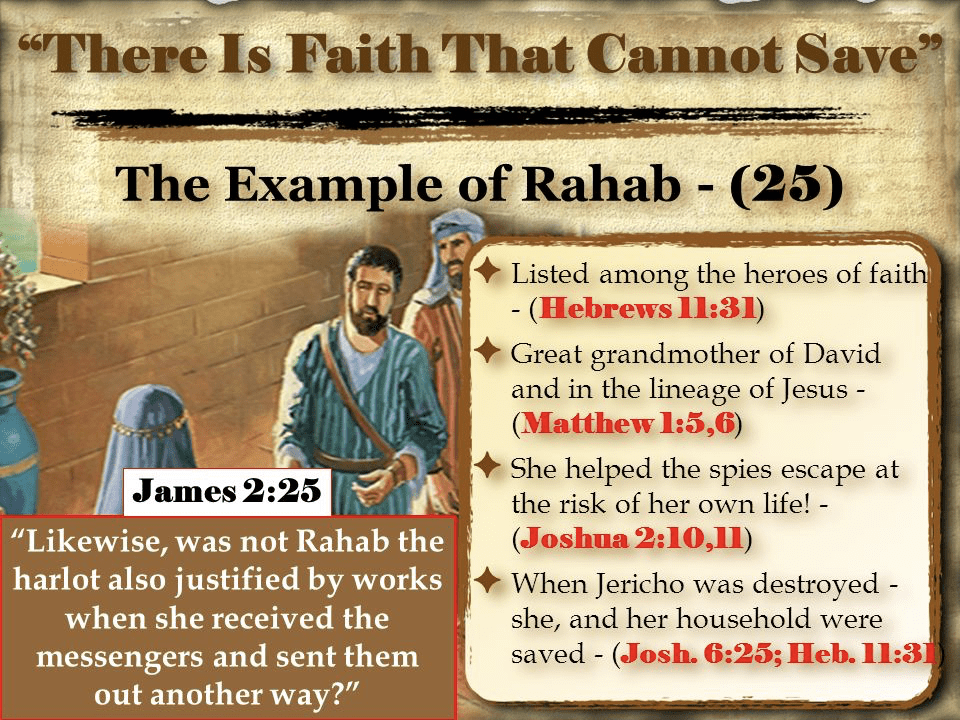
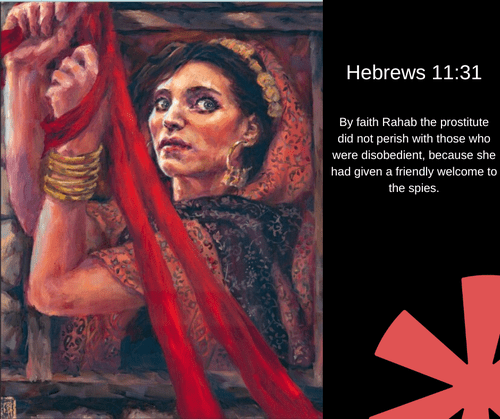
BY FAITH RAHAB WAS SAVED FROM THE DESTRUCTION OF JERICHO AND ITS PEOPLE Hebrews 11:31 By faith the prostitute Rahab did not perish along with those who were disobedient, after she had welcomed the spies in peace.” So what was the faith of Rahab based on? The king of Jericho had heard that the 2 spies sent by Joshua to spy out the city had been to Rahab’s house, but Rahab told him that they had escaped. She had hidden them on the roof and later let them down by a rope through a window to escape from the city (her house was high on the city wall). She told the 2 spies: Joshua 2:9 “I know that the Lord has given you the land, and that the terror of you has fallen on us, and that all the inhabitants of the land have despaired because of you. 10 For we have heard how the Lord dried up the water of the Red Sea before you when you came out of Egypt, and what you did to the two kings of the Amorites who were beyond the Jordan, to Sihon and Og, whom you utterly destroyed. 11 When we heard these reports, our hearts melted and no courage remained in anyone any longer because of you; for the Lord your God, He is God in heaven above and on earth below. ” The reports about the exodus, the Red Sea, and the conquest of the Amorite kings had convinced her that the God of Israel was the only true God. BTW everyone in Jericho (and Canaan) heard about the plagues in Egypt where God showed His power over the false gods of Egypt. That should have told them that the God of Israel was more powerful than the Canaanite gods like Baal and Asherah, but Rahab was the only Canaanite who was converted to belief in the God of Israel. God gave all the Canaanites the same opportunity to believe before He sent the Israelites to judge and destroy them. Thus by faith she rescued the spies. She asked for the safety of her whole family and was promied that. She would gather her immediate family and relatives in her house and put a scarlet thread through the window to show Israel the only ones to spare in the city. The part of the wall with Rahab’s house did not fall. “Archaeologists, including German excavations of 1907-1909, found evidence that a portion of the northern wall did not collapse, unlike other sections.” (AI) ” Excavations by Garstang and Garwood from 1930-1936 found evidence of collapsed walls, intense burning (the Israelites burned Jericho), and massive grain storage (indicating a short siege as per the 7 day siege in Joshua)”. Rahab’s family was saved as promised. Joshua 6:22 And Joshua said to the two men who had spied out the land, “Go into the prostitute’s house and bring the woman and all she has out of there, just as you have sworn to her.” 23 So the young men who were spies went in and brought out Rahab, her father, her mother, her brothers, and all she had; they also brought out all her relatives, and placed them outside the camp of Israel.” The Hebrew writer doesn’t mention the saving of her whole family, but that is important. It shows her influence. Hopefully our faith in God and Jesus that saves us will lead to the salvation of our familes and many others. Yes, Rahab was a prostitute but I’m sure that changed after she joined Israel. Yes, she told a lie. She told the men who came searching for the spies that the spies had already escaped the city even though they were up on her roof. My sister in law once said, “She was a prostitute. What’s one more sin gonna hurt?” I’m sure God approved of that lie as part of her faith in saving the spies. If my family was in the back bedroom and a gunman came in and asked if anyone else was in the house, I would lie and say that no one else was in the house. Of course that doesn’t justify lying in general, which is a sin. James used the example of Rahab to show that “faith wihout works is dead”. James 2:24 You see that a person is justified by works and not by faith alone. 25 In the same way, was Rahab the prostitute not justified by works also when she received the messengers and sent them out by another way? ” Saving faith must be demonstrated by action (works) although the works do not save us. We are saved by grace through faith (Ephesians 2:8-10). What if Rahab had refused to hide the spies, saying “I do believe that the god of Israel is the one true God but I can’t help you. Helping you would endanger me and my whole family. I can’t let you in my house. Go find somewhere else to hide.” If she had said that, she would not have been saved in the destruction of Jericho and she would not have been saved from her sin of prostitution.
The Hebrew writer gave us two great examples of faith from the period of the conquest of Canaan. What a great chapter in Hebrews 11.
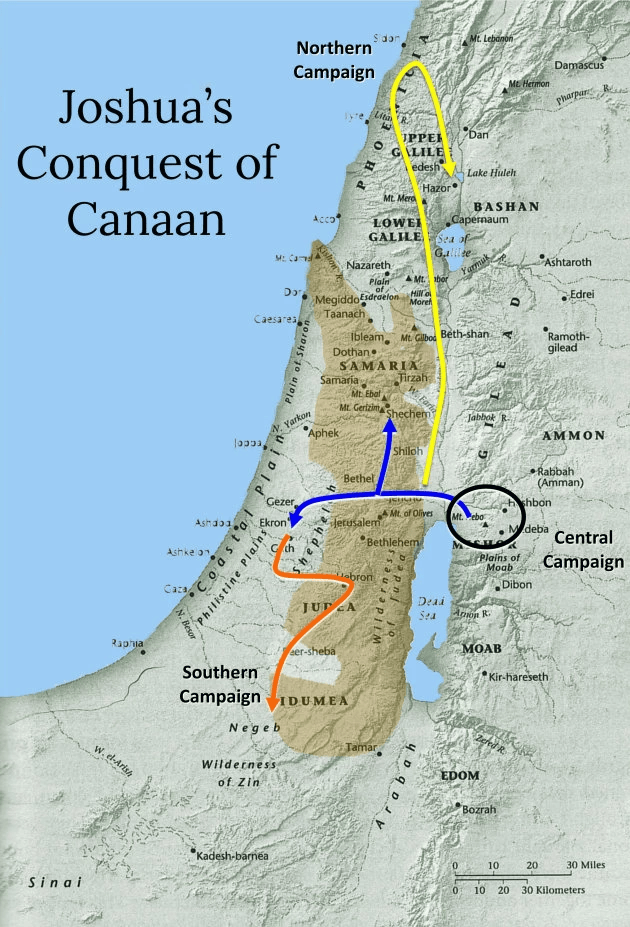
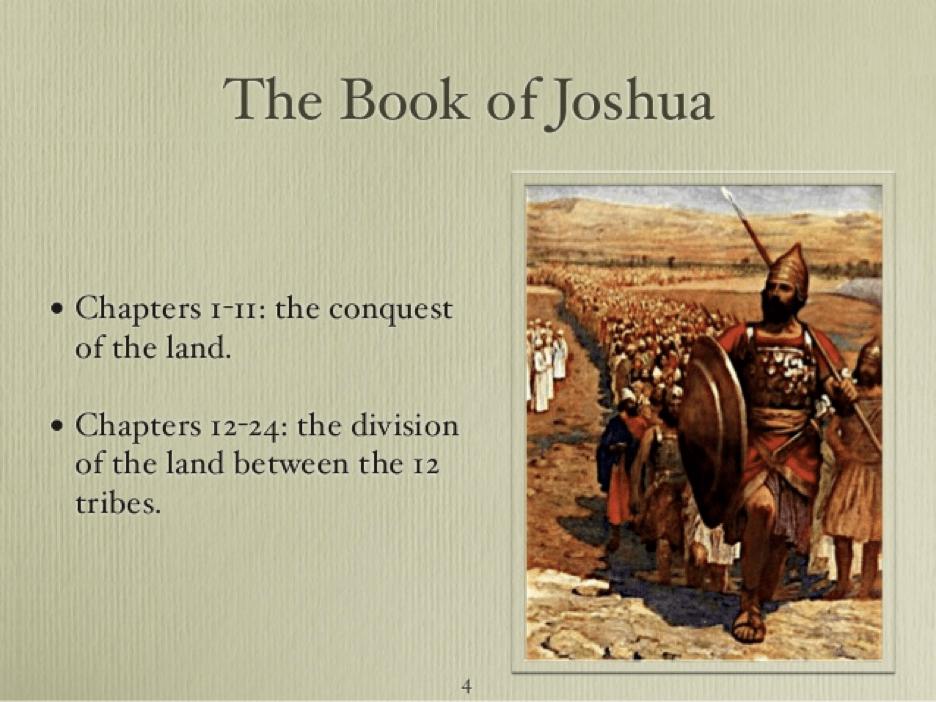
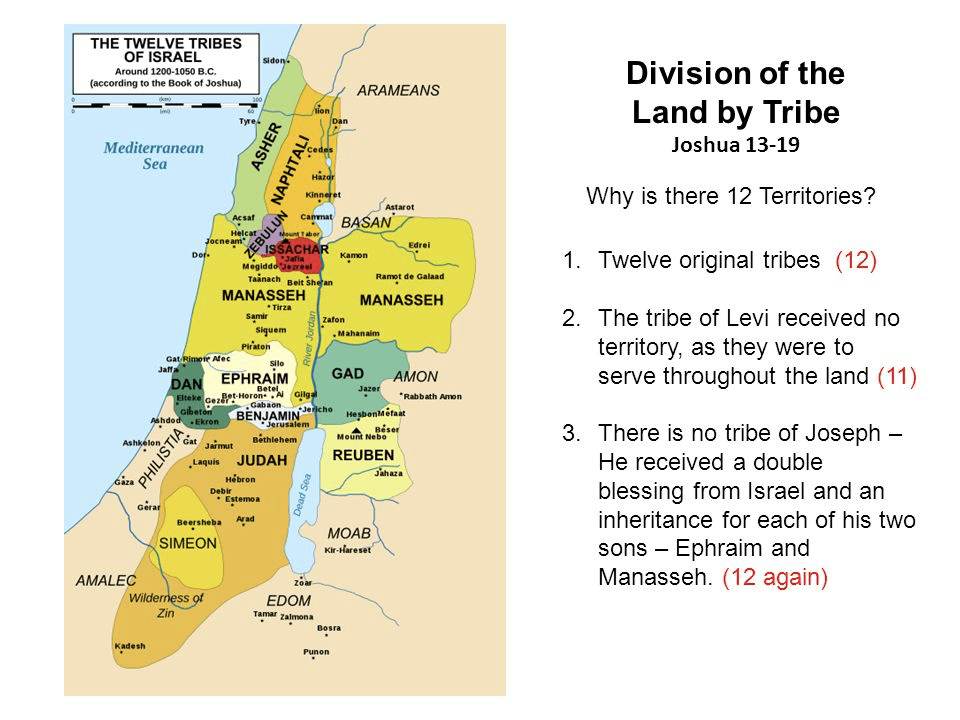
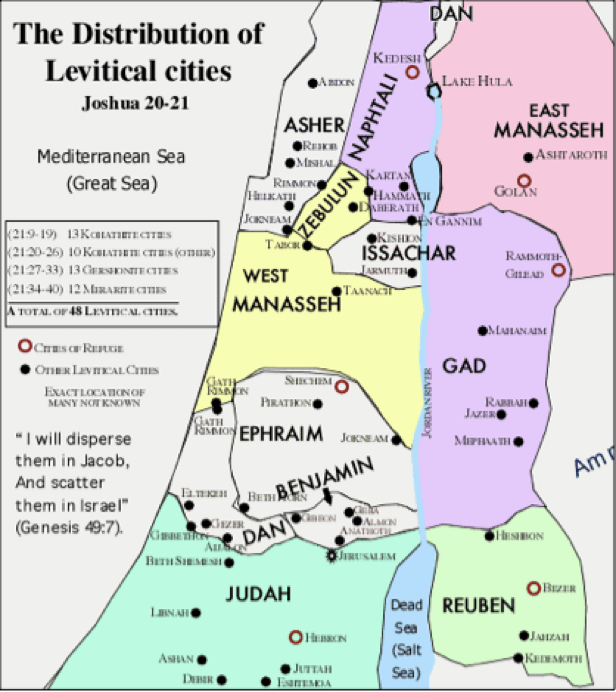
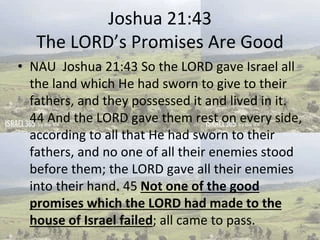
God had promised Abraham the land of Canaan (Gen 12:1-3) and repeated that promise to Isaac and Jacob. God told Abraham that his descendants would be in slavery in a foreign land for 400 years (Gen 15:13-16) before they would come out and occupy the land. Moses led them out of slavery, but was not allowed to go into Canaan. He appointed Joshua to lead them into Canaan. In about 7 years, Israel defeated all the major forces of the cities of Canaan, starting with Jericho in the central part, then the conquest of southern Canaan, and finally the conquest of northern Canaan. The land was divided between the 12 tribes. The Levites received 48 Levitical cities (ch 21) spread throughout the land so they could teach the Law to all 12 tribes, but they did not get a “tribe portion” of the land. Instead, the 2 sons of Joseph, Ephraim and Manasseh, received a “tribe portion” of the land since Jacob had ultimately given Joseph the firstborn portion (Gen 48:21,22) which means that he would receive twice as much land as his brothers. There were 6 cities of refuge (ch 20). The 12 tribes then went to their respective parts of the land, and were commanded to finish utterly destroying the Canaanites. They did not utterly destroy them, but they did possess the land such that Joshua 21:43-45 says, “So the Lord gave Israel all the land which He had sworn to give to their fathers, and they possessed it and lived in it. Not one of the good promises which the Lord had made to the house of Israel failed; all came to pass.”
BIOGRAPHICAL:
Joshua has often been pictured as a type of Christ. Why is that? In 2 main ways. First, his name. Moses changed his name from Hoshea (“salvation” in Hebrew) to Joshua. “Jesus” is the Septuagint (LXX) spelling of Joshua, and Mary was told, “You shall call your son Jesus, for he shall save His people from their sins” (Mat 1:21). Secondly, Joshua led the Israelites to victory over all their enemies and enabled them to enter their “rest” (Jos 22:4) in Canaan. Their rest was a time of no more war with the Canaanites, and a time of prosperity as they took over all the wealth of the Canaanites. Read Deut 8:7-10 for a full description of the “rest” that they were allowed to enjoy in Canaan. Moses delivered them from Egypt (a type of our deliverance from the slavery of sin), but it was Joshua who led them to victory over all enemies and occupying the land, entering the “rest”. Many Israelites did not enter that rest due to unbelief and died in the 40 years in the wilderness (Heb 3), but the next generation under Joshua did enter the “rest”. Joshua was a 2nd type of Jesus in that Jesus overcame all enemies and led the 1st Christians to enter the Messianic “rest” after 40 years of testing and tribulation (not all made it as seen in the Hebrews warnings). Read Isaiah 65:17-25 for a great description of the “rest” that would be given Christians when the Messiah would come. That was fulfilled in a spiritual way in the spiritual blessings in the church of Jesus Christ, body of the save. Hebrews 4 pictures that Messianic rest as still future at the time of writing, so it must be referring to the final victory at 70 AD. It is unfortunate that many are still waiting for a physical fulfillment of that prophecy. Heb 10:35 says that they would get their reward, that rest, in a “very little while”. Joshua, of the tribe of Ephraim, died at 110 years old (24:29)
God commands Joshua to be strong and courageous. There are giants in the land and each city has an army to defend it. But God promises to be with him and give him success.
From Pastor Dave Martine:
B. Joshua Prepares the People (Joshua 1:10-18)
The tribes of Reuben, Gad, and Manasseh had requested land east of the Jordan and were not planning on crossing the Jordan. Joshua commanded the three tribes to first help their fellow Israelites in conquering the land west of the Jordan before they could settle east of the Jordan..
The 2 Israelite spies enter Jericho and meet Rahab, a prositute. She tells them how terrified the people are of Israel and their god, YHWH. They all had heard how YHWH defeated all the gods of Egypt in the 10 plagues and the drowning of Pharoah’s army in the Red Sea. She is ready to put her trust in the one true God of Israel, YHWH. BTW that tells us that every Canaanite had the same opportunity to turn from their false gods and turn to YHWH, but only Rahab did. God was just in wiping out the Canaanites due to their idolatry even though it seems like genocide to. us. The spies promises to spare her family.
By Diane Norton:
3. Israel Crosses the Jordan River (Joshua 3:1-5:1)
The Israelites cross the Jordan River, into the land of promise, following the priests who carry the ark of the covenant. As at the Red Sea, God stops the flowing of the Jordan waters for the Israelites so that they cross on dry ground. Joshua and the Israelites set up twelve stones as a memorial at Gilgal, where they camp after crossing the Jordan. The leaders of Canaan hear of the drying of the waters of the Jordan and fear the Israelites. This crossing of the Joran confirmed to Israel that Joshua had taken over leading Israel just as the parting of the Red Sea confirmed Moses as leader.
Those men born during the 40 years in the wilderness had not been circumcised, so Israel paused to circumcise them even though that would leave them vulnerable to attack from the Canaanites (as Simeon and Levi attacked and killed the Shechemites after they had been circumcised. The place where they were circumcised is named, Gibeath Haaraloth translated as the “hill of foreskins.” They celebrate the Passover and start eating the produce of the land. The supply of manna that sustained them in the wilderness for 40 years ceases.
5. The Commander of the Army of the Lord (Joshua 5:13-15)
A man wielding a sword, the commander of the Lord’s army , appears to Joshua who falls on his face to the ground and requests instruction.The soldier tells tells Joshua to remove the sandals from his feet, for the ground upon which he is standing is holy. This soldier is probably the angel of the Lord, an appearance of God Himself in human form. He gives Joshua the battle plan for taking Jericho.
6. The Conquest and Destruction of Jericho (Joshua 6:1-27)
The Israelite people march around the city of Jericho, once each day for days, with seven priests carrying the ark and blowing on trumpets of ram’s horns continually. In front of the ark are the armed men, while the rear guard follow the ark. On the seventh day, they march around the city seven times. Joshua tells them that they are to destroy the city and should not covet or take anything (silver, gold, iron, bronze, or garments). During the seventh march around the city, the people hear the long blast of the ram’s horn and shout as instructed. The walls of the city miraculously fall, giving access to the Israelites who destroy Jericho and everyone and everything in it (both men and women, young and old, oxen, sheep, and donkeys), except for Rahab and her family. Anyone who attempts to rebuild the city now stands cursed. Joshua’s fame spreads.
7. The Sin of Achan (Joshua 7:1-26)
The spies sent to scout out Ai return and inform Joshua that it is a small city and that only a few soldiers need to be sent to take it. 3,000 Israelite men go to fight Ai and are defeated, losing 36 of their men.. Joshua is terribly disturbed b/c the Canannites would now think that Israel could be defeated. God tells Joshua that the defeat is due to “sin in the camp”: one of the Israelites has taken booty (a beautiful mantle from Shinar and 200 shekels of silver and a bar of gold weighing 50 shekels), from Jericho God reveals the culprit (by casting lots) to be Achan, of the tribe of Judah. He and his entire household (women, children, slaves, and livestock) are stoned, burned, and killed as punishment. A heap of stones is raised on the site, which to this day is named “the valley of Achor,” meaning “calamity.” This might sound like “group punishment” (punishing the whole group for the sin of one person) and I suppose that it is. God sometimes has to make an example for everyone to see what happens if he disobeys God. This reminds us of 1 Corinthians 5, where Paul rebukes the church for tolerating the sin of one member, and tells them to withdraw from him.
8. The Destruction of the City of Ai (Joshua 8:1-29)
Joshua and an army (30,000 in number) march against Ai and destroy it as they did Jericho. God tells them how to ambush and capturing the city of Ai. They kill all its inhabitants (12,000 in total). YHWH allows them to take livestock and other booty from the city as spoils of war. Ai is burnt and the king of Ai is hung; at sundown his body is taken down and thrown down at the city gates. Stones are raised into a heap on his body.
9. Covenant Renewal (Joshua 8:30-35)
The Israelites fulfill Moses’ instructions God had given Moses in Deuteronomy 27 to hold a covenant renewal ceremony at Mount Ebal and Mount Gerizim. 6 of the tribes read the curses of disobedience from Mt. Ebal and the other 6 tribes read the blessings of obedience from Mt Gerizim. Joshua builds an altar of unhewn stones at Shechem, and the priests offer sacrifices. Joshua cuts out a copy of the law of Moses in stone and reads it to the Israelites.
10. Treaty with the Gibeonites (Joshua 9:1-27)
The Gibeonites of central Canaan persuade the Israelites to make a peace treaty with them, so that they and their cities will not be destroyed. The Israelites were commanded to destroy all the nations in Canaan but they could make a treaty with nations outside of Canaan. They present themselves as having come from afar, showing their dry bread and dusty footwear as evidence. When the Israelites discover the trick, they honor the treaty, but consign the Gibeonites to be “hewers of wood and drawers of water” for the tabernacle.
11. Continued War with the Peoples of the Land (Joshua 10:1-11:23)
A. The Sun Stands Still as Israel Fights the Amorites (Joshua 10:1-15)
5 Canaanite kings attack the Gibeonites b/c they made a treaty with Israel instead of fighting Israel. Joshua honors his word given to the Gibeonites and marches all night to defend them. The Israelites defeat the five Amorite kings (of Jerusalem, Hebron, Jarmuth, Lachish, and Eglon) who have attacked Gibeon. At Joshua’s request, the sun stands still for a day so that the Israelites can have more time to completely kill the attacking armies. 10:14 14 There has been no day like it before or since, when the Lord heeded the voice of a man, for the Lord fought for Israel.
B. Five Amorite Kings Killed (Joshua 10:16-27)
“The five Amorite kings flee and hide in a cave. Joshua finds them and has large stones rolled over the mouth of the cave, imprisoning them there until their armies are destroyed. The five kings are then brought to Joshua, and they are killed as a symbol of what will happen to all of Israel’s enemies. Their bodies are hung until sundown and then thrown into the same cave where they had hidden themselves and stones are set over the mouth of the cave.”
C. Victories for Israel (Joshua 10:28-11:15)
Joshua and the Israelites capture and destroy many cities in the South – Makkedah, Libnah, Lachish, Gezer, Eglon, Hebron, and Debir. They leave no survivors as instructed by God. From Kadesh-barnea to Gaza, the whole land of Goshen as far as Gibeon, the highlands, and the arid southern plains are all also struck down.
Word of their victory spreads to the north and the Canaanite kings in the North mobilize a large army (“as numerous as the grains of sand on the seashore”) to attack the Israelites but they are defeated and the territory in the North is captured, the cities plundered, and the people wiped out.. In all this, Joshua is obeying the commands of the Lord to Moses (11:15).
D. Summary of Joshua’s Victories (Joshua 11:16-23)
These verses are a summary statement of all the land that Joshua and the Israelites conquer in Canaan just as was promised to Moses. However, the Anakim survived and are confined to the cities of Gaza, Gath, and Ashdod. The passage describes the boundaries of Israel at the height of the Davidic kingdom. The summary ends, “And the land had rest from war” (11:23).
E. The Kings Conquered by Moses (Joshua 12:1-6)
These verses list the lands and kings conquered by Moses and the Israelites east of the Jordan River. This land was given as property to the tribes of Reuben, Gad, and the half-tribe of Manasseh.
F. The Kings Conquered by Joshua (Joshua 12:7-24)
These verses list the lands and the 31 kings conquered by Joshua and the Israelites west of the Jordan River.
12. Dividing the Land for an Inheritance (Joshua 13:1-21:45)
The land captured by Israel, both east and west of the Jordan River, is divided and distributed by lots among the twelve tribes of Israel according to God’s will.
A. Introduction: The Land Still Unconquered and the Command to Divide the Land (Joshua 13:1-7)
The Lord lists for Joshua the parts of Canaan still unconquered by the Israelites and promises to drive out the inhabitants of those lands. The Lord also commands Joshua to divide the land of Canaan for an inheritance to nine tribes plus one half-tribe of Israel.
B. The Land East of the Jordan Given by Moses to Israelite Tribes (Joshua 13:8-33)
The text lists the lands and cities east of the Jordan River given by Moses to the other two tribes and a half-tribe of Israel: Reuben (15-23), Gad (24-28), and the half-tribe of Manasseh (29-33).
C. The Land West of the Jordan Given by Eleazar and Joshua to Israelite Tribes (Joshua 14:1-19:51)
The land of Canaan, west of the Jordan, is divided by lot and given by Joshua and the priest Eleazar (son of Aaron) to nine Israelite tribes plus a half-tribe: Judah (15:1-12; the list of Judahite cities 20-63), Ephraim (16:1-10), the other half-tribe of Manasseh (17), Benjamin (18:11-28), Simeon (19:1-9), Zebulun (19:10-16), Issachar (19:17-23), Asher (19:24-31), Naphtali (19:32-39), and Dan (19:40-48). Joshua and Caleb, the only two people still living of the generation that came out of Egypt, are given their own individual allotments of land. Caleb is allotted Hebron (14:6-15); and he gives Kiriath-sepher to his daughter Achsah and Othniel his son-in-law (15:13-19); Joshua is given Timnath-serah in the highlands of Ephraim (19:49-51).
D. The Cities of Refuge (Joshua 20:1-9)
The Lord commands Israel to set aside “cities of refuge,” where a person who has killed someone unintentionally can take refuge from those who would seek revenge. The Israelites designate six cities, strategically located throughout their territory, as cities of refuge.
E. Cities for the Levites (Joshua 21:1-42)
The priestly tribe of Levi, is given no land because “the LORD God of Israel is their inheritance” (13:33). The tribe of Levi is allotted 48 towns scattered throughout the territory of the other tribes. These towns include the six cities of refuge.
F. Promises Fulfilled (Joshua 21:43-45)
These verses are a summary statement of the fulfillment of God’s promises to Israel concerning the land. It ends, “Not one of all the good promises that the LORD had made to the house of Israel had failed; all came to pass” (21:45).
13. An Altar Built and a War Prevented (Joshua 22:1-34)
The eastern tribes–Reuben, Gad, and the half-tribe of Manasseh–return to their territory after having helped the other tribes conquer Canaan. They build a memorial altar on the western bank of the Jordan River. The other tribes interpret the building of the altar as rebellion against the Lord and threaten war, but the eastern tribes explain that the altar is meant to serve as a witness in generations to come that they, too, worship the same God as the rest of Israel.
14. Joshua’s Exhortation (Joshua 23:1-16)
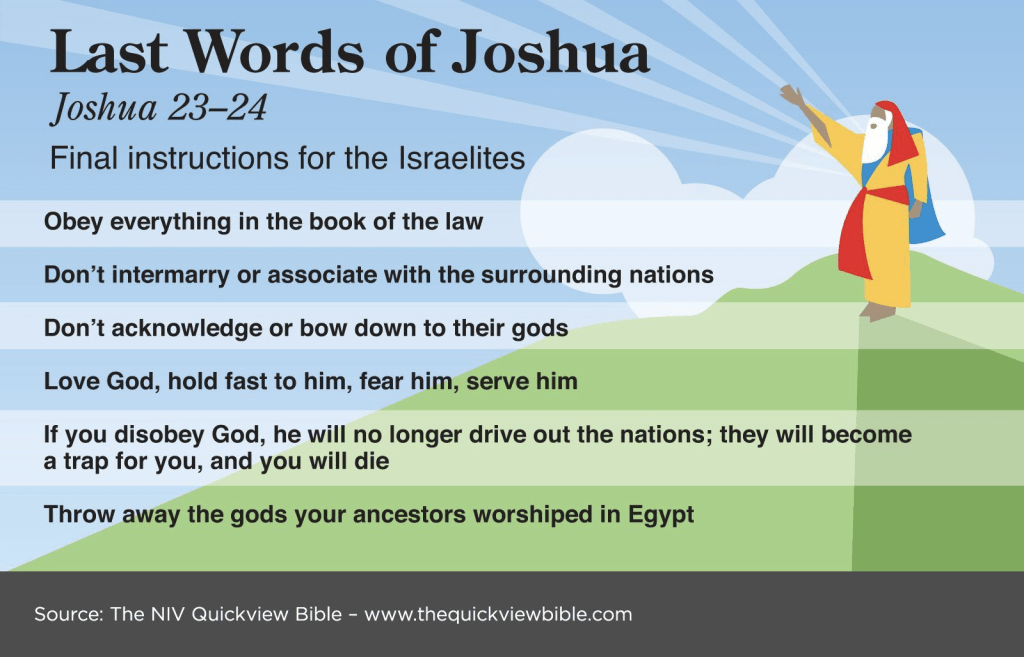
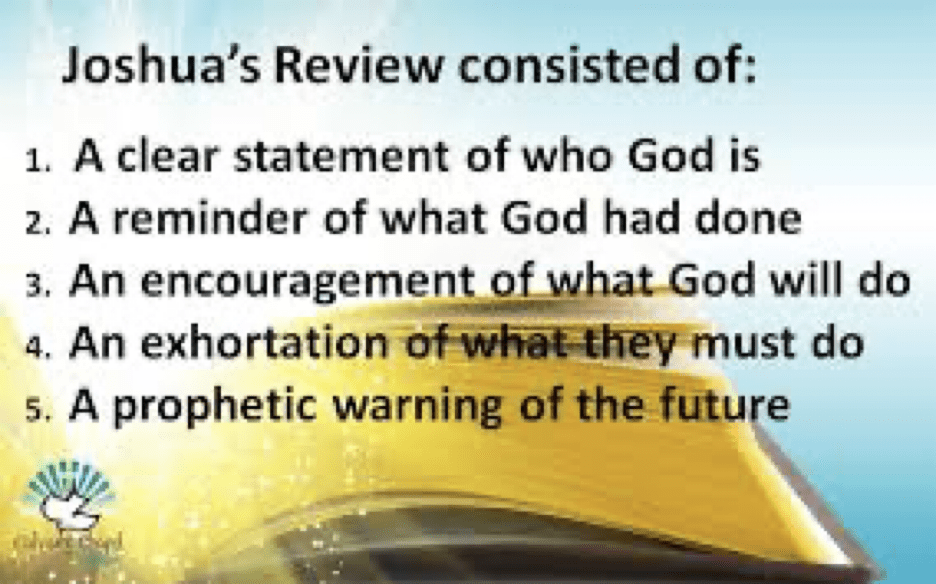
Joshua has grown old and is about to die. He calls all Israel to him and exhorts them to obey the commands of the book of the law of Moses, so that they might not be enticed by the nations around them to forsake the covenant.
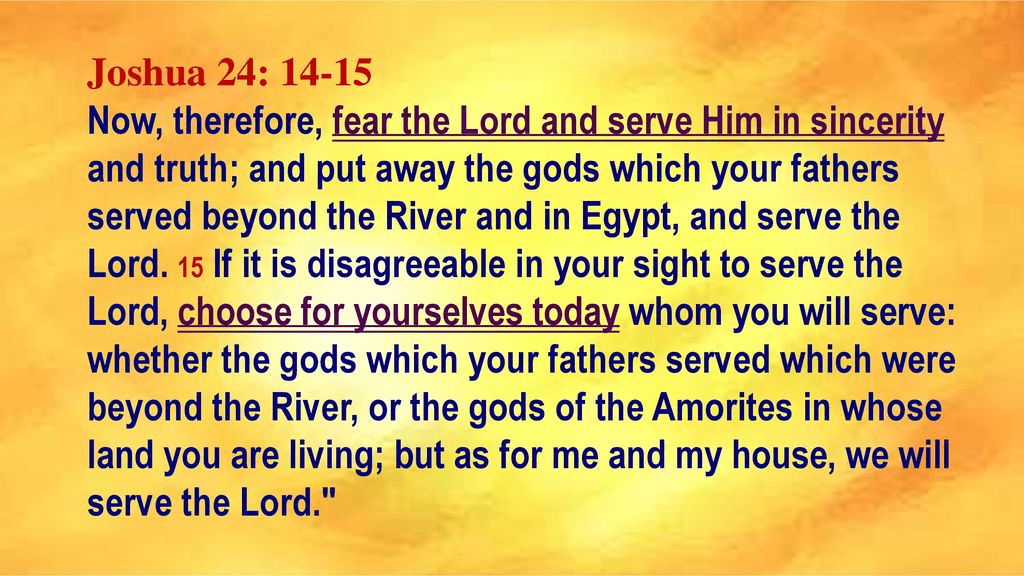
15. Covenant Ceremony (Joshua 24:1-28)
Joshua calls all Israel to him at Shechem, where he asks them to serve the Lord–the God of Abraham, Isaac, and Jacob–rather than other gods. They reaffirm their allegiance to the Lord, and Joshua makes a covenant with them there, erecting a stone as a memorial of the covenant.
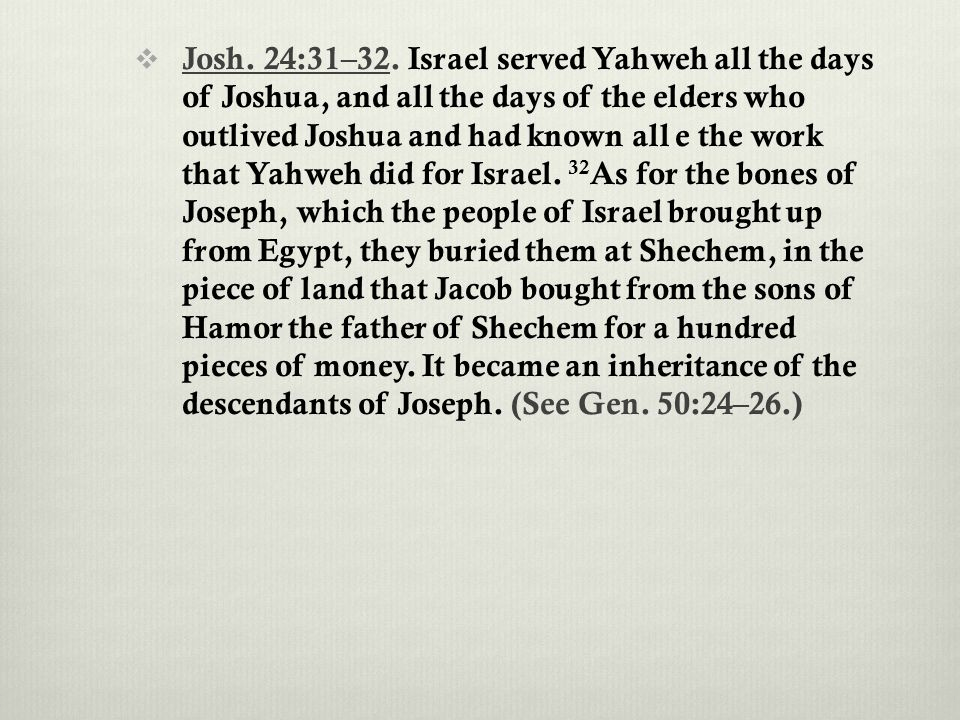
16. Death of Joshua and Death of Eleazar (Joshua 24:29-33)
Joshua dies at 110 years of age and is buried in the land he received as an inheritance. The bones of Joseph, which the Israelites brought out of Egypt, are buried at Shechem. The priest Eleazar, son of Aaron, dies and is buried at Gibeah.
God had promised Abraham the land of Canaan (Gen 12:1-3) and repeated that promise to Isaac and Jacob. God told Abraham that his descendants would be in slavery in a foreign land for 400 years (Gen 15:13-16) before they would come out and occupy the land. Moses led them out of slavery, but was not allowed to go into Canaan. He appointed Joshua to lead them into Canaan. In about 7 years, Israel defeated all the major forces of the cities of Canaan, starting with Jericho in the central part, then the conquest of southern Canaan, and finally the conquest of northern Canaan. The land was divided between the 12 tribes. The Levites received 48 Levitical cities (ch 21) spread throughout the land so they could teach the Law to all 12 tribes, but they did not get a “tribe portion” of the land. Instead, the 2 sons of Joseph, Ephraim and Manasseh, received a “tribe portion” of the land since Jacob had ultimately given Joseph the firstborn portion (Gen 48:21,22) which means that he would receive twice as much land as his brothers. There were 6 cities of refuge (ch 20). The 12 tribes then went to their respective parts of the land, and were commanded to finish utterly destroying the Canaanites. They did not utterly destroy them, but they did possess the land such that Joshua 21:43-45 says, “So the Lord gave Israel all the land which He had sworn to give to their fathers, and they possessed it and lived in it. Not one of the good promises which the Lord had made to the house of Israel failed; all came to pass.”
BIOGRAPHICAL:
Joshua has often been pictured as a type of Christ. Why is that? In 2 main ways. First, his name. Moses changed his name from Hoshea (“salvation” in Hebrew) to Joshua. “Jesus” is the Septuagint (LXX) spelling of Joshua, and Mary was told, “You shall call your son Jesus, for he shall save His people from their sins” (Mat 1:21). Secondly, Joshua led the Israelites to victory over all their enemies and enabled them to enter their “rest” (Jos 22:4) in Canaan. Their rest was a time of no more war with the Canaanites, and a time of prosperity as they took over all the wealth of the Canaanites. Read Deut 8:7-10 for a full description of the “rest” that they were allowed to enjoy in Canaan. Moses delivered them from Egypt (a type of our deliverance from the slavery of sin), but it was Joshua who led them to victory over all enemies and occupying the land, entering the “rest”. Many Israelites did not enter that rest due to unbelief and died in the 40 years in the wilderness (Heb 3), but the next generation under Joshua did enter the “rest”. Joshua was a 2nd type of Jesus in that Jesus overcame all enemies and led the 1st Christians to enter the Messianic “rest” after 40 years of testing and tribulation (not all made it as seen in the Hebrews warnings). Read Isaiah 65:17-25 for a great description of the “rest” that would be given Christians when the Messiah would come. That was fulfilled in a spiritual way in the spiritual blessings in the church of Jesus Christ, body of the save. Hebrews 4 pictures that Messianic rest as still future at the time of writing, so it must be referring to the final victory at 70 AD. It is unfortunate that many are still waiting for a physical fulfillment of that prophecy. Heb 10:35 says that they would get their reward, that rest, in a “very little while”. Joshua, of the tribe of Ephraim, died at 110 years old (24:29)
Here is a great topical outline of Joshua. I tried to put quotation marks where I quoted directly.
God commands Joshua to be strong and courageous. There are giants in the land and each city has an army to defend it. But God promises to be with him and give him success.
From Pastor Dave Martine:
B. Joshua Prepares the People (Joshua 1:10-18)
The tribes of Reuben, Gad, and Manasseh had requested land east of the Jordan and were not planning on crossing the Jordan. Joshua commanded the three tribes to first help their fellow Israelites in conquering the land west of the Jordan before they could settle east of the Jordan..
The 2 Israelite spies enter Jericho and meet Rahab, a prositute. She tells them how terrified the people are of Israel and their god, YHWH. They all had heard how YHWH defeated all the gods of Egypt in the 10 plagues and the drowning of Pharoah’s army in the Red Sea. She is ready to put her trust in the one true God of Israel, YHWH. BTW that tells us that every Canaanite had the same opportunity to turn from their false gods and turn to YHWH, but only Rahab did. God was just in wiping out the Canaanites due to their idolatry even though it seems like genocide to. us. The spies promises to spare her family.
From Truth Snitch
By Diane Norton:
3. Israel Crosses the Jordan River (Joshua 3:1-5:1)
The Israelites cross the Jordan River, into the land of promise, following the priests who carry the ark of the covenant. As at the Red Sea, God stops the flowing of the Jordan waters for the Israelites so that they cross on dry ground. Joshua and the Israelites set up twelve stones as a memorial at Gilgal, where they camp after crossing the Jordan. The leaders of Canaan hear of the drying of the waters of the Jordan and fear the Israelites. This crossing of the Joran confirmed to Israel that Joshua had taken over leading Israel just as the parting of the Red Sea confirmed Moses as leader.
Those men born during the 40 years in the wilderness had not been circumcised, so Israel paused to circumcise them even though that would leave them vulnerable to attack from the Canaanites (as Simeon and Levi attacked and killed the Shechemites after they had been circumcised. The place where they were circumcised is named, Gibeath Haaraloth translated as the “hill of foreskins.” They celebrate the Passover and start eating the produce of the land. The supply of manna that sustained them in the wilderness for 40 years ceases.
5. The Commander of the Army of the Lord (Joshua 5:13-15)
A man wielding a sword, the commander of the Lord’s army , appears to Joshua who falls on his face to the ground and requests instruction.The soldier tells tells Joshua to remove the sandals from his feet, for the ground upon which he is standing is holy. This soldier is probably the angel of the Lord, an appearance of God Himself in human form. He gives Joshua the battle plan for taking Jericho.
6. The Conquest and Destruction of Jericho (Joshua 6:1-27)
The Israelite people march around the city of Jericho, once each day for days, with seven priests carrying the ark and blowing on trumpets of ram’s horns continually. In front of the ark are the armed men, while the rear guard follow the ark. On the seventh day, they march around the city seven times. Joshua tells them that they are to destroy the city and should not covet or take anything (silver, gold, iron, bronze, or garments). During the seventh march around the city, the people hear the long blast of the ram’s horn and shout as instructed. The walls of the city miraculously fall, giving access to the Israelites who destroy Jericho and everyone and everything in it (both men and women, young and old, oxen, sheep, and donkeys), except for Rahab and her family. Anyone who attempts to rebuild the city now stands cursed. Joshua’s fame spreads.
7. The Sin of Achan (Joshua 7:1-26)
The spies sent to scout out Ai return and inform Joshua that it is a small city and that only a few soldiers need to be sent to take it. 3,000 Israelite men go to fight Ai and are defeated, losing 36 of their men.. Joshua is terribly disturbed b/c the Canannites would now think that Israel could be defeated. God tells Joshua that the defeat is due to “sin in the camp”: one of the Israelites has taken booty (a beautiful mantle from Shinar and 200 shekels of silver and a bar of gold weighing 50 shekels), from Jericho God reveals the culprit (by casting lots) to be Achan, of the tribe of Judah. He and his entire household (women, children, slaves, and livestock) are stoned, burned, and killed as punishment. A heap of stones is raised on the site, which to this day is named “the valley of Achor,” meaning “calamity.” This might sound like “group punishment” (punishing the whole group for the sin of one person) and I suppose that it is. God sometimes has to make an example for everyone to see what happens if he disobeys God. This reminds us of 1 Corinthians 5, where Paul rebukes the church for tolerating the sin of one member, and tells them to withdraw from him.
8. The Destruction of the City of Ai (Joshua 8:1-29)
Joshua and an army (30,000 in number) march against Ai and destroy it as they did Jericho. God tells them how to ambush and capturing the city of Ai. They kill all its inhabitants (12,000 in total). YHWH allows them to take livestock and other booty from the city as spoils of war. Ai is burnt and the king of Ai is hung; at sundown his body is taken down and thrown down at the city gates. Stones are raised into a heap on his body.
9. Covenant Renewal (Joshua 8:30-35)
The Israelites fulfill Moses’ instructions God had given Moses in Deuteronomy 27 to hold a covenant renewal ceremony at Mount Ebal and Mount Gerizim. 6 of the tribes read the curses of disobedience from Mt. Ebal and the other 6 tribes read the blessings of obedience from Mt Gerizim. Joshua builds an altar of unhewn stones at Shechem, and the priests offer sacrifices. Joshua cuts out a copy of the law of Moses in stone and reads it to the Israelites.
10. Treaty with the Gibeonites (Joshua 9:1-27)
The Gibeonites of central Canaan persuade the Israelites to make a peace treaty with them, so that they and their cities will not be destroyed. The Israelites were commanded to destroy all the nations in Canaan but they could make a treaty with nations outside of Canaan. They present themselves as having come from afar, showing their dry bread and dusty footwear as evidence. When the Israelites discover the trick, they honor the treaty, but consign the Gibeonites to be “hewers of wood and drawers of water” for the tabernacle.
11. Continued War with the Peoples of the Land (Joshua 10:1-11:23)
A. The Sun Stands Still as Israel Fights the Amorites (Joshua 10:1-15)
5 Canaanite kings attack the Gibeonites b/c they made a treaty with Israel instead of fighting Israel. Joshua honors his word given to the Gibeonites and marches all night to defend them. The Israelites defeat the five Amorite kings (of Jerusalem, Hebron, Jarmuth, Lachish, and Eglon) who have attacked Gibeon. At Joshua’s request, the sun stands still for a day so that the Israelites can have more time to completely kill the attacking armies. 10:14 14 There has been no day like it before or since, when the Lord heeded the voice of a man, for the Lord fought for Israel.
B. Five Amorite Kings Killed (Joshua 10:16-27)
“The five Amorite kings flee and hide in a cave. Joshua finds them and has large stones rolled over the mouth of the cave, imprisoning them there until their armies are destroyed. The five kings are then brought to Joshua, and they are killed as a symbol of what will happen to all of Israel’s enemies. Their bodies are hung until sundown and then thrown into the same cave where they had hidden themselves and stones are set over the mouth of the cave.”
C. Victories for Israel (Joshua 10:28-11:15)
Joshua and the Israelites capture and destroy many cities in the South – Makkedah, Libnah, Lachish, Gezer, Eglon, Hebron, and Debir. Canaanite kings in the North mobilize a large army (“as numerous as the grains of sand on the seashore”) to attack the Israelites but they are defeated and the territory in the North is captured, the cities plundered, and the people wiped out..
From historyinthebible.com
D. Summary of Joshua’s Victories (Joshua 11:16-23)
This is a summary of all the land that Joshua and the Israelites conquer in Canaan. However, the Anakim (giants) survived and are confined to the Phlistine cities of Gaza, Gath, and Ashdod. David will fight the Philistine giant Goliath later, and even kill 5 of Goliath’s brothers. The summary ends, “And the land had rest from war” (11:23). The period of the conquest of Canaan by Joshua was about 7 1/2 years.
E. The Kings Conquered by Moses (Joshua 12:1-6)
“These verses list the lands and kings conquered by Moses and the Israelites east of the Jordan River. This land was given as property to the tribes of Reuben, Gad, and the half-tribe of Manasseh.”
F. The Kings Conquered by Joshua (Joshua 12:7-24)
“These verses list the lands and the 31 kings conquered by Joshua and the Israelites west of the Jordan River.”
12. Dividing the Land for an Inheritance (Joshua 13:1-21:45)
The land captured by Israel, both east and west of the Jordan River, is divided and distributed by lots among twelve tribes. The Levite tribe does not get land, and Joseph gets two parcels of land for his two sons, Ephraim and Manasseh, who become basically 2 of the 12 tribes.
A. Introduction: The Land Still Unconquered and the Command to Divide the Land (Joshua 13:1-7)
The Lord lists for Joshua the parts of Canaan still unconquered by the Israelites The Lord commands Joshua to divide the land of Canaan for an inheritance to nine tribes plus one half-tribe of Israel that settle west of the Jordan.
B. The Land East of the Jordan Given by Moses to Israelite Tribes (Joshua 13:8-33)
“The text lists the lands and cities east of the Jordan River given by Moses to the other two tribes and a half-tribe of Israel: Reuben (15-23), Gad (24-28), and the half-tribe of Manasseh (29-33).”
C. The Land West of the Jordan Given by Eleazar and Joshua to Israelite Tribes (Joshua 14:1-19:51)
The land of Canaan, west of the Jordan, is divided by lot and given to nine Israelite tribes plus a half-tribe of Manasseh. Joshua and Caleb, the only two people still living of the generation that came out of Egypt, are given their own individual allotments of land. Caleb is allotted Hebron (14:6-15) and Joshua is given Timnath-serah in the highlands of Ephraim (19:49-51).
D. The Cities of Refuge (Joshua 20:1-9)
The Levites do not get a parcel of land. The Lord commands Israel to set aside 6 “cities of refuge,” where a person who has killed someone unintentionally can take refuge from those who would seek revenge (the “blood avengers). The cities are located throughout the land.
E. Cities for the Levites (Joshua 21:1-42)
“The priestly tribe of Levi, is given no land because “the LORD God of Israel is their inheritance” (13:33). The tribe of Levi is allotted 48 towns scattered throughout the territory of the other tribes. These towns include the six cities of refuge.
F. Promises Fulfilled (Joshua 21:43-45)
“Not one of all the good promises that the LORD had made to the house of Israel had failed; all came to pass” (21:45). Many today say that Israel never got the land that God promised Abraham, but these verses say that they did.
From Valley Bible Fellowship
13. An Altar Built and a War Prevented (Joshua 22:1-34)
“The eastern tribes–Reuben, Gad, and the half-tribe of Manasseh–return to their territory after having helped the other tribes conquer Canaan. They build a memorial altar on the western bank of the Jordan River. The other tribes interpret the building of the altar as rebellion against the Lord and threaten war, but the eastern tribes explain that the altar is meant to serve as a witness in generations to come that they, too, worship the same God as the rest of Israel.”
14. Joshua’s Exhortation (Joshua 23:1-16)
“Joshua has grown old and is about to die. He calls all Israel to him and exhorts them to obey the commands of the book of the law of Moses, so that they might not be enticed by the nations around them to forsake the covenant.”
15. Covenant Ceremony (Joshua 24:1-28)
“Joshua calls all Israel to him at Shechem, where he asks them to serve the Lord–the God of Abraham, Isaac, and Jacob–rather than other gods. They reaffirm their allegiance to the Lord, and Joshua makes a covenant with them there, erecting a stone as a memorial of the covenant.”
By Gwen White
16. Death of Joshua and Death of Eleazar (Joshua 24:29-33)
Joshua dies at 110 years of age and is buried in his land The bones of Joseph, which the Israelites brought out of Egypt, are buried at Shechem. The priest Eleazar, son of Aaron, dies and is buried at Gibeah.