
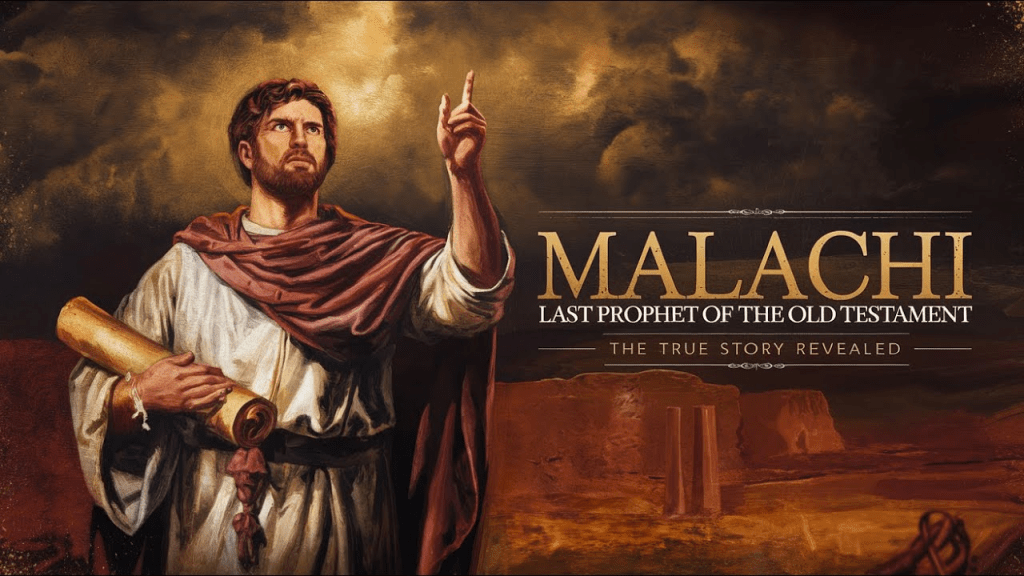
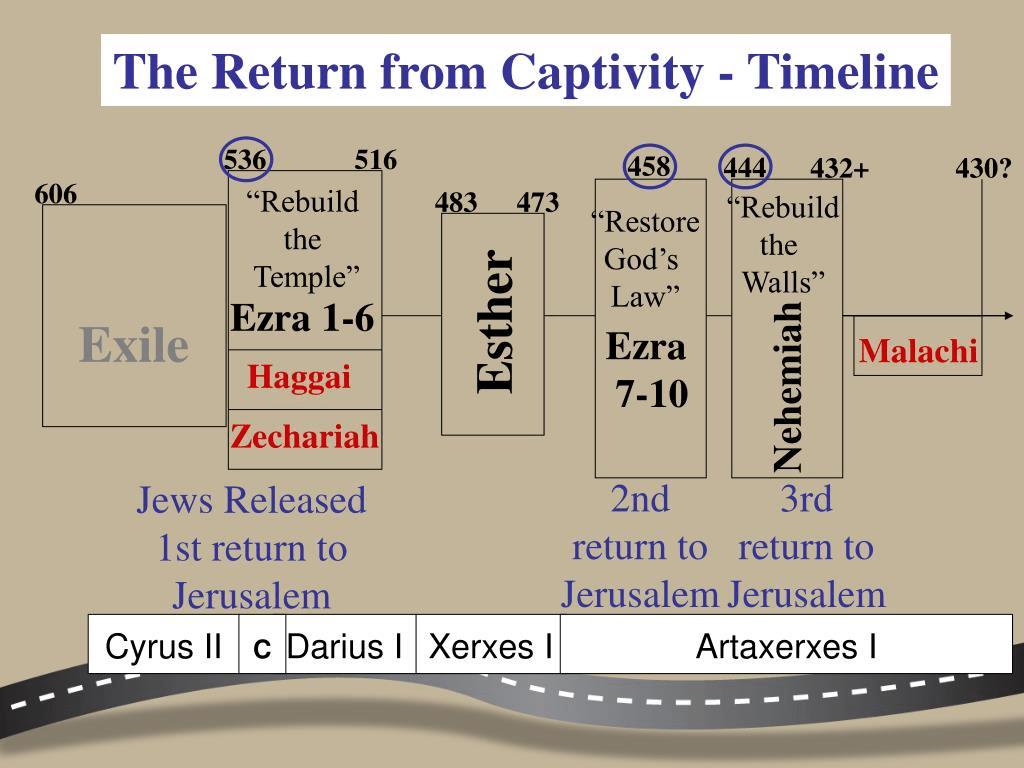
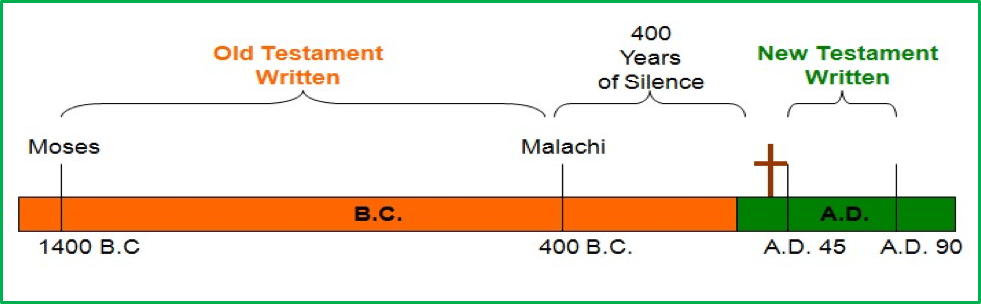
The book of the prophet Malachi was written around 430 BC. The entire history of the Old Testament is found in the first 17 books: Genesis through Esther. That history ends with the 3rd return of Judah from Babylonian captivity under Nehemiah to rebuild the walls of Jerusalem. The rest of the 39 books of the OT are writings of David, Solomon, the 5 major prophets, the 12 minor prophets, and the booik of Job. But all these occur chronologically within the time frame of the first 17 books, Genesis through Esther. The only exception to this is the book of Malachi, which some think even Malachi was written just before the return of Nehemiah. Here is a great chart:
“Malachi means “my messenger”. He was a contemporary of Nehemiah. In the last 5 chapters of Nehemiah, the walls are rebuilt but the people are still committing sins that Nehemiah has to address. “None of the prophecies of the glorious kingdom to come have come to pass. Times were hard b/c of drought, famine, and blighted crops. These hardships have been met by sloth, indifference, and spiritual lethargy. The people had been in the land for almost a 100 years, but present circumstances made them apathetic. They doubted the love of God. Since the wicked prospered, they questioned whether there was any profit in walking penitently before God and obeying His commandments. Against such a background the book was written.” (Harper Study Bible intro to Malachi).
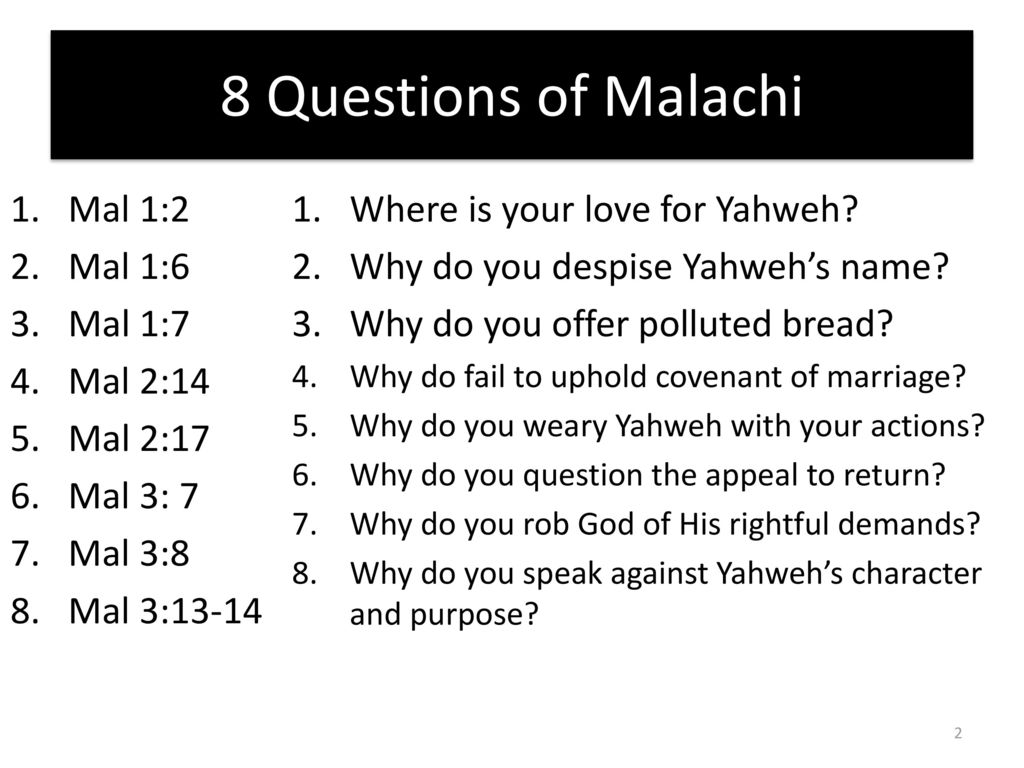
Malachi writes in question/answer form. Notice the 8 times that it says: “But or yet you say”.
- 1:2 “I have loved you,” says the Lord. But you say, “How have You loved us?” Malachi’s answer:God had shown his love for the descendants of Jacob (Israel) instead of Esau (the Edomites). The Jews would be blessed while the Edomites would be cursed.
- 1:6 “‘A son honors his father, and a servant his master. Then if I am a father, where is My honor? And if I am a master, where is My respect?’ says the Lord of armies to you, the priests who despise My name! But you say, ‘How have we despised Your name?’ Malachi’s answer: 1:7 You are presenting defiled food upon My altar.”
- 1:7b But you say, ‘How have we defiled You?’ Malachi’s answer: By the priests offering blind, sick, or lame animals as sacrifices on the altar of burnt offerings. Malachi then gives a scathing rebuke of the Levitical priests. They had a special covenant with God to instruct the people of the Law and to offer sacrifices, but they had become corrupt. Malachi then asks this follow up question: 2:10 Do we not all have one Father? Is it not one God who has created us? Why do we deal treacherously, each against his brother so as to profane the covenant of our fathers? ” Malachi answers his own question: The mistreating of one another among the Jews went back to the sin of taking foreign wives in some way. This could refer to the sin of some charging interest of fellow Jews as condemned by Nehemiah (Nehemiah 5), thus “dealing treacherously against each other”.
- 2:13 And this is another thing you do: you cover the altar of the Lord with tears, with weeping and sighing, because He no longer gives attention to the offering or accepts it with favor from your hand. 14 Yet you say, “For what reason?” (i.e. for what reason does God no longer accept our offerings?) Malachi’s answer: B/c of the practice of divorce among the people. God says, “I hate divorce.” Could that be part of the moral decline in the U.S. also? According to the American Psychological Association, approximately 40-50% of first marriages end in divorce. The divorce rate for second marriages is even higher, with approximately 60-67% of second marriages ending in divorce. The breakdown of the home is then passed on to future generations.
- 2:17 You have wearied the Lord with your words. Yet you say, “How have we wearied Him?” Malachi’s answer: B/c you say, “everyone who does evil is good in the sight of the Lord.” In other words, those who do evil are considered blessed by God with power and money. Malachi then says that in the distant future God will correct this falsehood by bringing His “messenger of the covenant (i.e. Jesus the messenger of the New Covenant” to judge the evil Jews in 70 AD in the destruction of the temple and of Jerusalem. The Jews took delight in the expectation of the coming of the Messiah, but they would find out that Jesus the Messiah would not only come to save the penitent Jews but also to judge and destroy the evil Jews in 70 AD. The remnant of the Jews who accepted Jesus as the Messiah would then be purified and able to offer acceptable offerings to God. They would become new covenant priests offering spiritual, not animal, offerings to God. 1 Peter 2:4 And coming to Him as to a living stone which has been rejected by people, but is choice and precious in the sight of God, 5 you also, as living stones, are being built up as a spiritual house for a holy priesthood, to offer spiritual sacrifices that are acceptable to God through Jesus Christ.” Those who practice sorcery or adultery or swearing falsely or who oppress the widows or orphans will be judged in the future and no longer will anyone say that those who are evil are blessed by God.
- 3: 7 “From the days of your fathers you have turned away from My statutes and have not kept them. Return to Me, and I will return to you,” says the Lord of armies. “But you say, ‘How shall we return?’ Malachi doesn’t give an answer to this question, but the answer should be obvious: “repent and keep the laws of the Lord”.
- 3: 8 “Would anyone rob God? Yet you are robbing Me! But you say, ‘How have we robbed You?’ Malachi’s answer: B/c you are not tithing (giving a tenth) as you were commanded by God. He challenges them to test God by tithing and then watch the windows of heaven open up to give them overflowing blessings. Is this sin another reason why Americans are making more money than ever and yet falling behind economically? The average American Christian gives around 2.5% of their income to church or charity, and about 5% of Americans regularly tithe, which is giving 10% of their income. However, some studies show that a larger portion of practicing Christians (around 40%) say they tithe at least 10% of their income.
- 3: 13 “Your words have been arrogant against Me,” says the Lord. “Yet you say, ‘What have we spoken against You?’ Malachi’s answer: B/c you say that it is pointless to serve God and there is no benefit in obeying Him. Malachi calls this “arrogance” b/c it is challenging God’s promise to bless the righteous, calling God a liar. It might not look like God is blessing the righteous at times, but in the end they will be blessed. The time will come when it is obvious that the righeous will be blessed and the evil will be punished (again referring to 70 AD). “The day is coming” (usually this phrase refers to Messianic times in the future) when the evil will be chaff to be burned. John the Baptist predicted that the Messiah would do this in 70 AD: Matthew 3:11 “As for me, I baptize you [i]with water for repentance, but He who is coming after me is mightier than I, and I am not fit to remove His sandals; He will baptize you with the Holy Spirit and fire. 12 His winnowing fork is in His hand, and He will thoroughly clear His threshing floor; and He will gather His wheat into the barn, but He will burn up the chaff with unquenchable fire.” But the “sun of righteousness” would bless those who fear and obey God with spiritual healing and joy. God would send a forerunner, Elijah, to try to get the evil Jews to repent before the “great and terrible day of the Lord”. Jesus said this prediction of Elijah coming was fulfilled in John the Baptist. Matthew 17:9 When they were coming down from the mountain, Jesus commanded them, saying, “Tell the vision to no one until the Son of Man has risen from the dead.” 10 And His disciples asked Him, “Why then do the scribes say that Elijah must come first?” 11 And He answered and said, “Elijah is coming and will restore all things; 12 but I say to you that Elijah already came, and they did not recognize him, but did to him whatever they wanted. So also the Son of Man is going to suffer at their hands.” 13 Then the disciples understood that He had spoken to them about John the Baptist.” Matthew 11:13 For all the Prophets and the Law prophesied until John. 14 And if you are willing to accept it, John himself is Elijah who was to come.” This shows that the “great and terrible day of the Lord” in Malachi 4:5 is the judgment day on the Jews in 70 AD. This is one of the many OT predictions for the Messianic times that will be fulfilled spiritually or figuratively and not literally. John the Baptist could come like Elijah trying to get the evil Jews to repent.
Here is a good slide of the 8 questions although it doesn’t match my 8 questions exactly.
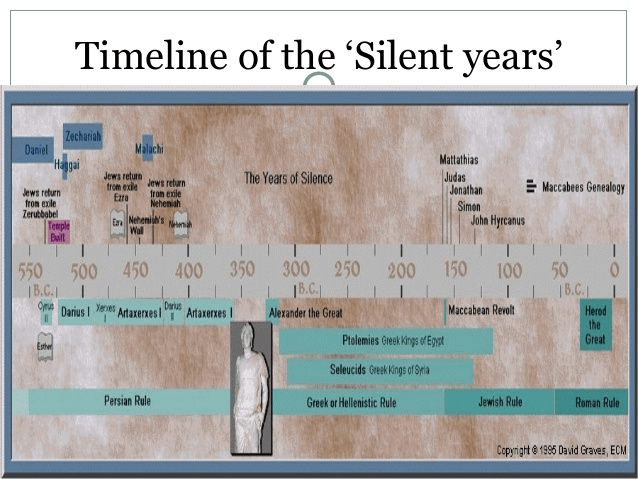
Malachi is the last book in the OT and perhaps the last chronological event occurring simultaneously with the 3rd return from exile under Nehemiah. Malachi was the last prophet. His book begins a 400 year period where there were no prophets recognized by the Jews and no inspired writings to be collected in the Hebrew OT canon. 1 Maccabees 9:27 states that “there was great distress in Israel, such as had not been since the time that prophets ceased to appear among them,” suggesting a period of prophetic silence. They are called the “silent years” for this reason, although they are filled with action. During this 400 years Alexander the Great would conquer the Persians just as Daniel predicted in Daniel 2,7, and 8. Alexander’s kingdom would be split among his 4 generals just as Daniel predicted in Daniel 7. Two of those 4 kingdoms that formed from the split would be the Ptolemies of Egypt and the Seleucids of Syria: both would control the Jews in Palestine for long periods of time during the 400 silent years. 1,2 Maccabees in the Apocrypha tells of the Maccabean priestly family who led a rebel uprising that defeated the Syrians and gained independence for Israel for about 100 years. Then in 63 BC the Romans took control of Palestine just as Daniel predicted in Daniel 2,7,and 8. After Malachi, however, there is nothing left for God to predict about the future Messianic times. All the OT predictions about the Messiah and his kingdom had been written by the prophets and collected by the Jews by 400 BC. God is just waiting for the “fulness of times” (Gal 4:4), for the Romans to rise to power, so He can send His son the Messiah to fulfill all OT predictions. It is interesting that the Apocrypha contains 1st and 2nd Esdras (the Greek name for Ezra) which duplicates a lot of the history of the returns, has apocalyptic visions of the end of the world, and answers questions about the suffering of God’s people. Those apocryphal books describe the Messianic expectations that the Jews held during the 400 silent years. That “silence” would be broken by the birth of Jesus beginning with Matthew 1. Unfortunately the Jews expected a Messiah who would restore the physical power of the Jewish kingdom and who would defeat the Romans, but Jesus came to begin a spiritual kingdom, the church. Thus most of the Jews except for a “remnant” rejected Jesus and continued in their evil ways till 70 AD when they would be judged, just as Malachi predicted.
It is an interesting parallel of the “God says but you say” today. God says that homosexuality is a sin, but you (those who reject God’s word) say it is not (many of whom form the liberal churches that have split off for the LGBQT movement). God say that Jesus is His special messenger and Son, but you (the Muslims, unbelieving Jews) say that Jesus was just a prophet or rabbi but not the Son of God. God says that there is only one God, Yahweh, but you (the Hindus) say there are many gods. God says that He created all things through Jesus in the beginning but you (the atheists) say that there is no creator god. God says that the Bible is the Word of God but you (the skeptics and liberals) say that the Bible is just the work of men and is not inspired by God).
I hope that this study in Malachi will edify you. Pray for America. We have lost our Christian foundation. You have to wonder if God will bring judgment on our nation just as He did the Jews in 70 AD. Is there a “great and terrible day of the Lord” awaiting us if we do not repent and return to keeping God’s word?
 Nicky's Notes