SEPT 30. READ DEUTERONOMY 23-27

Deuteronomy 23: Various laws. 1) Persons to be excluded from the assembly including Moabites. Life Lesson: Balak the king of Moab had hired Balaam to curse Israel as they passed by Mob land, but “the Lord your God was not willing to listen to Balaam, but the Lord your God turned the curse into a blessing for you because the Lord your God loves you.” Often bad things will happen to us and we will say, “I’m cursed!” But God can turn those bad things into blessings. Think back at the times God has done that in your life. Someone I love recently said that she was so disappointed with something that had happened, but that now she can see that it might turn out to be the best thing and she loves how it turned out. We just have to trust God. Romans 8:28And we know that God causes all things (the good and the bad) to work together for good to those who love God.” 2) Burying your excrement outside the camp. That is a sanitation law that prevents diseases like cholera and typhoid. 3) Cult prostitute harlots and male cult “dogs” are an abomination to God. Jews could not charge interest on fellow Jews (they could charge interest on foreigners). That seems strange to us today when we are all about how much interest we can get on our savings or on money we loan out to others, but giving an interest free loan was an act of love to help a fellow Jews who was having tough financial times. As discussed earlier, they might even lose some of that loan money in the sabbatical year or year of Jubilee. Nehemiah was very upset with the Jews who were charging interest on fellow Jews when he made his return to Palestine to rebuild the walls of Jerusalem (Nehemiah 5). He made those guilty to stop that and repay any interest they had collected. Do not delay in keeping your vows that you make to God.

Deuteronomy 24 begins with a strange law about divorce. 24:1“When a man takes a wife and marries her, and it happens that she finds no favor in his eyes because he has found some indecency in her, and he writes her a certificate of divorce and puts it in her hand and sends her out from his house, 2and she leaves his house and goes and becomes another man’s wife, 3and if the latter husband turns against her and writes her a certificate of divorce and puts it in her hand and sends her out of his house, or if the latter husband dies who took her to be his wife, 4then her former husband who sent her away is not allowed to take her again to be his wife, since she has been defiled.” Observation: the “indecency” used for the first divorce can’t be adultery. If it was, the first husband could have just had her stoned to death. Instead he gives her a certificate of divorce, something never authorized by God in the Law. The 2nd divorce (or even death of the 2nd husband) was not for adultery either for the same reasons. So technically, the woman was still married to the first husband even though she had married the 2nd husband. So why does this law in chapter 24 say that she can’t remarry the first husband if the 2nd husband divorces her or dies. We need to go to Matthew to clear this up. Matthew 19:3Some Pharisees came to Jesus, testing Him and asking, “Is it lawful for a man to divorce his wife for any reason at all?” 4And He answered and said, “Have you not read that He who created them from the beginning made them male and female, 5and said, ‘For this reason a man shall leave his father and mother and be joined to his wife, and the two shall become one flesh’? 6 So they are no longer two, but one flesh. What therefore God has joined together, let no man separate.” 7They *said to Him, “Why then did Moses command to give her a certificate of divorce and send her away?” 8He *said to them, “Because of your hardness of heart Moses permitted you to divorce your wives; but from the beginning it has not been this way. 9And I say to you, whoever divorces his wife, except for immorality, and marries another woman commits adultery.” Observations: 1) The Pharisees said that Moses “commanded to give her a certificate of divorce” but Jesus said that Moses only “permitted you to divorce your wives”. Chapter 22 had pretty much said, “no divorces”. If adultery is involved, the guilty will be stoned. If premarital sex is involved, marry and never divorce. But no divorce. But now in chapter 24 there is a law for a special situation involving divorce. 2) Jesus clarified that the “indecency” cause for divorce in 24:1 could not be used for divorce unless it was adultery. The only acceptable cause for divorce under the Law was adultery, and that called for stoning not divorce, but it did free the guilty party to remarry. 3) Jesus clarified that from the beginning with the first marriage of Adam and Eve that marriage was supposed to be one man, one woman becoming one flesh (the sexual consummation). BTW how much clearer could Jesus and God be that marriage is only for a man and a woman. It is such an abomination to God to see homosexual marriages in our country that was founded on Judeo-Christian teachings from the Bible. 4) The only reason the special divorce situation was given in Deuteronomy 24 was to protect wives from husbands who would divorce their wives for some other cause than adultery. Instead of loving their wives as God commanded them to do, they wanted to get rid of their wives but they didn’t have a scriptural cause. So they would just give a man-made certificate of divorce not even authorized by the Law. But they couldn’t remarry her if her 2nd husband died or divorced her in the same way. Why? Jesus is saying that this law might make the first husband think twice before divorcing his wife for some cause other than adultery. It might protect the wives from unscriptural divorces by hard hearted Jewish husbands.

The rest of the various laws in Deuteronomy are easy to understand. Question: What do you see is the emphasis in most of these laws in 24:6-21. Answer: Most of them protect the poor, widows, orphans, and strangers from other nations, God has always given special emphasis on not neglecting the care of widows, orphans, aliens, and the poor! James comments on this: James 1:27Pure and undefiled religion in the sight of our God and Father is this: to visit orphans and widows in their distress, and to keep oneself unstained by the world.” Romans 12:13: “Share with the Lord’s people who are in need. Practice hospitality.” Galatians 2:10: “All they asked was that we should continue to remember the poor. Luke 14:13–14: “When you give a banquet, invite the poor, the crippled, the lame, the blind, and you will be blessed.” The early church had a special ministry of providing food for needy widows (Acts 6).

Deuteronomy 25 has more various laws. 1) No more than 40 stripes as punishment for a crime. AI: To ensure they never accidentally broke the biblical law by miscounting in the heat of the moment, Jewish courts and synagogue tribunals capped the actual punishment at 39.” I wonder how many stripes Jesus was given. 2) The law for Levirate marriage: the brother has to marry the widow of his deceased brother and bear a child for his deceased brother to continue his deceased brother’s name and inheritance. If the brother refused to do this, the widow was to take off his sandal and spit in his face in front of the elders! Do you remember the case of Judah and Tamar in Genesis 38? Judah’s son refused to marry Tamar after his brother, her husband, died, and God killed him for refusing. A 3rd son was too young and Judah promised to give that son to Tamar (Levirate marriage) when he grew up, but he Judah failed to keep his promise. So Tamar dresses up like a prostitute and Judah unknowingly goes in to her and has sex. Later they bring Tamar to Judah to pronounce her punishment for harlotry, and she tells Judah that it is his child! She has twins and one of them, Perez, is in the seed line of Jesus! The Bible has a lot of dysfunctional family stories! 3) No cheating people by using dishonest weighing of goods. 4) A command to totally destroy all the Amalekites b/c they attacked Israel from the rear as they were coming around their territory. King Saul would be told to do this task but spared some of the animals and the king of Amalek and the kingdom was taken from Saul b/c of that.

Deuteronomy 26. Israelites were commanded to bring the first fruits of their crops as an offering to God to be shared with the Levites in each town. Tithing laws under the Law of Moses can be a little confusing, so here is a good explanation from AI: Under the Mosaic Law, the Israelites were commanded to give three distinct tithes, which totaled roughly 23% of their agricultural produce and livestock each year when averaged out.Most scholars and theologians outline these three separate tithes from the Hebrew Bible as follows:

The Poor (or Third / Welfare) Tithe: An extra 10% given every third and sixth year of the seven-year agricultural cycle. Instead of going to the temple, this was stored locally in the towns to support the Levites, strangers, orphans, and widows (Deuteronomy 14:28–29). Averaged annually, this amounted to about 3.3% per year.

The Levitical (or First) Tithe: A yearly 10% levy on crops and livestock given to the Levites (Numbers 18:21–24) because they did not receive a land inheritance like the other tribes. In turn, the Levites gave a tenth of what they received to the Aaronic priests (Numbers 18:26).

The Festival (or Second) Tithe: An additional 10% set aside each year by the Israelites, which they brought to Jerusalem to consume during the holy pilgrim feasts and national celebrations (Deuteronomy 12:17–18, 14:22–27).

Deuteronomy 27 gives the curses for disobeying God that the Levites were to read to the people from Mt Ebal when they entered Canaan. A wide variety of sins that would cause one to be cursed by God. They fulfill this command when Joshua has the curses and blessings read from Mt Ebal and Mt Gerizim (Joshua 8).
URGENT: HUSBANDS, READ THIS!

1 Peter 3:7 “You husbands in the same way, live with your wives in an understanding way, as with someone weaker, since she is a woman; and show her honor as a fellow heir of the grace of life, so that your prayers will not be hindered.” (NASB)

  1. Live with your wife in an understanding way. (NASB)

The Greek word for understanding here is gnósis: Knowledge, a word used in many ways in the New Testament. “The word appears twenty-nine times, spanning Luke, Romans, both Corinthian letters, Ephesians, Philippians, Colossians, the Pastoral Epistles, and 1 and 2 Peter. It describes everything from the initial understanding that accompanies conversion (Luke 1:77) to the mature discernment required for leadership and spiritual warfare (2 Corinthians 10:5). The contexts cluster around five themes: revelation of God, salvation in Christ, charismata, ethical formation, and warnings against counterfeit claims.” (biblehub.com). In 1 Peter 3:7 it means that “husbands are to live with their wives “in an understanding way” (1 Peter 3:7, cf. γνῶσιν, gnosis), demonstrating that domestic harmony flows from informed sensitivity.” In other words, a godly husband should get to know his wife’s needs and be sensitive to her needs. Our 5 senses are hear, taste, touch, see, and feel. Using those 5 senses, a husband should get a feeling for what his wife needs. He will then come to “know” what she knows. He will understand his wife better.

2. Show her honor as a fellow heir of the grace of life.

The Greek word for honor is timé: Honor, value, price, respect. The NASB translates the word as “honor” 28 times but also translates it as “price” 7 times, such as Acts 5 the price of the land sold by Ananias and Sapphira, or Matthew 27:9 the price of the money paid to Judas to betray Jesus. The idea is to assess the value of someone or something. A godly husband should assess the value. of his wife. Not a monetary value, but her worth as his wife, companion, help meet, fellow Christian on their physical and spiritual journey of life hopefully preparing to live together in eternity. If you tried to put a monetary value on a godly wife, it would be priceless. A typical husband, even a godly husband, values many things. He values his house, his car(s), his hobby, his position at work, his favorite football team, etc. He probably has a few things that he considers of great value. I am a Prius man and value my new Prius a lot. But how much value do I really place on my godly wife? How much respect do I give her? Once I assess her needs, how do I honor her by trying to respect those needs and fulfill those needs.

Each wife is different, but in general the books tell us what a wife needs. Perhaps my. favorite song of all time is “When a man loves a woman” by Percy Sledge. The first few lines:

When a man loves a woman
Can’t keep his mind on nothin’ else
He’d trade the world
For the good thing he’s found
If she is bad, he can’t see it
She can do no wrong
And turn his back on his best friend
If he puts her down

When a man loves a woman
Spend his very last dime
And trying to hold on to what he needs
He’d give up all his comforts
And sleep out in the rain
If she said that’s the way it ought to be, eh

When a man loves a woman, eh
I give you everything I’ve got
Trying to hold on to your precious love
And baby baby please don’t treat me bad.

Here is his song released in 1966 (I was a junior in high school at that time) if you want to listen to it now.

Percy Sledge worked in the cotton fields as a young man. He mentioned in interviews that he sang while picking cotton and chopping. He also worked as a hospital orderly. “One of the hospital’s many highly impressed patients passed on word of Sledge’s soaring and passionate vocals to local music producer, record-store owner and radio disc jockey Quin Ivy, who had just opened his Norala Recording Studios in downtown Sheffield.” (AI) The song was initially recorded by Percy Sledge at Rick Hall‘s FAME Studios at Muscle Shoals, before being re-recorded at the nearby Norala Studios owned by Quin Ivy.  In one story, Sledge said that one night he was upset over a broken relationship and asked Lewis and Wright (co-writers of the song and band members) to play a slow blues over which he improvised lyrics describing his emotions. These experiences helped shape his music and contributed to his rise to fame. My wife and I visited the Fame Studios. We also visited the Muscle Shoals Sound Studios on Jackson Way which was started by members of the Fame Studios after they left Fame. Additionally, his album “The Best of Percy Sledge” was recorded at Muscle Shoals Sound, according to Apple Music. I loved watching the Muscle Shoals documentary of all the hit songs recorded at the Muscle Shoals Sound Studio. Over the years, artists who recorded at Muscle Shoals Sound Studio included Bob Dylan, the Rolling Stones, Aretha Franklin, Wilson Pickett, Etta James, Percy Sledge, Willie Nelson, Duane Allman, Lynyrd Skynyrd, Joe Cocker, Levon Helm, Paul Simon, Bob Seger, Rod Stewart, Cat Stevens, Jimmy Cliff, Cher, George Michael, and the Black Keys. We especially loved touring the Muscle Shoals Sound Studios on Jackson Way.

Ok, could we get back to 1 Peter 3:7? Husbands, what does your wife need. I don’t know where AI gets info, but I thought AI said it very well. “A wife needs love, attention, and respect, alongside feeling valued, secure, and supported in the relationship. She also needs open communication, affection, and a sense of partnership, particularly in domestic responsibilities and family matters. Ultimately, she needs to feel prioritized and cherished, not just as a wife, but as an individual.” AI breaks down her needs:

1. Unconditional Love and Affection: 

  • Love: A wife needs to feel loved and cherished, not just for what she does, but for who she is as a person. 
  • Affection: This includes both physical touch (hugs, holding hands, etc.) and non-sexual expressions of love and intimacy, which can strengthen emotional connection. 
  • Romance: It’s important to actively pursue and woo her, showing her attention and affection. 

2. Attention and Appreciation:

  • Active Listening: Wives want to be listened to and feel that their thoughts and feelings are important. 
  • Meaningful Conversations: This includes open and honest communication, sharing thoughts, feelings, and experiences. 
  • Appreciation: Acknowledging her efforts, both big and small, and showing appreciation for what she does is crucial. 

3. Security and Support:

  • Financial Security: While not always about a high income, a wife needs to feel that her husband is taking responsibility for the financial well-being of the family and making responsible decisions. 
  • Domestic Partnership: She needs to feel like a partner in the home, sharing responsibilities and participating in raising the children. 
  • Commitment: Knowing that her husband is committed to the marriage and family is essential. 

4. Open Communication and Honesty:

  • Openness: A wife needs to feel like she can be honest with her husband and that he can be honest with her. 
  • Trust: Being reliable, keeping promises, and being open and honest builds trust, which is vital for a strong relationship. 
  • Vulnerability: Sharing feelings and insecurities can foster deeper intimacy and connection. 

5. Feeling Valued and Prioritized:

  • Attention: She needs to feel like she is a priority, not an interruption, and that her needs are being considered. 
  • Respect: Respect for her as an individual, her opinions, and her choices is crucial. 
  • Quality Time: Spending quality time together, both individually and as a couple, helps to strengthen the bond. 

One of my favorite songs as a teen was “Cherish” by The Association. The opening words are: “Cherish is the word I use to describe all the feeling that I have hiding here for you inside.” I always thought of Ephesians 5 when I heard that song: 5:28 So husbands also ought to love their own wives as their own bodies. He who loves his own wife loves himself; 29 for no one ever hated his own flesh, but nourishes and cherishes it, just as Christ also does the church.” The Greek word for cherish is thalpó: To warm, to cherish. “The verb carries the picture of holding something close so that it is kept warm and safe. In classical use it described a bird that sits on her eggs or a parent who keeps a child snug at the breast.” (biblehug.com). I think I missed something in the rest of the lines in the song, however. The rest of the liines portray a hidden cherishing for a woman that is never expressed, a desire that somehow she might come to cherish him like he cherishes her, a sadness that he will not be the one to share her dreams with, a reluctance to telling her how much he needs her for fear that she might think of him as a thousand other guys who tell her that when all they really want to do is “to touch your face, your hands
And gaze into your eyes.” So I just wanted the song to be about my feelings for my future wife whom i dated in high school and college but the song was about hidden feelings of cherishing someone that the singer would never be with. But maybe the song does fit in a way. I do cherish my wife, but too often that feeling is hidden and unexpressed. I was raised by godly parents who loved me but just didn’t express that love verbally. They were raised during the depression and long hours working on the farm. It was more about loyalty to your marriage vows and providing for your family rather than expressing emotion. At least, that was the way it was with my parents (and the way it was with their parents). So it is difficult to be affectionate if you weren’t raised in that environment. Can any of you relate to that? So I tend to take my wife for granted much of the time. Can any of you relate to that? I hope to do better in the future!

Husbands, do you take your wife for granted? Do you really do cherish and value greatly your wife but your preoccupation with other things you value puts her down on your priority list? Read those 5 things above and so a self assessment. Then follow up on each area with action.

A suggestion: Put 1 Peter 3:7 somewhere that you will see it every day. I have it as a tab that I keep open all the time. I try to look at it every morning and ask myself, “how will I apply this today”? Do that before you start looking at and thinking about all the urgent matters of your work or business or hobby.

Thanks for going down memory lane with me. What’s your favorite song that brings back cherished memories in your life with your wife?

1 PETER 3:1-12. WIVES AND HUSBANDS; A SUMMARY OF CHRISTIAN TRAITS

 1 Peter 3:1 In the same way, you wives, be subject to your own husbands so that even if any of them are disobedient to the word, they may be won over without a word by the behavior of their wives, 2 as they observe your pure and respectful behavior. 3 Your adornment must not be merely the external—braiding the hair, wearing gold jewelry, or putting on apparel; 4 but it should be the hidden person of the heart, with the imperishable quality of a gentle and quiet spirit, which is precious in the sight of God. 5 For in this way the holy women of former times, who hoped in God, also used to adorn themselves, being subject to their own husbands, 6 just as Sarah obeyed Abraham, calling him lord; and you have proved to be her children if you do what is right without being frightened by any fear.“

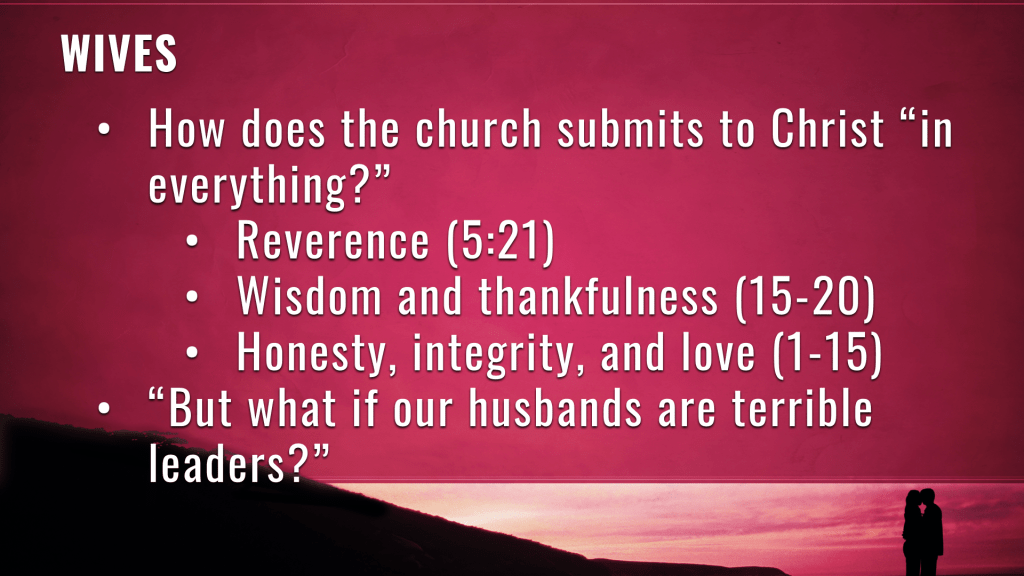
“In the same way”: the same way as what? As 2:18 Servants, be subject to your masters with all respect, not only to those who are good and gentle, but also to those who are harsh.” Another example of how Christians should respect and obey authority, whether it be masters over slaves, or the government. The emphasis is on obeying authority even if the authority is harsh or evil or mean or. oppressive. Paul taught that wives were to be submissive to their husbands. Ephesians 5:22 Wives, submit to your own husbands, as to the Lord. 23 For the husband is the head of the wife even as Christ is the head of the church, his body, and is himself its Savior. 24 Now as the church submits to Christ, so also wives should submit in everything to their husbands.” But what if the husband is mean and verbally abuses her?Wives should be subject to their husbands even if they are disobedient to the word, i.e. non Christian. Imagine a first century woman becomes a Christian but her husband is a pagan who worships idols and mistreats her. Can she just up and leave? Should she brow-beat him constantly with the word of God telling him how evil he is? Nope. Be subject to, respectful to your husband. Have a gentle and quiet spirit. Be modest in your dress and jewelry. Imagine a vain wife who wears expensive clothes and jewelry, who spends hours beautifying herself, and then she nags at her husband about him not being a Christian. That’s the picture here. Sarah is the example of a submissive, respectful wife. She followed Abraham from Ur, leaving whatever family she had there. When God called Abraham to leave Haran, she followed apparently without questioning his actions. She was a submissive wife for 62 years, moving around Canaan without ever owning any of the land God promised Abraham, apparently never complaining. What’s even worse, she was humiliated when Abraham lied to Pharoah, telling him that Sarah was his sister in order to save his own life. God intervened and stopped Pharoah from keeping her, but how in the world did she continue to respect and be submissive to her cowardly husband. To make it worse, Abraham repeated the same lie later with Abimelech the Philistine. But Sarah stayed submissive to Abraham. I suppose she never even tried to tell Pharoah or Abimelech that she was Abraham’s wife and not his sister. Again, the theme of obeying authority even if the authority does not deserve respect, just like servants with harsh masters. Sarah, like Abraham had her bad moments, like when she got Abraham to have a child by Hagar, like when she drove Hagar and Ishmael out to the consternation of Abraham, like when she laughed at the 3 angels announcing the birth of Isaac. Sarah becomes the example for all wives of times. On a side note, does vs 3 mean that Christian wives cannot braid their hair or wear gold jewelry? Throw in 1 Timothy 2:9 likewise also that women should adorn themselves in respectable apparel, with modesty and self-control, not with braided hair and gold or pearls or costly attire.” They can’t wear pearls or expensive clothes. Actually this looks like a pretty clear command! Women in the Pentecostal Church are not allowed to wear jewelry. They take the command to be obeyed literally. Most Christians take it to mean just don’t be excessive or vain in dress or jewelry. It’s kinda funny how my church always picked and chose which commands are to be taken literally and which can be obeyed in some other way. Like foot washing. Jesus said, John 13:14 If I then, your Lord and Teacher, have washed your feet, you also ought to wash one another’s feet. 15 For I have given you an example, that you also should do just as I have done to you.” That sounds like a clear command, and yet most churches do not teach it as a command for us today (although they would allow it). They say the command was “cultural” and can be fulfilled in other ways than washing feet, such as humbly serving others. Or the command, 2 Corinthians 13:12 Greet one another with a holy kiss.” They say that was cultural and we don’t have to obey that literally. You can obey it by shaking hands or a hug. Or the women wearing a veil when praying or prophesying aloud in an audience with men present. Some women in my church do take that literally and they wear a little doily in the assembly, but most say our women don’t have to obey that command literally. I’ll leave the women’s clothes and jewelry up to you ladies! It does make you question how my church could act so judgmental about which commands should be obeyed literally and which don’t have to be. My church would say that churches who don’t take the Lord’s Supper every week are apostate, disobedient churches, and yet the scriptures they use to support their arguments for weekly Lord’s Supper observance are less clear than the commands to foot wash or not wear jewelry. Again, they just “pick and chose” which commands to obey literally.

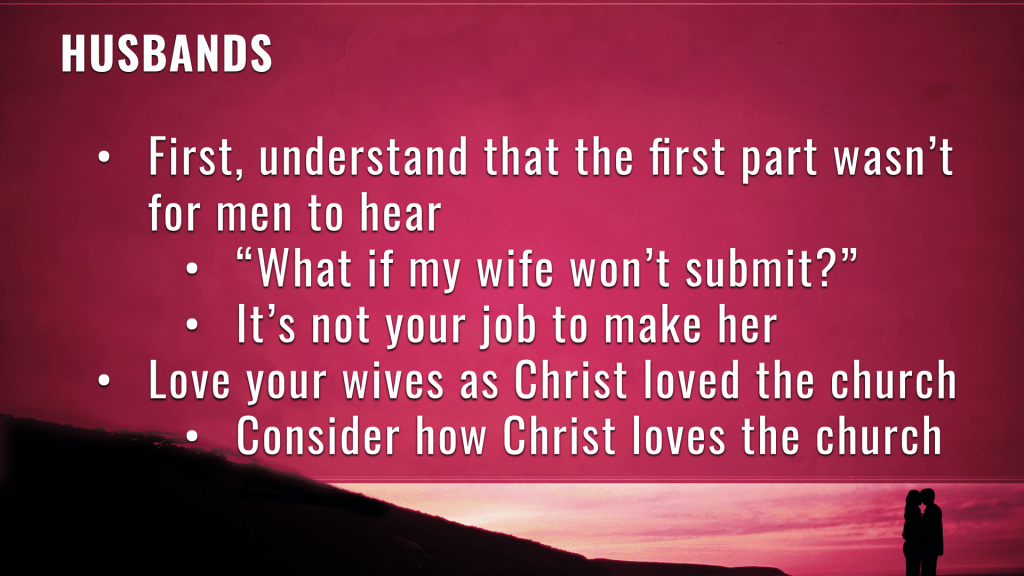
1 Peter 3:7 You husbands in the same way, live with your wives in an understanding way, as with someone weaker, since she is a woman; and show her honor as a fellow heir of the grace of life, so that your prayers will not be hindered.” Paul taught husbands: Ephesians 5:25 Husbands, love your wives, as Christ loved the church and gave himself up for her, 26 that he might sanctify her, having cleansed her by the washing of water with the word, 27 so that he might present the church to himself in splendor, without spot or wrinkle or any such thing, that she might be holy and without blemish. 28 In the same way husbands should love their wives as their own bodies. He who loves his wife loves himself. 29 For no one ever hated his own flesh, but nourishes and cherishes it, just as Christ does the church, 30 because we are members of his body. 31 “Therefore a man shall leave his father and mother and hold fast to his wife, and the two shall become one flesh.” 32 This mystery is profound, and I am saying that it refers to Christ and the church. 33 However, let each one of you love his wife as himself, and let the wife see that she respects her husband.” Peter adds another element: “live with your wife in an understanding way since she is weaker since she is a woman”. “Since she is a woman” tells you that the “weaker” is referring to, in general, that the woman is not as strong physically as the man. Most women can’t protect themselves like a man can (there are always exceptions). Women are designed by God to have the emotional makeup to have and nurse babies, which might leave them a little more vulnerable to be taken advantage of than men (Eve was deceived by Satan but Adam was not). Is that part of the “weaker” also? Husband should understand the limitations of their wives as women and take care of them. As Paul said, “nourish and cherish them” in their needs as the weaker sex. If you don’t, your prayers will be hindered!

1 Peter 3:8 To sum up, all of you be harmonious, sympathetic, loving, compassionate, and humble; 9 not returning evil for evil or insult for insult, but giving a blessing instead; for you were called for the very purpose that you would inherit a blessing. 10 For, “The one who desires life, to love and see good days,
Must keep his tongue from evil and his lips from speaking deceit. 11 He must turn away from evil and do good; He must seek peace and pursue it. 12 For the eyes of the Lord are toward the righteous, And His ears attend to their prayer, But the face of the Lord is against evildoers.”

Wow! What a summary of the traits every Christian should have! As I read vs 8, I am thinking, “how loving, compassionate, etc. am I?” Do I really feel compassion when I see someone hurting or in need? Jesus is our example of compassion: Matthew 9:36-38J esus was moved with compassion for the crowds because they were scattered and helpless, like sheep without a shepherd. Matthew 14:14 Jesus had compassion on the large crowd he saw when he landed and healed their sick.” Would people say that I am a “loving” Christian? Christians cannot retaliate or seek vengeance when wronged. Instead, bless those who. persecute you. Matthew 5:10 “Blessed are those who are persecuted for righteousness’ sake, for theirs is the kingdom of heaven. 11 “Blessed are you when others revile you and persecute you and utter all kinds of evil against you falsely on my account. 12 Rejoice and be glad, for your reward is great in heaven, for so they persecuted the prophets who were before you.” Jesus even felt compassion for those who crucified him: “Father forgive them for they know not what they are doing”. Seek peace and pursue it. Romans 12:17 Repay no one evil for evil, but give thought to do what is honorable in the sight of all. 18 If possible, so far as it depends on you, live peaceably with all. 19 Beloved, never avenge yourselves, but leave it to the wrath of God, for it is written, “Vengeance is mine, I will repay, says the Lord.” 20 To the contrary, “if your enemy is hungry, feed him; if he is thirsty, give him something to drink; for by so doing you will heap burning coals on his head.” 21 Do not be overcome by evil, but overcome evil with good.” The eyes of the Lord are always watching his children like a father or mother constantly watches their children to keep them safe. God is compassionate toward his children. Psalm 103:13 As a father shows compassion to his children, so the Lord shows compassion to those who fear him.
14 For he knows our frame; he remembers that we are dust.”

EPHESIANS 5:21-6:24 6th walk and “Stand”

6. 5:22-6:9 Walk in submission to one another.

Actually, 5:21 says 21 submitting to one another out of reverence for Christ. So it doesn’t say “walk” but I am making it one of the “walks” of chapters 4-6. 

“Walk in submission to one another” in Ephesians 5:21 means to humbly prioritize the needs and perspectives of others in your relationships, putting aside your own desires and ego, with the understanding that this act of submission is done out of reverence for Christ and to reflect his love in your interactions with others; essentially, it calls for mutual respect and a willingness to yield to one another within a community or relationship. 

We might think this is just a verse for wives to be subject to their husbands, which it does include that, but it would include all our relations with others: husbands and wives, children and parents; slaves and masters. A husband is submitting in a way to his wife when he puts aside his own ego and needs to love and cherish her needs. Etc. 

Christianity should change the way we treat others in all the different relationships in 5:22-6:9. What good is it if a man is a great member of the church but mistreats his wife, or abuses his wife or children, or is a cruel boss to his workers? He might obey all the commands in 4:1-5:21 and yet commit perhaps the worse sin of all in how he treats others. 

This is also tied to being filled with the Spirit. 

6. 5:22-6:9 Walk in submission to one another.

Actually, 5:21 says 21 submitting to one another out of reverence for Christ. So it doesn’t say “walk” but I am making it one of the “walks” of chapters 4-6. 

“Walk in submission to one another” in Ephesians 5:21 means to humbly prioritize the needs and perspectives of others in your relationships, putting aside your own desires and ego, with the understanding that this act of submission is done out of reverence for Christ and to reflect his love in your interactions with others; essentially, it calls for mutual respect and a willingness to yield to one another within a community or relationship. 

We might think this is just a verse for wives to be subject to their husbands, which it does include that, but it would include all our relations with others: husbands and wives, children and parents; slaves and masters. A husband is submitting in a way to his wife when he puts aside his own ego and needs to love and cherish her needs. Etc. 

Christianity should change the way we treat others in all the different relationships in 5:22-6:9. What good is it if a man is a great member of the church but mistreats his wife, or abuses his wife or children, or is a cruel boss to his workers? He might obey all the commands in 4:1-5:21 and yet commit perhaps the worse sin of all in how he treats others. 

This is also tied to being filled with the Spirit. 

6. 5:22-6:9 Walk in submission to one another.

Actually, 5:21 says 21 submitting to one another out of reverence for Christ. So it doesn’t say “walk” but I am making it one of the “walks” of chapters 4-6. 

“Walk in submission to one another” in Ephesians 5:21 means to humbly prioritize the needs and perspectives of others in your relationships, putting aside your own desires and ego, with the understanding that this act of submission is done out of reverence for Christ and to reflect his love in your interactions with others; essentially, it calls for mutual respect and a willingness to yield to one another within a community or relationship. 

We might think this is just a verse for wives to be subject to their husbands, which it does include that, but it would include all our relations with others: husbands and wives, children and parents; slaves and masters. A husband is submitting in a way to his wife when he puts aside his own ego and needs to love and cherish her needs. Etc. 

Christianity should change the way we treat others in all the different relationships in 5:22-6:9. What good is it if a man is a great member of the church but mistreats his wife, or abuses his wife or children, or is a cruel boss to his workers? He might obey all the commands in 4:1-5:21 and yet commit perhaps the worse sin of all in how he treats others. 

This is also tied to being filled with the Spirit where Paul ended the 5th walk as wise men.

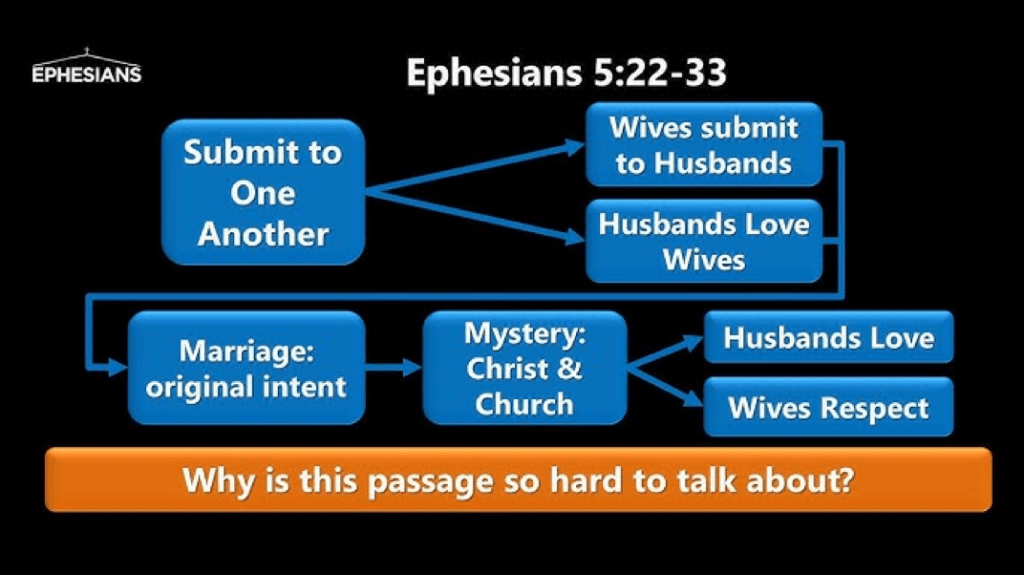
  1. 5:22-33 Husbands and wives


A. 5:22-33 Husbands and wives

These images are from saralandchristians.com

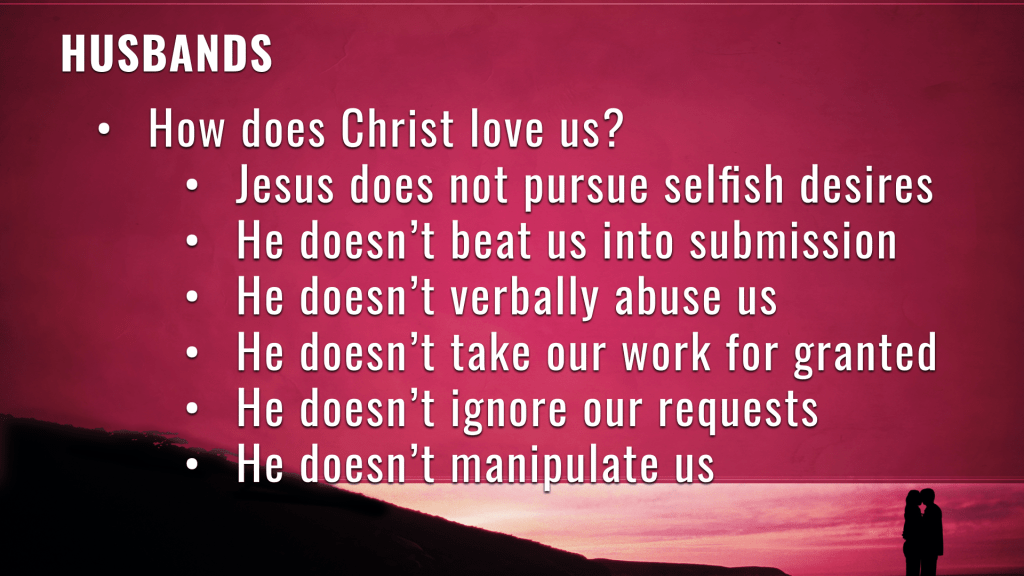
4:20 The husband is to nourish (supply her needs)and cherish (thalli, to keep warm, warm someone up, revive their health, by nourishing. Used in 1 Thess 2:7 of a nursing mother cherishing (cares for) her children). 

Q: Do most husbands even know what their wives needs are or care if he is really supplying those needs? 

Q: Do most husbands show their wives how much they cherish them? “Cherish is the word that I use to describe …” song by the Association. 

Q: What would you say are a wife’s main needs?

Q: Under what circumstances would a wife not have to be in submission to her husband? If he beat her? If he verbally abused her? If he lied to her? If he didn’t support her financially? If he was a drunk? 

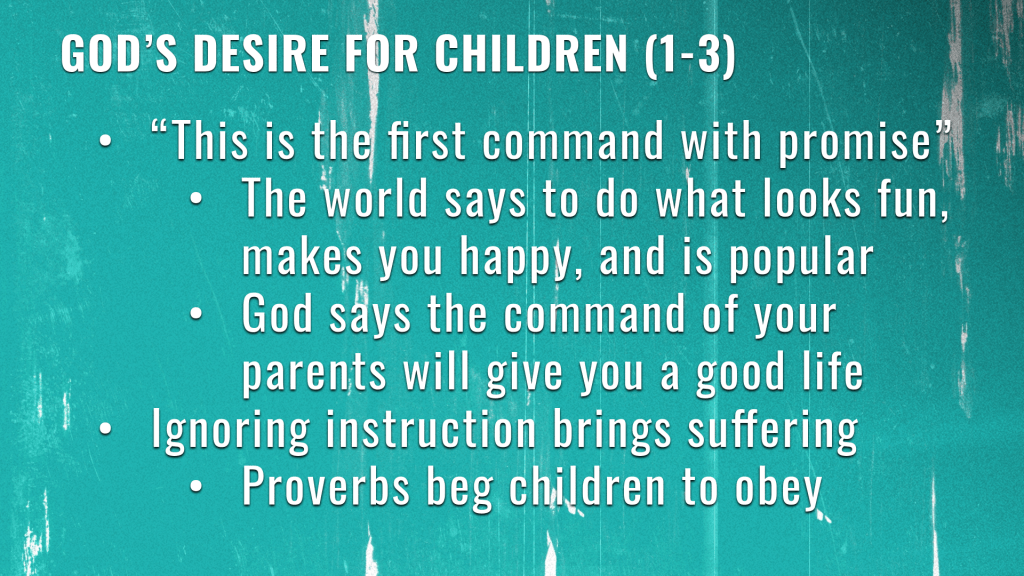
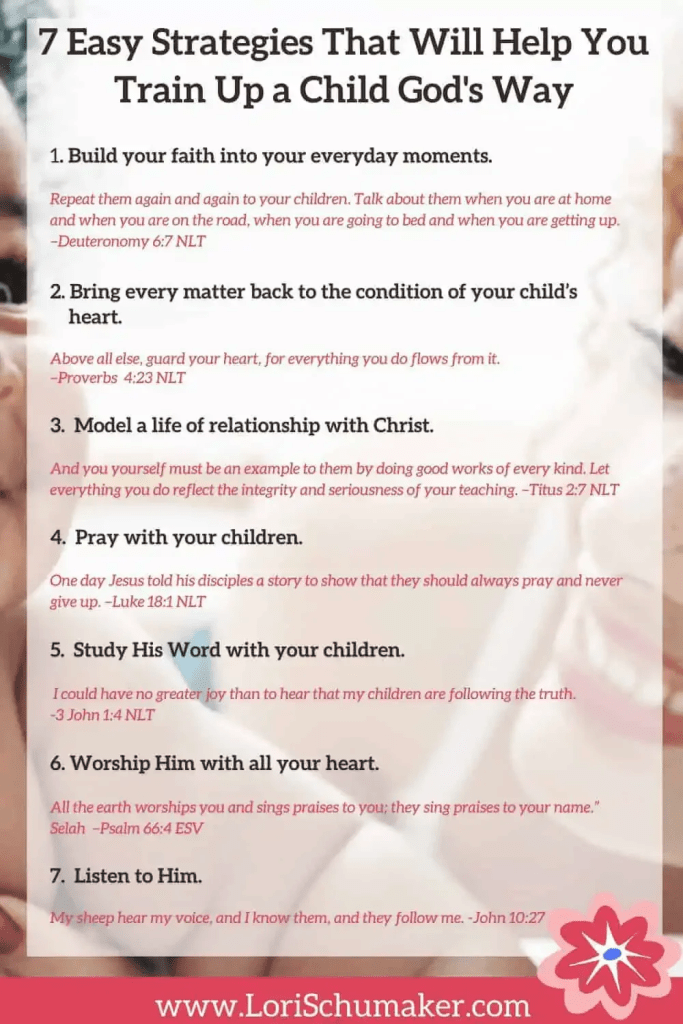
B) 6:1-4 Children and parents

Also from saralandchristians.com

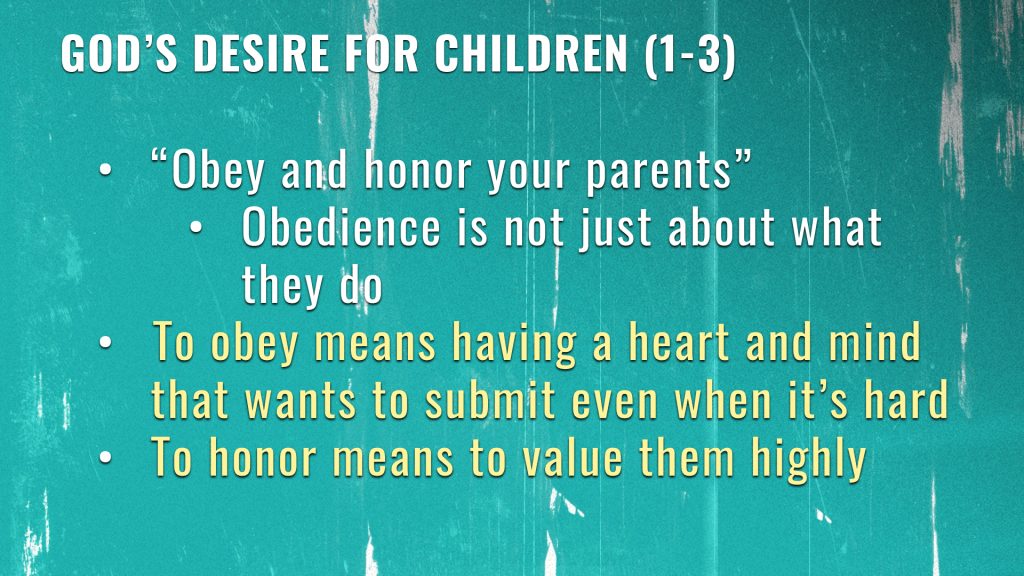
Q: Is there ever a time when children do not have to obey their parents?

What if the parents won’t let them be baptized or go to church with their friends?

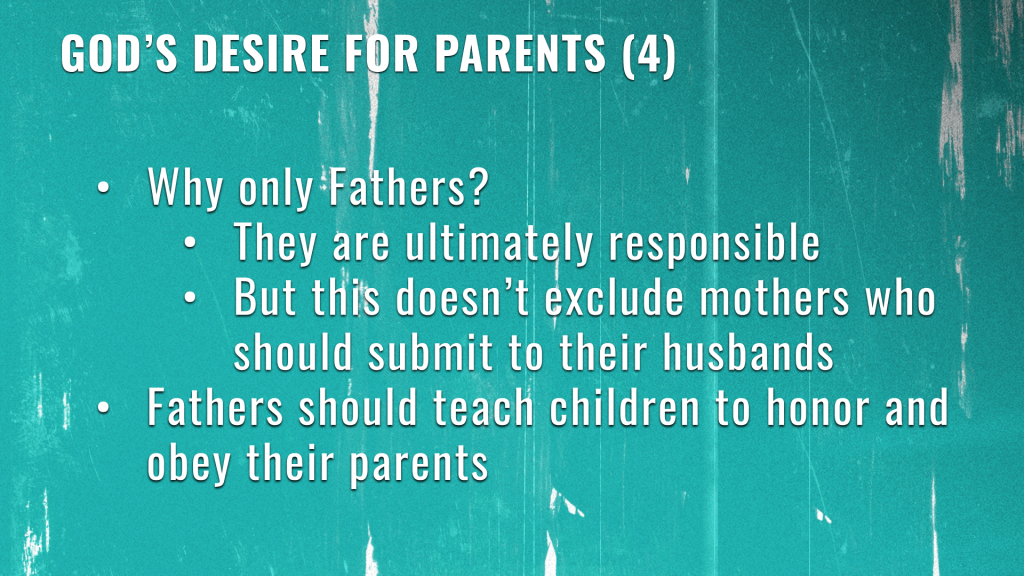
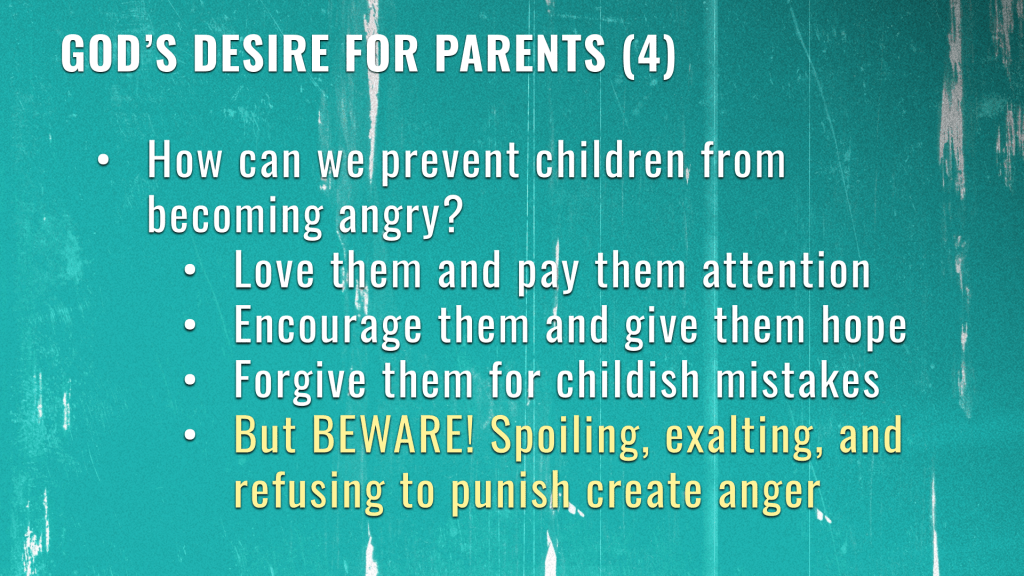
Q: What are some ways that fathers might exasperate their children and provoke them to anger?

Why are only fathers mentioned here and not mothers?

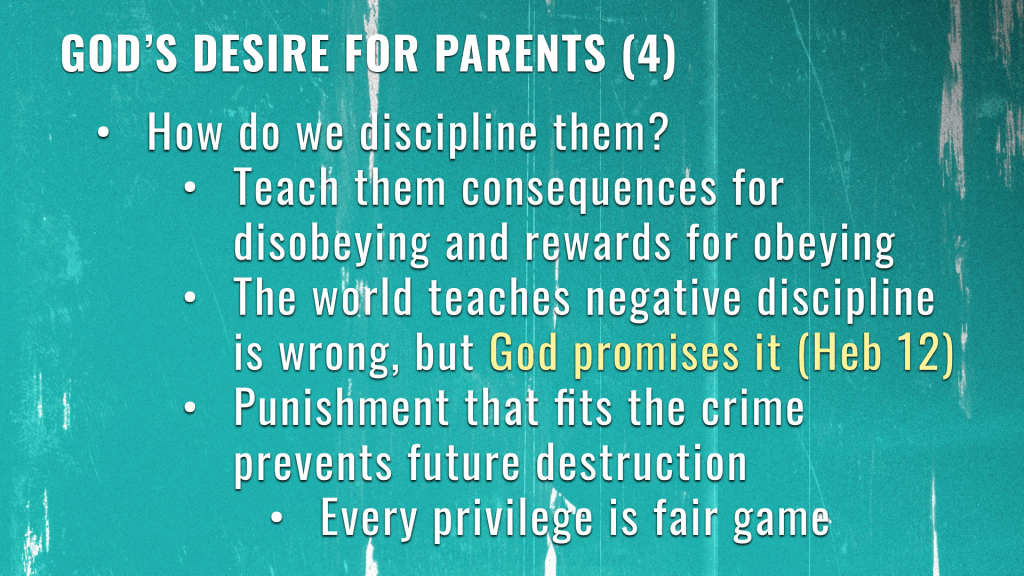
If you have children, do you remember times when you probably provoked your children to anger or disobedience because of the way you disciplined them? 

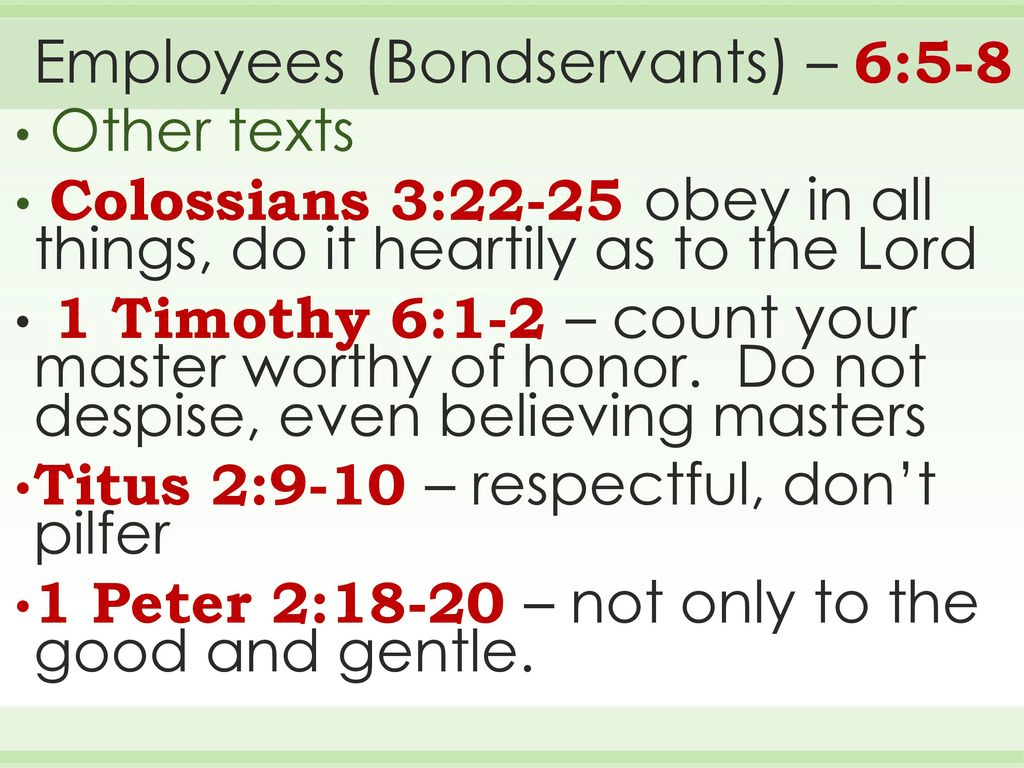
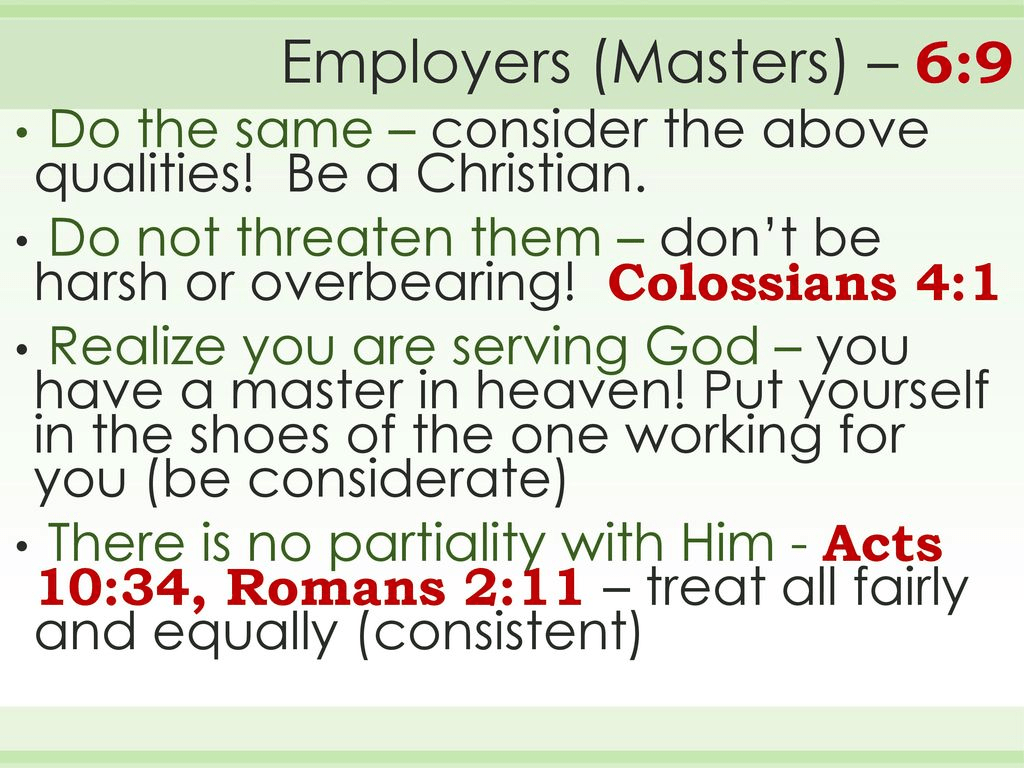
C) 6:5-9 Bondservants and masters 

Q: Does it surprise you that neither Jesus nor the apostles tried to do away with slavery? 

How did the Christians in the northern and southern churches handle the slavery issue around the time of the Civil War?

Do you think that a Christian master would voluntarily free his slave once he becomes a Christian?

We will study Philemon later where Paul tells Philemon to receive back kindly his runaway slave who had become a Christian while Paul was in Roman prison. Paul did not tell him to free Onesiphorus.  

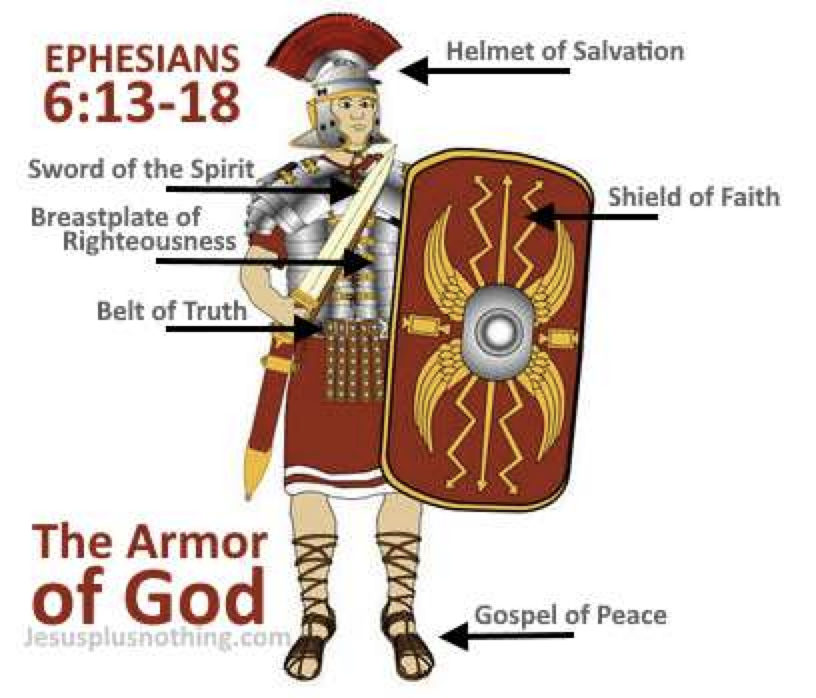
7. 6:10-20 Stand with the armor of God against the schemes of the devil

So far it has been about our “walk” and conduct. But if you are out walking and someone attacks you, then you have to keep walking to get to your goal but you need to defend yourself with a weapon like a gun or a knife, etc. 

The Christian walk is the same way. The devil had devious schemes to deceive Christians and many different ways of attacking Christians to get them to sin and fall from grace.

Thus the need for the “whole armor of God”. You can’t fight on your own. You need the strength of God and His armor. 

Q: After reading all the individual parts of the armor and what they do, which one do you need the most?

Q: 6:18 8 praying at all times in the Spirit, with all prayer and supplication. To that end, keep alert with all perseverance.

How often do you pray for God to help you fight the devi, to not give in to temptation?

6:21-24 FINAL GREETINGS

Paul sent Tychicus to see how they were doing.

Tychicus is mentioned five times in the New Testament:

  • Acts 20:4: Tychicus is mentioned alongside Trophimus 
  • Ephesians 6:21–22: Paul sends Tychicus to the Ephesians to tell them about his circumstances and encourage them 
  • Colossians 4:7–9: Paul sends Tychicus to the Colossians to tell them about his circumstances and encourage them 
  • Titus 3:12: Paul considers sending Tychicus to Crete to assist Titus 
    2 Timothy 4:12: Paul sends Tychicus to Ephesus. Tychicus was an Asiatic Christian who accompanied Paul on part of his journey from Macedonia to Jerusalem. Paul trusted Tychicus and referred to him as a “dear brother” and “faithful servant”. 
  • The Catholic Church calls Tychicus St. Tychicus, and his feast day is April 29. Church tradition holds that he was martyred for his faith in Colophon, which is 24 miles from Ephesus.