JOHN G. PATTON: MISSIONARY TO CANNIBALS

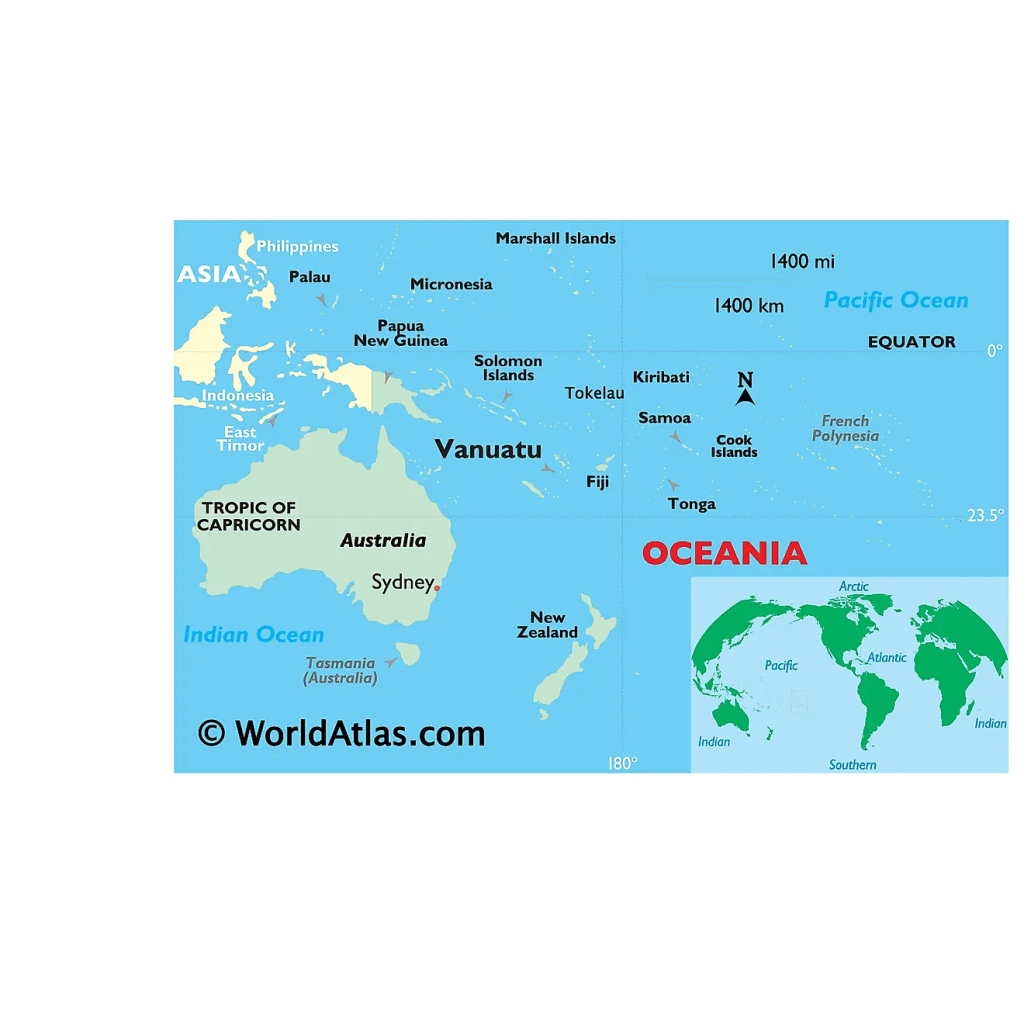
Do you have any idea where the New Hebrides islands are? They are in the South Pacific.

The New Hebrides, now known as Vanuatu, consists of roughly 80 islands in the South Pacific. These islands are situated northeast of New Caledonia and southeast of the Solomons. While there are 80-odd islands in total, not all of them are inhabited. Notice the islands of Tanna and Aniwa. They are at the heart of the post today concerning John G. Paton. Born in Scotland in 1824, John married Mary in April, 1858 and 14 days later sailed to the South Pacific and landed on the island of Tanna in November, 1858. They joined a missionary who had been working there for several years. Three months after their arrival, a son, Peter Robert Robson, was born on 12 February 1859. But just 19 days later, Mary died from tropical fever soon to be followed to the grave by the newly born Peter at 36 days of age. The natives on Tanna were cannibals. In 1839 two missionaries had been martyred and eaten by the cannibals in the South Pacific. “After Mary died, John spent nights sleeping on their grave to protect them from the local cannibals. The gravesite is still accessible to this day with a plaque marking the spot, erected in 1996.” (Wikipedia)

John continued alone for 4 years trying to convert the cannibals in spite of the danger he faced from the cannibals. 14 times he was attacked with a fever. He barely escaped the cannibals on many occasions. Later he returned to Scotland to raise money for the work in the New Hebrides and to encourage missionaries to go there. In 1865 he married again to Maggie and they went to another island in the New Hebrides, Aniwa, in 1866. The natives of Aniwa were cannibals also but they were more receptive than those in Tanna. “John learned the language and reduced it to writing. Maggie taught a class of about fifty women and girls who became experts at sewing, singing and plaiting hats, and reading. They trained the teachers, translated and printed and expounded the Scriptures, ministered to the sick and dying, dispensed medicines every day, taught them the use of tools, held worship services every Lord’s Day, built orphanages and took care of many orphans, and sent native teachers to all the villages to preach the gospel. Enduring many years of deprivation, danger from natives and disease, they continued with their work and after 15 years of patient ministry, the entire island of Aniwa professed Christianity. In 1899 Paton saw his Aniwa New Testament printed and the establishment of missionaries on twenty-five of the thirty islands of the New Hebrides.” (Wikipedia) Maggie died in 1905 and John died at the age of 82 in 1907. John spent almost 50 years mission work in Tanna and Aniwa. He was courageous and willing to put his life on the line to propagate the gospel of Jesus.

“In Christianity, an unreached people group refers to an ethnic group without an indigenous, self-propagating Christian church movement. It is estimated that of the 8.08 billion people alive in the world today, 3.42 billion of them live in unreached people groups with little or no access to the Gospel of Jesus Christ.  For every $100,000 a Christian earns, only $107 on average will go to world missions. And roughly 1% of that money will support the 3.1 billion people who live in unreached people groups.” (AI)

I encourage you to pray over this map of unreached people groups worldwide. Churches spend about 75-80 % of the money they collect in contributions on buildings and staff. Churches collect about 75 billion per in contributions but only a small % of that money goes into mission work and a very, very small % of that money goes toward reaching the unreached people groups with the gospel. Fellow Christians, what are we doing? Where do you think Jesus would want all that money spent? Children dying all over the world b/c of unclean water. Families and children in refugee camps trying to escape local warring groups. Famine and flood relief needed. The Bible needs to be translated into all the languages of the world. “As of November 2024 the whole Bible has been translated into 756 languages, the New Testament has been translated into an additional 1,726 languages, and smaller portions of the Bible have been translated into 1,274 other languages. Thus, at least some portions of the Bible have been translated into 3,756 languages.” (AI) So the translations are there, we just need to print and distribute them to the world.

I hope you at least tithe (give a tenth). I hope you give that tithe to the many organizations that print Bibles, support missionaries, drill wells, provide food for the oppressed and needy worldwide.

MARY MOFFAT

This post honors missionary wives. Mary Moffat was the consummate (perfect or complete in every way) missionary wife of British missionary Robert Moffat. Robert was a gardener but his passion for mission work led him to Africa at the age of 21. Mary’s parents forbade her marriage to Robert, but finally consented and she joined in both in marriage and in his mission work in South Africa in 1816. They would spend 50 years as partners in Kuruman, South Africa trying to bring the Bechuana to Christ. She had come from a well to do family but adjusted to living in a hut with mud walls and floors, hauling water in every day. Living conditions were tough on Mary and Robert. Their “honeymoon” was spent on a 700 mile trip to Kuruman with all their belongings in an ox cart pulled by six spans of oxen that took 7 weeks (she described it as one long picnic). “For the Moffats there were long years of fruitlessness, of reducing an unwritten language, and of translating the Bible into that difficult tongue.  Other duties took time from the all-important task of evangelism:  planting, building, carrying, creating, butchering, salting, storing, sewing, cobbling, carpentering, blacksmithing, preaching, teaching, exhorting, pacifying, supporting, cleaning, feeding, doctoring, praying, writing, etc.” (from GFA missions) They constantly dealt with natives stealing their possessions. Robert made trips into the interior leaving Mary very fearful due to threats from warring chiefs. It was 7 long years before they made their first Christian convert. ” Robert was an independent individual given to moods, both visionary and of depression.  Mary was steady, disciplined, patient, and organized. She had a faith in the future that never wavered.  She was always ready to comfort and support Robert. They eventually served for over 52 years with only one furlough during that period of time.

Mary was Robert’s “beloved partner,” a true helpmeet.  Their goal was to see the Bechuana come to Christ, a church planted, and the Word of God available in the language of the people.  Their love for the national was one, and their arms and home were open to the nationals.  Mary was wife, mother, and true missionary.  She was a great encourager to Robert in the tedious task of learning the language and translating the Bible, which took many years of plodding word by word, verse by verse.  Robert was self-taught in Greek. They were truly one flesh, one mind, and with one purpose—all to the glory of God.  Africa became their home. 

There were times when Robert was very discouraged and depressed; but Mary, at his side as a true companion and a true partner in the work, saw him through these difficult times (Ephesians 5:31-33).  She was a woman of great faith.” (from GFA)

Their oldest daughter married David Livingstone but died of a fever during his trips through Africa. Some of their other children became missionaries. “She and Robert were credited with creating a family of “Moffats” who carried forward the mission work.” (from Wikipedia)

“By degrees, better conditions came. Once Mary Moffat wrote to friends at home for a communion service, because, as she said, she believed that native Christians would yet sit together at the Lord’s table in that land. That time came, and she wrote: “You can hardly conceive how I feel when I sit in the house of God surrounded with the natives. Though my situation may be despicable and mean in the eyes of the world, I feel that an honor has been conferred upon me which the kings of the earth could never have done for me. I am happy, remarkably happy, though my present habitation is a single room with a mud floor and a mud wall. Not only did a native Christian community grow up about them in Kuruman, but through the influence of the native Christians here and the teaching of Moffat on his missionary tours, groups of native Christians may now be found through all that region.” (Jessie Brown Pounds from wholesomewords.org)

Do you see why I called Mary Moffat the “consummate missionary wife”? No doubt her daily life was filled with things like gardening, cooking, cleaning, etc. but she did all that with one purpose in mind: to partner with her husband to spread the gospel to the Bechuana in Kuruman. I encourage you to think about all the duties and chores that you do every single day. You ladies cook, clean, take care of the kids, run errands, shop, maybe work outside the home, wash clothes, etc. You men go to work every day, deal with the stress of providing for the family, fight the traffic coming and going to work, fix things around the house, deal with issues with the kids, watch sports, plan for future financial and health well being for your family, etc. But, men or women, do you do everything with one purpose in mind: to honor God, to save your own children first and then to share the gospel with as many people as you come in contact with? Do you just go through life doing the stuff you have to do or do you do follow Colossians 3:17 “Whatever you do in word or deed, do everything in the name of the Lord Jesus, giving thanks through Him to God the Father.”? Notice “whatever you do in word or deed”. That would include all the daily chores and duties that you do.

I am also blessed with a consummate missionary wife. We have partnered in mission work overseas, church work here in the U.S., and over 35 years of Christian education (which I considered to be mission work here in the U.S.). She has been, like Mary, steady, a great mother to our 3 children, a great role model to our 10 grandchildren, never complaining about whatever living conditions we had, always making the best of bad situations, encouraging to me when I get discouraged. When I felt like the Lord was calling us to a mission field overseas or locally in Christian education, she never questioned that calling but joined in. Like Robert, I often was off on my mission trips or duties in Christian education, leaving her to deal with the real issues of raising a family and she did so with great success. We are proud of the faith of our 3 children and the loving Christian homes they have established, and their faith was largely due to their mother’s prayers and faith passed on to them. She would pray every night with them, “God help ___, ___, and ___ grow up to be Christians and marry Christians” (long before they knew what either concept meant), and they did both!

Thanks to all consummate Christian wife partners in life. I can think of several more that I know well. How about you? Do you do all your daily duties and chores to honor God? I thought this was great from AI. “Making secular pursuits holy for God involves seeing all aspects of life, including work and everyday tasks, as opportunities to serve God and glorify him. This means approaching secular activities with diligence, honesty, and a sense of dedication, recognizing that even seemingly mundane tasks can be done for the glory of God.” Try that today as you go through the day. Make every thing you do holy. Think: “how can I make this mundane task become something holy to honor God?”

LOTTIE MOON

In my posts I try to gather info and pass it on to you. You can go to different sites and read the original sources that I gather from, but i hope my summaries make it simpler for you. Today, it’s Lottie Moon, missionary to China. Born in 1840, she went to China in 1873 at the age of 32 and spent 39 years there teaching women and girls and sharing the gospel in China. She was one of the first women to earn a master’s degree in the south. She never married (though engaged at one time) but instead dedicated her whole life to serving God. She spoke Latin, Greek, French, Italian, Spanish, and was fluent in reading Hebrew. Instead of pursuing a career in the U.S. she chose to devote her life to sharing the gospel in China. She adopted Chinese dress and customs and identified with the Chinese people. “She took a special interest in Chinese women, establishing schools for girls and working to free them from customs such as foot binding.” (AI) Lottie had several nicknames in China—foreign devil, foreign lady teacher, heavenly book visitor, and the cookie maker. (Lottie baked cookies to win the hearts of the children and families who were frightened of her.)” (AI) She was often persecuted by Chinese who hated foreigners. “Throughout her missionary career, Moon faced plague, famine, revolution, and war. The First Sino-Japanese War (1894), the Boxer Rebellion (1900) and the Chinese Nationalist uprising (which overthrew the Qing Dynasty in 1911) all profoundly affected mission work. Famine and disease took their toll as well.” (from Wikipedia)

She is famous for her letters to southern Baptist Christians begging them to come do mission work in China among the 472 million Chinese living at that time, or send missionaries, or support sending missionaries. She was a realist. She once wrote home to the Foreign Mission Board, “Please say to the [new] missionaries: they are coming to a life of hardship, responsibility and constant self-denial.” “Disease, turmoil and lack of co-workers threatened to undo Lottie’s work. But she gave herself completely to God, helping lay the foundation of what would become the modern Chinese church, one of the fastest-growing Christian movements in the world. Lottie Moon died at 72 — ill and in declining health after decades ministering to her beloved Chinese. But her legacy lives on. And today, when gifts aren’t growing as quickly as the number of workers God is calling to the field, her call for sacrificial giving rings with more urgency than ever.” (from the International Missions Board of the southern Baptist Church) There are now 1.4 billion Chinese. In 1918 the Women’s Missionary Union started the annual Lottie Moon Christmas Offering for international Missions. Lottie died in 1912. “In her final hours, she sang “Jesus Loves Me” with the missionary nurse who accompanied her. Lottie made one final gesture, pushing her fists together in the form of the Chinese greeting.” (AI) Due to declining health and sharing her food with starving Chinese, she weighed 50 pounds when she died. She was a feminist, promoting gender equality. She would have fit in quite well with the modern feminist movement!

I enjoyed learning more about Lottie Moon. I continue to be amazed at foreign missionaries like Lottie who suffered much to do life long mission work in foreign countries. My usual rant: the church in the U.S. should be sending and supporting missionaries to the unreached peoples groups around the world instead of spending 80% of the contributions on staff and buildings. Pray for all the missionaries abroad. In the messages to the 7 churches (Revelation 2,3), a warning is given several times to the churches to get back to their first love, to strengthen the things that remain, to repent of sin and worldliness, to oppose false teaching (like the lGBQT movement that has captured many churches), and to awake from lukewarm complacency. Those warnings would apply to many churches in the U.S.

GEORGE GRENFELL (1849-1906): A LIGHT IN CONGO DARKNESS

George Grenfell began 30 years of mission work in central Africa in 1875. An affair with his black Jamaican housekeeper almost ended his mission work, but He overcame his moral failure and continued his mission work. He would travel thousands of miles on the Congo River and its tributaries first in his steamer Peace and then 2 later steamers. The Peace was constructed in England, then dismantled and shipped to Africa in 800 packages weighting 65 pounds each. It took 1,000 people four months to carry the cargo to its destination. 3 engineers died shortly after arriving in the Congo trying to reassemble the Peace. Grenfell oversaw the putting of the steamer together. He later wrote, “The Peace was prayed together”. The spiritual darkness and depravity was unbelievable: burial murders (some living person had to be sacrificed and die when someone was buried), witchcraft cruelties (killing tens of thousands), slave raiding (to replenish the slave lavor supply or to sell to foreign slave traders), cannibalism, sensuality (drunkenness and sexual immorality), and sadistic methods of punishment (they enjoyed inflicting pain). At the end of one voyage he wrote, “We have been attacked by natives about 20 different times; we have been stoned and shot at with arrows, and have been the mark for spears more than we can count.” “But the Congolese were not the only danger the mis­sionaries faced — death by disease was a constant threat. The Congo was called “the short-cut to heaven.” In 1883-84, seven of Grenfell’s colleagues died after only a few months of service. In 1885, four men died in three months. In 1887, six missionaries fell in five months. These enormous losses prompted the missionary society to con­sider abandoning or at least curtailing the work in the Congo. But Grenfell possessed a different spir­it. In 1888, he wrote the Society, “We can­not continue as we are. It is either advance or retreat, but if it is retreat, you must not count on me, I will be no party to it, and you will have to do without me.” Thank­fully, the Society chose not to retreat. For almost 25 years Grenfell labored in the Congo. His last years were darkened by the sorrows of illness but gladdened by the joys of harvest. In 1902, he wrote, “Our services are crowded as they have never been before; God’s spirit is manifestly working.” In his journeys up and down the river, he saw many evidences of change, and he reported, “The light of life was beginning to dawn in many dark hearts.”

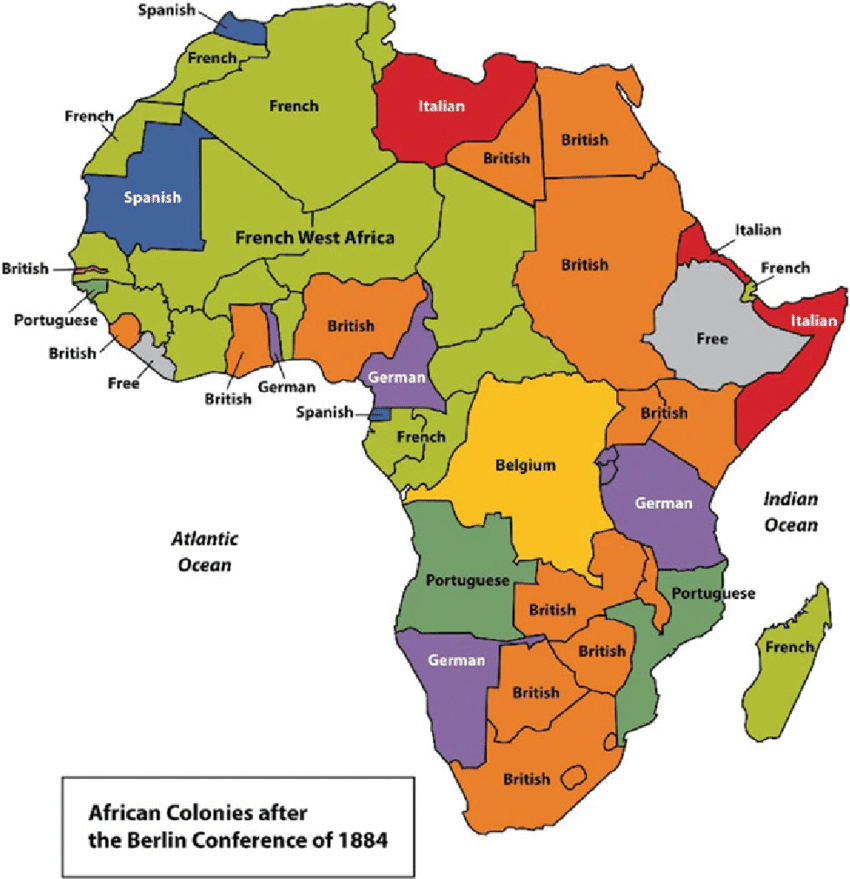
On a side note, Grenfell had dealings with the Belgium King Leopold II. Leopold II personally owned and controlled the Congo Free State, a vast territory in Central Africa, from 1885 until 1908. Under Leopold’s rule, Congolese people were subjected to brutal forced labor (working them literally to starvation and death), primarily for the collection of rubber, leading to widespread deaths and atrocities. Reports of human rights abuses in the Congo, including forced labor and widespread deaths, led to international condemnation and pressure on the Belgian government to take control of the colony. Facing mounting pressure and international criticism, the Belgian government intervened in 1908, taking control of the Congo Free State and renaming it the Belgian Congo, ending the reign of Leopold II over Belgium. The Belgian Congo remained a Belgian colony until 1960, when it gained independence and became the Democratic Republic of the Congo. Grenfell believed to the very end that Leopold had sincere intentions to help the people of the Congo until he finallly realized that he had been duped by Leopold who was only concerned about the wealth he could get from the Congo. Thus another sad chapter in the history of European colonization of Africa: European countries taking control over African areas to rob them of their precious resources in the guise of spreading civilization and Christianity! Here is a map of what that looked like around 1884. Ethiopia and Liberia were the only two countries never colonized by Europeans. Ethiopia had a strong Christian presence and military strength which helped them avoid colonization. Between 1945-1960 most of these colonized countries gained independence. Of course they were never reimbursed for all the resources that the European countries had stolen from them. It is amazing that during this colonial period of Africa that Christian missionaries helped make Africa about 50% Christian today. Unfortunately, it is about 45% Muslim which has led to much violence against Christians in Africa. In Sudan anti-Christian persecutions grew particularly after 1985, including murders of pastors and church leaders, destruction of Christian villages, as well as churches, hospitals, schools and mission bases, and bombing of Sunday church services. As of 2024, more than 100 churches have been damaged so far, and Christians have been abducted and killed.


Grenfell’s death occurred shortly after he opened a new mission station at Yalemba, near Stanley Falls. He fell ill from the dreaded haematuric fever and entered into the presence of his Lord, July 1, 1906. His last words were, “Jesus is mine.”” (Thomas Ray of the Baptist Bible Tribune) I wonder if he took those last 3 words from the song Blessed Assurance: Blessed assurance, Jesus is mine Oh, what a foretaste of glory divine Heir of salvation, purchase of God Born of his Spirit, washed in His blood. This is my story, this is my song. Praising my Savior all the day long This is my story, this is my song. Praising my Savior all the day long”. Here is the song to start your day: https://www.youtube.com/watch?v=UePXtov0zC0

Grenfell said: “Cruelty, sin, and slavery are as millstones around the necks of the people, dragging them down into a sea of sorrows.” Isaiah described it this way: Isaiah 5:8 “Woe to those who drag wrongdoing with the cords of deceit, and sin as if with cart ropes.” The imagery is the weariness of dragging a heavy. cart around everywhere you go. That cart is your sins. The cords you drug the cart with are deceit: you are deceived into thinking that the evil that you are doing is not sin. The 25 million natives along the Congo River believed that their many heathen practices were acceptable. As Isaiah said, “Woe to those who call evil good and good evil.” (Isaiah 5:20)

Grenfell was met with native spears when he first arrived in the Congo. 20 years later, he was met by little children who stood on the beach to welcome him and the singing of “All Hail the Power of Jesus’ Name” coming from a fishing canoe. He taught brick-making, treated the sick, engaged in translation, and was awarded a Gold Medal in 1886 for his service in exploration of the Congo and its tributaries. His legacy was that he prepared the way for the conversion of many in the Congo.

I continue to be amazed at the resilience and sacrifice of these missionaries to difficult foreign countries and unreached people groups. I see church preachers making 100k a year in their comfortable offices and wonder where church priorities are compared to these former giants of spreading the gospel. I know that located paid preachers do a lot of good, but think how many souls could be saved if we used most church contribution money for missions, printing Bibles, digging wells, feeding the poor, helping the oppressed! Most congregations have several talented, knowledgable Bible teachers that could preach sermons for us and let us all that staff money to support missionaries! I guess I end a lot of articles with that same thought, don’t I? But it does bother me.

George Grenfell got a Gold Medal on earth but he got a crown of righteousness (2 Timothy 4:8), a crown of glory (1 Peter 5:4), a crown of life (Revelation 2:10; James 1:12), an incorruptible crown (1 Corinthians 9:25), and a crown of joy (Philippians 4:1; 1 Thessalonians 2:19) after he finished his mission work, died, and got his reward in heaven. I have a feeling that he appreciated those spiritual crowns in heaven far more than his Gold Medal.

END OF THE SPEAR (2005 MOVIE)

Jim (1927-1956) and Elisabeth (1926-2015) Elliot

From Kindred Grace magazine (by Chantel): “Jim and Elisabeth met in college, but they didn’t get married until they separately went to Ecuador to minister to the Quichua. They married in Quito and moved to a more remote area to try to make contact with the Huaorani tribe (called the Aucas by the Quichua). Jim and four other missionaries were later killed by the tribe they were trying to reach. After her husband’s death, Elisabeth returned and spent two years ministering to the tribe that killed him. Elisabeth Elliot is one of the most known and loved women missionaries in the last few generations. Through her extensive speaking and many beautiful books, her legacy and inspiration will live on in the hearts of all who read them.”

If you have never watched the movie End Of The Spear (filmed in Panama) , I encourage you to do so. It will fill in the whole amazing story of these 5 missionaries who gave their lives trying to reach “unreached people groups” in Ecuador. Just when the missionaries thought they were making progress in befriending the Quichua, several Quichua natives became suspicious and speared them to death when they landed their plane by the river.

The follow up story is amazing. Eilsabeth Elliot was the wife of Jim Elliot. What would you do if your husband was speared to death by hostile natives in a foreign country. Grieve to death? Be filled with 2nd thoughts about trying to convert these “unreached people groups”? Be bitter and angry: how could God allow this to happen? Well, this is what she did. Two years “after her husband, Jim Elliot, was killed by the Waodani tribe, Elisabeth Elliot returned to the Ecuadorian rainforest to live among the tribe, choosing forgiveness over revenge, and later became a prominent author (over 20 books) and speaker, sharing her experiences and knowledge. In 1958 Elisabeth Elliot, wife of Jim Elliot, and Rachel Saint, sister of Nate Saint, made peaceful contact with the Huaorani tribe. They came to live with them, learned their language, and taught them the Bible. A native, Mincaye, soon converted to Christianity. He was one of the ones who speared the 5 missionaries.” (AI) Elisabeth died at age 88. Mincaye preached the gospel to fellow tribesmen in Ecuador until his death in 2020. I recently saw a picture of Waodani Indians being bapized exactly 50 years after and in the same river where the missionaries were speared. What a legacy? There is the song (and movie) “I Can Only Imagine” by Mercy Me, with Bar Millard imagining meeting his father in heaven. Can you imagine these 5 missionaries meeting Mincaye in heaven as he introduces them to some of those he converted after the missionaries died?

When you get through watching the movie End Of The Spear, watch Beyond The Gates Of Splendor” documentary film (filmed partly in Ecuador, released in 2002, was based on Elisabeth Elliot’s best seller book written in 1957). Watch it on youtube. “Through Gates of Splendor (the book), ” the story of Nate Saint, Roger Youderian, Ed McCully, Pete Fleming, and Jim Elliot, was first recorded in 1956 by Jim’s widow, Elisabeth in her best selling book. The story is told through the eyes of Elisabeth Elliiot. Decades later, its story of unconditional love and complete obedience to God still inspires new readers.” (AI) The documentary film Beyond The Gates Of Splendor documentary film (filmed partly in Ecuador, released in 2002, was based on Elisabeth Elliot’s best seller book written in 1957). Watch it on youtube. “Narrated by one of the missionary’s sons, Steve Saint, Beyond the Gates of Splendor not only documents the harrowing events of that fateful January day, but also reveals the dramatic changes in the Waodani culture that came as a result of the missionaries’ deaths.” (AI) In the film, the picture of the widowed Elizabeth in the canoe with her daughter, Valerie, heading back to the Huaorani​ with the gospel has inspired many missionaries to try to reach “unreached peoples groups”. I am watching Beyond The Gates Of Splendor film right now as I write this article.

I feel a little unworthy to even write this article. My mission work back in the 70’s was nothing in comparison to the work of these 5 missionaries and later their wives and children. My wife and I did spend 5 years doing mission work in Trinidad, West Indies (3 years) and Cali, Colombia (1 1/2 years). For some reason, as a teen my dream was to do mission work. I felt like it was a special calling. People living in the U.S. hear th gospel over and over in many different ways, but I felt like Paul did: “Romans 15:20 “And thus I make it my ambition to preach the gospel, not where Christ has already been named, lest I build on someone else’s foundation”. Although we taught and baptized many Trinidadians and started several churches there, we were not working with “unreached peoples groups”. To be honest, I don’t think I would have had the courage to do what those 5 missionaries did in Ecuador, risking their lives to share the gospel. I don’t think I would have had the courage or desire of Elisabeth to go back to convert those who killed her husband. I am still pleased withour mission work, however. I recently got a whatsapp call from the first sweet lady whom I baptized in starting a church in Siparia, Trinidad. She had 5 children and has been a strong leader in the church in Siparia since her conversion. It brought me great memories and joy to talk to her. I also recently talked to Eman Tobas and his wife Joan, one of the church leaders in the La Brea church with whom we worked closely. Eman is in the last stages of Alzheimer’s Disease. I know God is pleased with what we did in Trinidad as well as what they did in Ecuador. My wife and I went to Ecuador, actually, on a few mission trips to a Christian orphanage and school. We passed through the capital Quito just as Jim and Elisabeth did in the 50’s.

Maybe you don’t feel that God is calling you to do mission work in any foreign field. That’s all right. You can share the gospel right where you are. But you can still support mission efforts to share the gospel with the “unreached peoples groups”. “an unreached people group refers to an ethnic group without an indigenous, self-propagating Christian church movement. Any ethnic or ethnolinguistic nation without enough Christians to evangelize the rest of the nation is an “unreached people group. It is estimated that of the 8.08 billion people alive in the world today, 3.42 billion of them live in unreached people groups with little or no access to the Gospel of Jesus Christ. The latest estimates suggest that approximately 7,400 people groups are considered unreached. That means over 40% of the world’s people groups have no indigenous community of believing Christians able to evangelize the rest of their people group. With over 1.3 billion people living in unreached people groups, India has the largest population living in unreached people groups.” (AI)

Jesus’s command to his followers in Matthew 28:19-20, known as the Great Commission, instructs them to “go and make disciples of all nations”. Are we doing that today? Less than 3% of mission work is with unreached peoples groups. I think if Jesus was with us today, he might be turning some tables over. Matthew 21:12 “And Jesus entered the temple area and drove out all those who were selling and buying on the temple grounds, and He overturned the tables of the money changers and the seats of those who were selling doves.”

“This might surprise you. For every $100,000 a Christian earns, only $107 on average will go to world missions. And roughly 1% of that money will support the 3.1 billion people who live in unreached people groups.” (AI) Check your church’s budget. About 75-80% of contributions collected goes to staff and buildings. A small % might go to missions of some kind but a much smaller % goes to reaching the unreached peoples groups (if any at all). Churches should, in my opinion, focus on using the vast majority of their contributions to spread the gospel and help the poor and oppressed peoples of the world. Unfortunately, once you get into the “church business” stage of church organization, you end up with a budget mainly for buildings and staff.

As I have done before, I would encourage you to donate some of your tithes to organizations that work with helping the poor worldwide and spreading the gospel, especially among the unreached peoples groups.

Who are your heroes? Today, it is often famous athletes, movie stars, or musicians. Kinda like Isaiah 5:22 Woe to those who are heroes in drinking wine, And valiant men in mixing intoxicating drink.” The wrong kind of heroes in culture. There are many different “halls of fame” of athletes, musicians, actors, etc. The Bible “hall of fame” is in Hebrews 11 is often called the HEROES OF FAITH, the Bible “hall of fame”. There are quite a few people who make it into this “Hall of Faith” and some of these include Abel, Noah, Abraham, Isaac, Jacob, Sara, Joseph, Moses, Rahab, Gideon, Samson and David. Who are your heroes?

I hope these articles on courageous, sacrifical misionaries have inspired you in some way. Do you share the amzing stories of these missionaries with your children and others. Do they know Gladys Aylward, Jim and Elisabeth Elliot, and many others as well as they know Taylor Swift and LeBron James?

WILLIAM CAREY: FATHER MODERN MISSIONS

William Carey (1761-1834) was a shoe cobbler in England who preached on Sundays and studied Latin, Greek, and French. But he was burdened with the desire to preach the gospel to the heathen. He challenged the local preachers, “was the command given to the Apostles to tech all nations not obligatory on all succeeeding ministers?” The chairman of the meeting told him “sit down, young man,sit down. You are a miserable enthusiast. Certainly nothing can be done until another Pentecost…When the Lord wants to convert the heathen He will do it without your help or mine.” Such was the thinking of Baptist Calvinists who believed that the Holy Spirit worked directly on converting people (the “I” irresistible grace in “TULIP”. In spite of the opposition, he started “the particular Baptist society for propagating the gospel among the heathen.” It took 5 months on a ship to get to India. He never saw England again. Poverty, illness, and loneliness in India took its toll—hardships compounded by the fact the Thomas family (the doctor who came to India with Carey) was living in relative affluence in Calcutta. William complained in a letter that Dorothy and her sister were “continually exclaiming against” him. His wife had a mental breakdown adn died and she was often described as mad or insane. His child died. He lost his monetary support from England. He faced an India full of the Hindu caste system, superstition, and squalor. 9/10 of the population lived in poverty.

He saw the practice of suttee. Wives were tied to their husband’s dead body as they both burned on pyres of wood in open air as she also died. Or widows were even buried alive with their husband’s dead body. Many girls from 8 to 12 years oldd were married off by their fathers receiving a dowry from the marriage. Carey was eventually able to end suttee. He saw infant sacrifice, infants put in baskets in the trees exposed to the weather and deadly ants, or even torn from their mothers and thrown to alligators and sharks. He was able to stop infant sacrifice. He saw a leper burned by his mother and sister. He started a leper hospital to take care of lepers. But “Carey saw India not as a foreign country to be exploited, but as his heavenly Father’s land to be loved and saved… he believed in understanding and controlling nature instead of fearing, appeasing or worshipping it (as the Hindus did); in developing one’s intellect instead of killing it as mysticism taught.” (From Wikipedia)

From AI:”Carey arrived in India and spent 41 years in India without a furlough. His mission included about 700 converts in a nation of millions, but he had laid an impressive foundation of Bible translations, education, and social reform. He has been called the “father of modern missions” and “India’s first cultural anthropologist (one who studies human cultures.” He was a botanist who taught the people many methods for growing better crops. He was a postmillennialist Calvinist Baptist, probably doing his part to make society better for a thousand years after which Jesus would supposedly return.

“As the Danish pioneers had found a century earlier, Indian converts came slowly—from both Hinduism and Islam. Carey himself did not baptize his first convert, Krishna, till December, 1800—seven years after his arrival in India.” Most of his sermons were met with indifference, amusement, or hostility. He built Serampore, a college for the training of native ministers of the gospel.

“Appointed in 1801 to teach Bengali, Sanskrit, and Marathi at Fort William College, Carey translated the Bible into Bengali, Oriya, Marathi, Hindi, Assamese, and Sanskrit. He also translated parts of it into 29 other languages and dialects.” India eventually came to honor Carey’s accomplishments in India by putting his image on a stamp in 1993.

There is no telling how many Indian people were converted to Jesus as a result of his translations of the Bible into native Indian languages. Can you imagine taking your shoes to a poor cobbler to get them worked on, not realizing that the cobbler would one day be called the father of modern missions? He had, for the most part, much suffering and grief during his 41 years in India but never gave up.William Carey’s famous motto was “Expect great things from God; attempt great things for God“. 

AI: “Although there had been other Protestant missionaries before him, particularly among the Moravians, and the Catholic church never ceased mission work, Carey is called the father of modern missions because his eloquent plea, and personal example, inspired Protestants everywhere to mission endeavors. His efforts and writings, particularly his essay “An Enquiry into the Obligations of Christians to Use Means for the Conversion of the Heathens,” are seen as foundational to the modern missionary movement.”

I have become cynical about churches in the U.S. Should spreading the gospel not be the primary mission of the church? “While the exact percentage varies, studies suggest that a significant portion of church contributions, around 11%, are spent on missions, with a smaller portion, around 6%, specifically allocated for overseas missions. “Only 0.1% of all Christian giving is directed toward mission efforts in the 38 most unevangelized countries in the world.” – Barrett and Johnson, 2001. Churches spend a significant portion on personnel (49%), facilities (23%), programs (10%). I would encourage you to give your tithe (I hope you are at least tithing which only 12% of born again American do; most give 2-3%. to charity or church) to one of the many organizations that help the poor and oppressed all over the world, especially in 3rd world countries, like Healing Hands. Several of them print Bibles and children’s Bible story books, like EEM.

I was especially impressed with my long time friend Rex Watson and Baja Missions. They already have many churches they work with in the northern Baja, but Rex wants to expand to all the Baja, which would include sending 2 missionaries to work full time in the south Baja. They are raising money to fund that project if you can help. Baja Missions has a website at https://www.bajamissions.us/ if you want to check it out. They have many projects in the Baja to help the poor with clinics and they are spreading the gospel there.

It’s kinda ironic. Those Baptist preachers who discouraged Carey from going to the heathen, saying that the Holy Spirit would evangelize India without their help if the Holy Spirit wanted that done! B/c of their Calvinistic beliefs,they couldn’t see that the Holy Spirit was working through William Carey to get them to send missionaries to the heathen in India. That’s what happens sometimes when we let our theology blind us to the working of the Holy Spirit all over the world. Not just Calvinism. In the church I was raised in, preachers told us that the work of Billy Graham all over the world preaching the gospel was not valid b/c he didn’t preach baptism like my church taught. Some would say that Mother Teresa was not even a Christian b/c she was baptized as a baby and not as an adult. My church would say that a church that didn’t do the Lord’s Supper every Sunday or that used instrumental music in their worship was not the true church. All that was due to legalistic theology.

So, “expect great things from God, attempt great things for God”. Maybe you are just a stay home mom, a teacher, a mechanic, a construction worker, a janitor. Carey was a cobbler and look what great things he was able to accomplish for God. Let your mind imagine some great thing that God could use you for. Focus on that instead of the daily trivia that we deal with.


Adoniram (1788-1850) and Ann (1789-1826) Judson: MISSIONARIES TO BURMA (MYANMAR)

Adoniram (1788-1850) and Ann (1789-1826) Judson

“At the age of 25, Adoniram Judson was the first American (raised in Massachusetts) missionary to Burma (he arrived in Burma in 1813). He and Ann married two weeks before they boarded a ship bound for India, from which they eventually were able to make their way to Burma. Judson would spend the next nearly forty years of his life living among and witnessing to the Burmese people. Until her death, Ann was the friend of many and even more fluent in the Burmese language than her academically inclined husband. Judson’s efforts were slow-going. (AI: Adoniram Judson was charged by the Burmese during the first Anglo-Burmese War with being an English spy and was imprisoned in June 1824. In a 21-month period of incarceration during the Anglo-Burmese War, he suffered from fever and malnutrition and underwent a forced march.”) He was imprisoned and tortured, but he never gave up on his God-given calling to reach Burma for Christ. Before his death, Adoniram Judson had not only established several churches in Burma, but he had also given Burma one of the greatest gifts: the Bible in their own language. .” From Kindred Grace Magazine

AI: “Judson had two master goals (passions): (1) translate the Bible into the Burmese language, and (2) live to see 100 converts. As mentioned earlier, it was six long years of witness before the first Burmese soul came to know Christ. By the time of Judson’s death, there were 63 churches and 7,000 converts. But that is out of a population of 4 milliion in Burma in 1800’s. Now there are 54 million people in Burma. Christianity was brought to Myanmar by missionaries from England and France in the 17th century. It was not until the 19th century however, that large numbers of converts were made in the country.”

AI: “Judson developed a serious lung disease and doctors prescribed a sea voyage as a cure. On April 12, 1850, he died at age 61 on board ship in the Bay of Bengal and was buried at sea, having spent 37 years abroad with only one trip back home to America. Ann died at Amherst, Lower Burma, of smallpox in 1826.”

Here’s a great article about the Judsons, the suffering Ann went through, the first convert and how more converts were made in Burma. https://www.asiaharvest.org/adoniram-judson-a-life-poured-out-to-god

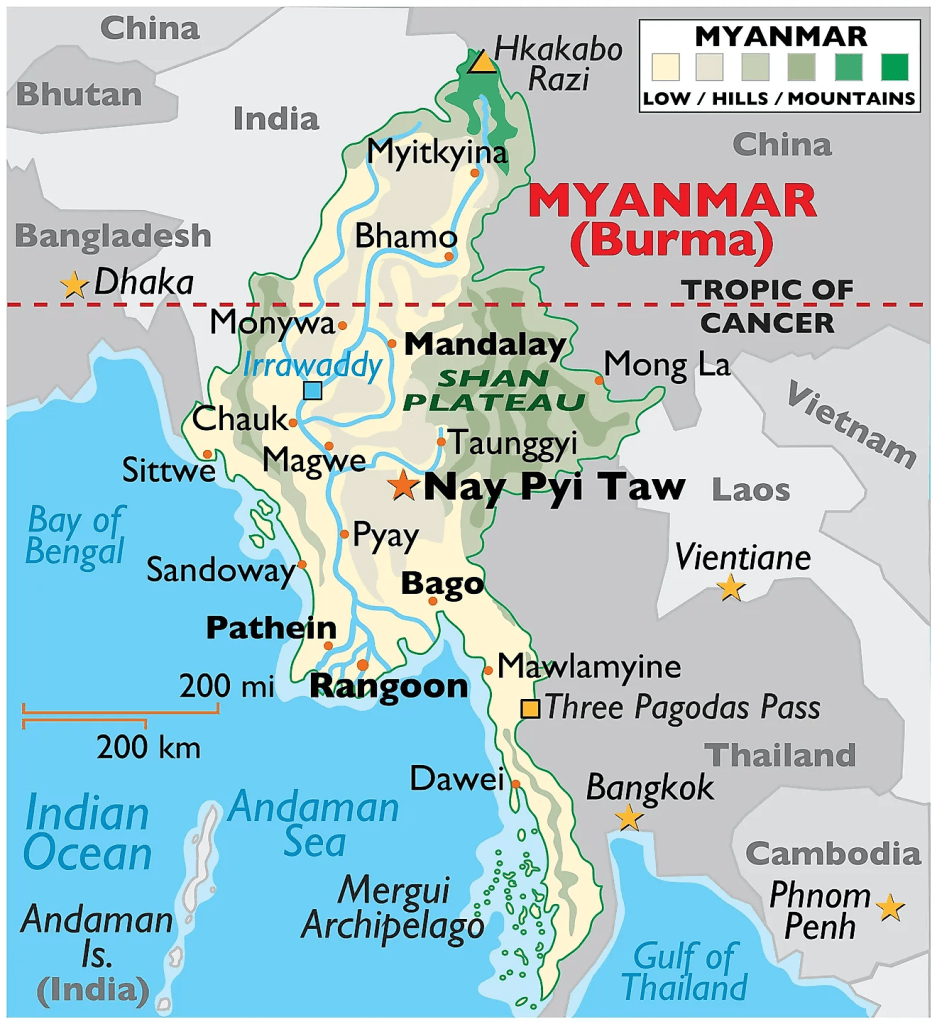
Where is Burma, now called Myanmar?

AI: “The history of Burma (now Myanmar) is marked by ancient city-states, the rise of the Pagan Kingdom (850-1300), periods of Mongol invasion, and British colonial rule, culminating in independence in 1948, followed by decades of military rule and ongoing conflict. British rule in Burma lasted from 1824 to 1948. This started from the successive three Anglo-Burmese wars through the creation of Burma as a province of British India to the establishment of an independently administered colony. The rule finally ended with independence. Some 40,000 British and Indian troops fought in the First Anglo-Burmese War, of whom over 15,000 died. Since staging a coup on February 1, 2021, the Myanmar military has carried out a brutal nationwide crackdown on millions of people opposed to its rule, killing 6,000 people and displacing 1 1/2 million people. Christians have been persecuted, caught in the middle of the military and rebel groups fighting. The dominant religion in Myanmar is Theravada Buddhism, practiced by about 88% of the population, with significant minorities of Christians (6%) and Muslims (4.3%).” Pray for the Christians in Myanmar.

Have you ever studied Buddhism? Buddhism originated in India around the 6th to 5th century BCE, with the teachings of Siddhartha Gautama, also known as the Buddha, forming its foundation. It spread to many countries and a number of different schools of Buddhism evolved, such as the Therevada Buddhism of Burma. Here is an AI summary of Buddhist teachings: The Four Noble Truths:These truths address the nature of suffering (dukkha), its origin, its cessation, and the path to its cessation. First Noble Truth: Life is characterized by suffering, which arises from attachment and craving.  Second Noble Truth: Suffering arises from attachment to impermanent things, leading to dissatisfaction and craving.  Third Noble Truth: Suffering can be overcome and ended. Fourth Noble Truth: The path to the cessation of suffering is the Eightfold Path.  The Eightfold Path:This is the practical guide for achieving enlightenment and ending suffering, comprised of eight interconnected practices: right understanding, right thought, right speech, right action, right livelihood, right effort, right mindfulness, and right concentration.”  I sum it up like this: Life is suffering and unfulfilled desires. Suffering is due to the desire to not suffer, to want things. The end of suffering is to cease to want to not suffer, to want things. Quit wanting to not suffer and you won’t be upset when you do suffer. Buddhist are actually very good people living by the 8 fold path. They just don’t have a Savior for their sins. Buddha never claimed to be such a savior. You can be a Buddhist and not believe in any god, as Buddhism is often described as a non-theistic or nontheistic religion, meaning it doesn’t require belief in a creator god. Buddhism has some good teachings, but no Savior.

That was the predominant religious culture in Burma when Judson worked for 37 years. 6 long years and much suffering before the first Burmese convert to Christ. I am a numbers person and would probably have given up after a couple of years and returned to America. But that one convert, Byu, led 1,270 members of his tribe to Christ in 12 years, and then Christianity spread to other tribes.Judson spent 37 years in Burma and only returned to America one time (in 1845) during those years. My wife and I spent 5 years in mission work in Trinidad, West Indies and Colombia, South America. We went home once a year during those 5 years. I must admit that I longed for life back in Alabama even though we loved our mission work abroad. I can’t imagine 37 years abroad and ony returning one time. Can you imagine that one visit Judson made back home to Massachusetts in 1845? He saw where Texas had just become the 28th state. He probably saw the conflict brewing in the states which led to the Civil War in 1861. He probably saw a lot of indifference and materialism. He stayed for 9 months and headed back to his passion, Burma.

All these great missionaries inspire me. Maybe I can’t or won’t do mission work abroad again as we did back in the 1970’s. But I teach students in my Bible classes that might become a Byu. Indeed a few grads are doing mission work in Ecuador, Tunisia, etc. My rant again: churches need to quit spending so much money on ourselves (buildings, staff, and assembly comforts) and start spending the vast majority of their contributions on printing Bibles to get the gospel to all these Hindu, Buddhist, Muslim, and atheistic countries. Judson had a goal to print the Bible in the Burmese language, and he did. I wonder how many were converted by that Burmese Bible? We need to make the printing and distributing of the Bible in all the main languages a priority in our spending. If you can go do mission work, go, even if on a short term trip. If you can’t go, then live modestly and give your tithing to organizations that print Bibles like Eastern European Ministries (EEM).


GLADYS AYLWARD (INN OF THE 6TH HAPPINESS)

Gladys Aylward (1902-1970)

“She always knew that she would be a missionary, but when Gladys applied to the China Inland Mission she was denied. They didn’t think someone so young could learn the language, and she had little education to back her up. Gladys wasn’t one to give up, and after working as a housemaid, she spent her life savings on a train ticket to China. Her trip was full of setbacks, but in 1932, Gladys arrived in Yangcheng and began to work with an older missionary, Jennie in setting up the Inn of the Eighth Happiness. Gladys worked for the Chinese government as a “foot inspector”, enforcing the new laws against female foot binding. She became a beloved Chinese citizen, affectionately called “Ai-Weh-Deh”. She took in many orphans and unwanted girls. When the region was invaded by the Japanese during WWII, Gladys took around 100 orphans over the mountains to safety. Unable to return to China after the communist regime was in place after the war, Alyward settled in Taiwan where she spent her remaining days running her orphanage.” Chantel from kimdredgrace.com

From Gladys Aylward: The Little Woman book, an autobiography where Gladys tells her own story: “A solitary woman. A foreign country. An unknown language. An impossible dream? No! With no mission board to support or guide her, and less than ten dollars in her pocket, Gladys Aylward left her home in England to answer God’s call to take the message of the gospel to China. With the Sino-Japanese War waging around her, she struggled to bring the basics of life and the fullness of God to orphaned children.”

One of my favorite movies was Inn Of The 6th Happiness (1958) with Ingrid Bergman (a name only we old timers will be familiar with, a great actress). AI: “The movie “The Inn of the Sixth Happiness” is a dramatized, fictionalized account of Gladys Aylward’s life, not a strict biography, and deviates significantly from reality in several key aspects, including character portrayals, plot details, and the actual name of the inn.” It was actually “The Inn of the 8th Happiness”. AI: “The inn was originally called “The Inn of the Eight Happinesses” (Chinese: 八福客栈; pinyin: bāfú kèzhàn), referencing the eight virtues of Love, Virtue, Gentleness, Tolerance, Loyalty, Truth, Beauty and Devotion, but was renamed in the film “The Inn of the Sixth Happiness”. Some romantic scenes didn’t really happen, but the core of the movie is factual. Can you imagine a 30 year old poor woman setting out on a train by herself to go do mission work in Chine? Aylward took a train across Siberia on the Trans-Siberian Railway to China. This dangerous 7,000 mile, 5 week long, trip took place in 1930, at a time when the Soviet Union and China were in an undeclared war.  Can you imagine a young woman in China finding a way to support herself so she could learn Chinese and spread the gospel? Can you imagine her rescuing 100 orphans who were roaming the streets, abandoned, and starting an orphanage? Can you imagine a woman leading 100 orphans over the mountains, avoiding the Japanese, to get them to safety. It is amazing how God provided help for her on the journey. AI: “Gladys Aylward did not lead the children over the mountain entirely by herself; she received assistance along the way, including from a Buddhist priest, Chinese soldiers, and a Chinese officer who helped them cross the Yellow River.” At the end of the journey, “the brown-eyed, modest missionary was virtually unconscious and delirious with typhus and fever.”

I read the story of this woman’s zeal for mission work and her faith and I feel so inadequate. You don’t have to be a missionary in a foreign country to do the Lord’s work. I told my wife to be when we were dating that I wanted to be a missionary. I don’t know why I wanted that? I remember thinking as a teen that it would be more noble to preach the gospel where it had not been preached, which was the apostle Paul’s philosophy. Romans 15:20 It has always been my ambition to preach the gospel where Christ was not known, so that I would not be building on someone else’s foundation.” I remember thinking that we had plenty of paid preachers in the U.S. My philosophy led me and my wife to do 5 years of mission work in Trinidad, West Indies, and Cali, Colombia. But our mission work was nothing like what Gladys did. We didn’t have much money, but we had a supporting congregation, churches, and individuals who provided us to have what we needed to live on overseas. We got on a 6 hour flight to Trinidad, not a 5 week train ride filled with many dangers and hazards. I think the Lord was pleased with our mission work even if it didn’t even start to compare with what Gladys did, but I admire her so much.

I appreciate the good that paid preachers and youth ministers do here in the U.S. I was a full time paid preacher for 6 years. I appreciate the good that organized churches do with their buildings and staff. But I wonder if we are doing church the wrong way? The church in the book of Acts did not have a paid preacher system or buildings. When they took up a collection offering, it was for someone in need (according to Justyn Martyr). They had house churches led by elders. There were evangelists who were like our missionaries, going from place to place where needed, establishing or maturing churches, receiving food and a place to stay from members,but they never became full time paid preachers. Paul himself would never take money from the church he was working with. He supported himself by tent making. He did take some help from another church, other than the one he was working with, so that he could devote more time to preaching where he was working. That’s kinda what we do when we support missionaries for a few years in the field. Churches spend 3/4 of their contributions on buildings and staff. What if we spent 3/4 of the contributions on printing and distributing Bibles, drilling clean water wells, helping orphans (over 150 million orphans worldwide, orphaned by wars, disasters, poverty, diseases like AIDS), etc. Can you imagine the good that churches could do? I appreciate finding a preacher who at least is very involved in mission work, both going on short mission trips and organizing members of his church to go on such trips. I appreciate a church that raised over $200k a year to support an orphanage in Ecuador even if they spend most of their budget on building and staff. At least perhaps they are making the best of the church system that we have set up.

Reading about Gladys Aylward and other great missionaries inspires me to want to be like her. I want to get back to the days when my wife and I only lived to do one thing, to spread the gospel. Or, if we can’t do that now, then am I living to share the gospel with my students I teach at school and others? Is that my passion? God has blessed us so much financially even though making money was never our goal. Am I using my money to support organizations that are printing Bibles (like EEM), that are drilling wells (like Healing Hands), that are establishing self supported mission works (like Mission Upreach in Honduras), that are supporting poor children overseas (like Christian Relief Fund), that are doing mission work in Mexico (like Baja Missions with my long time friend Rex Watson). Those are some of my favorite mission works, but there are many, many more that you might be involved in. Am I involved in helping the poor right here where I live?

So, does the Gladys Aylward story inspire you? Watch the movie if you can. Read the book.