
1Samuel 24 David sins by taking a census. This incident needs a little discussion. The Lord was already angry at the people for some sins they committed (we don’t know what). David’s numbering of the fighting men was a reaction to that. He probably feared that God would allow the Philistines to defeat Israel b/c of their sins and he put his trust in the strength of his fighting men instead of just trusting God and trying to get the people to repent. So Gods anger “incited David to number the people” and “Satan moved David to number the people” (1 Chronicles 21:1). As in the book of Job, God sometimes allows Satan to test His people. Even Joab told David he should not do the census. The census took almost 10 months and registered 1,300,000 fighting men of Israel. David’s conscience bothered him later and he asked forgiveness from God. God gave him 3 options for his punishment and David chose 3 days of pestilence. What would you have thought if your parents gave you 3 options for punishment for something bad that you did? 70,000 died in that pestilence, and the “death angel” was about to strike the people in Jerusalem when the Lord relented. David made offerings on an altar on the threshing floor of Araunah and God stopped the plague completely. You might read this punishment and think what David thought: 24:17 Behold, it is I who have sinned, and it is I who have done wrong; but these sheep, what have they done? Please let Your hand be against me and against my father’s house.” But remember that the Lord was angry with the people b/c of their sins so the plague was part of their punishment also.
Life Lesson: Do you ever resort to trusting in your doctors or your money or your possessions or your physical strength instead of trusting in God? Maybe some things have been making the future look bleak so you start counting your money to see how you will fare with a monetary collapse. Perhaps a major illness hits you or someone you love and you put your faith in the medical profession instead of God. It’s ok to have money in reserve and to seek help from doctors, but the first thing we should do is trust God and ask Him for wisdom. Asa was lifted up in pride at the end of his reign and it says that only sought the aid of physicians and not God.
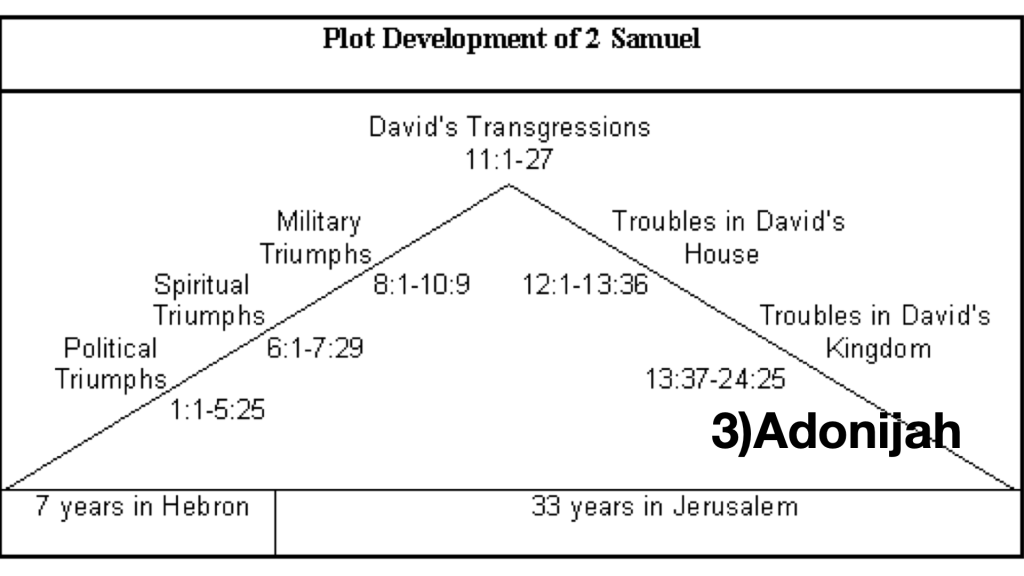
1 Kings 1 Adonijah tries to become king. David is about 70 years old and is on his deathbed, having been king for 40 years. But there is more “trouble in his house” as predicted by Nathan. David’s son Adonijah tries to make himself king even though David has said that Bathsheeba’s son Solomon will succeed him. Adonijah was a spoiled son. 1:6 His father had never crossed him at any time by asking, “Why have you done so?” And he was also a very handsome man, and he was born after Absalom.” It’s not hard to spot people like him today whose parents gave them whatever they wanted and never told them “no” or rebuked them. They become self willed and selfish. They might even turn on their parents to take their parents’ money or land or possessions. It’s not surprising that Joab tried to help Adonijah become king. He had been out of David’s favor for a long time now. Zadok the priest and Nathan the prophet sided with Solomon to be king. At Bathsheeba’s urging, David had Zadok and Nathan officially anoint Solomon as the next king and have him sit on David’s throne. Adonijah had been having a feast to anoint himself as king when he heard all this, and he took hold of the horns on the corners of the altar of burnt offerings out of fear of Solomon. Solomon did not kill him at this time but sent him to his house.
1 Kings 2 David’s deathbed charge to Solomon. David charged him to punish Joab and Shimei and show kindness to the sons of Barzilli. David died at the age of 70. Solomon put Adonijah to death for asking to be given Abishag (the woman who lay with David on his deathbed to keep him warm) for his wife. Solomon than dismissed Abiathar from being high priest b/c he had supported Adonijah. Abiathar was a descendant of Eli the high priest through the lineage of Aaron’s son Ithamar. God had given the high priesthood to Aaron’s son Elezar and his descendants after Aaron died but at some undefined point in the judges it shifted to the descendants of Aaron’s son,Ithamar, which is how Eli became high priest. But now Solomon will shift the high priesthood back to the descendants of Eleazar beginning with Zadok who supported Solomon becoming king. The Zadok high priesthood remained with the descendants of Zadok (the Zadokites) for roughly 700 to 800 years, beginning in the 10th century BCE under King Solomon until it was displaced around 171–167 BCE during the rise of the Maccabees and the Hasmonean dynasty took over the high priesthood. Solomon promised not to kill Shimei as long as he remained in Jerusalem, but after 3 years he left the city and Solomon had him killed. David was not allowed to build the temple b/c he was a man of bloodshed, but Solomon had Adonijah, Joab, and Shimei killed after David died. I guess those “notches” go on David’s belt since he ordered Solomon to do that.
Life Lesson: How would you summarize David’s life. He was the only Old Testament character described as “the man after God’s own heart”. But he committed 4 sins worthy of capital punishment (for which he was forgiven) and he was a man of much bloodshed and cruelty to enemies. But only God knows the hearts, and apparently David had a very, very special heart, wanting to please God all his life (except for some really bad periods of really bad decisions). My take is that God’s grace and forgiveness is awesome if we have sincere hearts than want to please Him. We tend to judge based on how bad and how many our sins are, but God is looking at the heart. A man might have many more sins than some self-righteous church goer, and yet have a more pleasing heart for God. The parable of the Pharisee and the tax collector says it all. Luke 18:9 And He also told this parable to some people who trusted in themselves that they were righteous, and viewed others with contempt: 10 “Two men went up into the temple to pray, one a Pharisee and the other a tax collector. 11 The Pharisee stood and was praying this to himself: ‘God, I thank You that I am not like other people: swindlers, unjust, adulterers, or even like this tax collector. 12 I fast twice a week; I pay tithes of all that I get.’ 13 But the tax collector, standing some distance away, was even unwilling to lift up his eyes to heaven, but was beating his breast, saying, ‘God, be merciful to me, the sinner!’ 14 I tell you, this man went to his house justified rather than the other; for everyone who exalts himself will be humbled, but he who humbles himself will be exalted.” So come clean. People might see you and comment on what a wonderful person and Christian you are. But what is really in your heart? Do you love God more than anything else in life? Is your #1 desire to please Him or to enjoy this world’s pleasures and riches? Is there evil in your heart that you are not repenting of? James 4:6 “God is opposed to the proud, but gives grace to the humble.” 7 Submit therefore to God. Resist the devil and he will flee from you. 8 Draw near to God and He will draw near to you. Cleanse your hands, you sinners; and purify your hearts, you double-minded. 9 Be miserable and mourn and weep; let your laughter be turned into mourning and your joy to gloom. 10 Humble yourselves in the presence of the Lord, and He will exalt you.”
1 Kings 3 Solomon’s wish granted. Solomon begins his reign well. 3:3 Now Solomon loved the Lord, walking in the statutes of his father David, except he sacrificed and burned incense on the high places. AI: “Elevated ground reduced the distance between earth and the divine realm, making prayers, smoke from burnt offerings, and incense more visible and accessible to deities. Many ancient cultures (such as the Canaanites, Moabites, and neighboring Near Eastern peoples) linked specific mountain peaks or hilltops to storm, sky, or fertility gods like Baal. These sites typically included stone altars, upright sacred pillars (matzevot), incense altars (hammanim), and wooden poles (asherim) dedicated to fertility and nature goddesses.” Solomon making offerings on the high places was rooted in pagan worship and God tolerated it though He did no approve of it. It will be a practice of sinful Israelites centuries after the temple was built. Kings Hezekiah and Josiah are the biblical kings of Judah credited with removing the high places of pagan worship. King Hezekiah: Removed the high places, smashed sacred stones, and cut down the Asherah poles as part of centralizing worship in Jerusalem (2 Kings 18:4). King Josiah: Conducted a massive religious reform, destroying pagan altars, high places, Asherah poles, and shrines throughout Judah, Jerusalem, and parts of the former northern kingdom of Israel (2 Kings 23). Other otherwise righteous kings—such as Asa, Jehoshaphat, and Jotham—did not take them down during their reigns. Solomon offered a thousand burnt offerings on the high place at Gibeon and God offered to give him whatever he wished. Solomon is still humble and only asks for wisdom. God gives him wisdom and riches b/c of his humility. His wisdom is soon demonstrated in the settling of the argument between the 2 women when he proposed splitting the child in half (which he knew he would not have to really do that b/c the real mother would not allow that). What would you ask for if God gave you one wish? Money? Material possessions? Would you ask for wisdom to be able to help others?
1 Kings 4 Solomon’s power, wealth, and wisdom. Solomon’s kingdom matched the scope of the land promised to Abraham in Genesis 15:18–21, though the nature of the rule involved both direct control and subject tributary kingdoms. The Fulfillment (1 Kings 4:21): The text states that Solomon “ruled over all the kingdoms from the Euphrates to the land of the Philistines, as far as the border of Egypt.” The Promise (Genesis 15:18): God promised Abraham’s descendants the land “from the river of Egypt [Wadi of Egypt] to the great river, the Euphrates.” Granted, Israel did not actually live in all the land in Solomon’s kingdom. A lot of his kingdom were subjugated or vassal kingdoms of other nations who paid much tribute to Solomon. Solomon did have a massive army so the subjugation of those nations were a result of his great power. The provisions needed for Solomon’s massive army and household were massive. Each tribe had to supply the provisions for one month of each year. This was a source of great unrest that helped split the kingdom after Solomon died. God made him the wisest man on earth. Imagine 3,000 proverbs (like in the book of Proverbs) and 1,005 songs (like in the book Song of Solomon). King Solomon fulfilled almost every warning that the prophet Samuel gave in 1 Samuel 8 and broke the specific instructions for kings outlined in Deuteronomy 17. He drafted the sons of the people for his army, multiplied horses, used forced labor to build his palaces, confiscated fields and property, and taxed the people heavily for his monthly provisions. This would be 40 years of this but things were peaceful and prosperous. 4:25 So Judah and Israel lived in safety, every man under his vine and his fig tree, from Dan even to Beersheba, all the days of Solomon.” They went along with it until Solomon died.

