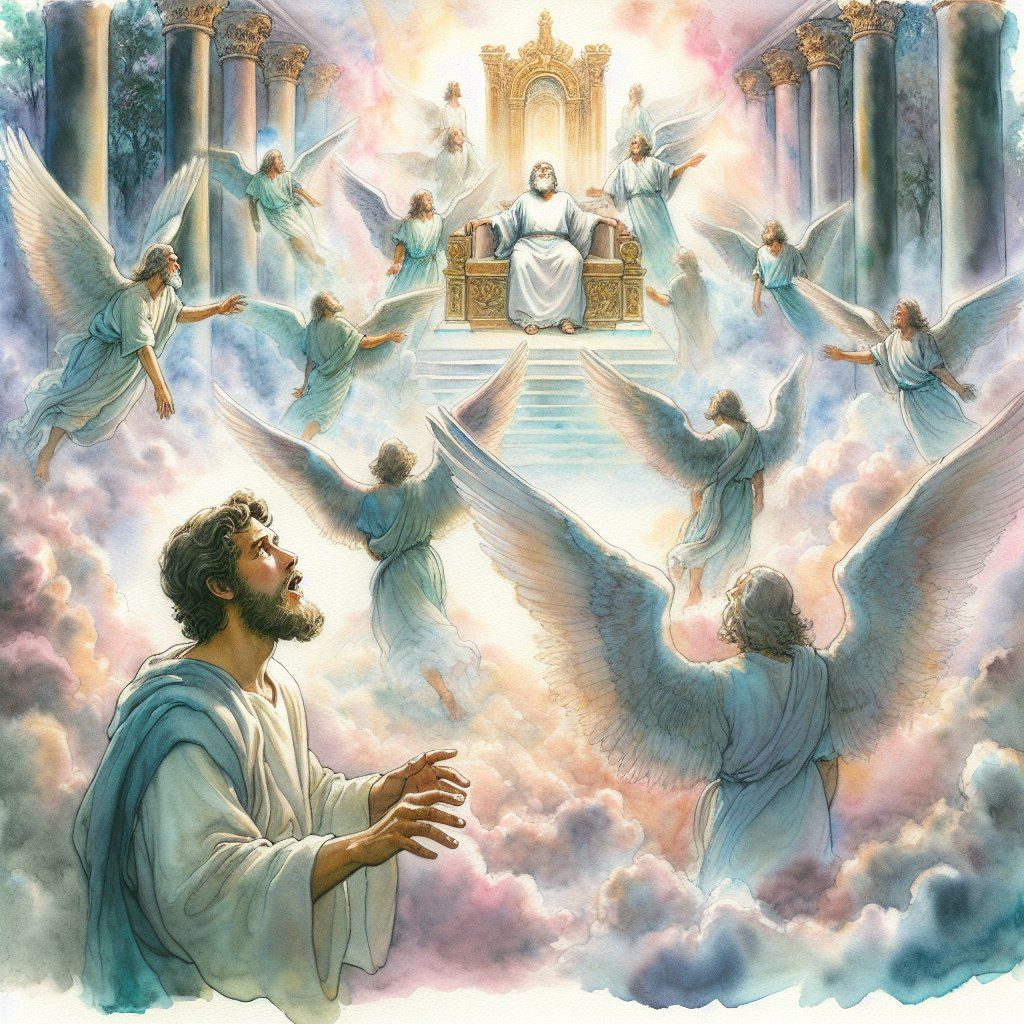
Amos the Prophet

Amos 7:10 Then Amaziah, the priest of Bethel, sent word to Jeroboam king of Israel, saying, “Amos has conspired against you in the midst of the house of Israel; the land is unable to endure all his words. 11 For thus Amos says, ‘Jeroboam will die by the sword and Israel will certainly go from its land into exile.’” 12 Then Amaziah said to Amos, “Go, you seer, flee away to the land of Judah and there eat bread and there do your prophesying! 13 But no longer prophesy at Bethel, for it is a sanctuary of the king and a royal [cq]residence.”

14 Then Amos replied to Amaziah, “I am not a prophet, nor am I the son of a prophet; for I am a herdsman and a [cr]grower of sycamore figs. 15 But the Lord took me from [cs]following the flock and the Lord said to me, ‘Go prophesy to My people Israel.’ 16 Now hear the word of the Lord: you are saying, ‘You shall not prophesy against Israel nor shall you [ct]speak against the house of Isaac.’ 17 Therefore, thus says the Lord, ‘Your wife will become a harlot in the city, your sons and your daughters will fall by the sword, your land will be parceled up by a measuring line and you yourself will die [cu]upon unclean soil. Moreover, Israel will certainly go from its land into exile.’”

As you can see, Amos prophesied mainly to the northern kingdom of Israel during the reign of Jereboam II, an evil king who reigned for 41 years (790-750 BC)of mainly prosperity and peace. Jonah the prophet, according to 2 Kings 14:23-27, had given a good prophecy to Jereboam that he would be successful militarily, that God was not ready yet to turn Israel over to foreign powers. But Amos, looking at the evil and idolatry of Jereboam, gives a different prophesy. He predicts that Israel will go into captivity soon, and they did, to Assyria, in 722 BC. Jonah finally went to Nivevah, the capital of Assyria, and preached to them which led to their repentance, which made Jonah angry and depressed. We don’t know what happened to Jonah after he returned from Ninevah as the Bible is silent on that. If he did return to Israel to continue prophesying to Jereboam, you have to wonder if he and Amos ever met and had a discussion about Amos’ prophecy that Assyria would take Israel into exile. Can you imagine how Jonah felt when he heard Amos’ prediction that it would be Israel falling and not Assyria?

Amos 3:

“You only have I [ab]chosen among all the families of the earth;
Therefore I will [ac]punish you for all your iniquities.”
Do two men walk together unless they have made an [ad]appointment?
Does a lion roar in the forest when he has no prey?
Does a young lion [ae]growl from his den unless he has captured something?
Does a bird fall into a trap on the ground when there is no [af]bait in it?
Does a trap spring up from the earth when it captures nothing at all?
If a trumpet is blown in a city will not the people tremble?
If a calamity occurs in a city has not the Lord done it?
7 [ag]Surely the Lord [ah]God does nothing
Unless He reveals His secret counsel
To His servants the prophets.
A lion has roared! Who will not fear?
The Lord [ai]God has spoken! Who can but prophesy?

This is a very insightful passage about God’s work with His prophets. Who knows the mind, thinking, and plans of God? No one. Does God want man to know what He is planning and doing, and why He is doing it? Yes. So He communicates to man through “His servants the prophets”. The Hebrew word for prophet simply means “spokesman”. That phrase is used many times in the Old Testament. The prophet was God’s spokesman. Of course, God used the Holy Spirit to inspire (the Greek word means “God breathed”) or put His words in their mouths. 2 Peter 1: 20 But know this first of all, that no prophecy of Scripture is a matter of one’s own interpretation, 21 for no prophecy was ever made by an act of human will, but men moved by the Holy Spirit spoke from God.” Jeremiah 1:9 Then the LORD reached out his hand and touched my mouth and said to me, “I have put my words in your mouth.” There is a constant battle to defend the inspiration of the Scriptures.

Amos 2:Thus says the Lord,
“For three transgressions of Israel and for four
I will not revoke its punishment,
Because they sell the righteous for money
And the needy for a pair of sandals.
“These who [o]pant after the very dust of the earth on the head of the helpless
Also turn aside the way of the humble;
And a man and his father [p]resort to the same [q]girl
In order to profane My holy name.
“On garments taken as pledges they stretch out beside every altar,
And in the house of their God they drink the wine of those who have been fined.

Amos 3:15 “I will also smite the [ao]winter house together with the summer house;
The houses of [ap]ivory will also perish
And the great houses will come to an end,”
Declares the Lord.

Then there is this condemnation of the women of Israel where Amos calls them the “cows of Bashan” (the image of fat cows enjoying the green grass of Bashan). In my mission experiences, the women usually end up as the spiritual strength of the congregations. Amos 4:1 “Hear this word, you cows of Bashan who are on the mountain of Samaria,
Who oppress the poor, who crush the needy,
Who say to [aq]your husbands, “Bring now, that we may drink!”

In Amos 4 tells us that, as evil as Israel was, they still loved to offer their sacrifices and give their tithes. They are the prime example of “hypocritical religion”.

“Enter Bethel and transgress;
In Gilgal multiply transgression!
Bring your sacrifices every morning,
Your tithes every three days.
[au]Offer a thank offering also from that which is leavened,
And proclaim freewill offerings, make them known.
For so you love to do, you sons of Israel,”
Declares the Lord God.

Amos 5:10 They hate him who reproves in the [bb]gate,
And they abhor him who speaks with integrity.
11 Therefore because you [bc]impose heavy rent on the poor
And exact a tribute of grain from them,
Though you have built houses of well-hewn stone,
Yet you will not live in them;
You have planted pleasant vineyards, yet you will not drink their wine.
12 For I know your transgressions are many and your sins are great,
You who distress the righteous and accept bribes
And [bd]turn aside the poor in the [be]gate.
13 Therefore at [bf]such a time the prudent person keeps silent, for it is an evil time.”

Amos 5:

21 “I hate, I reject your festivals,
Nor do I [bj]delight in your solemn assemblies.
22 “Even though you offer up to Me burnt offerings and your grain offerings,
I will not accept them;
And I will not even look at the peace offerings of your fatlings.
23 “Take away from Me the noise of your songs;
I will not even listen to the sound of your harps.
24 “But let justice roll down like waters
And righteousness like an ever-flowing stream.

Amos 6:

Those who recline on beds of ivory
And sprawl on their couches,
And eat lambs from the flock
And calves from the midst of the stall,
Who improvise to the sound of the harp,
And like David have [bp]composed songs for themselves,
Who drink wine from [bq]sacrificial bowls
While they anoint themselves with the finest of oils,
Yet they have not grieved over the ruin of Joseph.
Therefore, they will now go into exile at the head of the exiles,
And the sprawlers’ [br]banqueting will [bs]pass away.

Amos 8: Hear this, you who [da]trample the needy, to do away with the humble of the land, saying,

“When will the new moon [db]be over,
So that we may sell grain,
And the sabbath, that we may open the wheat market,
To make the [dc]bushel smaller and the shekel bigger,
And to cheat with [dd]dishonest scales,
So as to buy the helpless for [de]money
And the needy for a pair of sandals,
And that we may sell the refuse of the wheat?”

I have cited all these passages to show the sins of Israel and their religious hypocrisy. It scares me to see America committing similar sins. We have such a luxurious lifestyle even though everyone complains about their financial situation. Compared to the 3rd world countries, almost everyone in the U.S. is well off. Yet the average church going Christian gives 2-3% of his income to any kind of charity or church. In the meantime, most of us have nice houses, even a vacation house added to that, nice cars, eat out a lot at nice restaurants, take nice expensive vacations, etc. But we continue with our nice churches with multi-million dollar buildings and well paid professional church staffs. Churches spend most of their contributions on themselves and very little for helping the people of the world whom God would want us to focus on.

The last half of the book consists of visions of the judgment of Israel that Amos sees: a locust swarm (that God actually changes His mind and doesn’t send), a fire (He changes His mind and doesn’t send that either), a plumb line (like that used by builders to lay straight block) that shows that Israel is not obeying God like it should be, and a basket of overripe summer fruit (getting spoiled and ready to dispose of ).

As bad as all that sounds, Amos closes with a prediction of hope for Israel. There will be no return from Assyrian captivity as their was with Judah returning from Babylonian captivity, so Amos did not predict a return from captivity. Instead, he made a Messianic prediction:

Amos 9:

11 “In that day I will raise up the fallen [dl]booth of David,
And wall up its breaches;
I will also raise up its ruins
And rebuild it as in the days of old;
12 That they may possess the remnant of Edom
And all the [dm]nations who are called by My name,”
Declares the Lord who does this.

13 “Behold, days are coming,” declares the Lord,
“When the plowman will overtake the reaper
And the treader of grapes him who sows seed;
When the mountains will drip sweet wine
And all the hills will be dissolved.
14 “Also I will restore the [dn]captivity of My people Israel,
And they will rebuild the ruined cities and live in them;
They will also plant vineyards and drink their wine,
And make gardens and eat their fruit.
15 “I will also plant them on their land,
And they will not again be rooted out from their land
Which I have given them,”
Says the Lord your God.

I know this is Messianic because James quoted this passage in Amos 9 when, in the Jerusalem council, he was showing that the Gentiles had been added to the Jewish church at the time he was speaking.

Acts 15:13 After they had stopped speaking, [e]James answered, saying, “Brethren, listen to me. 14 Simeon has related how God first concerned Himself about taking from among the Gentiles a people for His name. 15 With this the words of the Prophets agree, just as it is written,

16 ‘After these things I will return,
And I will rebuild the [f]tabernacle of David which has fallen,
And I will rebuild its ruins,
And I will restore it,
17 So that the rest of [g]mankind may seek the Lord,
And all the Gentiles [h]who are called by My name,’
18 Says the Lord, who [i]makes these things known from long ago.

You seldom hear this prophesy from Amos discussed but it is extremely important. James’ citation in Acts 15 shows that the “fallen tabernacle of David” had been restored as he spoke, in about 50 AD. That shows that it is figurative language referring to the church that Jesus established that began in Acts 2 on the Day of Pentecost in 30 AD with the first 3,000 souls who were saved and added to the church. That shows that the Gentile believers were added on an equal basis to that church along with Jewish believers, which is why James quoted Amos 9. It also shows the use of figurative language by the prophets in describing the future church. An image of reapers walking right behind the sowers gathering the fruit immediately from seeds just sowed (obviously impossible), of mountains dripping sweet wine (I’ve seen little water falls coming out of mountains, but not wine), of Israel being restored to their land never to be plucked up again off off it (even that was fulfilled figuratively in the early church and it had nothing to do with actually being restored to the land of Palestine although that is how most interpret it). None of these Messianic predictions were to be fulfilled literally. David’s tabernacle was not to be restored with some physical structure like the OT tabernacle.

But in conclusion, one of the things that stands out about Amos is his very common background. A shepherd and caretaker of trees who did not attend the school of prophets as was common during his time. A common man who was called by God to go condemn Israel (and other nations). Even his language throughout the book is the language used by commoners.

Amos 3:

Does a lion roar in the forest when he has no prey?
Does a young lion [ae]growl from his den unless he has captured something?
Does a bird fall into a trap on the ground when there is no [af]bait in it?
Does a trap spring up from the earth when it captures nothing at all?

Amos 5:

18 Alas, you who are longing for the day of the Lord,
For what purpose will the day of the Lord be to you?
It will be darkness and not light;
19 As when a man flees from a lion
And a bear meets him,
[bi]Or goes home, leans his hand against the wall
And a snake bites him.

These passages are examples taken from everyday life of common people. We live in a world of professional preachers and clergy. Often we think that system is essential for the church business and big, stable churches that we have developed. I guess that it is if that is the system of churches that you want to develop. But, in my opinion, the professional preacher/clergy system has done more harm than good. I have seen churches with multiple, common men who could speak the word of God on Sundays to the flock (preferable men who were elders) and use all that money that we pay staff to drill wells for people in 3rd world countries, take care of AIDS orphans, or print Bibles in foreign languages to teach them about Jesus and His church. Often it is professional preachers/clergy who lead the flock astray, using their influence to teach false doctrine (like preachers who advocate homosexuality and homosexual marriages). Often it is professional preachers/clergy who cause multiple splits over minor doctrines in the church. We have many common men with common jobs who can teach and speak the words of God as well as any professional. Let’s build our churches around common men like Amos.
Hosea and Spiritual Adultery

The prophet Hosea was a contemporary with Isaiah, Amos, and Jonah. He prophesied during the reign of Kings Uzziah and Hezekiah of Judah, and King Jereboam II of Israel. That would be in the 790-750 BC time period.

The story of Hosea is most unusual. Imagine this scenario. You are the local preacher at a church. God tells you to go marry a prostitute and have 3 children by her. Imagine what the people will think if you do this. You are shocked at such a command, but He tells you that this has a spiritual parallel with the spiritual harlotry of the Israelites you are preaching to, so you do it. The names of each of the 3 children have a meaning that applies to the Israelites also. It must be hard for you to love your wife, Gomer, since this is like an arranged marriage. But you make the best of it, and then Gomer leaves you and the children and goes back into harlotry. You probably figure that you are just as well off with her being gone. Then you find out that she is on the auction block, just like the human traffickers do with prostitutes today. Then God gives you the 2nd shocking command. He tells you to go buy her off the auction block and love her. So you do because this also has a spiritual parallel with Israel, and this parallel is Messianic in nature to be fulfilled 700 years in the future. Hosea 3: For the sons of Israel will remain for many days without king or prince, without sacrifice or sacred pillar and without ephod or [af]household idols. Afterward the sons of Israel will return and seek the Lord their God and David their king; and they will come trembling to the Lord and to His goodness in the last days.” That phrase “last days” is the time period from 30 AD to 70 AD, the last days of the Jewish Age. Joel 2 predicted that the Spirit would be poured out miraculously on the remnant in the last day. Peter in Acts 2 said that prediction began to be fulfilled on the Day of Pentecost in 30 AD and would last until the “terrible judgment day of the Lord”. That judgment day was the judgement of the Jews in 70 AD and the destruction of the temple and the city of Jerusalem by Titus and the Romans. Also Hosea 3:5 predicts that David will be Israel’s king in the last days. This is symbolic and refers to Jesus, the Branch of David as He is called by the prophets. Several prophets predicted that David would be the king, prince, and priest of Israel in the Messianic kingdom. But this prophecy does not apply to the whole nation of Israel as many say it does. It only applies to the remnant of Israel during those “last days” who believed in Jesus as the Messiah and became the Jewish Christian church. As Hosea predicted, after many days without a king (the last king of Judah was in 586 BC), the remnant would be gathered and Jesus (David) would be their king. The remnant would like Hosea’s wife who went back into harlotry, but God would redeem her (“buy her back”) and love her again. I wonder what Hosea’s marriage was like after he bought her off the auction block. Did she appreciate Hosea’s love? The Jewish remnant church certainly appreciated God’s saving love in the first century AD. Did she understand at all the spiritual parallel that her marriage was to Israel? Did that satisfy her need for love and keep her from ever leaving Hosea and the kids again? Unfortunately, we don’t know the answers to those questions.

Hosea then condemns Israel of spiritual harlotry because they went after other lovers, i.e. the pagan gods of the nations around them. Hosea 4:

11 Harlotry, wine and new wine take away the [an]understanding.
12 My people consult their wooden idol, and their diviner’s wand informs them;
For a spirit of harlotry has led them astray,
And they have played the harlot, departing [ao]from their God.
13 They offer sacrifices on the tops of the mountains
And [ap]burn incense on the hills,
Under oak, poplar and terebinth,
Because their shade is pleasant.
Therefore your daughters play the harlot
And your [aq]brides commit adultery.
14 I will not punish your daughters when they play the harlot
Or your [ar]brides when they commit adultery,
For the men themselves go apart with harlots
And offer sacrifices with temple prostitutes;
So the people without understanding are [as]ruined.
18 Their liquor gone,
They play the harlot continually;
Their [au]rulers dearly love shame.
19 The wind wraps them in its wings,
And they will be ashamed because of their sacrifices.”

Hosea 5: I know Ephraim, and Israel is not hidden from Me;
For now, O Ephraim, you have played the harlot,
Israel has defiled itself.
Their deeds will not allow them
To return to their God.
For a spirit of harlotry is within them,
And they do not know the Lord.”

Hosea 9:1 Do not rejoice, O Israel, [ca]with exultation like the [cb]nations!
For you have played the harlot, [cc]forsaking your God.
You have loved harlots’ earnings on [cd]every threshing floor.”

This introduces a term, “spiritual adultery” that we need to discuss. The church is the bride of Christ. Jesus loves his bride and wants His bride to love Him and Him only, and to be faithful to Him. Paul said it like this in 2 Corinthians 11: For I am jealous for you with a godly jealousy; for I betrothed you to one husband, so that to Christ I might present you as a pure virgin. But I am afraid that, as the serpent deceived Eve by his craftiness, your minds will be led astray from the simplicity and purity of devotion to Christ.” We understand what adultery is in a marriage. A husband or wife starts being attracted to another male or female, which leads to an affair and adultery. Every husband or wife wants his mate to put him or her first in their affections and love. When we start putting money, or possessions, or careers, or hobbies, or anything ahead of our affection for Jesus, then we are flirting with “spiritual adultery”. Too often we think of Christianity as obeying Jesus as Lord of our lives, and that is indeed a correct concept. But Jesus is more than just our Lord, or king. He is our husband in a very intimate personal relationship. It might help us to think our our relationship with Jesus in this husband/wife figure. Think how it would make your mate to find out you had an affair. Think how it makes God feel when we commit spiritual adultery. It makes our little love affairs with worldly things more personal. Several times the Scriptures say that God is a “jealous” God, and now you can see why. James 4: You adulteresses, do you not know that friendship with the world is hostility toward God? Therefore whoever wishes to be a friend of the world makes himself an enemy of God. Or do you think that the Scripture speaks to no purpose: “[e]He [f]jealously desires the Spirit which He has made to dwell in us”?

Hosea condemns them from not being “loyal” to God. Hosea 6:

What shall I do with you, O Ephraim?
What shall I do with you, O Judah?
For your [be]loyalty is like a morning cloud
And like the dew which goes away early.
For I delight in loyalty rather than sacrifice,
And in the knowledge of God rather than burnt offerings.

The Hebrew word translated “loyal” here can be translated as “mercy, loving-kindness, or faithfulness”. Some translations say, “I delight in mercy rather than sacrifice”. It seems that in Hosea 6:6 that the idea is that the bride of God should be faithful to Him, just like a wife should be faithful to her husband. Of course, that faithfulness to one’s mate, and to God, is because of the love a husband or wife has for his/her mate, or love to God. Part of the idea might be that you feel compassion for your mate in that you would not want to hurt them by having other lovers. Again, our relationship with Jesus as His bride is very personal, like with your mate. Imagine a husband who commits adultery on his wife, but has no feelings of guilt when his wife breaks down crying in hurt and anguish. So God desires us to feel and extend love and compassion for His desires, just as He is jealous for our love and loyalty. Jesus cites this verse, and the NASB uses the Greek word “compassion” instead of loyalty: Matthew 9: 13 But go and learn [g]what this means: ‘I desire [h]compassion, [i]and not sacrifice,’ for I did not come to call the righteous, but sinners.” In that context, the Pharisees had no love for the sinners Jesus was eating with. If they had felt love for God, they would have felt love for the people God loves, but they did not. They put the emphasis on sacrifices and tithing.

Hosea condemns many of the sins of Israel and Judah but I think the main point in the book is the spiritual harlotry idea. I hope this article will help you personalize your relationship with Jesus as in a marriage relationship. In whatever you do, think of it in that way. Would it make my wife jealous if she saw me doing this? Am I starting to feel more affection for worldly things than I do for my spiritual husband Jesus? I don’t believe in the idea of women becoming nuns, but it is interesting that nuns considered themselves to be married to Jesus, and thus did not need husbands.

ISAIAH 1-6 STUDIES

I did an article on the Messianic prophecies in Isaiah. But there is a lot more than that in Isaiah. I will focus on some of the great lessons and verses in Isaiah in this article.

  1. THE HYPOCRITICAL WORSHIP OF JUDAH

Isaiah 1:11 “What are your multiplied sacrifices to Me?”
Says the Lord.
“I have had enough of burnt offerings of rams
And the fat of fed cattle;
And I take no pleasure in the blood of bulls, lambs or goats.
12 “When you come to appear before Me,
Who requires of you this trampling of My courts?
13 “Bring your worthless offerings no longer,
Incense is an abomination to Me.
New moon and sabbath, the calling of assemblies—
I cannot endure iniquity and the solemn assembly.
14 “I hate your new moon festivals and your appointed feasts,
They have become a burden to Me;
I am weary of bearing them.
15 “So when you spread out your hands in prayer,
I will hide My eyes from you;
Yes, even though you multiply prayers,
I will not listen.
Your hands are covered with blood.

16 “Wash yourselves, make yourselves clean;
Remove the evil of your deeds from My sight.
Cease to do evil,
17 Learn to do good;
Seek justice,
Reprove the ruthless,
[g]Defend the orphan,
Plead for the widow. 18 “Come now, and let us reason together,”
Says the Lord,
“Though your sins are as scarlet,
They will be as white as snow;
Though they are red like crimson,
They will be like wool.
19 “If you consent and obey,
You will eat the best of the land;
20 “But if you refuse and rebel,
You will be devoured by the sword.”
Truly, the mouth of the Lord has spoken.

21 How the faithful city has become a harlot,
She who was full of justice!
Righteousness once lodged in her,
But now murderers.
22 Your silver has become dross,
Your drink diluted with water.
23 Your rulers are rebels
And companions of thieves;
Everyone loves a bribe
And chases after rewards.
They do not defend the orphan,
Nor does the widow’s plea come before them.

This passage speaks for itself against hypocritical religion. They were offering sacrifices, praying, and keeping the sabbath, but they were oppressing or neglecting the poor, the widows, and the orphans. They were not treating people fairly and the land was full of violence. The acid test of true Christianity is not how many times we go to church or how much money we put in the collection plate. It is how we treat our fellow man, how we take care of the poor, the widows, and the orphans. It is how we try to stop the ruthless who are oppressing others. As James 1:27 says, “pure and undefiled religion is to visit the widows and orphans in their distress”.

2. THE WOMEN OF JUDAH JUDGED

Isaiah 3:16 Moreover, the Lord said, “Because the daughters of Zion are proud
And walk with heads held high and seductive eyes,
And go along with mincing steps
And tinkle the bangles on their feet,
17 Therefore the Lord will afflict the scalp of the daughters of Zion with scabs,
And the Lord will make their foreheads bare.”

18 In that day the Lord will take away the beauty of their anklets, headbands, crescent ornaments, 19 dangling earrings, bracelets, veils, 20 headdresses, ankle chains, sashes, perfume boxes, amulets, 21 finger rings, nose rings, 22 festal robes, outer tunics, cloaks, money purses, 23 hand mirrors, undergarments, turbans and veils.

24 Now it will come about that instead of sweet perfume there will be putrefaction;
Instead of a belt, a rope;
Instead of well-set hair, a plucked-out scalp;
Instead of fine clothes, a donning of sackcloth;
And branding instead of beauty.
25 Your men will fall by the sword
And your mighty ones in battle.
26 And her gates will lament and mourn,
And deserted she will sit on the ground.

Why does Isaiah attack the women of Judah? That is pretty obvious from reading this section. The women were extremely worldly and excessive in their clothing, accessories, hair, and appearance. No doubt they treated poor women with contempt and took advantage of them. In the mission work I have been involved in, it has always been that the women of the church are the heart and soul of the church. Yes, they can also be the source of slander, gossip, and contention. Paul mentioned 2 women in Philippians 4 who apparently were having conflict. Some of the Corinthian church women were apparently misusing their gifts to try to take over leadership from the men. He tells Timothy to not let the women usurp authority over the men. But in my experience, godly, humble women have always been the heart and soul of the church. The men are often focused on their jobs, as they should be as the main providers in the home. They deal with the stress of the workplace, although more and more women have to deal with that same stress (which btw probably hurts the spirituality of the home and church). It is the older women who are teaching the younger women to love their husbands and children (Titus 2). Paul has some specific instructions about widows and younger women in 1 Timothy 5: A widow is to be put on the list only if she is not less than sixty years old, having been the wife of one man, 10 having a reputation for good works; and if she has brought up children, if she has shown hospitality to strangers, if she has washed the saints’ feet, if she has assisted those in distress, and if she has devoted herself to every good work. 11 But refuse to put younger widows on the list, for when they feel sensual desires in disregard of Christ, they want to get married, 12 thus incurring condemnation, because they have set aside their previous pledge. 13 At the same time they also learn to be idle, as they go around from house to house; and not merely idle, but also gossips and busybodies, talking about things not proper to mention. 14 Therefore, I want younger widows to get married, bear children, keep house, and give the enemy no occasion for reproach; 15 for some have already turned aside to follow Satan. 16 If any woman who is a believer has dependent widows, she must assist them and the church must not be burdened, so that it may assist those who are widows indeed.” Paul also warns godly women about being too concerned about their clothes and outward appearance in 1 Timothy 2: Likewise, I want women to adorn themselves with proper clothing, modestly and discreetly, not with braided hair and gold or pearls or costly garments, 10 but rather by means of good works, as is proper for women making a claim to godliness. Peter has similar comments in 1 Peter 3: Your adornment must not be merely external—braiding the hair, and wearing gold jewelry, or putting on dresses; but let it be the hidden person of the heart, with the imperishable quality of a gentle and quiet spirit, which is precious in the sight of God.” Television ads and women being in the workplace has made many women focus on their appearance and clothing. In the U.S., one study showed that the average women spends $125,000 on clothing, handbags, accessories in her lifetime, and the figure is $200,000 for women under the age of 25. Older women were not raised on the emphasis on appearance that younger women are today. 2 out of every 5 women said they reapply their makeup up to 5 times a day. And yet 3 out of every 5 said they couldn’t find anything suitable to wear in their wardrobe. Another study showed that the average women spends over $300 per month on beauty products, hair treatments, or “beauty experiences” like facials, manicures, tanning, and pedicures. I imagine that amount is the same for church women as well as non-church women. Yes, I want my wife and women in the church to take care of their personal appearance, but aren’t we going to the same extremes as in Isaiah? Yes, I know that men have their bad spending habits and are often overly concerned about their clothing and appearance, but Isaiah focuses on the women in Israel as I am focusing on the women in the church. BTW those surveys I mentioned sound unrealistic but still accurately reflect trends among most women. The godly woman in Proverbs 31 is still the example for all women to follow. Stop and read that chapter again before you read on.

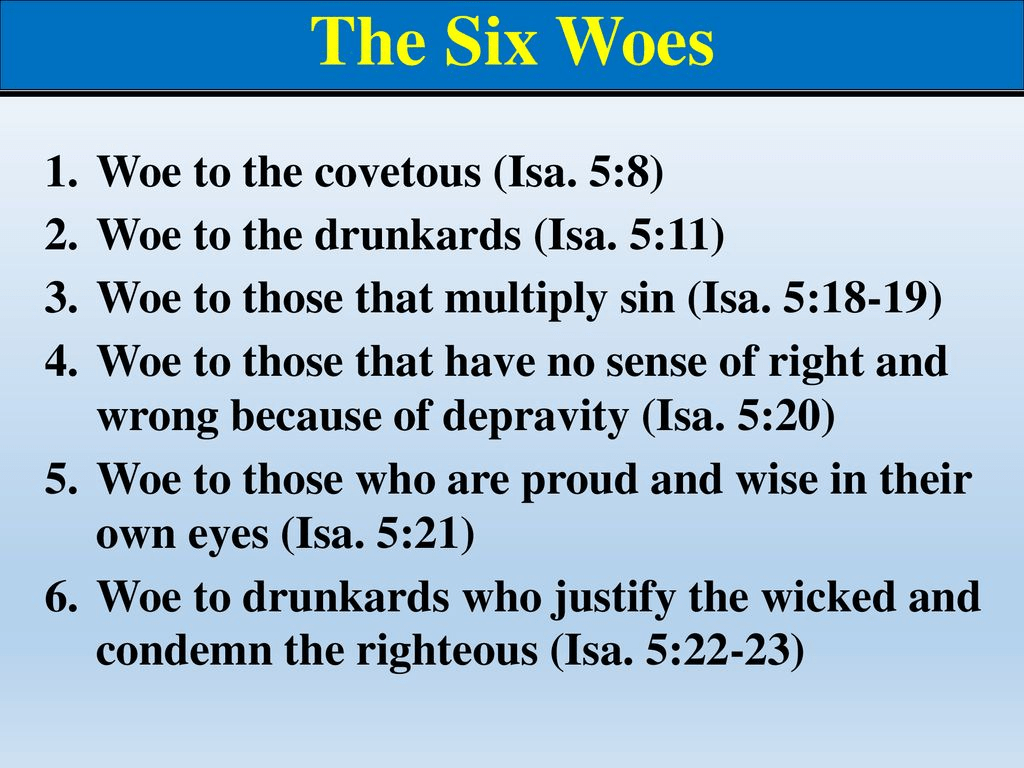
3. THE “WOES” TO THE WICKED

From Marlene Ellis

Isaiah 5:Woe to those who add house to house and join field to field,
Until there is no more room,
So that you have to live alone in the midst of the land!
In my ears the Lord of hosts has sworn, “Surely, many houses shall become desolate,
Even great and fine ones, without occupants.
10 “For ten acres of vineyard will yield only one bath of wine,
And a homer of seed will yield but an ephah of grain.”
11 Woe to those who rise early in the morning that they may pursue strong drink,
Who stay up late in the evening that wine may inflame them!
12 Their banquets are accompanied by lyre and harp, by tambourine and flute, and by wine;
But they do not pay attention to the deeds of the Lord,
Nor do they consider the work of His hands.

13 Therefore My people go into exile for their lack of knowledge;
And their honorable men are famished,
And their multitude is parched with thirst.
14 Therefore Sheol has enlarged its throat and opened its mouth without measure;
And Jerusalem’s splendor, her multitude, her din of revelry and the jubilant within her, descend into it.
15 So the common man will be humbled and the man of importance abased,
The eyes of the proud also will be abased.
16 But the Lord of hosts will be exalted in judgment,
And the holy God will show Himself holy in righteousness.
17 Then the lambs will graze as in their pasture,
And strangers will eat in the waste places of the wealthy.

18 Woe to those who drag iniquity with the cords of falsehood,
And sin as if with cart ropes;
19 Who say, “Let Him make speed, let Him hasten His work, that we may see it;
And let the purpose of the Holy One of Israel draw near
And come to pass, that we may know it!”
20 Woe to those who call evil good, and good evil;
Who substitute darkness for light and light for darkness;
Who substitute bitter for sweet and sweet for bitter!
21 Woe to those who are wise in their own eyes
And clever in their own sight!
22 Woe to those who are heroes in drinking wine
And valiant men in mixing strong drink,
23 Who justify the wicked for a bribe,
And take away the rights of the ones who are in the right!

But Isaiah condemns the men also! Not so much for their spending habits on their looks and concern for personal appearance, but for their greed, banqueting (partying), drinking, pride, and how they treat the poor by bribes. These are all listed in the “woes” in Isaiah 5. My dad was raised in the great depression era and was raised poor. He worked hard his whole life for minimum wages. We lived in very modest houses. He never bought anything that he didn’t really need. He generously helped others with his time and money. He never led a prayer in church but attended and set a godly example for me in his daily life and service to others. He loved his family and cared for them by hard work. He was the type of men Paul described in 1 Thessalonians 4: But we urge you, brethren, to excel still more, 11 and to make it your ambition to lead a quiet life and attend to your own business and work with your hands, just as we commanded you, 12 so that you will behave properly toward outsiders and [p]not be in any need. Or in Ephesians 4:28 He who steals must steal no longer; but rather he must labor, performing with his own hands what is good, so that he will have something to share with [t]one who has need.” We have this crisis in the welfare system of absentee dads. But we also have a similar crisis among middle and upper class dads. The emphasis is so great on making money, buying expensive houses, buying “man toys” like guns and boats, spending money on sports. Men in the church are just as guilty as non-church men. The average church going man spend 2-3% of their income on charity or church contributions. This emphasis on career and making money also limits the time he actually spends one on one with his children and wife. His children spend hours every day on social networking and just a few minutes at best every day one on one with dad. And then there is the partying and drinking. Need we say more about the drinking habits of American men. In Isaiah’s time, the “heroes” of society were the bullies and wine drinkers. In our times, the heroes are the sports heroes who make millions, or musicians or actors, or super rich business men who started all these businesses that consume our money. Who would consider the simple, godly, conservative living Christian family man to be a hero today? Don’t forget to mention gambling that is ruining the lives of so many men today. Again, these trends probably are the same for church and non-church men to a large degree. What about the addiction to porn among even church going men? Studies show that over 30% of men in church on a given Sunday have viewed porn on the internet within the last month. This country became great because of hard working, godly men, most of whom were also faithful Christians in churches all over America. One French visitor commented that the strength of America was its churches. But has that changed? Do Christian men still go to church, give that 2-3% of their income to the church, etc. and yet they are just as worldly as non Christian, non church going men? You be the judge.

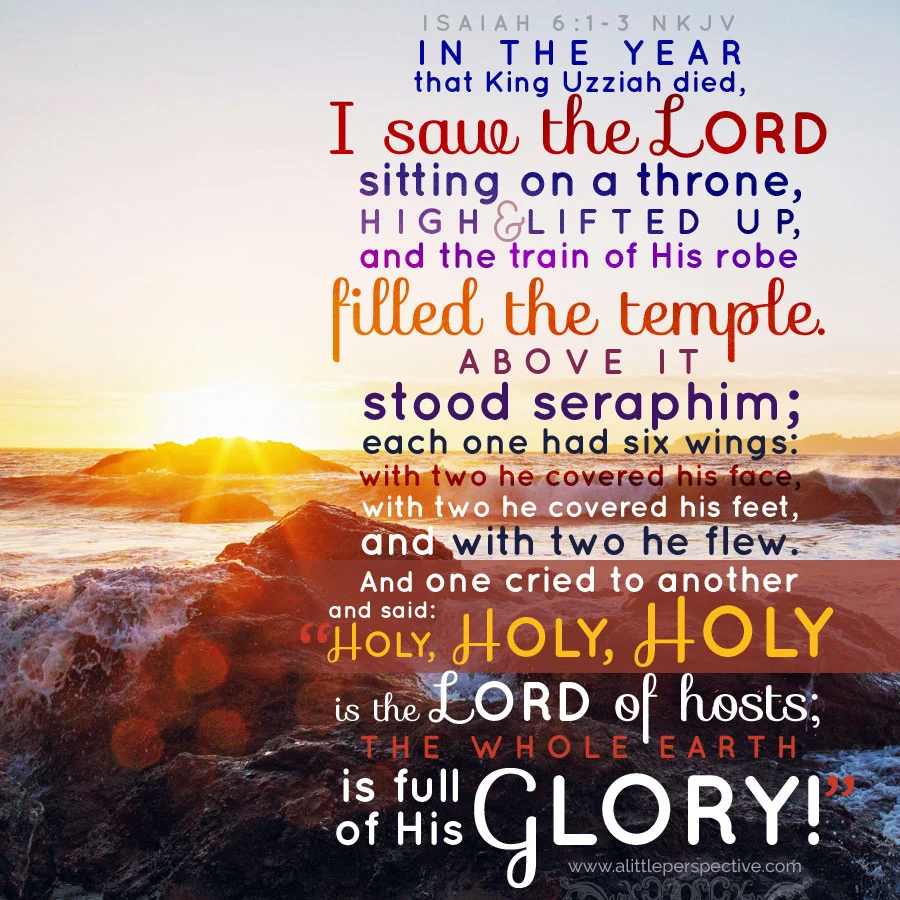
4. ISAIAH’S VISION OF THE THRONE OF THE LORD

From alittleperspective.com

Isaiah 6: From Bible.art  

I think this image tells us what Isaiah saw, except each of the seraphim had 6 wings. They were calling out to one another, “Holy, holy, holy is the Lord of hosts; the whole earth is full of his glory!” And the foundations of the thresholds shook at the voice of him who called, and the house was filled with smoke. Of course we don’t know what the Lord Himself actually looked like on the throne. Was it an elderly man like figure? God is a spirit, not flesh, so what exactly did Isaiah see on that throne?

And I said: “Woe is me! For I am lost; for I am a man of unclean lips, and I dwell in the midst of a people of unclean lips; for my eyes have seen the King, the Lord of hosts!” (YHWH tsaba) Then one of the seraphim flew to me, having in his hand a burning coal that he had taken with tongs from the altar. And he touched my mouth and said: “Behold, this has touched your lips; your guilt is taken away, and your sin atoned for.” 

What would your reaction be if you saw this throne scene? The temple is shaking like in an earthquake (you know the panic people feel in an earthquake). You are standing in the presence of God. You have seen the Lord (some grandiose image of Him). Isaiah’s sinfulness is awakened by the vision. I think the worst of sinners, like Hitler, and the most infamous atheists would all have this same reaction in the presence of the Lord. But God takes away and atones for his sins. The Hebrew word for “atone” is kaphar: To cover, to atone, to make reconciliation, to purge. The same root word for the mercy seat in the Holy of Holies. From AI: “According to the Hebrew Bible, the kaporet (Hebrew: כַּפֹּרֶת kapōreṯ) or mercy seat was the gold lid placed on the Ark of the Covenant, with two cherubim at the ends to cover and create the space in which Yahweh appeared and dwelled. Isaiah would have thought of the high priest sprinkling blood on the mercy seat (Leviticus 16:13) to make atonement (Leviticus 16:16 kaphar: to cover over, pacify, make propitiation) for the sins of Israel for the whole past year. The mercy seat was figuratively where God dwelt, where the high priest could be in the presence of God. Now Isaiah has that privilege! This vision is critical to God’s calling of Isaiah to preach. 6:Then I heard the voice of the Lord, saying, “Whom shall I send, and who will go for Us?” Then I said, “Here am I. Send me!” What should be the main motivation for preaching the gospel? It should be gratitude for the atonment of our sins through the cross of Jesus. How many of us really feel that motivation? We don’t need a special vision like Isaiah or Ezekiel had (Ezekiel 1) to be aware of our sinfulness. When I think about my sinful thoughts and deeds for each day I live, I should feel very unworthy of grace. But then I feel relieved, happy, and grateful that I am forgiven by the grace of God. If I feel that every day, then I should want to tell sinners about the forgiveness they can have in Jesus. If I don’t feel that, it is probably b/c my mind is set on earthly things and not the things above. Colossians 3:1″If then you have been raised with Christ, seek the things that are above, where Christ is, seated at the right hand of God. Set your minds on things that are above, not on things that are on earth.” If so, I need to start and close each day thinking about my sins I have committed and the forgiveness I have received.

The sad thing is that he is told that the people won’t listen and repent at his preaching. So he asks, “how long do I need to do this since they are not even going to listen”? The answer: until the Lord brings devastating judgment on them with only a tenth surviving. That tenth would be the remnant, the “holy seed is the stump”. As God told Elijah, 1 King 19:18 Yet I will leave seven thousand in Israel, all the knees that have not bowed to Baal, and every mouth that has not kissed him.” In all of God’s judgments against the sins of Israel, He has always had a remnant that were saved. A remnant is “Remnant” is used to describe a small part or piece that is left over after the majority of something has been used or destroyed, like the scaps of a piece of cloth used to patch a garment, or the remnants of a building that was destroyed. Romans 9 talks about the remnant of Jews who accpeted Jesus as the Messiah and who would be spared the judgment of the Jews in 70 AD when the temple was destroyed. Romans 9:27 And Isaiah cries out concerning Israel: “Though the number of the sons of Israel be as the sand of the sea, only a remnant of them will be saved”. Paul is quoting Isaiah 10:20 In that day the remnant of Israel and the survivors of the house of Jacob will no more lean on him who struck them, but will lean on the Lord, the Holy One of Israel, in truth. 21 A remnant will return, the remnant of Jacob, to the mighty God. 22 For though your people Israel be as the sand of the sea, only a remnant of them will return. Destruction is decreed, overflowing with righteousness.” The context there is a return of a remnant from captivity, but the principle is the same.
6:And He said, “Go, and tell this people:‘Keep on listening, but do not understand;
And keep on looking, but do not gain knowledge.’ 10 Make the hearts of this people insensitive,
Their ears dull, And their eyes blind, So that they will not see with their eyes, Hear with their ears,
Understand with their hearts, And return and be healed.”

11 Then I said, “Lord, how long?” And He answered, “Until cities are devastated and without inhabitant,
Houses are without peopleAnd the land is utterly desolate,12 The Lord has completely removed people,
And there are many forsaken places in the midst of the land.13 Yet there will still be a tenth portion in it, And it will again be subject to burning, Like a terebinth or an oak Whose stump remains when it is cut down. The holy seed is its stump.”

The Prophet Jonah

I encourage you to go to thebibleproject.com right now before you read this article. Go to Old Testament videos and find and watch the Jonah one, about 7 minutes long. Then come back and read this article. It is the best video of all the project videos I have seen and really got me thinking.

Jonah prophesied during the reign of Jereboam II (791-751 BC; a 41 year reign), an evil king of the northern kingdom of Israel (the 14th king of Israel). A short summary is given of his reign. His 41 years were perhaps the most peaceful and prosperous times of the northern kingdom. Apparently Jonah the prophet had predicted that Jereboam II would be successful militarily (he even took Damascus, the capital of Syria) as some sore of savior for Israel to deliver them from their oppression. That was in spite of the idolatry and sinfulness of Jereboam II and Israel, worshipping the goddess Astarte.

newworldencyclopedia.org/entry/Jeroboam_II Read this article about Jereboam II. Amos and Hosea denounced Jereboam II for his idolatry and sinfulness, but Jonah appeared to support him. Jereboam II might have paid tribute to Assyria, which might explain why Jonah didn’t want to go preach to the Ninevites, the capital of Assyria. God had told him to go preach to Ninevah that the city would be overthrown soon (40 days after he finally got there). Jonah was afraid they would repent, and He knew that God was a merciful God and might spare them. He would have loved to see Ninevah overthrown so as to make the northern kingdom even more secure and prosperous. Did Jonah just ignore the idolatry of Jereboam II in the sake of national peace and prosperity? Amos and Hosea could not ignore it, and denounced it. So we don’t get an image of a good prophet in Jonah even before we go to the book of Jonah.

The book brings up more questions in my mind than answers. Why would God send Jonah to Ninevah? Did God not know that he would rebel and get on a ship going in the opposite direction to get away from God? Did God know he would do that but wanted to get Jonah to tell the sailors on that ship about the one true God. They ended up fearing Jonah’s god Yahweh after they threw him overboard and the storm calmed. Did those sailors start worshipping the one true god from then on? Will they be in heaven? Was all this God’s plan to save them? He had told them that he was fleeing from the presence of the Lord, but apparently had not tried to convert them. What made Jonah think that he could run away from God? He told the sailors to throw him overboard to calm the sea. Was that a noble act or just a selfish, desperate way to end it all?

I wonder what Jonah was thinking while he was in the belly of the great fish for 3 days and nights. He repented of refusing to go to Ninevah as he sloshed in the gastric juices and weeds in the fish’s belly. So the Lord caused the fish to vomit him on dry ground. Meanwhile, he has wasted valuable time. When he finally arrived to preach at Ninevah, his message was 8 words: “Yet 40 days and Ninevah will be overthrown”, so Jonah had delayed several days getting is message to Ninevah. Was that all he told them? Did he not tell them that God was a merciful God who might spare them if they would repent? Did he not try to tell them about his one true God Yahweh? Apparently not. Can you picture him walking through this great city that took 3 days to walk through, crying out this message? He obeyed God by preaching to them, but he doesn’t encourage them to repent.

What caused the king to repent and almost force all the people to repent? Did Jonah have any private conversations with him, telling him about the one true God (I don’t think so since he didn’t want them to repent)? Did the king have any prior knowledge of Jonah’s God? Did God know they would repent and this was just an idle threat, or did He not know how they would respond? If they did not repent, how would that have changed history? Ninevah did not fall until 612 BC, so who would have taken the city in the mid 700’s BC? Does their repentance mean they were saved from their sins and could go to heaven if they remained faithful to Yahweh? If not, then what good would this repentance do, just spare them for a few more years. Nahum will come over 100 years later and predict the fall of Ninevah (which happened in 612 BC), so their repentance at the preaching of Jonah was not permanent. But thousands were saved and, I think, will be in heaven if they stayed faithful to Yahweh. How many such dealings did God have with the Gentile pagan nations? We knew about Melchizadek, king of Salem and priest of the Most High God. He worked in Salem, but that is all we know. Did God have priests like him and prophets like Jonah working with the pagan nations all along to try to save them?

So they repented and God spared them. Jonah becomes angry that God spared them. He prayed, but it was “I knew this might happen and that’s why I didn’t want to come preach to Ninevah. I knew You were slow to anger and merciful (read Exodus 34:1-7 to see these attributes of God as given to Moses), and was afraid they would repent and you would spare them. Just kill me”. How can a prophet talk to God like that? I’m surprised that God didn’t just zap him on the spot. Give him the death he asked for. Instead He asked Jonah if it was good for him to be angry over this, and Jonah did not reply. What could have made Jonah have such an unloving, hateful attitude toward the Ninevites? Is this just the self-righteousness typical of the Jews, thinking they were the chosen race and superior to the pagans? Had Jonah never experienced the saving love of God in his own life that would have motivated him to love his enemies the Ninevites? Or was it his nationalistic loyalty that knew about the horrible cruelty of the Assyrians and just wanted them dead? We tend to think of America’s enemies like that. We just want Isis exterminated and probably spend little time praying for their salvation because we think it is hopeless.

So he goes out of the city and refused to rejoice with the people. He is angry and builds a shelter to shield him from the sun that was bearing down on him. God sends a rapid growing plant to grow and shelter him and he is “extremely happy”. But God sends a worm to eat the plant and he is back in the burning sun, more angry than ever. He again wishes to die. God again asks him if he should be angry. This time, Jonah responded and said that he did have good reason to be angry. God had given him a little visual aid lesson and he refused to accept it. God asks him how he could have compassion on the plant that died and yet not have compassion on the people of Ninevah. In Micah 6:7-8 God calls on Israel to do justice, love mercy, and walk humbly. Jonah missed on all 3 points! Does God still work like that, giving us little visual aid lessons to try to get us to change our bad attitudes? What kind of a prophet is this that he has such an unloving attitude? Can you imagine a preacher who has 50 people come forward to be saved and he is angry because they are all from a race or social class that he despises? Balaam became corrupt for the money that Balak the king of Moab gave him in the incident at Peor, but no money seems to be involved in Jonah’s bad attitude- just bias, prejudice, and hate. Have you ever noticed such prejudice in a nice white, middle and upper class, church? Eyebrows get raised when several guys from the local drug recovery ministry visit the Sunday morning service, or when some poor looking different race people visit. Churches tend to have their own little in house ministries that cater mainly to their own members’ needs and wants, built around sermons and speeches and trips to water rafting or eating out places. I’m glad to be a part of a group that serves breakfast and groceries to about 150 poor people of all races every Saturday morning. But there is still that temptation to look down on them because of their social class. James 2 condemned social class prejudice in the church, a rich and poor issue.

What makes you “extremely happy”? Is it, like Jonah, things that make for your personal comfort, or is it letting God use you to help and save others? I love my prius, my recliner, my house, my hobby, my hot water, my AC in the hot summer, etc. But God is thinking about saving those Ninevites in a foreign country. God is thinking about human trafficking, child prostitution, children dying from a lack of health care and clean water, refugees in camps in war torn areas, the aids orphans, children raised in the cycle of welfare and slums, the lost Hindu, Muslim, and atheistic countries. But do I care about those whom God loves? Will I go or send money to help those groups? Do our churches focus on spending contributions to help those groups or to keep the flock comfortable so they will pay off the buildings and pay the staff.

So how does this story and book end? Job had a happy ending. Job repented and God restored his blessings. But Jonah? Nothing. We don’t know if Jonah ever changed his bad attitude. I think it would have been recorded if he did. We don’t know if he just went back to prophesying to Jereboma II but had to tell him that their enemy would not be overthrown after all. Twice he wished to be dead, so maybe he just quit being a prophet and went into a state of depression and anger. Why does the book end in silence? Probably because Jonah left Ninvevah without a response, still angry. But is there a lesson for us? Maybe God wants you to put yourself in Jonah’s place and ask how you would respond under similar circumstances. Has God ever tried to humble you, to give you an attitude adjustment, and yet you just keep resisting? Your pride, bias, lusts, whatever keep you from repenting and changing? You pray wen you get in the belly of a fish, but you don’t change your attitude. Maybe you are at a critical point in your life as you read this article. How will your story end?

Jesus mentioned both Jonah and Ninevah in Matthew 12: 38 Then some of the scribes and Pharisees said to Him, “Teacher, we want to see a [ak]sign from You.” 39 But He answered and said to them, “An evil and adulterous generation craves for a [al]sign; and yet no [am]sign will be given to it but the [an]sign of Jonah the prophet; 40 for just as Jonah was three days and three nights in the belly of the sea monster, so will the Son of Man be three days and three nights in the heart of the earth. 41 The men of Nineveh will stand up with this generation at the judgment, and will condemn it because they repented at the preaching of Jonah; and behold, something greater than Jonah is here.” Did this miracle of Jonah in the fish for 3 days really occur? Many say it did not; even some preachers say it did not. But Jesus said that it did and that’s enough for me. The main reason we know stories and miracles in the OT really happened is because Jesus referred to them. The revival in Ninevah would be comparable to the Great Awakening in Europe and America. Jesus said that he would be in the earth for the same 3 days and nights as Jonah was in the fish. Was Jesus in the tomb a full 72 hours? No. But the language loosely applied doesn’t demand that. We might say that we are going to the beach for 3 days, and get charged for 3 nights stay even if we don’t stay the full 72 hours. I wonder if God purposely chose the length of Jonah’s stay in the fish to match the time Jesus spent in the tomb? Did God look that far ahead?

I’m surprised that the Jews collected this book in the OT canon. It casts a bad image on Jonah who apparently was a respected prophet back in Israel. It shows the self-righteousness and unloving attitude of one of their prophets, probably reflective of the attitude of most of the Israelites. But Jonah was accepted as a true prophet and that was the test for adding a book to the canon. It is safe to say that they never doubted the veracity of the story of Jonah in the fish.I wonder who Jonah told about this story. As I said in the beginning of the article, this book brings up a lot of questions that really get me thinking. I hope the book makes me do some soul searching about my own attitudes and actions. How about you?

Micah

You can pull up some good commentaries on the book of Micah, so I won’t try to give a complete commentary on the book. Instead, I want to focus on just a few key sections of the book.

First, Micah condemns the 3 main institutions of the nation: the rulers, the priests, and the prophets. Micah 3:11″Her leaders pronounce judgment for a bribe, Her priests instruct for a price And her prophets divine for money.
Yet they lean on the Lord saying, “Is not the Lord in our midst?Calamity will not come upon us.” He prophesied starting around 735 BC. He predicted the fall of the northern kingdom of Israel, which he calls by its capital, Samaria. Israel did fall to Assyria in 722 BC as he predicted. He also predicts the fall of the southern kingdom of Judah, which he calls by its capital, Jerusalem. Judah would not fall till 586 BC, to the Babylonians. Political corruption was rampant. Priests were to be supported by tithes, but were asking for extra money just to teach the people. Prophets would only prophesy good for someone if they would give them money. Look at our country. The only Christian nation is the church, but our nation was founded on Judeo-Christian values. But we have become a very affluent nation. How much of our government is run by bribes, kickbacks, political deals that guarantee a politician’s job, scandal. Our professional preacher and priest system has become an expensive business. Some preachers are paid big money and yet don’t even preach basic Bible core truths anymore. The preacher system and priesthood of some churches has been filled with sexual scandals. Modern day prophets are making big money as they promote their end time predictions based on faulty interpretation of Bible prophecies. It seems that it is all about money! Just like in Micah’s time.

Second, we look at one of the most famous passages in the Bible: Micah 6:” With what shall I come to the Lord And bow myself before the God on high? Shall I come to Him with burnt offerings, With yearling calves?
Does the Lord take delight in thousands of rams, In ten thousand rivers of oil? Shall I present my firstborn for my rebellious acts, The fruit of my body for the sin of my soul? He has told you, O man, what is good; And what does the Lord require of you But to do justice, to love [av]kindness,
And to walk [aw]humbly with your God?” Chapter 6 is a dialogue between God and the people. God states that He has a “case” to make against Israel, as in a court case. He tells them to give their defense. He accuses them of sorcery, idolatry, cheating the poor, violence, lying, and other sins. He asks them what He has done to make them turn on Him. Micah 6:”“My people, what have I done to you, And how have I wearied you? Answer Me.” He reminds them of how He brought them out of Egypt to the Promised Land, conquering their enemies along the way.

Their answer comes in Micah 6:6-7. “With what shall I come to the Lord And bow myself before the God on high? Shall I come to Him with burnt offerings, With yearling calves? Does the Lord take delight in thousands of rams, In ten thousand rivers of oil? Shall I present my firstborn for my rebellious acts, The fruit of my body for the sin of my soul?” They just don’t get it! Their defense is to ask the Lord if He wants more ritual sacrifices or even the offering of their firstborns. Micah responds to their answer in 6:8. “He has told you, O man, what is good; And what does the Lord require of you But to do justice, to love [av]kindness, And to walk [aw]humbly with your God?” Yes, God did require sacrifices for sins but more importantly, He required justice, kindness, and humility in their hearts and daily lives. Stop here and read Leviticus 19 to get a picture of how God required fairness and kindness. They were not to take bribes. They were to be kind to the poor, the handicapped and to strangers. He called them to be humble. 2 Chronicles 7: “14 and My people [a]who are called by My name humble themselves and pray and seek My face and turn from their wicked ways, then I will hear from heaven, will forgive their sin and will heal their land.” David said in Psalm 51: “16 For You do not delight in sacrifice, otherwise I would give it; You are not pleased with burnt offering. 17 The sacrifices of God are a broken spirit; A broken and a contrite heart, O God, You will not despise.” Are we guilty of the same kind of thinking that Israel had? We might not be openly guilty of oppressing the poor, but how concerned are we really for social justice, for defending the oppressed, and for helping the poor. What am I as a Christian actually doing to help the poor or oppressed? Do I treat people fairly in all my business and personal dealings? Do I show kindness to everyone I meet? Am I personally involved in helping the handicapped? I might not worship idols like Israel did, but do I have my idols of money, my possessions, my job that are priorities in my life? Am I really humble in heart? Has my money and job made me trust in my riches instead of God? Do I really depend on the Lord in all things? But then when I hear a sermon on these things, my response is religious rituals: go to church more, give more money to salve my conscience, etc., but then I go right back to my daily life of sin and idolatry. The Lord wants us to go to church and to share with others, but more importantly He wants us to practice fairness, mercy, and humility.

Third, I am amazed at how Micah can be condemning Israel’s present sins and then, out of the blue, predict that one day God will send Jesus and will establish His kingdom. Micah 5: “

[an]But as for you, Bethlehem Ephrathah,
Too little to be among the clans of Judah,
From you One will go forth for Me to be ruler in Israel.
[ao]His goings forth are from long ago,
From the days of eternity.”
Therefore He will give them up until the time
When she who is in labor has borne a child.
Then the remainder of His brethren
Will return to the sons of Israel.
And He will arise and shepherd His flock
In the strength of the Lord,
In the majesty of the name of the Lord His God.
And they will [ap]remain,
Because [aq]at that time He will be great
To the ends of the earth.
This One will be our peace.

This can only be predicting the future birth of the Messiah to be fulfilled 700 years later. He was to be born in the Bethlehem located in Judea (there was another Bethlehem). When Herod wanted to find and kill the new born king of the Jews that the wise men told him about, the scribes searched the Old Testament scrolls and found this prediction. They told Herod and he proceeded to kill all the children 2 and under in Bethlehem. That tells me that this prediction was not put in Micah’s book “after the fact”. Nor could this prediction be manipulated and made to happen just to fulfill prophecy. It tells me that the Old Testament Messianic predictions like this one were written and collected long before Jesus was born. Of course, we know the circumstances of Jesus’ birth in Bethlehem. Joseph and Mary had to go to Bethlehem to register for the census, and Jesus was born while they were there even though he normally would have been born in their home town of Nazareth. There are many Messianic predictions in the OT like this one. The odds of fulfilling every single prediction are extremely low, and yet every prediction about His birth, life, and death came true.

Then there is the prediction, out of the blue, of a Messianic kingdom to be established in the “last days”. Micah 4:”

1 And it will come about in the last days
That the mountain of the house of the Lord
Will be established [af]as the chief of the mountains.
It will be raised above the hills,
And the peoples will stream to it.
Many nations will come and say,
“Come and let us go up to the mountain of the Lord
And to the house of the God of Jacob,
That He may teach us about His ways
And that we may walk in His paths.”
For from Zion will go forth the law,
Even the word of the Lord from Jerusalem.
And He will judge between many peoples
And render decisions for mighty, [ag]distant nations.
Then they will hammer their swords into plowshares
And their spears into pruning hooks;
Nation will not lift up sword against nation,
And never again will they [ah]train for war.
Each of them will sit under his vine
And under his fig tree,
With no one to make them afraid,
For the mouth of the Lord of hosts has spoken.”

This prediction was to give future hope for the remnant who were trying to obey God and who were distressed over he sins of Israel. They would not live to see this prediction fulfilled, and yet Micah wanted them to know that one day in the distant future God would establish a Messianic kingdom of justice and peace in which the Jews and Gentiles (the nations) would enjoy. Now when was this fulfilled? They key is the phrase the “last days”. BTW Isaiah has this same almost identical prediction in Isaiah 2. Daniel 2 also predicted that God would establish His eternal kingdom in the days of the Roman Empire. Joel 2:28-32 predicted the pouring out of the miraculous powers of the Holy Spirit in the last days.

28 [p]It will come about after this
That I will pour out My Spirit on all [q]mankind;
And your sons and daughters will prophesy,
Your old men will dream dreams,
Your young men will see visions.
29 “Even on the male and female servants
I will pour out My Spirit in those days.

30 “I will display wonders in the sky and on the earth,
Blood, fire and columns of smoke.
31 “The sun will be turned into darkness
And the moon into blood
Before the great and awesome day of the Lord comes.
32 “And it will come about that whoever calls on the name of the Lord
Will be delivered;
For on Mount Zion and in Jerusalem
There will be those who escape,
As the Lord has said,
Even among the survivors whom the Lord calls.”

So when was Joel’s prophecy fulfilled? Let’s go to Peter’s sermon in Acts 2.

16 but this is what was spoken of through the prophet Joel:

17 ‘And it shall be in the last days,’ God says,
‘That I will pour forth of My Spirit on all [q]mankind;
And your sons and your daughters shall prophesy,
And your young men shall see visions,
And your old men shall dream dreams;
18 Even on My bondslaves, both men and women,
I will in those days pour forth of My Spirit
And they shall prophesy.
19 ‘And I will grant wonders in the sky above
And signs on the earth below,
Blood, and fire, and vapor of smoke.
20 ‘The sun will be turned into darkness
And the moon into blood,
Before the great and glorious day of the Lord shall come.
21 ‘And it shall be that everyone who calls on the name of the Lord will be saved.’

The apostles were speaking in tongue and the people accused them of being drunk. Peter told them that these miraculous gifts of tongues was the beginning of the fulfillment of Joel’s prophecy, and the beginning of the “last days”. Many today say that the last days have not even begun yet, but Peter refutes that. But when would the last days end? Many say that the last days will begin at some time in our future and will end with the 2nd coming of Jesus. But look at what Peter said. He said the last days began right there in 30 AD while he was speaking. He said that the last days would be filled with miracles just like the tongues. He said the last days would end at the great and terrible day of the Lord, i.e. some terrible judgment day in his future. But when would that be? Acts 2:40 helps answer that: 40 And with many other words he solemnly testified and kept on exhorting them, saying, “[am]Be saved from this perverse generation!” This terrible judgment day was going to happen to that generation of Jews to whom he was speaking. That could only refer to the judgement of the Jews in the destruction of Jerusalem and the temple in 70 AD. That day was spoke on as a coming of the Lord in judgement in Matthew 24: 30 And then the sign of the Son of Man will appear in the sky, and then all the tribes of the earth will mourn, and they will see the Son of Man coming on the clouds of the sky with power and great glory. verse generation!” Jesus then adds 34 Truly I say to you, this [x]generation will not pass away until all these things take place.”

We conclude from this that the last days of Isaiah 2, Joel 2, and Micah 4 began in 30 AD (Acts 2) and ended in 70 AD (the destruction of the temple and Jerusalem). Some might even admit that the last days began in 30 AD but they say we are still living in the last days, i.e. the Messianic Age. But that’s not what Peter said, and he is an inspired apostle. Having established that, was this prediction in Micah 4 fulfilled in the last days? Did God establish a kingdom of justice and peace for all the nations? Yes He did. Jesus said that kingdom was “at hand” even as He spoke in 30 AD. He said that kingdom would come while some to whome he ws speaking would still be alive. Mark 9:And Jesus was saying to them, “Truly I say to you, there are some of those who are standing here who will not taste death until they see the kingdom of God after it has come with power.” Jesus was saying that God was about to establish His kingdom as predicted by the prophets. And He did. It was not a physical kingdom like Israel was in the Old Testament. It was a spiritual kingdom. John 18: 36 Jesus answered, “My kingdom [k]is not of this world. If My kingdom were of this world, then My servants would be fighting so that I would not be handed over to the Jews; but as it is, My kingdom is not [l]of this realm.” In Matthew 16, we see that this Messianic kingdom was synonymous with the church that Jesus built. 18 I also say to you that you are [l]Peter, and upon this [m]rock I will build My church; and the gates of Hades will not overpower it. 19 I will give you the keys of the kingdom of heaven; and whatever you bind on earth [n]shall have been bound in heaven, and whatever you loose on earth [o]shall have been loosed in heaven.” Peter did indeed use those keys to the kingdom to open the door to getting in the kingdom. How did he do that? In Acts 2 he told the Jews how to be saved, and 3000 were baptized that day, and the Lord added them to His church.

But Micah 4 predicted that in this kingdom that there would be peace, that its inhabitants would turn their swords into plowshares and their spears into pruning hooks. Has that been fulfilled in the church? Absolutely. Not literally, but spiritually. All those in the church are at peace with God, and at peace with one another. Jews and Gentiles, blacks and whites, people of all races who might normally hate one another now love one another. The prophets often used such figurative language to predict the future Messianic kingdom. But again, they key to interpreting this correctly is the phrase “the last days”. Once we establish this refers tothe tiem period from 30-70 AD, then we are forced to conclude that this prediction of Micah 4 involves figurative language, or else he is a false prophet. Many today expect this prophecy to be fulfilled literally in some future kingdom on earth in universal peace of all the nations. The peace predicted by Micah is only for those in the kingdom, i.e. Christians in Jesus’ church.

We are not waiting for some future kingdom to be established. Those of us in the church are enjoying that kingdom right now! This kingdom will give hope to the remnant of the saved today just like it did in Micah’s day. They did not live to see it fulfilled. How blessed we are to be living iin the days of its fulfillment. I hope this article gives you more hope. I hope it helps you focus on what God really requires of us. Let us pray for our leaders in government and religion that they will lead us in the way God wants us to go.

Isaiah: the Messianic Prophet

Jeremiah is known as the “weeping” prophet because he wept over his suffering he endured at the hands of false prophets and evil kings. Isaiah is known as the “Messianic” prophet because of his many predictions about a future “Servant” whom God would send. He doesn’t call him the “Messiah”, which in Hebrew means “the anointed one”, but it is obvious that it is the Messiah that he is predicting to come. There is much more to Isaiah’s message than just predictions about a future Messiah to come 700 years later, but let’s focus on those predictions in this article.

  1. Isaiah 2: 2″ In the last days the mountain of the Lord’s temple will be established as the highest of the mountains; it will be exalted above the hills, and all nations will stream to it.” The phrase the “last days” refers to the last days of the Jewish Age, i.e. from 30 AD to 70 AD. This is a prediction of the establishment of the spiritual temple, the church, that Jesus would build in the 1st century AD. The nations, i.e. the Gentiles, would stream into it, which is an amazing prediction that the Jews didn’t understand.
  2. Isaiah 4: 2″ In that day the Branch of the Lord will be beautiful and glorious, and the fruit of the land will be the pride and glory of the survivors in Israel. ” The term “the Branch” of David or of the Lord is used several times by the prophets to refer to Jesus, a descendant of David.
  3. Isaiah 7: 14 “Therefore the Lord himself will give you[o] a sign: The virgin[p] will conceive and give birth to a son, and[q] will call him Immanuel.” This was actually spoken to King Ahaz of Judah as a sign that God would deliver him from his enemies. Before that child was weaned, he would be delivered. It actually came true as Isaiah had a natural born child. Matthew 1 says that it also came true in the virgin birth of Jesus.
  4. Isaiah 9: 6-7 “For to us a child is born to us a son is given, and the government will be on his shoulders. And he will be called Wonderful Counselor, Mighty God, Everlasting Father, Prince of Peace. Of the greatness of his government and peace there will be no end He will reign on David’s throne and over his kingdom, establishing and upholding it with justice and righteousnes from that time on and forever. The zeal of the Lord Almighty will accomplish this.” Gabriel cited this prediction when he told Mary about her amazing son that would be born who would reign on David’s throne. The 4 names by which He would be called are amazing also. He would be human, but also Divine such that He would be called Mighty God. He is distinct from the Father, and yet He is so united with the Father that He would be called Everlasting Father.
  5. Isaiah 11:1 “A shoot will come up from the stump of Jesse; from his roots a Branch will bear fruit. The Spirit of the Lord will rest on him—the Spirit of wisdom and of understanding, the Spirit of counsel and of might the Spirit of the knowledge and fear of the Lord—” 10 In that day the Root of Jesse will stand as a banner for the peoples; the nations will rally to him, and his resting place will be glorious. 11 In that day the Lord will reach out his hand a second time to reclaim the surviving remnant of his people ” Again, the “Branch” of David is Jesus. In Romans 15 Paul cites verse 10 to show that the Gentiles, i.e. the nations, would be brought into the church along with the Jewish remnant who accepted Jesus as the Messiah. This gathering of the remnant the “second time” would begin in Acts 2 as God gathered His elect throug the preaching of the gospel. The “first” gathering would have been when He brought back a remnant from Babylonian captivity.
  6. Isaiah 35: 4 “say to those with fearful hearts, “Be strong, do not fear; your God will come, he will come with vengeance; with divine retribution he will come to save you. Then will the eyes of the blind be opened and the ears of the deaf unstopped. Then will the lame leap like a deer, and the mute tongue shout for joy.” Jesus cited this prophecy to affirm to John’s disciples that He was indeed “the One to come”, as proved by His healing miracles.
  7. Isaiah 40:3 “A voice of one calling: “In the wilderness prepare the way for the Lord make straight in the desert a highway for our God” Of course this refers to John the Baptist who would come to prepare the way for Jesus.
  8. Isaiah 42:1 “Here is my servant, whom I uphold, my chosen one in whom I delight I will put my Spirit on him, and he will bring justice to the nations. He will not shout or cry out or raise his voice in the streets. A bruised reed he will not break, and a smoldering wick he will not snuff out. 4 He will not grow faint or be discouraged till he has established justice in the earth; and the coastlands wait for his law.” Matthew 12:17-21 quoted this verse in reference to the gentle nature of the Messiah. It is interesting that Isaiah 42:4 ends with “the coastlands will wait for his law”, but Matthew 12:21 ends with “and in his name the Gentiles will hope.” Matthew paraphrases Is 42:4 to say that “coastlands” refers to the “Gentiles”, which makes sense. But it is interesting that he felt the liberty, inspired by the Holy Spirit, to make that change in Isaiah’s prophecy.
  9. Isaiah 44: 3 “For I will pour water on the thirsty land, and streams on the dry ground; I will pour out my Spirit on your offspring, and my blessing on your descendants.” Similar to Joel 2, this is a prediction of the pouring out of the miraculous gift of the Spirit in the last days. In Acts 2, Peter affirms that these predictions were beginning to be fulfilled on that day of Pentecost and would continue through the last days up to the destruction of Jerusalem in 70 AD.
  10. Isaiah 52:13-53:12 13 See, my servant will act wisely; he will be raised and lifted up and highly exalted. 14 Just as there were many who were appalled at him— his appearance was so disfigured beyond that of any human being and his form marred beyond human likeness— 15 so he will sprinkle many nations, and kings will shut their mouths because of him.For what they were not told, they will see, and what they have not heard, they will understand.

This is the peak of Isaiah’s Messianic predictions. It predicts details about the death of Jesus: being pierced (the nails of crucifixion), silent suffering, scourging, death associated with the 2 wicked thieves, burial in a rich man’s tomb though He was a pauper. Only God could predict with such accuracy details about Jesus’ life and death 700 years before He was even born. Imagine predicting even 10 such specific things about whoever would be President of the U.S. 700 years from now, putting these predictions in a box and buring them, and then opening that box 700 years later. What are the odds of every single prediction being accurate? Other prophets add such specific predictions, such as Mich 5:2 predicting that He would be born in Bethlehem, David’s details in Psalm 22 about his death on the cross, Zechariah’s prediction that he would be sold for 30 pieces of silver and pierced, etc. We need only to turn to Acts 8 to see how convincing it was in the first century when someone compared the life and death of Jesus with these Messianic predictions in Isaiah 53. The Ethiopian eunuch was reading from Isaiah 53 but wondered whom Isaiah was talking about. Philip the evangelist then told him the facts about Jesus’ life and death, showing him that Jesus was the fulfillment of Isaiah 53, thus making him the Messiah. The eunuch was convinced immediately and was baptized. We pause here to discuss the Dead Sea Scrolls. Critics of the prophets’ ability to predict the future with such accuracy claim that these predictions were added “after the fact”, i..e after they had already occurred so as to make the Bible look like it was accurately predicting the future. They also say that the Old Testament had been copied thousands of times since the originals and that we can’t trust the copies. Well the Dead Sea Scrolls proved them wrong on both counts. They were discovered in the caves of Qumran near the Dead Sea in 1947. Parts of almost the entire Old Testament were found. A complete scroll of Isaiah was found, later called “The Great Isaiah Scroll”. Based on several dating methods it was written no later than 100 BC; that’s 100 years before Jesus was born. Now the earliest copy of Isaiah in the Hebrew that it was originally written in was in the 10th century AD. So, prior to the discovery of the Dead Sea Scrolls, there was a gap of about 1700 years from the original to our earliest copy in Hebrew. But now we have a copy about 1000 years earlier than that, and most importantly, a copy 100 years before the birth of Jesus. So how does Isaiah 53 in the Great Isaiah Scroll compare with the 10th century AD copy? Almost identical. The specific predictions about the death of Jesus in Isaiah 53 were in the Great Isaiah Scroll 100 years before Jesus was born. They were not added “after the fact”. Isaiah’s other Messianic predictions were also in the Great Isaiah Scroll 100 years before Jesus was born. Not only that, this also shows that the copies of Isaiah over the centuries were done with great accuracy and can be trusted. There are many variants in all the copies, but they are of no great significance. Scholars had told us all along about the strict copying rules used by the copyists, but now we have proof of that. I encourage you to watch a youtube video, “The treasures of Qumran”. It is absolutely amazing how the providence of God protected these ancient scrolls for over 2,000 years until initially discovered by a little shepherd boy searching for his lost goat.

11. Isaiah 56: 6 “And the foreigners who join themselves to the Lord, to minister to him, to love the name of the Lord, and to be his servants, everyone who keeps the Sabbath and does not profane it, and holds fast my covenant— these I will bring to my holy mountain, and make them joyful in my house of prayer;
their burnt offerings and their sacrifices will be accepted on my altar; for my house shall be called a house of prayer for all peoples.” The Lord God, who gathers the outcasts of Israel, declares, “I will gather yet others to him besides those already gathered.” Jesus cited this passage twice. John 2:16 And he told those who sold the pigeons, “Take these things away; do not make my Father’s house a house of trade.” 17 His disciples remembered that it was written, “Zeal for your house will consume me.” John 10:16 And I have other sheep that are not of this fold. I must bring them also, and they will listen to my voice. So there will be one flock, one shepherd.” (AI) In John 10:16, the “other sheep” that Jesus refers to are the Gentiles, or non-Jewish nations, who would come to believe in Jesus through his ministry” It makes sense that Jesus would use Isaiah 56:8 to refer to the Gentiles since that is the prediction in Isaiah 56 that the Gentile believers would be included in Messianic salvation.

12. Isaiah 61:1 “The Spirit of the Sovereign Lord is on me,
    because the Lord has anointed me to proclaim good news to the poor. He has sent me to bind up the brokenhearted, to proclaim freedom for the captives and release from darkness for the prisoners,[t] to proclaim the year of the Lord’s favor and the day of vengeance of our God, to comfort all who mourn 3 and provide for those who grieve in Zion— to bestow on them a crown of beauty instead of ashes the oil of joy instead of mourning, and a garment of praise instead of a spirit of despair.” In Luke 4, Jesus went into the synagogue in his hometown of Nazareth. Often a guest rabbi would be allowed to speak. He took a copy of an Isaiah scroll and read this passage from Isaiah 61. He then told them that He was the fulfillment of that prediction. He was the one “anointed” (the Messiah, the “anointed one”) with the Spirit to do these great things. But a “prophet has no honor in his own hometown”, and they proceeded to try to kill Him.

13. Isaiah 59:20 “And a Redeemer will come to Zion, to those in Jacob who turn from transgression,” declares the Lord. 21 “And as for me, this is my covenant with them,” says the Lord: “My Spirit that is upon you, and my words that I have put in your mouth, shall not depart out of your mouth, or out of the mouth of your offspring, or out of the mouth of your children’s offspring,” says the Lord, “from this time forth and forevermore.” The Redeemer come to Ziion part of this prediction is quoted in Romans 11:25-27 and refers to 70 AD and the 2nd coming of Jesus. Read my blog article for a detailed discussion of Romans 9-11 and 11:25-27 in particular. The part of the prophecy about the covenant is the new covenant of Jeremiah 31:31-34 (quoted in Hebrews 8:8-13). The Spirit that is put upon them is fulfilled in Acts 2 and the prophecy of Joel 2:28-32, the pouring out of the miraculous indwelling on the remnant of Jews who believed in Jesus as the Messiah during the transition time from AD 30 to AD 70. The Spirit would remain with God’s people forevermore even if he did not continue to work in the same way, i.e. in the miraculous indwelling.

14. Isaiah 60:11 Your gates shall be open continually; day and night they shall not be shut, that people may bring to you the wealth of the nations, with their kings led in procession.” 19 The sun shall be no more your light by day, nor for brightness shall the moon give you light; but the Lord will be your everlasting light, and your God will be your glory. Your sun shall no more go down, nor your moon withdraw itself; for the Lord will be your everlasting light, and your days of mourning shall be ended.” These two verses are fulfilled in Revelation 21:22 And I saw no temple in the city, for its temple is the Lord God the Almighty and the Lamb. 23 And the city has no need of sun or moon to shine on it, for the glory of God gives it light, and its lamp is the Lamb. 24 By its light will the nations walk, and the kings of the earth will bring their glory into it, 25 and its gates will never be shut by day—and there will be no night there. 26 They will bring into it the glory and the honor of the nations.” This is a figurative description of the completed church, the bride of Christ, that was finalized in 70 AD at the 2nd coming and destruction of Jerusalem when the “new Jerusalem” came down out of heaven to earth for God to dwell in His tabernacle on earth, i.e. the church. The new Jerusalem is the church (Hebrews 12:20ff), a spiritual Jerusalem. The wealth of the nations would be the believers of every nation that came into the church. The Lord would be the Light in this church.

15. Isaiah 65: 17 “See, I will create new heavens and a new earth. The former things will not be remembered, nor will they come to mind 18 But be glad and rejoice forever in what I will create, for I will create Jerusalem to be a delight and its people a joy. 19 I will rejoice over Jerusalem and take delight in my people the sound of weeping and of crying will be heard in it no more.20 “Never again will there be in it an infant who lives but a few days,
or an old man who does not live out his years; the one who dies at a hundred will be thought a mere child; the one who fails to reach[a] a hundred will be considered accursed.” Hebrews 12 tells us that the “new Jerusalem” is the church and not a physical city like the old Jerusalem was. God sent the Romans to destroy the old Jerusalem and temple in 70 AD to show that the way of salvation was from then on to be found in a spiritual Jerusaelem and temple, i.e. the church, God’s new holy nation and chosen people. Peter had predicted that the “end of all things is at hand” in 1 Peter 4:7, and followed that up with 2 Peter 3 predicting the destruction of the old heavens and earth, i.e. the old Jewish system, and replacing it, as predicted he notes, with a new heavens and earth, i.e. the new covenant and Messianic system. Isaiah’s predictions are given in figurative language, such as no infants dying young, etc. but it is easy to see that he is referring to the eternal life that Jesus gives us in the new covenant. Other language is similar to that, such as a lion playing with a lamb or a child playing by trhe hole of a cobra. Such language refers to the peace that we have in this spiritual kingdom of God, the church.

13. Isaiah 66: 19 “I will set a sign among them, and I will send some of those who survive to the nations—to Tarshish, to the Libyans[c] and Lydians (famous as archers), to Tubal and Greece, and to the distant islands that have not heard of my fame or seen my glory. They will proclaim my glory among the nations. 20 And they will bring all your people, from all the nations, to my holy mountain in Jerusalem as an offering to the Lord—on horses, in chariots and wagons, and on mules and camels,” says the Lord. “They will bring them, as the Israelites bring their grain offerings, to the temple of the Lord in ceremonially clean vessels. 21 And I will select some of them also to be priests and Levites,” says the Lord. 22 “As the new heavens and the new earth that I make will endure before me,” declares the Lord, “so will your name and descendants endure. 23 From one New Moon to another and from one Sabbath to another, all mankind will come and bow down before me,” says the Lord. 24 “And they will go out and look on the dead bodies of those who rebelled against me; the worms that eat them will not die, the fire that burns them will not be quenched, and they will be loathsome to all mankind.” Isaiah had predicted God coming with a vengeance to destroy the old Jerusalem in 70 AD and punish the nation for killing the prophets. But here in ch 66 he says that God will send out survivors, i.e. the Jewish Christian remnant who escaped 70 AD because they heeded Jesus’ warnings in Matthew 24, to bring converts from the nations, i.e. Gentiles, into this new Jerusalem, the church. God would even make them Levites and priests, which obviuosly is figurative language. Of course all believers in Jesus are called priests in the New Testament. They will come to worship God in this “new heavens and earth”, i.e. the new Messianic system, even though he describes that worship in the language of old covenant worship (new moons, sabbaths).

I hope this long article will reach someone who is searching. God made these Messianic predictions and recorded them to give us proof that Jesus is the Messiah, the Son of God, so that believing in Him we might have eternal life (John 20:31). He even gave us the Dead Sea Scrolls to combat the claims of the critics of the Bible. Will you be like the Ethiopian eunuch and believe and be baptized?

ECCLESIASTES

Vanity of Vanity, says the Preacher, all is Vanity. The scholars tell us that the word for “vanity” is “vapor, breath”. Like when you exhale on a cold day and you can see your breath vapor but it quickly dissipates into the air. Or steam vapor coming out of boiling pot of water. It looks real, like you could touch it, hold it, but you can’t. It actually is real, but it is made up of gases, not solids, so it has no definite shape and form.

“Life under the sun” is like that, according to the Preacher. That phrase refers simply to life on earth, life as we know it and observe it. It is like chasing the wind, but you can’t catch it. He often talks about a man working hard all his life achieving wealth, and yet he dies, not knowing who will even get his wealth or how they will use it. We value riches, money, wealth, things, houses, cars, possessions, etc. and they seem so important to us while we are living, but all that is meaningless, empty, like a vapor once we die. A thousand years from now all those things will be deteriorated because of the 2nd law of thermodynamics.

Everything under the sun seems so important, but is really nothing in the big picture. We are nothing important in the history of earth. Life goes on, century after century. History repeats itself. Mark Twain said “history doesn’t repeat itself, it just rhymes”. That is true. An actual event in history is never repeated, but something very similar always occurs later. Usually because people don’t learn from history. “Those who cannot remember the past are condemned to repeat it”. “Get out of Russia before winter”. Neither Napoleon or Hitler followed that and it led to their downfall. Rivers flow continually into the seas but the sea level remains the same basically. Imagine pouring water non-stop into the bathtub. It would flood your house. The Mississippi River alone, not even the biggest river, dumps water into the Gulf of Mexico at the rate of almost 600,000 cubic feet per second! Add all the other rivers to that. How do the seas not overflow? Of course, we know it is the rain cycle that prevents that. But the Preacher’s point is that this cycle has continued as long as the earth has existed. We are insignificant in the big picture. Most of us don’t change much of anything by our accomplishments, but even the greatest men and women don’t control life under the sun. Men work, live, achieve, accumulate, and die. Some are remembered in the history books, but most are forgotten quickly.

The Preacher came to this conclusion by experience. We think the Preacher is Solomon. He was the wisest and richest man on earth. 1 Kings 4 32 He also spoke 3,000 proverbs, and his songs were 1,005. 33 He spoke of trees, from the cedar that is in Lebanon to the hyssop that grows out of the wall. He spoke also of beasts, and of birds, and of reptiles, and of fish. We usually think of his wisdom relative to ruling his people, like when he wisely settled the dispute between the two women over whose baby had died in the night. But he was also a naturalist. One can see some of that in Proverbs when he talks about ants and other animals. How would you like to be able to answer any question about any subject on earth? Solomon could, as evidenced by the visit by the Queen of Sheba. But in Ecclesiastes 1 he says that even such vast knowledge and wisdom is meaningless in the big picture. How will that knowledge and wisdom help you when you die? Men after you will always be discovering and gaining knowledge and wisdom that makes yours obsolete. So he tried riches (chapter 2). Imagine that you were rich enough to buy or build anything you wanted. But would those things mean anything to you after you die? You can’t even control how they are used or spent after you die. So he tried pleasure. Wine, women (from the men’s perspective), song, dance, laughter, orgies, sex, lust, etc. The hedonist philosophy of life. Eat, drink, and be merry. But will any of that pleasure last after you die? The pursuit of pleasure is also meaningless in the big picture. There is a time for all events that we experience under the sun (chapter 3). The Byrds made that chapter famous in the song “Turn, turn, turn”. Almost sounds like Calvinistic predestination of events, but that’s not it. The point is that events will just come and go, in cycles of sadness/laughter, etc. but those events won’t really matter in eternity.

Then he adds, Ecc 3 11 “He (God) has made everything [ap]appropriate in its time. He has also set eternity in their heart, [aq]yet so that man will not find out the work which God has done from the beginning even to the end.” The word “eternity” changes the whole picture. The ability of man to think about eternity, life after death, is what makes us different from the animals. I believe that is what is meant when God said that he made man “in his own images”. Animals experience life under the sun just as we do, but they never contemplate where they came from, or why they are here, or where they will spend eternity. All men thing about those questions at one time or another in their lives, even atheists. The Bible often speaks about the earth lasting forever, but we will not last forever on earth. So the only things that we do while on earth that really matter are the things that affect our eternal destiny, or the eternal destiny of others.

After chapter 3 the writer elaborates over and over that same these of life under the sun if vanity. He could have just gone directly to his conclusion in chapter 12 “13 The conclusion, when all has been heard, is: fear God and keep His commandments, because this applies to every person. 14 For God will bring every act to judgment, everything which is hidden, whether it is good or evil.” The fear of God will lead one to obey God and thus make his life under the sun meaningful as it relates to eternity. Instead he gives some logical, pointed observations that reinforce his statement about the vanity of life under the sun. I encourage you to read chapter 4-12 to see all those observations.

Some say the book is depressing. Well life under the sun on earth without a view of living for eternity is depressing. Even if you are trying to live a righteous life, the righteous often suffer while the wicked prosper, so that can be depressing also. But the author encourages the reader to enjoy life under the sun as a gift of God even while he lives for eternity. He gives hope that there is life after life under the sun.

Revelation Concluded: Part 2

I did not intend to write this article, but I just watched a movie that for some strange reason motivated me to write. The movie is “Notebook”, but not “The Notebook” that I also loved. I got in a little bit of trouble showing “The Notebook” to my Bible class at school several years ago. I thought it was a great, great movie, and that it was a tender story of a loving husband loving his alzheimer’s (I guess that was what it was) wife in her last years. I wanted the kids to see that, but I forgot that it had the sexual love story of the man when he and his wife to be were younger and not married. I just kinda overlooked that! Oh well, I still think it is a great movie! Especially in the culture our kids are raised in. I remember several years ago a preacher argued that a man could divorce his wife if she has alzheiimer’s. A preacher, mind you. Our kids hear stuff like that. Truly taking care of an alzherimer’s mate must be one of the greatest challenges that a marriage could ever face, or that a husband or wife could ever face. I hope I can learn from the example of my mother-in-law. Her husband, my wife’s dad, has alzheimer’s (or dementia or whatever; does it really matter what we call it?). He is a WWII vet, a self made man who always took care of everyone else in the family or among the neighbors or among the church members. But now he is totally dependent on his wife. As they say, we start and end life in diapers! And make a lot of poopy messes at the first, at the end, and all along the way. I think you get the picture of what she deals with. He is so dependent on her, not just physically. Although he can barely see (he has macular degeneration and can barely see, and can barely hear (a lot of his inner ear parts were taken out in “mash” ear surgery in WWII due to a fungus in his ear), he must constantly be able to see and hear her or else he becomes restless and just wonders around the house until he can find her. He is 93 and it so sad to see him as he is.

In the meantime, she is 89 and quite frail herself. She has fallen twice in the last couple of years, broke her hip and has screws in her hip, and has a lot of pain in he knee, probably due to needing a hip replacement. But she is devoted to taking care of her husband and her disabled, mentally challenged son (62 years old). She doesn’t want to do the hip replacement because she knows how agitated he gets when she is not in the house. Most women in her shape would be getting help to take care of her, instead of her helping two dependents. Her attitude amazes me every time I go to their house. Her husband will see people who aren’t even there, will poop and pee in the wrong places at times, and will say some of the strangest things at times. But she tells us about those things, and just laughs. Not laughing at him, but just laughs at the adversity she is facing. She laughs at trouble, at adversity, whereas most of us whine, cry, gripe, grumble, cuss, speak harshly, etc. She is a remarkable woman, a godly woman, who has always faced a lot of adversity in life, and has always laughed at it and overcome it. I have known her over 50 years (my wife and I are coming up on our 49th anniversary) and I have never heard her say a negative thing about someone or gripe about some trouble that she faced. She is the female counterpart to the man in “The Notebook”.

Sorry about that. The other move, “Notebook” is a foreign movie on Amazon Prime, an Indian (East Indian, not American Indian) love story with English subtitles. I am not going to elaborate on the movie, but there is a notebook that a young lady teacher keeps while she teaches for a year at a remote school of 7 children whom she loves dearly. Her notebook tells story after story of her love and her relationship with the 7 children. She doesn’t want to leave the school but has to, and a male teacher takes her place. He is not a good teacher, but comes to love the children also. He also reads her notebook, and comes to love her through the notebook, and even starts adding his own thoughts. He has to leave the school because he can’t really teach the children what they need to know. She comes back to teach the children, and reads what he has written in her notebook. I will leave the ending to your imagination, or you could watch the movie!

What in the world has this got to do with Revelation and another article on Revelation. Here’s what I am thinking. I have, in my mind, written articles on the correct interpretation of Revelation. In my mind, or is it arrogance, I have shown that the letter was written about the destruction of Jerusalem in 70 AD. The letter completed God’s mystery as spoken through the prophets (10:7), and completed God’s plan of redemption. Of course the plan of redemption is centered around the cross of Jesus, and not the destruction of Jerusalem. But the destruction of Jerusalem was essential in God’s mind to show the world, once for all time, that His plan of redemption was through Jesus and the new Jerusalem, the church, and not through the old Jewish system. God knew that He had to actually remove the possibility of keeping the Law to convince people that He had changed the priesthood (Jesus is the new High Priest and all believers are priests as opposed to the Levitical priesthood), the sacrifices (Jesus’ body on the cross as opposed to animals), the covenants (a new covenant of faith as opposed to the old covenant of works), etc. There is a critical passage in Hebrews 9: 8 “The Holy Spirit is signifying this, that the way into the holy place has not yet been disclosed while the [i]outer tabernacle is still standing, which is a symbol for the present time”. This verse not only shows that the temple was still standing when the letter was written, but also shows that God’s plan was not finished until he removed the old temple and system of worship. The New Testament letters were written to people living in this transition period between the establishment of the church in about 30 AD (on the day of Pentecost in Acts 2), and the destruction of the temple in 70 AD by the Romans who were sent by God to avenge the blood of the apostles, prophets, and saints whom the Jewish nation had killed. We read the New Testament as if the letters were written directly to us, but they weren’t.
There are certainly principles that would apply to us, and the main message of the gospel is to be preached as long as the earth stands, but much of the New Testament does not apply directly to us.

So, more specifically, what in Revelation does apply to us. I tried to answer that in the article, “Revelation Conclusion”. But after watching the movie “Notebook”, it made me think I had missed something important in that article. I might had made all the correct intellectual arguments, but maybe I missed the love story. How does one get a love story out of the fulfillment of prophecy in the destruction of Jerusalem and the killing of over a million Jews, probably 200,000 others made captives? Maybe the answer lies in the last few verses of the last chapter. Revelation 22: 17 17 The Spirit and the bride say, “Come.” And let the one who hears say, “Come.” And let the one who is thirsty come; let the one who wishes take the water of life without cost”. In chapters 21 and 22, there was the vision of the bride of the Lamb, the church. Of living water flowing from throne of God in the new Jerusalem, also the church. Of the tree of life, eternal life, available through the new system, the new covenant, that replaced the old Jewish system. Of those married to Jesus, i.e. believers, being able to see God face to face in a new way.

This is where the passionate, loving appeal of the Spirit and the bride come in. The Spirit closes this letter about the destruction of Jerusalem with a passionate plea to those who read the letter to come and drink of that living water that is now fully realized and made available to all believers for 70 AD forward. The church in the transition period (30-70 AD) could also drink of that water, but after 70 AD that living water as the source of eternal life was even more evident to all. This invitation to drink of the living water would be still standing long after the city had fallen. And it is free! Without cost! Isaiah 55:1 gave this same invitation: “Come, all you who are thirsty, come to the waters; and you who have no money, come, buy and eat! Come, buy wine and milk without money and without cost”. Isaiah was the Messianic prophet, so maybe that is why Rev 22:17 uses that same invitation.

But notice also that the bride is making the invitation to come. That is, the bride, the church of the Lamb. How does the church from 70 AD forward make this invitation? Well, the church should be about one main thing: the invitation to those who are spiritually thirsty to come and drink of the waters of eternal life and eat of the bread of life (Jesus himself; John 6). Yes, the church needs to be the “pillar of the truth” (1 Timothy 3:15), but mainly the church must be the loving bride of Jesus that invites the lost to come and enjoy the spiritual marital relationship that believers have with Jesus. Does the modern church really project that image? Sadly, some of the groups who do project such an image are people like the Unitarians. They just invite people to come and be a part of a loving group. They carry it so far as to say that one can come to their group and continue to be in a gay relationship, or be a Buddhist, etc. That’s not Biblical, but their appeal has some value. In contrast, I often as a former preacher and current elder, see a new family visiting at church and immediately I think, “what do we need to do and say to convince them to place membership with us?”. Or I see some lower class person come to church and I start to wonder what handout they are looking for.

Now, for the church to genuinely offer such a loving invitation to come enjoy the love they have with Jesus, that church must be built around their love for Jesus and their love for one another. Such is often not the case. Often the church is built around budgets, members gained or lost, the contribution and attendance figures, doctrinal disputes, etc. We need to ask, “do we really, really love one another?”. Do we really, really love Jesus and the Father? Is our church built around love?

So, Revelation 22:17 ends with a loving invitation to all. I will close with another thought about my mother-in-law. I drop by to fix something for her in the house, and occasionally just drop in to visit and chat for just a minute. She is always so positive and pleasant. But my wife continually is taking them to the doctor or carrying them food or checking on their health. And after my wife has visited her mom, she always sees me at our house and says, “Mom told me to tell you that she loves you!” I’m thinking, “Why would her mom even be thinking about me in the midst of all her troubles?”. Her life is so full of love that it radiates into everything she says and does. I wish I could be like that. God the Father is like that. Jesus is like that. The Spirit keeps telling us that the Father and Son love us and want us to come and drink of the living water they they have provided for those who are thirsty. The book of Revelation is indeed a love story when all is said and done! That love story is as strong for us as it was to those reading the original letter as they were actually caught up in the events that it predicted. The church today need to take that invitation the main message we are sending out. We need to get that message to as many people as we can in as many ways as we can. We need to send church contributions getting that message out in stead of spending them on ourselves. We need to reach out to the poor who are thirsty. Not all of them are thirsty. Many just want a handout, and even Jesus refused to provide more bread to such people in John 6. But many are good people who are just poor, but who want love. Then there are those children of the world who are physically thirsty, whose physical needs and circumstances are so desperate that they need our love. It’s hard to tell a child soldier in Africa, or a child prostitute, or a child dying from drinking dirty water, that the Spirit and bride want them to come and drink of the living water of the gospel until we help them with their circumstances. We have the resources to do that, but we continue spending our time, energy, and money on ourselves.

So there it is. Revelation Concluded: Part 2. Hope you enjoyed it.

Revelation Concluded

I hope you have read all of the Revelation articles. If you have, there is no need to repeat all the points. If you haven’t, I suggest you read those articles before you continue to read this article.

So, if the predictions in Revelation were completely fulfilled by 70 AD (and I believe they were), then what value is this book to us? What lessons does this book hold for us? Why should we study this book at all?

To start with, if the predictions of this book were completely fulfilled by 70 AD (and I believe that they were), then this confirms Jesus, John, and the Old Testament prophets to be true prophets of God. This also confirms the Bible to be the word of God, not men. The Old Testament prophets predicted the destruction of Jerusalem in 70 AD. An example would be Daniel’s “abomination of desolation” in Daniel 9 and 12 that Jesus said would be fulfilled within His generation, and it was. Jesus said in Luke 21: 22 “because these are days of vengeance, so that all things which are written will be fulfilled”. He was speaking of all things written in the Old Testament.

Many say that the prediction of Israel being restored to their land was fulfilled in 1948 when Israel was given statehood in the Holy Land. But Jesus said that all things that were written in the Old Testament were fulfilled by 70 AD. I think I will take Jesus’ interpretation of the Old Testament prophecies rather than that of modern day scholars. The truth is that the predictions about Israel being restored to their land were indeed fulfilled in a spiritual, not literal, sense when God redeemed the remnant of Israel who accepted Jesus as the Messiah. Paul made this point in Romans 9:6 “But it is not as though the word of God has failed. For they are not all Israel who are descended from Israel”, and 9:27 “Isaiah cries out concerning Israel, “Though the number of the sons of Israel be like the sand of the sea, it is the remnant that will be saved”. I know that we are told that we should take the literal interpretation of the fulfillment of OT prophecies, but most of those prophecies were given in figurative language and were never intended to be interpreted literally. For example, several prophecies of Jeremiah and Ezekiel predicted that David would be king, prince, and shepherd in the Messianic kingdom. I think almost all scholars would agree this is fulfilled in Jesus as the King of Kings and our shepherd. But then those same scholars would say that Israel being restored to their land, which is predicted in the same chapter (Ezekiel 37 for example) as the David predictions, has to be fulfilled literally. They also say it was fulfilled in 1948 by an a nation of Jews who do not accept Jesus to be the Messiah, for the most part, when Paul said the promises were fulfilled by the remnant and not the whole nation. Paul also said that those promises were fulfilled at the very time he wrote Romans 9.

In this same line of thought, Jesus predicted several times the destruction of Jerusalem in 70 AD (Matthew 24, Mark 13, and Luke 21, for example). His apostles predicted the same thing, and that the 2nd coming of Jesus was “at hand”, “near” (James 5:8, for example). Peter predicted that the “end of all things is near” (1 Peter 4:7). Paul predicted that the resurrection (as predicted in Daniel 12:2) would be fulfilled while some of those whom he was writing to at Corinth would still be alive (1 Corinthians 15:51). Hebrews 9:37 predicts that Jesus would come “in a very little while, and would not delay”. As most admit, the early Christians expected an imminent 2nd coming of Jesus within their generation, within their lifetime, and the reason they expected that is because Jesus and the apostles predicted it. All the New Testament books were written by 70 AD, and all closed their letters with some prediction of 70 AD. None mentioned the destruction of Jerusalem in 70 AD as an event that had been fulfilled already. Surely they would have done so so as to confirm that Jesus and the apostles were true prophets if indeed 70 AD had already occurred.

And then John gets this final vision of 70 AD in the book of Revelation. “Things shortly to come to pass”, “near”, and he even tells us that he wrote the book in the reign of Nero, the 6th emperor of Rome (Revelation 17:10), and Nero died in 68 AD. He tells us that the harlot woman Israel, also called the great city where the Lord was crucified (Revelation 11:8), i.e. Jerusalem, would be burned with fire by the sea beast Rome (Revelation 17:16). He tells us that the theme of the book is the “avenging of the blood of the apostles, prophets, and saints. Rome never killed any OT prophets, but Jerusalem surely did! Jesus had predicted (Matthew 23:35,26) that the guilt of all the shed blood of all the prophets would be avenged on the generation of Jews living at the time He spoke.

So Revelation is a fitting conclusion to all the Old and New Testament prophecies. It even concludes with a new Jerusalem, the church bride of Christ, coming down to replace the old Jerusalem which the book predicted would be shortly destroyed. It is as if, almost 40 years after Jesus predicted AD 70 would happen, John picks up on the fulfillment of Jesus’ prediction that was about to come true in just a few years. Some early church fathers weren’t sure that the book of Revelation was inspired because they did not understand the spiritual fulfillment of predictions in the book. Others accepted it because John an apostle wrote it (few doubted that), but still didn’t understand the book, and, like Iraneaus in the late 2nd century, still expected Jesus to return to establish a physical kingdom on earth (chiliasm, as it was called). That same false understanding has led to many failed predictions of Revelation being fulfilled at some time during the last 2,000 years since the book was written (whether it be premillennial or postmillennial). Instead, it is as if the Spirit is giving us a book that wraps up the full plan on redemption, that helps us understand God’s plan, that shows the Bible to be the word of God, and yet men’s false understanding of the book has led many to doubt the word of God and prophecies of the Bible.

Wow! That alone would be enough reason for us to study the book. But are there any other reasons? Another reason might be tied to the theme of the avenging of the blood of the apostles, prophets, and saints. The souls under the altar in the opening of the 5th seal (Revelation 6:9-11) were asking “how long before the Lord would avenge their blood”. These were probably those prophet martyrs of the Old Testament, and could include the early church martyrs killed by the non-Christian Jews (like Saul of Tarsus, who would become the apostle Paul). The book of Revelation is not an essay on the problem of evil and suffering, i.e. how could a loving, all powerful God, allow evil and suffering. How could such a God allow His people to be martyred as they were? God even tells those martyrs that He was going to allow more martyrs to die in the next “little while” (Rev 6:11). Why would God sit back and allow more martyrs to die when He could have stopped it? Revelation doesn’t answer that question. But it does assure the readers of two things. One is that He will one day avenge their blood and punish those who killed them (i.e. the wicked Jewish nation). Secondly is that all martyrs will be cared for and rewarded by being around the throne of God and the Lamb, and that all their tears will be wiped away in eternal life after death. Isn’t that enough for us when we think about the problem of evil and suffering? The souls under the altar just needed to trust God, and so do we. We are not persecuted for our faith in the U.S. as Christians are in many countries, so this point might not be as pertinent to us as it is to them. But don’t you know that a family in another country today who has had their husband, father, and brother killed by radical Muslims can find comfort in this point? Don’t you know that martyrs burned at the stake for their faith over the last 2,000 years took comfort in this point? John makes this point in some of the messages to the 7 churches in chapters 2 and 3. He says they will be persecuted and suffer for their faith, but that they will be rewarded if they endure, even to the point of death if necessary. They would then read the rest of the letter and find comfort.

In another article on this blog, I pointed out that the messages to the 7 churches also had a relevance to us today. That is another great reason to study Revelation. Maybe, as the article points out, “7” was a symbolic number of churches chosen to represent all churches of all ages since 70 AD in general. There were several type of churches and stages of faithfulness, or lack thereof, in those messages to the 7 churches in chapters 2 and 3. Even if someone didn’t understand the predictions of Revelation, he/she might see his/her church to be the same type of church as the lukewarm church at Laodicea, or the doctrinally correct but love lacking church at Ephesus, or one of the other churches. Reading those messages to the 7 churches might spur me or my church to repentance, or strengthen our faith if facing persecution, or excite us about new challenges and opportunities that God might give us (the church at Philadelphia). It might spur us to examine some of our tolerance of false teachers and teachings, and liberalism that encourages Christians to openly live in sin while claiming the grace of God (like the Nicolatians that some of the churches tolerated). That is so relevant today as we find churches tolerating same sex marriage and homosexuality. Can you imagine the message the Spirit would give to such a church today if He were to speak through a prophet? But He doesn’t need to condemn such teaching through a prophet today. He condemned it in the messages to the 7 churches, and that condemnation still stands 2,000 years later.

Another reason for studying the book is the picture of the spiritual blessings of the church, Jesus’ bride, as found in chapter 22. No more curse of sin, drinking of the water of life, seeing God by faith, bearing fruit continuously, etc. John Milton wrote Paradise Lost, but he also wrote Paradise Restored. Man lost Paradise in the Garden of Eden due to sin, but Revelation 22 gives a picture of that Paradise restored spiritually in the church that Jesus built and that has existed for 2,000 years. That church is commissioned to bring in converts from all the nations to enjoy the spiritual blessings therein. Those who say that chapters 21 and 22 haven’t been fulfilled yet are leaving believers in a state of limbo, still waiting for God to restore Paradise. Or they may say that it will be restored in a restored physical earth in the future, which is simply not what the Bible teaches. They say that Romans 8:18 teaches that the earth and creation will be restored physically some day, but that same verse says that this glory was “about to be” (the Greek word mello which always means “about to” of time or distance) revealed. Revelation 22 is such a great way for the Spirit to conclude the canon of the Bible, and should be an encouragement to us here and now, something all believers since 70 AD can experience and enjoy.

One final reason to study the book might be the fate of the dragon (Satan), the sea beast (Rome), and the earth beast (the Jewish false prophets and messiahs). After God had finished using them to accomplish His purpose, which was to destroy Jerusalem in 70 AD and to avenge the blood of the apostles, prophets, and saints, He cast them into the lake that burns with fire and brimstone. This was to happen shortly after the writing of the book. We might wonder Rome could destroy Jerusalem in 70 AD and yet be itself be cast into that lake. This is truly a spiritual fulfillment. Do you remember the princes of Persia and Greece who were hindering God’s plan being revealed to Daniel (Daniel 10)? Do you remember that Jesus said that Satan was the prince of this world because he controls the rulers of this world for the most part? Paul said that part of Jesus’ mission was to destroy all the evil powers that be, and that would include the rulers of all evil kingdoms of all time. Rome was not physically destroyed in 70 AD, but Satan’s prince who ruled it was judged and the kingdom of Christ was elevated above all kingdoms. Revelation 11:15 “The kingdom of the world has become the kingdom of our Lord and of His [j]Christ; and He will reign forever and ever.” This was the fulfillment of the great prediction of the Son of Man in Daniel 7:13 being anointed as the eternal king of kings over God’s eternal kingdom, the church, that was to be established in the days of the Roman Empire. You know, the one Jesus referred to when He predicted that “the kingdom of heaven is at hand”, to be established while some he was speaking to would be still alive (Mark 9:1).

And what about Satan being cast into the lake of fire, destroyed forever? This could simply mean that Satan’s power would be destroyed in the life of a believer once God completed the plan of redemption in 70 AD. The last enemy was death, and death had power through sin and the Law. In 70 AD, God removed all doubt about the Law of Moses and the old covenant. God was finished with that old system and had replaced it with a new system. It is not coincidental that the temple has never been rebuilt, nor that animal sacrifices and the priesthood of the Levites ended at 70 AD. Satan’s power to kill, using the Law, ended at 70 AD. But there might be an even more amazing meaning to Satan’s eternal fate. It might just be that Satan is annihilated forever, no longer free to roam the earth. That surely coincides with the fact that we don’t have demonic possession as was common in the early years of the church before 70 AD, though some would claim such still exists. But, you might ask, don’t we still have sin? How could that be if Satan and his angels have been annihilated or at least cast in to the lake of fire forever, no longer free to tempt us? James answers that question. He says that sin comes from within, from our lusts (James 1). We don’t need Satan to have sin and evil. The seed of sin has been planted by Satan and will tempt humans to sin as long as the earth exists. Plus, surely we don’t believe that Satan is some omnipresent being who personally is tempting billions of people on earth to sin all at the same time, do we? Some might think I have really lost it to make this last point, but it could be valid.

I hope this last concluding article to Revelation study has been beneficial. Thank you for reading it and I hope that all my articles will help you understand and appreciate the book of Revelation. It is still relevant!!!!!!