AUG 30. READ GENESIS 21-25

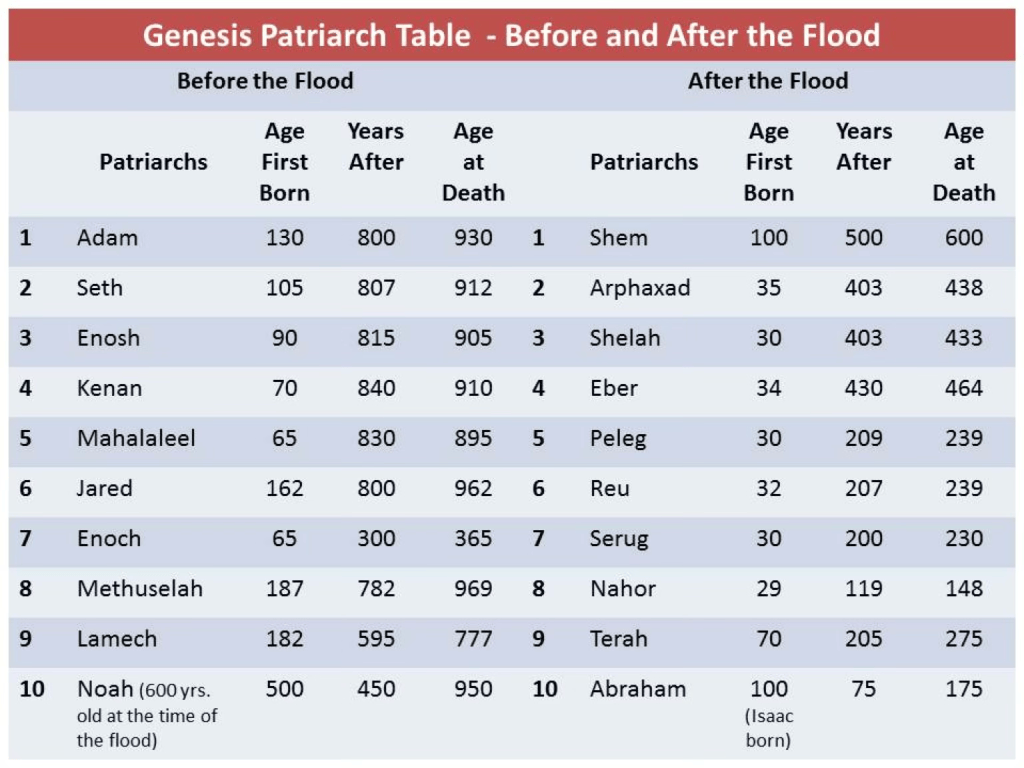
Genesis 21: The Birth of Isaac. Abraham is 100; Sarah is 90. After 25 years of Abraham planting his seed in his barren wife, Isaac, the child of promise, is finally born. Sarah laughs, but this time in joy instead of disbelief when the 3 men tell Abraham that he will have a child within a year (Genesis 18). Hebrews 11 commends her faith: 11:11 By faith even Sarah herself received ability to conceive, even beyond the proper time of life, since she considered Him faithful who had promised. 12 Therefore there was born even of one man, and him as good as dead at that, as many descendants as the stars of heaven in number, and innumerable as the sand which is by the seashore.” But trouble is brewing. Already there was tension between Hagar and Sarah. After Hagar got pregnant by Abraham (it was Sarah’s idea) when Abraham was 85, Hagar despised Sarah. Did Hagar despise Sarah b/c Sarah made her have a child by Abraham that could technically be claimed by Sarah as was the custom back then? Or was Hagar just lifted up with pride sensing that her child would not be the fulfillment of the promises to Abraham? She appears to keep full custody of Ishmael after he is born. So Sarah mistreated Hagar and the pregnant Hagar fled into the wilderness but God told her to go back and serve Sarah, which she did. So Hagar has Ishmael when Abraham is 86. But now in chapter 21 several years after Isaac is born, the tension peaks as Sarah sees Ishmael mocking her son Isaac. She demands that Hagar and Ishmael be driven away, and sadly Abraham sends them away to wander in the wilderness. They ran out of water and Hagar doesn’t want to watch her child die but the angel of God shows her a well of water and tells her that her son will make a great nation (the Arabs). Ishmael grows up in the wilderness of Paran. Here is the Islamic tradition: AI: “When their meager rations of dates and water were completely exhausted, the infant Ismail began to suffer from severe dehydration. In an agonizing search for water, caravans, or any sign of life, Hajar ran back and forth between two nearby hills—Safa and Marwa—a total of seven times. In response to her faith and perseverance, God sent the Angel Jibril (Gabriel). The angel struck the ground (in some accounts, the baby Ismail kicked the sand), causing a miraculous spring of fresh water to gush forth. This source became the holy Zamzam Well, which saved their lives and ultimately laid the foundation for the city of Mecca. Today, the two small hills are housed entirely within the massive complex of the Grand Mosque (Masjid al-Haram) at Mecca where Muslims make their mandatory once in a lifetime hadj to Mecca. Millions of pilgrims retrace Hajar’s desperate path. Pilgrims walk a total distance of approximately 2.76 kilometers (1.7 miles), completing seven one-way trips between the hills.While pilgrims generally walk the route, there is a specific section marked by green lights where men are encouraged to break into a brisk run or jog, mirroring Hagar’s frantic rush through the lowest point of the valley where she briefly lost sight of her baby. After completing Sa’i re-enactment, it is customary for pilgrims to drink deeply from the Zamzam water system, fulfilling the legacy of the miracle that saved the mother and child.” This has to be a very important event for Muslims since Ishmael was about to die and Muhammed is thought to be a descendant of Ishmael. Did God know that when he rescued Ishmael from the point of death and made a great nation from him (the Arabs) that it would he Ishmael’s descendants who would hate and kill his chosen people, the descendants of Isaac (the Jews), and even kill Christians in jhads. After all, they believe that Jesus was a prophet, but only a prophet and not the Son of God. Of course, Arabs and Jews can both find spiritual peace in Jesus Christ in the church if they choose to. Some might question why God allows Israel to do some of the things they do, so the only solution is for Jews and Arabs to both come to faith in Jesus

After the incident in Genesis 20 when Abraham lied to Abimelech in Gerar, Abimelech is leery of what the God of Abraham might do, so he asked Abraham to swear that he will never hurt him, which Abraham does. After some tension over a well, they enter a formal treaty at Beersheba.

Genesis 22. The Testing Of Abraham. We come to one of the most important chapters in the Old Testament. God “tested” Abraham by telling him to offer his son Isaac (most think he was 20 or so years old). Of course, the Muslims say that it was Ishmael, not Isaac, that was to be offered. The Hebrew word for “tested” is nasah: To test, to try, to prove, to tempt. James 1:13 Let no one say when he is tempted, “I am being tempted by God”; for God cannot be tempted by evil, and He Himself does not tempt anyone. The Greek word for “tempted” there is peirazó: To test, to tempt, to try, to examine. But Deuteronomy 8:2: God leads Israel through the wilderness for forty years to humble them and test what is in their hearts. So God does test people. He might even allow Satan to do the testing as in the case of Job. But if a test causes a person to have lusts that cause them to fail the test, it is not God to blame b/c he tested them. They only fail the test b/c of their own inner lusts. God will even put a limit to their failures if we seek an escape. Scripture assures believers that God does not allow people to be tested beyond what they have the strength to handle, and He always provides a way to endure it (1 Corinthians 10:13). I will never forget an incident when I was a principal. A high school boy was brought to my office b/c he was throwing rocks on the elementary playground (not at children, just throwing small pebbles) even after an elementary teacher told him to quit throwing. As I prepared to give him 3 “licks” with a very big wooden paddle, his excuse was: “If the teacher had not told me to quit throwing rocks, I wouldn’t have been in trouble for throwing rocks!” In other words, it was the teacher to blame for him getting in trouble! That’s James 1! Some blame God when they fail a test and sin.

Back to the test itself. Abraham had “unquestioning obedience” to God. He didn’t even question God as to why He could command a human sacrifice. Or why, after 25+ years of waiting to have the son of promise, He now tells Abraham to kill him. He gets up “early the next morning” When they arrived at the mount, 22:5 Abraham said to his young men, “Stay here with the donkey, and I and the lad will go over there; and we will worship and return to you.” “We”, i.e. Isaac and Abraham. Why would he say “we” when he was about to kill Isaac? The explanation is found in Hebrews 11:17 By faith Abraham, when he was tested, offered up Isaac, and he who had received the promises was offering up his only begotten son; 18 it was he to whom it was said, “In Isaac your descendants shall be called.” 19 [o]He considered that God is able to raise people even from the dead, from which he also received him back as a type.” He was thinking, “The only possible answer to my questions is if I kill Isaac and God raises him from the dead!” What imaginative faith! What possibility thinking! What trust in God! What was the “type” in Hebrews 11:19? 1) The ram taking Isaac’s place made it a figurative resurrection since Abraham had been fully willing to offer Isaac. 2) The ram taking Isaac’s place was a type of Jesus taking our place on the cross so that we won’t die forever but have eternal life. I can’t imagine what Isaac is thinking during this whole incident. Was he looking up at Abraham as he drew back the knife or did Abraham blindfold him? Abraham bound his on top of the wood, so he had to know what looked like was about to happen.

Why did God say “Now I know that you fear God”? Did God not know that Abraham was willing to offer Isaac even before he told him to? Does God’s omniscience not require that God already knew that? Maybe God’s omniscience does not require that God know everything about everyone in the future. Maybe his omniscience means that he can choose to know the future only when He so desires or needs to (which is called Open Theism). In open theism, he might not know the free will choices people will make unless he so chooses, but he can choose to know what their choices will be. He chose to know if Judas would betray Jesus and chose Judas to be an apostle knowing that he would betray Jesus. He did not know if Abraham would offer Isaac and thus it really was a true test of his faith. But I can’t imagine how it would have affected God’s plans if Abraham had not been willing to offer Isaac. After offering the ram, Abraham named the place “Yahweh Jireh”, Yahweh God will provide. The name is only mentioned once in the Bible. This incident is a type of God providing a substitute, Jesus, so that physical death will not be forever for us. We can live forever b/c Jesus took the punishment for our sins on the cross. The angel told Abraham, 22:18 In your seed all the nations of the earth shall be blessed, because you have obeyed My voice.” This is the verse quoted by Paul in Galatians 3:16 Now the promises were spoken to Abraham and to his seed. He does not say, “And to seeds,” as referring to many, but rather to one, “And to your seed,” that is, Christ.” The inspiration of Scripture is so complete that this argument hinged on the singular or plural of “seed” in Genesis 22:18. James comments on the offering of Isaac: James 2:21 Was not Abraham our father justified by works when he offered up Isaac his son on the altar? 22 You see that faith was working with his works, and as a result of the works, faith was perfected; 23 and the Scripture was fulfilled which says, “And Abraham believed God, and it was reckoned to him as righteousness (Genesis 15:6),” and he was called the friend of God. 24 You see that a man is justified by works and not by faith alone.” James quotes Genesis 15:6 where Abraham was “saved” by imputed righteousness, but says that Abraham’s faith was “perfected” (teleioó: To complete) when he offered Isaac. James had already said in his letter that trials can make our faith more “complete” (perfect): James 1:2 Consider it all joy, my brethren, when you encounter various trials, 3 knowing that the testing of your faith produces endurance. 4 And let endurance have its perfect result, so that you may be perfect and complete, lacking in nothing.” Abraham was “justified” (declared free of guilt spiritually by God) by his works, but not “on the basis of” his works. Salvation is 100% by the grace of God even when we do “works” of obedience to God.

Genesis 22 closes with more of the genealogy of Terah, which will come into play in chapter 24.
Genesis 23: The death and burial of Sarah. Sarah died at 127 years old. Abraham had to by a piece of land from Ephron, a Canaanite. He buried Sarah in the cave of Machpelah on the land he bought. This cave will be the burial site for many of the patriarchs and their wives. Sarah had been roaming all over Canaan since she and Abraham arrived there when she was 65, so roaming for 62 years! She never had a permanent home in Canaan, constantly moving to find pasture and water and to avoid conflicts with the Canaanites. Peter commends the humble, submissive attitude of Sarah: 1 Peter 3:5 For in this way in former times the holy women also, who hoped in God, used to adorn themselves, being submissive to their own husbands; 6 just as Sarah obeyed Abraham, calling him lord.” Abraham made the major decisions. He said, “Let’s leave Ur and go to this unknown land”, and she obeyed. He said, “We need to go to Egypt” and she obeyed although it nearly cost her dearly. She just humbly obeyed Abraham. A lot of modern women don’t like it when we quote Paul saying that wives should be in submission to their husbands, but Peter certainly agrees with that in 1 Peter 3:1-5. I can relate to that. I am blessed with such an humble, submissive wife. Sure I discussed major decisions with her, but I made the final decisions to leave my engineering job and our parents and house we just bought in B’ham to go to Louisiana to a school of preaching, then to move to Trinidad to do mission work, then to take a low paying job as a principal in Christian education in B’ham, then to move to Vernon, and then to move to Huntsville where we have been for 32 years now. I counted in one decade in the 70’s where we moved 11 times from foreign countries to apartments, back and forth. My wife never complained or questioned our moves. She would have been perfectly happy to have stayed in B’ham near her parents but followed wherever I thought God was leading us to serve. My wife sacrificed a lot of the things she could have had if we had settled in one place with more money, but God blessed her in the long run with 3 godly children that she did most of the raising while I was out saving the world or doing Christian education. Now as she has gotten older, she has at least had 18 years in a nice house with 10 grandchildren and close family ties with her 3 grown children. She would refute this, but I think she comes pretty close to the woman in Proverbs 31 (although Solomon says you can’t find such a woman!). I praise her as called for in 31:28 Her children rise up and bless her; Her husband also, and he praises her, saying: 29 “Many daughters have done nobly, But you excel them all.”

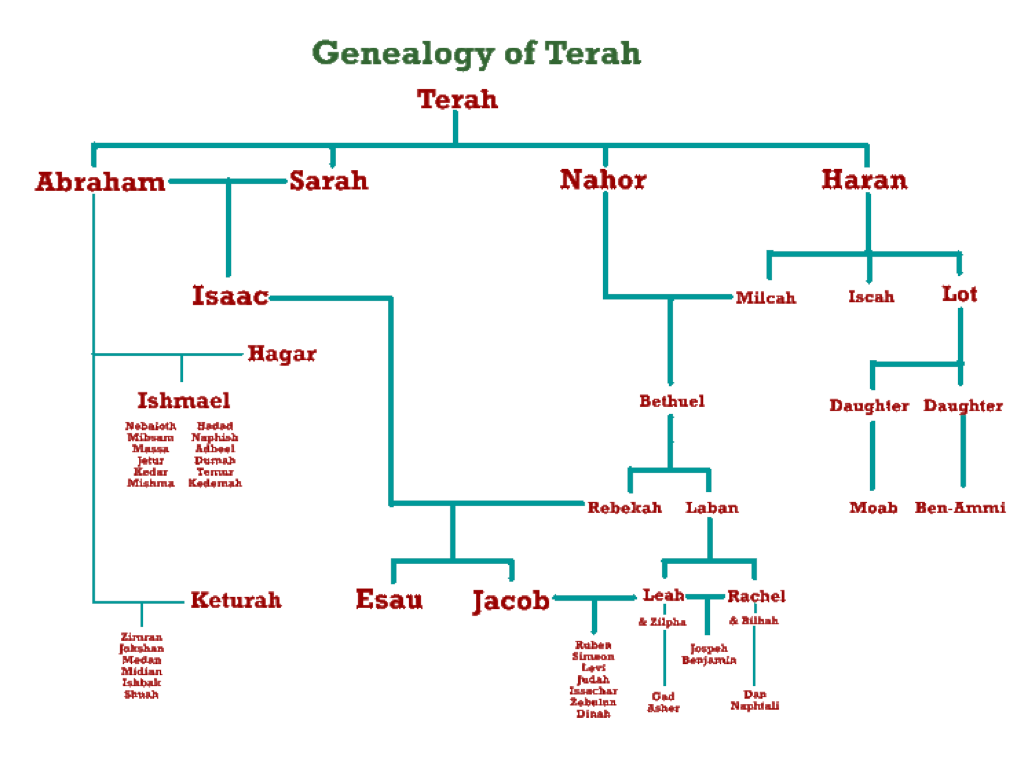
Genesis 24: A Wife For Isaac. Most scholars think this servant sent to find a wife for Isaac was Eliezer of Damascus (Genesis 15) so we will assume that it was for this blog. Look back at the genealogy of Terah above to see where Rebekah fits in as she was a first cousin once removed. The story is simple to read, but the bigger story in this chapter might be Eliezer. Notice the humility and faith of this man. He swore an oath to not take a bride for Isaac from Ur but only from Haran, and then traveled the 400 miles from Canaan to Haran. 24:12 He said, “O Lord, the God of my master Abraham, please grant me success today, and show lovingkindness to my master Abraham. He trusts God for a sign to show him the right bride (the girl who offered to water his camels). He is constantly trying to see how God is answering his prayer as Rebekah wateed his camels: 24: 21 Meanwhile, the man was gazing at her in silence, to know whether the Lord had made his journey successful or not. He did not know at first that she was a relative of Abraham, but when she told him that she was the granddaughter of Nahor, Abraham’s brother, 24:26 Then the man bowed low and worshiped the Lord. 27 He said, “Blessed be the Lord, the God of my master Abraham, who has not forsaken His lovingkindness and His truth toward my master; as for me, the Lord has guided me in the way to the house of my master’s brothers.” In Laban’s house (Rebekah’s brother) he would not eat until he told why Abraham had sent him. Both Laban and Bethuel (Rebekah’s father) agreed “The matter comes from the Lord” and agreed to let Rebekah marry Isaac. After a short delay, Eliezer brought Rebekah back to Canaan and she married Isaac. Isaac loved her and was comforted after his mother’s death (Sarah). I find it amazing that Genesis 24 is the longest chapter in Genesis. Of course, uninspired humans divided the Old Testament into chapters, so I’m not saying that is a “God thing” but I do find it interesting.

Life Lesson: I wish I had the faith of this relatively unknown character in the Bible. He is humble, he trusts God completely for success, he is focused on his task and will not even eat till he accomplishes it, he is prayerful, he is constantly seeking God’s guidance in what he is doing, he worships God when he has success, he is looking out for the interests of others (Abraham and Isaac), he believes that God can provide spiritual mates for his children, etc. We should be like Eliezer every day, every moment of every day. When you start out on a day’s jobs or tasks or travels, do you start first with prayer for success. When things happen, do you look for God’s leading or just assume it is circumstantial happenings? Do you praise God every time something good happens? Are you willing to go to great lengths to help others? Do you know of an “Eliezer” that has these qualities?

Genesis 25 Death Of Abraham and Birth Of Jacob And Esau. Abraham was 137 when Sarah died. He died at 175, so he lived 38 years after Sarah died and took a 2nd wife, Keturah during those 38 years and had 6 sons by her. We don’t know where Keturah was from. Abraham sent her sons off to the east so they wouldn’t interrupt God’s plans for Isaac. They became Arabian tribes. Abraham died at 175, “in a ripe old age, an old man and satisfied with life.” Isaac and Ishmael buried him in the cave of Machpelah where Sarah was buried. I find it interesting that he died “satisfied with life”. He could have easily been very unsatisfied with life. God had called him to an unknown land 1,000 miles away, and he only found out that he personally would never own any of the land except for the cave he bought to bury Sarah in. He was constantly moving around, being harassed by the Canaanites, dealing with the Philistines and Abimelech. He watched as Sodom went up in smoke. We don’t know if he ever saw Lot again after the destruction of Sodom. He had to take his 318 men and rescue Lot. He tries to plant his seed in a barren woman for 25 years after they enter Canaan (maybe many years before that). He has to send Hagar and Ishmael to wander in the wilderness, thinking they might die there, but he truly loved Ishmael. He almost killed Isaac if God had not stopped him. But Hebrews 11 says it best: 11: 9 By faith he lived as an alien in the land of promise, as in a foreign land, dwelling in tents with Isaac and Jacob, fellow heirs of the same promise; 10 for he was looking for the city which has foundations, whose architect and builder is God.” 11:13 All these died in faith, without receiving the promises, but having seen them and having welcomed them from a distance, and having confessed that they were strangers and exiles on the earth. 14 For those who say such things make it clear that they are seeking a country of their own. 15 And indeed if they had been thinking of that country from which they went out, they would have had opportunity to return. 16 But as it is, they desire a better country, that is, a heavenly one. Therefore God is not ashamed to be called their God; for He has prepared a city for them.” AI says it well: “Abraham died satisfied because his contentment came from his relationship with God and seeing God’s promises unfold, rather than from having an easy life or possessing the land completely. Abraham looked past his immediate hardships and lived with a long-term, eternal perspective. His deepest sense of fulfillment came from walking closely with God, who guided him step-by-step through every trial. Even though he lived as a nomad and did not own the entire promised land, he lived to see Isaac grow and his family begin to multiply, fulfilling God’s promise to make him the father of many nations.” He was looking for a city whose builder was God. I’m not sure what they means but it had to be an eternal spiritual place after death! Enjoy the song “Looking for a city”, Gaither style.

https://www.youtube.com/watch?v=xlcG8PJ9VK0

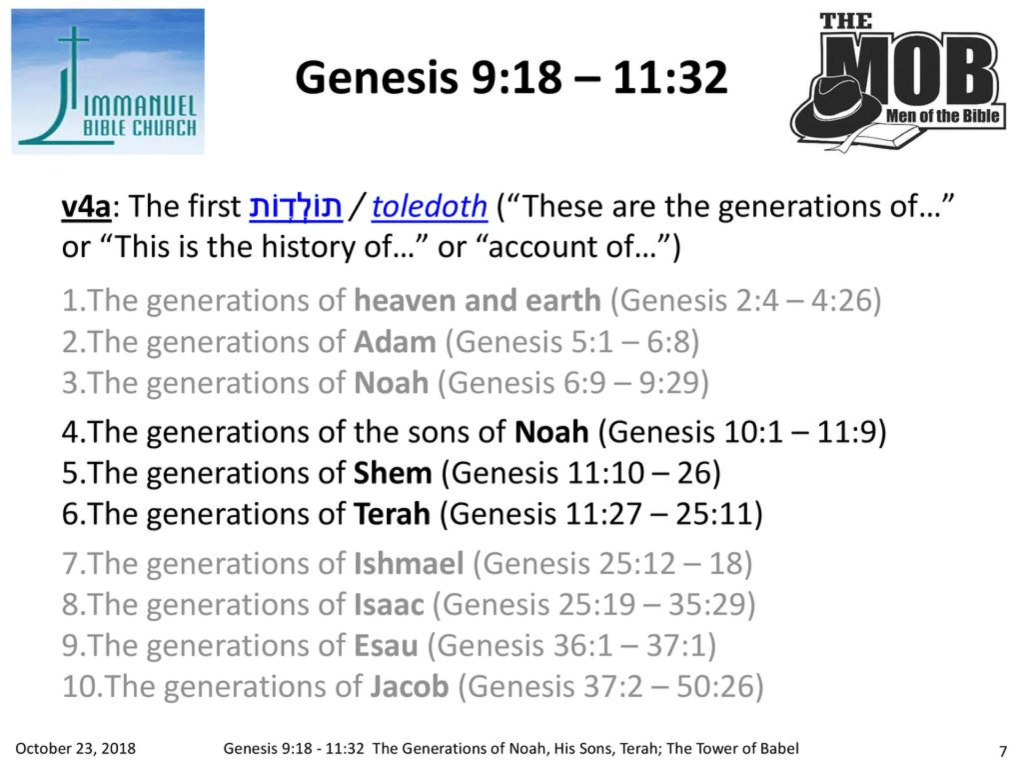
Genesis 25 has the 7th “these are the generations of” with “these are the records of the generations of Ishmael” in 25:12. Ishmael lived 137 years and settled in “defiance of all his relatives”, i.e the descendants of Abraham and Isaac.
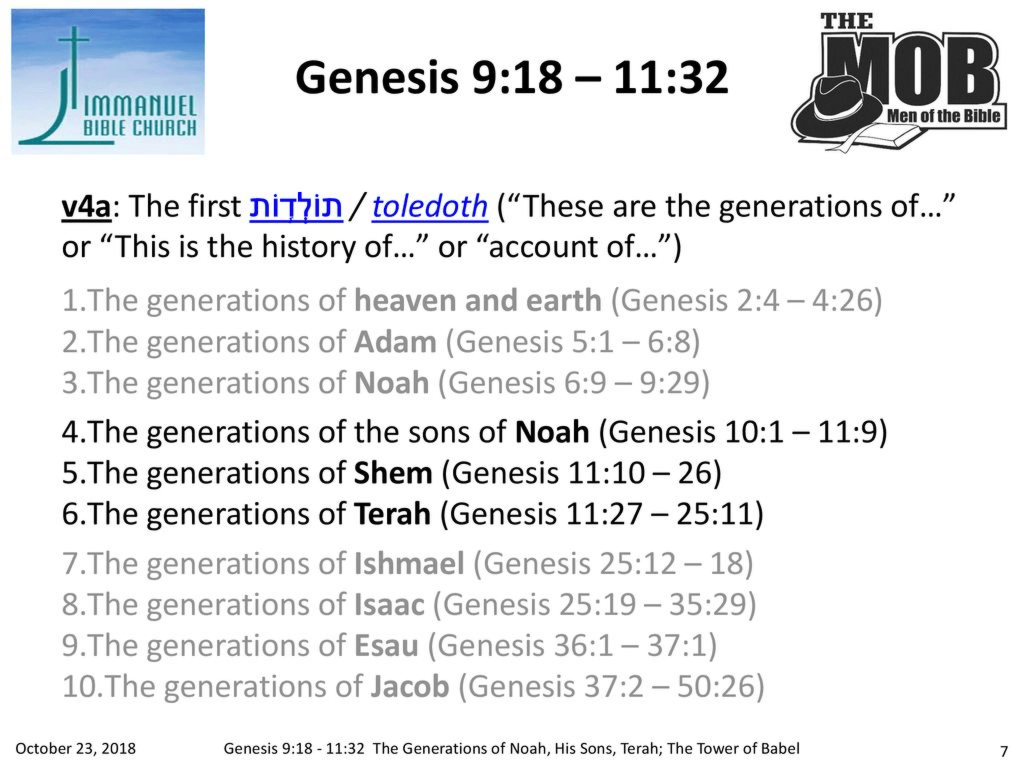
Then we come to the 8th “generations of” with “these are the records of the generations of Isaac” (25:19-35:29).

Genesis 25 closes with the birth of Isaac and Rebekah’s 2 sons, Jacob and Esau. Isaac was 40 when he married Rebekah and 60 when the twins were born. Twins but totally different looking, with totally different personalities. Esau was a hunter, the favorite child of Isaac and Jacob, the favorite of Rebekah, “lived in tents”. God told Rebekah that the older would serve the younger, and that proved to be true as Esau was the firstborn but Jacob was the one through whom the promises to Abraham would be fulfilled. A little lengthy but we need to look at Romans 9:6 But it is not as though the word of God has failed. For they are not all Israel who are descended from Israel; 7 nor are they all children because they are Abraham’s descendants, but: “through Isaac your descendants will be named.” 8 That is, it is not the children of the flesh who are children of God, but the children of the promise are regarded as [g]descendants. 9 For this is the word of promise: “At this time I will come, and Sarah shall have a son.” 10 And not only this, but there was Rebekah also, when she had conceived twins by one man, our father Isaac; 11 for though the twins were not yet born and had not done anything good or bad, so that God’s purpose according to His choice would stand, not because of works but because of Him who calls, 12 it was said to her, “The older will serve the younger.” 13 Just as it is written, “Jacob I loved, but Esau I hated.” I highlighted the reason God chose the older to serve the younger. He wanted to make it known that His plans are ultimately not based on our works or goodness but b/c of His power. Sure, he perhaps looked into the minds and hearts of the twins when they would grow up and decided that Esau would not appreciate his birthright so Jacob would be the better choice to fulfill the promises to Abraham. But Jacob had so many flaws, was he really a better choice than Esau? Ultimately, he was the better choice to carry on the seed line of Jesus despite his flaws. Paul then quotes Malachi 1:2-3 “Jacob I loved but Esau I hated”. Perhaps the “hated Esau” refers to the dislike God came to have of the descendants of Esau who persecuted Isaac’s descendants down through the centuries. Esau proved to be unworthy of the chosen line of Jesus b/c he sold his birthright for a bowl of stew. He “despised his birthright” (24:34). Jacob ended up in Egypt in old age, trusting God to fulfill the promises He had made to Abraham, Isaac, and Jacob. He made sure his bones would be buried in Canaan, not Egypt.

Well that accomplishes my purpose of catching up to where I first started the readings on Aug 31 with Genesis 26-30. I hope you have had time to read all these chapters and the blogs that go with them. And then keep up with the current daily readings.

Thanks for reading .
AUG 29. READ GENESIS 16-20

Genesis 16: El Roi. The Lord God (Yahweh) Who Sees Me. When Sarai drove Hagar from her presence into the wilderness, the angel of the Lord appeared and assured her that her son by Abraham (which was Sarai’s idea) would be blessed with many descendants. She was surprised that she was still alive after seeing God as the angel of the Lord was perhaps the pre-incarnate Jesus and thus God. She called the angel, “You are a God who sees”. She realized that He noticed her deep pain and isolation. She also named the nearby well Beer-lahai-roi, meaning “well of the Living One who sees me”.
Life Lesson: AI: “This name highlights that God sees the outcasts, the vulnerable, and the forgotten. To be “seen” by God means He fully understands personal suffering, distress, and individual circumstances with compassion. It reassures believers that no hidden place or lonely situation escapes God’s notice.” This name is only used once in the Old Testament. Do you ever wonder if God is watching you suffer, when you are depressed, when you are in trouble, when you are afraid, when you are discouraged? A good parent is always watching his/her children. He/she sees them when they are having difficulties and goes to help. It doesn’t always seem that the Lord is watching us like that when we have difficulties. But he is. He might not bail us out immediately, but He will always give us the strength we need to handle the difficulties. The next time you face such, just say the name “El Roi” and remember the lesson from Hagar. Hagar had her child Ishmael when Abraham was 86. Ishmael would become the father of the Arabs and of course, the Muslims. AI: “Muslims view Ishmael in Islam as a major prophet, a righteous man of deep faith, and the ancestral patriarch of northern Arab peoples. Unlike the biblical narrative, Islamic tradition teaches that Abraham was commanded to sacrifice Ishmael, not Isaac, in Genesis 22. According to Ishmael | Meaning, Facts, & Significance, Ishmael and Abraham together built and purified the Kaaba in Mecca as a house for the worship of the one true God. Muslims believe that the Prophet Muhammad is a direct descendant of Ishmael.”

Genesis 17: When Abraham was 99 (Sarah was 89) God renewed his promise with Abraham to multiply his descendants and give them the promised land. He changes Abram’s name to Abraham and Sarai’s name to Sarah. He then gives the covenant of circumcision for all male descendants when 8 days old. Also Abraham and all his servants were circumcised at that time. God then tells Abraham that he will a son by Sarah in one year’s time. Abraham’s response is a little surprising: Genesis 17: 17 Then Abraham fell on his face and laughed, and said in his heart, “Will a child be born to a man one hundred years old? And will Sarah, who is ninety years old, bear a child?” 18 And Abraham said to God, “Oh that Ishmael might live before You!” This sounds contradicotry to what Paul said in Romans 4:18 In hope against hope he believed, so that he might become a father of many nations according to that which had been spoken, “So shall your descendants be.” 19 Without becoming weak in faith he contemplated his own body, now as good as dead since he was about a hundred years old, and the deadness of Sarah’s womb; 20 yet, with respect to the promise of God, he did not waver in unbelief but grew strong in faith, giving glory to God, 21 and being fully assured that what God had promised, He was able also to perform.” It sure looks in Genesis 17 like he “wavered”, doesn’t it? He seems perfectly content to just have Ishmael as his descendant that would be multiplied. I saw this on AI: “Abraham’s laughter in Genesis 17:17 is best understood as an expression of awe, wonder, and stunned amazement rather than cynical disbelief, which resolves the tension with Paul’s description in Romans 4.” I’m sorry but I can’t buy that. He questioned in hs heart silently, “how can a child be born to a man 100 years old and a woman 90 years old”? He told God that he wanted his descendants to come through Ishmael. God had to tell him “No”, your descendants to fulfill the promises will be through Isaac not Ishmael. That sounds like wavering and doubt. My conclusion to this dilemma is that he did have a moment of doubt and wavering, but then obeyed God and went right back into Sarah to have sex with her and bear that promised child by her. A moment of wavering does not mean that he wavered throug the whole process. It took faith to go have sex at age 100 with a 90 year od woman, fully expecting God to give you a child in one year.

Life Lesson: Have you ever had one of those doubting, wavering moments, when you questioned God on how things would turn out? When you doubted that God was going to do some good thing in your life? When it looked “hopeless, hope against hope” in your difficulties or prospects, did you waver briefly but then come out of that moment with renewed hope in the promises of God? The next time your faith wavers a little think about Abraham and how it all turned out for the good like God promised.

Genesis 18: The 3 men visit Abraham. The story is easy to understand so just a few points that maybe you didn’t notice in your reading. 3 men come to Abraham. 19:1 identifies 2 of them as angels just taking the form of men temporarily. The 3rd men is more than an angel. After the 3 men tell Abraham that he will have a son in one year, 2 of the men head to Sodom and the 3rd man remains, talking with Abraham as Abraham finally asks God to save Sodom if 10 righteous souls could be found (which God agreed to do). Abraham addresses this main figure, the 3rd “man” as Adonai (Lord), and the text interchanges the dialogue directly between Abraham and Yahweh. It is what is called a “theophany” (a physical, visible manifestation of God (Yahweh) taking on human form). Maybe even the pre-incarnate Jesus, the Word, as he delivers the word about the birth of Isaac. Sarah laughs as she is snooping at the tent but denies it! It is encouraging to hear Abraham talk directly and boldlyto the Lord with his requests. Isn’t this what prayer should be, talking directly, humbly, boldly to God, making our requests made known to him? You might even can changed what God had planned to do. As evil as Sodom was, God was going to spare Sodom if 10 righteous souls could be found in the city b/c of the constant, bold intercession of Abraham. God even rescued Lot and his family of 4 even though 10 souls could not be found. Life Lesson: Who knows what disasters or bad things could be avoided for people or what good things could be given to people through your intercession. 1 Timothy 2:1 – “I urge, then, first of all, that petitions, prayers, intercession and thanksgiving be made for all people”. James 5:16 – “Therefore confess your sins to each other and pray for each other so that you may be healed. The prayer of a righteous person is powerful and effective.” Ephesians 6:18 – “And pray in the Spirit on all occasions with all kinds of prayers and requests. With this in mind, be alert and always keep on praying for all the Lord’s people.”

Genesis 19: The destruction of Sodom and Gomorrah. You probably know the sordid story. Lot takes the 2 angels into his house (they still lookd like men so did he know they were angels) and the men of Sodom want Lot to bring them out so they can have sex with them! The most surprising part of this story is when Lot offers his 2 virgin daughters to the men to have sex with them instead of with the 2 angels. What laws of hospitality could even remotely suggest doing this? What kind of a man had Lot become that he would do that? 2 Peter 2 comments on Lot’s frustration with the evil in Sodom: 2:6 and if He condemned the cities of Sodom and Gomorrah to destruction by reducing them to ashes, having made them an example to those who would live ungodly lives thereafter; 7 and if He rescued righteous Lot, oppressed by the sensual conduct of unprincipled men 8 (for by what he saw and heard that righteous man, while living among them, felt his righteous soul tormented day after day by their lawless deeds).” If Lor was tormented day by day by the sins in the city, why didn’t he take his family and leave. His wife was probably from Sodom. His 2 daughters were engaged to 2 of the man of Sodom (at least were either straight or bisexual), but the 2 future sons-in-laws thought he was joking about the upcoming destruction of the city. Lot “hesitated” leaving the city so the 1 angels/men take Lot and his family “by the hand” to pull them out of the city and tell them not to look back. I’m sure you know that Lot’s wife looked back and was turned into a pillar of salt, the falling, fiery briimstone with which God rained destruction on the city. Lot and his 2 daughters are given permission to flee to Zoar while Sodom was being destroyed. Later they fear for their safety in Zoar and flee to a cave in the mountains where his 2 daughters, thinking they are the last 2 women on earth, get Lot drunk and have sex with him to get pregnant. Moabites and Ammonites come from that incestuous relationship. A sad ending as Abraham looks down on the smoke from Sodom. I wonder if he knew at that time that Lot and his 2 daughters had been spared? We are not told what happened to Lot after that. His 2 daughters’ children obviously survived and formed the nations of Moab and Ammon, but we don’t know about Lot. Luke 17 tells us: 29 but on the day that Lot went out from Sodom it rained fire and [s]brimstone from heaven and destroyed them all.” and then adds “Remember Lot’s wife” which would serve as a warning to those fleeing the destruction of Jerusalem in 70 AD.

Life Lesson: Lot lost everything when he moved to Sodom for financial gain. He lost his self respect. He lost the respect of the men of Sodom and his future sons-in-laws. He lost any friends he might have had in Sodom. He lost his wife who turned into a pillar of salt. I wonder if he ever went back to look at that pillar. He lost his daughters to their incest. He lost his companionship with his uncle Abraham. He lost his peace of min as he was tormented day by day with the sins of Sodom. He lost his home and all his possessions that were burned up in Sodom. He was still called “righteous” in 2 Peter 2 so we don’t think he lost his spiritual relationship with Yahweh. We can only hope that he was not drawn into idol worship in Sodom. He lost everything and it started with one simply decision: which land to choose. Choose the one that promises more financial gain but is close to Sodom or choose some land in Canaan away from Sodom. Life is about choices. A friend of mind preached a simple lesson to our high school seniors telling them the 3 main choices in life were 1) To follow God and Jesus. 2) Who you marry. Nothing is guaranteed in marriage even if you marry a Christian, but your odds are better if you do. 3) Your career and all the implications of the career you choose. Perhaps you have already made some bad choices and are reaping what you sowed. Perhaps you have some choices still to make. Make them wisely. Ask God to give you wisdom in your choices and ask the Spirit to guide you.

Chapter 20. Surely Abraham learned from his mistake in Egypt, right? Nope. He goes to Gerar in Philistine territory and tells the same lie, that Sarah is his siter, to keep Abimelech from killing Abraham and taking Sarah to be his wife. Here is where he tells that Sarah is his half sister, which still was a lie to deceive Abimelech. Here we learn that Abraham had told his wife to lie wherever they went telling that Abraham was her brother. Again, Abimelech, not Abraham, is punished even though he innocently took Sarah in the “integrity of his heart”. The women in Abimelech’s household had been made barren b/c of this incident, but after he restored Sarah to Abraham the women were healed. I don’t understand this, but perhaps this is just God’s way of showing that Abraham was a prophet of the one true God (20:7) even if he makes mistakes. Have you ever committed the same sins over and over. Have you ever thought, “I wonder if God gets tired of me confessing the same sins. Maybe he is frustrated with me that I don’t learn from my mistakes.”

I’m about caught up.

AUG 28. READ GENESIS 11-15

Genesis 11. The first part of Genesis 11 (the Tower of Babel event in verses 1–9) occurs chronologically before a lot of the final dispersion of nations described in Genesis 10. A key clue confirming this is 10:25 Two sons were born to Eber; the name of the one was Peleg, for in his days the earth was divided; and his brother’s name was Joktan.” That tells us that aat least some of the genealogies of chapter 10 occurred after the tower of Babel when the earth was divided. Let’s track Shem’s descendants. Shem’s descendants from the flood up to Peleg and Babel are given from 10:21-25 and then 10:21-25 are the descendants of Peleg’s brother Joktan’s 13 sons (not Peleg’s descendants) from the tower of Babel to some time after Babel. Some suggest that 11:1-9 then tells why the earth was divided in the days of Peleg since 10:25 mentioned that. But notice in 11:10 “these are the records of the generations of Shem”. That is the 5th “these are the generations of ” in the outline we used in Genesis 1. So 11:10-17 gives the descendants of Shem from the flood to Peleg and the tower of Babel (covering about 100 years from the flood). Then in 11:18-26 give the descendants of Peleg from Babel to Terah the father of Abraham, Nahor, and Haran. I know that sounds confusing but that has to be the way it breaks down. Check it out and you will see.

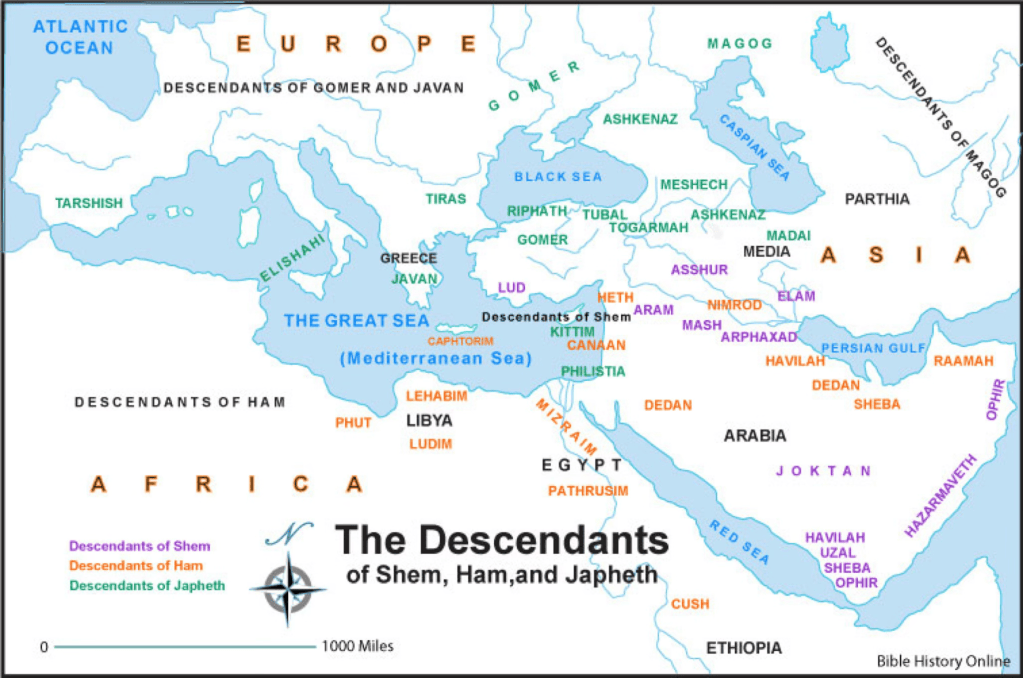
Genesis 11:1-9 The tower of Babel. This was probably about 100 years after the flood and the descendaants of Ham, Shem, and Japheth during that 100 years are still together instead of spreading out like God told them to. Imagine the mass confusion when God “confused” their languages. Sociologists have a lot of theories about how languages evolved over hundreds of thousands of years, but the Bible says they came about instantly at Babel. Perhaps God even miraculously changed some of their genetic code and that is where different “races” came from even though technically there is just one race, the human race who all came from Adam. Paul said in Acts 17:26 and He made from one man every nation of mankind to live on all the face of the earth.” Different colors of people and different languages would certainly scatter the people over the earth as God commanded. Here is the map of what it looked like some time after Babel:

Genesis 11:10-26 gives the 5th “generations of ” with the generations of Shem.

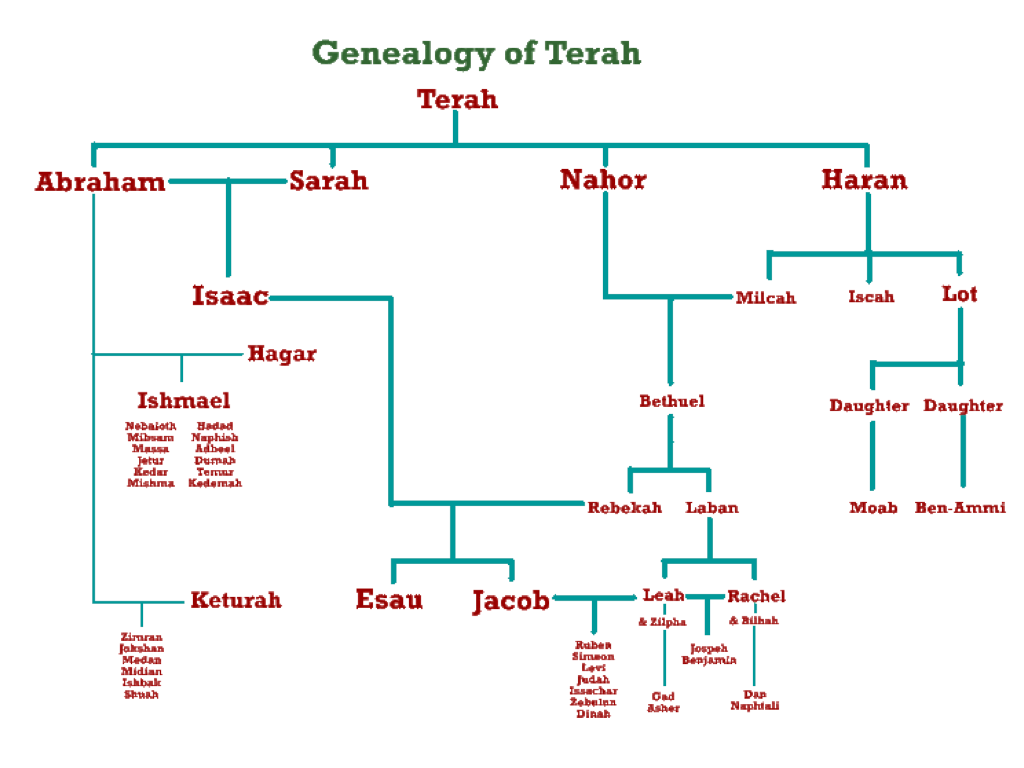
Genesis 11:27-25:11 gives the 6th “generations of” with the generations of Terah the father of Abraham, Nahor, and Haran.Terah took Abram, Sara, Lot. Nahor apprently stayed behind in Ur but later relocated to Haran since he is living in Haran in Gensis 24. Lot’s wife is not mentioned as traveling to Haran with Terah, so we assume that he married her after he went to live in Sodom. Terah died in Haaran.

Here is the genealogy of Terah that will be a big part of the rest of Genesis.

Genesis 12:1-3 is the call Abraham received while in Haran. But he was first called while in Ur according to Stephen in Acts 7:2 And he said, “Hear me, brethren and fathers! The God of glory appeared to our father Abraham when he was in Mesopotamia, before he lived in Haran, 3 and said to him, ‘Leave your country and your relatives, and come into the land that I will show you.’ 4 Then he left the land of the Chaldeans and settled in Haran. From there, after his father died, God had him move to this country in which you are now living.” We don’t know how long Abraham lived in Haran but he was 75 when he received his 2nd call while in Haran. God promised 3 things to Abraham: 1) A great nation would descend from him, fulfilled in Israel becoming God’s chosen nation at Mt Sinai. . 2) The Promised Land of Canaan. Joshua 21:43-45 says that, after the conquest of Canaan, Israel got all the land God had promised the. 3) In Abraham’s seed all nations, Jew and Gentile, would be b blessed. Galatians 3:16 says that “seed promise” was fulfilled in Jesus. This 3-fold promise to Abraham is the hub of all Old Testament history.

There are more verses devoted to the faith of Abraham in the “Hall of Faith” in Hebrews 11 than any other person. They begin with his call: Hebrews 11:8 By faith Abraham, when he was called, obeyed by going out to a place which he was to receive for an inheritance; and he went out, not knowing where he was going.” I assume this refers to his calling in Ur. We know that Terah worshipped foreign gods. Joshua 24:2: The Hebrew Bible explicitly states that Terah and his ancestors lived beyond the Euphrates River and “served other gods”. Some Jewish legends even have Terah making and selling idols and a young Abraham smashing some of those idols (as in the Turner movie “Abraham”). We don’t know if Terah ever came to have faith in Yahweh. We don’t know how God spoke to Abraham or whether God did any miracles to show Abraham that He was the one true God. But imagine leaving your home and relatives and traveling 1,000 miles to a land you have never even seen just on faith. No visits back to home in Ur even though he could have done so.

Life Lesson: In 1974 my wife and I left Birmingham, Al to travel 2,200 miles to do mission work in Trinidad, West Indies, but we knew where we were going and had monthly support to supply our needs. We had funds to come back to visit our parents in B’ham once every year. Back then, everyone could come to the airline gate to see us off and we had a big crowd as we boarded the plane, including our parents. But I do remember as we sat down in our seats on the plane having a panic attack, thinking “I can’t believe we are doing this! My dad would always bail me out of jams and my mom always sheltered me. No more of that, we were on our own.” After a 10 hour flight, it was a joy to have all the missionaries meet us at the airport and carry us to a missionary’s house for a little welcome party. Abraham did not get anything like that. I had faith to leave our relatives and go to Trinidad b/c I felt that God was calling us to do so, just like God called Abraham, but I had so many guarantees for our 3 years there that it really required very little faith. We could have hopped on a plane and been back in B’ham in half a day at any threat of danger. Abraham lived 75 years in Canaan, constantly surrounded by threats from the Canaanites. What about you? Have you ever felt a strong call from God to make a drastic change in your life, your career, your living location, your business decisions, your separation from relatives that maybe are holding you back? Are you completely ready to leave everything and go where God calls you? I know 2 young people who felt that call after graduating from college to go to Asia to preach the gospel in predominately Buddhist and Muslim countries. They are both married with 2 children each, leaving their parents in the US and carrying those precious children overseas to a distant land. What faith! Don’t be afraid to ask God to call you to do great things for him. William Carey felt the call to leave England in 1792 AD to go preach the gospel to the hundreds of Hindu, unconverted souls in India. He had a famous motto: “Expect great things from God; attempt great things for God.” I hope God will call you to do great things for Him. BTW that doesn’t have to be in a foreign country. He might be calling ou to adopt an orphan locally. That takes great faith. He might call you to take care of widows in your church. He might call you to feed the poor in your area. Be ready to respond.

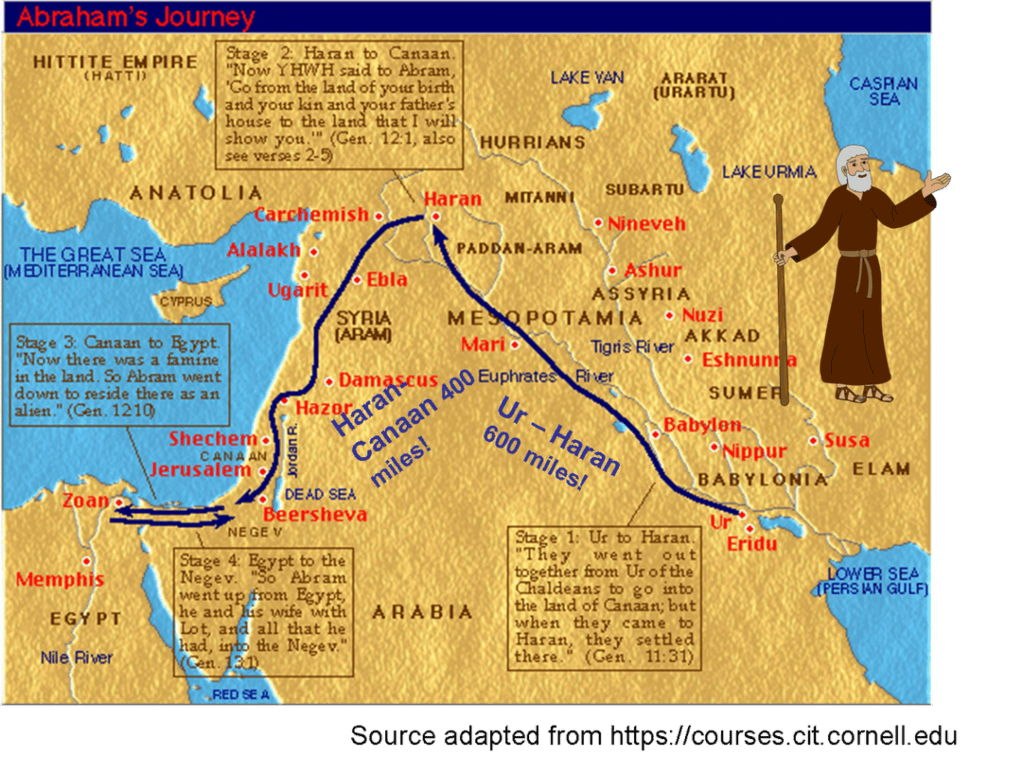
Here is a great map of Abraham’s journey giving distances:

Stage 1 on the map is from Ur to Haran. Stage 2 is from Haran to Canaan. He left Haran at age 75. When he came to Shechem, he built an altar to God and continued on to the Negev (locate on the map). Stage 3 on the map is from Canaan to Egypt during a famine where he lied to Pharoah, telling him that Sarai was his sister to keep from being killed by Pharoah who wanted to take Sarai as a wife. It’s hard to believe that the man with enough faith to leave everything and go to a land 1,000 miles away would not have enough faith that God would protect him from Pharoah, but Abraham failed this test. Stage 4 on the map is from Egypt back to Canaan. I wonder what Sarai thought of Abraham lying that she was his sister? She had to be afraid as Pharoah took her into his harem, only saved by God sending plagues on Pharoah. How did she feel knowing that her husband was willing to let Phroah take Sarai, have sex with her, and make her his wife? How did it feel knowing she was married to a coward? I bet it was a silent journey on the way back to Canaan. Did Abraham ever apologize to Sarai for this incident? Did his conscience bother him? Why is it that Pharoah gets punished for this deception and not Abraham? Technically Sarah was actually Abraham’s half-sister through their father, Terah, not their mother (Genesis 20:12) but this is still a lie, a cowardly deception. My mother called it an “Abrahamic lie” when she wanted to stretch the truth a little! We all laughed at that.

Life Lesson: We all have our moments of great faith and we all have our moments of weak faith. I know what my weak spots are. I know what I can handle with faith and what I have panic attacks over due to a lack of faith. I think back to some of my moments of weak faith and how I responded and am embarrassed by them. I almost had a nervous breakdown over an incident where I was afraid of being sued and was sleeping about an hour only each night for a month worrying. A friend carried me to a lawyer who assured me everything would be fine and I slept good that night for the first time in a month. I could have found that same relief from my worries a month earlier if I had more faith. What about you? Have you ever had your “Abraham in Egypt” panic attack where you resort to human tactics b/c of your lack of faith? Are you in the middle of one of those moments right now? Trust God and things will be just fine!

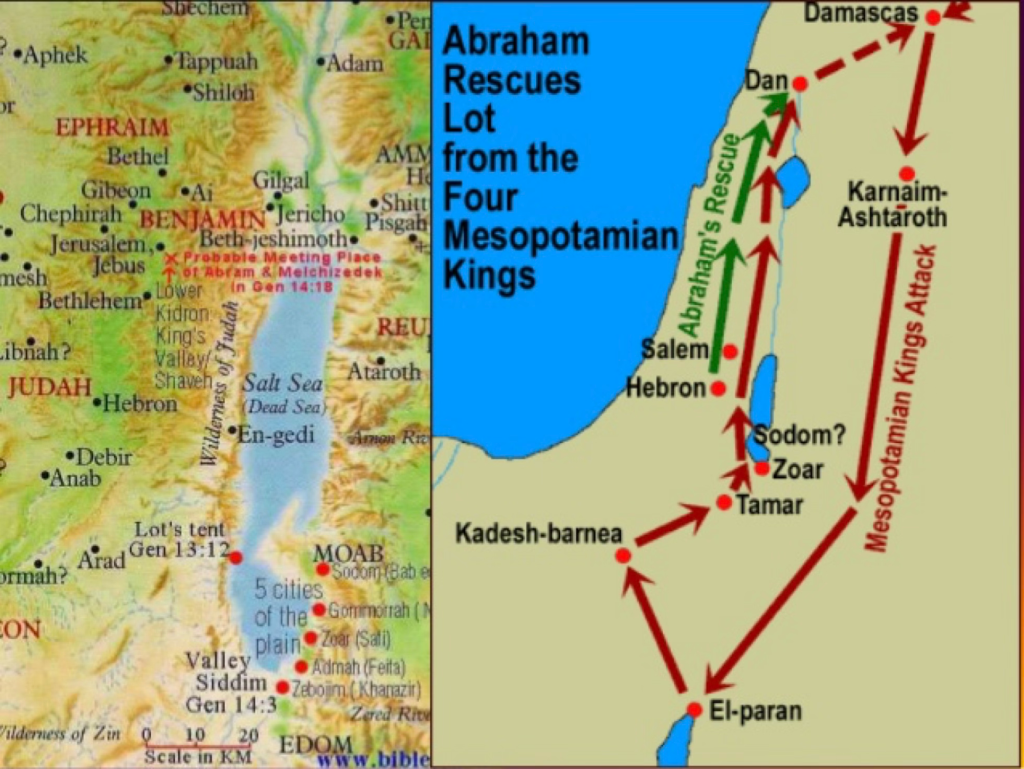
Genesis 13 and 14 tell about Abraham’s split with Lot b/c their herds were too big to stay together and it was causing conflict among their herdsmen. Abraham could have chosen the best land and sent Lot off looking for land, but he gave Lot the first choice of land. Lot chose land near the sinful city of Sodom and that was the beginning of Lot’s troubles. The land near Sodom was well watered (like the garden of Eden) and no doubt Lot could increase his wealth near a big city like Sodom. He probably found and married his wife there. Her faith in Yahweh is questionable since she didn’t obey the angels to not look back when leaving Sodom. While living in Sodom, 5 Canaanite kings attacked Sodom and carried Lot captive. Abraham and 318 of his men travelled 170 miles to Dan to rescue Lot. After the rescue, Lot had one last chance to get out of Sodom but he returned to live in Sodom. It only goes downhill after that as we will see in Genesis 18-19.

Genesis 14: On Abraham’s return from rescuing Lot, he was met by Melchizadek, king of Salem and high priest of the God Most High (El Elyon) who blessed Abraham and then Abraham gave the king a tenth. There is no info on Melchizadek. We don’t know how God appointed him to serve in pagan, Canaanite, Salem (later the cite of Jerusalem). Did he work to convert the pagans in Salem to Yahweh? Did he have any success? How long had he been in Salem? It will be fascinating one day to let him tell us about what all he did in Salem! What we do know from the writer of Hebrews (and from Psalm 110) that Jesus was high priest after the order of Melchizadek and not Levi (Hebrews 7). The writer tells us that Melchizadek was superior to Abraham b/c he blessed Abraham and the greater always blesses the lesser. He then used a math axiom: if a>b and b>c, then a>c. I’m sure you all remember that axiom from you math classes in middle school (LOL). If Melchizadek (a) > Abraham (b) > Levi (c) (Abraham would be greater than his descendant Levi), then Mechizadek (a) > Levi (c) and Jesus is high priest after a greater priestly order than Levi. The priesthood of Levi was done away with and replaced by the high priesthood of Jesus. Jesus’ priesthood was superior in that he was not a sinner and did not die (forever) like the Levitical priests. What a strange character Melchizadek was to base such a critical New Covenant doctrine on.

Genesis 15: Abraham questions God’s promise to give him descendants to make up a great nation. Abraham would be 85 now, having spent 10 years trying to have a child with his 75 year old barren wife Sarai. He was getting frustrated and began to have doubts about God’s promises. Then comes a great moment in Abraham’s faith. God shows him the stars and promises Abraham that his descendants would be countless like the stars. It says, Genesis 15:6 Then he believed in the Lord; and He reckoned it to him as righteousness.” The apostle Paul used this verse to say that Abraham was justified by faith and not works. Romans 4:2 For if Abraham was justified by works, he has something to boast about, but not before God. 3 For what does the Scripture say? “Abraham believed God, and it was credited to him as righteousness.” So was Abraham not saved when he left Ur by faith? He could not have obeyed God’s call to leave his homeland without a prior, saving trust in God. But doesn’t Genesis 15:6 sound like that was the moment his faith saved him? AI: Genesis 15:6 is generally understood not as the exact moment Abraham was first saved, but as an explicit, landmark confirmation and record of the faith he already possessed.” His faith was “reckoned to him as righteousness”. Paul comments on that also: Romans 4:4 Now to the one who works, his wage is not credited as a favor, but as what is due. 5 But to the one who does not work, but believes in Him who justifies the ungodly, his faith is credited as righteousness,” The Hebrew word for “reckoned” in Genesis 15:6 is chashab: To think, plan, reckon, account, consider, devise, esteem. The Greek word for “reckoned” is logizomai: To reckon, to consider, to account, to think, to impute. Both carry the idea of something that is credited or put into your spiritual “account” that you can’t possibly have on your own. AI: “The phrase “all our righteousness is as filthy rags” comes from Isaiah 64:6, meaning that human moral efforts and good deeds cannot earn salvation or match God’s absolute holiness.” God puts His own righteousness in our account to save us. We are given righteousness that is not our own, that is imputed to us. Picture this. You owe millions of dollars but you don’t have money in your bank account to pay your debt. Someone comes in to the bank, and puts millions of dollars in your account to pay off your debt. That’s what God did for Abraham. That’s what Jesus did for us! 1 Corinthians 1:30 But by His (God’s) doing you are in Christ Jesus, who became to us wisdom from God, and righteousness and sanctification, and redemption, 31 so that, just as it is written, “Let him who boasts, boast in the Lord.” 2 Corinthians 5:21: “For our sake he made him to be sin who knew no sin, so that in him we might become the righteousness of God.” Imputed righteousness is a free gift by grace through faith. It can’t be earned. Do you have that righteousness?

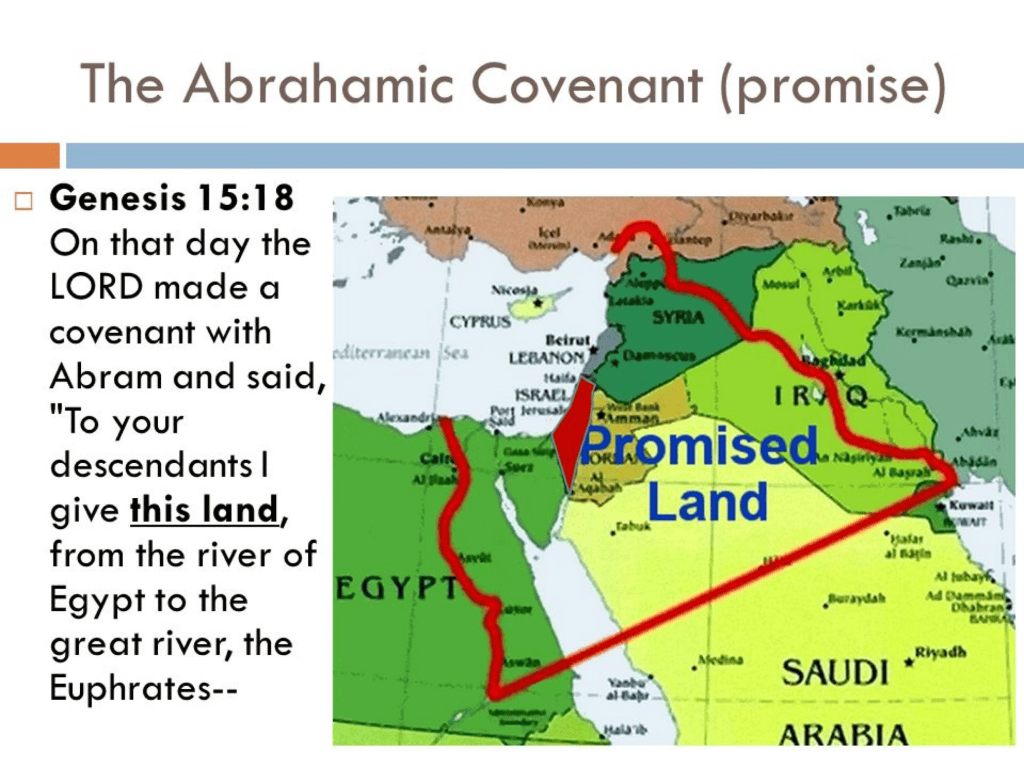
God then gives Abraham a confirmation of the land promise but also reveals a few things that He had not yet told Abraham.He tells him the full extent of the borders of the promised land. He also tells him that he will never personally own the promised land, but that it would be given to his descendants, and only after 400 years of slavery in a foreign land. Would Israel actually be in slavery in Egypt for 400 years? AI: “Based on generational timelines and the age of Moses (who was 80 at the Exodus and born after the oppression began), estimates for the actual period of hard bondage and enslavement range roughly between 80 and 144 years, even though the broader family lived or sojourned in the region for much longer.” There was no slavery until after Joseph died and they came out in the 4th generation (Isaac/Jacob/Levi/Amram) and that can’t be a full 400 years. AI: “This 400 year span encompasses a combined period of living in Canaan and actual servitude in Egypt, leading up to the 430-year total span mentioned in Exodus 12:40 (which counts from the initial unconditional covenant made with Abraham in Genesis 15).” Was Abraham disappointed to only learn after 10 years in Canaan then he personally would never own the land? He did buy a cave to bury Sarah, but that was it. Again, the writer of Hebrews. Did he think, “God, why didn’t you tell me this before I left Ur. I might have reconsidered leaving Ur if I knew I would never actually own the land.” I don’t think so. Hebrews 11″9 By faith he lived as an alien in the land of promise, as in a foreign land, dwelling in tents with Isaac and Jacob, fellow heirs of the same promise; 10 for he was looking for the city which has foundations, whose architect and builder is God.” I don’t know what he envisioned as “the city whose builder is God”. Was it eternal life with God in some heavenly city?

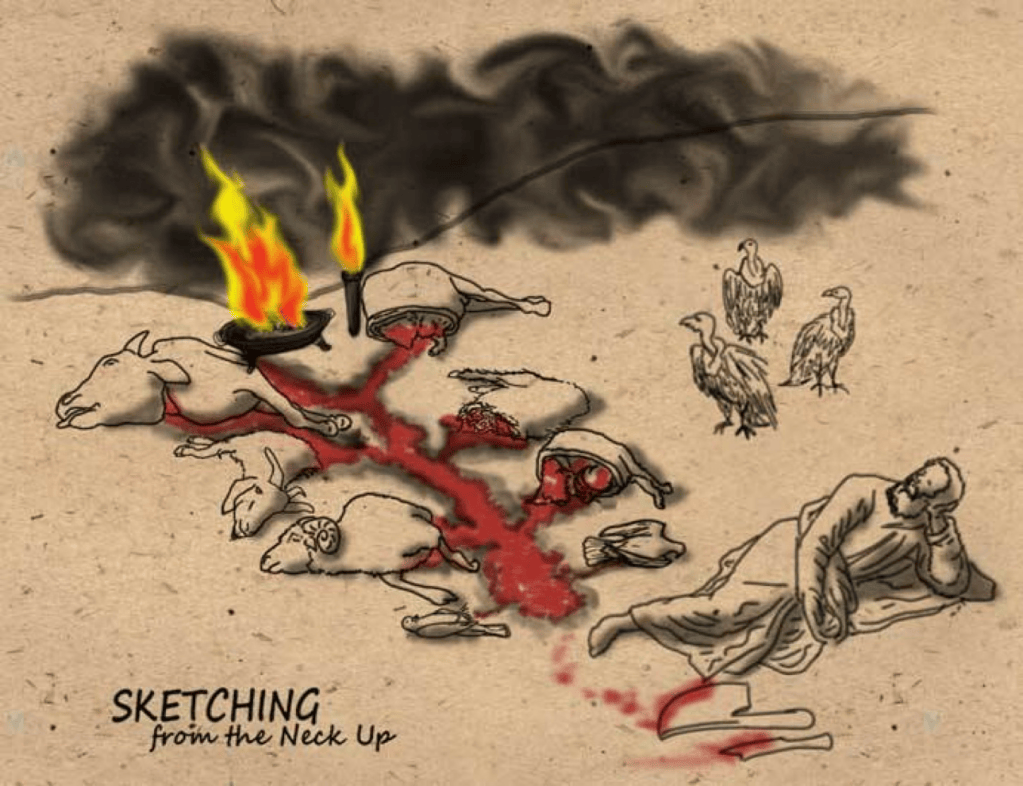
God then confirms his promise with a strange but apparently common method of confirming covenants back then. Genesis 15:9 So He said to him, “Bring Me a three-year-old heifer, a three-year-old female goat, a three-year-old ram, a turtledove, and a young pigeon.” 10 Then he brought all these to Him and cut them in two, down the middle, and placed each piece opposite the other; 17 And it came to pass, when the sun went down and it was dark, that behold, there appeared a smoking oven and a burning torch that passed between those pieces.” The smoking oven and torch is God’s passing between the pieces. I’m not sure why God used those two things to represent Himself. Apparently only God passed between the pieces and not Abraham.

Wow! Some great stuff from Genesis 11-15. Hope this helped understand those chapters.

THE FAITH OF ABRAHAM (HEBREWS 11:8-19)

ABRAHAM’S FAITH (1): BY FAITH ABRAHAM LEFT UR WHEN HE WAS CALLED Hebrews 8:8 By faith Abraham, when he was called, obeyed by going out to a place which he was to receive for an inheritance; and he left, not knowing where he was going.” Ur was an ancient Sumerian city in southern Mesopotamia near the head of the Persian Gulf in what is Iraq today. . “A thriving, wealthy port city during the Early Bronze Age, it was dominated by the Sumerian moon god Nanna. The city was at its height around 2000 B.C., which aligns with traditional dating for Abraham. Critics claimed Ur never existed but it was excavated extensively by Sir Leonard Woolley from 1922-1934, revealing it was a highly advanced civilization with intricate jewelry, musical instruments, and urban housing, unearthing a grand ziggurat, royal tombs, and thousands of cuneiform tablets that confirmed its status as a major Sumerian city-state..” (AI) Joshua 24:2 says that Abraham’s father Terah served other gods (maybe Nanna) but we don’t know if Abraham did. Jewish tradition (Midrash) characterizes Terah as a maker and seller of idols,We don’t know how many times God spoke to Abraham or if God gave him some kind of miraculous confirmation that He was the one true God. We just know that God called Abraham to leave Ur at the age of 65 and he left in faith, not knowing where he was going. He would head 600 miles northwest with his wife Sarai, nephew Lot, his brother Haran, and servants to Haran (where Nanna was also worshipped) where he would spend about 10 years until Terah died. We don’t know if Terah ever quit serving other gods. At the age of 75 God told him (Genesis 12) to make the 400 mile journey on down to the Promised Land, and he did so. Abraham left Ur by faith to go the Promised Land. He didn’t have a map or GPS to guide him He just trusted in God as his GPS. 50 years ago my wife and I left Alabama to go to Trinidad, West Indies, which is over 2,000 miles from Alabama. I remember a big “send-off” at the Birmingham airport with our parents and many Christian supporters gathered right at the gate (you could do that back then) as we boarded the plane.I remember taking our seats on the plane and thinking, “What have we done? This is crazy. We are going off to a far away land for at least 3 years, not knowing so many details about our stay in Trinidad.” I had a really sick feeling in my stomach on that plane. But we knew that we would come back to Alabama once each year to visit and see our parents. We knew we had missionary friends in Trinidad to greet us and take care of us until we found our own place to live. Our parents came to Trinidad to visit us so we didn’t leave all relatives forever as Abraham did. Abraham was leaving Ur not knowing any details about provisions in the Promised Land for his stay there. He just trusted God and obeyed Him, leaving Ur by faith. BTW, our going to Trinidad, while not equal to Abraham’s journey, began a journey of faith for my wife and me. We felt the need to go train leaders in the newly established churches in Trinidad and establish new churches. We didn’t get some miraculous call, but we believed that was what God wanted us to do, so we did it. We were scared and nervous, but we went. It turned out to be the beginning of a life journey of faith for us, going wherever we felt God wanted us to go work over the past 50 years. It turned out to be the best thing that ever happened to us. I had an engineering degree from UAB and a job with Alabama Power, and probably could have continued to work there until retirement as a friend of mine did. We could have stayed in Birmingham, living close to our parents, which would have been great. But God had something better for us. I just got calls from Trinidad from two close brothers and sisters there. It made my heart glad. We would have missed baptizing and working with all those people in Trinidad if we had stayed in Birmingham! Abraham could have stayed in Ur and started serving the one true God, but God had a better plan for Abraham. Does God have a possible plan for you that scares you? Just trust God and “go”. Most people want their futures to be laid out in detail with secure plans for success. Life is so much more interesting if we see ourselves on a faith journey with God, just going where He calls us to go, doing what He calls us to do.

ABRAHAM’S FAITH (2): BY FAITH ABRAHAM LIVED IN THE PROMISED LAND LIKE A STRANGER Hebrews 8:9 By faith he lived as a stranger in the land of promise, as in a foreign land, living in tents with Isaac and Jacob, fellow heirs of the same promise; 10 for he was looking for the city which has foundations, whose architect and builder is God.” Abraham lived 100 years in the Promised Land. He lived in tents the whole time, moving from place to place, often driven from water wells by the Canaanites. He never built a house for Sarai, or lived in a city in Canaan. He never received “citizenship” in Canaan. He would have been considered an “illegal immigrant”. He was just a stranger, a foreigner, living the entire 100 years in Canaan. After 3 years in Trinidad, we moved to Colombia, South America to do mission work. I remember that on our visas to stay there we were considered “estranjeros” for our 2 year stay there. That means “strangers”, just like in Hebrrews 11:9 Abraham was a “stranger” in Canaan. We sing that song, “This world is not my home, I’m just a passing through”. Here is that song. https://www.youtube.com/watch?v=t8e57YGVj7Q One of the verses touched me: “I have a loving mother waiting for me.” My mom moved to Huntsville to be near us where we could take care of her as she aged. I would sometimes just go by her apartment and sit when I was struggling with things. We didn’t talk much. We mainly watched “Samford and Son” on TV! She did in 2010 at the age of 92. I often wish I could go sit and visit with her. My dad died in 1992. I look forward to seeing both of them some day in heaven. Most of us spend too much time planting roots in this world as if we are going to be here forever. Abraham was looking for a heavenly city and was totally content to just be a stranger in Canaan. Our citizenship is in heaven (Philippians 3:20).

ABRAHAM’S FAITH (3): BY FAITH ABRAHAM DIED WITHOUT RECEIVING THE PROMISED LAND Hebrews 11:13 All these died in faith, without receiving the promises, but having seen and welcomed them from a distance, and having confessed that they were strangers and exiles on the earth. 14 For those who say such things make it clear that they are seeking a country of their own. 15 And indeed if they had been thinking of that country which they left, they would have had opportunity to return. 16 But as it is, they desire a better country, that is, a heavenly one. Therefore God is not ashamed to be called their God; for He has prepared a city for them.” Can you imagine how Abraham might have felt when he arrived in Canaan and God told him that he would never personally actually receive official ownership of the Promised Land. In Genesis 15, after being in the land for several years,God informed him he would not personally get to own the land but that it would be his descendants who would get it, but even then only 4 generations later and after spending a few hundred years in slavery in a foreign country. I wonder how he felt after hearing that? Did he think, “God, why didn’t you tell me that before I left Ur.” Did that discourage him? Did he feel like God had deceived him? Apparently not. Apparently he just trusted God on those promises that were “far off, from a distance” (Hebrews 11:13) and confessed that he would spend the next 90 years as a “stranger and pilgrim” in Canaan. He would go through many difficult times during that 100 years: famine that caused him to go to Egypt where he feared for his life and told Pharoah that Sarah was his sister, conflict with Lot that separated them, conflict with the Canaanites who would drive him from wells of water that his servants dug. The only piece of property in Canaan that he ever owned was the cave of Macpelah which he had to buy to bury Sarah in. He had to buy property that technically he already owned! I wonder if during that 100 years in Canaan he ever thought about going back to Ur? Since he would never actually get the land, why not go back to Ur where he would probably have relatives and a more secure living standard? He would probably be a respected citizen back in Ur. I know that I often thought about going back to Alabama while we were in Trinidad for 3 years, even though we had a nice house and a great life and ministry there. I missed a lot of things about our life back in Alabama. The only shows on TV were British shows that were weird (we did get MASH shows and looked forward to that). I was not able to see any American football games on TV, only soccer and cricket matches. No Alabama football games for 3 years!!!! No internet to get shows or games. To talk to our parents we had to go through a ham operator in San Fernando who had to go through a ham operator in the US who would make a collect call to our parents! Now we can talk to Trinidadians and see their faces as we talk! So yes, even though we were very happy and fulfilled, I thought often about when we would go back to Alabama. Did Abraham ever think about going back to Ur? Apparently not! Hebrews 13:16 says that he had the opportunity to go back to Ur any time that he wanted to. But Abraham was not discouraged or frustrated and never wanted to go back to live in Ur, or even to visit in Ur. He was looking for a heavenly country, a heavenly city. I don’t know what that heavenly country and city would have looked like in his mind. I guess that’s kinda like our vision of going to heaven even though we don’t know exactly where that is or what it will look like. We know that there will be no hunger or thirst or scorching heat or tears and that the Lamb Jesus our shepherd will guide us to springs of the water of life giving us eternal life where God dwells (Revelation 7:16,17). But we don’t even know where that is or any other details. I wonder what Abraham’s vision of the heavenly country or city looked like? All we know is that Abraham by faith lived in Canaan for 100 years as a stranger and was totally satisfied with his status. Genesis 25:7-8 says that he lived a long life and was “satisfied” with his life. He died satisfied with his journey of faith with God. If your goals in life are materialistic, you will never be satisfied. Ecclesiastes 5:10 “Those who love money will never be satisfied with the money they have. Those who love wealth will not be satisfied when they get more and more. This is also senseless.” (ERV) They will die, not satisfied with their life on earth. Those who seek a heavenly eternal existence will live to please God and will die satisfied with their life on earth. But it takes faith to live like Abraham did: faith that there is such a heavenly place prepared for us. I hope you have that faith. An atheist has nothing to look forward to after death. Go listen to the song “Looking for a city” for an encouraging reminder of our heavenly city that we are looking for. https://www.youtube.com/watch?v=oVjXDhOfne0 Great lyrics!

ABRAHAM’S FAITH (4): BY FAITH ABRAHAM OFFERED ISAAC AS A SACRIFICE Hebrews 11:17 By faith Abraham, when he was tested, offered up Isaac, and the one who had received the promises was offering up his only son; 18 it was he to whom it was said, “Through Isaac your descendants shall be named.” 19 [o]He considered that God is able to raise people even from the dead, from which he also received him back as a type.” Of course, he did not have to actually kill Isaac as a human sacrifice. An angel told him there was a ram to offer in the place of Isaac. But Hebrews 11:17 says that in God’s eyes he “offered Isaac as a sacrifice” since Abraham was willing to do that. I can’t possibly imagine what Abraham thought when God told him to go to Mt Moriah and offer Isaac as a sacrifice. He had spent 25 years planting his seed in the womb of his barren wife Sarai but finally at the age of 100 Isaac was born. He loved his son Ishmael that he bore through Hagar, but he knew that the promise that his descendants would be “like the stars and the sands on the shores” would be fulfilled through Isaac, not Ishmael. Killing Isaac would mean that that promise would never be fulfilled. We don’t know how old Isaac was when going with Abraham to Mt Moriah: we do know he was old enough and strong enough to carry the wood for the sacrifice. Josephus estimated that Isaac was 25, but he could have been just a teenager. The idea of making a human sacrifice would have seemed totally inconsistent with the God that Abraham worshipped. The Canaanites did human sacrifices to their gods, like to Molech the Moabite god, and God would later condemn such a practice as an abomination. He would strongly condemn King Ahaz and King Manasseh of Judah for offering a son as a human sacrifice to Molech. But here God is commanding Abraham to offer his son to God as a human sacrifice. But did Abraham argue with God? No. He got up early the next morning to take Isaac and offer him. He told Sari, “we will return after making the offering” (Genesis 22:5). That implies that he expected to return with Isaac after the sacrifice. How could he think that? Hebrews 11:17-19 tells us what Abraham was thinking. It says that Abraham thought that God would surely raise Isaac from the dead after offering him as a sacrifice. Abraham had never seen God raised anyone from the dead, and yet he reasoned this out in his mind. He offered Isaac by faith. He trusted God so much that he believed that God would do the impossible and raise Isaac from the dead after the sacrifice. Talk about faith that God will provide! Talk about “with God all things are possible”. Have you ever been in a tough situation where it just looks like there is going to be a terrible ending? Have you ever been terribly frustrated with some tragedy and wondered how God could allow such a thing to happen? Were you able by faith to think of a great positive thing that God might do to help you overcome that situation even if it ended terribly, some good that God had in mind? It’s called the “power of positive thinking” (Norman Vincent Peale: you can read his book online free). It’s called “possibility thinking”. “Impossibility thinking” fixates on why something cannot be done rather than how it can be done. With God, all things are possible. Always think of what great thing God might do in a terrible crisis. He might not save someone you love from cancer, but there is something great that God can do even in that situation. BTW God provided a ram to take Isaac’s place. Abraham named the place, “The Lord will provide” (Jehovah Jireh). That ram was aa type of Jesus’s death sacrifice to take our place as sinners. Jesus was offered to saved us from spiritual death. It’s amazing to see all the Old Testament types that should have prepared the Jews to accept Jesus as the offering for their sins.

CONCLUSION Paul says that those who believe in Jesus will be credited with righteousness and just like Abraham was credited with righteousness throug his faith (Genesis 15:6; Galatians 3:6-9). His faith is our example to follow. We become the “sons of Abraham” (spiritually) when we imitate his faith by believing in Jesus. Paul said that Abraham was “the father of all who believe’ (Romans 4:11). Christians are the true sons of Abraham today. The unbelieving Jews told Jesus,“Abraham is our father.” Jesus *said to them, “If you are Abraham’s children, do the deeds of Abraham (i.e. believe like Abraham did)”. (John 8:39). He went on to tell them that the devil was their father! God promised Abraham that he would have many descendants. There are the Arabs who descended from his son Ishmael. There are still Jews who don’t believe in Jesus and yet have been given statehood in Palestine. They claim to be God’s chosen people and most evangelicals still consider them to be God’s chosen people even though they don’t believe in Jesus (although many Messianic Jews do believe in Jesus). God’s chosen people, the true sons of Abraham, are believers in Jesus. They make up the church which consists of believers in Jesus from all the nations. Thus all the nations are blessed through the seed of Abraham, which is Jesus (Galatians 3:16). I know this article was long, but I think the faith of Abraham can be of great encouragement for our faith today. I hope this article blesses you.