
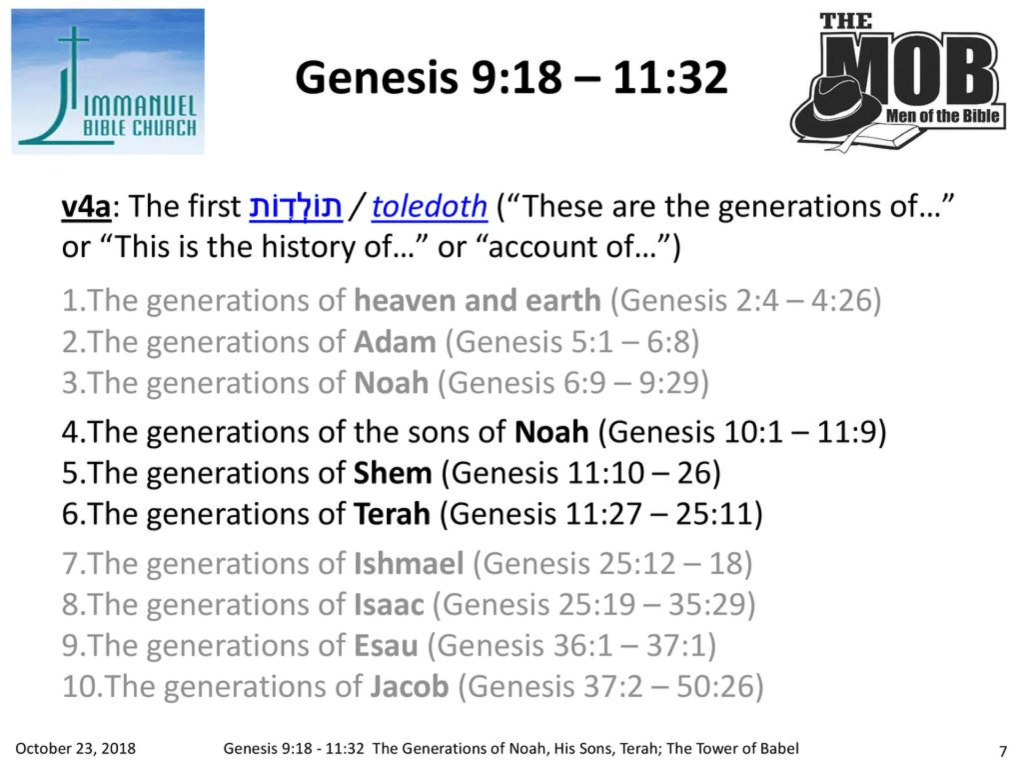
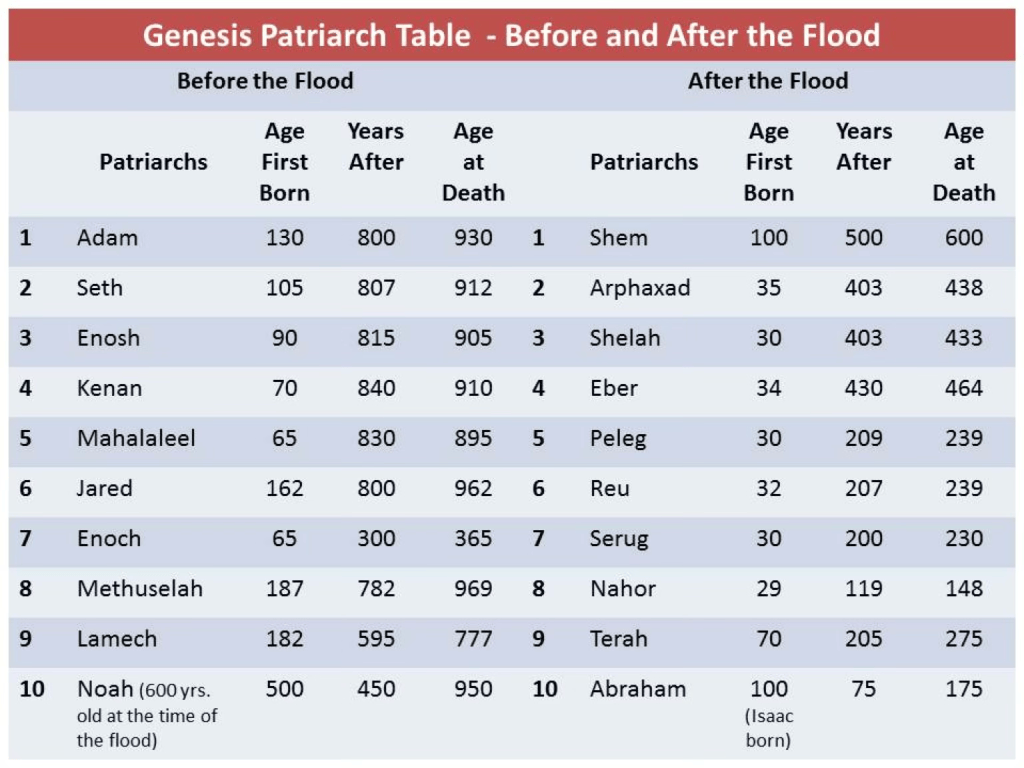
Genesis 11. The first part of Genesis 11 (the Tower of Babel event in verses 1–9) occurs chronologically before a lot of the final dispersion of nations described in Genesis 10. A key clue confirming this is 10:25 Two sons were born to Eber; the name of the one was Peleg, for in his days the earth was divided; and his brother’s name was Joktan.” That tells us that aat least some of the genealogies of chapter 10 occurred after the tower of Babel when the earth was divided. Let’s track Shem’s descendants. Shem’s descendants from the flood up to Peleg and Babel are given from 10:21-25 and then 10:21-25 are the descendants of Peleg’s brother Joktan’s 13 sons (not Peleg’s descendants) from the tower of Babel to some time after Babel. Some suggest that 11:1-9 then tells why the earth was divided in the days of Peleg since 10:25 mentioned that. But notice in 11:10 “these are the records of the generations of Shem”. That is the 5th “these are the generations of ” in the outline we used in Genesis 1. So 11:10-17 gives the descendants of Shem from the flood to Peleg and the tower of Babel (covering about 100 years from the flood). Then in 11:18-26 give the descendants of Peleg from Babel to Terah the father of Abraham, Nahor, and Haran. I know that sounds confusing but that has to be the way it breaks down. Check it out and you will see.
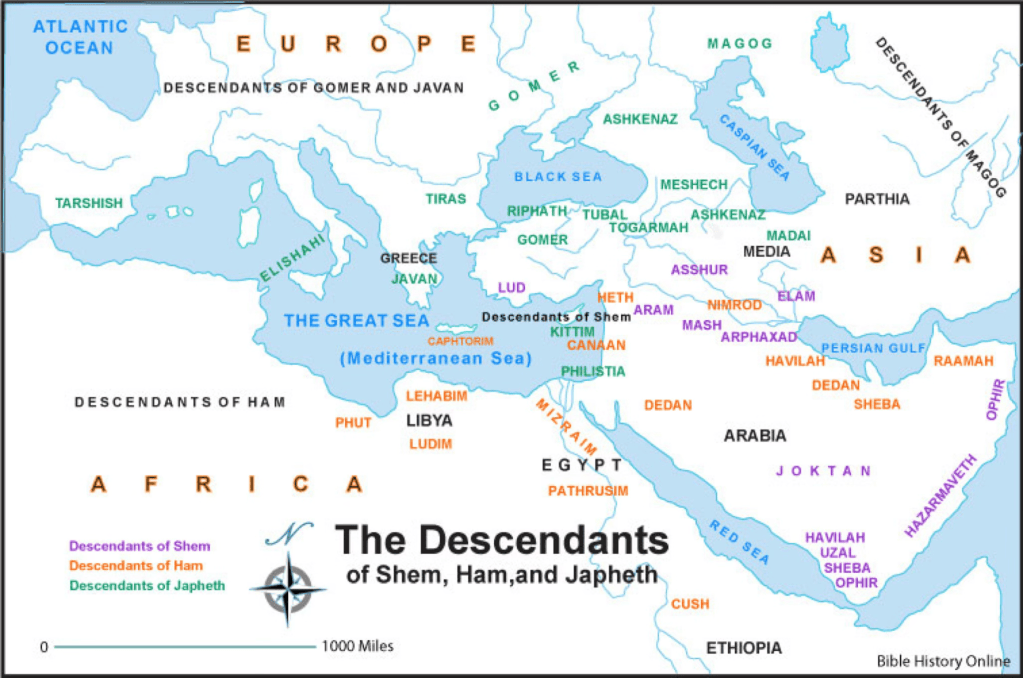
Genesis 11:1-9 The tower of Babel. This was probably about 100 years after the flood and the descendaants of Ham, Shem, and Japheth during that 100 years are still together instead of spreading out like God told them to. Imagine the mass confusion when God “confused” their languages. Sociologists have a lot of theories about how languages evolved over hundreds of thousands of years, but the Bible says they came about instantly at Babel. Perhaps God even miraculously changed some of their genetic code and that is where different “races” came from even though technically there is just one race, the human race who all came from Adam. Paul said in Acts 17:26 and He made from one man every nation of mankind to live on all the face of the earth.” Different colors of people and different languages would certainly scatter the people over the earth as God commanded. Here is the map of what it looked like some time after Babel:
Genesis 11:10-26 gives the 5th “generations of ” with the generations of Shem.
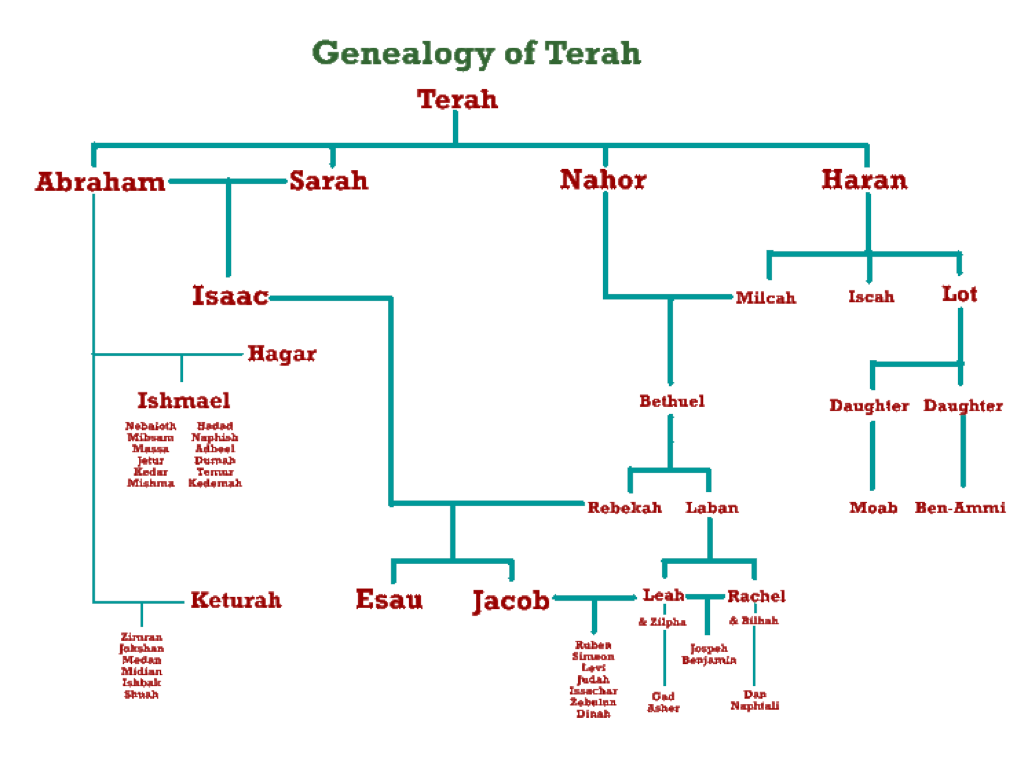
Genesis 11:27-25:11 gives the 6th “generations of” with the generations of Terah the father of Abraham, Nahor, and Haran.Terah took Abram, Sara, Lot. Nahor apprently stayed behind in Ur but later relocated to Haran since he is living in Haran in Gensis 24. Lot’s wife is not mentioned as traveling to Haran with Terah, so we assume that he married her after he went to live in Sodom. Terah died in Haaran.
Here is the genealogy of Terah that will be a big part of the rest of Genesis.
Genesis 12:1-3 is the call Abraham received while in Haran. But he was first called while in Ur according to Stephen in Acts 7:2 And he said, “Hear me, brethren and fathers! The God of glory appeared to our father Abraham when he was in Mesopotamia, before he lived in Haran, 3 and said to him, ‘Leave your country and your relatives, and come into the land that I will show you.’ 4 Then he left the land of the Chaldeans and settled in Haran. From there, after his father died, God had him move to this country in which you are now living.” We don’t know how long Abraham lived in Haran but he was 75 when he received his 2nd call while in Haran. God promised 3 things to Abraham: 1) A great nation would descend from him, fulfilled in Israel becoming God’s chosen nation at Mt Sinai. . 2) The Promised Land of Canaan. Joshua 21:43-45 says that, after the conquest of Canaan, Israel got all the land God had promised the. 3) In Abraham’s seed all nations, Jew and Gentile, would be b blessed. Galatians 3:16 says that “seed promise” was fulfilled in Jesus. This 3-fold promise to Abraham is the hub of all Old Testament history.
There are more verses devoted to the faith of Abraham in the “Hall of Faith” in Hebrews 11 than any other person. They begin with his call: Hebrews 11:8 By faith Abraham, when he was called, obeyed by going out to a place which he was to receive for an inheritance; and he went out, not knowing where he was going.” I assume this refers to his calling in Ur. We know that Terah worshipped foreign gods. Joshua 24:2: The Hebrew Bible explicitly states that Terah and his ancestors lived beyond the Euphrates River and “served other gods”. Some Jewish legends even have Terah making and selling idols and a young Abraham smashing some of those idols (as in the Turner movie “Abraham”). We don’t know if Terah ever came to have faith in Yahweh. We don’t know how God spoke to Abraham or whether God did any miracles to show Abraham that He was the one true God. But imagine leaving your home and relatives and traveling 1,000 miles to a land you have never even seen just on faith. No visits back to home in Ur even though he could have done so.
Life Lesson: In 1974 my wife and I left Birmingham, Al to travel 2,200 miles to do mission work in Trinidad, West Indies, but we knew where we were going and had monthly support to supply our needs. We had funds to come back to visit our parents in B’ham once every year. Back then, everyone could come to the airline gate to see us off and we had a big crowd as we boarded the plane, including our parents. But I do remember as we sat down in our seats on the plane having a panic attack, thinking “I can’t believe we are doing this! My dad would always bail me out of jams and my mom always sheltered me. No more of that, we were on our own.” After a 10 hour flight, it was a joy to have all the missionaries meet us at the airport and carry us to a missionary’s house for a little welcome party. Abraham did not get anything like that. I had faith to leave our relatives and go to Trinidad b/c I felt that God was calling us to do so, just like God called Abraham, but I had so many guarantees for our 3 years there that it really required very little faith. We could have hopped on a plane and been back in B’ham in half a day at any threat of danger. Abraham lived 75 years in Canaan, constantly surrounded by threats from the Canaanites. What about you? Have you ever felt a strong call from God to make a drastic change in your life, your career, your living location, your business decisions, your separation from relatives that maybe are holding you back? Are you completely ready to leave everything and go where God calls you? I know 2 young people who felt that call after graduating from college to go to Asia to preach the gospel in predominately Buddhist and Muslim countries. They are both married with 2 children each, leaving their parents in the US and carrying those precious children overseas to a distant land. What faith! Don’t be afraid to ask God to call you to do great things for him. William Carey felt the call to leave England in 1792 AD to go preach the gospel to the hundreds of Hindu, unconverted souls in India. He had a famous motto: “Expect great things from God; attempt great things for God.” I hope God will call you to do great things for Him. BTW that doesn’t have to be in a foreign country. He might be calling ou to adopt an orphan locally. That takes great faith. He might call you to take care of widows in your church. He might call you to feed the poor in your area. Be ready to respond.
Here is a great map of Abraham’s journey giving distances:
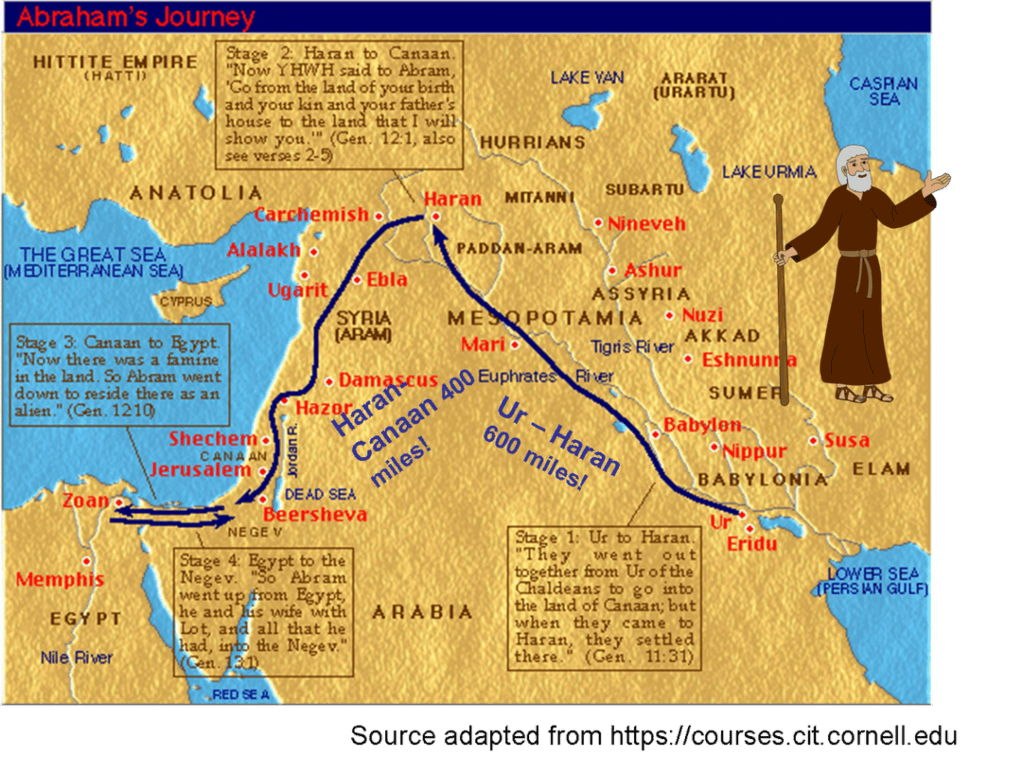
Stage 1 on the map is from Ur to Haran. Stage 2 is from Haran to Canaan. He left Haran at age 75. When he came to Shechem, he built an altar to God and continued on to the Negev (locate on the map). Stage 3 on the map is from Canaan to Egypt during a famine where he lied to Pharoah, telling him that Sarai was his sister to keep from being killed by Pharoah who wanted to take Sarai as a wife. It’s hard to believe that the man with enough faith to leave everything and go to a land 1,000 miles away would not have enough faith that God would protect him from Pharoah, but Abraham failed this test. Stage 4 on the map is from Egypt back to Canaan. I wonder what Sarai thought of Abraham lying that she was his sister? She had to be afraid as Pharoah took her into his harem, only saved by God sending plagues on Pharoah. How did she feel knowing that her husband was willing to let Phroah take Sarai, have sex with her, and make her his wife? How did it feel knowing she was married to a coward? I bet it was a silent journey on the way back to Canaan. Did Abraham ever apologize to Sarai for this incident? Did his conscience bother him? Why is it that Pharoah gets punished for this deception and not Abraham? Technically Sarah was actually Abraham’s half-sister through their father, Terah, not their mother (Genesis 20:12) but this is still a lie, a cowardly deception. My mother called it an “Abrahamic lie” when she wanted to stretch the truth a little! We all laughed at that.
Life Lesson: We all have our moments of great faith and we all have our moments of weak faith. I know what my weak spots are. I know what I can handle with faith and what I have panic attacks over due to a lack of faith. I think back to some of my moments of weak faith and how I responded and am embarrassed by them. I almost had a nervous breakdown over an incident where I was afraid of being sued and was sleeping about an hour only each night for a month worrying. A friend carried me to a lawyer who assured me everything would be fine and I slept good that night for the first time in a month. I could have found that same relief from my worries a month earlier if I had more faith. What about you? Have you ever had your “Abraham in Egypt” panic attack where you resort to human tactics b/c of your lack of faith? Are you in the middle of one of those moments right now? Trust God and things will be just fine!
Genesis 13 and 14 tell about Abraham’s split with Lot b/c their herds were too big to stay together and it was causing conflict among their herdsmen. Abraham could have chosen the best land and sent Lot off looking for land, but he gave Lot the first choice of land. Lot chose land near the sinful city of Sodom and that was the beginning of Lot’s troubles. The land near Sodom was well watered (like the garden of Eden) and no doubt Lot could increase his wealth near a big city like Sodom. He probably found and married his wife there. Her faith in Yahweh is questionable since she didn’t obey the angels to not look back when leaving Sodom. While living in Sodom, 5 Canaanite kings attacked Sodom and carried Lot captive. Abraham and 318 of his men travelled 170 miles to Dan to rescue Lot. After the rescue, Lot had one last chance to get out of Sodom but he returned to live in Sodom. It only goes downhill after that as we will see in Genesis 18-19.
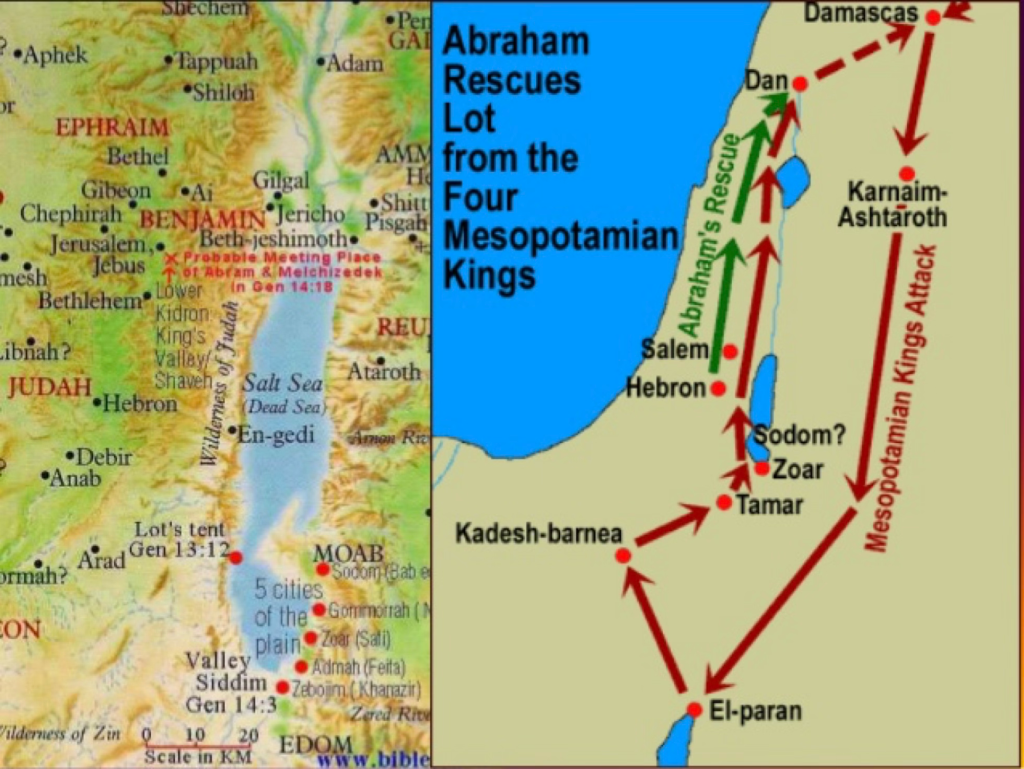
Genesis 14: On Abraham’s return from rescuing Lot, he was met by Melchizadek, king of Salem and high priest of the God Most High (El Elyon) who blessed Abraham and then Abraham gave the king a tenth. There is no info on Melchizadek. We don’t know how God appointed him to serve in pagan, Canaanite, Salem (later the cite of Jerusalem). Did he work to convert the pagans in Salem to Yahweh? Did he have any success? How long had he been in Salem? It will be fascinating one day to let him tell us about what all he did in Salem! What we do know from the writer of Hebrews (and from Psalm 110) that Jesus was high priest after the order of Melchizadek and not Levi (Hebrews 7). The writer tells us that Melchizadek was superior to Abraham b/c he blessed Abraham and the greater always blesses the lesser. He then used a math axiom: if a>b and b>c, then a>c. I’m sure you all remember that axiom from you math classes in middle school (LOL). If Melchizadek (a) > Abraham (b) > Levi (c) (Abraham would be greater than his descendant Levi), then Mechizadek (a) > Levi (c) and Jesus is high priest after a greater priestly order than Levi. The priesthood of Levi was done away with and replaced by the high priesthood of Jesus. Jesus’ priesthood was superior in that he was not a sinner and did not die (forever) like the Levitical priests. What a strange character Melchizadek was to base such a critical New Covenant doctrine on.
Genesis 15: Abraham questions God’s promise to give him descendants to make up a great nation. Abraham would be 85 now, having spent 10 years trying to have a child with his 75 year old barren wife Sarai. He was getting frustrated and began to have doubts about God’s promises. Then comes a great moment in Abraham’s faith. God shows him the stars and promises Abraham that his descendants would be countless like the stars. It says, Genesis 15:6 Then he believed in the Lord; and He reckoned it to him as righteousness.” The apostle Paul used this verse to say that Abraham was justified by faith and not works. Romans 4:2 For if Abraham was justified by works, he has something to boast about, but not before God. 3 For what does the Scripture say? “Abraham believed God, and it was credited to him as righteousness.” So was Abraham not saved when he left Ur by faith? He could not have obeyed God’s call to leave his homeland without a prior, saving trust in God. But doesn’t Genesis 15:6 sound like that was the moment his faith saved him? AI: Genesis 15:6 is generally understood not as the exact moment Abraham was first saved, but as an explicit, landmark confirmation and record of the faith he already possessed.” His faith was “reckoned to him as righteousness”. Paul comments on that also: Romans 4:4 Now to the one who works, his wage is not credited as a favor, but as what is due. 5 But to the one who does not work, but believes in Him who justifies the ungodly, his faith is credited as righteousness,” The Hebrew word for “reckoned” in Genesis 15:6 is chashab: To think, plan, reckon, account, consider, devise, esteem. The Greek word for “reckoned” is logizomai: To reckon, to consider, to account, to think, to impute. Both carry the idea of something that is credited or put into your spiritual “account” that you can’t possibly have on your own. AI: “The phrase “all our righteousness is as filthy rags” comes from Isaiah 64:6, meaning that human moral efforts and good deeds cannot earn salvation or match God’s absolute holiness.” God puts His own righteousness in our account to save us. We are given righteousness that is not our own, that is imputed to us. Picture this. You owe millions of dollars but you don’t have money in your bank account to pay your debt. Someone comes in to the bank, and puts millions of dollars in your account to pay off your debt. That’s what God did for Abraham. That’s what Jesus did for us! 1 Corinthians 1:30 But by His (God’s) doing you are in Christ Jesus, who became to us wisdom from God, and righteousness and sanctification, and redemption, 31 so that, just as it is written, “Let him who boasts, boast in the Lord.” 2 Corinthians 5:21: “For our sake he made him to be sin who knew no sin, so that in him we might become the righteousness of God.” Imputed righteousness is a free gift by grace through faith. It can’t be earned. Do you have that righteousness?
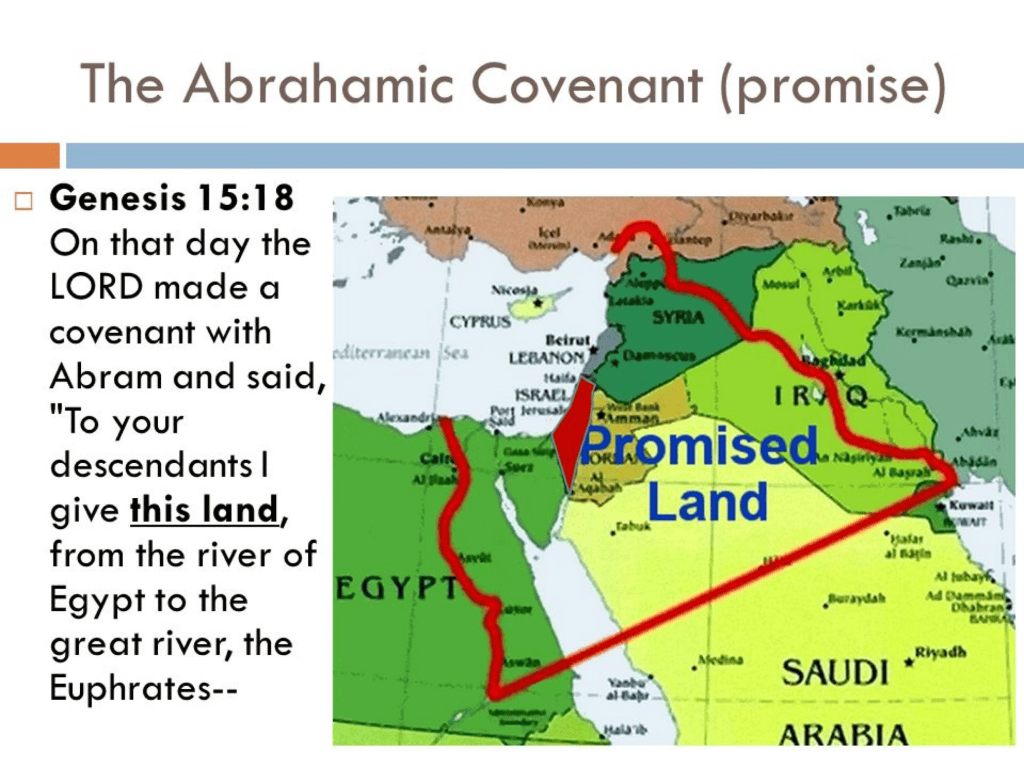
God then gives Abraham a confirmation of the land promise but also reveals a few things that He had not yet told Abraham.He tells him the full extent of the borders of the promised land. He also tells him that he will never personally own the promised land, but that it would be given to his descendants, and only after 400 years of slavery in a foreign land. Would Israel actually be in slavery in Egypt for 400 years? AI: “Based on generational timelines and the age of Moses (who was 80 at the Exodus and born after the oppression began), estimates for the actual period of hard bondage and enslavement range roughly between 80 and 144 years, even though the broader family lived or sojourned in the region for much longer.” There was no slavery until after Joseph died and they came out in the 4th generation (Isaac/Jacob/Levi/Amram) and that can’t be a full 400 years. AI: “This 400 year span encompasses a combined period of living in Canaan and actual servitude in Egypt, leading up to the 430-year total span mentioned in Exodus 12:40 (which counts from the initial unconditional covenant made with Abraham in Genesis 15).” Was Abraham disappointed to only learn after 10 years in Canaan then he personally would never own the land? He did buy a cave to bury Sarah, but that was it. Again, the writer of Hebrews. Did he think, “God, why didn’t you tell me this before I left Ur. I might have reconsidered leaving Ur if I knew I would never actually own the land.” I don’t think so. Hebrews 11″9 By faith he lived as an alien in the land of promise, as in a foreign land, dwelling in tents with Isaac and Jacob, fellow heirs of the same promise; 10 for he was looking for the city which has foundations, whose architect and builder is God.” I don’t know what he envisioned as “the city whose builder is God”. Was it eternal life with God in some heavenly city?
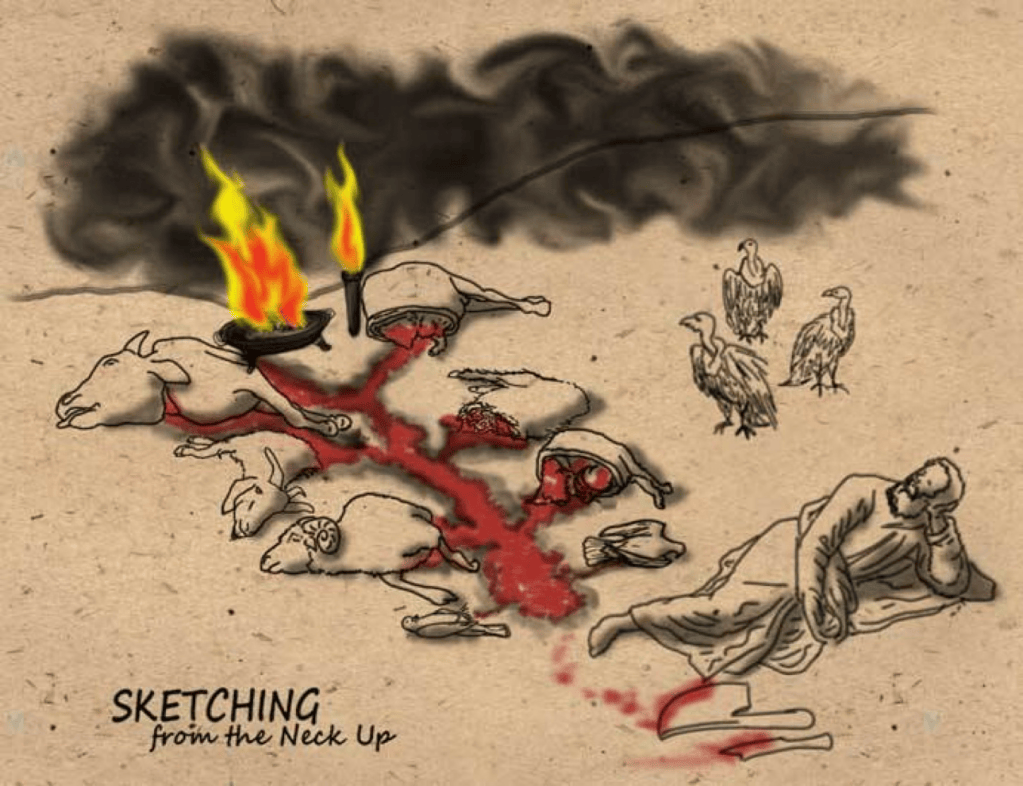
God then confirms his promise with a strange but apparently common method of confirming covenants back then. Genesis 15:9 So He said to him, “Bring Me a three-year-old heifer, a three-year-old female goat, a three-year-old ram, a turtledove, and a young pigeon.” 10 Then he brought all these to Him and cut them in two, down the middle, and placed each piece opposite the other; 17 And it came to pass, when the sun went down and it was dark, that behold, there appeared a smoking oven and a burning torch that passed between those pieces.” The smoking oven and torch is God’s passing between the pieces. I’m not sure why God used those two things to represent Himself. Apparently only God passed between the pieces and not Abraham.
Wow! Some great stuff from Genesis 11-15. Hope this helped understand those chapters.

