1 Samuel 9-11: Samuel anoints Saul as king. After meeting and eating with Saul (chapter 9), Samuel then anointed him to be the first king of Israel. Samuel gave Saul 3 signs to confirm his anointing, the most unusual of which was that Saul would meet some prophets with musical instruments and Saul would prophesy with them! God changed Saul’s heart (1 Samuel 10:9) with supernatural ability (i.e. whenever the Spirit of God would come upon him) and boldness to lead the people as king but that would not last long. All 12 tribes came together at Mizpah for the official anointing of Saul, but he had hidden himself among the supplies. He wasn’t hard to spot b/c he was a head taller than anyone else. 10:24 Samuel said to all the people, “Do you see the man the Lord has chosen? There is no one like him among all the people.” Is Saul a sincere, humble person at this time? Even when “scoundrels” despised Saul as king, Saul kept silent and did not try to kill them like he tried to kill David later. Saul seems like the perfect candidate for what the people wanted as their king. Soon after being anointed, the Spirit of God came on him miraculously and he mustered 3,000 men to go rescue the men of Jabesh-Gilead who had been threatened by the Ammonites with having their right eyes put out. Saul slaughtered the Ammonites. He was that king they wanted to go fight their battles with their enemies. Again, Saul humbly refused to kill those who objected to him being king.
1 Samuel 12: Samuel gave his farewell address. He called on the Lord to send thunder and rain to confirm that Israel had done an evil thing by asking for a king. The people asked Samuel to pray for them. Samuel said, 12:23 As for me, far be it from me that I should sin against the Lord by failing to pray for you. And I will teach you the way that is good and right.” We should never stop praying for people, even evil, rebellious people. I can think of several people right now who it seems have sinned and fallen from grace. They are not repenting or changing their sinful lives in spite of many warnings. It is easy to just quit praying for them, thinking that it is hopeless. But intercessory prayer can still change things.
1 Samuel 13: Saul’s first big sin. Saul was 30 when he became king and reigned 40 years as king. The Philistines had come up against Israel with many more men and chariots than Israel had. The men of Israel “were quaking with fear, hiding in caves, and deserting” Saul’s army of 3,000 down to only 600 men. Samuel had told Saul to wait 7 days for Samuel to come offer a burnt offering to ask God for victory in the battle, but Saul panicked and offered the burnt offering himself. Samuel condemned his action and told him that God was going to remove him as king and choose a man “after God’s own heart”. None of Saul’s 600 men had swords or shields b/c the Philistines had not allowed Israel to have blacksmiths. Things looked desperate.
1 Samuel 14: Victory over the Philistines. In the meantime, Jonathon, Saul’s son, had gone to the Philistine camp to seek a sign that God was going to deliver Israel. God gave him a sign and he and his armor-bearer killed 20 Philistines. God caused a panic to strike the Philistines and they began to scatter in total confusion, killing each other with their swords. The Israelites, however, were faint in hunger b/c Saul had made a foolish oath that no one should eat until he avenged himself of his enemies (his pride showing up). Jonathon did not know about the oath and ate some honey. The hunger of the Israelites caused them to kill and animals with the blood still in them, which was a sin under the Law. Saul asked God why He had not answered his prayer, and Saul assumed that it was b/c of “sin in the camp” (as with the sin of Achan in Judges). Lots were cast and Jonathon was chosen as the guilty party and Saul sentenced him to die for breaking the oath of not eating. The Israelites would not let Saul kill Jonathon. Again, it looked like Saul was just what the people wanted in a king. 14:23 47 After Saul had assumed rule over Israel, he fought against their enemies on every side: Moab, the Ammonites, Edom, the kings of Zobah, and the Philistines. Wherever he turned, he inflicted punishment on them.48 He fought valiantly and defeated the Amalekites, delivering Israel from the hands of those who had plundered them.” They did not know that God had already rejected Saul for his disobedience in not waiting for Samuel to offer the burnt offering. He was what we would call a “lame duck” king (still officially in office but already fired!). Saul had 2 daughters, Merab and Michal. His father was Kish. His commander of his army was Abner.
Saul is an intriguing character. He had the miraculous power of the Spirit and could have been a successful king. He seemed humble when first anointed, but then his lack of faith in God showed with his first big sin of not waiting for Samuel. God still gave Saul victories over the Philistines, but God said that he would be removed as king. In the rest of 1 Samuel, we will see a very evil Saul. In 2 Samuel 1:9 after Saul’s death in battle, David said “How the mighty have fallen”. Over time, it shifted from a literal mourning of fallen warriors into a general idiom when a major corporation goes bankrupt, a corrupt politician is disgraced, or a dominant sports team suffers a massive losing streak. Or when a Christian is lifted up with pride, quits trusting in God, and falls from grace. In other words, when pride causes a person to fall from a lofty status. Pride would be the cause of the fall of Saul from favor with God. A warning to all of us: Let him that thinks he stands take heed lest he fall (1 Corinthians 10:12).
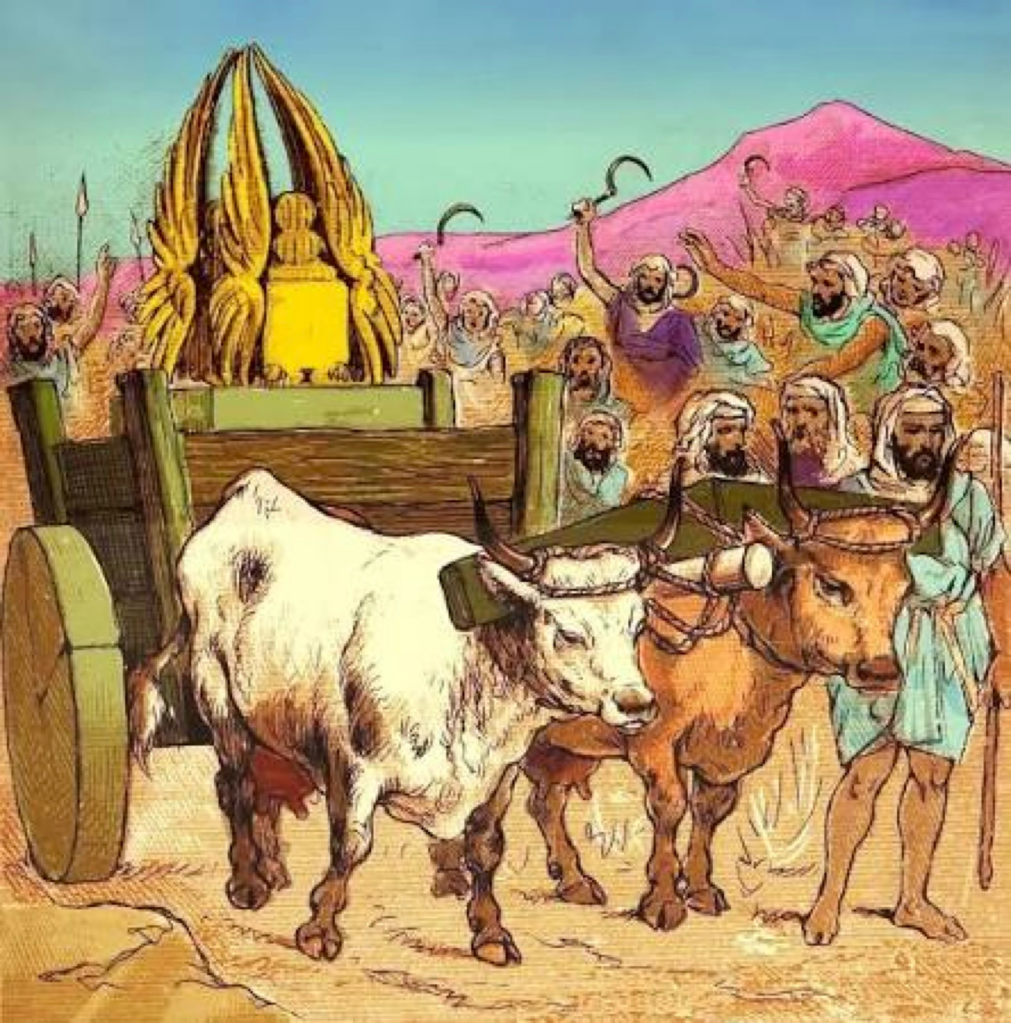
AI: Hophni and Phinehas took the ark of the covenant into battle with the Philistines and it was captured. It stayed in Philistine territory 7 months. “The Philistines returned the Ark of the Covenant to Israel on a new cart pulled by two nursing cows after suffering plagues and the falling of their idol Dagon. The cows walked straight to the Israelite border town of Beth Shemesh.
Key Scenes in the Biblical Story (AI)
Capture and Dagon’s Fall: The Philistines took the Ark to Ashdod, but their fish-god idol Dagon repeatedly bowed and shattered before it. They moved it to Gath, and then Ashdod, but the Lord sent “tumors” in both cities.
The Plagues: Severe outbreaks of tumors and rats struck Philistine cities, forcing their leaders to consult priests on how to send the Ark back.
The Trespass Offering: They sent golden tumors and golden mice along with the Ark as a guilt offering.
The Journey on the Cart: Placed on a cart with unguided nursing cows, the animals miraculously headed straight for Beth Shemesh without turning away. The 5 Philistine rulers followed, watching the cart return to israel.
Rejoicing at Beth Shemesh: The Israelites rejoiced, harvested wheat, and offered sacrifices when the cart arrived. God killed 70 who looked in the ark.
Taken to Kiriath Jearim: Men from Kiriaath Jearim brought the ark to that city to Abinadab’s house where it stayed 20 years. But David moved it from there to Jerusalem, which would be at least 40 years later since King Saul’s reigned 40 years. So where did the ark stay past the 20 years in 1 Samuel 7:2 until David moved it to Jerusalem? AI: “1 Samuel 7:2 states that “twenty years” passed from the time the Ark arrived in Kiriath-jearim until the house of Israel genuinely turned back to the Lord in repentance under Samuel. It is a marker for how long it took for spiritual awakening to happen, not an expiration date for when the Ark left. The Ark remained at the house of Abinadab in Kiriath-jearim for a much longer period than just the 20 years. It stayed there through the rest of Samuel’s judgeship, the entirety of Saul’s reign (40 years), and into the early years of David’s reign until David finally moved it to Jerusalem (2 Samuel 6).
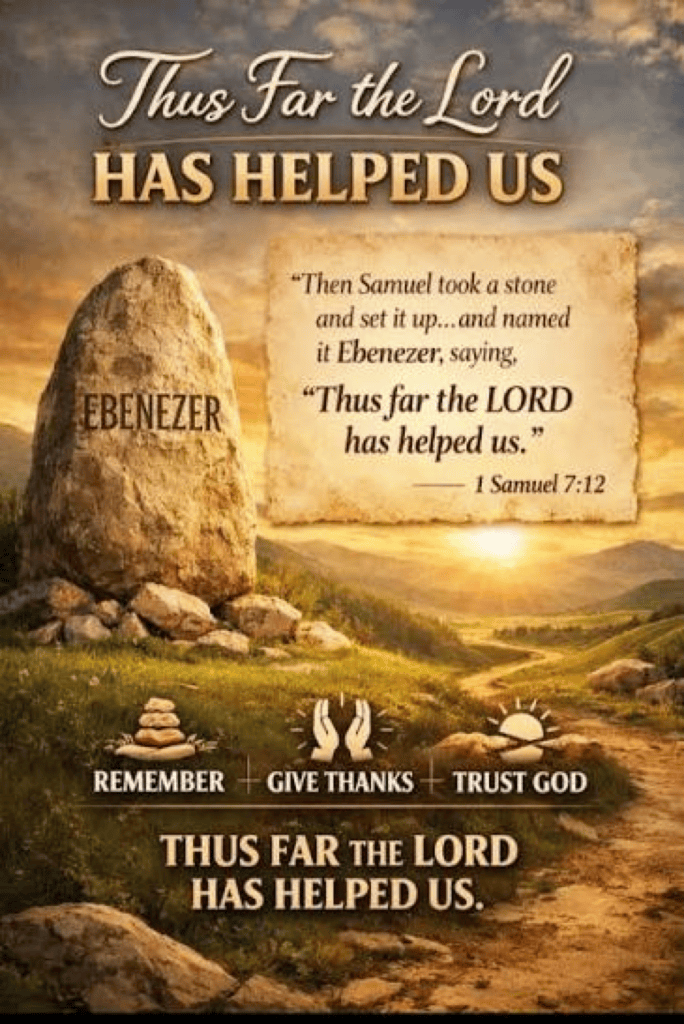
1 Samuel 7: A spiritual revival in Israel. 1 Samuel 2:Then all the people of Israel turned back to the Lord. 3 So Samuel said to all the Israelites, “If you are returning to the Lord with all your hearts, then rid yourselves of the foreign gods and the Ashtoreths and commit yourselves to the Lord and serve him only, and he will deliver you out of the hand of the Philistines.” 4 So the Israelites put away their Baals and Ashtoreths, and served the Lord only.” The Israelites assembled at Mizpah and confessed their sins. The Philistines heard that they were at Mizpah and attacked. 1 Samuel 7:But that day the Lord thundered with loud thunder against the Philistines and threw them into such a panic that they were routed before the Israelites.” The Israelites pursued them, slaughtering them. 1 Samuel 7:12 Then Samuel took a stone and set it up between Mizpah and Shen. He named it Ebenezer (which means “stone of help”), saying, “Thus far the Lord has helped us.” 13 So the Philistines were subdued and they stopped invading Israel’s territory. Throughout Samuel’s lifetime, the hand of the Lord was against the Philistines.” Samuel went on a circuit from Bethel to Mizpah to Gilgal, judging Israel, but always returned to his home town of Ramah. Estimates are that he judged Israel 20 to 40 years. A great church song: O Thou Fount of Every Blessing has Ebenezer in it. vs 2 “Here I raise my Ebenezer; hither by thy help I’m come; and I hope, by thy good pleasure, safely to arrive at home. Jesus sought me when a stranger, wandering from the fold of God; he, to rescue me from danger, interposed his precious blood.” I know most of us just sang that song and had no idea what Ebenezer, so know you know!
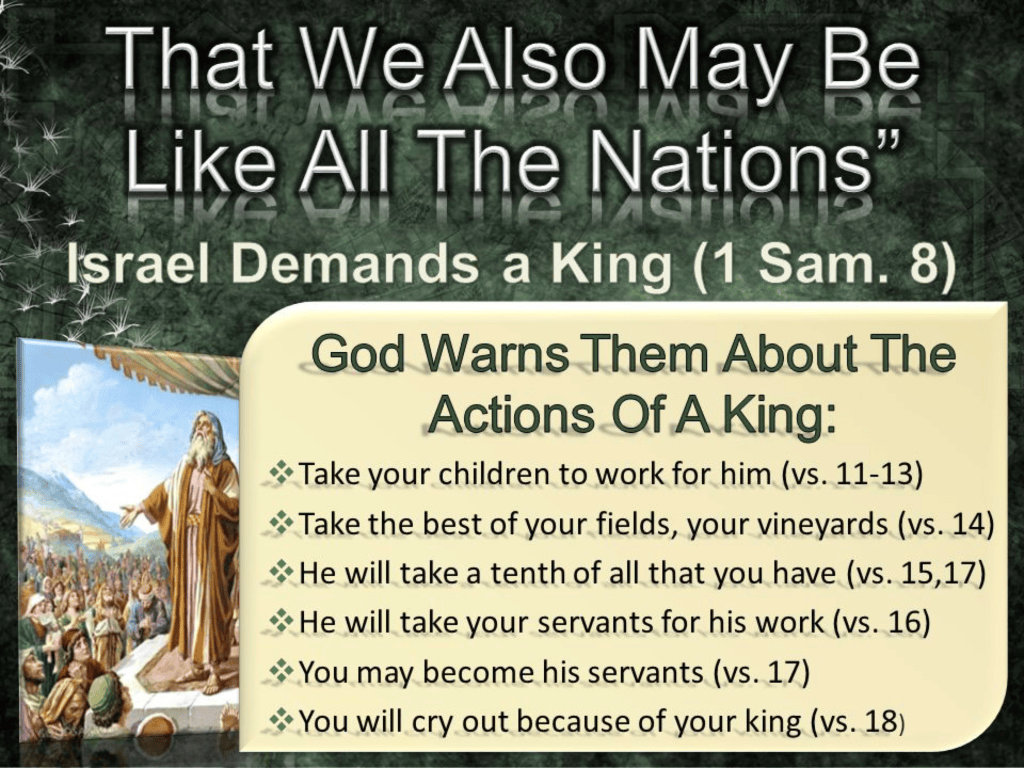
1 Samuel 8: Israel asks for a king. In his old age, Samuel appointed his 2 sons as judges but they turned aside after dishonest gain and accepted bribes and perverted justice. You would think his sons’ behavior would have really bothered Samuel since he hs experienced the trouble with Eli’s 2 sons. You would think that he would be very reluctant to appoint them as judges, but he did. That was the excuse the people used to ask Samuel to give them a king to be “like all the other nations have to lead us and to go out before us and fight our battles.” God told Samuel that they had not rejected Samuel, but had rejected God as their king. But He would give them a king anyway. Why did God give them a king if He never wanted a king and only wanted to be their king Himself? I think the main reason was to set the stage for King Jesus one thousand years later. Many years earlier Moses told the Israelites that once they would enter, take possession of, and settle in the Promised Land (Canaan), that they would eventually say, “Let us set a king over us like all the nations around us” (Deuteronomy 17:14). Moses then gave strict rules for the kings: Must be chosen by God from among their own people (not a foreigner) (v. 15). Must not accumulate many horses or send people back to Egypt to get them (v. 16). Must not take many wives (v. 17). Must not collect massive amounts of silver and gold (v. 17). Must hand-copy a personal scroll of God’s law (the Torah) and read it every day of his life to stay humble and obedient (vv. 18–20).So this had already been predicted by Moses. Wanting a king was a lack of faith and trust in Yahweh as their king to give them victory over their enemies. Samuel agrees to giving them a king but then gives this warning about the kings they will have. King Solomon pretty much violated all the rules for the kings which led to the split of the united kingdom.
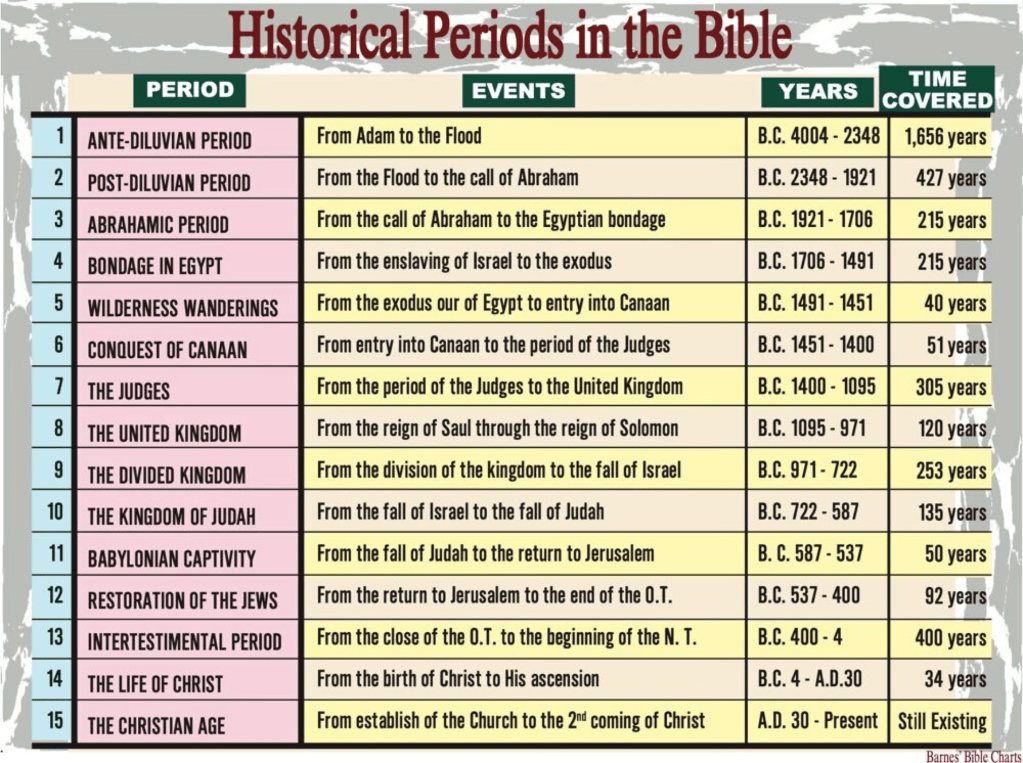
1 Samuel 9: Samuel meets and eats with Samuel, getting ready to anoint him as the first king of Israel. This begins the period of the “United Kingdom”. At first, Saul seems like a wise choice. He was “as handsome a young man as could be found anywhere in Israel, and he was a head taller than anyone else.” At first he seemed to be humble. When Samuel told him, “And to whom is all the desire of Israel turned, if not to you and your whole family line?” Saul replied “But am I not a Benjamite, from the smallest tribe of Israel, and is not my clan the least of all the clans of the tribe of Benjamin? Why do you say such a thing to me?” Unfortunately Saul’s true colors would come out as we continue the reading next time.
This might be a little opinionated, but here we go. God set up Israel as His theocracy with Him as the king, but Israel wanted to do it their way. They wanted a king to fight their battles for them instead of trusting God for their victories. God set up the church as house churches with elders to shepherd the sheep and deacons to serve physical needs of the sheep. Yes they had apostles and prophets but those gifts ceased after the first century. They had evangelists who traveled to churches but did not stay to become “located paid preachers”. Paul told the churches to provide for the needs of the traveling evangelists but the 1st century document the Didache said that if they stayed more than 2 or 3 days that they were just preaching for money. That was the simple structure of the churches that Jesus established. But by the 2nd and 3rd century, the church started adding positions of authority. AI has a summary: The Threefold Order: By the mid-to-late second century, the structure unified into a distinct three-tier office: bishops (monarchial overseers), presbyters (priests/elders), and deacons. Rise of the Single Bishop: Influential figures like Ignatius of Antioch advocated for a single bishop per city (monepiscopacy) around 110 AD to maintain unity and guard against emerging heresies like Gnosticism. Apostolic Succession: To validate teaching and authority, writers like Irenaeus and Tertullian emphasized apostolic succession, tracing unbroken lines of bishops back to the original apostles commissioned by Jesus. Centralization of Rome: Over the 2nd and 3rd centuries, the pre-eminence of specific historical sees grew, eventually setting the stage for the Bishop of Rome (the Pope) as a supreme authority in Western Christianity.” Thus evolved the Papacy of the Roman Catholic Church and we all know the corruption and oppression that caused for the next thousand years of Catholicism. The Reformation Movement rejected the papacy but still ended up divided by followers of men like Martin Luther (Lutherans), John Calvin (Refeormed churches), Zwingli, John Knox (Presbyterians), John Huss (Moravians and The Brethren), King Henry VIII (Anglicans), Menno Simmons (Anabaptists, Mennonites, Almish), John Smyth (Baptists) , John and Charles Wesley (Methodists), Charles Parham (Pentecostalism), Joseph Smith (Mormons), Ellen G White (7th Day Adventists), Mary Baker Eddy (Christian Science), Charles Russell (Jehovah’s Witnesses), Alexander Campbell and Barton Stone (Churches of Christ), etc. Each leader and church that evolved from that leader had its own creed instead of just using the Bible. Do you think this is what Jesus wanted his church to look like? Many of these leaders taught basic Christian truths but others were dangerous cults led by cult leaders. The problem is that Christians started following “men who would be kings”. The Bible is fully sufficient for Christians just to gather in house churches and continue in “the apostles’ doctrine fellowship, breaking of bread (including the Lord’s Supper) and prayer” without these leaders and creeds. In addition we now have the LGBTQ advocate churches with well paid men in authority (as kings) leading the flock into error. Even among the conservative churches, the church has evolved into a “business”. They pay a lot of money to find a pastor or preacher who will help their church grow and that man (or woman) becomes the king. They hire many other positions of leadership instead of using elders and deacons to lead in the work of the church. They compete for the best preachers that people will come to hear. They provide the best musicians and singers for church assemblies to compete with the other bands. They spend on average about 80% of the money they collect on buildings and staff. Have we made us a king so we can be like the other churches? Have we forsaken letting God organize the church the way Jesus wanted it in order to make it how we want it? Have we made the same mistake that Israel did in wanting a king? I think we have. What do you think?
Again, a little off the reading schedule since the last article covered all of Ruth 1-4.
Hannah’s vow and the birth of Samuel: AI
“Hannah prayed in deep anguish at the tabernacle in Shiloh, vowing to give her requested son back to God as a Nazirite for life. Eli the high priest blessed her, and she gave birth to Samuel, later bringing him to live and serve at the temple as she promised.
The Distress and the Vow
Barrenness and Mockery: Hannah suffered deep sorrow because she had no children while her husband’s other wife, Peninnah, provoked her yearly.
The Prayer at Shiloh: While weeping in bitterness of soul, Hannah prayed silently to God, moving her lips without a sound. [
Eli’s Misunderstanding: Eli the priest thought she was drunk until she explained her intense grief, after which he told her to go in peace.
The Vow: Hannah promised that if God gave her a son, she would dedicate him to the Lord all his days, with no razor ever touching his head.
Birth and Dedication
Birth of Samuel: God remembered Hannah, and she conceived and bore a son, naming him Samuel, which means “heard of God” or “asked of the Lord”.
Fulfilling the Promise: After weaning him, Hannah brought young Samuel to the tabernacle in Shiloh and left him in Eli’s care to minister before the Lord.
The Aftermath: Hannah visited him every year with a small robe she made, and God blessed her with three more sons and two daughters.
Eli’s wicked sons. AI:
The priest Eli’s wicked sons were HophniandPhinehas, who served as priests at the tabernacle in Shiloh. Described in 1 Samuel as worthless men who did not know the Lord, they abused their priestly office by stealing the best parts of the animal sacrifices and committing sexual immorality with the women serving at the tent entrance.
Sins and Corruption
Greed and Theft: They took raw meat from sacrifices by force before the fat could be burned to God.
Sexual Immorality: They slept with women who served at the entrance of the tabernacle.
Disregard for God: They treated the holy offerings with contempt, causing people to resent worship.
Eli’s Failure: Though Eli rebuked them, he failed to properly restrain or remove them from office, leading God to judge his household.
The call of Samuel. After the Lord calling Samuel 3 times, Eli told Samuel to answer “Speak, for your servant is listening.” The Lord then told Samuel that Eli’s house would be judged. 3: 12 At that time I will carry out against Eli everything I spoke against his family—from beginning to end. 13 For I told him that I would judge his family forever because of the sin he knew about; his sons blasphemed God, and he failed to restrain them.” Eli had verbally rebuked them but that is all. He should have removed them from office and maybe even carried them to the elders to be stoned to death according to the Law. To Eli’s credit, he humbly accepted his fate. 3:19 The Lord was with Samuel as he grew up, and he let none of Samuel’s words fall to the ground. 20 And all Israel from Dan to Beersheba recognized that Samuel was attested as a prophet of the Lord. 21 The Lord continued to appear at Shiloh, and there he revealed himself to Samuel through his word.” Of course, the tabernacle was at Shiloh at this time. Samuel would be the prophet who would anoint the first two kings, Saul and David. Peter credits the prophets as beginning with the prophet (and judge) Samuel: Acts 3:24 “Indeed, beginning with Samuel, all the prophets who have spoken have foretold these days.”
Judgment and Death
Prophecy of Doom: A prophet told Eli his family would lose the priesthood and both sons would die on the same day.
Battle at Aphek: Hophni and Phinehas died in battle when the Philistines defeated Israel and captured the Ark of the Covenant.
Eli’s Death: Upon hearing the news that the Ark was captured and his sons were dead, the elderly Eli fell backward from his seat, broke his neck, and died. He was 98 and heavy. He had been a faithful high priest for 40 years but his 2 sons have defiled his legacy.
Who took Eli’s place as high priest? AI:
Priestly Succession After Eli
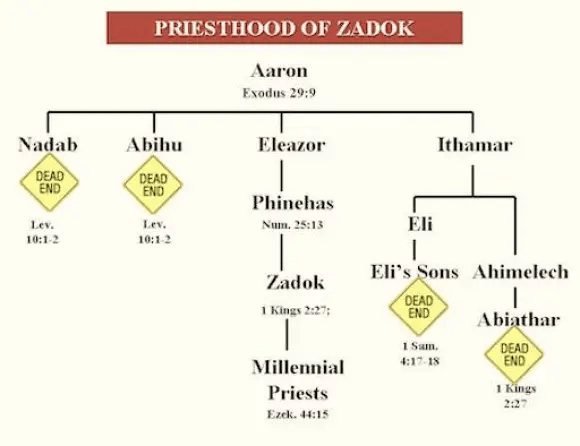
After Aaron died, the office of High Priest was passed down to his third son Phinehas, Eleazar (his two older sons, Nadab and Abihu, died earlier without children). Eleazar was succeeded by his son Phinehas (not the Phinehas son of Eli but instead the one who stopped the plague in the sin at Peor). Sometime during the period of the Judges—between Phinehas and Eli—the high priesthood moved from the family of Aaron’s son Eleazor to the family of Aaron’s youngest son, Ithamar.
Eli served as high priest and judge from the line of Ithamar. Eli’s 2 sons, Hophni and Phinehas,were killed. Phinehas’ wife was pregnant and died giving birth to Ichabod (meaning “no glory”) after hearing that Phinehas and Eli were dead. Before she died, 4:22 She said, “The Glory has departed from Israel, for the ark of God has been captured.”
Ahitub, Eli’s grandson, was next in the genealogical line of descent.
Ahijah served as high priest during the early reign of King Saul.
Ahimelech (Ahijah’s brother or son) succeeded him at Nob and was later killed by Saul.
Abiathar was Ahimelech’s son who escaped Saul’s slaughter, later serving as joint high priest with Zadok before being exiled by King Solomon for supporting a rival claim to the throne..
Zadok (from the line of Eleazar). Solomon replaced Abiathar with Zadok, returning the high priesthood to Eleazar’s lineage.
The high priesthood remained with the descendants of Zadok (who was a direct descendant of Aaron’s son, Eleazar) for roughly 800 years. In total, Zadok’s line held the position for nearly 8 centuries between Zadok’s initial appointment by King Solomon (around 960 BCE) and the deposing of the last legitimate Zadokite High Priest, Onias III, in 171 BCE.”
I loved tracing the high priesthood but you might not have enjoyed that. My mom was an Old Testament scholar and could have told me verbally everything I found on AI without even looking back at her Bible (and there was no AI when she was alive).
So you might want to focus instead on how godly a mother Hannah was. She had Samuel knowing that she would give him up to be raised by Eli to serve at the tabernacle for the rest of his life. Every parent should have children with the intent of raising them to serve the Lord. Maybe not right after they are weaned, as Samuel was, but maybe even starting in their teen years serving the Lord. Mary Jones was 16 years old in 1800 AD when she walked the 26 miles barefoot across rough and rocky terrain to buy her first Welsh Bible that she had worked so hard to save money to buy. Her noble act motivated the founding of the British and Foreign Bible Society in 1804 AD. King Josiah was crowned king at just eight years old. He began seeking the Lord as a youth and initiated massive religious reforms across Israel by the time he was 16 to 26.”
You might also take note of Eli’s lack of discipline of his 2 sons. Spanking and corporal punishment declined as forms of disciplining children from the late 1900’s to today as parents increasingly adopted gentle parenting styles. Critics sometimes mislabel the absence of spanking or yelling as a complete lack of discipline which isn’t necessarily true. Others feel that parents don’t discipline their children enough regardless of their methods of discipline, spanking or no spanking. Adonijah, David’s son who tried to take the throne from Solomon as David was dying, was never told “no” as he was growing up. 1 Kings 1:6 (His father (David) had never rebuked him by asking, “Why do you behave as you do?” Absentee fathers and broken homes contributes greatly to the lack of discipline of children today.
Today’s reading is Ruth 1-3 but let’s go ahead and include all 4 chapters. The story is easy to read and undestand. Here are some of the key points that I see in the story of Ruth.
Naomi’s bitterness. First a famine in Israel where Naomi’s husband Elimelech had to see the family land. They move to Moab for a while, hoping things would get better. It only got worse. In about 10 years Naomi’s husband and 2 sons died, leaving her and her 2 daughters-in-law alone with no support. No wonder when she returned to Bethlehem with Ruth after the famine had eased, the people said “Can this be Naomi”? She probably looked pretty rough. She said, 1:20 “Don’t call me Naomi,” she told them. “Call me Mara, (which means “bitter”) because the Almighty has made my life very bitter. 21 I went away full, but the Lord has brought me back empty. Why call me Naomi? The Lord has afflicted me; the Almighty has brought misfortune upon me.” She is blaming the Lord for her misfortune. Many people become bitter against God b/c of tragedies and illnesses to either them or their loved ones. They blame God. They ask, “Why does God allow suffering, pain, and evil.” Many lose their faith in God. Hopefully the story of Ruth won’t end in bitterness.
2. Ruth’s loyalty. At Naomi’s urging, Orpah, the other daughter-in-law of Naomi left Naomi and returned to live in Moab . We can only wonder what the rest of her life was like. Did she marry again and have a child? Did she end up offering her firstborn to Molech, the god of the Moabites? What caused Ruth to pledge undying loyalty to Naomi? 2:16 But Ruth replied, “Don’t urge me to leave you or to turn back from you. Where you go I will go, and where you stay I will stay. Your people will be my people and your God my God. 17 Where you die I will die, and there I will be buried. May the Lord deal with me, be it ever so severely, if even death separates you and me.” What had she seen in Naomi that caused her to want to follow Naomi’s God, Yahweh, especially since Naomi was blaming Yahweh for her misery? Ruth had to have seen something in the character and faith over the 10 years in Moab that made her want to be so loyal to Naomi in spite of Naomi’s bitterness. Loyalty is a fading virtue in our society today. AI: “Many relationships (including friendships and marriage), jobs, and social ties are treated as temporary contracts that last only as long as they offer mutual convenience or profit. Past disappointments in friendships, families, or workplaces lead people to guard themselves and pull back from deep reliance on others.” Most pledge “till death do us part” when they marry but the divorce rate is over 50%. Life-long friendships are rare. Many friendships are “you scratch my back and I will scratch yours”, or they are social but not very spiritual in nature and don’t last. There is little loyalty to local church families as members are constantly “shopping around” for a new church where they like the preaching or the worship service better instead of sticking with a church to make it better. I know there are times when you need to change churches for various reasons, but there is something to be said for loyalty to churches also.
3. The providence of God. Read chapter 2 again. Poor people could glean in any field that had been harvested, gathering anything leftover from the harvest. Ruth went to glean and just happened to pick the field of Boaz, a close relative to Naomi’s deceased husband. Boaz finds out who she is and showers her with kindness and protection. Was it a coincidence that Ruth picked the field of Boaz to glean? I don’t think so. This is the providence of God, providing for both Ruth and Naomi. 2:11 Boaz replied, “I’ve been told all about what you have done for your mother-in-law since the death of your husband—how you left your father and mother and your homeland and came to live with a people you did not know before. 12 May the Lord repay you for what you have done. May you be richly rewarded by the Lord, the God of Israel, under whose wings you have come to take refuge.” 13 “May I continue to find favor in your eyes, my lord,” she said. “You have put me at ease by speaking kindly to your servant—though I do not have the standing of one of your servants.” She said, “You have put me “at ease”.” Ruth’s mind had to be stressed out over how she and Naomi could survive on no income. Gleaning would bring in some income, but it certainly would not secure their financial future. She had to be wondering if she would ever marry again and have a child. She had a lot to be stressed out and worry about. But the providence of God, using Boaz, set her mind “at ease”. When Ruth said that, she still did not have the answers to her long term problems and future uncertainty, but at least she had some peace of mind. Do you have a lot of stressors and difficulties you deal with? Is the future uncertain and worrisome? Do you find it difficult to have “inner peace of mind”? God will provide if you trust Him and give your loyalty to Him as Ruth did. Phlippians 4:6 Do not be anxious about anything, but in every situation, by prayer and petition, with thanksgiving, present your requests to God. 7 And the peace of God, which transcends all understanding, will guard your hearts and your minds in Christ Jesus.” You can have peace of mind any time you are willing to completely trust God for all your needs and problems. Even if He does not make the problem go away, He will give you the strength you need to handle the problem.
4. Naomi’s creative problem solving. Even though Naomi was bitter about her own circumstances, her main concern was providing a home for Ruth, which meant marriage to a godly man who could provide for Ruth. Naomi’s solution? Go propose marriage to Boaz! “Go lie at his feet” which was a bold way of saying she was willing to marry Boaz if he would have her. Imagine Boaz as he was “startled” during the night at something at his feet, and it was a woman (not a dog or cat)! 3:9 “Who are you?” he asked (he knew Ruth but it was dark).“I am your servant Ruth,” she said. “Spread the corner of your garment over me (a sign that Boaz would accept her marriage proposal), since you are a guardian-redeemer of our family.” AI: “a guardian-redeemer (Hebrew: go’el) is a close male blood relative who has the legal duty and right to rescue a needy family member, buy back lost family property, and preserve the family line.” (Times Square Church) How far would this relationship with Boaz have gone without Naomi’s creative problem solving. We need creative problem solvers today. Many marriages are on the brink. Churches are faced with critical issues of how to spend the Lord’s money. Christian small business owners are faced with critical decisions. Mission works are trying to determine how to get the gospel out to the lost. Maybe you are facing difficult decisions. Ask God to give you some creative solutions, to help you think “outside the box”. Ladies, if you aren’t married yet, find a godly man that you want to spend the rest of your life with and go propose to him!!!!!!!! Don’t crawl into his bed at night, but propose to him.
5. Closing the deal. Boaz still had to go through the legal procedures of offering the kinsman redeemer privilege to someone closer relative than he was, but fortunately, that person turned it down. Boaz helped induce that rejection by reminding him that he would have to take Ruth as a wife as well as redeeming the land, which was pretty savvy. So Boaz closed the deal and married Ruth. 4:14 The women said to Naomi: “Praise be to the Lord, who this day has not left you without a guardian-redeemer. May he become famous throughout Israel! 15 He will renew your life and sustain you in your old age. For your daughter-in-law, who loves you and who is better to you than seven sons, has given him birth.” The woman who was so bitter against God would have a grandson to love in her old age and a son-in-law to take care of Ruth (and Naomi’s financial needs). Family. That’s what it’s all about. Boaz and Ruth have a son, Obed. who would be the father or Jesse, who would be the father of King David! Jesus would come from the descendants of David. Ruth, the Moabite, would be in the seed line of Jesus (Matthew 1:5). Boaz closed the deal on the marriage but God closed the deal on getting Ruth and her descendants in the seed line of Jesus.
There is something in the story of Ruth for everyone reading it. Most importantly, it tells us how a foreigner, howbeit a godly foreigner, came to be in the seed line of Jesus. What if we had seen her name in Matthew 1:5 and not known anything about her. What great lessons we would have missed.
I hope you have enjoyed looking at these points on Ruth. Those points are about as creative as I can get!
Cheating a little bit here. We finished the story of Samson in the Oct 9 blog and Judges 13-16, so we won’t go over chapter 15 and 16 again. Chapter 17-21 is usually called the “Apendix” to Judges so instead of stopping at chapter 20 and leaving 21 for the next blog, let’s go ahead and cover all of chapters 17-21. There’s a lot so here is a good AI summary:
The final chapters of the Book of Judges (Judges 17-21) serve as a dark epilogue that illustrates Israel’s spiritual, moral, and social rock-bottom. (Cornerstone Chapel; Bible Project)
The core theme of these chapters is summarized by the repeating verse: “In those days Israel had no king; everyone did as they saw fit” (Judges 17:6, 21:25). Rather than following God’s laws, society completely unraveled. (2BeLikeChrist; Cornerstone Chapel)
Key Events in Judges 17–21
Micah’s Idolatry (Chapters 17–18):
A man named Micah (from Ephraim) steals silver from his mother, then confesses out of fear of her curse.
His mother dedicates the silver to God, but uses a portion of it to fashion a carved idol.
Micah sets up a private shrine and hires a traveling Levite from Bethlehem to act as his personal priest.
The tribe of Dan, looking for more territory, raids Micah’s house, steals his idols, and convinces the Levite priest to join them as they violently conquer the peaceful city of Laish. (Escalate Church; Cornerstone Chapel; Lifespring Media; Steve Webb; GraceBiblemy.org)
The Levite and His Concubine (Chapter 19):
A Levite’s concubine is brutally abused and gang-raped to death by wicked men in Gibeah, a town belonging to the tribe of Benjamin.
In deep horror and outrage, the Levite cuts her dead body into twelve pieces and sends a piece to each of the twelve tribes of Israel as a call to action. (Theology of Work; Twenty Eight Eighteen; GraceBiblemy.org; Growing Godly Generations)
Civil War Against Benjamin (Chapters 20–21):
The rest of the tribes of Israel unite at Mizpah and demand that Benjamin hand over the guilty men of Gibeah.
Benjamin refuses, leading to a brutal civil war. Israel nearly annihilates the entire tribe of Benjamin, leaving only 600 surviving men.
Overcome with grief that an entire tribe of Israel might disappear, the other tribes scramble to find wives for the remaining Benjaminites. They do this by slaughtering the inhabitants of Jabesh-Gilead (who didn’t join the war) to spare virgin women, and later orchestrating the kidnapping of dancing maidens during a festival in Shiloh. (Twenty Eight Eighteen; GraceBiblemy.org; Growing Godly Generations)
Main Takeaway
These chapters demonstrate how quickly a society degrades when it abandons God as the moral compass. Religious rituals, selfish motives, and personal justifications replace absolute truth, turning God’s chosen people into a mirror image of the lawless culture around them. (Cornerstone Chapel; Theology of Work; 2BeLikeChrist)
My comments on Judges 17-21.
Breakdown of the home. A man stealing from his mother and then the mother uses the returned money to make an idol. Sounds like a total breakdown of morals in the home. Have we had a similar breakdown in our homes?
Breakdown of religion. Priests for hire: Micah first hired the Levite as priest and then the Danites made him a better offer and they hired that priest. Has the once reliable located preacher and priest profession become paying men and women who no longer teach the basic truths of the word of God?
Breakdown of society. The entire nation basically ends up in civil war punishing the Benjamites who wouldn’t turn over the men of Gibeah who killed the Levites concubine. Has our country become very polarized, liberal vs conservative, Republican vs Democrat that we are fighing among ourselves, even leading to attempted murders?
I hope that our country can have another grassroots revival. AI: “Grassroots spiritual revivals in United States history have repeatedly reshaped the nation’s cultural, social, and religious landscape from the ground up. These movements typically emerged during periods of perceived moral or spiritual decline, driven by ordinary believers rather than institutional hierarchy. (Vladimir Slavcuk Ministries). 1) The First Great Awakening (1734–1743) led by Jonathon Edwards and George Whitefield. Emphasized personal conviction, emotional connection with God, and spiritual egalitarianism over rigid church membership. 2) The Second Great Awakening (1800–1840) led by Barton W. Stone, James McGready, and Charles Finney. Massive outdoor camp meetings (such as the 1801 gathering at Cane Ridge, Kentucky) that drew tens of thousands of people in shared, emotional worship. Resulted in hundreds of thousands of converts. 3) The Businessmen’s Revival (1857–1858) led by Jeremiah Lanphier. Started as a simple noon-hour prayer meeting for businessmen in downtown New York City. Spread rapidly via word-of-mouth and telegraph across urban centers, adding an estimated 1 million members to churches nationwide without centralized crusades. 4) The Azusa Street Revival (1906) led by William J. Seymour. Daily, multiracial prayer meetings in Los Angeles characterized by expressive worship and supernatural experiences and tongue speaking. 5) College Students and The Jesus Movement (Late 1960s–1970s). Led by Billy Graham, youth leaders and counterculture converts connected through groups like Young Life and Campus Crusade. Reached the 1960s hippie and counterculture youth demographic by merging informal folk-rock music and casual attire with evangelical faith. Led to hundreds of thousands of student conversions, created contemporary Christian music, and permanently altered the aesthetic of American evangelicalism.
Pray with me for our nation. Notice that the 5 revivals above occurred about 50 years aprt. So we were due a national revival around 2, 000 AD and I thought 9/11 might be the catalyst for that. There was a brief revival, but it didn’t last long and it didn’t change some of the sins of our culture. Greed, sexual immorality, promotion of LGBTQ, churches leaving the basic truth of God’s word, divorce, adultery, fornication, drunkenness, and violence dominated our culture and country. Pray for a real revival. It begins with belief that the Bible is the Word of God and is the authority for us today. It begins with accepting what God calls sin.
I close with Solomon’s comment in 1 Chronicles 7:14 if my people, who are called by my name, will humble themselves and pray and seek my face and turn from their wicked ways, then I will hear from heaven, and I will forgive their sin and will heal their land.” Pray that our country will do that before it’s too late.
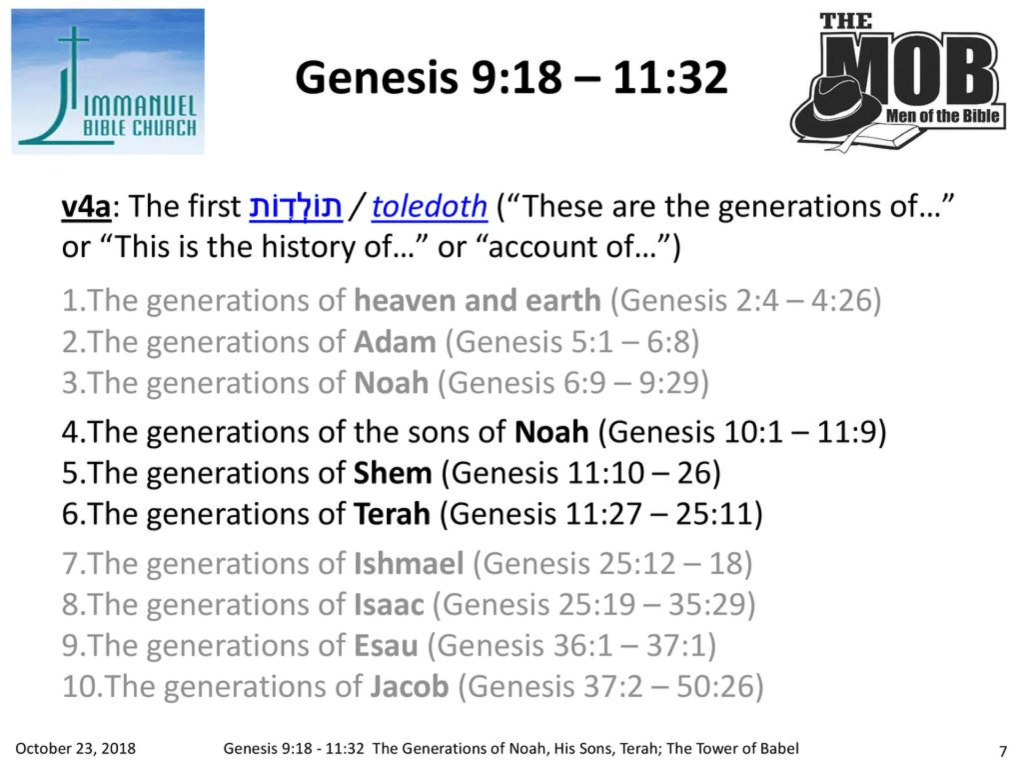
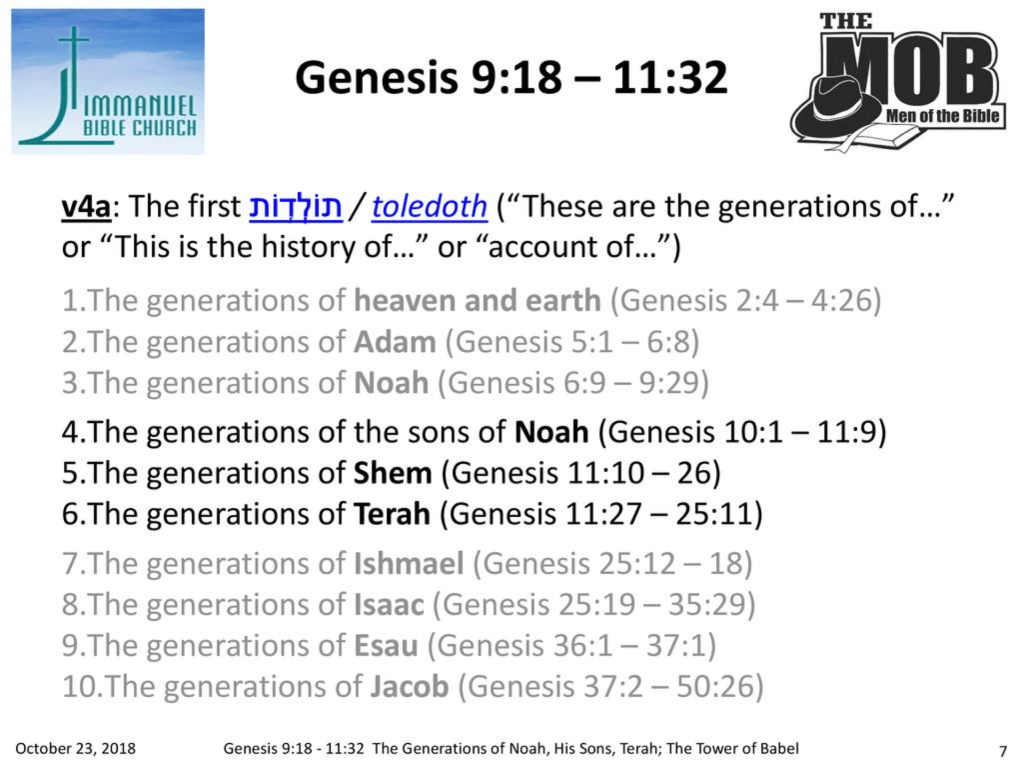
Genesis 11. The first part of Genesis 11 (the Tower of Babel event in verses 1–9) occurs chronologically before a lot of the final dispersion of nations described in Genesis 10. A key clue confirming this is 10:25 Two sons were born to Eber; the name of the one was Peleg, for in his days the earth was divided; and his brother’s name was Joktan.” That tells us that aat least some of the genealogies of chapter 10 occurred after the tower of Babel when the earth was divided. Let’s track Shem’s descendants. Shem’s descendants from the flood up to Peleg and Babel are given from 10:21-25 and then 10:21-25 are the descendants of Peleg’s brother Joktan’s 13 sons (not Peleg’s descendants) from the tower of Babel to some time after Babel. Some suggest that 11:1-9 then tells why the earth was divided in the days of Peleg since 10:25 mentioned that. But notice in 11:10 “these are the records of the generations of Shem”. That is the 5th “these are the generations of ” in the outline we used in Genesis 1. So 11:10-17 gives the descendants of Shem from the flood to Peleg and the tower of Babel (covering about 100 years from the flood). Then in 11:18-26 give the descendants of Peleg from Babel to Terah the father of Abraham, Nahor, and Haran. I know that sounds confusing but that has to be the way it breaks down. Check it out and you will see.
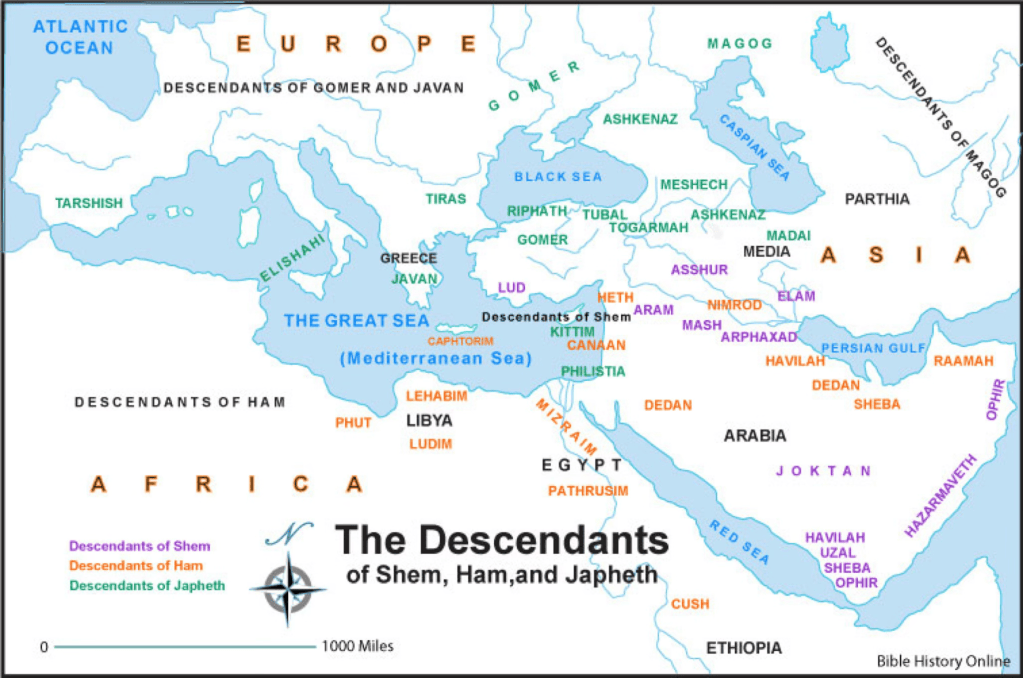
Genesis 11:1-9 The tower of Babel. This was probably about 100 years after the flood and the descendaants of Ham, Shem, and Japheth during that 100 years are still together instead of spreading out like God told them to. Imagine the mass confusion when God “confused” their languages. Sociologists have a lot of theories about how languages evolved over hundreds of thousands of years, but the Bible says they came about instantly at Babel. Perhaps God even miraculously changed some of their genetic code and that is where different “races” came from even though technically there is just one race, the human race who all came from Adam. Paul said in Acts 17:26 and He made from one man every nation of mankind to live on all the face of the earth.” Different colors of people and different languages would certainly scatter the people over the earth as God commanded. Here is the map of what it looked like some time after Babel:
Genesis 11:10-26 gives the 5th “generations of ” with the generations of Shem.
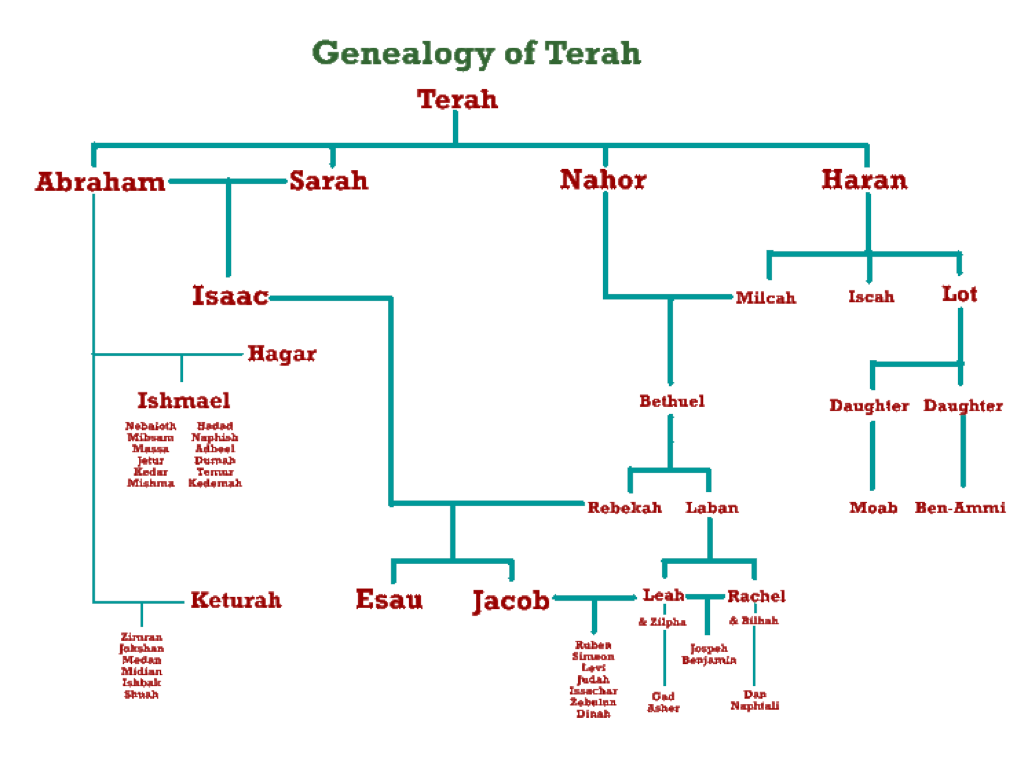
Genesis 11:27-25:11 gives the 6th “generations of” with the generations of Terah the father of Abraham, Nahor, and Haran.Terah took Abram, Sara, Lot. Nahor apprently stayed behind in Ur but later relocated to Haran since he is living in Haran in Gensis 24. Lot’s wife is not mentioned as traveling to Haran with Terah, so we assume that he married her after he went to live in Sodom. Terah died in Haaran.
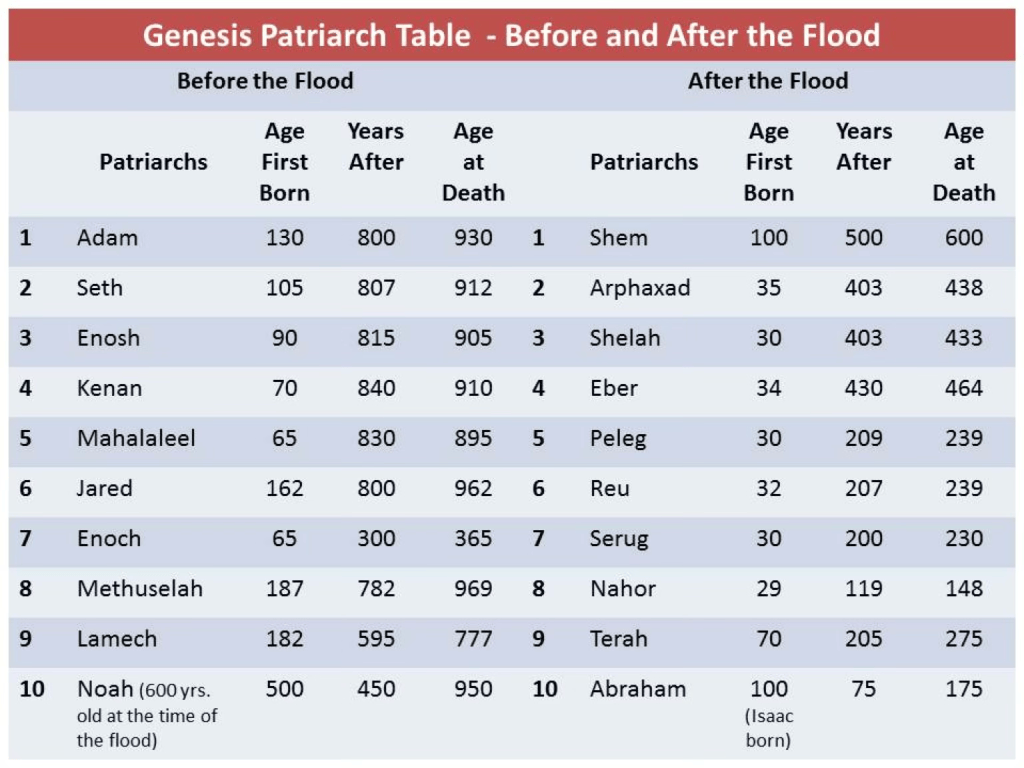
Here is the genealogy of Terah that will be a big part of the rest of Genesis.
Genesis 12:1-3 is the call Abraham received while in Haran. But he was first called while in Ur according to Stephen in Acts 7:2 And he said, “Hear me, brethren and fathers! The God of glory appeared to our father Abraham when he was in Mesopotamia, before he lived in Haran, 3 and said to him, ‘Leave your country and your relatives, and come into the land that I will show you.’ 4 Then he left the land of the Chaldeans and settled in Haran. From there, after his father died, God had him move to this country in which you are now living.” We don’t know how long Abraham lived in Haran but he was 75 when he received his 2nd call while in Haran. God promised 3 things to Abraham: 1) A great nation would descend from him, fulfilled in Israel becoming God’s chosen nation at Mt Sinai. . 2) The Promised Land of Canaan. Joshua 21:43-45 says that, after the conquest of Canaan, Israel got all the land God had promised the. 3) In Abraham’s seed all nations, Jew and Gentile, would be b blessed. Galatians 3:16 says that “seed promise” was fulfilled in Jesus. This 3-fold promise to Abraham is the hub of all Old Testament history.
There are more verses devoted to the faith of Abraham in the “Hall of Faith” in Hebrews 11 than any other person. They begin with his call: Hebrews 11:8 By faith Abraham, when he was called, obeyed by going out to a place which he was to receive for an inheritance; and he went out, not knowing where he was going.” I assume this refers to his calling in Ur. We know that Terah worshipped foreign gods. Joshua 24:2: The Hebrew Bible explicitly states that Terah and his ancestors lived beyond the Euphrates River and “served other gods”. Some Jewish legends even have Terah making and selling idols and a young Abraham smashing some of those idols (as in the Turner movie “Abraham”). We don’t know if Terah ever came to have faith in Yahweh. We don’t know how God spoke to Abraham or whether God did any miracles to show Abraham that He was the one true God. But imagine leaving your home and relatives and traveling 1,000 miles to a land you have never even seen just on faith. No visits back to home in Ur even though he could have done so.
Life Lesson: In 1974 my wife and I left Birmingham, Al to travel 2,200 miles to do mission work in Trinidad, West Indies, but we knew where we were going and had monthly support to supply our needs. We had funds to come back to visit our parents in B’ham once every year. Back then, everyone could come to the airline gate to see us off and we had a big crowd as we boarded the plane, including our parents. But I do remember as we sat down in our seats on the plane having a panic attack, thinking “I can’t believe we are doing this! My dad would always bail me out of jams and my mom always sheltered me. No more of that, we were on our own.” After a 10 hour flight, it was a joy to have all the missionaries meet us at the airport and carry us to a missionary’s house for a little welcome party. Abraham did not get anything like that. I had faith to leave our relatives and go to Trinidad b/c I felt that God was calling us to do so, just like God called Abraham, but I had so many guarantees for our 3 years there that it really required very little faith. We could have hopped on a plane and been back in B’ham in half a day at any threat of danger. Abraham lived 75 years in Canaan, constantly surrounded by threats from the Canaanites. What about you? Have you ever felt a strong call from God to make a drastic change in your life, your career, your living location, your business decisions, your separation from relatives that maybe are holding you back? Are you completely ready to leave everything and go where God calls you? I know 2 young people who felt that call after graduating from college to go to Asia to preach the gospel in predominately Buddhist and Muslim countries. They are both married with 2 children each, leaving their parents in the US and carrying those precious children overseas to a distant land. What faith! Don’t be afraid to ask God to call you to do great things for him. William Carey felt the call to leave England in 1792 AD to go preach the gospel to the hundreds of Hindu, unconverted souls in India. He had a famous motto: “Expect great things from God; attempt great things for God.” I hope God will call you to do great things for Him. BTW that doesn’t have to be in a foreign country. He might be calling ou to adopt an orphan locally. That takes great faith. He might call you to take care of widows in your church. He might call you to feed the poor in your area. Be ready to respond.
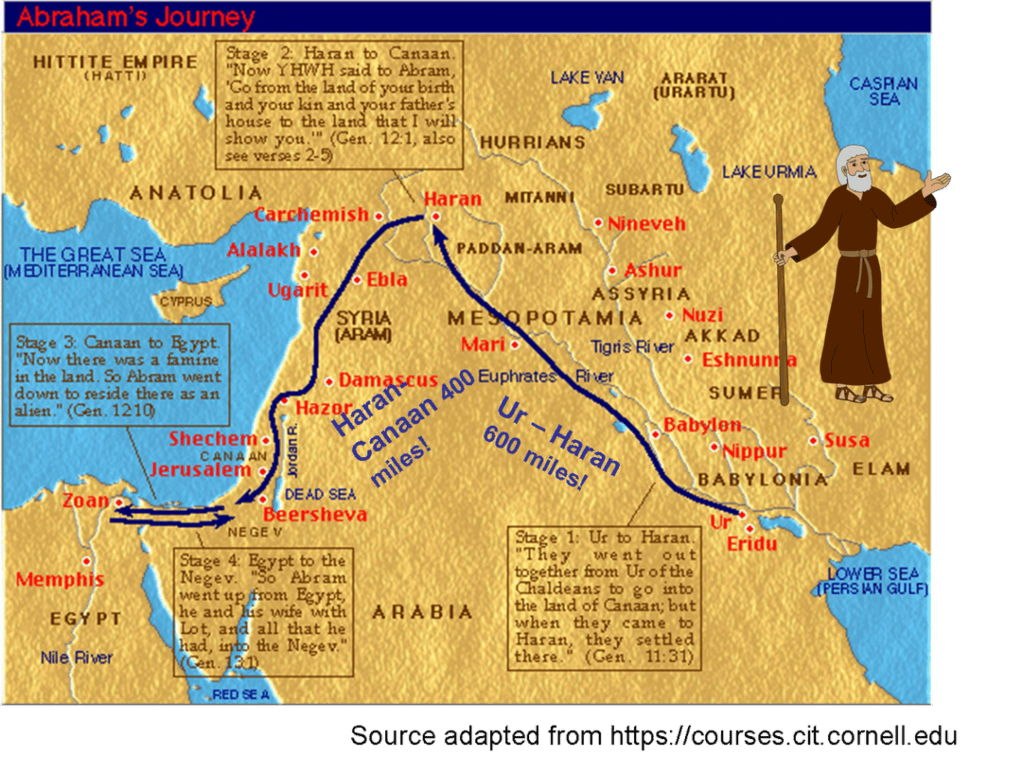
Here is a great map of Abraham’s journey giving distances:
Stage 1 on the map is from Ur to Haran. Stage 2 is from Haran to Canaan. He left Haran at age 75. When he came to Shechem, he built an altar to God and continued on to the Negev (locate on the map). Stage 3 on the map is from Canaan to Egypt during a famine where he lied to Pharoah, telling him that Sarai was his sister to keep from being killed by Pharoah who wanted to take Sarai as a wife. It’s hard to believe that the man with enough faith to leave everything and go to a land 1,000 miles away would not have enough faith that God would protect him from Pharoah, but Abraham failed this test. Stage 4 on the map is from Egypt back to Canaan. I wonder what Sarai thought of Abraham lying that she was his sister? She had to be afraid as Pharoah took her into his harem, only saved by God sending plagues on Pharoah. How did she feel knowing that her husband was willing to let Phroah take Sarai, have sex with her, and make her his wife? How did it feel knowing she was married to a coward? I bet it was a silent journey on the way back to Canaan. Did Abraham ever apologize to Sarai for this incident? Did his conscience bother him? Why is it that Pharoah gets punished for this deception and not Abraham? Technically Sarah was actually Abraham’s half-sister through their father, Terah, not their mother (Genesis 20:12) but this is still a lie, a cowardly deception. My mother called it an “Abrahamic lie” when she wanted to stretch the truth a little! We all laughed at that.
Life Lesson: We all have our moments of great faith and we all have our moments of weak faith. I know what my weak spots are. I know what I can handle with faith and what I have panic attacks over due to a lack of faith. I think back to some of my moments of weak faith and how I responded and am embarrassed by them. I almost had a nervous breakdown over an incident where I was afraid of being sued and was sleeping about an hour only each night for a month worrying. A friend carried me to a lawyer who assured me everything would be fine and I slept good that night for the first time in a month. I could have found that same relief from my worries a month earlier if I had more faith. What about you? Have you ever had your “Abraham in Egypt” panic attack where you resort to human tactics b/c of your lack of faith? Are you in the middle of one of those moments right now? Trust God and things will be just fine!
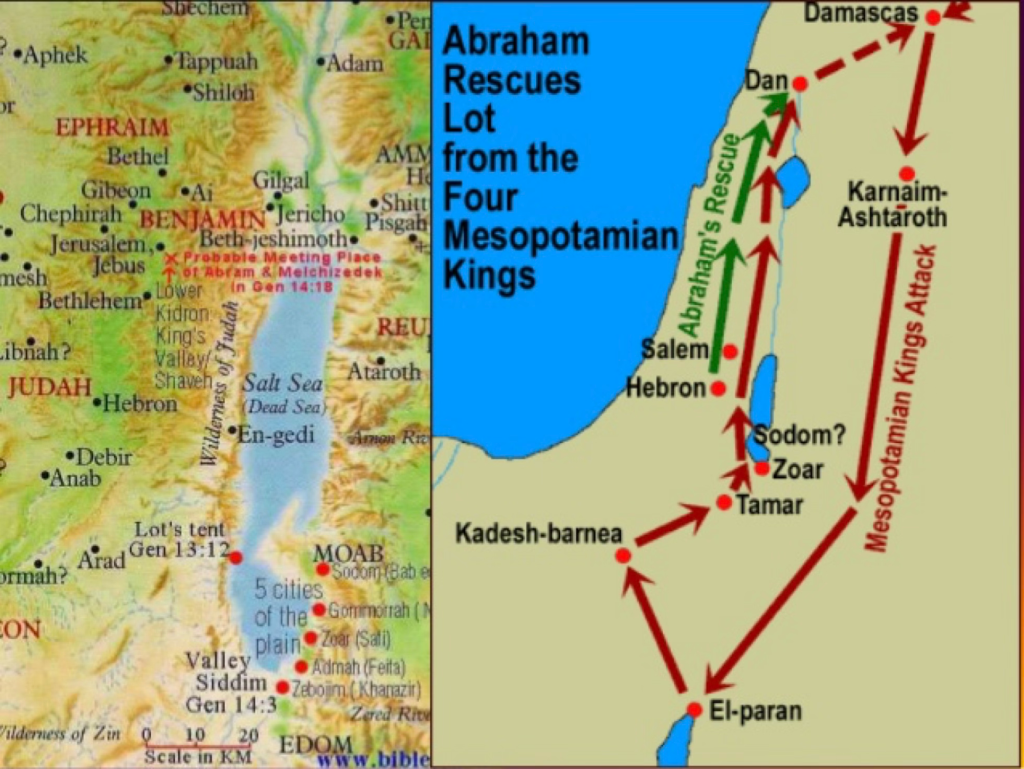
Genesis 13 and 14 tell about Abraham’s split with Lot b/c their herds were too big to stay together and it was causing conflict among their herdsmen. Abraham could have chosen the best land and sent Lot off looking for land, but he gave Lot the first choice of land. Lot chose land near the sinful city of Sodom and that was the beginning of Lot’s troubles. The land near Sodom was well watered (like the garden of Eden) and no doubt Lot could increase his wealth near a big city like Sodom. He probably found and married his wife there. Her faith in Yahweh is questionable since she didn’t obey the angels to not look back when leaving Sodom. While living in Sodom, 5 Canaanite kings attacked Sodom and carried Lot captive. Abraham and 318 of his men travelled 170 miles to Dan to rescue Lot. After the rescue, Lot had one last chance to get out of Sodom but he returned to live in Sodom. It only goes downhill after that as we will see in Genesis 18-19.
Genesis 14: On Abraham’s return from rescuing Lot, he was met by Melchizadek, king of Salem and high priest of the God Most High (El Elyon) who blessed Abraham and then Abraham gave the king a tenth. There is no info on Melchizadek. We don’t know how God appointed him to serve in pagan, Canaanite, Salem (later the cite of Jerusalem). Did he work to convert the pagans in Salem to Yahweh? Did he have any success? How long had he been in Salem? It will be fascinating one day to let him tell us about what all he did in Salem! What we do know from the writer of Hebrews (and from Psalm 110) that Jesus was high priest after the order of Melchizadek and not Levi (Hebrews 7). The writer tells us that Melchizadek was superior to Abraham b/c he blessed Abraham and the greater always blesses the lesser. He then used a math axiom: if a>b and b>c, then a>c. I’m sure you all remember that axiom from you math classes in middle school (LOL). If Melchizadek (a) > Abraham (b) > Levi (c) (Abraham would be greater than his descendant Levi), then Mechizadek (a) > Levi (c) and Jesus is high priest after a greater priestly order than Levi. The priesthood of Levi was done away with and replaced by the high priesthood of Jesus. Jesus’ priesthood was superior in that he was not a sinner and did not die (forever) like the Levitical priests. What a strange character Melchizadek was to base such a critical New Covenant doctrine on.
Genesis 15: Abraham questions God’s promise to give him descendants to make up a great nation. Abraham would be 85 now, having spent 10 years trying to have a child with his 75 year old barren wife Sarai. He was getting frustrated and began to have doubts about God’s promises. Then comes a great moment in Abraham’s faith. God shows him the stars and promises Abraham that his descendants would be countless like the stars. It says, Genesis 15:6 Then he believed in the Lord; and He reckoned it to him as righteousness.” The apostle Paul used this verse to say that Abraham was justified by faith and not works. Romans 4:2 For if Abraham was justified by works, he has something to boast about, but not before God. 3 For what does the Scripture say? “Abraham believed God, and it was credited to him as righteousness.” So was Abraham not saved when he left Ur by faith? He could not have obeyed God’s call to leave his homeland without a prior, saving trust in God. But doesn’t Genesis 15:6 sound like that was the moment his faith saved him? AI: Genesis 15:6 is generally understood not as the exact moment Abraham was first saved, but as an explicit, landmark confirmation and record of the faith he already possessed.” His faith was “reckoned to him as righteousness”. Paul comments on that also: Romans 4:4 Now to the one who works, his wage is not credited as a favor, but as what is due. 5 But to the one who does not work, but believes in Him who justifies the ungodly, his faith is credited as righteousness,” The Hebrew word for “reckoned” in Genesis 15:6 is chashab: To think, plan, reckon, account, consider, devise, esteem. The Greek word for “reckoned” is logizomai: To reckon, to consider, to account, to think, to impute. Both carry the idea of something that is credited or put into your spiritual “account” that you can’t possibly have on your own. AI: “The phrase “all our righteousness is as filthy rags” comes from Isaiah 64:6, meaning that human moral efforts and good deeds cannot earn salvation or match God’s absolute holiness.” God puts His own righteousness in our account to save us. We are given righteousness that is not our own, that is imputed to us. Picture this. You owe millions of dollars but you don’t have money in your bank account to pay your debt. Someone comes in to the bank, and puts millions of dollars in your account to pay off your debt. That’s what God did for Abraham. That’s what Jesus did for us! 1 Corinthians 1:30 But by His (God’s) doing you are in Christ Jesus, who became to us wisdom from God, and righteousness and sanctification, and redemption, 31 so that, just as it is written, “Let him who boasts, boast in the Lord.” 2 Corinthians 5:21: “For our sake he made him to be sin who knew no sin, so that in him we might become the righteousness of God.” Imputed righteousness is a free gift by grace through faith. It can’t be earned. Do you have that righteousness?
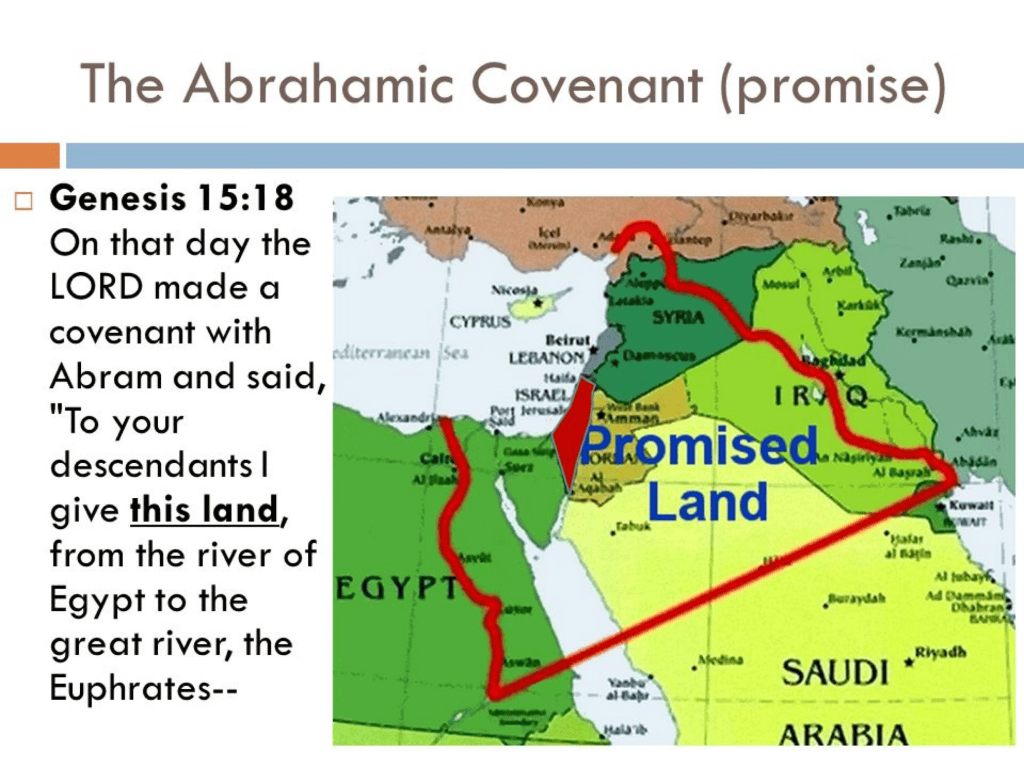
God then gives Abraham a confirmation of the land promise but also reveals a few things that He had not yet told Abraham.He tells him the full extent of the borders of the promised land. He also tells him that he will never personally own the promised land, but that it would be given to his descendants, and only after 400 years of slavery in a foreign land. Would Israel actually be in slavery in Egypt for 400 years? AI: “Based on generational timelines and the age of Moses (who was 80 at the Exodus and born after the oppression began), estimates for the actual period of hard bondage and enslavement range roughly between 80 and 144 years, even though the broader family lived or sojourned in the region for much longer.” There was no slavery until after Joseph died and they came out in the 4th generation (Isaac/Jacob/Levi/Amram) and that can’t be a full 400 years. AI: “This 400 year span encompasses a combined period of living in Canaan and actual servitude in Egypt, leading up to the 430-year total span mentioned in Exodus 12:40 (which counts from the initial unconditional covenant made with Abraham in Genesis 15).” Was Abraham disappointed to only learn after 10 years in Canaan then he personally would never own the land? He did buy a cave to bury Sarah, but that was it. Again, the writer of Hebrews. Did he think, “God, why didn’t you tell me this before I left Ur. I might have reconsidered leaving Ur if I knew I would never actually own the land.” I don’t think so. Hebrews 11″9 By faith he lived as an alien in the land of promise, as in a foreign land, dwelling in tents with Isaac and Jacob, fellow heirs of the same promise; 10 for he was looking for the city which has foundations, whose architect and builder is God.” I don’t know what he envisioned as “the city whose builder is God”. Was it eternal life with God in some heavenly city?
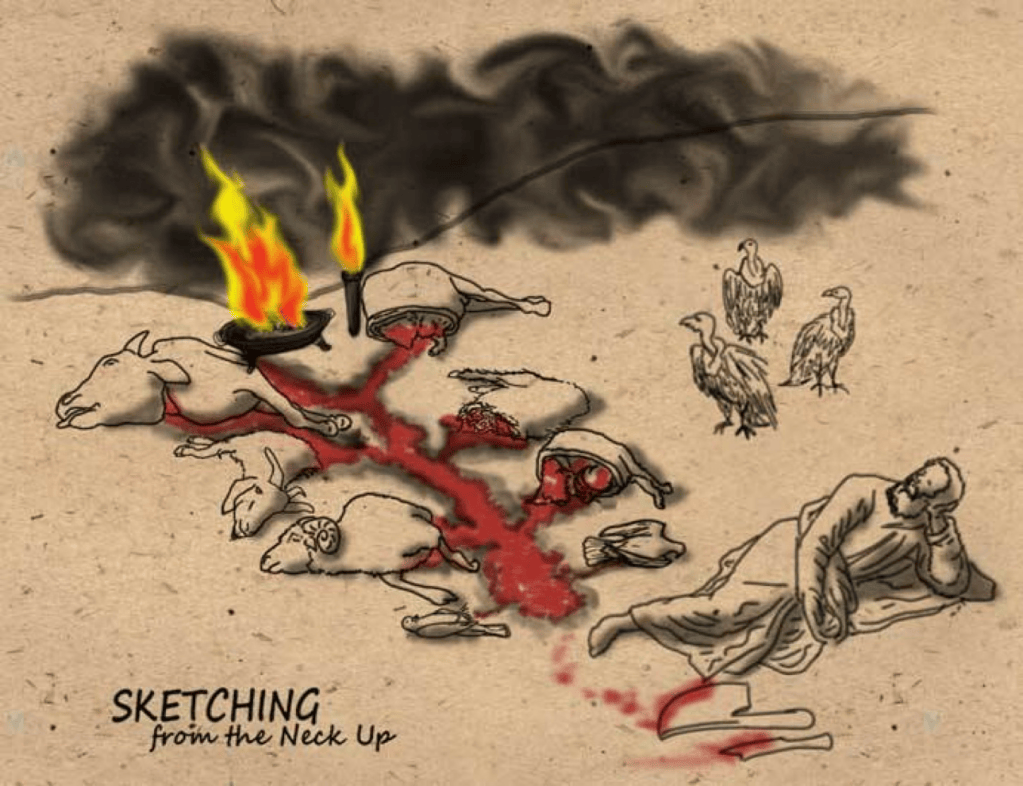
God then confirms his promise with a strange but apparently common method of confirming covenants back then. Genesis 15:9 So He said to him, “Bring Me a three-year-old heifer, a three-year-old female goat, a three-year-old ram, a turtledove, and a young pigeon.” 10 Then he brought all these to Him and cut them in two, down the middle, and placed each piece opposite the other; 17 And it came to pass, when the sun went down and it was dark, that behold, there appeared a smoking oven and a burning torch that passed between those pieces.” The smoking oven and torch is God’s passing between the pieces. I’m not sure why God used those two things to represent Himself. Apparently only God passed between the pieces and not Abraham.
Wow! Some great stuff from Genesis 11-15. Hope this helped understand those chapters.
I only started the 5 chapters/day and matching blog articles late so I wanted to catch up on the ones I missed. Maybe, if you are currently on schedule with the daily readings, you might want to do some binge reading on the ones I messed starting in Genesis 1 and read these catch up blogs that I will be dong!
What is the best outline of Genesis? I have seen many good ones, but the best is the one Moses used.
Notice that Abraham, a main character, does not have his own “generations”. He (as well as Isaac) falls under generations of Terah, his father. Same with Joseph, who has 13 chapters devoted to him. His generations fall under Jacob.
Genesis 1. The big debate is over the length of the days in Genesis 1 and the age of the earth. But before we dig into that, let’s not fail to praise God for His creation of all things. He spoke all things into existence from nothing. For a long time, scientists belileved that the universe was eternal. But then the 2nd Law of Thermodynamics says that everything is always moving into a higher state of entropy or disorder. Things wear out. Stars are burning out. So if the universe was eternal, it would have already deteriorated into chaos and not the design that we see in the universe and life itself. But scientists now believe that the earth had a beginning when there was nothing and that the earth (and the universe) somehow created itself from nothing. But then the 1st Law of Thermodynamics says that all matter and energy in the universe is constant. If there was ever nothing, there would still be nothing. Scientists admit these inconsistencies in their theories and say, “Science will figure it out some day.” They are asking you to trust science. But Moses said, “Here is how God did it!” But if every effect must have an adequate cause (the law of causality), then someone will say, “If God created everything, then who created God?” Creationists believe that God was (is) a supernatural cause of all things. Yes, that takes faith. But the alternative is that the universe created itself from nothing, and that is totally unscientific. Which theory is more reasonable and plausible? It helps that God gave so many predictive prophecies in the Old Testament that all came true with 100% accuracy. It helps that God did many miracles (but of course science rejects miracles). It helps a lot that God raised Jesus from the dead. Acts 17:31 says that God gave “proof” that Jesus is the judge of all by the resurrection of Jesus. Then there is the incredible design of the universe and life that simply could not happen by mere chance. The design of all the systems in the human body, the periodic table with each element adding one proton to its nucleus, the over 30 physical constants that must be finely tuned for life to exist, the complexity of the cell, the complexity of DNA, etc. Design demands a designer. If you see a new hosue, you think, “Someone built it and someone designed it”. The evidence for “intelligent design” is so overwhelming that Paul said in Romans 1:20 For since the creation of the world His invisible attributes, His eternal power and divine nature, have been clearly seen, being understood through what has been made, so that they are without excuse.” There is no excuse for a person to be an atheist. It has to be his pride and intellectual arrogance that keeps him/her from believing in God.
It’s interesting how many times the Psalms praise God for his creation of the universe and evertything in it. Then add Revelation 4.
Psalm 8: Reflects the creation of humanity and order of the cosmos, echoing Genesis 1.
Psalm 19: Celebrates the heavens declaring the glory of God and the order of day and night.
Psalm 33: Depicts creation by God’s spoken word (“he spoke, and it came to be”), directly mirroring Genesis 1.
Psalm 74: Recalls God crushing sea monsters and establishing light, day, and night.
Psalm 104: Provides a grand poetic sweep of the creation account, matching the specific order and elements of Genesis 1 (light, waters above, mountains, animals, and seasons).
Psalm 136: Praises God for making the heavens, earth, sun, moon, and stars with “understanding.”
Psalm 148: Calls all created elements, cosmic bodies, and creatures to praise the Lord.
Revelation 4:11 “Worthy are You, our Lord and our God, to receive glory and honor and power; for You created all things, and because of Your will they existed, and were created.”
Nehemiah 9:5“Arise, bless the Lord your God forever and ever! O may Your glorious name be blessed and exalted above all blessing and praise! 6 “You alone are the Lord. You have made the heavens, The heaven of heavens with all their host, The earth and all that is on it, The seas and all that is in them. You give life to all of them and the heavenly host bows down before You.
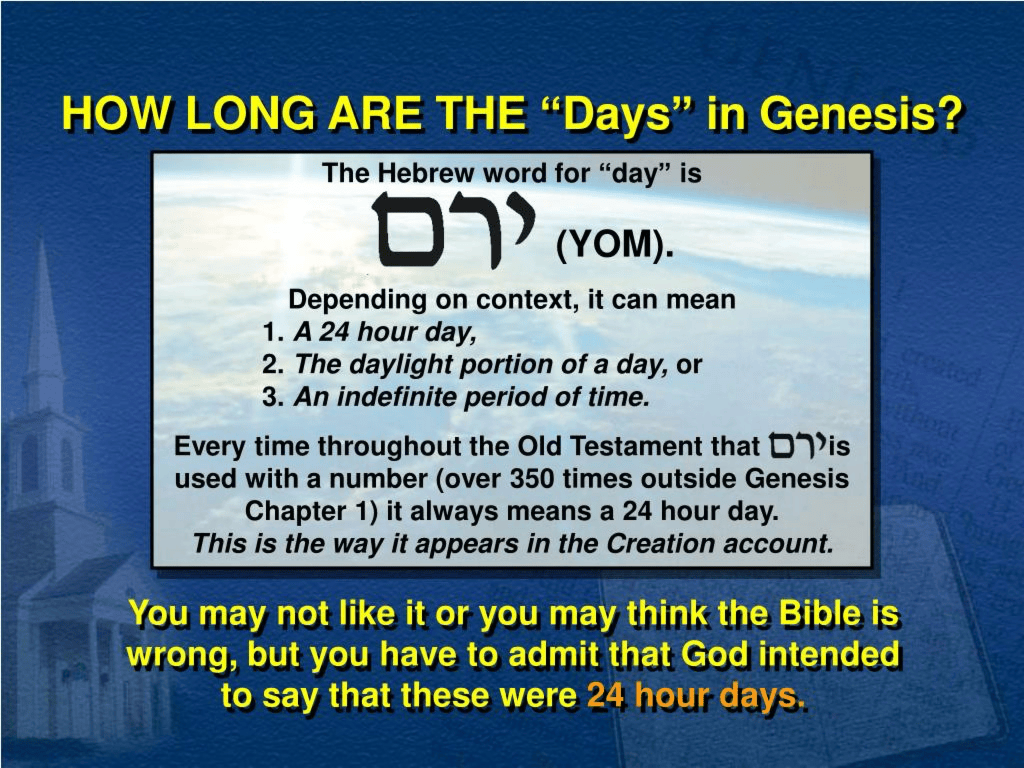
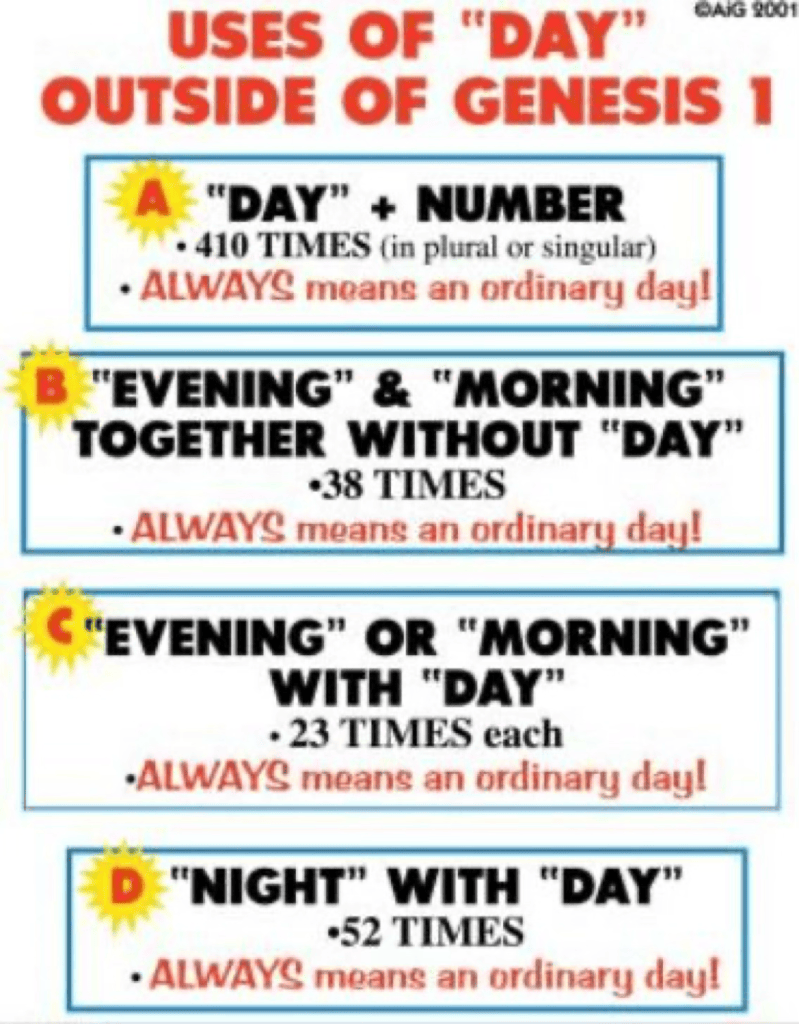
So now for the debate. In order to get the millions and billions of years into their atheistic evolutionary teaching, many say that the days in Genesis were millions of years long and not 24 hour days. Here’s are 2 slides that settle that IMO.
Many teach that the Genesis creation account is just a myth. Even many Christians teach that. But Jesus believed it was an historically accurate event. Matthew 19:4 And He answered and said, “Have you not read that He who created them from the beginning made them male and female, 5 and said, ‘For this reason a man shall leave his father and mother and be joined to his wife, and the two shall become one flesh’? 6 So they are no longer two, but one flesh. What therefore God has joined together, let no man separate.” The apostles Paul by inspiration of the Holy Spirit said that Adam was a the first man, a real person through whom sin entered the world: 1 Corinthians 15:45 So also it is written, “The first man, Adam, became a living soul.” Moses compared the 6 days of creation to the six 24 hour days each week that men work before honoring the Sabbath: Exodus 20:11 For in six days the Lord made the heavens and the earth, the sea and all that is in them, and rested on the seventh day; therefore the Lord blessed the sabbath day and made it holy.” Also on day 4 God created the sun and the moon and said, Genesis 1:16 God made the two great lights, the greater light (the sun) to govern the day, and the lesser light (the moon) to govern the night; He made the stars also.” That is obviously a 24 hour day. BTW that would mean that, at the minimum, days 4, 5,and 6 were 24 hour days. It is on days 5 and 6 that God created all the animals and man on 2 consecutive days, and not the millions of years that evolutionists claim was required for man and animals to evolve. Even “theistic evolutionists” try to make days 5 and 6 millions of years long to try to get their unproven theories of evolution to fit in the Genesis account. God created everything full-grown. Life did not evolve from a single cell. In conclusion, I believe that the 6 days of creation were 24 hour days.
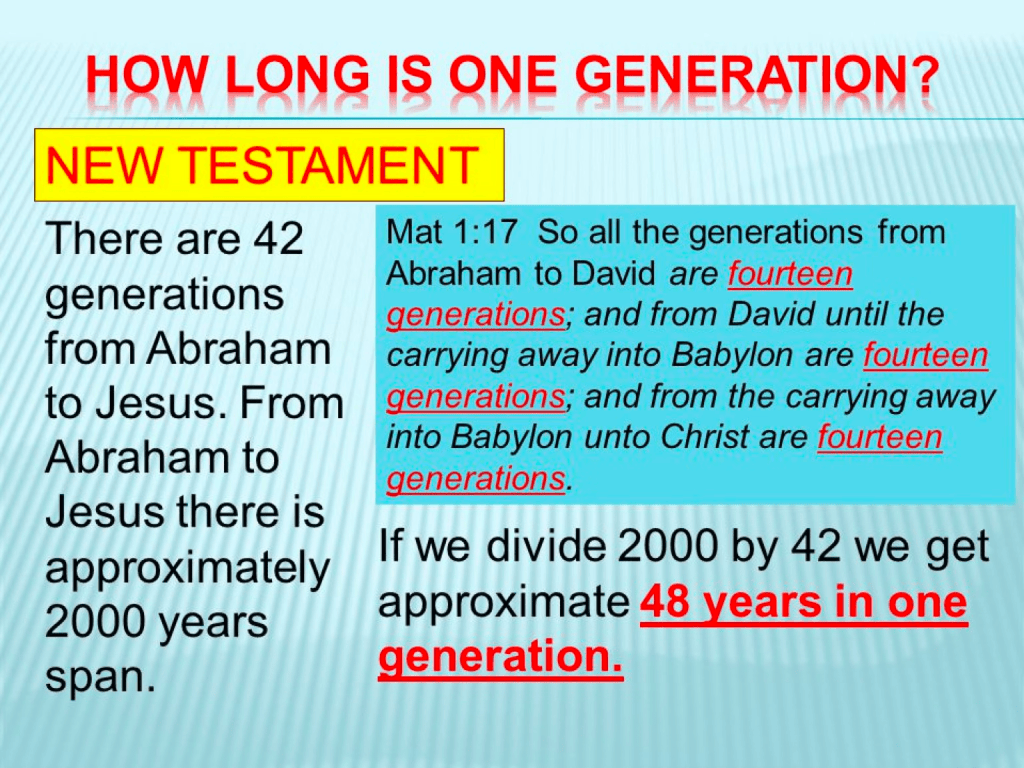
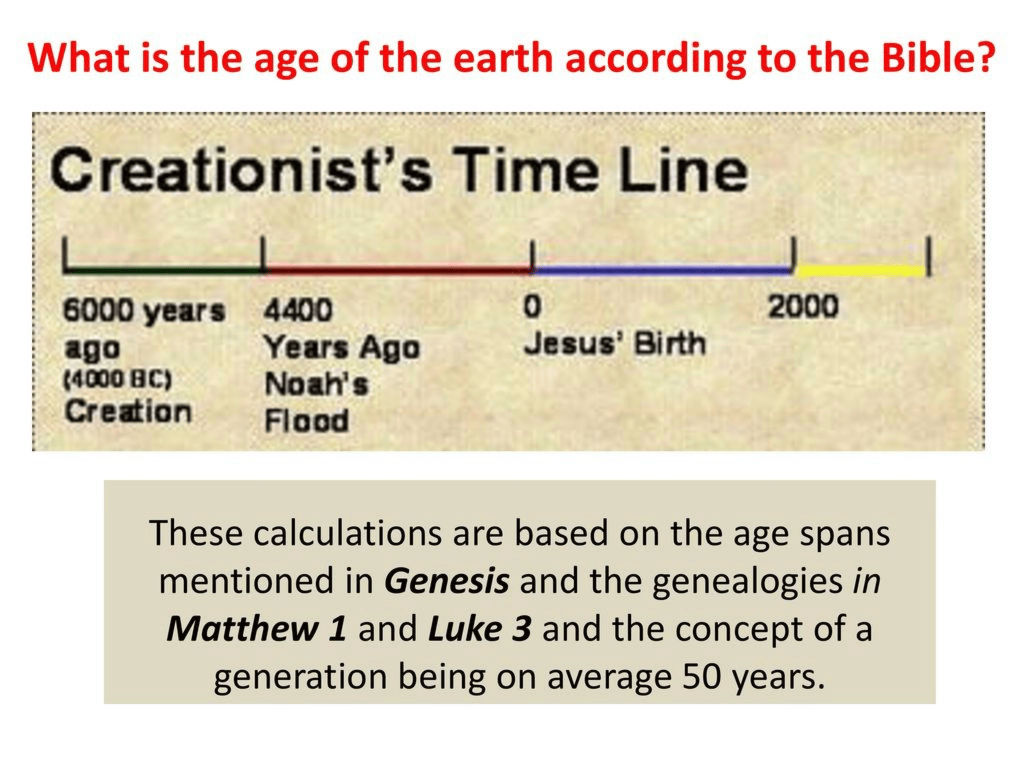
What about the age of the earth? Is it 6 billion years old or 6,000 years old? I don’t believe this is a “heaven/hell doctrine”. We Christians can even disagree on the age of the earth. Many strong Bible believing Christians believe that the earth is 6 billion years old. They cite their scientific proofs and young earth advocates cite their proofs. Here is what I believe. I believe that the Bible claims that the earth is about 6,000 years old based on the genealogical accounts in Genesis 5, 11, and Matthew 1. In Genesis 5 and 11 there are about 2,000 years from Adam to Abraham. In Matthew 1 there are about 2,000 years (42 generations of about 40-50 years each) from Abraham to Jesus. Then there are 2,000 yeas from Jesus to today. That’s 6,000 years from Adam to today, i.e. the Biblical age of the earth. It’ impossible to refute that the Bible claims a 6,000 year old earth even if you dn’t believe that is true.
I’m sure many atheists and Theistic Evolutionists would disagree with this, but to me they are disagreeing with what the Bible clearly claim, i.e. a young earth. If we can’t trust the genealogies in Genesis, why should we trust the rest of Genesis? Why should we trust the miracles in the Old Testament if we can’t trust the creation account in Genesis? Atheists point to radiometric dating to prove a 6 billion year old earth. But, without going into great detail, radiometric dating is based on one big, unprovable, assumption. You have to assume that you know the amount of the mother element that existed in the original sample before you can use the half lives of the decay of the daughter elements to determine how old the sample is. Radiometric dating is unreliable. I think I will stick with the reliable word of God!
Genesis 2 begins with a summary of the creation week. Many people make a big deal about how this summary supposedly contradicts the Genesis 1 account but I don’t believe that it does. Here is a good AI on the supposed contradicion:
Critics often claim a contradiction in the order of creation—specifically regarding animals and plants—between the two chapters. However, these are resolved by looking closely at Hebrew grammar and literary structure:
The Creation of Animals (Genesis 2:19): A surface reading of some English translations suggests God formed the animals after making Adam. However, in Hebrew grammar, the verb translated as “formed” can accurately be rendered in the pluperfect tense as “had formed.” This means Genesis 2:19 is not describing a second, later creation of animals, but rather a flashback or summary explaining that God had already created the animals (as stated in Genesis 1) and now brought them to Adam to be named.
The Creation of Plants (Genesis 2:5–9): Genesis 2 mentions that certain shrubs and cultivated plants had not yet grown because there was no man to till the ground. This passage refers specifically to the localized agricultural environment of Eden rather than a global re-creation of all botanical life from Day 3 of Genesis 1.
Whether we can fully explain all this, I believe Moses wrote Genesis and I can’t fathom him contradicting his Genesis 1 account immediately after he gives it. Instead, the two chapters are widely viewed as complementary narratives with different literary styles and focal points. AI: “‘Genesis 2 functions as a localized, intimate “zoom-in” or close-up on the sixth day. It skips the broad cosmic timeline to focus specifically on humanity, the Garden of Eden, human relationships, and moral responsibility.”
Moving on the the main part of Genesis 2. 1) The command to not eat of the tree of the knowledge of good and evil. 2) The creation of woman to be a helper for Adam and the first marriage. Jesus fully believe that this was a real, historical account. Matthew 19:4 And He answered and said, “Have you not read that He who created them from the beginning made them male and female, 5 and said, ‘For this reason a man shall leave his father and mother and be joined to his wife, and the two shall become one flesh’? 6 So they are no longer two, but one flesh. What therefore God has joined together, let no man separate.” There are several “eternal” principles given in this. God created 2 genders: male and female. The current debate over gender identity is so unbiblical. I can’t even imagine the factors that led to all the confusion. It is pretty obvious how God made man and woman to “fit” together in the sex act. Any homosexual activity is condemned in the Old and New Testaments. Some try to say that the Greek words for “homosexual” where Paul condemns such in 1 Corinthians 6 and 1 Timothy 1 only mean sexual acts with minors. I simply carry them to Romans 1 where there is no ambiguity: Romans 1:26 For this reason God gave them over to degrading passions; for their women exchanged the natural function for that which is unnatural, 27 and in the same way also the men abandoned the natural function of the woman and burned in their desire toward one another, men with men committing indecent acts and receiving in their own persons the due penalty of their error.” Case closed. Debate over. Homosexuality is a sin. Gay marriages are sinful. Marriage is between a man and a woman according to Moses and Jesus. The fact that God said “a man shall leave his father and mother and cleave to his wife” says that is an eternal rule for marriage since leaving father and mother wouldn’t even apply to Adam. You are born male or female, period. To change your gender through surgery is going against how God made you, period. One other point. Eve was created as a “helper” for Adam. No “suitable helper” was found for Adam among the animals (tough a dog is a man’s best friend, right?). She would meet his needs for companionship, love, and sexual procreation. But “helper” says that the woman was the helper, not the head person. An electrician’s helper or apprentice is not the one in charge. Paul stated that in Ephesians 5 when he said that the husband is the head of the wife and the wife should be in “submission” to the husband. In 1 Timothy 2 Paul said that women were not to “usurp authority over the men (at least in church affairs) b/c Adam was the first one created and then Eve. But let’s be clear: the husband is to love, cherish, and nourish his wife. He is to appreciate the role God gave her and not take advantage of that. She needs love, appreciation, and support in what she does, especially as she takes the main role in birthing the children and raising them. Conclusion: if we just followed God’s pattern set up in Genesis 2, we wouldn’t be in this moral mess we are in today. We are in this mess b/c many don’t believe that the Bible is the inspired word of God. Also, if you believe the Genesis account of creation is a myth, none of thse principles really exist.
Genesis 3 The fall of man. The serpent was Satan. Revelation 20: 2 And he laid hold of the dragon, the serpent of old, who is the devil and Satan. When did Satan enter or become a serpent? Where did Satan come from? We think that he was a beautiful angel who fell from heaven due to pride (Ezekiel 28). In his discussion with the woman, Satan questioned the reason God gave the rule not to eat of rhe forbidden tree. He said God just didn’t want Adam and Eve to be like God, knowing good and evil. Satan has always tried to tell people that God’s laws are simply to deprive us of joy and pleasure. But God’s laws might test our obedience to God, but they are also for our own good. Deuteronomy 6: 24 So the Lord commanded us to observe all these statutes, to fear the Lord our God for our good always and for our survival, as it is today.” They are for our good in giving us eternal life in the next life if we obey God, but they are also for our good in this life. Living just to satisfy the lusts of the flesh and of the eye and the pride of life does not bring true happiness, only misery. It’s interesting that it was Eve who first sinned by eating from the forbidden tree but Paul says that sin entered the world through one man, Adam (Roans 5:12). Is that b/c Adam failed in not leading his wife in opposing Satan and thus Adam is responsible for the fall? It is also interesting that Paul says that Eve was deceived by the devil’s lies, but Adam wasn’t (1 Timothy 2:12ff). That means that he heard the same lies as Eve did, so why didn’t he step up and help his wife resist?
Then come the curses on the serpent, on Eve, and on Adam. The most notable one is Genesis 3:15 And I will put enmity Between you and the woman, And between your seed and her seed; He shall bruise you on the head, And you shall bruise him on the heel.”
The seed of Satan will deliver a minor blow (to the heel) to the seed of woman (referring to Jesus) but the seed of woman (Jesus) will deliver a major blow to the seed of Satan. Indeed, Jesus came to destroy the works of the devil (1 John 3:8). He came tro cast Satan into the lake that burns with fire and brimstone (Revelation 20:19). The devil did give a blow to Jesus when he persuaded the Jews and the Romans to crucify Jesus, but Jessu arose from the dead after that so the blow was not fatal. But Jesus delivered a major blow to Satan and his power.
I find it interesting that God already planned to send Jesus to save sinners even before the creation of man. 1 Peter 1:18 knowing that you were not redeemed with perishable things like silver or gold from your futile way of life inherited from your forefathers, 19 but with precious blood, as of a lamb unblemished and spotless, the blood of Christ. 20 For He was foreknown before the foundation of the world, but has appeared in these last times for the sake of you.” That means that God knew that man, having been given freewill choice, would sin and that a loving God would one day in the distant future send His Son Jesus to die for sinners. God even put that forbidden tree in the garden, knowing that man would eat from the tree and sin and would therefore need salvation from sin b/c the justice of God demands punishment for sin. Why would God put that forbidden tree in the garden if He knew Adam and Eve would eat from it and sin? If God had not put that forbidden tree in the garden, would Adam and Eve have lived forever in a perfect garden, and if so, what would mankind after Adam and Eve be like? A lot of unanswered questions that I leave with your imagination. But it is what it is. We all sin like Adam and Eve did. Jesus died for our sins. Praise God.
Genesis 4. Cain and Abel. My question on Cain and Abel is this: why did God reject Cain’s offering of fruit? Was it b/c he offered fruit instead of Abel’s firstlings of his flocks? Was it b/c he lacked the sincere faith by which Abel offered a “better sacrifice” than Cain (Hebrews 11:4)? How was Abel’s sacrifice “better”? Better b/c of Abel’s attiude or b/c it was an animal? 1 John 3 tells us a little more about Cain: 3:11 For this is the message which you have heard from the beginning, that we should love one another; 12 not as Cain, who was of the evil one and slew his brother. And for what reason did he slay him? Because his deeds were evil, and his brother’s were righteous.” He did not love his brother Abel. He was envious of Abel pleasing God. But he did not want to repent and ask God what he should do to please God. Instead, he became angry and his countenance (his facial expression and body language) had fallen. God told him, “5:7 If you do well, will not your countenance be lifted up? And if you do not do well, sin is crouching at the door; and its desire is for you, but you must master it.” Life lesson: Isn’t sin always crouching at the door with us, waiting to catch us at a weak moment? There was no mention of the devil tempting Cain. His own lusts caused him to become envious and commit murder. But we must “master” sin and show it who is boss, who is in control. Do you have a lust you have trouble saying no to? Has sin caused your countenance to fall and make you angry, bitter, envious, unforgiving, unloving, etc.?
Ok, where did Cain get his wife? The critics of the Bible always ask that! It says he went to Nod and had relations with his wife. It doesn’t say he found her in Nod. Cain had to have married a niece or sister or cousin. Adam and Eve hand many children after Cain and Abel (Genesis 5:4). You had to marry a relative to populate the earth. Tubal-cain was the great great great great gandson of Cain and he was the forger of al instruments of bronze and iron (5:22). Adam lived 930 years and Tubal-cain was born before Adam died. Point being, within about 1,000 years of the creation of Adam there was forging or iron and bronze instruments. There was no “milions” of years of primitive man who could not speak a language, who used crude tools. The first men were civilized, could speak intelligently, and could make and use tools. They could play lyres and harps (5:21). Chapter 4 closes with the birth of Seth to replace Abel. The seed line of Jesus would come through Seth.
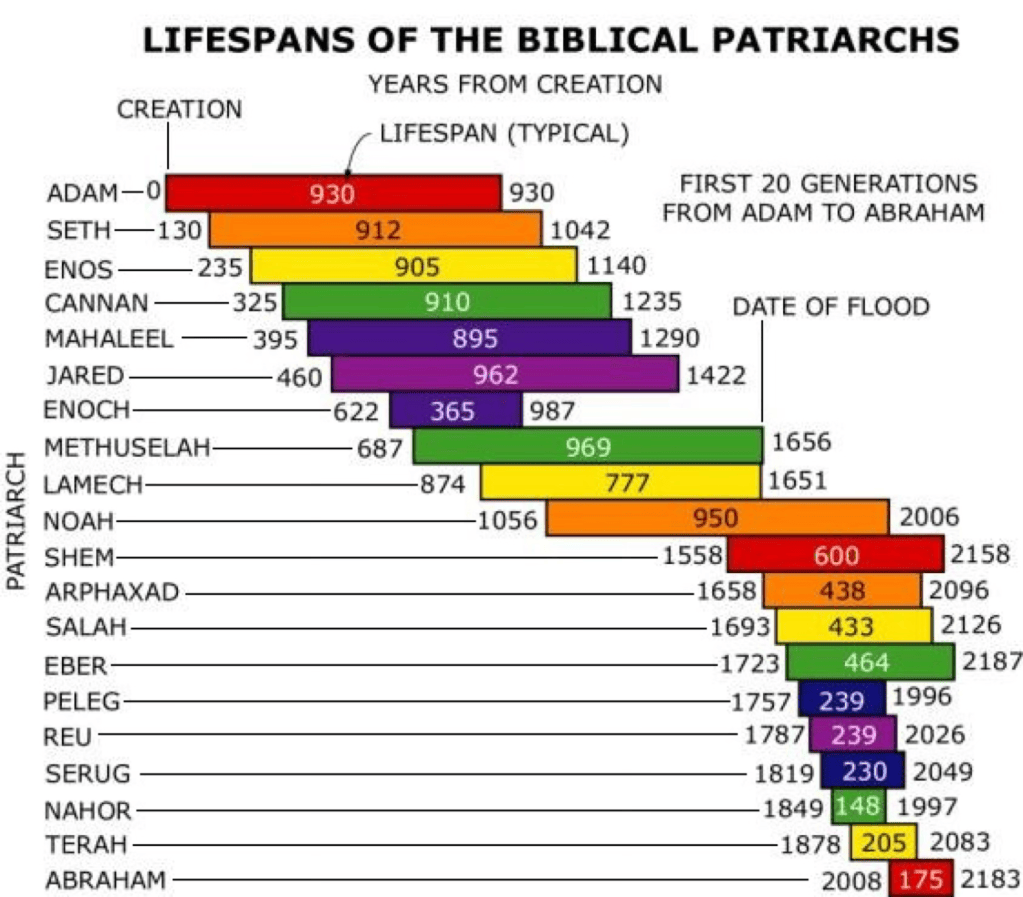
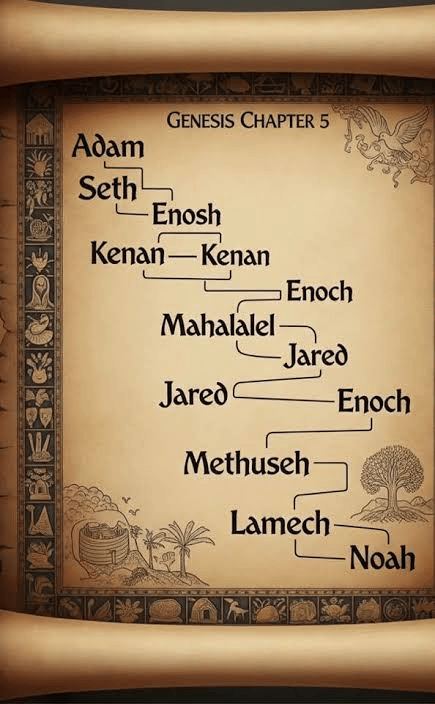
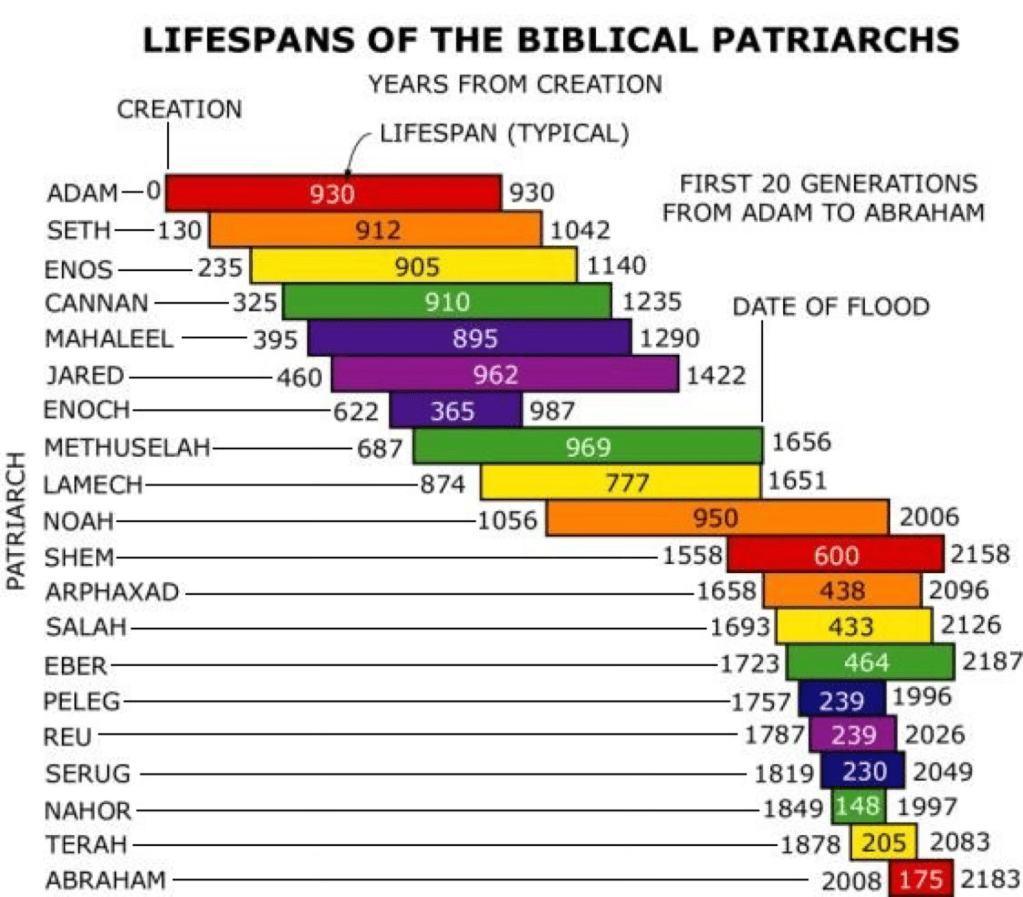
Chapter 5. Notice 5:1 this is the book of the generations of Adam (the 2nd “generations” of the outline given at the first of this blog Here is a slide of this chapter. Jesus would come from Seth. Enoch walked with God and God took him (he did not die). Methuselah lived the longest, 969 years.
Here is that slide again showing how much their lives overlapped!
Chapter 5 ends: 5:32 Noah was five hundred years old, and Noah became the father of Shem, Ham, and Japheth.” We are getting close to Noah and the flood!
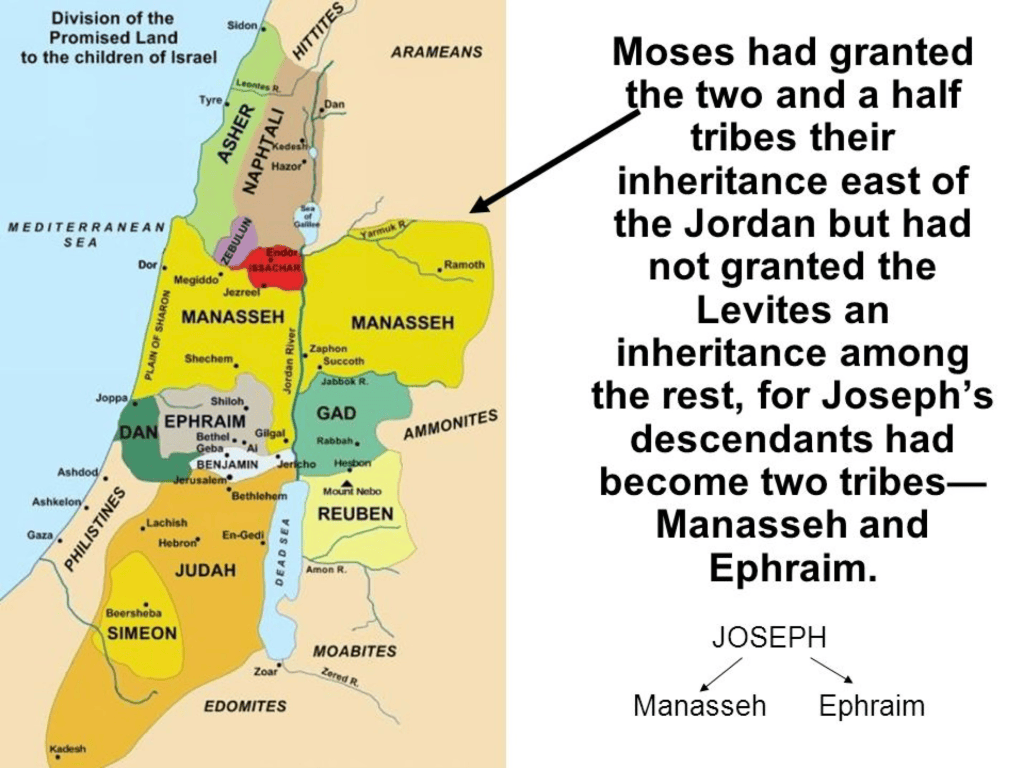
Chapter 19 continues with the last allotment of land portions to the tribes. Here again is the map.
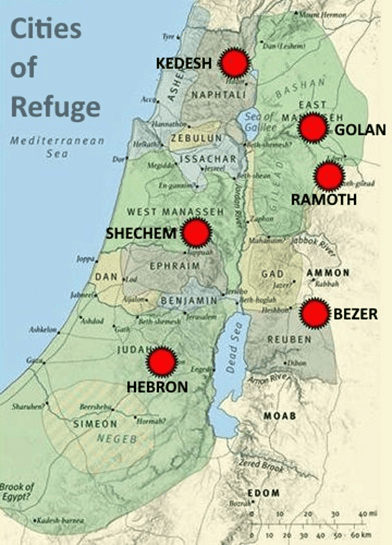
Chapter 20 gives the 6 cities of refuge. Someone guilty of manslaughter (not premeditated murder) could go to a city of refute for protection from the blood avenger of the person he/she killed. He/she would have to live in that city until the high priest died and then he could go back to his home city.
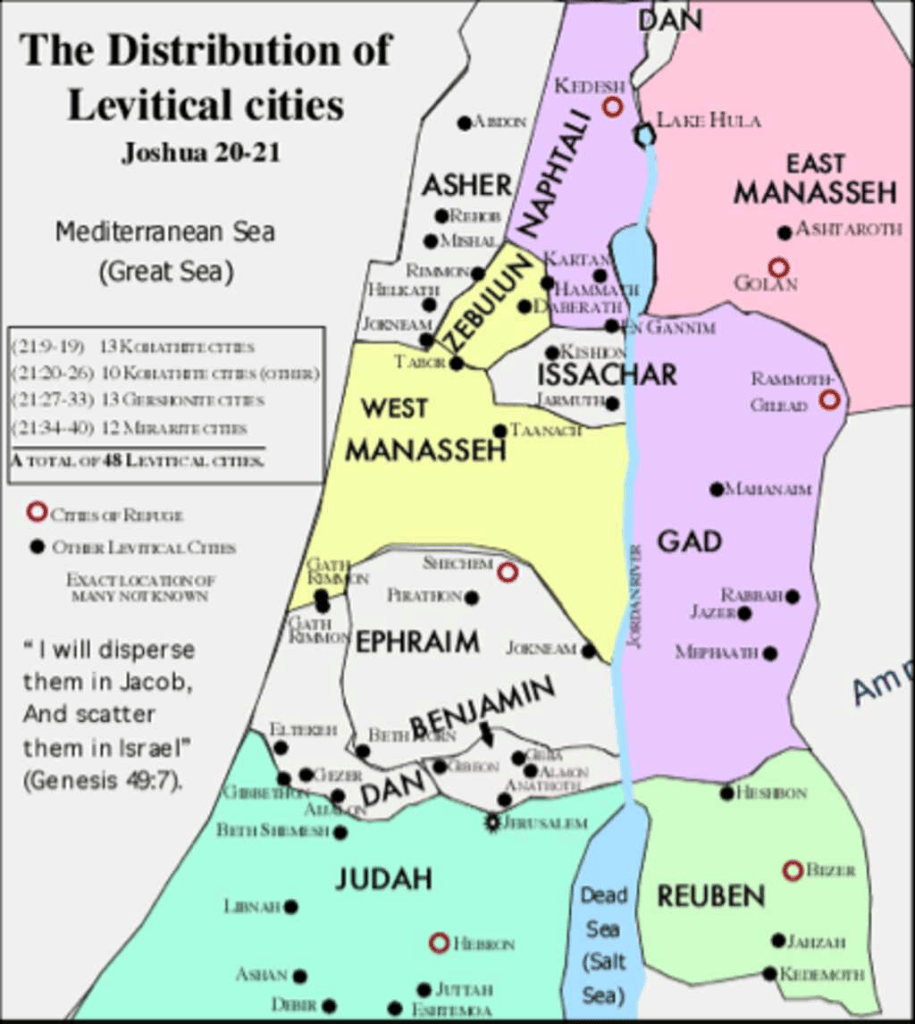
Chapter 21 is the 48 Levitical cities. AI: “They were distributed across the nation so Levites could teach God’s laws and assist with worship. Each city included surrounding common land measured out 1,000 cubits from the city wall for livestock and herds. Larger tribes provided more cities and smaller tribes gave fewer, averaging about 4 cities contributed by each of the 12 tribes.”
Chapter 21 ends with a very important statement. 21:43 So the Lord gave Israel all the land which He had sworn to give to their fathers, and they possessed it and lived in it. 44 And the Lord gave them rest on every side, according to all that He had sworn to their fathers, and no one of all their enemies stood before them; the Lord gave all their enemies into their hand. 45 Not one of the good promises which the Lord had made to the house of Israel failed; all came to pass.” God made the original promise to give Abraham the land while he was in Ur. God repeated the land promise to Abraham while he was in Haran (Genesis 12:1-3). He affirmed that promise to Isaac and Jacob. These verses say that Israel received all the land that God had promised them. AI: “Many biblical scholars and theologians state that ancient Israel never fully occupied or controlled all the territory described in the biblical promises made to Abraham. According to passages like Genesis 15:18, the Promised Land stretched from the “river of Egypt” (often identified as the Wadi of Egypt or Nile region) to the Euphrates River, encompassing vast territories well beyond modern borders. Historians and biblical scholars note that even at the height of the united monarchy under David and Solomon, Israel’s actual political control and military occupation covered a much smaller geographic area. They never ruled the entire expanse from the Nile to the Euphrates, Many evangelical and literalist theologians believe the unfulfilled boundaries mean the promise remains valid and will be completely fulfilled in a future prophetic or millennial reign.” But regardless of those points, 21:43-45 states clearly that Israel got all the land the God promised them. Not one of the. promises failed to come to pass. Period. Case closed. Now the bigger discussion will come later when the prophets predict that Israel will be restored to the land in the Messianic Age. Is that literal or figurative? We will save that discussion for later when we read the prophets. But don’t let anyone tell you Israel never got the promised land.
Chapter 22 is mainly about an altar that the 2 1/2 tribes who settled east of the Jordan built. The 9 1/2 tribes west of the Jordan were so angry that they gathered at Shiloh to attack the 2 1/2 tribes. The 9 1/2 tribes were afraid that the Lord would get angry with all 12 tribes b/c of the altar and punish them at at Peor or as He did with Achan. They accused the 2 1/2 tribes of rebelling against the Lord. The 2 1/2 tribes explained to them that they were not building the altar to offer sacrifices, which would have been a sin since all sacrifices were only to be made at the tabernacle in Shloh. They said they were just building the altar as a “witness” to future generations that they were following Yahweh just like the 9 1/2 tribes, a witness that they were still part of the nation. Phinehas the high priest and the elders of the 9 1/2 tribes were satisfied with that explanation and called off the attack plans. Civil war averted!
Chapter 23 Joshua’s farewell address. It’s too bad we have to break up the two chapters, 23 and 24, that contain Joshua’s farewell address. Joshua is in his upper 80’s at this time. He warns Israel to finish the job of conquering the rest of the land in Canaan that they had not yet conquered. If they did not finish the conquest, “they will be a snare and a trap to you, and a whip on your sides and thorns in your eyes, until you perish from off this good land which the Lord your God has given you.” 23:14 “Now behold, today I am going the way of all the earth, and you know in all your hearts and in all your souls that not one word of all the good words which the Lord your God spoke concerning you has failed; all have been fulfilled for you, not one of them has failed.” (the same as 21:43-45).
We will finish Joshua’s farewell address tomorrow with chapter 24, the last chapter of Joshua.
Joshua 9. Do you remember in Deuteronomy that God told Israel to totally annihilate all the inhabitants of all the cities in Canaan but they could make a peace treaty with cities outside of Canaan, letting them live if they would become servants to Israel. So the Gibeonites came to Joshua with worn out sandals and clothes, telling him they were from far off and wanted to make a peace treay. Joshua agreed and only 3 days later found out they had deceived him. Gibeon was very close to Gilgal where Israel camped. But Joshua said that he would keep his word and not destroy the Gibeonites, only make them servants.
Joshua 10. Five of the Canaanite kings attacked Gibeon for making this peace treaty with Israel b/c they thought it would weaken the coalition of Canaanite kings willing to fight Israel. They didn’t know that the Gibeonites had deceived Israel. So Joshua marched all night with his army to rescue the Gibeonites. The armies of the 5 kings were slaughtered with the Lord killing many with hailstones (more than the Israelites killed). Joshua needed more time to finish chasing down and killing the Canaanites, so he asked God to make the sun and moon stand still until they finished teh slaughter, and God did so. 9:13 Is it not written in the book of Jashar? And the sun stopped in the middle of the sky and did not hasten to go down for about a whole day. 14 There was no day like that before it or after it, when the Lord listened to the voice of a man; for the Lord fought for Israel. I do believe that this happened. I can’t explain how it happened. I know that scientifically the sun doesn’t even really move across the sky although it looks that way to us and the Bible speaks of it that way in accommodation language. But the Lord who made the sun from nothing and set in motion the laws of planetary orbits could make it stay daylight for an extra day. They finish the slaughter and Joshua killed the 5 Canaanite kings.
Life Lesson: If you were Joshua and you needed more hours of daylight to finish a complete slaughter of the Canaanites, would you have ever thought to ask God to make the sun stand still and give you an extra day of daylight? Have you ever asked God for something really crazy, something really out of the ordinary, something almost miraculous if not miraculous? Don’t be afraid to ask. James says “you have not b/c you ask not”. Think of something that you would really like God to do. Maybe it’s helping you find a mate. Maybe it’s working out a big issue in your marriage. Maybe it’s a major illness or injury that your loved one is facing. Mabye it’s a career change. I’m thinking of something that I want to see happen but there will need to be some big changes first. I’m going to ask God to make it happen and then trust Him, His will be done.
Chapter 10 then describes the conquest of southern Palestine. Chapter 11 describes the conquest of northern Palestine. Chapter 12 names the 31 kings that Joshua and the Israelites defeated and killed.
Chapter 13 begins: 13:1 “Now Joshua was old and advanced in years when the Lord said to him, “You are old and advanced in years (probably in his late 80’s), and very much of the land remains to be possessed.” He is told to give the land of Canaan west of the Jordan River to the 9 1/2 tribes (the half of the tribe of Manasseh) and to give the land east of the Jordan to the 2 1//2 tribes of Reuben, Gad, and half of the tribe of Manasseh. Here is a great map of the land that Israel had not yet conquered as Joshua neared the end of his life. As you can see, there was still a lot of land to be conquered. Unfortunately, they did not finish conquering those lands. Notice they did not conqueer the Philistines and the Philistines will be a major thorn in their side in the future just as God predicted.
The next thing will be the actual division of the parts of Canaan that they did conquer.
Here is a map of the land of Canaan at the time of Joshua to help see where the different cities are.
Joshua 4 The memorial stones from the crossing of the Jordan River. That crossing with the ark held by the. priests in the middle while the waters were held back and all Israel crossed over cand best be summed up by Joshua 4:14 On that day the Lord exalted Joshua in the sight of all Israel; so that they revered him, just as they had revered Moses all the days of his life.” Moses had brought the Israelites out of Egypt with miraculous signs and wonders, had parted the Red Sea and drowned the Egyptian chariots, and had led Israel 40 years in the wilderness. It was important for God to confirm that Joshua had been appointed by God to take Moses’ place and lead the people to conquer Canaan. So they took 12 stones from Jordan River bed, one for each tribe, and made a memorial so they could tell their children that God had dried up the water of the Jordan just like God parted the Red Sea. Life Lesson: If you have children, are you teaching your children the Bible stories about the amazing acts of God in history? It is our responsibility as parents to teach our children what God has done. Don’t leave it to the Sunday school teachers at church, although that is a great supplement. You should teach them at home. Read Bible stories and pray with them. I am so thrilled to hear about Eastern European Mission printing hundreds of thousands of children’s Bible story books and giving them out all across eastern Europe and to the Ukraine. I hear so man wonderful stories of children so excited about getting one of the books. Praise God for the work of EEM. $5 can print and distribute one children’s Bible story books. That’s a cup of coffee at Star Bucks!
Joshua 5 Circumcision and Passover. When the Canaanite kings heard how God dried up the Jordan and thatBut Israel had crossed over the Jordan, their hearts melted with fear. But there was something that Israel needed to do before beginning the conquest of Canaan. Apparently they had not circumcised any of the male babies born during the 40 years in the wilderness, so they had a mass circumcision. This was risky. Do you remember when Simeon and Levi convinced all the men of Shechem to be circumcised so they could presuamably marry into Jacob’s family? It was a cunning, deceptive plot. When the circumcised men of Shechem were “laid up” after the circumcisions, they were unable to fight and Simeon and Levi came in and killed them all as revenge for the ruler Shechem raping their sister Dinah. So Israel was taking a big risk by getting circumcised. The Canaanite kings could have heard about that and attacked the newly circumcised Israelite men while they were weak from the circumcision. 5:9 Then the Lord said to Joshua, “Today I have rolled away the reproach of Egypt from you.” So the name of that place is called Gilgal (which means “rolling”) to this day.” The place was also called Gibeath-haaraloth (which means “hill of foreskins”). You can imagine the mound of foreskins from 600,000 men! Gross.
While camped at Gilgal, they observed the Passover on the 14th day of the 1st month of the Hebrew calendar. This was a big deal. Apparently they had not celebrated the Passover since they were at Sinai in the 2nd year after coming out of Egypt. That’s 39 years of no Passover. Those born during that 39 years were never circumcised and you couldn’t eat the Passover if you weren’t circumcised. Those over 20 were destined to die in the wilderness and probably didn’t even care if they did the Passover. Not only that, but Acts 7 tells us, 7:42 But God turned away and delivered them up to serve the host of heaven; as it is written in the book of the prophets, ‘It was not to Me that you offered victims and sacrifices forty years in the wilderness, was it, O house of Israel? 43 You also took along the tabernacle of Moloch and the star of the god Rompha, the images which you made to worship.’ The Israelites over 20 who were destined to die in the 40 years were worshipping false gods so they would not have been interested in keeping the Passover.
The “captain of the Lord’s hosts” came as a man to meet Joshua. He told Joshua to take off his sandals b/c he was standing on holy ground, i.e. in the presence of the Lord Himself in the form of a man, possibly the pre-incarnate Jesus. Do you remember that Moses was told the same thing at the burning bush in Exodus 3:5? This man is the one doing the speaking in chapter 6.
Joshua 6. It is the captain of the Lord’s host who is still speaking to Joshua, and yet it says “The Lord said to Joshua…” So the man was the Lord himself, God taking the form of a man to give Joshua the battle plan for taking Jericho. Think about how crazy this battle plan sounded to Joshua and the fighting men of Israel. March around the city once a day without saying word for 6 days and then march around the city on the 7th day, blow the trumpet, and shout and the walls will come tumbling down! It would take about an hour for the 40,000 men to walk around Jericho. Everyone in the city would have heard the continuous blowing of the trumpets as they marched, which was probably eerie. But then on the 7th day, up to 7 hours of non stop trumpet had to be rattling for the people in the city, as if they knew something big was about to happen. Imagine their horror as they heard this loud shout of 40,000 men and the walls start tumbling down all around the perimeter of the city. That is, all but the part of the wall with Rahab’s house. The 2 spies were told to go rescue Rahab and her family, and they did. A ban was put on taking anything from the city as spoils or booty (remember that). Everyone and everything in the city was to be destroyed and the city burned. A curse was put on anyone rebuilding the city with the loss of his oldest and youngest sons. Hiel of Bethel attempted and completed the rebuilding of Jericho during the reign of King Ahab, according to the biblical account in 1 Kings 16:34. According to the text, Hiel laid the foundation at the cost of his oldest son, Abiram, and set up the gates at the cost of his youngest son, Segub, fulfilling Joshua’s warning. This may interest your from AI:
Archaeologists have found collapsed ancient fortification walls at the site of Tell es-Sultan (ancient Jericho), but how those findings connect to the biblical account remains a subject of ongoing scholarly debate. What Archaeologists Discovered:
Excavations led by figures like John Garstang, Kathleen Kenyon, and more recently Lorenzo Nigro have uncovered extensive ruins at Jericho, revealing a history of massive defensive walls and violent destruction: Scholars debate if these ruins are the actual ruins of the fall of the walls under Joshua.
Collapsed Bricks: Excavations found fallen piles of mud-brick retaining walls at the base of the mound, which researchers noted had collapsed outward.
Burn Layers: Archaeologists identified a thick layer of ash and burn debris, indicating the city met its end in a massive fire.
Stored Provisions: Large jars filled with charred grain were discovered intact, suggesting the city was conquered rapidly rather than starved out during a long siege.
Joshua 7. Chapter 7 is difficult to discuss. Achan violated the ban on Jericho and took gold, silver, and valuable mantle from Jericho and buried them in his tent. B/c of that, Israel was defeated when they sent 3,000 men to take the small city of Ai. At least 36 Israelites were killed and the Israelite force was routed by the man of Ai. Joshua started questioning God about why He had let them lose the battle, how the other Canaanites would hear about the defeat and take courage to fight Israel. God told him there was sin in the camp. Joshua went tribe by tribe, family by family, down to individuals until he found the guilty party, Achan, who confessed. So they took Achan, his sons, his daughters, his livestock, and all his possessions and stoned them to death and burned them. They raised over them a heap of stones and called it the valley of Achor (which means trouble).
BTW there might be a little Life Lesson here. Don’t take success for granted. Joshua was relying on his own knowledge and military reasoning. He thought 3,000 men would be plenty to take Ai, but he never consulted with the Lord, “Lord should we take Ai now?” If he had, the Lord would have told him to deal with the sin in the camp first and then go take Ai. James warned us about that: James 4:13 Come now, you who say, “Today or tomorrow we will go to such and such a city, and spend a year there and engage in business and make a profit.” 14 Yet you do not know what your life will be like tomorrow. You are just a vapor that appears for a little while and then vanishes away. 15 Instead, you ought to say, “If the Lord wills, we will live and also do this or that.” 16 But as it is, you boast in your arrogance; all such boasting is evil.” Always consult God before decisions.
But what bothers me are 2 nagging questions. 1) Why was all Israel punished by the defeat at Ai when it was just one man who violated the ban? There doesn’t seem to be any indication that anyone else knew about what Achan did. I really can’t answer my own question! I read where scholars try to explain it as “corporate personality”, i.e. a group stands or falls together as one. All I can say is that God wanted to make an example to Israel of what happens when someone disobeys Him. It is sad that at least 36 innocent men died to make that example. Maybe God is saying that Israel should have been more careful to make sure no one took anything from the city. They could have placed more guards to watch for anyone coming from the city with valuables. What I do know is that God’s people must purge the corporate body of anyone who sins repeatedly and will not repent. In 1 Corinthians 5 Paul tells the church to withdraw fellowship from unrepentant church members, to quit eating and fellowshipping them. 2) Why were Achan’s sons and daughters stoned to death along with Achan for his sin? There is no indication they had anything to do with his sin. Of course if they did know, they should have reported it to Joshua. Deuteronomy 24:16 Fathers shall not be put to death for their sons, nor shall sons be put to death for their fathers; everyone shall be put to death for his own sin.” So it looks like a complete violation of that verse to kill his children, which is why some scholars say that the children must have known about his sin but didn’t report it. Maybe so. For sure, it shows how much responsibility God puts on fathers to lead their families in the right way. I guess I need to quit asking questions that I can’t satisfactorily answer. I wish I could hear your comments as you study this dilemma.
The preacher where I was raised preached a sermon “Sin in the Camp” when I was about 14. He got up and just said “there is sin in the camp here at this church”, and then he sat down. They sang another song and he got back up and finished the sermon, telling about the story of the sin of Achan. That kinda shook us all up a little and I got baptized that morning! Some others came forward also to confess sins. Looking back I totally disagree with what the preacher did but it got me in the water! Of course, I think I was baptize with one thing in mind, “to not go to hell”. I was baptized again at age 21!
Joshua 8. The conquest of Ai. Having dealt with Achan, Joshua set up a plan to ambush the men of Ai and destroyed 12,000 “men and women” in Ai and burned the city. He hanged the king of Ai. So things are back on track to conquer Canaan. Then Joshua had half the 12 tribes stand on Mt Ebal and half on Mt Gerizim. He read the blessings and curses of Deuteronomy 27-28 just as Moses had told the people to do when they entered Canaan. Locate Jericho, Ai, and Gilgal on the map.