
2 Peter 1:1 Simon Peter, a bond-servant and apostle of Jesus Christ, To those who have received a faith of the same kind as ours, by the righteousness of our God and Savior, Jesus Christ: 2 Grace and peace be multiplied to you in the knowledge of God and of Jesus our Lord, 3 for His divine power has granted to us everything pertaining to life and godliness, through the true knowledge of Him who called us by His own glory and excellence. 4 Through these He has granted to us His precious and magnificent promises, so that by them you may become partakers of the divine nature, having escaped the corruption that is in the world on account of lust.” Those saved in Christ have the precious and magnifient promise of eternal life, but it is conditonal. Hebrews 6:4-6 discusses the fate of those “who have once been enlightened and have tasted of the heavenly gift and have been made partakers of the Holy Spirit, 5 and have tasted the good word of God and the powers of the age to come, 6 and then have fallen away.” It says that it is impossible “to restore them again to repentance, since they again crucify to themselves the Son of God and put Him to open shame.” Sounds like you can fall from grace, doesn’t it? That refutes Calvinism’s “P” perserverance of the saints (i.e. it is impossible to fall from grace if you are the elect).
So how do we make sure that we receive those magnificent promises? Hebrews 6:11 And we desire that each one of you demonstrate the same diligence so as to realize the full assurance of hope until the end, 12 so that you will not be sluggish, but imitators of those who through faith and endurance inherit the promises.” The Greek word for “diligence” is spoudé: Diligence, earnestness, zeal, effort. It is the same word that Peter then introduces the need to zealously, earnestly, diligently, make every effort to attain the qualities in the growth “ladder” that will keep one from being “ineffective or unfruitful”. 2 Peter 1:5 Now for this very reason also, applying all diligence (spoudé), in your faith supply (epichorégeó: To supply, to provide, to furnish abundantly) …. (and then he gives the qualities). Here is a great image from plumblineministries.org
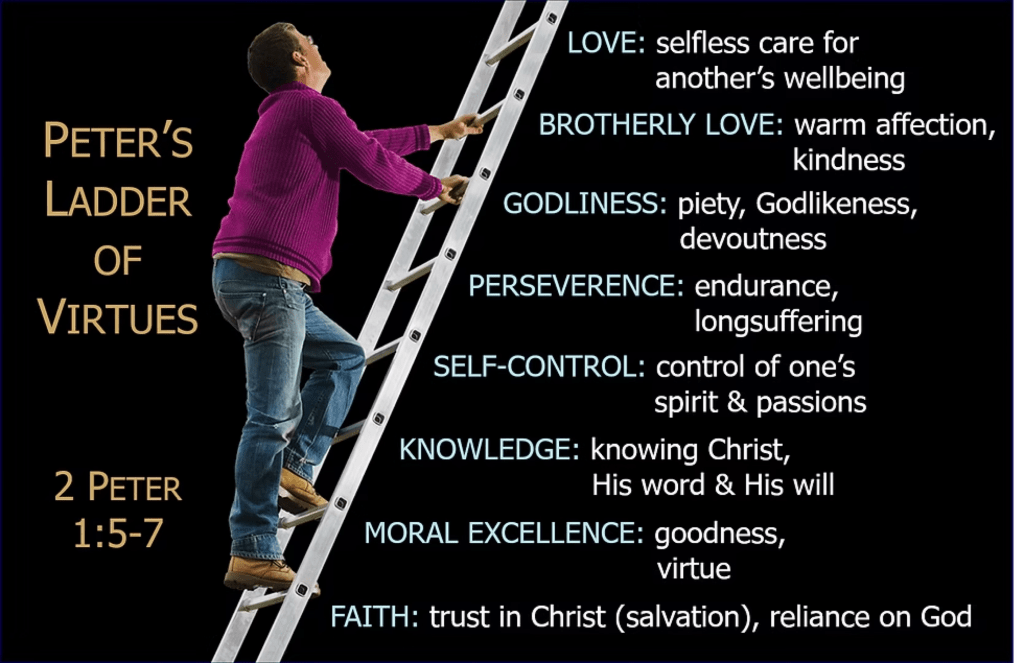
The progression of these qualities can be looked at in two ways. 1) The “progressively successive view”. You need to achieve success in each step, beginning with the first step, in order to proceed to the next step. You must learn to walk before you can run. You must pass Math 101 before you can take Math 102. In this view, the first thing you should make effort to add to your initial saving faith is moral excellence, (i.e. stopping your patterns of sinful behavior and doing virtuous things). Once you have success in moral excellence, you should add the next step which is knowledge of Christ and His will (i.e getting to know Christ in a more personal relationship than just initial knowledge of how to be saved). Once you have success in that step, add self-control (which can be difficult and takes great effort). Once you have success in that step, add perseverence (i.e. proving that your faith is real by being faithful under trials over a long period of time). Once you have success in that step, add godliness (i.e. becoming more Godlike in your devotion and reverence to God). Once you have success in that step, add brotherly love (philadelphia: Brotherly love, love of brothers, mutual affection between others in your new spiritual family). Once you have success in that step, add love (agapé: Love: affection that doesn’t depend on affection from the recipient, the kind that as a Christian you have for your enemies, the kind that Jesus had when he died for sinners). It is plausible that a Christian would first learn to have affection for fellow believers before he grows to be able to love his enemies which is much harder to do! So there is some merit to this first view. 2) The “soup view”. These qualities are just ingredients to put in a soup of virtues that will make you effective and fruitful and it doesn’t matter in what order you add them. A soup recipe might say, “add peas, corn, ground beef, potatoes, green beans, tomatoes, broth; stir the ingredients and heat for one hour at 325 degrees”. It wouldn’t matter what order you put the ingredients in a bowl. So this 2nd view just lists the virtues but it doesn’t matter what order you attain them You might become very loving toward your spiritual family long before you learned to control your temper or lustful thoughts. This view has merit also!
It doesn’t matter which view is correct. What matters is that we zealously, sincerely make “every effort” to add these virtues to our initial saving faith so that we won’t be “ineffective or unfruitful” Christians. Jesus said that we, as branches on a fruit tree, must bear fruit or we will be cut off and burned (John 15). The parable of the soils had a 3rd soil where the seed was sown among the thorns. A plant grew but b/c of the weeds (worries, riches, and pleasures of this world) the plant was unfruitful. It was only the 4th good soil that produced fruit (some good soil plants produced more fruit than others). Colossians 1:10 mentions bearing fruit in every good work. Galatians 5:22-23 lists the fruit of the Spirit (love, joy, peace, patience, kindness, goodness, faithfulness, gentleness, self-control).
Peter then adds, 2 Peter 2:9 For the one who lacks these qualities is blind or short-sighted, having forgotten his purification from his former sins. 10 Therefore, brothers and sisters, be all the more diligent to make certain about His calling and choice of you; for as long as you practice these things, you will never stumble; 11 for in this way the entrance into the eternal kingdom of our Lord and Savior Jesus Christ will be abundantly supplied to you.” The Greek word for “short-sighted” is muópazó: To be short-sighted, to see dimly but it means “near-sighted” (can’t see far off). “By choosing this rare word (used only once in the NT), Peter invokes the plight of spiritual nearsightedness: a believer whose vision is restricted to present impulses and earthly concerns, forfeiting the larger horizon of salvation history and future glory.” (AI) The problem with his spiritual eyesight is that he has forgotten his former purification from sin and has lost the gratitude he should have for Jesus’ dying for him. All Christians are excited when they first got saved and want to show gratitude to Jesus by zealous Christian living. But often as time goes on we often are more focused on earthly things and lusts instead of eternal life. We lose our “diligence” and don’t give our best “effort” to grow spiritually. We become complacent spiritually. We “stumble’, maybe even fall from grace. BTW another refutation of Calvinism in these 3 verses. In Calvinism, “U” is “unconditional election”, i.e. a certain number, the elect, have been chosen, preordained, predestined, and called. There are no conditions to be met on their part. The Spirit will come upon them and enable them to believe and find out that they are the elect. They can’t fall from grace after that. If Calvinism were true, there would be no “be diligent to make certain about His calling and choice of you” and there would be no “practice these things so you will never stumble”. In Calvinism, His calling would be certain without any effort of our part. It doesn’t sound like Peter is preaching Calvinism, does it?
So as you finish reading this article, look at those virtues on that ladder. In the progressively successive view, are you stuck on the 3rd step and can’t go higher b/c you are not growing in the virtue on that 3rd step? In the soup view, which one(s) of the virtues are really weak in and need to make more effort to grow in that virtue? Make a more diligent effort. Ask the Spirit to help you.

