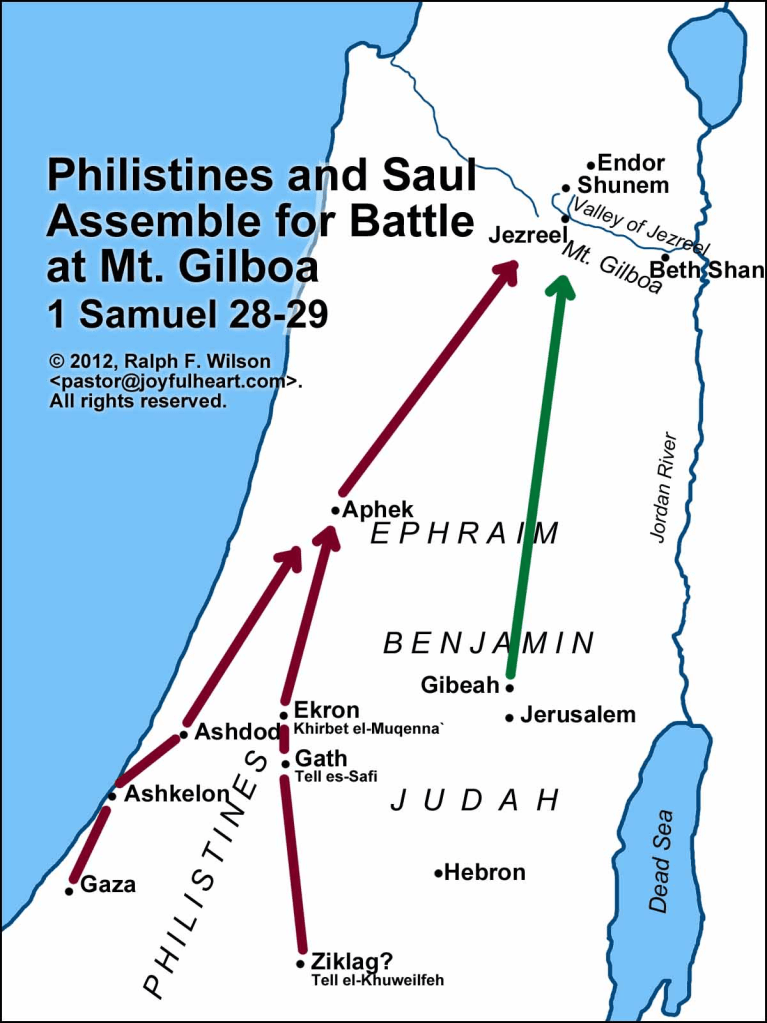
1 Samuel 30 Ziklag. Achish sent David back to Ziklag where David’s wives and the families of his men were living. While David had been off with Achish, Amalekites had raided Ziklag and taken captive David’s two wives and the families of the 600 men fighting with him. His men spoke of stoning David. He inquired of the Lord using the high priest ephod to see if he should pursue the Amalekites, and was told to do so. He took 400 men, leaving 200 exhausted men with the baggage, and rescued the captives, slaughtering the Amalekites. The 400 men who went did not want to share the spoils with the 200 who stayed with the baggage, but David said “The share of the man who stayed with the supplies is to be the same as that of him who went down to the battle. All will share alike.” 25 David made this a statute and ordinance for Israel from that day to this.” David shared the spoils from the raid with the people of Judah living in cities of Judah. That’s a great principle today. Many go off into foreign fields to do the Lord’s work and many, for whatever reasons, stay back in the US and support those who go. They share the “spoils” of success equally. I read every day where EEM partners in Europe deliver Bibles and see the joy of those receiving them. I get to share in that great work by supporting EEM.
1 Samuel 31 Mt Gilboa: The death of Saul and his 3 sons. As Samuel predicted, Saul and his 3 sons died at Mt Gilboa in a battle with the Philistines. Saul took his own life so a Philistine could not kill him. The Philistines found him, cut off his head and fastened the bodies of Saul and his sons to a wall. The men of Jabesh-Gilead (the city Saul rescued from having their right eyes put out) came and took down the bodies, burned and buried them. Thus ends the life of King Saul.
2 Samuel 1 An Amalekite brings Saul’s crown to David and claims that he killed Saul at Saul’s request having been critically wounded. We know that was not true (Saul killed himself) but the Amalekite thought David would give him a reward so he lied. Instead David had him killed for “killing the Lord’s anointed”. Then David took up a “lament” for Saul and Jonathon that is recorded in the book of Jashur. There are many such books that were not considered worthy of being put in the Old Testament canon. 3 times he says, “How the mighty have fallen”. He especially grieved over the death of Jonathon. 1″25 Jonathan lies slain on your heights. 26 I grieve for you, Jonathan my brother; you were very dear to me. Your love for me was wonderful, more wonderful than that of women.” It is sad that some try to make this imply homosexual love between Jonathon and David. The Law of Moses clearly condemned homosexuality. They just had a special, deep, non-sexual bond of spiritual brotherhood, political alliance, and covenant loyalty (comparable to ancient Near Eastern friendship pacts) rather than erotic love. (Marc Sims, Cross Examined)
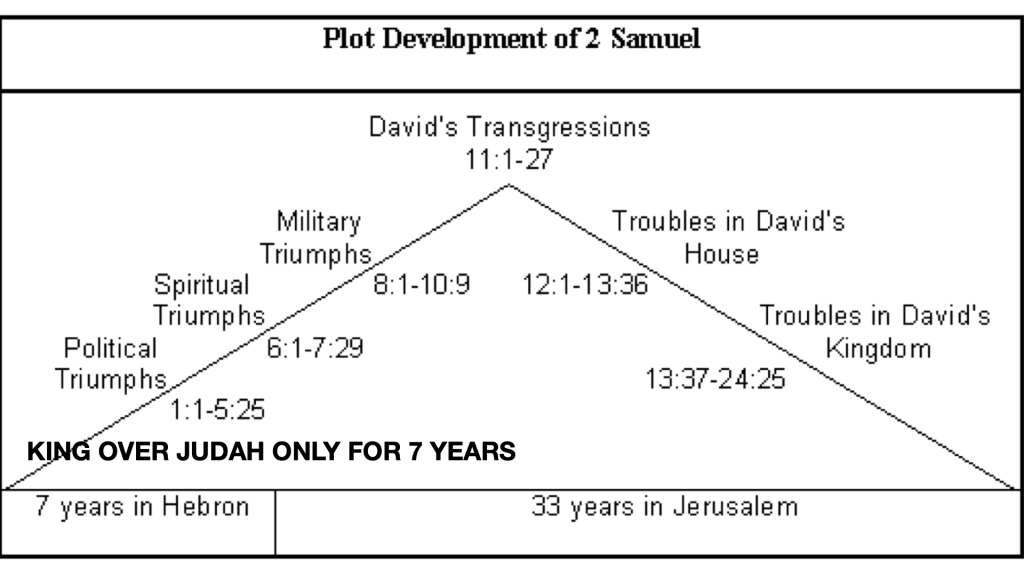
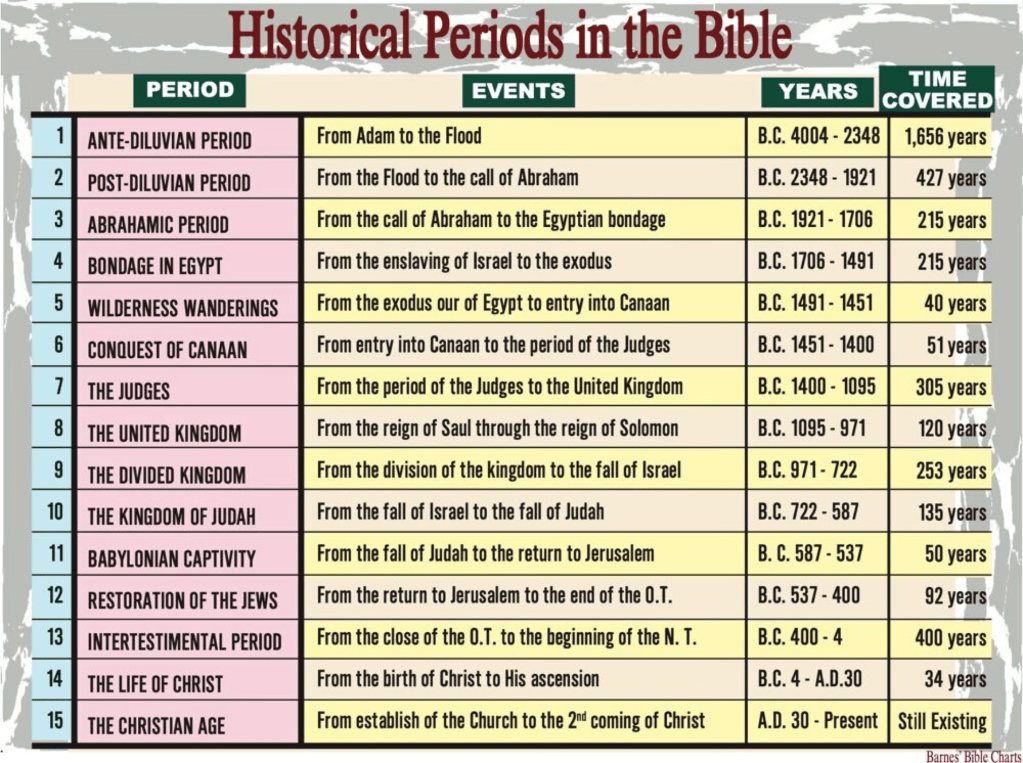
Here is a great slide that I will use for David’s life as king in 2 Samuel.
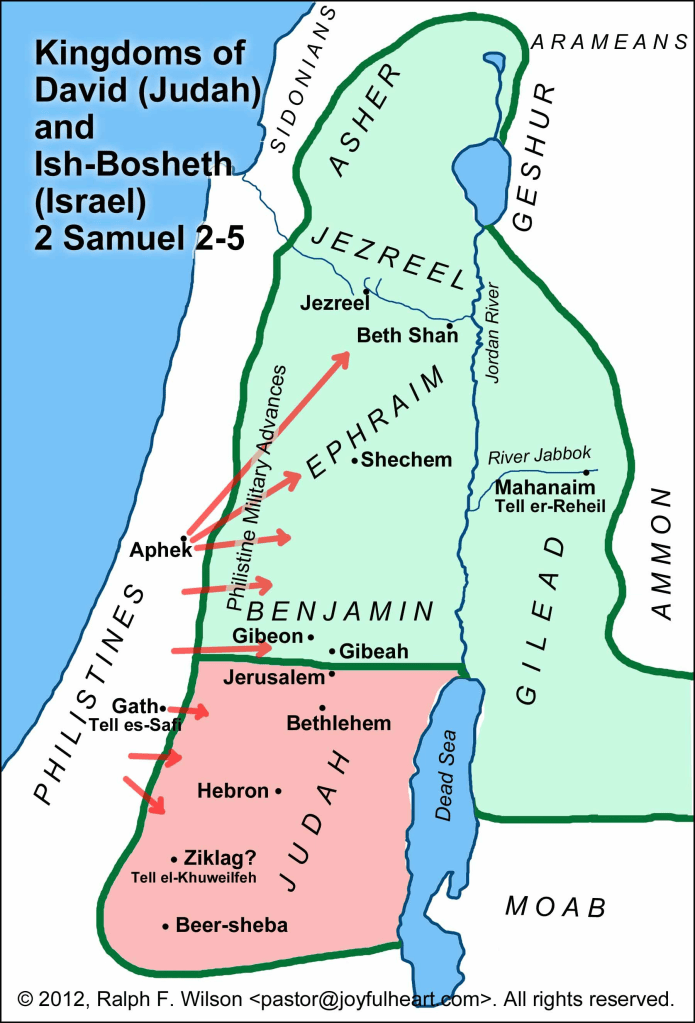
2 Samuel 2 David is anointed in Hebron as king but only of the tribe of Judah. He will be king over Judah only for 7 1/2years. Saul’s commander Abner makes Saul’s son Ish-Bosheth (obviously not one of Saul’s sons killed at Mt Gilboa) king over the other 11 tribes. Ishbosheth will only reign as king for 2 years and then there was 5 years of civil war before David is made king over all 12 tribes after being king over Judah for 7 1/2 years. The 5 year gap between when Ishbosheth died and David became king over all 12 tribes has been explained with several different theories that we won’t get into here. There was so much violence during this time. Abner, Ishbosheth’s commander, and Joab, David’s commander, meet and each sends out 12 men who battle hand to hand. 2: 16 Then each man grabbed his opponent by the head and thrust his dagger into his opponent’s side, and they fell down together.” Abner and Joab were just sitting back watching the slaughter like people watch WWF violence, nothing but a sport. Joab’s brother Asahel chased Abner and Abner told him to stop b/c he did not want to kill him. He wouldn’t stop and Abner killed him, thrusting the butt of his spear through Asahel’s stomach, implying that he is trying to get away from Asahael, not even facing him when he rams the butt end of his spear backwards into Asahel. Joab and Abner agree to stop fighting for the time being.
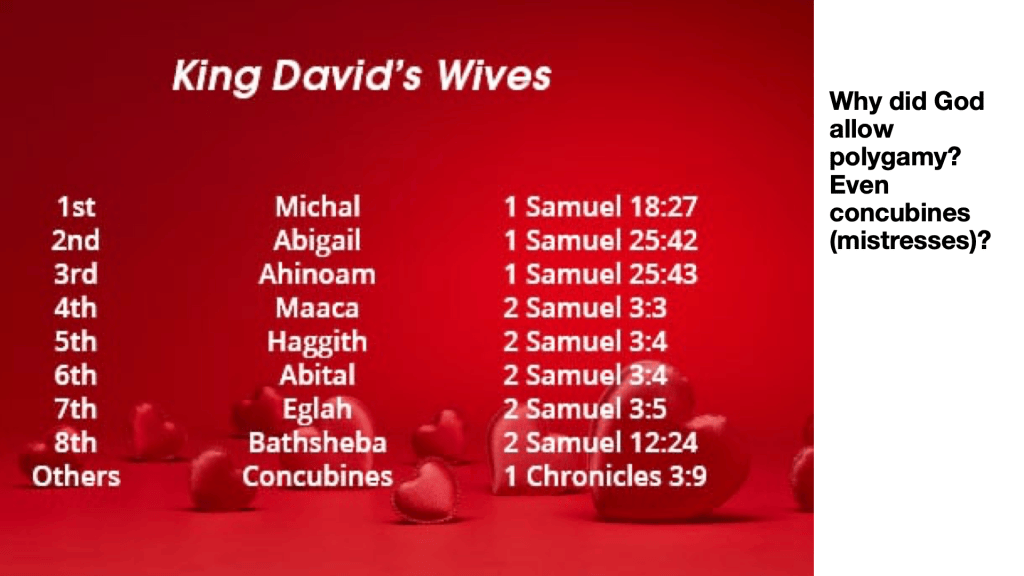
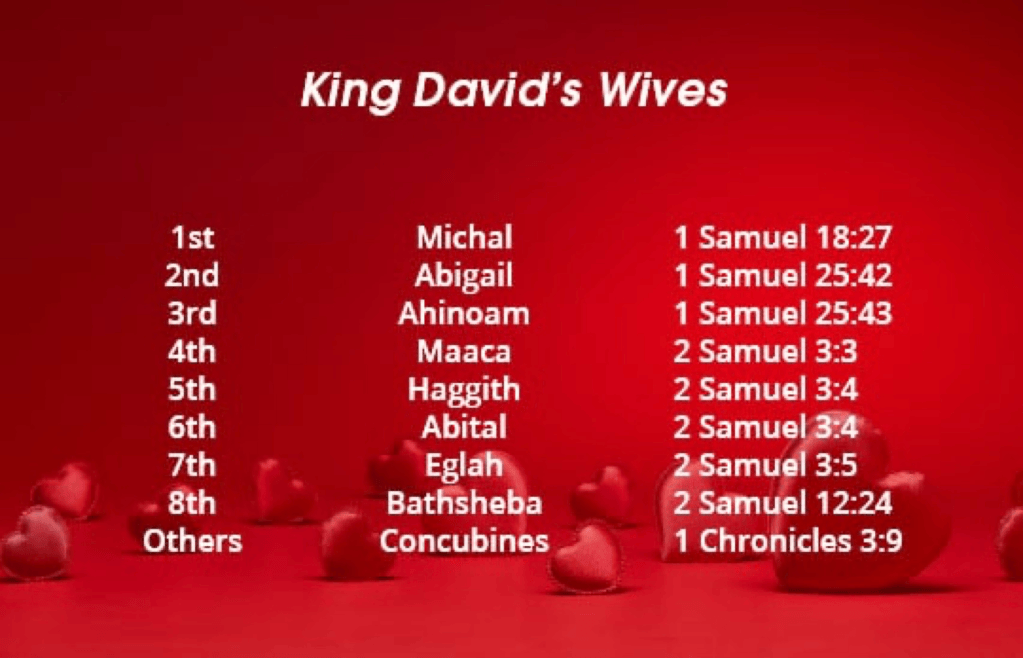
2 Samuel 3 David’s wives. There was also a lot of polygamy. David had 8 wives and many concubines. I don’t understand why God allowed that, especially why he allowed concubines which were just basically mistresses. David had 19 named sons and many more sons by his concubines. Even David violated one of the warnings Moses gave Israel about the bad things that a king would do, i.e. have many wives.
Sounds like a soap doesn’t it? Abner is angry with Ishbosheth b/c he criticized Abner for sleeping with his concubine. Ishbosheth was afraid of Abner and said no more. So Abner switches allegiance to David and to getting all 12 tribes to accept David as king. But David makes that conditional on returning his wife Michal to him (Saul had given her to Paltiel) which Abner did. Kinda sad: 3:16 Her husband, however, went with her, weeping behind her all the way to Bahurim. Then Abner said to him, “Go back home!” So he went back.” David sends Abner away in peace to persuade the 11 tribes to make David their king. Joab was angry with David for letting Abner go, accusing him of just being a spy. So Joab gets Abner to come back to Hebron and killed Abner for killing Joab’s brother Asahel! David claimed innocence in the killing of Abner and put a curse of Joab’s family. David mourned the death of Abner. 3: 37 So on that day all the people there and all Israel knew that the king had no part in the murder of Abner son of Ner.” That was an important political move on David’s part to get the 11 tribes to trust him. David admitted that Joab and his brothers were “too strong” for him and he was basically afraid of Joab.
Stay tuned for the next episode of this soap! Keep readying the texts and the blogs!
We continue to name and number the places David fled to during the 10 years that Saul was pursuing him
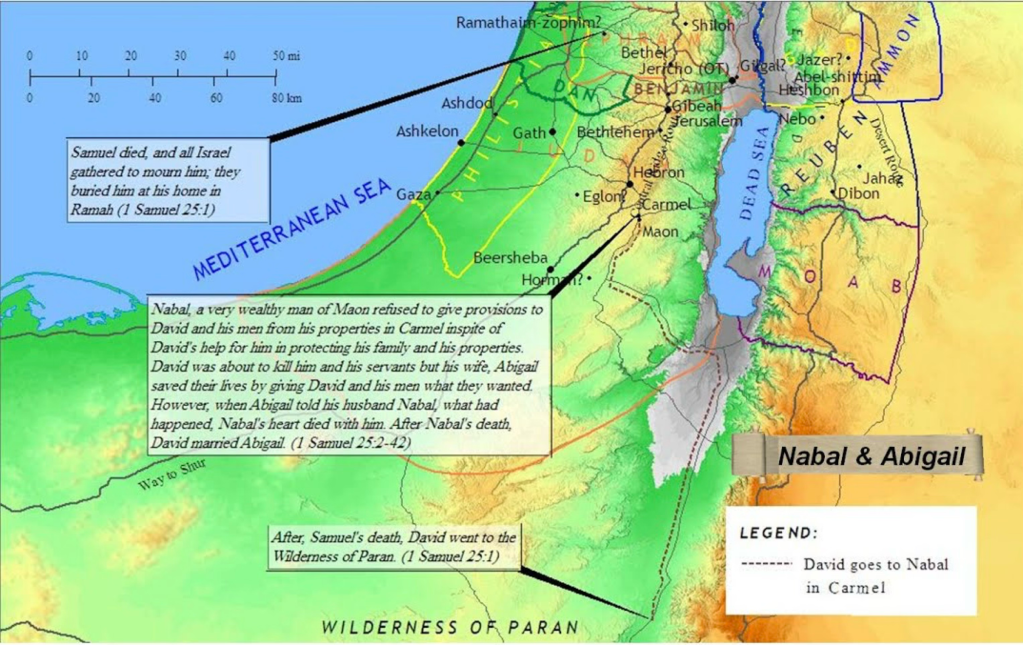
10. Wilderness of Paran 1 Sam 25. A very rich but harsh, evil business man, Nabal, refused to give David sheep for his men even though David’s men could have raided Nabal’s sheep in the fields but did not. David gets 400 of his men ready to go kill Nabal and his servants, and take what they want. Nabal’s wife, Abigail, brought plenty of food to David without Nabal knowing, and asked him not to kill Nabal. David concluded that the Lord had sent her to keep him from seeking vengeance in anger, and thanked her for her discernment. Many New Testament verses tell us not to ever seek revenge against our enemies or seek retaliation. When Abigail returned to Nabal and he found out what she had done, his heart died within in and the Lord struck him dead 10 days later. David took Abigail as his wife, along with Ahinoam, b/c Saul had given his wife Michal to Palti. Here’s a map showing where the wilderness of Paran was located.
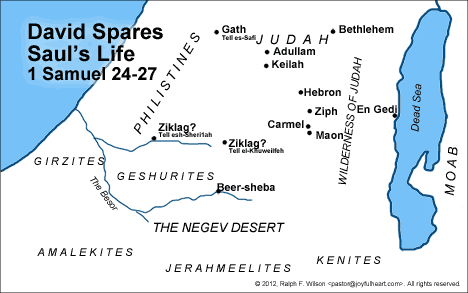
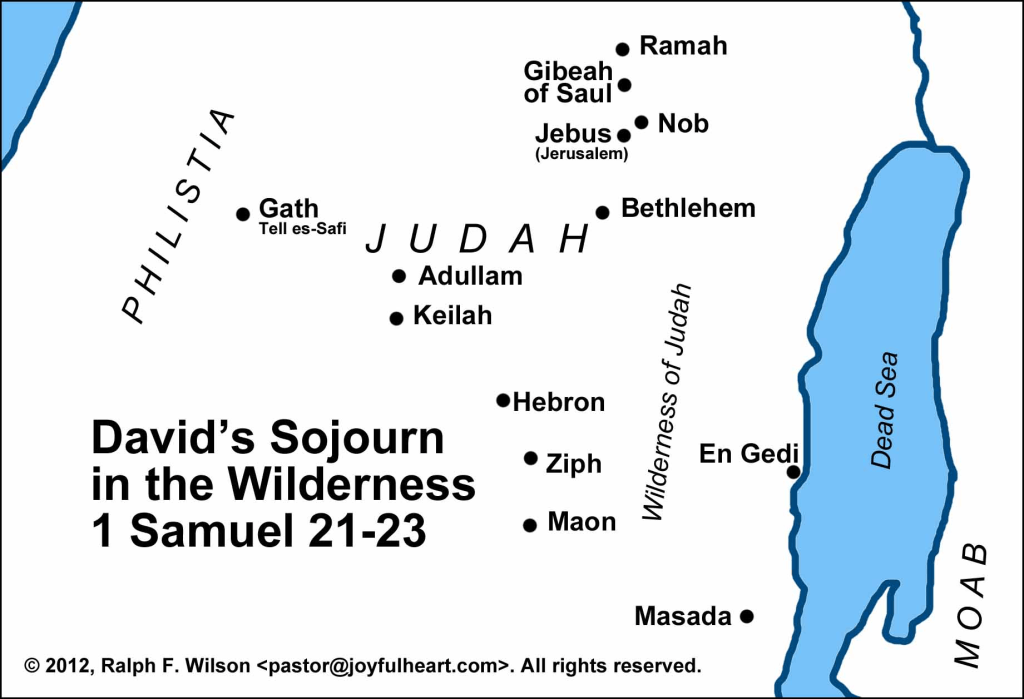
Here’s a map of places David fled to in 1 Samuel 24-27.
11. Wilderness of Ziph 1 Sam 26 The Ziphites told Saul where David was, and Saul took 3000 men to pursue him. David’s spies told him where Saul’s camp was, so David sneaked in and took Saul’s spear and jug of water, even though Abishai was telling him to kill Saul. From a distance David called out to Abner, showing him the spear and jug. Saul, as in the cave in 1 Sam 24, seems penitent again, and leaves.
12. Gath 1 Sam 27 David decides that his only choice is to escape to the Philistine king of Gath for protection, and Saul, upon hearing that, no longer searched for him. The king Achish gave David the city of Ziklag so David’s wives and the families of his men would eventually all be living in Ziklag. While telling Achish that he is raiding Israelites, he actually is raiding non-Israelite enemies of Achish, killing everyone both men and women there so there would be no witnesses. The Philistines prepared for war against Israel, and Achish trusted David to be his bodyguard for life and David agreed.
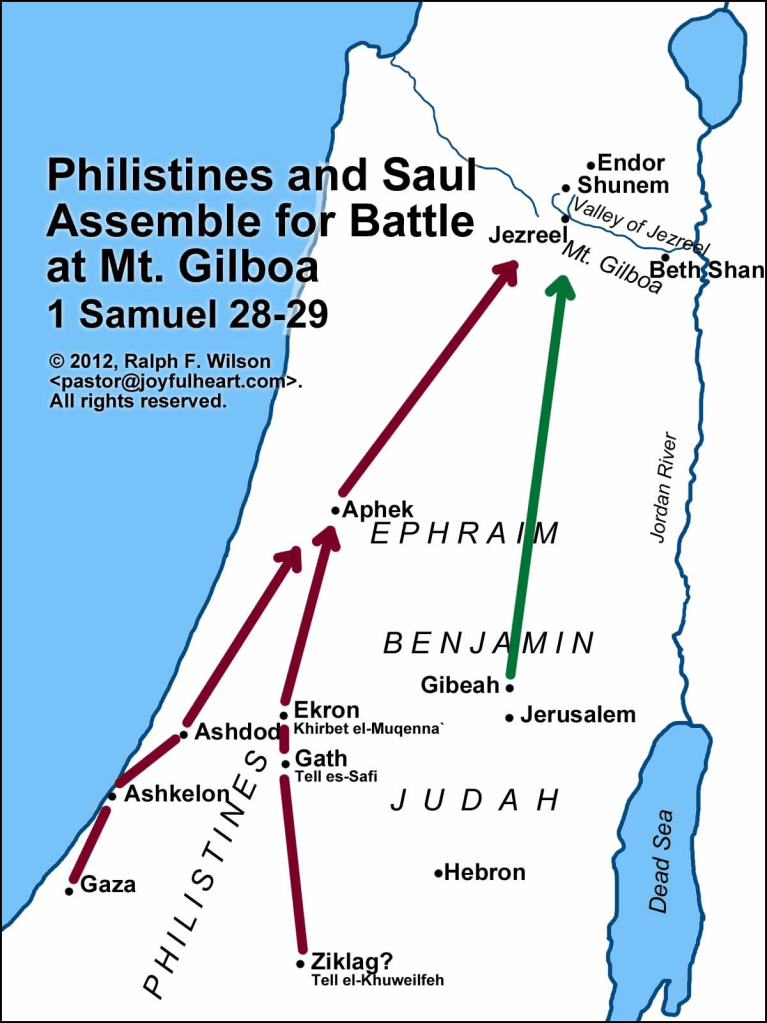
1 Samuel 28 Saul goes to the medium at Endor.
King Saul visits a hidden medium at Endor to summon the dead prophet Samuel for military advice on the eve of a battle against the Philistines.
The Background
The threat: The Philistine army gathered for war against Israel, and King Saul grew deeply afraid.
God’s silence: Saul tried to seek guidance from God through dreams, prophets, and sacred lots, but received no answer.
The hypocrisy: Out of desperation, Saul turned to necromancy—despite having previously banned and expelled all mediums and sorcerers from Israel on pain of death. Moses had condemned mediums, spiritists, etc. in Deuteronomy.
The Encounter at Endor
The disguise: Saul disguised himself, traveled by night with two men, and found a medium (the “Witch of Endor”).
The oath: The woman initially hesitated out of fear of Saul’s own laws, but Saul swore an oath by God that no harm would come to her.
The summoning: Saul asked her to bring up the spirit of Samuel. The woman saw the apparition, realized her visitor was Saul, and cried out in shock. Saul calmed her and asked what she saw. Her shock proves that she had not been able to actually raise someone from the dead before this IMO.
The Prophecy and Aftermath
The message: The spirit of Samuel rebuked Saul for turning to the occult after God had departed from him.
The doom: Samuel foretold that the Lord would hand Israel over to the Philistines, and that Saul and his sons would die in battle the very next day.
The end: Overwhelmed with terror and despair, Saul collapsed to the ground. True to the prophecy, the Israelite army was routed at Mount Gilboa the next day, and Saul committed suicide to avoid capture. Jonathon was killed in the battle also.
13 Ziklag 1 Sam 29-30. The Philistine lords joining Achish in the battle against Israel demanded that David not be allowed to go into battle with them b/c of his reputation of killing Israel’s enemies (1 Samuel 29). Achish told David that he could not go. David acted offended, but it must have been a relief for him b/c he would have been forced to kill Israelites if he had gone. Achish then sends David back to Ziklag so his days in Gath are finished. Meanwhile, while David was off with Achish, Amalekites had raided Ziklag and taken captive David’s two wives and the families of the 600 men fighting with him. His men spoke of stoning David. He inquired of the Lord using the high priest ephod to see if he should pursue the Amalekites, and was told to do so. He took 400 men, leaving 200 exhausted men with the baggage, and rescued the captives, slaughtering the Amalekites. The 400 men who went did not want to share the spoils with the 200 who stayed with the baggage, but David said “The share of the man who stayed with the supplies is to be the same as that of him who went down to the battle. All will share alike.” 25 David made this a statute and ordinance for Israel from that day to this.” David shared the spoils from the raid with the people of Judah living in cities of Judah. That’s a great principle today. Many go off into foreign fields to do the Lord’s work and many, for whatever reasons, stay back in the US and support those who go. They share the “spoils” of success equally. I read every day where EEM partners in Europe deliver Bibles and see the joy of those receiving them. I get to share in that great work by supporting EEM.
1 Samuel 20: Saul had already tried to kill David several times. Jonathon found out that Saul was still trying to kill David and Saul even tried to kill Jonathon for siding with David. Jonathon let David know by a pre-arranged sign when shooting arrows that he was in danger and should flee. They had one last emotional, tearful meeting after the arrows and pledged their loyalty and love to each other. Jonathon is a great person. He would have been the next king and yet he kept Saul from killing David who would be king instead of Jonathon. He was a great friend to David. David then begins 10 years of fleeing from Saul. Instead of studying by chapters, I will number the places david went to during that 10 years. Here is a map that shows each of the places.
1. Nob 1 Sam 21. Ahimelek the priest gives David the forbidden shewbread that only the priests could eat. Saul’s commander Doeg the Edomite was present. Ahimelech also gave David the sword of Goliath. The heading of Psalm 52 is “When Doeg the Edomite had gone to Saul and told him: “David has gone to the house of Ahimelek.” showing that David wrote this psalm while in Nob. Many of the psalms have headings that reflect the places David fled from Saul to.
2. Gath 1 Sam 21. David flees to the Philistine city of Gath and fakes insanity to keep King Achish from killing him. He scribbled on the gate and let saliva run down his beard as a madman. Why does David resort to such tactics instead of just trusting God to protect him? The heading of Palm 56 is “when the Philistines seized him in Gath” showing that the wrote that psalm in Gath. The same with the Psalm 34 heading: “…When he feigned madness before Abimelech [Achish], so that he drove him out, and he went away.”
3. Cave of Adullum 1 Sam 22. David gathers a “Robin Hood” army of 400 men who were in debt, discontented, and distressed. His army will grow to 600 eventually but Saul is chasing him with several thousand men.
4. Mizpah in Moab 1 Sam 22. David leaves his parents with the king of Moab for safety. We don’t know why David trusted the king of Moab b/c the Moabites were enemies of Israel. Was there some connection b/c of Ruth the Moabite who was David’s great grandmother? Mizpah is not on the map but it is in Moab.
5. Gibeah 1 Sam 22. Saul has Doeg kill Ahimelech and 85 priests. One priest escaped and told David. David feels guilty for causing their deaths. 22:19 He (Saul) also put to the sword Nob, the town of the priests, with its men and women, its children and infants, and its cattle, donkeys and sheep. Have you ever unintentionally caused hurt or harm to someone and felt guilty later?
6. Keilah 1 Sam 23. David “inquires” of the Lord and rescues Keilah from Philistines. Saul comes to Keilah to kill David. David “inquires of the Lord” (23:2,4), and God tells him Keilah will surrender him to Saul so David escapes with his men who now number 600. Things always went better when David inquired of the Lord for knowing where to go and what to do instead of relying on his own tactics.
7. Wilderness of Ziph 1 Sam 23. Jonathon makes his last visit to David to encourage him and make a covenant. Jonathon humbly tells David that David will be the next king and offers to be second to him. Jonathon would have been the next king so that is true humility to “play second fiddle” as we say. The heading of Psalm 54 is “…When the Ziphites went and told Saul, ‘Is David not hiding among us?'” showing that psalm was written in Ziph.
8. Wilderness of Maon. 1 Sam 23. Ziphites tell Saul that David was in Ziph and then that he has gone to Maon. Saul surrounds David at Maon but news of a Philistine raid make him withdraw. The heading of Psalm 63 is “When he was in the Desert of Judah.” showing that it was written at this time.
9. Engedi 1 Sam 24. Saul goes into a cave to “relieve himself”, probably laying his robe aside, the cave David and his men are hiding in. David secretly cuts off the edge of his robe. His men tell him that this is the Lord giving Saul into his hand, but David’s conscience bothers him b/c Saul is still the Lord’s anointed. Saul left the cave, and David confronted him, showing him the robe with the edge cut off, asking Saul why he was so intent on killing him since he had never sinned against Saul. Saul seems penitent, and says that one day David will be king and left. But later he continued his pursuit of David trying to kill him. The headings of Ps 57, 142 “when he (David) had fled from Saul into the cave” tell us that David wrote those 2 psalms, crying out to God for help, while at Engedi.
Psalm 18 has the heading: “He sang to the Lord the words of this song when the Lord delivered him from the hand of all his enemies and from the hand of Saul.” He wrote this psalm at some time and place when fleeing from Saul.
We will cover 4 more of the places David fled to in the next blog. A lot of historical facts but think of how David must have felt while fleeing Saul for 10 years, constantly fearing for his life. He knows he will be the next king but he refused to kill Saul twice in the cave.
1 Samuel 15: Saul’s 2nd big sin. God told Saul to go utterly destroy all the Amalekites including women, children, and animals b/c of what they did attacking Israel “for what they did to Israel when they waylaid them as they came up from Egypt.” The history of Israel and Amalek is interesting. AI:
The attack is recorded primarily in Exodus 17:8–16 in the Hebrew Bible, where the Amalekites assault the Israelites at Rephidim shortly after they leave Egypt. (Wikipedia)
The Main Account (Exodus 17:8–16): The text states that Amalek came and fought with Israel at Rephidim. Moses sends Joshua to lead the fighters while Moses, Aaron, and Hur watch from a hill holding the staff of God. (Wikipedia) Israel wins the battle as long as Moses holds up the staff. When Moses’ hands get weak, Aaron and Hur support his hands to hold up the staff.
The Retelling (Deuteronomy 25:17–19): This passage looks back at the event and specifies that the Amalekites targeted the weak, tired, and lagging stragglers at the rear of the Israelite camp rather than the main front. (GotQuestions.org) God told Israel, 25:19 When the Lord your God gives you rest from all the enemies around you in the land he is giving you to possess as an inheritance, you shall blot out the name of Amalek from under heaven. Do not forget!”
The Outcome: Joshua defeats the Amalekites in battle, and God instructs Moses to write down a memorial of the event, vowing perpetual opposition to Amalek. (Bible Study Tools) Moses built an altar named Jehovah Nissi (meaning “The Lord is my Banner”. In ancient warfare, a banner or flag (nes) was placed on a high pole at the front lines to give soldiers an identity, a focus of hope, and a visible place to gather. (Grand Canyon University) The name signifies that God Himself is the army, the defense, and the rallying standard—meaning victory comes through His power rather than human strength. (The Bible Show, GotQuestions.org)
The Amalekites not completely destroyed when Isreal entered Canaan. In Numbers 13:29 and Numbers 14:25, Amalekites are still documented living in the Negev and southern hill country, and the Book of Joshua does not record their complete eradication. (Nave’s Topical Bible)
The Period of the Judges: The Amalekites reemerge repeatedly as a persistent regional threat: In Judges 3:13, the Amalekites ally with Eglon, king of Moab, and the Ammonites to defeat Israel and capture the “City of Palms” (Jericho). The judge Ehud kills the fat Eglon and defeats the Moabites giving peace in Israel for 80 years. In Judges 6:3–5, the Amalekites join forces with the Midianites and “people of the east” to repeatedly raid, pillage, and devastate Israel’s crops and livestock every planting season. (BibleRef.com, Jewish Virtual Library, Bible Hub) Gideon battles with the Amalekites and Midianites, kills 135,000 of their men giving Israel peace for 40 years. Apparently Amalekites survived b/c Saul was later commanded to wipe them out.
1 Samuel 15: God commanded Saul to totally destroy the remaining Amalekites but he spared their King Agag and the best of the animals. When confronted by Samuel, Saul argued that he had “completely destroyed the Amalekites”. He admitted sparing King Agag and the best of the animals to offer to the Lord. 22 But Samuel replied: “Does the Lord delight in burnt offerings and sacrifices as much as in obeying the Lord? To obey is better than sacrifice, and to heed is better than the fat of rams. 23 For rebellion is like the sin of divination, and arrogance like the evil of idolatry. Because you have rejected the word of the Lord, he has rejected you as king.” Saul said, “I have sinned” and made the excuse that “I was afraid of the men and so I gave in to them.” Samuel put Agag to death. 15:35 Until the day Samuel died, he did not go to see Saul again, though Samuel mourned for him. And the Lord regretted that he had made Saul king over Israel.”
Amalekites during the reign of King David. Amalekites were still present during the reign of David. “While hiding from King Saul and serving as a mercenary under the Philistine King Achish of Gath, David led regular raids against the Amalekites, Geshurites, and Girzites, killing populations to keep his actions hidden from Achish. (Bible Hub) The Amalekites raided David’s city of Ziklag and captured his wives and famililes of his men whom David rescued but 400 Amalekites escaped. “Shortly after the Ziklag victory, an Amalekite soldier arrived in David’s camp with Saul’s crown and bracelet. He claimed that Saul was wounded at the Battle of Gilboa and had asked the Amalekite to finish him off.” (Wikipedia) David had the Amalekite killed. During David’s reign as king of Israel, military pressure and subsequent campaigns severely diminished the Amalekites, leaving only scattered remnants that eventually faced final destruction by the Simeonites during the later reign of King Hezekiah. According to 1 Chronicles 4:42–43, a force of 500 Simeonites They killed the remaining Amalekites who had escaped earlier conflicts, marking the end of their presence in that region. The Book of Esther later mentions Haman the Agagite (an “Agagite” being linked to the Amalekite king Agag).
A few questions: 1) Why didn’t God forgive Saul when he admitted that he had sinned and begged forgiveness? God forgave David of adultery, murder, lying, and coveting but he didn’t forgive Saul of this seemingly much less serious of sin. I can only assume that God knew that Saul was not sincere in this “repentance”. We call it “crocodile tears”: Crocodile tears means a fake or insincere display of sadness, grief, or remorse. God knows men’s hearts and whether they are sincere or not. 2) Why was this partial obedience considered by God to be so serious? I mean, Saul did kill many of the Amalekites and a lot of the weaker animals. Perhaps his men really did want to offer to God the animals they spared (but that is probably doubtful). The answer is that God expects complete, full obedience to His commands. We sin when we flagrantly disobey God even in the smallest way. Saul was arrogant and defensive when talking to Samuel which shows his disregard for obeying the Lord. This was an attitude and heart problem and not just a minor disobedience. Even today, the grace of God saves us under the new covenant even though we don’t perfectly obey every commands. But an humble Christian will sincerely try to obey ever single command of the Lord. We can’t say, “Oh that’s just a small sin; it doesn’t matter if I break that command.” Jesus said, John 14:15 “If you love me, keep my commands.” Don’t ever say, “Well I obeyed most of what Jesus commanded and that’s enough”. 3) Is this a command of God for Israel to commit genocide? I read Christian commentators who try to rationalize this command and say that it wasn’t really a genocide but I find that hard to defend. If it walks like a duck and quacks like a duck, then it is a duck. It was a command to commit a genocide of the Amalekites. It is especially horrifying that the children were to be destroyed. We can say that the children are better off dying before they reach the age of accountability and that God takes innocent childdren to heaven, but it is still the slaughter of young children and babies. But the difference in that genocide and historical genocides is found in the justice of an Almighty God who rules the world. God is the judge of all the earth (stated by Abraham in Genesis 18:25). God has the right to judge peoples and nations and destroy them when He decides to. The Amalekites (and other Canaanites nations) had been seeped in idolatry for centuries. They had the same opportunity to believe in the one true God Yahweh just like Rahab did, but instead chose to fight Israel. God had a certain point where He would no longer tolerate a nation’s sin and would execute justice by wiping them out. Genesis 15:16 In the fourth generation your descendants will come back here, for the sin of the Amorites has not yet reached its full measure.” The Amalekites had reached their “full measure” of sins. The same would be true of all the Canaanite nations that God commanded Joshua to totally annihilate (genocide). God’s command for Israel to commit genocide was not out of racial hatred like historical genocides but was the execution of Divine justice.
1 Samuel 16: Samuel anoints David as king. God sent Samuel to the house of Jesse to anoint David as the next king David was from the tribe of Judah, which Genesis 49:10 specified that the kings should come from Judah. Saul was a Benjamite, the wrong tribe and it makes you wonder why God told Samuel to anoint Saul knowing the kingly line could was not predicted to come from the family of Saul, a Benjamite. I think the anointing of Saul as king was to give Israel a bad king to show that God’s original plan was better. God gave Saul every chance to be an obedient king, even giving him miraculous Spirit powers, but God knew all along that Saul would turn bad and be rejected by God as king. God knew the kingly line would not continue through Saul’s descendants. Sometimes we ask God for something that is not really in our best interests or that is not the plans of God, and God grants our request just to show us we were wrong and teach us a lesson. A classic example of this is found in Numbers 11. In the wilderness the Israelites complained about only having manna to eat and no meat, so God gave them quail 3 feet deep and 15-20 miles square. While they were greedily gorging on the quail, God struck them with a plague and many died there at Kibroth-Hattaavah (which means “graves of greed). So be careful what you ask God for. You might be asking “with wrong motives, that you may spend what you get on your pleasures” (James 4:3). You might have good intentions on what you ask for, but it might not be God’s plan or in your own best interests, so always close your request “thy will be done”.
Life Lesson: Samuel saw Jesse’s son Eliab and thought surely he was the one to anoint. God said, 16:“Do not consider his appearance or his height, for I have rejected him. The Lord does not look at the things people look at. People look at the outward appearance, but the Lord looks at the heart.” How true that is! We judge people by how they look, by our prejudices. We tend to admire someone who is beautiful, smart, or talented. They might have evil hearts but we still admire them just b/c of their “outward appearance”. Or we look down on someone b/c of their outward appearance. A classic example: Do you remember Susan Boyle who originally auditioned on Britain’s Got Talent in 2009. You could tell from their expressions and raised eyebrows that the audience and judges judged her and looked down on her b/c of her plain appearance. She then sang, “I Dreamed a Dream” from Les Misérables and they were stunned with her talent. All of a sudden they praised and applauded her and she went on to become a star. Jeremiah 17:10 – “I the Lord search the heart and test the mind, to give every man according to his ways”. Proverbs 21:2 – States that while people think their ways are right, “the Lord weighs the heart”. I am so guilty of judging people by outward appearance. I tend to judge people who are obese, who talk too much, who beg on the streets, who are politicians, who are high paid located preachers, and the list goes on instead of trying to find out if someone has. good heart. I confess that I need to do better! Jesus said in Matthew 7:1 7 “Do not judge, or you too will be judged. 2 For in the same way you judge others, you will be judged, and with the measure you use, it will be measured to you.” I need to be more concerned about the log that is in my eye before criticizing the speck in someone else’s eye. What about you?
So Samuel anointed David. 1 Samuel 16:13 So Samuel took the horn of oil and anointed him in the presence of his brothers, and from that day on the Spirit of the Lord (miraculous powers) came powerfully upon David. Samuel then went to Ramah (his hometown). 14 Now the Spirit of the Lord had departed from Saul, and an evil spirit from the Lord tormented him.” This is not an evil spirit that kept Saul from making his own freewill choices even though it was from God. God has the right to send an evil spirit on someone who has rejected Him. Paul spoke of those who believed the lying signs of the “man of sin” who would decieve Jews before 70 AD: 2 Thessalonians 2:11 For this reason God sends them a powerful delusion so that they will believe the lie.” But they still had the ability to make freewill choices. From 1 Samuel 16:14 on, Saul had an evil spirit and would have fits of rage. David was brought in to play his lyre (a “portable” harp) and calm Saul. 1 Samuel 16:23 Whenever the spirit from God came on Saul, David would take up his lyre and play. Then relief would come to Saul; he would feel better, and the evil spirit would leave him.” David entered Saul’s service going back and forth from his home with Jesse.
Does 1 Samuel 17 occur chronologically before 1 Samuel 16? The basis for this possibility comes from something Saul said after David defeated Goliath. 1 Samuel 17:In 1 Samuel 17:55–58, King Saul asks, “Whose son is this young man?” and asks David who his father is, even though David had previously played the lyre for him and become his armor-bearer in 1 Samuel 16:21–23. Did Saul not rccognize David if David had been playing the harp for him? Maybe Saul was asking more about David’s family lineage since he had promised wealth and his daughter in marriage to whoever defeated Goliath. Thus David answers ““I am the son of your servant Jesse the Bethlehemite.” Maybe Saul was always in an evil spirit induced rage when David would come play he harp for Saul and Saul really didn’t recognize who had been playing the harp for him. David did not live permanently at the royal court as a full-time standing soldier. He split his time between playing music/serving Saul and going back home to tend his father’s sheep in Bethlehem (1 Samuel 17:15). I think that is the better explanation and thus 1 Samuel 17 does occur chronologically after 1 Samuel 16 just as it is recorded in the Hebrew Bible.
1 Samuel 17: David kills Goliath. Perhaps the most well known event in the Old Testament. No need to retell the story here but there is a great lesson. Why did David say that he could defeat Goliath? 1 Samuel 17:34 But David said to Saul, “Your servant has been keeping his father’s sheep. When a lion or a bear came and carried off a sheep from the flock, 35 I went after it, struck it and rescued the sheep from its mouth. When it turned on me, I seized it by its hair, struck it and killed it. 36 Your servant has killed both the lion and the bear; this uncircumcised Philistine will be like one of them, because he has defied the armies of the living God. 37 The Lord who rescued me from the paw of the lion and the paw of the bear will rescue me from the hand of this Philistine.” David credits God (and the supernatural miraculous Spirit God gave him) with his ability to kill the lion and the bear. He has full confidence that God will give him the wisdom and ability to kill the giant! 45 David said to the Philistine, “You come against me with sword and spear and javelin, but I come against you in the name of the Lord Almighty, the God of the armies of Israel, whom you have defied. 46 This day the Lord will deliver you into my hands, and I’ll strike you down and cut off your head. This very day I will give the carcasses of the Philistine army to the birds and the wild animals, and the whole world will know that there is a God in Israel. 47 All those gathered here will know that it is not by sword or spear that the Lord saves; for the battle is the Lord’s, and he will give all of you into our hands.” David used a stone, not a sword or spear although he did cut Goliath’s head off with Goliath’s own sword. King Saul was camped with the army of Israel in the Valley of Elah (1 Samuel 17:2) when “Abner took him and brought him before Saul, with David still holding the Philistine’s head.”
Life Lesson: Do you have the same confidence in the Lord that David had when you are fighting life’s battles? One of the things I thank God for in my daily prayers is God giving me “narrow escapes”. Many times God rescued me from some problem or danger. You would think that would give me the confidence that He will rescue me from future problems or danger, but often I panic when I have a new problem or danger. What battles are you facing? Do you trust in the Lord to help you win those battles. David still had to sling a stone at Goliath but he did so trusting that God would kill Goliath, and He did. Does God helping you in the past help you muster courage and confidence as you face new problems or dangers?
1 Samuel 18: Saul tries to kill David. After defeating Goliath, Saul 1 Samuel 18:2 From that day Saul kept David with him and did not let him return home to his family.” His going back and forth to his home with Jesse ended. He also met his best friend and confidant in Saul’s son Jonathon. David “loved him as himself”. Saul gives him a high rank in his army and David uses that miraculous Spirit powers to kill many Philistines. That’s when the “green eyed monster” of envy raised its head. Saul heard the women giving more praise to David than Saul and Saul became suspicious of David taking his kingdom. 18:9 And from that time on Saul kept a close eye on David.” The very next day Saul tried twice to spear David to the wall but failed. He offered his daughter Merab in marriage to David if he would fight the Philistines for him, thinking surely David would get killed in battle. But then he gave Marob to another man. Saul offered his other daughter Michal to David if he would bring him 100 Philistine foreskins! David brought him 200 foreskins and married Michal. 18:9 And from that time on Saul kept a close eye on David.
1 Samuel 19: David gets Michal as his wife and flees to Samuel at Ramah. Jonathon persuaded Saul that David was no threat to him and briefly David was welcome back in Saul’s court. Saul tries again to spear David. Saul sent men to capture David at the house of David and Michal, but Michal helped him escape. Michal said that David threatened to kill her if she did not help him escape. David fled to Samuel at Ramah. Saul sent men three times to capture David but all 3 times the men started prophesying and got sidetracked. Saul found out that David and Samuel were at Naioth and went there to kill David, but he also began prophesying naked a day and night in Samuel’s presence.
That’s long but I hope it is interesting to read about the Amalekites and then discuss those 3 questions.
Keep up with your daily reaading and corresponding blog articles.
1 Samuel 9-11: Samuel anoints Saul as king. After meeting and eating with Saul (chapter 9), Samuel then anointed him to be the first king of Israel. Samuel gave Saul 3 signs to confirm his anointing, the most unusual of which was that Saul would meet some prophets with musical instruments and Saul would prophesy with them! God changed Saul’s heart (1 Samuel 10:9) with supernatural ability (i.e. whenever the Spirit of God would come upon him) and boldness to lead the people as king but that would not last long. All 12 tribes came together at Mizpah for the official anointing of Saul, but he had hidden himself among the supplies. He wasn’t hard to spot b/c he was a head taller than anyone else. 10:24 Samuel said to all the people, “Do you see the man the Lord has chosen? There is no one like him among all the people.” Is Saul a sincere, humble person at this time? Even when “scoundrels” despised Saul as king, Saul kept silent and did not try to kill them like he tried to kill David later. Saul seems like the perfect candidate for what the people wanted as their king. Soon after being anointed, the Spirit of God came on him miraculously and he mustered 3,000 men to go rescue the men of Jabesh-Gilead who had been threatened by the Ammonites with having their right eyes put out. Saul slaughtered the Ammonites. He was that king they wanted to go fight their battles with their enemies. Again, Saul humbly refused to kill those who objected to him being king.
1 Samuel 12: Samuel gave his farewell address. He called on the Lord to send thunder and rain to confirm that Israel had done an evil thing by asking for a king. The people asked Samuel to pray for them. Samuel said, 12:23 As for me, far be it from me that I should sin against the Lord by failing to pray for you. And I will teach you the way that is good and right.” We should never stop praying for people, even evil, rebellious people. I can think of several people right now who it seems have sinned and fallen from grace. They are not repenting or changing their sinful lives in spite of many warnings. It is easy to just quit praying for them, thinking that it is hopeless. But intercessory prayer can still change things.
1 Samuel 13: Saul’s first big sin. Saul was 30 when he became king and reigned 40 years as king. The Philistines had come up against Israel with many more men and chariots than Israel had. The men of Israel “were quaking with fear, hiding in caves, and deserting” Saul’s army of 3,000 down to only 600 men. Samuel had told Saul to wait 7 days for Samuel to come offer a burnt offering to ask God for victory in the battle, but Saul panicked and offered the burnt offering himself. Samuel condemned his action and told him that God was going to remove him as king and choose a man “after God’s own heart”. None of Saul’s 600 men had swords or shields b/c the Philistines had not allowed Israel to have blacksmiths. Things looked desperate.
1 Samuel 14: Victory over the Philistines. In the meantime, Jonathon, Saul’s son, had gone to the Philistine camp to seek a sign that God was going to deliver Israel. God gave him a sign and he and his armor-bearer killed 20 Philistines. God caused a panic to strike the Philistines and they began to scatter in total confusion, killing each other with their swords. The Israelites, however, were faint in hunger b/c Saul had made a foolish oath that no one should eat until he avenged himself of his enemies (his pride showing up). Jonathon did not know about the oath and ate some honey. The hunger of the Israelites caused them to kill and animals with the blood still in them, which was a sin under the Law. Saul asked God why He had not answered his prayer, and Saul assumed that it was b/c of “sin in the camp” (as with the sin of Achan in Judges). Lots were cast and Jonathon was chosen as the guilty party and Saul sentenced him to die for breaking the oath of not eating. The Israelites would not let Saul kill Jonathon. Again, it looked like Saul was just what the people wanted in a king. 14:23 47 After Saul had assumed rule over Israel, he fought against their enemies on every side: Moab, the Ammonites, Edom, the kings of Zobah, and the Philistines. Wherever he turned, he inflicted punishment on them.48 He fought valiantly and defeated the Amalekites, delivering Israel from the hands of those who had plundered them.” They did not know that God had already rejected Saul for his disobedience in not waiting for Samuel to offer the burnt offering. He was what we would call a “lame duck” king (still officially in office but already fired!). Saul had 2 daughters, Merab and Michal. His father was Kish. His commander of his army was Abner.
Saul is an intriguing character. He had the miraculous power of the Spirit and could have been a successful king. He seemed humble when first anointed, but then his lack of faith in God showed with his first big sin of not waiting for Samuel. God still gave Saul victories over the Philistines, but God said that he would be removed as king. In the rest of 1 Samuel, we will see a very evil Saul. In 2 Samuel 1:9 after Saul’s death in battle, David said “How the mighty have fallen”. Over time, it shifted from a literal mourning of fallen warriors into a general idiom when a major corporation goes bankrupt, a corrupt politician is disgraced, or a dominant sports team suffers a massive losing streak. Or when a Christian is lifted up with pride, quits trusting in God, and falls from grace. In other words, when pride causes a person to fall from a lofty status. Pride would be the cause of the fall of Saul from favor with God. A warning to all of us: Let him that thinks he stands take heed lest he fall (1 Corinthians 10:12).
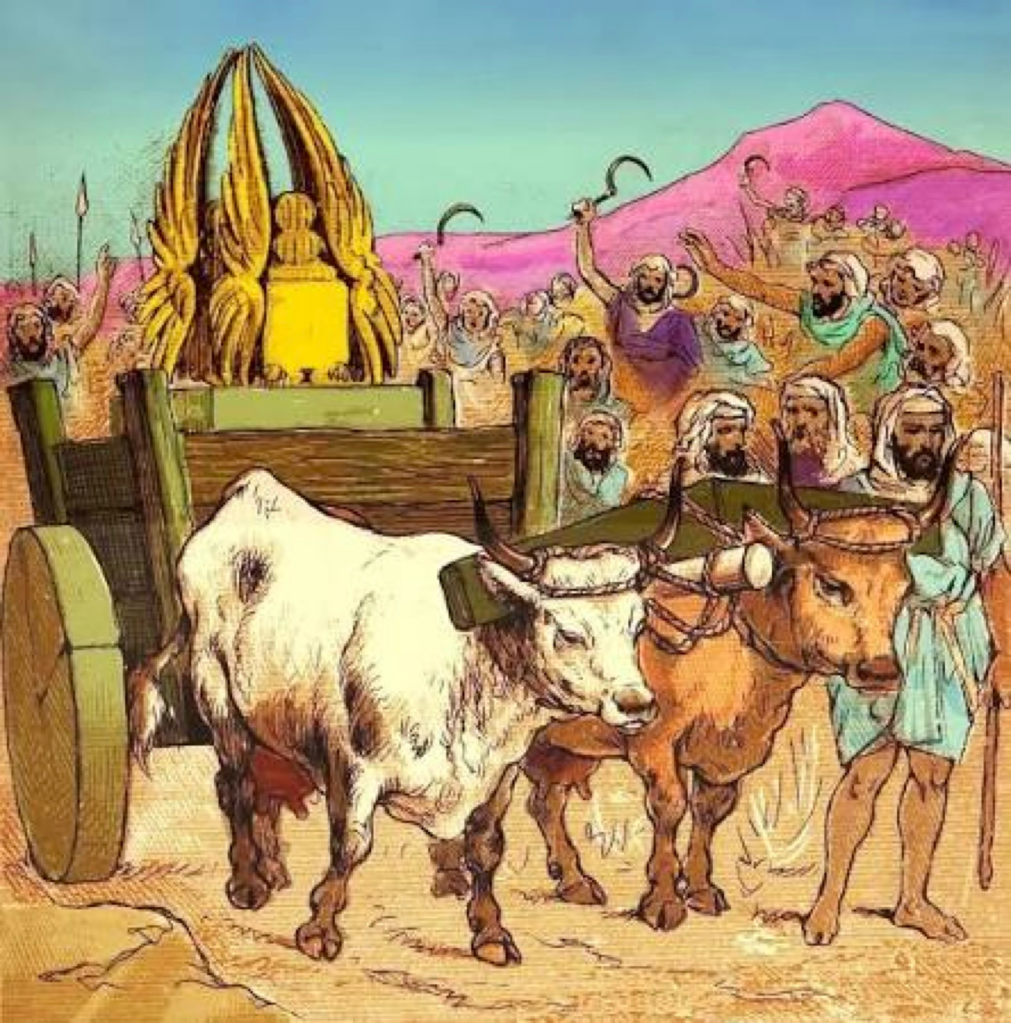
AI: Hophni and Phinehas took the ark of the covenant into battle with the Philistines and it was captured. It stayed in Philistine territory 7 months. “The Philistines returned the Ark of the Covenant to Israel on a new cart pulled by two nursing cows after suffering plagues and the falling of their idol Dagon. The cows walked straight to the Israelite border town of Beth Shemesh.
Key Scenes in the Biblical Story (AI)
Capture and Dagon’s Fall: The Philistines took the Ark to Ashdod, but their fish-god idol Dagon repeatedly bowed and shattered before it. They moved it to Gath, and then Ashdod, but the Lord sent “tumors” in both cities.
The Plagues: Severe outbreaks of tumors and rats struck Philistine cities, forcing their leaders to consult priests on how to send the Ark back.
The Trespass Offering: They sent golden tumors and golden mice along with the Ark as a guilt offering.
The Journey on the Cart: Placed on a cart with unguided nursing cows, the animals miraculously headed straight for Beth Shemesh without turning away. The 5 Philistine rulers followed, watching the cart return to israel.
Rejoicing at Beth Shemesh: The Israelites rejoiced, harvested wheat, and offered sacrifices when the cart arrived. God killed 70 who looked in the ark.
Taken to Kiriath Jearim: Men from Kiriaath Jearim brought the ark to that city to Abinadab’s house where it stayed 20 years. But David moved it from there to Jerusalem, which would be at least 40 years later since King Saul’s reigned 40 years. So where did the ark stay past the 20 years in 1 Samuel 7:2 until David moved it to Jerusalem? AI: “1 Samuel 7:2 states that “twenty years” passed from the time the Ark arrived in Kiriath-jearim until the house of Israel genuinely turned back to the Lord in repentance under Samuel. It is a marker for how long it took for spiritual awakening to happen, not an expiration date for when the Ark left. The Ark remained at the house of Abinadab in Kiriath-jearim for a much longer period than just the 20 years. It stayed there through the rest of Samuel’s judgeship, the entirety of Saul’s reign (40 years), and into the early years of David’s reign until David finally moved it to Jerusalem (2 Samuel 6).
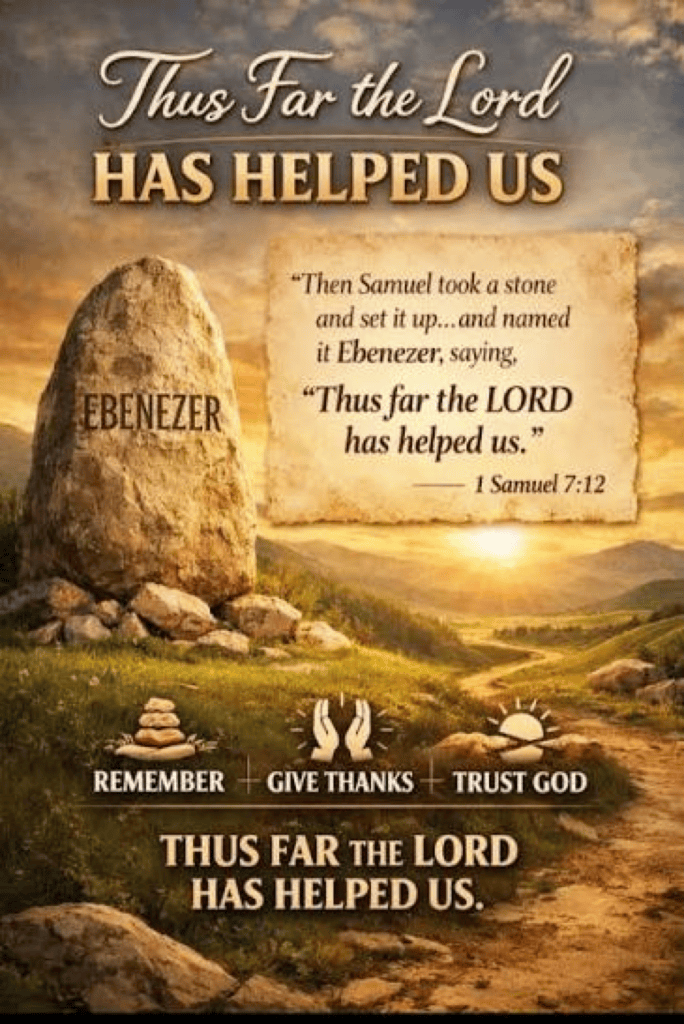
1 Samuel 7: A spiritual revival in Israel. 1 Samuel 2:Then all the people of Israel turned back to the Lord. 3 So Samuel said to all the Israelites, “If you are returning to the Lord with all your hearts, then rid yourselves of the foreign gods and the Ashtoreths and commit yourselves to the Lord and serve him only, and he will deliver you out of the hand of the Philistines.” 4 So the Israelites put away their Baals and Ashtoreths, and served the Lord only.” The Israelites assembled at Mizpah and confessed their sins. The Philistines heard that they were at Mizpah and attacked. 1 Samuel 7:But that day the Lord thundered with loud thunder against the Philistines and threw them into such a panic that they were routed before the Israelites.” The Israelites pursued them, slaughtering them. 1 Samuel 7:12 Then Samuel took a stone and set it up between Mizpah and Shen. He named it Ebenezer (which means “stone of help”), saying, “Thus far the Lord has helped us.” 13 So the Philistines were subdued and they stopped invading Israel’s territory. Throughout Samuel’s lifetime, the hand of the Lord was against the Philistines.” Samuel went on a circuit from Bethel to Mizpah to Gilgal, judging Israel, but always returned to his home town of Ramah. Estimates are that he judged Israel 20 to 40 years. A great church song: O Thou Fount of Every Blessing has Ebenezer in it. vs 2 “Here I raise my Ebenezer; hither by thy help I’m come; and I hope, by thy good pleasure, safely to arrive at home. Jesus sought me when a stranger, wandering from the fold of God; he, to rescue me from danger, interposed his precious blood.” I know most of us just sang that song and had no idea what Ebenezer, so know you know!
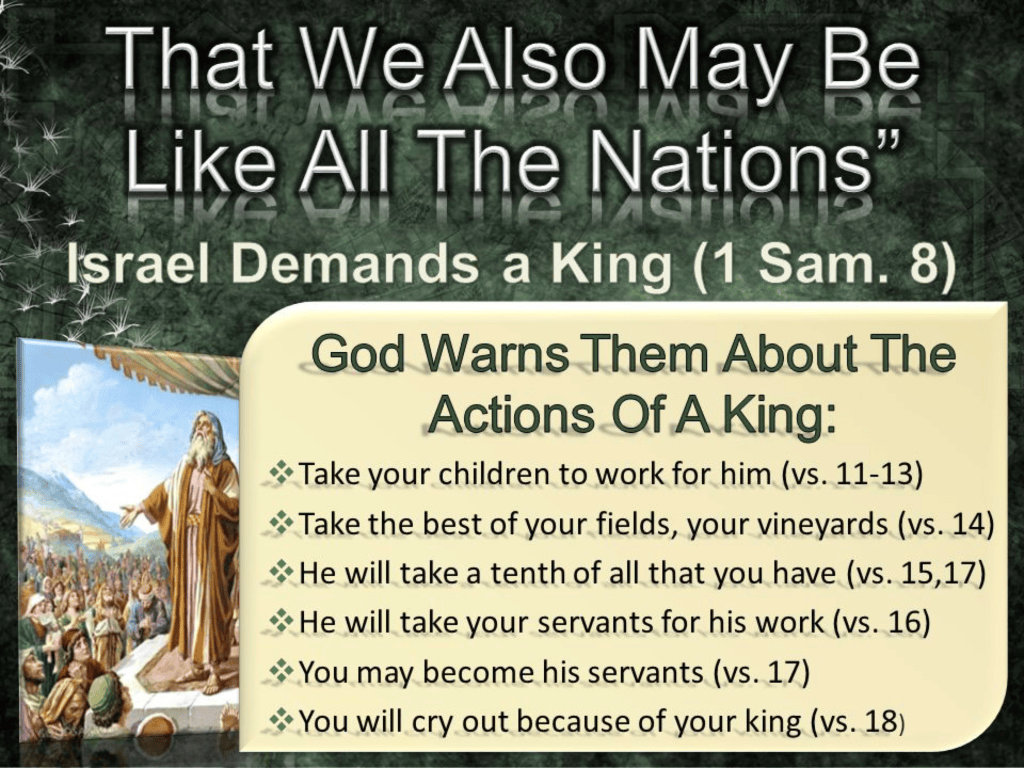
1 Samuel 8: Israel asks for a king. In his old age, Samuel appointed his 2 sons as judges but they turned aside after dishonest gain and accepted bribes and perverted justice. You would think his sons’ behavior would have really bothered Samuel since he hs experienced the trouble with Eli’s 2 sons. You would think that he would be very reluctant to appoint them as judges, but he did. That was the excuse the people used to ask Samuel to give them a king to be “like all the other nations have to lead us and to go out before us and fight our battles.” God told Samuel that they had not rejected Samuel, but had rejected God as their king. But He would give them a king anyway. Why did God give them a king if He never wanted a king and only wanted to be their king Himself? I think the main reason was to set the stage for King Jesus one thousand years later. Many years earlier Moses told the Israelites that once they would enter, take possession of, and settle in the Promised Land (Canaan), that they would eventually say, “Let us set a king over us like all the nations around us” (Deuteronomy 17:14). Moses then gave strict rules for the kings: Must be chosen by God from among their own people (not a foreigner) (v. 15). Must not accumulate many horses or send people back to Egypt to get them (v. 16). Must not take many wives (v. 17). Must not collect massive amounts of silver and gold (v. 17). Must hand-copy a personal scroll of God’s law (the Torah) and read it every day of his life to stay humble and obedient (vv. 18–20).So this had already been predicted by Moses. Wanting a king was a lack of faith and trust in Yahweh as their king to give them victory over their enemies. Samuel agrees to giving them a king but then gives this warning about the kings they will have. King Solomon pretty much violated all the rules for the kings which led to the split of the united kingdom.
1 Samuel 9: Samuel meets and eats with Samuel, getting ready to anoint him as the first king of Israel. This begins the period of the “United Kingdom”. At first, Saul seems like a wise choice. He was “as handsome a young man as could be found anywhere in Israel, and he was a head taller than anyone else.” At first he seemed to be humble. When Samuel told him, “And to whom is all the desire of Israel turned, if not to you and your whole family line?” Saul replied “But am I not a Benjamite, from the smallest tribe of Israel, and is not my clan the least of all the clans of the tribe of Benjamin? Why do you say such a thing to me?” Unfortunately Saul’s true colors would come out as we continue the reading next time.
This might be a little opinionated, but here we go. God set up Israel as His theocracy with Him as the king, but Israel wanted to do it their way. They wanted a king to fight their battles for them instead of trusting God for their victories. God set up the church as house churches with elders to shepherd the sheep and deacons to serve physical needs of the sheep. Yes they had apostles and prophets but those gifts ceased after the first century. They had evangelists who traveled to churches but did not stay to become “located paid preachers”. Paul told the churches to provide for the needs of the traveling evangelists but the 1st century document the Didache said that if they stayed more than 2 or 3 days that they were just preaching for money. That was the simple structure of the churches that Jesus established. But by the 2nd and 3rd century, the church started adding positions of authority. AI has a summary: The Threefold Order: By the mid-to-late second century, the structure unified into a distinct three-tier office: bishops (monarchial overseers), presbyters (priests/elders), and deacons. Rise of the Single Bishop: Influential figures like Ignatius of Antioch advocated for a single bishop per city (monepiscopacy) around 110 AD to maintain unity and guard against emerging heresies like Gnosticism. Apostolic Succession: To validate teaching and authority, writers like Irenaeus and Tertullian emphasized apostolic succession, tracing unbroken lines of bishops back to the original apostles commissioned by Jesus. Centralization of Rome: Over the 2nd and 3rd centuries, the pre-eminence of specific historical sees grew, eventually setting the stage for the Bishop of Rome (the Pope) as a supreme authority in Western Christianity.” Thus evolved the Papacy of the Roman Catholic Church and we all know the corruption and oppression that caused for the next thousand years of Catholicism. The Reformation Movement rejected the papacy but still ended up divided by followers of men like Martin Luther (Lutherans), John Calvin (Refeormed churches), Zwingli, John Knox (Presbyterians), John Huss (Moravians and The Brethren), King Henry VIII (Anglicans), Menno Simmons (Anabaptists, Mennonites, Almish), John Smyth (Baptists) , John and Charles Wesley (Methodists), Charles Parham (Pentecostalism), Joseph Smith (Mormons), Ellen G White (7th Day Adventists), Mary Baker Eddy (Christian Science), Charles Russell (Jehovah’s Witnesses), Alexander Campbell and Barton Stone (Churches of Christ), etc. Each leader and church that evolved from that leader had its own creed instead of just using the Bible. Do you think this is what Jesus wanted his church to look like? Many of these leaders taught basic Christian truths but others were dangerous cults led by cult leaders. The problem is that Christians started following “men who would be kings”. The Bible is fully sufficient for Christians just to gather in house churches and continue in “the apostles’ doctrine fellowship, breaking of bread (including the Lord’s Supper) and prayer” without these leaders and creeds. In addition we now have the LGBTQ advocate churches with well paid men in authority (as kings) leading the flock into error. Even among the conservative churches, the church has evolved into a “business”. They pay a lot of money to find a pastor or preacher who will help their church grow and that man (or woman) becomes the king. They hire many other positions of leadership instead of using elders and deacons to lead in the work of the church. They compete for the best preachers that people will come to hear. They provide the best musicians and singers for church assemblies to compete with the other bands. They spend on average about 80% of the money they collect on buildings and staff. Have we made us a king so we can be like the other churches? Have we forsaken letting God organize the church the way Jesus wanted it in order to make it how we want it? Have we made the same mistake that Israel did in wanting a king? I think we have. What do you think?
Again, a little off the reading schedule since the last article covered all of Ruth 1-4.
Hannah’s vow and the birth of Samuel: AI
“Hannah prayed in deep anguish at the tabernacle in Shiloh, vowing to give her requested son back to God as a Nazirite for life. Eli the high priest blessed her, and she gave birth to Samuel, later bringing him to live and serve at the temple as she promised.
The Distress and the Vow
Barrenness and Mockery: Hannah suffered deep sorrow because she had no children while her husband’s other wife, Peninnah, provoked her yearly.
The Prayer at Shiloh: While weeping in bitterness of soul, Hannah prayed silently to God, moving her lips without a sound. [
Eli’s Misunderstanding: Eli the priest thought she was drunk until she explained her intense grief, after which he told her to go in peace.
The Vow: Hannah promised that if God gave her a son, she would dedicate him to the Lord all his days, with no razor ever touching his head.
Birth and Dedication
Birth of Samuel: God remembered Hannah, and she conceived and bore a son, naming him Samuel, which means “heard of God” or “asked of the Lord”.
Fulfilling the Promise: After weaning him, Hannah brought young Samuel to the tabernacle in Shiloh and left him in Eli’s care to minister before the Lord.
The Aftermath: Hannah visited him every year with a small robe she made, and God blessed her with three more sons and two daughters.
Eli’s wicked sons. AI:
The priest Eli’s wicked sons were HophniandPhinehas, who served as priests at the tabernacle in Shiloh. Described in 1 Samuel as worthless men who did not know the Lord, they abused their priestly office by stealing the best parts of the animal sacrifices and committing sexual immorality with the women serving at the tent entrance.
Sins and Corruption
Greed and Theft: They took raw meat from sacrifices by force before the fat could be burned to God.
Sexual Immorality: They slept with women who served at the entrance of the tabernacle.
Disregard for God: They treated the holy offerings with contempt, causing people to resent worship.
Eli’s Failure: Though Eli rebuked them, he failed to properly restrain or remove them from office, leading God to judge his household.
The call of Samuel. After the Lord calling Samuel 3 times, Eli told Samuel to answer “Speak, for your servant is listening.” The Lord then told Samuel that Eli’s house would be judged. 3: 12 At that time I will carry out against Eli everything I spoke against his family—from beginning to end. 13 For I told him that I would judge his family forever because of the sin he knew about; his sons blasphemed God, and he failed to restrain them.” Eli had verbally rebuked them but that is all. He should have removed them from office and maybe even carried them to the elders to be stoned to death according to the Law. To Eli’s credit, he humbly accepted his fate. 3:19 The Lord was with Samuel as he grew up, and he let none of Samuel’s words fall to the ground. 20 And all Israel from Dan to Beersheba recognized that Samuel was attested as a prophet of the Lord. 21 The Lord continued to appear at Shiloh, and there he revealed himself to Samuel through his word.” Of course, the tabernacle was at Shiloh at this time. Samuel would be the prophet who would anoint the first two kings, Saul and David. Peter credits the prophets as beginning with the prophet (and judge) Samuel: Acts 3:24 “Indeed, beginning with Samuel, all the prophets who have spoken have foretold these days.”
Judgment and Death
Prophecy of Doom: A prophet told Eli his family would lose the priesthood and both sons would die on the same day.
Battle at Aphek: Hophni and Phinehas died in battle when the Philistines defeated Israel and captured the Ark of the Covenant.
Eli’s Death: Upon hearing the news that the Ark was captured and his sons were dead, the elderly Eli fell backward from his seat, broke his neck, and died. He was 98 and heavy. He had been a faithful high priest for 40 years but his 2 sons have defiled his legacy.
Who took Eli’s place as high priest? AI:
Priestly Succession After Eli
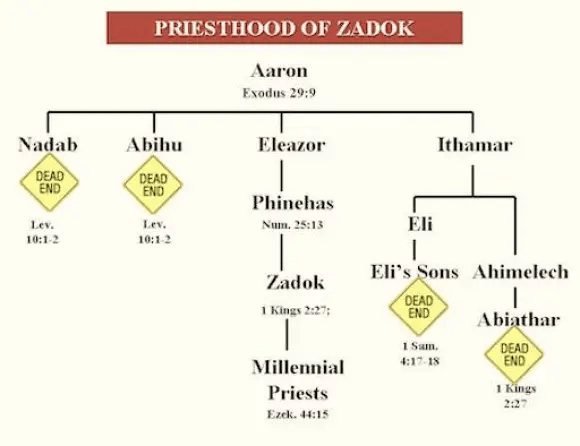
After Aaron died, the office of High Priest was passed down to his third son Phinehas, Eleazar (his two older sons, Nadab and Abihu, died earlier without children). Eleazar was succeeded by his son Phinehas (not the Phinehas son of Eli but instead the one who stopped the plague in the sin at Peor). Sometime during the period of the Judges—between Phinehas and Eli—the high priesthood moved from the family of Aaron’s son Eleazor to the family of Aaron’s youngest son, Ithamar.
Eli served as high priest and judge from the line of Ithamar. Eli’s 2 sons, Hophni and Phinehas,were killed. Phinehas’ wife was pregnant and died giving birth to Ichabod (meaning “no glory”) after hearing that Phinehas and Eli were dead. Before she died, 4:22 She said, “The Glory has departed from Israel, for the ark of God has been captured.”
Ahitub, Eli’s grandson, was next in the genealogical line of descent.
Ahijah served as high priest during the early reign of King Saul.
Ahimelech (Ahijah’s brother or son) succeeded him at Nob and was later killed by Saul.
Abiathar was Ahimelech’s son who escaped Saul’s slaughter, later serving as joint high priest with Zadok before being exiled by King Solomon for supporting a rival claim to the throne..
Zadok (from the line of Eleazar). Solomon replaced Abiathar with Zadok, returning the high priesthood to Eleazar’s lineage.
The high priesthood remained with the descendants of Zadok (who was a direct descendant of Aaron’s son, Eleazar) for roughly 800 years. In total, Zadok’s line held the position for nearly 8 centuries between Zadok’s initial appointment by King Solomon (around 960 BCE) and the deposing of the last legitimate Zadokite High Priest, Onias III, in 171 BCE.”
I loved tracing the high priesthood but you might not have enjoyed that. My mom was an Old Testament scholar and could have told me verbally everything I found on AI without even looking back at her Bible (and there was no AI when she was alive).
So you might want to focus instead on how godly a mother Hannah was. She had Samuel knowing that she would give him up to be raised by Eli to serve at the tabernacle for the rest of his life. Every parent should have children with the intent of raising them to serve the Lord. Maybe not right after they are weaned, as Samuel was, but maybe even starting in their teen years serving the Lord. Mary Jones was 16 years old in 1800 AD when she walked the 26 miles barefoot across rough and rocky terrain to buy her first Welsh Bible that she had worked so hard to save money to buy. Her noble act motivated the founding of the British and Foreign Bible Society in 1804 AD. King Josiah was crowned king at just eight years old. He began seeking the Lord as a youth and initiated massive religious reforms across Israel by the time he was 16 to 26.”
You might also take note of Eli’s lack of discipline of his 2 sons. Spanking and corporal punishment declined as forms of disciplining children from the late 1900’s to today as parents increasingly adopted gentle parenting styles. Critics sometimes mislabel the absence of spanking or yelling as a complete lack of discipline which isn’t necessarily true. Others feel that parents don’t discipline their children enough regardless of their methods of discipline, spanking or no spanking. Adonijah, David’s son who tried to take the throne from Solomon as David was dying, was never told “no” as he was growing up. 1 Kings 1:6 (His father (David) had never rebuked him by asking, “Why do you behave as you do?” Absentee fathers and broken homes contributes greatly to the lack of discipline of children today.
Cheating a little bit here. We finished the story of Samson in the Oct 9 blog and Judges 13-16, so we won’t go over chapter 15 and 16 again. Chapter 17-21 is usually called the “Apendix” to Judges so instead of stopping at chapter 20 and leaving 21 for the next blog, let’s go ahead and cover all of chapters 17-21. There’s a lot so here is a good AI summary:
The final chapters of the Book of Judges (Judges 17-21) serve as a dark epilogue that illustrates Israel’s spiritual, moral, and social rock-bottom. (Cornerstone Chapel; Bible Project)
The core theme of these chapters is summarized by the repeating verse: “In those days Israel had no king; everyone did as they saw fit” (Judges 17:6, 21:25). Rather than following God’s laws, society completely unraveled. (2BeLikeChrist; Cornerstone Chapel)
Key Events in Judges 17–21
Micah’s Idolatry (Chapters 17–18):
A man named Micah (from Ephraim) steals silver from his mother, then confesses out of fear of her curse.
His mother dedicates the silver to God, but uses a portion of it to fashion a carved idol.
Micah sets up a private shrine and hires a traveling Levite from Bethlehem to act as his personal priest.
The tribe of Dan, looking for more territory, raids Micah’s house, steals his idols, and convinces the Levite priest to join them as they violently conquer the peaceful city of Laish. (Escalate Church; Cornerstone Chapel; Lifespring Media; Steve Webb; GraceBiblemy.org)
The Levite and His Concubine (Chapter 19):
A Levite’s concubine is brutally abused and gang-raped to death by wicked men in Gibeah, a town belonging to the tribe of Benjamin.
In deep horror and outrage, the Levite cuts her dead body into twelve pieces and sends a piece to each of the twelve tribes of Israel as a call to action. (Theology of Work; Twenty Eight Eighteen; GraceBiblemy.org; Growing Godly Generations)
Civil War Against Benjamin (Chapters 20–21):
The rest of the tribes of Israel unite at Mizpah and demand that Benjamin hand over the guilty men of Gibeah.
Benjamin refuses, leading to a brutal civil war. Israel nearly annihilates the entire tribe of Benjamin, leaving only 600 surviving men.
Overcome with grief that an entire tribe of Israel might disappear, the other tribes scramble to find wives for the remaining Benjaminites. They do this by slaughtering the inhabitants of Jabesh-Gilead (who didn’t join the war) to spare virgin women, and later orchestrating the kidnapping of dancing maidens during a festival in Shiloh. (Twenty Eight Eighteen; GraceBiblemy.org; Growing Godly Generations)
Main Takeaway
These chapters demonstrate how quickly a society degrades when it abandons God as the moral compass. Religious rituals, selfish motives, and personal justifications replace absolute truth, turning God’s chosen people into a mirror image of the lawless culture around them. (Cornerstone Chapel; Theology of Work; 2BeLikeChrist)
My comments on Judges 17-21.
Breakdown of the home. A man stealing from his mother and then the mother uses the returned money to make an idol. Sounds like a total breakdown of morals in the home. Have we had a similar breakdown in our homes?
Breakdown of religion. Priests for hire: Micah first hired the Levite as priest and then the Danites made him a better offer and they hired that priest. Has the once reliable located preacher and priest profession become paying men and women who no longer teach the basic truths of the word of God?
Breakdown of society. The entire nation basically ends up in civil war punishing the Benjamites who wouldn’t turn over the men of Gibeah who killed the Levites concubine. Has our country become very polarized, liberal vs conservative, Republican vs Democrat that we are fighing among ourselves, even leading to attempted murders?
I hope that our country can have another grassroots revival. AI: “Grassroots spiritual revivals in United States history have repeatedly reshaped the nation’s cultural, social, and religious landscape from the ground up. These movements typically emerged during periods of perceived moral or spiritual decline, driven by ordinary believers rather than institutional hierarchy. (Vladimir Slavcuk Ministries). 1) The First Great Awakening (1734–1743) led by Jonathon Edwards and George Whitefield. Emphasized personal conviction, emotional connection with God, and spiritual egalitarianism over rigid church membership. 2) The Second Great Awakening (1800–1840) led by Barton W. Stone, James McGready, and Charles Finney. Massive outdoor camp meetings (such as the 1801 gathering at Cane Ridge, Kentucky) that drew tens of thousands of people in shared, emotional worship. Resulted in hundreds of thousands of converts. 3) The Businessmen’s Revival (1857–1858) led by Jeremiah Lanphier. Started as a simple noon-hour prayer meeting for businessmen in downtown New York City. Spread rapidly via word-of-mouth and telegraph across urban centers, adding an estimated 1 million members to churches nationwide without centralized crusades. 4) The Azusa Street Revival (1906) led by William J. Seymour. Daily, multiracial prayer meetings in Los Angeles characterized by expressive worship and supernatural experiences and tongue speaking. 5) College Students and The Jesus Movement (Late 1960s–1970s). Led by Billy Graham, youth leaders and counterculture converts connected through groups like Young Life and Campus Crusade. Reached the 1960s hippie and counterculture youth demographic by merging informal folk-rock music and casual attire with evangelical faith. Led to hundreds of thousands of student conversions, created contemporary Christian music, and permanently altered the aesthetic of American evangelicalism.
Pray with me for our nation. Notice that the 5 revivals above occurred about 50 years aprt. So we were due a national revival around 2, 000 AD and I thought 9/11 might be the catalyst for that. There was a brief revival, but it didn’t last long and it didn’t change some of the sins of our culture. Greed, sexual immorality, promotion of LGBTQ, churches leaving the basic truth of God’s word, divorce, adultery, fornication, drunkenness, and violence dominated our culture and country. Pray for a real revival. It begins with belief that the Bible is the Word of God and is the authority for us today. It begins with accepting what God calls sin.
I close with Solomon’s comment in 1 Chronicles 7:14 if my people, who are called by my name, will humble themselves and pray and seek my face and turn from their wicked ways, then I will hear from heaven, and I will forgive their sin and will heal their land.” Pray that our country will do that before it’s too late.
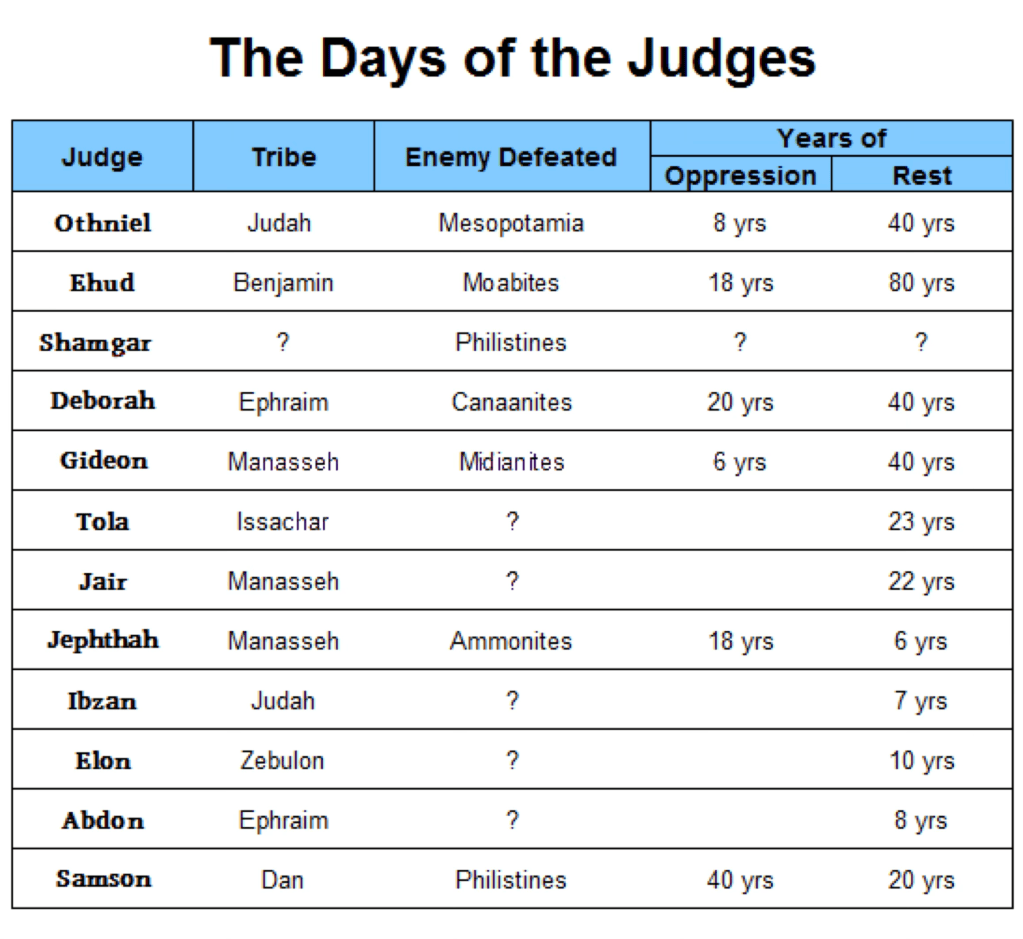
JUGES 10-12: Judge #6 Tola judged 23 years. Judge #7 Jair judged 22 years and is known for having 30 sons who rode 30 donkeys and controlled 30 cities in Gilead. Almost 3 chapters are devoted to Judge #8 Jephthah. An AI summary might help b/c it is a little confusing: “Jephthah was the son of Gilead and a prostitute. His half-brothers drove him away from his homeland to keep him from taking any family inheritance. Jephthah fled to the land of Tob and gathered a group of rough followers. Later, when the Ammonites launched a war against Israel, the elders of Gilead panicked and begged Jephthah to return and lead their army. Jephthah agreed to lead them on the condition that he would become the permanent ruler over the region of Gilead if he won. Jephthah sent messengers to the king of Ammon to ask why he was attacking. The king claimed Israel had stolen his ancestors’ land after leaving Egypt. Jephthah replied with historical accuracy. He pointed out that Israel had lived on the land for 300 years and that God had given them the territory after defeating the Amorites. The king ignored his message and prepared for battle. Empowered by the Spirit of the Lord, Jephthah marched out to fight. Before the battle, he made a foolish vow to God: if God gave him victory, he would sacrifice as a burnt offering whatever came out of his house first to meet him when he returned home safely. Israel won a major victory. However, when Jephthah returned to his home in Mizpah, his only child—his daughter—came out to meet him with music and dancing. Overcome with grief, Jephthah tore his clothes. His daughter bravely agreed that he must keep his word to the Lord, asking only for two months to mourn her virginity in the mountains. After the two months, the text states he carried out his vow (though some scholars interpret the outcome as a lifetime of dedicated virginity/seclusion rather than physical sacrifice). God never endorsed human sacrifice, and the story serves as a dark warning about impulsive promises. The men of Ephraim grew angry that Jephthah did not call them to help in the initial battle, so they threatened him and his house. A civil war broke out, and Gilead defeated Ephraim. The Gileadites guarded the Jordan River crossings, making fleeing Ephraimites say the word “shibboleth”. Because the Ephraimites pronounced it “sibboleth,” 42,000 of them were identified and killed. Jephthah judged Israel for six years before he died and was buried in Gilead.”
I hope that helped. I’m not sure what the life lesson is on Jephthah. Maybe you had a rough flight on a plane and told God “God, if you get me safely on the ground I’ll never fly again!” (LOL) Maybe you made a rash vow at some time in your life and now you have to keep it. Here’s a real story. A severe bolt of lightning struck close to Martin Luther as he was walking, knocking him to the ground. Fearing for his life, he cried out to his family’s patron saint, saying, “Help me, St. Anne, and I will become a monk”. Luther survived the storm, kept his solemn promise, and entered the Augustinian Monastery in Erfurt just two weeks later. His father, Hans Luther, was furious because he had invested heavily in Martin’s legal education to become a lawyer. Luther later became an ordained priest after entering the monastic life, celebrating his first mass in 1507, but the immediate vow made during the storm was specifically to become a monk.” The rest is history as he sent on to lead the Protestant Reformation. Did God send that bolt of lightning? Then there is John Newton. While sailing home to England, a ferocious North Atlantic storm battered the ship, washing crew members overboard and threatening to sink the vessel. Exhausted from pumping water and steering the ship, Newton cried out, “If this will not do, the Lord have mercy upon us!”—surprising himself with a sudden, desperate plea for divine mercy after years of mocking his mother’s Christian faith. He survived the storm and began reading the New Testament, viewing his deliverance as a sign of God’s grace. He commemorated the anniversary of the storm for the rest of his life with prayer and fasting. His conversion was a gradual awakening rather than an instant moral perfection. Newton continued working in the slave trade for several years after the storm, eventually becoming a slave ship captain before suffering a stroke that ended his seafaring career.” The slave trader became an evangelist and later an abolitionist (thought strangely not right after the incident). Did God send that storm? Maybe there is some parallel between those two stories and the story of Jephthah.
Judge #9 Ibzan judged 7 years and had 30 sons and 30 daughters. Judge #10 Elon judged 10 years. Judge #11 Abdon judged 8 years and had 40 sons and 30 grandsons who rode on 70 donkeys.
Judges 13-16: Judge #13 Samson judged 20 years and is the most “colorful” judge. His life is filled with several exploits with Philistine women even though he took the Nazarite vow and never cut his hair. There were probably more, but Judges records 3 specific instances where he got in trouble with his women.
According to the Book of Judges, Samson’s narrative features three distinct relationships, all involving Philistine women:
The woman from Timnah: Samson’s first major romance. He demanded to marry this unnamed Philistine woman against his parents’ wishes, and Samson told his riddle at the marriage feast. The marriage ended in tragedy and betrayal before it was fully realized with his fiancee being given to another man and later she and her father were burned to death by Philistines.
The prostitute in Gaza: The biblical text notes that Samson went to Gaza, saw a prostitute, and spent part of the night with her before carrying the doors of the city gates to the top of a hill and escaping his enemies.
Delilah: Samson fell in love with Delilah, who lived in the Valley of Sorek. While tradition often associates her closely with his downfall, the biblical text itself recounts that the Philistine lords bribed her to discover the secret of his strength, though it does not explicitly state they were married or even sleeping together.”
It is amazing that God can use morally weak men like Samson to punish His enemies. On one occasion when he allowed the Israelites to bind him and turn him over to the Philistine, he killed 1,000 Philistines withe the jawbone of a donkey. “The ends doesn’t justify the means” but Samson’s attraction to Philistine women certainly put him in a position to kill many Philistines, especially at his death when the pulled the pillars of the Philistine temple of Dagon down, killing more at that occasion that he had killed during his life. But it brings up a lot of questions. Why was Samson so drawn to Philistine women like his 1st woman that he wanted to marry? 14:3 His father and mother replied, “Isn’t there an acceptable woman among your relatives or among all our people? Must you go to the uncircumcised Philistines to get a wife?” But Samson said to his father, “Get her for me. She’s the right one for me.” 4 (His parents did not know that this was from the Lord, who was seeking an occasion to confront the Philistines; for at that time they were ruling over Israel.) His parents even went with Samson to Timnah to meet the woman. Samson was choosing a wife based on her looks apparently. If you are not married yet, look deeper than the physical attraction into the heart of the person you are considering marrying. Was Samson one of those people who tend to do the opposite of what their parents tell them to do? Some form of rebellion against parents? Samson still kept his faith in Yahweh even though he was surrounded by Philistines who worshipped Dagon, but his life was miserable b/c of his constant association with them. Paul gave a warning against idolatry in 2 Corinthians 6:14 Do not be yoked together with unbelievers. For what do righteousness and wickedness have in common? Or what fellowship can light have with darkness? 15 What harmony is there between Christ and Belial? Or what does a believer have in common with an unbeliever? 16 What agreement is there between the temple of God and idols? For we are the temple of the living God. As God has said:“I will live with them and walk among them, and I will be their God,and they will be my people.” 17 Therefore,“Come out from them and be separate, says the Lord. Touch no unclean thing, and I will receive you.” We live in a culture that is filled with worshipping the gods of gold and silver, of bronze, iron, wood and stone” (Daniel 5:4). It is filled with sexual immorality, drinking parties, greed, and lustful living. We must be careful that the influence of our culture does not rub off on us. Despite his flaws, the Hebrew writer puts Samson in the same hall of faith group as David and Samuel: Hebrews 11:32 And what more shall I say? I do not have time to tell about Gideon, Barak, Samson and Jephthah, about David and Samuel and the prophets …” Does that surprise you? Would you have put him in the hall of faith with David? Of course, look at the sins David committed. He is not flawless even though he was a man after God’s own heart. So there is hope for those of us who have serious moral flaws. God’s grace can save terrible sinners and help dysfunctional families.
BTW Samson committed suicide as he pulled down those pillars in the temple. But he still made it into the hall of faith. AI: “For centuries, Canon Law denied traditional Catholic funeral rites and burial in consecrated church cemeteries to those who died by suicide, The ban on Catholic funerals for suicide victims was lifted in the late 20th century. Today, the Church offers full funeral masses and burial rites.” Do you know of someone who committed suicide or who has a family member who committed suicide? I do. I have seen a father grieve over a son who committed suicide for no obvioius reasons since he was a church going active Christian. There are drug addicts who seemed to have the habit beat only to possibly overdose on purpose. Depression takes its toll on suicide victims. I know that the Father would look at such cases the same as an earthly father would give the benefit of the doubt to one of his own children who committed suicide. I certainly don’t believe it is the unpardonable sin. We leave all that to God the loving Father.
That goes further than chapter 14, but it’s better to tell the whole story of Samson in one reading. We will focus on Judges 17-21 in the next reading and blog.
Genesis 21: The Birth of Isaac. Abraham is 100; Sarah is 90. After 25 years of Abraham planting his seed in his barren wife, Isaac, the child of promise, is finally born. Sarah laughs, but this time in joy instead of disbelief when the 3 men tell Abraham that he will have a child within a year (Genesis 18). Hebrews 11 commends her faith: 11:11 By faith even Sarah herself received ability to conceive, even beyond the proper time of life, since she considered Him faithful who had promised. 12 Therefore there was born even of one man, and him as good as dead at that, as many descendants as the stars of heaven in number, and innumerable as the sand which is by the seashore.” But trouble is brewing. Already there was tension between Hagar and Sarah. After Hagar got pregnant by Abraham (it was Sarah’s idea) when Abraham was 85, Hagar despised Sarah. Did Hagar despise Sarah b/c Sarah made her have a child by Abraham that could technically be claimed by Sarah as was the custom back then? Or was Hagar just lifted up with pride sensing that her child would not be the fulfillment of the promises to Abraham? She appears to keep full custody of Ishmael after he is born. So Sarah mistreated Hagar and the pregnant Hagar fled into the wilderness but God told her to go back and serve Sarah, which she did. So Hagar has Ishmael when Abraham is 86. But now in chapter 21 several years after Isaac is born, the tension peaks as Sarah sees Ishmael mocking her son Isaac. She demands that Hagar and Ishmael be driven away, and sadly Abraham sends them away to wander in the wilderness. They ran out of water and Hagar doesn’t want to watch her child die but the angel of God shows her a well of water and tells her that her son will make a great nation (the Arabs). Ishmael grows up in the wilderness of Paran. Here is the Islamic tradition: AI: “When their meager rations of dates and water were completely exhausted, the infant Ismail began to suffer from severe dehydration. In an agonizing search for water, caravans, or any sign of life, Hajar ran back and forth between two nearby hills—Safa and Marwa—a total of seven times. In response to her faith and perseverance, God sent the Angel Jibril (Gabriel). The angel struck the ground (in some accounts, the baby Ismail kicked the sand), causing a miraculous spring of fresh water to gush forth. This source became the holy Zamzam Well, which saved their lives and ultimately laid the foundation for the city of Mecca. Today, the two small hills are housed entirely within the massive complex of the Grand Mosque (Masjid al-Haram) at Mecca where Muslims make their mandatory once in a lifetime hadj to Mecca. Millions of pilgrims retrace Hajar’s desperate path. Pilgrims walk a total distance of approximately 2.76 kilometers (1.7 miles), completing seven one-way trips between the hills.While pilgrims generally walk the route, there is a specific section marked by green lights where men are encouraged to break into a brisk run or jog, mirroring Hagar’s frantic rush through the lowest point of the valley where she briefly lost sight of her baby. After completing Sa’i re-enactment, it is customary for pilgrims to drink deeply from the Zamzam water system, fulfilling the legacy of the miracle that saved the mother and child.” This has to be a very important event for Muslims since Ishmael was about to die and Muhammed is thought to be a descendant of Ishmael. Did God know that when he rescued Ishmael from the point of death and made a great nation from him (the Arabs) that it would he Ishmael’s descendants who would hate and kill his chosen people, the descendants of Isaac (the Jews), and even kill Christians in jhads. After all, they believe that Jesus was a prophet, but only a prophet and not the Son of God. Of course, Arabs and Jews can both find spiritual peace in Jesus Christ in the church if they choose to. Some might question why God allows Israel to do some of the things they do, so the only solution is for Jews and Arabs to both come to faith in Jesus
After the incident in Genesis 20 when Abraham lied to Abimelech in Gerar, Abimelech is leery of what the God of Abraham might do, so he asked Abraham to swear that he will never hurt him, which Abraham does. After some tension over a well, they enter a formal treaty at Beersheba.
Genesis 22. The Testing Of Abraham. We come to one of the most important chapters in the Old Testament. God “tested” Abraham by telling him to offer his son Isaac (most think he was 20 or so years old). Of course, the Muslims say that it was Ishmael, not Isaac, that was to be offered. The Hebrew word for “tested” is nasah: To test, to try, to prove, to tempt. James 1:13 Let no one say when he is tempted, “I am being tempted by God”; for God cannot be tempted by evil, and He Himself does not tempt anyone. The Greek word for “tempted” there is peirazó: To test, to tempt, to try, to examine. But Deuteronomy 8:2: God leads Israel through the wilderness for forty years to humble them and test what is in their hearts. So God does test people. He might even allow Satan to do the testing as in the case of Job. But if a test causes a person to have lusts that cause them to fail the test, it is not God to blame b/c he tested them. They only fail the test b/c of their own inner lusts. God will even put a limit to their failures if we seek an escape. Scripture assures believers that God does not allow people to be tested beyond what they have the strength to handle, and He always provides a way to endure it (1 Corinthians 10:13). I will never forget an incident when I was a principal. A high school boy was brought to my office b/c he was throwing rocks on the elementary playground (not at children, just throwing small pebbles) even after an elementary teacher told him to quit throwing. As I prepared to give him 3 “licks” with a very big wooden paddle, his excuse was: “If the teacher had not told me to quit throwing rocks, I wouldn’t have been in trouble for throwing rocks!” In other words, it was the teacher to blame for him getting in trouble! That’s James 1! Some blame God when they fail a test and sin.
Back to the test itself. Abraham had “unquestioning obedience” to God. He didn’t even question God as to why He could command a human sacrifice. Or why, after 25+ years of waiting to have the son of promise, He now tells Abraham to kill him. He gets up “early the next morning” When they arrived at the mount, 22:5 Abraham said to his young men, “Stay here with the donkey, and I and the lad will go over there; and we will worship and return to you.” “We”, i.e. Isaac and Abraham. Why would he say “we” when he was about to kill Isaac? The explanation is found in Hebrews 11:17 By faith Abraham, when he was tested, offered up Isaac, and he who had received the promises was offering up his only begotten son; 18 it was he to whom it was said, “In Isaac your descendants shall be called.” 19 [o]He considered that God is able to raise people even from the dead, from which he also received him back as a type.” He was thinking, “The only possible answer to my questions is if I kill Isaac and God raises him from the dead!” What imaginative faith! What possibility thinking! What trust in God! What was the “type” in Hebrews 11:19? 1) The ram taking Isaac’s place made it a figurative resurrection since Abraham had been fully willing to offer Isaac. 2) The ram taking Isaac’s place was a type of Jesus taking our place on the cross so that we won’t die forever but have eternal life. I can’t imagine what Isaac is thinking during this whole incident. Was he looking up at Abraham as he drew back the knife or did Abraham blindfold him? Abraham bound his on top of the wood, so he had to know what looked like was about to happen.
Why did God say “Now I know that you fear God”? Did God not know that Abraham was willing to offer Isaac even before he told him to? Does God’s omniscience not require that God already knew that? Maybe God’s omniscience does not require that God know everything about everyone in the future. Maybe his omniscience means that he can choose to know the future only when He so desires or needs to (which is called Open Theism). In open theism, he might not know the free will choices people will make unless he so chooses, but he can choose to know what their choices will be. He chose to know if Judas would betray Jesus and chose Judas to be an apostle knowing that he would betray Jesus. He did not know if Abraham would offer Isaac and thus it really was a true test of his faith. But I can’t imagine how it would have affected God’s plans if Abraham had not been willing to offer Isaac. After offering the ram, Abraham named the place “Yahweh Jireh”, Yahweh God will provide. The name is only mentioned once in the Bible. This incident is a type of God providing a substitute, Jesus, so that physical death will not be forever for us. We can live forever b/c Jesus took the punishment for our sins on the cross. The angel told Abraham, 22:18 In your seed all the nations of the earth shall be blessed, because you have obeyed My voice.” This is the verse quoted by Paul in Galatians 3:16 Now the promises were spoken to Abraham and to his seed. He does not say, “And to seeds,” as referring to many, but rather to one, “And to your seed,” that is, Christ.” The inspiration of Scripture is so complete that this argument hinged on the singular or plural of “seed” in Genesis 22:18. James comments on the offering of Isaac: James 2:21 Was not Abraham our father justified by works when he offered up Isaac his son on the altar? 22 You see that faith was working with his works, and as a result of the works, faith was perfected; 23 and the Scripture was fulfilled which says, “And Abraham believed God, and it was reckoned to him as righteousness (Genesis 15:6),” and he was called the friend of God. 24 You see that a man is justified by works and not by faith alone.” James quotes Genesis 15:6 where Abraham was “saved” by imputed righteousness, but says that Abraham’s faith was “perfected” (teleioó: To complete) when he offered Isaac. James had already said in his letter that trials can make our faith more “complete” (perfect): James 1:2 Consider it all joy, my brethren, when you encounter various trials, 3 knowing that the testing of your faith produces endurance. 4 And let endurance have its perfect result, so that you may be perfect and complete, lacking in nothing.” Abraham was “justified” (declared free of guilt spiritually by God) by his works, but not “on the basis of” his works. Salvation is 100% by the grace of God even when we do “works” of obedience to God.
Genesis 22 closes with more of the genealogy of Terah, which will come into play in chapter 24.
Genesis 23: The death and burial of Sarah. Sarah died at 127 years old. Abraham had to by a piece of land from Ephron, a Canaanite. He buried Sarah in the cave of Machpelah on the land he bought. This cave will be the burial site for many of the patriarchs and their wives. Sarah had been roaming all over Canaan since she and Abraham arrived there when she was 65, so roaming for 62 years! She never had a permanent home in Canaan, constantly moving to find pasture and water and to avoid conflicts with the Canaanites. Peter commends the humble, submissive attitude of Sarah: 1 Peter 3:5 For in this way in former times the holy women also, who hoped in God, used to adorn themselves, being submissive to their own husbands; 6 just as Sarah obeyed Abraham, calling him lord.” Abraham made the major decisions. He said, “Let’s leave Ur and go to this unknown land”, and she obeyed. He said, “We need to go to Egypt” and she obeyed although it nearly cost her dearly. She just humbly obeyed Abraham. A lot of modern women don’t like it when we quote Paul saying that wives should be in submission to their husbands, but Peter certainly agrees with that in 1 Peter 3:1-5. I can relate to that. I am blessed with such an humble, submissive wife. Sure I discussed major decisions with her, but I made the final decisions to leave my engineering job and our parents and house we just bought in B’ham to go to Louisiana to a school of preaching, then to move to Trinidad to do mission work, then to take a low paying job as a principal in Christian education in B’ham, then to move to Vernon, and then to move to Huntsville where we have been for 32 years now. I counted in one decade in the 70’s where we moved 11 times from foreign countries to apartments, back and forth. My wife never complained or questioned our moves. She would have been perfectly happy to have stayed in B’ham near her parents but followed wherever I thought God was leading us to serve. My wife sacrificed a lot of the things she could have had if we had settled in one place with more money, but God blessed her in the long run with 3 godly children that she did most of the raising while I was out saving the world or doing Christian education. Now as she has gotten older, she has at least had 18 years in a nice house with 10 grandchildren and close family ties with her 3 grown children. She would refute this, but I think she comes pretty close to the woman in Proverbs 31 (although Solomon says you can’t find such a woman!). I praise her as called for in 31:28 Her children rise up and bless her; Her husband also, and he praises her, saying: 29 “Many daughters have done nobly, But you excel them all.”
Genesis 24: A Wife For Isaac. Most scholars think this servant sent to find a wife for Isaac was Eliezer of Damascus (Genesis 15) so we will assume that it was for this blog. Look back at the genealogy of Terah above to see where Rebekah fits in as she was a first cousin once removed. The story is simple to read, but the bigger story in this chapter might be Eliezer. Notice the humility and faith of this man. He swore an oath to not take a bride for Isaac from Ur but only from Haran, and then traveled the 400 miles from Canaan to Haran. 24:12 He said, “O Lord, the God of my master Abraham, please grant me success today, and show lovingkindness to my master Abraham. He trusts God for a sign to show him the right bride (the girl who offered to water his camels). He is constantly trying to see how God is answering his prayer as Rebekah wateed his camels: 24: 21 Meanwhile, the man was gazing at her in silence, to know whether the Lord had made his journey successful or not. He did not know at first that she was a relative of Abraham, but when she told him that she was the granddaughter of Nahor, Abraham’s brother, 24:26 Then the man bowed low and worshiped the Lord. 27 He said, “Blessed be the Lord, the God of my master Abraham, who has not forsaken His lovingkindness and His truth toward my master; as for me, the Lord has guided me in the way to the house of my master’s brothers.” In Laban’s house (Rebekah’s brother) he would not eat until he told why Abraham had sent him. Both Laban and Bethuel (Rebekah’s father) agreed “The matter comes from the Lord” and agreed to let Rebekah marry Isaac. After a short delay, Eliezer brought Rebekah back to Canaan and she married Isaac. Isaac loved her and was comforted after his mother’s death (Sarah). I find it amazing that Genesis 24 is the longest chapter in Genesis. Of course, uninspired humans divided the Old Testament into chapters, so I’m not saying that is a “God thing” but I do find it interesting.
Life Lesson: I wish I had the faith of this relatively unknown character in the Bible. He is humble, he trusts God completely for success, he is focused on his task and will not even eat till he accomplishes it, he is prayerful, he is constantly seeking God’s guidance in what he is doing, he worships God when he has success, he is looking out for the interests of others (Abraham and Isaac), he believes that God can provide spiritual mates for his children, etc. We should be like Eliezer every day, every moment of every day. When you start out on a day’s jobs or tasks or travels, do you start first with prayer for success. When things happen, do you look for God’s leading or just assume it is circumstantial happenings? Do you praise God every time something good happens? Are you willing to go to great lengths to help others? Do you know of an “Eliezer” that has these qualities?
Genesis 25Death Of Abraham and Birth Of Jacob And Esau. Abraham was 137 when Sarah died. He died at 175, so he lived 38 years after Sarah died and took a 2nd wife, Keturah during those 38 years and had 6 sons by her. We don’t know where Keturah was from. Abraham sent her sons off to the east so they wouldn’t interrupt God’s plans for Isaac. They became Arabian tribes. Abraham died at 175, “in a ripe old age, an old man and satisfied with life.” Isaac and Ishmael buried him in the cave of Machpelah where Sarah was buried. I find it interesting that he died “satisfied with life”. He could have easily been very unsatisfied with life. God had called him to an unknown land 1,000 miles away, and he only found out that he personally would never own any of the land except for the cave he bought to bury Sarah in. He was constantly moving around, being harassed by the Canaanites, dealing with the Philistines and Abimelech. He watched as Sodom went up in smoke. We don’t know if he ever saw Lot again after the destruction of Sodom. He had to take his 318 men and rescue Lot. He tries to plant his seed in a barren woman for 25 years after they enter Canaan (maybe many years before that). He has to send Hagar and Ishmael to wander in the wilderness, thinking they might die there, but he truly loved Ishmael. He almost killed Isaac if God had not stopped him. But Hebrews 11 says it best: 11: 9 By faith he lived as an alien in the land of promise, as in a foreign land, dwelling in tents with Isaac and Jacob, fellow heirs of the same promise; 10 for he was looking for the city which has foundations, whose architect and builder is God.” 11:13 All these died in faith, without receiving the promises, but having seen them and having welcomed them from a distance, and having confessed that they were strangers and exiles on the earth. 14 For those who say such things make it clear that they are seeking a country of their own. 15 And indeed if they had been thinking of that country from which they went out, they would have had opportunity to return. 16 But as it is, they desire a better country, that is, a heavenly one. Therefore God is not ashamed to be called their God; for He has prepared a city for them.” AI says it well: “Abraham died satisfied because his contentment came from his relationship with God and seeing God’s promises unfold, rather than from having an easy life or possessing the land completely. Abraham looked past his immediate hardships and lived with a long-term, eternal perspective. His deepest sense of fulfillment came from walking closely with God, who guided him step-by-step through every trial. Even though he lived as a nomad and did not own the entire promised land, he lived to see Isaac grow and his family begin to multiply, fulfilling God’s promise to make him the father of many nations.” He was looking for a city whose builder was God. I’m not sure what they means but it had to be an eternal spiritual place after death! Enjoy the song “Looking for a city”, Gaither style.
Genesis 25 has the 7th “these are the generations of” with “these are the records of the generations of Ishmael” in 25:12. Ishmael lived 137 years and settled in “defiance of all his relatives”, i.e the descendants of Abraham and Isaac.
Then we come to the 8th “generations of” with “these are the records of the generations of Isaac” (25:19-35:29).
Genesis 25 closes with the birth of Isaac and Rebekah’s 2 sons, Jacob and Esau. Isaac was 40 when he married Rebekah and 60 when the twins were born. Twins but totally different looking, with totally different personalities. Esau was a hunter, the favorite child of Isaac and Jacob, the favorite of Rebekah, “lived in tents”. God told Rebekah that the older would serve the younger, and that proved to be true as Esau was the firstborn but Jacob was the one through whom the promises to Abraham would be fulfilled. A little lengthy but we need to look at Romans 9:6 But it is not as though the word of God has failed. For they are not all Israel who are descended from Israel; 7 nor are they all children because they are Abraham’s descendants, but: “through Isaac your descendants will be named.” 8 That is, it is not the children of the flesh who are children of God, but the children of the promise are regarded as [g]descendants. 9 For this is the word of promise: “At this time I will come, and Sarah shall have a son.” 10 And not only this, but there was Rebekah also, when she had conceived twins by one man, our father Isaac; 11 for though the twins were not yet born and had not done anything good or bad, so that God’s purpose according to His choice would stand, not because of works but because of Him who calls, 12 it was said to her, “The older will serve the younger.” 13 Just as it is written, “Jacob I loved, but Esau I hated.” I highlighted the reason God chose the older to serve the younger. He wanted to make it known that His plans are ultimately not based on our works or goodness but b/c of His power. Sure, he perhaps looked into the minds and hearts of the twins when they would grow up and decided that Esau would not appreciate his birthright so Jacob would be the better choice to fulfill the promises to Abraham. But Jacob had so many flaws, was he really a better choice than Esau? Ultimately, he was the better choice to carry on the seed line of Jesus despite his flaws. Paul then quotes Malachi 1:2-3 “Jacob I loved but Esau I hated”. Perhaps the “hated Esau” refers to the dislike God came to have of the descendants of Esau who persecuted Isaac’s descendants down through the centuries. Esau proved to be unworthy of the chosen line of Jesus b/c he sold his birthright for a bowl of stew. He “despised his birthright” (24:34). Jacob ended up in Egypt in old age, trusting God to fulfill the promises He had made to Abraham, Isaac, and Jacob. He made sure his bones would be buried in Canaan, not Egypt.
Well that accomplishes my purpose of catching up to where I first started the readings on Aug 31 with Genesis 26-30. I hope you have had time to read all these chapters and the blogs that go with them. And then keep up with the current daily readings.