
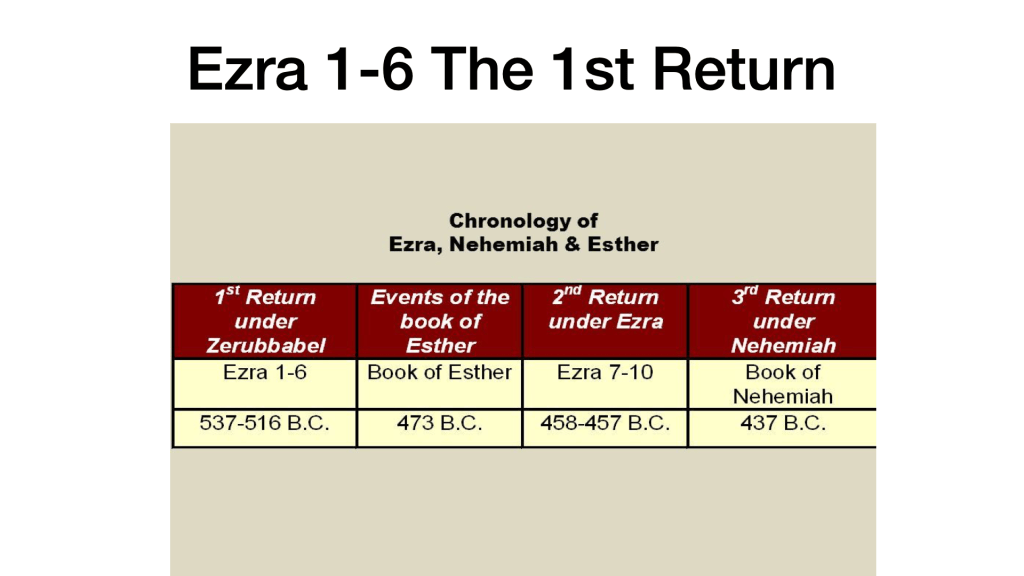
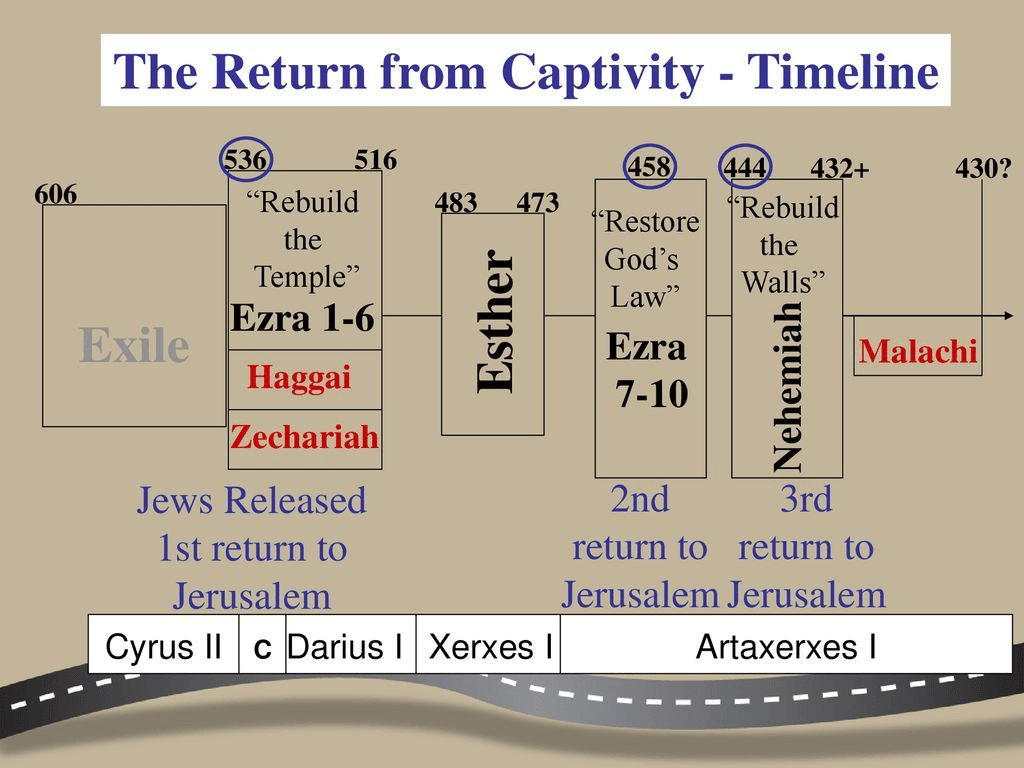
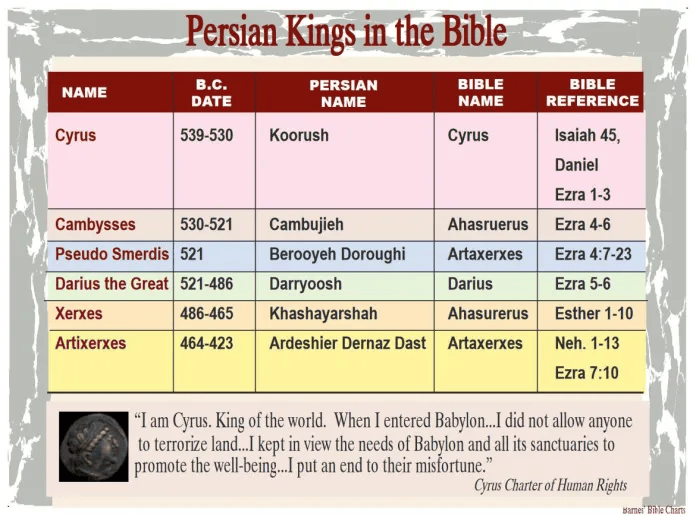
We pick up where we left off. The Medes and Persians defeated the Babylonians in 540 BC. The Jews were in Babylonian captivity for 70 years. Cyrus the king of Persia allowed the 1st return of Jews from Babylon under Zerubbabel to rebuild the temple just as Isaiah and Jeremiah predicted. It is critical that we understand the sequence of events in Ezra, Nehemiah, and Esther b/c they are not in chronological order. This chart really helps:
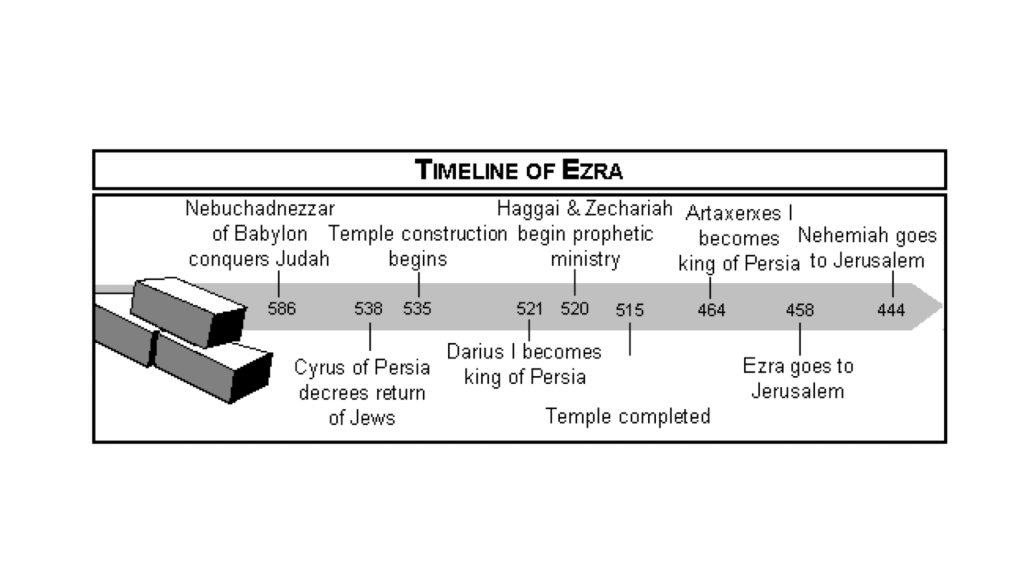
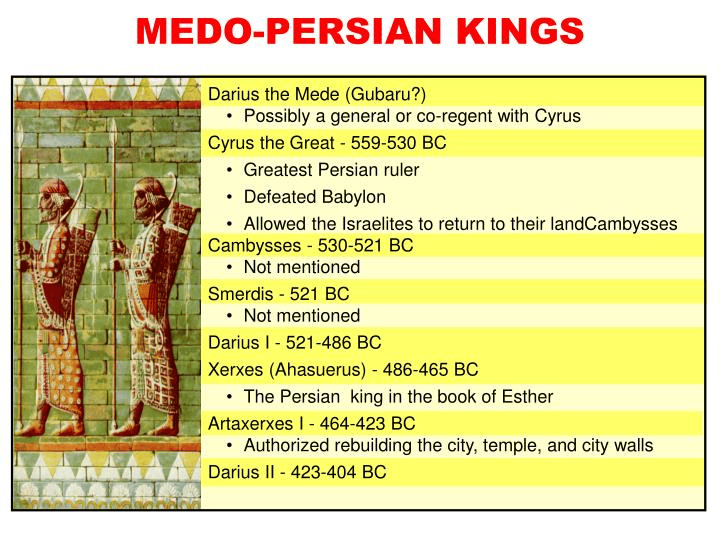
Here are the Medo Persian kings and the reign of Cyrus king of Persia.
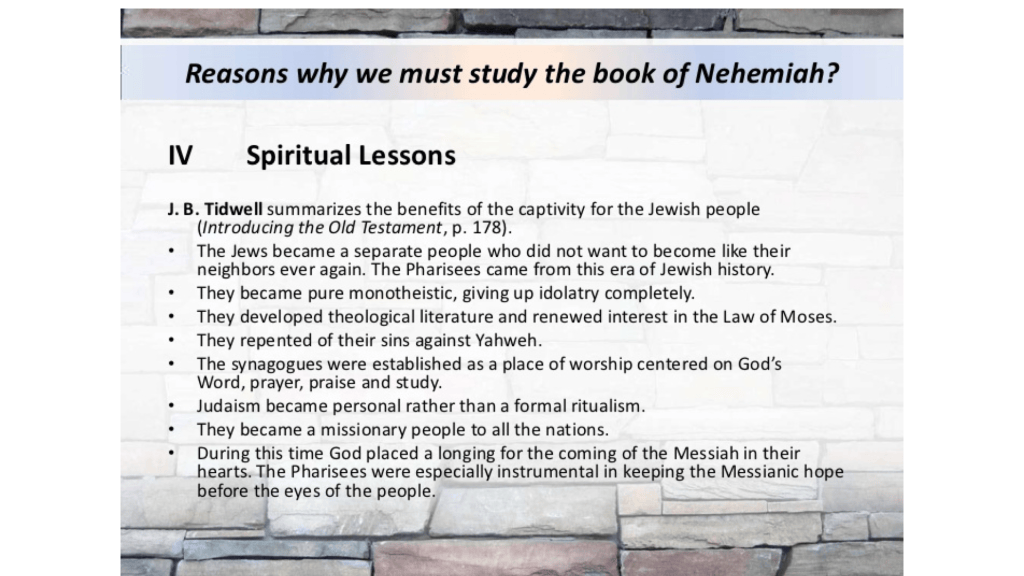
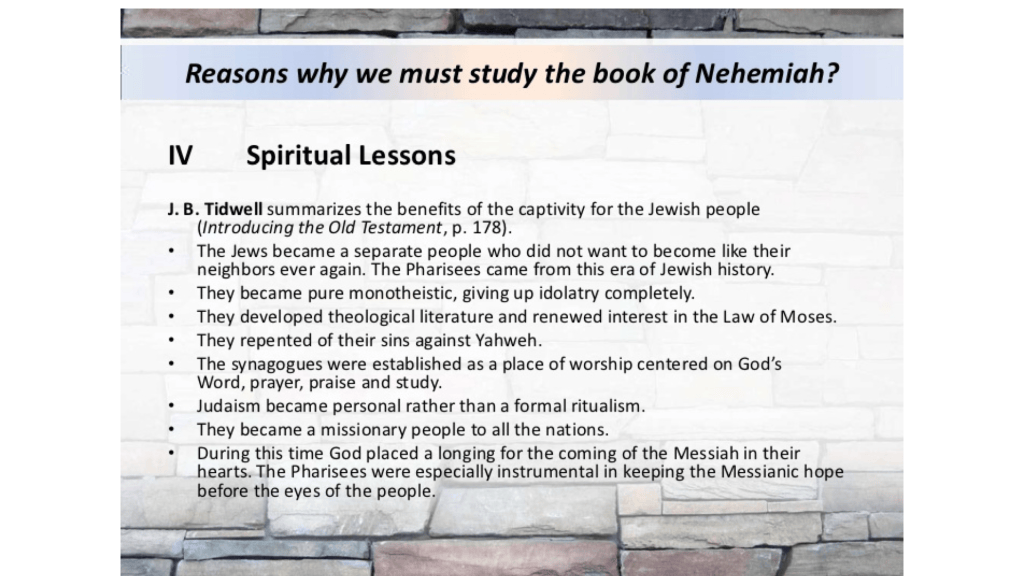
Here is a great slide showing the benefits of the 70 year captivity of Judah.
The best way to study Ezra 1-6 and the 1st return under Zerubbabel to rebuild the temple is an outline:
Ezra chapters 1 through 6 describe the return of Jewish exiles from Babylon to Jerusalem and the rebuilding of the Lord’s temple.
Key Events in Ezra 1–6
- Cyrus’s Decree (Ezra 1): King Cyrus of Persia issues a royal proclamation allowing the Jewish exiles to return to Jerusalem and rebuild the temple. He restores 5,400 gold and silver temple vessels looted by Nebuchadnezzar.
- The Return and Spirit-Stirred Response (Ezra 1–2): God stirs the hearts of family heads, priests, and Levites (led by Zerubbabel and Jeshua) to make the journey, while neighbors and those staying behind supply them with silver, gold, goods, and animals. A remnant of roughly 42,360 people returns.
- Rebuilding the Altar and Foundation (Ezra 3): The returnees set up the altar of the God of Israel in Jerusalem, restart daily burnt offerings, and lay the foundation of the new temple amid mixed reactions of weeping and shouting for joy. Many were joyful b/c the 2nd temple would be built but others were sad b/c the 2nd temple of Zerubbabel was so inferior to Solomon’s temple.
- Opposition and Work Stoppage (Ezra 4): Local Samaritan adversaries and regional officials oppose the project, sending letters to Persian authorities that force the construction to halt for about 16 years around 520 BC.
- Resumption of Work (Ezra 5): Propelled by the encouragement of the prophets Haggai and Zechariah, the Jewish leaders restart building the temple. The local governor, Tattenai, challenges their authority and writes to King Darius for clarification.
- Darius’s Search and Temple Completion (Ezra 6): King Darius searches the royal archives, finds Cyrus’s original decree at Ecbatana, confirms its validity, and orders local officials to fund the construction from royal taxes. The temple is finished in 516 BC (Darius’s sixth year) and dedicated with great joy and a celebration of the Passover. Ezra 6:14 And the elders of the Jews were successful in building through the prophesying of Haggai the prophet and Zechariah the son of Iddo. And they finished building according to the command of the God of Israel and the decree of Cyrus, Darius, and Artaxerxes king of Persia.”
We will not cover Ezra 7 even though it is in today’s reading b/c it happened in 456 BC (see the chart above) which was about 50 years after Ezra 6. As you can see on the chart above, the whole story of Esther occurs between Ezra 6 and Ezra 7.
The main thing about the 1st return is fulfilled prophecy. It is amazing to see how God had his prophets predict the rise and fall of major world empires in the Old Testament and the captivity and return of Judah from Babylon. Fulfilled prophecy is one of the main proofs the Bible is the Word of God.
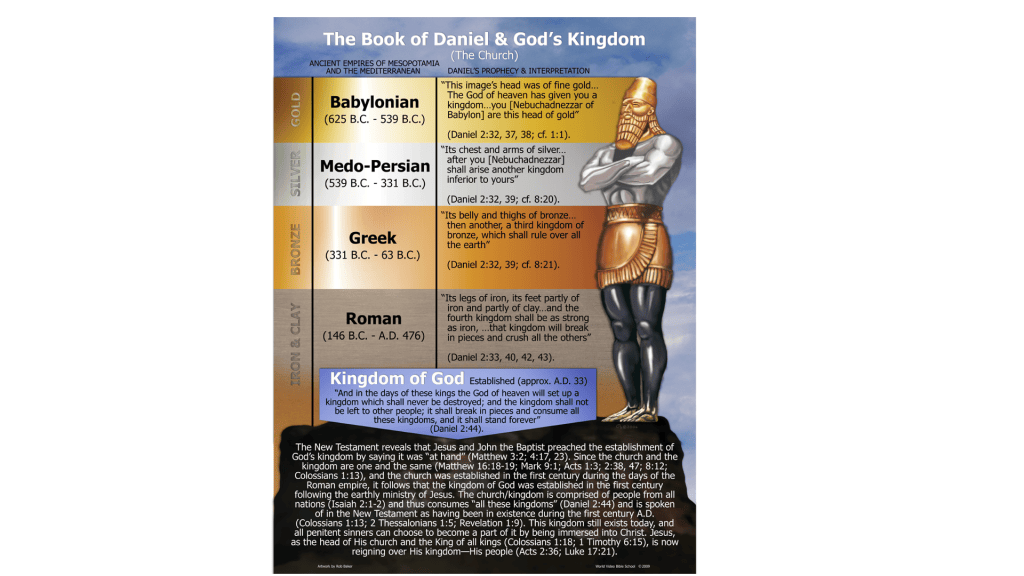
King Nebuchadnezzar’s statue in Daniel 2: Daniel predicted the 4 kingdoms: Babylon, Media/Persian, Greece and Rome. That was right after Daniel was carried into Babylonian captivity in about 606 BC. So he predicted the Medo/Persian conquest of Babylon about 60 years before it happened.
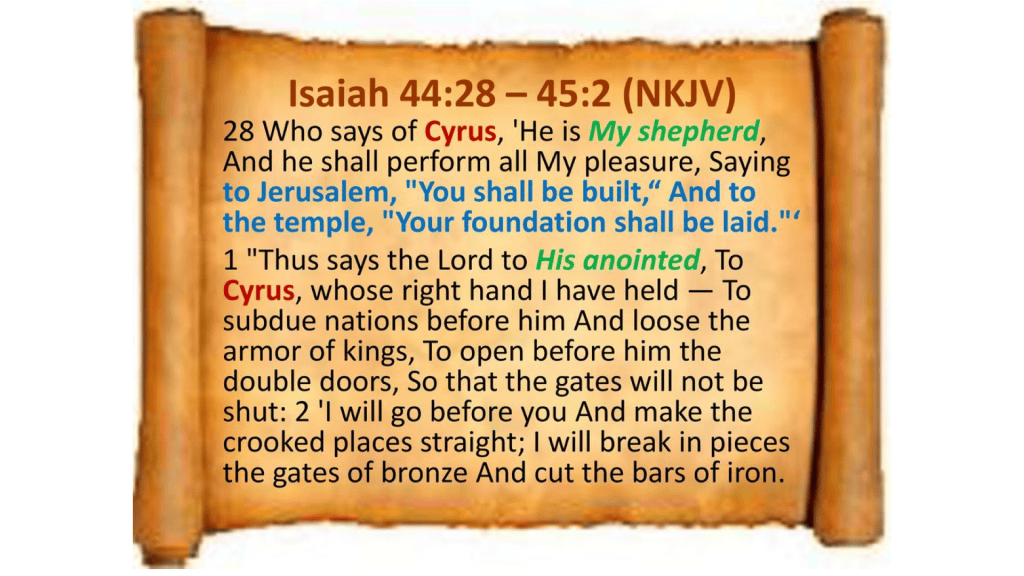
Isaiah predicted that Judah would be in Babylonian captivity but allowed by Cyrus king of Persia to return to the Promised Land to rebuild the temple. This prediction was made 150-175 years before Medo/Persia conquered Babylon in 540 AD.
Jeremiah 25:11 This whole land will be a desolation and a horror, and these nations will serve the king of Babylon seventy years.12 ‘Then it will be when seventy years are completed I will punish the king of Babylon and that nation,’ declares the Lord, ‘for their iniquity, and the land of the Chaldeans; and I will make it an everlasting desolation. Jeremiah 29:10: Jeremiah wrote a letter to the exiles in Babylon stating, “When seventy years are completed for Babylon, I will visit you, and I will fulfill to you my promise and bring you back to this place.”
I thought this was really good from Ligonier Ministries:
The 70-year Babylonian captivity served a dual purpose of divine judgment for sin and restitution for the land’s unobserved Sabbath-rest.
1. Judgment for Idolatry and Rebellion
- Covenant Violation: Judah repeatedly turned away from God, ignored the warnings of prophets like Jeremiah, and practiced idolatry and social injustice.
- Discipline: God used the Babylonian Empire under King Nebuchadnezzar II as an instrument of judgment to punish the nation and destroy Jerusalem and the Temple.
2. Granting the Land Its Sabbath-Rest
- Neglected Commandments: According to 2 Chronicles 36:21 and Leviticus 25:2–7, God commanded that every seventh year the land of Israel must rest and lie fallow.
- Recompense: For hundreds of years, the people disobeyed this law and overworked the land. The 70 years of exile allowed the land to finally enjoy the Sabbath-rests that the people had denied it. This 2nd purpose of the 70 years might not seem like much to us but it shows God’s respect for the land that He created. We should be concerned with protecting the environment. The infamous “Dust Bowl” shows what happens when we overwork the land.
3. Purification and Restoration
- Cure for Idolatry: The trauma of losing the land, the monarchy, and the Temple permanently cured the Jewish people of their tendency toward gross national idolatry.
- Fulfillment of Prophecy: The fixed 70-year timeline—prophesied by Jeremiah—demonstrated God’s sovereignty over history and culminated in King Cyrus of Persia issuing a decree in 538/536 BC allowing the Jews to return and rebuild Jerusalem.
Here is a great slide summarizing the benefits of the 70 year captivity.
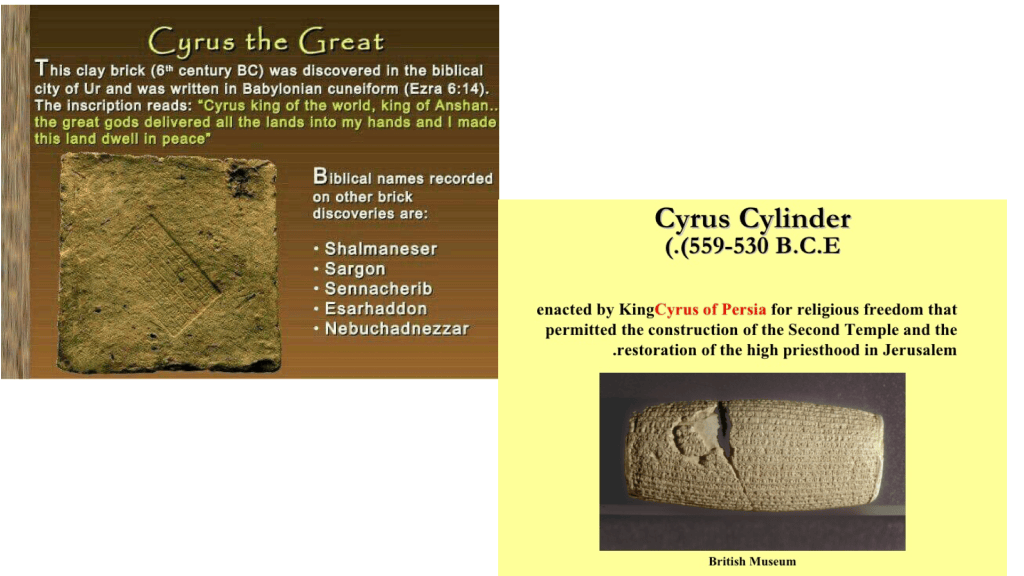
We have archaeological confirmation of Cyrus king of Persia.
The book of Esther will happen between Ezra 6 and Ezra 7 but for the daily reading we will pick up with Ezra7-12 next time and the 2nd return from captivity even though that would occur after the events in the book of Esther. Confusing, right?

