
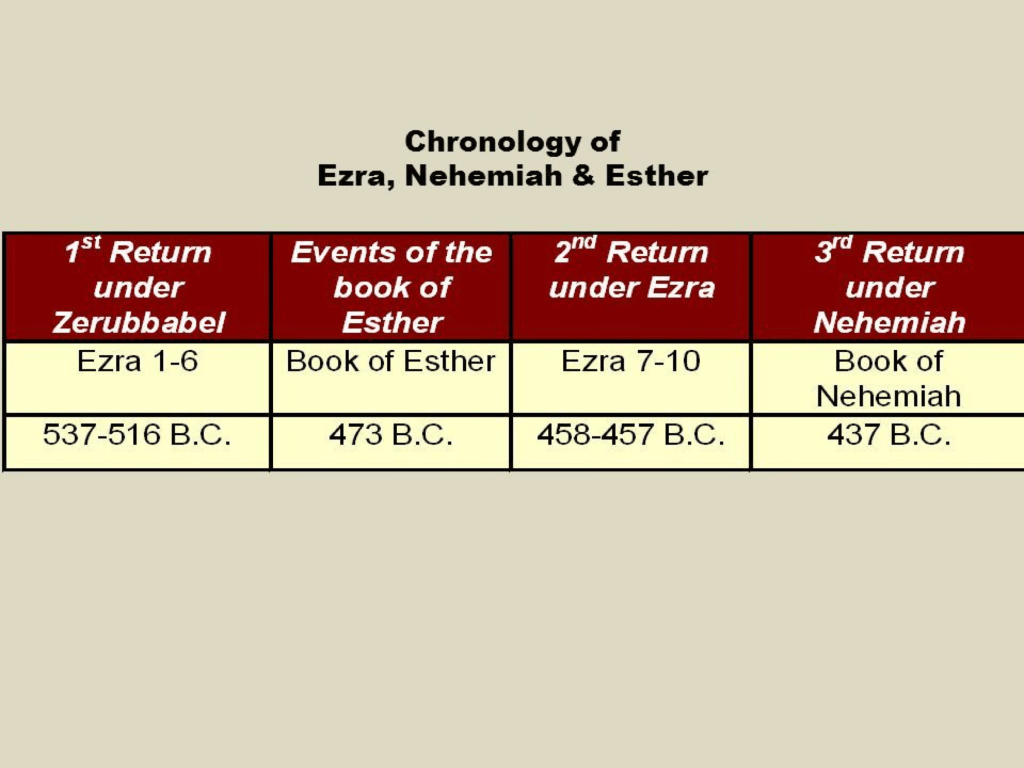
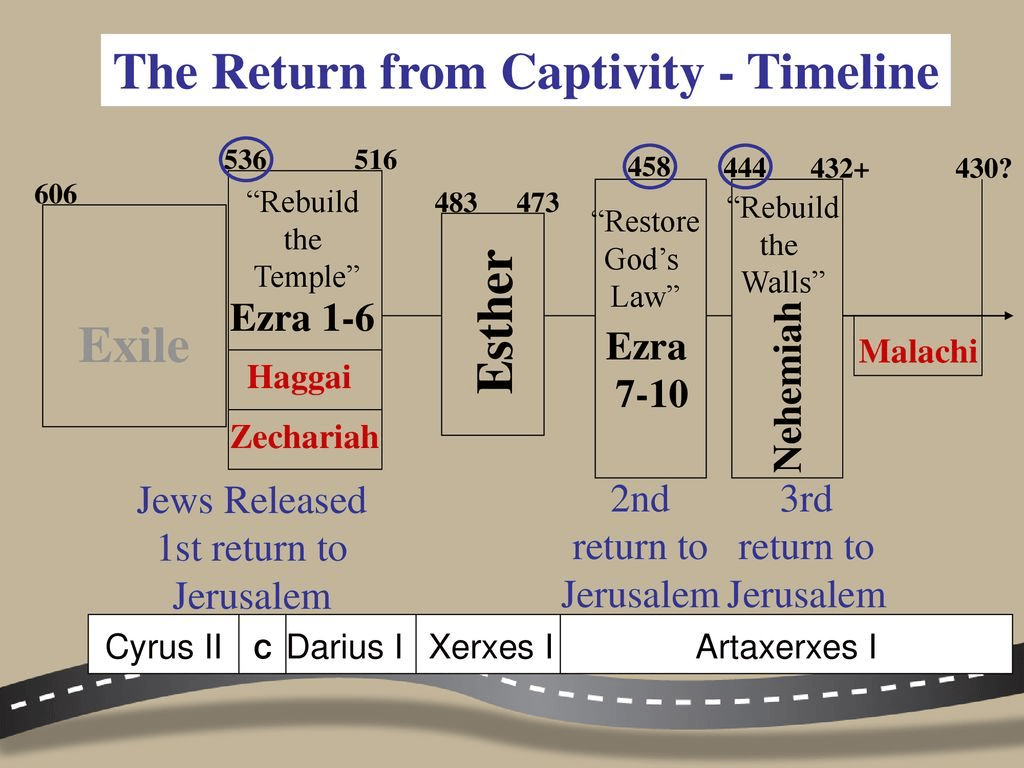
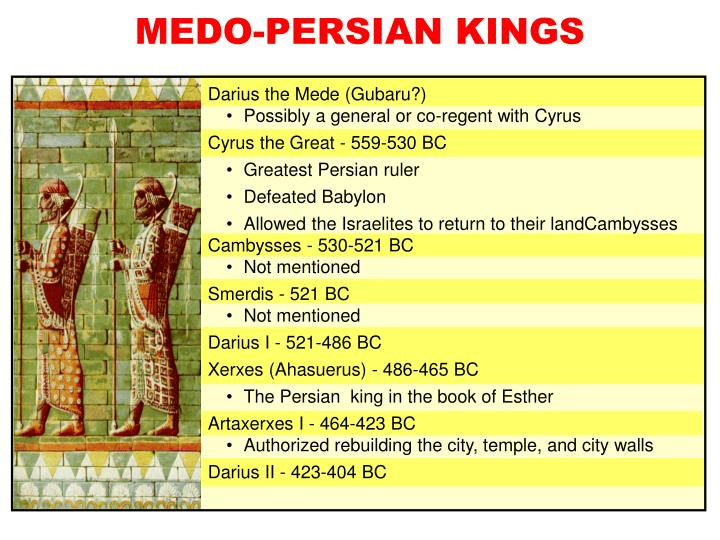
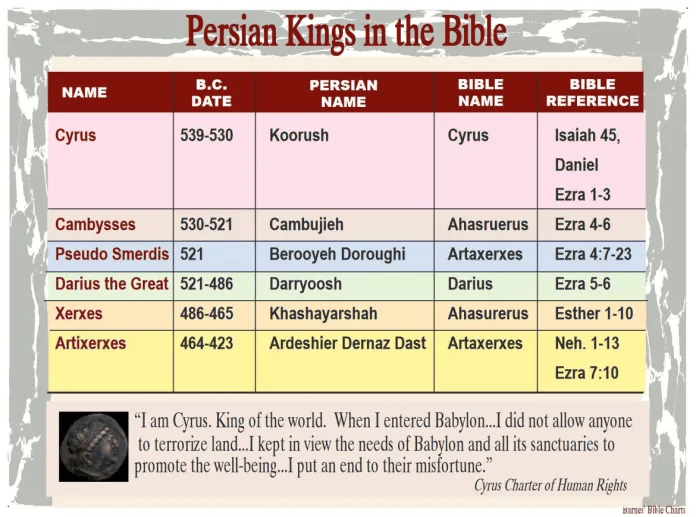
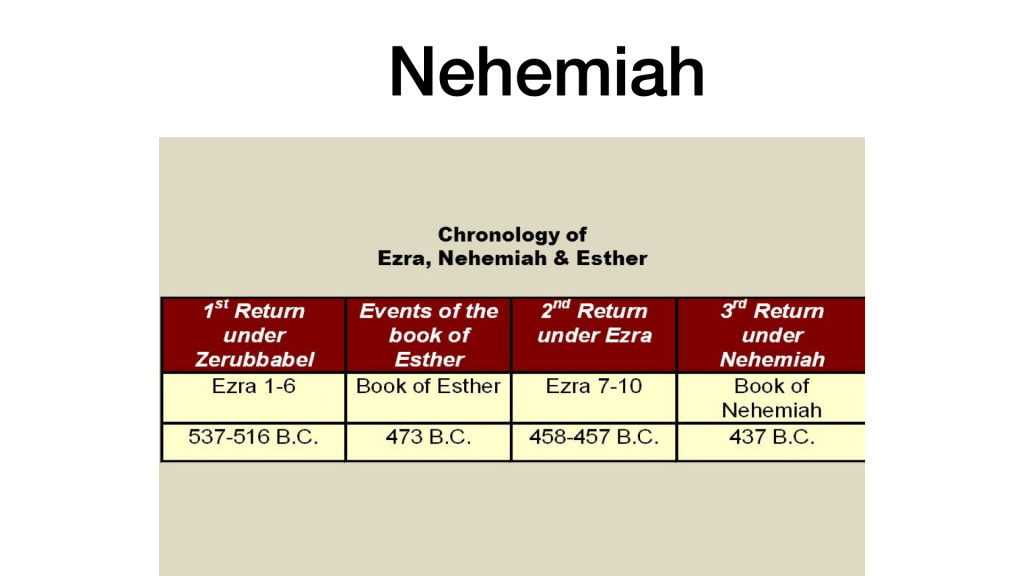
It is very important to get the chronology right. Look at the chart above. The 2nd return from Babylonian captivity in about 458 BC occurred after the events in Esther. The events in Esther occurred between Ezra 6 and Ezra 7. Yesterday’s reading included Ezra 7 but it really should be read today with the full 2nd return from Ezra 7-10. It is important to know the kings of the Medo Persians as we read. Notice that the 2nd return was granted to Ezra by Artaxerxes I (464-423 BC).
As with the 1st return, it is best to have a good AI outline of the 2nd return from Ezra 7-10
Chapters 7–10 of the Book of Ezrashift the focus from the rebuilding of the temple (chapters 1–6) to the spiritual and social reform of the people through the Law of Moses. [1]
Ezra 7: Ezra’s Arrival and Commission
- Ezra’s Genealogy and Background (7:1–10):
- Ezra is introduced as a priest and a skilled scribe in the Law of Moses, tracing his lineage back to Aaron.
- Highlights his personal commitment in Ezra 7:10: to study the Law of the Lord, to practice it, and to teach its statutes and rules in Israel.
- The Decree of King Artaxerxes (7:11–26):
- King Artaxerxes of Persia grants Ezra royal authorization to lead a second wave of exiles back to Jerusalem.
- The decree provides silver, gold, and supplies for temple sacrifices, exempts temple personnel from taxation, and empowers Ezra to appoint magistrates and judges to enforce God’s Law.
- Ezra’s Praise to God (7:27–28):
- Ezra praises God for moving the heart of the king and recognizes that the gracious hand of God is upon him.
Ezra 8: The Journey to Jerusalem
- The List of Returning Exiles (8:1–14):
- A census of the family heads and approximately 1,500 men (along with women and children) who journey with Ezra from Babylon.
- Recruiting Levites at the Ahava Canal (8:15–20):
- Realizing no Levites or temple servants are yet in the company, Ezra dispatches messengers to recruit them, adding key ministers to the group.
- Fasting and Prayer for Safe Passage (8:21–23):
- Ezra proclaims a fast by the Ahava Canal to humble themselves before God and ask for a safe journey, refusing to request a military escort from the king to prove their reliance on God.
- Weighing and Caring for the Temple Treasures (8:24–30):
- The silver, gold, and sacred vessels are weighed and entrusted to leading priests and Levites for safe transport.
- Arrival and Offerings in Jerusalem (8:31–36):
- The group departs on the first day of the first month and arrives safely in Jerusalem four months later.
- They rest, offer burnt offerings to God, and deliver the king’s commissions to the local satraps and governors.
Ezra 9: Discovery of Sin and Ezra’s Confession
- The Report of Intermarriage (9:1–4):
- Jewish leaders inform Ezra that the returned exiles—including priests and Levites—have intermarried with the surrounding pagan peoples, violating covenant commands.
- Ezra’s Mourning and Shock (9:3–4):
- Overwhelmed by grief, Ezra tears his tunic and cloak, pulls hair from his head and beard, and sits in deep distress until the evening sacrifice.
- Ezra’s Prayer of Corporate Confession (9:5–15):
- Ezra falls on his knees, spreads his hands to God, and confesses the collective guilt of Israel, acknowledging that despite God’s grace in allowing a remnant to return, the people have rebelled again.
Ezra 10: The Covenant Renewal and Reform
- The Proposal for Repentance (10:1–4):
- A large crowd of weeping Israelites gathers around Ezra.
- Shecaniah speaks up on behalf of the people, proposing a covenant to put away the foreign wives and children in accordance with the law.
- The Assembly Summoned (10:5–12):
- Ezra makes the leaders and all the exiles take an oath to follow this plan, calling a mandatory assembly in Jerusalem with a threat of property confiscation and excommunication for non-attendance.
- Investigation of Unlawful Marriages (10:13–44):
- The people agree to the plan, and a commission is formed to investigate every household involved.
- Conclusion of the Matter (10:16–44):
- The process takes about three months to examine all the cases, concluding with a documented list of priests, Levites, and laymen who had married foreign women.
Couple of notes. Ezra was a scribe. Ezra 7:10 For Ezra had set his heart to study the law of the Lord and to practice it, and to teach His statutes and ordinances in Israel.” A good scribe would study it, practice it, and teach it. A good Bible teacher will do the same.
Life Lesson: The phrase “the hand of God was upon Him” is used in 7:6,9,28; 8:18,22,31. It is apparent how much Ezra trusted in God’s hand and providence to provide for the 2nd return and to keep them safe on the journey. Ezra 8:21 Then I proclaimed a fast there at the river of Ahava, that we might humble ourselves before our God to seek from Him a safe journey for us, our little ones, and all our possessions. 22 For I was ashamed to request from the king troops and horsemen to protect us from the enemy on the way, because we had said to the king, “The hand of our God is favorably disposed to all those who seek Him, but His power and His anger are against all those who forsake Him.” 23 So we fasted and sought our God concerning this matter, and He listened to our entreaty.” That’s faith. The journey to Jerusalem was dangerous. The king had been so kind in providing for Ezra, I’m sure he would have provided troops to protect him on the journey to Jerusalem but Ezra trusted in the Lord to protect him. I wish I had that kind of faith. When I face dangerous situations, who or what do I put my trust in? In God or in my own resources or ingenuity?
Life Lesson: Ezra 9 and 10 is a national confession and repentance. Ezra 10:1 Now while Ezra was praying and making confession, weeping and prostrating himself before the house of God, a very large assembly, men, women and children, gathered to him from Israel; for the people wept bitterly. 3 So now let us make a covenant with our God to put away all the wives and their children, according to the counsel of my lord and of those who tremble at the commandment of our God; and let it be done according to the law.” I know that the US is not a theocracy. It is not a “Christian nation”. God’s only nation is a spiritual nation, i.e. the church. But our country was founded on Judeo-Christian principles and belief that the Bible was the Word of God. We were not a Muslim nation like Iran or Iraq. We were not a Hindu nation like India. We were not an atheistic nation like North Korea or China. We were not a Communist nation like Russia or Cuba. People in the US considered the Bible to be the Word of God and the authority for moral standards. That’s why in many states homosexuality was a crime. The 2nd Great Awakening was based on people acknowledging that their actions like adultery and drunkenness were sins. Those who “trembled” at the commandments of God repented and their was a grass roots revival. Things have changed. The majority in our country no longer consider the Bible to be the final authority on what is sin. The LGBTQ movement has shaken our churches to the core. If people do not respect the Bible as the Word of God, I don’t know how we can have a national grass roots revival, but we sorely need one. Pray for our country that we will do what Ezra and the returnees did and weep b/c of our sins, repent, and make a covenant with God to obey His commands.
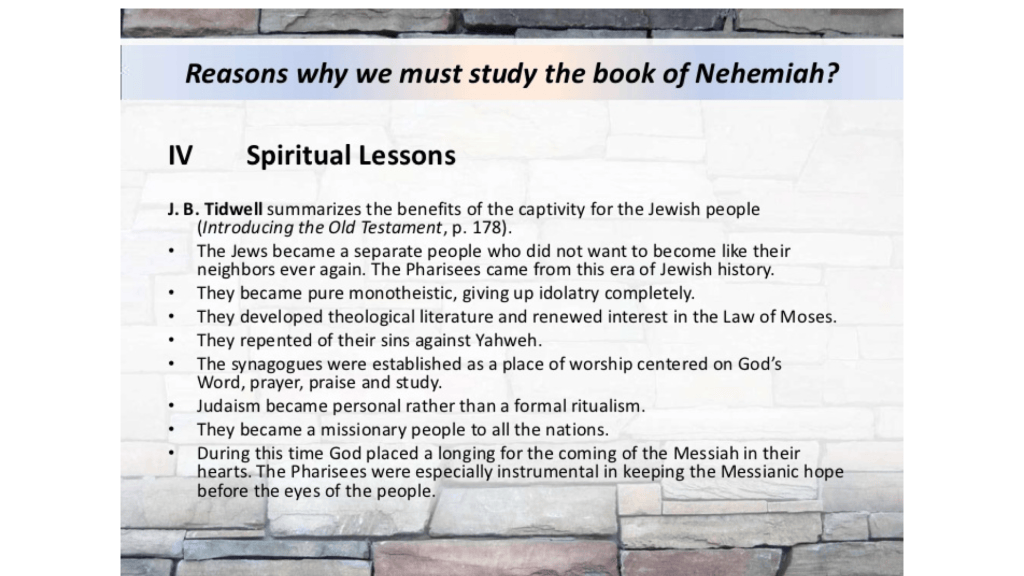
Again, we are going straight through, not chronologically, so we go from the 2nd return in Ezra 7-10 to the 3rd return in Nehemiah, about 20 years between the 2nd and 3rd returns. Here is a great slide repeated showing the benefits of the 70 year Babylonian captivity.
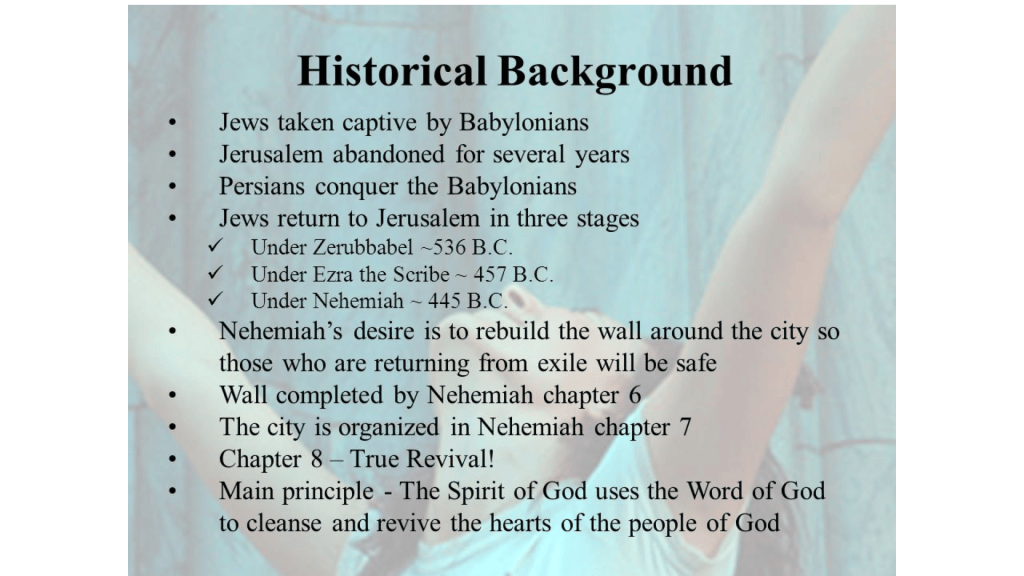
Here is a good summary of what we will be reading in the book of Nehemiah.
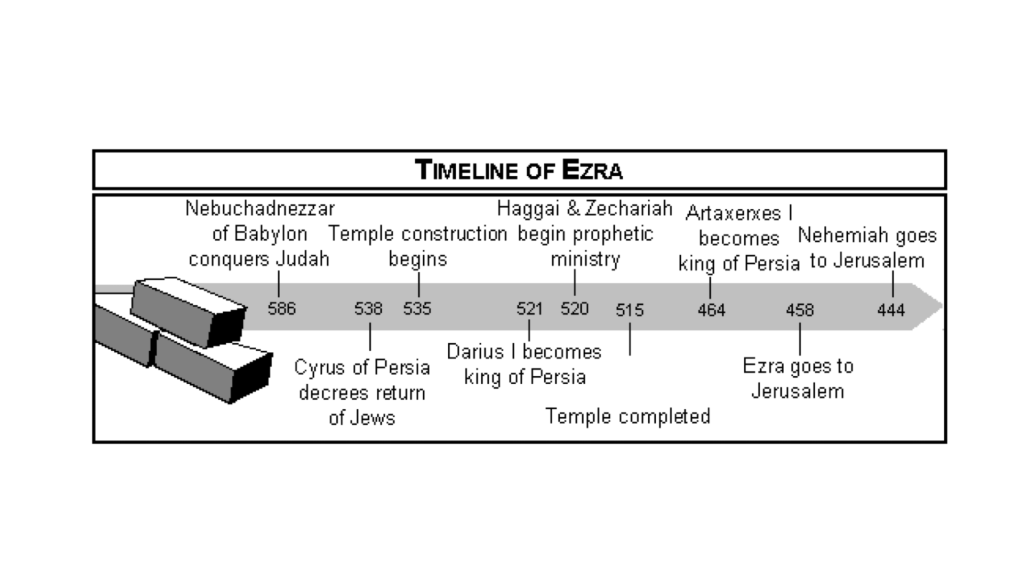
Nehemiah was cupbearer to King Artaxerxes I of Persia.
The story of Nehemiah is pretty straightforward so no need to tell it in the blog. I want to focus on the leadership qualities of Nehemiah. Here is a good AI summary: Qualities 1-5 will be covered in chapters 1 and 2 in today’s reading.
Nehemiah’s leadership—most notably demonstrated by rebuilding the walls of Jerusalem in 52 days—was defined by a mix of spiritual devotion, strategic planning, and hands-on courage.
Key Leadership Qualities
- 1 Deep Compassion and Empathy: Chapter 1 He mourned, fasted, and wept when he heard of his people’s suffering and vulnerability in Jerusalem. He had a comfortable position as cupbearer to the king. Many of those exiled in Babylon would have been slaves but somehow Nehemiah got a very good position.
- 2 Active Prayer and Reliance on God: Chapter 1,2 He turned to prayer and fasting immediately upon facing distress and sought divine guidance in every step. He then prayed again before telling the king his request to be allowed to go to Jerusalem to rebuild the walls. This took a lot of courage. The king could have been displeased with him and removed him from being cupbearer.
- 3 He trusted in the providence of God and gave God the glory. Chapter 2:8 And the king granted them to me because the good hand of my God was on me.” He saw the hand of God in this whole project.
- 4 Prudent Planning and Foresight: Chapter 2 He quietly surveyed the damage at night to keep the enemies Sanballat and Tobiah from knowing his plans, organized workers into logical teams, and secured letters and permits from King Artaxerxes before starting. 2:18 I told them how the hand of my God had been favorable to me.”
- 5 Clear Vision and Communication: Chapter 2 He concisely framed the goal to the people (“rebuild the wall”) and united a diverse community behind a shared purpose. He inspired them to commit to the task. 2:Then they said, “Let us arise and build.” So they put their hands to the good work.”
For the next blogs.
- 6 He knew how to organize workers and delegate responsibilities. Chapter 3 How do you go about building a wall that is 2.5 miles long around the entire city of Jerusalem, and it must be done quickly b/c of the enemies? The key was to organize and delegate small sections of the wall to responsible men. Nehemiah chapter 3 records 42 specific work sections or divisions assigned to various individuals, family heads, trade guilds (such as goldsmiths and perfumers), and community groups rather than a single counted tally of individual men. That’s about 300 feet of the walls that each was in charge of building and each man had several workers. That is a lot but can be done in 52 days time.
- 7 Courage and Adaptability: Chapter 4 He confronted hostile naysayers who mocked the builders, armed the builders with spears and swords, and adjusted strategies (such as stationing guards) to protect workers from threats. He continued to pray asking God for safety for the workers. Nehemiah was a very prayerful leader.
- 8 Integrity and Ethical Justice: Chapter 5 As governor, he refused to exploit his position, cancelled heavy debts, and stopped the rich from oppressing the poor. Some were charging interest to fellow Jews during the famine which was forbidden in the Law. Nehemiah refused to take the daily “governor’s food allowance”. Instead he fed 150 officials daily at his own expense. When is the last time you heard of a leader, maybe a paid preacher, refusing to take money from the church. My wife’s father had a full time job. He was the preacher for a church and never took a penny for preaching for many years. He could have easily gotten a nice part time salary from the church.
- 9 He wisely detected the plots of the enemies and refused to compromise his mission. Chapter 6 The enemies tried to get him to come meet, plotting to kill him. They made false accusations that he was trying to make himself a king and rebel against the Persians who helped him with his mission They hired a man to try to get him to come to the temple so they could kill him. Nehemiah continued to pray and trust God. Church leaders today face all kinds of attempts to get us to compromise the Word of God. The LGBTQ issue has caused many church leaders to compromise. The split in the Methodist church shows that. Liberalism has atttacked many seminaries who no longer stand for the truth.
- 10 Role Modeling and Delegation: He worked right alongside the builders and delegated tasks across families and districts rather than trying to do everything himself.
More on leadership in the next blog.

