
” Main views on the end times generally divide into four primary schools of interpretation regarding the timing of prophecy: Preterism, Futurism, Historicism, and Idealism. These views are often intersected with millennial viewpoints—Premillennialism, Postmillennialism, and Amillennialism—which determine the nature and timing of Christ’s return and reign.” AI
Preterism
- Definition: From the Latin preter (past), this view holds that most or all prophecy was fulfilled in the first century AD, particularly surrounding the destruction of Jerusalem in 70 AD.
- Full Preterism: Teaches that all prophecy, including the second coming (Parousia), the resurrection of the dead, and the final judgment, was completed in 70 AD.
- Partial Preterism: Believes most prophecies (e.g., the tribulation, the rise of the “Beast,” often identified as Nero) were fulfilled in 70 AD, but maintains that a future second coming, resurrection, and final judgment are still to occur.
Other Major Views
- Futurism: Interprets Revelation 4–22 as largely future events, including a literal seven-year tribulation and millennial kingdom, a dominant view in modern evangelicalism.
- Historicism: Views Revelation as a symbolic panoramic map of church history, from the first century through to the end of time.The Reformation leaders considered the sea beast in Revelation to be the Pope.
- Idealism (Symbolic): Interprets the imagery as symbolic of the ongoing, timeless battle between good and evil rather than specific historical or future events.
Millennial Perspectives
- Premillennialism (Historic & Dispensational): Jesus returns before the millennium to rule on earth.
- Postmillennialism: The world is progressively christianized, bringing about the kingdom before Jesus returns.
- Amillennialism: The 1000-year reign is symbolic of Christ’s current reign in heaven and through the Church, with no future literal earthly kingdom.
Here is a great chart on full preterism.’
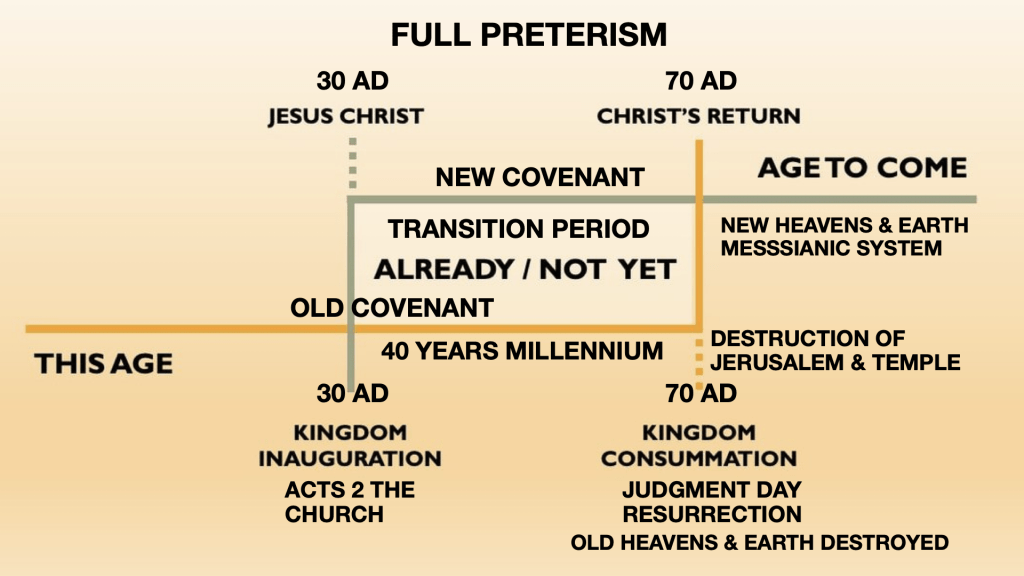
Full preterism is based on Jesus’ 4 predictions that He would return within the lifetime of those he was speaking to: Matthew 10:4; 16:27-28 (where it even says that He is “about to come” (mello which always in the NT means “about to be” and it also says that some whom he was talking to would still be alive when he would come); 24:30-34 he would come before that generation he was talking to would pass away (generation: genea which in the NT always means a 40 year period or the people living in a 40 year period, just like we use the word for baby boomer generation, Gen Z, etc.); 26:64. There are no other predictions by Jesus of any other “coming” after that generation. The apostles and other NT writers also predicted an imminent 2nd coming: James 5:7 the coming of the Lord is near. Hebrews 10:37 He who is coming will come in a very little while and will not delay. Jesus did return in 70 AD using the Romans to judge the Jews and to destroy the temple and the city of Jerusalem. That was his “2nd coming”. There would also be a resurrection of the dead of the OT at the end of the Jewish age in 70 AD as predicted by Daniel 12:1-3. Paul even said that resurrection was “about to happen” (mello again) when he spoke. Peter said that the “end of all things was at hand” in 1 Peter 4:7. If he was predicting an imminent end of the world, then he was a false prophet since that did not happen. What he was predicting was the end of the Law of Moses and the end of the “old heavens and earth” (which is the Jewish system). Hebrews 8:13, written in 60 AD, said that the old covenant was “ready to disappear”, and it did disappear in 70 AD when the temple was destroyed. There has been no temple, animal sacrifices, or priesthood since 70 AD so the Law of Moses and the Jewish system ended in 70 AD. The new covenant of Jesus and the “new heavens and earth” would take the place of the old covenant after 70 AD (Hebrews 12:25-29; 2 Peter 3). The Jews were God’s holy nation and chosen people in the old covenant but that kingdom was taken from them and given to a new spiritual nation, the church (Matthew 21:43) which is made up of Jew and Gentile Christians. The old covenant priesthood was replaced by the priesthood of all believers (1 Peter 2:6-9) who offer up spiritual sacrifices and not animals. Jesus predicted that the kingdom was at hand but he also said that kingdom would not be a physical kingdom like the kingdom of David (John 18:36). It would be a spiritual kingdom, the church, established in Acts 2 and full consummated in 70 AD. There was a transition period from 30-70 AD as the transition was made from the old to the new covenant, just like we have a transition period between the election of a president and the inauguration. The people living in that 40 year transition period already had spiritual blessings, but immortality would only be officially given in 70 AD when Jesus destroyed death (1 Corinthians 15). The book of Revelation was about things to happen “soon” after the time of writing (Rev 21:1-3; 22:5-10). It was written during the reign of the 6th emperor of Rome. Rev 17 says 5 emperors had fallen, i.e. died, and “one is” at the time of writing. That 6th emperor would be Nero who died in 68 AD so the book was written before 70 AD. The book is predicting the destruction of Jerusalem in 70 AD. The theme is God avenging the blood of the apostles, prophets, and saints that was shed by the ungodly, rebellious Jewish harlot nation all through their history (Rev 18). The famous “1000 year millennium” of Rev 20 was just figurative of the 40 year period from 30 AD to 70 AD that ended when the devil was released to get God and Magog (the Romans) to surround and destroy the holy city of Jerusalem (Rev 20).
Now go back and look at the details in the chart above. It should make more sense now. Why does it matter? It probably doesn’t for most sincere Christians. They love Jesus and live for him regardless of their views on eschatology. But understanding preterism helps confirm our faith in all the NT eschatological predictions. It helps us defend Jesus when Jews, Muslims, and atheists say that he is a false prophet b/c his predictions of an imminent 2nd coming did not come to pass. It keeps us from being mislead by false teachers saying that our current events are the fulfillment of prophecy. Jesus said in Luke 21:21-25 that “all things that are written (i.e. written in the OT) would be fulfilled within that generation (Luke 21:32) which would be at the destruction of the temple in 70 AD. Thee are no future predictions in the Bible of things to happen after 70 AD.
Whether. you believe full preterism is correct or not, at least I hope that you better understand what it is now and how logical it is.

