SEPT 8. READ EXODUS 16-20

FROM THE RED SEA TO MT SINAI The The complaining and grumbling of Israel began at Marah (Exodus 15:22-25). Several more things happened between the Red Sea and Mt Sinai in Exodus 16-20. Here is a summary:

1. Marah: This is where the travelers encountered bitter, undrinkable water. Moses miraculously sweetened the water by casting a piece of wood into it.

2. Elim: They camped beside 12 springs of water and 70 date palms.

3.. Wilderness of Sin: Here, the community grumbled about food shortages. In response, God introduced the weekly Sabbath and began providing daily manna and evening quail.

4. Rephidim (Massah and Meribah): Rephidim encompasses multiple events:

  • Massah & Meribah: These titles mean “testing” and “quarrelling”. They describe the exact spot within Rephidim where the people complained about water, prompting Moses to strike the rock at Horeb to supply them.
  • The Battle of Rephidim: The location where Joshua led the defense against the attacking Amalekites while Aaron and Hur held up Moses’ arms. Much later God would tell Saul to completely wipe out the Amalekites b/c of this attack. Yahweh-Nissi (The Lord is my Banner).

4. Mount Sinai (Mount Horeb): The sacred mountain where Israel camped, received the Ten Commandments, and constructed the Tabernacle

MANNA AND WATER FROM THE ROCK God gave them manna every day for the 40 years in the wilderness (except on the Sabbath: they would gather twice as much on Friday although some tried to gather on the Sabbath and found none( ) and water fron the rock. They could only gather what they could eat in a day: anything extra would rot at sunset. 1 Corinthians 10:1  For I do not want you to be unaware, brethren, that our fathers were all under the cloud and all passed through the sea; and all were baptized into Moses in the cloud and in the sea; and all ate the same spiritual food; and all drank the same spiritual drink, for they were drinking from a spiritual rock which followed them; and the rock was Christ.” As they crossed the Red Sea, the sea was on both sides of them and the cloud that followed them was above them: thus they were “immersed” (baptized) in the cloud and sea. The rock was Christ: water from the rock is a type of Jesus giving the water of eternal life to believers.

JETHRO COMES TO MOSES Exodus 18: Apparently Moses’ wife and two sons had started his journey back to Egypt but returned to Midian b/c Jethro (Ruel) brought them to meet Moses at Mt Sinai. Jethro saw that Moses was wearing himself out trying to judge every single dispute among the people and advised him to delegate the minor issues to various capable men.

ARRIVAL AT MT SINAI. Exodus 19: The Israelites arrived at Mt Sinai in the 3rd month after they left Egypt. They had traveled about 350 miles. They camped at the foot of Mt Sinai. The terrifying scene at Mount Sinai in Exodus 19 features a violent display of divine presence with heavy thunder, flashes of lightning, a thick dark cloud, and a blaring trumpet that caused the entire Israelite camp to shake with fear. This display of God’s power was designed to strike fear in the people such that they would be afraid to not obey God. Hebrews 12 describes this same scene: 12:18 For you have not come to a mountain that can be touched and to a blazing fire, and to darkness and gloom and whirlwind, 19 and to the blast of a trumpet and the sound of words which sound was such that those who heard begged that no further word be spoken to them. 20 For they could not bear the command, “If even a beast touches the mountain, it will be stoned.” 21 And so terrible was the sight, that Moses said, “I am full of fear and trembling.” The Hebrew writer would then go on to say that the Hebrew Christians had not come to Mt Sinai but had come to a spiritual Mt Zion and the heavenly Jerusalem, the church and warned them not to leave their faith in Jesus to return to Judaism. I can’t imagine what it was like being at the fout of Mt Sinai seeing and hearing all this. It had to be terrifying.

THE 10 COMMANDMENTS Moses want up on Mt Sinai and God gave him the 10 commandments. Here is a great slide:

ARE THE 10 COMMANDMENTS BINDING ON GENTILE CHRISTIANS UNDER THE NEW COVENANT? 9 of the 10 commandments would apply to Christians under the new covenant also, but “remember the Sabbath day to keep it holy” was a special command given to Israel and not to Gentile Christians under the new covenant. Eodus 31:12 The Lord spoke to Moses, saying, 13 “But as for you, speak to the sons of Israel, saying, ‘You shall surely observe My sabbaths; for this is a sign between Me and you throughout your generations, that you may know that I am the Lord who sanctifies you.” Nehemiah 9:13 says that God made known the Sabbath at Mt Sinai. They did not have a command to rest on the Sabbath before Mt Sinai The 7th Day Adventists claim that people were commanded to keep the Sabbath from the very beginning in the Garden of Eden but that is not true. Genesis 2 says that God blessed and sanctified the Sabbath day but it doesn’t say that He commanded Adam and Eve to start resting on the Sabbath. Nowhere in the new covenant are Gentile Christians commanded to keep the Sabbath. Jesus kept the Sabbath but this is b/c he was a Jews still living under the old covenant. Paul and Jewish Christians continued to keep the Sabbath until 70 AD when the old covenant “disappeared” (Hebrews 8:13). Of course, any Christian is free to observe a day or rest on Saturday, but he/she should not bind that on others.

SEPT 7. READ EXODUS 11-15

Chapters 11 and 12 tell about the 10th plague, the death of the firstborn of Egypt, including the cattle, at midnight. Can you imagine the horror, the cries and screaming coiming for every house in your neighborhood, all at the same time at the stroke of midnight? Picture that happening all through the land of Egypt to about 3 million Egyptians (according to historians). They awaken to find dead cattle all over the land in mass numbers. No wonder they begged the Israelites to leave Egypt and gave them silver and gold and clothing. That gold, unfortunately, would be used to make a golden calf and worship it at Mt Sinai. The Israelites “plundered” the Egyptians (Exodus 12:36).

THE PASSOVER That night of the death of the firstborn the Israelites were to eat the Passover lamb (chapter 12) with their sandals on, ready to make a hasty departure from Egypt. They were to sprinkle the blood of the lamb on their doorposts and lintels. If they did, the Lord would “pass over” their houses and not allow the “destroyer” (Exodus 12:23, some have called this the “death angel”) to kill their firstborn. They would not have time to let their bread leaven, so they made cakes of unleavened bread for their meal and their journey. God then gave Moses detailed instructions for this Passover Feast and Feast of Unleavened Bread (a 7 day feast) to be an annual ritual for Israel. The Israelites are to use these feasts to teach and remind their children about how God brought Israel out of Egyptian slavery.

Life Lesson: The Passover lamb was a type of Jesus, our Passover lamb who was slain to save us from our sins. 1 Corinthians 5:6 For Christ our Passover also has been sacrificed.” The Passover lamb was to be “unblemished” and Christ was sinless. John 1:29 John the Baptist proclaims Jesus to be the “Lamb of God, who takes away the sin of the world!” 1 Peter 1:18 you were not redeemed with perishable things like silver or gold from your futile way of life inherited from your forefathers, 19 but with precious blood, as of a lamb unblemished and spotless, the blood of Christ. 20 For He was foreknown before the foundation of the world.” You see, even before God created man, God knew that man would sin and that God would send His sinless Son to die to redeem man from sin (for some reason that satisfied God’s wrath against our sins and allowed Him to be both just and the justifier of those who put their faith in Jesus). So, God gave the commands to Israel in Egypt for a Passover Lamb as a type of Christ our Passover Lamb. Gentile Christians don’t celebrate the Passover Feast each year but we celebrate Christ as our Passover Lamb every moment of every day (or at least we should). Do you begin each day thanking God for sending Jesus to save us? Do you begin each day thanking Jesus for dying for us? Jesus ate his last supper with his disciples in the upper room the night before his death with a Passover meal with unleavened bread. During that meal, he instituted the Lord’s Supper with the wine and the unleavened bread, which he said represented his body and blood offered for sin. Early Christians were told to partake of that Lord’s Supper in remembrance of Jesus dying for them. It appears that they ate the Lord’s Supper as part of a meal, the “love feasts” (Jude 1:12, a love meal with the rich and the poor Christians). It’s kinda sad to me that we make the Lord’s Supper just the eating of a little wafer and sip of grape juice instead of part of a love feast meal. I think the early Christians took the Lord’s Supper often, even during the week, as part of their meals together. But whenever, however, and how often you partake of the Lord’s Supper, it should be a sacred reminder of Jesus, the Passover Lamb who was slain to take away the sins of the world. Hebrews 11:28 By faith he kept the Passover and the sprinkling of the blood, so that he who destroyed the firstborn would not touch them.”

THE CONSECRATION OF THE FIRSTBORN God also commanded the people to “consecrate their firstborn” of children and animals as a remembrance of God sparing the firstborn of Israel in Egypt (chapter 13). The first of all their crops was to be given to the Lord. The firstborn of clean animals was to be offered as a sacrifice to God. The firstborn of unclean animals was to be substituted with a lamb sacrifice since unclean animals could not be sacrificed to God. But the firstborn children could be “redeemed” instead of killed by giving 5 shekels of silver to the support of the Levitical priests (Numbers 18:15-16). If you are a firstborn in your family, this ritual has to have some meaning for you even if you are not an Israelites and even if you were not redeemed with money. You are special to God.

THE EXODUS Exodus 12:40 Now the time that the sons of Israel lived in Egypt was four hundred and thirty years. 41 And at the end of four hundred and thirty years, to the very day, all the hosts of the Lord went out from the land of Egypt.” If you are one for technicalities, the statement that Israel went our from Egypt after 430 years “to the very day” is interesting. In Genesis 15 God told Abraham that his descendants would come out of slavery in the 4th generation which proved to be true: Levi/Kohath/Amram/Moses. Levi, Kohath, and Amram lived to their 130’s, but those 4 generations overlapped and would not give a total of 430 years in actual slavery. The 430 years in Exodus 12:41 is calculated as the total time of the Abrahamic Sojourn, spanning from the time God made His covenant promise to Abraham in Canaan until the Exodus. Scholars divide the 430-year period into two equal blocks of 215 years based on the chronological data in Genesis. First 215 Years (Canaan): From when Abraham was 75 and received the divine promise (Genesis 12:4) until Isaac was born (25 years), plus the years Isaac and Jacob lived as foreigners in Canaan before descending into Egypt. Second 215 Years (Egypt): From when Jacob and his family moved to Egypt (at age 130) until the final Exodus, covering the 4 generations of Levi/Kohath/Amram/Moses. Genesis 15:13 mentions 400 years of affliction, which begins later (approx. 30 years into the timeline, after Isaac is mocked or Ishmael/afflictions begin) and specifically isolates the time of hardship, while the 430 years marks the complete legal span of the covenant. Joseph was 40 when Jacob moved his family to Egypt and he died at 110 before a new king arose and began the slavery of the Israelites, so that is 70 years of peace and prosperity including the time of Levi, the son of Jacob. If the Israelites were only in Egypt for 215 years, then that only leaves a maximum of 140 years that they were enslaved. How’s that for being technical! It does kinda nullify my teaching in the past that the Israelites were actually in slavery for a full 400 years. Oh well, live and learn.

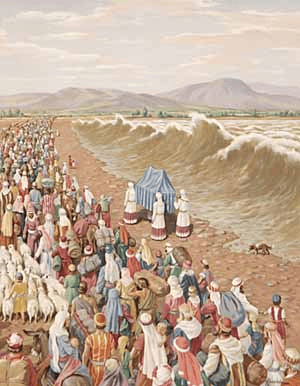
THE CROSSING OF THE RED SEA Chapter 14 tells how God led 600,000 men (probably over 1 1/2 million total men, women, and children) to the Red Sea instead of going by the well traveled route that passed close by the Mediteranean Sea through Philistine territory (He knew they would see the military of the Philistines and rebel, returning to Egypt). He led them with a pillar of cloud by day and a pillar of fire by night so they “could travel day and night”. They camped by the Red Sea when Pharoah decided to track them down with 600 select chariots. To Pharoah it looked like the Israelites were trapped in the wilderness b/c they could not cross the Red Sea and had nowhere to escape. So he pursued them. Actually this was another part of God’s plan. He would harden Pharoah’s heart one more time (Exodus 14:4,8) into tricking him into thinking that the Israelites were trapped and easy prey to kill. Again, Pharoah made his own choice to pursue Israel. What the Israelites said to Moses when they saw the dust of the approaching Egyptian chariots reveals their lack of faith in God. Exodus 14:10 As Pharaoh drew near, the sons of Israel looked, and behold, the Egyptians were marching after them, and they became very frightened; so the sons of Israel cried out to the Lord. 11 Then they said to Moses, “Is it because there were no graves in Egypt that you have taken us away to die in the wilderness? Why have you dealt with us in this way, bringing us out of Egypt? 12 Is this not the word that we spoke to you in Egypt, saying, ‘Leave us alone that we may serve the Egyptians’? For it would have been better for us to serve the Egyptians than to die in the wilderness.” This lack of faith in God would be repeated many times in the wilderness. Moses’ reply to them: Exodus 14:13 But Moses said to the people, “Do not fear! Stand by and see the salvation of the Lord which He will accomplish for you today; for the Egyptians whom you have seen today, you will never see them again forever. 14 The Lord will fight for you while you keep silent.” But then it is almost as if the Lord is telling Moses to quit talking and start doing something to save the people. Exodus 14:15 Then the Lord said to Moses, “Why are you crying out to Me? Tell the sons of Israel to go forward. 16 As for you, lift up your staff and stretch out your hand over the sea and divide it, and the sons of Israel shall go through the midst of the sea on dry land. 17 As for Me, behold, I will harden the hearts of the Egyptians so that they will go in after them; and I will be honored through Pharaoh and all his army, through his chariots and his horsemen. 18 Then the Egyptians will know that I am the Lord, when I am honored through Pharaoh, through his chariots and his horsemen.” You know what happened next. Moses parted the Red Sea, the Israelites crossed (it took all night while the angel of God kept the Egyptian army at bay), the Egyptians tried to cross and were drowned (was Pharoah drowned also?). Exodus 14:30 Thus the Lord saved Israel that day from the hand of the Egyptians, and Israel saw the Egyptians dead on the seashore. 31 When Israel saw the great power which the Lord had used against the Egyptians, the people feared the Lord, and they believed in the Lord and in His servant Moses.” They sand the “song of Moses” praising the Lord (Yahweh) for their deliverance (chapter 15). Aaron and Moses’ sister Miriam sang, danced and praised God with timbrels. Hebrews 11:29 By faith they passed through the Red Sea as though they were passing through dry land; and the Egyptians, when they attempted it, were drowned.This would be a superficial, shallow belief in the Lord and Moses that would not last very long. Once they left the Red Sea they would continually complain and show lack of faith in God. After 3 days in the wilderness with no water, they grumbled at Marah when they found bitter water but Moses threw a tree in the waters and made them drinkable. This was just the beginning of their grumbling. They would complain for the next 40 years as God made them wander (Numbers 14).

Here is a map of where I think the crossing of the Red Sea occurred. It places Mt Sina east of the Red Sea (known as the Gulf of Aqaba today) instead of the traditional site west of the Gulf of Aqaba. Moses 40 years later would taked his sheep to Mt Sinai looking for pasture. That would fit the location of Mt Sinai in Midian (now Saudi Arabia) east of the Gulf. I can’t imagine him taking his sheep up to the northern tip of the Gulf of Aqaba and then southwest into the wilderness to the traditional Mt Sinai location in the middle of the wilderness, a journey of about 200 miles!. So I think the map is correct even though we don’t know the exact place of the crossing (although some have claimed to find evidence of the crossing in the Gulf of Aqaba). The Red Sea had to be deep enough to drown an army, so it couldn’t be the shallow “Sea of Reeds” (Yam Suph could refer to a shallow lake of reeds near the Nile) as liberals claim, trying to deny the miracle of the parting of the Red Sea.

Life Lesson: Teach your children the story of the Red Sea crossing and the exodus. This miraculous event is alluded to or mentioned over 20 times in the Old Testament including Psalm 66:6, Psalm 78:13, Psalm 106:9, Psalm 114:3, Psalm 136:13. Isaiah 11:15, Isaiah 51:10, and Isaiah 63:12–13. Psalm 78:13 He divided the sea and caused them to pass through, and He made the waters stand up like a heap. Psalm 106: 6 We have sinned like our fathers, We have committed iniquity, we have behaved wickedly.
Our fathers in Egypt did not understand Your wonders;
They did not remember Your abundant kindnesses,
But rebelled by the sea, at the Red Sea.
Nevertheless He saved them for the sake of His name,
That He might make His power known.
Thus He rebuked the Red Sea and it dried up,
And He led them through the deeps, as through the wilderness.
10 So He saved them from the hand of the one who hated them,
And redeemed them from the hand of the enemy.
11 The waters covered their adversaries;
Not one of them was left.
12 Then they believed His words;
They sang His praise.” We must teach out children stories about the exodus, the crossing of the Red Sea, etc. These are not fairy tales or myths. They are real stories that show the awesome power of God.

Life Lesson: Have you ever been faced with a desperate situation where you see no escape, a “Red Sea”? Circumstances have become very dificult for you. Maybe cancer, divorce, financial problems, health, children problems. You’v just about given up on a way of escape. 1 Corinthians 10:13 No temptation has overtaken you but such as is common to man; and God is faithful, who will not allow you to be tempted beyond what you are able, but with the temptation will provide the way of escape also, so that you will be able to endure it.” A “way of escape”, just as God provided a way of escape for Israel from Pharoah’s army at the Red Sea. When you are desperate for a way of escape, “Stand by and see the salvation of the Lord which He will accomplish for you today.” God will in some way provide a way of escape, even if death itself might be the way to escape the pain and suffering of thhis life to be able to move on to the eternal joy in heaven (wherever that is). The Israelites panicked when they saw the dust of the approaching chariots of Pharoah. They did not have faith in God. I can’t tell you how many times I have had panic attacks b/c I didn’t have faith in God to rescue me from some desperate situation. I can’t sleep. I worry. I wake up thinking about some bad situation I am facing. I come up “what if’s” that might happen. God must be thinking, “How many times do I have to prove to you that I am with you and will provide and protect you?”

SEPT 6. READ EXODUS 6-10

These chapters are mainly about the 10 plagues.

THE NAME OF GOD. But first read Exodus 6:2-9. Have you ever heard the song, “El Shaddai” by Amy Grant. I suggest you stop and listen to it. You will hear what El Shaddai did for Abraham.

Exodus 6:God spoke further to Moses and said to him, “I am the Lord; and I appeared to Abraham, Isaac, and Jacob, as God Almighty (El Shaddai), but by My name, Lord, I did not make Myself known to them. God was known by the patriarchs in Genesis (Abraham, Isaac, Jacob) by the name “El Shaddai” (Genesis 17:1-2; 28:3; 35:11; 43:14). It means “God Almighty” and emphasized the power of God. But beginning with the exodus and founding of the nation of Israel God wanted Israel to call him “YHWH” or “Yahweh” (ancient Hebrew writing only used consonants so the vowels were added later). YHWH comes from the root verb “to be”. At the burning bush (Exodus 3) Moses said, “They may say to me, ‘What is His name?’ What shall I say to them?” 14 God said to Moses, “I AM WHO I AM”; and He said, “Thus you shall say to the sons of Israel, ‘[i]I AM has sent me to you.’” “I AM” is from hayah: To be, become, come to pass, exist, happen. The self-designation “I AM” (’ehyeh) proclaims God’s eternal, self-existent being. The generic word for “God” is “Elohim” and can be used even of false gods. But Yahweh is a personal, intimate name that can only be used of the one true God of Israel. It is a special, sacred name given to Israel (and to us). Out of reverence, ancient Jewish readers stopped pronouncing the literal four-letter Hebrew name for God (YHWH, called the Tetragrammaton). When reading aloud, they substituted the word Adonai (meaning “Lord”). (Adonai is also in the Amy Grant song “El Shaddai”). All Caps Format: Most English Bibles (like the ESV, NIV, and NRSV) follow this tradition by printing LORD in all-capital or small-capital letters whenever the original Hebrew text has YHWH. Yahweh is translated as Kyrios, the Greek word for “Lord,” throughout the New Testament. The term “Jehovah” only began to be used by Christian scholars in the middle ages, a Latinized word they created to call Yahweh. Only the King James uses “Jehovah”.

So the name Yahweh has a special significance. When you see God called “LORD” in the New Testament, you need to remember that is Yahweh, God’s special name. Here’s a great song with a lot of the names of God. Often Yahweh would be combined with a 2nd word like Yahweh Jireh (the Lod provides), or Yahweh Rophe (the Lord who heals) and you will hear some of those names.

Moses revealed this special name of God to the slaves and gave them God’s promise to deliver them from slavery and take them to the promised land. Exodus 6:So Moses spoke thus to the sons of Israel, but they did not listen to Moses on account of their despondency and cruel bondage.

Life Lesson: It is often hard to believe in God’s promises when you are “despondent”, depressed, hurting. You are taking chemo for cancer, you are in terrible pain every day from some permanent health issue, your marriage is fallling apart, your child is on drugs, you are losing your job, you can’t pay your bills, your health insurance won’t pay for a needed surgery, you are facing a lawsuit, you are burnt out taking care of again prents, etc. The preacher quotes all those verses about how trials can make you stonger, more mature or complete, that you should find “joy” in your trials (James 1:3-5). But you don’t really “listen on account of your depondency”. But it’s God’s promises that keep us going when you hit bottom and don’t think that you can go on trying. Sometimes, the situation is hopeless in this life, and the only promise that matters is the promise of eternal life, away from all the struggles of this life. Paul said, 17 For momentary, light affliction is producing for us an eternal weight of glory far beyond all comparison, 18 while we look not at the things which are seen, but at the things which are not seen; for the things which are seen are temporal, but the things which are not seen are eternal.” (2 Corinthians 4:17-18) Read about his “momentary light affliction” in 2 Corinthians 11:23-29. Sounds pretty heavy, not light, to me. But he says it is nothing compared to what eternal glory will be after we die.

THE TEN PLAGUES. Exodus 6: 10 Now the Lord spoke to Moses, saying, 11 “Go, tell Pharaoh king of Egypt to let the sons of Israel go out of his land.” 12 But Moses spoke before the Lord, saying, “Behold, the sons of Israel have not listened to me; how then will Pharaoh listen to me, for I am unskilled in speech?” 13 Then the Lord spoke to Moses and to Aaron, and gave them a charge to the sons of Israel and to Pharaoh king of Egypt, to bring the sons of Israel out of the land of Egypt.” God made Aaron to be Moses’ spokesman (prophet). Moses went to Pharoah, did the signs God had given him at the burning bush (rod becoming a snake, hand turning leprous) but Pharoah refused to let the slaves go, even for a 3 day feast celebration. His response: Exodus 5:But Pharaoh said, “Who is the Lord that I should obey His voice to let Israel go? I do not know the Lord, and besides, I will not let Israel go.” So God began the 10 plagues on Egypt. Each plague was directed at one (or more) of the gods of Egypt as shown in this chart. God is showing his power over all the many gods of Egypt. By the time God is through with Pharoah, he will know “who Yahweh is”.

Ra, the god of the sun, for example, can’t stop the darkness plague. Nut, the goddess of the sky, can’t stop the hail plague. BTW Rehab and the inhabitants of Jericho saw clearly the impact of the 10 plagues. She told the spies that the Canaanites heard about the 10 plagues and were terrified of the power of the God of the Israelites. BTW God doesn’t have to repeat these plagues to show his power over the false gods of other nations, like the gods of the Babylonians or the Assyrians or the Moabites or the Philistines. When God was announcing the last plague, the death of the firstborn, He said, “For I will go through the land of Egypt on that night, and will strike down all the firstborn in the land of Egypt, both man and beast, and against all the gods of Egypt I will execute judgments—I am the Lord” (Exodus 12:12).  

DID GOD HARDEN PHAROAH’S HEART OR DID PHAROAH HARDEN HIS HEART? It says that Pharoah “hardened” his heart and would not let the slaves go free (until the last plague and his. firstborn died). But it also says that “the Lord hardened Pharoah’s heart”.

So which is it? Both. Did Pharoah have a free will choice of whether to let the slaves go free? Yes, although Calvinism falsely teaches that things are predestined with no free will choices. Arminianism correctly teaches that all men can make their own free will choices in matters of faith. God doesn’t always allow us to choose our circumstances, but He always allows us to choose our response. So Pharoah had a choice and he chose to harden his own heart. But did God harden his heart also? Yes. How did God do that? He did not somehow make Pharoah unable to choose to obey God. Pharoah was not a “totally depraved” sinner (the T in TULIP) as Calvinism teaches, unable to choose to obey God. Calvinism teaches that sinners are not able to believe, that only a select few whom Jesus died for (the L in TULIP) are predestined to be saved (the U in TULIP), that God has to send His Spirit on those few to enable them to be believe and they can’t resist that Spirit (The I in TULIP). It would be hard for me to believe in the God of Calvinism whom could choose to enable and basically force all sinners to believe and be saved but who arbitraarily selects a few and leaves the rest to burn in hell. Pharoah was free to choose whether to obey God or not, and he chose to disobey. Indeed God sent the plagues that He knew would harden Pharoah’s heart. Thus, indirectly God hardened Pharoah’s heart by sending the plagues. Romans 12:17 For the Scripture says to Pharaoh, “For this very purpose I raised you up, to demonstrate My power in you, and that My name might be proclaimed throughout the whole earth.” 18 So then He has mercy on whom He desires, and He hardens whom He desires.” Someone might object: Romans 9:19 You will say to me then, “Why does He still find fault? For who resists His will?” In other words, if God hardens someone’s heart, then how can that person be held responsible? Well God has the right to harden someone’s heart, but he never violates their free will to choose whether to obey Him or not. So Paul adds, Romans 9:20 On the contrary, who are you, O man, who answers back to God? The thing molded will not say to the molder, “Why did you make me like this,” will it? God has the right to use someone’s hard heart to accomplish His will, and that is what He did with Pharoah. That doesn’t make the person no responsible for his evil choices.

That covers the 10 plagues. We will cover the Passover and the exodus next lesson.

SEPT 5. READ EXODUS 1-5

Fast forward from Jacob’s family moving to Egypt at the end of Genesis. Joseph was about 40 when Jacob moved to Egypt. Joseph died at 110. The Israelites were not enslaved until after Joseph died so the Israelites had at least 70 years of prosperity and peace. A new king (Pharoah) arose who did not know Joseph. The new king said that the Israelites were “more and mightier” than the Egyptians, so sufficient time must have elapsed from the death of Joseph to allow for Israelites growing into a large number but we don’t know how long from the death of Joseph until the beginning of the enslavement of the Israelites. God had told Abraham that his descendants would be enslaved for 400 years and then come out of slavery in the 4th generation. Levi: Lived 137 years (Exodus 6:16). Kohath: Lived 133 years (Exodus 6:18). Amram: Lived 137 years (Exodus 6:20). We can’t be sure how to reconcile the 400 years exactly, but it is easy to see that the Israelites would come out of Egypt in the 4th generation: Levi/Kohath/Amram/Moses and Aaron (the sons of Amram).

That’s enough of that! Most everyone knows the facrs surrounding the birth of Moses to Amram and Jochebed. Hebrews 11:23 By faith Moses, when he was born, was hidden for three months by his parents, because they saw he was a beautiful child; and they were not afraid of the king’s edict.” This verse tells us about the faith of Moses’ parents. Did they just hide Moses from being thrown into the Nile to die b/c they thought he was beautiful? That would not require faith but it does say that they hid him b/c he was beautiful. The Hebrew word tob (meaning “good”) and the Greek word asteios (meaning “well-formed” or “fair”) might suggest that they thought Moses’ beauty as a baby meant that he was destined for some divine purpose. We just don’t know what they were thinking but we do admire their faith.

Life Lesson: I would hope that all parents have faith that their newborns can be destined for some divine purpose. Maybe not a Moses leading 2 million people out of slavery, but faith that a child can become a godly mother or father, a sincere Christian who marries a Christian and raises a Christian family. My wife prayed with all 3 of our children every night before they were even old enough to know what a Christian was: “God, help ____ grow up to be a Christian and to marry a Christian.” I am shocked when I hear of some parents these days say that they never influence their children when they are little to become any particular religion. They say they want their children to be free to choose to be Muslim, Christian, Buddhist, Hindu, etc.without being “brainwashed”. “Brainwashing” is forcing or pressuring someone into a certain belief. Grounding our children in the Christian faith is not brainwashing. It is simply teaching them the Word of God. They can still choose to become Christians or not when they get older.

Moses’ life was divided into 3 periods:

1) 1st 40 years: in Egypt in Pharoah’s palace (Exodus 2:1-14). Pharoah’s daughter brought him up as her own son. He was educated in all the wisdom of the Egyptians and powerful in speech and action (Acts 7:21-22). We don’t know how or when he found out that he was an Israelite, but when he was 40 he killed a taskmaster who was beating on of his “Hebrew brethren”. Acts 7:23-25 tells us that he was thinking that his killing the Egyptian would show the Israelites that Moses was the one to deliver them from slavery but they didn’t see it that way. Maybe he was planning a slave uprising, which could be possible with so many Israelite slaves. The next day he realized that they were not behind his plan to deliver them. A slave uprising wasn’t God’s plan either. God would use a staff, not a sword, to deliver Israel from slavery. So Moses fled to Midian att the age of 40. Hebrews 11:24 By faith Moses, when he had grown up, refused to be called the son of Pharaoh’s daughter, 25 choosing rather to endure ill-treatment with the people of God than to enjoy the passing pleasures of sin, 26 considering the reproach of Christ greater riches than the treasures of Egypt; for he was looking to the reward. 27 By faith he left Egypt, not fearing the wrath of the king; for he endured, as seeing Him who is unseen.” How did Moses consider the “reproach of Christ greater riches than the treasures of Egypt”? The Hebrew writer is simply saying that Moses chose to suffer with the Israelites just as Christ suffered. Moses did not know about the actual suffering of Christ. Hebrews 11:27 is puzzling. Exodus 2:14-15 says that Moses was afraid and fled from Pharoah, so it seems that Moses did fear the wrath of the king but that looks like a contradiction with Hebrews 11:27. Some think that Hebrews 11:27 is referring to his 2nd leaving of Egypt when he led the Israelites out of slavery at the age of 80 when he did not fear the wrath of Pharoah.

2) 2nd 40 years: in Midian (Exodus 2:15-25) as a shepherd with a family. It seems that he was resolved to just live the rest of his life as a shepherd. He married Zipporah, a daughter of Jethro (Ruel) and had 2 sons. Moses has completely dismissed any intenetions of helping the Israelites get freedom from slavery in Egypt. He never ever wants to go back to Egypt. But God had other plans for Moses. At the age of 80, God appears to Moses in the burning bush (Exodus 3), telling him to go to Egypt and tell Pharoah to let God’s people go free. The time has come for God to deliver the Israelites from slavery and bring them to the “promised land” of Canaan (flowing with milk and honey) just as He had promised Abraham. But Moses does not want to go to Egypt. Here is a great slide that shows the excuses that Moses gave God in Exodus 3-4.

The anger of the Lord burned against Moses after he made his 5th excuse (Exodus 4:14) so I guess that Moses figured he better do what God said! He took Zipporah and his 2 sons and headed to Egypt.

On the way to Egypt something strange happened. “The Lord met him and sought to put him to death” (Exodus 4:24). Zipporah perhaps saved Moses’ life when she cut off the foreskin of one of Moses’ sons and threw it at his feet. We are not told if and when the other son was circumcised. Moses had apparently failed to circumcise at least one of his 2 sons while in Midian even though he knew that circumcision was a very important “sign of the covenant” that God made with Abraham (Genesis 17) for all Israelite babies at 8 days old. This incident tells us that we need to get our own house “in order” before leading others. That’s why one of the requirements for elders was managing their own families and children before being appointed to manage the church. Aaron meet Moses on his way back and then went to the Israelites where Moses performed the signs God had given him at the burning bush and the people believed that God was going to deliver them and they worshipped God. That didn’t last long. Moses told Pharoah to let the people go but Pharoah refused and made the Israelites work even harder to make their quota of bricks. The Israelites immediately turned on Moses, saying that Moses had simply made their life more difficult instead of delivering them as promised. Exodus 5 closes with even Moses questioning God: 22 Then Moses returned to the Lord and said, “O Lord, why have You brought harm to this people? Why did You ever send me? 23 Ever since I came to Pharaoh to speak in Your name, he has done harm to this people, and You have not delivered Your people at all.”

Life Lesson: Look out for how God might be planning to use you to help others or to be a leader of others. Don’t make excuses for not doing what you feel God has called you to do. Have you ever started out with great plans to serve God but, like Moses, forsook those plans and settled for a selfish lifestyle? Have you ever had your “burning bush” where God called you out of your complacency to go do something for Him? Did you make excuses to not go or did you willingly go immediately?

3) 3rd 40 years of Moses were spent wandering the wilderness with the unbelieving generation that came out of Egypt. We will be studying that later. Keep reading each day. Catch up if you miss a day.

SEPT 2. READ GENESIS 36-40

I like outlines of books. Seldom does a book of the Bible actually give an outline for that specific book, but Genesis does.

Each part of the outline begins “These are the records of the generations of …” as in Genesis 36:9 “These are the records of the generations of Esau” and then 37:1 “These are the records of the generations of Jacob”. It is interesting that Abraham, a main character in Genesis, does not have his own “generations of Abraham”. Instead, he is included in the “generations of Terah” (his father). Likewise, Joseph has 13 chapters (Genesis 3-50) devoted to his life, but does not have have his own “generations of Joseph”. Instead he is included in “the generations of Jacob” (his father). But Ishmael, Abraham’s son by Hagar, has his own “These are the records of the generations of Ishmael” in Genesis 25:12 which would not seem important to the Jews since Isaac, born to Sarah, was the son of the promises to Abraham and not Ishmael. But both Ishmael and Esau had many powerful and important descendants. Esau has his own chapter of generations (chapter 36).The Arabs come from Ishmael. The Edomites descended from Esau. The Edomites played a complex role in the history of Israel. They refused to allow Israel to pass through their territory as Israel was making their way to Canaan. The Edomites cheered and plundered Jerusalem when Babylon destroyed Jerusalem in 586 BC. The short one chapter book of the prophet Obadiah is a prediction about the destruction of Edom b/c of “violence done to your brother Jacob”, b/c they took part in plundering and “looting” Jerusalem when it fell, b/c they “gloated and rejoiced” over the fall of Jerusalem, b/c they killed or imprisoned fugitives trying to escape from the city when it fell. Obadiah mentions their arrogance: they live in mountain ranges like Petra where they felt no enemy could defeat them. AI: “the ancient city of Petra in Jordan appears in Indiana Jones and the Last Crusade (1989). Harrison Ford and Sean Connery’s characters travel through the narrow gorge (the Siq) and arrive at the Treasury where the holy grail is during the final sequence of the film.” The Edomites grew rich and proud from controlling trade routes that passed through Edom. But Obadiah predicted the destruction of Edom and the house of Esau. That prophecy was fulfilled by the time of the Romans when Edom no longer existed as a separate people. The only survivors were living in Idumea, not Edom, and were called Idumeans. Herod the Great who ruled Judea was an Idumean appointed by the Romans as king. More than you wanted to know about Edom, maybe, but Genesis 36 and the book of Obadiah show the importance of Edom and the descendants of Esau in the Bible.

Moving on to Genesis 37:2 “these are the records of the generations of Jacob”. The life of Jacob was already told in Genesis 25-36, so this last section of generations in the Genesis outline is really mainly about Joseph and the other sons of Jacob, along with Jacob, moving to Egypt during the famine. Jacob committed favoritism, just as his parents Isaac and Rebekah had done with him and his brother Esau, by loving Joseph more than his other sons. Joseph was the son of his favorite wife Rachel. It caused his brothers to hate him and sell him to a caravan going to Egypt. Joseph even contributed to their hatred by telling them of his dreams of the brothers, even including Jacob and Rachel, bowing down to Joseph. Why tell that dream to your brothers who already hate you and are jealous of you? Did Joseph have a little bit of an “attitude”, “better than his brothers”? Joesph was given special privileges. The brothers were out shepherding the flocks, but not Joseph. He was back with Jacob who sent him to check up on his brothers who have moved the sheep to Dothan, about 65 miles north of where they all lived in Hebron. So shepherding and finding pasture for large flocks all over Canaan would have been hard work that Joseph (and probably Benjamin, Jacob’s other favorite son by his wife Rachel) were exempt from that hard work. Jacob made Joseph a “coat of many colors” which made his brothers hate him even more. Stop and youtube Dolly Parton’s song, “Coat of many colors”. Her mother sowed her a coat from rags, inspired by the Bible story of Joseph’s coat of many colors. So when he found his brothers, they put him in a pit and eventually sold him to the caravan going to Egypt. They dipped his coat in animal blood and showed it to Jacob, saying an animal had killed Joseph. Jacob was very grieved. He would believe that Joseph was dead for the next 22 years before he was reunited with Joseph in Egypt. Life Lesson: Be thankful if you have never been involved in some type of family conflict among siblings or parents! Many of us have and it is a miserable thing to deal with. Joseph and his brothers will end up in a happy reunion 22 years later, but many sibling and family conflicts don’t end up in happy reunions. They end up with hatred and bitterness, accusing each other of wrong doing, squabbling over family inheritance, one sibling having to care for aging parents while the other siblings just give lip service. If you do have such family conflicts, try to be the peacemaker. You may end up being the responsible sibling who does more work and sacrifices more than the others, but God will reward you for your integrity and your sense of responsibility.

Then we come to one of the strangest chapters in the Bible, Genesis 38. Right in the middle of telling about Joseph’s childhood and being sold into slavery in Genesis 37 and his being a slave to Potiphar in Egypt in Genesis 39 is a totally unrelated chapter about a sordid affair in Genesis 38. Read it for the details. Judah, Jacob’s son who is in the seed line of the rightful kings of Judah down to Jesus, unknowingly goes to a prostitute who is his daughter in law Tamar. Tamar married one of Judah’s sons but that son died without a child, so the other two brothers were supposed to take her as wife and bear a child for their deceased brother. This was called the Levirate marriage law and is found in Deuteronomy 25:5-10. The 2nd son refused to put his seed in Tamar and was killed. The 3rd son was still too young, so Judah promised that later he would give that 3rd son to Tamar to bear a child for the deceased brother, but as the 3rd son grew older, Judah failed to keep his promise and failed to obey the Levirate marriage law. He probably knew that his 3rd son was evil like the first two sons and was afraid the 3rd son would disobey and be killed also. Did Tamar know that Judah was prone to visit prostitutes? She dressed up as a temple prostitute and Judah had sex with her, promising to pay her with a goat. He gave her his ring as collateral. But Judah’s friend was sent to give her the goat and recover Judah’s ring but the prostitute (Tamar) was nowhere to be found. Judah discontinues the search for Tamar and his ring, and hopes no one will find out about the sordid affair, making him a “laughingstock”. 3 months later they bring Tamar to Judah b/c she is pregnant, saying she had committed prostitution. Judah said, “Let her be burned”. Burning someone was a capital punishment used for certain crimes in the Old Testament, like a man marrying both a woman and her mother (Leviticus 20:14) or like the burning of Achan for taking forbidden items from Jericho (Joshua 7). Perhaps the victim was killed first and then his/her body burned. As they were carrying her out to be burned, she basically says, “BTW Here is the ring of the man who got me pregnant if you want to track him down and punish him also”. Can you imagine the startled look on Judah’s face as he looks at his own ring that he had given Tamar after having sex with her? The guilt, the shame, the embarrassment, the exposure of his self righteous conviction of Tamar. Can you imagine the startled look on the faces of those who were carrying Tamar out when they realized Judah had gotten his own daughter in law pregnant while she was posing as a temple prostitute? Can you imagine the shock of Judah’s friend, the Adullamite, whom Jacob sent to take Tamar the goat and retrieve his ring? I guess that friend knew Judah had been to a prostitute, which was a sin, but did not know that the woman posing as a prostitute was Tamar. Tamar was not burned, but instead had twins, Perez and Zerah. But the most unusual thing about this sordid affair is that Perez is in the seed line of Jesus. Perez will be the great grandfather of King David! Life Lesson: Don’t judge people based on their family history. I wonder if anyone mocked Perez as he was growing up, knowing that he was the illegitimate “bastard” son of the noble Judah and his daughter in law Tamar. Leviticus 18:15 states directly: “Do not have sexual relations with your daughter-in-law; she is your son’s wife, so you must not have sexual relations with her”. Leviticus 20:12 reinforces this rule, stating that if a man has sexual relations with his daughter-in-law, both of them must be put to death because it is a perversion.” The Law of Moses had not yet been given at the time of Judah, but this would still have been a terrible sin. But this wasn’t the fault of Perez. Often you see children of bad, immoral people. The children might have a rough upbringing with sinful, irresponsible parents. They might end up considered to be “bad” kids and looked down on by outsiders. But you never know what all those “bad” children have gone through. Don’t judge the kids by their family history. We would like to think that Perez handled people knowing about his shameful birth well. Maybe that is why he was chosen to be in the seed line of Jesus instead of Zerah. It had looked like Zerah was coming out of Tamar’s womb first (the midwife put a scarlet thread on Zerah’s hand as his hand first emerged but then his hand drew back and Perez came out first, making him the firstborn). Maybe God knew Perez could handle his family’s sordid history better than Zerah? Surely you have seen that where two siblings from bad parenting and shameful births react totally different to their bad family history. One learns from it and uses it to be a better person than his/her parents. The other lets the family history make him a victim of self pity all his life.

Genesis 39 and 40 tell about Joseph being a slave to Potiphar in Egypt and being imprisoned falsely b/c Potiphar’s wife falsely accused him of trying to rape her when it was really she who was trying to seduce Joseph. The thing we admire about Joseph is his integrity and character. He could have just become another miserable slave, wallowing in self pity. Instead he was such a loyal and responsible slave to Potiphar that he was put in charge of everything Potiphar had. He had moral integrity. They say, “integrity is doing what is right when no one is looking”. Surely it was tempting for Joseph to have sex with Potiphar’ wife. He perhaps had never had sex with a woman. He wouldn’t want to risk causing her to become angry with him by rejecting her advances, would he? Surely they could keep it a secret affair and Potiphar never find out? But Joseph “just said no”. He apparently had his convictions on not having sex out side of marriage. He told her, “No, I won’t sin against my master and against my God”. “Hell hath no fury like a woman scorned” did not come from Shakespeare. The phrase comes from the English playwright William Congreve in his 1697 play The Mourning Bride. But wherever it originated, it fits Joseph’s predicament. She lies to Potiphar and has Joseph thrown in prison unjustly. Life Lesson: Stats say that 25% of marriages have some adulterous affair. AI: “When emotional affairs, online connections, and sexting are included, rates jump to roughly 45% for men and 35% for women. Many couples report that emotional cheating can hurt a relationship just as much as a physical affair.” Paul said that fornicators and adulterers will not inherit the kingdom of God (1 Corinthians 6:9,10). He then added, “6:18 Flee immorality. Every other sin that a man commits is outside the body, but the immoral man sins against his own body. 19 Or do you not know that your body is a temple of the Holy Spirit who is in you, whom you have from God, and that you are not your own? 20 For you have been bought with a price: therefore glorify God in your body.” Joseph literally “fled” from Potiphar’s wife, leaving his garment in her hand. To resist fornication (sex outside of marriage) or adultery (sex with a marriage involved) requires that a person has conviction about his sexual boundaries, about how far he/she will go sexually in a relationship. He/she already has his/her mind made up and is ready to say “no” when temptation arises or when he/she is being pressured into having sex. He/she is ready to “flee”. Some good advice: Avoid places or times with close contact where you will be tempted. Promptly just leave a place when you see where it is headed sexually. Don’t give in to lines like “if you loved me then you would have sex with me”. Avoid flirtatious friendships at work that can lead to emotional infidelity. Certainly avoid pornographic literature or videos that can pollute your mind. If you are still young and dating, do group dating so that you won’t find yourself in isolated, tempting or pressured situations. Think about the horrible conseqences to your family if you cheated on your mate. Would an affair be worth the damage it would cause? Get in the word and study passaages about sexual purity.

But again instead of wallowing in self pity in prison, it says that Joseph was such a responsible prisoner that the chief jailor put him in charge of all the other prisoners. Many times people in prison just want to talk about how unfairly they were treated or that they were innocent of charges. They talk about the inequity of their harsh, lengthy prison sentences as opposed to prison sentence given to the rich. They talk about racism being part of prison sentences. Not Joseph. His character is seen as he just sets about to be the best prisoner he can be. Several times it says “The Lord was with Joseph and prospered Joseph”, both in Potiphar’s house and in prison, showing how God rewards integrity and character. Life Lesson: I have a friend who spent 25 years in prison for committing murder. He never once said he was innocent or that he got an unfair prison sentence (he got “life” but not “life without parole”). He had no money so that didn’t help in his legal representation, but he never complained. I would talk to him once a month for 25 years. I baptized him while he was in local jail waiting on his trial. We studied the Bible once a week. We studied a lot of Old Testament history just like the past few weeks of our study. In prison, he spent his time studying the Bible and trying to convert other prisoners. He had his depressed times, but usually we talked about people he was trying to help. Finally after 25 years and 2 or 3 “parole denied” hearings, he was released on parole and is still on parole. But the Lord rewarded him for his integrity and character. He has held a steady job and gone to church regularly since his release. His faith is still strong and he helps others. Not all prisoners released do as well as my friend. The stats say 70% of prisoners released end up back in prison within 5 to 9 years after release. Prison ministry is a difficult one with many failures. But that doesn’t mean that there is not someone who is like my friend, who is part of the 30 % who do not end up back in prison. If released prisoners have the integrity and character of Joseph, they can live successful lives in spite of their past history and crimes. Don’t judge someone when you find out they have been in prison before. It might just be like my friend.

Finally, chapter 40 tells about Joseph interpreting the dreams of two fellow prisoners that leads to the release and restoration to his job of Pharoah’s butler and the beheading of Pharoah’s baker. The sad part about this is that Joseph asked the butler to remember him after he will be released. The butler was restored to his position and could have helped Joseph get out of prison a lot earlier than the did but the butler forgot Joesph and what Joseph had done for him. Life Lesson: Have you ever helped someone and just asked them to remember you in the future if you need their help- but they forgot you? Someone said, “I’m tired of people just remembering me when they need help”. They never call me or socialize with me, but then out of the blue they call me wanting help in some way. They never call you or contact you unless they need something. Do you ever feel like people are “using you” to get what they want? They don’t really appreciate your friendship or what you have done for them. They seldom thank you or show appreciation. That’s ok. Find new friends who are loyal to you. Two great verses to close with: Proverbs 18:24: This verse warns against fake companions and highlights that a real friend sticks closer than a brother. Proverbs 17:17: This verse explains that a true friend loves at all times and is born to help during times of distress.

This has been long but there is so much to discuss in Genesis, especially doing 5 chapters at a time. I hope you are keeping up with the daily reading. Sept 3 will be Genesis 41-45 and Joseph’s time in Egypt.

MATTHEW CHAPTER 4

Matthew 4:1-11

1 Then Jesus was led up by the Spirit into the wilderness to be tempted by the devil. And after He had fasted for forty days and forty nights, He then became hungry. And the tempter came and said to Him, “If You are the Son of God, command that these stones become bread.” But He answered and said, “It is written: ‘Man shall not live on bread alone, but on every word that comes out of the mouth of God.’”

Then the devil *took Him along into the holy city and had Him stand on the pinnacle of the temple, and he *said to Him, “If You are the Son of God, throw Yourself down; for it is written:‘He will give His angels orders concerning You’; and ‘On their hands they will lift You up,So that You do not strike Your foot against a stone.’” Jesus said to him, “On the other hand, it is written: ‘You shall not put the Lord your God to the test.’”

Again, the devil *took Him along to a very high mountain and *showed Him all the kingdoms of the world and their glory; and he said to Him, “All these things I will give You, if You fall down and worship me.” 10 Then Jesus *said to him, “Go away, Satan! For it is written: ‘You shall worship the Lord your God, and serve Him only.’” 11 Then the devil *left Him; and behold, angels came and began to serve Him. (NASB)

How long after his baptism was Jesus tempted in the wilderness?  Most say it was immediately after his baptism.

Why did the Spirit lead him to the wilderness to be tempted? Fasting 40 days is one things, but this was to be tempted and even worst, tempted by the devil. God and the Spirit are going to allow Satan to tempt Jesus. Does this remind you of Job? 

AI: “The Holy Spirit led Jesus into the wilderness to be tempted to publicly demonstrate His sinless nature, fulfill the typological mission of Israel, and prepare Him for His redemptive ministry. 

The primary theological reasons for this event include:

  • Overcoming Where Israel Failed: The 40 days in the wilderness parallel Israel’s 40 years of wandering. While ancient Israel succumbed to temptation and failed God, Jesus triumphed over the exact same tests through perfect obedience. 
  • Equipping as Our High Priest: By experiencing and resisting human temptation, Jesus became a compassionate and sympathetic High Priest who understands human suffering and weakness. 
  • Revealing Satan’s Tactics: The temptations exposed the core categories of worldly temptation—physical desire, pride, and the desire for power—and provided a model for how humans can resist them using scripture.
  • Validating His Messiahship: In his weakest physical state, Jesus confirmed His true identity as the Son of God, choosing the path of the Suffering Servant over a path of worldly glory or easy miracles.”

But isn’t this a case of God tempting someone which James 1 says He does not do? Answer: It was the devil tempting Jesus, not God. But it was God and His Spirit that led him into the wilderness to be tempted. The Greek word is peirazó: To test, to tempt, to try, to examine. So it can mean tempt or test. The problem is James 1:13 No one is to say when he is tempted, “I am being tempted by God”; for God cannot be tempted by evil, and He Himself does not tempt anyone. 14 But each one is tempted when he is carried away and enticed by his own lust. 15 Then when lust has conceived, it gives birth to sin; and sin, when it has run its course, brings forth death. But then Hebrews 11:17 By faith Abraham, when he was tested (peirazó), offered up Isaac, and the one who had received the promises was offering up his only son. Then Genesis 22:1 Now it came about after these things, that God tested Abraham. The Hebrew word is nasah: To test, to try, to prove, to tempt (the equivalent of peirazo in Greek). So God does test people, even tempt them. How do we reconcile James 1:13,14? 

AI: “To reconcile these verses, we must distinguish between two different meanings of the word “tempt” in the Bible: outward testing (designed to prove and strengthen faith) and inward temptation (an enticement to commit sin). 

The passages present two different concepts:

1. James 1:13-14: Inward Temptation to Sin

In James, the Greek word for “tempt” is peirazō, which here means to entice or lure into committing evil. James states clearly that God does not tempt anyone this way. Instead, sin originates from our own internal desires. God is holy, untemptable, and never entices His children to do wrong. 

2. Genesis 22:1 & Hebrews 11:17: Outward Divine Testing of Faith

In Genesis and Hebrews, the word translated as “tempt” or “test” means to evaluate, examine, or prove something. The purpose of God “testing” Abraham was not to make him sin, but to provide an opportunity for Abraham to demonstrate and strengthen his obedience and trust in God. 

The Core Difference:

  • Temptation (James 1): Designed to cause failure and lead to moral downfall. Originates from our own flesh, not from God.
  • Testing (Genesis 22 / Hebrews 11): Designed to bring out the best and lead to spiritual growth. Originates from God.”

But then what does 1 Corinthians 10:13 No temptation (peirasmos: Temptation, trial, testing) has overtaken you except something common to mankind; and God is faithful, so He will not allow you to be tempted beyond what you are able, but with the temptation (peirazó: To test, to tempt, to try, to examine) will provide the way of escape also, so that you will be able to endure it.” Is this saying that God will never allow you or cause you to face a trial or temptation that you will fail? If so, God is not doing a very good job b/c we do fail tests often. It is saying that your trials or testing is common to all and that if you will control your lusts you can overcome or endure trials without giving in to your lusts and sinning. Even if you fail, you can get stronger from your failure. The context of 1 Corinthians 10 is the Israelites in the 40 years in the wilderness: they craved, grumbled, lusted and committed sexual immorality, etc and they fell from grace! But they could have endured their trials if they had controlled their lusts. Even then, their are times when we just can’t find the strength to endure. 2 Corinthians 1:8 For we do not want you to be unaware, brothers and sisters, of our affliction which occurred in Asia, that we were burdened excessively, beyond our strength, so that we despaired even of life.” Deuteronomy 8:2 And you shall remember all the way which the Lord your God has led you in the wilderness these forty years, in order to humble you, putting you to the test, to know what was in your heart, whether you would keep His commandments or not.” God did test them the 40 years but he did not cause them to give in to their lusts and sin. Peter failed but came back stronger: Luke 22:31 “Simon, Simon, behold, Satan has demanded to sift you men like wheat; 32 but I have prayed for you, that your faith will not fail; and you, when you have turned back, strengthen your brothers.” 

What are the 3 general areas of lusts that Jesus was tempted in?  The lust of the eye the lust of the flesh, and the pride of life.                      

1 John 2:16 For all that is in the world, the lust of the flesh and the lust of the eyes and the boastful pride of life, is not from the Father, but is from the world.” 

Turn stones to bread = lust of the flesh. After 40 days without food, this had to be a real temptation for Jesus.

Throw yourself off the temple = pride of life. To show everyone that He was the Son of God!

Worship Satan = lust of the eye. To be given control of all the kingdoms of the world, and to get that control without having to die on the cross. Could Satan give him all the kingdoms? Yes, he controlled all kingdoms with his demonic princes.

These 3 areas cover all temptations categorically. Hebrews 4: 15 For we do not have a high priest who cannot sympathize with our weaknesses, but One who has been tempted in all things just as we are, yet without sin.” Maybe not specific situations, I.e. Jesus was not tempted to cheat on his wife as we might be tempted to do. Add the temptation he faced due to his suffering: Hebrews 2:18 For since He Himself was tempted in that which He has suffered, He is able to come to the aid of those who are tempted.” That was a special temptation needed b/c 2 Timothy 3 all who live godly will suffer and Jesus needed to set an example of endurance. 1 Peter 2:21 For you have been called for this purpose, because Christ also suffered for you, leaving you an example, so that you would follow in His steps.”

What did Jesus use to answer all 3 temptations even as Satan used some OT scriptures out of context?  3 times Jesus answered with “It is written” (i.e. written in the Old Testament). That means that Jesus had Scriptures memorized to be able to resist temptation. Psalm 119: 11 “I have hidden your word in my heart that I might not sin against you”. When you are tempted to commit adultery, you need to already have verses memorized ready to resist. Say those verses over and over until you have resisted the temptation. You can’t wait till you face temptation to decide how you will handle certain temptations. If you do, in the heat of the moment you will probably give in and sin.

Does Satan or anyone still use Scriptures out of context to tempt people to sin? Yes. Satan quoted an Old Testament verse: ‘He will give His angels orders concerning You’; and ‘On their hands they will lift You up,So that You do not strike Your foot against a stone.’ But he quoted it out of context. LGBTQ advocates will quote “God is love” passages. Universalists, Calvinists, JW’s will quote passages out of context. Jesus said “on the other hand” to show other verses that showed that Satan was quoting Scripture out of context. A Calvinist will quote John 10:28 and I give them eternal life, and they will never perish; and no one will snatch them out of My hand. But we need to say, “on the other hand” Galatians 5:4 clearly said that some believers had fallen from grace. Also John 10:27 My sheep listen to My voice, and I know them, and they follow Me. Present tense verb: they “follow me”. As long as the sheep follow Jesus, they will not fall from grace. But if they quit following Jesus, they can fall from grace. The verses harmonize when interpreted correctly. Jesus’ “on the other hand” tells us to harmonize verses that appear to contradict each other.

What are the main areas in general or specific temptations that you face?  Maybe some things never tempt you, like doing drugs, but other things do. Have you set your mind to resist those temptations? Daniel 1:8 But Daniel made up his mind that he would not defile himself with the king’s choice food or with the wine which he drank.” James 4:7 (ESV): “Submit yourselves therefore to God. Resist the devil, and he will flee from you.” Do you pray Matthew 6:13 And do not lead us into temptation, but deliver us from evil? Do you try to avoid situations where you might be tempted? Of course, you can’t avoid all possible tempting situations. You can’t quit driving b/c you get road rage. You can’t quit work b/c there are some pretty women there who might tempt you. But maybe you can avoid some like going out with guy friends who are going to be drinking. 

Do we test God, and if so, how do we test God? Yes, we test God when we challenge him to do things just to satisfy our own purposes. “On the other hand”, Jesus said,”do not test the Lord God”. Examples of testing God: Exodus 17:2, 7: The Israelites quarreled with Moses in the desert when they had no water, asking, “Is the Lord among us or not?” Moses named the place Massah (which means “test”) because they tested the Lord. Deuteronomy 6:16: Moses explicitly warns the Israelites later: “You shall not put the Lord your God to the test, as you tested him at Massah.” Psalm 78:18-19: Describes how the Israelites “tested God in their heart by demanding the food they craved”. Hebrews 3:8 Do not harden your hearts as when they provoked Me,As on the day of trial in the wilderness, 9 Where your fathers put Me to the test, And saw My works for forty years. Judges 6:36-40 Gideon tested God asking for the fleece signs. There is one notable exception where God actively commands humanity to test Him. Malachi 3:10: God challenges His people regarding tithing, saying, “Bring the full tithe into the storehouse… And thereby put me to the test, says the Lord of hosts, if I will not open the windows of heaven for you and pour down for you a blessing until there is no more need.” Can you think of some examples where we test God?

Matthew 4:12 Why was John taken into custody and by whom?

AI: “John the Baptist was taken into custody by King Herod Antipas

The Outcome: Herodias wanted John killed immediately, but Herod protected him initially because he respected him as a holy man. However, following a dance by Herodias’s daughter, Herod was tricked into an oath and ultimately had John beheaded in prison. 

The Reason: John openly and publicly condemned Herod’s marriage to Herodias, the former wife of Herod’s brother Philip, calling the union unlawful.”

Matthew 4:12-16 Why did Jesus move from Nazareth to Capernaum? 

AI: “Jesus relocated from Nazareth to Capernaum primarily to escape a violent threat to his life in his hometown and to establish a strategic base for his ministry. 

The move was driven by several key factors:

  • Hostility in Nazareth: After Jesus preached in his hometown synagogue and challenged the traditional expectations of the townspeople, the crowd became enraged, expelled him from the city, and attempted to throw him off a cliff. Luke 4
  • Strategic Location: Capernaum was a bustling, prosperous fishing village located on the Via Maris (the “Way of the Sea”). This major international trade route allowed Jesus to reach large, diverse, and traveling crowds.
  • Discipleship Network: The city was the hometown of key disciples like Peter, Andrew, James, and John. Basing his ministry there provided immediate support from their fishing operations and established a reliable community foundation.
  • Fulfillment of Prophecy: According to the Gospel of Matthew, this move fulfilled the prophecy in Isaiah 9:1–2 regarding the lands of Zebulun and Naphtali, bringing “a great light” to the region. Isaiah 9:1-2 is a predictive prophecy not an analogy. That is obvious b/c it follows with Isaiah 9:6-9 which is all Messianic. 
  • Safety Following John’s Arrest: The Gospels note that Jesus moved to Capernaum immediately after John the Baptist was imprisoned, suggesting the bustling town also offered a safer environment for his early ministry compared to small, tight-knit Nazareth.”

Matthew 4:17 What was the message of Jesus about the kingdom?

The same message as that of John (Matthew 3:1-2): “Repent for the kingdom of heaven is at hand or near.” Matthew 4:17 From that time Jesus began to preach and say, “Repent, for the kingdom of heaven has come near.” 4:23 Jesus was going about in all of Galilee, teaching in their synagogues and proclaiming the gospel of the kingdom. This was the kingdom predicted to be established during the reign of Rome, Daniel 2:44-45. The Jews expected the Messiah to set up a kingdom that would defeat the Romans so they would have liked his preaching until he said that his kingdom was not of this world (John 18:26) which is why they rejected him in spirt of his miracles and fulfilled prophecy. The kingdom was near. It would be a spiritual kingdom, the church, that was established in Acts 2, made up of those saved by Jesus’s death.

Matthew 4:18-20 Who were the first two disciples Jesus called?

Peter and Andrew. Now read John 1:35-42. Same first two disciples but John is very different. Is this a contradiction?

AI: “The accounts in Matthew and John appear to contradict each other, but most biblical scholars view them as complementary stages of the same events rather than direct contradictions . They describe two different milestones in the relationship between Jesus and the disciples. 

John’s Account (An Initial Meeting)

  • What happens: John the Baptist points out Jesus as the “Lamb of God,” prompting Andrew (and likely John) to follow Jesus and spend the day with Him. Andrew then finds his brother Simon, tells him he has found the Messiah, and brings him to Jesus. Jesus meets Simon and gives him the name “Peter”.
  • Key detail: The brothers are introduced to Jesus, but Jesus does not formally call them to leave their livelihoods at this moment.

Matthew’s Account (A Formal Call to Ministry)

  • What happens: Some time later, after John the Baptist has been arrested, Jesus is walking by the Sea of Galilee. He sees Peter and Andrew fishing and formally commands them, “Come, follow me, and I will make you fishers of men,” prompting them to immediately leave their nets to follow Him.
  • Key detail: This is the official induction into full-time discipleship.

How the Accounts Reconcile

In first-century Jewish culture, it was common for disciples to meet a rabbi informally before making a permanent, life-altering commitment to follow him. The consensus among theologians is that John records their first initial meeting in Judea, while Matthew describes a later, formal calling by the Sea of Galilee, where they officially left their fishing business to become traveling disciples.”

Matthew 4:21-22 Who were the next two disciples called?

The brothers James and John. Now read John 1:43-51 where Philip and Nathaniel are the next two called after Peter and Andrew. Is this a contradiction?

AI: “No, the two accounts describe different stages of Jesus’ early ministry and name different disciples after Peter and Andrew. 

The two passages detail these callings as follows:

1. Matthew 4:21-22

In this account, Jesus calls James and John (the sons of Zebedee) immediately after calling Peter and Andrew. All four men were fishermen by trade, and Jesus called them directly from their boats to follow him. 

2. John 1:43-51

In this account, Jesus calls Philip and Nathanael (also known as Bartholomew) after Peter and Andrew. This event happens chronologically earlier than Matthew 4, occurring in the region of Judea/Bethsaida before Jesus began his widespread ministry in Galilee.

Summary

  • Matthew’s sequence: Peter → Andrew → James → John.
  • John’s sequence: Andrew (and an unnamed disciple) → Peter → Philip → Nathanael.”

Did people really travel from Syria to be healed by Jesus?

AI: “Yes. 60-80 miles depending on starting point. In the first century, this trip through mountainous terrain and rugged ancient roads would have taken a traveler around 3 to 5 days on foot. Also from Decapolis and Judea which could be many miles from Capernaum.”

Matthew 4:23-25 Name all the diseases and sicknesses that Jesus healed. Did he cull anyone? No. Did he have disciples culling the severe cases like modern faith healers do? 

AI: “Many modern faith healers and large crusade ministries do screen or deter people with severe, terminal, or visibly verifiable illnesses . Organizers often use screening lines or strict pre-interviews to manage the crowd, weed out obvious medical cases, and prioritize ailments that rely heavily on subjective reporting.

The practice of screening at healing crusades can be understood across three main approaches:

1. Pre-Screening and “Faith” Requirements

Many ministries use “prayer teams” or volunteer ushers to interview attendees before they ever reach the main stage or the healer. 

  • Selective Vetting: Individuals with severe or terminal medical conditions are frequently weeded out or directed to a separate prayer area away from the main event.
  • Managing Expectations: Attendees are often screened to gauge their “level of faith”. Those who express doubt, medical skepticism, or who are not members of the specific faith tradition are often turned away. 

2. Focus on Subjective Ailments

Instead of attempting to heal verifiable organic diseases (such as advanced cancer, genetic conditions, or amputations), crusades typically focus on symptoms that are subjective, fluctuate in intensity, or improve naturally. 

  • Common Ailments Treated: Back pain, arthritis, temporary mobility issues, fatigue, and headaches.
  • Medical Verification: Because these conditions are not easily verified by objective medical imaging or blood tests, claims of immediate “healing” are much easier for a ministry to promote as miraculous.

3. Shifting the Blame for Failure

In a widely known investigatory documentary, Miracles for Sale by Derren Brown, undercover investigations revealed that some faith healers utilize “plants” and covertly gather information on the sick prior to the show to stage dramatic healings. 

When a cure does not happen, modern healers often circumvent the issue by claiming:

  • The individual did not have enough faith.
  • There was a hidden, unconfessed sin in the person’s life.
  • It was simply “not God’s will” for that person to be healed at that time.

While some communities and ministries emphasize prayer as spiritual support alongside modern medicine, large-scale traveling “crusades” generally rely heavily on rigorous curation and orchestration.

This does not mean that God cannot heal today. But the evidence is clear that there are no healers who are healing instantaneously, undeniably, no relapses, unconditional (faith is not always required or mentioned), confirmable sicknesses and diseases. The healings ofJesus and the apostles were to confirm. We now have the completed word of God to confirm our salvation. If God still did those kind of healings, can you imagine how many people would become Christians just to be healed?”

I hope you enjoy this study of Matthew 4. A lot of “AI” but my philosophy is that if AI has a great answer to questions and searches, then why not use it. The info in AI comes from very good Biblical articles and usually finds some of the best answers on topics.

MATTHEW 24

CHAPTER 24

24:1-14 Signs of Christ’s return

Mark 13 and Luke 21 comment on the beautiful stones in Herod’s temple. 

AI: “Herod’s Temple, or the Second Temple, was a massive expansion of the Jewish temple in Jerusalem begun by Herod the Great around 19 BCE. It served as the focal point of Jewish worship and the three major pilgrimage festivals until it was completely destroyed by the Roman army in 70 CE.

History and Construction

Following the return of the Jewish people from the Babylonian exile and the destruction of the First Temple (built by Solomon), the Second Temple was constructed around 516 BCE. Seeking to legitimize his rule and honor the Jewish faith, Herod the Great initiated a massive renovation and expansion project in the 1st century BC.

  • The Temple Mount: Herod greatly expanded the flat esplanade of the Temple Mount by building monumental retaining walls and filling in the surrounding terrain, creating a massive, nearly 35-acre platform.
  • Engineering Feats: The construction involved massive stones, some weighing hundreds of tons, which were maneuvered and set using advanced ancient techniques. 
  • Timeline: While the main sanctuary took about 18 months to build, expansions and subsidiary additions continued for decades. It was frequently under construction during the time of Jesus’s ministry.

Architecture and Layout

The temple complex was renowned for its beauty and grandeur, and the Talmud noted that “he who has not seen the Temple of Herod has never seen a beautiful building”. 

  • The Sanctuary: The temple building itself was faced with white marble and overlaid with gold, reflecting the sunlight so brightly that it was hard to look at directly.
  • The Courts: The esplanade was surrounded by magnificent colonnades. On the southern side stood the Royal Stoa, a grand basilica used for civic and commercial purposes. Other sections included the Court of the Gentiles, the Court of the Women, and the Court of the Priests.
  • The Antonia Fortress: At the northwest corner of the complex sat the Antonia Fortress, a Roman military garrison that overlooked the temple courts.

Significance and Destruction

Herod’s Temple was the epicenter of religious, cultural, and national life for the Jewish people. Complex sacrifices and rituals were performed there, and it was the destination for required annual pilgrimages.

  • Destruction: In 66 CE, the First Jewish-Roman War broke out. In 70 CE, Roman legions under the command of Titus besieged and conquered Jerusalem. The Romans set fire to the temple and completely leveled it, leaving not one stone standing upon another, as prophesied in Christian scriptures.
  • Modern Surviving Remains: The Temple building itself was entirely lost. However, the colossal retaining walls Herod built to support the Temple Mount esplanade survived. The most famous and holiest remaining section of this structure is the Western Wall (or Wailing Wall) in Jerusalem, which continues to be a sacred site of prayer for the Jewish people. 

But Jesus said to the disciples, “Not one stone will be left on another”. The disciples  would never have expected such  a prediction of the destruction of God’s holy temple. The Babylonians destroyed it in 586 BC. The Jews rebuilt it, although not as grandeur as Solomon’s first temple, in 516 BC on the first return from Babylonian captivity. Herod then made it a beautiful structure by the time of Jesus. 

The disciples then asked a question with two parts.” 1) When will that happen? 2) What will be the sign of Christ’s coming and the end of the age. They had heard Jesus predict that he would come back within that generation (Matthew 10:23; 16:27,28). They assumed that the 2nd coming would bring about the end of the Jewish Age and usher in the beginning of the Messianic Age. The prediction of the destruction of the temple had to confound and disturb. Maybe they are thinking that Christ will return, destroy the temple, rebuild a 3rd temple, which is what a lot of Christians think today. 

AI: “In Matthew 24:3, the disciples asked Jesus about the “end of the age”. To the 1st-century Jewish mind, this was not the end of the physical planet, but the end of the Old Covenant era—the age dominated by the Jerusalem Temple and Roman oppression. They expected the Messiah to trigger an apocalyptic transition, overthrow the Roman Empire, and establish a permanent, glorious Kingdom of Israel.

Key Jewish expectations regarding the “end of the age” included:

  • The Messiah’s Glorious Reign: They expected the Messiah to literally “come” (as inquired in verse 3) to sit on a physical throne, judge the wicked, and restore national sovereignty to Israel.
  • The Resurrection and Judgment: Rooted in passages like [Daniel 12:1-13], they anticipated a final resurrection of the dead and a vindication of the righteous.
  • The Passing of “This Age”: Jewish theology divided history into two periods: “this present evil age” (characterized by sin, suffering, and foreign domination) and “the age to come” (characterized by righteousness and the visible presence of God).

When Jesus prophesied the destruction of the Temple (v. 2), the disciples naturally assumed this catastrophic judgment would signal the arrival of the Messiah’s kingdom and the dawn of the “age to come”.”

So the disciples are looking for “when” the temple will be destroyed and for the “signs” that would precede the 2nd coming and end of the age. Jesus then names several things that will happen that will not be signs (wars, etc.). He gives a “when” answer in Matthew 24:14 This gospel of the kingdom shall be preached in the whole world as a testimony to all the nations, and then the end will come.”” The preaching of the gospel to the whole Roman Empire would have to happen first and the end of the age would follow right after that. The apostles fulfilled that by 70 AD (Colossians 1:23) when the temple was destroyed. 

Daniel 9:24-27 had predicted the abomination and destruction of the temple in the 70 week prophecy. Daniel 12 also predicted the abomination of desolation to occur at the “end”, the “end time”, and the “end of the age”. That would be where the Jews got the idea of the “end of the age”. Jesus said that the abomination of desolation predicted by Daniel would occur after the gospel was preached to the whole world (Matthew 24:15). When would that be? In Matthew 24:34 Jesus said 34 Truly I say to you, this generation will not pass away until all these things take place.” The Greek word genea in the New Testament always means a 40 year period or the people living in a 40 year period. So the abomination of desolation of the temple had to occur within about 40 years of when Jesus said that. That means that he must be predicting the destruction of the temple by the Romans in 70 AD since he made that prediction in about 30 AD.

Luke 21 describes it differently and adds that Jerusalem itself will be trampled under foot by Gentiles (Romans) and destroyed: 21:20 “But when you see Jerusalem surrounded by armies, then recognize that her desolation is near. 21 Then those who are in Judea must flee to the mountains, and those who are inside the city must leave, and those who are in the country must not enter the city; 22 because these are days of punishment, so that all things which have been written will be fulfilled. 23 Woe to those women who are pregnant, and to those who are nursing babies in those days; for there will be great distress upon the land, and wrath to this people; 24 and they will fall by the edge of the sword, and will be led captive into all the nations; and Jerusalem will be trampled underfoot by the Gentiles until the times of the Gentiles are fulfilled.” But Luke puts the same time limit for the event to happen: 21:32 Truly I say to you, this generation will not pass away until all things take place.” Indeed the Romans did surround Jerusalem and siege it for 5 months before finally breaking through the 3 walls and destroying the city and the temple under Titus. 

Luke also adds, 21: 22 because these are days of punishment, so that all things which have been written will be fulfilled.” All Old Testament prophecies had to be fulfilled by 70 AD, and that would include Daniel’s predictions about the abomination of desolation and the end of the Age. 

Jesus adds a few warnings for the inhabitants of the city to flee hastily to the mountains when they see this sign coming true. He predicted a tribulation of the Jews like had never occurred. That tribulation would happen at the same time as the abomination of desolation. Matthew 21:21 For then there will be a great tribulation, such as has not occurred since the beginning of the world until now, nor ever will again.” Daniel 12:1-2 also predicted this AD 70 tribulation that would occur at the end of the age in 70 AD. Many use this verse to predict a tribulation of Christians at some time in our future, but that is totally incorrect. The tribulation Jesus spoke of occurred in the suffering and killing of Jews by the Romans in the Wars of the Jews (66-70 AD) and In the siege and destruction of the temple in 70 AD. 

Jesus then predicts his 2nd coming that the disciples had asked for a sign of when that would happen (24:3). 24:29 “But immediately after the tribulation of those days the sun will be darkened, and the moon will not give its light, and the stars will fall from the sky, and the powers of the heavens will be shaken. 30 And then the sign of the Son of Man will appear in the sky, and then all the tribes of the earth will mourn, and they will see the Son of Man coming on the clouds of the sky with power and great glory. 31 And He will send forth His angels with a great trumpet blast, and they will gather together His elect from the four winds, from one end of the sky to the other.” Notice that this 2nd coming would occur “immediately after the tribulation”. If the tribulation occurred in 70 AD, then the 2nd coming would be immediately after that, also in 70 AD. Jesus had already predicted that his 2nd coming would be within the lifetime of those he was talking to (Matthew 10:23; 16:27,28) so this prediction agrees with earlier predictions. He even said that some of those he was talking to would still be alive to see his 2nd coming in his kingdom (Matthew 16:28). He said in 24:30 that this 2nd coming would happen within that generation. Jesus had ascended in the clouds (Acts 1:9-11) and two angels told the apostles that he would return in the same way. Matthew 24:30 confirms that he came “on the clouds” in 70 AD. “Every eye will see him”: Revelation 1:7 describes the Second Coming of Jesus, stating: “Behold, he is coming with the clouds, and every eye will see him, even those who pierced him, and all tribes of the earth will wail on account of him.” Matthew 24:30 “they will see” Jesus when he would come in 70 AD at his 2nd coming. Did every eye on the planet see Jesus coming in 70 AD? No, but the first century Jews saw that 70 AD was Jesus coming on the clouds to judge the Jews, especially those who crucified him, who would be killed by the Romans in 70 AD. The bottom line is that Matthew 24:30-34 said that they would see Jesus coming on the clouds at the 2nd coming within that generation, fulfilling the prediction that every eye will see him coming on the clouds.

But what about “the stars will fall from the sky” if this prediction in 70 AD? Did that happen literally in 70 AD. Of course not. But such figurative language was used often in the Old Testament describing judgments of nations. Isaiah 13 uses the same type of figurative language to describe the judgment of Babylon. Isaiah 13:10 “the stars will not flash their light, the sun will be dark when it rises, and the moon will not shed its light”. So the stars falling was fulfilled figuratively in the 2nd coming in 70 AD. Many think that the stars will have to fall literally at some future 2nd coming but that is false. 

In Matthew 24:36-41 Jesus compares this imminent 2nd coming with the judgment of the world in the days of Noah. Just like the wicked before the flood, the wicked Jews would not heed Jesus’ warning about 70 AD. 24:37 For [ab]the coming of the Son of Man will be just like the days of Noah.” This is the same 2nd coming in 70 AD that he had just predicted. Many agree that up to verse 35 is predicting AD 70 but then they say verses 36-41 is predicting a 3rd coming that is still in our future. Where would such a new prediction of a 3rd coming come from since we now have 3 predictions (Matthew 10:23; 16:27,28; 24:30-34) by Jesus that his 2nd coming would be within that generation? Not only that, he says that, just like the flood, “two men will be taken and one left”. So who was “taken” at the flood? It was the wicked taken and the righteous (Noah and his family) that were left. This is totally opposite of what futurists teach will happen at some “rapture” at some future 2nd coming. They say the righteous will be taken and the wicked left, which is the opposite of what Jesus said would happen in 70 AD. Matthew 24 is predicting only one 2nd coming in 70 AD Even Jesus did not know the exact time and date, but he gave the signs to look for so the righteous Jews could escape the city before it was too lat. According to Eusebius, they Jewish Christians in the city did heed Jesus’ warnings and fled to Pella before 70 AD. 

This discussion of Matthew 24 doesn’t deal with every detail, but I hope it does correctly interpret Jesus’ comments. Some say that it does predict AD 70 but that it has a double fulfillment of a 3rd coming in our future, but such double fulfillments would make the original prediction meaningless. The prediction was that the 2nd coming would occur within that generation and that can’t be fulfilled a 2nd time going on 2000 years later. Some use this chapter to predict nothing but a future 2nd coming that is yet to happen, but that is false also. They say that the “generation” in Matthew 24:34 is some future “terminal generation, the last generation before the 2nd coming, instead of the generation living when Jesus spoke this. That is false also. I heard on TV preacher use 24:34 to say that the 2nd coming was imminent at the time he was speaking b/c he said it had to happen “within this generation” of about 40 years, i.e. the period the preacher was living in. If it meant that when the preacher lived, why did it not mean that when Jesus spoke it? 

AI: Associated with Daniel’s prophecies, this is widely viewed as a future, literal event where an ultimate world leader (the Antichrist) desecrates a rebuilt Jewish Temple in Jerusalem.” Of course, for Matthew 24 to be fulfilled in our future, a 3rd temple would have to be built and many expect that to happen.

AI:”Beliefs about a Third Temple on the Temple Mount in Jerusalem are rooted in Jewish eschatology and Christian end-times prophecy. Specific groups hold varying views on its construction:

  • Orthodox Judaism: Many believe a literal Third Temple will be built, and animal sacrifices will be reinstituted in the Messianic era. Organizations like the Temple Institute have actively prepared for this by recreating ritual objects and priestly garments. Traditional views dictate that this Temple will be built by the Messiah himself or descend miraculously from heaven. They do not expect this 3rd temple to be defiled or destroyed, as Christians believe, b/c they do not accept Jesus as the true Messiah and therefore reject his teachings in Matthew 24. 
  • Evangelical and Dispensational Christians: Many Christians (particularly premillennialists) believe a literal Third Temple must be built in Jerusalem prior to the Second Coming of Jesus Christ. They interpret biblical prophecies as foretelling that the Antichrist will allow the Temple to be built, only to defile it mid-way through a seven-year tribulation period. They believe that 3rd temple will be destroyed. 
  • The Church of Jesus Christ of Latter-day Saints: Also known as the LDS Church, they believe that a Jewish temple will be built in Jerusalem in the last days, in addition to another temple to be built in Missouri.”

That just amazes me these groups all agree that a 3rd temple will be built but totally disagree on what will happen after that. The orthodox Jews believe that the temple will not be destroyed but will resume animal sacrifices and convert Gentiles to Judaism. They get this from Jeremiah 33:17 For this is what the Lord says: ‘David shall not lack a man to sit on the throne of the house of Israel; 18 and the Levitical priests shall not lack a man before Me to offer burnt offerings, to burn grain offerings, and to prepare sacrifices continually.’” That does sound like what will happen if this was to be fulfilled literally. But if you are a Christian and believe in the New Testament, then you know that is not going to happen. The book of Hebrews clearly states that the animal sacrifices have ceased and we are saved by the blood of Jesus. God would never have us go back to animal sacrifices and Levitical priests like in the Old Covenant. All Christians are priests in the new covenant and not just one tribe of Judah who can’t even prove their genealogy today. So Jeremiah 33:17-18 is fulfilled figuratively and not literally in the new covenant. The sacrifices Christians offer as spiritual priests are praise, thanksgiving, and sharing with others instead of animal sacrifices. 

Then there are the Christians who mistakenly say Matthew 24 is still in our future, that a 3rd temple will be built and destroyed, and that Jesus’ 2nd coming will convert the Gentiles and Jews to Christianity. But they think the nation of Israel is somehow part of this happening so they promote the support of Israel. But God said that he was taking the kingdom from Israel and giving it to the spiritual kingdom, the church (Matthew 21:43). God wants all Jews to be saved by belief in Jesus but he is through with Israel as a nation. Strange bedfellows, the Jews and the Christians. Raising money together to build a 3rd temple but totally different plans for that temple and two totally different plans of salvation (one with Jesus and one with a future Messiah to come). Of course the Mormons have their cultish believe in two temples, one in Jerusalem and one in Missouri (why not Utah?) 

Let’s thrown in another kink. AI: “Shia Muslims do not believe that Jesus will rebuild the Jewish temple but they do believe that Jesus is coming back with the Imam Madhi. In Shia eschatology, the primary goal of Jesus’s return is to support the Imam Mahdi (the twelfth, hidden Shia Imam) in establishing global justice and to unite believers under Islam.

Key aspects of these beliefs include:

  • The Role of Jesus: Jesus (known as Isa in Islam) is a highly revered prophet and the Messiah. Upon his return, he is expected to pray behind Imam Mahdi, demonstrating the finality of Prophet Muhammad’s message and the leadership of the Imam.
  • Focus on Existing Holy Sites: Rather than building a new Jewish temple, the returned Jesus and Imam Mahdi are focused on defeating evil and restoring righteous rule and the conversion of all peoples and religions other Islam. The site of the former Jewish temple in Jerusalem is currently home to the Al-Aqsa Mosque and the Dome of the Rock, which are deeply sacred in Islam.
  • Islamic Prophecy: According to traditional Islamic sources, Jesus will fulfill his role by correcting misunderstandings about his life, confirming his status as a messenger, and guiding Christians and Jews to recognize the truth of Islam. He will tell Christians that they have been misled into believing that Jesus was the Son of God when he was just another prophet, not even the last prophet (Muhammed was the last prophet). Muhammed was very clear in the Koran that God did not have a Son and that the Christians had been deceived to believe that Jesus was the Son of God. 

MATTHEW CHAPTER 3

CHAPTER 3. I would encourage you to pull up Matthew chapter 3 as you read this article and study questions.

1 How many years did John preach before he baptized Jesus?

AI: John the Baptist preached for about six months before he baptized Jesus. Historically and biblically, John was six months older than Jesus. According to tradition and Levitical principles, religious teachers began their public ministries around the age of 30. Consequently, John likely started his preaching and baptismal ministry in the wilderness at age 30, preceding Jesus’s own baptism by about half a year.

2 Is 40:3 is a predictive prophecy only fulfilled in John? The voice of one calling out, “Clear the way for the Lord in the wilderness; Make straight in the desert a highway for our God.

3 Did John do miracles? John 10:41-42 Many came to Him and were saying, “While John performed no sign, yet everything John said about this Man was true.” And many believed in Him there.

4 Why did so many Jews believe that John was a prophet even though he did no miracles to confirm that he was a prophet?

Matthew 21:23 When He entered the temple area, the chief priests and the elders of the people came to Him while He was teaching, and said, “By what authority are You doing these things, and who gave You this authority?” 24 But Jesus responded and said to them, “I will also ask you one [z]question, which, if you tell Me, I will also tell you by what authority I do these things. 25 The baptism of John was from what source: from heaven or from men?” And they began considering the implications among themselves, saying, “If we say, ‘From heaven,’ He will say to us, ‘Then why did you not believe him?’ 26 But if we say, ‘From men,’ we fear the people; for they all regard John as a prophet.” 27 And answering Jesus, they said, “We do not know.” He also said to them, “Neither am I telling you by what authority I do these things.

AI: “Many first-century Jews viewed John the Baptist as a prophet—despite his lack of miracles—due to a “400-year drought” of prophecy, his compelling Elijah-like persona, and widespread spiritual readiness for an apocalyptic messenger.

Historically, this belief was driven by several distinct factors:

  • The Prophetic Drought: Prophecy was believed to have ceased in Israel centuries earlier with Malachi. When John appeared in the wilderness calling people to repentance, the sheer return of a bold, uncompromising prophetic voice electrified a weary populace. 
  • The “Elijah” Archetype: John dressed in camel’s hair with a leather belt—the exact attire of the prophet Elijah. The Jewish people expected Elijah to return before the Messiah, and John’s location at the Jordan River matched these messianic expectations. Micah 4:“Behold, I am going to send you Elijah the prophet before the coming of the great and terrible day of the Lord. He will turn the hearts of the fathers back to their children and the hearts of the children to their fathers, so that I will not come and strike the land with complete destruction.”
  • Anointed Preaching: On Christian forums such as Christianity.StackExchange, users and theologians agree that his powerful, spirit-anointed speech convicted listeners’ hearts. His boldness in calling out the sins of everyday people and religious elites resonated deeply in a time of political and spiritual tension. 
  • The Symbolism of Baptism: Rather than requiring miracles, John’s introduction of mass ritual immersion in the Jordan River for the forgiveness of sins was seen as a potent sign of spiritual cleansing and national renewal. 
  • Vindication by Historical Events: According to the Jewish historian Flavius Josephus, when King Herod Antipas executed John and later lost a military battle to an enemy, the Jewish populace saw the military defeat as divine punishment for executing a holy man.”

5 What was John’s message?

Repent for the kingdom of heaven is near. Near: eggizó: To draw near, to approach, to come near. Is this near in God’s time frame? Notice “repent” is tied to “kingdom is near”. What does that imply about the meaning of “near”? The urgency. Study hard b/c I’m giving you a test soon. If the kingdom was not established soon after John and Jesus predicted that then they were false prophets. 

6 What was this kingdom of heaven that was near? 

Jesus also predicted that the kingdom of heaven was near: Mark 1:15 “The time is fulfilled, and the kingdom of God has come near; repent and believe in the gospel.”Daniel 2 had predicted that God would set up His kingdom in the days of the 4th empire, the legs of iron on the stature, which would be Rome, so the kingdom had to be established while Rome was still in power (Rome fell in 450 AD). Rome was ruling at the time John preached. That kingdom and long awaited Messiah and King would establish a spiritual kingdom. John 18:36 My kingdom is not of this world. That kingdom would be the church (church and kingdom are synonymous in Matthew 16:16-18).      Colossians 1:13 believers were translated into the kingdom of Jesus (the church).        Revelation 1:6 God made believers into a kingdom of spiritual priests. 

7 What was the baptism of John for? Mark 1:4: “John did baptize in the wilderness, and preach the baptism of repentance for the remission of sins” (KJV). Luke 3:3: “And he came into all the country around the Jordan, preaching a baptism of repentance for the remission of sins.

8 How long would it be used and valid? As of Matthew 28:18-20; Acts 2:38 the baptism of the new covenant after Jesus died was in the name of Jesus. Acts 19:1-10 there were 12 disciples who were baptized with John’s baptism after it was no longer valid. Apollos (Acts 18:24-28) was a Christian preacher but for some reason was still preaching the baptism of John after it was no longer valid so he probably baptized these 12 disciples. Paul re-baptized the 12 men in the name of Jesus. Did those baptized with John’s baptism before Acts 2, before the new baptism started, have to be re-baptized in the name of Jesus? Surely some of those 3,000 baptized in Acts 2 in the name of Jesus had been baptized with John’s baptism? 

9 Who did John rebuke harshly and why?

AI: John the Baptist’s rebuke was specifically directed at the Pharisees and Sadducees , not the entirety of the Jewish population. In the biblical accounts, he condemned these specific religious leaders for hypocrisy, self-righteousness, and lack of genuine repentance.

The historical context and exact details of his message clarify this distinction:

The Metaphor of “Vipers”

  • Nature of the Term: John called them a “generation” or “brood of vipers” (poisonous snakes).
  • Theological Meaning: In biblical tradition, serpents and vipers were associated with deceit, danger, and Satan. John used this metaphor to highlight that these religious leaders bore evil, satanic qualities despite their outward appearance of righteousness. 
  • Scholarly Consensus: Scholars agree that John was directly condemning the hypocrisy of these leaders, who sought baptism not out of a repentant heart, but to maintain their status and escape God’s judgment. 

The Warning Against False Lineage

  • Relying on Heritage: The Pharisees and Sadducees believed they were secure in God’s favor simply because they were physical descendants of Abraham. 
  • John’s Rebuttal: John told them not to rely on their lineage, warning that God could “raise up children to Abraham from these stones”. He demanded that they produce “fruit in keeping with repentance”, meaning their inner faith had to be backed by righteous actions.

Who He Preached To

  • The General Crowds: In Luke 3:7-14, large crowds of regular Jewish people, tax collectors, and soldiers came to hear John and asked him, “What should we do then?” Instead of calling them vipers, John instructed them to share their resources, act with integrity, and avoid extortion.
  • The Opponents: The harsh judgment was reserved for the unrepentant leaders who opposed his message of humility and actively misled the people.

10 What do you admire about John the Baptist? His courage, humility (willing to play 2nd fiddle to Jesus), dedication to his calling, sacrifice (tough lifestyle), perseverance, he was beheaded for condemning a marriage. What if God called you to such a job? Do we need some of John’s preaching today for America, for the church? 

11 What was the “wrath to come” he warned them about? Was that AD 70 and the judgment on the Jews that killed one million Jews? The “axe already at the root of the Jews” also indicates imminency. 

12 What was the baptism of the Spirit that Jesus would baptize with?

Acts 1:Gathering them together, He commanded them not to leave Jerusalem, but to wait for what the Father had promised, “Which,” He said, “you heard of from Me; for John baptized with water, but you will be baptized with the Holy Spirit not many days from now.” What did they receive? Miraculous speaking in tongues in Acts 2.    Acts 2:33 Therefore, since He has been exalted at the right hand of God, and has received the promise of the Holy Spirit from the Father, He has poured out this which you both see and hear.” Baptism is immersion. The HS was “poured out” in Acts 2, immersing (baptizing) the apostles in the HS. Acts 2:17 Joel had predicted that the HS would be poured out on all believers in the last days (30-70 AD), referring to the miraculous gifts (again, immersing them in the HS). 

Cornelius also received the baptism of the HS. Acts 10:45 All theJewish believers who came with Peter were amazed, because the gift of the Holy Spirit had also been poured out on the Gentiles.” Acts 11:15 And as I began to speak, the Holy Spirit fell upon them just as He did upon us at the beginning. 16 And I remembered the word of the Lord, how He used to say, ‘John baptized with water, but you will be baptized with the Holy Spirit.’ 17 Therefore, if God gave them the same gift as He also gave to us after believing in the Lord Jesus Christ, who was I that I could stand in God’s way?”

The fact that the HS was to be poured out on all believers in the last days indicates to me that the baptism of the HS was the pouring out of the HS miraculous gifts during the last days. The apostles received a greater miraculous portion of that pouring out. They received inspiration. I don’t believe that we have the baptism of the HS today after 70 AD.

13 What was the baptism of fire that Jesus would baptize with? Hint: 3:10 mentioned trees being cast into the fire. 3:12 the chaff were burned up with fire. The baptism of fire was the judgment on the Jews in 70 AD killing one milliion wicked Jews. Some groups taught that the baptism of fire was a good thing:

AI: Pentecostals & Holiness Groups: Many denominations within the Holiness and Pentecostal movements (such as the International Pentecostal Holiness Church) explicitly teach that the baptism with the Holy Spirit and fire is an empowering, sanctifying experience that comes after water baptism. They associate this “fire” with intense spiritual zeal and often link it to the outward sign of speaking in tongues as recorded in Acts 2.

Charismatics: Contemporary Charismatic groups often emphasize a “baptism of fire” as a refining process that burns away worldly habits and empowers believers to boldly preach and serve.

Historical Church Fathers: In the early Church, theologians like Origen and Gregory of Nyssa taught that God’s fire was restorative. They viewed the baptism of fire as a necessary, loving purification of the soul—either in this life or the afterlife—to purge away sin and reconcile all people to God.”

This pouring out of the HS on believers was promised in Isaiah 43:3 For I will pour water on the thirsty land And streams on the dry ground; I will pour out My Spirit on your offspring, And My For I will pour water on the thirsty land And streams on the dry ground; I will pour out My Spirit on your offspring.”

14 Why was John so reluctant to baptize Jesus? How long had he known Jesus? He was Jesus’ second cousin and roughly 6 months older. While they likely knew of each other as family, John did not fully recognize Jesus’ divine identity until Jesus’ baptism when he saw the Spirit descend on Jesus. . 

John 1:29 The next day he *saw Jesus coming to him, and *said, “Behold, the Lamb of God who takes away the sin of the world! 30 This is He in behalf of whom I said, ‘After me is coming a Man who has proved to be my superior, because He existed before me.’ 31 And I did not recognize Him, but so that He would be revealed to Israel, I came baptizing in water.” 32 And John testified, saying, “I have seen the Spirit descending as a dove out of heaven, and He remained upon Him. 33 And I did not recognize Him, but He who sent me to baptize in water said to me, ‘He upon whom you see the Spirit descending and remaining upon Him, this is the One who baptizes in the Holy Spirit.’ 34 And I myself have seen, and have testified that this is the Son of God.”Their active ministries overlapped for roughly 1 to 3 years before John was imprisoned and beheaded.”

Apparently John knew Jesus’ upright character and didn’t think that Jesus even needed a baptism for repentance and remission of sins. Have you ever known someone that you think is flawless? 

15 Why did Jesus insist on John baptizing him? He said it was to “fulfill all righteousness”. What does that mean?

16 What did Jesus receive when he was baptized by John? 

Isaiah 42:1: Records God’s promise: “I will put My Spirit upon Him; He will bring justice to the nations” Isaiah 61:1: Foretells that the “Spirit of the Lord GOD” is upon the Anointed One.  Acts 10:38 You know of Jesus of Nazareth, how God anointed Him with the Holy Spirit and with power, and how He went about doing good and healing all who were oppressed by the devil, for God was with Him. He received miraculous power. He did no miracles until he was baptized.

17 What miracles did the apocryphal 2nd century Infancy Gospel of Thomas claim that the boy Jesus did?

At age 5, Jesus shaped twelve sparrows from soft clay on the Sabbath. When criticized, he clapped his hands, gave the birds breath, and told them to fly away. He resurrected playmates who had died from falls or fatal illnesses, and once commanded a dead workman to stand up and continue his labor. Jesus healed the foot of a young woodcutter who had severed it with an axe, and also cured his brother James from a venomous snakebite. To assist Joseph with his carpentry, Jesus miraculously stretched a short piece of wood to the exact length Joseph required.Jesus planted a single grain of wheat that yielded an impossible 100 bushels of grain. Unlike the canonical Gospels, the Infancy Gospel also includes darker miracles. When angered, young Jesus cursed a boy who knocked over his play pools causing him to wither and die, and temporarily blinded parents and community members who criticized his actions.

IS CONDEMNATON OF HOMOSEXUALITY BASED ON FAULTY TRANSLATIONS OF GREEK WORDS???????

A friend and fellow believer asked me to do a blog article on the same sex issue, so here it is. She commented that the LGBTQ advocates keep talking about the mistranslation of words that supposedly condemn homosexuality. There are two of Paul’s passages that conservatives say condemn homosexuality. 1 Corinthians 6:’Or do you not know that the unrighteous will not inherit the kingdom of God? Do not be deceived; neither the sexually immoral, nor idolaters, nor adulterers, nor homosexuals (arsenokoites: Homosexual, sodomite, a male who lies with a male as with a female. Thayer’s Greek Lexicon),  10 nor thieves, nor the greedy, nor those habitually drunk, nor verbal abusers, nor swindlers, will inherit the kingdom of God.” 1 Timothy 1:realizing the fact that law is not made for a righteous person but for those who are lawless and rebellious, for the ungodly and sinners, for the unholy and worldly, for those who kill their fathers or mothers, for murderers, 10 for the sexually immoral, homosexuals (arsenokoites: Homosexual, sodomite), slave traders, liars, perjurers, and whatever else is contrary to sound teaching.”

In all openness, here is the pro LGBTQ argument that Paul is not condemning homosexuality, but instead certain typed of deviant sexual behavior. Their argument is based on what they say the original meaning of the Greek word Arsenokoitai (ἀρσενοκοῖται) was.

LGBTQ supporters and progressive theologians argue that New Testament Greek words historically translated as “homosexual” actually condemned exploitative practices like pederasty, temple prostitution, or abusive sexual acts rather than consensual same-sex relationships. This historical debate centers heavily on the word Arsenokoitai found in the writings of the Apostle Paul (in 1 Corinthians 6:9,10 and 1 Timothy 1:9-10).

1. Arsenokoitai (ἀρσενοκοῖται)

  • Literal Meaning: A compound of arsen (male) and koite (bed/sex), literally meaning “men who lie with a male”.
  • LGBTQ Perspective: Scholars argue this term is a Jewish-Greek adaptation of Leviticus prohibition language (Greek Septuagint). They contend it originally referred to specific abusive acts like pederasty (relations between older men and young boys), male prostitution, or economic exploitation, rather than a modern, loving gay relationship.
  • Historical Note: Critics of the traditional translation frequently cite the 1946 release of the Revised Standard Version (RSV) as the first major Bible translation to use the word “homosexual” for arsenokoitai, a term that did not exist in the English language until the late 19th century. Prior to 1946, it was often translated as “abusers of themselves with mankind,” “sodomites,” or “boy molesters”.

3. The Overall Consensus
While conservative theologians and certain translation committees maintain that the original Greek terms broadly encompass all same-sex sexual activity, many scholars agree that the cultural, ethical, and historical context of the ancient world is fundamentally different from modern understandings of LGBTQ identities and marriage. Determining the exact original intent of these words remains an active area of linguistic and historical research.”

I am not a Greek scholar. I rely on Thayer’s Greek Lexicon to tell me what the word originally meant, and Thayer’s says that it meant “homosexual; a male who lies with a male as with a female”. But let’s suppose we can’t be sure about what it meant in the first century. Is there any other way to determine if Paul is saying that homosexuality is a sin? Yes. The answer to that is found in Romans 1:26 For this cause God gave them up unto vile affections: for even their women did change the natural use into that which is against nature: 27 And likewise also the men, leaving the natural use of the woman, burned in their lust one toward another; men with men working that which is unseemly, and receiving in themselves that recompence of their error which was meet.” To me, this is clear. There are no Greek words to quibble over. There is nothing in this text about the forbidden sin being men with boys: this is men with men, women with women. How can advocate of homosexuality argue around this? So how do pro homosexual advocates explain this text? AI: “Homosexual advocates and affirming theologians interpret Romans 1:26–27 as a condemnation of unrestrained lust, pagan idolatry, and exploitative practices (like adult men having sex with boys) rather than a universal prohibition against loving, monogamous same-sex relationships.” I’m sorry but that explanation is putting a twist on the text that is just not there. Again, Paul clearly condemns sex between men with men and women with women. Paul calls this homosexual relations “changes the natural use into that which is against nature”. I know that the pro homosexuality advocates will say “there are many examples in nature of what looks like homosexual activity”. That might be true, but “in nature, reproduction strictly requires both male (sperm) and female (egg) genetic contributions. Because standard homosexual sex cannot produce both types of gametes, two males or two females cannot naturally bear offspring together” (AI). So what is the natural use of the sex organs that God created males and females with? So what is the God given model for sexual relations? A man with a woman. I mean you only have to look at the sex organs of a male and a female to figure that out! The male sex organ fits into the female sex organ. That is nature as God designed it. That is why God designed marriage in Genesis 2:24 For this reason a man shall leave his father and his mother, and be joined to his wife; and they shall become one flesh.” What does “become one flesh” mean? 1 Corinthians 6 says that is sex between two people. 6:16 Or do you not know that the one who joins himself to a prostitute is one body with her? For He says, “The two shall become one flesh.” (quoting Genesis 2:24).

Often the conservatives will quote the Old Testament condemnation of homosexuality. Leviticus 18:22: “You shall not lie with a male as with a woman; it is an abomination.” Leviticus 20:13: “If a man lies with a male as with a woman, both of them have committed an abomination; they shall be put to death, their blood is upon them.” But many argue that these verses target specific ancient practices—such as cultic prostitution, pederasty, or violations of societal honor—rather than modern, loving same-sex relationships. I’m sorry, but again: ” a man lies with a man as with a woman” looks pretty clear to condemn homosexuality. But then the homosexual advocates make this argument: passages like Leviticus 19:19 say that it is condemned to wear a garment of two kinds of material mixed together (like my polyester/cotton shirt), and yet Christians don’t believe that we have to obey that under the new covenant. They argue, “why would you enforce the law against homosexuality and not enforce the law about a mixed material garment? They argue that conservatives just pick and choose which verses in the Old Testament are binding on us today. I feel that there is a big difference between not wearing a shirt with mixed material and men having sex with men. But for the sake of argument, we don’t need the old covenant Law of Moses condemnation of homosexuality to argue that homosexuality is a sin. Romans 1:26-27 is sufficient.

Isn’t Romans 1:26-27 clearly condemning homosexuality? Does’t Paul clearly call homosexuality “degrading passions” (1:26), and “depraved minds” (1:28)? Paul is saying that homosexuality was maybe the final depraved sin that caused God to give the Gentiles over to their degrading pasions. Adultery (sexual immorality where marriage is involved) is wrong. Fornication (sexual immorality where marriage is not involved) is wrong. But homosexual sex is crossing a bigger more serious line. It shows that not just the passions are degraded but the mind is degraded b/c it says that homosexuality is not even a sin. That’s where our cultrue is today!

I hope this article has been a fair discussion, even giving the opposing views on homosexuality. The last debate might be over whether Paul was speaking by inspiration the words of God through the Holy Spirit or was he jsut expressing his homophobic opinions on the matter. In other words, do we have to obey what Paul wrote in Romans 1:26-27 even if we conclude that he is condemning homosexuality? Paul has been recognized as an apostle by Christians, churches, and church fathers since the first century. One of the requirements to be an apostle was to have seen the resurrected Jesus (Acts 1:21-22) and Paul saw the resurrected Jesus on the road to Damascus to imprison Jewish Christians (Acts 9). Seeing the resurrected Jesus is the only thing that could have changed Paul from being a persecutor of Christans to an apostle to the Gentiles who was martyred for his testimony of the resurrection. He had nothing to gain by becoming an apostle; instead, he lost everything he had in Judaism. Paul said in 2 Corinthians 12:12 The distinguishing marks of a true apostle were performed among you (by me, Paul) with all perseverance, by signs, wonders, and miracles.” Apparently all the churches accepted Paul as a true apostle. Not one of the original 12 apostles, but a true apostle to the Gentiles. Some Jewish Christians tried to discredit his apostleship, but he defended his apostleship quite well. Then there is the affirmation of the apostle Peter. Surely all Christians believe that Peter was a true apostle (some even think he was the first Pope). Read what Peter said about Paul’s writings in 2 Peter 3:15 just as also our beloved brother Paul, according to the wisdom given him, wrote to you, 16 as also in all his letters, speaking in them of these things, in which there are some things that are hard to understand, which the untaught and unstable distort, as they do also the rest of the Scriptures, to their own destruction.” Notice that Peter is saying that Paul’s letters are Scripture. That’s the word used many times of the old testament inspired writings. Peter is putting the letters of Paul on the same authority as old testament scripture. So if someon accepts Peter as an apostle, which most everyone does, then they should accept Paul’s letters as inspirred by the Spirit.

I thnk that wraps it up. Thanks for reading. I hope the arguments are clear and logical. I hope they are truth.

PONDERINGS ABOUT THE BIRTH OF JESUS FROM MY WIFE!!! VERY, VERY GOOD!!!

The following was written by my wife and is super good. She is much, much more verbal, creative, etc. than I am (as you will see when you read it). My blog on Matthew chapter 1 was on the birth of Jesus.

“Ponderings on the birth of Jesus – How might conversations have gone?
Here’s a young Jewish girl, Mary, probably about 14 or 15 years old, when one day an angel
named Gabriel appears to her and announces a message from God. God calls her “highly
favored” and says has chosen her – out of all the women in Judah – a teenager – to conceive
and bear the Son of God, Savior of the world. She is afraid, incredulous, very troubled at his
words – “How can this be? I am a virgin”. Gabriel reassures her that she has favor with God and
that she will indeed bear His son. The Son who will reign on the throne of David and whose
kingdom will never end. Gabriel also announces to Mary that her relative Elizabeth is going to
bear a son in her old age. “Nothing is impossible with God” says Gabriel. Mary finally says, “I am
the Lord’s servant. Let it happen to me just as you have said.” Gabriel leaves her. What is she
thinking right now?


Mary is pledged to be married to Joseph. Probably within the year. Maybe they have already
seen the rabbi and set a date for the ceremony? What will she say to Joseph? When does she
tell him about Gabriel’s words to her? Does she tell her mother and father? What will they
think? Will they believe her?


It appears her parents sent her off the be with Elizabeth at this point. Maybe they were thinking
some time should go by and maybe Mary would change her story? Maybe they hoped she
would miscarry and avoid all the complications of an “unplanned” pregnancy? At any rate,
Mary goes to the hill country and spends the next three months with her cousin Elizabeth who
has conceived a child in her old age who will become John the Baptizer. And Elizabeth confirms
what the angel Gabriel has told Mary – the tiny embryo growing inside her womb is indeed the
son of God, divine in every way yet human as well.


Mary returns home to Nazareth after John’s birth, now 3 months pregnant – maybe just
beginning to show a little “baby bump.” Has she felt the flutter of the little feet kicking yet?
She must tell Joseph. Face to face. What will he say? How will he react? She knows he is a good
man – if God has chosen her to be the mother of the Messiah, surely, He chose Joseph as well to
be his earthly father.


Who knows? Perhaps the conversation went something like, “Joseph, you know I love you very
much. Do you think we can move up the wedding a few months? – Why? – Well, you probably
won’t believe this, but, and angel of God, he said his name was Gabriel, appeared to me and
told me something incredible. You know how our women through the ages have hoped to be
mother of the promised Messiah? – Yes, it would be the highest honor for a woman. – Well,
this Gabriel told me that I am chosen. – Chosen?? – Yes, chosen to bear the Son of God, the
Messiah we have all been waiting for. I am still in shock. – You are in shock? What about me?
What does this mean?


I don’t know Mary – that sounds far-fetched. How do you know this person was telling the
truth? Where did he go? I want to talk to him. – Joseph, I don’t know where he is now, but my
parents are willing to move the date up – they don’t want a lot of talk.

Joseph may have said, “Let me go home and think this out – it’s going to be a scandal. A good
girl from a good family – pregnant before marriage? How does that make me look? What
shame on my family? I don’t know, Mary, this is not a good way to start out – the whole village
will gossip. This is not good.”


Mary may have replied, “But Joseph, how can we not obey God? You said yourself just now that
it is an honor for a woman to be chosen as the mother of our Messiah – and as unbelievable as
it sounds, I did see an angel, he told me his name was Gabriel, and he did speak those words to
me – “You are highly favored of God” – You will bear a son – and Joseph, we are to name him
JESUS, Gabriel said.”


“I’ll be back tomorrow – let me sleep on this – it’s a lot to take in, Mary.” Joseph goes home,
heavy hearted. How could Mary do this to him and his family? Has she really been with another
man? What is this business about an angel? I just don’t know about that that incredible story
she has told. An angel told her she would be the mother of the promised Messiah. Really? Even
if I believe it, certainly no one else will. What will the elders of our village say? What are we
going to do?


His heart very troubled, Joseph decides that he will divorce sweet Mary quietly, not wanting to
cause her shame or worse. However, that night Gabriel appears to Joseph in a dream and tells
him not to be afraid to take Mary as his wife; that her child is indeed the son of God, conceived
by the Holy Spirit, and he confirms that all Mary has told him is true. Joseph, a righteous man
who loves God, joyfully returns to Mary’s house in the morning and arranges to marry her right
away.

Thoughts – Jesus became human so that we could see God. The God of creation has always
been unapproachable by humans, so the incarnate son of God, Jesus, not only came to redeem
humanity, but also to allow humanity to touch God. To converse with God. To have a personal
relationship with the Creator. To eat and drink with him. To have complete fellowship. To be
comforted by and guided by him. To have him not only as redeemer but as a friend. A brother.
The unapproachable became approachable. God came near.


For centuries God has been ‘far away’ – a rule maker, a deity to be appeased with sacrifices,
someone to be obeyed at cost of life…now, with the coming of Jesus, God is still to be obeyed
but because we want to, not because we must. Because of Jesus’ love for us, we willingly give
our lives as a sacrifice of love, not of compulsion or rule keeping. We can enjoy a relationship
with God, Paradise restored in a way; the Garden that was lost after Adam and Eve sinned is
now ours, and we can walk and talk with God in full fellowship because of Jesus.


What a beautiful plan – no wonder angels longed to know God’s plan for humanity.” (End of her article).

Wow! Good stuff. AI: The method of putting yourself in the emotions and situations of biblical characters is most commonly referred to as imaginative identification, experiential reading, or Ignatian contemplation. Sounds like what she did. I should start letting her write my blog articles. Don’t comment on that comment.