
It’s been a while since I bogged on Nicky’s Notes but I plan on doing more now.
I am enjoying teaching Ephesians to our home group on Wednesday nights. Here are some thoughts on Ephesians. Paul finished his voyage to Rome (his 4th journey) in Rome as a prisoner under house arrest for 2 years (Acts 28). Here is a neat map off the google images.

During those 2 years, he wrote the “prison epistles” of Ephesians, Colossians, Philippians, and Philemon. While some claim this letter might not have been written specifically to the Ephesian church, it clearly says it was written to the Ephesians (1:1). Of course, Paul meant for all of his letters to be passed around and read by all the churches he was associated with.
There are two distinct sections in this book. 1) Doctrinal Ch 1-3; 2) Practical Ch 4-6
This article will discuss the doctinal section by dividing the 3 chapters into several topcs.
- 1:3-15 SPIRITUAL BLESSINGS IN CHRIST
I found this image.
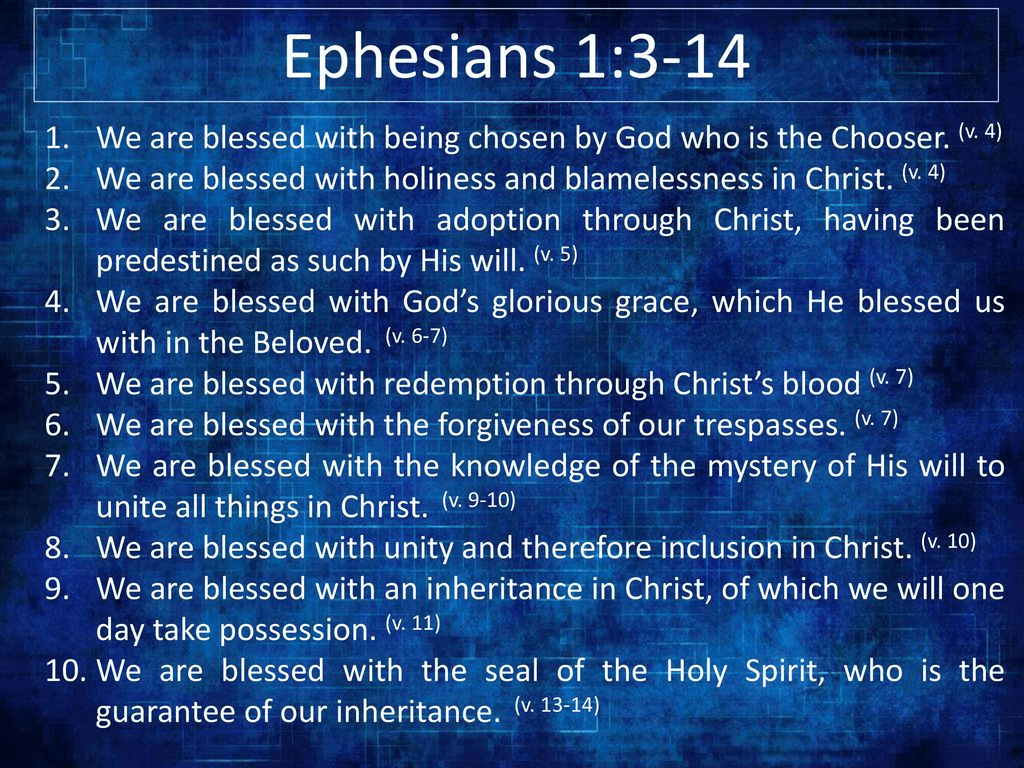
Notice the phrase “to the praise of His glory” in 1:6,12,14. This section is about what God has graciously done for those who have “heard and believed in Him (Jesus)”.
These spiritual blessings were by the “purpose of HIs will” (1:5,9,11) and “plan” (1:10). All this was due to the “grace” of God (1:6,7). We did not and cannot earn it by good works. Notice that we were “predestined” (1:5,11) and chosen before the foundation of the world.
Before we get into the controversial issues in this section, just look at that list of spiritual blessings and rejoice in what God has done for you (if you are a sincere, faithful believer). Using the numbers in the image above:
#1 You were chosen by God. You didn’t choose your parents, your parents chose you. Not so with adopted chldren. The parents out of love and compasion chose to adopt you. That is how it is with us, the Father’s adopted children. Once adopted, we are fully accepted as if we were birth children. My wife and I try to make no distinction bewteen our natural and adopted children.
#2 We are blessed with being holy, not by our own goodness, but b/c God has made us holy by His grace. He has reckoned or imputed righteousness to us even though we are not righteous. The word for holy means “set apart”. The word for saint is “one who has been set apart”. We are all saints (not like the Catholic saints who have to acheive or earn sainthood by some great works). On your worst sinful day, you are still holy in the eyes of God by God’s doing, not your own. Repent, ask for forgiveness, and rejoice that you are still holy in the eyes of god. 1 Corinthians 1:30: “Because of God you are in Christ Jesus, who has become for us wisdom from God. In Christ we are put right with God, and have been made holy, and have been set free from sin”. Hebrews 10:10, 14: “And in accordance with this will [of God], we have been made holy (consecrated and sanctified) through the offering made once for all of the body of Jesus Christ (the Anointed One)”.
#3) You have been predestined to be adopted as sons of God, children of the Father. 1 John 3:1 “See what kind of love the Father has given to us, that we should be called children of God; and so we are”. I have 10 grandchildren, 5 of whom were adopted. I have seen the joy of those adopted grandchildren as they have found joy in finding the love and security of their new moms and dads (my children) whereas they were basically orphans before their adoption. That adoption as children of the Father and thus brothers of Jesus should mean just as much to us!
#4) You are blessed with grace “in the Beloved”, i.e. Jesus. The phrase “In Christ” is used 35 times in the book of Ephesians, 11 times just in this section alone. These spiritual blessings are only available “in Christ” to those who believe. Galatians 3:26 “for in Christ Jesus you are all sons of God, through faith. 27 For as many of you as were baptized into Christ have put on Christ. 28 There is neither Jew nor Greek, there is neither slave nor free, there is no male and female, for you are all one in Christ Jesus”.The emphasis is clearly on what God has done and not what we have done. He takes a sinner and by His grace, not by our works or goodness, He makes us a cleansed sinner even though we still sin. God gets all the glory when the world looks at a cleansed sinner. Our new cleansed self is not b/c of what we have done or the good works we do as Christians. It is 100% the work of God in cleansing us by His grace and power.
#5) You are redeemed by the blood of the Lamb. The Greek word: apolutrósis: a release effected by payment of ransom. As in paying a ransom price to free a slave. This redemption price was his blood according to the riches of his grace which he “lavished” on us (1:8). “Lavished” in the Greek is perisseuó: to be over and above, to abound. In English, “lavish” means bestow something in generous or extravagant quantities.
#6) You are forgiven of sins by God’s grace “in the Beloved”, ie. “in Christ. You don’t even have to live a sinless life. 1 John 1:7 “if we walk in the light…the blood of Jesus cleanses (present tense, continues to cleanse) us from all sin”. 1 John 2:1,2 “if we do sin, we have an adocate with the Father, Jesus Christ… the propitiation for our sins”.
#7 We know the solution to the mystery that was hidden all through the Old Testament that even the prophets did not understand (1 Peter 1:”10 Concerning this salvation, the prophets who prophesied about the grace that was to be yours searched and inquired carefully, 11 inquiring what person or time[a] the Spirit of Christ in them was indicating when he predicted the sufferings of Christ and the subsequent glories. 12 It was revealed to them that they were serving not themselves but you, in the things that have now been announced to you through those who preached the good news to you by the Holy Spirit sent from heaven, things into which angels long to look”). The mystery or hidden plan was how could God saved sinners and yet be just and punish sin which the just Judge of the universe must do? We know the answer to that mystery, i.e. that Jesus died for us, satisfying the wrath of God against our sins, allowing God to be “just and the justifier of the one who has faith in Jesus” (Romans 3:26).
#8 We are blessed to be united into the worldwide body of believers, the church, the spiritual body of Jesus, made up of different ethnic groups. We look different and live in different cultures, but we all have one thing in common, i.e. saved by God’s grace and children of God in one big spiritual family. I know it warms my heart to hear of fellow believers coming to Christ in foreign nations. It greives me to hear of brothers and sisters suffering for their faith in foreign countries as organizations like Voice of the Martyrs continual remind us of (get there monthly publication free). We have so much racial tension in America and yet there is nothing but love between us in Christ. We see the constant conflict between Muslims and Israel but then we hear of Arab Muslims being converted to Christ now worshipping with Jewish Christians in some places.
#9)You have been predestined to receive an “inheritance”, eternal life, both now (1 John 5:13 ” I am writing these things to you who believe in the name of the Son of God that you may know that you have eternal life”) and after you die physically (John 11:25 Jesus said to her, “I am the resurrection and the life.[d] Whoever believes in me, though he die, yet shall he live”). Most would love to get the news that they just inherited a billion dolars. That does’t even compare with our inheritance!
#10 You are sealed with the Holy Spirit as a guarantee that you will receive that eternal inheritance. “Sealed” in the Greek: 4972 sphragízō (from 4973 /sphragís, “a seal”) – properly, to seal (affix) with a signet ring or other instrument to stamp (a roller or seal), i.e. to attest ownership, authorizing (validating) what is sealed. “Guarantee” in the Greek: 728 arrhabṓn – properly, an installment; a deposit (“down-payment”) which guarantees the balance (the full purchase-price).
But now for the controversial topic: predestination (#3 above, Ephesians 1:5,11). The Greek word means “to predetermine, foreordain”. So, predestination is a Biblical doctrine. The question is whether God’s predestination takes away the freewill of men. Is the Calvinism doctrine of predestination Biblical?

What verses do Calvinists use to support Calvinism?
T
Romans 5: 12 Therefore, just as sin entered the world through one man, and death through sin, and in this way death came to all people, because all sinned—
U
Ephesians 1:4 even as he chose us in him before the foundation of the world, that we should be holy and blameless before him. In love 5 he predestined us[b] for adoption to himself as sons through Jesus Christ, according to the purpose of his will,
L
John 10:11 “I am the good shepherd. The good shepherd lays down his life for the sheep.
I
John 6:37 “All that the Father gives Me will come to Me, and whoever comes to Me I will never cast out.” 44 “No one can come to me unless the Father who sent me draws them
P
John 10:27 My sheep listen to my voice; I know them, and they follow me. 28 I give them eternal life, and they shall never perish; no one will snatch them out of my hand. 29 My Father, who has given them to me, is greater than all; no one can snatch them out of my Father’s hand.
What are the verses that refute Calvinism?
T
Rom 5:12 death passed upon all men b/c all have sinned, not b/c all have been born inheriting Adam’s sin
Ezek 18 the soul that sinners shall die. The chapter goes on to discuss a righteous man who has an ungodly son, and vice versa. Each one shall give account for his own sins.
U
Eph 1:13 those predestined had heard and believed the gospel.
John 3:16 “For God so loved the world, that he gave his only Son, that whoever believes in him should not perish but have eternal life.
Acts 2:37 Now when they heard this they were cut to the heart, and said to Peter and the rest of the apostles, “Brothers, what shall we do?” 38 And Peter said to them, “Repent and be baptized every one of you in the name of Jesus Christ for the forgiveness of your sins, and you will receive the gift of the Holy Spirit.
Salvation can’t be earned, but it is “conditional” based on the response of the hearer of the gospel.
L
2 Corinthians 5:15 says, “He died for all, so that those who live would no longer live for themselves, but for Him who died and was raised for their sake”.
1 John 2:2: “Christ is the propitiation for not only the sins of those who are believers, but of the whole world”.
Revelation 3:20 KJV Behold, I stand at the door, and knock: if any man hear my voice, and open the door, I will come in to him, and will sup with him, and he with me.
I
Ac 7:51 “You men who are stiff-necked and uncircumcised in heart and ears are always resisting the Holy Spirit; you are doing just as your fathers did.”
P
Galatians 5:4 You are severed from Christ, you who would be justified[a] by the law; you have fallen away from grace.
2 Peter 2:20 For if, after they have escaped the defilements of the world through the knowledge of our Lord and Savior Jesus Christ, they are again entangled in them and overcome, the last state has become worse for them than the first. 21 For it would have been better for them never to have known the way of righteousness than after knowing it to turn back from the holy commandment delivered to them.
Hebrews 6:4 For it is impossible, in the case of those who have once been enlightened, who have tasted the heavenly gift, and have shared in the Holy Spirit, 5 and have tasted the goodness of the word of God and the powers of the age to come, 6 and then have fallen away, to restore them again to repentance, since they are crucifying once again the Son of God to their own harm and holding him up to contempt.
Often verses in the Bible “seem” to contradict each other but we know the Bible is the inspired word of God and it cannot contradict itself. So seemingly contradictory passages must be harmonized. For example, how can John 10:27-29 (above under “P”) which supports Calvinism teaching that one of he elect can’t fall from grace be harmonized with Galatians 5:4 (above under “P” verses that refute Calvinism) which clearly says that some of the Galatian believers had “fallen from grace”? The answer s in taking a closer look at John 10:27-29. Verse 27 says “my sheep hear my voice, they listen and they follow me”. The security of the believer in Jesus here is clearly for those sheep who continue to follow Jesus, is it not? This doesn’t promise “once saved always saved” for those who cease following Jesus. How can Calvinists just ignore Galatians 5:4 and 2 Peter 2:20-21?
So how do some try to explain the apparent contradiction? Some would simply say, “that believer who goes back into sin and rejects faith in Jesus ” never was really saved, never was really one of the “elect”. But Galatians 5:4 says they had “fallen from grace”. You can’t fall from a horse that you were never on. You can’ fall from grace if you were never in grace. If “irresistable grace” (the “I” of Calviinism) was working on a perso to enable them to believe and be saved in the beginning, why would that “I” not keep them from ceasing to believe later in their spirtual journey? This type of trying to explain away the obvious teaching of the Scriptures leads to other issues. Can a believer ever be assured of his salvation if it might be that “he was never really saved” if he falls later? Yet, the preacher will tell him that he has the assurance of his salvation once he believes. Arminians who reject Calvinism and yet say they believe in eternal security of the believer often say “they were never really saved” if one “backslides” back into sin, and yet they assure the one who gets saved that he can have the full assurance of his salvation. True Calvinism would just say this discussion is meaningless. God’s power can save the elect even if they fall back into sain b/c salvation is just not by human goodness or works. God’s grace is so powerful that it can saved the elect even if they fall back into sin (whether they ever repent and change or not). I think that is the teaching of Calvinism, but there are probably Calvinists who have their own opinions on this.
Bottom line, why is it so hard to just harmonize John 10:27-29 and Galatians 5:4 and accept that initial salvation is conditional based on a person believing in Jesus (salvation is by grace through faith, not of works Ephesians 2:8-9) but continued salvation after that is also conditional on a sincere, working faith (James 2:24 you see that a man if justified by works and not faith alone). Thus one can truly be saved and have the full assurance of salvation by grace only to lose that salvation if he “falls from grace” through disobedience and loss of faith in Jesus. Of course, we would never know when one “crosses that line” into falling from grace (only God determiines that) but the line does exist according to Scripture.
Of course, that gets back to the “U” (unconditional election) of Calvinism. We know that one is not saved “on the basis of his works or what he does”, but that does not mean that there are no conditions one must submit to in order to be saved. As John 3:16 and Acts 2:38 show in the verses that refute Calvinism, two things are obvious: 1) Johne 3:16 Salvation is available to “whosover” chooses to be saved (not just an elect group arbitrarily chosen by God to the exclusion of all others to show God’s sovereign power); 2) Acts 2:38 they asked “what must we do?”. Why didn’t Peter tell them, “you are totally depraved due to the original sin of Adam (the “T” in Calvinism), you are unable to even believe or do anything in order to be saved, you need to just sin at the mourners’ bench and cry out to God for some sign that you are in the elect and if you don’t get that sign, sorry, no salvation for you? That is basically what Calvinism would tell someone to do although I’m sure many Calvinists modify that. It is obvious that God has placed “conditions” that one must meet in order to be saved even though salvation is 100% by grace. Those initial conditions to be saved are belief, repentance, confession, and baptism. The condition to remain saved by grace is a sincere, working faith (not a perfect faith or a sinless faith). It is obvious that the invitaion to salvation is available to anyone and not just the ones that God has predetermined to be saved (the “L” limited atonement, i.e since only the predestined elect are going to be saved, then Jesus only died for the elect and not ror all men which 1 John 2:2 (above) refutes). Of course this is the Arminian position that says that salvation is by grace and yet is consitonal based on the freewill choices of men on whether to believe and obey Jesus or not.
Is Calvinism really a dangerous doctine? Yes and no. Many true Calvinists or even Arminians who have a modified view of “once saved always saved” continue to believe, obey, and bear the fruit of the Spirit and are truly saved (even if they believe that they could backslide and yet still be saved (Calvinism)or even if they believe that there is the possiblity that they never were really saved if they do backslide (Aminianism)). So in the end, for those believers who are “faithful unto death”, the whole Calvinism vs Arminianism discussion is bunch of theological words. They just want to live for Jesus by God’s grace, assured of their salvation. So for them Calvinism is not a dangerous doctrine even if it is wrong.
But for many, Calvinism could be dangerous and that is the point of writing this long article trying to refute Calvinism. How could it be dangerous? 1) It could make someone believe that, even if he belleves he is one of the saved elect, that he can continue in a blatant sinful life that he will be saved anyway. Paul said, “shall we continue in sin that grace may abound?” (Romans 6:1). I think Paul anticipated someone saying that b/c he had just said in Romans 5:20 “where sin increased, grace abounded all the more”. If “P” of Calvinism is false and a person can fall from grace, then Calvinism could be fatally dangerous to the eternal salvation of such a person. 2) If could make someone quit tryiing to get saved if he sincerely goes to the mourners’ bench and yet gets no sign that the Holy Spirit is enabling him to believe and be saved. He feels nothing, there is no miraculous direct operation of the Spirit confirmation. He goes home discouraged, thinking there is no hope for his salvation. I have personally seen this happen to someone. That person was a sincere, hard working family man of impeccable character. He was taught the Calvinistic view of being saved, went to mourners’ bench, felt nothing and went home discouraged, thinking he was not one of he elect and that there was nothing he else he could do to be saved. I showed him Acts 2:38 and he said, “you mean I can simply choose to believe, repent, and be baptized” and be saved and have the assurance that I am saved?” I said “that’s what Peter an apostle said, that’s what the 3,000 did and they were added to the church, which is the saved (Acts 2:47), and that’s what you can do to be saved and know that you are saved”. He was so joyful. He was baptized that night and enjoyed his savlation by grace for many years until he died a few years ago. I thank God that He led that man and me to that conversation.
Do you see why I say that Calvinism can be a dangerous doctrine? Die hard Calvinists will read this article and immediately start refuting my points. Many Calvinistic preachers of Calvinistic churches would probably lose their position if they refuted Calvinism. Or maybe they just truly believe that TULIP is Biblical. My hope is that this article will help someone who is confused by Calvinism. Maybe someone like my friend who is searching for salvation but can’t find it b/c of Calvinism. Or just someone who thinks the Bible is full of contradictions that even the theological scholars cannot agree on.
I truly hope that the first part of this article will warm your hearts with the spiritual blessings that we have in Jesus. I hope the 2nd part about Calvinism will not take away from your Christian joy if your are indeed living for Jesus regardless of you doctrinal position on the matter. God bless your reading of this article. I pray that I have “spoke the truth in love” (Ephesians 4:15).
 Nicky's Notes