
4:CH 4-6 THE PRACTICAL SECTION
Having given 3 fairly deep doctrinal chapters, Paul goes on in the last 3 chapters to give day to day practical commands for living the life of one who has been saved and added to this church body of believers of all different backgrounds.
A key word is “walk”, used figuratively of how you move about as a Christian day to day, how you conduct yourself. There are 6 walks found in Eph 4-6. Let’s examine the first.
- 4:1-16 Walk in a manner worthy of your calling in the “unity of the faith” (which includes both dotrinal unity and love unity)
Q: Does God call us to become Christians? How? Do you consider your conversion to be a calling of God? Does God call people by some voice or thought that He puts in your head? We probably have different opinions on that, but one thing for certain is that he calls us “through the gospel”. The good news of salvatiion by grace through Christ’s death for us is the drawing power.
2 Thessalonians 2:13 But we ought always to give thanks to God for you, brothers beloved by the Lord, because God chose you as the firstfruits to be saved, through sanctification by the Spirit and belief in the truth. 14 To this he called you through our gospel, so that you may obtain the glory of our Lord Jesus Christ.

In ch 2 and 3 Paul gave the doctrine of the mystery of uniting Jew and Gentile believers into the one church body. But that brings together believers from two totally different backgrounds. Just as in the church today, we have many different backgrounds and personalities. It is one thing to say that we are united in one body, but it is another thing to say that we love and tolerate one another in love when we have conflicts and differences.
Q: 4:1-3 gives the qualities necessary for us to really have “unity” in the church. Which of these is the most important in your opinion? Which one do you struggle with practicing?
Paul then goes on to give the 7 doctrinal truths that are necessary to have “unity”. Hindus could have all the qualities in 4:1-3 and be united as Hindus, but that would not be unity in Christ. There are 7 basic doctrines and beliefs that we must have to really have Christian unity.
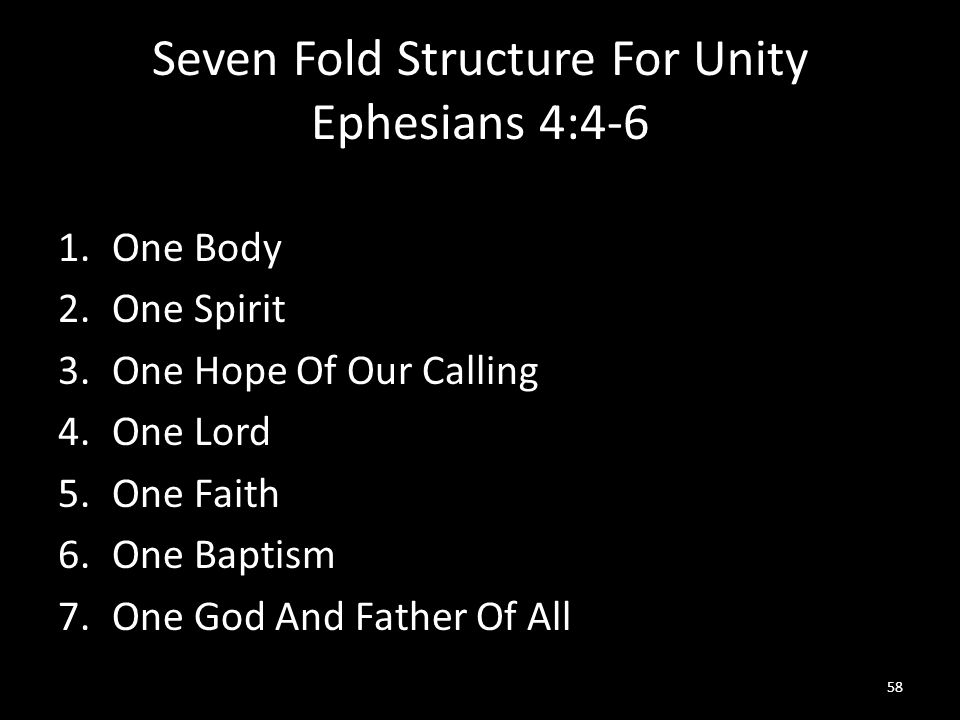
This list excludes those who believe in other gods than Yahweh and other Lords than Yeshua (Jesus). The one baptism is water baptism for the remission of sins (as opposed to the baptism of the Holy Spirit or of fire as some teach). There is one body, which is the church, which is believers all over the world.
Q: How exclusive is this list among those who have the one faith but are in many different denominations? It is exclusive, but some of the 7 doctrines could be interpreted differently.
Q: Does the one baptism have to be for exactly the right reason (i.e. the remission of sins) in the right manner (immersion)? Can it be sprinkling or pouring? Does that really matter? Can it be baby baptism? Why can’t we unite of what the “on baptism” of unity is?
Q: Does the “one body” include all the denominations who have many different names and beliefs but basically hold to these 7 doctrines? The church I was raised in taught that the different man made denominations could not be part of the “one body”, but I disagree with that. The one body is simply those saved by grace throug faith even though they are in different denominations. Unity of those denominations would be great, but not essential for salvation. The founders of the Churches of Christ, Stone and Campbell, sought to get believers from all denominations to put away their denominational names and creeds and just be united as Christians, but they did not say that those believers in those denominations were not Christians.
But what about the denominations that are going LGBQT? Are they still part of the one body?
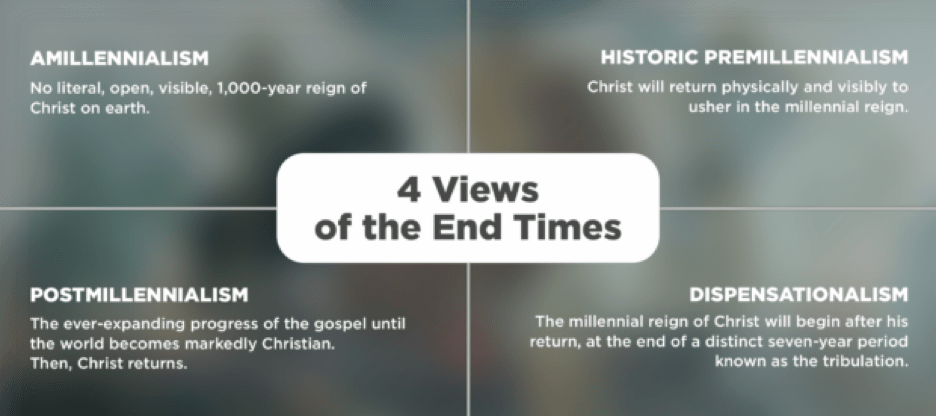
The “one hope” is that of eternal life. But there are many views on eschatology (amillinealism, ? Do we all have to believe the same on eschatology? Add preterism to the chart below.
4:8 Jesus gave miraculous “gifts” to certain men in the early church to give the doctrinal truths necessary for unity. He “ascended” to heaven to pour out those gifts on men.
Act 2:33 Being therefore exalted at the right hand of God, and having received from the Father the promise of the Holy Spirit, he has poured out this that you yourselves are seeing and hearing.
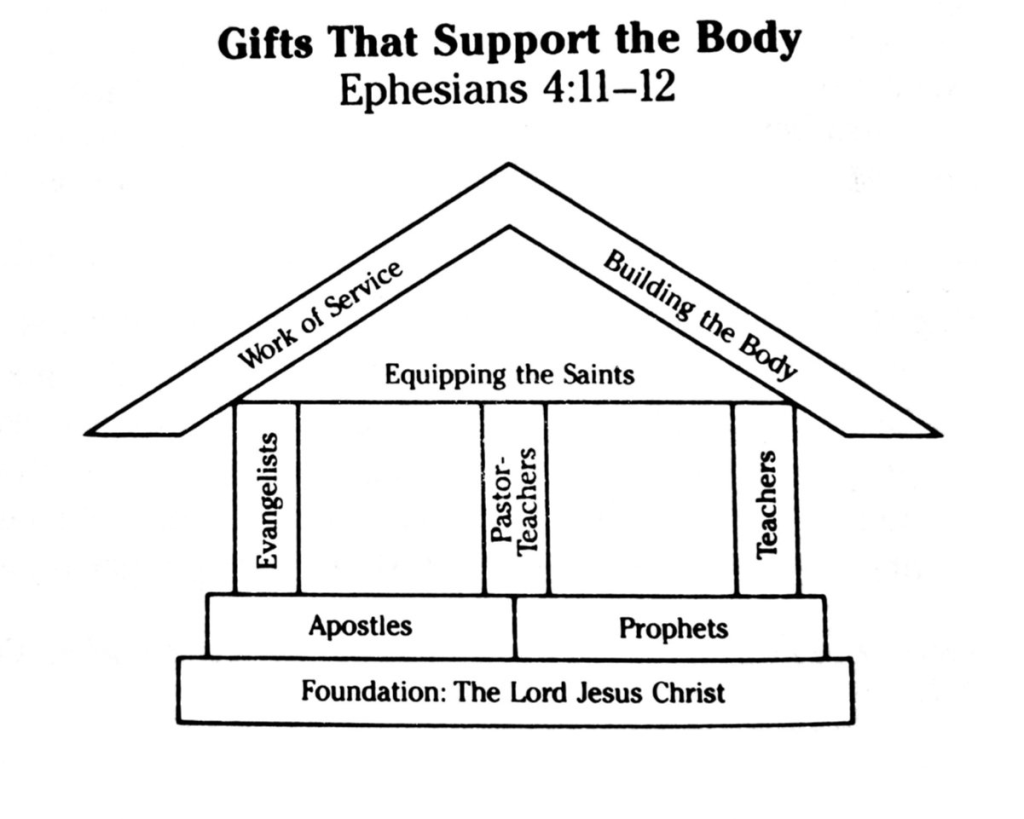
This would include the 5 miraculously gifted leadership positions (apostles, prophets, evangelists, pastors, and teachers) as well as the miraculous gifts given to members of the church (1 Cor 12). Thus in 4:16 “every joint” helped maintain unity in the body.
These 5 gifted positions were to equip the saints for ministry, to build up the body, to a mature unity of faith and knowledge, to not be tossed about by deceitful doctrines, to speak the truth in love.
Jesus prayed for this “unity of the faith” in John 17:20 “I do not ask for these only, but also for those who will believe in me through their word, 21 that they may all be one, just as you, Father, are in me, and I in you, that they also may be in us, so that the world may believe that you have sent me. 22 The glory that you have given me I have given to them, that they may be one even as we are one, 23 I in them and you in me, that they may become perfectly one, so that the world may know that you sent me and loved them even as you loved me.
This is Jesus’ prayer on the night before he is crucified the next day. It would be like me knowing that I will die tomorrow and the night before I pray that my 3 children will always be united and love and help each other after I die.
Q: As a result of these gifted 1st century positions, do we have all that we need for Christian unity and “maturity” in the church? If we have all that we need doctrinally for unity, then why. do we have so many different denominations teaching so many different doctrines? I might teach my 3 children all that they need to become mature adults, but that doesn’t mean they will become mature adults.
What would be examples of “deceitful doctrines” that stray from that unity? This sounds more devious than just differences of interpretation on issues and doctrines that are not heaven or hell issues, such as those given by Paul in Romans 14 (eating of meats, observing of days, etc.). Deceitful doctrines sounds like doctrines taught by devious people trying to lure and pull believers away from the one body, maybe their motivation is power or sex or money.
Peter spoke of such false prophets in 2 Peter 2:But false prophets also arose among the people, just as there will be false teachers among you, who will secretly bring in destructive heresies, even denying the Master who bought them, bringing upon themselves swift destruction. 2 And many will follow their sensuality, and because of them the way of truth will be blasphemed. 3 And in their greed they will exploit you with false words. Their condemnation from long ago is not idle, and their destruction is not asleep.
Q: What are some doctrines that are not heaven or hell doctrines? Maybe instrumental music in worship, frequency of taking the Lord’s Supper, names and organization of churches, etc. We should not make any doctrine a heaven or hell doctrine unless the scriptures specifically do so. If we make almost every doctrine a heaven or hell one, then we will end up in untold division, as some groups have found out.
Q: So what are the doctrines are heaven or hell essential doctrines to the “unity of the faith”?
The list of 7 doctrines in this chapter is where we start, but even then the “one baptism” can be interpreted differently. Certainly the one faith would include the belief that Jesus is the Son of God whose death is the only way to be saved. That would rule out all the cults who deny the deity of Jesus.
There are certain sins that Paul says in Galatians 5:19 Now the works of the flesh are evident: sexual immorality, impurity, sensuality, 20 idolatry, sorcery, enmity, strife, jealousy, fits of anger, rivalries, dissensions, divisions, 21 envy, drunkenness, orgies, and things like these. I warn you, as I warned you before, that those who do such things will not inherit the kingdom of God. The Bible teaches that homosexuality is a sin, but the LGBQT issue has divided churches and believers, but there can be no compromise on that. Sometimes unity is not possible if some refuse to acknowledge the inspiration of Scripture and won’t allow the Bible to define what is right and wrong.
Q: Do we still need and have those gifted leaders today?
Apostles (the Mormon church has 12 apostles)? Paul spoke of false apostles: Paul spoke of “false apostes”: For such are false apostles, deceitful workers, transforming themselves into apostles of Christ. And no wonder! For Satan himself transforms himself into an angel of light. Therefore it is no great thing if his ministers also transform themselves into ministers of righteousness, whose end will be according to their works (2 Corinthians 11:13-15).
Prophets (many churches claim to have prophets)? What about all the prophets of all the cults? The Mormons have Joseph Smith as their prophet, the Seventh Day Adventists have Ellen G. White, the Jehhovah’s Witnesses have Rutherford and Russell, Christian Science have Mary Baker Eddy, and countless more examples. These false prophets have no miraculous confirmation that they are a prophet and no predicting of the future to confirm that they are prophets. They also add to the “all truth” that was given to the original apostles without any proof that Jesus is allowing them to do that.
Evangelists (are our preachers really evangelists?) In the early church, evangelists were gifted men who moved around preaching the gospel, establishing churches, grounding churches in the truth as Paul left Timothy in Ephesus to do (1 Timothy 1:3 As I urged you when I was going to Macedonia, remain at Ephesus so that you may charge certain persons not to teach any different doctrine) or as Paul left Titus in Crete to do (Titus 1:5 This is why I left you in Crete, so that you might put what remained into order, and appoint elders in every town as I directed you—). It was not a permanent paid position such as the paid clergy position that we have invented in churches today. The church did provide food and a place to stay for the evangelists who came to them. The Didache (a first century document) warns “You should treat apostles and prophets as the Gospel commands. Receive every apostle that comes to you as you would the Lord. But he must not stay more than one day, or two if necessary: but if he stays three days, he is a false prophet.” In other words, he must be preaching for the money! There were gifted elders and teachers to lead the church, so a permanent paid evangelists were not needed or authorized. We don’t have miraculously gifted elders or teachers today, but we still have many good elders and teachers in our churches. Why do we spend so much money of permanent paid pastors and preachers?
I can see how evangelists who do mission work to establish churches might need to be supported (as my family was doing mission work in Trinidad and Colombia), but even then that was not a permanent position. It is interesting that the Moravians sent out many missionaries all over the world (I encourage you to read about their history). They taught them a trade so they could support themselve in the foreign country they worked in, gave them money to get there, but did not support them as they lived there!
Pastors (i.e. elders; are our elders today gifted?): The word for shepherd is poimainó: to act as a shepherd. [4165 /poimaínō (“to shepherd, tend”) occurs 11 times in the NT, usually with a figurative sense of “shepherding (tending) God’s flock.” This provides Spirit-directed guidance (care) conjunction with feeding His people (teaching them Scripture).] This is the word Paul used in Acts 20 when telling the elders (4245 presbýteros – properly, a mature man having seasoned judgment (experience); an elder.) whom God had made to be overseers (episkopos: a superintendent, an overseer: this is the word used of elders in 1 Timothy 3 and Titus 14166 poimḗn – properly, a shepherd (“pastor” in Latin); (figuratively) someone who the Lord raises up to care for the total well-being of His flock (the people of the Lord).) to “shepherd (Pastors (i.e. elders; are our elders today gifted?): The word for shepherd is poimainó: to act as a shepherd. [4165 /poimaínō (“to shepherd, tend”) occurs 11 times in the NT, usually with a figurative sense of “shepherding (tending) God’s flock.” This provides Spirit-directed guidance (care) conjunction with feeding His people (teaching them Scripture).] This is the word Paul used in Acts 20 when telling the elders (4245 presbýteros – properly, a mature man having seasoned judgment (experience); an elder.) whom God had made to be overseers (episkopos: a superintendent, an overseer: this is the word used of elders in 1 Timothy 3 and Titus 1) to shepherd (4166 poimḗn – properly, a shepherd (“pastor” in Latin); (figuratively) someone who the Lord raises up to care for the total well-being of His flock (the people of the Lord) the flock. In other words, the 3 Greek words in Acts 20 refer to the same position: elders( presbyteros from which we get presbyters), overseers (episkopos from which we get bishops), shepherds (poimen from which we get pastors and shepherds). The early church organization at the local level was “elders and deacons”. Philippians 1:1: Paul wrote to the “overseers and deacons” in Philippi.1 Timothy 3: Paul lists qualifications for elders and deacons, including that elders should be experienced Christians with good reputations and well-ordered families. Titus 1: Paul refers to elders and overseers as the same. Acts 20:28: Paul spoke to the elders in Ephesus and told them to be overseers of the church. 1 Peter 5: Paul uses language of elders both shepherding and overseeing. In Christianity, the roles of presbyters and bishops have varied across time and denomination, often as 2 different positions, but the words refer to one position, that of elders.
Bottom line, the gifted “pastors” in Eph 4:11 were shepherds or elders, not preachers like the term is used for preachers in denominations today. They were appointed in churches even soon after they were established. Paul on his 1st missionary journey: Acts 14:21 When they had preached the gospel to that city and had made many disciples, they returned to Lystra and to Iconium and to Antioch, 22 strengthening the souls of the disciples, encouraging them to continue in the faith, and saying that through many tribulations we must enter the kingdom of God. 23 And when they had appointed elders for them in every church, with prayer and fasting they committed them to the Lord in whom they had believed. So Paul appointed elders in those local congregations very soon after he established those churches. Those elders would have met the qualifications for elders in 1 Tim 3, but they would have needed the miraculous gifts to enable them to guide and protect the flock from false teachers. I believe all the first century elders had miraculous gifts, just as Eph 4:11 claims.
We do not have miraculously gifted elders today, so do we still need elders? I think so. They just need to realize their limitations since they are not miraculously gifted. Of course, they can still protect the flock from heresy without being gifted by using the “all truth” in the Word, and they can still lovingly shepherd and care for the flock. They need to be careful about forcing their “opinions” on the flock.
Teachers : According to Ephesians 4:11, “pastors and teachers” are listed together, but whether they represent one single position or two distinct gifts is a matter of debate among scholars; some interpret it as meaning that all pastors should be teachers, but not all teachers are necessarily pastors, suggesting a distinction between the roles even if they are closely related. One of the qualifications for an overseer or elder was “apt to teach” (1 Timothy 3:1The saying is trustworthy: If anyone aspires to the office of overseer, he desires a noble task. 2 Therefore an overseermust be above reproach, the husband of one wife, sober-minded, self-controlled, respectable, hospitable, able to teach… Of the elders that Paul told Titus to appoint in Crete: Titus 1:9 He must hold firm to the trustworthy word as taught, so that he may be able to give instruction in sound doctrine and also to rebuke those who contradict it. So, elders did teach in the churches, but in Eph 4:11 the “teachers” probably referred to a different position from elders. There were miraculously gifted teachers in the early church. 1 Cor 12:27 Now you are the body of Christ and individually members of it. 28 And God has appointed in the church first apostles, second prophets, third teachers, then miracles, then gifts of healing, helping, administrating, and various kinds of tongues. 29 Are all apostles? Are all prophets? Are all teachers? Do all work miracles? 30 Do all possess gifts of healing? Do all speak with tongues? Do all interpret? 31 But earnestly desire the higher gifts.It is interesting that Paul list the top 3 gifted positions in the church at Corinth as apostles, prophets, and teachers. It is also interesting that he does not include the miraculously gifted positions of elders or evangelists. Evangelists traveled church to church, so I can see why they were not included, but were there not miraculously gifted elders in the church at Corinth. I found this on the internet:”No, elders do not appear in any Biblical accounts of the church at Corinth. The church at Corinth lacked the spiritual maturity that would have been necessary for elders to be present. The church was made up of people with a history of immoral lifestyles, including sexual immorality, idolatry, and adultery. There was also evidence that many Corinthian disciples were former members of pagan mystery cults.” But then I found this. “For example, there is nothing said in the New Testament of the Eldership in Corinth, yet the epistle of the church in Rome to the church in Corinth commonly called the epistle of Clement, written about the close of the first century, proves that there was a plurality of Elders in Corinth.” Maybe the church added elders after Paul’s death as the miraculous gifts ceased to exist?
Do we need teachers today in churches, even if they are not miraculously inspired? I think so. They just need to be grounded in the Word.
 Nicky's Notes