
There were 6 “walks” in Eph 4-6. This referred to the way Christians were to live and act as a result of their special calling into the one body (the doctrinal section in Eph 1-3).
2. 4: 17-32 Walk no longer as the Gentiles
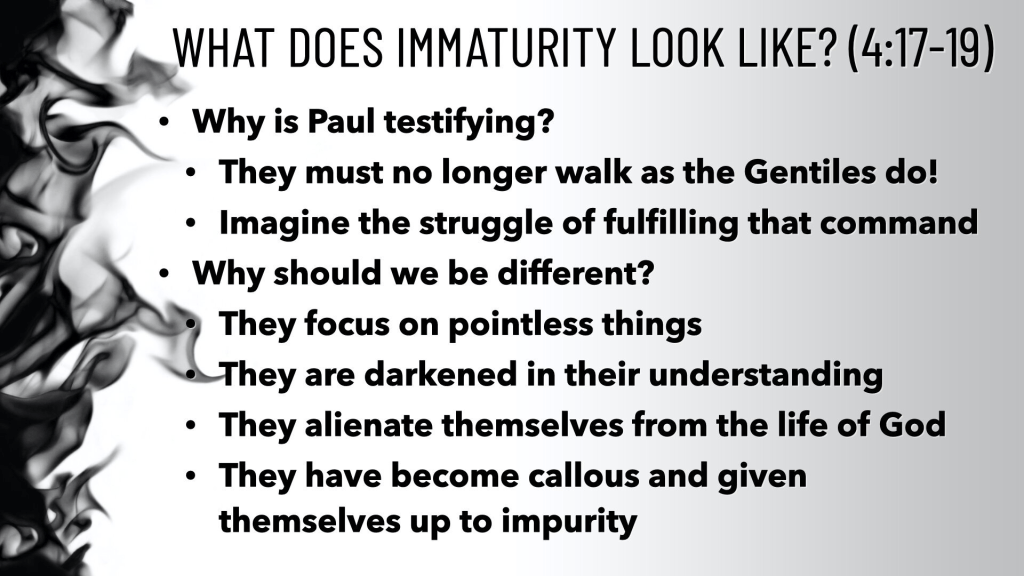
Paul had just talked about the church “maturing” (Eph 4:13), and now he describes what a mature church would look like.
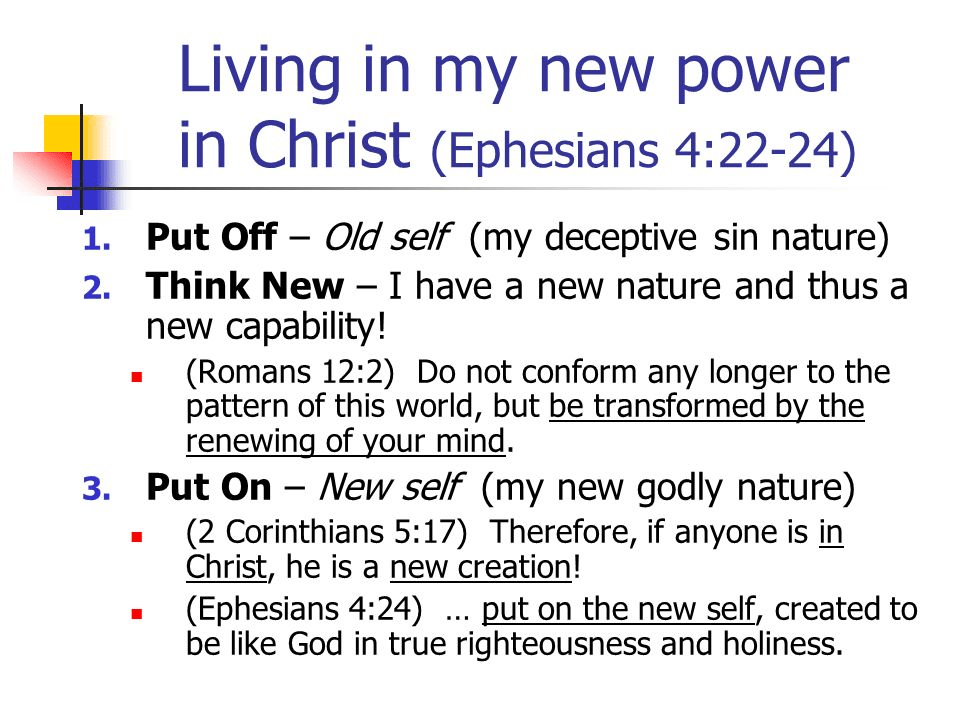
4:25-32 But what does that mean to put off the old self and put on the new self. Let’s get specific on what to put off and what to put on.
4:30 A key verse in the midst of this. 30 And do not grieve the Holy Spirit of God, by whom you were sealed for the day of redemption. The Holy Spirit is constantly working to help us (through the written word and other ways) to do all this. Just like parents are constantly trying to instill these life principles in their children and it grieves them when their children do wrong and don’t do right. It grieves the Holy Spirit when we don’t.
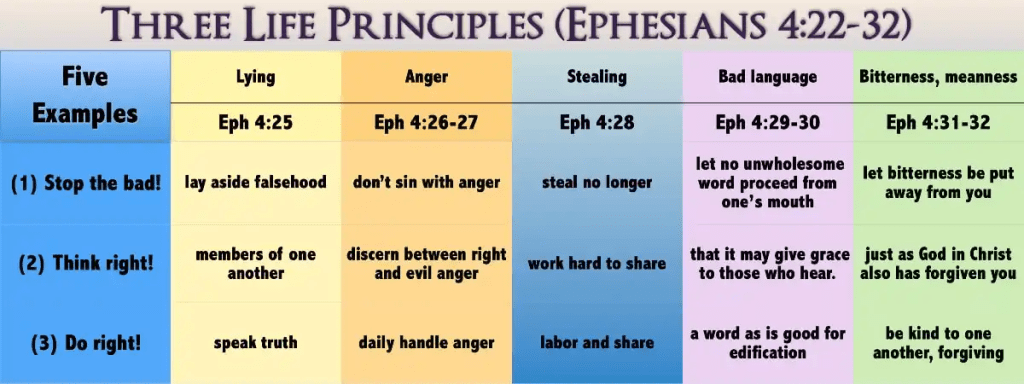


Q: Which one (or ones!) of these do you struggle with the most to put away the bad and do the right?
Q: The “Gentiles” would be the non-Christians around us. Are the non-Christians today really as bad as Paul described them to be?
Are we really different than them? Do we need to be different like the Amish? Can we be “in the world but not of the world”? John 17:14 I have given them your word, and the world has hated them because they are not of the world, just as I am not of the world. 15 I do not ask that you take them out of the world, but that you keep them from the evil one. 16 They are not of the world, just as I am not of the world.
Would your friends and co-workers say that you are different? How could they tell a difference?
3. 5:1-2 Walk in love as Christ loved us and gave himself for us

This is from got questions.org
The “walk” of Ephesians 5:2 refers to our behavior and how we act. We walk in love when we act like God. When we behave like Jesus, we are walking in love. Just as children like to imitate their parents, we are to mimic God in the same way Jesus copied His Father’s behavior.
The Greek word translated as “love” in this passage is agape. Agape is sacrificial, unselfish, unconditional love that proves itself through actions. It perfectly describes God’s love for us (John 3:16) and Christ’s love for us (1 John 3:16). With agape, “God showed how much he loved us by sending his one and only Son into the world so that we might have eternal life through him” (1 John 4:9, NLT). When the Bible says, “God is love” in 1 John 4:8, the word “love” is a translation of agape. God’s nature, His essence, is selfless, sacrificial, unconditional love.
The apostle John stressed that, since God loves us sacrificially and unconditionally, we ought to love others in the same way: “Dear friends, since God so loved us, we also ought to love one another” (1 John 4:11). Again, we walk in love by imitating God’s love for us in how we show love to others. Jesus taught the same principle when He said, “There is no greater love than to lay down one’s life for one’s friends” (John 15:13, NLT).
The apostle Paul gives a detailed description of how to walk in love: “Love is patient and kind. Love is not jealous or boastful or proud or rude. It does not demand its own way. It is not irritable, and it keeps no record of being wronged. It does not rejoice about injustice but rejoices whenever the truth wins out. Love never gives up, never loses faith, is always hopeful, and endures through every circumstance” (1 Corinthians 13:4–7, NLT). The greatest virtue we can nurture in our Christian walk is agape love (1 Corinthians 13:13).
In Ephesians 5:2, Paul said that Jesus “gave himself up for us.” Giving ourselves up means offering our lives to God in sacrifice. It means following, obeying, submitting, serving, and living in a committed relationship with Him. Giving ourselves up means walking in love. When we behave like this, our lives become “a fragrant offering” that is pleasing to God and everyone who encounters the scent (Leviticus 1:17; 3:16). Paul urged believers to offer themselves “as a living sacrifice, holy and pleasing to God—this is your true and proper worship” (Romans 12:1).
When we walk in love, we show the world that we are true followers of Jesus Christ: “Your love for one another will prove to the world that you are my disciples” (John 13:35, NLT; see also 1 John 3:14).
As God’s children and members of His family, we are called to deny our own selfish desires and interests for the sake of God and others. Although we are free in Christ, we use our freedom “to serve one another in love. For the whole law can be summed up in this one command: ‘Love your neighbor as yourself’” (Galatians 5:13–14, NLT). Peter said, “You were cleansed from your sins when you obeyed the truth, so now you must show sincere love to each other as brothers and sisters. Love each other deeply with all your heart” (1 Peter 1:22, NLT). This wholehearted, sacrificial imitation of God’s divine agape is what it means to walk in love.
Q: Would you friends, family, co-workers, people you do business with say that you are a loving Christian, that they see the love of God and of Jesus in you?
Of course there are different ways of expressing love?
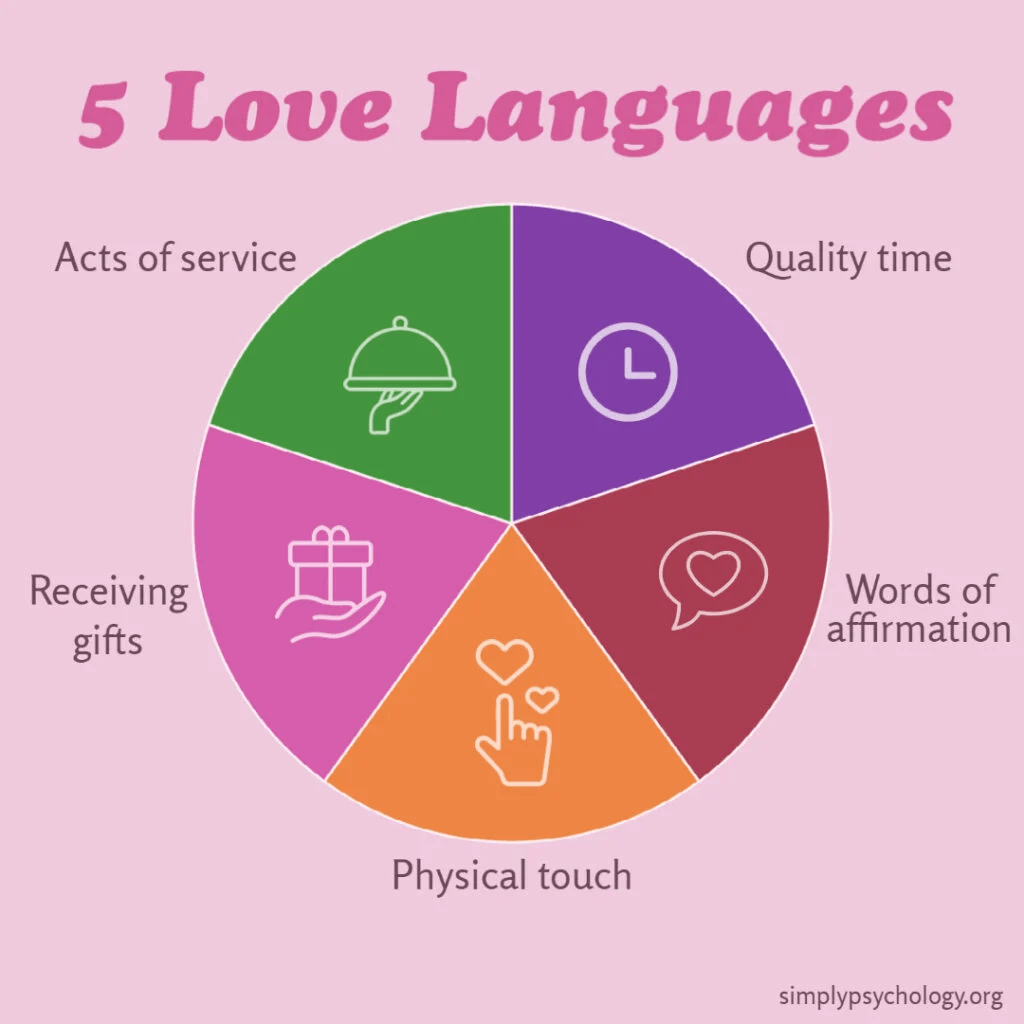
Q: Which of these is your primary way of expressing love?
 Nicky's Notes