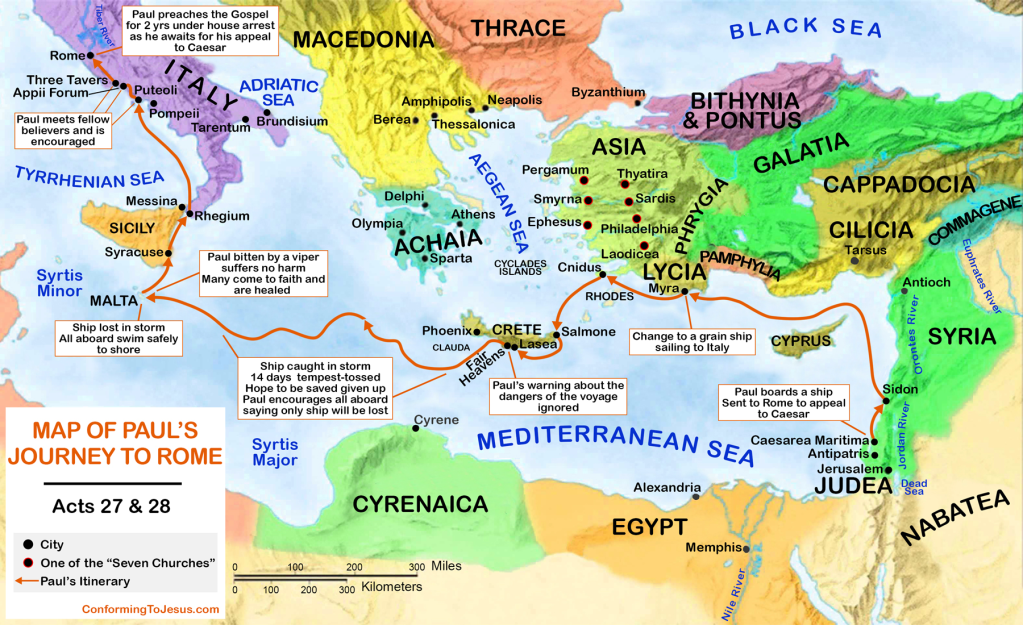
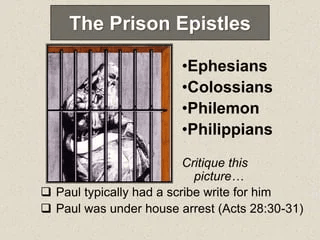
Here is a map of Paul’s voyage to Rome as a prisoner when he appealed to Caesar. Notice the island of Crete where they planned to spend the winter but the hurricane winds blew them out to sea for 14 days out of control. Notice the island of Malta where they shipwrecked and Paul was bitten by a poisonous snake but unharmed. Notice Rome where he spent 2 years in house arrest and wrote the prison epistles of Ephesians, Pilippians, Colossian, and Philemon.
AUTHOR: The apostle Paul (Phl 1:1), joined in his salutation by Timothy. Personal references by the author (Phl 1:12-14; 2:19-24; 3:4-7; 4:15-16) are certainly consistent with what we know of Paul from other New Testament sources. Paul’s authorship of this letter is also supported by the testimony of early “church fathers” such as Polycarp and Irenaeus.
THE CITY OF PHILIPPI: Named after Philip of Macedonia, the father of Alexander the Great, it was a major city of Macedonia on the road from Rome to Asia known as the Egnatian Way. It was the site of a famous battle in 42 B.C. in which Antony and Octavius defeated Brutus and Cassius. In 30 B.C., Octavian made the town a Roman colony where retired soldiers could live and enjoy the full privileges of Roman citizenship (to which Paul may have alluded in Phl 3:20).
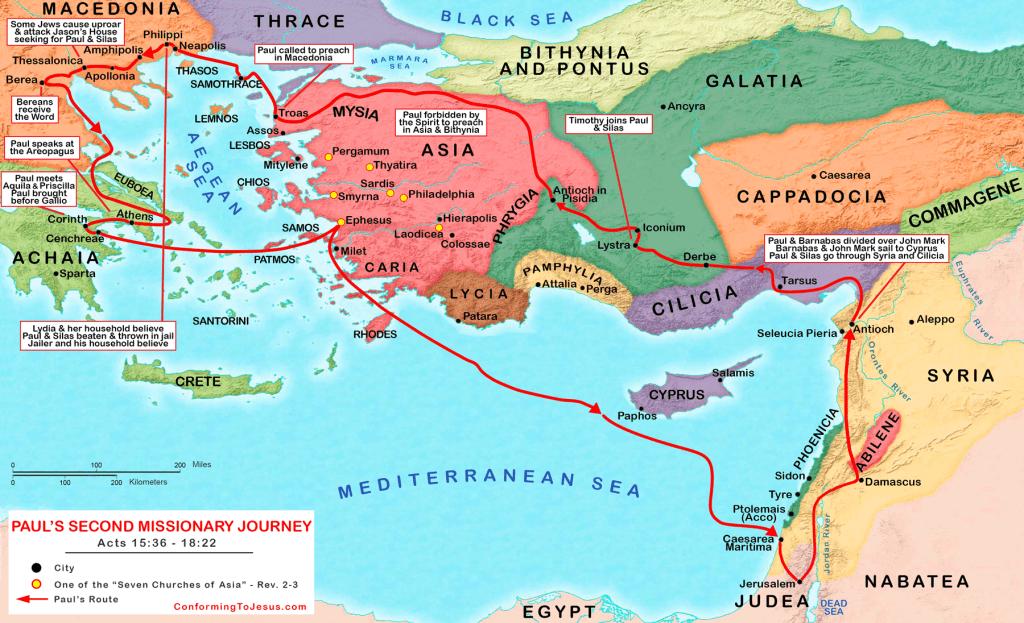
THE CHURCH AT PHILIPPI: During his second missionary journey (49-52 A.D.), Paul and his traveling companions (Timothy and Silas) were making their way across Asia Minor (Turkey) when Paul received a vision at Troas. In the vision, a man of Macedonia pleaded, “Come over to Macedonia and help us.” Perceiving that the Lord was calling them to go to Macedonia, they sailed from Troas (Luke having joined them) and eventually arrived at Philippi (Ac 16:6-12).
With the conversion of Lydia (Ac 16:13-15) and the Philippian jailor (Ac 16:25-34), the church was established at Philippi. The lack of a synagogue seems to indicate that Jews were not prevalent and so the church may have consisted primarily of Gentiles. From the conversion of Lydia and references in the epistle itself (Phl 4:2-3), it is evident that a number of women played a role in the growth of the church.
When it became necessary for Paul to leave, Luke seems to have stayed at Philippi (based upon careful observations of personal pronouns; e.g., “we, they”, cf. Ac 16:12; 17:1). As Paul left Macedonia, the church at Philippi became a significant source of support (Phl 4:15-16; 2 Co 11:9).
Paul visited the church at Philippi again on his third missionary journey (Ac 20:3,6).
TIME AND PLACE OF WRITING: Philippians is one of Paul’s four “prison epistles” (Phl 1:7,13,17; cf. Ephesians, Colossians, and Philemon). The general consensus is that these epistles were written during Paul’s imprisonment at Rome (cf. Ac 28:16,30-31). If such is truly the case, then Paul wrote Philippians around 61-63 A.D. from Rome.
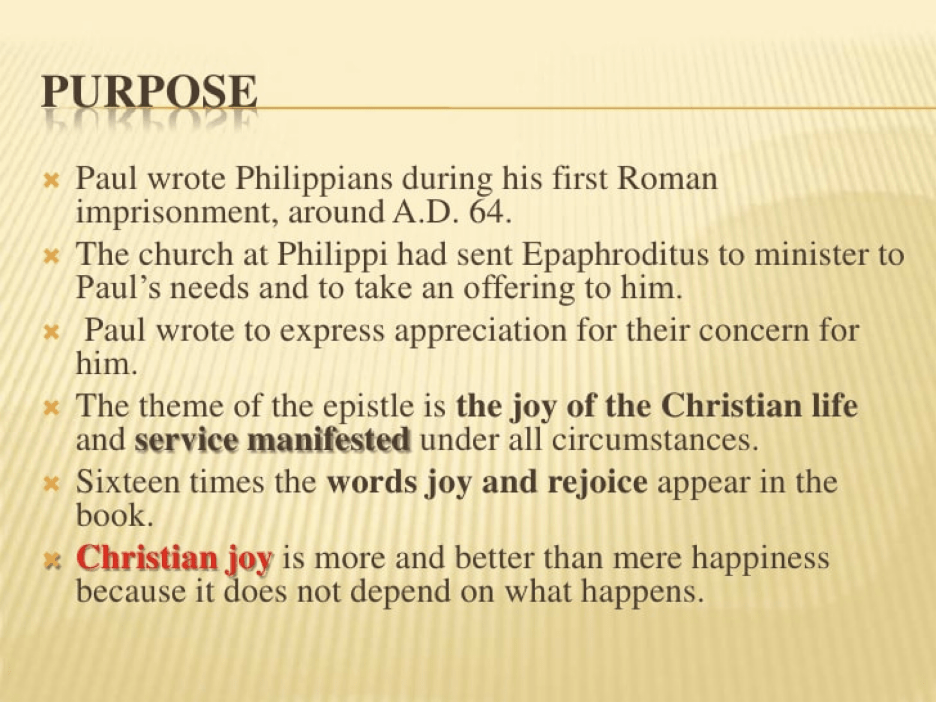
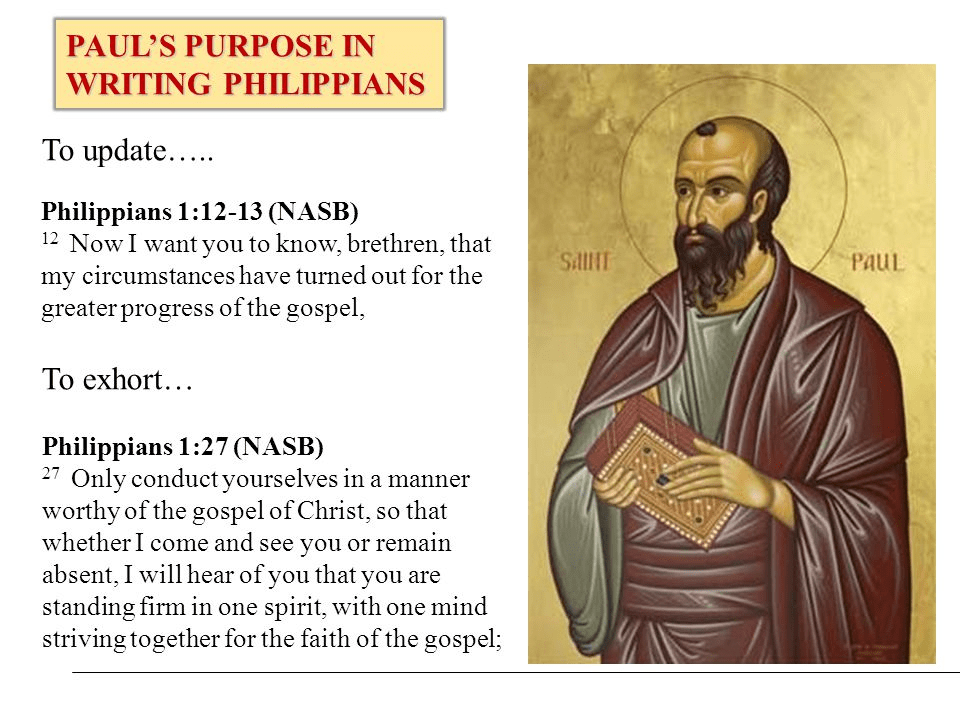
PURPOSE OF THE EPISTLE: The church at Philippi had sent a gift to Paul in Rome by the hand of Epaphroditus (Phl 4:10,18). Paul uses this occasion not only to thank them, but to comfort them concerning his situation as a prisoner for Jesus Christ (Phl 1:12-14). He also writes of his plans to send Timothy soon (Phl 2:19-24), and why he considered it necessary to send Epaphroditus back to them (Phl 2:25-30). There may have also been a problem at Philippi involving two women, for Paul has a few words to say concerning them (Phl 4:2-3).
THEME OF THE EPISTLE: Throughout this short and rather personal epistle, one keynote resounds again and again. That keynote is joy. Five times the word “joy” (Grk., chara) is found (Phl 1:4,25; 2:2,29; 4:1), and the verb “to rejoice” (Grk., chairein) occurs eleven times (twice in Phl 1:18; 2:17,18; 4:4; once in Phl 2:28; 3:1; 4:10). For this reason, the epistle to the Philippians has often been called Paul’s “hymn of joy” in which the theme is: “Rejoice in the Lord!”
“Rejoice in the Lord always. Again I will say, rejoice!”
Here is a map of Paul’s 2nd missionary journey during which he established the church at Philippi.
From an article by Brian Tabb:
Joy is “a feeling of great pleasure and happiness.” It’s the emotion we feel when life is good — when the sun is shining, when our team is winning, when we are healthy, happy, and heartened. Most people do not typically speak of the happiness of heartbreak, the pleasure of migraines, or the bliss of losing.
Philippians is the most joyful book in the Bible — the apostle Paul uses the Greek words for joy and rejoicing sixteen times in only 104 verses. And yet he writes from a dingy Roman prison, a place we would typically associate with misery and trial, which most people assume are the opposites of joy. He’s surrounded by every conceivable obstacle to joy, so why does he seem so happy?
Here is a neat list of the 7 topics covered in the letter. from blueletterbible.org. I will try to make note of most of the places where the word joy or rejoice is found, which is the theme of the book.
1:1-12 A personal “prayer with joy” (1:4) for their love and faith and enduring suffering with him for the gospel.
List the 7 main sections of this epistle.
1)1:12-26 The situation in Rome. Paul circumstances, i.e. as a prisoner, had turned out for the good of the gospel b/c he had been allowed freedom under house arrest to preach the gospel which led to the conversion of some of the Praetorian Guard (a special guard to protect the emperor). He could even “rejoice” (1:18) that some were trying to undermine him and yet at least they were preaching Christ. A similar thing happened on his visit to Philippi when he and Silas were put in prison and yet were singing songs of joy and praise to God which led to the conversion of the jailor and his household. When bad things or circumstances happen to you, can you look for how God might use your bad circumstances to spread the gospel and help others?
2) 1:19-30 Exhortation to behavior worthy of the gospel even if they had to suffer for their faith as Paul did. He would “rejoice” (1:18) knowing their prayers and the Holy Spirit might lead to his freedom from prison. Paul went on to say that he would actually prefer to die and go to be with Jesus (to die is gain) but that he would probably get out of prison (at least this first imprisonment for he would end up being beheaded in his 2nd imprisonment later) which would allow him to preach the gospel more (to live is Christ’ benefit). The Philippian Christians continued to suffer after Paul left after establishing the church there (he left b/c Jews followed him to the city to try to kill him and he had to flee). So there might be a tendency for them to be ashamed of Paul being a prisoner as if he were a convict. They should not be ashamed of his suffering.
3) 2:1-18 He urges them to “comlete his joy” (2:2) by being united in love. He gives an admonition to have the same attitude of humility as Jesus did in giving up equality with God to lower himself to become a man and die a suffering death. Seek not your own interests, but put the interests of others ahead of yours, just like Jesus did. Work out your salvation with fear and trembling for it is God working in you to do His will and pleasure. Don’t grumble and complain, which is what many do when things are not going well. Be lights in a dark ungodly world of darkness. He will be “glad and rejoice” with them even if he ends up dying in prison (2:17). “Be glad and rejoice with me” (2:18).
4) 2:19-30 Plans involving Timothy and Epaphroditus. Paul praises Timothy, his child in the faith, for his unselfish service to others and planned to send him to Philippi to tell them how he was doing. He also praised Epaphroditus, who had almost died serving Paul and the Philippians. He knew they would “rejoice” to see Epaphroditus (2:28) so “receive him with all joy” (2:29).
5) 3:1-21 So “rejoice in the Lord” 3:1, but he gives warnings against the Judaizers who were trying make Gentile Christians keep the Law of Moses and even getting Jewish Christians to put their trust in Law keeping instead of Jesus and the grace of God. Paul said that he was righteous under the Law but that righteousness could not save him. Instead he found the righteousness which is by faith in Jesus that did save him. He had put his past behind him and was pressing on toward the goal of the prize of eternal life. He encouraged the readers to do the same and to beware of the Judaizers who whose god was their belly (preaching for money) and who enemies of the cross and the grace in Christ. HIs citizenship was in heaven, not on earth.
6) 4:1-9 The Philippians were his “joy and crown” (4:1). I know my converts in mission work and Christian education, however many they may be, will be my joy and reward when I die. He urges two women members, who apparently are having conflict, to get along. He gives the famous “rejoice in the Lord always, again I say rejoice 4:4 (the simple song with those words). The coming of the Lord was “at hand”. The early church lived in constant expectation that Jesus would come back in their lifetime, just as Jesus predicted that he would. The apostles also predicted that. My favorite verses, 4:6-7. Be anxious in nothing, but in everything give thanks and the peace of God wil guard your hearts and minds (although I still worry too much). Let your mind dwell on good things, not worldly or bad things. Exhortations to unity, joy, and peace
7) 4:10-20 He “rejoiced” (4:10) that they had sent him supplies through Epaphroditus while he was in prison to meet his needs, although he assures them that he had learned the secret of “contentment” in whatever circumstances he was in, whether good or bad. They had sent him support when he worked left Philippi to go preach in Athens and Corinth. Paul would never accept money from the people he was preaching to in any location, but he did accept their help while establishing the church in Corinth so that he could spend more time preaching instead of supporting himself fully by tent making. He was confident that God would supply the needs of the Philippians in the future. He gives thanks for their generosityd
4:21-23 He closes the letter with greetings from the saints in Rome and from members of Caesar’s household that apparently had been converted.
Here is the outline given in blueletterbible.org It is a great outline to use your study of the letter.
Also helpful in the outline you can click on the verses referred to in each point and they will pop up.
Here are some OT verses on joy.
Psalm 37:4: “Delight yourself in the Lord”
Psalm 32:11: “Be glad in the Lord and rejoice”
Psalm 16:11: “In your presence there is fullness of joy; at your right hand are pleasures forevermore”
Psalm 118:24: “This is the day which the LORD hath made; We will rejoice and be glad in it”
Isaiah 61:10: “I will have much joy in the Lord. My soul will have joy in my God”
Psalm 30:5: For his anger lasts only a moment, but his favor lasts a lifetime; weeping may stay for the night, but rejoicing comes in the morning.
Proverbs 10:28: “The prospect of the righteous is joy, but the hopes of the wicked come to nothing”
Psalm 126:4-6: “The Lord has done great things for us, and we are filled with joy”
Psalm 28:7: “My heart leaps for joy and I will give thanks to him in song”
Proverbs 17:22 ~ A joyful heart is good medicine, but a crushed spirit dries up the bones.
Psalms 47:1 Clap your hands, all you nations; shout to God with cries of joy.
Isaiah 35:10 and those the LORD has rescued will return. They will enter Zion with singing; everlasting joy will crown their heads. Gladness and joy will overtake them, and sorrow and sighing will flee away.
Ecclesiastes 9:7 Go, eat your food with gladness, and drink your wine with a joyful heart, for God has already approved what you do.
Nehemiah 8:10 Nehemiah said, “Go and enjoy choice food and sweet drinks, and send some to those who have nothing prepared. This day is holy to our Lord. Do not grieve, for the joy of the LORD is your strength.” (The song The joy of the Lord will be my strength).
Psalm 100:1 Make a joyful noise to the Lord, all the earth! 2 Serve the Lord with gladness! Come into his presence with singing!
Psalms 27:6 Then my head will be exalted above the enemies who surround me; at his sacred tent I will sacrifice with shouts of joy; I will sing and make music to the LORD.
Here are some good NT verses.
Romans 14:17 For the kingdom of God is not a matter of eating and drinking, but of righteousness, peace and joy in the Holy Spirit,
John 16:22 So with you: Now is your time of grief, but I will see you again and you will rejoice, and no one will take away your joy.
1 Peter 1:8-98 Though you have not seen him, you love him; and even though you do not see him now, you believe in him and are filled with an inexpressible and glorious joy,9 for you are receiving the end result of your faith, the salvation of your souls.
James 1:2-32 Consider it pure joy, my brothers and sisters, whenever you face trials of many kinds,3 because you know that the testing of your faith produces perseverance.
Galatians 5:22 ~ But the fruit of the Spirit is love, joy, peace, patience, kindness, goodness, faithfulness,
Romans 12:12 ~ Rejoice in hope, be patient in tribulation, be constant in prayer.
Romans 12:15 Rejoice with those who rejoice, weep with those who weep.
IN CONCLUSION:
Christians ought to be the most joyful and happiest people on earth b/c of the hope of eternal life. Even when we are suffering greatly, we can rejoice knowing that we have an eternal place of joy waiting for us where there will be no pain or death. We can have internal everlasting joy even while on earth even when we are crying on the outside for whatever reason. So why am I not happier and more joyful? Maybe it is b/c my mind is not “set on the things that are above, but instead set on the things of the earth” (Colossian 3:1-4).
Jesus is our example. Hebrews 12: 2 fixing our eyes on Jesus, the pioneer and perfecter of faith. For the joy set before him he endured the cross, scorning its shame, and sat down at the right hand of the throne of God. He was not laughing or happy on the cross. He was suffering so much that he prayed, “My God, my God, why hast Thou forsaken me”. And yet he kept the prospect of being reunited with the Father after his ascension before him as his motivation to endure.
Here are some ways to be more joyful in the Lord: From the internet:
Spend time with God: Consistently spending time in God’s presence can increase joy.
Remember God’s goodness: Meditate on God’s goodness and faithfulness to you.
Express gratitude: Thank God for His blessings.
Read the Bible: Make reading the Bible a priority and try to understand what you can learn about God as a person.
Pray: Pray throughout the day, even for small things, or to praise God.
Ask for more: Ask God for more, even if you feel guilty about it.
Find God everywhere: Try to find God in everyday life.
Have a clear conscience: Unaddressed sin can diminish joy.
Prioritize God’s Word: Consider who you listen to the most and how their words encourage or discourage your meditation on God’s Word.
My prayer is that we can all be more joyful in the Lord at all times. “Rejoice in the Lord always, and again I say rejoice” (Phil 4:4).