
First, let’s establish the time of writing and circumstances of writing. These charts help:
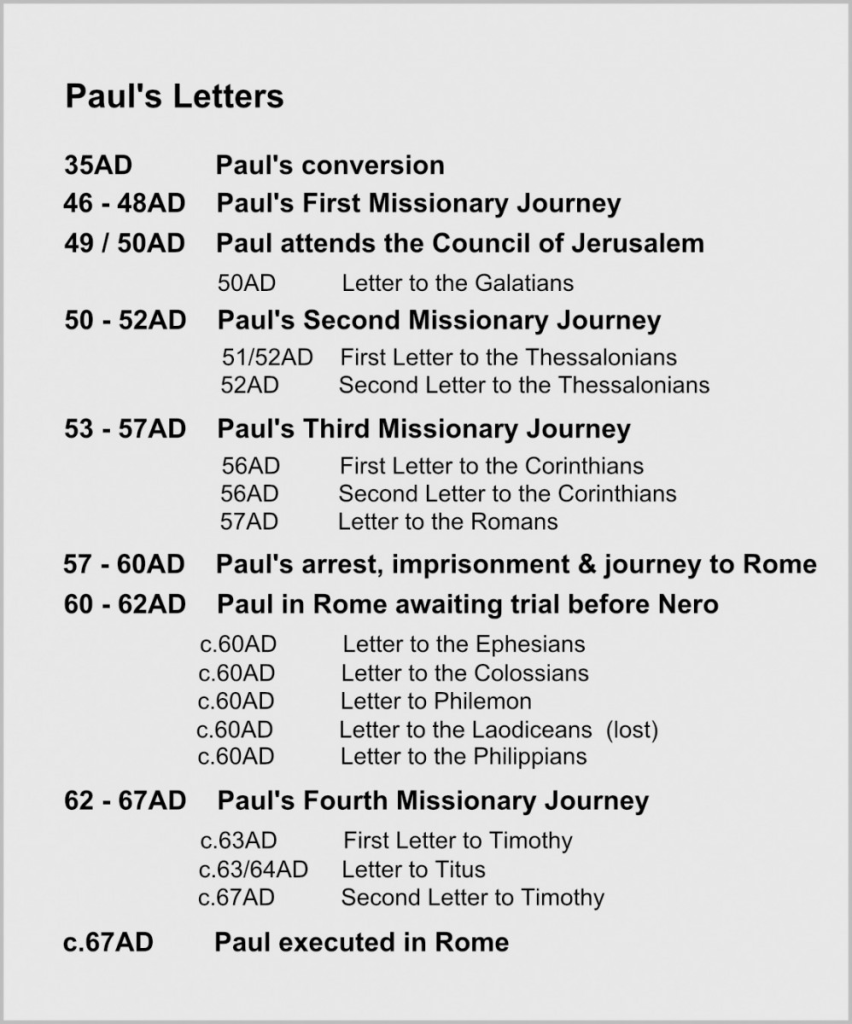
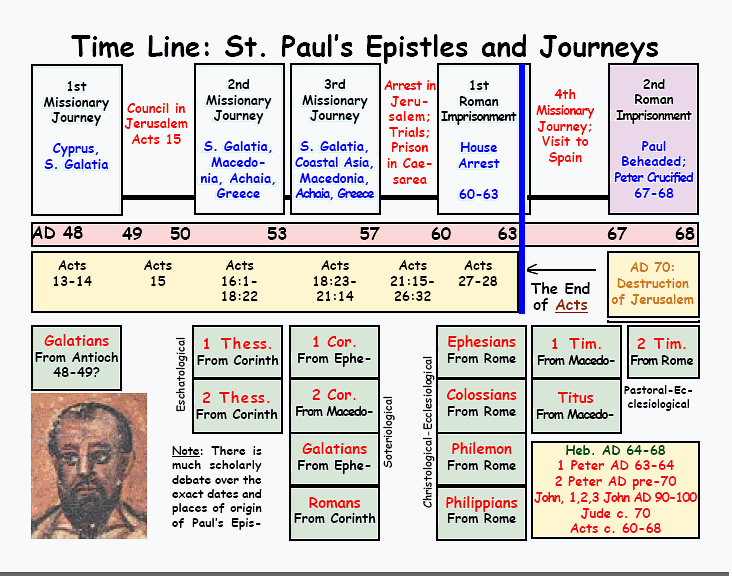
Acts closes with Paul in Rome during those 2 years. He was released, traveled widely over the Roman Empire for 2-3 years, going perhaps as far as Spain, before his last imprisonment and martyrdom. He wrote 1 Timothy from Macedonia (1 Tim 1:3) in 66 AD (on his way to Nicopolis, Tit 3:12) to Timothy who was in Ephesus. He states a desire to visit Timothy (1 Tim 3:14,15;4:13). The style and subject matter are very different, but it would make sense that, as Paul nears death and the end of the miraculous period is nearing, he directs Timothy (and Titus later also) in matters like public prayer, the subjective position of women, qualifications for future elders and deacons, church support of widows, rebuking of elders, and the use of wealth. He also condemns the Law teaching Judaizers, Hymenaeus and Alexander by name (2 Tim 2:17), warns of an apostasy, warns against worldly fables, warns about false teachers who have a morbid interest in controversial questions and disputes about words and constant friction who are preaching for gain (6:3ff), and tells him to guard what was entrusted to him, avoiding arguments of what is falsely called “knowledge” (1 Tim 6:20-21). This last heresy was already developing in Colossians, a Jewish prre-gnostic heresy. He also gives personal encouragement to Timothy in this ministry of teaching and preaching the word, stressing personal purity and faithfulness to his ministry (1 Tim 4:11ff; 6:11ff).
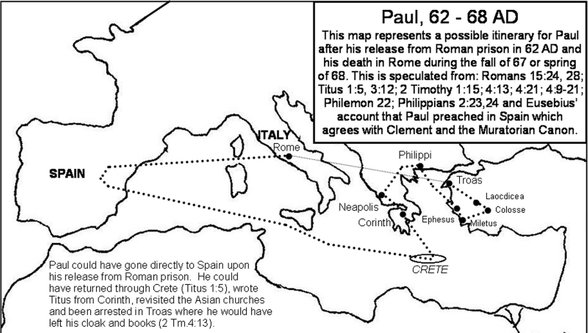
Here is a map of Paul’s last journey after release from Roman house arrest (Acts 28) without showing a visit to Spain (tradition says he did that trip).

Here’s another map that include the possible visit to Spain before he heads to Crete.

There are some good commentaries on 1 Timothy such as: blueletterbible.org is good by David Guzik. This is an intro:
https://www.blueletterbible.org/study/eo/1ti/1ti000.cfm. Then it has studies of each individual chapter.
My goal is to try to examine how each chapter applies to us and to “church” today.
Chapter 1
Warning Against False Teachers 1:3-11
https://www.blueletterbible.org/comm/guzik_david/study-guide/1-timothy/1-timothy-1.cfm by David Guzik
1:3 As I urged you when I was going to Macedonia, remain at Ephesus so that you may charge certain persons not to teach any different doctrine, 4 nor to devote themselves to myths and endless genealogies, which promote speculations rather than the stewardship from God that is by faith.”
The church at Ephesus has quite a history. Paul established the church there in Acts 19 on his 3rd missionary journey (53-57 AD: see the chart above). He stayed 3 years there. After a riot led by Demetrius the silversmith who made idols of the goddess Diana (or Artemis), he left for Macedonia. He returned near Ephesus at Miletus where he called for the elders of the Ephesian church to come. He warned them: Acts 20:28 Pay careful attention to yourselves and to all the flock, in which the Holy Spirit has made you overseers, to care for the church of God, which he obtained with his own blood. 29 I know that after my departure fierce wolves will come in among you, not sparing the flock; 30 and from among your own selves will arise men speaking twisted things, to draw away the disciples after them. 31 Therefore be alert, remembering that for three years I did not cease night or day to admonish every one with tears. 32 And now I commend you to God and to the word of his grace, which is able to build you up and to give you the inheritance among all those who are sanctified.” He wrote the letter to the Ephesians while in 2 years of house arrest (Acts 28) in Rome (60-62 AD), but there is no mention of false teachers in that letter. But it is not surprising, as he warned, that false teachers, even from among the elders, would arise in the church by the time he wrote this letter, 1 Timothy, to Timothy in Ephesus in 63 AD, about 5 years after he established the church there. On his missionary journey after he was released from house arrest in Rome, he passed near or through Ephesus (probably only near Ephesus) and left Timothy there to deal with the false teachers.
It was about this same time, 63 AD, that John the apostle wrote Revelation. In Revelation 2: “To the angel of the church in Ephesus write: ‘The words of him who holds the seven stars in his right hand, who walks among the seven golden lampstands.
2 “‘I know your works, your toil and your patient endurance, and how you cannot bear with those who are evil, but have tested those who call themselves apostles and are not, and found them to be false. 3 I know you are enduring patiently and bearing up for my name’s sake, and you have not grown weary. 4 But I have this against you, that you have abandoned the love you had at first. 5 Remember therefore from where you have fallen; repent, and do the works you did at first. If not, I will come to you and remove your lampstand from its place, unless you repent. 6 Yet this you have: you hate the works of the Nicolaitans, which I also hate. 7 He who has an ear, let him hear what the Spirit says to the churches. To the one who conquers I will grant to eat of the tree of life, which is in the paradise of God.’ John commends the church at Ephesus, led by its elders, for identifying and refuting false apostles there, even the Nicolaitans. The church must have become very rigid about fighting false teachers and maintaining doctrinal purity. The Nicolaitans were a heretical group of Christians in the early church who were known for their immoral and idolatrous practices. John did rebuke the church at Ephesus for leaving their “first love”. We can only wonder if the church at Ephesus heeded John’s warning and returned to their first love. Some say the church died out in the 2nd century, although I have seen no hard proof of that. It is possible today to have a church today that is committed to fighting doctrinal error but one that has lost the love that Jesus wanted his followers to be known for (John 13:34 A new commandment I give to you, that you love one another: just as I have loved you, you also are to love one another. 35 By this all people will know that you are my disciples, if you have love for one another.” I was raised in a church that kinda fits that description. My church was so intent on fighting doctrinal error that it ended up creating its own sectarian legalism, unlovingly judging and condemning any who disagreed with their sectarian teaching.
Guzik: “Perhaps the endless genealogies (1 Timothy 1:4) had to do with Gnostic-type theories of “emanations” from God. Perhaps they were connected with Jewish-type legalism that sought righteousness by virtue of one’s ancestry. Or perhaps he had in mind doctrinal systems based on mystic readings of Old Testament genealogies. Ancient Jewish writings have been discovered which dig into the most complex genealogies, connecting them with wild speculations about spiritual mysteries. A consuming interest in these kinds of things will crowd out godly edification which is in faith.”
Christian history is full of such false doctrines over the past 2,000 years. Church of God of prophecy claims to have traced the the genealogy of the ‘lost 10 tribes” of the northern kingdom of Israel, with Ephraim being Great Britain and Manasseh being the U.S. Mormons add the Book of Mormon to the same authority as the New Testament. Latter-day Saints believe the Book of Mormon to be a record of God’s dealings principally with another group of Israelites he brought to the Western Hemisphere from Jerusalem about 600 b.c. They anticipated the birth and coming of Jesus Christ and believed in his Atonement and gospel. Such false doctrines lead to speculation since none of them can be verified. They distract from “the stewardship of God which is by faith”. Paul spoke of this stewardship (oikonomia: Stewardship, administration, management, dispensation) in Ephesians 3:1 “For this reason I, Paul, a prisoner of Christ Jesus on behalf of you Gentiles— 2 assuming that you have heard of the stewardship of God’s grace that was given to me for you, 3 how the mystery was made known to me by revelation, as I have written briefly.” A person would be appointed to manage the estate or affairs of someone. Paul, by the direct revelation of the Holy Spirit, was made a steward to tell the Gentiles about the mystery (musterion) of the gospel, i.e. uniting Jew and Gentile believers in the one body of the saved, i.e. the church. The other apostles had been led to “all truth” by the Holy Spirit (John 16:13; 14:26). Paul was an apostles of equal authority. The New Testament contains all the truth that we need to not be tossed about by every wind of doctrine. Ephesians 4:13 until we all attain to the unity of the faith and of the knowledge of the Son of God, to mature manhood, to the measure of the stature of the fullness of Christ, 14 so that we may no longer be children, tossed to and fro by the waves and carried about by every wind of doctrine, by human cunning, by craftiness in deceitful schemes.” Beware of any doctrine that is not clearly taught in the New Testament.
1 Timothy 1:5 The aim of our charge is love that issues from a pure heart and a good conscience and a sincere faith. 6 Certain persons, by swerving from these, have wandered away into vain discussion, 7 desiring to be teachers of the law, without understanding either what they are saying or the things about which they make confident assertions.” Those who teach the revealed gospel (whether it is the original apostles and Paul or us today) are charged (paraggelia: Command, instruction, charge) to teach the gospel without changing or adding to it. Those teaching must have pure motives: a pure heart, good conscience, and a sincere faith. The motives of most false teachers are lust, money, sex, and power. The paid preacher system can put preachers on a pedestal that leads them to scandals involving sex or money. The cult leaders are key examples of impure motives of sex, money, and power.
1:8 Now we know that the law is good, if one uses it lawfully, 9 understanding this, that the law is not laid down for the just but for the lawless and disobedient, for the ungodly and sinners, for the unholy and profane, for those who strike their fathers and mothers, for murderers, 10 the sexually immoral, men who practice homosexuality, enslavers, liars, perjurers, and whatever else is contrary to sound doctrine, 11 in accordance with the gospel of the glory of the blessed God with which I have been entrusted.”
“Sound (hugiainó: To be sound, to be healthy, to be well; often used of someone bein in good physical health) doctrine”: in other words, teachings that will promote good spiritual health. Apparently the false teachers in Ephesus taught unhealthy doctrines that promoted the sins listed in these verses. Apparently they tolerated or allowed these sins. Does that sound like many of the liberal Christian denominations today? For example, “homosexuality” is arsenokoites: Homosexual, sodomite: Derived from ἄρσην (arsen, meaning “male”) and κοίτη (koite, meaning “bed” or “lying down”), indicating a male engaging in sexual activity with another male. This is the same word used in 1 Corinthians 6:9 list of sins. Paul was “entrusted” with teaching the gospel but the gospel called for repenting of sins. But what is sin in the eyes of God? People might define sin based on their opinions and emotions, but sin must be defined based of God’s word as given us by, in this passage, Paul. Of course, many liberals say that Paul was not inspired by the Holy Spirit, that he was just giving his homophobic opinions that we don’t have to follow today. But Paul was an inspired apostle. At the same time, almost all would say that Peter was an inspired apostle. But Peter wrote this in 2 Peter 3:15 And count the patience of our Lord as salvation, just as our beloved brother Paul also wrote to you according to the wisdom given him, 16 as he does in all his letters when he speaks in them of these matters. There are some things in them that are hard to understand, which the ignorant and unstable twist to their own destruction, as they do the other Scriptures. 17 You therefore, beloved, knowing this beforehand, take care that you are not carried away with the error of lawless people and lose your own stability. 18 But grow in the grace and knowledge of our Lord and Savior Jesus Christ. To him be the glory both now and to the day of eternity. Amen.” The apostle Peter is saying that Paul’s writings are “scripture” just like the other scriptures (old testament scriptures). The writings of Paul, Peter, John, Matthew, and others would be considered scriptures also. So if you accept Peter as an apostle, and few Christians question that, then you have to accept Paul as an apostle.
Christ Jesus Came to Save Sinners 1:12-20
1:12 I thank him who has given me strength, Christ Jesus our Lord, because he judged me faithful, appointing me to his service, 13 though formerly I was a blasphemer, persecutor, and insolent opponent. But I received mercy because I had acted ignorantly in unbelief, 14 and the grace of our Lord overflowed for me with the faith and love that are in Christ Jesus. 15 The saying is trustworthy and deserving of full acceptance, that Christ Jesus came into the world to save sinners, of whom I am the foremost. 16 But I received mercy for this reason, that in me, as the foremost, Jesus Christ might display his perfect patience as an example to those who were to believe in him for eternal life. 17 To the King of the ages, immortal, invisible, the only God, be honor and glory forever and ever. Amen.”
In this section Paul seems to be telling how and why he was entrusted with the gospel even though he was formerly a “blasphemer, persecutor, and insolent opponent (hubristés: Insolent, violent, arrogant, one who behaves with wanton violence or outrage)”. Paul began persecuting Christians in Acts 7:58 Then they cast him out of the city and stoned him. And the witnesses laid down their garments at the feet of a young man named Saul. Then some time later, Acts 9:1 And there arose on that day a great persecution against the church in Jerusalem, and they were all scattered throughout the regions of Judea and Samaria, except the apostles. 2 Devout men buried Stephen and made great lamentation over him. 3 But Saul was ravaging the church, and entering house after house, he dragged off men and women and committed them to prison. Acts 9:1 But Saul, still breathing threats and murder against the disciples of the Lord, went to the high priest 2 and asked him for letters to the synagogues at Damascus, so that if he found any belonging to the Way, men or women, he might bring them bound to Jerusalem.” He told Agrippa in Acts 26:9 “I myself was convinced that I ought to do many things in opposing the name of Jesus of Nazareth. 10 And I did so in Jerusalem. I not only locked up many of the saints in prison after receiving authority from the chief priests, but when they were put to death I cast my vote against them. 11 And I punished them often in all the synagogues and tried to make them blaspheme, and in raging fury against them I persecuted them even to foreign cities. Acts 22:4 I persecuted this Way to the death, binding and delivering to prison both men and women. It was on his way to Damascus that the resurrected Jesus appeared to him. He became a believer in Jesus, was baptized by Ananias in Damascus (Acts 22:16 And now why do you wait? Rise and be baptized and wash away your sins, calling on his name), and began his ministry to preach the gospel to the Gentiles. He returned to Jerusalem but Jesus appeared to him again, telling him to get out of Jerusalem b/c the Jews there would not listen to his preaching. Acts 22: 19 And I said, ‘Lord, they themselves know that in one synagogue after another I imprisoned and beat those who believed in you. 20 And when the blood of Stephen your witness was being shed, I myself was standing by and approving and watching over the garments of those who killed him.’ 21 And he said to me, ‘Go, for I will send you far away to the Gentiles.’” Galatians 1:13 For you have heard of my former life in Judaism, how I persecuted the church of God violently and tried to destroy it.”
But Paul received mercy b/c he acted “ignorantly in unbelief”. He thought that the Jewish Christians were blasphemers b/c Jesus claimed to be equal with God (John 5:18 This was why the Jews were seeking all the more to kill him, because not only was he breaking the Sabbath, but he was even calling God his own Father, making himself equal with God.) He sincerely thought that he was doing what God waned him to do by killing Christians. He became a mass murderer and torturer of Christians, entering homes to find Jewish Christians to beat them. But in 1 Timothy 1:14 the grace of our Lord overflowed for me with the faith and love that are in Christ Jesus.” All his past sins were “washed away” when he was baptized (Acts 22:16).
Baptism alone does not save, but it is part of saving faith. It is an act of faith; it is not a work that one does to earn salvation. We believe the gospel, confess Jesus to be the Son of God, repent of our sins, but it is in baptism that our sins are washed away. Saul (Paul) was not saved on the road to Damascus when he saw Jesus. He was saved when he was baptized. This is what Jesus, after he was raised from the dead, told the apostles in Mark 16:15 And he said to them, “Go into all the world and proclaim the gospel to the whole creation. 16 Whoever believes and is baptized will be saved, but whoever does not believe will be condemned.” Peter told those asking “what must we do to be saved”, Acts 2:38 And Peter said to them, “Repent and be baptized every one of you in the name of Jesus Christ for the forgiveness of your sins, and you will receive the gift of the Holy Spirit.” Forgiveness of sins comes after baptism, not before (as some teach). It is an act of faith: Colossians 2:12 having been buried with him in baptism, in which you were also raised with him through faith in the powerful working of God, who raised him from the dead. 13 And you, who were dead in your trespasses and the uncircumcision of your flesh, God made alive together with him, having forgiven us all our trespasses”. Baptism is the moment of being raised from being spiritually dead (also raised up from the water) to walk in newness of life. Romans 6:3 Do you not know that all of us who have been baptized into Christ Jesus were baptized into his death? 4 We were buried therefore with him by baptism into death, in order that, just as Christ was raised from the dead by the glory of the Father, we too might walk in newness of life.”
Some think that we are teaching a works salvation when we teach that one is not saved till they are baptized, but we are not. We are just saying that the Scriptures teach that baptism is an essential part of saving faith, just like repentance and confess. Peter is the apostle who taught that forgiveness comes after baptism (Acts 2:38 above). Later in one of Peter’s letters Peter even used the phrasse, “baptism now saves you”. 1 Peter 3:18 For Christ also suffered once for sins, the righteous for the unrighteous, that he might bring us to God, being put to death in the flesh but made alive in the spirit, 19 in which he went and proclaimed to the spirits in prison, 20 because they formerly did not obey, when God’s patience waited in the days of Noah, while the ark was being prepared, in which a few, that is, eight persons, were brought safely through water. 21 Baptism, which corresponds to this, now saves you, not as a removal of dirt from the body but as an appeal to God for a good conscience, through the resurrection of Jesus Christ, 22 who has gone into heaven and is at the right hand of God, with angels, authorities, and powers having been subjected to him.” Was Peter teaching baptism only saves? No, but he was teaching that it is at baptism that one is saved by water, just as Noah and his family were saved by water from the sinful society that surrounded them. I’v heard many preachers say, “baptism doesn’t save”, but Peter plainly said “baptism now saves you”. In context, we understand why Peter could say that. I always compare baptism to Namaan’s dipping in the Jordan River 7 times to be healed of leprosy. That was what Elisha the prophet had told him to do, and he was reluctant at first. He did go dip 7 times and was healed of his leprosy. Was it the water that healed him? No. Was it the number of times he dipped? No. Could Elijah have just healed him without the dipping in water? Yes, but he didn’t. But the fact remains, he was healed after he obeyed in faith the command to be dipped 7 times in the Jordan River. I think baptism is an act of faith similar to the story of Namaan.
Please remember that baptism in the name of Jesus (also in the name of the Father, Son, and Holy Spirit) was only a command for salvation for those living after the death of Jesus. It was a new covenant command. That’s why the thief on. the cross could be saved while on his cross without being baptized. Someone will say, “what if someone is on his way to be baptized and falls dead before he gets to the water?” That doesn’t change what the scriptures teach about baptism and salvation. I do feel, however, that God is a gracious God so I will leave that person’s salvation up to God. What if a person is sprinkled instead of immersed? The Greek word for baptism is baptizó: To baptize, to immerse, to dip. I know I would want to do exactly what Jesus said, to be immersed. Namaan was told to “dip in the Jordan River”, not to just pour some water on his head. Again, though, I will leave to God the salvation of a person who is sprinkled with water instead of immersed. Mother Teresa, being a Cathholic, ws probably sprinkled as a child instead of adult believer immersion, but I would hope that would not keep her out of heaven! If she doesn’t make it, how can I? What if a person does the “sinner’s prayer”, asking Jesus to come into his heart and save him before baptism, later to be baptized as an outward sign showing that he was saved? Again, surely God would still saved that person even if that isn’t exactly the way it was done in the book of Acts. As you can tell, I am pretty convicted that the scriptures teach that baptism is essential to salvation, but I am pretty tolerant of those who don’t understand baptism the way I do.
Back to 1 Timothy1:12-17. Paul said that the grace and mercy that saved him, the “chief of sinners b/c of his killing Christians, confirmed the saying: 15 The saying is trustworthy and deserving of full acceptance, that Christ Jesus came into the world to save sinners, of whom I am the foremost.” If God’s grace could saved Paul in spite of his sins, then God’s grace can save anyone. Paul said that his salvation was “an example” for others for all time. John Newton was a slave trader, but was saved.
Paul closes chapter 1 with 18 This charge I entrust to you, Timothy, my child, in accordance with the prophecies previously made about you, that by them you may wage the good warfare, 19 holding faith and a good conscience. By rejecting this, some have made shipwreck of their faith, 20 among whom are Hymenaeus and Alexander, whom I have handed over to Satan that they may learn not to blaspheme.
Apparently some prophet had predicted that Timothy would be an evangelist, preaching the gospel. Paul told him to have that “sincere faith and good conscience” that he mentioned in 1:5. We don’t know the exact sins of Hymenaeus and Alexander except that it was bad enough for Paul to hand them over to Satan, i.e. to withdraw fellowship from them as heretics. 2 Tim 2:17 does mention a Hymenaeus who was teaching that the resurrection of the dead had already happened, so that might be the same Hymenaeus here in 1 Timothy 1, and that might be his heretical sin.
Again, I encourage you to study this chapter using the blueletterbible.org site by David Guzak. I encourage you to be saved just as Paul was in order to receive the grace of God no matter how sinful you have been. I encourage you, as part of your saving faith, to be baptized (immersed) in water for the forgiveness of sins just as Paul was (Acts 22:16). I hope you would study the subject of baptism in the new testament if need be to get your own conviction of what baptism should be.
Thanks for reading.
 Nicky's Notes