

Titus was a prominent figure in the early church. He traveled with Paul from Antioch to Jerusalem for the Jerusalem Council (see Acts 15 and Galatians 2). Paul did not have Titus circumcised as he did Timothy since Titus was Greek. In Galatians 2 Paul said that he took Titus to Jerusalem for the debate over whether Gentile Christians had to be circumcised or not. He used Titus as a “test case” for his argument against Gentile Christians having to be circumcised. Titus worked with Paul in Ephesus during his third missionary journey and may have delivered a letter to the Corinthian church from Paul (2 Corinthians 2:12–13).
Titus 1:5 For this reason I left you in Crete, that you would set in order what remains (leipó: To leave, to forsake, to lack) and appoint elders in every city as I directed you.” Some say that Paul established the church in Crete on his 4th journey when he left Titus there, but it says that Titus was to set in order what remains. So the church must have been in Crete for a while before Paul left Titus in Crete. Also there were Judaizer false teachers there. 10 For there are many rebellious people, empty talkers and deceivers, especially those of the circumcision, 11 who must be silenced because they are upsetting whole families, teaching things they should not teach for the sake of dishonest gain.” That sounds like already existing church families were being upset. I don’t think Paul established the church in Crete or else he would have appointed elders already, and yet he told Titus to appoint elders so apparently they didn’t have elders. It just appears that the church had been in Crete for some time, long enough to be down to “what remains” of the original church. Cretans were present on the Day of Pentecost in 30 AD (Acts 2:1 both Jews and proselytes, Cretans and Arabians—we hear them telling in our own tongues the mighty works of God.”). No doubt some Cretans were baptized among the 3,000 baptized and they would have gone back to Crete and established the church there.
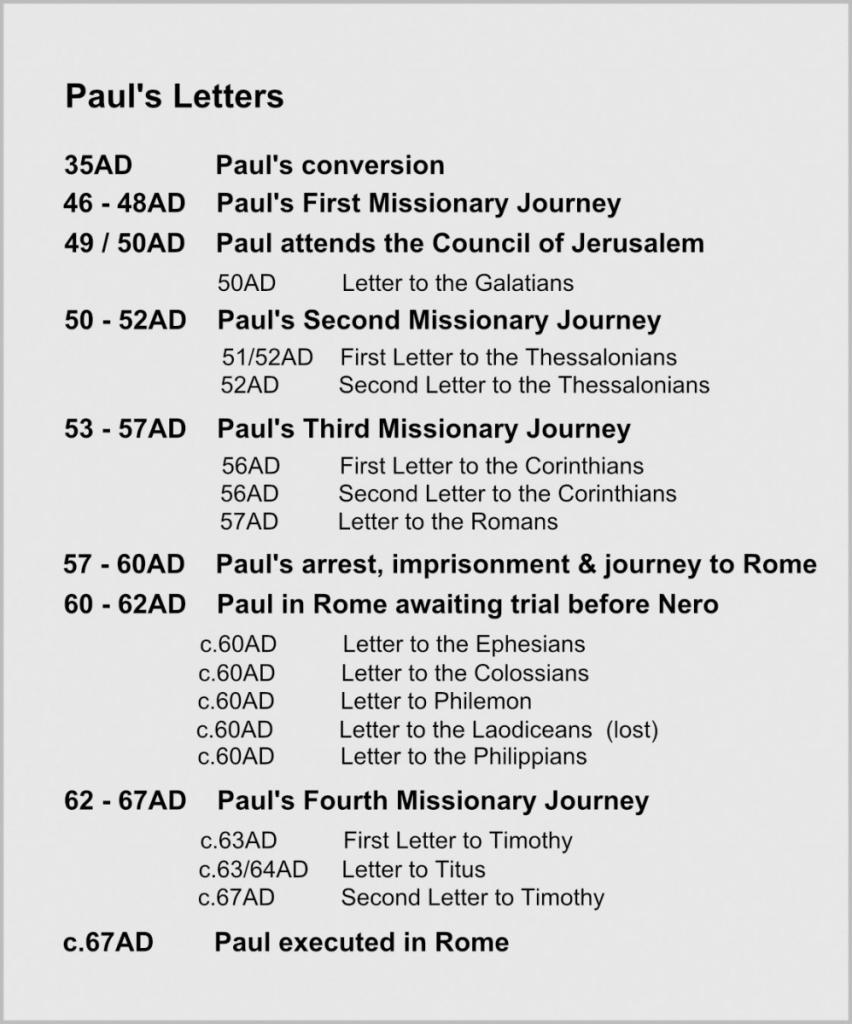
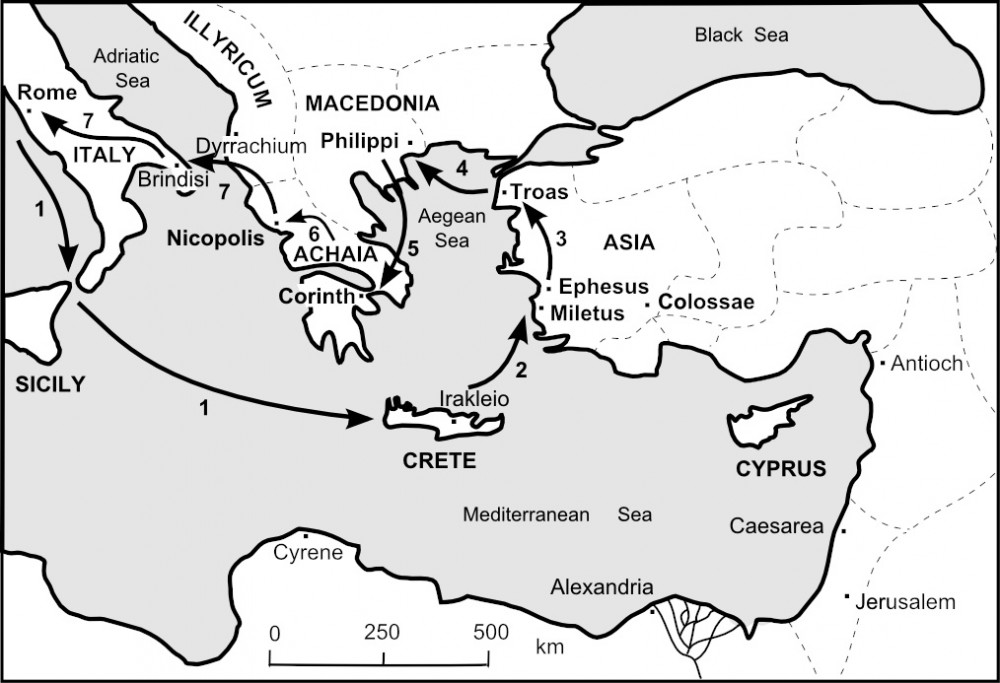
Paul wrote Titus from Macedonia or Ephesus to Titus in Crete (2 Tim 1:5), probably 66 AD. Paul had visited Crete with Titus on his “4th missionary journey (see charts above) and left him there, having seen firsthand the problems. When he wrote the letter to Titus, Paul was on his way to Nicopolis, in Achaia, to spend the winter (3:12), but apparently was arrested in Nicopolis and sent to Rome for his final imprisonment and martydom. He hoped to sent Tychicus to Crete (3:12). He tells them to help Zenas the lawyer and Apollos on their way, so they would be coming to Crete. Just as 1 Timothy, Paul deals with issues of sound doctrine and church order. He tells Titus to “set in order” (1:5) what remains of a church now several years old as his death and the end of the miraculous period approaches, to appoint elders in every “city” with emphasis on men who are able to “exhort in sound doctrine and refute those who contradict”, warns against the Judaizers who preach for money and are “upsetting whole families”, and warns against foolish controversies and disputes about the Law (3:9-10), even rejecting a factious man after 2 warnings. His “sound doctrine” deals not only with heretical teachings, but with healthy (“sound”) Christian living of older men, older women, young women, young men, and slaves, urging all to engage in good deeds b/c of the great saving kindness, love, and grace given them through Jesus Christ. Titus was to teach these things and to reprove with all authority, letting no one disregard him (2:15).
The theme of the letter to Titus is “sound doctrine”. There are two parts to the sound doctrine.
Firstly, the core central truths of the gospel is part of the sound doctrine. One of the main qualifications for the elders that Titus was to appoint in every city: Titus 1:9 holding firmly the faithful word which is in accordance with the teaching, so that he will be able both to exhort in sound (hugiainó: To be sound, to be healthy, to be well) doctrine and to refute those who contradict it.” Sound doctrine is teaching that will make believers healthy in their faith. What were the false teachers teaching? 10 For there are many rebellious people, empty talkers and deceivers, especially those of the circumcision, 11 who must be silenced because they are upsetting whole families, teaching things they should not teach for the sake of dishonest gain. 12 One of them, a prophet of their own, said, “Cretans are always liars, evil beasts, lazy gluttons.” 13 This testimony is true. For this reason reprimand them severely so that they may be sound in the faith, 14 not paying attention to Jewish myths and commandments of men who turn away from the truth. 15 To the pure, all things are pure; but to those who are defiled and unbelieving, nothing is pure, but both their mind and their conscience are defiled. 16 They profess to know God, but by their deeds they deny Him, being detestable and disobedient and worthless for any good deed.” The “especially those of the circumcision” and “Jewish myths” tells us it is the Judaizers who were trying to make Gentile Christians be circumcised and keep the Law. Also they were teaching for money. Titus was to “reprimand them severely”. The elders appointed were “to refute those who contradict it (i.e. sound doctrine). These false teachers were worthless, detestable, disobedient liars. They were bad! The rest of the qualifications for the elders to be appointed by Titus were similar to those in 1 Timothy 3. Titus 1:6 namely, if any man is beyond reproach, the husband of one wife, having children who believe, not accused of indecent behavior or rebellion. 7 For the overseer must be beyond reproach as God’s steward, not self-willed, not quick-tempered, not overindulging in wine, not a bully, not greedy for money, 8 but hospitable, loving what is good, self-controlled, righteous, holy, disciplined”.
Secondly, there is a practical part of sound doctrine. Paul discusses that in Titus 2. Sound doctrine is not just a list of intellectual doctrines to be believed. It includes how Christians should live and act. Paul gives sound doctrine instructions (Titus 2:1 But as for you, proclaim the things which are fitting for sound doctrine) for older men, older women, young men, young women, and slaves.
Titus 2: 2 Older men are to be temperate, dignified, self-controlled, sound in faith, in love, in perseverance.”
3 Older women likewise are to be reverent in their behavior, not malicious gossips nor enslaved to much wine, teaching what is good, 4 so that they may encourage the young women to love their husbands, to love their children, 5 to be sensible, pure, workers at home, kind, being subject to their own husbands, so that the word of God will not be dishonored.” Of note here is “workers at home”. When I was young, preachers preached against Christian women working outside the home. Paul always tell women to be subject to their husbands.
6 Likewise urge the young men to be sensible; 7 in all things show yourself to be an example of good deeds, with purity in doctrine, dignified, 8 sound in speech which is beyond reproach, so that the opponent will be put to shame, having nothing bad to say about us.”
9 Urge slaves to be subject to their own masters in everything, to be pleasing, not argumentative, 10 not stealing, but showing all good faith so that they will adorn the doctrine of God our Savior in every respect.” Many Christians were slaves in the early church, so this was needed instructions. Paul always gave similar instructions to slaves.
Paul then gives the reason that such godly living is needed by all of these groups of Christians. Titus 2:11 For the grace of God has appeared, bringing salvation to all people, 12 instructing us to deny ungodliness and worldly desires and to live sensibly, righteously, and in a godly manner in the present age, 13 looking for the blessed hope and the appearing of the glory of our great God and Savior, Christ Jesus, 14 who gave Himself for us to redeem us from every lawless deed, and to purify for Himself a people for His own possession, eager for good deeds. 15 These things speak and exhort, and rebuke with all authority. No one is to disregard you.“
The saving grace of God instructed Christians to “deny ungodliness and worldly desires and to live sensibly, righteously, and in a godly manner in the present age”. Jesus gave Himself for us to “redeem us from every lawless deed and to purify for Himself a people eager for good deeds”. These verses sum up how Christians should live. You have the “don’t do’s”: deny ungodliness and worldly desires” and “redeem us from every lawless deed”, and the “do’s”: live righteously, sensibly, and in a godly manner” and “eager for good deeds”. Doesn’t that about sum it all up! We are saved 100% by the grace of god through faith in Jesus, we can’t earn it. But these verses tell what is expected of those saved by grace. No believer will do these things perfectly and the grace of God will continue to save us even when we sin (as long as we don’t fall from grace), but we must try to do these things.
3:1 is linked to 2:15 These things speak and exhort, and rebuke with all authority. No one is to disregard you.” Then he adds: 3:1 Remind them to be subject to rulers, to authorities, to be obedient, to be ready for every good deed, 2 to slander no one, not to be contentious, to be gentle, showing every consideration for all people. 3 For we too were once foolish, disobedient, deceived, enslaved to various lusts and pleasures, spending our life in malice and envy, hateful, hating one another. 4 But when the kindness of God our Savior and His love for mankind appeared, 5 He saved us, not on the basis of deeds which we did in righteousness, but in accordance with His mercy, by the washing of regeneration and renewing by the Holy Spirit, 6 whom He richly poured out upon us through Jesus Christ our Savior, 7 so that being justified by His grace we would be made heirs according to the hope of eternal life. 8 This statement is trustworthy.”
3:1-2 is a basic list of things that every Christian should do out of gratitude for the grace of God that saves us. “Showing every consideration (prautés: Gentleness, meekness; usually translated “gentleness”, even “humility”)for all people”. Christians might tend to look down on non-Christians, but Paul says “remember that you too were just like they are, and it was only b/c of the kindness of God and His love and grace that you are saved, not on the basis of your deeds or works.” So show “consideration” or kindness or mercy to “all people”, including all the sinners around you. Be “humble” and not self righteous. Be “gentle” if they oppose you. 2 Timothy 2:25 with gentleness correcting those who are in opposition, if perhaps God may grant them repentance leading to the knowledge of the truth.”
“This statement is a trustworthy saying”. I assume that statement is all of vs 4-7. Here they are:
- Christ Came to Save Sinners – 1 Timothy 1:12-17 “Here is a trustworthy saying that deserves full acceptance: Christ Jesus came into the world to save sinners—of whom I am the worst.”
- A Noble Task – 1 Timothy 3:1-7 “Here is a trustworthy saying: Whoever aspires to be an overseer desires a noble task.”
- The Value of Godliness – 1 Timothy 4:8-10 “For physical training is of some value, but godliness has value for all things, holding promise for both the present life and the life to come. 9 This is a trustworthy saying that deserves full acceptance.”
- He Remains Faithful – 2 Timothy 2:11-13 “Here is a trustworthy saying: If we died with him, we will also live with him; if we endure, we will also reign with him. If we disown him, he will also disown us; if we are faithless, he remains faithful, for he cannot disown himself.”
- Saved by Grace. Now What? – Titus 3:1-8 “But when the kindness and love of God our Savior appeared, he saved us, not because of righteous things we had done, but because of his mercy. He saved us through the washing of rebirth and renewal by the Holy Spirit, whom he poured out on us generously through Jesus Christ our Savior, so that, having been justified by his grace, we might become heirs having the hope of eternal life. This is a trustworthy saying.”
Paul then adds: 3:8 and concerning these things I want you to speak confidently, so that those who have believed God will be careful to engage in good deeds. These things are good and beneficial for people. 9 But avoid foolish controversies and genealogies and strife and disputes about the Law, for they are useless and worthless. 10 Reject a divisive person after a first and second warning, 11 knowing that such a person has deviated from what is right and is sinning, being self-condemned. Avoid those Judaizer myths, disputes about the Law. If a false teacher continues to divide the flock with their teachings, then reject them after 2 warnings. Romans 16:17 – Now I urge you, brothers and sisters, keep your eye on those who cause dissensions and hindrances contrary to the teaching which you learned… ” Some characteristics of a divisive person: Starting arguments. Spreading gossip. Creating cliques. Creating fear. Carrying grudges. Backstabbing. Deliberately undermining those in authority. Pitting one person off against another. Lying. Setting up rules in order to create social barriers. Being a racist or sexist or elitist. Giving orders and demanding obedience. Using principles (or even ‘righteous’ anger) as an excuse to cut off contact. The church has always been filled with “divisive persons”. The church at Corinth divided over favoritism toward different ministers who had worked with the church. 1 Corinthians 1:10 I appeal to you, brothers and sisters, in the name of our Lord Jesus Christ, that all of you agree with one another in what you say and that there be no divisions among you, but that you be perfectly united in mind and thought. 11 My brothers and sisters, some from Chloe’s household have informed me that there are quarrels among you. 12 What I mean is this: One of you says, “I follow Paul”; another, “I follow Apollos”; another, “I follow Cephas”; still another, “I follow Christ.” 13 Is Christ divided? Was Paul crucified for you? Were you baptized in the name of Paul? 14 I thank God that I did not baptize any of you except Crispus and Gaius, 15 so no one can say that you were baptized in my name. 16 (Yes, I also baptized the household of Stephanas; beyond that, I don’t remember if I baptized anyone else.) 17 For Christ did not send me to baptize, but to preach the gospel—not with wisdom and eloquence, lest the cross of Christ be emptied of its power.”
I was raised in a denomination that was filled with divisive persons and division. I think that, for the most part, the divisive persons sincerely thought they were simply refuting false teachers just like Paul told Titus to do, although probably many were carried away by the desire for power, to control, and pride. They operated under the belief that we had to get every doctrine right, and we had to rebuke and withdraw from everyone who disagreed. The problem was that they operated without the trustworthy statement in Titus 3. We are saved by grace. No one understands every single doctrine correctly. Grace must save us even if we don’t understand every doctrine correctly. Most doctrines that we disagree on are not heaven or hell issues. We must extend grace to others on such doctrines, just as God extends grace to us when we don’t understand every doctrine correctly. Divisive persons in the church constantly debate issues, making all kinds of points for their beliefs. For example, having kitchens in the church building. The divisive person says that we can only do things in the church specifically authorized in the New Testament by command, approved example, or necessary inference (CENI). Now, I can counter with my arguments that CENI is not a correct way to interpret scripture. But before I get into a debate with that person, I challenge them: “is this a heaven/hell issue? Will the grace of God save both of us even if we disagree? Should the church split over this issue? Is everyone who disagrees with you going to hell?” If I can’t get someone to see the grace of God that would allow us to agree to disagree on this issue, then it is futile to debate the issue with that person.
By the same token, my denomination probably created division among churches at large. We taught that a church is not the “one true church” if it did not have the right name, the right form of governance, the right baptism, the right worship (without instruments; the “5 acts of worship”), etc. We condemned the division among the many denominations and appealed to them to come be the one true church with us. Yet these denominations, for the most part, agreed with us on the basics: salvation by grace through faith in Jesus’ sacrificial death, the Deity of Jesus, the necessity of baptism (though interpreted differently), the godly obedience of those saved in all areas of their lives, the mission of the church to preach the gospel to the world, etc. We disagreed over instrumental music, how often to take the Lord’s Supper, the name of the church, etc. But even if we were right on those doctrines, those are not heaven/hell doctrines to be divided over. But we were the ones actually causing division in the church at large b/c we made those doctrines to be heaven/hell. If we had not done that, we would have said that all denominations were part of the one body even if they differed in a lot of ways.
I remember when I was young the preacher quoting Galatians 1 to condemned denominations. 1:6 I am amazed that you are so quickly deserting Him who called you by the grace of Christ, for a different gospel,7 which is not just another account; but there are some who are disturbing you and want to distort the gospel of Christ.8 But even if we, or an angel from heaven, should preach to you a gospel contrary to what we have preached to you, he is to be accursed! 9 As we have said before, even now I say again: if anyone is preaching to you a gospel contrary to what you received, he is to be accursed!” The preacher was saying that the denominations were preaching a distorted gospel when they, for example, said instrumental music was not a sin and not a heaven/hell issue to be divided over. But look at the context of Galatians. Those who were preaching a different, distorted gospel were the Judaizers who were trying to force Gentile believers to be circumcised. Paul said, “that is not a heaven or hell issue (6:15 For neither is circumcision anything, nor uncircumcision, but a new creation), but if you make it so and divided the church over that issue, then you are the divisive persons preaching a distorted gospel. In other words, anyone who divides the church over issues that are not heaven/hell is condemned by Paul in Galatians. Yet that is what we were doing in my church, making instrumental music a heaven/hell issue when it is not (in my opinion). We accused the denominations of preaching a distorted gospel when it was really we who were preaching a distorted gospel. I’m thankful that many of our churches have grown past these mistakes and now preach grace and fellowship believers in all denominations.
Yes, there are some heaven/hell doctrines that we must refute, even divide over, such as the Deity of Jesus, salvation by grace through faith in Jesus’ death, the necessity of love, the necessity of obedience in the moral commands (not practicing sin). But there are very few. The LGBQT is a heaven/hell issue. It has caused division in many churches such as recently with the Methodist Church. Also we can’t fellowship with groups like the Jehovah’s Witnesses and Christian Science who deny the Deity of Jesus. But we must be very careful when we make any issue a heaven/hell issue and divide the church over it. My philosophy is this: If the New Testament does not specifically say that an issue is a heaven/hell issue, then don’t make it one. “Specifically” means book, chapter, verse that says the issue is absolutely essential for salvation. Not a verse that teaches the correctness of the issue but a verse that says that the issue is a heaven/hell issue.
Paul closes the letter to Titus with personal concerns. Titus 3:12 When I send Artemas or Tychicus to you, make every effort to come to me at Nicopolis, for I have decided to spend the winter there. 13 Diligently help Zenas the lawyer and Apollos on their way so that nothing is lacking for them. 14 Our people must also learn to engage in good deeds to meet pressing needs, so that they will not be unproductive. 15 All who are with me greet you. Greet those who love us in the faith. Grace be with you all.” Tychicus probably delivered the letter to Titus. He probably wrote the letter while in Macedonia. He planned to spend the winter at Nicopolis (find it on the map above; not sure why he was headed there), but probably was arrested before he was able to do that. He probably spent his last winter in prison in Rome awaiting his beheading from Nero. He wrote 2 Timothy during that last winter in prison. He was cold and told Timothy to come bring him a coat! I. 2 Timothy 4:13 When you come, bring the overcoat which I left at Troas with Carpus, and the books, especially the parchments.” It was common practice to help ministers and messengers with food and a place to stay as they traveled among the churches (thus help Zenas and Apollos). “Engage in good deeds” again (2:7,13; 3:1), so that must be important for Paul to keep repeating that. We are not saved by our good deeds (3:5) but we must do good deeds or works if we are saved and if we want to continue to be saved. We are justified by grace not works (3:7), but that doesn’t mean we don’t have to do works as a condition of continued justification. James 2:24 You see that a person is justified by works and not by faith alone.” “Engage in good deeds to meet pressing (anagkaios: Necessary, needful, indispensable).needs”. Helping Zenas and Apollos with their needs was a pressing need. The early church only took up collections for pressing needs such as helping widows and orphans. Justin Martyr 150 AD in First Apology described the collection of money in the Sunday assemblies: “Those who have means and are willing, each according to his own choice, gives what he wills, and what is collected is deposited with the president. He provides for the orphans and widows, those who are in need on account of sickness or some other cause, those who are in bonds, strangers who are sojourning, and in a word he becomes the protector of all who are in need.” Google his full description of a 2nd century assembly. Of course, they did not have church buildings, utility bills, paid preacher payrolls, insurance on the building and church vehicles as part of their “pressing needs”. 70-80% of money collected by churches today goes to those things and not the needs mentioned by Justin Martyr. How did we get to where we are today in the “church business” system????????
“Engage in good deeds to meet pressing needs that they won’t be unproductive (unfruitful).” Luke 8:14 And the seed which fell among the thorns, these are the ones who have heard, and as they go on their way they are choked by worries, riches, and pleasures of this life, and they bring no fruit to maturity.” John 15:6 If anyone does not remain in Me, he is thrown away like a branch and dries up; and they gather them and throw them into the fire, and they are burned.”
As Paul said, “Grace be with you all”.
 Nicky's Notes