
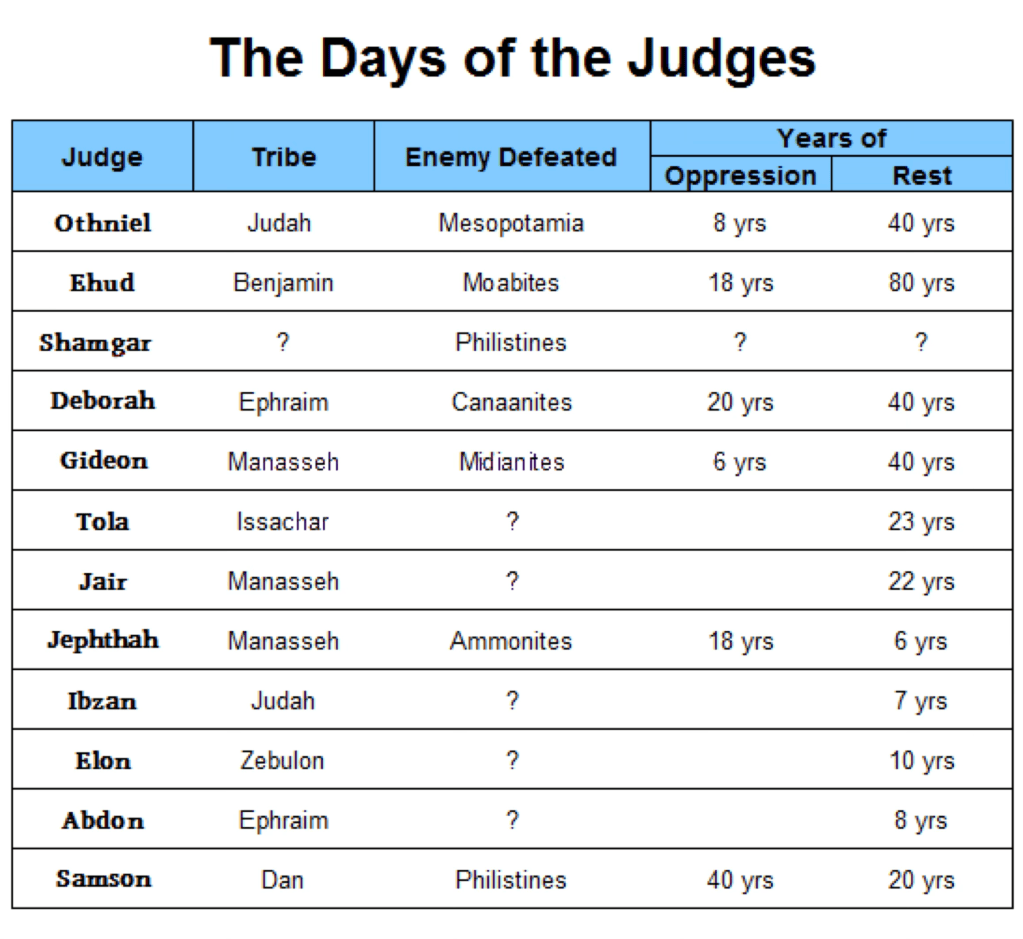
JUGES 10-12: Judge #6 Tola judged 23 years. Judge #7 Jair judged 22 years and is known for having 30 sons who rode 30 donkeys and controlled 30 cities in Gilead. Almost 3 chapters are devoted to Judge #8 Jephthah. An AI summary might help b/c it is a little confusing: “Jephthah was the son of Gilead and a prostitute. His half-brothers drove him away from his homeland to keep him from taking any family inheritance. Jephthah fled to the land of Tob and gathered a group of rough followers. Later, when the Ammonites launched a war against Israel, the elders of Gilead panicked and begged Jephthah to return and lead their army. Jephthah agreed to lead them on the condition that he would become the permanent ruler over the region of Gilead if he won. Jephthah sent messengers to the king of Ammon to ask why he was attacking. The king claimed Israel had stolen his ancestors’ land after leaving Egypt. Jephthah replied with historical accuracy. He pointed out that Israel had lived on the land for 300 years and that God had given them the territory after defeating the Amorites. The king ignored his message and prepared for battle. Empowered by the Spirit of the Lord, Jephthah marched out to fight. Before the battle, he made a foolish vow to God: if God gave him victory, he would sacrifice as a burnt offering whatever came out of his house first to meet him when he returned home safely. Israel won a major victory. However, when Jephthah returned to his home in Mizpah, his only child—his daughter—came out to meet him with music and dancing. Overcome with grief, Jephthah tore his clothes. His daughter bravely agreed that he must keep his word to the Lord, asking only for two months to mourn her virginity in the mountains. After the two months, the text states he carried out his vow (though some scholars interpret the outcome as a lifetime of dedicated virginity/seclusion rather than physical sacrifice). God never endorsed human sacrifice, and the story serves as a dark warning about impulsive promises. The men of Ephraim grew angry that Jephthah did not call them to help in the initial battle, so they threatened him and his house. A civil war broke out, and Gilead defeated Ephraim. The Gileadites guarded the Jordan River crossings, making fleeing Ephraimites say the word “shibboleth”. Because the Ephraimites pronounced it “sibboleth,” 42,000 of them were identified and killed. Jephthah judged Israel for six years before he died and was buried in Gilead.”
I hope that helped. I’m not sure what the life lesson is on Jephthah. Maybe you had a rough flight on a plane and told God “God, if you get me safely on the ground I’ll never fly again!” (LOL) Maybe you made a rash vow at some time in your life and now you have to keep it. Here’s a real story. A severe bolt of lightning struck close to Martin Luther as he was walking, knocking him to the ground. Fearing for his life, he cried out to his family’s patron saint, saying, “Help me, St. Anne, and I will become a monk”. Luther survived the storm, kept his solemn promise, and entered the Augustinian Monastery in Erfurt just two weeks later. His father, Hans Luther, was furious because he had invested heavily in Martin’s legal education to become a lawyer. Luther later became an ordained priest after entering the monastic life, celebrating his first mass in 1507, but the immediate vow made during the storm was specifically to become a monk.” The rest is history as he sent on to lead the Protestant Reformation. Did God send that bolt of lightning? Then there is John Newton. While sailing home to England, a ferocious North Atlantic storm battered the ship, washing crew members overboard and threatening to sink the vessel. Exhausted from pumping water and steering the ship, Newton cried out, “If this will not do, the Lord have mercy upon us!”—surprising himself with a sudden, desperate plea for divine mercy after years of mocking his mother’s Christian faith. He survived the storm and began reading the New Testament, viewing his deliverance as a sign of God’s grace. He commemorated the anniversary of the storm for the rest of his life with prayer and fasting. His conversion was a gradual awakening rather than an instant moral perfection. Newton continued working in the slave trade for several years after the storm, eventually becoming a slave ship captain before suffering a stroke that ended his seafaring career.” The slave trader became an evangelist and later an abolitionist (thought strangely not right after the incident). Did God send that storm? Maybe there is some parallel between those two stories and the story of Jephthah.
Judge #9 Ibzan judged 7 years and had 30 sons and 30 daughters. Judge #10 Elon judged 10 years. Judge #11 Abdon judged 8 years and had 40 sons and 30 grandsons who rode on 70 donkeys.
Judges 13-16: Judge #13 Samson judged 20 years and is the most “colorful” judge. His life is filled with several exploits with Philistine women even though he took the Nazarite vow and never cut his hair. There were probably more, but Judges records 3 specific instances where he got in trouble with his women.
According to the Book of Judges, Samson’s narrative features three distinct relationships, all involving Philistine women:
- The woman from Timnah: Samson’s first major romance. He demanded to marry this unnamed Philistine woman against his parents’ wishes, and Samson told his riddle at the marriage feast. The marriage ended in tragedy and betrayal before it was fully realized with his fiancee being given to another man and later she and her father were burned to death by Philistines.
- The prostitute in Gaza: The biblical text notes that Samson went to Gaza, saw a prostitute, and spent part of the night with her before carrying the doors of the city gates to the top of a hill and escaping his enemies.
- Delilah: Samson fell in love with Delilah, who lived in the Valley of Sorek. While tradition often associates her closely with his downfall, the biblical text itself recounts that the Philistine lords bribed her to discover the secret of his strength, though it does not explicitly state they were married or even sleeping together.”
It is amazing that God can use morally weak men like Samson to punish His enemies. On one occasion when he allowed the Israelites to bind him and turn him over to the Philistine, he killed 1,000 Philistines withe the jawbone of a donkey. “The ends doesn’t justify the means” but Samson’s attraction to Philistine women certainly put him in a position to kill many Philistines, especially at his death when the pulled the pillars of the Philistine temple of Dagon down, killing more at that occasion that he had killed during his life. But it brings up a lot of questions. Why was Samson so drawn to Philistine women like his 1st woman that he wanted to marry? 14:3 His father and mother replied, “Isn’t there an acceptable woman among your relatives or among all our people? Must you go to the uncircumcised Philistines to get a wife?” But Samson said to his father, “Get her for me. She’s the right one for me.” 4 (His parents did not know that this was from the Lord, who was seeking an occasion to confront the Philistines; for at that time they were ruling over Israel.) His parents even went with Samson to Timnah to meet the woman. Samson was choosing a wife based on her looks apparently. If you are not married yet, look deeper than the physical attraction into the heart of the person you are considering marrying. Was Samson one of those people who tend to do the opposite of what their parents tell them to do? Some form of rebellion against parents? Samson still kept his faith in Yahweh even though he was surrounded by Philistines who worshipped Dagon, but his life was miserable b/c of his constant association with them. Paul gave a warning against idolatry in 2 Corinthians 6:14 Do not be yoked together with unbelievers. For what do righteousness and wickedness have in common? Or what fellowship can light have with darkness? 15 What harmony is there between Christ and Belial? Or what does a believer have in common with an unbeliever? 16 What agreement is there between the temple of God and idols? For we are the temple of the living God. As God has said:“I will live with them and walk among them, and I will be their God,and they will be my people.” 17 Therefore,“Come out from them and be separate, says the Lord. Touch no unclean thing, and I will receive you.” We live in a culture that is filled with worshipping the gods of gold and silver, of bronze, iron, wood and stone” (Daniel 5:4). It is filled with sexual immorality, drinking parties, greed, and lustful living. We must be careful that the influence of our culture does not rub off on us. Despite his flaws, the Hebrew writer puts Samson in the same hall of faith group as David and Samuel: Hebrews 11:32 And what more shall I say? I do not have time to tell about Gideon, Barak, Samson and Jephthah, about David and Samuel and the prophets …” Does that surprise you? Would you have put him in the hall of faith with David? Of course, look at the sins David committed. He is not flawless even though he was a man after God’s own heart. So there is hope for those of us who have serious moral flaws. God’s grace can save terrible sinners and help dysfunctional families.
BTW Samson committed suicide as he pulled down those pillars in the temple. But he still made it into the hall of faith. AI: “For centuries, Canon Law denied traditional Catholic funeral rites and burial in consecrated church cemeteries to those who died by suicide, The ban on Catholic funerals for suicide victims was lifted in the late 20th century. Today, the Church offers full funeral masses and burial rites.” Do you know of someone who committed suicide or who has a family member who committed suicide? I do. I have seen a father grieve over a son who committed suicide for no obvioius reasons since he was a church going active Christian. There are drug addicts who seemed to have the habit beat only to possibly overdose on purpose. Depression takes its toll on suicide victims. I know that the Father would look at such cases the same as an earthly father would give the benefit of the doubt to one of his own children who committed suicide. I certainly don’t believe it is the unpardonable sin. We leave all that to God the loving Father.
That goes further than chapter 14, but it’s better to tell the whole story of Samson in one reading. We will focus on Judges 17-21 in the next reading and blog.

