
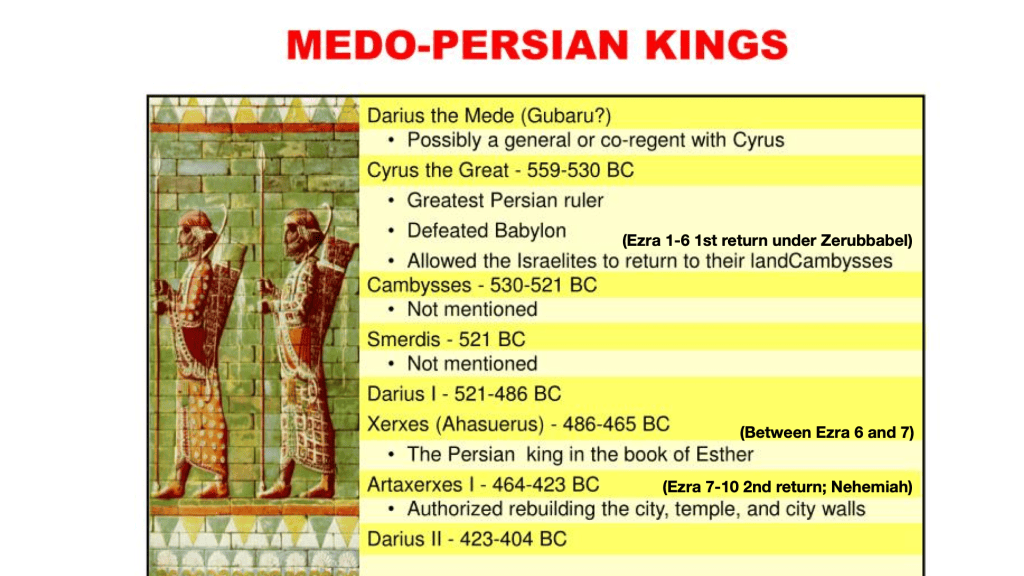
Notice that Xerxes is called Ahasuerus in the book of Esther.
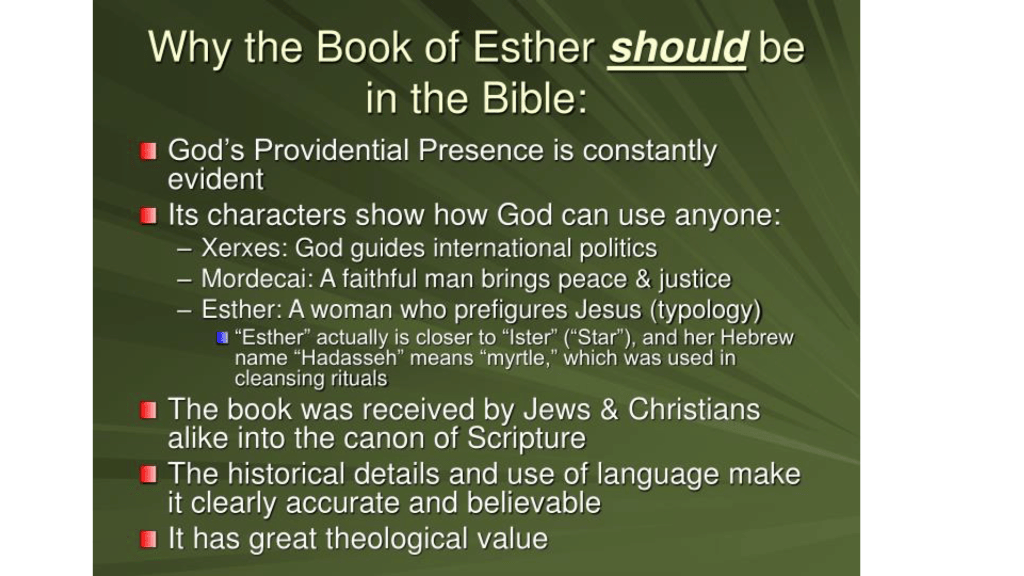
As we begin a study of Esther, we should note that the book almost did not make it into the OT canon of books accepted by the Jews as being inspired of God, written by a prophet of God. Here are 2 slides that sum up that issue:
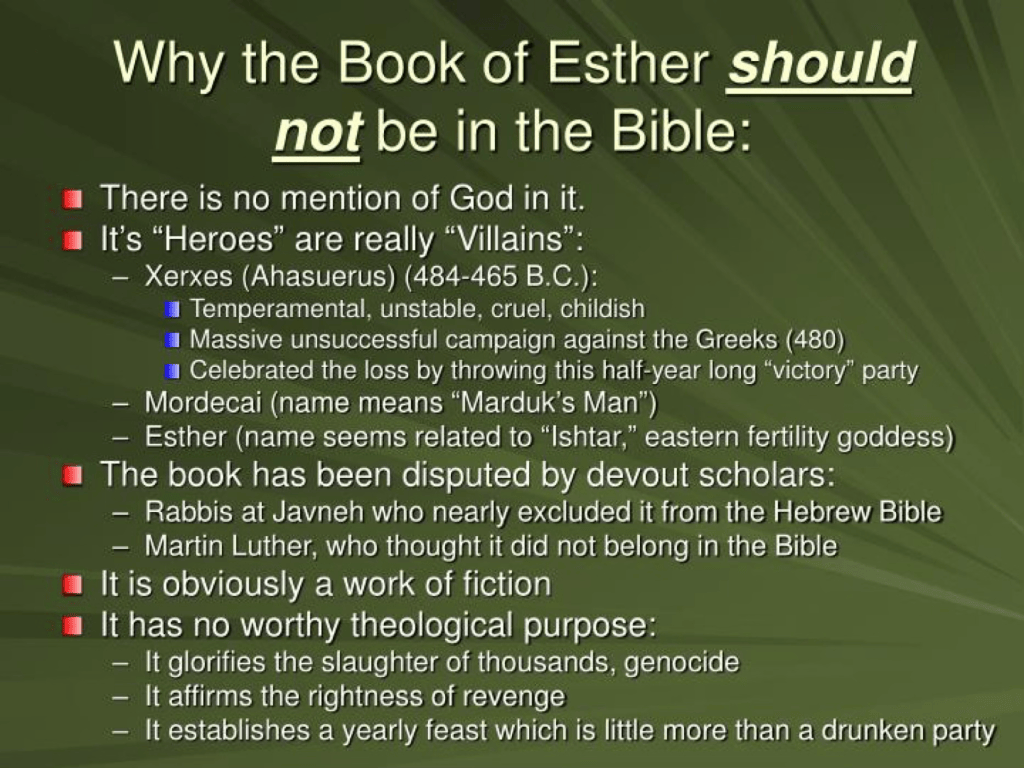
That’s pretty negative, obviously from a very cynical point of view. I can see why the canonicity of the book was challenged. In the Apocrypha there are “heroine” stories similar to Esther, and those books are not considered canonical, at least by Protestants! One such book is the book of Judith: Judith (Book of Judith : The Heroine: Judith is a wealthy, pious, and beautiful Jewish widow living in the besieged mountain town of Bethulia. The Plot: The Assyrian general Holofernes (sent by King Nebuchadnezzar) lays siege to Bethulia, cutting off the town’s water supply. The Action: Trusting in God rather than despair, Judith dresses in fine clothes, slips out of the city with her maid, and enters the Assyrian camp. She charms Holofernes with false flattery, telling him the Israelites are doomed because of their sins and that she will guide him to victory. During a private feast in his tent, Holofernes drinks himself into a stupor. Judith takes his own sword and decapitates him, escaping back to Bethulia with his head in a food sack. The Outcome: The leaderless Assyrian army panics and flees, saving Israel. The story of Judith might even some creibility but the Jews did not accept it into the OT canon. But they did, even with some reservations, accept the book of Esther into the OT canon. Paul said, Romans 3:1 What advantage, then, is there in being a Jew, or what value is there in circumcision? 2 Much in every way! First of all, the Jews have been entrusted with the very words of God.” God entrusted the Jews to collect the inspired books of the OT. They knew who the true prophets were. They knew what stories were credible and which were myths.
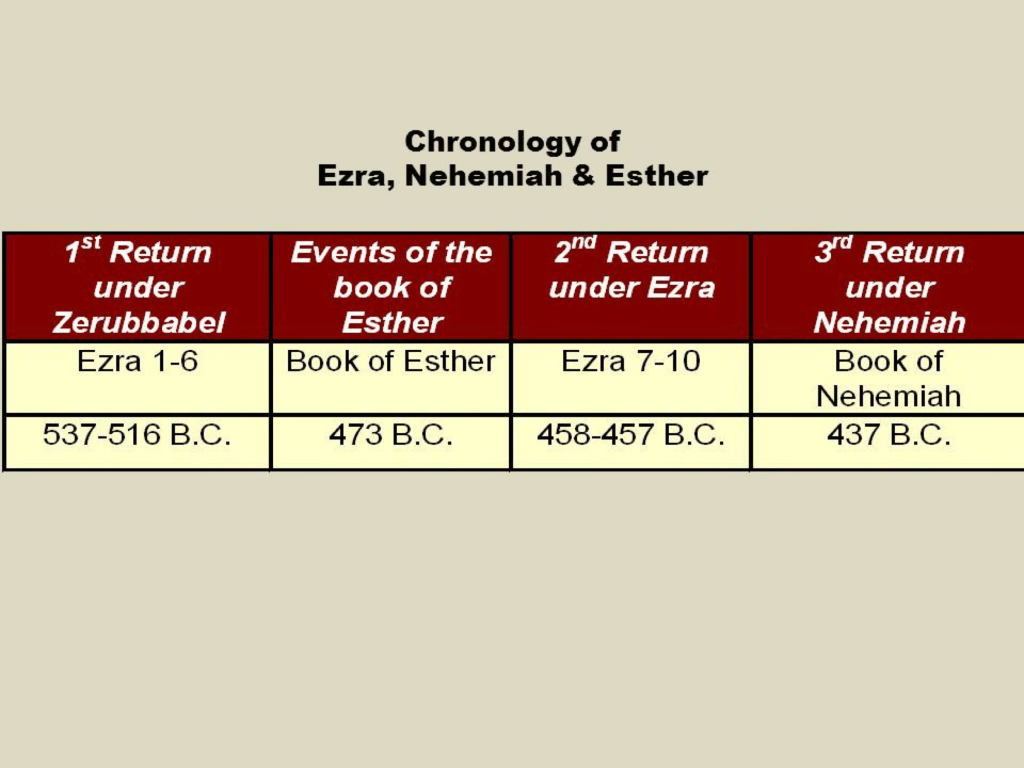
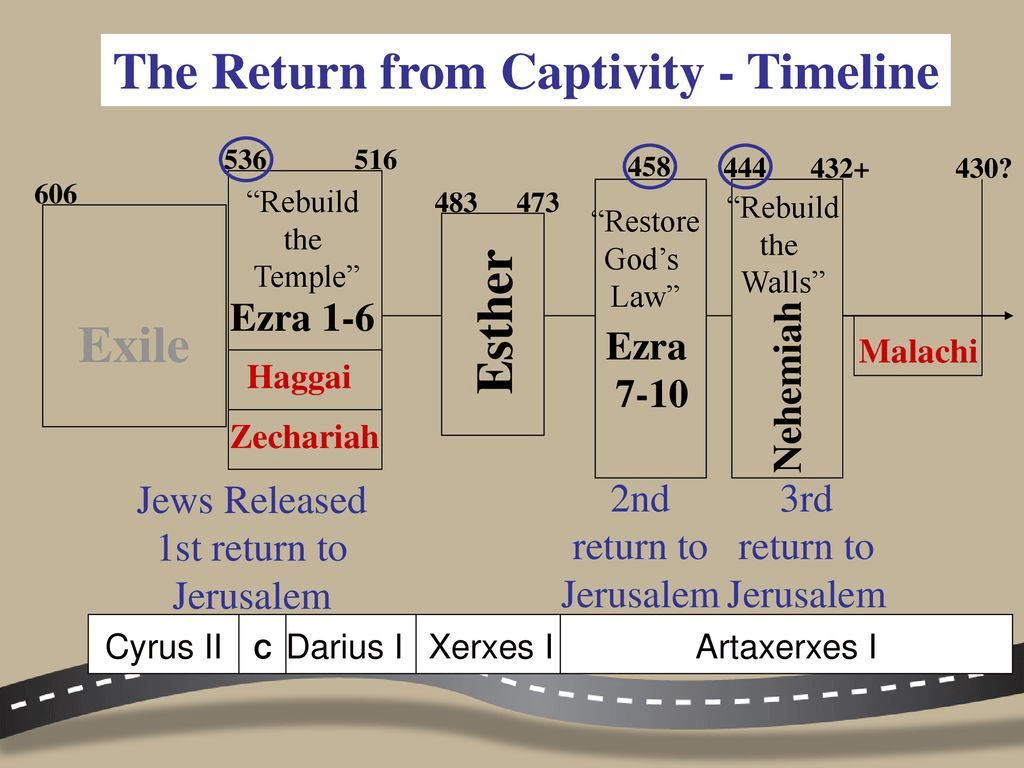
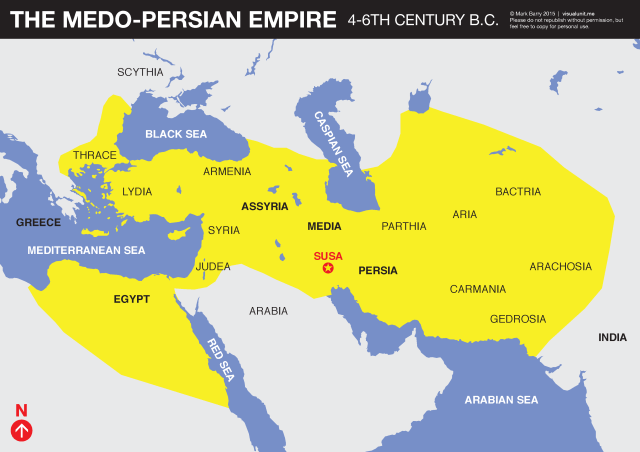
As you can see on the charts, Esther occurs between the 1st and 2nd returns from Babylonian captivity, specifically between Ezra chapters 6 and 7 from 483-473 BC. Persia is the dominant world power, having conquered the Babylonian Empire in 540 BC. Xerxes (486-465 BC) was the king of Persia (he was called Ahasuerus in some translations of the book of Esther). Xerxes ruled over 127 provinces from India to Cush (modern day Sudan south of Egypt). The city of Susa was his capital.
Chapter 1 begins with the 180 day display of the wealth of the Persian Empire under Xerxes. The wealth of the Persian Empire under Xerxes I (r. 486–465 BC) was immense and derived from a centralized imperial economy, standardized taxation, and vast accumulated royal treasuries. AI: “Royal Treasuries: Massive reserve stores were held across administrative capitals like Persepolis, Susa, and Ecbatana. Persepolis, heavily developed and expanded under Xerxes, stood as the ultimate architectural symbol of this wealth. Modern Valuations: Based on historical estimates (such as Herodotus’s 15,000-talent annual revenue or specific biblical references like the 10,000-talent figure in the Book of Esther), modern economic comparisons value Persian annual royal revenues in the hundreds of billions of dollars in modern purchasing power (roughly equivalent to over $400 billion). The Audience: Xerxes invited all his nobles, princes, and officials from the empire’s 127 provinces (stretching from India to Cush), alongside the military commanders and leaders of Persia and Media. Historians and commentators often view this gathering as a strategic war-planning and morale-boosting council ahead of his major campaigns (such as the invasion of Greece), combined with a massive geopolitical show of force. The Purpose: Rather than a single continuous party, it functioned as an extended state exhibition where the king paraded the vast treasury, opulence, resources, and administrative power of his empire to key leaders from across his territories visited Susa. The Sequel (The Seven-Day Feast): Immediately following the 180-day exhibition, Xerxes capped off the event with an extravagant, open-access seven-day banquet in the garden courtyard of the royal palace for all the residents of Susa—from the greatest to the lowest. The Setting of the Follow-Up Banquet: While the 180-day display showcased the formal state riches to dignitaries, the subsequent 7-day feast featured white cotton and blue hanging curtains fastened with purple ribbons to silver rings, marble and alabaster pillars, gold and silver couches, and mosaic stone floors (porphyry, mother-of-pearl, and alabaster), with royal wine flowing freely in unique golden cups. Simultaneously, Queen Vashti hosted a separate banquet for the women of the royal household.”
The plot of the book is pretty easy to read, so no need to summarize all the parts of the story. I do think a good summary will help see the whole picture of the book, even though we are taking 2 blog days to cover the book.
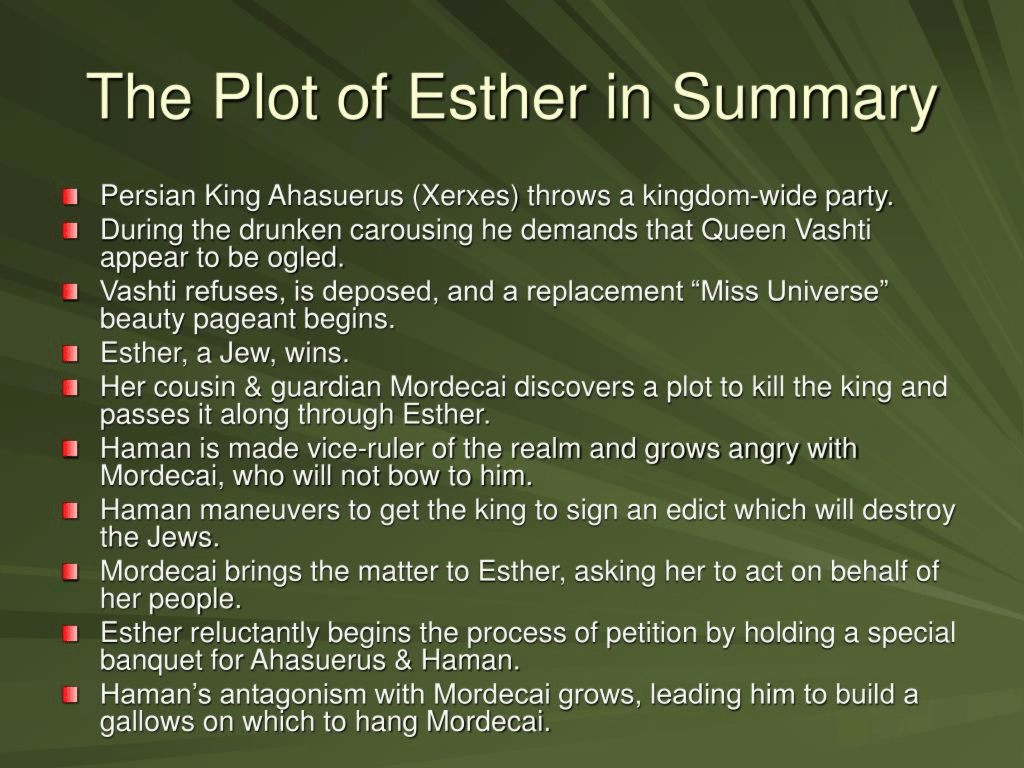
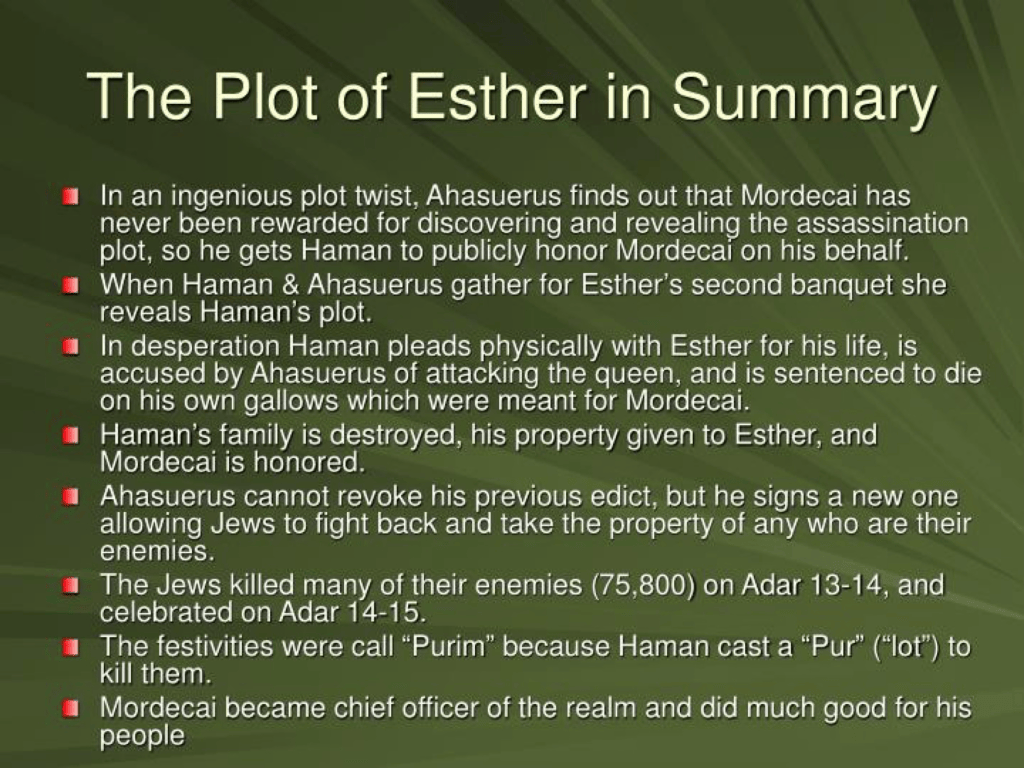
Now for some interesting subplots in chapters 1-4 which is today’s reading.
The king’s decree to all the empire after the deposing of Vashti. Xerxes’ counselor told him that Vashti’s refusal to come before the king at the banquet could cause all the women in the empire to disobey their husbands! He convinced the king to send out a decree “proclaiming that every man should be ruler over his own household”. Of course that is exactly what the apostle Paul taught in Ephesians 5, but the actions of Xerxes shows why many women don’t respect God’s laws on the submission of women to their husbands in marriage. The decree came while a drunken, vain, arrogant, angry king was disrespecting his wife, the queen. Did he expect all the wives in the kingdom to obey their husbands if their husbands acted like he did? Apparently so. Does God expect wives to be in submission to their husbands even if their husbands don’t treat them like Paul told husbands to treat their wives, i.e. nourish, cherish, and love them as they love their own bodies? Apparently so. There would be exceptions for physical abuse IMO. Kinda like slaves and masters. 1 Peter 2:18 “Slaves, in reverent fear of God submit yourselves to your masters, not only to those who are good and considerate, but also to those who are harsh”. Christians have to obey the laws of the land even if they are treated unfairly by policemen or judges. But husbands are never to take advantage of being the head in the marriage by being dictatorial, harsh, mean, or inconsiderate. 1 Peter 3:7 Husbands, in the same way be considerate as you live with your wives, and treat them with respect as the weaker partner and as heirs with you of the gracious gift of life, so that nothing will hinder your prayers.”
The providence of God. So Xerxes has beautiful women brought in from the 127 provinces in the Persian Empire. Only one will be chosen to be the next queen. Mordecai, a Jew, had somehow ended up living in Susa even though he had been carried into Babylon in the 2nd deportation in 596 BC. He had raised Esther as his own daughter after her parents died. But what are the odds that this Jewish orphan could become queen? What are the odds that Hegei, who was in charge of the king’s harem, would show special treatment to Esther with 7 female attendants, special food, and the best place in the harem.Would he have done that if he had known that she was a Jew? Highly unlikely. This story is about the providence of God. There are no miracles involved, just the “behind the scenes” working of God. He did not make the king choose Esther, but He set things up where he would choose Esther. What are the odds that Mordecai would somehow discover a plot to assassinate the king and foil the plot by telling Esther to tell the king? What are the odds that the king would, when having trouble sleeping, read from the Persian chronicles that it was Mordecai who had saved his life by telling him about the assassination plot (6:1-2)? That caused the king to give special honor to Mordecai and no doubt made him more likely to have sympathy on Mordecai and Esther later in the story.
Mordecai’s challenge to Esther. Chapter 4 Mordecai found out that Haman persuaded the king to issue a decree to kill all the Jews b/c Mordecai would not bow down to Haman. He had the decree shown to Esther and told her to go to the king to beg for mercy for the Jews. But even the queen could not just go in to the king without being summoned, and she had not been summoned in 30 days. Mordecai told her, 4:13 “Do not think that because you are in the king’s house you alone of all the Jews will escape. 14 For if you remain silent at this time, relief and deliverance for the Jews will arise from another place, but you and your father’s family will perish. And who knows but that you have come to your royal position for such a time as this?” A couple of points. 1) God is working on His plans. If have the opportunity to let God use you in His plans and refuse to do so, He will find someone else to do it. 2) We should always consider that we might be in life exactly where God wants us to be to work in His plans. Notice that Mordecai doesn’t say that he knows for sure that Esther is where she needs to be. He says “who knows” but that she was queen providentially just to save the Jews. The prophets would often tell men like Jeremiah or Isaiah or Ezekiel that God had chosen them for a special purpose. You might not have a prophet telling you what job to take or specific things that God wants you to do in life. It might just be for you, “who knows” but that I am where I am for a special purpose. So it is best to assume that you are where you are to work in some plan of God. Even if you can’t figure out the specifics, God will still use you b/c of your desire to fit in His plans.
Chapters 1-4 is just the crucial beginning of the providence of God in saving the Jews from Haman’s decree. We will continue that story in the next two blogs.

