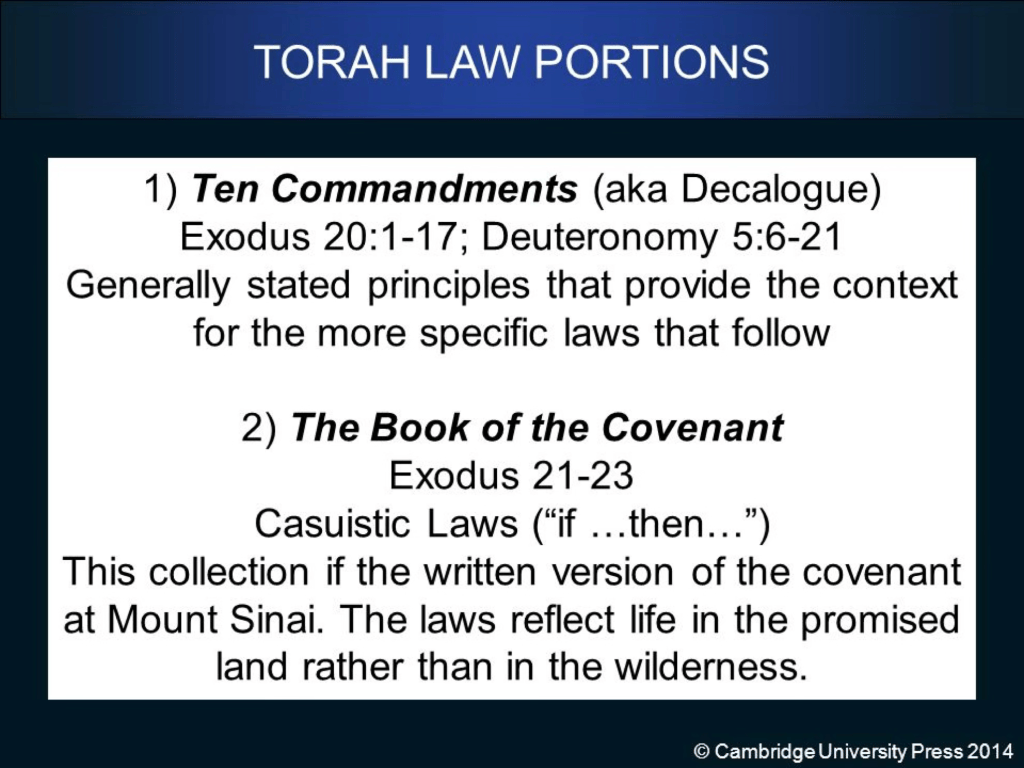
Chapters 21-23 are called the “book of the covenant” (Exodus 24:7). Here’s a great AI summary of the book of the covenant. The book contains an ancient set of practical case laws given by God to Israel at Mount Sinai to show how the Ten Commandments apply to everyday life.
Exodus 21: Laws on People and Injury
Servants: Rules for Hebrew and foreign servants, including freedom after six years of service.
Violence: Punishments for murder, accidental manslaughter, and striking parents.
Personal Injury: Rules for physical fights and harm to pregnant women, establishing proportional justice (lex talionis, or “an eye for an eye”).
Animal Liability: Owner responsibility if a dangerous ox gores someone.
Exodus 22: Property, Theft, and Moral Duty
Theft and Restitution: Rules requiring thieves to pay back stolen property, sometimes multiple times.
Property Damage: Responsibility for fires spreading to a neighbor’s field or livestock eating crops.
Social Morality: Laws on not mistreating vulnerable people like widows, orphans, and strangers.
Moral Purity: Strict prohibitions against sorcery, bestiality, and idol worship.
Exodus 23: Justice, Sabbaths, and Feasts
Fair Justice: Warnings against taking bribes, spreading false rumors, or ganging up to pervert justice. Even enemies must receive basic help with their stray animals.
Sabbath Year: Letting farm fields rest every seventh year so the poor and wild animals can eat.
Weekly Sabbath: Commanding a day of rest for workers and animals.
Three Annual Feasts: The Feast of Unleavened Bread, the Feast of Harvest, and the Feast of Ingathering, where all males must appear before God.
The Angel’s Role: God promises to send an angel ahead of Israel to guard them on the way and bring them into Canaan.
Call to Obedience: The people must listen to the angel’s voice and not rebel, because God’s name is in him and rebellion will not be pardoned.
Warnings Against Idolatry
Reject False Gods: Israel is strictly commanded not to bow down to, serve, or imitate the religious practices of the local inhabitants (Amorites, Hittites, Perizzites, Canaanites, Hivites, and Jebusites).
Destroy Idols: The Israelites must utterly overthrow these nations and break their sacred pillars in pieces.
Avoid Snares: Foreign nations cannot remain in the land, or they will tempt Israel into idolatry.
Promises of Blessing and Victory
Gradual Conquest: God will drive out the enemy nations “little by little” so the land does not become desolate and overrun by wild animals before Israel’s population grows enough to occupy it.
Provision and Health: Serving the Lord brings divine blessing on their bread and water, freedom from sickness, and fertile land where none are barren. Blessings in the old covenant are pretty much physical in nature.
Moses told the people all these words and twice the people said, ““All the words which the Lord has spoken we will do!” (Exodus 24:3). Of course, they did not obey the Lord’s words in the future. Moses had them offer bulls as a sacrifice to God and then sprinkled half the blood on the altar and half on the people, calling it the “blood of the (old) covenant”. The book of Hebrews tells us that blood of animals was insufficient to provide eternal forgivenss of sins, and that the blood of Jesus was the blood of the new covenant that would forgive sins once for all time.
Then something strange happened. Exodus 24:9 Then Moses went up with Aaron, Nadab and Abihu, and seventy of the elders of Israel, 10 and they saw the God of Israel; and under His feet there appeared to be a pavement of sapphire, as clear as the sky itself. 11 Yet He did not stretch out His hand against the nobles of the sons of Israel; and they saw God, and they ate and drank.” God would later tell Moses, “You cannot see My face, for no man can see Me and live!” (Exodus 33:20) so it is unusual that these men “saw God” and lived. Then Moses went up on Mt Sinai alone and stayed there 40 days. The people looked on as the glory of the Lord appeeared as a burning fire on top of the mountain. Chapter 25 begins the detailed instructions for building the tabernacle and the furnishings that God gave Moses during those 40 days. So we will hold off on discussing the tabernacle since it is covered in the next day reading. BTW Nadab and Abihu were priests who were killed by God for offering strange fire in Numbers 10.
Hope you are keeping up with the daily reading and blog articles. I am enjoying writing them for you and hope they are helpful.
Chapters 11 and 12 tell about the 10th plague, the death of the firstborn of Egypt, including the cattle, at midnight. Can you imagine the horror, the cries and screaming coiming for every house in your neighborhood, all at the same time at the stroke of midnight? Picture that happening all through the land of Egypt to about 3 million Egyptians (according to historians). They awaken to find dead cattle all over the land in mass numbers. No wonder they begged the Israelites to leave Egypt and gave them silver and gold and clothing. That gold, unfortunately, would be used to make a golden calf and worship it at Mt Sinai. The Israelites “plundered” the Egyptians (Exodus 12:36).
THE PASSOVER That night of the death of the firstborn the Israelites were to eat the Passover lamb (chapter 12) with their sandals on, ready to make a hasty departure from Egypt. They were to sprinkle the blood of the lamb on their doorposts and lintels. If they did, the Lord would “pass over” their houses and not allow the “destroyer” (Exodus 12:23, some have called this the “death angel”) to kill their firstborn. They would not have time to let their bread leaven, so they made cakes of unleavened bread for their meal and their journey. God then gave Moses detailed instructions for this Passover Feast and Feast of Unleavened Bread (a 7 day feast) to be an annual ritual for Israel. The Israelites are to use these feasts to teach and remind their children about how God brought Israel out of Egyptian slavery.
Life Lesson: The Passover lamb was a type of Jesus, our Passover lamb who was slain to save us from our sins. 1 Corinthians 5:6 For Christ our Passover also has been sacrificed.” The Passover lamb was to be “unblemished” and Christ was sinless. John 1:29 John the Baptist proclaims Jesus to be the “Lamb of God, who takes away the sin of the world!” 1 Peter 1:18 you were not redeemed with perishable things like silver or gold from your futile way of life inherited from your forefathers, 19 but with precious blood, as of a lamb unblemished and spotless, the blood of Christ. 20 For He was foreknown before the foundation of the world.” You see, even before God created man, God knew that man would sin and that God would send His sinless Son to die to redeem man from sin (for some reason that satisfied God’s wrath against our sins and allowed Him to be both just and the justifier of those who put their faith in Jesus). So, God gave the commands to Israel in Egypt for a Passover Lamb as a type of Christ our Passover Lamb. Gentile Christians don’t celebrate the Passover Feast each year but we celebrate Christ as our Passover Lamb every moment of every day (or at least we should). Do you begin each day thanking God for sending Jesus to save us? Do you begin each day thanking Jesus for dying for us? Jesus ate his last supper with his disciples in the upper room the night before his death with a Passover meal with unleavened bread. During that meal, he instituted the Lord’s Supper with the wine and the unleavened bread, which he said represented his body and blood offered for sin. Early Christians were told to partake of that Lord’s Supper in remembrance of Jesus dying for them. It appears that they ate the Lord’s Supper as part of a meal, the “love feasts” (Jude 1:12, a love meal with the rich and the poor Christians). It’s kinda sad to me that we make the Lord’s Supper just the eating of a little wafer and sip of grape juice instead of part of a love feast meal. I think the early Christians took the Lord’s Supper often, even during the week, as part of their meals together. But whenever, however, and how often you partake of the Lord’s Supper, it should be a sacred reminder of Jesus, the Passover Lamb who was slain to take away the sins of the world. Hebrews 11:28 By faith he kept the Passover and the sprinkling of the blood, so that he who destroyed the firstborn would not touch them.”
THE CONSECRATION OF THE FIRSTBORN God also commanded the people to “consecrate their firstborn” of children and animals as a remembrance of God sparing the firstborn of Israel in Egypt (chapter 13). The first of all their crops was to be given to the Lord. The firstborn of clean animals was to be offered as a sacrifice to God. The firstborn of unclean animals was to be substituted with a lamb sacrifice since unclean animals could not be sacrificed to God. But the firstborn children could be “redeemed” instead of killed by giving 5 shekels of silver to the support of the Levitical priests (Numbers 18:15-16). If you are a firstborn in your family, this ritual has to have some meaning for you even if you are not an Israelites and even if you were not redeemed with money. You are special to God.
THE EXODUS Exodus 12:40 Now the time that the sons of Israel lived in Egypt was four hundred and thirty years. 41 And at the end of four hundred and thirty years, to the very day, all the hosts of the Lord went out from the land of Egypt.” If you are one for technicalities, the statement that Israel went our from Egypt after 430 years “to the very day” is interesting. In Genesis 15 God told Abraham that his descendants would come out of slavery in the 4th generation which proved to be true: Levi/Kohath/Amram/Moses. Levi, Kohath, and Amram lived to their 130’s, but those 4 generations overlapped and would not give a total of 430 years in actual slavery. The 430 years in Exodus 12:41 is calculated as the total time of the Abrahamic Sojourn, spanning from the time God made His covenant promise to Abraham in Canaan until the Exodus. Scholars divide the 430-year period into two equal blocks of 215 years based on the chronological data in Genesis. First 215 Years (Canaan): From when Abraham was 75 and received the divine promise (Genesis 12:4) until Isaac was born (25 years), plus the years Isaac and Jacob lived as foreigners in Canaan before descending into Egypt. Second 215 Years (Egypt): From when Jacob and his family moved to Egypt (at age 130) until the final Exodus, covering the 4 generations of Levi/Kohath/Amram/Moses. Genesis 15:13 mentions 400 years of affliction, which begins later (approx. 30 years into the timeline, after Isaac is mocked or Ishmael/afflictions begin) and specifically isolates the time of hardship, while the 430 years marks the complete legal span of the covenant. Joseph was 40 when Jacob moved his family to Egypt and he died at 110 before a new king arose and began the slavery of the Israelites, so that is 70 years of peace and prosperity including the time of Levi, the son of Jacob. If the Israelites were only in Egypt for 215 years, then that only leaves a maximum of 140 years that they were enslaved. How’s that for being technical! It does kinda nullify my teaching in the past that the Israelites were actually in slavery for a full 400 years. Oh well, live and learn.
THE CROSSING OF THE RED SEA Chapter 14 tells how God led 600,000 men (probably over 1 1/2 million total men, women, and children) to the Red Sea instead of going by the well traveled route that passed close by the Mediteranean Sea through Philistine territory (He knew they would see the military of the Philistines and rebel, returning to Egypt). He led them with a pillar of cloud by day and a pillar of fire by night so they “could travel day and night”. They camped by the Red Sea when Pharoah decided to track them down with 600 select chariots. To Pharoah it looked like the Israelites were trapped in the wilderness b/c they could not cross the Red Sea and had nowhere to escape. So he pursued them. Actually this was another part of God’s plan. He would harden Pharoah’s heart one more time (Exodus 14:4,8) into tricking him into thinking that the Israelites were trapped and easy prey to kill. Again, Pharoah made his own choice to pursue Israel. What the Israelites said to Moses when they saw the dust of the approaching Egyptian chariots reveals their lack of faith in God. Exodus 14:10 As Pharaoh drew near, the sons of Israel looked, and behold, the Egyptians were marching after them, and they became very frightened; so the sons of Israel cried out to the Lord. 11 Then they said to Moses, “Is it because there were no graves in Egypt that you have taken us away to die in the wilderness? Why have you dealt with us in this way, bringing us out of Egypt? 12 Is this not the word that we spoke to you in Egypt, saying, ‘Leave us alone that we may serve the Egyptians’? For it would have been better for us to serve the Egyptians than to die in the wilderness.” This lack of faith in God would be repeated many times in the wilderness. Moses’ reply to them: Exodus 14:13 But Moses said to the people, “Do not fear! Stand by and see the salvation of the Lord which He will accomplish for you today; for the Egyptians whom you have seen today, you will never see them again forever. 14 The Lord will fight for you while you keep silent.” But then it is almost as if the Lord is telling Moses to quit talking and start doing something to save the people. Exodus 14:15 Then the Lord said to Moses, “Why are you crying out to Me? Tell the sons of Israel to go forward. 16 As for you, lift up your staff and stretch out your hand over the sea and divide it, and the sons of Israel shall go through the midst of the sea on dry land. 17 As for Me, behold, I will harden the hearts of the Egyptians so that they will go in after them; and I will be honored through Pharaoh and all his army, through his chariots and his horsemen. 18 Then the Egyptians will know that I am the Lord, when I am honored through Pharaoh, through his chariots and his horsemen.” You know what happened next. Moses parted the Red Sea, the Israelites crossed (it took all night while the angel of God kept the Egyptian army at bay), the Egyptians tried to cross and were drowned (was Pharoah drowned also?). Exodus 14:30 Thus the Lord saved Israel that day from the hand of the Egyptians, and Israel saw the Egyptians dead on the seashore. 31 When Israel saw the great power which the Lord had used against the Egyptians, the people feared the Lord, and they believed in the Lord and in His servant Moses.” They sand the “song of Moses” praising the Lord (Yahweh) for their deliverance (chapter 15). Aaron and Moses’ sister Miriam sang, danced and praised God with timbrels. Hebrews 11:29 By faith they passed through the Red Sea as though they were passing through dry land; and the Egyptians, when they attempted it, were drowned.This would be a superficial, shallow belief in the Lord and Moses that would not last very long. Once they left the Red Sea they would continually complain and show lack of faith in God. After 3 days in the wilderness with no water, they grumbled at Marah when they found bitter water but Moses threw a tree in the waters and made them drinkable. This was just the beginning of their grumbling. They would complain for the next 40 years as God made them wander (Numbers 14).
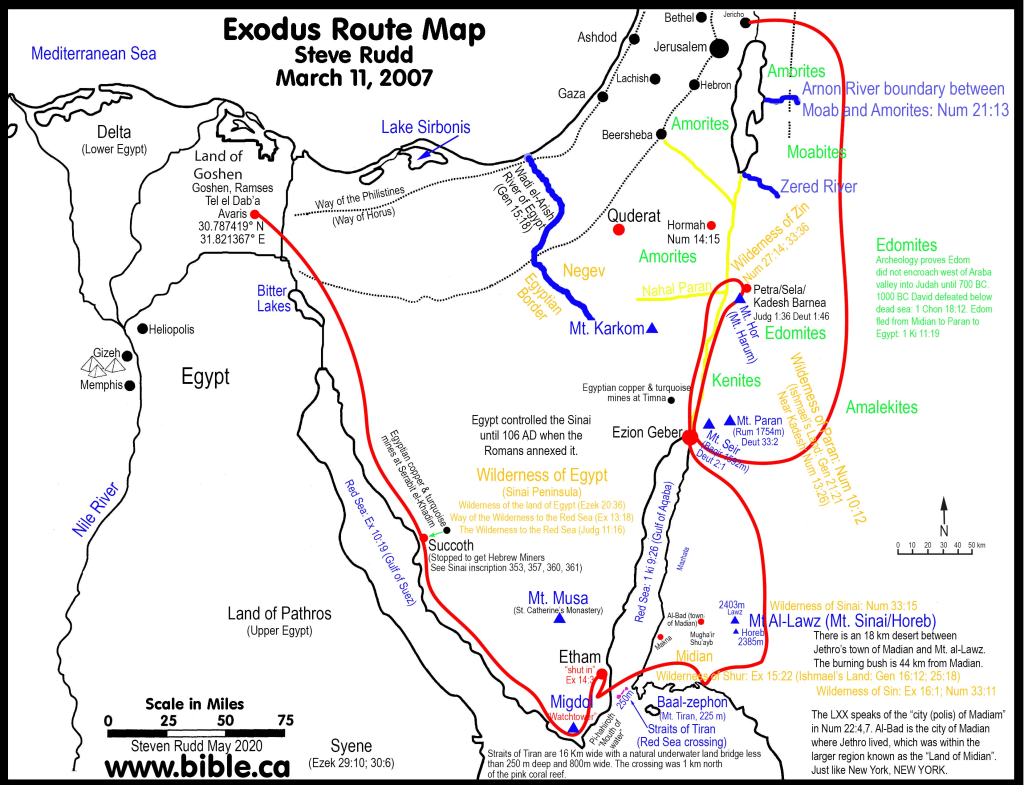
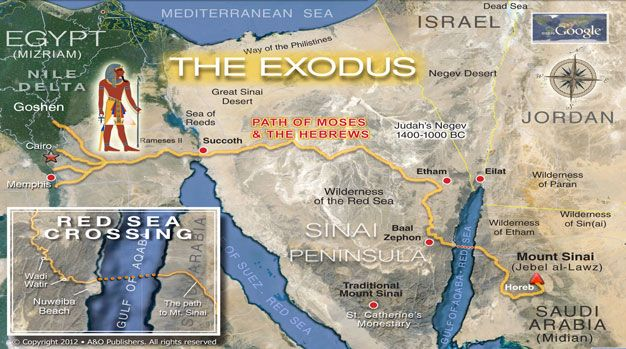
Here is a map of where I think the crossing of the Red Sea occurred. It places Mt Sina east of the Red Sea (known as the Gulf of Aqaba today) instead of the traditional site west of the Gulf of Aqaba. Moses 40 years later would taked his sheep to Mt Sinai looking for pasture. That would fit the location of Mt Sinai in Midian (now Saudi Arabia) east of the Gulf. I can’t imagine him taking his sheep up to the northern tip of the Gulf of Aqaba and then southwest into the wilderness to the traditional Mt Sinai location in the middle of the wilderness, a journey of about 200 miles!. So I think the map is correct even though we don’t know the exact place of the crossing (although some have claimed to find evidence of the crossing in the Gulf of Aqaba). The Red Sea had to be deep enough to drown an army, so it couldn’t be the shallow “Sea of Reeds” (Yam Suph could refer to a shallow lake of reeds near the Nile) as liberals claim, trying to deny the miracle of the parting of the Red Sea.
Life Lesson: Teach your children the story of the Red Sea crossing and the exodus. This miraculous event is alluded to or mentioned over 20 times in the Old Testament including Psalm 66:6, Psalm 78:13, Psalm 106:9, Psalm 114:3, Psalm 136:13. Isaiah 11:15, Isaiah 51:10, and Isaiah 63:12–13. Psalm 78:13 He divided the sea and caused them to pass through, and He made the waters stand up like a heap. Psalm 106: 6 We have sinned like our fathers, We have committed iniquity, we have behaved wickedly. 7 Our fathers in Egypt did not understand Your wonders; They did not remember Your abundant kindnesses, But rebelled by the sea, at the Red Sea. 8 Nevertheless He saved them for the sake of His name, That He might make His power known. 9 Thus He rebuked the Red Sea and it dried up, And He led them through the deeps, as through the wilderness. 10 So He saved them from the hand of the one who hated them, And redeemed them from the hand of the enemy. 11 The waters covered their adversaries; Not one of them was left. 12 Then they believed His words; They sang His praise.” We must teach out children stories about the exodus, the crossing of the Red Sea, etc. These are not fairy tales or myths. They are real stories that show the awesome power of God.
Life Lesson: Have you ever been faced with a desperate situation where you see no escape, a “Red Sea”? Circumstances have become very dificult for you. Maybe cancer, divorce, financial problems, health, children problems. You’v just about given up on a way of escape. 1 Corinthians 10:13 No temptation has overtaken you but such as is common to man; and God is faithful, who will not allow you to be tempted beyond what you are able, but with the temptation will provide the way of escape also, so that you will be able to endure it.” A “way of escape”, just as God provided a way of escape for Israel from Pharoah’s army at the Red Sea. When you are desperate for a way of escape, “Stand by and see the salvation of the Lord which He will accomplish for you today.” God will in some way provide a way of escape, even if death itself might be the way to escape the pain and suffering of thhis life to be able to move on to the eternal joy in heaven (wherever that is). The Israelites panicked when they saw the dust of the approaching chariots of Pharoah. They did not have faith in God. I can’t tell you how many times I have had panic attacks b/c I didn’t have faith in God to rescue me from some desperate situation. I can’t sleep. I worry. I wake up thinking about some bad situation I am facing. I come up “what if’s” that might happen. God must be thinking, “How many times do I have to prove to you that I am with you and will provide and protect you?”
THE NAME OF GOD. But first read Exodus 6:2-9. Have you ever heard the song, “El Shaddai” by Amy Grant. I suggest you stop and listen to it. You will hear what El Shaddai did for Abraham.
Exodus 6:2 God spoke further to Moses and said to him, “I am the Lord; 3 and I appeared to Abraham, Isaac, and Jacob, as God Almighty (El Shaddai), but by My name, Lord, I did not make Myself known to them. God was known by the patriarchs in Genesis (Abraham, Isaac, Jacob) by the name “El Shaddai” (Genesis 17:1-2; 28:3; 35:11; 43:14). It means “God Almighty” and emphasized the power of God. But beginning with the exodus and founding of the nation of Israel God wanted Israel to call him “YHWH” or “Yahweh” (ancient Hebrew writing only used consonants so the vowels were added later). YHWH comes from the root verb “to be”. At the burning bush (Exodus 3) Moses said, “They may say to me, ‘What is His name?’ What shall I say to them?” 14 God said to Moses, “I AM WHO I AM”; and He said, “Thus you shall say to the sons of Israel, ‘[i]I AM has sent me to you.’” “I AM” is from hayah: To be, become, come to pass, exist, happen. The self-designation “I AM” (’ehyeh) proclaims God’s eternal, self-existent being. The generic word for “God” is “Elohim” and can be used even of false gods. But Yahweh is a personal, intimate name that can only be used of the one true God of Israel. It is a special, sacred name given to Israel (and to us). Out of reverence, ancient Jewish readers stopped pronouncing the literal four-letter Hebrew name for God (YHWH, called the Tetragrammaton). When reading aloud, they substituted the word Adonai (meaning “Lord”). (Adonai is also in the Amy Grant song “El Shaddai”). All Caps Format: Most English Bibles (like the ESV, NIV, and NRSV) follow this tradition by printing LORD in all-capital or small-capital letters whenever the original Hebrew text has YHWH. Yahweh is translated as Kyrios, the Greek word for “Lord,” throughout the New Testament. The term “Jehovah” only began to be used by Christian scholars in the middle ages, a Latinized word they created to call Yahweh. Only the King James uses “Jehovah”.
So the name Yahweh has a special significance. When you see God called “LORD” in the New Testament, you need to remember that is Yahweh, God’s special name. Here’s a great song with a lot of the names of God. Often Yahweh would be combined with a 2nd word like Yahweh Jireh (the Lod provides), or Yahweh Rophe (the Lord who heals) and you will hear some of those names.
Moses revealed this special name of God to the slaves and gave them God’s promise to deliver them from slavery and take them to the promised land. Exodus 6:9 So Moses spoke thus to the sons of Israel, but they did not listen to Moses on account of their despondency and cruel bondage.
Life Lesson: It is often hard to believe in God’s promises when you are “despondent”, depressed, hurting. You are taking chemo for cancer, you are in terrible pain every day from some permanent health issue, your marriage is fallling apart, your child is on drugs, you are losing your job, you can’t pay your bills, your health insurance won’t pay for a needed surgery, you are facing a lawsuit, you are burnt out taking care of again prents, etc. The preacher quotes all those verses about how trials can make you stonger, more mature or complete, that you should find “joy” in your trials (James 1:3-5). But you don’t really “listen on account of your depondency”. But it’s God’s promises that keep us going when you hit bottom and don’t think that you can go on trying. Sometimes, the situation is hopeless in this life, and the only promise that matters is the promise of eternal life, away from all the struggles of this life. Paul said, 17 For momentary, light affliction is producing for us an eternal weight of glory far beyond all comparison, 18 while we look not at the things which are seen, but at the things which are not seen; for the things which are seen are temporal, but the things which are not seen are eternal.” (2 Corinthians 4:17-18) Read about his “momentary light affliction” in 2 Corinthians 11:23-29. Sounds pretty heavy, not light, to me. But he says it is nothing compared to what eternal glory will be after we die.
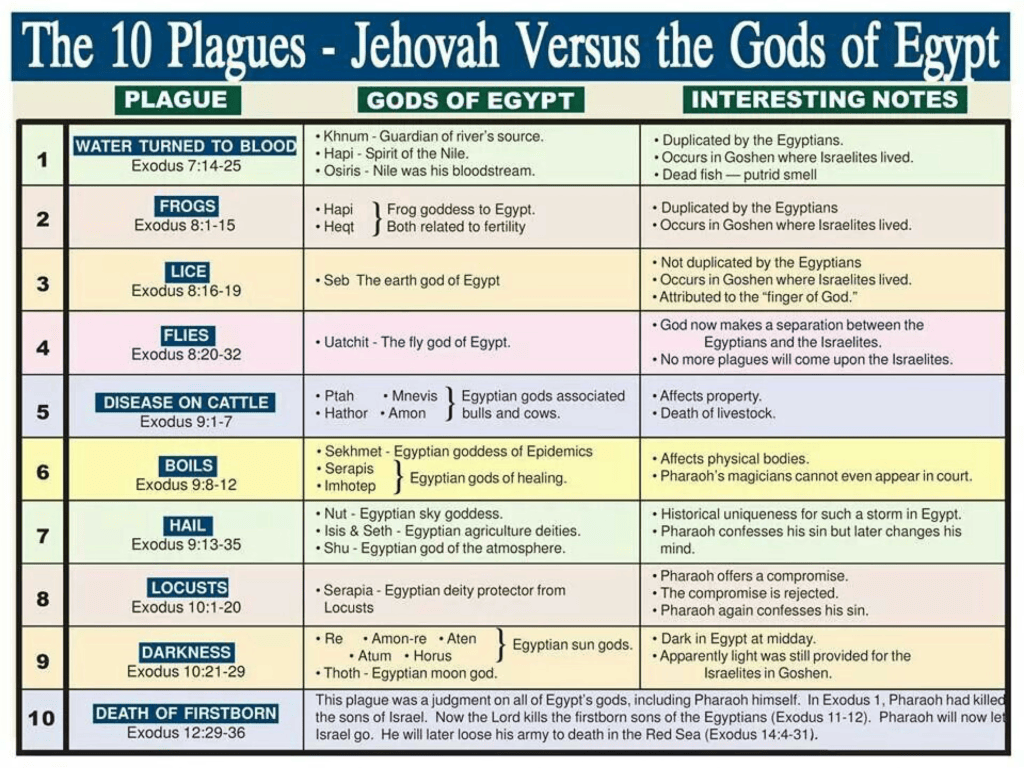
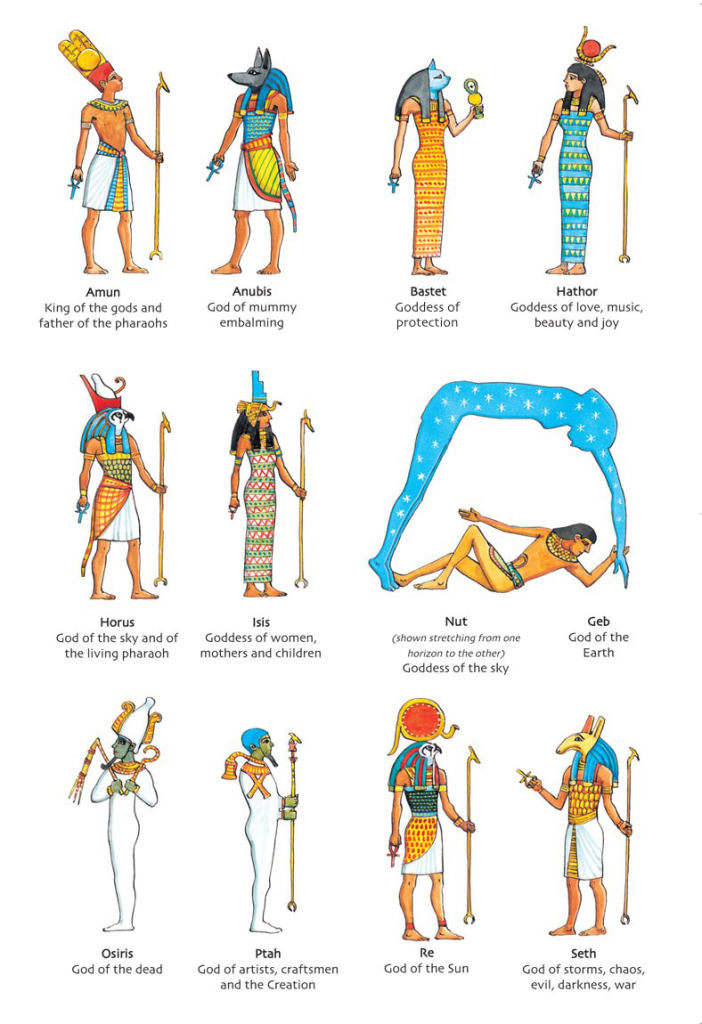
THE TEN PLAGUES. Exodus 6: 10 Now the Lord spoke to Moses, saying, 11 “Go, tell Pharaoh king of Egypt to let the sons of Israel go out of his land.” 12 But Moses spoke before the Lord, saying, “Behold, the sons of Israel have not listened to me; how then will Pharaoh listen to me, for I am unskilled in speech?” 13 Then the Lord spoke to Moses and to Aaron, and gave them a charge to the sons of Israel and to Pharaoh king of Egypt, to bring the sons of Israel out of the land of Egypt.” God made Aaron to be Moses’ spokesman (prophet). Moses went to Pharoah, did the signs God had given him at the burning bush (rod becoming a snake, hand turning leprous) but Pharoah refused to let the slaves go, even for a 3 day feast celebration. His response: Exodus 5:2 But Pharaoh said, “Who is the Lord that I should obey His voice to let Israel go? I do not know the Lord, and besides, I will not let Israel go.” So God began the 10 plagues on Egypt. Each plague was directed at one (or more) of the gods of Egypt as shown in this chart. God is showing his power over all the many gods of Egypt. By the time God is through with Pharoah, he will know “who Yahweh is”.
Ra, the god of the sun, for example, can’t stop the darkness plague. Nut, the goddess of the sky, can’t stop the hail plague. BTW Rehab and the inhabitants of Jericho saw clearly the impact of the 10 plagues. She told the spies that the Canaanites heard about the 10 plagues and were terrified of the power of the God of the Israelites. BTW God doesn’t have to repeat these plagues to show his power over the false gods of other nations, like the gods of the Babylonians or the Assyrians or the Moabites or the Philistines. When God was announcing the last plague, the death of the firstborn, He said, “For I will go through the land of Egypt on that night, and will strike down all the firstborn in the land of Egypt, both man and beast, and against all the gods of Egypt I will execute judgments—I am the Lord” (Exodus 12:12).
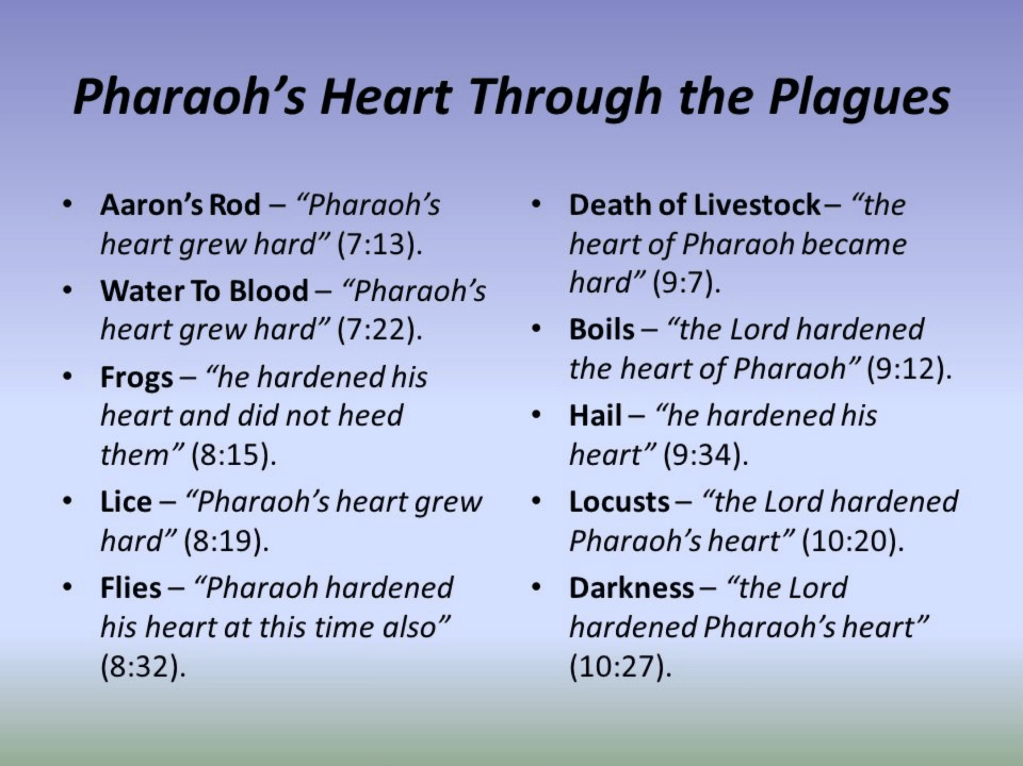
DID GOD HARDEN PHAROAH’S HEART OR DID PHAROAH HARDEN HIS HEART? It says that Pharoah “hardened” his heart and would not let the slaves go free (until the last plague and his. firstborn died). But it also says that “the Lord hardened Pharoah’s heart”.
So which is it? Both. Did Pharoah have a free will choice of whether to let the slaves go free? Yes, although Calvinism falsely teaches that things are predestined with no free will choices. Arminianism correctly teaches that all men can make their own free will choices in matters of faith. God doesn’t always allow us to choose our circumstances, but He always allows us to choose our response. So Pharoah had a choice and he chose to harden his own heart. But did God harden his heart also? Yes. How did God do that? He did not somehow make Pharoah unable to choose to obey God. Pharoah was not a “totally depraved” sinner (the T in TULIP) as Calvinism teaches, unable to choose to obey God. Calvinism teaches that sinners are not able to believe, that only a select few whom Jesus died for (the L in TULIP) are predestined to be saved (the U in TULIP), that God has to send His Spirit on those few to enable them to be believe and they can’t resist that Spirit (The I in TULIP). It would be hard for me to believe in the God of Calvinism whom could choose to enable and basically force all sinners to believe and be saved but who arbitraarily selects a few and leaves the rest to burn in hell. Pharoah was free to choose whether to obey God or not, and he chose to disobey. Indeed God sent the plagues that He knew would harden Pharoah’s heart. Thus, indirectly God hardened Pharoah’s heart by sending the plagues. Romans 12:17 For the Scripture says to Pharaoh, “For this very purpose I raised you up, to demonstrate My power in you, and that My name might be proclaimed throughout the whole earth.” 18 So then He has mercy on whom He desires, and He hardens whom He desires.” Someone might object: Romans 9:19 You will say to me then, “Why does He still find fault? For who resists His will?” In other words, if God hardens someone’s heart, then how can that person be held responsible? Well God has the right to harden someone’s heart, but he never violates their free will to choose whether to obey Him or not. So Paul adds, Romans 9:20 On the contrary, who are you, O man, who answers back to God? The thing molded will not say to the molder, “Why did you make me like this,” will it? God has the right to use someone’s hard heart to accomplish His will, and that is what He did with Pharoah. That doesn’t make the person no responsible for his evil choices.
That covers the 10 plagues. We will cover the Passover and the exodus next lesson.
Fast forward from Jacob’s family moving to Egypt at the end of Genesis. Joseph was about 40 when Jacob moved to Egypt. Joseph died at 110. The Israelites were not enslaved until after Joseph died so the Israelites had at least 70 years of prosperity and peace. A new king (Pharoah) arose who did not know Joseph. The new king said that the Israelites were “more and mightier” than the Egyptians, so sufficient time must have elapsed from the death of Joseph to allow for Israelites growing into a large number but we don’t know how long from the death of Joseph until the beginning of the enslavement of the Israelites. God had told Abraham that his descendants would be enslaved for 400 years and then come out of slavery in the 4th generation. Levi: Lived 137 years (Exodus 6:16). Kohath: Lived 133 years (Exodus 6:18). Amram: Lived 137 years (Exodus 6:20). We can’t be sure how to reconcile the 400 years exactly, but it is easy to see that the Israelites would come out of Egypt in the 4th generation: Levi/Kohath/Amram/Moses and Aaron (the sons of Amram).
That’s enough of that! Most everyone knows the facrs surrounding the birth of Moses to Amram and Jochebed. Hebrews 11:23 By faith Moses, when he was born, was hidden for three months by his parents, because they saw he was a beautiful child; and they were not afraid of the king’s edict.” This verse tells us about the faith of Moses’ parents. Did they just hide Moses from being thrown into the Nile to die b/c they thought he was beautiful? That would not require faith but it does say that they hid him b/c he was beautiful. The Hebrew word tob (meaning “good”) and the Greek word asteios (meaning “well-formed” or “fair”) might suggest that they thought Moses’ beauty as a baby meant that he was destined for some divine purpose. We just don’t know what they were thinking but we do admire their faith.
Life Lesson: I would hope that all parents have faith that their newborns can be destined for some divine purpose. Maybe not a Moses leading 2 million people out of slavery, but faith that a child can become a godly mother or father, a sincere Christian who marries a Christian and raises a Christian family. My wife prayed with all 3 of our children every night before they were even old enough to know what a Christian was: “God, help ____ grow up to be a Christian and to marry a Christian.” I am shocked when I hear of some parents these days say that they never influence their children when they are little to become any particular religion. They say they want their children to be free to choose to be Muslim, Christian, Buddhist, Hindu, etc.without being “brainwashed”. “Brainwashing” is forcing or pressuring someone into a certain belief. Grounding our children in the Christian faith is not brainwashing. It is simply teaching them the Word of God. They can still choose to become Christians or not when they get older.
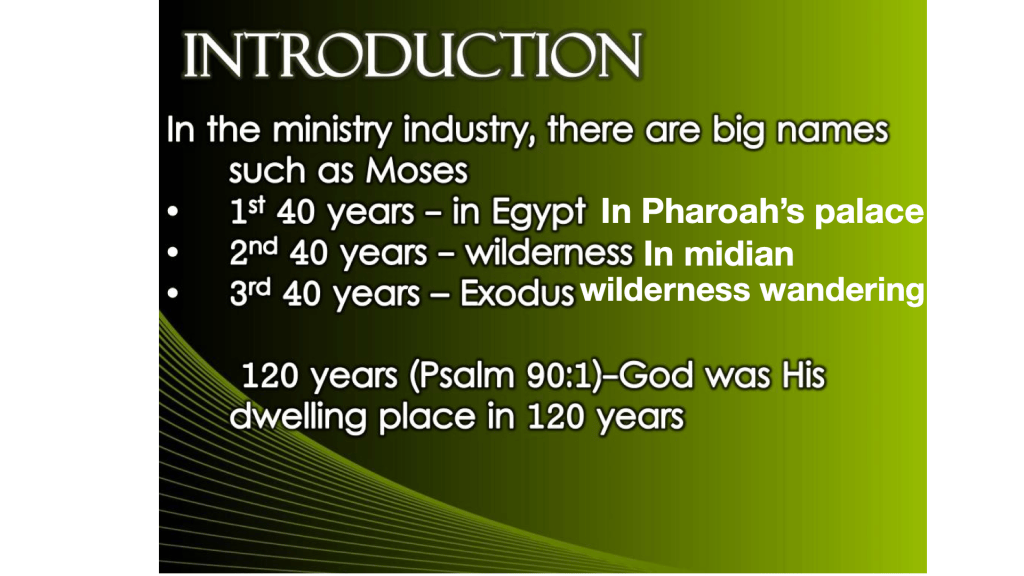
Moses’ life was divided into 3 periods:
1) 1st 40 years: in Egypt in Pharoah’s palace (Exodus 2:1-14). Pharoah’s daughter brought him up as her own son. He was educated in all the wisdom of the Egyptians and powerful in speech and action (Acts 7:21-22). We don’t know how or when he found out that he was an Israelite, but when he was 40 he killed a taskmaster who was beating on of his “Hebrew brethren”. Acts 7:23-25 tells us that he was thinking that his killing the Egyptian would show the Israelites that Moses was the one to deliver them from slavery but they didn’t see it that way. Maybe he was planning a slave uprising, which could be possible with so many Israelite slaves. The next day he realized that they were not behind his plan to deliver them. A slave uprising wasn’t God’s plan either. God would use a staff, not a sword, to deliver Israel from slavery. So Moses fled to Midian att the age of 40. Hebrews 11:24 By faith Moses, when he had grown up, refused to be called the son of Pharaoh’s daughter, 25 choosing rather to endure ill-treatment with the people of God than to enjoy the passing pleasures of sin, 26 considering the reproach of Christ greater riches than the treasures of Egypt; for he was looking to the reward. 27 By faith he left Egypt, not fearing the wrath of the king; for he endured, as seeing Him who is unseen.” How did Moses consider the “reproach of Christ greater riches than the treasures of Egypt”? The Hebrew writer is simply saying that Moses chose to suffer with the Israelites just as Christ suffered. Moses did not know about the actual suffering of Christ. Hebrews 11:27 is puzzling. Exodus 2:14-15 says that Moses was afraid and fled from Pharoah, so it seems that Moses did fear the wrath of the king but that looks like a contradiction with Hebrews 11:27. Some think that Hebrews 11:27 is referring to his 2nd leaving of Egypt when he led the Israelites out of slavery at the age of 80 when he did not fear the wrath of Pharoah.
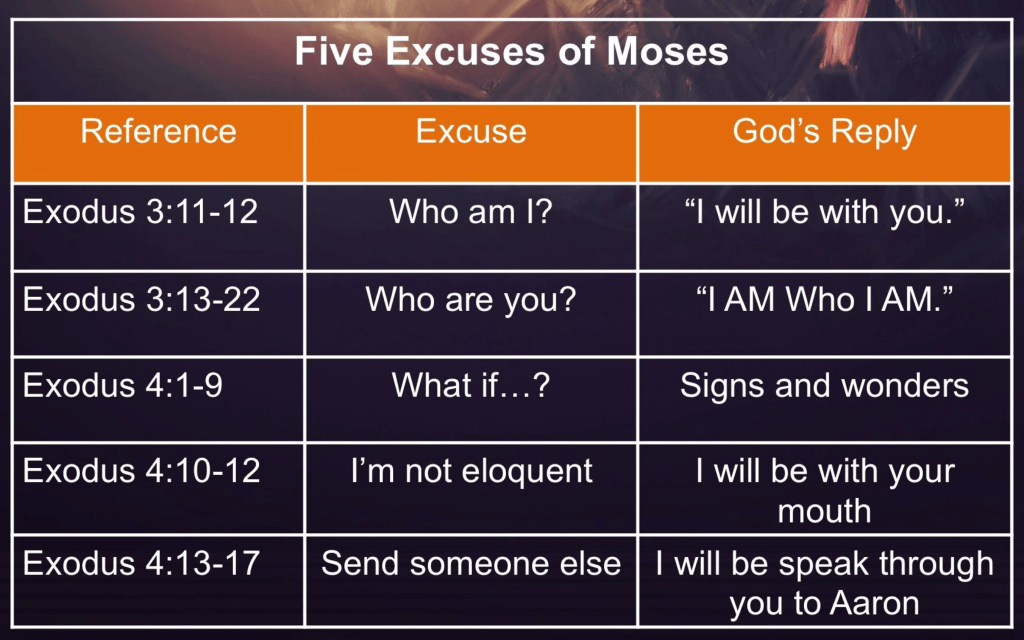
2) 2nd 40 years: in Midian (Exodus 2:15-25) as a shepherd with a family. It seems that he was resolved to just live the rest of his life as a shepherd. He married Zipporah, a daughter of Jethro (Ruel) and had 2 sons. Moses has completely dismissed any intenetions of helping the Israelites get freedom from slavery in Egypt. He never ever wants to go back to Egypt. But God had other plans for Moses. At the age of 80, God appears to Moses in the burning bush (Exodus 3), telling him to go to Egypt and tell Pharoah to let God’s people go free. The time has come for God to deliver the Israelites from slavery and bring them to the “promised land” of Canaan (flowing with milk and honey) just as He had promised Abraham. But Moses does not want to go to Egypt. Here is a great slide that shows the excuses that Moses gave God in Exodus 3-4.
The anger of the Lord burned against Moses after he made his 5th excuse (Exodus 4:14) so I guess that Moses figured he better do what God said! He took Zipporah and his 2 sons and headed to Egypt.
On the way to Egypt something strange happened. “The Lord met him and sought to put him to death” (Exodus 4:24). Zipporah perhaps saved Moses’ life when she cut off the foreskin of one of Moses’ sons and threw it at his feet. We are not told if and when the other son was circumcised. Moses had apparently failed to circumcise at least one of his 2 sons while in Midian even though he knew that circumcision was a very important “sign of the covenant” that God made with Abraham (Genesis 17) for all Israelite babies at 8 days old. This incident tells us that we need to get our own house “in order” before leading others. That’s why one of the requirements for elders was managing their own families and children before being appointed to manage the church. Aaron meet Moses on his way back and then went to the Israelites where Moses performed the signs God had given him at the burning bush and the people believed that God was going to deliver them and they worshipped God. That didn’t last long. Moses told Pharoah to let the people go but Pharoah refused and made the Israelites work even harder to make their quota of bricks. The Israelites immediately turned on Moses, saying that Moses had simply made their life more difficult instead of delivering them as promised. Exodus 5 closes with even Moses questioning God: 22 Then Moses returned to the Lord and said, “O Lord, why have You brought harm to this people? Why did You ever send me? 23 Ever since I came to Pharaoh to speak in Your name, he has done harm to this people, and You have not delivered Your people at all.”
Life Lesson: Look out for how God might be planning to use you to help others or to be a leader of others. Don’t make excuses for not doing what you feel God has called you to do. Have you ever started out with great plans to serve God but, like Moses, forsook those plans and settled for a selfish lifestyle? Have you ever had your “burning bush” where God called you out of your complacency to go do something for Him? Did you make excuses to not go or did you willingly go immediately?
3) 3rd 40 years of Moses were spent wandering the wilderness with the unbelieving generation that came out of Egypt. We will be studying that later. Keep reading each day. Catch up if you miss a day.
1) BY FAITH MOSES WAS HIDDEN FROM PHAROAH WHEN HE WAS BORN. Hebrews 11:23 By faith Moses, when he was born, was hidden for three months by his parents, because they saw he was a beautiful child; and they were not afraid of the king’s edict.” Of course, this was by the faith of his parents and not the faith of the baby Moses. Kinda like when parents have their babies baptized, trusting that the parents and the church will bring that baby up to be a Christian some day. That baby doesn’t even know what is going on, except a few annoyng drops of water. Interesting: the Orthodox Church immerses those babies 3 times! That must be a frightening experience for the baby! Back to Moses as a baby. It took a lot of courage for Moses’ parents to hide the baby Moses for 3 months. There were probably taskmasters roaming in and out of the Israelite houses or tents, listening for a crying baby that they would then kill. Maybe even a fellow Israelite would know about the hidden baby Moses and tell the taskmasters to get a reward of some kind. Non-Jews often sold out the location of Jews in hiding for money from the Germans. Did Moses’ parents just want to protect their little newborn? They hid the baby by faith, so maybe they had faith that God would help them find a way to save their baby. Maybe they even knew that the time was nearing for God’s promise (Genesis 15) to bring Israel out of foreign slavery and they had faith that their baby might be the deliverer chosen by God. It takes a lot of faith to raise a child for the Lord in today’s sinful culture. AI: “Proverbs 22:6, “Train up a child in the way he should go, and when he is old he will not depart from it,” is a biblical mandate for parents to provide godly guidance, education, and nurturing in the early, formative years. This training involves nurturing a child’s spiritual, moral, and emotional development, creating a lasting foundation that influences their character throughout life.” Too often parents are too busy with their careers and their own interests. They allow the world to train up their children. Then they are shocked when their children turn to alcohol, drugs and porn. 66-75% of teens raised in churches leave their churches during or after college. They might not leave their faith in God and Jesus, but many do that also.
2) BY FAITH MOSES CHOSEN TO SUFFER WITH GOD’S PEOPLE INSTEAD OF ENJOYING LIFE IN EGYPT Hebrews 11:24 By faith Moses, when he had grown up, refused to be called the son of Pharaoh’s daughter, 25 choosing rather to endure ill-treatment with the people of God than to enjoy the temporary pleasures of sin, 26 considering the reproach of Christ greater riches than the treasures of Egypt; for he was looking to the reward.” When did Moses make this choice? He was raised by Pharoah’s daughter and had the luxurious life of an Egyptian prince. Who told him that he was a Hebrew and not an Egyptian? When did he figure that out? His mom nursed him for Pharoah’s daughter but did she have any further contact after he was weaned? We do know that at the age of 40 he made the choice to join the Hebrew slaves. Acts 7:20 At this time Moses was born; and he was beautiful to God. He was nurtured for three months in his father’s home. 21 And after he had been put outside, Pharaoh’s daughter took him away and nurtured him as her own son. 22 Moses was educated in all the wisdom of the Egyptians, and he was proficient in speaking and action. 23 But when he was approaching the age of forty, it entered his mind to visit his countrymen, the sons of Israel. 24 And when he saw one of them being treated unjustly, he defended and took vengeance for the oppressed man by fatally striking the Egyptian. 25 And he thought that his brothers understood that God was granting them deliverance through him; but they did not understand.” At 40 he visited the Hebrew slaves, probably to tell them that he was ready to be their deliverer from slavery. He is casting his lot with the slaves, never to be able to go back to being an Egyptian prince. He kills the taskmaster, thinking that will be the sign that he is the deliverer. But the next day Moses broke up a fight between two Hebrew slaves and one of them said “‘Who made you a ruler and judge over us? 28 You do not intend to kill me as you killed the Egyptian yesterday, do you?’” Moses knew then that they were not ready to follow him in a slave Spartacus like rebellion. Perhaps Moses planned for the 600,000 male slaves to take up their tools as weapons and attack the Egyptians. We don’t know what his plans for rebellion were. It is understandable that the slaves rejected Moses. Why would they accept an Egyptian prince in fine clothes to be the deliverer, one who had never been a slave a single day, one who had never shared their miseries of slavery? Let’s give Moses credit for his faith in this incident at the age of 40. He did what he did by faith, believing that God was going to use him to deliver the slaves. Was he just sympathetic to their suffering, or did he somehow find out God’s promise to Abraham in Genesis 15 that after 4 generations the Hebrew slaves would be delivered? We just know that he acted by faith in God’s protection and promises. Why at age 40? Did he only realize he was a Hebrew close to turning 40 or had he known that for a long time before that but just got the courage and decided to act when he turned 40? “According to the Talmud (Avot 5:26), 40 is the age when one moves from knowledge to deeper understanding (binah). Famous sages like Hillel, Johanan ben Zakkai, and Akiva only began their intensive rabbinical careers at age 40, following a similar pattern to Moses.” (AI) Coincidence that Moses made his life changing decision at age 40? What does it mean that he “considered the reproach of Christ greater riches than the treasues of Egypt”? He did not know about the suffering of Christ 1500 years later, but the Hebrew writer sees a parallel of Moses’ choice to suffer with Christ’s suffering. In Moses’ mind God would give him a greater reward by joining God’s suffering people than the luxurious life of a prince. That is faith!
3) BY FAITH MOSES LEFT EGYPT NOT FEARING THE WRATH OF PHAROAH Hebrews 11:27 By faith he left Egypt, not fearing the wrath of the king; for he persevered, as though seeing Him who is unseen.” Is this referring to when Moses left Egypt at the age of 40 when he saw that the slaves were not ready to accept him as their deliverer? If so, it contradicts Exodus 3:14 Then Moses was afraid and said, “Surely the matter has become known!” 15 When Pharaoh heard about this matter, he tried to kill Moses. But Moses fled from the presence of Pharaoh and settled in Midian.” Moses fled from Phaoah and left Egypt, but Hebrews 11:27 says that he left Egypt “not fearing the wrath of the king (Pharoah)”. Most think that Hebrews 11:27 is referring to Moses leaving Egypt at the age of 80, leading the slaves on the exodus from Egyptian slavery. Moses made excuses at the burning bush for not wanting to obey God’s command to go tell Pharoah to let the slaves go free. No doubt his old fears of Pharoah came to his mind at the burning bush. But when he stood before Pharoah telling Pharoah to let the slaves go free, Moses was no longer afraid. God had given Moses miraculous signs to use when he stood in Pharoah’s court (the staff turning. to a snake and his hand becoming leprous and then clean) that would bolster Moses’s confidence and ease his fears. What made Moses so courageous when he stood before Pharoah? AI: “He stood before Pharaoh, backed by divine authority, to demand the release of the Israelites, persevering by focusing on the invisible God rather than the intimidating ruler.” “As though seeing Him who is unseen” (Hebrews 11:27). His faith in the unseen God gave him courage to overcome his fears. What are your fears? Failure in your career? Sickness and cancer? Of death? Your fears can be fear of someone or something. You can overcome your fears by faith, by trusting in God. The thing you fear might still happen, but you will face it courageously in faith. You will find something good even in bad circumstances, or you will find eternal life if you die from what you fear. Isaiah 41:10 So do not fear, for I am with you; do not be dismayed, for I am your God. I will strengthen you and help you; I will uphold you with my righteous right hand. Psalm 27:1 The Lord is my light and my salvation— whom shall I fear? The Lord is the stronghold of my life—of whom shall I be afraid? Psalm 118:6 The Lord is with me; I will not be afraid. What can mere mortals do to me? John 14:27 Peace I leave with you; my peace I give you. I do not give to you as the world gives. Do not let your hearts be troubled and do not be afraid.
4) BY FAITH MOSES AND ISRAEL KEPT THE PASSOVER Hebrews 11:28 By faith he kept the Passover and the sprinkling of the blood, so that the destroyer of the firstborn would not touch them.” This of course refers to the night when the death angel passed through Egypt killing all the firstborn of the Egyptians. The firstborn of the Israelites could be saved by sprinkling blood on their doorposts. The Israelites would eat the Passover lamb and Passover meal that night, fully dressed, packed, and ready to depart from Egypt on sudden notice. No doubt Moses ate the Passover meal, but did he have his firstborn in Egypt at that time and sprinkle blood on a doorpost to spare his firstborn? Exodus 4 suggests that Moses took Zipporah and his 2 children with him back to Egypt. 4:19 Now the Lord said to Moses in Midian, “Go back to Egypt, for all the men who were seeking your life are dead.” 20 So Moses took his wife and his sons and mounted them on a donkey, and returned to the land of Egypt. Moses also took the staff of God in his hand.” But then clearly Exodus 18:1-7 says that Moses’ father in law Jethro brought Zipporah and the 2 sons to meet Moses when Moses camped at Mt Sinai after crossing the Red Sea. Moses had for some reason sent his wife and sons back to Midian even though they started with him going back to Egypt. 18:2 And Jethro, Moses’ father-in-law, took in Moses’ wife Zipporah, after he had sent her away, 3 and her two sons.” So they did not go to Egypt with Moses. Perhaps he sent them back after the incident where God tried to kill Moses b/c he had not circumcised his son but Zipporah cut off the foreskin and threw it at Moses’ feet and rebuked him ““You are indeed a groom of blood to me!” So Moses would have eaten the Passover lamb meal and maybe even sprinkled blood on the doorpost along with the people even though his firstborn was not in any danger of being killed that night b/c he was in Midian, not Egypt. No doubt the Israelites were in a state of panic as they heard reports of all the firstborn of the Egyptians being killed. Exodus 12:29 Now it came about at midnight that the Lord struck all the firstborn in the land of Egypt, from the firstborn of Pharaoh who sat on his throne to the firstborn of the captive who was in the dungeon, and all the firstborn of cattle. 30 And Pharaoh got up in the night, he and all his servants and all the Egyptians, and there was a great cry in Egypt, for there was no home where there was not someone dead.” The generation of those slaves who left Egypt never made it to the promised land b/c of a lack of faith (Hebrews 3), but they at least had enoug faith to put that blood on their doorposts. Moses had faith to keep that Passover that night also. The Passover feast was to be an annual feast of the Jews although they did not always observe it properly. Most think that they did not observe the Passover in the 40 years in the wilderness (except once at Mt Sinai) b/c they did not circumcise their males as they should, have during that 40 years which was a requirement for keeping the Passover. Joshua corrected that with a mass circumcision ceremony at Gilgal in Joshua 5, after which they kept the Passover. Faithful Jews have always kept the Passover “by faith”. AI: “Jews express profound faith when observing Passover (Pesach) by re-enacting the Exodus story, treating it as a personal liberation rather than just a historical event. The Seder ritual serves as a profound expression of faith in God’s redemption, providence, and the enduring strength of the Jewish people.” We non-Jew Christians are not required to keep the Passover (or any of the Jewish feasts) but it is good when we eat meals with our families and talk about what God has done for us in history by sending Jesus to die for us and making that a very personal thing.
5) BY FAITH MOSES AND ISRAEL PASSED THROUGH THE RED SEA WHEN THE WATERS PARTED. Hebrews 11:29 By faith they passed through the Red Sea as through dry land; and the Egyptians, when they attempted it, were drowned.” Actually the Israelites were in a state of panic when they reached the Red Sea with no visible way to escape the approaching Egyptian army with all their chariots stirring up quite a trail of dust that could no doubt be seen miles away. Exodus 14:10 As Pharaoh approached, the sons of Israel looked, and behold, the Egyptians were coming after them, and they became very frightened; so the sons of Israel cried out to the Lord. 11 Then they said to Moses, “Is it because there were no graves in Egypt that you have taken us away to die in the wilderness? Why have you dealt with us in this way, [bq]bringing us out of Egypt? 12 Is this not the word that we spoke to you in Egypt, saying, ‘Leave us alone so that we may serve the Egyptians’? For it would have been better for us to serve the Egyptians than to die in the wilderness!” Not much faith there! God had purposely brought them to this crisis of faith but they were failing. Moses told them, ““Do not fear! Stand by and see the salvation of the Lord, which He will perform for you today; for the Egyptians whom you have seen today, you will never see them again, ever. 14 The Lord will fight for you, while you keep silent.” He then parted the sea with his staff so that Israel could cross over. To Israel’s credit, they at least had enough faith to cross through this sea with “the waters were like a wall to them on their right and on their left.” Liberal critics of this story say the waters they passed through were a shallow “sea of reeds” and that a strong wind blew the waters back, which makes no sense at all. There was a “wall” of water on their right and left. They were terrified and it took faith to step into that dry land and walk an estimated 6-10 miles across the Gulf of Aqaba across to the Saudi Arabian coast. I do believe that Mt Sinai was in Midian in modern day Saudi Arabia and not at the traditional site in the Sinai peninsula. Research that if you wish. But can you imagine walking 6-10 miles with loaded carts and animals and children, the whole time these two walls of water ready to crash in on you? Probably glancing back often to see if the Egyptians were crossing also. As you know, after they safely crossed over, God removed the cloud that had been holding the Egyptians back and they tried to cross over on the dry land. Moses stretched out his staff and the waters collapsed on them, killing them all. Exodus 14:30 So the Lord saved Israel that day from the hand of the Egyptians, and Israel saw the Egyptians dead on the seashore. 31 When Israel saw the great power which the Lord had used against the Egyptians, the people feared the Lord, and they believed in the Lord and in His servant Moses.” Truly, Hebrews 11:29 by faith Israel crossed the Red Sea. That incident would be the high point of their faith. After the crossing, they would camp at Mt Sinai for a whole year. They would worship the golden calf while Moses was on Mt Sinai getting the 10 commandments. They would complain about lack of water and food, never trusting God for their needs. Moses would send out the 12 spies and the people would rebel, wanting to return to Egypt instead of trusting in God to defeat the Canaanites as Joshua and Caleb did. Hebrews 3 says that they were not allowed to enter the promised land b/c of a lack of faith. Hebrews 3:16 For who provoked Him (God) when they had heard? Indeed, did not all those who came out of Egypt led by Moses? 17 And with whom was He angry for forty years? Was it not with those who sinned, whose dead bodies fell in the wilderness? 18 And to whom did He swear that they would not enter His rest, but to those who were disobedient? 19 And so we see that they were not able to enter because of unbelief.” It is interesting that the Hebrew writer commends the faith of Israel in crossing the Red Sea since that was their only moment of faith ever and they would then later become perhaps the worst example of faith. Did you have great faith at one time but now it seems as if your faith is weak? If so, then you need to go back to the great works of God that he has done. The miracles of the Old Testament, the miracles of Jesus.