
Here’s a slide that breaks down Exodus 20-23.
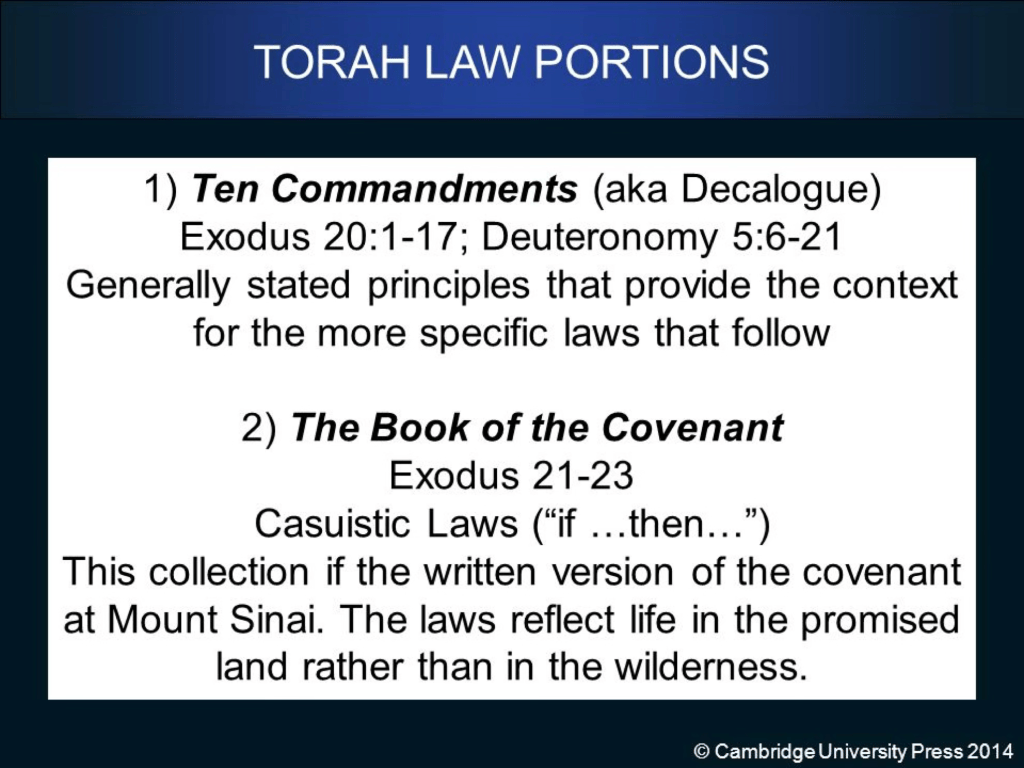
Chapters 21-23 are called the “book of the covenant” (Exodus 24:7). Here’s a great AI summary of the book of the covenant. The book contains an ancient set of practical case laws given by God to Israel at Mount Sinai to show how the Ten Commandments apply to everyday life.
Exodus 21: Laws on People and Injury
- Servants: Rules for Hebrew and foreign servants, including freedom after six years of service.
- Violence: Punishments for murder, accidental manslaughter, and striking parents.
- Personal Injury: Rules for physical fights and harm to pregnant women, establishing proportional justice (lex talionis, or “an eye for an eye”).
- Animal Liability: Owner responsibility if a dangerous ox gores someone.
Exodus 22: Property, Theft, and Moral Duty
- Theft and Restitution: Rules requiring thieves to pay back stolen property, sometimes multiple times.
- Property Damage: Responsibility for fires spreading to a neighbor’s field or livestock eating crops.
- Social Morality: Laws on not mistreating vulnerable people like widows, orphans, and strangers.
- Moral Purity: Strict prohibitions against sorcery, bestiality, and idol worship.
Exodus 23: Justice, Sabbaths, and Feasts
- Fair Justice: Warnings against taking bribes, spreading false rumors, or ganging up to pervert justice. Even enemies must receive basic help with their stray animals.
- Sabbath Year: Letting farm fields rest every seventh year so the poor and wild animals can eat.
- Weekly Sabbath: Commanding a day of rest for workers and animals.
- Three Annual Feasts: The Feast of Unleavened Bread, the Feast of Harvest, and the Feast of Ingathering, where all males must appear before God.
Then an “epilogue” follows in Exodus 23:20-33. Exodus 23:20–33 serves as the concluding epilogue to the Book of the Covenant, outlining God’s promises, warnings, and instructions as Israel approaches the Promised Land.
Divine Guidance and the Angel
- The Angel’s Role: God promises to send an angel ahead of Israel to guard them on the way and bring them into Canaan.
- Call to Obedience: The people must listen to the angel’s voice and not rebel, because God’s name is in him and rebellion will not be pardoned.
Warnings Against Idolatry
- Reject False Gods: Israel is strictly commanded not to bow down to, serve, or imitate the religious practices of the local inhabitants (Amorites, Hittites, Perizzites, Canaanites, Hivites, and Jebusites).
- Destroy Idols: The Israelites must utterly overthrow these nations and break their sacred pillars in pieces.
- Avoid Snares: Foreign nations cannot remain in the land, or they will tempt Israel into idolatry.
Promises of Blessing and Victory
Gradual Conquest: God will drive out the enemy nations “little by little” so the land does not become desolate and overrun by wild animals before Israel’s population grows enough to occupy it.
Provision and Health: Serving the Lord brings divine blessing on their bread and water, freedom from sickness, and fertile land where none are barren. Blessings in the old covenant are pretty much physical in nature.
Moses told the people all these words and twice the people said, ““All the words which the Lord has spoken we will do!” (Exodus 24:3). Of course, they did not obey the Lord’s words in the future. Moses had them offer bulls as a sacrifice to God and then sprinkled half the blood on the altar and half on the people, calling it the “blood of the (old) covenant”. The book of Hebrews tells us that blood of animals was insufficient to provide eternal forgivenss of sins, and that the blood of Jesus was the blood of the new covenant that would forgive sins once for all time.
Then something strange happened. Exodus 24:9 Then Moses went up with Aaron, Nadab and Abihu, and seventy of the elders of Israel, 10 and they saw the God of Israel; and under His feet there appeared to be a pavement of sapphire, as clear as the sky itself. 11 Yet He did not stretch out His hand against the nobles of the sons of Israel; and they saw God, and they ate and drank.” God would later tell Moses, “You cannot see My face, for no man can see Me and live!” (Exodus 33:20) so it is unusual that these men “saw God” and lived. Then Moses went up on Mt Sinai alone and stayed there 40 days. The people looked on as the glory of the Lord appeeared as a burning fire on top of the mountain. Chapter 25 begins the detailed instructions for building the tabernacle and the furnishings that God gave Moses during those 40 days. So we will hold off on discussing the tabernacle since it is covered in the next day reading. BTW Nadab and Abihu were priests who were killed by God for offering strange fire in Numbers 10.
Hope you are keeping up with the daily reading and blog articles. I am enjoying writing them for you and hope they are helpful.

