
These chapters are mainly about the 10 plagues.
THE NAME OF GOD. But first read Exodus 6:2-9. Have you ever heard the song, “El Shaddai” by Amy Grant. I suggest you stop and listen to it. You will hear what El Shaddai did for Abraham.
Exodus 6:2 God spoke further to Moses and said to him, “I am the Lord; 3 and I appeared to Abraham, Isaac, and Jacob, as God Almighty (El Shaddai), but by My name, Lord, I did not make Myself known to them. God was known by the patriarchs in Genesis (Abraham, Isaac, Jacob) by the name “El Shaddai” (Genesis 17:1-2; 28:3; 35:11; 43:14). It means “God Almighty” and emphasized the power of God. But beginning with the exodus and founding of the nation of Israel God wanted Israel to call him “YHWH” or “Yahweh” (ancient Hebrew writing only used consonants so the vowels were added later). YHWH comes from the root verb “to be”. At the burning bush (Exodus 3) Moses said, “They may say to me, ‘What is His name?’ What shall I say to them?” 14 God said to Moses, “I AM WHO I AM”; and He said, “Thus you shall say to the sons of Israel, ‘[i]I AM has sent me to you.’” “I AM” is from hayah: To be, become, come to pass, exist, happen. The self-designation “I AM” (’ehyeh) proclaims God’s eternal, self-existent being. The generic word for “God” is “Elohim” and can be used even of false gods. But Yahweh is a personal, intimate name that can only be used of the one true God of Israel. It is a special, sacred name given to Israel (and to us). Out of reverence, ancient Jewish readers stopped pronouncing the literal four-letter Hebrew name for God (YHWH, called the Tetragrammaton). When reading aloud, they substituted the word Adonai (meaning “Lord”). (Adonai is also in the Amy Grant song “El Shaddai”). All Caps Format: Most English Bibles (like the ESV, NIV, and NRSV) follow this tradition by printing LORD in all-capital or small-capital letters whenever the original Hebrew text has YHWH. Yahweh is translated as Kyrios, the Greek word for “Lord,” throughout the New Testament. The term “Jehovah” only began to be used by Christian scholars in the middle ages, a Latinized word they created to call Yahweh. Only the King James uses “Jehovah”.
So the name Yahweh has a special significance. When you see God called “LORD” in the New Testament, you need to remember that is Yahweh, God’s special name. Here’s a great song with a lot of the names of God. Often Yahweh would be combined with a 2nd word like Yahweh Jireh (the Lod provides), or Yahweh Rophe (the Lord who heals) and you will hear some of those names.
Moses revealed this special name of God to the slaves and gave them God’s promise to deliver them from slavery and take them to the promised land. Exodus 6:9 So Moses spoke thus to the sons of Israel, but they did not listen to Moses on account of their despondency and cruel bondage.
Life Lesson: It is often hard to believe in God’s promises when you are “despondent”, depressed, hurting. You are taking chemo for cancer, you are in terrible pain every day from some permanent health issue, your marriage is fallling apart, your child is on drugs, you are losing your job, you can’t pay your bills, your health insurance won’t pay for a needed surgery, you are facing a lawsuit, you are burnt out taking care of again prents, etc. The preacher quotes all those verses about how trials can make you stonger, more mature or complete, that you should find “joy” in your trials (James 1:3-5). But you don’t really “listen on account of your depondency”. But it’s God’s promises that keep us going when you hit bottom and don’t think that you can go on trying. Sometimes, the situation is hopeless in this life, and the only promise that matters is the promise of eternal life, away from all the struggles of this life. Paul said, 17 For momentary, light affliction is producing for us an eternal weight of glory far beyond all comparison, 18 while we look not at the things which are seen, but at the things which are not seen; for the things which are seen are temporal, but the things which are not seen are eternal.” (2 Corinthians 4:17-18) Read about his “momentary light affliction” in 2 Corinthians 11:23-29. Sounds pretty heavy, not light, to me. But he says it is nothing compared to what eternal glory will be after we die.
THE TEN PLAGUES. Exodus 6: 10 Now the Lord spoke to Moses, saying, 11 “Go, tell Pharaoh king of Egypt to let the sons of Israel go out of his land.” 12 But Moses spoke before the Lord, saying, “Behold, the sons of Israel have not listened to me; how then will Pharaoh listen to me, for I am unskilled in speech?” 13 Then the Lord spoke to Moses and to Aaron, and gave them a charge to the sons of Israel and to Pharaoh king of Egypt, to bring the sons of Israel out of the land of Egypt.” God made Aaron to be Moses’ spokesman (prophet). Moses went to Pharoah, did the signs God had given him at the burning bush (rod becoming a snake, hand turning leprous) but Pharoah refused to let the slaves go, even for a 3 day feast celebration. His response: Exodus 5:2 But Pharaoh said, “Who is the Lord that I should obey His voice to let Israel go? I do not know the Lord, and besides, I will not let Israel go.” So God began the 10 plagues on Egypt. Each plague was directed at one (or more) of the gods of Egypt as shown in this chart. God is showing his power over all the many gods of Egypt. By the time God is through with Pharoah, he will know “who Yahweh is”.
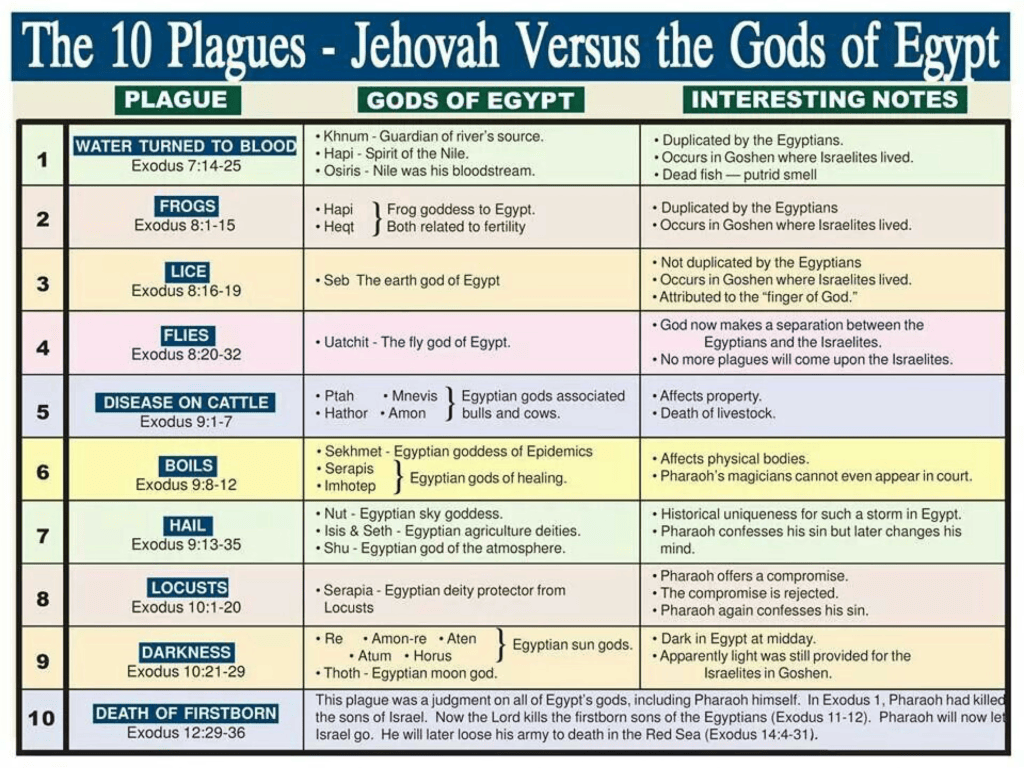
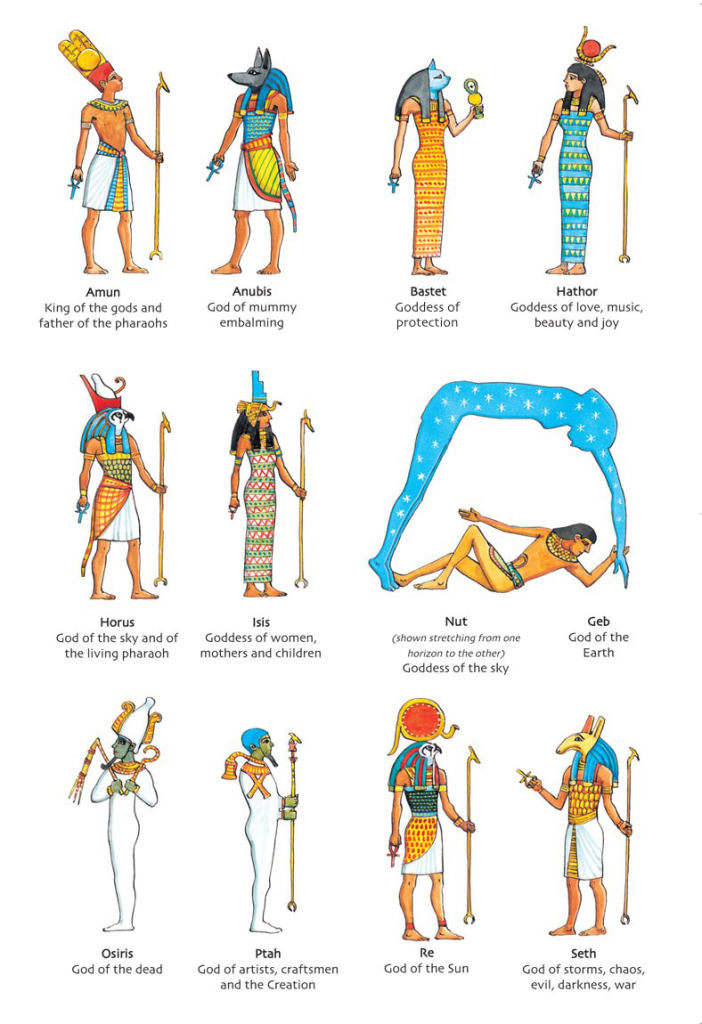
Ra, the god of the sun, for example, can’t stop the darkness plague. Nut, the goddess of the sky, can’t stop the hail plague. BTW Rehab and the inhabitants of Jericho saw clearly the impact of the 10 plagues. She told the spies that the Canaanites heard about the 10 plagues and were terrified of the power of the God of the Israelites. BTW God doesn’t have to repeat these plagues to show his power over the false gods of other nations, like the gods of the Babylonians or the Assyrians or the Moabites or the Philistines. When God was announcing the last plague, the death of the firstborn, He said, “For I will go through the land of Egypt on that night, and will strike down all the firstborn in the land of Egypt, both man and beast, and against all the gods of Egypt I will execute judgments—I am the Lord” (Exodus 12:12).
DID GOD HARDEN PHAROAH’S HEART OR DID PHAROAH HARDEN HIS HEART? It says that Pharoah “hardened” his heart and would not let the slaves go free (until the last plague and his. firstborn died). But it also says that “the Lord hardened Pharoah’s heart”.
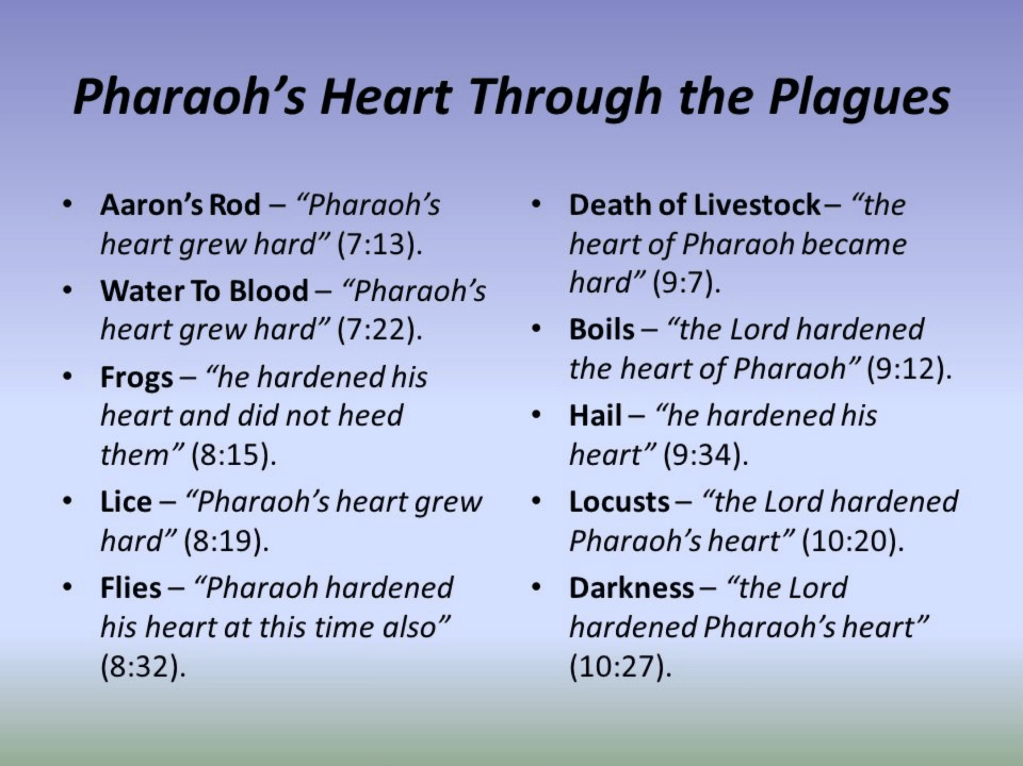
So which is it? Both. Did Pharoah have a free will choice of whether to let the slaves go free? Yes, although Calvinism falsely teaches that things are predestined with no free will choices. Arminianism correctly teaches that all men can make their own free will choices in matters of faith. God doesn’t always allow us to choose our circumstances, but He always allows us to choose our response. So Pharoah had a choice and he chose to harden his own heart. But did God harden his heart also? Yes. How did God do that? He did not somehow make Pharoah unable to choose to obey God. Pharoah was not a “totally depraved” sinner (the T in TULIP) as Calvinism teaches, unable to choose to obey God. Calvinism teaches that sinners are not able to believe, that only a select few whom Jesus died for (the L in TULIP) are predestined to be saved (the U in TULIP), that God has to send His Spirit on those few to enable them to be believe and they can’t resist that Spirit (The I in TULIP). It would be hard for me to believe in the God of Calvinism whom could choose to enable and basically force all sinners to believe and be saved but who arbitraarily selects a few and leaves the rest to burn in hell. Pharoah was free to choose whether to obey God or not, and he chose to disobey. Indeed God sent the plagues that He knew would harden Pharoah’s heart. Thus, indirectly God hardened Pharoah’s heart by sending the plagues. Romans 12:17 For the Scripture says to Pharaoh, “For this very purpose I raised you up, to demonstrate My power in you, and that My name might be proclaimed throughout the whole earth.” 18 So then He has mercy on whom He desires, and He hardens whom He desires.” Someone might object: Romans 9:19 You will say to me then, “Why does He still find fault? For who resists His will?” In other words, if God hardens someone’s heart, then how can that person be held responsible? Well God has the right to harden someone’s heart, but he never violates their free will to choose whether to obey Him or not. So Paul adds, Romans 9:20 On the contrary, who are you, O man, who answers back to God? The thing molded will not say to the molder, “Why did you make me like this,” will it? God has the right to use someone’s hard heart to accomplish His will, and that is what He did with Pharoah. That doesn’t make the person no responsible for his evil choices.
That covers the 10 plagues. We will cover the Passover and the exodus next lesson.

