
Notice that this is giving thanks for the Ephesian believers b/c Paul had heard of their faith and love. He is thankful that they have believed and remained faithful even in a pagan city like Ephesus where Diana was worshipped (Acts 18).
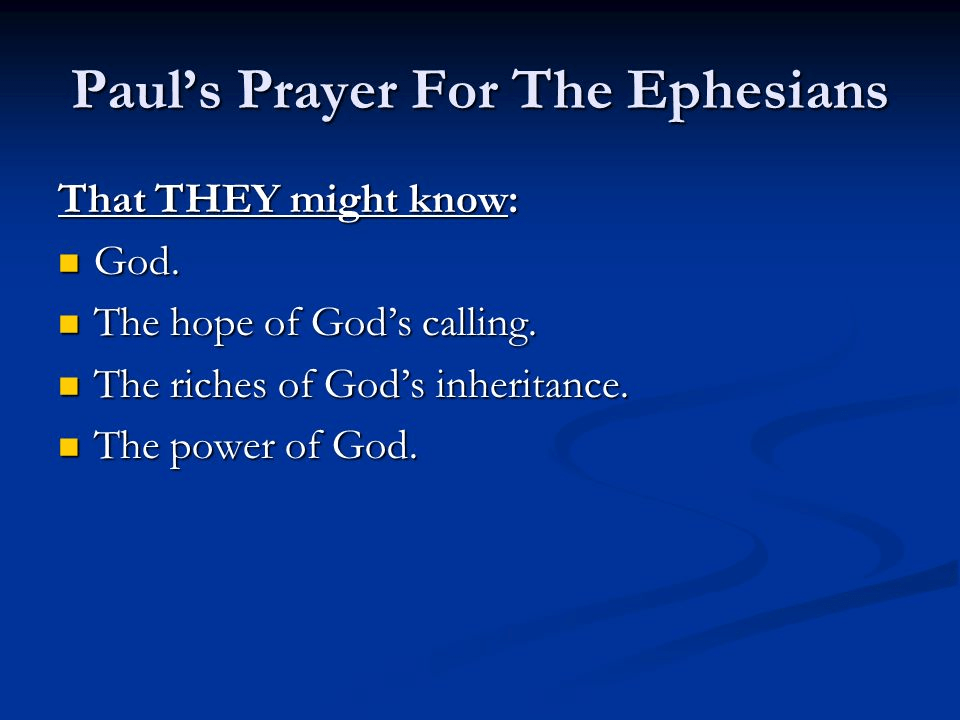
He give these thanks in unceasing prayer and also prays that God will give them the “Spirit of revelation and wisdom and knowledge of him” having “their eyes enlightened to know 3 things:
1 The hope to which he has called you, i.e. the hope of eternal life.
2 The riches of his glorious inheritance in the saints
3 The immeasurable greatness of his power toward us who believe.
This power is in accordance with God’s power when he raised Jesus from the dead, seated him at His right hand “in the heavenly places” far above all spiritual powers of darkness and made him head over the church, which is his body. This last few verses will set the tone for God’s power raising us from the spiritual dead and seating us with Jesus at the right hand of God in the heavenly places.
Q: What does “having the eyes of your heart enlightened” mean in Ephesians 1:18? (Does the human heart have spiritual senses that are dormant but can be awakened by God?)
We may be overlooking certain obvious truths here. Physiologically, the human heart consists of nothing more than “a hollow organ that pumps blood through the circulatory system by rhythmic contraction and dilation.”[1] Therefore, perhaps we might recognize references to “the heart” as the predispositions, inclinations and traits of personality that are characterized by our minds, at the core of our consciousness.
Naturally, the mind and the heart are two separate aspects of human nature; we shouldn’t allow metaphorical or poetic language to overwhelm our common sense. With that in mind, we can proceed a bit further metaphorically as we identify the “biblical heart.” Dr. James Burton Coffman has observed:
“According to the Scriptures, it is ‘the heart’ that imagines (Genesis 6:5), understands (Matthew 15:13), reasons (Mark 2:8), thinks (Luke 9:47), believes (Romans 10:9), and loves (1 Peter 1:22). These passages are more than enough to identify the Scriptural ‘heart’ as the mind or seat of the intelligence” (emphasis added).
Interestingly, the “blindness of the heart” is found in Ephesians 4 (KJV).
Ephesians 4:18, KJV: “[Gentiles having] the understanding darkened, being alienated from the life of God through the ignorance that is in them, because of the blindness of their heart…”
Suppose we illuminate this verse a bit by relying on key phrases in the NASB, beginning at verse 17 for context:
Ephesians 4:17-18: “So this I say, and affirm together with the Lord, that you walk no longer just as the Gentiles also walk, in the futility of their mind, being darkened in their understanding, excluded from the life of God because of the ignorance that is in them, because of the hardness of their heart…” (emphasis added).
Here, the “eyes of [the] heart” constitute our intellect and mental, spiritual recognition of other-worldly truths. Paul’s reference to the Gentiles’ “ignorance” is helpful toward the remaining clause “hardness of their heart.” (“blindness” in KJV). As we put all the pieces together, we should understand that the phrase “eyes of the heart” is merely our conscious recognition of that which Satan labors so arduously to suppress:
2 Corinthians 4:3-4: “And even if our gospel is veiled, it is veiled to those who are perishing, in whose case the god of this world has blinded the minds of the unbelieving so that they might not see the light of the gospel of the glory of Christ, who is the image of God.”
Paul further relates his concern over the veil of duplicity that clouds the minds of the faithless:
2 Corinthians 11:3: “But I am afraid that, as the serpent deceived Eve by his craftiness, your minds will be led astray from the simplicity and purity of devotion to Christ” (emphasis added).
The biblical heart is clearly a vital aspect of our intellect, recognition of spirit truths, and the faithful humility we exercise in Christ.
According to the Bible, Elisha’s servant’s eyes were opened by the Lord in 2 Kings 6:17:
- The king of Syria sent an army to capture the prophet Elisha in the city of Dothan.
- Elisha and his servants were surrounded by the army at night.
- The servant asked Elisha, “Oh, my lord, what shall we do?”.
- Elisha replied, “Don’t be afraid. Those who are with us are more than those who are with them”.
- Elisha prayed, “O LORD, open his eyes so he may see”.
- The Lord opened the servant’s eyes, and he saw the hills full of horses and chariots of fire all around Elisha.
Elisha then prayed to the Lord to make the Aramean army blind, which he did. Elisha led the Arameans to Samaria, telling them, “This is not the way, nor is this the city. Follow me and I will lead you to the man whom you are seeking”.
Q: The spiritual blessings are found in “the heavenly places” (1:3). What are the “heavenly places”? 1:20 Jesus was raised to sit in the heavenly places.
This phrase is used 5 times in Ephesians: 1:3,20; 2:6; 3:10; 6:12. In 2:6, the saved are seated with Christ in the heavenly places, so it must be a spiritual realm that we are in while on earth and not just a future place in heaven somewhere in the future after we die. The blessings are “spiritual” in nature, not physical. We are living in a spiritual world that can’t be seen. It is a spiritual world in which both good and bad powers and authorities exist and work (6:12). It is a spiritual realm where Christ has defeated all the evil powers that can rule over us.
I believe it is a spiritual realm all around us, right now. I believe it is where my mother and father are, perhaps even totally aware of what is happening on earth.
Doesn’t this make you just feel different about everything you do? Can you see yourself living in a spiritual realm as in an out-of-body experience at all the things happening in this world?
Q: Do you believe that faithful Christians immediately go into another phase of these heavenly places when they die? If so, are they aware of what’s happening on earth? If so, can they be sad over bad things on earth? Does the phrase “no tears in heaven” apply here?
A couple of key verses.
John 11:24 Martha said to him, “I know that he will rise again in the resurrection on the last day.” 25 Jesus said to her, “I am the resurrection and the life.[d] Whoever believes in me, though he die, yet shall he live, 26 and everyone who lives and believes in me shall never die.
The OT dead were kept in hades until they were judged (Daniel 12:1,2) and given their final reward or punishment. That is not where the dead in Christ go. We are able to go be with Jesus immediately after death.
Revelation 21:1 Then I saw a new heaven and a new earth, for the first heaven and the first earth had passed away, and the sea was no more. 2 And I saw the holy city, new Jerusalem, coming down out of heaven from God, prepared as a bride adorned for her husband. 3 And I heard a loud voice from the throne saying, “Behold, the dwelling place of God is with man. He will dwell with them, and they will be his people,[b] and God himself will be with them as their God. 4 He will wipe away every tear from their eyes, and death shall be no more, neither shall there be mourning, nor crying, nor pain anymore, for the former things have passed away.”
This describes the new Jerusalem, i.e. the church, on earth after the old Jerusalem has been destroyed. It describes God dwelling in his people and his people dwelling in God, right here on earth, now. The “no more tears, no death, no crying, no pain” etc. is right now on earth for Christians. This is spiritual joy and life even though we still cry and die physically. These verses do not refer to life after death although they would also describe life after death. But they would not preclude sadness in heaven after death.
 Nicky's Notes