
2 Timothy 4:1 I do fully testify, then, before God, and the Lord Jesus Christ, who is about to judge living and dead at his manifestation and his reign —2 preach the word; be earnest in season, out of season, convict, rebuke, exhort, in all long-suffering and teaching, 3 for there shall be a season when the sound teaching they will not suffer, but according to their own desires to themselves they shall heap up teachers — itching in the hearing, 4 and indeed, from the truth the hearing they shall turn away, and to the fables they shall be turned aside. 5 And thou — watch in all things; suffer evil; do the work of one proclaiming good news; of thy ministration make full assurance,
Another one of those “full preterism” verses in 4:1. Jesus is “about to” (mello, always means about to happen or about to be at a place). https://parousiafulfilled.com/mello-about-to-happen/index.php#:~:text=So%2C%20whenever%20something%20was%20%E2%80%9Cabout,(Matt%2017%3A12). For example For example, when Jesus prophesied his coming crucifixion, he told his disciples that the Son of Man “is about to” [Gk: μέλλει : mellei] suffer at the hands of certain men (Matt 17:12). Matthew 3:7 – But when he saw many of the Pharisees and Sadducees coming to his baptism, he said to them, “You brood of vipers! Who warned you to flee from the wrath to [Gk: μελλούσης : mellouses : which is about to] come (i.e. the judgment on the Jews in 70 AD). But mello is used in several eschatological passages like 2 Timothy 4:1 (a judgment of the living and the dead passage at his manifestation (epiphaneia: Appearing, Manifestation; used in 2 Thess 2:8 NAS: and bring to an end by the appearance of His coming) so this is a 2nd coming judgment passage. Matthew 16:27 – the Son of Man is going to i [Gk: μέλλει : mellei : is about to] come with his angels in the glory of his Father, and then he will repay each person according to what he has done.” Acts 17:31 – because he has fixed a day on which he will i [Gk: μέλλει : mellei : is about to] judge the world in righteousness by a man whom he has appointed; and of this he has given assurance to all by raising him from the dead.”Check the site just given for more uses. Luke 21:36 – But stay awake at all times, praying that you may have strength to escape all these things that are going to i [Gk: μέλλοντα : mellonta : are about to] take place, and to stand before the Son of Man.” Luke 21 is all about the end of the age in 70 AD and the destruction of the city and the temple in 70 AD, so the use of mello in 21:36 makes sense. Revelation 1:19 YLT – Write the things that thou hast seen, and the things that are, and the things that are about to [Gk: μέλλει : mellei : is (are) about to] iii ) come after these things.” Revelation was written in about 63 AD about things “shortly to take place” (Rev 1:1-3), so mello makes sense here also.
Preach (kérussó: To proclaim, to preach, to herald) the word. The verb κηρύσσω (kérussó) is used in the New Testament to describe the act of proclaiming or announcing a message publicly. It often refers to the preaching of the Gospel. That is something an “evangelist” like Titus would do, to preach the gospel (good news) message to sinners. We call our sermons “preaching”, but technically our sermons are just teaching (occasionally preaching the gospel good news of the death, burial, and resurrection of Jesus and how to be saved), but not preaching. Semantics I guess. I’m sure Titus preached the basic gospel message to unconverted sinners everywhere he could. There would be a season when people will not listen to sound (hugiainó: To be sound, to be healthy, to be well; the word we get “hygiene” from) teaching. They will have “itching ears” and will “heap up teachers” that will scratch their itching ears. (AI) “In the Greco-Roman world, rhetoric and philosophy were highly valued, and speakers often tailored their messages to please their audiences. This cultural context helps illuminate the metaphorical use of “knéthó” in the New Testament, where it warns against the tendency to seek out teachings that align with personal desires rather than divine truth.”
The number of false prophets and false teachers is amazing. Marshall Applewhite of Heaven’s Gate cult; Jim Jones of People’s Temple (Guyanaa tragedy). David Karesh of Branch Davidians cult. Charles Manson and the Manson Family. David Berg of the Children of God cult. Bhagwan Shree Rajneesh and the Rajneeshpuram,cult. Here is a site that discusses each of these false prophets and cults. https://www.teenvogue.com/story/most-famous-cults-history These are just a few of the many! Add Joseph Smith of the Mormons. Ellen G. White of the 7th Day Adventists. Rutherford and Russell of the Jehovah’s Witnesses. Mary Baker Eddy of the Christian Science. L Ron Hubbard and Scientology. Warren Jeffs of the Fundamentalist Church of Jesus Christ of Latter Day Saints. That list doesn’t include the many, many false prophets who falsely predicted dates for the 2nd coming.
But what is amazing to me is why so many people can be drawn to these false prophets. These false prophets and cult leaders obviously had charismatic appeal to people. But what was it that caused so many to be drawn to Joseph Smith and his Book of Mormon. Or to Marshall Applewhite and to Jim Jones, joining in mass suicide. (AI) “Cults prey upon the vulnerable among us, such as teenage runaways, drug addicts, abuse survivors, those who have lost someone close to them through death or a breakup, those suffering from insecurity or mental health issues, or anyone who feels disconnected from society.” But many are just well meaning people who like the personality and teachings of some preacher. Surprisingly the majority of those drawn to cults have higher education. Most have less religious and spiritual upbringing. Again it just amazes me that so many people would fall into the false teaching of cults and cult leaders. I’m not sure what the “fables” in 4:4 are that the false teachers are teaching, but the fables of the Book of Mormon would to me be a prime example. There are 17 million Mormons worldwide.
Next Paul turns to his expected imminent death. 2 Timothy 4:6 For I am already being poured out as a drink offering (spendó: To pour out as a drink offering, to make a libation, and the time of my departure has come. 7 I have fought the good fight, I have finished the course, I have kept the faith; 8 in the future there is reserved for me the crown of righteousness, which the Lord, the righteous Judge, will award to me on that day; and not only to me, but also to all who have loved His appearing.” The Law had drink offerings (Exodus 29:40), libations poured out in worship to God. His death would be like that. The Christian life is a constant battle against sin and evil. Paul fought the good fight. It is a race filled with obstacles and difficulties. Paul finished the course. It is life filled with doubt and bad things that challenge your faith in God. Paul kept the faith. He would get his crown stephanos: Crown). (AI) “In the New Testament, “stephanos” primarily refers to a crown or wreath, symbolizing victory, honor, or reward. Unlike a royal diadem, which signifies sovereignty, a “stephanos” is often associated with the wreath awarded to victors in athletic contests or given as a mark of honor and celebration. It is used metaphorically to describe the eternal rewards and honors bestowed upon believers by God.”
Next is Paul’s personal concerns. Remember that this is last winter, spent in a Roman dungeon. He wants Timothy to come to him in prison soon,, before he dies. He is sending Tychicus to Ephesus, probably with this 2 Timothy letter, to relieve Timothy in his work there so that Timothy can come see Paul in prison. He is cold and wants his overcoat he left in Troas. He feels deserted by many. He is lonely, having only Luke with him at the time he wrote. We wonder why he left his books and parchments in Troas, but he wants Timothy to bring them. We are happy to see that Paul says that Maark is useful him for service. We assume that is John Mark who deserted Paul and Barnabas on the 1st missionary journey. That caused a big argument between Paul and Barnabas over whether to take Mark with them on the 2nd journey as Paul refused to take him. Paul and Barnabas split up after that, with Paul taking Silas on his 2nd journey and Barnabas taking John Mark with him on a journey somewhere. In his hour of need, Demas deserted Paul, having loved this present world. Maybe that means that Demas was afraid to stick around with Paul in prison for fear that he also might end up in prison. He was deserted by all at his first defense (possibly a trial during his 2nd imprisonment in Rome). Can we even fathom how Paul felt in his last few months in a cold dungeon in Rome? If you were writing your last letter before you died, who would you write to and what would you say?
Paul did not expect to get out of prison this time like he did after house arrest in Acts 28. He expected to be released from the 2 year house arrest of Acts 28. He wrote Philippians during that 2 year house arrest, his 1st imprisonment, and wrote Philippians 1:21 For to me to live is Christ, and to die is gain. 22 If I am to live in the flesh, that means fruitful labor for me. Yet which I shall choose I cannot tell. 23 I am hard pressed between the two. My desire is to depart and be with Christ, for that is far better. 24 But to remain in the flesh is more necessary on your account. 25 Convinced of this, I know that I will remain and continue with you all, for your progress and joy in the faith, 26 so that in me you may have ample cause to glory in Christ Jesus, because of my coming to you again.” Not so this time in his 2nd imprisonment. But even if he died in prison this time he expected to be brought safely into the heavenly kingdom (i.e. wherever eternal life is).
2 Timothy 4: 9 Make every effort to come to me soon; 10 for Demas, having loved this present world, has deserted me and gone to Thessalonica; Crescens has gone to Galatia, Titus to Dalmatia. 11 Only Luke is with me. Take along Mark and bring him with you, for he is useful to me for service. 12 But I have sent Tychicus to Ephesus. 13 When you come, bring the overcoat which I left at Troas with Carpus, and the books, especially the parchments. 14 Alexander the coppersmith did me great harm; the Lord will repay him according to his deeds. 15 Be on guard against him yourself too, for he vigorously opposed our teaching.
16 At my first defense no one supported me, but all deserted me; may it not be counted against them. 17 But the Lord stood with me and strengthened me, so that through me the proclamation might be fully accomplished, and that all the Gentiles might hear; and I was rescued out of the lion’s mouth. 18 The Lord will rescue me from every evil deed, and will bring me safely to His heavenly kingdom; to Him be the glory forever and ever. Amen.
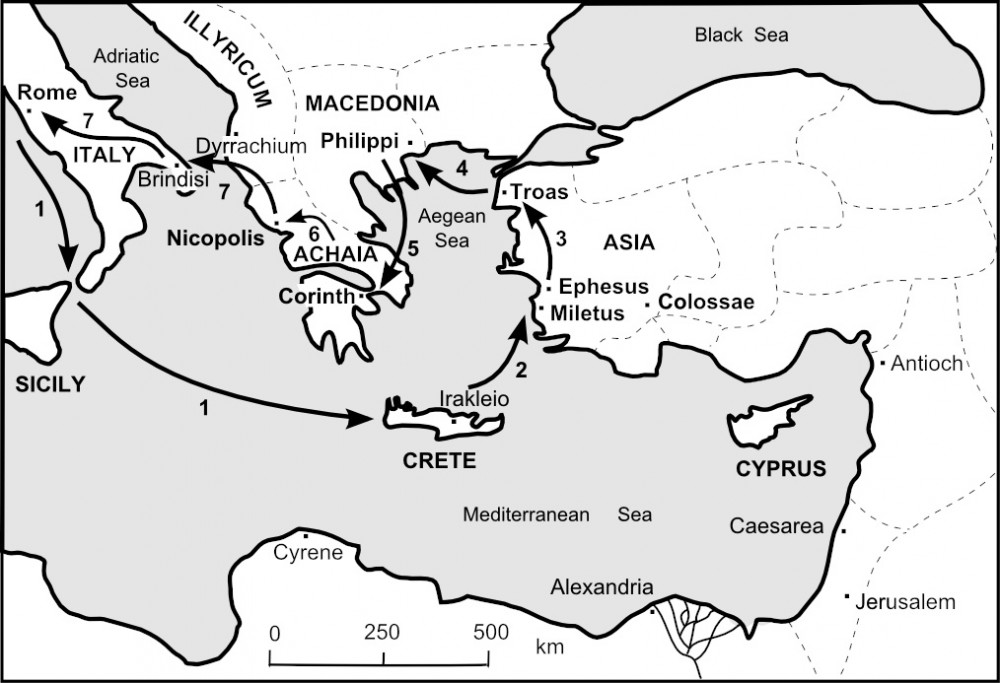
A reminder of Paul’s possible 4th journey after he was released from 2 years in house arrest in Rome (Acts 28). Notice Troas which is where he left his overcoat, books, and parchments. He left Titus in Crete and Timothy in Ephesus. He went through Troas where he left his overcoat and books and parchment. He planned to spend the winter in Nicopolis (Titus 3:12 When I send Artemas or Tychicus to you, do your best to come to me at Nicopolis, for I have decided to spend the winter there) and apparently did not make it there before being arrested and carried to Rome for his last winter during which he wrote 2 Timothy. He would have written the letter to Titus and the 1st letter to Timothy probably from Macedonia on his way to Nicolopis.
If you just had to try to read Paul mind as he is about to die, what do you think were his main concerns? 1 Timothy had a lot of instructions for Timothy to teach to the church about elders, deacons, roles of men and women members, widows, and false teachers. But 2 Timothy is more about instructions to Timothy to not be ashamed of Paul in prison, to be strong, to peach the word and rebuke false teachers. It is more personal as Paul mentioned Timothy’s mother and grandmother. He is very concerned about Timothy carrying on the work.
That concludes the study of 2 Timothy. Hope you enjoyed it.
 Nicky's Notes