
I Peter 1:1 Peter, an apostle of Jesus Christ,
To those who reside as strangers, scattered throughout Pontus, Galatia, Cappadocia, Asia, and Bithynia, who are chosen 2 according to the foreknowledge of God the Father, by the sanctifying work of the Spirit, to obey Jesus Christ and be sprinkled with His blood: May grace and peace be multiplied to you.”
Peter wrote this letter to the Jewish Christians scattered (diaspora: Dispersion, Scattering) over several countries. That would be the Jewish diaspora: “The term diasporas is only ever applied to ethnic Jews in biblical texts (John 7:35; James 1:1; in the Apocrypha, 2 Maccabees 1:27; Judith 5:19), so if it were taken to mean Gentiles in 1 Peter 1:1, it would have to be a remarkable exception. It certainly wouldn’t be a natural reading of the verse.” (Derek Demars) Some say 1 Peter 2:10 shows that the letter was written to Gentile Christians, but I refer you to my article on 1 Peter 2:10-17 to discuss that verse which I do not think means Peter is writing to Gentile Christians. Also remember that Peter is the “apostles to the Jews” (Galatians 2), so it is more likely that Peter would be writing to the Jewish Christians among the Jewish diaspora than to Gentile Christians scattered. Gentile Christians were never scattered. The Jewish diaspora were the “chosen” remnant of the Jewish believers who accepted Jesus as the Messiah. They were sanctified in the Spirit and sprinkled with the blood of Jesus. John 7:35 NAS: to go to the Dispersion among the Greeks.
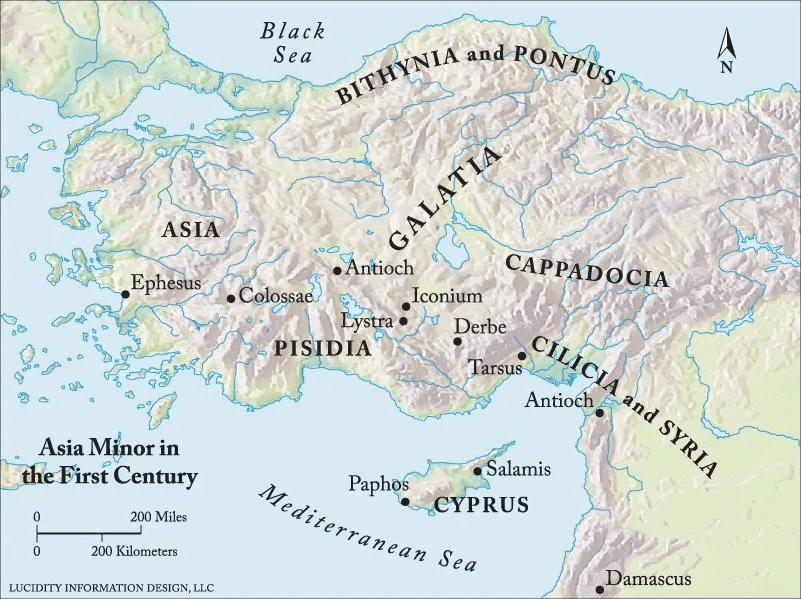
Usually we speak of the diaspora as the scattering of the Jews after the destruction of the temple in 70 AD, but Wikipedia says this: “A Jewish diaspora existed for several centuries before the fall of the Second Temple in 70 CE. The Jewish diaspora in the second Temple period (516 BCE – 70 CE) was created from various factors, including through the creation of political and war refugees, enslavement, deportation, overpopulation, indebtedness, military employment, and opportunities in business, commerce, and agriculture.[7] Before the middle of the first century CE, in addition to Judea, Syria and Babylonia, large Jewish communities existed in the Roman provinces of Egypt, Crete and Cyrenaica, and in Rome itself.[8] In 6 CE the region was organized as the Roman province of Judaea.” All Jews in the diaspora suffered wherever they were scattered, but Peter was writing to Jewish Christians who were scattered before 70 AD for whatever reasons to Cappadocia, Asia, Bithynia (Pontus) and Galatia. Peter died in 65 AD, so he wrote I Peter before that.
Much of 1 Peter deals with the suffering and trials that the diaspora faced. So let’s look at the sections that deal with their suffering.
1 Peter 1:3 Blessed be the God and Father of our Lord Jesus Christ, who according to His great mercy has caused us to be born again to a living hope through the resurrection of Jesus Christ from the dead, 4 to obtain an inheritance which is imperishable, undefiled, and will not fade away, reserved in heaven for you, 5 who are protected by the power of God through faith for a salvation ready to be revealed in the last time. 6 In this you greatly rejoice, even though now for a little while, if necessary, you have been distressed by various trials, 7 so that the proof of your faith, being more precious than gold which perishes though tested by fire, may be found to result in praise, glory, and honor at the revelation of Jesus Christ; 8 and though you have not seen Him, you love Him, and though you do not see Him now, but believe in Him, you greatly rejoice with joy inexpressible and full of glory, 9 obtaining as the outcome of your faith, the salvation of your souls.
Several points from this section.
1) Christians have a “living” hope b/c of the resurrection of Jesus from the dead. Why “living”? B/c our Savior is not still dead like other religioius leaders of world religions, like Mohamed, Buddha, Zoroaster, the Bab, etc. Our Savior still lives to be our HIgh Priest forever. Also the resurrection of Jesus is the ultimate proof that He is the Son of God and Savior. No other world religion can offer such irrefutable proof of its validity.
2) The diaspora Christians had an imperishable inheritance, a salvation “ready to be revealed in the last time”. This indicates a future salvation of some kind. Vs 9 also: “9 obtaining as the outcome of your faith, the salvation of your souls.” That would be a future salvation of some kind. But weren’t they already saved? Of course they were. So what is this salvation that is still in their future? Is it heaven? Could be. But it could be the same “immortality” that Paul said believers would receive at the resurrection of the dead which he said some of those he was writing to would still be alive to receive (1 Corinthians 15:50-54). That would have to be the resurrection of the dead at 70 AD, predicted by Daniel 12:1-2 to happen at the end of the Jewish Age in 70 AD. Paul said in Acts 24:15 that there “is about to be (mello, which always in the NT means “about to happen”) a resurrecton of the righteous and the unrighteous just as the Law and Prophets predicted. This is the “already, not yet” phase of salvation for the transiton Christians (those living between 30AD and 70AD): already saved but not yet received immortality until the resurrection in 70 AD.
3) They could rejoice even in he midst of “distressing” (lupeó: To grieve, to cause sorrow, to distress) suffering and trials, looking forward to that future salvation.
4) A tested, proven (dokimion: Testing, trial, proving) by enduring trials faithfully would result in “praise, glory, and honor at the revelation of Jesus Christ (i.e. his 2nd coming). Again, that is a reward in their future. While most say this 2nd coming revelation (apokalupsis: Revelation, unveiling, disclosure) of Jesus, full preterism would say that this 2nd coming was at 70 AD. 1 Peter 4:13 calls this 2nd coming a “revelation of his glory”. So what is the “glory” that these diaspora believers would receive at 70 AD if they remained faithful? Romans 8:18 For I reckon that the sufferings of the present time [are] not worthy [to be compared] with the glory about to be (mello) revealed in us. 21 that also the creation itself shall be set free from the servitude of the corruption to the liberty of the glory of the children of God; 23 And not only [so], but also we ourselves, having the first-fruit of the Spirit, we also ourselves in ourselves do groan, adoption expecting — the redemption of our body; (Young’s Literal Translation). Notice that this glory to be received by believers was “about to be revealed”. Many try to make this some, still in our future, restoration of the created earth to its Garden of Eden state, but this event is “about to” happen in the lifetime of those Paul is writing to, so it can’t be something in our future. So this must refer to the 2nd coming in 70 AD when God would destroy the temple and send the Romans to kill 1 million evil Jews in Jerusalem who rejected Jesus as the Messiah. When He did that, it would be obvious that the Jewish remnant believers in Jesus were the true children of God, not the unbelieving Jews who still claimed to be the children of Abraham and of God (John 8). The believing Jews would be “glorified” at the 2nd coming in 70 AD. 1 Peter 5:1 Elders who [are] among you, I exhort, who [am] a fellow-elder, and a witness of the sufferings of the Christ, and of the glory about to be revealed (again, mello)a … This glory of 1 Peter 1:7 was “about to be revealed” to them at 70 AD. It would indeed be “glorious” as they would be given immortality and imperishable, spiritual bodies that would live forever even after physical death (1 Corinthians 15).
5) They could rejoice even while “distressed” in their suffering and trials with “joy inexpressible and full of glory” over the prospects of receiving glory and immortality at the 2nd coming of Jesus in 70 AD. Again, we can’t ignore the fact that this is all “about to happen”.
In a way, we can’t relate to these suffering diaspora Christians. The Voice of the Martyrs constantly tells us about believers in foreign countries who are suffering just as the diaspora Christians were. This letter is more applicable to them than us, and they probably love this letter more than we do in the U.S. where we really don’t suffer persecution. While our lack of suffering is a good thing, it probably makes us weaker, materialistic Christians. Even if these verses mean heaven when one dies instead of 70 AD, a suffering Christian can rejoice at the prospect of the glory to be received in heaven in eternal life. Suffering believers long for that release from their suffering. They rejoice in their suffering for Jesus, and they even rejoice when a believer is martyred for his/her faith.That just sounds foreign to believers in the U.S. who don’t really suffer persecution.
But that doesn’t mean that we can’t rejoice over the prospects of eternal life after we die. After 70 AD, all believers receive their immortal, spiritual bodies when they become Christians. That allows them to “live even if they die physically” (John 11:24-26). We might not suffer persecution as the diaspora did, but we still go through a lot of trials or testing of our faith. We have a lot of “1st world” problems to endure. Our faith is constantly tested by the agnostic and atheistic attacks on the Bible, God, and Jesus. We are being mocked for our conservative stands on LGBQT and abortion. Bellevers are “distressed” by things like divorce, death of loved ones especially children, child abuse, infidelity of one’s mate, one’s children addicted to drugs, serious or even fatal illnesses of ourselves or loved ones, mental or physical abuse by one’s mate, poverty for some, the terminal illness especially in old age that brings a lot of physical suffering, etc.. These things might not be some Muslim terrorists killing us, burning our church buildings, and putting us in. prison for our faith, but they are real trials nonetheless. We can rejoice in those. trials, knowing that we will live on after death in eternity in our immortal spiritual bodies.
 Nicky's Notes