
2 Peter 1:1 Simon Peter, a bond-servant and apostle of Jesus Christ,
Many question whether Peter really wrote 2 Peter. He says in 2 Peter 1:A lot of uncertainly about exactly when Peter wrote 2 Peter and when he died. Tradition says that he was crucified upside down in Rome by Nero. Since Nero died in 68 AD, we can assume Peter both wrote 2 Peter and died between 64-67 AD. Are we sure Peter wrote 2 Peter? Many scholars say Peter did not write 2 Peter (even if they think he did write 1 Peter). Here is an article that discusses that debate over who wrote 2 Peter. https://answersingenesis.org/is-the-bible-true/did-peter-write-2-peter/?srsltid=AfmBOoqlolwPdUTr6Zvy1Nb5zI2-Cqhe_32JKTx8HuQ_zLsswW7kjs1j
I won’t summarize the article, but one point is interesting. Some say the grammar and style of 2 Peter is different that 1 Peter, which is true. I thought the article made a valid answer to that: “The differences between 1 Peter and 2 Peter reflect the specific pastoral situations in each. For example, 1 Peter is written to encourage believers who are facing suffering for their faith (1 Peter 1:6, 3:14). On the other hand, 2 Peter is written to warn believers about false teachers (2 Peter 2). In 2 Peter, Peter is at a different stage in his life, although only a few years apart from 1 Peter, as he knows that he is near death and so is leaving a farewell address (2 Peter 1:12–15).” Another issue is: “It is well noted amongst scholars that of all the books in the New Testament, 2 Peter had the most difficult time of being accepted into the canon. One of the reasons for this is that there were other letters that were forgeries (e.g., The Gospel of Peter, The Acts of Peter, The Apocalypse of Peter) around the second century claiming to be written by Peter.” “The early church father and historian of Christianity, Eusebius (AD 263–339), in his compilation on early church history, tells his readers that although 2 Peter was disputed, it was not unknown but recognized by many (Hist. eccl. 3.25). Irenaeus (AD 130–202), bishop of Lyon, seems to have had access to 2 Peter as the wording of 3:8, “with the Lord one day is as a thousand years, and a thousand years as one day,” is very close to what he wrote (Haer. 5.23.2). Other early church fathers, such as Clement of Alexandria (AD 150–215), also appear to accept 2 Peter as Scripture (see Eusebius Hist. eccl. 6.14.1, 3.25.3).” Bottom line, in the 4th century AD our 27 books of the NT were “officially” acknowledged to be the ” NT canon” of inspired scripture. Those who made that decision were not inspired and could have made a mistake, accepting a book that was not inspired or rejecting one that was inspired. But they did reject a few spurious “Peter epistles” like “The Acts of Peter”, and they did accept 2 Peter even though they acknowledged that many doubted Peter as the author. They saw enough evidence that the early church fathers accepted Peter as the author based on comments they made. I would add another argument that Peter wrote 2 Peter. My argument comes from 2 Peter 3 and his prediction of a new heavens and earth. As I will show later in a blog on 2 Peter 3, I think that chapter is predicting 70 AD. If so, the letter was written before that event, i.e. before 70 AD. If it was written before 70 AD, then those living at about the same time as Peter’s death would have known if Peter really wrote it. They would have exposed the letter as spurious if he did not write it. Another good article: https://bible.org/article/2-peter-peter%E2%80%99s “2 Peter was recognized as canonical by the Councils of Hippo and Carthage in the fourth century, and this is the more significant because these Councils rejected the Epistle of Barnabas and 1 Clement, because they were not of apostolic origin. . . . At the Reformation it was regarded as second-class Scripture by Luther, rejected by Erasmus, and regarded with hesitancy by Calvin.” I would claim that 2 Peter is “first class Scripture” b/c of the accurate prediction about 70 AD found in 2 Peter 3. I found this to be a good point in the article: “The struggle over 2 Peter began early in church history. “II Peter was disputed up to the time of Eusebius. It was quoted less and discussed more by the Church Fathers than any other single book of the New Testament.”11 The earliest certain reference to ii Peter is in Origen, whom Eusebius (H.E. vi. 25) refers to as having said that Peter left one acknowledge epistle, and ‘perhaps also a second, for it is disputed… .’ Farther back than Origen it is not easy to trace.12 Robert Picirilli has shown that 2 Peter is clearly a possible source for several allusions by the early church fathers. If and when the similarities between 2 Peter and the Fathers are a possible twenty-two times, “the level of likelihood ranging from merely possible to highly probable”13 is high that 2 Peter is Peter’s. He summarizes the external evidence well, by saying that:
One cannot dogmatically affirm that there are certainly no allusions to 2 Peter in the Apostolic Fathers; the common material is too obviously there… . [The] authenticity of 2 Peter will have to be debated on grounds other than whether the Apostolic Fathers knew it and alluded to it.” The arguments for and against Petrine authorship are many and complicated. But I do think Peter wrote 2 Peter.
2 Peter 1:1 To those who have received a faith of the same kind as ours, by the righteousness of our God and Savior, Jesus Christ: 2 Grace and peace be multiplied to you in the knowledge of God and of Jesus our Lord, 3 for His divine power has granted to us everything pertaining to life and godliness, through the true knowledge of Him who called us by His own glory and excellence. 4 Through these He has granted to us His precious and magnificent promises, so that by them you may become partakers of the divine nature, having escaped the corruption that is in the world on account of lust.”
Notice twice “granted to us“:
1) His divine power has granted to us everything pertaining to life and godliness. His divine “power” (dunamis: Power, strength, ability, might, miracle: the word we get dynamite from). Dunamis is often used of the miraculous power of God and of the Holy Spirit. It is often translated “miracle”. God’s miraculous power has granted (dóreomai: To give freely, to bestow) to us everything pertaining to eternal life and godliness (eusebeia: Godliness, piety, devotion). (AI) “In the New Testament, “eusebeia” refers to a reverent and devout attitude towards God, characterized by a life that reflects His holiness and commands. It encompasses both an inner piety and outward conduct that aligns with God’s will. This term is often associated with living a life that is pleasing to God, marked by moral integrity and spiritual devotion.”
2) Through these things (i.e. His own glory and excellence) He has granted to us His precious (timios: Precious, valuable, honorable)and magnificent (megas: Great, large, mighty: from which we get mega) promises so that by them (His promises) you can become partakers (koinónos: Partner, sharer, companion, participant) of the divine nature, having escaped the corruption (phthora: Corruption, decay, destruction) in the world on account of lust. God promised eternal life to us: Titus 1:2 in hope of eternal life, which God, who never lies, promised before the ages began 3 and at the proper time manifested in his word through the preaching with which I have been entrusted by the command of God our Savior” It is by that promise of eternal life that we partake of God’s nature, which I take to mean “immortality”. 1 Timothy 6:15 he who is the blessed and only Sovereign, the King of kings and Lord of lords, 16 who alone has immortality, who dwells in unapproachable light, whom no one has ever seen or can see. To him be honor and eternal dominion. Amen.” 1 Corinthians 15:53 For this perishable body must put on the imperishable, and this mortal body must put on immortality. 54 When the perishable puts on the imperishable, and the mortal puts on immortality, then shall come to pass the saying that is written: “Death is swallowed up in victory.”55 “O death, where is your victory? O death, where is your sting?” Think about that for a moment. We have escaped the sinful corruption of the world (and of us) through lust. We were trapped by our own lusts that separated us from God and made us dead spiritual. Ephesians 2:1 And you were dead in the trespasses and sins 2 in which you once walked, following the course of this world, following the prince of the power of the air, the spirit that is now at work in the sons of disobedience— 3 among whom we all once lived in the passions of our flesh, carrying out the desires of the body and the mind, and were by nature children of wrath, like the rest of mankind.” Usually you “escape” from something really bad, like being held a prisoner in a terrible place. By the grace of God, we escaped that corruption, that decay, that spiritual rottenness and have been given immortality, constantly cleansed by the grace of God through faith in the blood of Jesus. We share (partakers) of God’s immortality. All the bad in this life means nothing in light of this immortality and eternal life. 2 Corinthians 4:16 So we do not lose heart. Though our outer self is wasting away, our inner self is being renewed day by day. 17 For this light momentary affliction is preparing for us an eternal weight of glory beyond all comparison, 18 as we look not to the things that are seen but to the things that are unseen. For the things that are seen are transient, but the things that are unseen are eternal.” I watch my wife’s 94 year old mother, her body failing in so many ways, “wasting away”. It helps to think that inside of her is this immortal body that will pass into eternal life with God, Jesus, her deceased husband of 70 years. I know she is ready and doesn’t even want to hang on to this life.
2 Peter 1:5 Now for this very reason also, applying all diligence, in your faith supply moral excellence, and in your moral excellence, knowledge, 6 and in your knowledge, self-control, and in your self-control, perseverance, and in your perseverance, godliness, 7 and in your godliness, brotherly kindness, and in your brotherly kindness, love. 8 For if these qualities are yours and are increasing, they do not make you useless nor unproductive in the true knowledge of our Lord Jesus Christ. 9 For the one who lacks these qualities is blind or short-sighted, having forgotten his purification from his former sins. 10 Therefore, brothers and sisters, be all the more diligent to make certain about His calling and choice of you; for as long as you practice these things, you will never stumble; 11 for in this way the entrance into the eternal kingdom of our Lord and Savior Jesus Christ will be abundantly supplied to you.
But you can fall from grace and lose your eternal life (Calvinism says that you can’t fall from grace). Galatians 5:4 You are severed from Christ, you who would be justified by the law; you have fallen away from grace.” 2 Peter 2:20 For if, after they have escaped the defilements of the world by the knowledge of the Lord and Savior Jesus Christ, they are again entangled in them and are overcome, the last state has become worse for them than the first. 21 For it would be better for them not to have known the way of righteousness, than having known it, to turn away from the holy commandment handed on to them. 22 It has happened to them according to the true proverb, “A dog returns to its own vomit,” and, “A sow, after washing, returns to wallowing in the mire.” A saved sinner can also become complacent and revert to his lusts. He can “forget” his purification from sin nd just take that for granted. He can become very worldly minded. He can become “useless and unproductive”, bearing little or no fruit. So to “make certain your eternal life, here are the qualities that you need to practice so that you don’t “stumble” and fall from grace. So you can receive “entrance into the eternal kingdom of Jesus”. They were “already” in the kingdom, the church, of Jesus. Colossians 1:13 He has delivered us from the domain of darkness and transferred us to the kingdom of his beloved Son, 14 in whom we have redemption, the forgiveness of sins.” But there was another “phase” of the kingdom to be delivered in 70 AD (as 1 Peter talked about so much) when the kingdom was officially realized as the kingdom above all worldly kingdoms. Revelation 11:“The kingdom of the world has become the kingdom of our Lord and of his Christ, and he shall reign forever and ever.” Entrance into that phase of the kingdom was still future to the diaspora that Peter was writing to. Notice what Paul told the new converts on his first journey: Acts 14: 21 When they had preached the gospel to that city and had made many disciples, they returned to Lystra and to Iconium and to Antioch, 22 strengthening the souls of the disciples, encouraging them to continue in the faith, and saying that through many tribulations we must enter the kingdom of God.” We are not waiting to enter that kingdom today. We are in that kingdom, the church, the saved.
This is the famous Christian ladder: This image from Paul Reich: https://www.plumblineministries.org/post/the-progression-of-godliness
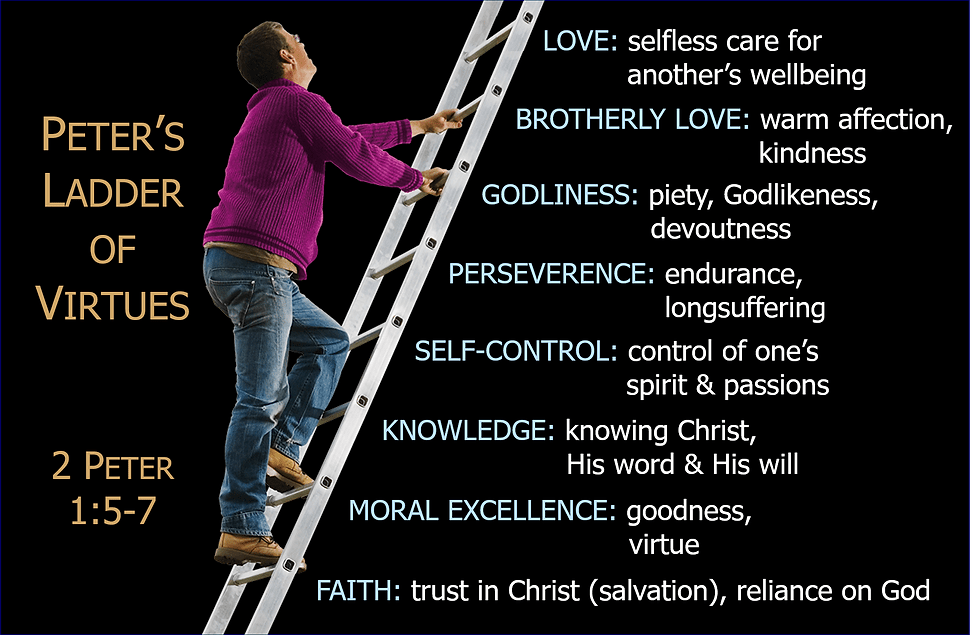
Obviously it all starts with “faith” since we are saved by grace through faith. Are these 7 virtures to be added to faith sequential, logical order, each virture building on the previous one. In other words, is “moral excellence” the first things we strive for once we are saved? And then add knowledge” to your “moral excellence”? Is there any priority of virtues here? I don’t think so. “Love” is the last one, and surely love is perhaps the first virtue we should strive for after becoming a Christian. I think the image above gives a brief definition of each virtue that will suffice. I am going to just sit here (and I encourage you the reader to do the same) and think about whether I have these virtues and are they “increasing” (2 Peter 1:8 For if these qualities are yours and are increasing) constantly in my Christian walk. Rate yourself from 1 to 10 (10 being the highest) on these virtues in your life. Which ones are you the strongest in? Which ones are you the weakest in? I don’t get drunk or cheat on income tax, but what about my sinful thoughts and desires? I think I have the knowledge of God’s word pretty good, but do I really know God Jesus in a personal, intimate way? Can I control my lustful thoughts, passions, and desires? How “pious” am I, worshipping God constantly, giving him honor and praise? How affectionate am I with other believers, just good old brotherly love “(philadelphia: Brotherly love, love of brothers: Philadephia, the city of brotherly love) with hugs and concern? (AI) “Philadelphia refers to the love and affection shared among believers, akin to the love between siblings. It emphasizes a deep, familial bond that transcends mere friendship, highlighting the unity and mutual care expected within the Christian community. This term is used to describe the ideal relational dynamic among Christians, characterized by kindness, compassion, and support.” Finally, how loving am I? The Greek word for “love” is agape. (AI) “Agapé is a term used in the New Testament to describe a selfless, sacrificial, unconditional love. It is the highest form of love, often associated with the love of God for humanity and the love that believers are called to have for one another. Unlike other Greek words for love, such as “eros” (romantic love) or “philia” (brotherly love), agapé is not based on emotions or feelings but is an act of the will, characterized by a commitment to the well-being of others.” Finally, are these virtues “increasing” as the years go by? In some of them, I think I am doing worse than I did when I first became a Christian. I don’t know about you, but I have a lot to work on! I’m thankful we have the grace of God and don’t have to practice these virtues perfectly.
What a challenge from Peter to the diaspora of Jewish Christians! What a challenge to us today! I need to look at the image above every day and think about practicing these virtues. I need to think about my purification from sin and how wonderful it is to be saved and given immortality and eternal life. How many days do I probably get up and go through the day with all its lusts and stresses and never even think about my forgiveness from sin?
2 Peter 1:12 Therefore, I will always be ready to remind you of these things, even though you already know them and have been established in the truth which is present with you. 13 I consider it right, as long as I am in this earthly dwelling, to stir you up by way of reminder, 14 knowing that the laying aside of my earthly dwelling is imminent, as also our Lord Jesus Christ has made clear to me. 15 And I will also be diligent that at any time after my departure you will be able to call these things to mind.
I have taught lessons through the entire Bible many, many times since I started preaching and teaching the word. I have studied and taught the same books, like Acts, over and over through the years. I also realize that anyone in my classes have studied the same books multiple times with different teachers. I sometimes think, why keep studying the same Bible books over and over? Isn’t once enough? A lot of people feel that way and maybe that’s why the shift from direct Bible study to a study of some book some person wrote about the Bible. That’s ok, but I’m thinking, “why not just let the Holy Spirit Himself speak to us directly through the written word. There will always be a new, fresh perspective on the same passages even though we’ve studied them many times. Also our circumstances, age, season of life, experiences change. The Holy Spirit can take the. same book, like James, and apply it in a current, different way than He would have 5 years earlier.
Then there is the “reminder” factor. Peter is saying, “you already know all this; I’m just reminding you b/c it is very important.” That’s what a “reminder” is. Reminding us of something we already know. I get a phone call from my doctor: this is a reminder that you have an appointment Tuesday. I already knew I had the appointment, but I appreciated the reminder so I would not “forget” to go. Peter had spoken in 2 Peter 1:9 For the one who lacks these qualities is blind or short-sighted, having forgotten his purification from his former sins.” Peter is trying to remind them of what it felt like when they first became Christians, when Jesus forgave all their sins, when they arose from the water of baptism to a new life, when they were so excited and happy about their new birth. Some had forgotten that, just as we tend to take that for granted today. Peter wanted to “stir” (diegeiró: To awaken, to stir up, to arouse) them up with this reminder, to call them to action (to go to that doctor appointment). (AI) “The verb διεγείρω is used in the New Testament to describe the action of awakening or stirring someone from sleep or inactivity. It conveys a sense of urgency and thoroughness, often implying a transition from a state of rest or dormancy to one of alertness or action. This term can be used both literally, as in waking someone from physical sleep, and metaphorically, as in stirring someone to spiritual awareness or action.” Peter wants to stir them to be “diligent” about the 7 virtues on the spiritual ladder.
Peter said that he wanted to remind them as long as was alive, but that, when he wrote the letter, his death was imminent. As stated in the 1st article on 2 Peter 1, his death was at the hands of Nero who died in 68 AD. Thus Peter died before that, sometime between 64-67 AD. He said that he would be
diligent” even after death that this 2nd letter would remind them of his warnings in the letter. We must be able to read 2 Peter as if Peter is personally speaking directly to us through the Holy Spirit. My mom wrote some long letters about things before she died. Occasionally I read through those letters again. When I do, I can just see her face, her voice, her expressions as if she was talking directly to me even though she was dead.
 Nicky's Notes