
Acts 27,28: Paul is in a Roman prison when he wrote the “prison epistles” (Ephesians, Philippians, Colossians, and Philemon). Actually, more like “house arrest” in his own quarters with a guard for 2 years. He had appealed to have his trial before Caesar and apparently was wating for that trial. We don’t have any follow up on that trial, but we think that he was released after the 2 years and made another missionary journey.
Here is a great map from thebiblejourney.org tracing of his last missonary journey after he was released.
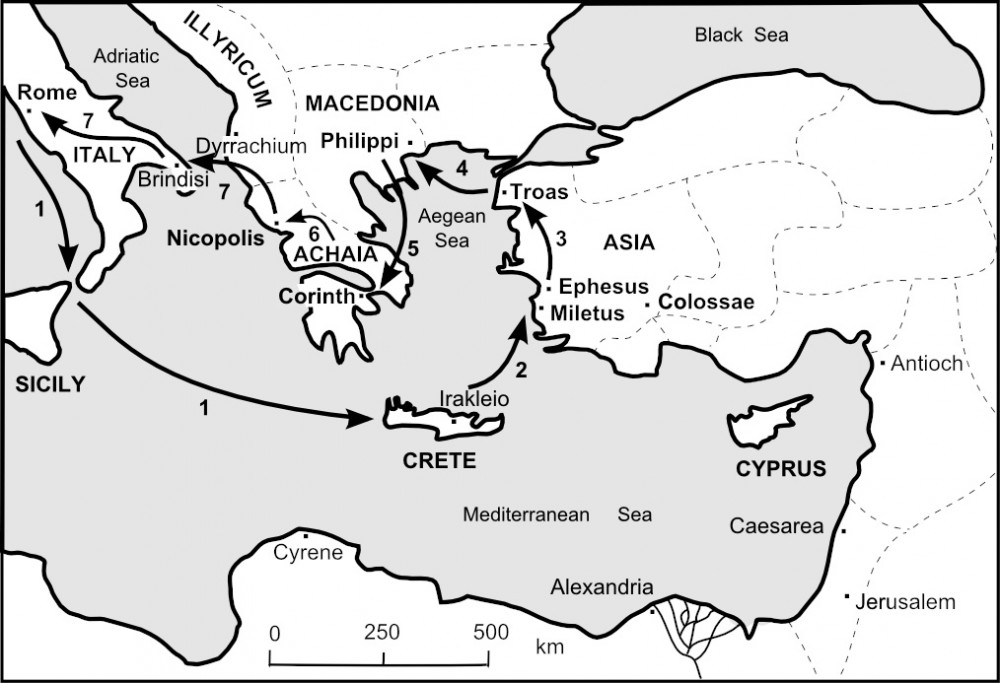
“Paul commissioned Titus to be the leader of the local church while in Crete (which Paul had visited only briefly before, en route to Rome – see Titus 1:5 & Acts 27:8-9). He visited Miletus (and left Trophimus there because he was ill – see 2 Timothy 4:20) and then left Timothy in charge of the church at Ephesus (see 1 Timothy 1:3) (see 2 on Map 28). He may have visited Colossae (see Philemon 1:22) before he continued to Troas (where he left his coat with Carpus – see 2 Timothy 4:13) (see 3 on Map 28).
Paul then went on to Philippi in Macedonia (see 1 Timothy 1:3) where he wrote his First Letter to Timothy and his Letter to Titus between 63 and 66AD (see 4 on Map 28). He may have visited Ephesus again (see 1 Timothy 3:14 & 4:13) before travelling back via Corinth (see 2 Timothy 4:20) (see 5 on Map 28) and Nicopolis (see Titus 3:12) (see 6 on Map 28) to Rome (see 7 on Map 28) where he was imprisoned in the Mamertine Prison (see 2 Timothy 1:8,16-17 & 2:9). From Rome he wrote his Second Letter to Timothy shortly before he was beheaded (as he was a Roman citizen) in c.67AD during the intense persecution of Jews and Christians by Nero (see 2 Timothy 4:6).
Paul may also have visited Spain at some time between 63 and 67AD (see Romans 15:24 & 28) but we have no Biblical evidence of such a visit.”
I encourage you to take time right now to read 2 Timothy (12 minutes reading time). As you read it, think about the mood that Paul was in during his last months in prison in Rome before he was beheaded. It says a lot that he would write his last letter to Timothy, “my beloved child” (2 Timothy 1:2; 2:1), his “child in the faith” (1 Timothy 1:2). If you knew your death was imminent and that you could write one last letter, who would you write it to? I would probably write it to my surviving family, but Paul had no surviving family that we know of. His family was his church family. His brothers and sisters were those who worked with him preaching the gospel to the Roman Empire. You can just feel the emotion as he thinks about his time with Timothy: 2 Timothy 1:3 I thank God whom I serve, as did my ancestors, with a clear conscience, as I remember you constantly in my prayers night and day. 4 As I remember your tears, I long to see you, that I may be filled with joy. 5 I am reminded of your sincere faith, a faith that dwelt first in your grandmother Lois and your mother Eunice and now, I am sure, dwells in you as well.” He hoped that Timothy could come to him soon: 2 Timothy 4:9 Do your best to come to me soon.” We don’t know if Timothy made it to see Paul before he died.
Paul had a lot of instructions for Timothy.
1) 1: 6 “Kindle afresh (anazópureó: To rekindle, to stir up, to fan into flame) his gift (i.e. his evangelistic miraculous gift, Ephesian 4:11). The ESV translates it “fan the flame”. That’s not to say that Timothy’s zeal had begun to waver. It is just a reminder to constantly keep that zeal blazing, just like you stoke a fire constantly to keep the fire bright and burning.
2) 1:8 Don’t be ashamed of Paul’s imprisonment. Some of Paul’s enemies might try to make Timothy be ashamed of Paul being in prison as a condemned criminal worthy of death. Especially Jewish unbelievers might say that Pauls’ death proved that he was just another misled false teacher of this false sect called Christianity. After all, his imprisonment was at the time that the Jewish rebels were rebelling against Rome, trying to convince all Jews that victory over Rome was imminent.
3) 2:1-7 Be strong, suffering hardship as a good soldier, a competitive athlete, and a hard working farmer. Those are 3 down to earth examples to show Timothy how to handle his suffering.
4) 2:2 Entrust the gospel to faithful men who would then be able to teach others. An evangelist must train others to carry on the work. This verse was our “mission statement” when we went to Trinidad to do 3 years of mission work. There were already hundreds of baptized believers in Trinidad due to evangelistic campaigns and several churches already established (we worked mainly with two of them in the south). We baptized several more and established 3 new congregations while there. But our main focus was identifying and training their leaders to carry on the work after we left. We had a “Saturday school” where we taught many of the church leaders the same Bible courses that we had studied in our 2 years in a school of preaching in West Monroe, La. Apparently that worked b/c those leaders carried on the work in the churches for the next 50 years without depending on U.S. money to pay preachers there! I recently talked to several of those leaders via WhatsApp. That was very encouraging to me. Those leaders also continued to train other men. A son of one of those leaders worked with some of the new congregations and did mission work over in Guyana, South America. Paul wanted Timothy to do the same training of leaders, and I’m sure that he did.
5) 2:14-19 Remind those faithful men (and all believers) to “accurately handle the word of truth”. Avoid disputes over words, worldly and empty chatter. Especially avoid heretical teachings like that of 2 men who were saying that the resurrection had already taken place. Paul had said that “there is about to be (mello, which always means “about to” in the NT) a resurrection of the righteous and unrighteous (Acts 24:15). That would be the resurrection of Daniel 12:2 which would occur at the end of the Jewish Age in 70 AD. The OT dead in hades would be raised to receive their final sentencing in 70 AD. Paul wrote 2 Timothy in 67 AD, so that resurrection had not taken place yet. We don’t know exactly what arguments were used by those 2 men to say the resurrection had already happened. It is interesting that Paul did not just say, “it is obvious that the resurrection has not happened yet b/c no one has seen bodies coming out of the tombs”. Apparently, the resurrection as Paul taught it was not a bodily resurrection as many teach or else Paul could have said that and used that argument against them. In 1 Corinthians 15, Paul taught that the resurrection would be changing to immortal spiritual bodies, not physical bodies raised. He even told them in 15:50 I tell you this, brothers: flesh and blood cannot inherit the kingdom of God, nor does the perishable inherit the imperishable. 51 Behold! I tell you a mystery. We shall not all sleep, but we shall all be changed.” He told them that some of those he was writing to would still be alive at the resurrection that was “about to happen” (Acts 24:15). But dead or alive, the believers would be given immortal, spiritual bodies at that resurrection. Either Paul is a false prophet predicting this to happen in their lifetime or else it did happen, and it did. Yes, that means that I am saying that, based on Paul’s writing, the resurrection “has already happened” at 70 AD. You might say I am a heretic for teaching that just like those 2 men. But the difference is when those 2 men made that statement and when I am making that claim (which is today, long after 70 AD). Food for thought!
6) 2:22-26 Flee youthful lusts and purse righteousness, faith, love, and peace. Don’t be quarrelsome in trying to correct those teaching error. Many who try to “defend the faith” end up being very argumentative, thinking their opinion on doctrine is the only correct one. That leads to sectarianism. The church I was raised in taught a lot of truths but also became very argumentative about minor doctrines, condemning those who disagreed.
 Nicky's Notes