
This is a follow up article to the “Jesus came to conquer spiritual death” article so please read that first. Jesus did conquer spiritual death. But there is an apparent contradiction. 1) Paul said that the Ephesian Christians had already been raised from the dead spiritually before 70 AD (he wrote Ephesians in about 60 AD)? Ephesians 2:4 But God, being rich in mercy, because of His great love with which He loved us, 5 even when we were dead in our wrongdoings, made us alive together with Christ (by grace you have been saved), 6 and raised us up with Him, and seated us with Him in the heavenly places in Christ Jesus.” Likewise with the Colossian Christians: Colossians 2:12 having been buried with Him in baptism, in which you were also raised with Him through faith in the working of God, who raised Him from the dead. 13 And when you were dead in your wrongdoings and the uncircumcision of your flesh, He made you alive together with Him, having forgiven us all our wrongdoings.” 2) But the last enemy, spiritual death, was not defeated until 70 AD according to 1 Corinthians 15 (again read the first article if you haven’t). If spiritual death, the last enemy, was not conquered until 70 AD (1 Corinthians 15), then how could the Ephesians and Colossians be raised from the dead spiritually before 70 AD. That is the “already and not yet” of the transition period from 30 AD to 70 AD. This is an excellent article by Alex Polyak on this topic: https://thebiblefulfilled.com/the-already-and-not-yet/. Thebiblefulfilled.com is his site and he has many excellent videos and articles. He also has an excelent book, “The End is Here” (amazon prime) that is very detailed and deals with all the objections to full preterism). Why reinvent the wheel? I can’t explain this any better than Alex did, so I will simply quote directly from his article and say “Amen”.
“The New Testament is filled with New Covenant realities that had already arrived in part (pre-AD 70), but had not yet arrived in full. Consider the following examples:
Salvation had already arrived in part (2 Tim. 1:9, Titus 3:5, 1 Cor. 6:11), but salvation still had to come in full (Rom. 13:10; 1 Pet. 1:5; Heb. 9:28).
Righteousness had already come in part at the cross (1 Pet. 2:24), yet Righteousness would not come in full until “the elements burned with fervent heat” / the new heaven and earth (2 Pet. 3:13; Gal. 5:5).
Redemption had already happened in part (Eph. 1:7), yet Redemption still needed to happen in full (Eph. 1:14; 4:30; Rom. 8:23).
The Adoption had already happened in part (Rom. 8:15), but the Adoption still needed to happen in full (Rom. 8:23)
The Kingdom of God had already come in part (Col. 1:13; Luke 11:20), but the Kingdom of God still needed to come in full (Mark 9:1, Luke 21:31, Rev. 11:15).
The Gathering of Jews and Gentiles into one new body, Christ, had already begun in part (Eph. 2:12–13), but the Gathering would happen in full at the second coming (2 Thess. 2:1–2, Matt. 24:30–31).
The New Jerusalem had arrived in part (John 4:23, Heb. 12:22–24), yet the New Jerusalem still had to come in full (John 4:21, 23; Rev. 21:2).
The (General) Resurrection had already happened in part (John 5:24–25; Eph. 2:1, 2:6; Col. 3:1–2), but the Resurrection still needed to happen in full (John 5:28–29; 1 Thess. 4:16–17; 1 Cor. 15:51–52; Rev. 20:13).
The New Testament is filled with such New Covenant realities that had already arrived in part, but had not yet arrived in full. In fact, some of these events are spoken about in both the present and future tenses in the very same passage, just a few verses apart (see the redemption example above)! Either the New Testament writers/apostles blatantly and repeatedly contradicted each other–and even their own statements–or there was something more going on here. The already/not yet concept explains this nicely. The New Covenant realities had already arrived in part (pre-AD 70)…but they had not yet arrived in full. And when would they arrive in full? When the Old Covenant age of types and shadows[1] completely vanished away, which would happen at Jesus’ second coming in AD 70.[2] Paul captured this sentiment beautifully in saying (in AD 62/63): “He who has begun a good work in you [saints in Philippi] will complete it until the day of Jesus Christ” (Phil. 1:6).
Note: Just about all Christians acknowledge the “already/not yet” concept. However, while preterists[3] contend it refers to the time period between AD 30 and AD 70, futurists [4] argue it refers to the time period between AD 30 and today–a 2000+ year time period–which would negate the purpose for using such a concept in the first place!
The time period between AD 30 (Jesus’ earthly ministry) and AD 70 (the second coming) was a time of transition. The Old Covenant types and shadows were gradually passing away…and the New Covenant realities were gradually being built up. As the writer of Hebrews said in approximately AD 60: “In that He [God] says, ‘A new covenant,’ He has made the first [covenant] obsolete. Now what is becoming obsolete and growing old is ready to vanish away (Heb. 8:13). The Old Covenant was growing old…and the New Covenant was being built up.”
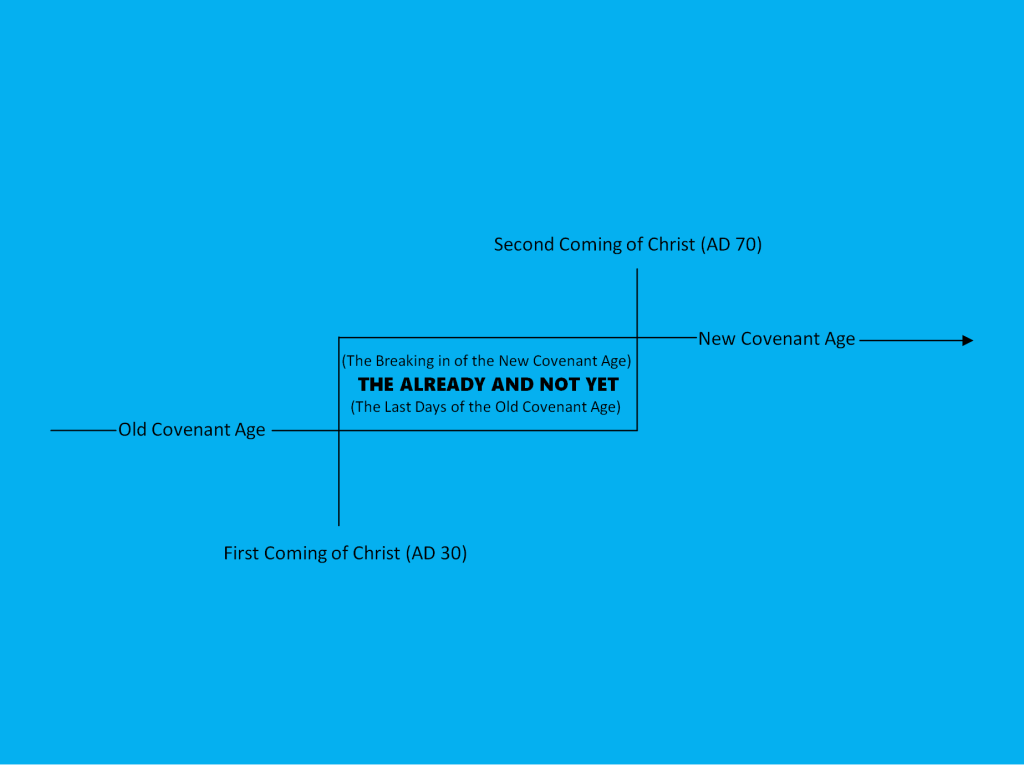
Now a few of my comments. If the futurists are correct, then we are still waiting for Jesus to return to conquer the last enemy death. Maybe they think that means that Jesus will return in the future to conquer physical death, but we have already seen that he did not come to abolish physical death. So if he hasn’t fully conquered spiritual death yet, then our redemption is not complete. I prefer to believe that he fully accomplished what He came to do, and that is to conqer spiritual death completely in my life and in the life of all believers. We are not living in the transition period (30-70 AD), still waiting for the completion of the redemption process in 70 AD. We usually read the New Testament as if we were living in the transition period, taking things written to those living in the transition period as if they were written directly to us.
I’m especially interested in the point Alex made about the kingdom. “The Kingdom of God had already come in part (Col. 1:13; Luke 11:20), but the Kingdom of God still needed to come in full (Mark 9:1, Luke 21:31, Rev. 11:15).” The spiritual kingdom of God, which is the church, was established in Acts 2 in 30 AD. Christians in the transtion period were added to that kingdom. Colossians 1:13 For He rescued us from the domain of darkness, and transferred us to the kingdom of His beloved Son, 14 in whom we have redemption, the forgiveness of sins.” But then Paul told recent converts on his first missionary journey: Acts 14:21 And after they had preached the gospel to that city and had made a good number of disciples, they returned to Lystra, to Iconium, and to Antioch, 22 strengthening the souls of the disciples, encouraging them to continue in the faith, and saying, “It is through many tribulations that we must enter the kingdom of God.” So there was another phase of that kingdom that the believers were going to enter later. Most think that is heaven, but it is referring to the final phase of the establishing of the spiritual kingdom in 70 AD. That is what Jesus predicted in Luke 21:31 So you too, when you see these things happening, recognize that the kingdom of God is near. 32 Truly I say to you, this generation will not pass away until all things take place.” Luke 21 is Jesus’ predictions about the destruction of Jerusalem in 70 AD. If the kingdom had already been established in 30 AD, how could he say that the kingdom would be “near” in 70 AD. B/c the final phase of the establishment of the kingdom would happen in 70 AD at the end of the transition period. The mistake that futurists make is that they are still looking for Jesus to establish a physical kingdom. They think that the final phase will be Jesus returning some day to establish a physical kingdom, but he never planned to establish a physical kingdom. John 18:36 Jesus answered (Pilate), “My kingdom is not of this world. If My kingdom were of this world, My servants would be fighting so that I would not be handed over to the Jews; but as it is, My kingdom is not of this realm.”
Another good point by Alex: “The New Jerusalem had arrived in part (John 4:23, Heb. 12:22–24), yet the New Jerusalem still had to come in full (John 4:21, 23; Rev. 21:2).” Isaiah had predicted the new Jerusalem. Isaiah 65:“For behold, I create new heavens and a new earth; And the former things will not be remembered or come to mind. 18 But be glad and rejoice forever in what I create; For behold, I create Jerusalem for rejoicing And her people for gladness. 19 I will also rejoice in Jerusalem and be glad in My people; And there will no longer be heard in her The voice of weeping and the sound of crying.” Hebrews 12 calls it the “heavenly Jerusalem” and is referring to the church, not to a physical city. Hebrews 12:22 But you have come to Mount Zion and to the city of the living God, the heavenly Jerusalem, and to myriads of angels, 23 to the general assembly and church of the firstborn who are enrolled in heaven.” The new Jerusalem, which is the church, was established in 30 AD in Acts 2. So how does John predict the new Jerusalem coming down to earth at some time in the future after he wrote Revelation in about 65 AD?? Revelation 21:1 Then I saw a new heaven and a new earth; for the first heaven and the first earth passed away, and there is no longer any sea. 2 And I saw the holy city, new Jerusalem, coming down out of heaven from God, prepared as a bride adorned for her husband.” He then adds: 21:9 Then one of the seven angels who had the seven bowls, full of the seven last plagues, came and spoke with me, saying, “Come here, I will show you the bride, the wife of the Lamb.” 10 And he carried me away in the Spirit to a great and high mountain, and showed me the holy city, Jerusalem, coming down out of heaven from God, 11 having the glory of God.” Again, “already and not yet”. There was another phase of the establishment of the new Jerusalem, i.e. the church, that would be completed in 70 AD. Why 70 AD? B/c the book of Revelation was written about 65 AD about things that. were going to happen shortly, soon, near (Revelation 1:1-3; 22:1-10). The book is about the destruction of the old Jerusalem in 70 AD, just as Jesus had predicted in Matthew 24. The final phase of establishing the new Jerusalem would be the removal of the old Jerusalem in 70 AD. So the transition Christians were already in the kingdom but would enter the completed final phase of the kingdom in 70 AD. But still it would be a phase of the spiritual kingdom, the church, and not some physical kingdom. Revelation 21:1-11 says that the new Jerusalem was the “bride of Christ” which of course is the church. The Hebrew writer spoke of this: Hebrews 13:14 For here we do not have a lasting city, but we are seeking the city which is to come.” It was still in the future for the transtion Christians, but not for us. We live after the final phase of the new Jerusalem, the church, was completed in 70 AD.
One last point from Alex: “Redemption had already happened in part (Eph. 1:7), yet Redemption still needed to happen in full (Eph. 1:14; 4:30; Rom. 8:23).” Paul said that the Ephesians had their redemption, the forgiveness of sins. Ephesians 1:7 In Him we have redemption through His blood, the forgiveness of our wrongdoings, according to the riches of His grace 8 which He lavished on us.” But just a few verses later he spoke of a future redemption for them: 1:13 In Him, you also, after listening to the message of truth, the gospel of your salvation—having also believed, you were sealed in Him with the Holy Spirit of the promise, 14 who is a first installment of our inheritance, in regard to the redemption of God’s own possession, to the praise of His glory.” In Luke 21 Jesus predicted the destruction of Jerusalem in 70 AD in Luke 21. He spoke of the redemption of believers in 70 AD: Luke 21:28 But when these things begin to take place, straighten up and lift up your heads, because your redemption is drawing near.” So the redemption process began in Acts 2 in 30 AD when the first 3,000 were baptized for the remission of sins, but the full redemption process was not completed until 70 AD when the last enemy, spiritual death, was destroyed, when they would receive their immortality whether dead or alive (1 Corinthians 15, read the first article). BTW this is what Paul was referring to in Romans 8:23 And not only that, but also we ourselves, having the first fruits of the Spirit, even we ourselves groan within ourselves, waiting eagerly for our adoption as sons and daughters, the redemption of our body.” There was a future redemption for the transition Christians he was writing to even though they had already been redeemed and forgiven of sins. Futurists say this future redemption has not yet happened. They say it will be a future recreation of the earth to its original Garden of Eden state at some future 2nd coming of Jesus and that believers will get some kind of a new physical body to live on earth for a millennium or maybe even forever. But notice Romans 8:18 For I reckon that the sufferings of the present time [are] not worthy [to be compared] with the glory about to be (mello which always means something about to happen) revealed in us.” Their future redemption phase that Paul predicted in 8:23 was about to happen in their lifetime, so it could not refer to something that has not even happened yet some 2,000 years later! That future redemption for them was the final phase of redemption in 70 AD as predicted by Paul and Jesus. That is why the Roman Christians were so eagerly waiting for that final phase of redemption. Romans 8:19 For the eagerly awaiting creation waits for the revealing of the sons and daughters of God.” In 70 AD the identity of the true sons of God would be revealed. It would be shown once for all that God had rejected the unbelieving Jews and that the true sons of God were the Christians. The transition Christians had been told by Jesus and the apostles that all this was going to happen in their lifetime, so that explains why they were so eagerly awaiting their future redemption at 70 AD. I don’t know how much they understood all that would happen in 70 AD, but they were fully expecting it to happen within their lifetime and eagerly waiting for it. Again, we read transition passages as if they were written directly to us, but they weren’t. Romans 8:23 has already been fulfilled. The final redemption of believers has been available since 70 AD. We have that full redemption. When we die, we live on eternally in our spiritual bodies in heaven, wherever that is!
Hopefully this article explains the “already and not yet” concept. Again, I encourage you to read some of Alex Polyak’s articles and watch his videos on thebiblefulfilled.com.
One last note. Compare this transition period to our transition period in choosing a new president. We elect a new president in November but he is inaugurated in January. There is a transition period between the election and the inauguration. The newly elected president is called the president elect until his inauguration. He is the official next president once he is elected. He starts to form his new cabinet during the transition. The things of the old administration begin to b removed during the transition period, and are completely removed by the inauguration. But he doesn’t officially become the president until the inauguration. That’s the same as the transtion period in the New Testament. Jesus began his reign as king in his new spiritual kingdom in 30 AD, but he did not finalize his reign and his kingdom until 70 AD. He began removing all the remnants of the old Jerusalem, the old covenant, the old heavens and earth (i.e. the Jewish system), the old animal sacrifices, the old covenant priesthood, etc. during the last days of the Jewish Age (from 30-70 AD), but those things were completely removed in 70 AD. In about 60 AD, the Hebrew writer wrote: Hebrews 8:13 When He said, “A new covenant,” He has made the first obsolete. But whatever is becoming obsolete and growing old is about to disappear.” That old covenant was about to disappear in 70 AD just a few years after this was predicted. Hebrews 9:8 The Holy Spirit is signifying this, that the way into the holy place has not yet been disclosed while the outer tabernacle is still standing, 9 which is a symbol for the present time.” The final phase of the redemption process was not disclosed (phaneroó: To make manifest, to reveal, to make known, to show openly) until 70 AD after everything in the old covenant was removed. AI: “The verb “phaneroó” is used in the New Testament to describe the act of making something visible or known that was previously hidden or not apparent.” There had to be a lot of confusion about God’s final plan during this transition period. For 2,000 years God’s presence was built around the priesthood, the animal sacrifices, and the temple. But the Paul and others start preaching about a new covenant based on the blood of Jesus. So would believers in Jesus just try to obey both covenants? Should believers in the future do that? Just a lot of confusion. But 70 AD explains it all and brings the plan all together. This is what Paul was referring to in Ephesians 1:9 He made known to us the mystery of His will, according to His good pleasure which He set forth in Him, 10 regarding His plan of the fullness of the times, to bring all things together in Christ, things in the heavens and things on the earth.”
 Nicky's Notes