
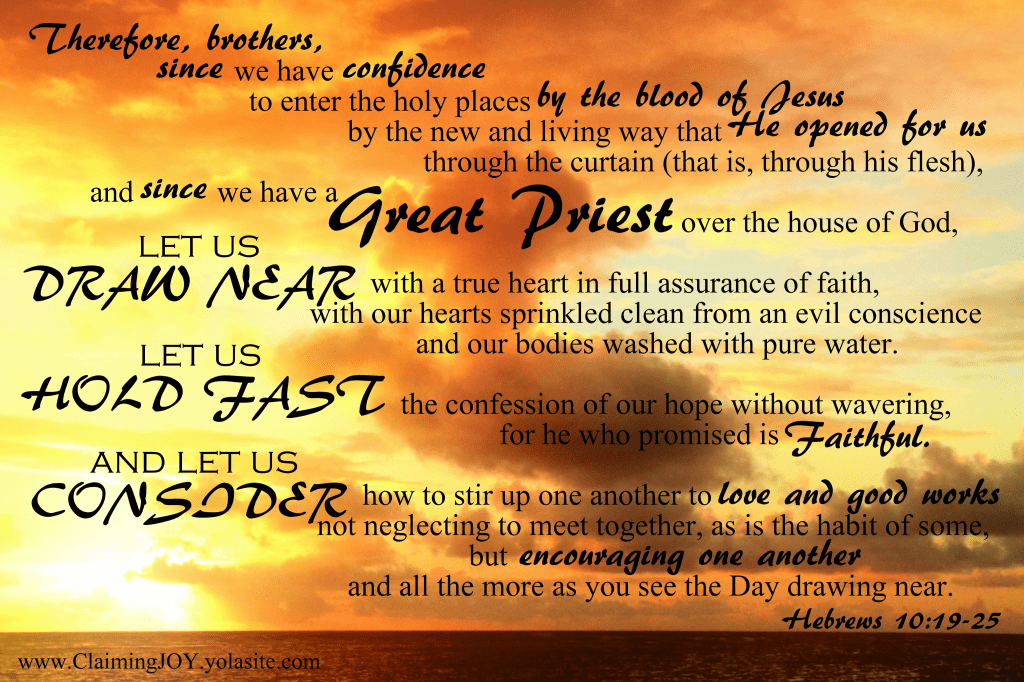
This is a great slide from ClaimingJoy.yolasite.com taken from Hebrews 10:19-25.
It begins with “therefore” which I was taught means “based on what went before”. The Hebrew author has presented point after point to show that Jesus is “better” than the angels, better than Moses as deliverer, better than Aaron as High Priest, and that Jesus has a better covenant with better sacrifices.
So “therefore” based on what went before (his points in 1:1-10:18) he gives a “since”. The Greek word for since is echó: To have, to hold, to possess, so it just means “having”. Having what? 2 things. 1) “Having” the ability to enter the presence of God, the Most Holy Place in heaven, by the blood of Jesus. We can draw near to the the throne of God. Hebrews 4:16 Therefore let’s approach the throne of grace with confidence, so that we may receive mercy and find grace for help at the time of our need.” 2) “Having” such a great high priest over the house of God, which is the church. A high priest who will never die, who offered his own blood as the sacrifice to forgive sins permanently “once for all time”. A high priest who can sympathize with our weaknesses. A high priest who is merciful to forgive us of our sins.
So, “since” or we “have” those 2 things, what does the Hebrews writer encourage us to do as believers in this new covenant church of the firstborn? He gives 3 things. Each begins in the various translations with “let us” (NASB, NIV), or “may we” (Young’s Literal Translation). Then there are 3 action verbs that he encourages us to do.
1) Let us draw near (proserchomai: To come to, to approach, to draw near) to that throne of grace for forgiveness and help in time of need. What a shame to have this privelege and opportunity and not take advantage of it. The Old Testament saints did not have that privilege. Draw near with a true or sincere heart in full assurance that you can come to the very presence of God. After all, you have been cleansed by the blood of Jesus and are now the “sanctified” or set apart for God. Our bodies have been washed with pure water. Is that figurative of our spiritual cleansing from sin or does it refer to water baptism which was “for the remission of sins” (Acts 2:38). Perhaps both. Our water baptism alone does not save us. We are saved by grace through faith in Jesus’ death. But they were commanded by the apostle Peter to be baptized in water for the remission of sins (Acts 2:38). Ananias told Saul to “arise and be baptzed and wash away your sins” (Acts 22:16). The same apostle Peter who told them to be baptized for he remission of sins in Acts 2:38 also said in Acts 10:47 “Surely no one can refuse the water for these (Cornelius’ and his household) to be baptized, who have received the Holy Spirit just as we did, can he?” 48 And he ordered them to be baptized in the name of Jesus Christ.” The apostle Peter went on in his first letter to compare water baptism to the water saving of the 8 people on the ark. In the context those 8 people (Noah and his family) were not saved “from” the water (although they were but that is not Peter’s point) but instead they were saved “by” the water (saved from the human sinful filth that had filled the earth, that surrounded them). 1 Peter 3:20 eight persons, were brought safely through (or by) the water. 21 Corresponding to that, baptism now saves you—not the removal of dirt from the flesh, but an appeal to God for a good conscience—through the resurrection of Jesus Christ.” Those are some pretty strong verses that show the importance of water baptism, which was practiced by the apostles and the church in the book of Acts. So “our bodies washed with pure water” could refer to water baptism in Hebrews 10:22 but it would also be figurative of the cleansing of our sinful flesh by the blood of Jesus when we are baptized. Water baptism is part of saving faith. It is not a work to earn salvation.
2) Let us “hold firmly (Greek: katechó: To hold fast, to restrain, to possess, to keep)
to the confession of our hope” without wavering. AI: “The verb (hold fast) encompasses two chief actions: positive retention of what is good and active restraint of what is harmful.” The writer already encouraged this to the readers in 3:6 and 3:14. “We are His house if indeed we hold firmly to our confidence and the hope of which we boast” (Hebrews 3:6); “For we have become partakers of Christ if we hold firmly to the end the assurance we had at first” (Hebrews 3:14). The theme of the whole Hebrew letter has been to warn Jewish Christians about leaving the faith and going back to Judaism, showing them the old covenant was “about to disappear” (Hebrews 8:13), showing them the superiority of the new covenant that could forgive sins permanently once for all time. Indeed the readers of the letter were persecuted (Hebrews 10:32-36) and many “wavered” in their faith and began to have doubts if this new way was really worth leaving their honored traditions under the Law. Over and over he begs them to “endure” and not quit, to stay faithful and not be like the Israelites in the wilderness who failed to enter their Promised Land “rest” due to lack of faith and obedience. These Jewish Christians had made the great “confession” (that Jesus was the Christ, the Son of the living God) when they were baptized. That confession was their “hope” of eternal llfe. Don’t waver from that. The writer adds, “He who promised (eternal life) is faithful.” God will be faithful and give eternal life to those who endure. You don’t have to worry about Him keeping His promise, but will you be faithful to your confession? The same question could be asked of us believers today. We are surrounded with people denying the deity of Jesus (even in a lot of the churches). Jesus said, Matthew 10:32 “Therefore, everyone who confesses Me before people, I will also confess him before My Father who is in heaven. 33 But whoever denies Me before people, I will also deny him before My Father who is in heaven.”
3) Let us consider how to encourage one another to love and good deeds. The Greek word for “encourage” is paroxusmos: Provocation, Stirring up, Sharp Disagreement. AI: “The Greek word marks a sudden surge of emotion that moves people to action. The noun can carry either a constructive or a destructive sense, describing a stimulus that provokes, stirs, or irritates. The direction—toward unity or toward division—is determined by the moral and spiritual context in which the stimulus is received.” It was the word used of the sharp disagreement between Paul and Barnabas (Acts 15:39). But the word can also be “stirring up” believers to love and good works. Synonyms for “stimulate” include arouse, energize, provoke, encourage, excite, and motivate. A “stimulus package” is to stir up a slow economy. Light is a physical stimulus that activates photoreceptors in the eye. In other words, when we see Christians wavering or becoming complacent in their faith, we need to stimulate them to get back to love and good works. That could even be harsh warnings such as given several times by the Hebrews writer.
When do we have he opportunity to do this? When we “meet together” (episunagógé: Gathering together, assembly)(10:25). Did you notice the “synagogue” in that word, the Jewish assembly place in the first century? No doubt this refers to the gathering of Christians in their various house churches in the first century. 1 Corinthians 14:26 had instructions on the use of miraculous gifts when they would “assemble” (sunerchomai: To come together, to assemble, to gather). The early church assembled often from its first inception, the first 3,000 baptized believers in Acts 2:46 Day by day continuing with one mind in the temple, and breaking bread from house to house, they were taking their meals together with gladness and sincerity of heart.” They met in house churches; they did not have “church buildings”.
When did they meet? Obviously their meetings were not restricted to just one day, but it does appear that they met on the first day of the week (Sunday) as a regular practice. 1 Corinthians 16:2 On the first day of every week, each of you is to put aside and save as he may prosper, so that no collections need to be made when I come.” Paul believes that the Corinthian Christians are meeting every Sunday and therefore encourages them to make this collection for the saints in Jerusalem who are suffering from a famine. Some misuse this command to make it one of the “5 acts of worship” that are mandatory for acceptable Christian worship today. This was a command that would have ended once Paul came to Corinth and when the Corinthians gave him the money collected so he could carry it to Jerusalem. How can someone make that a command that applies to us today? The principle of giving or our means is there, but that’s all. The Hebrews writer adds: “not neglecting to meet together”, “not forsaking the assembling of ourselves together” (KJV), “not abandoning our own meeting together” (NASB). The Greek word here is egkataleipó: To forsake, abandon, leave behind, desert. AI: “The verb ἐγκαταλείπω conveys a deeply personal form of forsaking: deserting someone who reasonably expected ongoing presence, help, or protection. The compound intensifies the ordinary “leave,” stressing an abandonment that wounds, exposes, or isolates.” It is the word used by Jesus, “My God, My God, why hast thou forsaken me? Demas had deserted and forsaken Paul (2 Timothy 4:10). A misuse of this verse in Hebrews 10:25 might be saying that a believer is going to hell if he misses any of the regular church services, which is kinda what my church taught when I was little. A “faithful church member and Christian was one who attended all 3 services (Sunday morning, Sunday night, and Wednesday night). A believer might have several ways of gathering with other believers that do not involve Sunday “going to church” (which is a misnomer since we are the church). On the other hand, you can see the value in gathering with other Christians whenever possible to encourage one another to love and good works. Even if you don’t think that you need any encouragement, there is someone there who does need encouragement and you might be the one to give it to them. Covid really disrupted that, and many have just chosen not to return to such church gatherings, which is sad. Many believers are very disgusted with the “big church business” which spends 80% of the money collected on buildings and staff instead of feeding the poor, drilling clean water wells overseas, and printing and distributing Bibles in the many languages to the unreached masses in the world. That’s me actually. I would almost prefer to listen to a good sermon online from my favorite Bible teacher, do my own personal studies in the Word, pray my daily prayer list, and then maybe encourage a believer in need with a text or email. I’m sure that is okay with God, but it would still be good for me to attend the church this Sunday morning and encourage those gathered there. There will be many Christians there that need encouragement that I would not have the opportunity to encourage otherwise. So, I guess I will “go to church” Sunday! In the meantime, we have a house church every Wednesday in our house and a Sunday night small group gathering. So I do encourage you to gather with other believers whenever and wherever you can. There was a special incentive for the readers of the Hebrews letter: “all the more as you see the day drawing near”. My church taught that day was Sunday, the day of meeting. I disagree. I believe it refers to the day of judgment coming on the Jews in 70 AD. The next verse following 10:25 is Hebrews 10:26 For we — willfully sinning after the receiving the full knowledge of the truth — no more for sins doth there remain a sacrifice, 27 but a certain fearful looking for of judgment, and fiery zeal, about to devour the opposers” (Young’s Literal). Notice that Young’s correctly translates it as a judgment “about to” devour the Jews in 70 AD.
Hebrews 10:20 we have a “new and living way”. A new covenant superior to the old about to disappear covenant. A living way, the sacrifice of Jesus that provide forgiveness and eternal life. Hebrews 10:20 by a new and living way which He inaugurated for us through the veil, that is, through His flesh. It took Jesus’ death, by His sacrifice in the “flesh” to provide access to the very throne of God. There was a veil between the Holy Place and the Holy of Holies and only the high priest could go through that veil and only on the Day of Atonement. Jesus’ flesh is the removal of that veil that allows us to enter the very presence of God.
 Nicky's Notes