
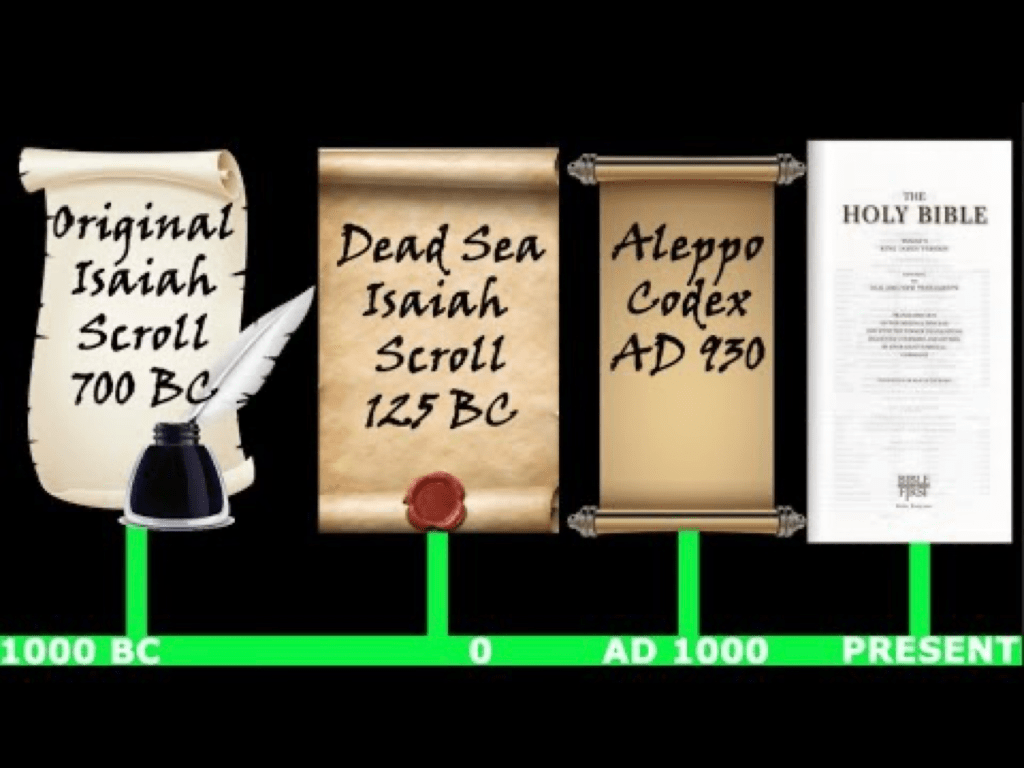
What is this image about? On the left is the original book (scroll) of Isaiah written in Hebrew about 700 BC. We do not have the original. On the far right is the Aleppo Codex copy of Isaiah in 930 AD. This Aleppo Codex copy of Isaiah is the oldest surviving Hebrew copy of Isaiah (there are older ones in different languages) and was done by the Masoretes. The Masoretes were Jewish scribes who from the 6th to the 10th century AD standardized previous Hebrew copies of Scripture for accuracy. The Masoretic text is used as the basis for most of our modern translations.
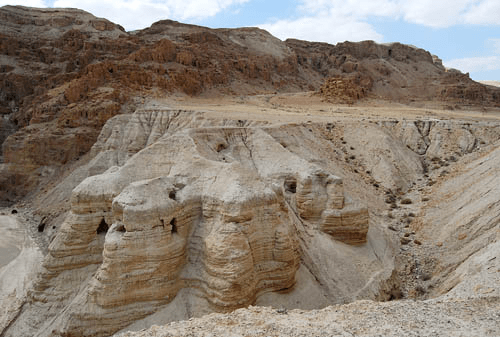
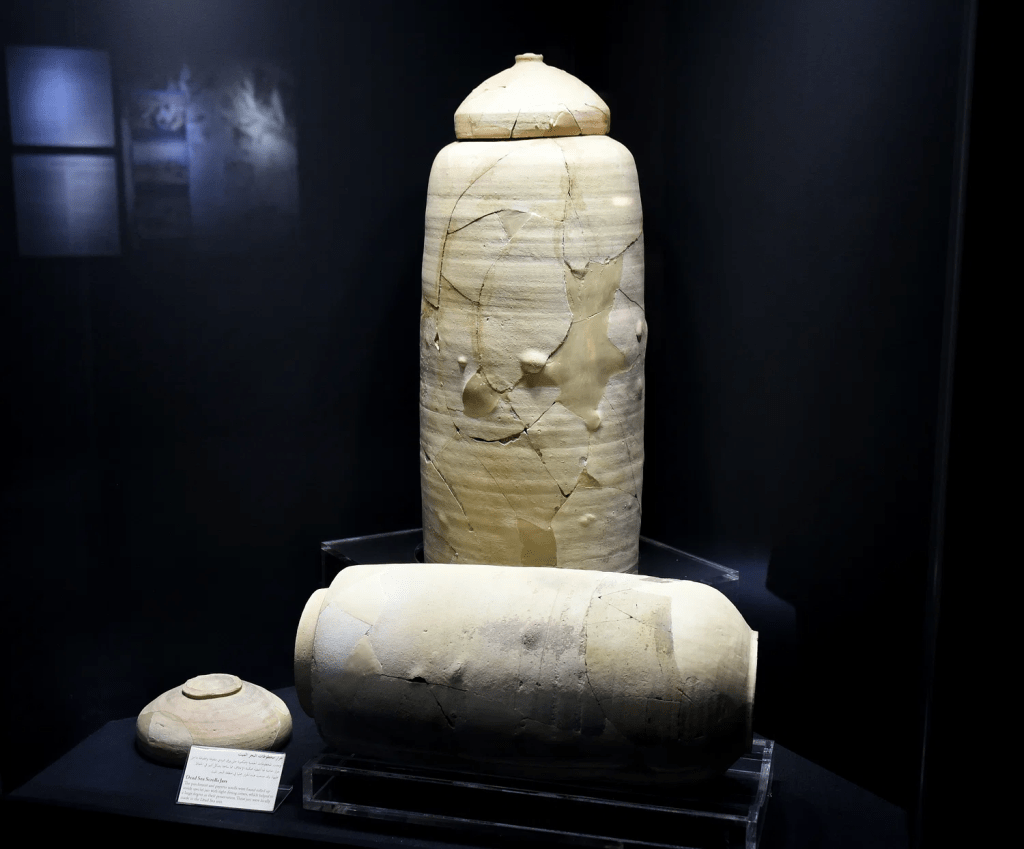
As you can see, that is i 1630 year gap between the original Isaiah copy in 700 BC and the oldest surviving Hebrew Isaiah copy in 930 AD. That means that we are relying on 1630 years of copies of Isaiah. How can we be sure that it was copied accurately in all those copies? The skeptics often bring up this issue. Well that is where the middle image of the Dead Sea Scrolls “Great Isaiah” scroll comes in. The Dead Sea Scrolls were found in the Qumran caves near the Dead Sea in 1947 by a Bedouin shepherd boy looking for his straying goat. He found pottery and clay jars that contained 2,000 year old scrolls. Later over 900 scrolls were found. Among them was a complete Hebrew copy of Isaiah called the “Great Isaiah Scroll”. It was dated 125 BC using a combination of radiocarbon dating and paleography (handwriting analysis). That’s over 100 years before the birth of Jesus. That DSS copy of Isaiah is over 1,000 years earlier than the 930 AD Aleppo Codex copy. So how do the two copies compare? That will tell us how accurately copies were made during that 1,000 year gap. Without going into detail, the two copies are almost identical with only small, insignificant variations. That means that the Hebrew copies during that 1,000 year gap were done very accurately. We knew the scribes took great care to copy Hebrew Scripture accurately, but this gives hard evidence that they actually did so. Now we don’t have evidence of accuracy of copying during the gap between the original Isaiah in 700 BC and the DSS Isaiah in 125 BC, but I think we can safely assume that the same accurate copying methods were used during that time gap. Needless to say, this is a great discovery that gives us great confidence in the accuracy of the Old Testament Scriptures and helps us answer the skeptics.
This brings up another question concerning the Messianic predictions in Isaiah, especially in Isaiah 53. Isaiah is known as the “Messianic prophet” because he has more predictions about the Messiah than any other prophet. Isaiah 53 predicts that the Messiah will be despised and rejected and that he will die to bear the punishment for our sins and to justify us. But it also makes several very specific predictions. 1) Being “pierced” (NASB), bruised, and wounded for our offenses. This prediction would include all the suffering from Jesus’ scourging, being beaten, and crucifixion. 2). Not opening his mouth to defend himself but was led like a lamb silently to his slaughter. Jesus did not defend himself before Pilate, which astounded Pilate. 3) His grave was with wicked men. Jesus was crucified between two criminals. Most thought that he was just another criminal worthy of death. 4) Yet he was with a rich man in his death. Joseph took Jesus’ body and put it in a rich man’s unused tomb. Normally, Jesus’ body would have been thrown in an open pit for the dogs to tear apart. 5) He will see his offspring (spiritual offspring) and prolong his days. Jesus would be raised and his life on earth prolonged another 50 days before he ascended to heaven.
There is a video of a man reading the Hebrew copy of Isaiah 53 to non Christian Jews in Israel, asking them who it sound like Isaiah 53 is referring to. They all say “Jesus” even though they don’t believe in Jesus. He then asks where that passage is found, and they all say that it must be in the Christian New Testament, which they also reject. They are shocked when the tells them that he is reading from their Jewish Hebrew Old Testament copy of Isaiah, which would mean that their own Scriptures predicted Jesus’ suffering and dying for our sins. https://www.youtube.com/watch?v=cGz9BVJ_k6s
But that brings up the skeptic objection that these predictions (and other OT Messianic predictions were put in “after the fact”, after the death of Jesus, to make it look like the OT prophets predicted these things about the future Messiah when they really didn’t. Again, the DSS Isaiah answers that objection. The DSS Isaiah scroll has all the predictions listed above and it dates 125 BC, so the predictions were made over 100 years before Jesus was born. They were not added “after the fact”.
The same could be said for the rest of the OT Messianic predictions. Here is a list of the main ones.
Some of these are quite amazing. 1) He would be born in Bethlehem but his growing up years ministry would be in Galilee (not where you would expect him to minster which would be in Jerusalem and Judea). 2) He would be betrayed for 30 pieces of silver and then that money would be used to buy a potter’s field (Zechariah 11). 3) Zechariah 12:10 says that he would be pierced (daqar: To pierce, to thrust through, to stab). The OT predicted that he would be rejected by the Jews and that would normally mean stoning to death as they did with Stephen in Acts 7. So it is unusual that Isiah 53 would predict that he would be pierced, which he was pierced in his crucifixion with nails in his hands and feet. Then the spear was thrust into his side to make sure that he was dead. The first recorded crucifixion was in 519 BC by the Persian king Darius, so there was no practice of crucifixion around when Isaiah wrote his book. 4) His bones would not be broken. Again, if he were stoned to death many bones would be broken but since he was crucified, his bones were not broken. Even his legs were not broken b/c the Romans declared him dead with no need to break his legs to hasten his death. 5) They cast lots for his clothes at the foot of the cross while he was hanging. 6) He was raised from the dead and his body would not undergo normal decay (shachath: pit, undergo decay, destruction). 6) He would ascend to heaven after his resurrection. 7) He would make his triumphal entry on a donkey (Zechariah 9). 8) Isaiah 35 predicts that the Messiah would make the blind to see, the deaf to hear, the lame to walk, and the mute to speak. In Matthew 11 John, when in prison awaiting his beheading by Herod, sent messengers to ask if Jesus was the “Coming One” or should they expect someone else. While the messengers were watching, Jesus did a few healings and told them to go tell John what they saw. In other words, he was fulfilling the Isaiah 35 prediction of miracles that would prove that he was the Messiah. 9) We could add Daniel 9:24-27 where Daniel predicted the “cutting off” (death) of the coming Messiah and the destruction of the temple in 70 AD.
Imagine us doing a time capsule, putting specific predictions about whoever will be the president of the U.S. in 500 years from now, sealing up the capsule until someone opens it 500 years later. We might predict male or female (1 in 2 odds), where he/she will be born (1 in 36,000 towns and cities in the U.S.), how he/she will die (natural death, assassination, car wreck, plane crash, etc: 1 in hundreds odds); how many children, etc. What would be the odds of let’s say 10 such specific predictions coming true 500 years later exactly as we predicted in our time capsule? Very, very infinitesimally small. Beyond the capability of any human to predict the future. Yet God, by the Holy Spirit through the prophets, predicted at least these 26 and more specific prophecies about the Messiah, all made 400-1000 years before Jesus was born, and all of them came true exactly as predicted.
Let’s add this skeptic objection. Maybe Jesus read these OT Messianic predictions and did various things to make it look like he was fulfilling them. For example, he sent his disciples to get a donkey so he could ride it into Jerusalem and fulfill Zechariah 9:9. That might seem to be a plausible objection, but notice all the predictions that Jesus fulfilled in which he could not have manipulated them. He could not manipulate being born in Bethlehem, or Judas betraying him for 30 pieces of silver, or being crucified instead of being stoned, or being hung between 2 thieves, or being buried in a rich man’s tomb, or not having any of his bones broken, etc. That objection can be easily answered.
Jesus said that everything written about Him in the Law and the prophets had to come true, including his suffering, death, and resurection. They did not expect the Messiah to die before he would defeat the Romans and give Israel independence, so his death was a big obstacle to them believing that he was the Messiah. Jesus told the 2 men on the road to Emmaus the very day he was raised, Luke 24:25 And then He said to them, “You foolish men and slow of heart to believe in all that the prophets have spoken! 26 Was it not necessary for the Christ to suffer these things and to come into His glory?” 27 Then beginning with Moses and with all the Prophets, He explained to them the things written about Himself in all the Scriptures.” Again in Luke 18:31 – Jesus took the Twelve aside and told them, “We are going up to Jerusalem, and everything that is written by the prophets about the Son of Man will be fulfilled. 32 He will be delivered over to the Gentiles. They will mock him, insult him and spit on him; 33 they will flog him and kill him. On the third day he will rise again.”
This comparison of the OT Messianic predictions and the facts about the birth, life, miracles, death, and resurrection of Jesus is the method Paul used to convert Jews to believe that Jesus was the Messiah. Acts 17:1 Acts 17 Now when they had traveled through Amphipolis and Apollonia, they came to Thessalonica, where there was a synagogue of the Jews. 2 And according to Paul’s custom, he visited them, and for three Sabbaths reasoned with them from the Scriptures, 3 explaining and giving evidence that the Christ had to suffer and rise from the dead, and saying, “This Jesus whom I am proclaiming to you is the Christ.” 4 And some of them were persuaded and joined Paul and Silas, along with a large number of the God-fearing Greeks and a significant number of the leading women.”
This is the method used by Philip to convert the Ethiopian eunuch in Acts 8. The eunuch was reading in Isaiah 53:6-7 about someone who would be led like a lamb to the slaughter. He asked Philip if Isaiah was talking about himself or someone else. Philip began at the verse in Isaiah 53 and preached Jesus to him, no doubt showing that Jesus fulfilled the predictions of Isaiah 53 (and other OT Messianic predictions) and was therefore the predicted Messiah. The eunuch believed and asked to be baptized. Apparently Philip also told him about being baptized for the forgiveness of sins (Mark 16:16; Acts 2:38).
I know this is long but I hope it is edifying to your faith. You never know when you present evidences like this who might be reading or listening who has been dealing with skepticism about the fulfilled prophecies. I did this presentation in my Bible classes and right when I thought, “Most of these students are not even interested in this”, two of my students asked the two main questions addressed in this blog. 1) How do we know if the Isaiah 53 predictions were put in after the fact? 2) How do we know that Isaiah 53 has been copied accurately ? I left class thinking, “Lord I just hope that the seen has been sown that will bring these 2 students to a deeper faith in Jesus as the Messiah, the Son of God, their Savior.
Amen.
 Nicky's Notes