
AI: “The Baháʼí Faith is a global religion founded by (a self proclaimed prophet) Baháʼu’lláh in 19th-century Iran, centered on the core belief in the oneness of God, the oneness of religion, and the oneness of humanity, promoting unity, justice, equality (especially of women and men), and harmony between science and religion, viewing all world religions as part of a single, progressive divine plan. Baháʼís focus on spiritual development, community service, and building a peaceful, unified world, practicing daily prayer, fasting, and communal worship without clergy, adhering to a strict ethical code.”
From wikipedia: “The Baháʼí Faith has three central figures: the Báb (1819–1850), executed for heresy (by a Persian Muslim firing squad b/c they considered the Bab to be a threat to Persian Islamic faith), who taught that a prophet similar to Jesus and Muhammad would soon appear; Baháʼu’lláh (1817–1892), who claimed to be said prophet in 1863 and who had to endure both exile and imprisonment; and his son, ʻAbdu’l-Bahá (1844–1921), who made teaching trips to Europe and the United States after his release from confinement in 1908. After ʻAbdu’l-Bahá’s death in 1921, the leadership of the religion fell to his grandson Shoghi Effendi (1897–1957). Baháʼís annually elect local, regional, and national Spiritual Assemblies that govern the religion’s affairs, and every five years an election is held for the Universal House of Justice, the nine-member governing institution of the worldwide Baháʼí community that is located in Haifa, Israel, near the Shrine of the Báb.
According to Baháʼí teachings, religion is revealed in an orderly and progressive way by a single God through Manifestations of God, who are the founders of major world religions throughout human history; the Buddha, Jesus, and Muhammad are cited as the most recent of these Manifestations of God before the Báb and Baháʼu’lláh. Baháʼís regard the world’s major religions as fundamentally unified in their purpose, but divergent in their social practices and interpretations. The Baháʼí Faith stresses the unity of all people as its core teaching; as a result, it explicitly rejects notions of racism, sexism, and nationalism. At the heart of Baháʼí teachings is the desire to establish a unified world order that ensures the prosperity of all nations, races, creeds, and classes.”
This chart does a great job of showing how the Baha’i faith looks at progressive revelation via the founders of the world’s major religions.
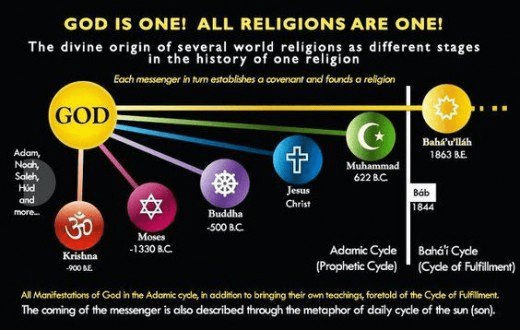
I find the Baha’i faith fascinating. It is the perfect religion for those who don’t want to judge or condemn any of the world’s main religions or the faith of anyone in those religions. Perfect for those who believe that there are “many roads to God”. The logic is that there are many roads leading into Huntsville, Al. Roads from the south, north, east, and west. But they all end up in the same place, Huntsville, right? Is that true of all the world’s religions even though they teach totally different doctrines on salvation and faith? Perfect for those who reject the exclusivity claims of Christianity. One Christian lady changed to Buddhism b/c she despised the Christian claim that Jesus was the only way for salvation. She did not examine the evidence or rationale behind that claim. She just didn’t like the idea of any religion claiming to be the only true religion.
Baha’ism honors 9 world religion founders: Abraham, Moses, Zoroaster, Krishna, Buddha, Jesus, Mohammed, the Bab, Bahaullah (the founder of Bahaism). According to Bahaism, each of these brought genuine revelations from God, but none of them brought all of God’s truth and none of them brought the one and only true religion. AI: “Baha’is believe there’s one God who reveals His will progressively through different divine messengers for different ages, bringing teachings suited for humanity’s spiritual development at that time. Each Manifestation fulfills the promises of the one before and announces the coming of the next, building upon past teachings. Baháʼís believe these past spiritual teachers brought divine guidance suited to their times, encouraging the study of other faiths to find shared truths and promote unity, while emphasizing the core spiritual principles remain constant across religions. Baha’i Faith teaches that all major religions come from the same God and contain fundamental truths, viewing them as progressive stages of one divine religion, with Baha’u’llah’s revelation being the latest for humanity’s current stage.”
Christians do believe in progressive revelation from God. Moses brought the Law and the old covenant for the Jews, but then Jesus came with the new covenant. Gentile Christians do not have to obey the animal sacrifices, etc. of the old covenant, so indeed the Mosaic law was only for a limited, specified time before Jesus came. Christianity claims to be the last of God’s progressive revelation. Hebrews 1:1 God, after He spoke long ago to the fathers in the prophets in many portions and in many ways, 2 in these last days has spoken to us in His Son.” Jesus in turn gave the Holy Spirit to his apostles to miraculously inspire them to deliver all the truth of the new covenant for all time. John 16:13 But when He, the Spirit of truth, comes, He will guide you into all the truth.” That completed God’s progressive revelation to man, once for all time. Jude 3 Beloved, while I was making every effort to write you about our common salvation, I felt the necessity to write to you appealing that you contend earnestly for the faith that was once for all time handed down to the saints.” According to the Bible, there would be no more progressive revelation after the apostles. Period. No more prophets delivering new revelations from God. That rules out the Popes whom Catholics claim to give continuous new revelations from God on doctrinal issues given through countless papal decrees or bulls. That rules out Islamic claim that Muhammed was God’s final prophet, some 600 years after Jesus, and that the Koran, not the Bible, is the last of God’s progressive revelation and that we should follow the Koran. Islam does believe that Moses and Jesus were prophets with progressive revelations from God but they reject Jesus’ claim that he was the Son of God and that the New Testament was the last of God’s progressive revelation. Islam would also reject all the other world religions like Buddhism, Hinduism, Zoroastrianism, and even Bahaism. It was a Persian Muslim group that excecuted the Bab in 1850. Judaism (except for Messianic Jews) reject that Jesus came as the Messiah with new revelations from God that they should start following. On and on we could go.
None of the other major world religions (Hinduism, Buddhism, Zoroastrianism) would claim progressive revelation of truth. Hinduism just has its gods and goddesses, reincarnation, karma, dharma, and epic tales. Buddhism has the teachings of the Buddha to give enlightenment and the release from suffering. Zoroaster started preaching one God, Ahura Mazda. We could add many other world religions that Bahaism doesn’t specifically name as one of the 9 major religions, such as Shintoism, Taoism, Confucianism, Sikhism, etc.
But the idea that all the world’s religions just gave revelations from God for their specific times and that they all somehow harmonize into one final revelation from God, uniting them all in Bahaism, is just contradictory. Muslims and Jews reject Christian claims. Shintoism follows the sun goddess Amaterasu and all the kami spirits. That contradicts the Muslim, Jewish, and Christian claim that there is only one true God, the God of the Bible (Yahweh to the Christians and Jews, Allah to the Muslims-though Allah is not the same as Yahweh). The Hindus have 3 main gods: Brahma, Vishnu, and Shiva. Do we need to honor those gods as part of progressive revelation or was that just a need for ancient times in India.
Those contradictions and questions don’t even include modern day prophets like Joseph Smith and Mormonism. Or Ellen G. White and 7th Day Adventists. Or Rutherford and Russell, the founding prophets of Jehovah’s Witnesses. Would the Baha’i faith say that those prophets of those groups were part of God’s progressive revelation and had truth from the one true God? How could Bahaists reject those latter day prophets?
But here’s “the catch” (a hidden problem or negative in an otherwise solution that sounds good on the surface but is “too good to be true”). Only one of those 9 world religions honored by Bahaism claims to be the only true way to God. John 14:6 Jesus *said to him, “I am the way, and the truth, and the life; no one comes to the Father except through Me.” So the Baha’is can’t include Jesus as one of the 9 world religions that each brought some truth from God but not the only truth. But then we have to ask, can Jesus’ claim of exclusivity be proven? The answer is “yes” There are many proofs to Jesus’ claim, but the main one is his resurrection from the dead. Paul preached on Mars Hill to those who worshipped many Roman gods. He told them that following Jesus was the only way to eternal life. He said that Jesus’ resurrection proved that. Acts 17:30 So having overlooked the times of ignorance, God is now proclaiming to mankind that all people everywhere are to repent, 31 because He has set a day on which He will judge the world in righteousness through a Man whom He has appointed, having furnished proof to all people by raising Him from the dead.” There are many convincing proofs that Jesus was raised from the dead. Jesus died and was raised from the dead. Name another world religion whose leader, prophet, and founder has such proof. In other words, Bahaism sounds “too good to be true” since it offers a belief that allows its followers to not condemn any of the world’s relgions. But the catch is that it, as well as any other of the world’s religions, have no proof that any of their revelations are really from the one true God. Only Christianity has such irrefutable proof.
Not only that, the real issue is this: only Christianity teaches that one is not saved by what he does. Most of those world religions teach that their followers should do good and be good persons. Buddhism has the Buddha’s 8 noble truths: right speech, right actions, etc. as well as not lying, stealing, or gossiping. Zoroaster taught his followers to do good works, good deeds, and good words. Confucius taught his followers to respect others. Taoism taught the 3 jewels: compassion, modesty, and humility. Sikhism taught followers to be kind, to live an honest life and work hard. Mormons are usually very moral people. But here’ the other catch. Being a good person as a follower of those religions doesn’t save you from your sins. Those religions might promise faithful followers a better reincarnation or inner peace or just a better way of living, but none of them offer the forgiveness of sins from the one true God, Yahweh. Only Christianity offers that. But how is Christianity different from those religions? Aren’t Christians also taught to be kind, honest, good words, good works, etc. Yes. Aren’t they taught to seek inner peace of mind? Yes. But in Christianity, we are not saved by our goodness or good works. We are saved 100% by the unearned grace of God through putting our faith and trust in Jesus as God’s sacrifice on the cross for our sins. We are not saved by what we do, but by what Jesus did for us on the cross. No other world religion has such a plan of salvation. That is what makes Christianity unique. Most any of the major world’s religions can help you be a better person, but only Christianity can saved you from your sins.
So Christianity has exclusive claims of being the only true faith, and has the proof to back up those claims So examine the proofs before you reject the exclusive claims of Christianity. Of course one must come to believe that Jesus did die and be raised in order to be saved. Here is the major difference in Islam and Christianity. Islam claims that Jesus was not the Son of God, but Jesus claims that he was. Islam claims that Jesus was not even crucified, certainly not raised from the dead. Islam claims that eternal rewards will be based on keeping the 5 pillars of Islam, a works system of salvation. Islam does not believe that one is saved from sin by faith in the vicarious offering of Jesus on the cross. Each person must decide to follow Jesus or Muhammed, and I respect that choice. But I wish all Muslims could see the grace of God that comes from putting faith in what Jesus did on the cross. All those in the other world religions must realize that their good works can’t save them. They must examine their religion to see if it is from God or man, to see if their religion has miraculous proof that it is truly a revelation from God that they can stake their eternal futures on. Many are dong that and finding salvation through Jesus. Christians should be utilitizing all our resources to spreading the gospel message to all the countries dominated by all those world religions. Getting the Bible to them in their own languages so they can examine the claims and proofs of Christianity. It’s too bad that churches are spending 80% of their collections on buildings, staff, etc. instead of spreading the gospel and supporting missionaries That’s another blog I guess.
 Nicky's Notes